Polar biologists found a species of moss during their search to the ice-covered continent in 2017. It took scientists five years to confirm that the species had been discovered for the first time.
The Indian biologists, from the Central University of Punjab, have named the specie Bryum Bharatiensis(Bharati which means learning) . This arduous process of identification involved the collection of samples, and then five years of sequencing DNA and comparing its forms with other plants.
Prof Felix Bast, one of the six-month-long expedition scientists to the continent discovered the dark green specie at Larsemann Hills, in January 2017, while inspecting the Southern Ocean, located near Bharati, one of the remotest research stations in the world.
“The big question was that how does moss survive in this landscape of rock and ice landscape,” Prof Bast said as per the fact that plants needs nitrogen, along with potassium, phosphorus, sunlight and water to survive. Which here works with the fact that only 1% of Antarctica is ice free.
Later, scientists figured out that this moss mainly grew in areas where penguins bred in large numbers. Penguin poop contains nitrogen. “Basically, the plants here survive on penguin poop. It helps that the manure doesn’t decompose in this climate,” said Prof Bast.
Now comes the sunlight. Scientists say they still fully don’t understand and is unsure with fact that how the plants survive under thick snow during the six winter months with no sunlight and temperatures dropping to as low as -76°C.
They claim that the moss “dries up to a dormant stage, almost to a seed” at this time, further they germinate again during summer in September when they start getting sunlight again. And then the dried up moss absorbs water from the melting snow.
Later after collecting the required samples, Indian scientists spent five years sequencing the plant DNA and comparing its form with other plants.
“Antarctica is getting greenified. Many temperate species of plants that previously could not survive in this frozen continent are now seen everywhere because of the warming up of the continent,” said Prof Bast.
The scientists were highly worried about the “alarming evidence” of climate change that they saw during the inspection. They say they came across melting glaciers, crevasse-infested ice sheets and glacial melt-water lakes on top of ice sheets.
Bharati is located between Thala Fjord and Quilty Bay, in Antarctica. The specie has been named after the Indian research station called Bharati.
“The finding that Antarctica was greenifying was disturbing,” said Prof Raghavendra Prasad Tiwari, a leading biologist and the vice chancellor of the Central University of Punjab.
This is the first time India has discovered a plant species in the four decades since it first set up a research station in the continent. A proud moment for Indians.
Agusto Boal was a Brazilian activist who brought revolutionary changes to theatre as an artform. In his work Theatre of the Oppressed, Boal extensively discusses about the theatrical form that he developed of the same name. He also explains the politics involved behind various dramatic techniques and criticisms from across the world like Aristotle, Hegel and Brecht. In the first chapter, Boal argues that the Greek tragedies, as defined by Aristotle, is actually a coercive system that enforces state ideologies onto the citizens.
Tragedy, then, is an imitation of an action that is serious, complete, and of a certain magnitude; in language embellished with each kind of artistic ornament, the several kinds being found in separate parts of the play; in the form of action, not of narrative; through pity and fear effecting the proper purgation of these emotions.
-Aristotle
According to Aristotle, Tragedy is an imitation of an action that, through its several characteristics, evokes catharsis or ‘proper purgation of soul’. Every tragedy has a tragic hero who is defined as “a man who is not eminently good and just, yet whose misfortune is brought about not by vice or depravity, but by some error or frailty”. This error in the hero is referred to as his tragic flaw or hamartia. The spectator establishes an empathic relationship with the protagonist and lives vicariously through him as he enjoys a state of happiness brought upon by the same hamartia. Then suddenly, the hero falls from happiness to misfortune. This is referred to as ‘peripeteia’. The spectator along with the hero suffers this but is unable to disassociate with the character due to ‘anagnorisis’, i.e, recognition of the flaw. Furthermore, the tragedy ends with a ‘catastrophe’ wherein, the hero suffers the consequences of his action through death or a fate worse than death.
Boal sums up this process in three stages. Stage 1, where the protagonist and the spectator take a path towards happiness which then moves towards misfortune. Stage 2, the character and the spectator realise their own hamartia which Boal refers to as an ‘anti-constitutional flaw’; where the state reinforces certain unsaid social set-ups. Stage 3, where after the horror of the catastrophe, the terrified spectator undergoes catharsis through which they are purified of their hamartia. As explained by Arnold Hauser, the tragedians were paid by the state to produce the plays and thus, they naturally denied any plays that went against the state. Through the tragedies, the spectator is emotionally manipulated into thinking that having this hamartia would lead to a terrible fate, thus maintaining the status-quo in the society. This can also be analysed with reference to Althuser’s Ideological State Apparatus. In this context, the values of the state are propagated through theatre which acts as an institution.
Tragedy effectively coerces people into believing that any desire to go against the state will prove disastrous. This reinforces Boal’s statement that, theatre is the most perfect artistic form of coercion. Though Aristotle claims that poetry, theatre and tragedy are not associated to politics, Boal points out that reality states otherwise. And so, it can be argued that artforms, including theatre or its modern variants such as television and film – are all political.
The line “all that glitters is not gold” occurs in William Shakespeare’s well-known play The Merchant of Venice”. It comes as a shock to Prince of Morocco when he, led by the exterior glitter of gold, chooses the gold casket and loses the lottery of caskets. The line has since then become a proverb. It means, in simple words, that appearances are deceptive. The seemingly beautiful and valuable object may turn out to be something most ugly and worthless.
Therefore, like all proverbs, ‘all that glitters is not gold contains the time-tested truth. It enjoins upon us to be cautious in our approach while judging the worth of a person or object. We should not be led by external appearance. A seemingly good apple may be rotten at the centre. A person may smile and smile, and yet prove to be a villain. An extremely beautiful face of a woman may hide her ugly, vicious character. A charming Cleopatra often proves to be a siren.
It is, of course, human to be attracted by good and beautiful persons and things. When a young man falls in love or goes to select a life partner, he is first tempted or repulsed by the outward appearance of the girl. If he does not pause and judge the real character of the girl, he is destined to rue and suffer for his choice throughout his life. So, it is equally true in the case of a girl in the choice of her would- be husband.
There is a beautiful story in the Bible which warns us against falling in to the seemingly attractive exterior. Eve gets attracted to the beautiful and yet forbidden fruit of knowledge (an apple). She fails to resist the temptation of tasting it. The moment she and Adam eat the forbidden fruit, they are thrown out of the Paradise forever. They bring upon them and their progeny (the whole mankind) endless sufferings in many forms.
In our modern world of glitter and glamour, there are many temptations around us. Most of us get attracted to glittering cars and bikes, gadgets and products of several kinds. Youngsters force their parents to buy them, which land their parents in vicious debt circles. The young men and women realise quite late how some of these attractive gadgets tell upon their health and ruin their careers.
Advertisements on the screen and in newspapers often coax people to buy things which are neither worth their money nor as useful as claimed. Most of us are misled by the utility of some products as they are advertised by some beautiful actresses, popular actors or other celebrities.
Menstruation is the actual time when women bleed. And the entire time between 2 menstruation is called Menstrual cycle.
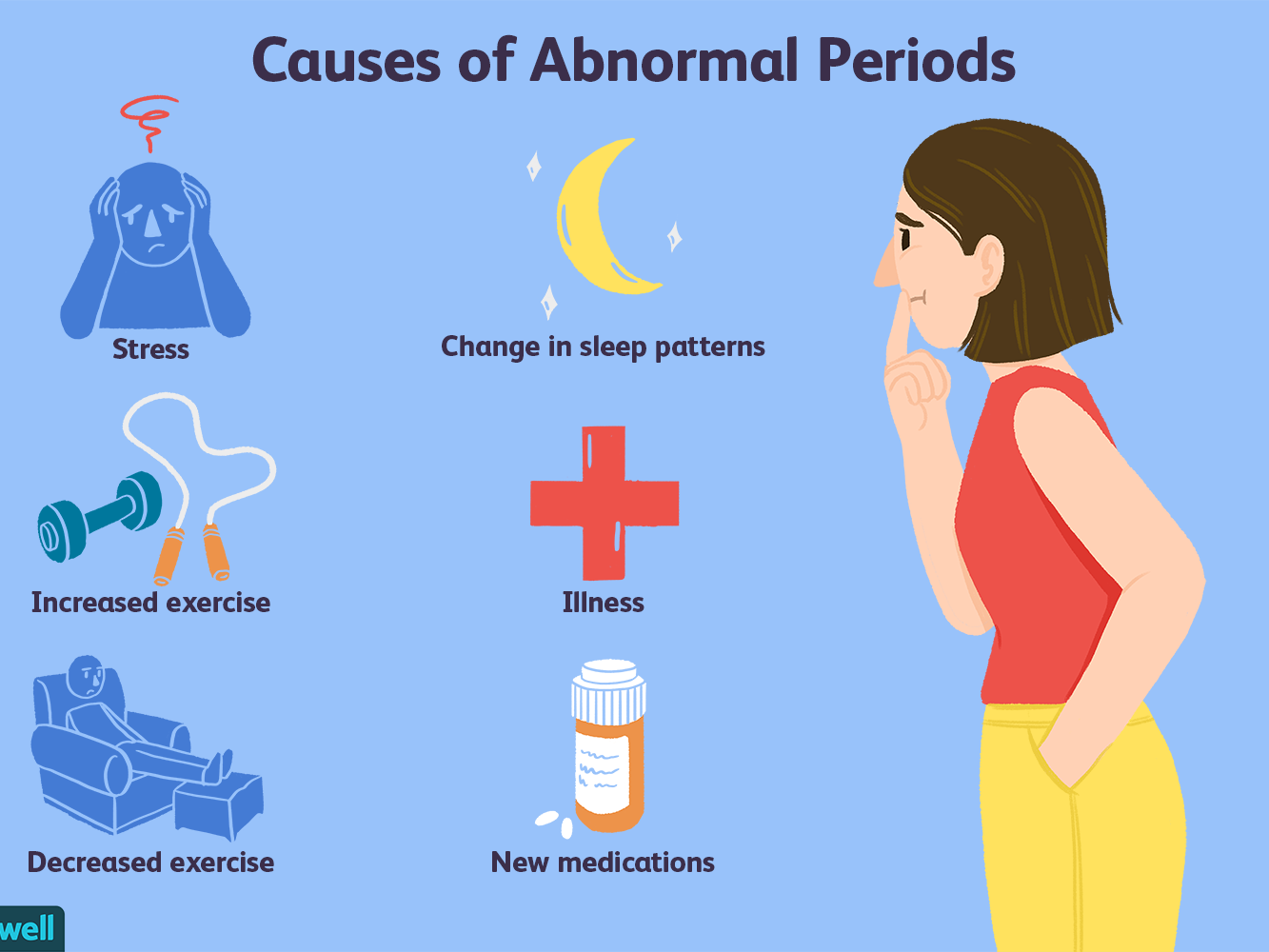
The excessive pain in menstruation is not normal and this condition is called Dysmenorrhea.
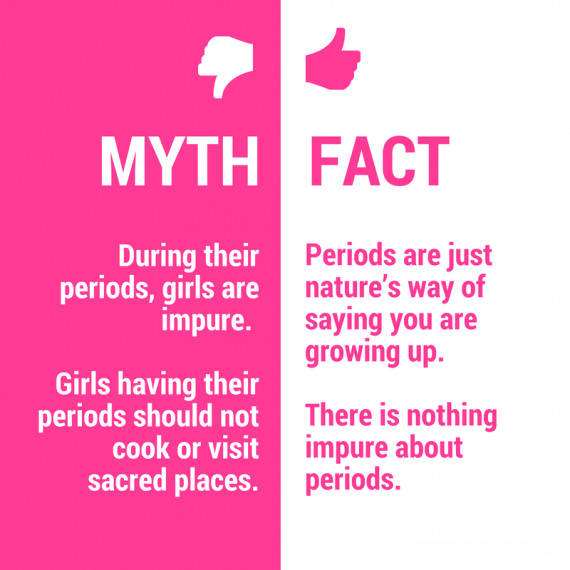
As everyone says period blood is dirty blood but in reality it is not the rejected blood of the body. It is less concentrated than normal blood and it has less blood cells.
“Smuggling pads to the bathroom like it’s some sort of illegal thing gotta be the worst adaptation to patriarchy”
Transgender men may still get their periods, just as transgender women might not have periods.
Girls miss their school 1-2 days every month and it affect their studies and education.
We bleed 5 days in a month and it really sucks…
I am a girl Yes, I am a girl And like every other girl, I also go through those painful days The day which comes and goes every month. When the day comes, I feel like I’m in hell I don’t have to touch stuff I am not allowed to go to bed I am not allowed to go to the place of worship. I am not allowed to say anything I am not allowed to cry because of this cycle I feel like thousands of hammers are breaking my bones. I go through all these things like – mood swings, cramps, frustration, anger, and much more. But I am not allowed to cry I am not allowed to cry even when I feel the worst. The reason behind this is that I am a girl I am a girl And I always taught to hide this I always have to do that I always have to be away from everyone I have to hide this just because I am a girl And I am on my periods
How it feels when I am on my periods and no one understands the pain I am going through…
Superstitions
INDIA
Yoan’t enter a kitchen or cook food for anyone else.
Can’t enter a place of worship.
only enter a place of prayer once we’ve washed our hair on or after the fourth day.
Must wash our hair on the first day of our period to clean ourself completely. Buttt on the contrary…
If we wash our hair, our flow will be less and it will affect our fertility later in life.
Italy
Can’t touch plants.
Everything we cook will be a disaster.
UK
Tampons will break our hymen and make us impure.
Can’t take a bath.
Bolivia
can’t cradle babies or we’ll cause them to get sick.
As we know it is just because improper balance of estrogen and progesterone leads to the breakdown of endometrium lining that ultimately causes Menstruation every month.
we were taught to hide this. Why, why do we have to hide this if it is natural.
This menstrual cycle is a natural thing and this is the reason why only women carry babies.But despite this, we all try to hide this.Everyone knows that this menstrual cycle always comes during it’s duration but everyone tries to hide it.When it is natural then why do we feel shame for this. Why??
This is a very simple title, yet a major loophole that our society is facing for many decades. This is not about giving rights to a specific gender but the suppressions which a language creates in the backdrop of society and makes it a center of concern. Never thought language can create such discrimination against two genders.
In colloquial context we see that every day we speak our language and communicate flawlessly yet we never recognized the ocean of problem which a language brings every day.
Profoundly, the title itself gives us the best example as to how we use the word “Manmade”, linguistically whenever a thing is made by a human it is denoted as manmade. But the question here arrives is that why don’t we spell it as human-made?
There are many endless words where the wordings are based on one gender-biased, for say: countrymen, mankind, etc and mostly these words denote men and women were often neglected or ignored since the formation of words.
“Language has always been a media through which many cultures and communities bounded and created a sense of harmony with each other”.
Whereas we can notice that Gender Discrimination has always been a core of fear since civilization. It has become one of the cliché topics when it comes to feminism and cause of this people are ignorant as they assume that the world is changed and there is no more discrimination in today’s society.
Taking back to the advent of the problem we can observe that many writers, critics have battled to always protect the women community as they are always considered the “weaker section of the society”. We can’t deny this fact but, inevitably, they are still subjected when it comes to literature and language.
How Women are Neglected by Language as Language reflects Patriarchal world:
She says, “Women can either read and choose to stay trapped in their bodies by a language that does not allow them to express themselves, or they can use the body as a way to communicate.”
– Helene Cixous (in; “The Laugh of Medusa” )
This very quote is taken from the famous article written by a critic, writer, and feminist; Helene Cixous who has explained how a woman had gone through repression in history and how literature and language had given an upper hand to the men in society to suppress women.
In “The Laugh of Medusa”, she explains how women should find their voice and the Language is the symbol of how a person portrays themselves. “Writing is for you, you are for you, your body’s yours, take it”. This line highlights that it’s high time that women should raise their head and minds and be themselves by being flawlessly independent and break the walls which portray women as fragile and frail.
The author claims that there is a very close relationship between women’s bodies and their writings and both have been repressed by men for centuries. Literature, in particular, explains to us how women as a writer were hard for the audience to accept them due to cultural prejudices laid against them since ages.
Writers like Virginia Woolf show us the patriarchal world through one of her works namely “Room of one’s own” through the lens of all the women present in the world and the problems they go through.
“A Woman must have money and a room of her own if she is to write fiction”. This quote is quite relatable for the women of contemporary society, but this was a major issue which women of the 18th and 19th centuries were facing, to be independent they always needed acceptance to flourish in their fields and for that, they always needed acceptance which was a great hurdle in their lives. For their personal growth, they were bounded to be under 4 walls and do all sorts of wifely duties which gave the society that women are doing dutiful jibs under their husbands present.
But unfortunately, those women were never accepted who was unique and out of the box because society was not people’s perspective, rather it was the male perspective.
Even in “Room of one’s own”, Woolf mentions Judith Shakespeare ( was considered as Shakespeare’s real sister), her character portrays us the devastation a woman goes through while struggling for getting justice.
It also portrays us that many decades of literature didn’t accept women’s works as they were not considered as talented and rather, they were judged based on patriarchal society.
Females were Disowned yet contributed best Literature:
As when we look into 18th century British literature, we can see that several female writers have given an immeasurable piece of works which is still remarkable to date.
It would be a disgrace if we forget to mention Jane Austen, the Bronte sisters, Virginia Woolf, who were the pillars of 18th-century literature. Whether it is a broody romantic novel of wuthering heights or it is jane Eyre, every writer has spilled their hearts and provided the real situation of women in the era.
Some great writers are unforgettable like J.K Rowling who made us believe in fantasy and made childhood more fascinating by giving us Harry Potter which always provides us nostalgia going back to those days.
Unfortunately, these writers have always struggled to prove their identity to the world, that these immense writers like J.K.Rowling, Emily Bronte, had to change their names to get worldwide recognition. Even in the postmodern age, the situation didn’t change and the process of women hiding their originality, their names was like a custom they followed for ages.
But these female writers never let their readers down and always provided the best piece of art even having so many hurdles in their life.
It’s a long way to go, but still, the situation is better as women are gaining recognition and fame in society, the world, and literature through their masterpieces of works.
If you believe that if I say Tamil people developed Nanotechnology 2600 years ago. Yes, it is true. Researches say that the pots which the tamil people used then, was coated using Nanotechnology. This blog is going to be about the carbon nanostructures that were found in Keezhadi. Scientists found the 2600 years old earthenwares in Keezhadi coated with carbon nanotubes. Carbon nanotubes have high thermal and electrical conductivity and very high mechanical strength and also very light in weight.
Many may have heard about Keezhadi, the archeological site which portrays the rich civilization of Tamil people in the sixth century BC. Many steps of excavation was made in Keezhadi. Huge remains of pottery were found. When scientists experimented on the pot remains, they found a unique black coating over it. They also discovered that Carbon Nanotubes were in the black coating. These were the oldest known nanostructures on the Earth right now.
In the modern era, Carbon Nanotubes was developed in 1991 which is called CNT. From 1991 to 2006, in America, more than 4500 applications for getting patent rights for Nanotubes have been submitted. This data is from a Scientific paper.
A graphite consists of layers of Graphene laid one over the other. If a single layer Graphene is taken and folded cylindrically/ round, then it is called Carbon Nanotubes. These Carbon Nanotubes and Graphene comes under SP2 bond type. Diamond cones under SP3 bond type. So Carbon Nanotubes and Graphene are tougher than diamonds. So Carbon Nanotubes and Graphene are called as “Wonder Material” by the scientists. Nanotube is used in the Bullet proof vests.
How many types does the Carbon Nanotubes consist of? Carbon Nanotube has three typpes – Armchair CNT, Zigzag CNT and Choral CNT. The direction in which they are shaped will determine the type. After they have completed a Nanotube it is called Single-Walled Carbon Nanotubes (SWCNT). If there are layers of these, then it is called Multi-Walled Carbon Nanotube (MWCNT).
Can these SWCNT or MWCNT created naturally?
There are scientific papers released in 2008 and 2017. In any of those, there is no proof that they occured naturally. So according to science, the possibility for Nanotubes to occur naturally is very low. So one should have helped the process in the ancient era. An external force in specific level is required for its formation. A paper in 2008 says that from 2020 to 2025, the carbon nanotubes would be a billion dollars business. Such a precious material is found in Keezhadi now. But no one is ready to talk about it. But we should know about our history.
Gravity is science. But it existed for billions of years. When a person named it as “Gravity” it was changed into a Scientific term but still it is a Natural Occurance. That is the Reality. The Tamils in Ancient times were dependent on nature. Their way of using Nature to their will was unique. They thought about how to use it to improve their lifestyle. The Tamils were one step ahead of research. So the Tamils in the ancient times knew that Carbon Nanotubes and Graphene were the toughest materials which were very high electrical and heat conductors. Take only the toughness property. So Tamil people who lived 2600 years ago, needed the toughest material available on Earth. Tamils had metals. But they had clay in large quantities. The Tamils wanted to toughen up the clay. So they built aypots but it broke soon. So they discovered that to toughen up the claypots, they should heat them. These heated pots were not so tough. Now they wanted a coating to be done upon the pots. So through trial and error method they did a coating in the claypots. They would have spent many years to complete the research. After many trials with many materials which resulted in failures, the Tamils would have developed the carbon nanotubes.
How many degrees Celsius was required?
Nearly 1100° to 1400° Celsius. In these extreme conditions only, they could have created the Carbon Nanotubes. The Scientists of today say that the materials used for coating may be Carbon rich materials. So when we say Carbon rich materials, it could be Vegetable oil or any other material. When it is combined with the claypots under extreme heat, the carbon nanotubes may be created. The claypots would consist of Iron content. So iron and carbon together may produced Carbon Nanotubes, a material which is 200 times tougher than steel. So through this method, the ancient Tamils would have created Carbon Coated claypots which lasted for many years. Due to the toughness of carbon nanotube, the claypots has been discovered as Archaeological remains in Keezhadi.
It takes no compromise to give people their rights ... it takes no money to respect the individual. It takes no political deal to give people freedom. It takes no survey to remove repression.
Pride is the stand for dignity, equality and justice for the people who are in relationship or prefer same gender .
Pride has lent its name to LGBT-themed organizations, institutes, foundations, book titles, periodicals, a cable TV station, and the Pride Library.
Pride Month
THE HISTORY OF PRIDE MONTH
During the time of 1950s and 60s the LGBTQ community in United State of America . The initiative to Fight against the odds was taken by two homophile organizations Daughter of Bilitis and Mattachine Society. These two pioneered in carrying out pickets called AnnualReminders. These two organization woke up people to inform and reminded that LGBTQ community didn’t receive civil rights protection.
Gay Is Good The anti-LGBT discourse of these times equated both male and female homosexuality with mental illness. Inspired by Carmichael’s “Black is Beautiful“, gay civil rights pioneer and participant in the Annual Reminders “Gay is Good” a slogan Originated by Frank Kameny in 1968 to counter social stigma and personal feelings of guilt and shame.
CRITICISM FACED BY LGBTQ COMMUNITY.
The criticism faced by the community outside And inside is against the movement of Pride Events. In Many countries the initiative to promote LGBTQ community was taken by the Government officials. Brazil In August 2011, Carlos Apolinário the Aldernman of Sao Paulo City the right-wing Democrats Party sponsored a bill to organize and sponsor “Heterosexual Pride Day” on the third Sunday of December. Apolinário, an Evangelical Protestant, stated that the intent of the parade was a “struggle … against excesses and privileges“. Members of Grupo Gay da Bahia and the Workers’ Party opposed the bill as enhancing “the possibility of discrimination and prejudice”. The bill was nevertheless passed by the city council, but never received the signature of mayor . Turkey. In 2015 police dispersed the LGBT Pride Parade using tear gas and rubber bullets.
In 2016 and 2017, the Istanbul Governor’s Office did not allow the LGBT Pride Parade to take place, citing security concerns and public order.
The Pride March
CONCLUSION.
• people are marginalized and suffer a lot for their human rights. •Their are several Anti-Gay bills passed by some States and some states fought against the odds and help the LGBTQ community to attain their human rights.The issues, challenges and the opportunity experienced by this group in the labor force will draw the attention towards the issues.
India’s Independence Day reminds the country’s citizens of all the sacrifices the freedom fighters have made to secure the country’s future. Since its independence, India has made stellar progress in every field, including education, military and space programmes.
History of Our Independence Day
For almost two centuries the Britishers ruled over us. And the citizen of the country suffered a lot due to these oppressors. British officials treat us like slaves until we manage to fight back against them.
We struggled for our independence but work tirelessly and selflessly under the guidance of our leaders Jawahar Lal Nehru, Subhash Chandra Bose, Mahatma Gandhi, Chandra Shekhar Azad, and Bhagat Singh. Some of these leaders choose the path of violence while some choose non-violence. But the ultimate aim of these was to drive out the Britishers from the country. And on 15th August 1947, the long-awaited dream come true.
Why We Celebrate Independence Day?
To relive the moment and to enjoy the spirit of freedom and independence we celebrate Independence Day. Another reason is to remember the sacrifices and lives we have lost in this struggle. Besides, we celebrated it to remind us that this freedom that we enjoy is earned the hard way.
Apart from that, the celebration wakes up the patriot inside us. Along with celebration, the young generation is acquainted with the struggles of the people who lived at that time.
Activities on Independence Day
Although it’s a national holiday the people of the country celebrate it with great enthusiasm. Schools, offices, societies, and colleges celebrate this day by organizing various small and big events.
Every year at Red Fort the Prime Minister of India host the national flag. In the honor of the occasion, 21 gunshots are fired. This is the begging of the main event. This event is later on followed by an army parade.
The school and colleges organize cultural events, fancy dress competitions, speech, debate, and quiz competition.
Importance of Independence Day
Every Indian holds a different viewpoint about Indian Independence. For some, it’s a reminder of the long struggle while for youngsters it stands for the glory and honor of the country. Above all, we can see the feeling of patriotism across the country.
The Indian’s celebrate Independence Day with a feeling of nationalism and patriotism across the country. On this day every citizen echoes with festive feeling and pride in the diversity and unity of the people. It’s not only a celebration of Independence but also of the unity in diversity of the country.
After it’s first launch , thousands of programmers and users got attracted towards LINUX . Today we can say that Linux is the first choice of millions of people all over the globe . It is different from other operating systems as it comes with a host of positive developments . This is because of what LINUX offers to users and programmers , such as scalability , security , consistency , user friendliness , freedom and non pirated enterprise software . Many of the advantages of Linux are an aftermath of its origins , deeply rooted in UNIX .
Linux is Free : Linux is a freely distributable operating system . The first thought that comes to mind is what does free means . When we say Linux is free that does not mean it is always free of cost . Here , free implies the freedom to work . You can download the Linux for free from Internet , without registration and without going into per user per year kind of licensing . You are free to use , free to customize , free to modify , free to distribute and also free to brand your modified variant . Modification is possible because its source code is freely available . This makes the Linux free . It has already been explained that no licensing is required for Linux . Again , this does not mean that there is no license . Like any other software Linux also has a license . Linux comes with GNU Public License (GPL) . The license states that anybody who may want to use and apply Linux can do so . Anybody has the right to change Linux and eventually redistribute a changed version , on the condition that he makes available the code after redistribution . In other words we can say that you are always free to grab a kernel image , for any of your functionality as long as your client can still have a copy of that code .
Linux is Hardware Independent : Linux is compatible with nearly all available hardware . As mentioned in the previous section , its source code is freely downloadable and that also comes with the GPL license , you are free to follow the documentation available and customize so as to work with your unsupported hardware . This makes the Linux hardware independent .
Linux is Secure : Linux has proven , beyond doubt , the sound security level it offers . This security aspect is the key feature of Linux and its security model is entirely based on UNIX , which we all know is very robust and of proven quality . In Linux , security is not only restricted to the security from internet threats but it is also very much secure from other system related breaches or malpractices . Linux offers security at all levels , such as User level , Application level , System level , Device level , Inner threats , External threats .
Linux is Scalable : When Linux was in the gestation process , its creators wanted to make an operating system that was extensively suitable for any application , any hardware , and any process . They wanted it to work with computers with high power and capacities like of super computers , mainframes , and with computer for personal use like PCs , laptops and even with computers of limited resources like Palmtop , PDAs , etc., so that Linux fits everywhere .
Hello guys!Today I am going to tell you guys about some of the places to visit in ICELAND.
1) Reynisfjara is a world-famous black-sand beach found on the South Coast of Iceland, just beside the small fishing village of Vík í Mýrdal.
From : TripAdvisor
2) Skaftafell is a nature reserve located in Vatnajökull National Park in the South East of Iceland. It is an oasis of this nation’s diverse landscapes and features, so beautiful it was once a national park in its own right.
From:enchanting travels.com
From:evaneos
3) Mývatn is the shallow lake which is also dotted with volcanic islands and is surrounded by numerous craters, hot springs, and a variety of lava formations
From:momentsthrolens
4) Seljalandsfoss waterfall -The waterfall is located between Skógafoss and Selfoss on the Ring Road of Iceland. It drops dramatically from a cliff that is over 60 m high. It is one of the few waterfalls in the world where it is possible to walk behind the fall and observe the water falling off the cliff in front of your eyes.
From:Times of India
From:twistedsifter.com
5) Jökulsárlón Ice lagoon -In Southeast Iceland, you’ll find a glacier lagoon filled with icebergs. This ice lagoon has become one of Iceland’s most popular attractions due to its stunning beauty. The lagoon is called , or ‘Glacier’s-River-Lagoon.’
From:Jeff kang
From:SureshGv
The above mentioned are some of the places that you can visit in ICELAND.
We have started our view on Area-51 in the previous blog. This blog is a continuation of that.
Many people were curious to know what was inside Area-51. But the government didn’t let any information go out. At that time, an American conspiracy theorist named ‘Bob Lazer’ claimed that he had worked inside Area-51 and also told that inside Area-51, the traped Aliens that came to Earth and were doing research on them. Many believed him, many did not. But his claim is that they were doing reverse engineering on alien technologies. He said that the alien bodies, their tools and the spacecraft of aliens were taken into control by the USA government and research works on those items was going underground. Many questioned whether he is a credible person. Many believed him. He claims that he studied in MIT. But there was no evidence or certificate that proves that he studied in MIT. He said that the USA government deleted all his records and tried to portray him as a lier and looser. He was strong on his claim that there were aliens inside Area-51. Like his say, some random incidents happen at times to make people think that there are aliens inside Area-51.
In 2019, a 21- year old guy named Matty Roberts, who calls himself a gamer, has watched a documentary in which Bob Lazer spoke and he came to an idea to organise an event in Facebook. The event was planned such that on September 20, 2019, a big mass of people should run towards Area-51. If they run in masses, no one could stop them. That was his plan. As a shock to him, that plan went viral. It reached people worldwide. 20 lakh people from many corners of the world supported him and said that they would come for this event.
The American government warned them when that event plan went viral. They said the army would shoot every person whoever comes to that event. The government had shut the air strips that were near to Area-51 and maintained a high security.
In a small town called ‘Rachel’ in that desert, around 150 people were living. That town was near to Area-51. When the people of the town knew that lakhs of people were planning to go there on September 20, they arranged all the facilities for the people coming. They planned to make a small business out of this event. But what happened was something disappointing to them. Out of the 20 lakh people who supported the event and told that they would come there, only 500 went there. Many went from foreign and European countries. They had to get immigration pass, land on a distant airport and take many kilometres of car travel and walk through the desert to get near to the gates of Area-51. Out of them, only 45 reached the Area-51. But they too came back on seeing the cops with gun. They also had permission even to kill people trying to entry Area-51. At last, the event was a failure. That made people to realise that everything in the internet is not always serious.
The Area-51 story still remains a mystery. Still there are people saying that it is an army base of the USA, some saying that nothing is there and the government tries to fool other nations by hiding something that is not real. But still the story continues. The government didn’t reveal anything to the people.
On July 11, Virgin Galactic will make a giant leap toward commercial suborbital spaceflight. The company will launch its first fully crewed flight of its SpaceShipTwo space plane Unity with a special passenger on board: the company’s billionaire founder Richard Branson.
Branson, three crewmates and two pilots will launch on the historic flight after being carried into launch position by Virgin Galactic’s carrier plane VMS Eve. They will take off from the company’s homeport of Spaceport America in New Mexico, with a live webcast chronicling the flight. Here’s everything you need to know about the mission, which Virgin Galactic has dubbed Unity 22.
WHAT TIME IS VIRGIN’S GALACTIC LAUNCH & AND CAN I WATCH?
Virgin Galactic has not released a specific time for the actual Unity 22 launch, but the company has announced it will begin webcasting the mission at 9 a.m. EDT (1300 GMT). And it looks like it’s going to be fun. The crew will walk out to the ship about an hour earlier.
Stephen Colbert, host of The Late Show on CBS, will host the webcast along with singer Khalid (who will debut a new single during the launch), former Canadian Space Agency astronaut Chris Hadfield and future Virgin Galactic astronaut Kellie Gerardi, who will launch on a research flight in 2022.
The webcast will begin with the Unity spacecraft and its carrier plane taking off from its runway at Spaceport America, which is located 55 miles (88 kilometers) north of Las Cruces, New Mexico.
Branson has stated that the entire flight will take about 90 minutes, including the ascent up to launch position, release, flight to space and glide back to Earth for a runway landing at Spaceport America.
Virgin Galactic will launch six people on the Unity 22 flight, although the spacecraft is designed to carry up to eight people (two pilots and six passengers).
Unity 22’s crew includes four mission specialists:
Sirisha Bandla, Vice President of Government Affairs and Research Operations at Virgin Galactic. She will evaluate the human-tended research experience via an experiment from the University of Florida that requires several handheld fixation tubes to be activated at various points in the flight profile.
Colin Bennett, Lead Operations Engineer at Virgin Galactic. He will evaluate cabin equipment, procedures and the experience during the boost phase and weightless environment inside Unity.
Sir Richard Branson, founder of Virgin Galactic. Branson will evaluate the private astronaut experience. He will receive the same training, preparation and flight as Virgin Galactic’s future ticket-buying astronauts and use the flight to fine ways to enhance the experience for customers.
Beth Moses, Chief Astronaut Instructor at Virgin Galactic. She will serve as cabin lead and test director in space. Her tasks include overseeing the safe execution of the test flight objectives. Moses has launched on Unity before.
Two veteran Virgin Galactic pilots will be at the helm of Unity during the launch. They have both launched to space on Unity before and are:
Dave Mackay: Mackay is Virgin Galactic’s chief pilot and grew up in the highlands of Scotland. He is a former Royal Air Force pilot and flew for Branson’s airline company Virgin Atlantic before joining Virgin Galactic.
Michael Masucci: Michael “Sooch” Masucci is a retired U.S. Air Force colonel who joined Virgin Galactic in 2013 who racked up over 9,000 flying hours in 70 different types of airplanes and gliders during more than 30 years of civilian and military flight.
Two other pilots will fly the VMS EVE carrier plane that will carry SpaceShipTwo into launch altitude. They are:
Frederick “CJ” Sturckow: A former NASA space shuttle commander who joined Virgin Galactic in 2013 with Masucci. A retired Marine Corps colonel, he was the first NASA astronaut to join the company and flew four space shuttle missions.
Kelly Latimer: Latimer is a test pilot and retired lieutenant colonel in the U.S. Air Force who joined Virgin Galactic’s pilot corps in 2015. She was the first female research test pilot to join what is now NASA’s Armstrong Flight Research Centre.
The primary objective for Unity 22 is to serve as a test flight for future passenger flights by Virgin Galactic. As its number suggests, this will be the 22nd flight of Unity, but only its fourth launch to space.
The four mission specialists will each evaluate different experiences that Virgin Galactic has promised its future customers, many of whom have already reserved trips to space with the company at $250,000 a seat.
Bandla, for example, will test the experience of performing experiments aboard Unity during different phases of the flight, including the weightless period. Branson will take note of the flight as a paying passenger to look for ways to enhance the trip for ticket holders looking for the experience of a lifetime.
Moses is Virgin Galactic’s Chief Astronaut Trainer and will ensure everyone is safe in their tests while Bennet will examine Unity’s cabin performance to look for potential enhancements.
This mission is a critical flight or Virgin Galactic, which Branson founded in 2004. VSS Unity is the company’s second SpaceShipTwo after the first, VSS Enterprise, broke apart during a 2014 test flight, killing one pilot and seriously injuring another. Virgin Galactic has made numerous safety upgrades to prevent such an accident from happening again.
The mission will begin with takeoff from Spaceport America, where Virgin Galactic has built its “Gateway to Space” terminal to serve its future customers. The crews of Unity and Eve will walk out to their vehicles at about 8 a.m. EDT (6 a.m. local time, 1200 GMT). They’ll be wearing custom Under Armour flight suits made for Virgin Galactic.
After takeoff, the carrier plane VMS EVE will haul the SpaceShipTwo VSS Unity (short for Virgin Space Ship) to an altitude of about 50,000 feet (15,000 meters), when it will drop the the spacecraft.
Virgin Galactic’s first test passenger Beth Moses looks out the window of the VSS Unity during a test flight with pilots Dave Mackay and Michael “Sooch” Masucci, on Feb. 22, 2018. (Image credit: Virgin Galactic)
After separation, Unity will ignite its hybrid rocket motor, which uses a mixture of solid and liquid propellant, to begin the boost phase. This will carry Unity to its target altitude above 50 miles (80 kilometers), where the pilots and crew can expect up to 4 minutes of weightlessness. They will exist their seats and enjoy sweeping views of the Earth below through the many round windows that dot the space plane’s fuselage.
After that short encounter with weightlessness, the crew will climb back into their seats as Unity prepares to return to Earth. Pilots Mackay and Masucci will have “feathered” the spacectraft’s twin tail booms to provide stability during atmospheric reentry.
The feathered tail will then be locked back into place for the glide back to Earth, which will end with a runway landing at Spaceport America. The entire flight, from takeoff to landing, should last about 90 minutes, Branson has said.
WILL VIRGIN GALACTIC REALLY REACH SPACE WITH UNITY 22?
Virgin Galactic’s VSS Unity spaceliner captured this view of Earth during the vehicle’s first trip to space, on Dec. 13, 2018. (Image credit: Virgin Galactic)
Virgin Galactic will launch Unity to an altitude above 50 miles (80 km), which NASA, the Federal Aviation Administration and the U.S. military classify as space. They will earn astronaut wings for reaching that height.
Another widely recognized boundary of space, the Kármán line, is at an altitude at 62 miles (100 km) above Earth. The SpaceShipTwo VSS Unity won’t reach this milestone, which has led Virgin Galactic’s competitor Blue Origin (which does fly higher than 62 miles) to call out Virgin Galactic for missing that mark.
WHERE DOES VIRGIN GALACTIC LAUNCH SPACESHIPTWO FROM?
Click here for more Space.com videos…Sorry, the video player failed to load.(Error Code: 101102)Advertisementhttps://e42edf55977935dba9fbedb9fb4dde49.safeframe.googlesyndication.com/safeframe/1-0-38/html/container.html
Virgin Galactic initially launched SpaceShipTwo test flights from the company’s facilities at Mojave Air and Space Port in California. However, in 2020 the company moved Unity and its carrier craft to its permanent home at Spaceport America, where it plans to fly regular passenger flights beginning in 2022.
Spaceport America is located near Las Cruces, New Mexico and is home to Virgin Galactic’s “Gateway to Space” terminal, a welcome center and waiting room for ticketed passengers preparing for trips to space. It also sports a large hangar designed to fit multiple SpaceShipTwo spaceplanes and the VMS Eve. Virgin Galactic has also built a new vehicle, the SpaceShip III VSS Imagine.
WHEN COULD I LAUNCH TO SPACE WITH VIRGIN GALACTIC?
If you booked a trip with Virgin Galactic early and have one of the first reservations, you may get your chance to fly in space as early as 2022. If not, there’s a long wait ahead. And that’s assuming you can afford the $250,000 ticket price.
Virgin Galactic has said it plans to begin passenger launches in 2022 after a series of final test flights in 2021. The company does have hundreds of reservations for customer flights in backlog from eager would-be astronauts that have been waiting for over 17 years (since Richard Branson first announced Virgin Galactic in 2004) for the SpaceShipTwo to finally fly. The company paused taking new reservations after the 2014 accident.
Virgin Galactic is expected to resume taking reservations for “a limited number of tickets for future spaceflights” sometime this year, according to its website.
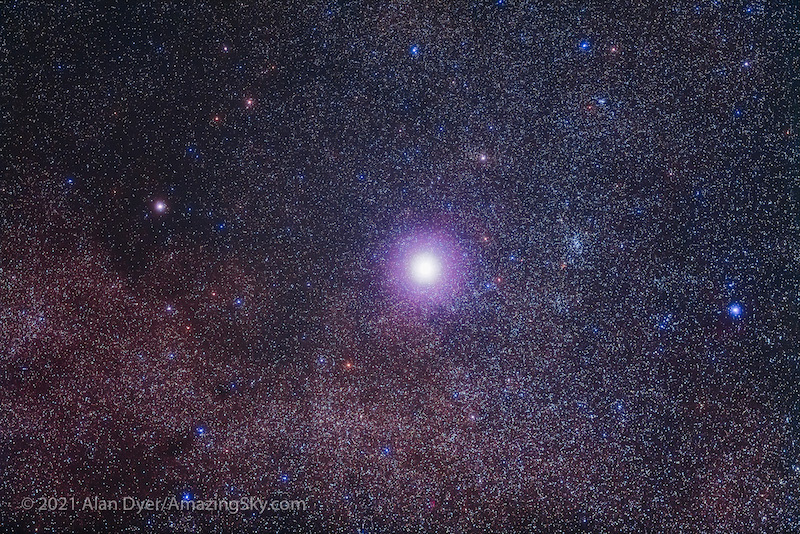
Alpha Centauri is the third-brightest star in our night sky – a famous southern star – and the nearest star system to our sun. Through a small telescope, the single star we see as Alpha Centauri resolves into a double star. This pair is just 4.37 light-years away from us. In orbit around them is Proxima Centauri, too faint to be visible to the unaided eye. At a distance of 4.25 light years, Proxima is the closest-known star to our solar system. Science of the Alpha Centauri system. The two stars that make up Alpha Centauri, Rigil Kentaurus and Toliman, are quite similar to our sun. Rigil Kentaurus, also known as Alpha Centauri A, is a yellowish star, slightly more massive than the sun and about 1.5 times brighter. Toliman, or Alpha Centauri B, has an orangish hue; it’s a bit less massive and half as bright as the sun. Studies of their mass and spectroscopic features indicate that both these stars are about 5 to 6 billion years old, slightly older than our sun.
Alpha Centauri A and B are gravitationally bound together, orbiting about a common center of mass every 79.9 years at a relatively close proximity, between 40 to 47 astronomical units (that is, 40 to 47 times the distance between the Earth and our sun).Must Watch Sky Events in 2021
In comparison, Proxima Centauri is a bit of an outlier. This dim reddish star, weighing in at just 12 percent of the sun’s mass, is currently about 13,000 astronomical units from Alpha Centauri A and B. Recent analysis of ground- and space-based data, published in 2017, has shown that Proxima is gravitationally bound to its bright companions, with a 550,000-year-long orbital period.
Proxima Centauri belongs to a class of low mass stars with cooler surface temperatures, known as red dwarfs. It’s also what’s know as a flare star, where it randomly displays sudden bursts of brightness due to strong magnetic activity.
In the past decade, astronomers have been searching for planets around the Alpha Centauri stars; they are, after all, the closest stars to us so the odds of detecting planets, if any existed, would be higher. So far, two planets have been found orbiting Proxima Centauri, one in 2016 and another in 2019. A paper published in February 2021 reported tantalizing evidence of a Neptune-sized planet around Alpha Centauri A, but so far, it has not been definitively confirmed.
How to see Alpha Centauri. Unluckily for many of us in the Northern Hemisphere, Alpha Centauri is located too far to the south on the sky’s dome. Most North Americans never see it; the cut-off latitude is about 29° north, and anyone north of that is out of luck. In the U.S. that latitudinal line passes near Houston and Orlando, but even from the Florida Keys, the star never rises more than a few degrees above the southern horizon. Things are a little better in Hawaii and Puerto Rico, where it can get 10° or 11° high.
But for observers located far enough south in the Northern Hemisphere, Alpha Centauri may be visible at roughly 1 a.m. (local daylight saving time) in early May. That is when the star is highest above the southern horizon. By early July, it reaches its highest point to the south at nightfall. Even so, from these vantage points, there are no good pointer stars to Alpha Centauri. For those south of 29° N. latitude, when the bright star Arcturus is high overhead, look to the extreme south for a glimpse of Alpha Centauri.
The southern constellation Centaurus. Image via Wikimedia/ International Astronomical Union/ SkyandTelescope.com.
Observers in the tropical and subtropical regions of the Northern Hemisphere can find Alpha Centauri by first identifying the distinctive Southern Cross. A short line drawn through the crossbar (Delta and Beta Crucis) eastward first comes to Hadar (Beta Centauri), then Alpha Centauri. Meanwhile, in Australia and much of the Southern Hemisphere, Alpha Centauri is circumpolar, meaning that it never sets.
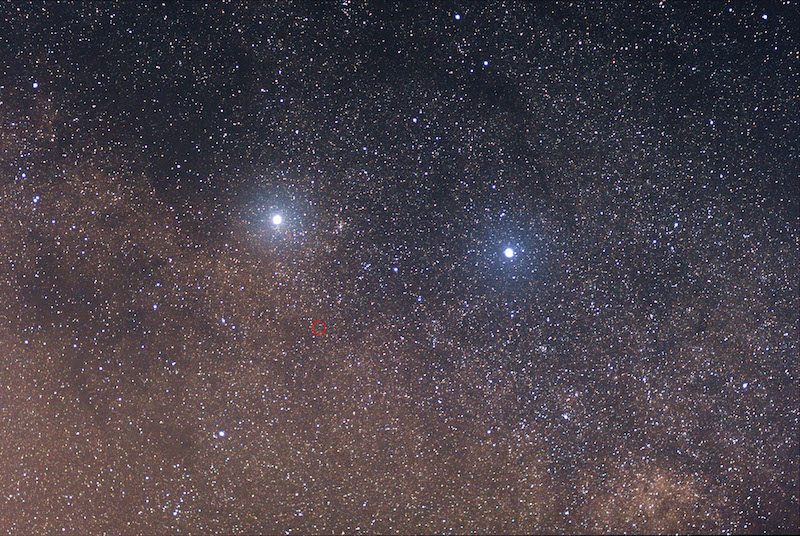
In this image taken at the European Southern Observatory’s La Silla Observatory in Chile, the Southern Cross is clearly visible, with the yellowish star, closest to the dome, marking the top of the cross. Drawing a line downward through the crossbar stars takes you to the bluish star, Beta Centauri, and then to the yellowish Alpha Centauri. Image via ESO / Wikimedia Commons.
Alpha Centauri in mythology. Alpha Centauri has played a prominent role in the mythology of cultures across the Southern Hemisphere. For the Ngarrindjeri indigenous people of South Australia, Alpha and Beta Centauri were two sharks pursuing a sting ray represented by stars of the Southern Cross. Some Australian aboriginal cultures also associated stars with family relationships and marriage traditions; for instance, two stars of the Southern Cross were through to be the parents of Alpha Centauri.
Astronomy and navigation were deeply intertwined in the lives of ancient seafaring Polynesians as they sailed between islands in the vast expanse of the South Pacific. These ancient mariners navigated using the stars, with cues from nature such as bird movements, waves, and wind direction. Alpha Centauri and nearby Beta Centauri, known as Kamailehope and Kamailemua, respectively, were important signposts used for orientation in the open ocean.
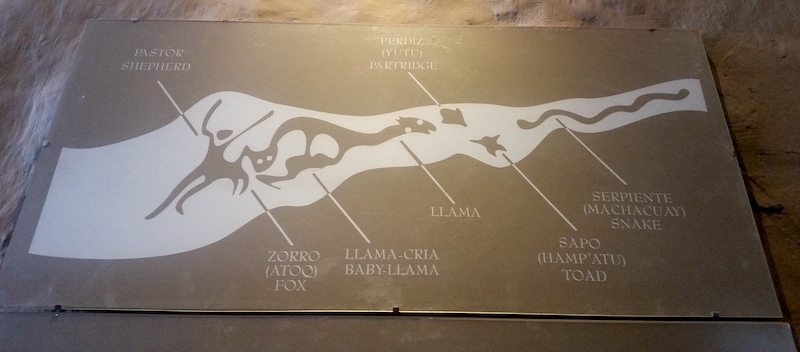
For ancient Incas, a llama graced the sky, traced out by stars and dark dust lanes in the Milky Way from Scorpius to the Southern Cross, with Alpha Centauri and Beta Centauri representing its eyes.
A plaque at the Coricancha museum showing Inca constellations. Coricancha, located in Cusco, Peru, was perhaps the most important temple of the Inca empire. Image via Pi3.124 / Wikimedia Commons.
Ancient Egyptians revered Alpha Centauri, and may have built temples aligned to its rising point. In southern China, it was part of a star group known as the South Gate.
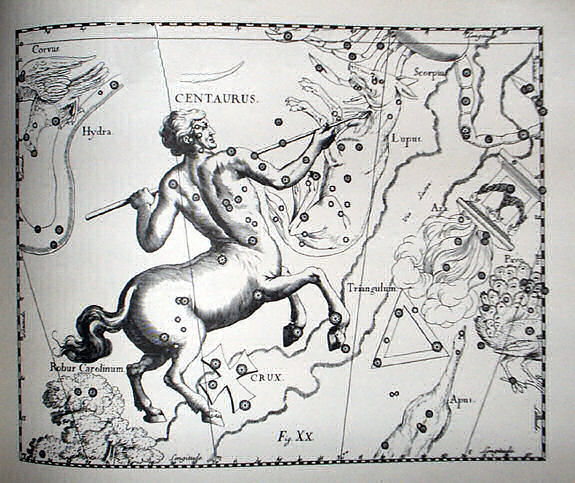
Alpha Centauri is the brightest star in the constellation Centaurus, named after the mythical half human, half horse creature. It was thought to represent an uncharacteristically wise centaur that figured in the mythology of Heracles and Jason. The centaur was accidentally wounded by Heracles, and placed into the sky after death by Zeus. Alpha Centauri marked the right front hoof of the centaur, although little is known of its mythological significance, if any.
A depiction of the Centaur by Polish astronomer Johannes Hevelius in his atlas of constellations, Firmamentum Sobiescianum, sive Uranographia. Image via Wikimedia Commons.
Alpha Centauri’s position is RA: 14h 39m 36s, Dec: -60° 50′ 02″
Bottom line: Alpha Centauri is actually two binary stars that are quite similar to our sun. A third star that’s gravitationally bound to them is Proxima Centauri, the closest star to our sun.
NASA’s Kepler mission has confirmed the first near-Earth-size planet in the “habitable zone” around a sun-like star. This discovery and the introduction of 11 other new small habitable zone candidate planets mark another milestone in the journey to finding another “Earth.”
The newly discovered Kepler-452b is the smallest planet to date discovered orbiting in the habitable zone — the area around a star where liquid water could pool on the surface of an orbiting planet — of a G2-type star, like our sun. The confirmation of Kepler-452b brings the total number of confirmed planets to 1,030.
“On the 20th anniversary year of the discovery that proved other suns host planets, the Kepler exoplanet explorer has discovered a planet and star which most closely resemble the Earth and our Sun,” said John Grunsfeld, associate administrator of NASA’s Science Mission Directorate at the agency’s headquarters in Washington. “This exciting result brings us one step closer to finding an Earth 2.0.”
Kepler-452b is 60 percent larger in diameter than Earth and is considered a super-Earth-size planet. While its mass and composition are not yet determined, previous research suggests that planets the size of Kepler-452b have a good chance of being rocky.
Highlighted are 12 new planet candidates from the seventh Kepler planet candidate catalog that are less than twice the size of Earth and orbit in the stars’ habitable zoneCredits: NASA Ames/W. StenzelTwelve New Small Kepler Habitable Zone Candidates
There are 4,696 planet candidates now known with the release of the seventh Kepler planet candidate catalog – an increase of 521 since the release of the previous catalog in January 2015.Credits: NASA/W. StenzelRead more…
While Kepler-452b is larger than Earth, its 385-day orbit is only 5 percent longer. The planet is 5 percent farther from its parent star Kepler-452 than Earth is from the Sun. Kepler-452 is 6 billion years old, 1.5 billion years older than our sun, has the same temperature, and is 20 percent brighter and has a diameter 10 percent larger.
“We can think of Kepler-452b as an older, biggercousin to Earth, providing an opportunity to understand and reflect upon Earth’s evolving environment,” said Jon Jenkins, Kepler data analysis lead at NASA’s Ames Research Center in Moffett Field, California, who led the team that discovered Kepler-452b. “It’s awe-inspiring to consider that this planet has spent 6 billion years in the habitable zone of its star; longer than Earth. That’s substantial opportunity for life to arise, should all the necessary ingredients and conditions for life exist on this planet.”
To help confirm the finding and better determine the properties of the Kepler-452 system, the team conducted ground-based observations at the University of Texas at Austin’s McDonald Observatory, the Fred Lawrence Whipple Observatory on Mt. Hopkins, Arizona, and the W. M. Keck Observatory atop Mauna Kea in Hawaii. These measurements were key for the researchers to confirm the planetary nature of Kepler-452b, to refine the size and brightness of its host star and to better pin down the size of the planet and its orbit.
The Kepler-452 system is located 1,400 light-years away in the constellation Cygnus. The research paper reporting this finding has been accepted for publication in The Astronomical Journal.
In addition to confirming Kepler-452b, the Kepler team has increased the number of new exoplanet candidates by 521 from their analysis of observations conducted from May 2009 to May 2013, raising the number of planet candidates detected by the Kepler mission to 4,696. Candidates require follow-up observations and analysis to verify they are actual planets.
Twelve of the new planet candidates have diameters between one to two times that of Earth, and orbit in their star’s habitable zone. Of these, nine orbit stars that are similar to our sun in size and temperature.
“We’ve been able to fully automate our process of identifying planet candidates, which means we can finally assess every transit signal in the entire Kepler dataset quickly and uniformly,” said Jeff Coughlin, Kepler scientist at the SETI Institute in Mountain View, California, who led the analysis of a new candidate catalog. “This gives astronomers a statistically sound population of planet candidates to accurately determine the number of small, possibly rocky planets like Earth in our Milky Way galaxy.”
These findings, presented in the seventh Kepler Candidate Catalog, will be submitted for publication in the Astrophysical Journal. These findings are derived from data publicly available on the NASA Exoplanet Archive.
Scientists now are producing the last catalog based on the original Kepler mission’s four-year data set. The final analysis will be conducted using sophisticated software that is increasingly sensitive to the tiny telltale signatures of Earth-size planets.
Ames manages the Kepler and K2 missions for NASA’s Science Mission Directorate. NASA’s Jet Propulsion Laboratory in Pasadena, California, managed Kepler mission development. Ball Aerospace & Technologies Corporation operates the flight system with support from the Laboratory for Atmospheric and Space Physics at the University of Colorado in Boulder.
For more information about the Kepler mission, visit:
In a wide variety of contexts, we employ memes nowadays. They help us connect and feel we are part of, can be the beginning of a conversation, and even assist you to manage a problem or make an observation. Memes also allow us to relax while we surf and dwell in distressing news. They are free entertainment, a choice always even if you don’t have time to spend more time. It’s even easier to have them penetrate a large variety of specialist circles, being so great mixing cultures and touches of humor, to generate viral content.
The introduction of Meme Studies, an actual academic course on memes, at Northwestern University in the US state of Illinois in 2011 has long been cited as a barometer of the internet’s impact on society, from language to culture to beliefs.
Memes have a variety of goals and functions, but at their most basic level, they serve as a means of expressing people’s thoughts and feelings. Memes are created by appropriating sequences of words from television shows and films, which are then taken out of context, remixed with other content, and given new meanings in a humorous and relevant way. Meme content might range from whining about the difficulties of being a college student to expressing shame experienced during a daily encounter – something that everyone can relate to.
Memes, on the other hand, can have an impact on how we connect with others. Some aspects of meme culture have caused ripples in our social fields outside of the internet. After all, every meme has a creator who created it intending to spread a viral message, whether for enjoyment or to persuade others.
What exactly are memes? And how does it matter to our society?
Memes are statements that are clear, brief, and explicit, and this cultural paradigm reflects current society’s mentality – one that loves entertainment, celebrates materialism, and reinforces people’s need to stay relevant. Memes can be used as propaganda tactics because of their accessibility and capacity to reach a large audience in minutes (and become part of the online vernacular in days), which means they can readily instill and cement opinions that fast become popular among cybernauts (a habitual user of the internet).
The working of memes that make them interestingly catchy to the readers allows them to further cultivate their humor and let them become a new mark or a strong speaker of the society. As we know memes are not only for entertainment but also imprint a deep message for society.
Memes allow people to communicate with one another. Knowing the correct memes can assist you in joining a group. They give a sensation of belonging to a group. Memes are an excellent approach to get influence online because they are based on social media today. People can gain more followers by creating and reblogging popular memes, and these social ties can be used in both positive and negative ways.
Memes don’t merely bridge languages; their relatability fosters a sense of community among specific internet users of a certain age range. Memes are a simple and amusing way for youngsters to communicate with their pals, whether they’re used to express their opinions about certain socio-political concerns or to reinforce their fascination with famous people. Indeed, the process of spreading memes, sharing them on social media platforms, and tagging their friends within specific meme pages has improved global communication and made a significant contribution to globalization’s success.
But memes, just like many other parts of online culture, are easily misrepresented by those who aren’t familiar with them. Some people believe they are unimportant. Others believe memes are destructive and damaging to our communication, others in some sectors believe that memes, which have become the vernacular language of many a teen, have had a detrimental influence.
They suggest that memes obstruct communication in more ways than just reducing things to one-liners and visuals. They can be utilized to exacerbate hostile and discriminatory sentiments against various races, genders, religions, and sexualities, therefore expanding rather than closing the gap between people.
Memes, on the other hand, are a medium of communication that may be utilized for a variety of objectives. They can help to bring about constructive societal changes, but they can also be exploited to cause harm to others. It’s critical to establish a realistic understanding of memes’ potency as a communication medium, both today and in the future.




































 Eduindex
You must be logged in to post a comment.