Superstitious India!

India is the diverse country with variety of people, religion, cultures, faith, caste, creed, colour etc. Variety of religions in India are Hinduism, Jainism, Islam, Christianity, Sikhism, Buddhism and many more. Everyone has their own faiths according to their cultures and religion. But many times, this faith on cultures and religion becomes ‘Superstitions’ or blind faith. Superstition can be called as a belief of the people that is not true and cannot be proved by science or any reasons. In India many people have different kinds of superstitions, or myths in their mind. Not only uneducated but many educated people also have fake believes or blind faiths in some or the other thing related to their lives. But comparatively illiterate or poverty ridden people are more superstitious than the literate ones. Anyone can misuse these innocent people easily by tempting them for money or anything these people want. These people can be used for any of the crimes like smuggling of drugs, kidnapping, child trafficking, murder etc. These people believe in black magic or witch craft (practice of black magic). Some people even prefer to go to witch-doctors for the treatment of their health, wealth, marital and many other issues of life. But in the name of treatment of treatment these innocent people get attacked by witch-doctors. Women are mostly attacked by these witch doctors.

There are many other superstitions followed by the people living in Indian society:

  • Some people consider black cat unlucky as they believe that if black cat crosses their path, they will have a bad luck.
  • Seeing squirrels at day time symbolizes that your day is lucky. 
  • If you have itching in your palms that means you will earn lots of money soon.
  • People are not allowed to enter their homes after a wake as people believe that bad souls or negative energy might tag along them. Mourners have to take bath before entering their homes.
  • Hanging lemon with chillies at the entrance or at the front door to protect the house from ‘buri nazar’ or evil eyes is another common superstition. But the scientific reason behind this is that lemon and chillies contain anti-bacterial properties which act as anti-pesticides and thus prevent insects and other bacteria entering our homes.
  • Upside down sleepers can create disputes in our family; this is another belief of people.
  • People doesn’t sweep their houses after sunset as they believe that it will bring bad luck to their houses. But the logic behind this misconception is that, in old age when there were no lights  people have to clean their houses before the sunset as after sunset they will not be able to do so without light.
  • Eating curd with sugar together before stepping out from homes for exams, finding jobs or for any other important work; is considered very lucky.
  • Going near Peepal tree at night is considered dangerous as people think that there is the ghost inside the tree. But the logic behind this is that at night plants and trees emits carbon dioxide and absorbs oxygen at night so its dangerous to go or sleep under the tree.
  • During menstruation girls or women are not allowed in kitchen and temples as they are considered profane at this time. they have to follow many rules and regulations during their menstrual days. Logic behind this belief is that earlier women don’t have any sanitary pads with them and because of this they were unable to go anywhere.
  • Sati Pratha was one of the biggest superstitions of old times.

There are many other superstitions followed by people. people. Now people have started misinterpreting the concerns of our ancestors and this is one of the reasons of India’s backwardness. Not only in India but almost the whole world is full of superstitions and the people who follow them.

So, these superstitions need to be vanished completely; not only from India but from the whole world.  People who only believe in logic, science and facts should take initiative and make superstitious people understand about the reality of the myths they follow in their lives and should also try to remove them from their mind.

OTT Platforms Under Surveillance

The Central government this month announced that Over The Top (OTT) platforms and video streaming service providers like Hotstar, Netflix, Amazon etc will be brough under Information and Broadcasting Ministry. This notification has created quite a stir in the world of internet as there was no law or autonomous body governing the digital content before this.

A petition was filed by advocate Shashank Shekhar Jha in October that asked for setting up of an autonomous body to monitor and also filter content on these OTT platforms. He mentioned that OTT platforms have created a space for artists and movie makers to make content without any censorship.

Currently, traditional medias such as Films are under the surveillance of Central Board of Film Certification while the Press Council of India represents the Print Media. Television News Channels are overlooked by News Broadcasters Association.

What exactly is OTT?

Over The Top media service is an online audio and video streaming services that are delivered to the customers over the web. The term could be denoted to audio streaming, hosting, message services, video on demand, and internet-based voice calling. Such platforms initially started out as content hosting platforms but later grew into short films, documentaries, web series, production etc. Many OTT platforms offer certain stuff for free and then ask for subscription either monthly or yearly from their users. The platforms have created spaces for artists to bring out their content with authenticity without any filtration. The platforms also make artificial intelligence come in handy by recommending the users shows/content they are likely to watch.

Before this notification by the Ministry of Information and Broadcasting, led by Prakash Javadekar, no laws were regulating the OTT platforms. The whole debate about surveillance of the online content had been in existence ever since the advent of new media.

The hassles and challenges online content providers and news/current affairs will face is that to keep a check on the work they post. They might also need to go under the process of certification and approval in order to publish their work, which may include censorship also. This might face resistance from the OTT platforms who might speak against censorship as the content that they have been putting out which made them stand out from the traditional media is the content that is relevant, political and unique topics.

The reason why OTT is preferred in contrary to the traditional media is the promise of authentic and original content, high value of the content at a low cost and could be set up in multiple devices. Owing to the internet dependent delivery system, OTT platforms rule out networks that earlier managed online content. Customers only require an internet connection and a compatible device, like Smart TVs, Mobile Devices, Personal computers and Digital Media Players.

All in all, OTT platforms are here to stay and also to flourish. Government knows this very well and hence, wants to control and monitor it. Competition and increasing diversification and many new opportunities suggest the growing popularity of the OTT platforms.

Election Commission Has Power To Decide Disputes Over Symbols In Case Of Party Split

In a latest, landmark and laudable judgment titled PJ Joseph vs. Election Commission of India and 7 others in WP(C). No. 18556 and 18638 of 2020 delivered just recently on November 20, 2020, the Kerala High Court has upheld the order of the Election Commission of India (ECI) to allot the party symbol ‘two-leaves’ to Rajya Sabha MP Jose K Mani-led faction of the Kerala Congress (Mani) party. A single Bench of Justice N Nagaresh dismissed the writ petition filed by PJ Joseph MLA who is the leader of the rival section of KC(M), challenging the ECI order. The High Court dismissed the legal argument raised by the lawyers of PJ Joseph that the Election Commission had no power to determine the disputes over election symbol.    

                                        To start with, the ball is set rolling in para 1 of this learned judgment wherein it is put forth that, “Two writ petitions have been filed, one by Working Chairman of a recognised State Political Party, Kerala Congress (Mani) and the other by a Member of the said party, aggrieved by Ext.P1 order dated 30.08.2020 in Dispute Case No.2 of 2019 of the 1st respondent-Election Commission of India. In Ext.P1, by a majority of 2:1, the Election Commission of India held that the group of the said Party led by the 2nd respondent, is the Kerala Congress (Mani) and is entitled to use its name and its reserved symbol “Two Leaves” for the purpose of the Election Symbols (Reservation and Allotment) Order, 1968.”

                                   While narrating the brief background, it is then laid down in para 2 that, “Respondents 2 to 5 filed a petition before the 1st respondent-Election Commission invoking Paragraph 15 of the Election Symbols (Reservation and Allotment) Order, 1968 (hereinafter referred to as ‘the Symbols Order’, for short) claiming that two rival factions were existing in Kerala Congress (Mani) (hereinafter referred to as ‘the KC(M)’, for short) and seeking to declare that the faction led by the 2nd respondent be declared as the KC(M), entitled to use the name “Kerala Congress (Mani)” and entitled to use its name and symbol “Two Leaves” for the purposes of Symbols Order.”

                      Going forward, it is then divulged in para 3 that, “The Election Commission noted that the last organisational Election of of KC(M) was held on 20.04.2018 and results intimated to the Commission by letter dated 30.04.2018. As per the said letter, 351 State Committee Members (out of a total 450 Members) who were present, elected Sri. K.M. Mani as Chairman, the petitioner in W.P.(C) No.18556/2020 as Working Chairman and the 2nd respondent as Vice Chairman. Apart from five office bearers, the State Committee also elected 99 members to State Steering Committee. The State Steering Committee further elected 29 Members to the High Power Committee. However, the list of 450 Members of the State Committee was not provided to the Election Commission.”

                                 Furthermore, para 4 then brings out that, “Sri. K.M. Mani, Chairman of KC(M) passed away on 09.04.2019. Article XXIX of the Constitution of KC(M) provided that in the absence of the Chairman, all functions and powers of the Chairman will vest in the Working Chairman. On 30.05.2019, the petitioner in W.P.(C) No.18556/2020 (hereinafter referred to as ‘the petitioner’. The ‘petitioner in W.P.(C) No.18638/2020’ will be referred to as such) sent a letter to the Commission stating that on the demise of the Party Chairman, he has assumed charge as ‘Acting Chairman’ and that election to the vacancies of Party Chairman and leader of Legislative Party would be held as per law in due course.”

              In addition, it is then made known in para 5 that, “The 2nd respondent submitted before the Tribunal that by representation dated 29.05.2019 signed by himself and 1/4th members of the State Committee, the petitioner was asked to convene State Committee meeting to elect Chairman, but the petitioner did not take any action on the representation. Thereupon, a Member of the High Power Committee called for a State Committee meeting on 16.04.2019(sic). The meeting attended by 314 Members unanimously elected the 2 nd respondent as Chairman, which election was communicated to the Election Commission. On 19.06.2019, the Commission received communication from two members of the KC(M) stating that election of the 2nd respondent a Chairman has been stayed in OS No.166/2019 of Munsiff’s Court, Thodupuzha as per order dated 17.06.2019 of the Court. The 2 nd respondent, however, informed the Election Commission that order dated 17.06.2019 is only an ex-parte interim order of temporary injunction.”

                                      What’s more, para 6 then states that, “On 28.08.2019, the Election Commission announced by-poll for 93 – Pala Assembly Constituency to fill the vacancy caused by the death of Sri. K.M. Mani. The petitioner, according to the Election Commission, informed that the party would not contest the by-election. The 2nd respondent, however, stated that a Sub Committee formed by the Steering Committee of the Party decided to field Sri. Jose Tom Pullikkunnel, in the election. The Returning Officer rejected his nomination paper as candidate of KC(M), on the ground that Form-A and Form-B of nomination paper did not contain signature of the Chief Executive Officer of the Party. The candidate thereupon contested as independent candidate and eventually lost the election. The 2nd respondent thereupon approached the Election Commission stating that rival factions had emerged in KC(M) and the faction led by him should be declared as KC(M).”

                         Not stopping here, it is then brought out in para 7 that, “The Commission considered the written submission of the parties and instructed the Director (Law) to verify the authenticity of the separate lists of State Committee Members submitted by both sides and make a report on his findings. The Director (Law) submitted his Report dated 05.02.2020, with the following important findings:- 

“(i) That there is a discrepancy in relation to the authority who finalized the State Committee list of KC(M) after the 2018 organizational elections. The State Committee List submitted by the Petitioner was issued and signed by the State Returning Officer of the Party. On the contrary, the list submitted by the Respondents was signed by the State Election Committee of the Party. It is pertinent to note that the Party Constitution does not provide for the authority responsible for finalizing the list of Party State Committee members.

(ii) That after taking into account the allegations made by both the Parties against each other’s list, it was noted that possibility of forgery and manipulation by both the parties regarding their respective lists could not be ruled out. 

(iii) That both the lists had 305 names in common. It is proposed that the Commission may consider only these undisputed members of the State Committee for the purpose of deciding the dispute under Paragraph 15 of the Symbols Order. 

(iv) That the Commission may ask both the Parties to submit affidavits of their supporters from the State Committee (Organizational Wing) and the Legislative Wing of the Party.””

                                               To put things in perspective, it is then pointed out in para 50 that, “The further contention of the petitioners is that under the Symbols Order, in view of the fact that registration of political parties now falls under Part IV-A of the Representation of the People Act, 1951, the Election Commission is exercising only a peripheral jurisdiction. In view of the judgments of the Apex Court in Jai Mahal Hotels Pvt. Ltd. v. Rajkumar Devraj and others [(2016) 1 SCC 423] and in Ammonia Supplies Corporation (P) Ltd. v. Modern Plastic Containers Pvt. Ltd. [(1998) 7 SCC 105], if for reasons of complexity or otherwise the matter could be more conveniently decided in a Suit, the Election Tribunal ought to relegate the parties to such remedy. The argument is not acceptable for two reasons. Firstly, even according to the petitioners, a decision taken by the Election Commission in exercise of its powers under Article 324 and Paragraph 15 of the Symbols Order is not tentative, but final. When a Constitutional functionary exercises powers and passes orders which are final in nature, subject only to judicial review under Constitutional provisions, it cannot be said that such Constitutional functionary’s jurisdiction is peripheral. Secondly, the Hon’ble Apex Court has in All Party Hill Leaders’ Conference, Shillong (supra) has held that the decision with regard to the reserved symbol is within the special jurisdiction of the Election Commission and it is not permissible for the ordinary hierarchy of courts to entertain such a dispute. In such circumstances, it cannot be held that the adjudicatory powers exercised by the Election Commission are peripheral in nature.”

                                 As it turned out, it is then pointed out in para 51 that, “Yet another ground urged by the petitioners is that the Election Commission can invoke Paragraph 15 only when the Commission has sufficient information in its possession that there are rival sections or groups of a recognised political party each of whom claims to be that party. The argument is that the 2nd respondent has raised a dispute only as to who is the Chairman of the KC(M) and that by itself is not sufficient to hold that there are rival groups/factions in KC(M).”

                                        Needless to say, it is then observed in para 52 that, “The Election Commission, in fact, did not consider the dispute as to the Election of Chairman held on 16.06.2019. The Election Commission noted the following facts:- 

(1) Both groups held separate Steering Committee Meetings in relation to by-election in Pala Assembly Constituency and took divergent decisions in fielding a candidate.

 (2) Four out of the seven elected legislators had signed the petition dated 18.10.2019 stating that rival factions exist, which is an indicator of split in the legislative wing.

 (3) Both parties claimed majority support in the State Committee and submitted affidavits in support of them. Both parties failed to submit original list of the State Committee Members.”    

                             Truth be told, it is then pointed out in para 53 that, “It was on the basis of the aforesaid undisputed facts that the Election Commission came to the conclusion that there are two factions/groups in the KC(M). The conclusions arrived at by the Election Commission were based on materials available before the Commission. The conclusions of the Commission cannot be said to be perverse and it cannot be said that no reasonable person can arrive at such conclusions. This Court cannot, in exercise of the jurisdiction under Article 226 of the Constitution of India, interfere with the said finding of fact.”

                                     It would be pertinent to mention here that it is then observed in para 55 that, “It may be noted that in Ext.P14 Order in IA No.295/2019 in OS No.53/2019, the Munsiff’s Court, Idukki also also doubted the authenticity of list and observed that the custodian of the list has not produced the list of State Committee Members before the Court. As both the lists produced by the rival factions were unreliable, the Election Commission proceeded to decide the numerical strength based on majority of members admitted by both sides. Such action of the Commission cannot be found fault with, in the circumstances of the case. It is further to be noted that the Commission based on its decision, not only considering the support of undisputed State Committee members, but also on the numerical strength of legislative party members of the party. Therefore, the Election Commission was justified in adopting a course available to it, in the facts and circumstances of the case.”

                                     To say the least, the key point of para 56 is that, “This Court is also not inclined to accept the argument that the petition of the 2nd respondent claiming Party Symbol is a class action and all members of the KC(M) ought to have been put to notice. The KC(M) being a State Party, the Election Commission treated the State Committee of KC(M) as the representative organisational wing and proceeded to determine comparative strength of both factions in the said Committee. Respondents 6 and 7 therefore cannot be heard to contend that petitions before the Commission is a class action and all members of KC(M) ought to have been put to notice. In view of the findings as stated above, this Court finds no reason to interfere with the impugned order of the 1st respondent-Election Commission of India. The writ petitions therefore stand dismissed.”

                          No doubt, the Kerala High Court has very rightly concluded after careful analysis in this noteworthy case that the Election Commission has the power to decide the disputes over symbols in case of party split. It has certainly ascribed right reasons also for doing so which we have already discussed above in detail. It is thus now quite ostensible that the Election Commission certainly has the requisite power to determine the disputes over election symbol. Very rightly so!

Sanjeev Sirohi, Advocate,

s/o Col BPS Sirohi,

A 82, Defence Enclave,

Sardhana Road, Kankerkhera,

Meerut – 250001, Uttar Pradesh

Freedom of press a mere hoax in India?

Media is referred as the fourth estate following the legislature, executive and judiciary. While the constitution of India does not specifically state freedom of press but it is implied from the freedom of speech and expression under Article 19(1)(a). The term has its origin attributed to a parliamentary debate on the opening of press reporting in 1787 of the houses of commons of Great Britain. Media is directly not part of the political system but it challenges those in power and call them out. It has great impact on policies while having a social influence. It is regulated and monitored. However, Indian media has been home to media trials, succumbing to market pressure, quick opinion makers and sensationalism leading to its today’s ranking of Freedom of Press put out by Reporters Without Borders-142nd place in the list of 180 countries.

Madras High Court in 2018 stood by the freedom of press and media quoting ‘If the voice of the Fourth Pillar is stifled, India will become like a Nazi State’.  There have been several instances in the past years where we have seen freedom of press has been on a ventilator. For instance, recently, UAPA charges have been held against two J&K journalists, Masrat Zahra and Peerzada Ashiq. Ashiq is a reported working with The Hindu has been booked for a news that was eventually proved inaccurate and Zahra, a photojournalist has been booked under UAPA for social media posts deemed “anti-national”. While Zubair Ahmed in Andaman and Nicobar Islands, a freelance journalist was charged and arrested under the various sections of the IPC and Disaster Management Act over a tweet questioning the local administration’s quarantine policies.

According to Neha Dixit, an independent journalist, it has become difficult for journalists in India to publish ground reports or investigative reports which makes a room for evidence and fact-based journalism as there is increase in capitalist media influenced by corporate/political ideologies making more space for opinion journalism. She mentioned a new pattern in the present regime where along with the defamation case, they also file a criminal case which is easy to manipulate. On the same lines, according to Aliya Iftikhar, a Senior Asia Researcher of Committee to protect journalists, filing of defamation and criminal cases are not just about the threat of imprisonment but also a form of harassment as the legal system can be slow and puts a financial stress over the accused journalists who miss out on their jobs.

In recent years, independent online media and other alternative platforms have come into existence, whose mode of revenue is by people paying for them. Such platforms emphasis on quality journalism and therefore swear to provide facts/real news and not propaganda. Altnews.in and Newslaundry are examples of providing fact checking and credible news, respectively. Although this month, the government issued an order bringing OTT platforms like Netflix, Hotstar, Amazon and news portals under Information and Broadcasting ministry. Earlier there was no surveillance and the content creators could publish their work without worrying about any clearance certificates.

How To Add Font Awesome Social Icons In Blogger

  It’s near impossible to find a blog or site these days without at least one social media account to their name. Be it Twitter or Facebook, Instagram or Pinterest, or all of those for that matter, what’s become increasingly clear is that social media helps increase your online presence.

Gone are the days when you used to rely on good old search engine results alone. These days, maybe you don’t rank well in results for your keyword on Google or any other search engine, but you can launch a social media campaign that can hopefully give you the results that you want.

Essentially, your site and social media need to co-exist. One cannot live without the other, if you want another way of putting it. Social media is one of the best drivers of traffic on the internet, and if you want to increase your chances of being seen, then you have got to get an account on one or more platforms as long as it fits with your brand’s identity.

Spreading Awareness of Your Social Media Presence

Once you’ve set up your social media accounts, you don’t just leave it there to be discovered. Sure, you can make use of hashtags and communicate with industry leaders, but that’s not enough to bring awareness to your customers. To let them know you have a presence on Facebook, Twitter, Instagram, Vine or Pinterest, you have to make use of the real estate on your website.

How exactly do you do that, you ask? Well, by means of social icons.

Social icons are those little images you see that represent a symbol associated with a particular social network. For example, social icons for Twitter usually feature a blue bird. If not that, then a lowercase letter T.

The presence of these images remind your viewers that they have other ways of being up to date with whatever you put out. Social media use is pretty high these days thanks to the immediacy of the medium as well as the fun factor. And more likely than not, your audience would want to know whether you’re on any social network.

If you’re on the Blogger platform, you can add these social media representations through Font Awesome social icons.

What is Font Awesome?

Font Awesome “gives you scalable vector icons that can instantly be customized – size, color, drop shadow, and anything that can be done with the power of CSS”. In essence, it functions as a toolkit where you get access to more than 500 icons for use on your site – free of charge.

Now, if you’ve used social media icons before, you know that there are non-vector varieties. But those offered by Font Awesome are scalable vector icons, and in the long run, they are the better option for your site.

Why is that the case?

Well, a very good reason would be that images take time to load. Yes, these images are tiny but the point still stands. Plus, images tend to lose their quality as computer resolution increases. In other words, if you want your icons to load faster and have a nice, crisp and clean look, then you’re better off with using the collection of Font Awesome. Also, the chance to customize your icons accordingly is definitely an attractive factor too.

Why you should start using Font Awesome?

Of the many providers out there, why stick with Font Awesome?

  • Large collection of icons. You’ll not only find social media icons here, but other traditional icons as well.
  • CSS support. With CSS, you can adjust the icons according to what suits your site best. You can tinker with the colors, size, shadows and other components. This is something sorely lacking with non-vector images because you’re stuck with the icon you chose.
  • Speed. Vector images are lightweight and therefore load faster.
  • Free. You don’t have to pay a single thing when you use Font Awesome.

So now you know the importance of icons on your site, it’s time to learn how to add Font Awesome icons in Blogger.

Adding Font Awesome Social Icons in Blogger

The adding of icons to your Blogger isn’t rocket science. In fact, the process is pretty straightforward.

Here’s what you have to do:

Add Font Awesome Stylesheet into Blogger

Follow the steps below to get Font Awesome working with your blog:

  1. Log into your Blogger dashboard, then go to Theme and press the Edit HTML button.
  2. Click anywhere inside the code area and press CTRL + F keys to open the search box.
  3. Type the  tag inside the search box and press Enter to find it.
    font awesome stylesheet
  4. Add the following line of code referencing the location of the font-awesome.min.css stylesheet just below the  tag:
  5. Click the ‘Save theme’ button to save the changes and start playing with Font Awesome!

Using the Font Awesome Icons

After you get the steps in the previous section done, you’re now ready to use Font Awesome in your blog. The first thing you need to do is add the social icons links to the HTML and delete the icons that you don’t need anymore.

This is a sample HTML that you can add:


In the above HTML code, we can see 8 separate social icons which can be recognized by looking at the link title attribute. For example, the first one is for Facebook.

To use the social icons, paste your URL where it says URL-HERE for each social icon you want to include. Put the link between the quotes and make sure to not remove any of the quotation marks.

If you want to remove a social icon, just delete that line of code starting with “<a href" and ending with "”.

Now, keep in mind that Font Awesome works anywhere with the  tag as it was designed to work with inline elements. Although you can use , official documentation prefers the  option for brevity.

Font Awesome icons can be placed anywhere using the CSS prefix fa together with the name of the icon. For a list of social media icon names, you can refer to the official website of Font Awesome.

Let’s say that you want to display a Youtube icon so you can link it to your official account on the platform. Find the Youtube icon on the list and click on it:

font awesome icon

That will bring you to a page for Youtube where you will see this code:

font awesome social icons

To include the icon within the list, copy any line starting with “<a href" and ending with " from the code above, paste where you want it to appear and replace the code starting with “<i class="fa " and ending with "” with that of your chosen icon.

Finally, after adding the icon, the list will look like this:


Note: don’t forget to change the title and add your URL between the quotes.

Once you’ve finished editing the icons, insert the code into a HTML/Javascript gadget by going to “Layout” and click on the “Add a gadget” link. If you’re using WordPress, paste it in a Text widget.

Customize the Font Awesome Icons Using CSS

Suppose you want to make the icons a lot bigger than they currently are. That task is made simple with the use of CSS. Here’s a sample code:

#fawesomeicons a {
    font-size: 16px;
    width: 30px;
    height: 30px;
    line-height: 30px;
}

To change the font size, increase or decrease the 16px value. Below are the values (30px) for the container’s width and height which should always match. Increasing/decreasing these values, will increase/decrease the size of the container where is the font.

Here are some different styles for the font awesome social icons. In the CSS, look for the #background-color#border-color#font-color and #hover-color text so that you can know here to put the color codes. You can use this tool to generate the color code: Color Code Generator. And if you’re not familiar with CSS, please see this tutorial.

font awesome social icons

#fawesomeicons {
text-align: center;
}
#fawesomeicons a {
background: #background-color;
color: #font-color;
display: inline-block;
font-size: 16px;
width: 30px;
height: 30px;
line-height: 30px;
margin: 0 1px 6px;
}
#fawesomeicons a:hover{
background: #hover-color;
}

font awesome social icons

#fawesomeicons {
text-align: center;
}
#fawesomeicons a {
background: #background-color;
color: #font-color;
display: inline-block;
font-size: 16px;
width: 30px;
height: 30px;
line-height: 30px;
margin: 0 1px 6px;
-webkit-border-radius: 100%;
-moz-border-radius: 100%;
border-radius: 100%;
}
#fawesomeicons a:hover{
background: #hover-color;
}

font awesome social icons

#fawesomeicons {
text-align: center;
}
#fawesomeicons a {
border: 1px solid #border-color;
color: #font-color;
display: inline-block;
font-size: 16px;
width: 30px;
height: 30px;
line-height: 30px;
margin: 0 1px 6px;
}
#fawesomeicons a:hover{
background: #hover-color;
}

font awesome social icons

#fawesomeicons {
text-align: center;
}
#fawesomeicons a {
border: 1px solid #border-color;
color: #font-color;
display: inline-block;
font-size: 16px;
width: 30px;
height: 30px;
line-height: 30px;
margin: 0 1px 6px;
-webkit-border-radius: 100%;
-moz-border-radius: 100%;
border-radius: 100%;
}
#fawesomeicons a:hover{
background: #hover-color;
}

font awesome social icons

#fawesomeicons {
text-align: center;
}
#fawesomeicons a {
color: #font-color;
display: inline-block;
font-size: 23px;
margin: 0 6px 6px;
}
#fawesomeicons a:hover{
background: #hover-color;
}

Now, what if we want to change the background or font color of a specific icon? First, we need to identify the icon class which is just after the <i class="fa …" and add it like this:

#fawesomeicons a .fa-facebook {
background: #background-color;
color: #font-color;
}

Here, we can change the background and color for the Facebook icon but we can do it for any icon you want. For example, let’s add another rule for the twitter icon:

#fawesomeicons a .fa-facebook {
background: #background-color;
color: #font-color;
}
 #fawesomeicons a .fa-twitter {
background: #background-color;
color: #font-color;
}

To make the fonts bigger, we can add the CSS code like this:

#fawesomeicons {
text-align: center;
}
#fawesomeicons a .fa{
display: inline-block;
font-size: 16px;
width: 30px;
height: 30px;
line-height: 30px;
}
#fawesomeicons a .fa-facebook {
background: #background-color;
color: #font-color;
}
 #fawesomeicons a .fa-twitter {
background: #background-color;
color: #font-color;
}

To apply, copy the code above and add the CSS rule with the icon class that you wish to change.

Important: When adding the class for your icon, always put a dot (.) in front of it as you can see in the example above, otherwise it won’t work.

And that’s it! Hopefully, this tutorial helped you to add Font Awesome social icons in Blogger. If you’re still in trouble adding them, please take a look at Examples page.

What are Insurance Premiums and How do They Work?

  An insurance premium is an amount that the insurance policyholders have to pay to get the benefits of their insurance policy. Insurance premiums work as income for the insurance companies that they get from the policyholders, in return for which, they become liable to provide coverage for the claims made against the policy.

These premiums are paid for healthcare, auto, life insurance, home and a lot more. If an individual or the organisation fail to pay the insurance, they may risk the cancellation of their policy. The amount of the premium depends on many factors, which will be different in different cases. Let’s understand the factors that affect the premiums’ amount.

Factors affecting the Insurance Premium Amount

The insurance premium depends on various factors and the insurance companies use these factors to decide your insurance premium amount. Here are those factors:

  • The type of coverage or insurance policy
  • Your age
  • Previous claims
  • The area/region in which you live

The premium amount for different types of insurance policies will be different. It will also be different for different coverage amounts, i.e., in general, the higher the coverage amount, the higher will be the premium. The premium amount also depends on the policyholders’ age, the amount will be lower for the younger people than the elder ones.

Also, if you have claimed coverage against any of your insurance policies before, it can increase the premium amount for the current period. Also, the area/region in which a policyholder lives can also affect the premium amount. Generally, the insurance companies estimate the risk and increase the premium amount if the risk is higher. For example, in the case of vehicle insurance, the premiums may be higher in urban areas than the rural/suburban ones.

Types of Insurance Policies in India

As we have discussed what an insurance premium is and the factors that affect the premium amount, let’s look at different types of insurance policies in India. Mainly there are 8 different types of insurance policies in India, where some are more common than others.

  • Life Insurance- Life insurance provides coverage to the nominee/family members after the death of the policyholder
  • Health Insurance-
  • Motor Insurance- Motor insurance, on the other hand, provides coverage against the damage/theft of the vehicles. Property insurance provides coverage against the damage of houses, buildings, etc.
  • Property Insurance-
  • Travel Insurance- Travel insurance is a short-term coverage plan and offers claims against the losses/accidents that occur during a trip
  • Mobile Insurance- Mobile insurance provides coverage against damage/theft of the mobile phone
  • Cycle Insurance- Cycle insurance, on the other hand, provides the same for your bicycle and may also provide accidental death coverage to the family members of the policyholders
  • Bit-Size Insurance- Bit-size insurance minimises the financial liabilities of the policyholders for a very limited period

There can be other types of insurance policies, which would be different from the ones mentioned above, depending upon the insurance companies. Life insurance, Health insurance, Motor insurance and property insurance are preferred by most of the policyholders.

Finding the Best Insurance Policy

If you are looking to buy an insurance policy for yourself or any family member, and you want to find the policy that suits you the best, then you can do it easily online. There are many platforms like Paytm Insurance that allow you to check and compare the premium amounts against the coverage sum of different insurance companies.

All you have to do is enter details like your age or the age of the person you want to buy an insurance policy for, your relationship with them, type of insurance policy, area, etc. Compare different platforms by entering these details to check the premium amount and the coverage of different insurers and then choose the one that suits your needs the best.

Benefits of Having an Insurance Policy

Life is full of uncertainties and we do not know when we find ourselves in an unpredictable and disastrous situation. Having an insurance policy is the best way to manage the financial losses in such situations; however, there are a few more benefits of having an insurance policy. It helps the cash flow management in an uncertain event but it can also provide you with investment opportunities such as unit-linked investment plans. Plus, you can also get tax benefits with your insurance policy.

Conclusion

An insurance premium is an amount that every insurance policyholder has to pay; in return for which, the insurers provide coverage against the losses as per the policy. When an insurance policyholder stops paying his/her insurance premium, he/she indirectly risk the cancellation of the policy.

CHHATH PUJA

Today, on the occasion of Chhath Puja we will know about it and also its significance in India.

Chhath is the Hindu festival which is celebrated in many parts of India like Bihar, Jharkhand and Uttar Pradesh etc. This festival is celebrated after 6 days of Diwali. Bhojpuri, Awadhi, Maithili, Magahi people celebrate this festival by worshiping God Sun and Sahasthi (Chhath Maiya) and thanking them for giving this precious life to us and for fulfilling our wishes. Other than Indians, Nepalies also celebrate this festival. This festival imparts health, wealth and prosperity to us. Devotees belonging to any of the cast, colour, economy or status arrives near ponds and river bank for praying. According to environmentalists Chhath is considered as one of the most eco-friendly festival as it conveys the message of nature conservation. It has now gained lots of importance like other festivals of India (Holi, Diwali, Eid etc.). One of the members of family has to perform this Puja. Some people also celebrate this Puja at their homes only as they are unable to go to river banks.   

HISTORY: According to Indian epic, Chhath Puja was firstly celebrated in Ramayana. When Lord Rama and Sita returned to Ayodhya people celebrated Diwali and just 6 days later of Ram Rajaya was established. So, on this occasion Lord Rama and Sita kept fast that day. Sita worshiped Suraya and goddess Sahasthi and as result they were blessed with their children Luv and Kush. In Mahabharat too, when Pandavas returned from Lakshagirh, Kunti worshiped Suraya and Sahasthi (Chhathi Maiya). Therse are many other incidents related to the celebration of this puja in history. These incidents prove that Chhath Puja has lot of significance since antient times.

People celebrate this festival for 4 days. This year puja is starting from19 to 21 November. People celebrate this puja by offering prasad which contains many ingredients to Goddess Sahasthi and Suraya.

Ingredients that are required for puja are Thekua, fruits, vegetables, bamboo, sweets, paan, honey, turmeric, camphor, rice, kheer-puri, malpua, coconut, sugarcane, sweet potato, milk, plate etc.   

Four days of Chhath Puja are:    

  • Nahay Khay: It is considered as the first day of Chhath Puja. On this day people clean their homes after taking bath and eat vegetarian food like kheer-roti or any other item.
  • Kharna: It is considered as the second day of puja. People keep fast till evening; they are even not allowed to drink a drop of a water. Then at evening they break their fasts by eating some fruits, kheer, chapati and other food items.
  • Sandhya Arghya: On the third day of puja Arghya is offered to Surya and Sahasthi. People decorate a bamboo basket with different types of ingredients like fruits, thekua etc. After worshiping people sing songs and Vrat katha related to Chhath Puja.
  • Usha Arghya: This is the fourth and the last day for puja. On this day people offer Arghya to Surya and Sahasthi. Devotes go near river banks and offer araghya at the time of sunrise. Lastly, devotes drink sharbat and eat Prasad to break their fasts.

During these all four days the devotees have to stay very clean and hygienic. Especially the person who will perform puja have to follow stick rules and regulations. He/she have to be very hygienic throughout the whole puja. The area at home where puja has to performed needs to be very clean and hygienic and should be treated like temple.     

In Delhi, U.P, Maharashtra and other parts of India the ponds and river banks are closed by the government due to covid-19. People have to follow certain guidelines this year which are issued by the government of different areas of India. In some areas like Bihar and Jharkhand people are appealed for doing puja at their homes only.

People are still celebrating this festival with full enthusiasm even in this pandemic but by following rules and regulations. And worshiping goddess Sahasthi (Chhath Maiya) and Suraya.

The secrets of orderliness and arranging of visual elements to form a page

Balance in design is the distribution of elements of the structure. Large, dense elements appear of being heavier while lighter components give off an impression of being lighter. The essential target of any page one makes, regardless of whether it’s for a printed handout, newspaper or the most recent new media and the online news portals is to impart data obviously and successfully to the reader. Among The numerous mysteries of precision and orchestrating of visual components to frame a page perhaps the most ideal approaches to guarantee that the key messages are conveyed to the reader is to make a reasonable design. Page design ordinarily includes a great deal of arrangement, revising and organizing of components and visual cues. Numerous creators and designers approach this procedure naturally, feeling their way to a satisfying final product. While this can prompt some glad mishaps, there is a danger that utilizing freestyle technique can bring about an absence of visual parity on the page which a designer designs. The components of the newspaper ought to be even, implying that their visual weight is equitably conveyed on the page. A decent layout structure for a newspaper ought to be both satisfying to the eye, and furthermore impart those key messages plainly to the target group. These methodologies will function admirably to give a structure to adjust and form the layout and the desigins in it, paying little heed to the medium you’re working with. Additionally, one of the best approaches to give a feeling of equalization is to pick a solitary point of convergence for your design. A genuine case of this by and by is the utilization of a big centre picture as the greatest single component on a the content to grab attention. At last, the utilization of scaling can be an exceptionally powerful strategy for accomplishing a decent visual parity in your design. By making a few components bigger than others, a feeling of request and chain of command will rise. This makes an agreeable format in light of the fact that the viewer or the reader will consequently take a gander at the bigger components inside the design first, advancing through to the littler components as they read. Balanced parity is accomplished by setting components in an even manner in the plan. On the off chance that one has a big, substantial component on the right side, you’ll have a coordinating overwhelming component on the left. Centering is the simplest method to get an evenly adjusted page. In any case, one has to be cautious, as it very well may be hard to make a focused plan that doesn’t look level or exhausting. On the off chance that you need an evenly adjusted structure, it’s smarter to make the offset with various components. Diverse estimated text styles and fonts can be utilized, however, remain reliable. At the point when your body text out of nowhere gets bigger, it unconsciously affects your readers. In addition to the fact that it looks muddled, however, it makes a visual degradation from the message. Empty space is as significant as the space you utilize while writing and designing. Leaving considerably big spaces in your paper configuration isn’t savvy, however attempting to utilize all the let loose space may not be shrewd either. Very much situated unfilled or void area can make a newspaper truly stick out, look clean, look new, and look exquisite for a reader to read and enjoy the content.

Importance of crisp headlines and sub editing to make stories read smoothly

The prime rule which administers editing is to never over estimate public’s knowledge or underestimate public’s intellect. Editing plays an imperative role in news organisations. Reporters often write news stories in a hush-ed manner and are often left rough edged. Therefore, a team of editors is responsible for polishing and honing the copy.

In simpler terms, the main purpose of editing is to accomplish the gap between the news coming from outside and news to be published. It helps in making the report grammatically correct and newsworthy. This bridges the gap between well written write ups by the less skilled or inexperienced reporters. Crisp and tight copies are simple to read and crystal clear, making the readers engaged in the write up. Key features of crisp and tight copies are the simple and to the point story with zero repetition.

The sub editors are termed as “the mid wife” or “an unsung hero of a newspaper”. Subbing ensures quality control of a submission prior the public display. Sub editors are very essential and considered the backbone of journalism as they ensure that the theme of the write is consistent and aligned with the vision of the media outlet where the work is being presented. Sub editors lay out the story on the page, write headings and perhaps be involved in the overall page design. They hold a huge responsibility to account the factual errors and correct them, safeguarding the client and the writer against liability. They ensure correct use of grammar, syntax and tone. They in fact save writers from a legal suit or looking unintelligible, they filter out stories that have a scope of being ignored by the consumers. Sub-editors also lay out the story on the page, write headings and may be involved with overall page design.

· Fine-tunes the copy to the style of the newspaper

· Simplifies the language to make it reader-friendly

 · Tailors story length to space requirements

 · Correct factual errors

· Ensure balance and fairness and objectivity in the stories.

· Guard against legal trappings like defamation and copyright violation.

 · Rewrites and restructures stories if necessary. Normally sub editing (subbing) involves looking for errors in spellings and grammar 19

Headlines are getting progressively significant in the web and modern day and age of news. In addition to the fact that they capture the reader’s attention, they fill in as source material for web engines and sites when one inquiries an article to find out about. Today a reader is similarly prone to run over an article by perusing a rundown of web sites and results as by reading a hard newspaper. Headlines decide what number of individuals will really peruse a piece, especially in this period of internet online approach to news reading. Yet, all the more fascinating, a headline changes the manner in which individuals read an article and the manner in which they recall it. Headlines must be precise and to the point: in suggestion, in spelling, in language structure. At the point when readers see mistakes, they accept a comparable pace of mistake will proceed.

“SECULAR” INDIA

Recently, a Muslim girl named Gulnaz Khatoon was molested and burnt alive in Vaishali, Bihar. According to Gulnaz, on 30th October when she went near her home for dumping the waste at evening, the culprits Satish Rai, Vijay Rai and Chandan Kumar forcefully dragged her somewhere and started throwing kerosene on her and then they burnt her brutally for not marrying the Hindu guy Satish Ray. Accused then ran away after they saw the people of that locality started gathering there when she started shouting. Her mother rushed her to the hospital with the help of their neighbors. And the hospital registered F.I.R against the accused. She expired on 15th November. Accused are not yet arrested by police, media and political parties are still silent. Everyone is demanding for her justice and raising questions regarding the injustice with Gulnaz.

The incident which I quoted above is the recent example that raised questions on Secularism of India. Secularism can be called as the belief that every religion of the country is equal and have the right access education, employment and other sectors of the country. Is India really secular? I think my answer is no because everyone is observing this case according to the religion instead of humanity. Many people are also silent just because the accused are Hindus and they don’t believe that Muslim girl. Media and political parties are hiding this case just because the girl was a Muslim. Silence of media and political parties shows that the voice against injustice will also be raised according to the religion.

So, we should unite against every accused whether they belong from any religion and demand for justice and raise voice against the injustice done to Gulnaz and other girls like her. Because this is not the matter of religion this is the matter of humanity. Gulnaz was firstly a human, then a daughter of our country and then a Muslim. There are many cases in our country where people get justice according to their religion and caste too. This incident showed that India is only a ‘Hindu Rashtra’ instead of a secular country.                                                                                                                                                                                                                                                                                                                                                                                                                                                                                                                                                                                                                                                                                                                                                                                                                                                                                                                                                                                                                                                                                                                                                                                                                                                                                                                                                                                                                                                                                                                                                                                                                                                                                                                                                                                                                                                                                                                                                                                                                                                                                                                                                                                                                                                                                                                                                                                                                                                                                                                                                                                                                                                                                                                                                                                                                                                                                                                                                                                                                                                                                                                                                                                                                                                                                                                                                                                                                                                                                                                                                                                                                                                                                                                                                                                                                                                                                                                                                                                                                                                                                                                                                                                                                                                                                                                                                                                                           

Spirituality

Spirituality is a broad concept with a broad range of perspectives. Often, it involves the feeling of being connected to something bigger than we are, and it has to look for a purpose in life. Thus, it is a general experience – something that affects us all. People can describe a spiritual feeling as sacred or transcendent or simply a deep feeling of life and connection.

Some may find that their spiritual health is closely linked with their association with a church, temple, mosque, or synagogue. Others can pray or find comfort in a personal relationship with God or in a higher power. And some seek meaning through their connection with nature or art. As the concept of your purpose, your personal spiritual meaning can change your whole life, adapting to your experiences and relationships.

Spirituality is about seeking a meaningful relationship with something greater than yourself, which can lead to positive emotions, such as peace, fear, contentment, gratitude, and acceptance.
Emotional health is about developing a positive attitude, which can expand your vision to see and connect with something bigger than you.

Significance of scientific and empirical research in health reporting in India

Before 1990 doctors were utilizing the results of single or carefully selected examinations, or the procedures or advices they took in clinical school from their professors or seniors, to treat the patients. With the advent of 1990, the process of treating the patients changed dramatically as a group of science minded doctors subscribed themselves to built up a store of ‘systematic reviews’ which combined every query sort through all the best science on specific medical questions. This a statistical method to weigh the relative findings and the methods of single studies rather than relying on specific examinations or its results. Systematic reviews were revolutionary, it didn’t confine doctors’ evidence-based automatons, rather it empowered them to access a huge variety of data and make sense out of it. The review had in-fact played a role in wearing off certain misconceptions that found a way into the medicine, one such being, it was advised earlier to put infants to sleep on their stomachs, but through the reviews, it actually showed how the practice had put the children’s life in more threat. Reporting of research could grab the new audience and provide them with vital information, it can generate responses from the policymakers. The significance of scientific and empirical research stands high while reporting as any inappropriate, inaccurate, unauthentic and unreliable news draw up unnecessary expectations in pubic which in turn could result in formation of inefficient or unhealthy policies by the policy makers. Many evidences suggest that journalists while producing health reports often include their own interpretations and personal speculation lacking objectivity which results in incorrect and misleading reports.

A study published in 2014 listed the prime challenges while reporting health news:

  1. Negligible willingness of health professionals to impart information to the press
  2. Limitation of time
  3. Absence of latest statistics
  4. Problem in statistical interpretation
  5. Lack of medical knowledge in general.
  6. Little cooperation of health authorities.

The mainstream media, be it news channels or newspapers, is the first source from which the public learns about recent medical advancements. Thus, it is crucial when dealing with health issues or medical advancements to avoid creating a generalised or false narratives or generating unwarranted pressure on the already limited healthcare funding and infrastructure. There is an expectation that the media will provide unbiased, accurate and complete information while reporting on health. There are many obstacles while performing good quality health journalism. A stark gap between journalists and scientist can be witnessed which often leads to inaccurate information or the information being incomplete. There is an increasing tussle for reporting first hand news. Many reporters don’t have access to the researchers nor they have the appropriate tools. Often, special terms, expressions and abbreviations used by the health experts are not completely understood by the reporters. In addition to this, researches require time and in the industry of fast reportage and daily reminders, it almost becomes impossible to focus on it. A lot of reporters are also unaware about ‘systematic reviews’, let only their advantage. Reporters are often under pressure to report the health stories not only on time but also to sensualize it. Although the new media has provided space to journalists where they can always update their stories and explain the science behind the news.

Press Has Right To Publish News Item With Its Necessary Comments & Views

In a fresh, fine and favourable judgment, the Kerala High Court just recently on November 13, 2020 in Philip Mathew vs. State of Kerala [Crl. MC. No. 7758 of 2016] has quashed a defamation complaint registered against the Chief Editor, Managing Editor and Publisher of Malayala Manorama Daily. It is most gratifying, most refreshing and most rejuvenating to learn that Justice P Somarajan of the Kerala High Court has categorically, convincingly and cogently observed that the press has the right to publish a news item with its necessary comments and views. Such right cannot be defeated unless malafides writ large on its face and not concerning with a matter of public interest or public good. This cannot be denied or disputed! 

Photo by Kaboompics .com on Pexels.com

                                    Truth be told, it also made it clear that the contemptuous nature of news item, if it is connected with imputation of truth, which requires publication for the public good will not attract the  offence of defamation. Very rightly so! The complaint was against a news published in the daily about a Vigilance report against the complainant (R. Chandrasekaran) and three others. 

                                      To start with, the ball is set rolling in this latest, landmark and laudable judgment authored by Justice P Somarajan  by first and foremost observing in para 1 that, “The Managing Editor, the Chief Editor and the Printer and Publisher of a daily newspaper came up to quash the proceedings initiated on the allegation of offence under Section 500 IPC through a private complaint on which cognizance was taken by the Magistrate and process was issued under Section 204 Cr.P.C. Annexure A is the copy of news item published.” 

                                     While elaborating further, it is then pointed out in para 2 that, “Annexure A news item was published based on a report submitted by the Vigilance to set the criminal law in motion against the defacto complainant and three others after conducting a preliminary enquiry and recommended registration of crime against them. Going by Annexure A news item, it is clear that what is reported is the true version of report submitted by the Vigilance against the defacto complainant and three others. It is true that they were referred as accused persons in the news item, even before registration of crime in connection with the allegations.”

                            Truth be told, it is then most significantly disclosed in para 3 that, “What is reported is the true version of an enquiry report submitted by the Vigilance Department against the defacto complainant and three others. It is the duty of the fourth estate to publish all news materials, especially having public importance and it is their further duty to comment on the news material with its pros and cons so as to enlighten the society to remain vigil on the matters of public importance. It would squarely come under the first exception attached to Section 499 IPC, when it is done with bonafides for the public interest. The fourth estate is not expected to shy away from the matters governing public importance, but it is their solemn duty to serve the society with the news item with its pros and cons so as to make the society more functional and vigil. The fourth estate being one of the rostrums to address and comment on each and every matters governing public interest/public importance in a democratic society, the news item published with necessary comments, though sometimes contemptuous, may not itself amount to a defamation as defined under Section 499 IPC, unless the same is lacking in good faith and not concerning with a matter of public interest or public good. The first proviso to Section 499 IPC has got a wide canvass in a democratic system and right to publish a news item with its necessary comments and views though sometimes contemptuous, cannot be defeated unless malafides writ large on its face and not concerning with a matter of public interest or public good. The contemptuous nature of news item, if it is connected with imputation of truth, which requires publication for the public good will not attract the offence and there shall not be any misunderstanding with respect to the requirement to attract Section 499 IPC with the first exception therein. The news item published hence will not attract the offence of defamation as defined under Section 499 IPC. It was submitted that subsequently a crime was registered against the defacto complainant and three others and a refer report was submitted subsequently.”

                                Finally, it is then held in the lat para 4 that, “The private complaint submitted is really intended to defeat the solemn function vested with the fourth estate and it will tell upon what is behind it. It is an abuse of the process of court, liable to be quashed. Hence the private complaint and the further proceedings are hereby quashed. Crl.M.C. is allowed.”

                In essence, the cornerstone of this really cogent, commendable and convincing judgment is contained clearly, credibly and convincingly in para 3 which must be read maximum times. It certainly minces no words to make it amply clear as to what is the duty of the fourth estate. It also makes it further clear that the press has right to publish news item with its necessary comments and views.

                         No wonder, the Kerala High Court takes the right step in quashing the defamation case against Manorama Editors. There can certainly be no denying or disputing it! Freedom of press is most important and indispensable and its importance merits no reiteration. 

                                It goes without saying that for any democracy to function smoothly and effectively, there has to be free press which is just not possible if journalists have to keep fighting defamation case or some other case in the courts all the time! Even Supreme Court has acknowledged this and has always advocated more freedom for press and journalists to function independently just as we saw recently in case of Arnab Goswami who is the Editor-in-Chief of Republic TV and who was set free recently after 8 days from Taloja prison in Navi Mumbai after Supreme Court’s intervention by a Bench of Justice Dr DY Chandrachud and Justice Indira Banerjee! So Kerala High Court has certainly acted wisely to ensure press freedom and this definitely must be applauded and admired in no uncertain terms!  

Sanjeev Sirohi, Advocate,

s/o Col BPS Sirohi,

A 82, Defence Enclave,

Sardhana Road, Kankerkhera,

Meerut – 250001, Uttar Pradesh

Spicy puffed rice-Recipe I learnt from my Grandmaa!

Let’s discus something different today! I want to share a recipe that my grandmother use to make and some tips related to this recipe.

  1. Ingredients you require:
  • Puffed rice or Murmure (base ingredient)
  • Ghee
  • Salt or Namak
  • Mango or amchur powder
  • Chili powder or Lal mirch powder
  • Procedure:
  • Take some puffed rice in a container you want it can be a big or small bowl.
  • Add some amount of chili powder into that bowl. Maybe 2-3 spoons or as per the spicy you want your dish to be.
  • Then add 3-4 spoons of amchur or mango powder into it.
  • Add salt as per your taste.
  • Lastly, spread some ghee into it and then mix it well.

That’s it! Your tasty snack is ready to be served. It can be served alone or with any other food item.

  • Best part about this snack is:
  • It requires less or no cooking.
  • It can be easily carried anywhere whether we go to picnic or just for a walk in a garden.
  • Just like maggie it can be served in just a couple of minutes. Hence, it’s a time-consuming option.
  • We can adjust the amount of spices and puff rice according to our preference.
  • You can change the order of adding spice into it. Its not compulsory to add every ingredient step wise as I listed above in procedure.
  • We can eat it at any time we want, as lunch, dinner or as breakfast.
  • You can preserve it in any container like any other preservable snack.
  • Some tips that can add to your taste:
  • You can also use Gram or Chana instead of puff rice as your base ingredient.
  • To add more taste, you can add some roasted peanuts or any other ingredient like already roasted namkeen to it.
  • You can also roast your puffed rice to make it crunchier.
  • You can add some pieces of boiled potato.

I use to eat this snack a lot when I am starving and don’t have any other thing to cook. It’s a quick and easy option when you don’t want/have anything to cook.

5 Best Popular Posts Widgets For Blogger

  If you’re using Blogger as the platform for your personal or business blog, you’re probably looking for ways to customize it and make it your own. This way, you’ll make your webpages unique and eye-catching and ensure they’ll stand out from the many other pages on the internet. You’ll also grab the attention of your target market, encourage them to browse through your blog and become your loyal readers and followers.

Fortunately, there are lots of ways to personalize your Blogger blog, and one of these is to customize your Popular Posts widget. Haven’t installed this yet? Don’t worry since putting it in your blog easy.

Adding the Popular Posts Widget for Blogger

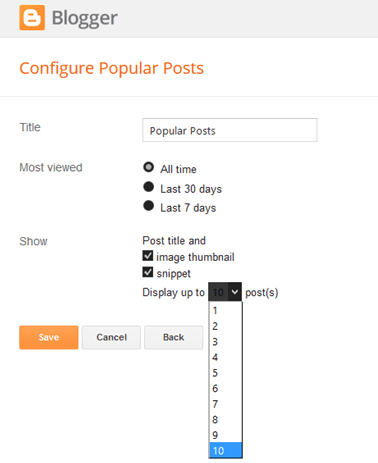
Just click on your blog title, access the “Layout” menu, click “Add a Gadget” and choose “Popular Posts”. A window will appear asking you to configure the widget by choosing which posts you’ll feature (e.g. those that were most viewed in the past 7 days or 30 days or from the beginning of your blog). You’ll also be asked to choose how many posts you’ll feature in your Popular Posts section and select if you’ll show the post title only or along with the image thumbnail and/or the snippet. (Remember that each widget style has different requirements, so follow the styles and instructions carefully to find out if you need the snippet and image thumbnail or not).

Configuring Popular Posts Widget for Blogger

Once you’ve followed these instructions, you’ll get to see the basic version of the Popular Posts Widget for Blogger in your blog. You can stick with this if it matches your blog design but, if it sticks out like a sore thumb or doesn’t suit your taste, there’s no need to fret since you can personalize it. You can choose from the following styles – see the demo blog:

Popular Posts Style 1 – Box within a box

This is an interesting widget style since it uses your snippet and image thumbnail in a unique way. Your snippet is written in opaque text and placed in a small transparent box. This, in turn, is placed in a bigger rectangular box, wherein your image thumbnail is used as a background. Choosing this Popular Posts Widget for Blogger can be a great option if you want to brighten up your blog and grab the attention of readers with your colorful photos.

popular posts widget for blogger

CSS code:

.sidebar .PopularPosts ul{margin:0;padding:0;}.sidebar .PopularPosts ul li{list-style:none !important;padding:0 !important;margin-bottom:10px;}.sidebar .PopularPosts .item-thumbnail{height:190px;margin:0;overflow:hidden;width:100%;}.sidebar .PopularPosts .item-title{position: relative;}.sidebar .PopularPosts img{height:auto;width:100%;padding:0;}.sidebar .PopularPosts .item-title a{color: #FFFFFF;font:20px Oswald;text-transform:uppercase;padding:10px;position:absolute;right:0;left:0px;margin:0px auto;text-align:center;text-decoration:none;top:40px;width:60%;height:26px;overflow:hidden;z-index:2;}
.sidebar .PopularPosts .item-snippet{background:rgba(0, 0, 0, 0.35);border-top:6px solid rgba(0, 0, 0, 0.1);border-bottom:6px solid rgba(0, 0, 0, 0.1);color:#FFFFFF;left:0px;right:0px;margin:0px auto;padding:65px 10px 10px;position:absolute;font:13px ‘Times New Roman’,Times,FreeSerif,serif;text-align:center;top:35px;width:60%;z-index:1;}.sidebar .PopularPosts .item-content{position:relative;}

Popular Posts Style 2 – Large thumbnails with small post titles underneath

This uses the same code as the basic Blogger Popular Posts Widget with a few tweaks. Popularized by well-known blogs, this style is eye-catching because it focuses on pictures, which don’t only summarize the posts’ content but also add visual drama to the entire page. This is particularly useful for blogs that focus on clothes, makeup, art and other topics that highly depend on visual presentation to better express ideas.

popular posts widget for blogger

CSS code:

.sidebar .PopularPosts ul{counter-reset:popularcount;margin:0;padding:0;}.sidebar .PopularPosts ul li{width:100%;list-style:none !important;padding:0 !important;margin-bottom:20px;position:relative;border:0;text-align:center;}.sidebar .PopularPosts .item-thumbnail a{clip: auto;display:block;height:auto;height:120px;}.sidebar .PopularPosts .item-thumbnail{width:100%;height:120px;overflow:hidden;position:relative;margin-bottom:15px;}.sidebar .PopularPosts .item-thumbnail::before{background:rgba(0, 0, 0, 0);border-bottom:29px solid #fff;border-left:29px solid transparent;border-right:29px solid transparent;bottom:0px;content:"";height:0;width:0px;left:0px;right:0px;margin-left:auto;margin-right:auto;position:absolute;z-index:3;}.sidebar .PopularPosts .item-thumbnail:after{color:#000;content:counter(popularcount, decimal);counter-increment:popularcount;font:13px "Times New Roman",Times,FreeSerif,serif;list-style-type:none;position:absolute;bottom:0;margin:0px auto;left:0px;right:0px;z-index:4;}.sidebar .PopularPosts .item-thumbnail img{position:relative;width:100%;height:auto;padding:0;}.sidebar .PopularPosts .item-title{font:15px 'Oswald', sans-serif;text-transform:uppercase;margin:0px auto;padding-bottom:10px;border-bottom:1px solid #000;}.sidebar .PopularPosts .item-title a{color:#000;text-decoration:none;}.sidebar .PopularPosts .item-snippet{padding:10px 15px;font:13px "Times New Roman",Times,FreeSerif,serif;}

Popular Posts Style 3 – Colorful boxes

If your blog needs a pop of color, this is the right choice for you. This widget style presents your Popular Posts in several boxes that feature a thumbnail image and have bright, eye-catching shades like light green, ocher yellow and vivid orange. Each box has a different color, and you can add up to four boxes.

popular posts widget for blogger

CSS code:

.sidebar .PopularPosts ul{padding:0;margin:0;}.sidebar .PopularPosts .item-thumbnail a{clip:auto;display:block;height:auto;overflow:hidden;}.sidebar .PopularPosts .item-thumbnail{width:130px;height:130px;border-right:5px solid #fff;margin:0px 10px 0px 0px !important;position:relative;}.sidebar .PopularPosts .item-thumbnail img{position:relative;height:auto;width:100%;padding:0;}.sidebar .PopularPosts ul li{float:left;margin-bottom:5px;max-height:130px;min-width:250px;overflow:hidden;}.sidebar .PopularPosts ul li:first-child{background:#D9EDF7;}.sidebar .PopularPosts ul li:first-child + li{background:#F2DEDE;}.sidebar .PopularPosts ul li:first-child + li + li{background:#DFF0D8;}.sidebar .PopularPosts ul li:first-child + li + li + li{background:#FFEEBC;}.sidebar .PopularPosts ul li:first-child + li + li + li + li{background:#E0E0E0;}.sidebar .PopularPosts .item-title{font:13px 'Oswald', sans-serif;text-transform:uppercase;padding:10px 5px 10px;}.sidebar .PopularPosts .item-title a{color:#000;text-decoration:none;}.sidebar .PopularPosts .item-snippet{font:13px "Times New Roman",Times,FreeSerif,serif;padding-right:5px;}.sidebar .PopularPosts .widget-content ul li{padding:0px 5px 0px 0px!important;}

Popular Posts Style 4 – Grid layout

Just like the large-picture widget style, the grid layout is an excellent option if you want to showcase your pictures or if your blog depends on visual information. However, the title of your posts won’t be included in the layout, so readers will have to hover their mouses on the images to read the titles.

popular posts widget for blogger

CSS code:

.sidebar .PopularPosts ul{padding:0;}.sidebar .PopularPosts ul li:first-child{width:100%;max-height:100%;opacity:0.9;}.sidebar .PopularPosts ul li:nth-child(even){margin-right:2%;}.sidebar .PopularPosts ul li{-moz-box-sizing:border-box;-webkit-box-sizing:border-box;box-sizing:border-box;position:relative;padding:0px !important;width:49%;max-height:120px;opacity:0.4;overflow:hidden;float:left;margin-bottom:2%;-webkit-transition: all 0.5s ease 0s;-moz-transition:all 0.5s ease 0s;-ms-transition:all 0.5s ease 0s;-o-transition:all 0.5s ease 0s;transition:all 0.5s ease 0s;}.sidebar .PopularPosts ul li:hover{opacity:1;}.sidebar .PopularPosts .item-thumbnail{margin:0;width:100%;line-height:0;}.sidebar .PopularPosts ul li img {-moz-box-sizing:border-box;-webkit-box-sizing:border-box;box-sizing: border-box;width:100%;height:auto;padding:0;}.sidebar .PopularPosts .item-content:hover .item-title a,.sidebar .PopularPosts .item-thumbnail-only:hover .item-title a{visibility:visible;opacity:1;}.sidebar .PopularPosts .item-title a{color:#fff;background:rgba(0, 0, 0, 0) linear-gradient(to bottom, rgba(0, 0, 0, 0) 0%, rgba(0, 0, 0, 0.93) 100%, rgba(0, 0, 0, 0.85) 100%);text-decoration:none;position:absolute;text-align:center;font:13px 'Oswald', sans-serif;left:0;right:0;bottom:0%;padding:100px 10px 10px;opacity:0;visibility:hidden;}.sidebar .PopularPosts .item-snippet{display:none;}

Popular Posts Style 5 – Numbered posts

If you love numbered lists, or if you’d like to make your blog more organized, this can be the perfect option. By using the code for this widget style, your Popular Posts will be automatically numbered and will feature clean, minimalistic boxes that include your snippet and image thumbnail.

popular posts widget for blogger

CSS code:

.sidebar .PopularPosts ul{counter-reset:popularcount;margin:0;padding:0;}.sidebar .PopularPosts ul li{float:left;max-height:130px;min-width:250px;position:relative;}.sidebar .PopularPosts .item-thumbnail::after{color:rgba(255,255,255, 0.63);content:counter(popularcount, decimal);counter-increment: popularcount;font:70px 'Oswald', sans-serif;list-style-type:none;position:absolute;left:5px;top:-5px;z-index:4;}.sidebar .PopularPosts .item-thumbnail::before{background:rgba(0, 0, 0, 0.3);bottom:0px;content:"";height:100px;width:100px;left:0px;right:0px;margin:0px auto;position:absolute;z-index:3;}.sidebar .PopularPosts .item-thumbnail a{clip:auto;display:block;height:auto;overflow:hidden;}.sidebar .PopularPosts .item-thumbnail{width:100px;height:100px;margin:0px 10px 0px 0px !important;position:relative;}.sidebar .PopularPosts .item-thumbnail:hover:before{display:none;}.sidebar .PopularPosts .item-thumbnail img{position:relative;padding-right:0px !important;height:auto;width:100%;}.sidebar .PopularPosts .item-title{font:13px 'Oswald', sans-serif;text-transform:uppercase;padding:0px 5px 10px;}.sidebar .PopularPosts .item-title a{color:#000;text-decoration:none;}.sidebar .PopularPosts .item-snippet{font:13px "Times New Roman",Times,FreeSerif,serif;}.sidebar .PopularPosts .widget-content ul li{padding:0px 5px 0px 0px !important;}.sidebar .PopularPosts .item-content{padding:5px 0px;border-bottom:1px dotted #dedede;overflow:hidden;height:100px;position:relative;}

These are just some of the widget styles you can choose from. When you’ve picked a style you want, make sure to copy its CSS code. Once you do so, go to your blog, click “Theme” on the left side and select “Edit HTML” under the template preview.

These next codes need to be pasted above the “” or “” tags, so check the instruction to know exactly where you need to put the code.

Adding the CSS

When the template editor has opened, click anywhere inside the code area and hit CTRL + F or Command F to search the following tag:

Just ABOVE the  tag, copy-paste the CSS code of one of the styles above.

Important: If the Popular Posts widget is located in the footer of your blog, remove the .sidebar class found in the CSS code in order to make it work.

Please note that most of the styles are using the ‘Oswald’ font which you need to add to your template’s code as well.

So, search for this tag:

… and just BELOW it, add this line:

Adding the JavaScript

These styles also require using a script in order to resize the popular posts image / thumbnail and trim the post snippet and title. To add the JavaScript code, search the  tag and paste the following script just above it:

//ajax.googleapis.com/ajax/libs/jquery/1.11.1/jquery.min.js

Note: if you have already the jQuery library in your template, remove the line in red.

After you have added all the codes in the right place, press the “Save theme” button to save the changes.

That’s it!

The five Popular Posts widgets for Blogger featured today are all great solutions for adding a popular post section to your blog. They all have different appearance for determining what makes a post popular, but the end result is the same: visitors are always one click away from your best content. Try some of these styles, find your favorite, and see how it impacts the performance of your blog.