Buffett Purchased at Least $1.7 Billion of BofA Stock This Month

The billionaire’s Berkshire Hathaway Inc. spent at least $1.7 billion buying shares of the bank in the last two weeks of July, building its stake to about $25 billion, based on the minimum purchase prices disclosed in regulatory filings. The holdings are Berkshire’s second-largest common stock bet, behind Apple Inc.

A Securities and Exchange Commission filing showed Buffett’s conglomerate bought 21.2 million shares of the banking giant between Tuesday and Thursday. That increased Berkshire stake in Bank of America by $522 million and sets its total position in the bank at 11.8%.

Buffett’s conglomerate piled even further into Bank of America stock after getting a green light earlier this year from the Federal Reserve. The purchases came after the shares slumped almost 30% this year. They’re up 4.3% this month.

Bank shares have been hit lately as concerns about the economy keep interest rates low. Bank of America shares are off by 29% this year.

Though Buffett voiced his usual upbeat tone on the American economy during Berkshire’s annual shareholder meeting in May, he did acknowledge the extreme pressure the Covid19 pandemic is having on certain industries.

Brexit Negotiations Now Scheduled to October

The United Kingdom (UK) left the European Union (EU) on 31 January 2020. A transition period is now in place until 31 December 2020. During this period the UK must comply with all EU rules and laws. Virtually nothing will change for businesses or for the public. There will be changes after the transition period, whether or not an agreement is reached on the new relationship between the UK and the EU.

Talks between UK and European Union negotiators will continue into October, the UK government said, ending only days before a key meeting of EU leaders the bloc says is the deadline for the two sides to reach a comprehensive trade agreement.

The UK left the EU at midnight on 31 January 2020.  A transition period is now in place until 31 December 2020. During this period all EU rules and laws will continue to apply to the UK. Virtually nothing will change for businesses or for the public. This will give everyone more time to prepare for the new agreements that the EU and the UK intend to make after 31 December 2020.

On 17 October 2019 the UK and the EU reached an agreement on the conditions for the UK’s departure from the EU (Brexit), and on a transition period until 31 December 2020.

On 17 October 2019 the UK and the EU reached an agreement on the conditions for the UK’s departure from the EU (Brexit), and on a transition period until 31 December 2020.

Negotiators will meet on the weeks of August 17, September 7 and September 28, the British government said in a statement on Friday.

EU leaders are pushing to reach a deal before the meeting to allow time for any trade accord to be implemented before the post-Brexit transition period expires on December 31.

A fifth round of talks between ended last week with both sides saying they are still far from reaching an agreement. Without one, businesses face the imposition of tariffs and quotas from next year.

What is Anxiety?

Anxiety is an emotion that’s best described as a prolonged feeling of uneasiness, apprehension or nervousness about potentially threatening events that haven’t happened yet. It’s triggered by objects, people, or modes of thought that suggest the emergence of a physical or social threat. Examples might include preparing for a public speech, hearing a tornado warning, or seeing a bear’s footprint while hiking. These events each foretell an uncertain, unavoidable, or uncontrollable future threat.

Much like pain or fear, anxiety is an unpleasant warning system that tells us to avoid danger. However, unlike these other sensations, it activates well in advance of any real threat, utilizing the imagination and memory to simulate worst case scenarios. Anxiety also causes our cognitive capacities to change. For example, we’ll start scanning the environment for further signs of danger, and interpret stimuli in threatening ways. Thus, anxiety’s fundamental function is to direct thought, behavior and cognition in ways that increase the likelihood of the early detection of danger.

Anxiety and Fear

Anxiety and fear are distinct emotions with different causes and effects. Anxiety is evoked by signs of potential danger, leading one to exhibit increased vigilance and precautionary behavior. Fear is produced when we are faced by an immediate, observable threat. It triggers an instinctive flee, fight, or freeze response.

State and Trait Anxiety

Most psychology textbooks separate the emotion into two parts. State anxiety simply refers to one’s current anxious feelings. Trait anxiety is an affective personality trait, defined as relatively stable individual differences in anxiety proneness. About 30% of population variance in trait anxiety is described by genetic factors, with the remainder shaped in development.

Traumatic experiences can serve to increase trait anxiety during a person’s life. These experiences form `danger schemas’ in the brain, which are filled with memories, beliefs, and knowledge related to sources of the trauma. Anxiety resurfaces when stimuli are detected that relate to what is in the schema.

Anxiety is probably the most important emotion in our affective repertoire. Like fear, it functions to warn of impending danger; but unlike fear, it remains with us as a constant reminder of the threats we are likely to face. Like all products of evolution, anxiety isn’t a perfect construct.

Those with high trait anxiety are tormented by unpleasant feelings that distort the way they view the world. This species-wide variance in our proneness to anxiety could potentially act as a buffer against a deteriorating environment. Indeed, anxiety helps individuals to learn about threats in their environment, and motivates behavior that may prove vital during times of adversity.

Time Management:

No matter how hard we strive to successfully accomplish our mission when and unless we set our pace to manage each job efficiently we will never be able to achieve our aim. Time, being such a vital element of existence, needs to be handled in the most respectable way.And if we strive to practice the art of time management could our lives undergo a meaningful improvement. Since time management is one of the most valuable abilities that can carry you further in your lives-personal as well as professional. Time control basically helps workers to have more and more jobs completed with less time.

Benefits using time effectively:

Understanding the art of time management may have a positive effect especially on your personal life — where most of us fail each and every job to be provided proper time. So let us take a quick glance at the benefits it offers:

Better task management

Higher productivity

No stress levels

Better work-life balance

Tips for managing time :

Wake up early, and spend longer days: 

Once you get up early then you would get more time to workout, meditate, concentrate or even try a hobbies. You’ll increase the everyday efficiency slowly and time management will never be a concern. 

Set SMART goals — Don’t just wish, do

Specific, Measurable, Achievable, Realistic, and Time-bound.(S.M.A.R.T .)Do you think there is a correct and incorrect method of achieving goals? There’s something incomplete or defective in your strategy when your ambitions don’t achieve rewards. Whereas your efficiency could hit the sky if you set targets the correct way.

Keep mornings for MITs — Most important tasks

Take the most important task into the morning as the first move. Time control and goal management go hand and hand with both. And when you realize what will be accomplished where do you handle your energy efficiently. The aim is to take on, complete a challenging or time-consuming job and concentrate on certain things.

Install a good time tracking software:

Implementing a time tracking app is one of the best ways to maintain track of any minute spent at work. This time tracking app is programmed to establish averages of time, monitor time spent on tasks and hold tracks of every minute you spend working on tasks.

For instance, you should set a time limit for each task and subtask to maximize your time effectively, whether you are working on a project. You should use time scheduling tools such as ProofHub to handle the tasks effectively and with time.

Discover your zone:

You ‘d have found that you’re focused on an arrow in the entire day, and your efficiency shoots up like something else. This occurs while the consciousness is completely in agreement with outside circumstances. Many people term it ‘wind,’ while others term it ‘pace.’

The exploration of the flow or zone will lead directly to the correct time usage. This lets you reach an ideal level of consciousness while you feel and perform your best.

Block Distractions:

Emails, phone calls, and social networking posts are some of the workplace’s frequent and biggest distractions. Whenever you operate on high-priority projects, put the phone on silent mode and switch off data. You ‘d end up spending a lot of time and getting the performance a notch higher

Avoid Multitasking:

Instead of dividing your attention into three different things, it’s better to focus entirely on one thing and marvel at it. To make it more effective, try timeboxing them. It refers to the act of allocating a time-frame for every task which in return, increases the likelihood of its successful completion.

Take some small breaks:

Smart time control doesn’t just consist of performing anything or anything else. This further illustrates the reality that little changes will boost your efficiency to another stage after an hour or two.

Do less but impactful

It’s never a good idea to take up more than you can handle. High achievers and great performers all over the world do less but better. When you prioritize tasks, it gives you clarity and direction so that you can start working on things, save time, and be more productive.

The next time you find it difficult to manage time, take a deep breath and take up a single task, complete it, and start another without stressing yourself too much.

Sleep at least 7–8 hours

Human mind and body make healthier choices, and while well-rested, work more effectively. You will easily determine what to do, where and how. Build a sleep routine, and keep to it regularly. Around the same moment, continue to relax and get up.

Conclusion

Managing time plays an significant part of our everyday lives. Only knowing about the simple time management techniques will do miracles in your life. -Each minute is precious, don’t waste it doing anything that doesn’t bring much benefit to your life.

Design/Framework of Organisation

The business world of the early 21st century is radically different from that of the early 20th century, in two key respects.

First, organizations now have to operate in a vastly more complex environment—one of globalization, hypercompetition, revolutionary technologies, and elaborate regulation. Such complexity implies an increased number of performance requirements for companies (for instance, to satisfy customer needs, address competitive pressures, or comply with the ever-increasing labyrinth of regulation). If you then assign to each requirement its own structural solution (which is the essence of the “hard approach,” described in the sidebar) you end up with an extremely complicated and unwieldy organization.

Second, in most companies the nature of work has changed: from algorithmic work—that is, clerical or manual labor—to knowledge or heuristic work.Knowledge workers differ from clerical or manual workers in that their role is not merely to follow rules and perform specific tasks but also to use their own initiative to further the organization’s mission. They have to interpret the rules, adjust to the changing realities, and make trade-offs among conflicting requirements in order to arrive at the optimal solution.

If reorganization efforts continue to overlook these two major changes in the world of work, they will continue to fail. A new approach is needed, one that is better suited to the realities of the world in which companies now operate. BCG has developed such an approach, called Smart Design for Performance—or just Smart Design—drawing on the principles of Smart Simplicity. (See “Smart Design, Smart Simplicity.”) The approach has been battle tested and has shown great success in raising company performance, mastering complexity, and enhancing employee engagement.

The basis of new approach

A holistic view of organization design would encompass numerous components: structural elements, roles and responsibilities, individual talent, and enabling mechanisms such as core enterprise decision-making processes, performance management, and talent management. These are the key levers for organizational change, and they are obviously crucial—but their relevance is indirect. To change a company’s performance is to change what happens in the company. And what happens in a company is not directly a matter of organizational levers (such as structures, processes, and systems) but one of behavior—that is, what people do: how they act, interact, and make decisions. Workforce behavior is what determines company performance.

The new approach to redesigning an organization, far more appropriate for the new business environment, has behavior at its core. It involves identifying and explaining the current behaviors of the workforce, defining the desired behaviors—those that would improve company performance—and generating the new behaviors by creating contexts that are conducive to them.

What’s so smart about smart design?

Smart design approach involves three main steps- the why, what and how.

  • Define the purpose of the recoganizition (the why)
  • Determine the behaviours that will support that purpose and design the organisation in such a way as to promote those behaviours, using a broad range of design elements (the what)
  • Make it happen (the how)

An effective way to design role and responsibilities is through the process of role chartering. Each role is defined –

  • Individual and shared accountabilities : that is , responsibility for the completion of tasks.
  • Decision rights needed for carrying out the accountabilities.
  • KPIs for measuring the performance of these accountabilities
  • Mission critical corporation requirements : what each person can do make others more effective at accomplishing their accountabilities , and what others can do in return.
  • Desired leadership makers for the role : the values, characteristics and style best suited to the role, such as a bias toward action , a sense of urgency , or candor and openness.
  • key capabilities required for fulfilling the purpose of the role .

The transformation model

The Transformation Model is the framework we use to help leaders understand their organizations and also guide a successful redesign. The model reduces the complexity of an organization to eight key variables that must be understood and aligned for a business to be successful.  Alignment implies a holistic or systems point of view that finds the best “fit” between all organizational elements.  Paying attention to and understanding these variables will result in major improvements in customer service, quality, efficiency, cycle time, profitability and satisfaction of employees.

These eight variables form the “big picture” or context of an organization and ultimately determine its success. When we talk about organization design we are talking about the relationship and balance between each of these variables.  The role of leaders could be defined as understanding and managing these variables.

▪︎Environment

▪︎Strategy

▪︎core process

▪︎Structure

▪︎systems

▪︎ Culture

▪︎Results

▪︎Leadership

Cues of rationalism

Things like promoting kindness, increasing social connection, finding time affluence, so opening up sometimes we have free time, finding ways to control our thoughts so that we stay in the here and now, and these healthy practices of sleep and exercise that we don’t get as much as we should. And the point of putting these up there is not to say that we never want these things, but how often are we prioritizing all those other things that we started with at the expense of this stuff. And if we could switch our ratio of what we’re investing in we could be a lot happier. “We think that knowing is half the battle but it’s not.” And so what are some strategies we can use to put these habits into practice today? First of these is paying attention to the situation. Finding situations that support you , you can also think about external underrated factors effecting these things. But think about it in the context of like healthy eating or in the context of whether you want to stay off social media, or whether you want to have more social connection or not playing on your phone. The idea is that there are situational factors that we don’t realize that are affecting the extent to which we do this. The point is just the presence of the situation causes certain behaviors. Simply making these tempting bad behaviors go far away and these kind of good behaviors that we want to encourage at the forefront can change the way we interact, and can increase our good habits.

Get rid of the stuff that is tempting you. If you had the goal of getting off social media after all my negative comments about social media, you can delete it from your phone. You can put your phone away when you’re trying to work.All those things you can do to increase this stuff. If you want to change around the bad environment of a place like this where you’re not getting enough sleep and you’re not exercising and so on, you can shape your environment to have less of those cues about grades that you’re worried about or less of those cues about workaholism or affluence. All that stuff. Right. You can shape your environment to have less of the bad cues that are causing you to value the wrong stuff.

Patent Pooling during COVID-19

The International Science Collaborations on COVID-19 has a new discussion on the table. The idea of patent pooling.

Costa Rica, one of the countries in the meeting suggested the inkling of pooling the rights to deal with the current pandemic through minimal or at times free, preferably affordable licensing to ensure that the outcomes of efforts by various countries which can be used by one another and especially by those countries which have limited economic resources to deal with this problem. This proposal had received full support from all the other countries except from the UK and the US.

Patent Pooling, according to World Intellectual Property Organisation (WIPO), is defined as an agreement made between two or more patent holders. The agreement licenses the patents to one another or any third party. The main idea is to share the intellectual property rights and also to have a hand in the product.

Generally, patents pooling is done with the objective for necessitating the complex technologies as complementary patents. It is believed to provide productive technical solutions. Such an idea was seen in work in regard to the vaccines which were produced in the present COVID-19 crisis.

The ‘Sewing Machine Combination” made in the year 1856 is recognised to be as the first modern patent pool done in the US.

Patent pooling structures were actively debated and implemented during the SARS outbreak of 2002-03. The same process was also seen during the H5N1 influenza outbreak of 2005, followed by the 2009 H1N1 influenza pandemic.

Patent pooling ensures innovation between companies by minimizing the potential legal issues which arise due to the use of protected concepts of the other. It lowers the transaction costs and allows better process efficiencies as businesses that hold these complementary patents. Such a pooling by effectively agreeing not to sue each other for infringement can result in better and new products in the marketplace.

The International steps towards patent pooling that were taken are the C-TAP, GISAID, MIPP, TRIPS and CBD.

The COVID-19 Technology Access Pool (C-TAP) which is hosted by WHO accumulates all the pledges of commitments made under the Solidarity Call to Action. It is done in order to voluntarily share COVID-19 health technology related data, knowledge and intellectual property.

Global Initiative to Sharing of All Influenza Data (GISAID) promotes the data of rapid sharing of the virus as seen in the case of all influenza viruses and the coronavirus capable of causing COVID19. This also includes genetic sequences data, related clinical data and also the epidemiological data which might be associated with human viruses to be endorsed in public. The geographical and species-specific data is noted. According to this data, in the recent times, around 49,781 genome sequences of the COVID virus have been shared and they have been shared voluntarily by the researchers from all over the world.

Medicines Patent Pool (MPP) has simplified the development of generic drugs. For tuberculosis, HIV and Hepatitis C by allowing them to be sold at an affordable price. MPP is a UN backed public health organisation. It works to increase the access of the drugs and also in the facilitation of development of these life-saving medicines especially for the low- and middle-income countries.

Trade Related Intellectual Property Regime (TRIPS) consents the countries to grant compulsory licences to the selected companies which would work to produce a patented product at the times of such emergencies.

Nagoya Protocol under Convention on Biodiversity (CBD) frames Article 2(e) in the protocol which includes the genetic sequence information. These information forms the basis of all ongoing researches and developments that take place for the COVID-19 treatment and prevention. The Protocol specifically requires the contracting parties to provide the options for access and benefit sharing when the resources could be used for commercial purposes. It indirectly provides the scope for patent pooling.

The concept of ‘patent pooling’ is practically new in India. It primarily focuses to have solutions for the affordable health care.

Indian Patents Act (IPA), 1970 does not either render for any provisions related to formation of such patent pools or provide any guidelines for the same. But at the same time, it neither restrains to create nor denies for the formation of patent pools.

Under this Act, the Central Government on its motion can set up a patent pool by acquiring the patents and inventions required in the public interest. Such an exception only exists in the hands of the authorities and thus, the pooling is particularly viewed as a restrictive practice by Competition Act, 2002 and is claimed to be anti-competitive in nature.

Good lesson taught to China

   It has to be admitted that this time India has taught a good lesson to China. The leaders of China seem to be narcissistic and that is why because of their imperialistic attitude many countries are against them. And unfortunate incident in the Galwan River valley in June 2020, resulting in a brutal skirmish that killed dozens of Indian soldiers has glaringly revealed that China believes in backstabbing which also happened in 1962.

   I was in China and observed China is not a pluralistic society like India, only one community in China that is Han community with more than 90 percent population dominates their economy, politics, army etc. The nasty behaviour of Chinese leaders towards Muslims of Uyghurs, / Uighurs/ Uygurs/Uigurs is well known to all in the world. Anyway, India has taught a good lesson after the Galwan valley incident which I feel they could not imagine. In this context, few lines from South China Morning Post, 25 July may be quoted. “Since 2010, China has committed or planned more than US$26 billion worth of investment in India but some of that may now be in jeopardy. Public sector construction projects will be tougher for Chinese companies to bag, but private ones will still be largely driven by cost considerations”.  Also another line may be quoted from the newspaper, “Chinese companies in India are bracing for tough times ahead, with some of them scaling down operations or cutting jobs as relations between the two countries worsen”.

   Indians know “Nehru’s China policy is seen as a monumental failure”. “Perhaps the biggest mistake the country made was not to update its assessment of the Chinese in Tibet. In 1950 they clearly did not pose a military threat to India. But by 1960 they did. Yet in this decade, India reduced its military by half and constrained its defence expenditure. It only woke up in 1959 when Zhou Enlai told Nehru that the entire Sino-Indian boundary was yet to be delimited” (The Quint, 27 May 2020).

    I feel China because of their leaders cannot be friend of India presently. Only with the passing of time and change of their leadership future generation can see the reality. Because during Pt Nehru’s period, India was under Congress rule and present Prime Minister Narendra Modi is from BJP, but leaders of China did not change their stand as they are having expansionist attitude.

Dr. Shankar Chatterjee

Former Professor& Head (CPME)

NIRD &PR (Govt. of India),

Hyderabad-500 030

Telangana, India

Email <shankarjagu@gmail.com>

Impact of Social Media

The growing use of social media is evident in the society. It has become a platform for people to communicate with others or to stay in touch with their friends and family who are in another country or state. It provides many facilities like information sharing, communication, starting a business, start an awareness campaigns, etc. the development of technology, especially the mobile phones, has played an important role in the impact that social media has created on the people. Social media sites like facebook, twitter, instagram, pinterest, etc. has become platforms for people to share their photographs or content online for their viewers to access it. It has also become a platform for people to share their opinions about various aspects of their life with others. Social Media has also paved a way for many small businesses to have an online platform; many existing businesses are now turning to social media to expand themselves in the online world. 

WHAT MAKES SOCIAL MEDIA UNIQUE?
Social media can be termed as a unique platform because it is easily accessible to most of the people around the world. Majority of the younger generation, teenagers, and middle-aged people contribute to the highest percentage of the total social media user population. From the business perspective, social media opens possibilities of direct access to clients without any third party intervention. Advertising using social media is cost friendly as compared to the costs of the print, TV, or any other media. Also the businesses have the option to promote their products to the target audience that they have the freedom to choose based on their products.
Social media is present everywhere creating an impact on different walks of life. Most of the times, the social media is used by people to support any issue or any cause they relate to or feel strongly about. It is also used by people to build their image and to demonstrate who they are and what they stand for. They can also participate and get a feeling of involvement in things that are currently happening in the world.

IMPACT OF SOCIAL MEDIA
Social media has the following impacts:
  1.  Impact on the society – almost a quarter of the world’s population use facebook and as the social networks grow due to the interaction between people, they become more and more powerful. Each person can now share their point of view online as they know they are not alone. Through the help of social media, the social, ethical, environmental, and political ills in the society come into the mainstream and give people the right to voice out their views for the same.
  2. Impact on commerce– many of the organizations are now reaching out to its customer through either one of the social media platform, thanks to its growing use. Many businesses use the social media platform to connect with the customers, build revenue, generate insights, stimulate demands, and create targeted product offerings.
  3. Impact on the world of work – sites like LinkedIn are important social media platforms that are used by people to find employment and to stand out in their profession. Social media has had a great impact on the recruitment and hiring processes of the companies. Also the candidates who develop skills in the latest and most advanced social media techniques are the preferable choice for being employed. 

CHALLENGES OF SOCIAL MEDIA
Social media has the following challenges that are posed for its user:
  1.  Lack of Privacy– many of the users end up sharing too much information on the online profiles that should not be made available for the public eye. By the time they realize their mistake; it becomes late and cause problems for the individual. Stalking, identity-theft, personal attacks, and misuse of private information are the most common issues faced by many users on the social media.
  2. Deteriorating relationships – the increasing use of social media is affecting the relationships that people have with their families or their friends. People are now forming artificial bonds and cherishing them over the bond with actual people. The friends on the social media lack the intimacy of the conventional friendship that a person had where one gets to know each other or gets to meet each other face to face.
  3. Cyber bullying– it is the most common thing that people face, especially teenagers, online. Teens have a notion that they have to fit in, or to be popular, or to do have better content than others due to which they have immense stress leading to mental illness. Teenagers mostly use the social media platform to spread rumors about each other, share content that has the potential to ruin someone’s reputation, or to blackmail others.

Child trafficking in India

Introduction

Child trafficking can be defined as any person under 18 who is illegally recruited, transported, transferred, harboured or received by threats, force, and coercion or inducing fear for the purpose of exploitation, either within or outside a country. Child trafficking is a common malpractice in India. Child exploitation is done for several reasons. Some of the primary reasons are:

  • Sexual exploitation : children, especially girl children are lured into moving to another city and are forced into prostitution, sex tourism and pornography.
  • Illegal activities : kidnapped children are often forced to beg, and sometimes their organs like kidney etc. are sold. These children are also often used for drug trafficking purposes.
  • Labour : children brought into the city are sold as bonded labour to industry owners. They are often placed at factories of carpet weaving, diamond cuƫng etc.

Trafficking of children is a form of human trafficking and is defined by the United Nations as the “recruitment, transportation, transfer, harboring, and/or receipt” kidnapping of a child for the purpose of slavery, forced labor and exploitation.

Though statistics regarding the magnitude of child trafficking are difficult to obtain, the International Labour Organization (ILO) estimates that 1.2 million children are trafficked each year.

International human rights instruments

These legal instruments were developed by the UN in an effort to protect international human rights and, more specifically, children’s rights.

  • Universal Declaration of Human Rights, 1948
  • Convention on the Rights of the Child, 1989

Causes of Child Trafficking

Poverty

Poverty is the leading cause for child trafficking worldwide. Often parents are not able to provide for their families and consequentially exploit their children for financial reasons. These influencers lead to children being more inclined to take riskier jobs in order to sustain life for themselves and their families. The decision for parents to expose their children for child trafficking, due to poverty, is not always for money incentives, but also because a lack of education causes them to believe that migration elsewhere will provide their children with more opportunities, which will help them escape chronic poverty.

Lack of Education

A lack of education and literacy furthermore makes families more vulnerable to traffickers. Parents are often unaware of the negative consequences of child trafficking and voluntarily send their children away. Additionally, children are often not aware of their rights and lack understanding regarding which of their rights are violated.

Scenario in India

Child trafficking is a serious problem that is prevalent especially in India. The majority of India’s trafficking problem is internal, and those from the most disadvantaged social strata- lowest caste Dalits, members of tribal communities, religious minorities and women and girls from excluded groups – are most vulnerable.

It is the children of the poor and marginalized communities who are often trafficked to be forced into labour. Parents of these children are either betrayed or lured due to their poor socio-economic conditions thus forcing them to ‘send’ or ‘sell’ their children for better livelihood options. The lack of awareness is a situation that traffickers exploit especially when it comes to uneducated poor living in slums and other backward regions in the country. Traffickers promise daily wages to parents of young children and transport them to big cities where they are often treated as commodities. Families in dire financial conditions are often approached by traffickers with an offer to buy their children and with no other escape from their pitiful conditions, parents comply.

In India, there is a great need for convergence and implementation of comprehensive child protection mechanisms. The Indian children are exposed to multiple vulnerabilities. With thousands of children still working in brick kilns, construction sites, dhabas and agricultural land, trafficking for the sake of forced child labour is widely prevalent. Apart from this children are also sold by their parents to work in factory ,dhabas and industries are highly dangerous with toxic environments.

Constitutional and Legislative Provision in India:

  • Trafficking in Human Beings or Persons is prohibited under the Constitution of India under Article 23 (1)
  • Protection of Children from Sexual offences (POCSO) Act, 2012,which has come into effect from 14th November, 2012 is a special law to protect children from sexual abuse and exploitation.
  • The Immoral Traffic (Prevention) Act, 1956 (ITPA) is the premier legislation for prevention of trafficking for commercial sexual exploitation.
  • Criminal Law (amendment) Act 2013 has come into force wherein Section 370 of the Indian Penal Code has been substituted with Section 370 and 370A IPC which provide for comprehensive measures to counter the menace of human.
  •  Prohibition of Child Marriage Act, 2006,
  • Bonded Labour System (Abolition) Act, 1976,
  • Child Labour (Prohibition and Regulation) Act, 1986,
  • Juvenile Justice Act.

carrer after law

bachelor of legislative laws is the undergraduate professional degree that is sought by students to get into a legal profession. LLB is abbreviated as Legum Baccalaureus, which means Bachelor of Laws.

The course covers legal procedures, legal principles, ideals of corporate governance, and laws and regulations of countries. There are ample career opportunities in India after completing LLB.

LLB graduates can enter three major organs of the Government— Legislature, Executive and Judiciary. Perhaps, LLB opens the door to a wide set of opportunities that cannot be boasted by other career options.

Below are some of the major options available to LLB graduates after completion of their courses.

Career Path After Law in India – Top Options

Advocate

Advocacy is one of the chief professions chosen by ing this path can practice in the courts. Note that the aspirants have to qualify the examination conducted by the All India Bar council first, in order to qualify for their practice.

Once they enroll with All India Bar Council, they can opt to practice in any court across the country.

Before becoming a good advocate, every aspirant has to first gather some experience as a Junior assistant with a senior advocate.  This involves drafting files and studying legal documents and cases.

Government Services

Students can opt to join Government Services after completing their LLB. If they prepare themselves, they would be eligible for Indian Legal Services and the various posts that it offers. This includes Legislative Counsel in the Legislative department and Legal advisors in the Department of Legal Affairs.

This requires the aspirants to qualify the exam held by the Public Service Commission. Certain legislative counsels are appointed under the legislative department Hindi as well as regional languages.

Those qualified would also be eligible to join the Air Force, Indian Army, and the Navy. They are also eligible to crack the exams like HAS and IAS organized by UPSC (Union Public Service Commission) or SPSC (State Public Service Commission). They also have the option of becoming an Assistant Public Prosecution or Public Prosecutor.

The law graduates can study in detail about the Indian Constitution, about powers and functions of government, how government works and many other things in detail which make him easy to Crack these exams after some preparations. And they also can become Public Prosecutor or Assistant Public Prosecution.

For this, after gaining some experience from the practice they are appointed through an exam conducted by the Union Public Service Commission or by the State Public Service Commission.

Legal Advisor

After completing your LLB, you can become a legal advisor or join law firms, Private Companies, Corporate firms, or Banks. You can provide advice on various legal matters. Furthermore, your legal expertise could also be used in NGOs. These provide their clients with legal advisory services. They also help people to make the correct decision in a given situation. Most large corporations and government organizations hire legal advisors.

Judiciary

Students are also free to work for the Judicial machinery of Country as a Judge or  Magistrate. This requires them to pass a Judicial examination conducted by the Public Service Commission. This is a very difficult exam to pass.

The lowest post of the Magistrate, Subjudge, or Munsif is filled up by the latest recruitments through Public Service Commission or by the supervision of High Court. The Magistrate judges the Criminal cases and the Sub Judge decides the Civil Cases. Through promotion, these judges could become district judges and also attain higher posts.

They would be able to gain promotion based on their experience and seniority. The initial requirement of these posts is an LLB degree from an approved University and should not have crossed the limit of 35 years of age.

Teaching

Students with impressive academic ability and with the skill of explaining and narrating different topics to a group of people are good fits to become a lecturer in one of the best-recognized Universities or a Law College of the country.

If they choose to do LLM, they could go on to complete research in their respective field of study and earn a PhD./ this way you can also become the professor in Government Universities and Private Universities too.

Legal Outsourcing

Legal outsourcing refers to the practice of a law firm that acquires legal services from an exterior firm. This service is called off sharing if the outsourced entity has its origins in another country.

This is one of the fields where the potential has not fully been reached. There are several opportunities for the people of the country to grab the opportunities in this field.

Private Companies

There is great scope for law graduates to join private firms across the country. They can choose to become the legal advisor and help the company with legal decisions. In case someone is looking for a well-paid job, they can get an MBA after their LLB.

This way, they would be able to get a dual post in companies. Firstly, they could work as legal advisors. Secondly, would be able to take part in the business administration. The dual package will guarantee excellent pay for the employees.

Higher Education

In case you wish to gain better knowledge in a specialised area of law, you can choose from among several options available for higher studies in Law. This includes research work, or LLM Ph.D. in fields like  International Law, Constitutional Law, Labour Law, Cyberlaw, and Family Law.

Writer Of Law Books /Reports /Journalist

If you excel at writing, and you understand the law well, then this profession is the right one for you. If you are capable of writing and editing law books used by law students or if you are able to write legal reports for various publications or newspapers, this job would fit you well. You can also work with a journalist as a guide who guides them all the time.

Legal Analyst

Law graduates could join law firms or corporate fir and conduct analyses regarding the law sphere about the company and its functions. This requires aspirants to own a license in order to practice law.

Legal Analysts also have the ability to assist in drafting various legal documents and also assists attorneys. In the case of financial law, this is a great option. It also requires you to be well analytical and organisational along with the great athlete.

Legal Researcher

A legal researcher is someone responsible for researching various cases and finding ways to win a case. It includes general topics regarding the laws. In other words, they are the ones that the lawyers hire in order to gain a deeper insight into the cases and legal nuances.  Therefore, this is also an interesting profession for you if you are an LLB graduate.

Politics

If you are interested in taking part in the governance of the country or if you have a political background, you can enter politics if you are an LLB graduate. This is helped by the fact that you will have deep knowledge regarding all three domains of the government- Legislature, Executive and Judiciary. This allows them to contribute actively to the nation and become a politician.

Note that in India, joining politics does not mandate any educational qualification. However, there are several of the top political leaders in the country who are law graduates.

Besides, Indian political history is the best proof for the fact that the lawyers are the best politicians out there. Remember that the 250 member assembly that formed the constitution comprised entirely of lawyers. Therefore, studying LLB is one of the best options if you have an interest in pursuing politics.

LLM

If you want to study further about law, you can choose to study LLM. This will help you gain a specialised view on a particular branch of law and you would be able to master that particular section.

This might also be an opportunity to choose a career path as the specialization means that they would spend their time in that area of law. An LLM course will not just help you gain a deeper perspective, but it will help you get jobs that pay you better.

Remuneration

The remuneration available in the field of law is dependent on the type of career one chooses. In the case of government jobs, there would be many additional benefits apart from the basic pay.

Government servants are receiving a considerably good salary package in the country. The other professions, even though private also earn a significant amount of money.

Conclusion

Overall, completing an LLB is one of the first steps to a successful career as there are numerous opportunities for you to pursue a successful career. Know the options well, and choose wisely before you take up a career path.


sustainable development

WHAT IS SUSTAINABLE DEVELOPMENT?

Sustainability is development that satisfies the needs of the present without compromising the capacity of future generations, guaranteeing the balance between economic growth, care for the environment and social well-being.

it is a concept that appeared for the first time in 1987 with the publication of the Brundtland Report, warning of the negative environmental consequences of economic growth and globalization, which tried to find possible solutions to the problems caused by industrialization and population growth.

HOW TO ACHIEVE SUSTAINABLE DEVELOPMENT?

Many of the challenges facing humankind, such as  inequality and hunger, can only be resolved at a global level and by promoting sustainable development: a commitment to social progressenvironmental balance and economic growth.

As a part of a new sustainable development roadmap, the United Nations approved the 2030 Agenda, which contains the Sustainable Development Goals, a call to action to protect the planet and guarantee the global well-being of people. These common goals require the active involvement of individuals, businesses, administrations and countries around the world.


WHAT ARE THE SUSTAINABLE DEVELOPMENT GOALS?

The Sustainable Development Goals, also known as the Global Goals, are a call from the United Nations to all countries around the world to address the great challenges that humanity faces and to ensure that all people have the same opportunities to live a better life without compromising our planet.

17 GOALS FOR A BETTER WORLD

These 17 objectives are interrelated and often the key to one’s success will involve the issues most frequently linked to another. They can be summarised as follows:

  • Eradicate poverty and hunger, guaranteeing a healthy life
  • Universalize access to basic services such as water, sanitation and sustainable energy
  • Support the generation of development opportunities through inclusive education and decent work
  • Foster innovation and resilient infrastructure, creating communities and cities able to produce and consume sustainably
  • Reduce inequality in the world, especially that concerning gender
  • Care for the environment combating climate change and protecting the oceans and land ecosystems
  • Promote collaboration between different social agents to create an environment of peace and sustainable development.

WHAT IS ACCIONA DOING IN THE AREA OF SUSTAINABILITY?

At ACCIONA we want to contribute to achieving sustainable development by responding to the planet’s great challenges, so that current and future generations may enjoy a better life.

HOW DOES ACCIONA CONTRIBUTE TO THE GLOBAL GOALS?

ACCIONA contributes to each SDG through the impacts generated by its projects in countries in which improvements are needed in relation to that SDG.

The company offers solutions to present and future challenges such as water shortage and sanitation, the decarbonisation of the energy system, resilient infrastructures and innovation, the new and growing needs of populations concentrated in cities, and mitigating climate change.

paid media

The Department-Related Parliamentary Standing Committee on Information Technology presented its 47th report on the “Issues Related to Paid News” in the Lok Sabha on May 6, 2013.  The Committee is headed by Mr. Rao Inderjit Singh.

  • The Press Council of India (PCI) defines paid news as any news or analysis appearing in print or electronic media for consideration in cash or kind.
  • Definition of ‘paid news’: The Committee acknowledged challenges in defining and determining what constitutes or qualifies as ‘paid news’.  It cited advertisements camouflaged as news, denial of coverage to select electoral candidates, exchanging of advertisement space for equity stakes between media houses and corporate and the rise in paid content as manifestations of paid news.
  • The Committee asked the Ministry of Information and Broadcasting (MoIB) to formulate a comprehensive legal definition of ‘paid news’ in consultation with stakeholders and suggest measures for usage of ‘circumstantial evidence’ in indentifying paid news.
  • Reasons for rise in paid news: The Committee identified corporatisation of media, desegregation of ownership and editorial roles, decline in autonomy of editors/journalists due to emergence of contract system and poor wage levels of journalists as key reasons for the rise in the incidence of paid news.  It urged the MoIB to ensure periodic review of the editor/journalist autonomy and wage conditions.
  • The Committee opined that financial accounts of the media houses should be subject to examination, especially the revenue source for a suspected paid news case. It recommended mandatory disclosure of ‘private treaties’ and details of advertising revenue received by the media houses.
  • Regulators lack adequate powers: The Committee found the exiting regulatory set-up dealing with paid news as inadequate.  It described voluntary self-regulatory industry bodies like the News Broadcasting Standards Authority and Broadcasting Content Complaints Council as an ‘eye wash’. It found the punitive powers of statutory regulators like the PCI and Electronic Media Monitoring Centre (EMMC) to be inadequate.  It also highlighted the conflict of interest inherent with appointment of media-owners as members of the PCI or self-regulatory bodies.
  • Need for regulatory overhaul: The Committee recommended establishment of either a single regulatory body for both print and electronic media or enhancing punitive powers of the PCI and setting-up a similar statutory body for the electronic media.  Such regulator(s) should have the power to take strong action against offenders and should not include media owners/interested parties as members.
  • Inaction by the government: The Committee censured the MoIB for its failure to establish a strong mechanism to check the spread of paid news.  It accused the government of dithering on important policy initiatives, citing the lack of action on various recommendations of the PCI and Election Commission of India (ECI).
  • The PCI has sought amendment in the Press Council Act, 1978, to make its directions binding on government authorities and bring the electronic media under its purview. The ECI has made a reference to the Ministry of Law and Justice to amend the Representation of the People Act, 1951 (RP Act) in order to include indulgence of an electoral candidate in paid news as a corrupt practice. It also recommended inclusion of abetting and publishing of such paid news as an electoral offence with minimum punishment of two years imprisonment.
  • Penal provisions and jurisdiction: The Committee observed that existing penal provisions have not served as an effective deterrent for the practice of paid news and stricter penal provisions are needed.  It highlighted the lack of clarity regarding the jurisdiction of the designated authority to penalise offenders, given existence of multiple bodies like the MoIB, PCI, EMMC and ECI.
  • The Committee recommended that the ECI should have the authority to take punitive action against electoral candidates in cases of paid news.  It endorsed the ECI’s proposed amendments to the RP Act and urged the government to provide the ECI with more powers to deal with paid news.
  • Concentration of media ownership: The Committee expressed concern that the lack of restriction on ownership across media segments (print, TV or internet) or between content and distribution could give rise to monopolistic practices.  It urged the Telecom Regulatory Authority of India (currently examining the issue) to present its recommendations and the MoIB to take conclusive action on those recommendations on a priority basis.
  • Distribution of government advertisements: The Directorate of Advertising and Visual Publicity (DAVP) is the nodal advertising agency for the central government under the MoIB. It is responsible for execution of advertisements on behalf of various ministries, autonomous bodies and PSUs. Various stakeholders alleged that the government uses advertisements to arm-twist media houses for favourable coverage.
  • The Committee found the DAVP’s existing policy on distribution of advertisements amongst various media houses to be unsatisfactory. Hence, it recommended a transparent and unbiased policy for distribution of advertisements by the central and state governments, with provisions for scrutiny. It asked the DAVP to disclose details about disbursements of advertisements expenditure on its website.
  • Adoption of international best practices: The Committee expressed concern that the MoIB and self-regulatory bodies have not conducted any study to evaluate the mechanism adopted by other countries to tackle the problem of paid news.  Taking note of the Justice Leveson Report on the press and existing regulatory structure in the UK, it asked the MoIB to consider the report’s recommendations and progress of their implementation while dealing with the issue.

Functions of Central Bank

A central bank is an independent national authority that conducts monetary policy, regulates banks, and provides financial services including economic research. Its goals are to stabilize the nation’s currency, keep unemployment low, and prevent inflation.

Most central banks are are governed by a board consisting of its member banks. The country’s chief elected official appoints the director. The national legislative body approves him or her. That keeps the central bank aligned with the nation’s long-term policy goals. At the same time, it’s free of political influence in its day-to-day operations.

Functions of Central Bank:

Central bank of every country is established with view to regulate total money supply in the economy.

Issue of currency:

The Central bank of India has the monopoly of issuing notes or paper currency to the public. This is the first important function of the Central bank.

Bankers to the government:

Another important function of the Central bank is to act as a banker to the government, both Central and State Governments. It carries out banking business of the government and the government keeps its cash balances on current account with the Central bank. Central bank also provides short term credit to the government. In fact, the Central bank is the monetary agent of the government advises the government on all financial matters, and in the formulation of economic policy.

Banker to banks:

A Central bank is also act as banker to the Commercial banks. The Central bank holds a part of cash reserve of banks, lends them short term funds and provide them with centralised clearing and remittance facilities. The Central bank also supervise, regulate and control the credit creation policy of the Commercial banks.

Lender of the last resort:

The Central bank also acts as the lender of the last resort. This means that the central bank lends to such institutions in order to help them at times of stress, so as to save the financial structure of the nation. Central bank helps through discounting of approved securities and collateral loans and advances.

Custodian of foreign exchange reserves:

An important function of the Central bank is to manage and control the foreign exchange reserves. Central bank tries to stabilise the exchange rate by selling and buying gold, foreign securities.

Controller of credit:

The most important function of the Central bank is to control the credit creation by the Commercial banks. Quantitative as well as qualitative instruments are used to control the volume of credit in the economy.

Other functions:

Apart from the above important functions, a Central bank also performs the following other functions:

(a) Central bank is entrusted with the responsibility of extending a strong banking” system.

(b) Central bank also helps in accelerating the agricultural and industrial growth rates of a country.

(c) Central bank published periodical economic and statistical information relating to different aspects of the economy.

Less Plastic Good Nature

Everybody uses things made of plastic as well as things that comes to us made of Plastic. There are many

types of plastic and they are all light in weight, low in cost, can be used in all seasons and they last long. The funny thing is, we don’t usually end up using plastic for a long time. We throw away plastic bags, cups and bottles, plastic straws, spoons, plates etc. and also we must immediately throw after using them. 
Plastic is made of certain chemicals that do not decompose easily. Anything made of plastic takes a

long time to go away and within the certain period of time it does a lot of damages. The trash we throw away, is collected from various places and is sent to dump yards. At the dump yards it is disposed of as best as possible. The plastic things are collected and cut into tiny pieces, which are then melted to give it a new shape. In certain countries, plastic is reused to make Furniture, Clothes and other useful things.
Lots of trash flows out of the garbage bins. All are thrown away casually, carelessly anywhere. What happens to those plastics???

Well it goes into the drains, ponds, lakes, rivers and one way or the other ends up in the oceans. In the oceans, everywhere there are lots of plastics which keeps floating and sunk like threshers and goes deep down the surface of the ocean everywhere. Because of the waves of the ocean and the rays of the sun, those plastic things in the ocean break down into smaller pieces.
The oceans are the home to many types of fishes, animals etc. They are not used to see such type of

bright coloured and slow moving things in the surface of the ocean. They think those plastics as food, and consume those plastics.

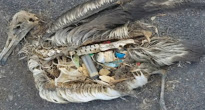
Many ocean birds roam around for foods. They return with plastic and feed 

those plastics to their little babies. They consume those plastics. As they consume those, they don’t get the nutrition which is needed and they die. The dead bodies of those birds are found and when surveyed it is seen that their stomach is full of plastics which is the reason of their death.
There are also many creatures that have died, because of eating plastics

If you visit the sea beach, you will get some kind of idea that plastic is present there in the oceans. Some of the plastics can be seen when the

wave of the ocean comes towards the sand present in the beach. If  we don’t pick up those plastics and throw them in the dump yards or dustbins, the plastic goes back into the water and harms the little birds, the fish and the other animals in the oceans specially the turtles.

The ocean and the sea are home to some of the special and beautiful creatures.

Comparatively there are more plastics present in the oceans than the creatures. Each one of us must do something to get rid of plastic. We must promise ourselves to use less plastics and not to throw them away anywhere. Let’s do something good for the animals in the ocean, for nature and for our planet “earth”.

 THANK YOU