PLANNING IN MANAGEMENT

Planning is deciding the objectives and methods to achieve them. Planning involves deciding in advance what is to be done, how is to be done, where is to do, how is to done and by whom is to be done and it makes things happen which may not occur otherwise and it bridges the gap between where we are and where we want to go, the process of planning includes two things:

             1. Deciding objectives

             2. Choosing best from available alternatives

Planning is a fundamental managerial function planning implies an arrangement for doing something as considered in advance and simple words, planning is deciding in advance and Prof. Urwick rightly said: “Planning is fundamentally a mental predisposition to things in an orderly way, to think before acting and to act in the light of facts rather than guesses”. Thus, a plan is a predetermined course of action and it is an attempt on the part of a manager to anticipate the future to achieve better performance, and planning is based on the principle, Look before you leap’.

CONCEPT OF PLANNING

Planning requires goals and it focuses attention on purposes and determines ways achieving them and planning is necessarily a problem of choice and it involves the selection of the most feasible course of action from all available alternatives. Planning is a means of building a bridge to span the present position of the firm with its desired future position. It implies the work of both problems solving as well as decision-making. Man possesses a unique power of reasoning and he often evaluates the pros and cons before proceeding further into the matter.

NATURE OF PLANNING

1. Planning focuses on achieving objectives:

 Planning is to facilitate the attainment of objectives of the organization and planning focuses action on purposes. Planning is merely an empty mental exercise if it loses sight of the organizational objectives and every plan should contribute towards the achievement of company goals. Thus, all plans are directly linked with the goals and objectives of the enterprise and contribute to its attainment and if there are objectives, there is no need for any planning.

2. Planning is a primary function of Management

 Planning is a primary function of management and a manager must perform efficient and intelligent planning before performing any other managerial activities. Thus, planning comes before the execution of all other managerial functions. Planning function of management has the distinction of establishing objectives and all managerial efforts of organizing, staffing, directing, and controlling are directed towards their attainment.
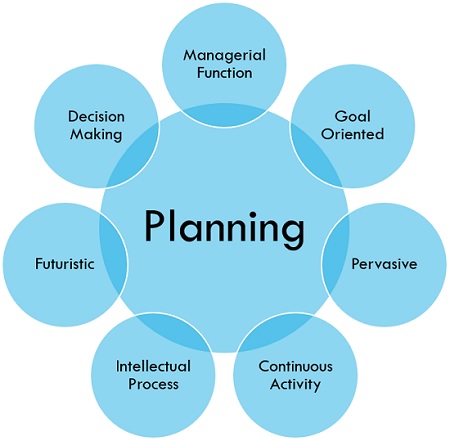
3. Planning is pervasive  An element of planning can be seen behind every human activity in an organization and God has gifted man with the faculty of reasoning and this enables a person to measure the consequences of his planned actions and we can quote several examples where planning precedes individual or group action. Planning is a pervasive activity covering the entire enterprise will all its segments and every level of management. Top management does strategic planning, middle management looks after the administrative planning and the lower management concentrates on operational planning.

Expert Speak: Necessary precautions is the only to reduce Covid-19 infections

The Head Scientist in the Epidemiology and Communicable Diseases Division of ICMR Dr Raman R Gangakhedkar has said that the only way to reduce the number of covid infections is by taking all necessary precautions.

Participating in AIR live phone in programme on Covid 19, He said that people should not be afraid of testing for the infection. Dr Gangakhedkar also said that lack of testing can deprive patients of necessary medication.

Railways Ministry takes important decision to ease procurement norms

Railways Ministry has taken an important decision to ease procurement norms and improve ease of doing business. A vendor, approved for an item by any of the Vendor Approving Agency of Indian Railways shall be considered as Approved vendor by all Railway Units for that particular item.
 
Previously vendor approved at one establishment was not automatically eligible to be considered for procurement at other establishments and they had to apply for approval at multiple establishments to get considered.

The Ministry said, this decision will impact vendors favorably as it will save time and do away the need of approaching multiple vendor approving agencies. This will also promote better utilization of manufacturing capacity of Industry in the country.

Conditions becoming favourable for further advance of southwest monsoon: IMD

India Meteorological Department (IMD) has said that the conditions becoming favourable for further advance of southwest monsoon into some more parts of Madhya Pradesh, Uttar Pradesh and Uttarakhand from tomorrow. The monsoon will reach entire Western Himalayan Region, Haryana, Chandigarh and Delhi, most parts of Punjab and some parts of Rajasthan during 24th and 25th June.
 
IMD said, widespread rainfall with isolated heavy to very heavy rainfall is likely to continue over northeast India during next five days and over East and adjoining central India during next 2 to 3 days. Widespread rainfall activity with isolated heavy to very heavy falls also very likely over Western Himalayan Region, Punjab, Haryana, Chandigarh and Delhi, Uttar Pradesh and East Rajasthan from tomorrow onwards. 

Parents and their importance…

A parent is their child’s first teacher and should remain their best teacher throughout life.  Functioning as a coach, the parent exposes a child to age-appropriate challenges to encourage development as well as to experiences that allow the child to explore on their own and learn from interacting with their environment. Child Development specialists have learned that from birth children are goal-directed to experiment and learn from each experience. Child Development experts have taken the concept of scaffolding from the building trades.  Just as scaffolding is put up to support the structure of the building as it is being built and gradually taken down as the building is able to stand on its own, a parent will need to provide the necessary support for a child to allow them to safely and productively explore and learn from their environment.

As the child matures and develops mastery the scaffolding is removed or changed to allow the child to become more independent.  If the child is not quite ready, the support is reinstated and then gradually withdrawn once again. As children develop from infants to teens to mature they go through a series of developmental stages that are important to all aspects of their personhood including physical, intellectual, emotional, and social.  The proper role of the parent is to provide encouragement, support, and access to activities that enable the child to master key developmental tasks.

Parents and caregivers make sure children are healthy and safe, equip them with the skills and resources to succeed as adults, and transmit basic cultural values to them. Parents and caregivers offer their children love, acceptance, appreciation, encouragement, and guidance. They provide the most intimate context for the nurturing and protection of children as they develop their personalities and identities and also as they mature physically, cognitively, emotionally, and socially.

The role of grandparents in the rearing of healthy and happy children should not be overlooked. A recent study concluded that spending time with a grandparent is linked with better social skills and fewer behavior problems among teenagers, especially those living in single-parent or stepfamily households. This study found that children and teenagers whose parents have separated or divorced see their grandparents as confidants and sources of comfort. In fact, supportive relationships with other family members outside the immediate family may lead to better adjustment for all children and teenagers.

Here some when parents involve in child education life:

Families are the keystone that holds the educational framework together. In a research report, Southwest Educational Development Laboratory (SEDL) concluded: “When schools, families, and community groups work together to support learning, children tend to do better in school, stay in school longer, and like school more.” The synergy of these forces is infinitely more beneficial to students when parents do their part. Consider the following benefits to students who have involved parents, according to SEDL:

  1. Higher grades and test scores, enrollment in more advanced programs.
  2. Grade promotions, earn more credits.
  3. Better school attendance and homework completion rates.
  4. Improved social skills and behavior allow students to acclimate better to school environments.
  5. Higher self-esteem.
  6. High school graduation and advancement to post-secondary education.

Even parents themselves benefit when they are involved in their children’s education. By involving themselves at the school and community levels, parents:

  1. Interact with their children more and are thus more sensitive to their emotional and intellectual needs.
  2. Have more confidence in their parenting abilities.
  3. Have a better understanding of the teacher’s role and the curriculum.
  4. Use more positive reinforcement the more they know about developmental stages.
  5. They are more likely to respond to teachers’ requests for help at home when they stay apprised of what their children are learning.
  6. Have higher opinions of and feel more committed to their children’s schools.
  7. Become more active in policy-making at school and in the community.

parents-505x336

Sometimes, Considering the heavy workload at the workplace and stress, parents find it difficult to take out time for their children. They spend very little time listening to and communicating with children because of their long working hours. As a result, children avoid sharing their school life or other regular events with their parents and feel neglected. These factors form communication barriers between them, and their child gets more freedom to whatever they wont to do, and they become fearless of parents or guardians they can not choose their right way of success, so parents are one of the entities, who can control and give batter information regarding better career, sometimes a child does like their parent’s suggestions, they start to grumble but they do no think that it is life-changing steps are taken by the second face of GOD.

so, please respect parents and their suggestions and discussions.


Insurance Scheme under Pradhan Mantri Garib Kalyan Package for health workers extended

The Insurance Scheme announced under Pradhan Mantri Garib Kalyan Package for health workers who are fighting to contain COVID-19 has been extended for another three months till September.

The scheme provides an insurance cover of 50 lakh rupees to around over 22 lakh public healthcare providers. They include community health workers, who may have to be in direct contact and care of COVID-19 patients and who may be at risk of being impacted by this. Earlier the scheme was slated to end on 30th June.
 
The scheme is funded through the National Disaster Response Fund, operated by the Ministry of Health and Family Welfare. Doctors, nurses, paramedics, sanitation workers and a few others working in hospitals under the central and State governments are covered under the insurance scheme.

Ward-Boys, ASHA workers and technicians are also covered by the special insurance scheme. The scheme also include accidental loss of life on account of contracting COVID-19. The insurance provided under this scheme will be over and above any other insurance cover being availed by the beneficiary.

Procurement of MFP by govt touches all time high, giving boost to tribal economy

The ongoing procurement of Minor Forest Produces under the Minimum Support Price for MFP Scheme in 16 states has hit a record-breaking high with the procurement touching 79.42 crore rupees. With this, the total procurement for the year, both government and private trade, has crossed more than 2000 crore rupees.

This has proved to be a much needed panacea during the times of the Covid-19 pandemic which has disrupted lives and livelihoods of Tribals. On 26th May, the Tribal Affairs Ministry also recommended the addition of 23 new items under the MSP for MFP list.

These items include agricultural and horticultural produce collected by tribal gatherers. With the injection of over 2000 crore rupees in the tribal economy, the MSP for MFP Scheme can lead in the transformation of the tribal ecosystem and empowering the tribal people.

Among the States, Chhattisgarh has taken the lead by procuring 20,270 Metric tonnes of Minor forest produces worth 52.80 crore rupees. Chhattisgarh has emerged as a Champion State for its commendable efforts. With the State government putting all its might behind the implementation of the MSP for MFP Scheme, the systems and processes for procurement is well in place across all districts.  

Centre sanctions Rs 190 cr for augmentation of healthcare facilities in North Eastern States

Union Minister of Development of North Eastern Region (DoNER) Dr Jitendra Singh has reviewed the COVID status and healthcare facility in Aspirational districts with special focus on North East. He also disclosed that in the wake of COVID pandemic, Ministry of DoNER has decided to sanction 190 crore rupees  for augmentation of healthcare facility in the eight North Eastern States, particularly for developing infrastructure for management of infectious diseases.
 
Addressing a Virtual meeting, attended by the Health Secretaries as well as Deputy Commissioners and Health officials of the 14 Aspirational districts of Northeast, Dr  Singh said, the concept of Aspirational District was based on 49 key indicators, of which the status of healthcare was an important component. Dr Singh said that an important experience from the COVID pandemic is that in future, pre-emptive preparedness for epidemic and infection was imperative for optimum healthcare. Considering this, he said, the Ministry of DoNER has given the North Eastern States the option to send proposals for health related projects to be funded up to over 500 crore rupees from North East Special Infrastructure Development Scheme.
 
He said, accordingly, proposals have been received from the States of Assam, Arunachal Pradesh, Meghalaya, Manipur, Sikkim, Mizoram and Nagaland, while the proposal from the eighth State of Tripura is awaited. Dr Singh also complemented the Aspirational Districts of Goalpara and Dhubri in Assam for having achieved Ayushman Bharat coverage of nearly 100 and 85 per cent.  

Defence Minister asks top military brass to ensure strict vigil on Chinese activities around land border, airspace & sea

Defence Minister Rajnath Singh yesterday held a high-level meeting with the Chief of Defence Staff General Bipin Rawat and three service Chiefs on the situation in Ladakh. 

AIR Correspondent reports that after the review meeting, Armed forces were given full freedom to deal with any aggressive behaviour by China’s PLA along the LAC. 

The meet also discussed adopting a different tactical approach in guarding the border with China henceforth. Top military brass were also told to ensure strict vigil on Chinese activities around land border, airspace and in strategic sea lanes.

Defence Minister asks top military brass to ensure strict vigil on Chinese activities around land border, airspace & sea

Defence Minister Rajnath Singh yesterday held a high-level meeting with the Chief of Defence Staff General Bipin Rawat and three service Chiefs on the situation in Ladakh. 

AIR Correspondent reports that after the review meeting, Armed forces were given full freedom to deal with any aggressive behaviour by China’s PLA along the LAC. 

The meet also discussed adopting a different tactical approach in guarding the border with China henceforth. Top military brass were also told to ensure strict vigil on Chinese activities around land border, airspace and in strategic sea lanes.

More than 2 lakh people successfully cured of coronavirus infection so far

The Union Government yesterday said that a total of 2,27,756 people affected with the Coronavirus have been cured so far and the recovery rate reached to 55.49 per cent in the country. 

During the last 24 hours, 13,925 people have recovered from COVID-19. Presently, the total number of active Corona cases in the country is 1,69,451.

The Health and Family Welfare Ministry said a total of 15,413 new cases of COVID-19 have been reported in the last 24 hours taking the total number of cases to 4,10,461. This is the highest number of cases registered in a single day since the outbreak of COVID-19 in the country. 

In one day, a total of 306 deaths have been reported taking the nationwide toll to 13,254. With this, the case fatality rate reached 3.22 per cent in the country.

Meanwhile, Indian Council of Medical Research, ICMR said that a total of 1,90,730 tests of Coronavirus samples were conducted by the various laboratories in the country within 24 hours. 

Mizoram extends total lockdown till 30th June

Mizoram government has extended the ongoing total lockdown in state capital Aizawl, 10 other district headquarters and containment areas for another eight days till June 30 to contain further spread of coronavirus infection.

The total lockdown was imposed on June 9 after the number of coronavirus cases in the state has jumped from 1 to 42 in a week. It was scheduled to be in force till today.
 
In an order, the government said that it extended the total lockdown as stricter measures imposed earlier were found to be effective in containing the spread of COVID-19.

Mizoram yesterday reported one fresh case taking the state’s tally to 141, of which 140 were returnees. The new patient, a 29-year-old woman from Aizawl, was a Maharashtra returnee. There are 132 active cases in the state while 9 have recovered from the virus.

HM Amit Shah reviews coronavirus situation in National Capital; Calls for strict monitoring of containment zones

Union Home Minister Amit Shah has chaired a high level meeting where report of Dr. VK Paul Committee on containment strategy of COVID-19 in Delhi was presented. The Containment Strategy determined by Dr. Paul, has asked to revise demarcation of containment zones and a strict monitoring and control of activities in such containment zones. It has asked to do contact tracing and quarantining of Contacts of all infected persons, with the help of Aarogya Setu and Itihas Aap. Listing and monitoring of each household even outside containment zones, which will help in getting comprehensive information about Delhi.
 
The report said to keep the COVID19 positive cases in hospitals, Covid-19 care centres or home isolation and proper functioning of Covid care centres and taking the help of voluntary organizations and NGOs in this regard. It has been decided that Serological survey will be conducted in all of Delhi from 27th of this month to 10th of next month in which sample testing will be conducted of 20 thousand persons. This will help in comprehensive assessment of the spread of infection in Delhi and will help draw up a comprehensive strategy. As per the plan proposed by Dr VK Paul every district in Delhi will be linked to a major hospital, which will provide adequate help.
 
The proposed report also includes a timeline for all of such activities based on which the Delhi Government will finalize a plan by 22nd of this month and will issue revised demarcation of all containment zones by 26 June as well as hundred percent survey of containment zones by 30th June. A comprehensive survey of the rest of Delhi will also be done by 6th July. During the meeting, the Home Minister also directed the Delhi Government to conduct assessment in respect of every dead individual as regards how many days before death the person was brought to hospital and from where. A special focus has to be given about whether the person was in home isolation and whether the person was brought to hospital at the right time or not. Every death has to be reported to the Central Government.
 
Mr Shah also said that all COVID-19 positive cases should be first referred to Covid centres and those who have adequate facilities at home and do not suffer from other co-morbidities, can be allowed to stay in home isolation. The Central Government will also be informed of the number of people kept in home isolation. The meeting was attended by the Union Health Minister Dr Harshvardhan, Delhi LG Anil Baijal,  Chief Minister Arvind Kejriwal and senior officials. 

How Insomnia Affects our Health???

Insomnia is a sleep disorder in which you have trouble falling and/or staying asleep.The condition can be short-term (acute) or can last a long time (chronic). It may also come and go. Acute insomnia lasts from 1 night to a few weeks. Insomnia is chronic when it happens at least 3 nights a week for 3 months or more. There are two types of insomnia primary and secondary. Primary insomnia: This means your sleep problems aren’t linked to any other health condition or problem.Secondary insomnia: This means you have trouble sleeping because of a health condition (like asthma, depression, arthritis, cancer, or heartburn); pain; medication; or substance use (like alcohol).

There are three different types of Insomnia:-

  • Acute insomnia. A brief episode of difficulty sleeping.
  • Chronic insomnia. A long-term pattern of difficulty sleeping.
  • Comorbid insomnia. Insomnia that occurs with another condition.
  • Onset insomnia. Difficulty falling asleep at the beginning of the night.
  • Maintenance insomnia. The inability to stay asleep.

Research shows that comorbid insomnia accounts for 85 to 90 percent of chronic insomnia. Insomnia also increases with age. Sometimes insomnia goes away after lifestyle factors such as family or work stress resolve. For more serious cases, addressing the underlying cause can improve your sleep quality.Treating insomnia is important because this condition can increase your risk for other health concerns.

What happens if someone suffers from Insomnia:-

  1. There is an increased risk for medical conditions such as strokes, asthma attacks, seizures, weak immune system, sensitivity to pain, inflammation, obesity, diabetes, high blood pressure, heart diseases, etc.
  2. There is an increased risk of mental health disorders like depression, anxiety, and confusion and frustration.
  3. There is an increased risk of accidents. Performance in school can be declined. It can affect our sex drive, memory, and judgement as well.
  4. There is a shortened life expectancy. Having insomnia can shorten your life expectancy. An analysis of 16 studies that covered over 1 million participants and 112,566 deaths looked at the correlation between sleep duration and mortality. They found that sleeping less increased risk for death by 12 percent, compared to those who slept seven to eight hours per night. A more recent study looked at the effects of persistent insomnia and mortality over 38 years. They found that those with persistent insomnia had a 97 percent increased risk of death.

Causes of Insomnia:-

There is primary Insomnia, which has no underlying cause, and secondary insomnia, which is attributable to an underlying cause. Some causes can be stress, jet lag, poor sleep habits, eating too late in the evening, not sleeping on a regular schedule due to work or travel. There are some medical causes as well, such as, mental health disorders, medications such as antidepressants or pain medications, conditions such as cancer, heart disease and asthma, chronic pain, restless leg syndrome, obstructive sleep apnea, etc.

Although it’s common to have insomnia from time to time, you should schedule an appointment with your doctor if the lack of sleep is negatively affecting your life. As part of the diagnostic process, your doctor will likely perform a physical exam and ask you about your symptoms. They will also want to know about any medications you take and your overall medical history. This is to see if there’s an underlying cause for your insomnia. If there is, your doctor will treat that condition first.

What we can do ourselves to treat Insomnia:-

There are many strategies for treating insomnia. Before you talk to your doctor about medications, try making lifestyle changes. Medications provide effective short-term results, but long-term use is associated with mortality. We can go for Melatonin Supplements. This over-the-counter hormone can help regulate sleep by telling your body that it’s time for bed. Higher melatonin levels make you feel sleepier, but too much can disrupt your sleep cycle and cause headaches, nausea, and irritability. Adults can take between 1 and 5 milligrams, an hour before bed. Talk to your doctor about dosage before taking melatonin, especially for children.

Sleep Medications. Talk to your doctor about sleep medications if lifestyle changes aren’t working. Your doctor will look for underlying causes and may prescribe sleep medication. They’ll also tell you how long you should take it. It’s not recommended to take sleeping pills on a long-term basis.

Hence, Insomnia affects our health really bad in the long go. At first we would don’t even know that something is wrong with us. So, it’s better to change our sleeping patterns and also doing little changes in our lifestyle.

Refrences:-

http://www.healthline.com

What is a Dental Hygienist?

Dental hygienists are dental professionals who work closely with other members of the dental team such as dentists, dental assistants and front desk staff.  Dental hygienists are most known for their clinical work, but they can also serve in several other roles, such as educator, researcher, administrator/manager and advocate. 
Some dental hygienists work their entire careers clinically, while others may start their career by working clinically for several years before moving to a different role of their choice.  Regardless of their desired role, all dental hygienists must complete a dental hygiene program before they can become certified to work with patients.

How long does it typically take to complete a dental hygiene program?

The length of a dental hygiene program varies by institution.  Earning an Associate of Science in Dental Hygiene typically take two years, while earning a Bachelor of Science in Dental Hygiene typically takes four years. Many institutions also require students to fulfill several prerequisites before they can begin the dental hygiene program. Herzing University offers a Bachelor of Science in Dental Hygiene in Minneapolis, Minnesota you may complete in three years with no prerequisites for program entry. 
At the end of a dental hygiene program, graduates must successfully complete a series of licensure exams for the state they choose to work in. The exams needed for licensure in Minnesota include: The National Dental Hygiene Board Examination (NBDHE), Central Regional Dental Testing Services (CRDTS) clinical exam and a state jurisprudence exam.

What does a dental hygienist do?

The range of services that dental hygienists can perform varies in each state. In Minnesota, dental hygienists are able to perform many services under general supervision, meaning the dentist must give his or her consent for the services to be performed. This gives dental hygienists a certain degree of freedom while treating patients. 
Clinical dental hygienists often have a large amount of flexibility in creating their own schedule.  Some hygienists choose to work three days a week, while others choose to work five days a week.  A typical schedule consists of six to ten patients per day, depending on the age of the patient and the procedure(s) being performed. 

Four of the skills you will master as a dental hygienist:

• Perform and interpret dental x-rays:

Dental hygienists often take x-rays (also known as radiographs) in order to gather information for a dental exam.  Although dental hygienists are not licensed to make an official diagnosis, dentists appreciate when a dental hygienists summarize their findings of possible areas of decay, periodontal bone levels and other artifacts prior to the dental exam

• Perform oral cancer screenings:

Oral cancer screenings should be completed as a part of every assessment. While dental hygienists cannot diagnose a patient with oral cancer, they can inform the dentist’s recommendation for treatment or suggest that the patient be referred to a pathologist or oral surgeon for further evaluation. 

• Perform preventative and non-surgical periodontal procedures: 

Dental hygienists focus on prevention.  A major part of dental prevention is receiving regular dental cleanings.  Preventative dental cleanings include child prophylaxis and adult prophylaxis, which are thorough cleanings meant to remove plaque and stains from the teeth. Dental hygienists can also provide other types of “dental cleanings” that fall under the preventative or non-surgical categories, such as scaling and root planing. The dental hygienist will perform an initial assessment of the patient’s current oral condition to determine the type of cleaning that is necessary.

Give local anesthetic injections:

In Minnesota and several other states, dental hygienists are able to administer local anesthetic to their patients to keep them comfortable during certain procedures, such as scaling or root planing. In some cases, dental hygienists also administer local anesthetic when a patient is undergoing a filling or tooth extraction.
Dental hygienists are an invaluable part of the dental team. In a clinical role, they assist the dentist in performing a variety of different dental procedures in order to ensure a patient’s oral health. Dental hygienists also help assess a patient’s oral condition and provide the necessary treatment. As a dental hygienist, you will master many different skills, all of which will help you provide exceptional dental care for your patients.
Ashley Chouinard, MS, LDH is the Department Chair for the Dental Hygiene program at Herzing University-Minneapolis. Professionally, Mrs. Chouinard has worked in the dental field as a Licensed Dental Hygienist, Dental Hygiene Supervisor and a Dental Office Assistant. Ashley works diligently to bring current in-the-field experiences to the classroom each day. Ashley earned her Master of Science degree in Education from the University of Wisconsin-Stout, her Bachelor of Science in Community Health from St. Cloud State University and her Associates of Science degree in Dental Hygiene from Normandale Community College.