Prime Minister attends the grand Sesquicentenary Celebrations of the Kolkata Port Trust, launches multimodal development projects for kolkata Port.

Prime Minister Shri Narendra Modi participated in the grand Sesquicentenary Celebrations of the Kolkata Port Trust today.

Prime Minister  unveiled a plaque at the site of original Port Jetties to commemorate 150 years of the Kolkata Port Trust (KoPT).

Shri Modi termed that it is a privilege to be a part of the 150th anniversary celebrations of the KoPT a historic symbol of the country’s water power.

“This port has stood witness to many a historical moment in the country like India getting independence from foreign rule. From Satyagraha to Swachhagraha, this port has seen the country changing. This port has not only seen consignors, but also the carriers of knowledge who have left a mark on the country and the world. In a way, this port of Kolkata symbolizes India’s aspiration for industrial, spiritual and self-reliance”, the Prime Minister added.

The Prime Minister also launched the Port Anthem during the event.

PM stated that the long coast line of India from Gujarat’s Lothal Port to Kolkata Port was not only engaged in trade and business but also in spread of civilization and culture across the world.

“Our government believes that our coasts are gateways to development. This is the reason the government started Sagarmala project for modernizing infrastructure and improving connectivity of the Ports. Thirty six hundred projects worth more than Rs 6 lakh crore have been identified under this scheme. Out of these, more than 200 projects worth more than Rs 3 lakh crore are underway and about one hundred twenty five have been completed. Kolkata Port is connected to the industrial centers of eastern India due to the construction of river waterways. And trade has become easier with countries like Nepal, Bangladesh, Bhutan and Myanmar”, PM added.

PIB India

@PIB_India

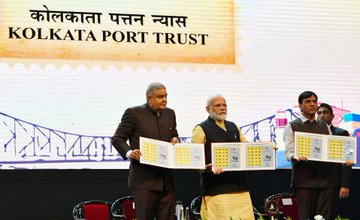
PM @narendramodi presenting commemorative stamp marking celebrations of 150 years of Kolkata Port Trust.

View image on Twitter
19 people are talking about this

Dr Shyama Prasad Mukherjee Port Trust

PM also announced Kolkata Port Trust to be named after Dr. Shyama Prasad Mukherjee. “Dr. Mukherjee, the son of Bengal, laid the foundation for industrialization in the country and has been very instrumental in the development of projects such as Chittaranjan Locomotive Factory, Hindustan Aircraft Factory, Sindri Fertilizer Factory and Damodar Valley Corporation.  I also remember Babasaheb Ambedkar. Dr. Mukherjee and Baba Saheb  gave a new vision to post-independence India”,  PM said.

PIB India

@PIB_India

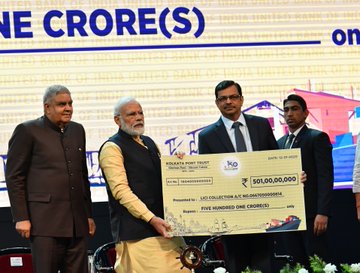
PM @narendramodi handing over a Cheque of Rs 501 Crore towards final instalment to meet the deficit of pension fund of retired and existing employees of the Kolkata Port Trust.

View image on Twitter
125 people are talking about this

Welfare of the Pensioners of KoPT

Shri Narendra Modi also handed over a Cheque of Rs 501 Crore towards final instalment to meet the deficit of pension fund of retired and existing employees of the Kolkata Port Trust.

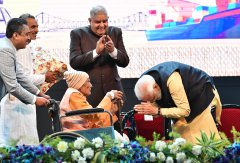
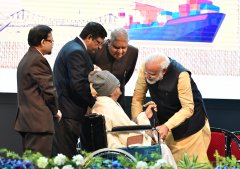
Prime Minister also felicitated two oldest pensioners of the Kolkata Port Trust, Shri Nagina Bhagat and Shri Naresh Chandra Chakraborty (105 and 100 years respectively).

PIB India

@PIB_India

PM @narendramodi felicitating two oldest pensioners of the Kolkata Port Trust- 105 years old Shri Nagina Bhagat and 100 years old Shri Naresh Chandra Chakraborty for their contribution towards the Kolkata Port Trust.

View image on TwitterView image on Twitter
335 people are talking about this

Prime Minister inaugurated Kaushal Vikas Kendra and Pritilata Chhatra Avas for 200 Tribal girl students of Sunderbans.

PM said that every effort is being made by the Central Government for the development of West Bengal, particularly for the  development of the poor, underprivileged and  the exploited. He said that as soon as the West Bengal state government approves of the Ayushman Bharat Yojana and PM Kisan Samman Nidhi, people of West Bengal will also start getting benefits from these schemes.

The Prime Minister also inaugurated the upgraded Ship Repair Faciility of Cochin Kolkata Ship Repair Unit at Netaji Subhas Dry Dock.

PM  inaugurated the Full Rake Handling Facility and dedicated the upgraded Railway Infrastructure of Kolkata Dock System of KoPT for smooth cargo movement and improving turnaround time.

PM also launched the Mechanisation of Berth No.3 at Haldia Dock Complex of KoPT and a proposed riverfront development scheme.

*****

Text of PM’s address at the grand Sesquicentenary Celebrations of the Kolkata Port Trust

पश्चिम बंगाल के राजयपाल, श्रीमान जगदीप धनखड़ जी, केन्‍द्रीय मं‍त्रीपरिषद के मेरे सहयोगी मनसुख मांडविया जी, यहां उपस्थित भारत सरकार के अन्‍य मंत्रीगण, सांसदगण, और बड़ी संख्‍या में यहां पधारे पश्चिम बंगाल के मेरे बहनों और भाइयो।

मां गंगा के सानिध्य में, गंगासागर के निकट, देश की जलशक्ति के इस ऐतिहासिक प्रतीक पर, इस समारोह का हिस्सा बनना हम सबके लिए एक अनन्‍य सौभाग्य की बात है। आज का ये दिन कोलकाता पोर्ट ट्रस्‍ट के लिए, इससे जुड़े लोगों के लिए, यहां काम कर चुके साथियों के लिए तो बहुत ही महत्‍वपूर्ण अवसर है। भारत में port laid development को नई ऊर्जा देने का भी मैं समझता हूं इससे बड़ा कोई अवसर नहीं हो सकता। स्‍थापना के 150वें वर्ष में प्रवेश करने के लिए कोलकाता पोर्ट ट्रस्‍ट से जुड़े आप सभी साथियों को बहुत-बहुत बधाई देता हूं, अनेक-अनेक शुभकामनाएं देता हूं।

साथियो, थोड़ी देर पहले यहां आज के इस पल की गवाही देने वाले डाक टिकट जारी किए गए। इसी के साथ इस ट्रस्‍ट के कर्मचारियों और यहां काम कर चुके हजारों पूर्व कर्मचारियों की पेंशन के लिए 500 करोड़ रुपए का चैक भी सौंपा गया। विशेष रूप से 100 वर्ष से अधिक आयु के वरिष्‍ठ महानुभावों को सम्‍मानित करने का गौरव मुझे मिला। कोलकाता पोर्ट ट्रस्‍ट के माध्‍यम से राष्‍ट्र सेवा करने वाले ऐसे तमाम महानुभावों को और उनके परिवारों को मैं नमन करता हूं, उनके बेहतर भविष्‍य की कामना करता हूं।

साथियो, इस पोर्ट के विस्तार और आधुनिकीकरण के लिए आज सैकड़ों करोड़ रुपए के इंफ्रास्ट्रक्चर प्रोजेक्ट्स का लोकार्पण और शिलान्यास भी किया गया है। आदिवासी बेटियों की शिक्षा और कौशल विकास के लिए हॉस्टल और स्किल डेवलपमेंट सेंटर का भी शिलान्यास हुआ है। विकास की इन तमाम सुविधाओं के लिए भी पश्चिम बंगाल के सभी नागरिकों को बहुत-बहुत बधाई देता हूं।

साथियो, कोलकाता पोर्ट सिर्फ जहाजों के आने-जाने का स्‍थान नहीं है, ये एक पूरे इतिहास को अपने-आप में समेटे हुए है। इस पोर्ट ने भारत को विदेशी राज से स्वराज पाते हुए देखा है। सत्याग्रह से लेकर स्वच्छाग्रह तक, इस पोर्ट ने देश को बदलते हुए देखा है। ये पोर्ट सिर्फ मालवाहकों का ही स्थान नहीं रहा, बल्कि देश और दुनिया पर छाप छोड़ने वाले ज्ञानवाहकों के चरण भी इस पोर्ट पर पड़े हैं। अनेक मनीषियों ने, अनेक अवसरों पर यहीं से दुनिया के अपने सफर की शुरूआत की थी।

एक प्रकार से कोलकाता का ये पोर्ट भारत की औद्योगिक, आध्यात्मिक और आत्मनिर्भरता की आकांक्षा का जीता-जागता प्रतीक है। ऐसे में जब ये पोर्ट 150वें साल में प्रवेश कर रहा है, तब इसको न्यू इंडिया के निर्माण का भी एक ऊर्जावान प्रतीक बनाना हम सबका दायित्‍व है।

पश्चिम बंगाल की, देश की इसी भावना को नमन करते हुए मैं कोलकाता पोर्ट ट्रस्ट का नाम, भारत के औद्योगीकरण के प्रणेता, बंगाल के विकास का सपना लेकर जीने वाले और एक देशएक विधान के लिए बलिदान देने वाले डॉक्टर श्यामा प्रसाद मुखर्जी के नाम पर करने की घोषणा करता हूं। अब ये पोर्ट डॉक्‍टर श्‍यामा प्रसाद मुखर्जी पोर्ट के नाम से जाना जाएगा।

साथियो, बंगाल के सपूत, डॉक्टर मुखर्जी ने देश में औद्योगीकरण की नींव रखी थी। चितरंजन लोकोमोटिव फैक्ट्री, हिन्दुस्तान एयरक्राफ्ट फैक्ट्री, सिंदरी फर्टिलाइज़र कारखाना और दामोदर वैली कॉर्पोरेशन; ऐसी अनेक बड़ी परियोजनाओं के विकास में डॉक्टर श्‍यामा प्रसादमुखर्जी का बहुत बड़ा योगदान रहा है। और आज के इस अवसर पर, मैं बाबा साहेब अंबेडकर को भी याद करता हूं, उन्हें नमन करता हूं। डॉक्टर मुखर्जी और बाबा साहेब अंबेडकर, दोनों ने स्वतंत्रता के बाद के भारत के लिए नई-नई नीतियां दी थीं, नया vision दिया था।

डॉक्‍टर मुखर्जी की बनाई पहली औद्योगिक नीति में देश के जल संसाधनों के उचित उपयोग पर जोर दिया गया था तो बाबा साहेब ने देश की पहली जल संसाधन नीति और श्रमिकों से जुड़े कानूनों के निर्माण को लेकर अपने अनुभवों का उपयोग किया। देश में नदी घाटी परियोजनाओं का, डैम्‍स का, पोर्ट्स का निर्माण तेजी से हो पाया तो इसका बड़ा श्रेय इन दोनों महान सपूतों को जाता है। इन दोनों व्‍यक्तित्‍वों ने देश के संसाधनों की शक्ति को समझा था, उसे देश की जरूरतों के मुताबिक उपयोग करने पर जोर दिया था।

यहीं कोलकाता में 1944 में नई water policy को लेकर हुई conference में बाबा साहेब ने कहा था कि भारत की water ways policy व्‍यापक होनी चाहिए। इसमें सिंचाई, बिजली और यातायात जैसे हर पहलू का समावेश होना चाहिए। लेकिन ये देश का दुर्भाग्य रहा कि डॉक्टर मुखर्जी और बाबा साहेब के सरकार से हटने के बाद, उनके सुझावों पर वैसा अमल नहीं किया गया, जैसा किया जाना चाहिए था।

साथियो, भारत की विशाल समुद्री सीमा लगभग 7,500 किलोमीटर लंबी है। दुनिया में समुद्र तट से जुड़ा होना आज भी बहुत बड़ी ताकत माना जाता है। Landlocked countries अपने-आप को कभी-कभी असहाय महसूस करती हैं। पुराने समय में भारत की भी एक बहुत बड़ी शक्ति थी। गुजरात के लोथल पोर्ट से लेकर कोलकाता पोर्ट तक देखें, तो भारत की लंबी कोस्ट लाइन coastline से पूरी दुनिया में व्यापार-कारोबार होता था और सभ्यता, संस्कृति का प्रसार भी होता था। साल 2014 के बाद भारत की इस शक्ति को फिर से मजबूत करने के लिए नए सिरे से सोचा गया, नई ऊर्जा के साथ काम शुरू किया गया।

साथियो, हमारी सरकार ये मानती है कि भारत के बंदरगाह भारत की समृद्धि के प्रवेशद्वार हैं। और इसलिए सरकार ने Coasts पर कनेक्टिविटी और वहां के इंफ्रास्ट्रक्चर को आधुनिक बनाने के लिए सागरमाला कार्यक्रम शुरू किया। सागरमाला परियोजना के तहत देश में मौजूद पोर्ट का modernization और एक नए पोर्ट के development का काम लगातार किया जा रहा है। सड़क, रेलमार्ग, Interstate waterways और coastal transport को integrated किया जा रहा है। ये परियोजना coastal transport के जरिए माल ढुलाई को बढ़ाने में बहुत अहम भूमिका निभा रही है।

इस योजना के तहत करीब 6 लाख करोड़ रुपए से अधिक के पौने 6 सौ प्रोजेक्ट्स की पहचान की जा चुकी है। इनमें से 3 लाख करोड़ रुपए से अधिक के 200 से ज्यादा प्रोजेक्ट पर काम चल रहा है और लगभग सवा सौ पूरे भी हो चुके हैं।

साथियो, सरकार का प्रयास है कि transportation का पूरा framework आधुनिक और integrated हो। हमारे देश में टांसपोर्ट नीतियों में जो असंतुलन था, उसे भी दूर किया जा रहा है। इसमें भी पूर्वी भारत और नॉर्थ-ईस्‍ट को Inland waterway यानी नदी जलमार्ग आधारित योजनाओं से विशेष लाभ हो रहा है और आने वाले समय में जलशक्ति के माध्‍यम से पूरे नॉर्थ-ईस्‍ट को जोड़ने का नेटवर्क भारत के विकास में एक स्‍वर्णिम पृष्‍ठ के रूप में उभर करके आने वाला है।

बहनों और भाइयों, कोलकाता तो जल से जुड़े विकास के मामले में और भी भाग्यशाली है। कोलकाता पोर्ट देश की समुद्री परिधि में भी है और नदी के नट पर भी स्थित है। इस प्रकार से ये देश के भीतर और देश के बाहर के जलमार्गों की एक प्रकार से संगम स्थली है।

आप सभी भलीभांति जानते हैं कि हल्दिया और बनारस के बीच गंगा जी में जहाज़ों का चलन शुरु हो चुका है। और मैं काशी का एमपी हूं, इसलिए स्‍वाभिक रूप से आपसे सीधा जुड़ चुका हूं। देश के इस पहले आधुनिक Inland waterway को पूरी तरह से तैयार करने के लिए तेज़ी से काम चल रहा है।

इस वर्ष हल्दिया में multimodal terminal और फरक्का में navigational lock को तैयार करने का प्रयास है। साल 2021 तक गंगा में बड़े जहाज़ भी चल सकें, इसके लिए भी ज़रूरी गहराई बनाने का काम प्रगति पर है। इसके साथ-साथ गंगाजी को असम के पांडु में ब्रह्मापुत्र से जोड़ने वाले inland waterway-2 पर भी cargo transportation शुरू हो चुका है।  नदी जलमार्ग की सुविधाओं के बनने से कोलकाता पोर्ट पूर्वी भारत के औद्योगिक सेंटर्स से तो जुड़ा ही है, नेपाल, बांग्लादेश, भूटान और म्यांमार जैसे देशों के लिए व्यापार और आसान हुआ है।

साथियों, देश के पोर्ट्स में आधुनिक सुविधाओं का निर्माण, connectivity की बेहतर व्यवस्था, management में सुधार जैसे अनेक कदमों के कारण कार्गो के clearance और उसके transportation से जुड़े समय में कमी आई है।

Turnaround time बीते 5 वर्ष में घटकर लगभग आधा हो गया है। ये एक बड़ा कारण है जिसके चलते भारत की ease of doing business की रैंकिंग में 79 rank का सुधार हुआ है।

साथियों, आने वाले समय में Water Connectivity के विस्तार का बहुत अधिक लाभ पश्चिम बंगाल को होगा, कोलकाता को होगा, यहां के किसानों, उद्योगों और श्रमिकों को होगा, यहां के मेरे मछुआरे भाइयों-बहनों को होगा।

हमारे मछुवारे भाई जल संपदा का पूरा इस्तेमाल कर पाएं, इसके लिए सरकार Blue Revolution Scheme चला रही है। इसके तहत उन्हें इस क्षेत्र में value addition करने के साथ ही ट्रॉलर्स के आधुनिकीकरण में भी मदद की जा रही है। किसान क्रेडिट कार्ड के माध्यम से मछुआरों को अब बैंकों से सस्ता और आसान ऋण भी उपलब्ध हो रहा है। एक तरफ हमने अलग जलशक्ति मंत्रालय बनाया है, उसी को ताकत देने वाला और उसी से अधिकतम फायदा लेने वाली अलग fisheries ministry भी बनाई है। यानी विकास को हम कहां ले जाना चाहते हैं, किस दिशा में जाना चाहते हैं, उसका संकेत इन रचनाओं में भी समाहित है।

साथियो, Port laid development एक व्यापक ecosystem का विकास करता है। इस जल संपदा का उपयोग पर्यटन के लिए, समुद्री पर्यटन, नदी जल पर्यटन के लिए भी किया जा रहा है। आजकल लोग cruise  के लिए विदेशों में चले जाते हैं। ये सारी चीजें हमारे यहां बहुत आसानी से विकास किया जा सकता है। ये सुखद संयोग है कि कल ही पश्चिम बंगाल की कला और संस्कृति से जुड़े बड़े सेंटर्स के आधुनिकीकरणकी शुरुआत हुई और आज यहां water tourism से जुड़ी बड़ी स्कीम launch हुई है।

River front development योजना से पश्चिम बंगाल के टूरिज्म उद्योग को नया आयाम मिलने वाला है। यहां 32 एकड़ ज़मीन पर जब गंगा जी के दर्शन के लिए आरामदायक सुविधाएं तैयार होंगी, तब इससे टूरिस्‍टों को भी लाभ मिलेगा।

बहनों और भाइयों, सिर्फ कोलकाता में ही नहीं, सरकार द्वारा पूरे देश में पोर्ट्स् से जुड़े शहरों और clusters में aquarium, water park, sea museums,  cruise, और water sports के लिए ज़रूरी infrastructure बनाया जा रहा है।

केंद्र सरकार cruise आधारित पर्यटन को भी बढ़ावा दे रही है। देश में cruise ship की संख्या जो अभी डेढ़ सौ से, करीब-करीब 150 के आसपास है, अब उसको हम 1 हज़ार तक बढ़ाने का लक्ष्य लेकर काम कर रहे हैं। इस विस्तार का लाभ पश्चिम बंगाल को भी अवश्‍य मिलने वाला है, बंगाल की खाड़ी में स्थित द्वीपों को भी मिलने वाला है।

साथियों, पश्चिम बंगाल के विकास के लिए केंद्र सरकार की तरफ से हर संभव कोशिश की जा रही है। विशेषतौर पर गरीबों, दलितों, वंचितों, शोषितों और पिछड़ों के विकास के लिए समर्पित भाव से अनेक प्रयास किए जा रहे हैं।

पश्चिम बंगाल में लगभग 90 लाख गरीब बहनों को उज्जवला योजना के तहत गैस का कनेक्शन मिला है। इसमें भी 35 लाख से अधिक बहनें दलित और आदिवासी परिवार से हैं।

जैसे ही राज्य सरकार आयुष्मान भारत योजना, पीएम किसान सम्मान निधि के लिए स्वीकृति दे देगी; मैं नहीं जानता हूं कि देगी या नहीं देगी, लेकिन अगर दे देगी तो यहां के लोगों को इन योजनाओं का भी लाभ मिलने लगेगा।

और वैसे आपको बता दूं कि आयुष्मान भारत के तहत देश के करीब-करीब 75 लाख गरीब मरीज़ों को गंभीर बीमारी की स्थिति में मुफ्त इलाज मिल चुका है। और आप कल्‍पना कर सकते हैं जब गरीब बीमारी से जूझता है, तब जीने की भी आस छोड़ देता है। और जब गरीब को बीमारी से बचने का सहारा मिल जाता है तो उसके आशीर्वाद अनमोल होते हैं। आज मैं चैन की नींद सो पाता हूं क्‍योंकि ऐसे गरीब परिवार लगातार आशीर्वाद बरसाते रहते हैं।

इसी तरह पीएम किसान सम्मान निधि के तहत देश के 8 करोड़ से अधिक किसान परिवारों के बैंक खाते में लगभग 43 हज़ार करोड़ रुपए सीधे direct benefit transfer के तहत उनके खाते में जमा हो चुके हैं। कोई बिचौलिया नहीं, कोई cut नहीं, कोई syndicate नहीं; और जब सीधा पहुंचता है, cut मिलता नहीं, syndicate का चलता नहीं, ऐसी योजना कोई क्‍यों लागू करेगा।

देश के 8 करोड़ किसानों को इतनी बड़ी मदद, लेकिन मेरे दिल में हमेशा दर्द रहेगा, मैं हमेशा चाहूंगा, ईश्‍वर से प्रार्थना करूंगा कि नीति-निर्धारकों को इस पर सद्बुद्धि दे। और गरीबों को बीमारी में मदद के लिए आयुष्‍मान भारत योजना और किसानों की जिंदगी में सुख और शांति का रास्‍ता पक्‍का हो इसके लिए प्रधानमंत्री किसान सम्‍मान निधि का लाभ मेरे बंगाल के गरीबों को मिले, मेरे बंगाल के किसानों को मिले। आज बंगाल की जनता का मिजाज मैं जानता हूं, भलीभांति जानता हूं। बंगाल की जनता की ताकत है कि अब इन योजनाओं से लोगों को वंचित कोई नहीं रख पाएगा।

साथियों, पश्चिम बंगाल के अनेक वीर बेटे-बेटियों ने जिस गांव और गरीब के लिए आवाज़ उठाई, उनका विकास हमारी प्राथमिकता होनी चाहिए। ये किसी एक व्यक्ति की, किसी एक सरकार की जिम्मेदारी नहीं है, बल्कि पूरे भारतवर्ष का सामूहिक संकल्‍प भी है, सामूहिक दायित्व भी है और सामूहिक पुरुषार्थ भी है। मुझे विश्वास है कि 21वीं सदी के नए दशक में, जब दुनिया एक वैभवशाली भारत का इंतज़ार कर रही है, तब हमारे ये सामूहिक प्रयास दुनिया को कभी निराश नहीं करंगे, ये हमारे प्रयास ज़रूर रंग लाएंगे।

इसी आत्‍मविश्‍वास के साथ 130 करोड़ देशवासियों की संकल्‍पशक्ति और उनके सामर्थ्‍य पर अप्रतीम श्रद्धा होने के कारण मैं भारत के उज्‍ज्‍वल भविष्‍य को अपनी आंखों के सामने देख रहा हूं।

और इसी विश्‍वास के साथ आओ हम कर्तव्‍य पथ पर चलें, अपने कर्तव्‍यों का निर्वाह करने के लिए आगे आएं। 130 करोड़ देशवासी जब अपने कर्तव्‍यों का पालन करते हैं तो देश देखते ही देखते नई ऊंचाइयों को पार कर लेता है।

इसी विश्‍वास के साथ एक बार फिर कोलकाता पोर्ट ट्रस्ट के 150 वर्ष के लिए और विकास परियोजनाओं के लिए, आज के इस महत्‍वपूर्ण अवसर पर मैं आप सबको, पूरे पश्चिम बंगाल को, यहां की महान परम्‍परा को नमन करते हुए अनेक-अनेक शुभकामनाएं देता हूं, बहुत-बहुत बधाई हूं।

मेरे साथ ये धरती, प्रेरणा की धरती, देश का सामर्थ्‍य जगाने वाली धरती है। यहां से पूरी ताकत से हमारे सपनों को समेटता हुआ नारा हम बोलेंगे। दोनों हाथ ऊपर करके, मुट्ठी बंद करके पूरी ताकत से बोलेंगे-

भारत माता की – जय

भारत माता की – जय

भारत माता की – जय

बहुत-बहुत धन्‍यवाद।

***************

Prime Minister congratulates HM Sayyid Haitham bin Tariq al Said, Sultan of Oman

Prime Minister Shri Narendra Modi has congratulated HM Sayyid Haitham bin Tariq al Said, on taking over as Sultan of Oman.

“I heartily congratulate HM Sayyid Haitham bin Tariq al Said on taking over as Sultan of Oman. I am confident that under his leadership, Oman will continue to progress and prosper and contribute to global peace.

India has millennia old relations with Oman. We look forward to working hand in hand with HM Sayyid Haitham to further strengthen our strategic partnership”, PM said.

I heartily congratulate HM Sayyid Haitham bin Tariq al Said on taking over as Sultan of Oman. I am confident that under his leadership, Oman will continue to progress and prosper and contribute to global peace.

— Narendra Modi (@narendramodi) January 12, 2020

India has millennia old relations with Oman. We look forward to working hand in hand with HM Sayyid Haitham to further strengthen our strategic partnership.

— Narendra Modi (@narendramodi) January 12, 2020

***

Vice President asks the youth to work towards an India free of hunger and discrimination

The Vice President of India Shri M Venkaiah Naidu today called upon the youth work towards shaping an India that is free of hunger, discrimination and inequalities based on caste, creed and gender.

Speaking at the Centenary Celebrations of ‘Sri Ramakrishna Vijayam,’ Tamil Monthly Magazine brought out by Ramakrishna Mission in Chennai today, he said that there was a renewed interest on India world over as the country was moving to become a 5 trillion dollar economy.

At this juncture, Shri Naidu said that the timeless vision and teachings of Swami Vivakananda would continue to be the guideposts for the individual growth and collective advancement of the nation.

Shri Naidu described Swami Vivekananda as an embodiment of Hindu culture and a social reformer, who was against religious dogmas. He said that Vivekananda believed in the uplift of humanity, irrespective of caste or creed.

Calling upon the youth to take inspiration from the life and teachings of Swami Vivekanada, he urged them to dedicate their lives for the progress of country, welfare of the downtrodden and uplift of the poor. “We have opportunities to become strong, stable and more prosperous nation,” he added.

Shri Naidu said that Swami Vivekananda was anguished by the miserable living conditions of the poor and recalled that he prioritized “first bread and then religion.”

Vivekananda also felt that no amount of politics would be of any avail until the masses in India were well educated, well fed, and well cared for.

Talking about the importance of holistic education that takes care of the physical and mental wellbeing of the children, the Vice President said “For Swami Ji education did not mean academic pursuits alone. He stressed equally on physical fitness and bodily health.”

While expressing his deep concern over the spurt in Non Communicable Diseases, the Vice President cautioned the youth be aware of the ill effects of the changing life style and dietary habits. He suggested them to practice yoga, meditation and adopt healthy eating habits.

He also asked the youth to take a pledge to be physically fit and promote India’s cultural and spiritual values.

The Governor of Tamil Nadu, Sri Banwarilal Purohit, Minister for Fisheries, Govt of Tamil Nadu, Thiru Jaya Kumar, Pujya Swami Gautamanandaji, Vice President, SRK Math & Mission, Belur and others were present at the event.

Later, the Vice President visited Amir Mahal, the residence of Prince of Arcot, Nawab Mohammad Abdul Ali and interacted with his family members and other guests at a reception hosted in honour of the Vice President.

Briefly addressing the gathering, Shri Naidu said that India was known for its civilizational values the world over. He urged the people, particularly the younger generation to promote and propagate India’s culture and heritage.

The Vice President said “we speak different languages but we all are one. The constitution provides equal opportunities to all citizens.

Following is the full text of the Vice President’s speech on centenary celebrations of Ramakrishna Vijayam-

“Dear Sisters and Brothers,

Today is a great day. It was on this day in 1863 that one of the most illustrious spiritual leaders of India and an embodiment of Hindu Culture, Swami Vivekananda was born.

I join the nation in paying homage to Swami Vivekananda, an embodiment of Hindu Culture on his birth anniversary today. An ardent advocate of universal brotherhood, peace and a strong proponent of India’s ancient wisdom and values, Swamiji’s teachings resonate with us all the times.

Through his address at Chicago’s World Parliament of Religions, Swami Vivekananda introduced the timeless values of our culture and its eternal relevance for maintaining peace.

A great saint, teacher and social reformer, Swami Vivekananda played a major role in introducing Hinduism to the West.

I bow my head to this great son of mother India.

Today, India is moving on an ambitious path to transform people’s lives. We are on track to become a 5 trillion dollar economy. There is renewed interest in India world over.

At this juncture, the timeless vision and teachings of Swami Vivakananda will continue to be the guideposts for our individual growth and collective advancement.

Swami Ji was a social reformer and was against religious dogmas. He believed in the uplift of humanity, irrespective of caste or creed and emphasized the importance of spiritualism for the survival and progress of mankind.

The Swami Ji had said “I am proud to belong to a religion which has taught the world both tolerance and universal acceptance. We believe not only in universal toleration, but we accept all religions as true”.

In his historic Chicago address to the Parliament of Religions, he had said: I am proud to belong to a nation which has sheltered the persecuted and the refugees of all religions and all nations of the earth. I am proud to tell you that we have gathered in our bosom the purest remnant of the Israelites, who came to Southern India and took refuge with us in the very year in which their holy temple was shattered to pieces by Roman tyranny. I am proud to belong to the religion which has sheltered and is still fostering the remnant of the grand Zoroastrian nation”.

Each religion can enrich itself with the higher values professed by the other, and realise that all paths, ‘crooked or straight’ lead to the Supreme Source. Truth is the essence of divinity, inherent in every religion.

Swami Ji in his final speech on September 27 had advocated that a Christian was not to become a Hindu, or a Buddhist to become a Christian. ‘But each must assimilate the others, and grow according to its own laws of growth.

Today more than ever, there is a need to bring down walls that create differences among people. We follow Sarva Dharma Sama Bhavana — that is in our Indian blood and part of our civilization.

We should all understand the concepts, precepts and practices connected with Hinduism in a correct perspective.

But, what exactly is ‘Hinduism’?  That is the question.  That has to be understood. That has to be analyzed. That has to be articulated in a proper manner. As Dr. Sarvepalli Radhakrishnan had observed, “We find it difficult, if not impossible, to define Hindu religion or even adequately describe it. Unlike other religions in the world, the Hindu religion does not claim any Prophet.  It does not worship any one God.” In fact, there is a whole range of beliefs from atheism to worshipping Gods and Goddesses in different forms. In fact, we believe divinity exists in each and every being or in every atom of the Universe.

As Radhakrishnan goes on to say, “It does not subscribe to one dogma; it does not believe in any one philosophical concept; it does not follow any one set of religious rites or performances.  In fact, it does not appear to satisfy the narrow traditional features of any religion or creed.  It may broadly be described as a way of life, and nothing more.”  This is what Dr. Radhakrishnan has said. Hinduism is a way of life. It is a way of life that has evolved over millions of years and has become an integral part of our daily lives. When someone asked me for a simple definition of this way of life , I had said that if you eat what you have, it is quite natural, if  you snatch away what others are eating it is unnatural, but If you share what you have with others in need , that reflects your cultural refinement. I wish to underscore this attitude of ‘care’ and ‘share’ as the core principle of Indian way of life.

Dear sisters and brothers

Swami Vivekananda believed in the religion of humanity. Swami ji said that he did not believe in a god or religion ‘ which cannot wipe the widow’s tears or bring a piece of bread to the orphan’s mouth’.

His heart pained at the miserable living conditions of his fellow countrymen. He prioritized “first bread and then religion” and felt that no amount of politics would be of any avail until the masses in India are well educated, well fed, and well cared for.

Swami Ji had said: “Let each one of us pray day and night for the downtrodden millions who are held fast by poverty, priest-craft and tyranny. Pray day and night for them. I care more to preach religion to them than to the high and the rich”.

Stressing on the emancipating role of education, he advocated inclusive education system and said, “If the poor boy cannot come to education, education must go to him”.

For Swami Ji education did not mean academic pursuits alone, he stressed equally on physical fitness and bodily health. Very few of us know that Swami Vivekanada was a good player of football as well.

Swami Ji observed that the greatest sin is to consider oneself to be weak. ‘You will understand the Bhagwad Gita better with your biceps, your muscles, a little stronger,’

Today Prime Minister Shri Narendra Modi has given a call for ‘Fit India’. I appeal to each and every youngster to adopt it as a mission and spread the message of fitness among our schools, institutions, friends, families and communities.

Let us take this pledge on the Birth Anniversary of Swami Vivekanada today.

His clarion call to youth was – “Arise, awake, and stop not till the goal is reached.”

Our youth must become ambassadors of our great heritage and culture. India was known as Vishwaguru once upon a time and was in the forefront of knowledge creation and sharing it with people from all over the world. We believe in sharing our knowledge for the well-being of entire humanity as we treat the entire universe as one family-Vasudhaika Kutumbakam. Share and care is at the core of Indian philosophy.

Youth are the future of any nation and they must work towards shaping India that is free of hunger, discrimination and inequalities based on caste, creed and gender.

Of course, there would be challenges in it. But let me quote Swami Ji who had said: “In a day, when you don’t come across any problems – you can be sure that you are travelling in a wrong path.”

Swami Ji always advocated women’s empowerment and gender equality. He had stated, “The best thermometer to the progress of a nation is treatment of its women”.

He had also said “there is no chance for the welfare of the world unless the condition of women is improved.

In the 21st century, the world is facing the threats of fragmentation, conflict, hatred and irrational prejudices. The voice of Swami Vivekanada is an eternal guiding lamp for the humanity. We need to strive to spread Swami Ji’s teachings far and wide.

In this regard, I am happy to note that Sri Ramakrishna Math, Chennai has been publishing ’Sri Ramakrishna Vijayam” a Tamil monthly since January 1921.

It is a record that a spiritual-cultural Tamil monthly maintained uninterrupted publication and is celebrating Centenary Year.

I am told that 3 other magazines, viz., Prabuddha Bharata (English), Udbodhan (Bengali) and Vedanta Kesari (English) have crossed centenary year landmark. It is praiseworthy that all the three magazines are from Sri Ramakrishna Mission.

Sri Ramakrishna Vijayam has been propagating Sanatana Dharma since its inception.

Once again, I congratulate Sri Ramakrishna Math and Ramakrishna Vijayam for doing yeoman service to humanity.

Swami Ji had said, “They alone live, who live for others.”

Today on National Youth Day, I call upon the youth of the country to take inspiration from the life and teachings of Swami Vevekanada and dedicate their lives for the progress of country, welfare of the downtrodden and uplift of the poor.

As we celebrate National Youth Day, we must make the youth understand the importance of the teachings of Vivekananda. The youth must follow the path laid down by Swami Vivekananda and lead by the ideals of Tyaga (Sacrifice) and Seva (Service).

My best wishes to all of you.”

****

VRRK/MS/MSY/RK

President’s Greetings on The Eve Of Lohri, Makar Sankranti, Pongal, Bhogali Bihu, Uttarayan and Poush

The President of India, Shri Ram Nath Kovind has greeted his fellow citizens on the eve of the festivals of Lohri, Makar Sankranti Pongal, Bhogali Bihu, Uttarayan and Poush.

In his message the President has said, “I offer my greetings and best wishes to all fellow citizens in India and abroad on the occasion of Lohri, Makar Sankranti, Pongal, Bhogali Bihu, Uttarayan and Poush.

India is a land of festivals. The coming festivals, celebrated under different names and forms across the country, are also an occasion to mark our respect for the ceaseless hard work of our farmers. These festivals, symbolising the joy of sharing the new crop with one’s family and community, are intertwined in the soul of the country. All communities celebrate these festivals with the spirit of mutual love, affection and fraternity.

Such festivals have an invaluable contribution in the geographical, cultural and emotional unification of the country. I am confident that these festivals will help further strengthen the spirit of peaceful co-existence and unity, and further enhance the prosperity and happiness of the nation.”

VRRK/VJ/AK

“Given the choice between a land that is available at a cheaper price without long-term appreciation and a land that is available at a reasonable price with a long-term appreciation, prefer purchasing the land available at a reasonable price with a long-term appreciation.” —Professor M.S. Rao

“Given the choice between a land that is available at a cheaper price without long-term appreciation and a land that is available at a reasonable price with a long-term appreciation, prefer purchasing the land available at a reasonable price with a long-term appreciation.” —Professor M.S. Rao
Vision 2030: One Million Global Leaders

“Sports build both hard and soft skills. Hard skills help the players become competent individually while soft skills help them become competent collectively to win the game.” —Professor M.S. Rao

“Sports build both hard and soft skills. Hard skills help the players become competent individually while soft skills help them become competent collectively to win the game.” —Professor M.S. Rao
Vision 2030: One Million Global Leaders

IUT conference

The last few days have been spent attending the IUT conference (Improving University Teaching). Yes university teachers do care about good teaching! I went as a Doctorate in Education student and because it was nearby at the University of Otago. There were some interesting sessions on offer, and it was a different conference to the ones I normally go to – not eLearning but education.

The highlights were hearing Tom Angelo (University of Victoria) speak again and seeing him in action using interactive methods in a big lecture theatre. The man is magic…and he gets the audience to think and do!

Kathleen Weigert, Georgetown University USA was intriguing when speaking about justice. She asked us to define justice and then talked about three kinds of justice – commutative (fairness in exchange), distributive (allocation and how things are shared), social (contributive – contribute to common good and remove barriers e.g. education).

My definition was: \”Doing the right thing to serve the needs of people\”. She mentioned the importance of policies in institutions matching their practices, and whether the mission statements in our organisations had included statements about justice. I was interested in the Community-Based Learning programme she teaches in where students undertake community-based work to complement their academic learning. For example, students taking courses about homelessness actually work in the community with people experiencing homelessness.

Another speaker, Bland Tomkinson, spoke about the integration of interdisciplinary topics, sustainable development and global citizenship. Although he wasn\’t a particularly receptive speaker when I approached him afterwards, and and there wasn\’t any discussion about his topic, he had some good ideas. I will have to read his conference paper.

The first workshop on Teaching Philosophy (Elaine Laflamme) was partially useful in that it made me think about to which category of teacher I belong – my result from the inventory is that I am a humanist, progressive teacher.

I also found Robert Aitken\’s presentation about using audio journaling techniques with students very relevant – he believes that people think while they talk so the audio recordings demonstrate more thinking about the process whereas written journals tend to be censored and the actual process is rarely documented. The session I was particularly interested on metacognition was presented by someone who didn\’t know the subject very well, a co-author, so I will have to read the paper.

It was also good to meet up with friends and colleagues from my past biology life, and find out about Rob Wass and his research topic of looking at the Zone of current development (ZCD) and how it moves to the zone of proximal development (ZPD) during study in Zoology.

The podcasting and vodcasting workshop was okay, particularly because I was able to promote Leigh\’s courses. A little bit was covered on good practice so this was good. A bit gobsmacked to talk to someone who was planning to record biology lectures and put them up on Blackboard. Good for review I suppose. but the idea of taking them down if people stop coming to lectures is ludicrous. surely the measure would be if students liked them and actually learned better.

And the worst presentation by far had to be Gerrie Jacobs and his Powerpoint Karaoke. some good messages about integrity and credibility but too many flashy bits and not enough substance. good lessons for what not to do to an audience.

There were some very good posters – eportfolio at Massey university in an engineering programme, Rob\’s research study about Learning in the Zone and another one about pharmacy and experiential learning in the curriculum. I also got a couple of free books – one on Curriculum transformation and disability: Implementing universal design in HE and effective tutorial teaching. The former book also had a poster about their work. Oh yes the workshop where L Meyer used a questioning instrument to stimulate self-questioning was very useful. Qs such as how, why etc matched with other words which could be attached to a statement about a topic to get a class to generate their own questions to go away and research and think about. we had to throw a dice and choose the words which matched each number. The game aspect instilled a bit of fun, and the class shared the questions they came up with.

The next step is to look at some of the conference papers, especially the sessions I missed because of the flexible delivery operations committee inaugural meeting – papers on transformative learning – a subject close to my heart.

using mobile learning to stimulate critical thinking

I am a little behind the eight ball with my responses to the discussions, so you are forgiven if this topic is well forgotten. I was intrigued to read about the M4Lit project where phones are being used to engage teens in creative storytelling and interactive writing. Sabine has responded on the group email with a great post discussing the merits of reading and writing for stimulating critical thinking. \” … reading and writing is the most important, and most efficient way to develop critical thinking\”.  Here I am using material from my Doctorate thesis (in progress) to support this claim.  For example, Menary (2007) claims “writing is thinking” (p. 361) because writing helps to re-structure and manipulate a person\’s thoughts.  
However, there is also the belief that guided thinking needs to occur before writing reflectively and critically, using dialogue for stimulating critical thinking. In any case, I believe it is important to develop critical thinking skills, but these may or may not be associated with the capacity to write reflectively and critically.  If a tool such as a mobile phone can capture the interest of students to engage in activities which stimulate critical thinking this is a good thing.  I don\’t believe we should despair if reading and writing is not a component, because critical thinking can also occur when viewing multimedia, and engaging in conversations – if the right prompts are in place. There is plenty of evidence that guided reflection can stimulate critical reflection (Fook & Gardner, 2007; Reiman, 1999).  In my opinion, we need to move away from reading and writing as the only way to see evidence of critical thinking, and embrace other exciting methods of stimulating evidence of critical thinking. 
It may well include writing, but for example, if students uploaded images to Flickr, or Youtube or their blog or ePortfolio etc, and using quiding questions were encouraged to reflect critically on the meaning of the images or video sequence, they could write or speak (through using an audio recording) or video to describe the meaning of the image or video, or other material, wouldn\’t this be more fun than preparing the traditional essay? All this could be done directly from their mobile phone.

"What Is Graphicacy?" — An Essential Literacy Explained In An Animated Motion Graphic


What Is Graphicacy? from The ASIDE Blog on Vimeo.

We live in a visual world. Smartphones, television, Internet, and social media all push information in real-time, all the time. Visual media bombard us in constant streams. Learners of every age, therefore, need to understand how to analyze pictorial information. This skill of parsing images, interpreting pictures, and decoding diagrams is known as graphicacy.
The motion graphic (or explainer video) in this post describes the many reasons for graphicacy education. Maps, cartoons, and photographs all feature symbolic cues and metaphoric elements. An animated infographic itself can become a conduit for graphic instruction.


Sixty-five percent of people today identify as visual learners. In fact, the brain processes optic inputs 60,000 times faster than text. Yet schools and scholarship rarely apply the tools and time to train people how to understand all of these visual streams.


Source: ASIDE 2015


Graphicacy stands with literacy, oracy, and numeracy as one of the four indispensable corners of education. It dates to W.G.V. Balchin‘s coinage of the term in the 1960s to identify the visual-spatial aspect of human intelligence. What began as a staple of South African geography education has ballooned in importance, especially in today’s 1:1 classroom. With today’s rightful emphasis on differentiated instruction, contemporary classrooms need to incorporate coaching in graphicacy to reach students via their learning preferences. (Continue reading for more information….)
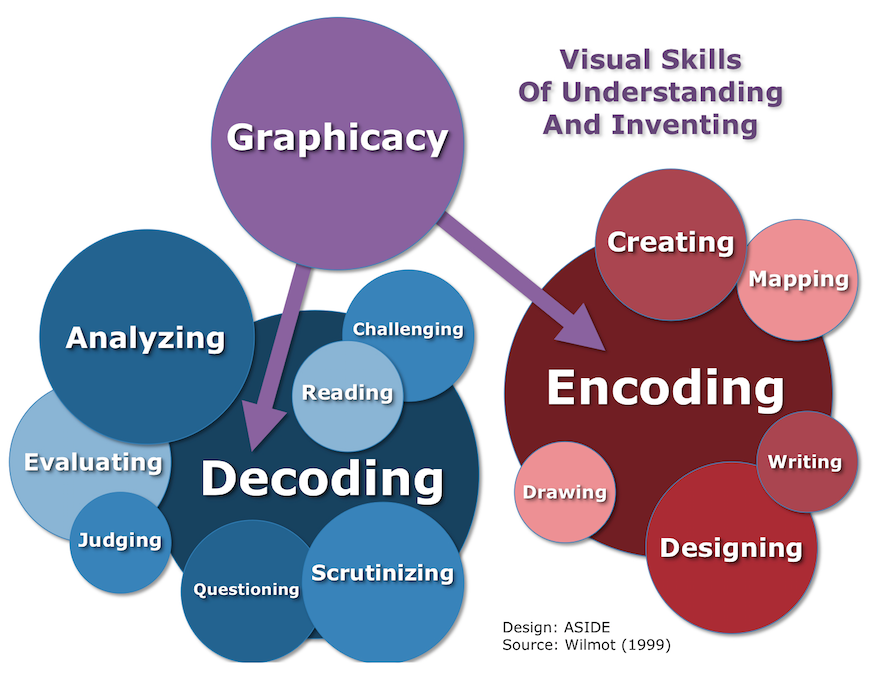
Visual literacy is about learning how to look. It involves learning how to internalize and deconstruct the images that the brain sees. It involves input. Visual thinking is about learning how to design. It involves imagining graphic representations of new or traditional concepts based on the mind’s unique creation. It involves output. Graphicacy, therefore, is the union of the two acuities. It marries the essential skills of decoding and encoding to embrace a range of pictorial proficiencies. (Continue reading for more information….)

Source: ASIDE 2011
Tommy McCall hit the nail on the head when he called “graphicacy the neglected step child in the classroom” during his TEDx East talk on Literacy, Numeracy, And Graphicacy. In the new e-cology to design and create digital content that is transmitted, interactive, and shared, it is even more vital to incorporate graphicacy skills in daily lessons. By training kids to thoroughly study what they see, we reinforce their visual acuity, attention to detail, and ability to notice conspicuous absences of information. We want them to develop a keen eye for seeing, to detect problems, and to understand the message inherent in the design. (Continue reading for more information….)
Graphicacy often takes a backseat in traditional classrooms, because understanding pictures is thought to be a natural consequence of basic vision. The conventional wisdom says that if people can see, then naturally they can comprehend what they see. Parents, however, know this is untrue. They know children must learn to decode images and connect the visual parts to the cognitive whole. Mothers and fathers dedicate evenings to paging through picture books with their toddlers, pointing out clouds and jackrabbits and smiling moons. (Continue reading for more information….)
Whether graphicacy is the “fourth R” or the “third skill,” as Howard A. Spielman refers to it, the format for representing data and visuals is much more complex today. Data visualizations such as infographics and the myriad of designs used in their creation are arguably more complex in many cases. This is quite the opposite of what infographics are by definition, which is to present complex information quickly and clearly. They often combine images and data in ways very different from standard graphs, charts, and maps in most elementary textbooks, thus prompting a need for graphicacy in education. (Continue reading for more information….)

Source: ASIDE 2015
We use four steps in guiding students to interpret charts, maps, cartoons, infographics, and logos. These four steps progress from base-level identification toward more analytical and sophisticated skills. The understandings proceed from: 1) Substance, 2) Scaffold, 3) Story, and 4) So What? (Continue reading for more information….)


Amid the national emphasis on STEM programs, charts are becoming key tools to represent visual statistics. As more and more schools migrate to 1:1 tablets, therefore, students need a foundation in reading and rendering their own optic inputs. The language of apps today is printed in icons. On handheld devices, colorful squares dance across each swiped screen. Children need to recognize these badges and identify the relationships between the logos and the corresponding actions. (Continue reading for more information….)

"What Is Graphicacy?" — An Essential Literacy Explained In An Animated Motion Graphic


What Is Graphicacy? from The ASIDE Blog on Vimeo.

We live in a visual world. Smartphones, television, Internet, and social media all push information in real-time, all the time. Visual media bombard us in constant streams. Learners of every age, therefore, need to understand how to analyze pictorial information. This skill of parsing images, interpreting pictures, and decoding diagrams is known as graphicacy.
The motion graphic (or explainer video) in this post describes the many reasons for graphicacy education. Maps, cartoons, and photographs all feature symbolic cues and metaphoric elements. An animated infographic itself can become a conduit for graphic instruction.


Sixty-five percent of people today identify as visual learners. In fact, the brain processes optic inputs 60,000 times faster than text. Yet schools and scholarship rarely apply the tools and time to train people how to understand all of these visual streams.


Source: ASIDE 2015


Graphicacy stands with literacy, oracy, and numeracy as one of the four indispensable corners of education. It dates to W.G.V. Balchin‘s coinage of the term in the 1960s to identify the visual-spatial aspect of human intelligence. What began as a staple of South African geography education has ballooned in importance, especially in today’s 1:1 classroom. With today’s rightful emphasis on differentiated instruction, contemporary classrooms need to incorporate coaching in graphicacy to reach students via their learning preferences. (Continue reading for more information….)
Visual literacy is about learning how to look. It involves learning how to internalize and deconstruct the images that the brain sees. It involves input. Visual thinking is about learning how to design. It involves imagining graphic representations of new or traditional concepts based on the mind’s unique creation. It involves output. Graphicacy, therefore, is the union of the two acuities. It marries the essential skills of decoding and encoding to embrace a range of pictorial proficiencies. (Continue reading for more information….)

Source: ASIDE 2011
Tommy McCall hit the nail on the head when he called “graphicacy the neglected step child in the classroom” during his TEDx East talk on Literacy, Numeracy, And Graphicacy. In the new e-cology to design and create digital content that is transmitted, interactive, and shared, it is even more vital to incorporate graphicacy skills in daily lessons. By training kids to thoroughly study what they see, we reinforce their visual acuity, attention to detail, and ability to notice conspicuous absences of information. We want them to develop a keen eye for seeing, to detect problems, and to understand the message inherent in the design. (Continue reading for more information….)
Graphicacy often takes a backseat in traditional classrooms, because understanding pictures is thought to be a natural consequence of basic vision. The conventional wisdom says that if people can see, then naturally they can comprehend what they see. Parents, however, know this is untrue. They know children must learn to decode images and connect the visual parts to the cognitive whole. Mothers and fathers dedicate evenings to paging through picture books with their toddlers, pointing out clouds and jackrabbits and smiling moons. (Continue reading for more information….)
Whether graphicacy is the “fourth R” or the “third skill,” as Howard A. Spielman refers to it, the format for representing data and visuals is much more complex today. Data visualizations such as infographics and the myriad of designs used in their creation are arguably more complex in many cases. This is quite the opposite of what infographics are by definition, which is to present complex information quickly and clearly. They often combine images and data in ways very different from standard graphs, charts, and maps in most elementary textbooks, thus prompting a need for graphicacy in education. (Continue reading for more information….)

Source: ASIDE 2015
We use four steps in guiding students to interpret charts, maps, cartoons, infographics, and logos. These four steps progress from base-level identification toward more analytical and sophisticated skills. The understandings proceed from: 1) Substance, 2) Scaffold, 3) Story, and 4) So What? (Continue reading for more information….)


Amid the national emphasis on STEM programs, charts are becoming key tools to represent visual statistics. As more and more schools migrate to 1:1 tablets, therefore, students need a foundation in reading and rendering their own optic inputs. The language of apps today is printed in icons. On handheld devices, colorful squares dance across each swiped screen. Children need to recognize these badges and identify the relationships between the logos and the corresponding actions. (Continue reading for more information….)

"What Is Graphicacy?" — An Essential Literacy Explained In An Animated Motion Graphic


What Is Graphicacy? from The ASIDE Blog on Vimeo.

We live in a visual world. Smartphones, television, Internet, and social media all push information in real-time, all the time. Visual media bombard us in constant streams. Learners of every age, therefore, need to understand how to analyze pictorial information. This skill of parsing images, interpreting pictures, and decoding diagrams is known as graphicacy.
The motion graphic (or explainer video) in this post describes the many reasons for graphicacy education. Maps, cartoons, and photographs all feature symbolic cues and metaphoric elements. An animated infographic itself can become a conduit for graphic instruction.


Sixty-five percent of people today identify as visual learners. In fact, the brain processes optic inputs 60,000 times faster than text. Yet schools and scholarship rarely apply the tools and time to train people how to understand all of these visual streams.


Source: ASIDE 2015


Graphicacy stands with literacy, oracy, and numeracy as one of the four indispensable corners of education. It dates to W.G.V. Balchin‘s coinage of the term in the 1960s to identify the visual-spatial aspect of human intelligence. What began as a staple of South African geography education has ballooned in importance, especially in today’s 1:1 classroom. With today’s rightful emphasis on differentiated instruction, contemporary classrooms need to incorporate coaching in graphicacy to reach students via their learning preferences. (Continue reading for more information….)
Visual literacy is about learning how to look. It involves learning how to internalize and deconstruct the images that the brain sees. It involves input. Visual thinking is about learning how to design. It involves imagining graphic representations of new or traditional concepts based on the mind’s unique creation. It involves output. Graphicacy, therefore, is the union of the two acuities. It marries the essential skills of decoding and encoding to embrace a range of pictorial proficiencies. (Continue reading for more information….)

Source: ASIDE 2011
Tommy McCall hit the nail on the head when he called “graphicacy the neglected step child in the classroom” during his TEDx East talk on Literacy, Numeracy, And Graphicacy. In the new e-cology to design and create digital content that is transmitted, interactive, and shared, it is even more vital to incorporate graphicacy skills in daily lessons. By training kids to thoroughly study what they see, we reinforce their visual acuity, attention to detail, and ability to notice conspicuous absences of information. We want them to develop a keen eye for seeing, to detect problems, and to understand the message inherent in the design. (Continue reading for more information….)
Graphicacy often takes a backseat in traditional classrooms, because understanding pictures is thought to be a natural consequence of basic vision. The conventional wisdom says that if people can see, then naturally they can comprehend what they see. Parents, however, know this is untrue. They know children must learn to decode images and connect the visual parts to the cognitive whole. Mothers and fathers dedicate evenings to paging through picture books with their toddlers, pointing out clouds and jackrabbits and smiling moons. (Continue reading for more information….)
Whether graphicacy is the “fourth R” or the “third skill,” as Howard A. Spielman refers to it, the format for representing data and visuals is much more complex today. Data visualizations such as infographics and the myriad of designs used in their creation are arguably more complex in many cases. This is quite the opposite of what infographics are by definition, which is to present complex information quickly and clearly. They often combine images and data in ways very different from standard graphs, charts, and maps in most elementary textbooks, thus prompting a need for graphicacy in education. (Continue reading for more information….)

Source: ASIDE 2015
We use four steps in guiding students to interpret charts, maps, cartoons, infographics, and logos. These four steps progress from base-level identification toward more analytical and sophisticated skills. The understandings proceed from: 1) Substance, 2) Scaffold, 3) Story, and 4) So What? (Continue reading for more information….)


Amid the national emphasis on STEM programs, charts are becoming key tools to represent visual statistics. As more and more schools migrate to 1:1 tablets, therefore, students need a foundation in reading and rendering their own optic inputs. The language of apps today is printed in icons. On handheld devices, colorful squares dance across each swiped screen. Children need to recognize these badges and identify the relationships between the logos and the corresponding actions. (Continue reading for more information….)

\’Jammu and Kashmir High Court\’ | \’High Court of Jammu and Kashmir\’ (171 Words)

The \’Jammu and Kashmir High Court\’ is the high court of the state of Jammu and Kashmir of India. High Court of Judicature for the Jammu and Kashmir State was established in the year 1928. The High Court of Judicature was established and for the first time the High Court was to consist of the Chief Justice and two Judges on 26.3.1928. Hon\’ble Justice Lala Kanwar Sein was the First Chief Justice of the Jammu and Kashmir High Court.

The seat of the High Court of Jammu and Kashmir shifts between its summer capital Srinagar and winter capital Jammu. From May to end October, the Chief Justice and the Administrative Wing of High Court shifts to Srinagar and from November to end April, the HQ is at Jammu. However, Court sections of both the Jammu and Srinagar Wings of the High Court function throughout the year. The High Court has at present a sanctioned strength of 14 Judges including 9 Permanent Judges and and 5 Additional Judges. 
 

\’Jammu and Kashmir High Court\’ | \’High Court of Jammu and Kashmir\’ (171 Words)

The \’Jammu and Kashmir High Court\’ is the high court of the state of Jammu and Kashmir of India. High Court of Judicature for the Jammu and Kashmir State was established in the year 1928. The High Court of Judicature was established and for the first time the High Court was to consist of the Chief Justice and two Judges on 26.3.1928. Hon\’ble Justice Lala Kanwar Sein was the First Chief Justice of the Jammu and Kashmir High Court.

The seat of the High Court of Jammu and Kashmir shifts between its summer capital Srinagar and winter capital Jammu. From May to end October, the Chief Justice and the Administrative Wing of High Court shifts to Srinagar and from November to end April, the HQ is at Jammu. However, Court sections of both the Jammu and Srinagar Wings of the High Court function throughout the year. The High Court has at present a sanctioned strength of 14 Judges including 9 Permanent Judges and and 5 Additional Judges. 
 

\’Jammu and Kashmir High Court\’ | \’High Court of Jammu and Kashmir\’ (171 Words)

The \’Jammu and Kashmir High Court\’ is the high court of the state of Jammu and Kashmir of India. High Court of Judicature for the Jammu and Kashmir State was established in the year 1928. The High Court of Judicature was established and for the first time the High Court was to consist of the Chief Justice and two Judges on 26.3.1928. Hon\’ble Justice Lala Kanwar Sein was the First Chief Justice of the Jammu and Kashmir High Court.

The seat of the High Court of Jammu and Kashmir shifts between its summer capital Srinagar and winter capital Jammu. From May to end October, the Chief Justice and the Administrative Wing of High Court shifts to Srinagar and from November to end April, the HQ is at Jammu. However, Court sections of both the Jammu and Srinagar Wings of the High Court function throughout the year. The High Court has at present a sanctioned strength of 14 Judges including 9 Permanent Judges and and 5 Additional Judges.