WORLD CONSUMER RIGHTS DAY

 WORLD CONSUMER RIGHTS DAY

Every year on March 15, the world commemorates World Consumer Rights Day to increase public awareness of consumer needs and rights. Every person has the right to information about the quality, purity, price, and standard of the numerous items, goods, and services they purchase. Did you know that, as a consumer, you have the right to lodge a complaint at any time and from any location? The majority of people are unaware of their rights as consumers, thus by commemorating this day, we educate people about their ability to request protection and avoid falling victim to scams in the marketplace.


HISTORY OF WORLD CONSUMER RIGHTS DAY

The main objective of World Consumer Rights Day, which is commemorated on March 15 each year, is to make sure that customers have access to all the information they need to make an informed decision. This day’s history is an intriguing one. World Consumer Rights Day is an annual event that was started by Consumers International. To give consumers a strong, independent voice, Consumers International, a global federation of consumer organizations, was established in 1960.

Since 1983, March 15 has been observed as World Consumer Rights Day in remembrance of John Fitzgerald Kennedy’s speech to the U.S. Congress on that date in 1962. He introduced the four basic consumer rights in this speech: the right to safety, the right to information, the right to make a choice, and the right to be heard.

Since then, World Consumer Rights Day has become more well-known and is observed annually with a particular topic. The most intriguing theme, “Tackling Plastic Pollution,” sought to promote sustainable consumption and habits, with a particular emphasis on the production and use of plastics and their effects on the environment. Knowing our consumer rights is essential since only when we are aware of them can we tell if we are being duped or taken advantage of. Most essential, we have the right to speak up and sue any business that violates our rights by selling us goods or services. Talk about empowering the people!

RBI Consumer Protection Initiatives

The Reserve Bank of India (RBI) has recently taken the following steps to protect and educate consumers:

Charter of Customer Rights

Based on international best practices in consumer protection, the RBI has created a “Charter of Customer Rights” for banks. The Charter outlines the five main fundamental rights of bank customers and enshrines broad, overarching principles for their protection.

Internal Ombudsman Scheme for Banks

All Scheduled Commercial Banks (excluding Regional Rural Banks) with 10 or more banking outlets are now required to appoint an Internal Ombudsman at the top of their grievance redress mechanism to conduct an independent review of customer complaints that have been partially or completely rejected by that mechanism. This requirement took effect on September 3, 2018.

Internal Ombudsman Scheme for Non-Bank System Participants (NBSPs), 2019

On October 22, 2019, an Internal Ombudsman Scheme for NBSPs was created to bolster their internal grievance redress mechanisms, following the model of the Internal Ombudsman Scheme for banks. The program is available to NBSPs (issuers of Pre-Paid Payment Instruments, or PPIs), which as of March 31 of the preceding year had more than one crore PPIs outstanding. The NBSPs covered are required to select an impartial authority to assess the complaints that have been partially or completely rejected at the top of their grievance redress mechanism.

Complaint Management System (CMS)

On June 24, 2019, RBI introduced the CMS, a cutting-edge web-based tool that unites all stakeholders on one platform, including clients, representatives from RBI Ombudsman Offices, CEPCs, CEPDs, and Regulated Entities to enable end-to-end complaint processing digitally. To raise awareness of financial services and consumer rights, CMS offers real-time status updates on complaints and also hosts extensive e-learning-based consumer education materials.

Strengthening of grievance redress mechanism in banks

In January 2021, a thorough framework for improving the internal grievance redress procedure in banks was implemented, and it consists of the following components: A thorough examination of the banks’ grievance redress mechanisms and the start of the necessary supervisory and regulatory actions. B. Recovery of the cost of redress for maintainable complaints received against the banks that exceed the averages for their peer groups based on certain parameters. C. Enhanced disclosures on complaints.


Factors Affecting the Value of Cryptocurrency

 The cryptocurrency’s value fluctuates very quickly. Sometimes it shows enormous growth, and sometimes it shows a downside trend. After being a decentralized currency, some factors can impact the cryptocurrency’s value over time.  It is because of this reason there is a constant shift in the mindset towards cryptocurrencies. For more detail about Bitcoin 360 ai visit our website.

An investor can predict cryptocurrency’s upcoming upward or downward trend by understanding those factors. Here are some factors that can affect the value of cryptocurrency: 

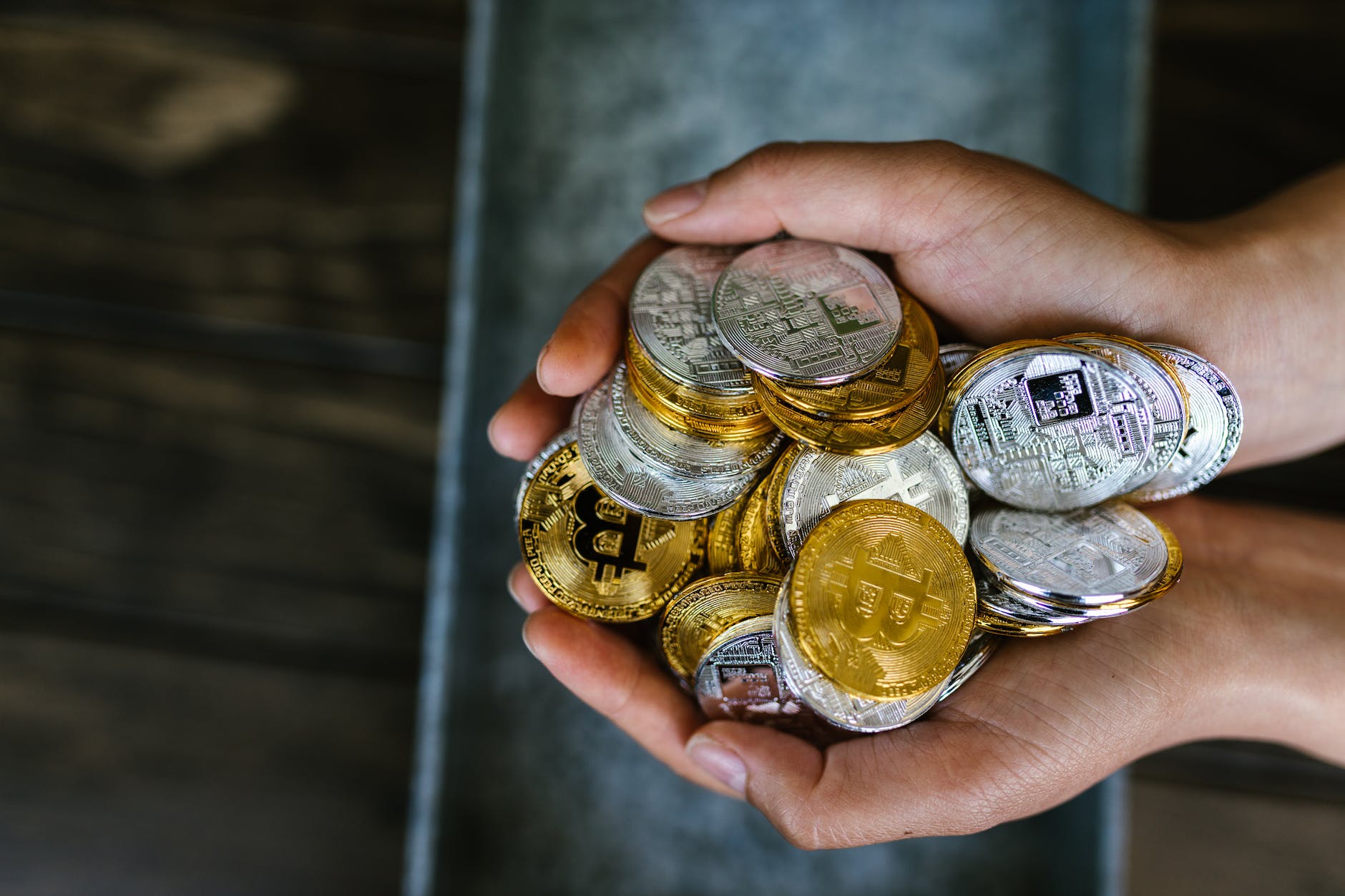
Photo by Jonathan Borba on Pexels.com

Supply and Demand

Like other things, cryptocurrency is also affected by supply and demand as the demand increase more rapidly than the supply. The value of a certain cryptocurrency would go higher. And likewise, if the supply is more than the demand, then the value of certain cryptocurrencies would be lower. 

The basic same demand and supply principle applies to cryptocurrency too. In such a situation, crypto investors should focus on the demand and supply of certain cryptocurrencies to understand the upcoming trend. 

Fee of Exchange

Sometimes the token can be available on a huge number of crypto exchanges, which surely raises the number of people purchasing and using the same tokens. For every swap on any cryptocurrency token on the exchange, the user has to pay some fee to the exchange. 

The more exchanges, the more fees the user has to pay to swap the token. This process certainly raises the investment cost. There is no doubt this has a huge effect on the cryptocurrency value. 

The Competition 

In the cryptocurrency market, there are lots of cryptocurrencies existing. Still, the new token keeps launching every month or even every week. There are doge coins, some soccer team coins, and many more. 

The number of the existing token would allure new investors, and surely sooner or later, it would affect the value of cryptocurrency. It would also give the investors many options which can fit into their financial statements. To know about other coins, check Bitcoin PRO.

The cost of Production 

The cost of Production is one of the major factors that have a huge effect on the value of cryptocurrency. Every day, from all over the world, crypto miners use high-end servers and other computer hardware to produce new tokens and try to verify fresh network transactions. 

Miners get the virtual token with the rewards as the payment and the network fee for their work. Such miners’ network performance allows the decentralization of the cryptocurrency in the working mode. And if, in any situation, the cost of the miner would increase, surely it would also affect the value of cryptocurrency. 

The Social Media

Undoubtedly, social media plays an important role in cryptocurrency value. Like other things, if social media build hype about any cryptocurrency at any point in time, people worldwide would show interest in the cryptocurrency. The result would affect the certain cryptocurrency value. 

For example, in recent years, many times Tesla Founder Elon Musk’s statements over the tweeter affect the Dogecoin value. This one was something that everyone witnessed. For investors, social media is one of the most powerful tools. 

Regulations of Government

From all over the world, every ruling government has its point of view regarding cryptocurrency. And they make the regulations according to their point of view about cryptocurrency. Sometimes such kind of regulations is in favor of cryptocurrency, and sometimes not. 

The worth of cryptocurrencies might be affected under any of these situations. Such as some countries they are also decided to ban bitcoin and a few other crypto coins to control the crypto market. In such a situation, many crypto investors would be unable to invest further in crypto. This would devaluate cryptocurrencyies.

Under Supply of Cryptocurrency

According to the theories, there is a limitation on the cryptocurrency supply, and the price would automatically go up trends once fewer coins are available. As per the same theory, 40% of coins are circulating all over the internet, and 60% are still reserved, and then the value would be decreased when more coins would be available for buyers all over the internet. 

Conclusion

The value of cryptocurrency is affected by a lot of factors. Some factors affect the value of cryptocurrency directly, and some affect the cryptocurrency indirectly. In both situations, investors must be more careful while trading in cryptocurrency. 

To understand the effect of certain factors on cryptocurrency, investors have to show a keen interest in cryptocurrency news.

Know about Dogecoin

 Dogecoin is a name that you’ll recognize even when you’re blindfolded. This cryptocurrency has been continually trending on Reddit and Twitter, making it extremely popular. Even though it was the first “meme coin,” Elon Musk praised it and even accepted it as payment for Tesla. What began as a joke evolved into one of the most obvious ways for bitcoin users to tip creators online, make online purchases, and interact with one another. For more information on bit alpha ai click here.

Dogecoin is not a cryptocurrency that has resulted in technological advances and has yet to achieve anything noteworthy. Dogecoin was designed solely to mock the other altcoins that were available at the time. The money eventually evolved into much more than a simple spoof. 

Photo by RODNAE Productions on Pexels.com

What is the source of all this success? What makes Dogecoin so appealing to investors? Let’s take a closer look into Dogecoin’s antics and understand its history and what makes it unique among cryptocurrencies. There is a wealth of data on Dogecoin available in this article.

  • Historical Perspective 

Jackson Palmer and Billy Markus created the digital currency Dogecoin in December 2013. They had a more casual, optimistic view of the bitcoin market, which is more widespread now. 

In a couple of hours, Markus had invented the token as a parody of Bitcoin, the current leading cryptocurrency. As the crypto community has evolved from its former elitist and aristocratic state, the joke is intended to poke fun at the past. This is why the Dogecoin developers want to create a friendly, welcoming, and lighthearted neighborhood.

At the time, Billy Markus was a software engineer for IBM in Portland, Oregon, and Jackson Palmer was a product manager for Adobe Inc. in Sydney, Australia. Palmer created the token. Once Markus learned about it, he contacted Palmer to ask permission to create the software that runs it. 

Dogecoin initially provided block miners with a randomized payment. That situation changed when Dogecoin implemented a fixed payment to miners of 10,000 DOGE tokens in 2014.

Even if Bitcoin’s price only fluctuated by about $1,000 in 2013, many more individuals started to take cryptocurrencies seriously—possibly a bit too seriously. The Shiba Inu dog meme was chosen as the two artists’ mascot after brainstorming something intriguing together. The internet was intrigued by this unique approach to cryptocurrencies, given its presence. 

  • Its creation

They created the Dogecoin cryptocurrency using the Scrypt-based Proof-of-Work (PoW) consensus algorithm employed by Luckycoin. PoW is a technique for determining who updates transactions on a blockchain network, and it is often tied to the computational power miners or nodes contributing to transaction validation. 

Although Luckycoin (LKY) was an innovative open-source P2P money that used cutting-edge cryptographic techniques for security, it has now become obsolete. As with Litecoin, Luckycoin relied heavily on that cryptocurrency’s codebase. 

For online payments, Charlie Lee, a former Google developer, launched Litecoin (LTC) in 2011.

  • Its Popularity

This “meme coin” sparked a flurry of interest throughout the internet and now boasts one of the world’s largest crypto communities. It is regarded as a welcoming and beginner-friendly coin and is also well-known for its charitable contributions and support of numerous other worthy causes.

Shibes are members of the Dogecoin community. They have their language, which you must see for yourself to understand. In general, the community is most interested in having a good time. What a blast! (Shibe dialect)Since Dogecoin has grown in popularity, let’s consider what makes it tick.

  • Its Features

Dogecoin, like practically every other cryptocurrency, is built on blockchain technology. The blockchain is a massive database that maintains transaction information, known as a public ledger. Miners must solve a cryptographic challenge to validate transactions and receive rewards.

After that, every transaction you perform using Dogecoin is recorded on the Dogecoin blockchain network. It’s worth noting that the blockchain isn’t stored on a single hard disc or a single central server; instead, it’s distributed across thousands of computers known as nodes. This is what makes DCNs so unique and desirable. They are not centrally located but rather scattered around the world.

Conclusion

The fact that Dogecoin is the newest cryptocurrency is common knowledge. It has not yet attained a level of acceptability that constitutes a critical mass. Even still, business magnates like Elon Musk have hailed the concept. 

If a person of such prominence and accomplishment can see the potential in this novel monetary system, it is destined for greatness. Let’s wait and see whether it gains traction in the future since, right now, it’s not very popular. 

Cryptocurrency to cash

 Although cryptocurrency is quickly becoming a smart investment option for people, it has some practical problems. For example Trading Software, people cannot use it for all day-to-day transactions, such as paying restaurant bills and paying personal effects.

Therefore, the question arises whether we can convert cryptocurrency into cash. It’s an interesting question, isn’t it? Cryptocurrency is a highly unregulated virtual currency with high price fluctuations. But turning it into money is quite simple. Well, you certainly have the option of converting it into cash, but you should also know that crypto transactions are now a global phenomena. Around 15000 companies are accepting Bitcoin payment. 

Photo by Alesia Kozik on Pexels.com

So, if you want to convert Bitcoin to cash, there are a few things to keep in mind to ensure that once the cryptocurrencies are converted into cash, the real value of the money is not lost. Due to the volatility of digital tokens, the risk of losing the value of your money is great.

Although it is possible to convert cryptocurrencies into cash, it is essential to note that since they are not recognized as legal tender in the country, the income must be taxable.

How can I turn my digital currency into cash?

Recently, a news item raised this problem, which is very common.

There are three ways to convert cryptocurrency into fiat currency: mining, trading cryptocurrency, and using cryptocurrency as a payment method.

Converting cryptocurrencies to fiat through mining is likely to be lengthy. Creating new crypto assets involves solving computer puzzles and speculating on their solutions.

Another way to convert cryptocurrencies into cash is to exchange crypto assets. You can easily sell your crypto assets to other users on an online trading platform in exchange for cash or other crypto assets. 

Using fiat currency is the third way to convert cryptocurrencies into cash. For example, businesses and services that accept bitcoin will exchange the cryptocurrency for fiat currency to pay their vendors. The procedure is very much like making a purchase using a credit card.

Advantages of cash over cryptocurrencies:

  • The idea was that compared to bitcoin (BTC), bitcoin cash (BCH) could make more transactions faster and cheaper. The reality is that bitcoin cash has come to an end. It’s just another Proof-of-Work (PoW) altcoin, like many others, like Dogecoin, that has no future.
  • The incredibly talented developers who have contributed so much to Bitcoin’s success have stuck with it. As a result, bitcoin is evolving into a very secure settlement layer which, along with layer 2 and 3 applications, could be essential for the world of finance.
  • BTH is based on the archaic idea that one can use cryptocurrency to buy a cup of coffee. BTH and BTC use the SHA-256 hash function as their proof-of-work (PoW) algorithm. BCH has very low usage and very low difficulty settings, so BTH is only more efficient than BTC because it is less secure than BTC.
  • Naturally, BCH is neither more efficient nor less efficient than BTC. However, BCH is not preparing for future significant use cases. Proof of Stake (PoS) is where things currently seem to be heading, as it will be controlled by cryptocurrency if used for small purchases.

Top cryptocurrencies to hold:

Ethereal

If you’re surprised the list doesn’t start with bitcoin, it’s time to turn your attention to other cryptocurrencies worth buying this month. Ethereum fell from USD 4,300 to USD 2,300. However, little by little, it picks up speed. According to experts, Ethereum has a chance to overtake Bitcoin this month and emerge as one of the best cryptocurrencies to invest in June.

Cardano

Cardano is the best cryptocurrency to buy right now, as the blockchain will see a lot of new developments and improvements. Because of this, it has a tremendous potential to bring in profits over the long run for the sake of investing. In support of Cardano, IOHK presented the Alonzo hard fork project. On the Cardano blockchain, this will enable the functionality of smart contracts.

Cash

Due to its fast transaction processing and low transaction fees, Bitcoin Cash is considered one of the best cryptocurrencies to invest in. The scalability of this crypto indicates significant future growth potential. Due to the huge price drop, now is the perfect time to invest in Bitcoin Cash.

Ripple

Ripple is now making headlines for winning a lawsuit with the Securities and Exchange Commission (SEC) after refusing to provide access to Ripple Labs’ private legal status documentation. Ripple’s growth is fueled by its popularity. Also, it plans to go public. This should be an essential factor to consider if you are looking to invest in major cryptocurrencies in November.

Conclusion:

This article is all about converting crypto to cash. This article is for you if you want to know how to do it and how it is beneficial. You can also trust the Bitcoin Era app.

What do You need to Know to Succeed in the Cryptocurrency Market?

 Before you can succeed with cryptocurrencies, you must know what you’re doing. It can’t be simple to learn all there is to know about cryptocurrencies when you’re just starting. For more detail about Bitsoft360 visit at this link.

Numerous services, exchanges, and wallets are accessible, but keeping track of all their abbreviations might be difficult. Stay away from the bitcoin market if you don’t know what you’re doing.

Photo by Worldspectrum on Pexels.com

In essence, you are gambling with money that has no worth until someone else decides that it does. If you want to make it big in the bitcoin market, consider the advice below.

First and foremost, keep in mind that the market is always right while trading cryptocurrencies; the market is always right. Yes, there are days when market predictions are more accurate than others. However, you may conclude that you are at fault if its behavior deviates from your expectations.

Do not give anybody access to your financial resources:

Several individuals may approach you, hoping to borrow some of your coins. It might be tempting to lend money to someone who asks, but you should avoid doing so if possible. That’s because the value of a single cryptocurrency coin may fall if it’s misplaced or stolen, and cryptocurrencies are notoriously unstable. To avoid being taken advantage of, you should only put your money into projects or currencies you have faith in.

If you want to maintain track of your investments, please do the following:

Even if there is no practical need to keep track of your bitcoin investment amounts, doing so is a good habit to get into. If you think the currency is a good investment, you may consider buying more. The business world might seem like one big hoax when you’re just starting. If you want to know what to anticipate from your assets in the future, tracking them is a smart move.

Take a look at the white paper:

It’s tough to make it as a cryptocurrency investor if you don’t know what a coin is or the project’s goals. Some digital currencies lack even a whitepaper. You should stay away from any currency that doesn’t have a whitepaper. 

You should read the whitepaper before making any financial commitments. Furthermore, you must provide adequate evidence that the corporation supposedly backing the initiative is doing so.

Get more for your money when you stock up:

Many people wrongly believe that purchasing in large quantities is a negative idea when, in fact, it often saves them money. It is in your best interest to purchase coins as quickly as possible after becoming aware of their existence since their value may fall precipitously over time.

Technical analysis is based on the principle of “less is more”; thus, all that you need to know about wedges, breakouts, bull flags, upward and downward bands, trends, stochastic RSI, exponential moving averages, and candlestick charts to succeed in bitcoin trading is the basics of these indicators. 

However, shorter periods are nearly always more error-prone, so if you know it would take hours to uncover anything, don’t attempt to design your TA using minute numbers.

Investment Strategy:

Successful investing and trading require a thorough familiarity with market dynamics and trade practices. You may compare the pros and cons of each cryptocurrency with the help of your techniques and methods. 

It helps you recognize trends and maintain a watchful eye on the latest happenings in the world. You may utilize that knowledge to further your career and expand your grasp of the industry.

Have a plan B ready?

Make contingency measures in case anything goes wrong. Successful traders know they must be flexible and prepared for anything. New traders are especially vulnerable to the mental turmoil resulting from sudden market reductions. 

Avoid letting your emotions cloud your judgment. Instead of behaving impulsively, it would be better to take a more calculated approach.

If you study the market and a few different cryptocurrencies in-depth, you’ll have a better idea of when to buy and sell. Keep in mind that the notion that the bitcoin market is very unstable is widely held. 

One day, a cryptocurrency may be a great investment; the next, it may be worthless. Keeping tabs on the bitcoin market is a great way to get insight into common trends and price movements in the cryptocurrency industry. A lot more money can be made if you just do as I say.

How to Use a Wallet for Cryptocurrencies?

If you keep all of your digital money on exchange platforms, hackers may easily access it. Money stored in a physical or digital wallet is guaranteed to remain safe. There is a separate purchase for your wallet, or you may buy one online and save it to your computer’s storage device.

Tap on this download to download those who want to invest in cryptos.

Conclusion:

Although bitcoin is still in its infancy, the sector shows immense potential. Putting money into cryptocurrencies is a high-stakes gamble. Therefore it’s crucial to complete your research before making any purchases. Success is far more likely if you invest time into studying the bitcoin market and how it operates.

Top Reasons to hoard bitcoins right now

 As per bitcoin’s history in the past years, it provided a 59% return in the year of 2020, a 60% return in the year of 2021, and then in 2022, there was a decline of 67%. Still, a question occurs in the crypto investors’ minds the bitcoin worth it to hoard or not? Learn more profit edge Application click here

Photo by RODNAE Productions on Pexels.com

Some experts still insist on hoarding bitcoin because huge profits await investors in the upcoming years. Let’s dive into it. Does bitcoin still have the ability to give good returns or not? 

Rising Trend of Bitcoin

Major tech and non-tech firms are rapidly increasing the usage of bitcoin in their expenses, such as bonuses to the employee or allowing customers to pay in bitcoins. For example, in recent times, Tesla founder Elon Musk created a sensation in the bitcoin price when he announced, “Tesla would accept the bitcoin as the payment of its electric vehicle.”

On the other hand, all over the world, people are considering using bitcoin as a trading currency like the dollar, euro, or any other trading currency presently. Some e-Commerce portals allow the customer to pay via bitcoins or any other cryptocurrency.   

With time, bitcoin will hold its presence worldwide like the usual trading currency. Sooner we are going to witness the situation when bitcoin and cryptocurrency would trade like the usual currency. After that, holding bitcoin will undoubtedly provide some amazing returns in the upcoming years.

The safest asset

As everyone is aware, no centralized enterprise or authority manages bitcoin. So it is one of the safest assets for people. In the world, no government can seize this asset from any of the holders. If an individual holds the assets, no one can seize or still the asset, and exceptions are always there, such as theft of the key or loss of a hot wallet. And one of the best things no one will know is how much an individual possesses. For a bitcoin trade, an investor can use CRYPTOSoft, one of the best of its own. 

Instead of holding the assets in a bank or vault. In any situation, if something happens, then the assets are seized by the holder’s authority or the government. Bitcoin allows the investor to be the authorized person to use the currency whenever required without nobody’s intervention. 

Furthermore, there is a major advantage of keeping some bitcoin in reserve. Why wouldn’t it hold the currency that anyone in any circumstances can seize?

Is it the best time to Buy?

The current rate of the bitcoin is $16987.80 per bitcoin, according to the 6th of December 2022, and in June 2022, it was $31,148.30 per bitcoin. Why not buy bitcoin? Compared to June 2022 and December 2022, an individual gets one bitcoin at almost half price. 

And if an individual considers himself one of those investors who would buy the bitcoin at the bottom price, then this is something like I would drive my car when every signal is green. This is an amazing time to buy bitcoin. 

As it is obvious, no one can control the bitcoin rates. However, an individual can prevent the loss. Hence, before buying bitcoin at this time, keep the below-mentioned things in mind: 

  • Only invest the amount which cannot affect life in the situation of loss. 
  • What’s the storage device? Such as a “hot wallet” or “cold wallet”? 

Accessible to move

Let’s look at it this way, suppose an individual is hoarding gold and silver. It would take effort and time. Or maybe it can be theft in the middle of the moving process. But this doesn’t hold true with Bitcoin.

Bitcoin transactions between accounts may be completed in a matter of seconds. A sender needs the receiver’s wallet address, internet connection, smartphone, laptop, or desktop. With one click, the bitcoin would be in another account. 

Conclusion

Hoarding bitcoin at this time is going to provide some huge financial benefits. Due to this, it has declined a lot since June. As per the cryptocurrency expert, it is going to be upward soon. Before bitcoin starts to trend upward, invest something into it. Even many governments from all over the world also hoard bitcoin in their treasures to deal with inflation.

ZERO DISCRIMINATION DAY

 ZERO DISCRIMINATION DAY

Every year on March 1, Zero Discrimination Day is honoured. It is primarily observed by the United Nations and other global institutions with the goal of eradicating all forms of inequality and injustice. Individuals must work together and contribute in order to build an unstoppable movement that promotes change and peace.


HISTORY OF ZERO DISCRIMINATION DAY

Every year on March 1, there is a global movement known as Zero Discrimination Day. The day, which is sponsored by UNAIDS, is a rallying cry for combating prejudice in all its manifestations and advancing tolerance and social inclusion. Although not everyone has the same level of privilege, it is wrong to deny someone the freedom to live their life as they see fit. All people have the right to live in dignity, regardless of their appearance, colour, location, or religious beliefs.

Unexpectedly, prejudice to the unfamiliar and ignorance are frequently the core causes of discrimination. A strategy to foster tolerance and patience for others is to raise awareness of and engage in discourse about discrimination. Discrimination must be fought against since it effectively violates human rights. Everyone has a chance to change things, which is wonderful news. Even if it might not appear that way, one action can start a chain reaction that changes civilizations such that they are founded on justice and equality.

The first Zero Discrimination Day was established in December 2013 by Michel Sidibé, the UNAIDS Director at the time. Zero Discrimination Day was held to put a stop to prejudice and discriminatory conduct toward various people and was inspired by World AIDS Day, a day dedicated to battling intolerance toward persons living with HIV/AIDS. In order to advance this cause, the United Nations has organised a number of events and created campaigns that recognise human life and the freedom to live it with honour and dignity, regardless of gender, race, religion, colour, country, impairments, and profession.

How to Observe Zero Discrimination Day

1. Celebrate Diversity

Celebrate the wonderful people in your life. Examine the impact of inequality on others.

2. Talk about it

Hold a seminar or discussion about discrimination. Find out what you can do to end it with people in your community.

3. Participate in campaigns

You can also participate in events held in your area. Register as a volunteer or join as a companion.

Why Zero Discrimination Day is Important

1. You Can Make a Difference

Small actions can make a difference. Whether at the individual, local or national level, it is important to speak up in situations of racial injustice and other issues of justice.

2. Struggle for Freedom

Discrimination is still an obstacle today. Only when grassroots discrimination is eliminated can real progress be made

3. Awareness is essential

We still have a long way to go. Until then, awareness of victims of discrimination is essential.

Five Facts About Discrimination

1. Racial Barriers

According to a recent poll conducted by the Pew Research Center, black Americans believe that their race hinders their success. I think it is highly possible.

2. Discrimination is man-made

Scientists refer to race as a man-made social construct, not a biological problem.

3. The numbers tell

He is less than 13% of the white students attending black majority schools.

4. Worse Figure

Although the figure is fairly low, black students make up one-third of all students expelled or suspended.

5. Unjustified Privilege

Official police statistics show that police are less likely to stop and investigate white Americans.


World NGO Day

World NGO Day is celebrated on February 27th each year. N.G.O. is an acronym for Non-Governmental Organization. World NGO Day is a day to recognize, celebrate and appreciate the fundamental contributions and profound impact these independent organizations have on the world. NGOs are non-profit organizations and are a modern phenomenon, but their history goes back hundreds of years. Her influence continues to grow, bringing positive change where it is needed in today’s world.

World NGO Day History

World NGO Day was founded in 2009 by social entrepreneur Marcis Liors Skadmanis. However, he was first observed on February 27, 2014. A day to honor all non-governmental and non-profit organizations and recognize their impact on the world.

This holiday was officially proclaimed in 2010 he by 12 member states of the Baltic NGO Forum. The Baltic NGO Forum is a recognized partner of the Baltic States Council.

However, it only received international recognition from the European Union, the United Nations, and other international organizations in 2014.

N.G.O. defined by the United Nations Department of Global Communications as an organization that is “a non-profit, voluntary civic group established at the local, national, or international level to address issues in support of the public interest.”

Although the history of N.G.O.s goes back to the 18th century, the name “Non-Governmental Organizations” was created by Article 71 of the 1945 United Nations Charter – Non-Profit Organizations (N.P.O.s.).

s), affiliates and charities.

N.G.O.’s distinguishing feature is its independence from the government. NGOs are privately funded through grants, individual donations, dues, product sales, and sometimes government donations. Research shows that NGOs enjoy high levels of public trust and can help voice public concerns.

According to the World Bank, there are two types of NG

Operating Systems These are the Operating N.G.O. and Advocacy N.G.O. While the former focuses on the design and implementation of development-related projects, advocacy NGOs promote specific causes that influence public policy.

CELEBRATING WORLD NGO DAY

1. SUPPORT THE CAUSE

NGO needs the help of volunteers. Celebrate World NGO Day by volunteering for worthy causes.

2. Donations

As non-profit organizations, NGOs rely on donations to continue their work. Consider going to an NGO if that’s within your means. World NGO Day.

3. Use the hashtag

Use the hashtag #worldngoday on your social media platforms

Post about someone you know who is volunteering with an NGO. It is the selfless efforts of these individuals that sustain the work and effectiveness of NGOs around the world.

WHY WORLD NGO DAY IS IMPORTANT

1. An Opportunity to Honor N.G.Os

This holiday is an opportunity to honor altruistic individuals who have contributed to the success of his N.G.Os around the world.

From founders to employees, volunteers to regular supporters, we have the opportunity to show our support.

2. Create Awareness

There are many good reasons that are often overlooked. World NGO Day is an opportunity to shine a spotlight on these issues, especially humanitarian issues.

3. Inspirational

This special day not only raises awareness but also encourages others to get involved. Donate or volunteer.


International Women's Day

International Women’s Day (March 8) is a global day to celebrate the historical, cultural, and political achievements of women. This day is also observed to support action against gender inequality around the world. We all know the world wouldn’t be complete without women. This is the day to recognize their efforts! Organizations large and small come together to show how valuable women are in today’s society. Also, help women in your area find scholarship resources available to women around the world to spread their wings and fly higher.


When is International Women’s Day in 2023?

International Women’s Day is March 8th. It celebrates women’s achievements and how far they have come in the struggle for their rights in politics, culture, and society.

International Women’s Day History

Political activist Susan B. Anthony fought for the rights of women. She advocated for the 14th Amendment after the Civil War in the hopes that it would include the ability to vote and grant citizenship to all naturalised and indigenous peoples. Despite its ratification in 1868, the 14th Amendment did not win her support. Elizabeth Cady Stanton and Susan B. Anthony established the National Women’s Suffrage Association (NWSA) in 1869 to carry on the battle for women’s rights.

Women faced overwork, unequal pay, and a lack of voting rights in the early 1900s. In response, 15,000 women demonstrated for their rights across New York City in 1908.

The Socialist Party of America declared 1909 to be the inaugural National Women’s Day, marking the occasion with a proclamation.

In August 1910, the International Women’s Conference was organized by Clara Zetkin, German suffragist and head of the Women’s Bureau. Zetkin proposed organizing a special Women’s Day each year, and International Women’s Day was held the following year in Austria, Denmark, Germany, and Switzerland, with more than one million people attending the rally. Feminism and the fight against gender inequality have revived as the internet has become more popular. Today, we celebrate International Women’s Day every year and work continuously to create a fully equal society.

SIGNIFICANCE:

UNESCO states that International Women’s Day is an occasion to celebrate progress toward gender equality and women’s empowerment, but it critically reflects on these achievements and promotes progress toward global gender equality. Advocate for greater momentum. It is a day to recognize the extraordinary behavior of women and stand together to advance gender equality around the world.

THEME:

This year’s UN theme is ‘Gender Equality Today for a Sustainable Tomorrow’, honoring, celebrating, and leadership of the women and girls who are responsible for adapting and responding to climate change. and to acknowledge contributions. Towards a sustainable future.

How is this day celebrated around the world?

International Women’s Day is celebrated as a national holiday in countries around the world, where women are often presented with flowers and gifts celebrated around the world. IWD events are held in major cities in

On March 8, 1914, prominent activist Sylvia Pankhurst was arrested during a women’s suffrage demonstration in London demanding women’s suffrage.

In 2001, the internationalwomensday.com platform was launched to rekindle awareness of the day, celebrate women’s achievements and continue to promote gender equality.

2023 Science Vision

 In a media interaction on the first day of the New Year, Union Minister of State (Independent Charge) Science & Technology; Minister of State (Independent Charge) Earth Sciences; MoS PMO, Personnel, Public Grievances, Pensions, Atomic Energy and Space, Dr Jitendra Singh today said, 2023 Science Vision will define India at 2047.

Dr Jitendra Singh added that the year 2023 also happens to be the first of the last 25 years or the last quarter of the calendar before independent India turns 100 at 2047 and realizes its century dreams.

This is also the year, the Minister said, when India under PM Narendra Modi reiterates its stature in the international fora as the host of G20 as well as the Nation on whose proposal the world is observing International Year of Millets.

Dr Jitendra Singh said, “The future belongs to those who have innovative ideas and out-of-box goals, and have the conviction and courage to achieve the same. The Minister emphasized that today we have a Prime Minister, who not only thinks out of box, but inspires 130 Crore Indians to take decisions with courage of conviction.

Referring to Prime Minister Narendra Modi’s penchant for “Innovation”, Dr Jitendra Singh pointed out to his Independence Day address, where he had said, “Till today we always remember our revered Lal Bahadur Shastri ji for his inspirational clarion call of Jai Jawan Jai Kisan meaning “Hail the Soldier, Hail the Farmer”. Later Atal Bihari Vajpayee ji added a new link of Jai Vigyan which meant “hail science” and we gave it utmost importance. But in this new phase Amrit Kaal now it is imperative to add jai anusandhaan that is “hail innovation”. “Jai Jawan Jai Kisan Jai Vigyan Jai Anusandhaan.”

Dr Jitendra Singh underlined that in the Centre –State Science Conclave held in September, 2022 also, Modi had highlighted that in order to make India a global center of research and innovation in this Amrit Kaal, we have to work on many fronts simultaneously and stressed the need to take science and technology-related research to the local level. 

Departments dealing with Science and Technology have already outlined their focus and thrust areas for the year 2023. 

ISRO, after the opening up of Space Sector to private participants on the intervention of PM Modi, today has more than 100 StartUps in a short span of time. At the same time, its focus is on scientific exploration missions, Technology Demonstration missions and Human spaceflight programme “Gaganyan” in 2024. 

The department of Biotechnology (DBT) would take forward the successes of COVID-19 vaccine mission by investing in improvement of vaccines for the existing and emerging diseases. Significantly, major missions would also be launched on millets and patho-genomics of plant viruses in the International Year of Millets.

CSIR in 2023 will also focus on Green Hydrogen as it has already made a headway in Green Hydrogen indigenous as part of clean energy mission.

The Ministry of Earth Sciences (MoES) will focus on Deep Sea mission & technologies which will add value to India’s economy in the years to come. 2023 will also witness further headway in Blue Economy. Significantly, PM Modi referred to Deep Ocean Mission twice in his Independence Day address, first in 2021 and then again in 2022.

Department of Atomic Energy, DAE in its contribution to India’s Electoral Management will deliver about 21.00 lakh equipment for the Election Commission of India which includes Ballot Units (BU), Control Units(CU) and Voter Verifiable Paper Audit Trail (VVPAT) to be completed by ECIL by Sept/Oct 2023. 


Pele leaves behind a legacy

Pele was one the greatest. He pushed football to new heights. But now we have a void which can never be filled. The place which he had in the football world and among his fans, will become sacred.

Days after Argentina lifted the World Cup and the football world was basking in the success of the glorious tournament, Pele left us with just his memories. 

Pele always wanted to be the best in the world. The most beautiful game on the planet gave him the respect that he deserved. He was always eager to put his family name on the top, especially his father’s. his father was also a player and loved the sport a lot. But he didn’t get the popularity or the recognition that he wanted. So, Pele fulfilled his wish and became the best football player in the world. Pele, started his career at the age of just 17 at the World Cup, in the year 1958.

 He was one of a kind, whose most of his career was during the radio era. After the arrival of television, he played for some time and gave a glimpse of his greatness to the world. The moves and the technique he had, were one of a kind. He was the one, who despite being a legend, treated everyone around him with respect.

https://unsplash.com/photos/lBhhnhndpE0

He even showed the world that anyone can connect with the entire world at one point without taking into consideration, caste, religion or skin colour. The mere mention of his name made sure that everyone was glued to the presence he had on the field. His style of play was magical. He was one of a kind, who can never be replicated. His entire charisma was the benchmark for future generations.

The people of his generation made sure that no one ever forgets the player, who gave the world one big reason to love the game of football. The sheer magnitude with which people loved him and his style, was proof that his name will remain in the history books forever.

He also made sure that even after he retired from the sport, he was still in touch with the game. The love he had for the game never fainted and always praised any perfect moment in any match. The sheer pleasure he experienced in watching the magical game, brought him closer to the hearts of his fans. 

He was the one who loved every instance and even the changes to the game. The implementation of technology is also good for the game, as even he realized the importance and the positive effects on the game. But the various advancements were never able to explain or overshadow the pure brilliance with which he played the game. All the other greats of his time were in agreement that he was the one who made sure that others who didn’t love the game, also kept an eye on the most popular sport. So, he was, is and will remain the best in the world.

Samagra Shiksha Scheme has been aligned with the recommendations of the National Education Policy

 Samagra Shiksha

The Centrally sponsored scheme of Samagra Shiksha of the Department of School Education and Literacy is an overarching programme for the school education sector extending from pre-school to class XII. The scheme treats school education as a continuum and is in accordance with Sustainable Development Goal for Education (SDG-4). The Samagra Shiksha Scheme has been aligned with the recommendations of the National Education Policy: 2020 (NEP: 2020) and extended from 2021-22 to 2025-26. 


Cabinet Committee on Economic Affairs has approved continuation of Samagra Shiksha Scheme for a period of five years i.e., from 2021-22 to 2025-26 with a total financial outlay of Rs 2,94,283.04 crores which includes Central share of Rs 1,85,398.32 crores, as per EFC recommendations and approval of revised programmatic and financial norms.


ICT and smart class approvals: Under the Information & Communication Technology (ICT) component of the Samagra Shiksha Scheme, there is a provision to impart computer literacy and computer-enabled learning to children, by developing and deploying curriculum-based interactive multimedia, digital books, virtual labs etc. across the country. It supports the establishment of smart classrooms, and ICT labs in schools, including support for hardware, educational software and e-content for teaching. It envisages covering all Government/Government-aided schools with classes VI to XII. Till November 2022 (since inception), ICT Labs have been approved in 1,20,614 schools and Smart classrooms in 82,120 schools across the country.


Brief of activities undertaken from 1st January, 2022 to 31st December, 2022 is as under:

  1. Shiksha Shabdkosh – Department of School Education & Literacy has brought out Shiksha Shabdkosh, a document on glossary of various terminologies in School Education and a compilation of all the terms which have been used in the context of school education.
  2. Samagra Shiksha Framework for Implementation – Department of School Education & Literacy has issued a Samagra Shiksha Framework, which gives the Key Performance Indicators (KPI) for each component and physical and financial details of implementation of each component of Samagra Shiksha.
  3. 444531 Schools have awarded Fit India Flag, and 43074 Schools have applied for 3 Stars Rating and 13008 Schools have applied for 5 Stars rating.
  4. 4th FIT India School Week is being celebrated from 15th November 2022 till 15th January 2023. Till 19th December 2022, total 1,17,844 students participated in various activities.
  5. FIT INDIA Quiz 2022 for schools has been launched by FIT India Team. In this 1,74,473 students registered from 42,490 schools across 36 States/UTs in 2022.
  6. A Virtual event on Assistive Technology Innovations for Inclusive Education as a part of Azadi Ka Amrit Mahotsav (AKAM): As a part of Azadi Ka Amrit Mahotsav (AKAM), Department of School Education & Literacy, Ministry of Education, in collaboration with Atal Innovation Mission, NITI Aayog organized a virtual event on Assistive Technology startups for Inclusive Education showcasing innovations and startup solutions on January 17, 2022. The virtual event on ‘Assistive Technology Innovations for Inclusive Education’ focused on start-ups and their innovations that enhance or aid the learning of children with special needs.
  7. Fifth edition of Pariksha Pe Charcha, the unique interactive program of Hon’ble Prime Minister, Shri Narendra Modi with students, teachers and parents was held successfully on 1st April 2022 at Talkatora Stadium. Selection for this program was carried out through a creative writing competition for the students of classes 9 to 12, teachers and parents on MyGov.in portal from 28th December, 2021 to 3rd February, 2022.


PRASHAST Mobile App – “Pre Assessment Holistic Screening Tool”:


Department of School Education & Literacy has launched a Disabilities Screening Checklist for Schools and an Android Mobile App titled as PRASHAST Mobile App – “Pre Assessment Holistic Screening Tool” for schools during Shikshak Parv, 2022. PRASHAST App will help in screening 21 disability conditions recognized in RPwD Act, 2016, at the school level and will generate the school-wise report, for further sharing with the authorities for initiating the certification process, as per guidelines of Samagra Shiksha. PRASHAST Mobile App has been developed by CIET, NCERT.


Amendment in RTE Act, 2009 w.r.t. pupil teacher ratio for special educators in general schools:


The schedule to RTE Act, 2009 has been amended regarding pupil teacher ratio for special educators in general schools i.e. one special education teacher for every ten pupils with disabilities enrolled at primary level and one special education teacher for every fifteen pupils with disabilities enrolled at upper primary level and a notification has been published in Gazette of India vide Notification No. S.O. 4586 (E) dated 21.09.2022 (published on 29.09.2022).


Exam Accommodations to CwSN in Board Exams:

Virtual Inclusive Education Meets were organized by DoSEL on 31.01.2022 and 09.06.2022 with the IE coordinators of all states and UTs to review the status of Board Accommodations offered to CwSN. As information received from States/UTs, 32 out of 36 States/UTs have notified the exam accommodations provided to CWSN to be availed in Board Exams, 20 out of 36 States/UTs prepared Audio/ Video films on Exam Accommodations provided to CWSN in Board Exams and 27 out of 36 States/UTs conducted webinars to sensitize teachers/ principals on Exam Accommodations.


Up-gradation of Kasturba Gandhi Balika Vidvalavas (KGBVs):


KGBVs are residential schools under Samagra Shiksha, for girls from class VI to XII belonging to disadvantaged groups such as SC, ST, OBC, Minority and Below Poverty Line (BPL). Under Samagra Shiksha, provision has been made to upgrade/converge the existing KGBVs at upper primary level and Girls’ Hostels at secondary/senior secondary level, as feasible, up to Senior Secondary Level. The task of up-gradation of the KGBVs was started in the year 2018-19 and till the year 2022-23,a total of 357 KGBVs have been approved for up-gradation to Type-II (class 6-10) and 2010 KGBVs have been approved for up-gradation to Type-III (class 6-12).


PARAKH


NEP 2020 envisages a shift from summative assessment to regular and formative assessment, which is more competency-based, promotes learning and development, and tests higher-order skills, such as analysis, critical thinking, and conceptual clarity. In view of implementation of NEP 2020, a new National Assessment Centre, PARAKH (Performance Assessment, Review, and Analysis of Knowledge for Holistic Development) will be setup as a standard-setting body under Ministry of Education in NCERT. This centre will work for setting norms, standards, and guidelines for student assessment and evaluation for all recognized school boards of India, hand holding the States and undertaking the National Achievement Survey (NAS). This Centre will also advise school boards regarding new assessment patterns and latest researches, promoting collaborations between school boards. It will encourage and assist school boards to shift their assessment patterns towards meeting the skill requirements of the 21st century. PARAKH will be established as a technical organisation with knowledge of assessment standards and skills, as well as a robust understanding of policymaking and implementation.


National Achievement Survey (NAS) 2021:


The Government of India has been implementing a programme of sample based National Achievement Survey (NAS) aimed at classes III, V, VIII and X with a cycle period of three years. The NAS 2021 was held on 12.11.2021 and has covered (a) Government Schools (Central Government and State Government); (b) Government Aided Schools; and (c) Private Unaided Schools. Subjects covered are Language, Mathematics & EVS for class 3 & 5; Language, Mathematics, Science & Social Science for class 8 and Language, Mathematics, Science, Social Science and English for class 10. 


About 34,01,158 students of 1.18 lakh schools from both rural and urban areas, have appeared in NAS 2021 which was held on 12th  November, 2021. National, State/UT and District Reports for NAS 2021 have been released on 25.5.2022 and are available at http://nas.gov.in. The learning gaps identified at the district level will be used to provide feedback to the districts.


Further, a national level workshop on Post-NAS 21 interventions was organised on 28/07/2022 by Ministry of Education with representatives of all States/UTs, SCERTs, DIETS and NCERT. The purpose is to support State/UT governments in developing long term, mid-term and short-term interventions to improve learning levels and orient on differential planning based on NAS 2021 data. In addition, NCERT has conducted Post-NAS 21 regional workshops at many locations across the country. The purpose is to disseminate the findings of reports and assist states/UTs in planning strategies to bridge identified learning gaps as per NAS 21 data.


Actions initiated by the Department for implementation of NATIONAL EDUCATION POLICY (NEP):


  • NEP Implementation Plan ‘SARTHAQ’ (Students’ and Teachers’ Holistic Advancement through Quality Education) has been released on 8th April, 2021.
  • A National Foundational Literacy and Numeracy Mission named as ‘National Initiative for Proficiency in Reading with Understanding and Numeracy – (NIPUN BHARAT) was launched on 5th July 2021, for ensuring that every child in the country necessarily attains foundational literacy and numeracy in Grade 3 by 2026-27.
  • NCERT has developed a 3 Months Play Based ‘School Preparation Module’ named ‘Vidya Pravesh’ which was launched on 29thJuly 2021.
  • Foundational Learning Study (FLS) to assess the learning level of Class 3 students in Foundational Literacy and Numeracy was administered by MoE and NCERT in collaboration with States/UTs from 23rd to 26th March and 4th  to 6th  April, 2022 across all Indian States and Union Territories under the NIPUN-BHARAT Mission. The results for FLS were published on 06th September 2022 in the form of national, state and district reports. The reports can be accessed at: https://dsel.education.gov.in/fls_2022 .
  • To connect the Government and Government aided schools through a community/volunteer management program, the Department has revamped the Vidyanjali web portal. The newly introduced portal – Vidyanjali 2.0 aims to help the community/volunteers interact and connect directly with schools of their choice to share their knowledge and skills as well as contribute in the form of assets/material/equipment. 
  • The department has aligned our existing schemes i.e, Samagra Shiksha and Mid Day Meal with the recommendation of NEP 2020.
  • NISHTHA 4.0 (ECCE) – Online: Teacher training programme for Early Childhood Care and Education has been launched on 06th September, 2022 with 6 modules. Initiated in 36 States/UTs in 2 languages, and in 5 Autonomous Organisation under MoE, MOD &MOTA. It targets to train 25 Lakh teachers and school heads at pre-primary and primary level.


PM Schools for Rising India (PM SHRI) :


The Cabinet has been approved a newly central sponsored scheme called PM SHRI on 7 September, 2022. These schools will showcase the implementation of the National Education Policy 2020 and emerge as exemplar schools over a period of time, and also offer leadership to other schools in the neighborhood. They will provide leadership in their respective regions in providing high-quality education in an equitable, inclusive and joyful school environment that takes care of the diverse background, multilingual needs, and different academic abilities of children and makes them active participants in their own learning process as per the vision of NEP 2020.


Under the scheme there is provision of setting up of More than 14500 PM SHRI Schools (PM ScHools for Rising India) by strengthening the existing schools from amongst schools managed by Central government/State/UT Government/local bodies.


The duration of scheme is proposed to be from 2022-23 to 2026-27; after which it shall be the responsibility of the States/UTs to continue to maintain the benchmarks achieved by these schools. More than 20 lakh students are expected to be direct beneficiaries of the scheme. The total cost of the project will be Rs.27360 crore spread over a period of 5 years which includes central share of Rs.18128 crore.

PM POSHAN Scheme

The Cabinet Committee on Economic Affairs (CCEA) has approved the continuation of PM POSHAN Scheme in Schools for the five-year period 2021-22 to 2025-26 with the financial outlay of central share of Rs.54,061.73 crore for five years from 2021-22 to 2025-26. During 2022-23 the scheme covers more than 12 crore children studying in Bal Vatika and classes I-VIII in Govt. and Govt. Aided Schools.

During 2022-23 (upto December 2022), Rs 6758.84 crore had been released to States and UTs as central assistance and 29.68 lakh MT foodgrains had been allocated to them. 

PM POSHAN Scheme Guidelines have been comprehensively revised and several focus areas such as Public Financial Management System, Quality and Safety Aspects, Social Audit, Joint Review Mission, School Nutrition Gardens, Cooking Competitions, TithiBhojan, Supplementary Nutrition in Aspirational districts and districts having high burden of malnutrition, Information, Education and Communication (IEC) etc.

Material cost (earlier known as cooking cost), which includes cost of procurement of pulses, vegetables, oil, condiments and fuel has been enhanced to Rs 5.45 per child per day in primary and Rs 8.17 per child per day in upper primary w.e.f. 1st October, 2022. 

DoSE&L has decided to set up School Nutrition (Kitchen) Gardens (SNGs) and planting in an immense way. School Nutrition (kitchen) Gardens (SNGs) utilizes the schoolyard to reconnect the students to a natural world and make them aware about the true source of their food and teach them valuable gardening, agriculture concepts and skills that integrate with several subjects such as math, science, art, health and physical education and social studies etc. The vegetables and fruits grown in these kitchen gardens are being used in the preparation of hot cooked meals. This offers an opportunity for students to eat freshly grown vegetables loaded with vitamins and minerals which are essential source of their physical and mental growth & development.


Adult Education


New India Literacy Programme (NILP): Keeping in view the recommendations of NEP, 2020 and UNESCO Sustainable Development Goal (SDG) 4.6, a centrally sponsored scheme“New India Literacy Programme”(NILP)has been approved by the Government of India in this year with financial outlay of Rs.1037.90 crore (central share: Rs.700.00crore and state share: Rs.337.90 crore) for the financial years 2022-23 to 2026-27. A D.O. letter dated 21.02.2022 from Secretary (SE&L) was issued to all Chief Secretaries of all States/UTs in respect of launching NILP. The scheme has five components: (i) Foundational Literacy and Numeracy, (ii) Critical Life Skills, (iii) Vocational Skills Development, (iv) Basic Education and (v) Continuing Education. The target for Foundational Literacy and Numeracy for FYs 2022-27 is 5.00 crore learners @ 1.00 crore per year by using “Online Teaching, Learning and Assessment System (OTLAS)” in which a learner may register him/herself with essential information.


The NILP provides for (i) involvement of school students, pre-service students of Higher Education Institutions (HEIs), school teachers, Aganwadi and ASHA workers, NYKS, NSS, NCC volunteers, (ii) school to be unit for implementation of the scheme (iii) The age cohorts of 15-35 will be saturated first, followed by ages 35 and above.priority will be given to girls and women, SC/ST/OBC/Minorities, Persons with Special Needs/Divyangjans (Disabled persons), marginalized/nomadics/construction workers/labourers, etc. (iv) use of ICT and online implementation of the scheme through ‘Online Teaching Learning and Assessment System’ (OTLAS) (v) material and resources through digital modes, viz, TV, radio, cell phone-based free/open-source Apps/portals, etc. (vi) Assessment tests to be conducted in schools; Assessment on demand through OTLAS and generation of e-certificates, (vii) Sample achievement survey: Sample achievement survey will be held every year for 500-1000 randomly selected learners from each State/UT.(viii) Online MIS: Online MIS will be in place to track the progress. Monitoring of progress shall be undertaken at national, state, district and school levels through online mode.


Other Initiatives

Vidyanjali:

Vidyanjali-the school volunteer initiative is an online portal that acts as a facilitator by connecting volunteers directly to the schools.  The effort is to bridge the knowledge / skill / human resource and infrastructure gap in the schools by tapping the potential available in the civil society. This is not to substitute the government responsibility, but to compliment, supplement and strengthen government efforts to reach the last mile in the best possible way. The government has been trying to mobilise the contribution of assets or services from all segments of the society comprising of alumni of educational institutions, serving and retired teachers, scientists, government/semi-government officials, retired armed forces personnel, self-employed and salaried professionals etc. During the year upto 22nd December, 2022 3,92,488 schools have onboarded and 1,10,874 volunteers have registered on the Vidyanjali portal.  Volunteers have expressed their interest in several areas such as subject assistance, mentoring of gifted children, teaching vocational skills, sponsoring projector, ceiling fans, laptop and library for schools etc. With volunteers’ active participation, the program has successfully managed to impact 1085648 students across the country.


Ek Bharat Shreshtha Bharat Campaign (2021-22) :

  • In celebration of Rashtriya Ekta Diwas or National Unity Day-2022 over 86 lakh students participated in several suggested activities by the Dept of School Education. 
  • Bhasha Sangam programme has been held on 1st November, 2021, through launch of a mobile app and 22 booklets (QR coded with audio and Indian Sign Language) with the aim of learning of 100 sentences in the 22 scheduled Indian languages to facilitate listening, comprehension and practice speaking of these languages. Around 6 Lakh Students of KVS and JNV took Sankalp to learn 100 sentences in the 22 scheduled Indian languages
  • The international mother tongue day-2022 was celebrated in all the schools virtually. Students from across the country participated in the celebration of MatribhashaDiwas. 
  • 3.8 Lakh EBSB Clubs formed in schools in J&K, Andhra Pradesh, Goa, Uttarakhand, Tripura, Nagaland, Himachal Pradesh, Rajasthan, Odisha, Gujarat, Telangana, KendriyaVidyalayas and CBSE etc.
  • Altogether 2.5 Crore school students from across the country have participated in regular EBSB activities (suggested under guidelines) during the year 2022.
  • Over 8 crore students in Kala Utsav Programme, Band Competition, National Integration Day, “Ek Bharat Shreshtha Bharat Parv”, Mother Tongue Day, Bhasha Sangam etc.
  • All States and Union Territories have been culturally mapped under EBSB.
  • 240,73,728 students from class I to X participated in the Mandatory Art-Integrated Project”– CBSE program by submitting their reports.
  • 431503 students from 1843 schools participated in Expression Series on Art and Culture-CBSE and 4315 entries have been received by the Board
  • Student visits to the paired State/UT Programme under Azadi ka Amrit Mahotsav is going on across the country. Total 432 school students from different States/UTs have visited to their paired State/UT under the program.


Aspirational Districts:

The officials of the Ministry visited the only one aspirational district Mewat in Haryana, Jaisalmer in Rajasthan and Nabarangpur in Odisha during the year 2022. An interactive session was organized with the DEO, BRCs and CRCs implementing Aspirational District Program and on Vidyanjali the school volunteer initiative. The status of ADP implementation was also assessed through field visits to the Primary, Upper Primary, Secondary and Senior Secondary Government schools, Navodaya Vidyalaya, Kasturba Gandhi Balika Vidyalayas and Netaji Subhas Chander Bose Residential hostels in the districts.


National Informatics Centre (NIC):

  1. The achievements of NIC under UDISE+ :
  • Emerged as the One-stop shop for general citizens of the country to acquire an overview of the school education system with contemporary and credible facts
  • Drastically improving the quality and credibility of the data provided by the schools
  • Accuracy and reliability of information has helped to draw more precise inferences.
  • Enabled the States/UTs to undertake evidence-based planning and design appropriate interventions to improve the system.
  • The following Awards won by NIC for UDISE


Project Name

Award Name

Category

Position

Year

UDISE+ Ecosystem

National Award for e-Governance 2020-21

Universalizing Access including e-Services

Silver

2020-21

19th CSI SIG e-Governance awards 2021

Central Government


2021


  1. The achievements of NIC under NAS- 2021:
  • NAS is envisaged for formulating policies, planning, and pedagogical interventions to improve student learning. It is not designed to assess the individual student performance.
  • NIC has successfully designed an application platform pre-examination, core examination and developing various national, state and district level reports along with analytical dashboard.
  • Coordination with various stakeholders Ministry of Education (MoE), Central Board of Secondary Education (CBSE), National Council of Educational Research and Training (NCERT), NITI Aayog, UNICEF.
  • Sampling to select school was developed based on the Circular Systematic Sampling algorithm along with American Institute of Research (AIR) along with all the stakeholders.
  1. PM SHRI School: The Tech platform developed by NIC provides facility – PM SHRI School Selection at District/State and National Level, Monitoring & Assessment of the selected PM SHRI Schools.


Statistical Profile of School Education in India


1.         UDISE PLUS

DoSE&L collects annual data on important parameters relating to school education from all recognized schools through Unified District Information System for Education Plus (UDISE+) through online mode. UDISE+ has inbuilt validation checks and subsequent data verification at the Block, District and State level before being finalized at National level. Due to COVID-19 pandemic schools were closed during April 2020 to January 2022 in most of the States. Immediately after re-opening of schools, UDISE+ 2020-21data have been collected on a war footing and final report for 2020-21 was released on 26.4.2022. Subsequently, the data collection for UDISE+ 2021-22 was also completed in a record time and released 3.11.2022. The UDISE+ reports can be assessed online at https://dashboard.udiseplus.gov.in/#/home.   From 2022-23, UDISE+ system will capture Student wise data from all the recognised schools for which data compilation is presently underway at State/UT level.


2.         Performance Grading Index (PGI)-State :  

The Performance Grading Index (PGI) developed by Department of School Education & Literacy (DoSE&L) aims to assess the relative performance of the all the States/UTs in a uniform scale to encourage States/UTs to perform better. The PGI-State has been conceptualized as a tool to catalyze transformational change in the field of school education and introduced from 2018-19.   The PGI – State motivate States and UTs to adopt best practices followed by the top performing State and it has five domains with seventy (70) indicators carrying a score of 1000.  The PGI-State report for the year 2020-21 was released on 3.11.2022. The PGI report from 2017-18 to 2020-21 can be accessed at https://pgi.udiseplus.gov.in/#/home  To align with National Education Policy 2020 initiatives and to replace existing indicators which have achieved optimal target, the PGI – State structure for 2021-22 has been revised and renamed as PGI 2.0. The new PGI structure covers 73 indicators, focused more towards qualitative assessment besides including digital initiatives and teacher education.    The PGI report for 2021-22 is presently under advanced stage of completion by States/ UTs and will be released soon.


3. Performance Grading Index District  (PGI-D) : 

Based on the success of State PGI and to provide district level measures for effective assessments of educational attainment, DoSE&L decided to extend PGI exercise to District level by creating a new Performance Grading Index for Districts (PGI-D) for the first time ever.  The PGI-D is crafted with more focused objective of assessing districts on a common parameter with attention now shifting towards outcome measurement of educational policies. The PGI-D structure comprises of total weight age of 600 points across 83 indicators, which are grouped under 6 categories viz., Outcomes, Effective Classroom Transaction, Infrastructure Facilities & Student’s Entitlements, School Safety & Child Protection, Digital Learning and Governance Process. PGI-D grades the districts into ten grades  viz.,  highest achievable Grade is  called Daksh, which is for Districts scoring more than 90% of the total points in that category or overall. The lowest   grade in PGI-D is called Akanshi-3 which is for scores upto10% of the total points. Ultimate objective of PGI-D is to help the Districts to priorities areas for intervention in school education and thus improve to reach the highest grade. PGI-D is the tool to get insight into intra State comparison of progress of School education.


PGI-D report for 2018-19 and 2019-20 has been released on 27.06.2022 and can be accessed at https://pgi.udiseplus.gov.in/#/home. PGI-D report for 2020-21 has been finalised and will be released soon.


4. Data Governance Quality Index (DGQI):  The NITI Aayog has developed DGQI platform in 2020 for assessing the data preparedness of the Ministries/ Departments in respect of Central Sector/Centrally Sponsored Schemes. For this, 74 Ministries/ Departments for 630 plus Central Sector Schemes/ Centrally Sponsored Schemes/ Non-Schematic Interventions have been selected to assess the evidence based planning and use of technology by the Ministries. The DGQI assess the Ministries/ Departments of Government of India on a uniform scale of 0 to 5. The DoSE&L score in DGQI 1.0 (2020) was 2.95 out of 5 which was further improved in DGQI 2.0 (2021) to 4.28 and was remarkably improved to 4.62 making it fifth best performer among all Ministries/ Departments.


5. Timely submission of data for Global Indices – Being nodal department, DoSE&L has compiled upto date  enrolment data for 2021-22 from all the stakeholder viz., M/o Women & Child Development, M/o Skill Development & Entrepreneurship, D/o Higher Education and other enrolment data from UDISE+ ,  NIOS  and provided to UNESCO Institute of Statistics (UIS) on 10th November, 2022 much before the cut of date of 31st March, 2023.The latest enrolment data is expected show improvement in Country’s performance in various Global Indices.


*******

Soldier Saint concept that secures physical boundaries as well as spiritual wellbeing of the Nation

 Raksha Mantri Shri Rajnath Singh said that the World today recognizes India as military power to be reckoned with, due to the Government’s pitching in for ‘Self-reliant India” which is based on ‘‘Prosperity through industry” preaching of Shri Narayan Guru of Sivgiri Mutt. He was addressing the congregation of saints and learned elders gathered at Sivagiri Mutt, Kerala to celebrate the Tirthdanam Mahotasav on 30th December, 2022. “His preaching of prosperity through industry is the basis of the Government of India’s resolution of “Self-reliant India”. Today India is one of the largest economies of the world because of its hard work and enterprise. Today India has become the top five economies of the world”,Said shri Rajnath  Singh and added that “It was the far-sightedness of Sree Narayana Guru that he ordered Sivagiri Math to spread consciousness among the common people on subjects like education, cleanliness etc. And with the grace of Guruji and the blessings of revered saints, our government has also focused its special attention on these subjects.”

Invoking the Soldier Saint concept, the Raksha Mantri pointed that as a Defence Minister he is securing the physical boundaries of the country on the strength of the bravery and valour of the soldiers, likewise the saintly soldiers are protecting the culture of the country. “If we are protecting the body of the country, then you are protecting the soul of this country. And a Nation can survive till eternity only when both its body and soul are safe. I congratulate you for this.”

Shri Rajnath Singh added that Self-reliance has been an intrinsic part of India’s culture. Shri Narayan Guruji spread this message of self-reliance in the public through his teachings, and today Sivagiri Mutt is also working to take it forward continuously. Guruji was not only in favor of modernity, but also maintaining a balance between India’s ancient culture and modernity, which is relevant even today. It has been corroborated by India becoming one of the largest economies of the world through hard work and enterprise, he said.  

Paying his tribute to the sacred land of Kerala that has produced great saints, philosophers, and poets who not only ingrained high ideals and values in the heart of the common man, but also united the entire nation, the Raksha Mantri said that Acharya Shankara, born in a small village Kaladi, traveled all over India and culturally integrated the entire nation. It was unprecedented in itself. “The principle of oneness of the whole world as postulated by his philosophy of Advaitvaad, is still embedded in the soul of the country inspiring different sections of the society to remain united and equal. Sree Narayana Guru ji is undoubtedly one such name in the chain of enriching cultural unity”,  he said.

Discarding the criticism of Indian tradition, thinking and philosophy not being concerned with equality, liberty and fraternity, which is considered as Western concept, Shri Rajnath Singh said that the concept of human equality and fraternity has been prevalent in the ancient literature, tradition and thinking of India. Rather It is more comprehensive and inclusive than that of the western one. Whereas the West talks about equality, liberty and fraternity only among human beings, the Indian tradition, in the form of  ‘Vasudhaiva Kutumbakam’ i.e. ‘Whole world is one family’ sees equality, fraternity and unity between human beings and animals, between animate and non-animate beings and in fact entire World and Universe . “And this is the reason why India was recognized as Vishwaguru in ancient times”, he said.

The Raksha Mantri further elaborated upon the equality and unity of world by quoting various texts and tenets of Ved, Upanishad, Gita and Ramayan. He apprised the gathering of the ‘Adaitvaad’ of Acharya Shankara which is a synonym for universal equality. He mentioned that Shri Narayan Guru gave the slogan of “freedom through education” during the freedom struggle. “It is also found in our ancient commentaries that knowledge liberates a man. Education leads to enlightenment, which leads to freedom.”

Sivagiri Mutt is a famous tourist pilgrimage place in Varkala town of Thiruvananthapuram district in Kerala. The Mutt also headquarters Sree Narayana Dharma Sangham, an organisation of Sree Narayan Guru’s disciples and followers. Sivagiri pilgrimage, known as Sivagiri Theerthadanam in Malayalam is another important festival celebrated in the Mutt.

****

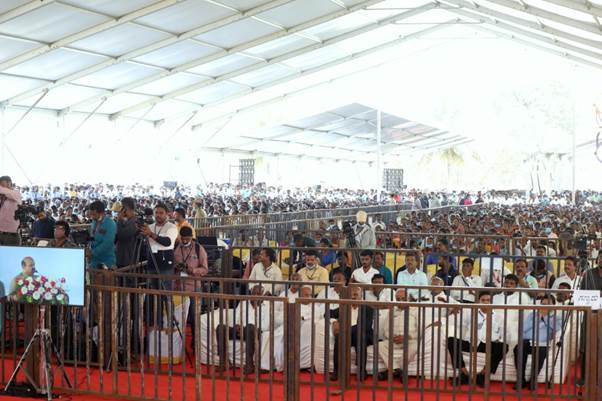
Mega Dairy at Mandya, Karnataka

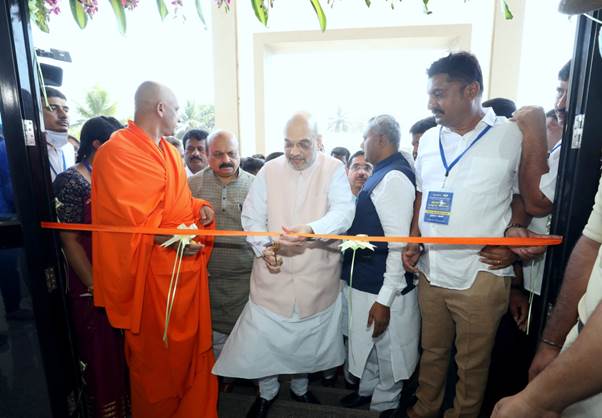
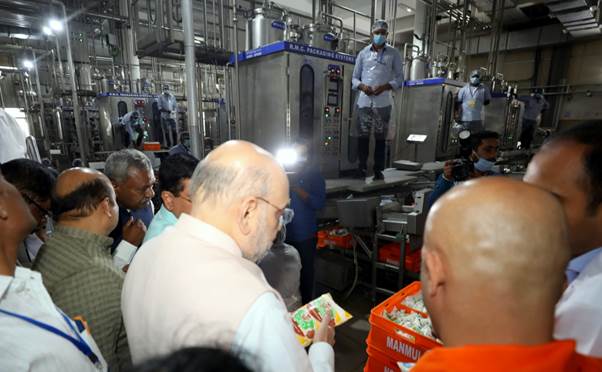
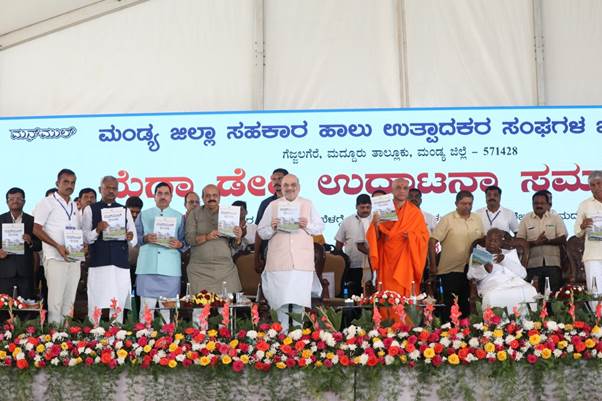
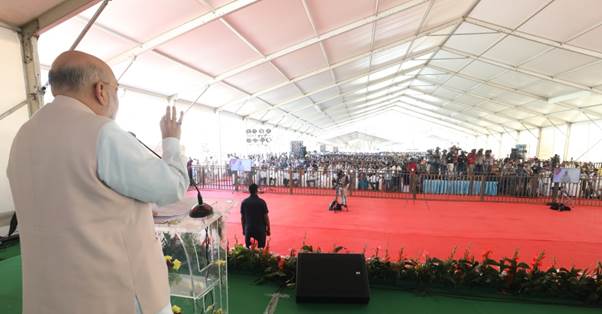
 Union Home and Cooperation Minister Shri Amit Shah inaugurated Mega Dairy at Mandya in Karnataka today. Several dignitaries including Nirmalanandanatha Mahaswamiji, the 72nd Pontiff of Sri Adichunchanagiri Mahasamsthana Math, Mandya, Chief Minister of Karnataka, Shri Basavaraj Bommai, former Prime Minister Shri HD Deve Gowda and Union Minister of Parliamentary Affairs and Coal and Mines Shri Pralhad Joshi were present on the occasion.

Condoling the demise of Prime Minister Narendra Modi’s mother, Shri Amit Shah paid tributes to her and said that the whole country is standing with the Prime Minister in this hour of grief. The Union Home and Cooperation Minister said that since independence, the farmers of the country had demanded a Ministry of Cooperation separate from the Ministry of Agriculture. He said that he would like to thank Prime Minister Narendra Modi for paving the way for the development of farmers by forming a separate Ministry of Cooperation. Shri Shah said that from the inaugural platform of Mandya Mega Dairy, he wants to tell the cooperative workers across the country that it is the decision of the Government of India that there will be no injustice to the cooperatives.

The Union Cooperation Minister said that the mega dairy inaugurated today at a cost of Rs 260 crore would process 10 lakh liters of milk per day and the will have the capacity to increase it upto 14 lakh liters per day. He said that when 10 lakh liters of milk is processed, prosperity reaches the homes of lakhs of farmers. Shri Shah said that in Karnataka, the cooperative dairy is working very well. Today, there are 15,210 village level cooperative dairies in Karnataka, in which about 26.22 lakh farmers deliver their milk daily and through 16 district level dairies, Rs 28 crore is deposited into the accounts of 26 lakh farmers every day.

Shri Amit Shah said that around 66,000 kg milk used to be processed daily in Karnataka in 1975 while today over 82 lakh kg milk is processed daily and 80% of the total turnover goes to the farmer. The Union Cooperation Minister said that the White Revolution in Gujarat has changed the fortunes of the farmers and through Amul, 60,000 crore rupees is deposited into the bank accounts of about 36 lakh women annually. He said that he would like to assure all the farmer brothers and sisters of Karnataka that Amul and Nandini will work together towards establishing primary dairies in every village of Karnataka and in next three years there will not be a single village in Karnataka where primary dairy has not been established. Shri Amit Shah said that the government has decided that the National Dairy Development Board (NDDB) and the Ministry of Cooperation will establish a primary dairy in every panchayat of the country in the next three years and a complete action plan has been prepared in this regard. He said that with this, two lakh primary dairies will be established at the village level across the country in three years, through which India will emerge as a big exporter in the milk sector by connecting the farmers of the country with the White Revolution.

The Union Home and Cooperation Minister said that Karnataka Milk Federation will be provided with technical support, cooperative sector support and overall functioning support from Amul and all its requirements will be addressed  by the Ministry of Cooperation. He said that Gujarat and Karnataka together can work for the welfare of the milk producing farmers of the whole country. Union Cooperation Minister appreciated the Government of Karnataka under the leadership of Chief Minister Basavaraj Bommai for ensuring depositing Rs 1,250 crore directly to bank accounts of milk producing farmers through DBT at the rate of Rs 5 per liter during the year. Shri Amit Shah said that Government led by Shri Bommai is crediting Rs. 1,250 crore annually through DBT to the accounts of milk producing farmers and also to remove malnutrition among children through the Ksheer Bhagya scheme, milk is being provided to 65 lakh children in 51,000 government schools and 39 lakh children in 64,000 Anganwadis .Shri Amit Shah congratulated the Chairman of Mandya Milk Producers Committee for his efforts to increase the income of all the farmers of Mandya district through dairy.

****