Cooperative Beneficiaries Conference in Bengaluru, Karnataka

  by Shashikant Nishant Sharma 

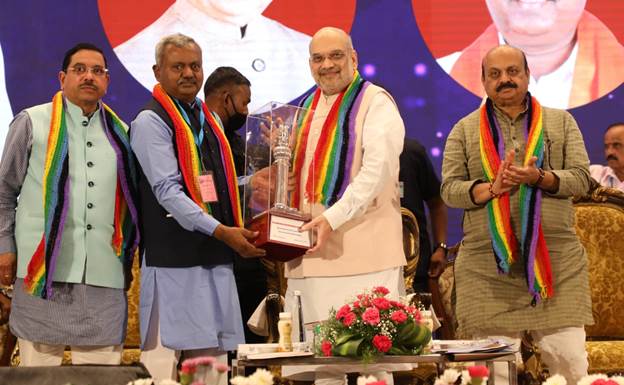
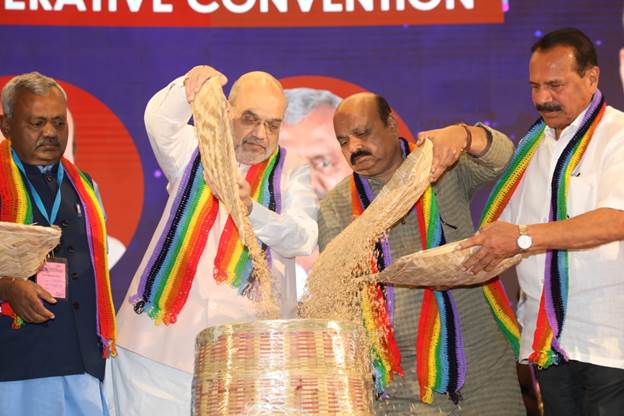
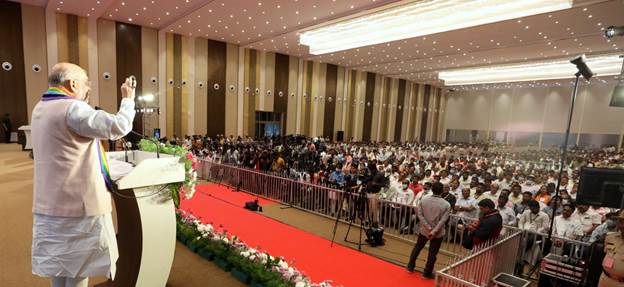
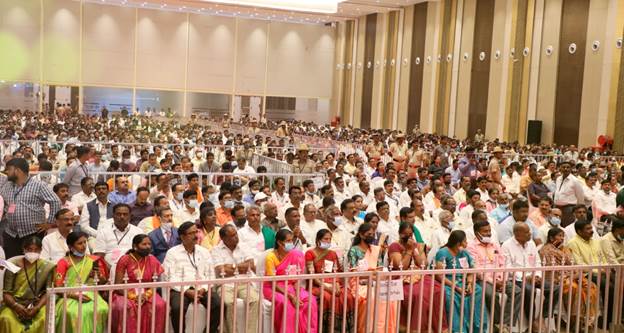
Union Minister of Home and Cooperation, Shri Amit Shah addressed the ‘Cooperative Beneficiaries Conference’ in Bengaluru, Karnataka today. Several dignitaries including Chief Minister of Karnataka Shri Basavaraj Bommai and Union Minister Shri Pralhad Joshi were present on the occasion.
https://static.pib.gov.in/WriteReadData/userfiles/image/image00177VL.jpg

In his address, Shri Amit Shah said that the cooperative movement in Karnataka has been progressing at a good pace for more than 100 years. He said that the first cooperative society in the whole country was established in Gadag district of Karnataka in 1905. The cooperative movement that started from there, today stands as an example in front of the world with many successful models like Amul, KRIBHCO, IFFCO, Lijjat Papad.
https://static.pib.gov.in/WriteReadData/userfiles/image/image0024Z95.jpg

The Union Minister of Cooperation said that under the Nandini brand in Karnataka, about 23 lakh farmers, mostly women, are paid Rs 28 crore per day, which makes their lives more prosperous which is a huge achievement. He said that the beauty of the cooperatives is ‘Production for Masses, Production by Masses’.

Shri Amit Shah said that the Prime Minister Narendra Modi has given new momentum and long life to the cooperative movement by creating a separate ‘Ministry of Cooperation’ in the country. He said that out of 30 lakh cooperatives in the whole world, 9 lakh cooperatives are in India only. About 91 percent of India’s population is linked to a cooperative in one way or another, with cooperatives covering 70 percent of the country’s farmers through PACS. He said that there are 33 state level cooperative banks, 363 district level cooperative banks and 63,000 PACS in the country. Shri Shah said that today 19 percent of our agriculture finance is done through cooperative societies. 35 percent fertilizer distribution, 30 percent fertilizer production, 40 percent sugar production, 13 percent procurement of wheat and 20 percent of paddy procurement is done by cooperatives only.

The country’s first Minister of Cooperation said that since the government led by Prime Minister Narendra Modi came in the country many farmer-centric schemes has been made and accelerated further. He said that after the formation of the Ministry of Cooperation, many decisions were taken, such as to bring transparency in cooperatives, computerization of 63,000 PACS across the country has been done at a cost of Rs. 2,500 crores. Apart from this, one cooperative society will be formed in every panchayat of the country, which will be multi-purpose and NABARD, NDDB and the Ministry of Cooperation have prepared an action plan to form 2 lakh new such cooperative societies in three years. Shri Shah said that after this scheme, the coverage of cooperatives in the country, turnover and the number of its beneficiaries will increase more than three times.
https://static.pib.gov.in/WriteReadData/userfiles/image/image003MAAR.jpg

Shri Amit Shah said that on the basis of Amul Model, a multistate cooperative Society is being established for the sale of organic products across the world, so that the profit goes directly to the farmers. A multistate cooperative society is also being formed for seed production and breed promotion of Indian seeds. He said that there is also a plan to set up a Cooperative University in the country, to create a national database of all cooperatives across the country work has started and formulation of a new cooperative policy has also begun. Shri Shah said that we are going to expand the role of NCDC along with NABARD so that cooperative societies can get finance in a better way. For conducting of transparent Elections a model act has also been prepared and sent to all the states. To bring transparency and fix accountability in the Multi-State Co-operative Societies Act, a bill has come which has been sent to the Standing Committee. He said that earlier more tax was being collected from the cooperative societies than the companies, but in the last budget Prime Minister Narendra Modi has brought the cooperatives at par with the companies by reducing the surcharge of the cooperative society from 12% to 7% by and reducing the alternative tax from 18% to 15%. Shri Shah said that the housing loan limit of Urban Cooperative Bank has been increased by 3 times by RBI, loan limit on commercial property has also been increased and door step banking has also been allowed.
https://static.pib.gov.in/WriteReadData/userfiles/image/image004H9MP.jpg

The Union Home and Cooperation Minister said that it is not only the responsibility of Karnataka to strengthen the cooperative movement of Karnataka, some ideals have to be established so that the states across the country get the message and from here all the states can adopt the best practices and create a new model of cooperation in their respective states. He said that Prime Minister Narendra Modi’s decision to form the Ministry of Cooperation to speed up the cooperative movement will strengthen the efforts to fill the gaps in the cooperative movement across the country so that the cooperative movement progress uniformly across the country.

**************
Youth Parliament Program

 The Youth Parliament Program is run with a view to strengthen the roots of democracy, inculcate health habits of discipline, develop tolerance of divergent views and to familiarize the student community about the working and functioning of Parliament. The Youth Parliament Program is organized in 2 modes:-

    1. Youth Parliament Competition (YPC):

   The following YPCs were organized this year: –

  1. Group Level Competition of the 16th National Youth Parliament Competition (NYPC), 2019-20 for Universities / Colleges wherein 35 institutions participated
  2. 33rd NYPC, 2022-23 for Kendriya Vidyalayas wherein 150 institutions participated
  3. Regional Level Competition of 24th NYPC, 2022-23 for Jawahar Navodaya Vidyalayas wherein 80 institutions participated
  4. 55th YPC for schools under Directorate of Education, Govt. of NCT of Delhi and NDMC wherein 39 institutions participated

2) Web-portal of National Youth Parliament Scheme (NYPS):

The web-portal of the NYPS was launched on 26th November, 2019 to increase the outreach of the youth parliament program to every nook and corner of the country. The registration on the first edition of NYPS was closed on 31st July, 2022. 8317 registrations and 373 event completion reports were received on the portal. The registration for the second edition of NYPS was opened on 1st August, 2022. Till 30th November 2022, 1702 successful registrations and 367 event completion reports have been received on the portal. The last date for registering for the second edition is 31st December, 2022.

Consultative Committees:

The Ministry constitutes Consultative Committees of Members of Parliament and makes arrangements for holding their meetings during session and inter session periods. After the constitution of 17th Lok Sabha, 37 Consultative Committees had been constituted for various Ministries/Departments. 38th Consultative Committee in respect of the Ministry of Labour and Empowerment was constituted on 28th July, 2020. The following activities were undertaken during the year 2022: –

  • One Consultative Committee for the Ministry of Law and Justice (39th) was constituted on 20th April, 2022.
  • 60 meetings of the Consultative Committees were held till November, 2022.
  • 73 Members of Parliament (Lok Sabha & Rajya Sabha) were nominated on various Committees/Councils/boards etc. set up by the Government of India.
  • Deletion of membership of 69 MPs were done from the various Consultative Committees due to their resignation/ retirement/ demise etc.

Digitization of Legislatures through National e-Vidhan Application (NeVA)

 National e-Vidhan Application (NeVA) is an end-to-end cloud based digital solution for bringing all the 39 Legislatures (Lok Sabha + Rajya Sabha + 31 Assemblies + 6 Councils) across the country including the 2 Houses of the Parliament on a single platform. It has been developed on the theme of ‘One Nation- One Application’. The Ministry of Parliamentary Affairs (MoPA) has been entrusted with the responsibility of rolling out NeVA in all the Legislatures across the country.

The NeVA Application has been developed to cater various stakeholders like Members, Ministers, House Secretariat personnel, Govt. Department personnel and Citizens at large. Developed as a member centric application, it enables them to handle diverse House Business smartly by putting entire information needed by them in their hand-held devices/ tablets. It also helps the Ministers to have access to all the House Information like Question Replies, Bills, other Papers laid, etc. It equips all the Branches of Legislatures/ Department to handle it efficiently and creating an efficient inclusive database thereby overhauling the way our legislatures work with facilities for Live webcasting. Moreover, NeVA not only aims to bring democracy closer to our citizens by giving the citizens access to the bills, the questions and answers, the documents tabled in the Houses in an easy manner, but also to empower them by providing an opportunity to the citizens for meaningful engagement with the democracy which can be achieved through e-Constituency Management Module and Grievance Module.

Operationalization of this electronic platform would account for huge savings on papers (App. 340 Cr annually), thereby leading to reduction of carbon footprints and moving a step forward in the achievement of UN’s SDGs (15)- ‘Life on Earth’.

The President and Prime Minister had also urged the Presiding Officers for digitalization of all the Legislative Houses in the country by adopting the NeVA to reap the benefits of the Digital Legislatures in the present scenario.

The MoPA has recently developed the new module ‘Digital Archive’ for management of the legacy data of respective House for the benefit of Members and citizen equally. The Reporter’s module has also been re-developed. Digital House module, Question processing module, committee module, member’s module, master content management module, user management module, etc. have also been upgraded as per the requirements of various Legislatures. The NeVA website has also been updated with various new features and latest designs.

As far as the current status of implementation of NeVA is concerned, a total of 21 Legislatures (19 States) viz. Punjab, Odisha, Bihar {both Houses}, Meghalaya, Mizoram, Manipur, Gujarat, Arunachal Pradesh, Nagaland, Puducherry, Tripura, Himachal Pradesh, Chhattisgarh, Tamil Nadu, Sikkim, Haryana, Uttar Pradesh{both Houses} Jharkhand ,Jammu & Kashmir have signed the Memorandum of Understanding (MoU) with MoPA, out of which 17 legislatures (15 States) viz. Punjab, Odisha, Bihar (Both Houses) Nagaland, Manipur, Sikkim, Tamil Nadu, Meghalaya, Haryana, Tripura Uttar Pradesh (Both Houses), Mizoram, Gujarat, Jharkhand, Puducherry have been sanctioned the project along with the release of required funds. At present, 8 Legislatures, viz. Bihar Council, Nagaland Assembly, Uttar Pradesh Assembly, Haryana Assembly, Mizoram Assembly, Meghalaya Assembly, Uttar Pradesh Council and Tamil Nadu have already been transformed into Digital House through NeVA. Other Houses are also on the path of becoming paperless shortly.

Key achievements of the Department of Space for the last 8 years

 Indian Space Programme and its ecosystem have been in a state of unprecedented vibrancy with various achievements. The glimpse of key milestones embraced by the department since 2014 till date is highlighted as below:

Key missions

  • Altogether 44 spacecraft missions, 42 launch vehicle missions and 5 technology demonstrators, have been successfully realized, since 2014 till date.
  • In January 2014, the first successful flight with indigenous Cryogenic Upper Stage, in the GSLV-D5 launch vehicle was achieved and GSAT-14 was placed into GTO.
  • In September 2014, India’s Mars Orbiter Spacecraft successfully entered into an orbit around planet Mars, putting India into a league of select nations which had sent a spacecraft to the Red Planet. The spacecraft is still functional even after 7 years of operation against the designed life of 6 months and serving nation with a lot of interesting science data.
  • In December 2014, the country witnessed the experimental flight of the next generation launch vehicle – the GSLV MKIII. The LVM3-X/CARE Mission, the first experimental suborbital flight of the vehicle, launched the Crew Module Atmospheric Re-entry experiment (CARE).
  • AstroSat launched by PSLV in September 2015, is the first dedicated Indian astronomy mission aimed at studying celestial sources in X-ray, optical and UV spectral bands simultaneously. AstroSat has made major breakthroughs by discovering five new galaxies.
  • ISRO has established and operationalised Navigation with Indian Constellation (NavIC) which provides highly accurate Position, Navigation and Time information to users in India and its surroundings. A total of 7 satellites form the Indian Regional Navigation Satellite System [IRNSS] – all launched by PSLV, with IRNSS-1G completing the constellation in 2016. 
  • Various NavIC based services have been rolled out in many key sectors like  – integration of NavIC-enabled devices with the enrolment architecture of UIDAI Aadhar enrolment, incorporation of NavIC in the Continuously Operating Reference Stations (CORS) network, In agricultural drones and Radio Technical Commission for Maritime Services (RTCM) etc.
  • Successful flight testing of Reusable Launch Vehicle-Technology Demonstrator (RLV-TD) was done on May 23, 2016 from Satish Dhawan Space Centre (SDSC) SHAR, Sriharikota. RLV-TD is one of the most technologically challenging endeavours of ISRO towards developing essential technologies for a fully reusable launch vehicle to enable low cost access to space.
  • The first experimental mission of ISRO’s Scramjet Engine towards the realisation of Air Breathing Propulsion System was also successfully conducted in 2016 from SDSC SHAR, Sriharikota.
  • In 2017, PSLV C-37 created a world record by successfully placing 104 satellites in orbit during a single launch.
  • As idea mooted by the Hon’ble Prime Minister in 18th SAARC summit, ISRO has launched the 2.2 Ton communication satellite in 2017 to support neighbouring countries.
  • The first developmental mission of GSLV Mk-III D1 was successfully accomplished in June-2017 and boosted GSAT-19 satellite into geosynchronous transfer orbit.
  • ISRO demonstrated a crucial technology element of Human spaceflight in July 2018- The Pad Abort Test (PAT) to qualify the Crew Escape System (CES). The Pad Abort Test flight was a demonstration of the capability of CES to evacuate the Crew in case of a contingency at launch Pad.
  • In the Independence Day address – 2018, the Hon’ble Prime Minister announced the “Gaganyaan Programme”, marking India’s foray into the new age of human space exploration.
  • GSAT-29 high throughput communication satellite was successfully launched on November 14, 2018, on-board GSLV Mk III-D2. It is providing satellite based connectivity to Jammu & Kashmir and North Eastern regions of India.
  • In 2018, ISRO’s next generation high throughput communication satellite, GSAT-11 was successfully launched on December 05, 2018 from Kourou, French Guiana by Ariane-5 VA-246. Weighing about 5854 kg, GSAT-11 is the heaviest satellite built by ISRO.
  • India’s second mission to Moon, Chandrayaan-2 was successfully launched on July 22, 2019 on-board GSLV Mk III-M1, first operational flight of this new launch vehicle. Chandrayaan-2 Orbiter is providing valuable science data for the research community.
  • The launch of PSLV-C48/ RISAT-2BR1 in Dec 2019 marked the 50th launch of PSLV, the workhorse launch vehicle.
  • Quantum entanglement based real time Quantum Key Distribution (QKD) over 300m atmospheric channel along with quantum-secure text, image transmission and quantum-assisted two-way video calling was demonstrated on 27 January 2022.
  • The Hon’ble Minister of State (Department of Space) dedicated ISRO System for Safe & Sustained Operations Management (IS4OM) to the nation in  Jul-2022.
  • LVM3 (GSLV MkIII) M2/OneWeb India-1 Mission was successfully accomplished on 23rd October 2022. With this launch, LVM3 exemplifies Atmanirbharata and enhances India’s competitive edge in the global commercial launch service market.
  • As part of Gaganyaan programme, new Test Vehicle for testing critical systems is developed. ‘Integrated Main Parachute Airdrop Test (IMAT)’ of crew module deceleration system was successfully carried out at Babina Field Fire Range (BFFR), Jhansi, Uttar Pradesh on 18th November 2022.
  • ISRO successfully demonstrated new technology with Inflatable Aerodynamic Decelerator (IAD) – a game changer with multiple applications for future missions.
  • Recently, PSLV-C54 was successfully launched EOS-06 satellite on 26th   November 2022 along with Eight Nano-satellites including INDIA-BHUTAN SAT (INS-2B).

Academic support, Capacity building and Outreach

  • In order to boost the space research activities, Space Technology Incubational Centres (STIC) at some of the key locations of the country were established, since 2018. Under this initiative, at present, nine Space Technology Cells (STC) are operational at academic institutions, six Space Technology Incubational Centres (STIC) are operational at Agartala, Trichy, Jalandhar, Rourkela, Nagpur & Bhopal and six Regional Academic Centre for Space (RACS) at Varanasi, Kurukshetra, Jaipur, Guwahati, Suratkal & Patna. Recently, Satish Dhawan Centre for Space Sciences is jointly established by ISRO/DoS and Central University of Jammu. A number of Non-Disclosure agreements (NDAs) and MOUs have been signed between ISRO and Academia.
  • In June 2018, India announced a capacity building training programme UNNATI (UNispace Nanosatellite Assembly &Training by ISRO) on Nanosatellites development through a combination of theoretical coursework and hands-on training on Assembly, Integration and Testing (AIT). First batch of UNNATI Programme was conducted from 15th January to 15th March 2019 wherein 30 participants from 17 countries had benefitted. Second batch was held in Oct-Dec 2019 and third batch was held in Oct-Dec 2022. 
  • In 2019, ISRO launched an annual special programme called “Young Scientist Programme” or the YUva VIgyani KAryakram” (YUVIKA) in 2019, in line with the Government’s vision “Jai Vigyan, Jai Anusandhan”. The Program is primarily aimed at imparting basic knowledge on Space Technology, Space Science and Space Applications to the young talents with the intent of encouraging them in the fascinating domain of outer space. Second batch of YUVIKA programme was held in May 2022.
  • Indian Space Research Organisation (ISRO) and Social Alpha today signed an MoU in Dec 2022 to launch SpaceTech Innovation Network (SpIN), India’s first dedicated platform for innovation curation and venture development for the burgeoning space entrepreneurial ecosystem.

Reforms and enhanced participation of industries

  • In 2019, the NewSpace India Limited (NSIL) got incorporated, as a wholly owned Government of India Undertaking/ Central Public Sector Enterprise (CPSE), under the administrative control of Department of Space (DOS), to enable Indian Industries to scale up high-technology manufacturing base for space programme and to commercially exploit the products and services emanating from the Indian Space Programme for meeting the domestic and global customer needs
  • On June 26, 2020, the Government of India announced Space Sector Reforms – a major transformation of Indian Space Sector with enhanced participation of private players in Indian space programme and playing key roles to boost India’s market share in Global Space Economy. IN-SPACe Headquarters at Ahmedabad was inaugurated by the Hon’ble Prime Minister in Jun-2022.
  • Setting up of Indian National Space Promotion and Authorisation Centre (IN-SPACe) and enhancing the role New Space India Limited (NSIL) are the two major thrust areas in the Reform.
  • The establishment of IN-SPACe was announced in June 2020 by Government of India, as an autonomous body under Department of Space, to create eco-system of industry, academia and start-ups and to attract major share in the global space economy, by authorizing and regulating activities of NGEs in space sector through detailed guidelines and procedures.
  • Launch of Vikram-S (Prarambh mission), a suborbital launch vehicle from M/s Skyroot Aerospace Pvt. Ltd., Hyderabad, was accomplished successfully on 18th November 2022.
  • First private launchpad & mission control center established by M/s Agnikul Cosmos Pvt. Ltd., Chennai in ISRO campus at SDSC, SHAR on 25th November 2022. Agnilet Semi-cryogenic rocket engine developed by Agnikul was successfully hot tested at ISRO facility on 04th November 2022.
  • HAL and L&T consortia will be Indian Industry partner for end-to-end production of 5 Nos. of PSLV, with a contract value of Rs. 824 crores.
  • Two nano-satellites from Indian space start-up M/s DhruvaSpace were launched as a rideshare passenger in PSLV-C54 mission. Gen-1 satellites from M/s OneWeb was launched using LVM3 (GSLV Mk-III).
  • GSAT-24 communication satellite which is the first demand driven mission of NSIL was launched from Kourou, French Guiana, in June 2022.
  • NSIL has signed 19 Technology Transfer Agreements and has successfully transferred 8 ISRO developed Technologies to Indian Industry.
  • Indian Space Policy – 2022 policy is cleared by the Space Commission. The Policy has undergone extensive deliberations with industry groups, inter-ministerial consultations, has been reviewed by Empowered Technology Group and is under further approval process.

Disaster Management

Monitoring flood inundation (about 250+ flood inundation maps/ flood season), generation of flood hazard zonation atlases (Assam, Bihar, Odisha, West Bengal, Andhra Pradesh & Uttar Pradesh) of flood prone states, developing flood early warning models (Brahmaputra, Godawari & Tapi), multiple daily detections & dissemination of active forest fires (>35,000 detections/ forest fire season), forecasting cyclone track; intensity & landfall, damage assessment due to earth quakes and landslides, etc. were carried out.

COVID-19 related supports

During the COVID-19 pandemic period, devices like Mechanical Ventilator & Medical Oxygen Concentrator were developed and the technologies are transferred to Indian industries.

Samsung prepares to launch its new devices

Samsung has been able to get the attention it deserves after every flagship launch. It has also been able to launch devices that cater to the needs of the people. Now, they are already making plans for 2023.

They are planning to launch their next flagship on February 1, 2023. Within the next few days, they are going to even launch a budget device for the market. The device specifications have been leaked and the pricing is also out.

The budget device is named Galaxy F04. It will be launched at an approximate price of 7500 rupees. It will likely have a memory of 8 GB. It will also have various models and will be available in two different colours purple and green and will be available for sale on Flipkart.

The specifications of the device also look impressive on paper. The device is speculated to have a Mediatek chipset. The display segment has a 6.8-inch HD + screen. The display will also have a refresh rate of 60 Hz. The device has a battery power of 5000 mAh.

It appears to be an upgrade for the Galaxy A04e model. In terms of the camera, it appears to have a 13 MP main camera. There will also be a depth 2 MP camera. The device will have Android 12 out of the box. 

https://unsplash.com/photos/PdALQmfEqvE

On the other hand, S23 Ultra will also launch with some bells and whistles. It will be a worthy successor to the S22 Ultra. The new flagship is likely to have a better zoom quality. The smartphone will likely have the same shooter as the S22 Ultra.   

These devices are also going to have satellite communication. There are also rumours of an increase in battery capacity in some models of the S23 series. Along with these, there seem to be very slight changes to the design of the device. 

There will also be some drastic improvements in terms of the performance of the device as the devices will have the latest Snapdragon chipset. The chipset will be top-of-the-line. The new chipset will also help in providing better battery life to the device along with a smooth performance. 

In terms of colour, the devices are going to be available in beige, light pink and black colour. These colours are the probable ones and can also be different in the final product. 

Now, it remains to be seen whether these devices will perform well or not for Samsung in the market. But next year Samsung is also going to reduce its production. It is being done to clear out the current stock which has piled up over time. Apart from that, there is also stiff competition from Chinese players. The devices are now being launched with at least one USP by all the companies. The intense competition is keeping all the players on their toes. The devices need to be competitive to stay relevant in the market. Now, various devices can compel any other company to be the number one or number two smartphone maker in the world, in terms of popularity. So, Samsung needs to be careful now.

Safer Internet Day

It’s Safer Internet Day on February 14, so turn on your modems! Nowadays, the internet allows you to do practically everything. You can interact with pals, play games, and buy that new clothing you didn’t realize you needed but do now. Having limitless access to information and entertainment at your disposal is an amazing experience. The Yahoo Geocities and “You’ve Got Mail” of the past have been replaced by the world wide web. By honoring Safer Internet Day on February 14, we recognize these enormous achievements and the challenges that may result from these changes.

History of Safer Internet Day

In 2012, when the US Department of Homeland Security and the European Commission determined it was time to assist and guide the huge beast known as the Internet toward becoming a playground that was safer for our children, Safer Internet Day became officially recognized. When ConnectSafely.org was chosen to lead the efforts in the American theatre, things in this country really got moving in 2013, and they’ve been doing so a little bit more each year since. Each year, they decide on a cause to support and an objective they want to accomplish. What kind of aims?

They started promoting the “Actions & Activism Toward a Better Net & World” theme in 2015, focusing on issues including bullying, collaboration with the National Parent Teacher Association, and using technology to assist bring about social change. Given that people from many walks of life and cultures can interact and communicate in ways they never could before, this is a particularly potent application of the instrument. That is what the Internet was created for, what it has given us, and what it has done to unite the world.

HOW TO OBSERVE SAFER INTERNET DAY

1. Participate in the Safer Internet Day conference

A sizable conference is held annually by the nonprofit organization ConnectSafely.org to raise internet literacy throughout a range of age groups. Representatives from Microsoft, Facebook, Google, and other companies have previously held panel discussions, musical performances, and speaking engagements. The purpose of the all-day event is to improve the online experience for a wide range of users.

2. Go over safe Internet usage techniques

Don’t worry if you can’t make it to the conference. The process of using the internet responsibly advances with the discussion on how to make it a better and safer place for people to be. Speaking with people from both older and younger generations makes it easier to express worries and wishes for the future and set a goal for appropriate online behavior.

3. Develop ethical online behavior

You don’t necessarily know everything there is to know about the Internet just because you’re good at using it. Read the wealth of information that the websites supporting Safer Internet Day offer for both kids and adults. The resources are instructive and useful in helping to comprehend the various challenges that modern Internet user faces each time they open a new browser.

WHY SAFER INTERNET DAY IS IMPORTANT

1. It serves as an opportunity to study the Internet

Every day, thousands of new websites are developed. Given the volume of fresh content being produced, it’s critical to stay informed of how the Internet is always evolving. Adults and kids alike should place a high focus on being aware of the changing environment.

2. It is a worldwide holiday

The day known as Safer Internet Day is observed in around 130 nations. The numerous nations in between, including the United States, the United Kingdom, Poland, and Panama, all have unique traditions for celebrating the significant day.

3. Major corporations back in the day

Not only do parents, teachers, and students care about Safer Internet Day. Global companies are aware of how critical it is to maintain user safety on the internet. An improved and safer Internet is something that Facebook, Google, and Twitter are all dedicated to promoting.


World Cancer Day is observed annually on February 4 to raise awareness, spur change, and lessen the burden of cancer on the world. The goal is to lessen misconceptions about cancer and the stigmas attached to it to assist individuals in receiving accurate information about it. Additionally, it presents an opportunity to influence cancer patients’ and survivors’ quality of life. World Cancer Day has been dubbed a “global uniting initiative” by the Union of International Cancer Control (UICC).

World Cancer Day: Significance

The primary goals of the day are to increase awareness and lessen the stigma attached to the illness. The second greatest cause of death worldwide is cancer. Lung, breast, cervical, head & neck, and colorectal cancer are the most common cancers in Indians (CRC). On Globe Cancer Day, everyone gets together to eradicate cancer from the world. Numerous activities are scheduled for this day where it will be discussed how to inform people about cancer and its early detection, treatment, and other aspects.


HISTORY OF WORLD CANCER DAY

Cancer is one of the major causes of death worldwide, according to the World Health Organization. In 1993, the Union for International Cancer Control (UICC) was founded. It is a membership-based association with headquarters in Geneva that strives to end cancer globally and advance medical research. In Geneva, Switzerland that year, the inaugural International Cancer Day was observed under its direction. This project was backed by numerous reputable organizations, cancer societies, and treatment facilities.

The inaugural World Summit Against Cancer in 2000 saw the official establishment of World Cancer Day. Members of cancer groups and significant world leaders from governments attended the event, which was held in Paris. The ten-article “Charter of Paris Against Cancer” was signed, indicating an international commitment to enhancing the support and quality of life of cancer patients. The development and increasing funding for cancer research, screening, and treatment was also emphasized. This charter’s Article X formally established February 4 as World Cancer Day.

There are many different varieties of cancer, so different colors and symbols are used to identify each type and raise awareness of the battle against it. For instance, the orange ribbon is used to raise awareness of cancer among youngsters, but the pink ribbon is used to promote breast cancer awareness all around the world. The American Cancer Society uses the daffodil flower as a representation of hope for sufferers and survivors of this life-threatening illness.

Each year, thousands of events and fundraising efforts are held on this day in hospitals, schools, businesses, markets, community halls, parks, etc. to unite people and organizations and serve as a powerful reminder that those affected by cancer are not alone and that everyone has a role to play in lessening the disease’s global impact.

WHY WORLD CANCER DAY IS IMPORTANT

1. It is possible to prevent one-third of the most common cancers

With the correct cancer prevention strategies, a lot may be done on an individual, community, and policy level. Just one person can be greatly impacted by taking the time to learn what you, your family, and your community can do to make a difference.

2. Early indications of cancer exist.

There are warning signs and symptoms for many malignancies, and the advantages of early detection are undeniable. Regardless of how busy you are, making the time to visit the doctor and get a checkup will help you become more aware and at ease.

3. Discussing cancer can truly aid in everyone’s recovery

Even though talking about cancer can be challenging, especially in some cultures and contexts, doing so can lead to better results for people on an individual, societal, and policy level. Everyone can feel like they are a part of the solution by knowing where to turn for assistance and being a part of a broader support system.

Punjab Kings 2023: टीम में इस बार इन खिलाड़ियों को मिला स्थान, तो कुछ को दिखाया बाहर का रास्ता

पंजाब किंग्स की टीम एक बार फिर पहली बार आईपीएल का खिताब जीतने के इरादे से मैदान में उतरेगी। ऐसे में उसके सामने सबसे बड़ी चुनौती नए सिरे से टीम तैयार करने की है। पंजाब के पास नीलामी के लिए पर्से में 32.2 करोड़ रुपये की मोटी राशि है। जिससे उसे 3 विदेशी सहित कुल 9 खिलाड़ियों की खरीदारी करनी है। आईपीएल 2022 में मयंक अग्रवाल की कप्तानी में पंजाब किंग्‍स का प्रदर्शन बेहद लचर रहा था।
iऐसे में मैनेजमेंट ने उनके सहित कुल 9 खिलाड़ियों को बाहर का रास्ता दिखा दिया था। जिसमें 2 विदेशी और 7 भारतीय खिलाड़ी शामिल थे। ऐसे में पंजाब के सामने अपनी टीम में सबसे बेहतरीन भारतीय खिलाड़ियों को शामिल करके संतुलन हासिल करने की है। आईए जानते हैं पंजाब किंग्स के मैनेजमेंट ने किन खिलाड़ियो पर लगाया है दांव और अब कैसी दिखती है पंजाब किंग्स की टीम?
PBKS IPL Team 2023 Players List, Full Squad (नीलामी से पंजाब किंग्स के खिलाड़ी)
खिलाड़ी का नाम देश भूमिका कितने में खरीदा
सैम कुर्रन इंग्लैंड बल्लेबाज 18.50 करोड़ रुपये
हरप्रीत भाटिया भारत बल्लेबाज 40 लाख रुपये
विध्वथ कावेरप्पा भारत (कर्नाटक) तेज गेंदबाज 20 लाख रुपये
शिवम सिंह भारत (बिहार) दाएं हाथ के बल्लेबाज 20 लाख रुपये
मोहित राठी भारत ऑलराउंडर 20 लाख रुपये

नए खिलाड़ियों सहित पंजाब किंग्स की पूरी टीम:

शिखर धवन (कप्तान), सैम कुर्रन, जॉनी बेयर्स्टो, प्रभसिमरन सिंह, भानुका राजपक्षे, जितेश शर्मा, राज अंगद बावा, ऋषि धवन, लियाम लिविंग्स्टोन, अथर्व तायडे, अर्शदीप सिंह, बलतेज सिंह, नाथन एलिस*, कगिसो रबाडा, राहुल चाहर, हरप्रीत बराड़, शाहरुख खान, हरप्रीत भाटिया, विध्वथ कावेरप्पा, शिवम सिंह और मोहित राठी।

Bollywood Flop Films 2022: इस साल ये फ़िल्में बॉक्स ऑफिस पर बुरी तरह हुई फ्लॉप

 बॉलीवुड के लिए साल 2022 कुछ खास नहीं रहा। 2021 में फ्लॉप की झड़ी लगाने के बाद 2022 से कुछ उम्मीदें थी लेकिन यह साल बड़े बड़े कलाकारों के लिए बहुत बुरा साबित हुआ। अक्षय कुमार, आयुष्मान खुराना, आमिर खान, अजय देवगन जैसे दिग्गज कलाकारों की फिल्में इस साल धाराशाही होते दिखी। 

Indian rupees was worst performing asian currencies in 2022.

The Indian rupee ended 2022 as the worst-performing Asian currency with a fall of 10.14%, its biggest annual decline since 2013, as the dollar rocketed on the U.S. Federal Reserve’s aggressive monetary policy stance to tame inflation.

The rupee finished the year at 82.72 to the U.S. currency, down from 74.33 at the end of 2021, while the dollar index was headed for its biggest yearly gain since 2015.

A rise in oil prices brought on by the crisis between Russia and Ukraine also hurt the rupee and resulted in India’s current account deficit reaching an absolute record high in the third quarter of that year.

Market participants anticipate that the rupee will trade with an appreciation bias in 2023.finding comfort in declining commodity prices and holding out hope that foreign investors will continue to purchase Indian stocks.

Heading into 2023, market participants believe the rupee would trade with an appreciation bias, finding relief from easing commodity prices and hopeful of foreign investors continuing to buy Indian equities.

Indian rupees was worst performing asian currencies in 2022.

The Indian rupee ended 2022 as the worst-performing Asian currency with a fall of 10.14%, its biggest annual decline since 2013, as the dollar rocketed on the U.S. Federal Reserve’s aggressive monetary policy stance to tame inflation.

The rupee finished the year at 82.72 to the U.S. currency, down from 74.33 at the end of 2021, while the dollar index was headed for its biggest yearly gain since 2015.

A rise in oil prices brought on by the crisis between Russia and Ukraine also hurt the rupee and resulted in India’s current account deficit reaching an absolute record high in the third quarter of that year.

Market participants anticipate that the rupee will trade with an appreciation bias in 2023.finding comfort in declining commodity prices and holding out hope that foreign investors will continue to purchase Indian stocks.

Heading into 2023, market participants believe the rupee would trade with an appreciation bias, finding relief from easing commodity prices and hopeful of foreign investors continuing to buy Indian equities.

India’s first underwater tunnel to be built in West Bengal, expected to start by december 2023.

The first underwater tunnel in India is being built as part of the East-West Metro Corridor’s project, and it will take about 45 seconds for trains to cover the 520-meter stretch. The tunnel that goes under the Hoogly river in West Bengal is being touted as the Indian version of Eurostar’s London-Paris corridor. An estimated cost of Rs 120 crores is being spent on the project.

The tunnel, which is about 2.5 kilometres long, is expected to be commissioned in 2023 following the completion of the section between Sealdah and Esplanade.

The tunnel runs through the Salt Lake Sector V IT hub metro station in the east to Howrah Maidan in the west under the river. The construction of the tunnel has already been completed, and it is expected to be operational in December 2023 following the completion of a 2.5-kilometer section between Sealdah and the Esplanade.

India's first underwater tunnel to be built in West Bengal, expected to start by december 2023.

The first underwater tunnel in India is being built as part of the East-West Metro Corridor’s project, and it will take about 45 seconds for trains to cover the 520-meter stretch. The tunnel that goes under the Hoogly river in West Bengal is being touted as the Indian version of Eurostar’s London-Paris corridor. An estimated cost of Rs 120 crores is being spent on the project.

The tunnel, which is about 2.5 kilometres long, is expected to be commissioned in 2023 following the completion of the section between Sealdah and Esplanade.

The tunnel runs through the Salt Lake Sector V IT hub metro station in the east to Howrah Maidan in the west under the river. The construction of the tunnel has already been completed, and it is expected to be operational in December 2023 following the completion of a 2.5-kilometer section between Sealdah and the Esplanade.

BigBasket goes offline in Hyderabad

BigBasket is going to become a supermarket. After the acquisition by Tata in 2021, it has experimented in different ways. Earlier, it also tried self- services to fruit and vegetable outlet in Bangalore. But this time, it is going to do so in the form of a supermarket in Hyderabad. 

It is also planning to expand in this physical space. It is going to open 3 more supermarkets in Hyderabad, 5 in Kolkata and 15 more in Bangalore. After that, it also plans to open 400 more such stores across the top 10 cities of the country. It will cater to those users, who are more comfortable with physical stores. 

On the online front, BigBasket has a user base of 15 million. It is also making a profit of around $ 1 billion. Now, there is also one additional app that Tata has launched for use by the users of BigBasket. It is a total of all the apps that belongs to the companies owned by Tata Group.

Now, there are some drastic changes that Tata Group is going through. For the last few years, it has been on a purchasing spree. It now owns some companies from the tech world like 1mg and BigBasket. It also has an airline named Air India. So, Tata has lined up major expansion plans for the future. For the time being it needs to invest some more resources in these companies to make them capable competitors in the market. After that, companies like BigBasket will also make it to the IPO listing by 2025. 

From the business point of view, BigBasket did serve its customers well. The highest order on its online platform was from Karnataka. On the popularity front, the tomato was the top choice of the customers on the platform. In the entire year, BigBasket delivered around 400 kgs of coriander also, which was also one of the most popular items.

On the offers front, users also saved around 1500 crore rupees from various offers and coupons. The orders were mostly during the rush hours of 7 pm and 9 pm. The platform is also planning to expand to 20 more cities. This expansion will take the total count of cities from 55 to 75 for BigBasket service. 

Now, BigBasket also needs to take care of the fact that it needs to tackle the competition from platforms like Jio. The competition is also from some physical platforms that do support the flexibility of shopping by looking at the actual product. There are still several users who love the offers and the variety of products that stress like DMart offers. There are also some competitive moves from Flipkart and Amazon. These e-commerce giants are also putting in efforts to score big in one of the world’s fastest-growing online markets.

These changes will surely put smiles on the face of those who love to buy milk from the supermarket while coming back from morning exercise. The further increase in the valuation of BigBasket at $3.2 billion also makes it a top contender to become one of the best platforms for groceries and fresh veggies for a long time and with a bright future.

Health experts says the next 40 days will be crucial for India amid covid surge in China.

.

There is still no clarity on what is happening in China, with experts raising alarm that the country is witnessing a steep increase in the number of COVID-19 cases due to coronavirus variant BF.7.

The Union Health Ministry has, however, said that the next 40 days will be crucial in India – with the country likely to witness a surge in January.

“In the past, whenever a NBCOVID-19 wave was reported in India, it used to hit us in 30-35 days, starting from East Asia, it used to hit Europe in 10 days, moving towards America and the Pacific region, and then finally hitting India which would normally take 30 days,” a senior health ministry official told media, requesting anonymity.

The official added that the number of deaths and hospitalisations is likely to be low this time, even if India is hit by a COVID wave by the end of January.

Meanwhile, the Ministry is likely to make mandatory, from next week, negative RT-PCR reports for passengers arriving from China, Hong Kong, Singapore, Japan, South Korea and Thailand.

Filling up of ‘air-suvidha’ forms and 72-hour prior RT-PCR testing could be mandatory for arrivals from these countries.

The government has made random coronavirus testing mandatory for two per cent of passengers arriving in each international flight from December 24. Union Health Minister Mansukh Mandaviya is likely to visit the Delhi airport to take stock of testing and screening facilities there.