INDIAN NAVY SHIPS SHIVALIK AND KAMORTA VISIT HO CHI MINH CITY, VIETNAM

 Indian Naval Ships, Shivalik and Kamorta which are forward deployed in the South China Sea are in Ho Chi Minh City, Vietnam. The ships would be undertaking numerous professional interactions with the Vietnam People’s Navy during the visit. 

        The visit is part of the bilateral defence cooperation activities to further enhance the robust ties between the two navies as also to mark the 50th anniversary of diplomatic relations between India and Vietnam. Earlier this year, two Indian Naval Ships, Sahyadri and Kadmatt had also visited Ho Chi Minh City. 

        The visiting Indian Naval ships Shivalik and Kamorta form part of the Indian Navy’s Eastern Fleet based at Visakhapatnam. The two ships, designed and constructed in India, are equipped with a versatile array of weapons and sensors, carry multi-role helicopters and symbolise India’s advanced warship building capabilities.


_________________________________________________________________

VM/JSN                                                        

“Swar Dharohar Festival”- to showcase the iconic art & culture, rich literary Art & Heritage of Indian States, at Central Vista

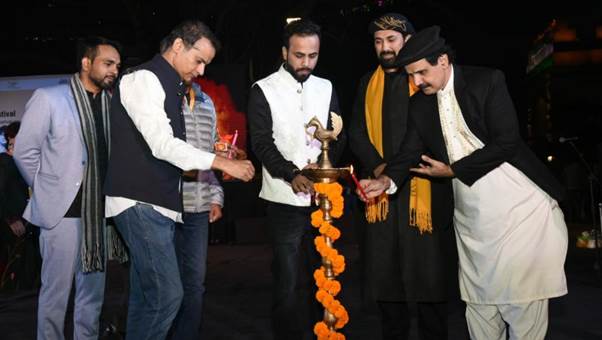
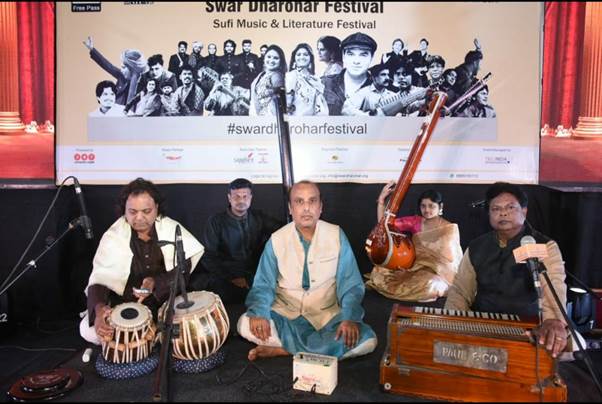
 Ministry of Culture, Government of India in collaboration with “Swar Dharohar Foundation,” inaugurated three day “Swar Dharohar Festival” under Kalanjali. “Swar Dharohar Festival” is a Music, Art & Literature Festival to showcase the iconic art and culture of India and, the rich literary Art & Heritage of Indian States.

Swar Dharohar festival was Inaugurated today by Chief Guest Sh. Mehtab Ali (Sitar Player) and Pt. Lalit Prasad (Classical Vocal). On the first day Classical Performance, Ghazal, Kavi Sammelan, Mushaira, Sufi Performance were organised. Ghazal was performed by Sh. Diwakar Meena, Sh. Hamsar Hayat and Athar Hayat performed Sufi Music.


Under Kalanjali, cultural programmes are being organised at Central Vista every week. The 3 days festival will continue to be organized on 3rd and 4th of December 2022 at the Central Vista, India Gate, New Delhi, Delhi.

Swar Dharohar Utsav started in the morning with Ragaas, and many celebrities performed.

In this program the upcoming local Artists will perform with Legend Artist on the same platform to showcase their talents. The National as well as Local Poets will exhibit their artistry through Kavi Sammelan.

*****

“Swar Dharohar Festival”- to showcase the iconic art & culture, rich literary Art & Heritage of Indian States, at Central Vista

 Ministry of Culture, Government of India in collaboration with “Swar Dharohar Foundation,” inaugurated three day “Swar Dharohar Festival” under Kalanjali. “Swar Dharohar Festival” is a Music, Art & Literature Festival to showcase the iconic art and culture of India and, the rich literary Art & Heritage of Indian States.

Swar Dharohar festival was Inaugurated today by Chief Guest Sh. Mehtab Ali (Sitar Player) and Pt. Lalit Prasad (Classical Vocal). On the first day Classical Performance, Ghazal, Kavi Sammelan, Mushaira, Sufi Performance were organised. Ghazal was performed by Sh. Diwakar Meena, Sh. Hamsar Hayat and Athar Hayat performed Sufi Music.


Under Kalanjali, cultural programmes are being organised at Central Vista every week. The 3 days festival will continue to be organized on 3rd and 4th of December 2022 at the Central Vista, India Gate, New Delhi, Delhi.

Swar Dharohar Utsav started in the morning with Ragaas, and many celebrities performed.

In this program the upcoming local Artists will perform with Legend Artist on the same platform to showcase their talents. The National as well as Local Poets will exhibit their artistry through Kavi Sammelan.

*****

All states should establish price monitoring centres in all districts: Centre

 All states should establish price monitoring centres in all districts, urged Shri Rohit Kumar Singh, Secretary Department of Consumer Affairs during a day-long workshop in Guwahati, Assam today. He said that that the Centre intends to achieve target of having 750 price monitoring centres by March 31st 2023 for which financial support will be assured.

The Secretary explained that through Price Monitoring Division, the Centre is making all efforts to control prices of essential commodities thereby, keeping check over inflation. The Department of Consumer Affairs regularly generates data about price and has the system of collecting prices of 22 essential food commodities in the country.

The workshop was organised in association with Government of Assam to address the issues concerning consumer protection in North Eastern States.

The Secretary during his inaugural address informed how the Department, National Commission, State Commissions and District Commissions and the whole ecosystem in terms of quality, quantity, standards, testing and benchmarks through BIS, NTH, Legal Metrology and National Consumer Helpline are working together towards protection of consumer interests.

He further highlighted the role of Bureau of Indian Standards (BIS) as the National Standards Body of India, in developing Indian Standards and implementation of voluntary and mandatory standards such as Quality Control Orders and how through Legal Metrology and Weights and Measures consumers are assured that what is being offered, the quantity being offered is exactly same as claimed on the product.

Speaking about the domain of consumer protection he underlined that infrastructure of commissions, human resource in consumer commissions and use of technology are three verticals through which the whole eco system of consumer protection is made robust and responsible.

It was assured that Department will provide its complete support to all State and District Commissions for having necessary infrastructure for effective functioning of consumer commissions as per the policy which states that 50% will be funded by State government and 50% will be funded by Central Government and requested all the representative of the State Government to provide its Utilisation Certificates of previous year, if pending, without which centre cannot release the funds for subsequent year.

Talking about the appointment of Hon’ble President’s and Members and the issue of vacancies in Consumer Commissions, he proudly stated that position of North East is the best in the country in terms of less number of vacancies in consumer commissions.

Highlighting the facility of online filing of consumer complaints through e daakhil, he informed that, Department has recently finalised a format/template for the consumer to file a complaint which comprise of standard fields and once all the mandatory information is provided, commissions can easily admit the genuine cases. He assured that the template will be very soon deployed and proliferated in the system and thereby commissions may expect rise in number of cases being filed through e daakhil throughout the country.

Shri Singh further highlighted the change of paradigm in consumer protection with advent of e commerce and mentioned that with changing equation between consumer and supplier, especially through e commerce, there has been steep rise in consumer grievances registered in e commerce sector at National Consumer Helpline. Out of the 90,000 complaints registered in NCH every month, 45-50% of the total complaints pertain to e commerce, it was informed.

He further stressed that, as a required measure, Department is taking necessary action through Central Consumer Protection Authority (CCPA) headed by Ms. Nidhi Khare, Additional Secretary, Department of Consumer Affairs. However, it is upon consumers to be more aware and more assertive of their rights and challenge the actions of e commerce companies he urged.

Talking about the various recent initiatives of the Department, he informed about the launch of BIS standard IS 1900/2022 on fake reviews wherein e commerce companies need to adhere to these standards within their policy of generating and publishing reviews on their platform.

Highlighting the role of Consumer Commissions in reducing the pendency of cases, he informed that one third of the pending cases pertains to insurance sector and therefore, by participating in lok adalats and engaging intensively with Insurance companies, Department of Financial Services and IRDAI, department is endeavouring to target the genesis of complaints and requested commissions to function effectively in reducing pendency of cases.

The Chief Secretary, Government of Assam, Shri Paban Kumar Borthakur emphasized that effective functioning of consumer commissions are utmost necessary for protection of consumers and if consumer commissions are not functioning properly, instead of consumer being a king, they become king in exile. Further, stressing on the need for consumer awareness, he pointed out that, unless consumers are enlightened about their rights, they cannot ascertain it, therefore, awareness is vital. He further urged all the Consumer Commissions of North Eastern States to work harder, come together and active part in national campaign for reducing the pendency of cases.

Additional Secretary, Ms. Nidhi Khare welcomed the gathering and highlighted that the objective of the workshop is to throw light and discuss the importance of consumer affairs in the north-eastern part of India. Emphasising on the various initiatives taken,  she stated that the Department of Consumer Affairs has taken numerous initiatives in the matters of consumers across National level, State level and District level, ranging from establishing mediation cells, conducting lok adalats, use of e-filing for hassle-free consumer grievance redressal and many more.

Shri Anupam Mishra, Joint Secretary, Department of Consumer Affairs delivered vote of thanks and expressed his gratitude to Chief Secretary, Government of Assam and his team for extending a huge support in making the even a grand success.

Inaugural session was followed by panel discussion on reducing the pendency of cases in consumer commissions, strengthening infrastructure, use of mediation for speedier resolution of consumer grievances, use of e-filing for hassle-free consumer grievance redressal etc., and separate technical sessions were held to discuss the use of National Test House, Guwahati in the material used in government projects, the utilisation of ISI quality mark products in projects of state governments, the implementation and enforcement of the Legal Metrology Act and Issues concerning monitoring of retail and wholesale prices of key commodities were discussed in the workshop.

Hon’ble Mr. Justice Ram Surat Ram Maurya, Member, NCDRC, Hon’ble Mr. Subhash Chandra, Member, NCDRC, Hon’ble Ms. Justice Deepa Sharma, Member, NCDRC, Hon’ble Dr. S. M. Kantikar, Member, NCDRC, Hon’ble Mr. Justice Arindam Lodh, President, State Consumer Disputes Redressal Commission, Tripura,  Hon’ble Mr. Justice Prasanta Kumar Deka, President, State Consumer Disputes Redressal Commission, Assam, Th. Saimon Singh, Acting President, State Consumer Disputes Redressal Commission, Manipur, Ms. Ramdinliani, Secretary, Food, Civil Supplies and Consumer Affairs, Government of Mizoram, Ms. Chubasangla Anar, Commissioner & Secretary, Food, Civil Supplies and Consumer Affairs, Government of Nagaland and other senior officials of North Eastern States attended the workshop and presided over various panel discussions.

***

Scheme for Intellectual Property (IP) protection revised to upgrade the professional charges of the facilitators

 To protect and promote Intellectual Property Rights (IPR) of Startups and to encourage innovation and creativity among them, Government of India had launched a Scheme for facilitating Start-Ups Intellectual Property Protection (SIPP) in 2016. The scheme facilitated startups in filing and processing of their patent, design or trademark application through the assistance of IP Facilitators, whose fee was borne by the Office of the Controller General of Patents Designs and Trademarks, Department for Promotion of Industry and Internal Trade, Government of India. After its successful implementation resulting in a significant increase in IP fillings by Startups the Scheme was extended for a period of three years till 31st March 2023. 

To further encourage the IP facilitators to provide quality services to Startups in order to increase the number of IP Applications filed by startups, the scheme has now been revised and facilitation fees has been notably increased by at least 100%. The revised scheme is applicable from 02 November 2022 and revised fees structure vis-à-vis the old scheme is as under:

Stage of Payment

Patents

Trademarks

Designs

FEE (in INR)

2016

2022

2016

2022

2016

2022

At the time of filing of Application

10,000

15,000

2,000

3,000

2,000

3,000

At the time of final disposal of Applications

Without Opposition

10,000

25,000

2,000

5000

2,000

5,000

With Opposition

15,000

35,000

4,000

10000

4,000

10,000


In addition to above scheme, IP filling by startups are also encouraged by providing with fee rebates under respective IP legislations. Startups are provided 80% fee rebate in filing patent applications and 50% fee rebate in filling trademark application. In addition, there are also provisions for fast-track examination of patent applications.

Resultantly, there has been a significant increase in IP activities by Startups in last 6 years:

  • Patent applications filed by Startups have increased from 179 in 2016-17 to 1500 in 2021-22;
  • Trade Mark applications filed by Startups have increased from 4 in 2016-17 to 8649 in 2021-22;
  • From 2016-17 to October 2022, 7430 patent applications and 28749 Trade mark applications have been filed by Startups.

As on 30 September 2022, INR 380.81 Lakhs have been disbursed as fees to the facilitators assisting the Startups in IP fillings. The revised fee structure will further augment the filing of IP applications by the Startups through the assistance of IP facilitators offering effective and quality service.

************

Workshop-cum-Buyer Seller Meet (BSM) organized in Aizawl to promote organic agricultural products of Mizoram and North Eastern Region (NER)

 As a part of its strategy to give a boost to the export of organic agricultural products of Mizoram and North Eastern Region (NER),Centre through  Agricultural and Processed Food Export Development Authority (APEDA) organized Workshop-cum-Buyer Seller Meet (BSM) at Mizoram University in Aizawl.

After the BSM, a consignment of Hatkora (local variety of citrus) sourced from farmers of Mamit district of Mizoram was exported to London and another consignment of Hatkora is being exported to Bangladesh.

APEDA, which is the apex agricultural products export promotion organization under the Ministry of Commerce and Industry, Government of India, organized the buyer seller meet in association with Ministries of Agriculture, Commerce & Industries, Govt of Mizoram and North Eastern Regional Agricultural Marketing Corporation Ltd (NERAMAC).

The BSM was organized to promote the exports of the potential agri-horti products from Mizoram and provide market linkage to farmers, Farmer Producer Organisations (FPOs), Farmer Producer Companies from the north-eastern state. 

The potential crops for the export from Mizoram are pineapple, hatkora (citrus), dragon fruit, oranges, passion fruit, squash, anthurium flower, Mizo Ginger, Mizo chilli and grape wine.

Seventeen exporters and 58 FPOs participated in the BSM while 14 exhibitors representing the state government, coffee board, spices board, NABARD and NERAMAC attended the meet.

The exclusive BSM provided an opportunity to the producers and processors of Mizoram to showcase their products and promote the exports as well as their wholesale and retail sales.

The workshop-cum-buyer seller meet was inaugurated by Hon’ble Agriculture Minister Pu C Lalrinsanga of Mizoram. 

With the intervention of APEDA, there is a tremendous increase in the export of agricultural produce from NE states like Sikkim, Assam, Nagaland, Manipur, Mizoram, Tripura, Arunachal Pradesh and Meghalaya. NE region witnessed an 85.34 percent growth in the export of agricultural products in the last six years as it increased from USD 2.52 million in 2016-17 to USD 17.2 million in 2021-22. 

The major destination of export has been Bangladesh, Bhutan, the Middle East, the UK and Europe.

To provide potential market linkages, APEDA organised field visits of importers to have first hand information about the qualitative cultivation practices being followed by farmers by inviting the importers from the neighbouring countries, the Middle East, far Eastern countries, European nations and Australia, etc. The field visits were carried out in all eight states of NER.

APEDA, in association with the Department of Commerce and Industry, Government of Assam, organised an export promotion conference-cum-buyer seller meet at Aizawl, Mizoram in March 2021.

Besides, APEDA organized international buyer seller meet (BSM) in Guwahati, Assam on March 10, 2022 wherein exhibitors from across the state displayed a wide range of agri-horti products, including GI  products such as fresh fruits, vegetables, processed food products, black rice, red rice, joha rice, spices, tea, coffee, honey, processed meat, spices & organic products. Importers from Sri Lanka, Dubai, Bangladesh, Oman, Netherlands, Singapore and Greece participated along with exporters from NER and other states.

A national buyer-seller meet was organized by APEDA in Guwahati on June 24, 2022, to promote the export of organic products grown in Assam. APEDA also signed an MoU with Assam Agriculture University, Jorhat to conduct various training programmes on pre-harvest and post-harvest management and other research activities for the promotion of export from the region.

Even during the Covid-19 period, APEDA continued to push its export plans through Virtual Buyer Seller Meet in association with the Embassy of India located in different countries with exporters and FPOs/FPCs from NER regarding the sourcing of pineapple, ginger, lemon, orange, etc. APEDA also organised Virtual Trade Fairs during the pandemic and facilitated the export to foreign countries.

APEDA has also planned to undertake several other projects like capacity building of 80 budding entrepreneurs and exporters from the region, the Farmer Producer Organizations (FPOs) and Farmer Producer Companies (FPCs) and the state govt. officials, organize skill development and training in food processing, value addition on horticultural produce, etc.

APEDA also extended its support to NER to undertake branding and promotion of North East products such as KIWI Wine, processed foods, carrying out a wet sampling of Joha Rice Pulao, Black Rice kheer, etc.

As a part of capacity building, APEDA organised skill development programmes for manufacturers, exporters and entrepreneurs to utilise the local produce for value addition and export. Training programmes are being held in different states of the Northeast in association with the Central Food Technology Research Institute, Mysore (CFTRI) and Indian Institute of Food Processing Technology (IIFPT), for five days.

APEDA, in association with the Industries and Commerce Department, Govt of Assam, organised an Export Conclave on February 19, 2021, in Guwahati.

With the APEDA’s intervention, Tripura’s Jack fruit was exported to London, and Nagaland’s King Chilli to London through a local exporter for the first time. Also, Assam’s local fruit called Leteku (Burmese Grape) was exported to Dubai and Assam’s Betel leaves have been regularly exported to London.

APEDA under its Agricultural Export Policy is encouraging states to harness the potential of Agri produce exports. APEDA aims to create a platform for the buyers to get the products directly from the producer group and the processors.

*******

Shri Jyotiraditya M. Scindia inaugurates direct international flight from Pune to Singapore

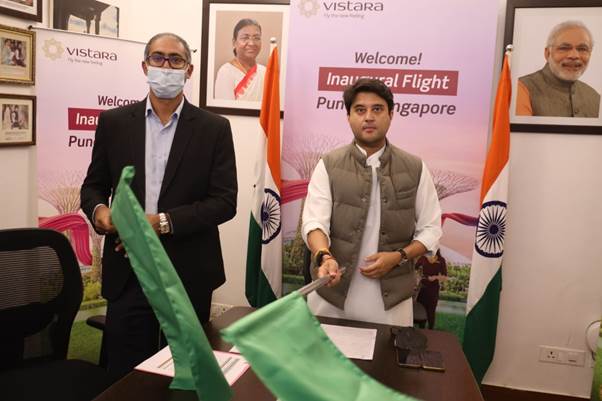
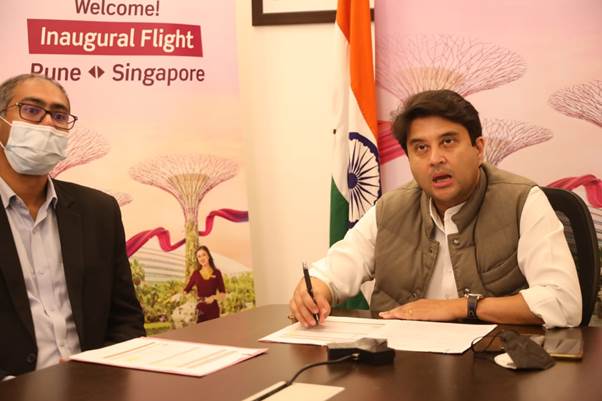
 Minister of Civil Aviation and Steel, Shri Jyotiraditya Scindia inaugurated a direct international flight from Pune to Singapore on 1st December 2022.

The flight will operate from 2nd December, 2022 as per the following schedule:

Flight No.

Sector

Departure

Arrival

Frequency

Aircraft

UK 111

PNQ – SIN

2:10

10:30

Mon, Wed, Fri, Sun

Airbus A321neo

UK 112

SIN – PNQ

11:50

15:10

Mon, Wed, Fri, Sun

Airbus A321neo


In his inaugural address, Minister of Civil Aviation and Steel, Shri Jyotiraditya Scindia said that the city of Pune, with its rich historical and cultural heritage, is constantly growing to become a hub for innovation, education, and development. He added that giving an impetus to this growth, the government has planned a gamut of activities to increase Pune’s connectivity, such as enhancing connectivity to domestic and international locations, developing a new terminal, and providing infrastructural support to the city by providing a separate cargo terminal.

Image

The Minister further added that the initiation of the Pune – Singapore flight is an important landmark in the history of Pune. He also mentioned about the newly launched flight route between Pune and Bangkok and said that these two routes will not just connect the city to important global destinations but also provide an edge to the development of the city by linking it to a wide range of opportunities related to employment, education, trade, and business.

Image

Looking at its increasing capacity, the new terminal is being built with a cost of Rs. 475.39 Cr and will expand its current area from 22,500 square meters to 48,500 square meters. To boost exports from Pune, a new International Air Cargo Terminal is also being built which will be completed by December 2024. A newly built multi-level parking facility worth Rs. 120 crores was recently launched on 25th November, 2022 at the Pune Airport.

The inauguration was graced by the presence of H.E. Gavin Roch, Vice Consul, Consul General of the Republic of Singapore, Shri Prashant Girbane, Director General, MCCIA, Shri Deepak Karandikar, President, MCCIA, Shri Sunil Tingre, MLA, Air Marshal Bhushan Gokhale, Chairperson & Director, MCCIA, Dr. Sudhir Mehta, Chairman & Managing Director, Pinnacle Industries Pvt. Ltd., Mr. Vinod Kannan, CEO, Vistara. Mr. Moinuddin Wasil, Head – Regulatory Affairs, Vistara, and other dignitaries from Vistara.

***


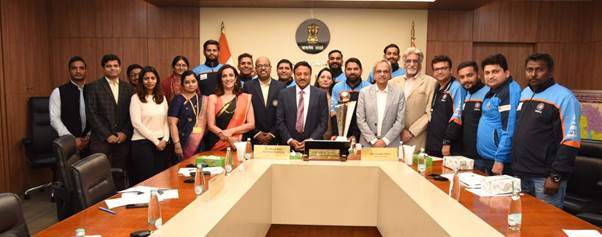
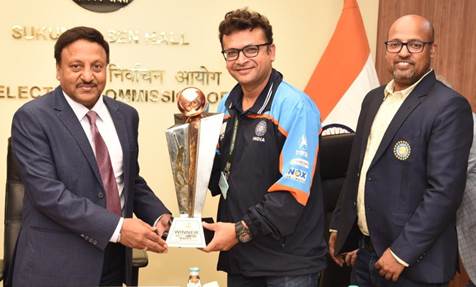
ECI felicitates Indian Deaf Cricket team ‘T20 Champions Trophy winners’ to mark International Day of Persons with Disabilities

 On the eve of the International Day of Persons with Disabilities, the Election Commission of India, felicitated the Indian Deaf Cricket Team, today at Nirvachan Sadan. Welcoming the team, CEC Shri Rajiv Kumar said that the Election Commission salutes the resilience and tenacity demonstrated by the players. The team has brought laurels to the country by winning the T20 Champions Trophy held in UAE by Deaf International Cricket Council. Sh Kumar said it’s important to accord due publicity and visibility to the winners. ECI will explore the possibility of sponsoring a match of the Indian Deaf Cricket Association team with mainstream cricket teams.


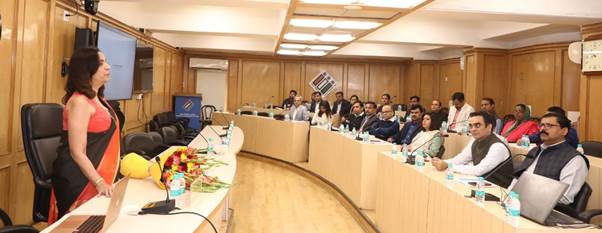
The Commission also organised a sensitization training workshop for officers of the Commission on ‘Diversity and Inclusion’ by Padma Shri awardee Dr. Niru Kumar, ECI National Icon to mark the International Day of PwDs.

Speaking on the occasion Sh Kumar said that ECI is committed to mainstream and deeply embed the concept and practice of accessibility in ensuring a new normal of enabling environment in the entire election process ecosystem from registration to voting.

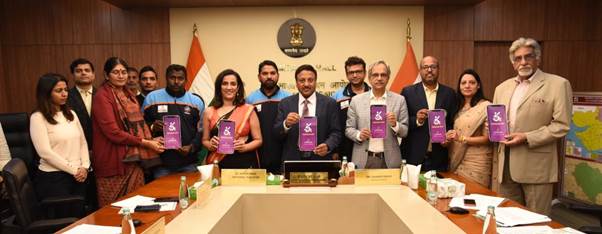
Shri Kumar elaborated that with administrative and technological innovations ECI has developed a one stop solution in the form of an APP – Saksham App – for enabling and facilitating the PwDs from enrolment to poll day facilities. The PwD electors can avail various services provided by the ECI enabling their participation in the election process, thus making them Saksham. The App can be downloaded from Google Play Store and Apple store.

ECI has been implementing several measures to ensure accessible facilitation at the polling stations, making them conducive for Persons with Disabilities to cast their vote without any hassles. Notified checklist for provisions such as polling stations on ground floor, standardised ramps, wheelchairs, volunteers, EVM with braille and ballot paper, braille EPIC, accessible toilets, tactile signage, sign language interpreters and pick up drop facility are made available in polling stations. The Commission has also provided the option of postal ballot facility to PwDs with 40% benchmarked disability to vote from the comfort of their homes. 

The Commission has carried out milestone initiatives such as:

    1. Setting up of the National Advisory Committee on Accessible Elections.
    2. A module on sensitization of election personnel.
    3. Deploying Accessibility Observers during elections
    4. Appointing achievers with disabilities as election ambassadors/icons
    5. Developing awareness films on inclusive elections starring achievers with disabilities

The Commission is dedicated to the goal of inclusive and accessible elections and shall endeavour to increase the participation of PwDs in the electoral process for a truly representative and robust democracy. So far, over 83 lakhs electorate have been mapped as PwDs in the electoral roll across the country.

****

Vice President’s speech at 8th LM Singhvi Lecture

 We are the world’s most vibrant democracy that is representative to an ideal level.

We started with the Constituent Assembly in which members were enormously talented from all sections of society. But progressively with each election our parliament reflects authentically the mandate of people …wisdom of the people. And now what we have in the parliament is fairly representative. at a global level we do not have a parallel on that count.

We must keep only one thing in mind –interest of Bharat – above everything else.

It is indicated in the preamble of our constitution – we the people. That means the power resides in the people – their mandate, their wisdom. Indian parliament reflects the minds of the people.

In the year 2015-16, the Parliament was dealing with a constitutional amendment act and as a matter of record the entire Lok Sabha voted unanimously. There was no abstention and no dissention. And the amendment was passed. In Rajya Sabha it was unanimous, there was one abstention. We the people – their ordainment was converted into a constitutional provision.

Power of the people, which was expressed through a legitimate platform, that power was undone. The world does not know of any such instance.

I appeal to the people here, they constitute a judicial elite class, thinking minds, intellectuals – please find out a parallel in the world where a constitutional provision can be undone.

Our Indian constitution provides in explicit terms Art 145 (3). Interpretation of the constitution when a substantial question of law is involved can be done by the court. Nowhere it says that a provision can be run down.

If a constitutional provision that carries the ordainment of people at large in such a vibrant democracy, is undone, what will happen?

I’m appealing to everyone that these are the issues that should not be viewed on partisan lines. I expect everyone to rise to the occasion and be part of the growth story that is India at the moment.

I’m startled that after this verdict, there was no whispering in the parliament. It was taken as such. This is too serious an issue.

We are proud of our judiciary. It has contributed to the growth of promoting the rights of the people.

After 9/11, US had passed the Patriot Act. Not with this majority. And it was taken as. That is why primacy of national interest prevails.

Imagine if 73rd and 74th amendments were to be undone. What will happen?

Now friends I put it to you the basic of the basic structure is primacy of the will of the people. In democracy, there can be nothing more basic than the prevalence of the rights of the people. And the ordainment of the people should be reflected through a legitimised mechanism which is the legislature in a sanctified manner.

I’m sure it is never too late to reflect and think. Our judiciary is one of the critical institutions of governance long with the executive and legislature. The doctrine of separation of powers is fundamental to our governance. The harmonious working of these institutions is vital for the growth of democracy. Any incursion, howsoever subtle, in the domain of one by another has the capacity to unsettle the apple cart of governance.

We have a parliament that is far more representative at the moment.

I have an appeal that as a true citizen of this country, generate a public opinion that political stance should be distanced from sublimity of our constitutional functioning.

It is never too late. The basic structure doctrine, we have lived with it. We have taken as such. It was by a majority of 7 to 6.

As a student of law, can parliamentary sovereignty be ever compromised? Can a succeeding parliament have to be bound by what has been done by an earlier parliament?

I leave you with this thought.

****

Republic Day 2023

The Azadi Ka Amrit Mahotsav celebration honors 75 years of India’s progress, as well as the illustrious past of its people, culture, and accomplishments. Every year on January 26th, India celebrates Republic Day with great fanfare. On this day, it is customary to hoist national flags across India and hold grand parades at Janpath, New Delhi, including the Indian National Army. In 2023, India will celebrate her 74th Republic Day.


Significance of Republic Day

A new constitution was approved by a drafting committee headed by Dr. BR Ambedkar Written after India’s independence from British rule. The Indian Constitution, which confirmed India’s status as an independent republic, went into effect on January 26, 1950. Since the Indian National Congress issued Purna Swaraj, declaring India’s independence from colonial authority, on this day in 1930, January 26 was chosen as the date for the event.

Republic Day Holiday 2023- Theme 


According to reports on Tuesday, the government has proposed three distinct themes for the tableaux of the Republic Day Parade in 2019: India@75, the International Year of Millets, and Nari Shakti. Several state governments, central ministries, and departments, according to sources, have been invited to take part in the Republic Day Parade on January 26 by developing a tableau using one of these three themes, or a mix of the three.

The government has suggested that India@75 tableaux highlight India’s freedom struggle, its accomplishments, its deeds, and its commitment throughout the previous seven decades. This is in honor of India marking 75 years since its independence.

The idea for a millets day originated in 2021 when India asked the UN to designate 2023 as the International Year of Millets (IYOM). The United Nations General Assembly (UNGA) declared 2023 to be the International Year of Millets after 72 nations backed India’s request.

How is Republic Day celebrated?

India celebrates Republic Day with enthusiasm and passion. It is a day dedicated to the Sovereign Constitution of India. It is common for schools and colleges to display national flags. National cultural activities are held to support India’s struggle for independence. The President of India raises the national flag at the India Gate in New Delhi.

The largest parade is held in Rajpat, New Delhi. The Ministry of Defense organized a parade led by the President of India. The event not only showcases military prowess but also promotes India’s rich cultural diversity.

The occasion also honors those who have given their lives as martyrs for the nation. By placing a wreath at the Amar Jawan Jyoti at India Gate, the Indian Prime Minister pays tribute to the martyrs. The national song, national flag raising, and 21-gun salute come next. The Paramvir Chakra, Ashok Chakra, and Vir Chakra are awards given to heroic troops. Awards are given out to people of all ages who have shown fortitude in the face of hardship.

In military jeeps, the recipients of the heroism medals greet the president. India then shows off its military prowess after that. Police, National Cadet Corps, and military parades are also held and the President of India receives salutes from various regiments. The Indian Air Force fighter jets pass over Janpath to end the show.

Although the holiday is observed across the nation, Delhi—the capital—sees India’s largest Republic Day celebrations.


India will witness a rise in gamers by 2025.

The number of Indian gamers is expanding at a compounded annual growth rate (CAGR) of 12% and is expected to jump to 700 million in FY25 compared with 507 million in 2021, said a new report by Dentsu titled Gaming Report India 2022 – For the Game.

The report said that 46% of gamers in India are women and that overall, ‘Real Money Game’ revenues currently constitute 57% of market size but future growth is projected to be driven by in-app purchases growing at a 34% CAGR. There were 120 million paying users in FY22, which represents a 24% conversion rate.

Anita Kotwani, CEO, Carat India & lead at Dentsu Gaming, said, “Gaming’s growing cultural impact, combined with the promise of the metaverse, has generated endless opportunities for advertisers. With the meteoric expansion of esports and streaming platforms, gaming has shifted from solitary play to spectator sport. Gaming platforms are now the main avenue for social connections and self-expression. One cannot follow the cookie-cutter approach anymore given the fluidity & dynamism of the industry.”

India will witness a rise in gamers by 2025.

The number of Indian gamers is expanding at a compounded annual growth rate (CAGR) of 12% and is expected to jump to 700 million in FY25 compared with 507 million in 2021, said a new report by Dentsu titled Gaming Report India 2022 – For the Game.

The report said that 46% of gamers in India are women and that overall, ‘Real Money Game’ revenues currently constitute 57% of market size but future growth is projected to be driven by in-app purchases growing at a 34% CAGR. There were 120 million paying users in FY22, which represents a 24% conversion rate.

Anita Kotwani, CEO, Carat India & lead at Dentsu Gaming, said, “Gaming’s growing cultural impact, combined with the promise of the metaverse, has generated endless opportunities for advertisers. With the meteoric expansion of esports and streaming platforms, gaming has shifted from solitary play to spectator sport. Gaming platforms are now the main avenue for social connections and self-expression. One cannot follow the cookie-cutter approach anymore given the fluidity & dynamism of the industry.”

India receive a whopping 100 billion dollars as remittance according to a report by World Bank.

The World Bank Report has stated that India, the third largest economy of Asia, is set to become the first country to receive $100 billion in remittances from migrant workers abroad. Notably, India had received $89.4 billion in remittances in 2021, according to the World Bank report, which then made India the top recipient globally.

India will be the first country in the world to receive $100 billion from remittances during 2022, the World Bank has said.

Remittance flows to India will rise 12% to reach $100 billion this year, according to a World Bank report published Wednesday. That puts its inflows far ahead of countries including Mexico, China and the Philippines.

Highly-skilled Indian migrants living in wealthy nations such as the US, UK, and Singapore were sending more money home, according to the report. Over the years, Indians have moved away from doing lower paid work in places like the Gulf. Wage hikes, record-high employment and a weakening rupee also supported growth.

Remittances to India were enhanced by wage hikes and a strong labor market in the US and other OECD countries. In the Gulf Cooperation Council destination countries, governments ensured low inflation through direct support measures that protected migrants’ ability to remit. 

India receive a whopping 100 billion dollars as remittance according to a report by World Bank.

The World Bank Report has stated that India, the third largest economy of Asia, is set to become the first country to receive $100 billion in remittances from migrant workers abroad. Notably, India had received $89.4 billion in remittances in 2021, according to the World Bank report, which then made India the top recipient globally.

India will be the first country in the world to receive $100 billion from remittances during 2022, the World Bank has said.

Remittance flows to India will rise 12% to reach $100 billion this year, according to a World Bank report published Wednesday. That puts its inflows far ahead of countries including Mexico, China and the Philippines.

Highly-skilled Indian migrants living in wealthy nations such as the US, UK, and Singapore were sending more money home, according to the report. Over the years, Indians have moved away from doing lower paid work in places like the Gulf. Wage hikes, record-high employment and a weakening rupee also supported growth.

Remittances to India were enhanced by wage hikes and a strong labor market in the US and other OECD countries. In the Gulf Cooperation Council destination countries, governments ensured low inflation through direct support measures that protected migrants’ ability to remit. 

National Milk Day

The day commemorates Dr. Verghese Kurien’s 100th birthday and is referred to be the “Father of the White Revolution.”

On November 26, National Milk Day is marked to raise awareness of the value and advantages of milk.

India is the largest milk producer. Animals eat milk, so it is a food consumed by both humans and animals. World Milk Day, established by the Food and Agriculture Organization of the United Nations, is also celebrated on June 1st each year.


National Milk Day: History

The National Dairy Development Board (NDDB), the Indian Dairy Association (IDA), and 22 State Dairy Associations have jointly decided to commemorate Dr. Celebrating his Verghese Curiae on November 26, 2014. Dr. Curia is considered the father of India’s White Revolution. As a result, on November 26, 2014, the first National Milk Day was celebrated.

Do you know about the White Revolution and Operation Flood?

India’s National Dairy Development Board (NDDB) initiated a rural development program, Operation Flood, in 1970. It is one of the largest programs aimed at building a nationwide milk network. As a result, milk traders and merchant fraud has decreased and India is now one of the largest producers of milk and dairy products. Hence the White Revolution is another name.

Dr. Verghese Kurien, then Chairman of the NDDB, provided the management know-how and necessary impetus for the cooperative sector. He is credited with being the driving force behind Operation Flood, also known as White Revolution in India.

Operation Flood was implemented in three phases.

Phase I (1970-1980): It was paid for by the European Union’s World Food Program donations of skimmed milk powder and butter oil. Connected with consumers in Mumbai, Kolkata, and Chennai.

Phase II (1981-1985): Between 18 and 136 dairy stalls were added during this time. A total of 290 urban markets also increased milk distribution. And he said that by the end of 1985, 4.25 million milk producers were part of a self-sustaining network of 43,000 village cooperatives. By 1989, 22,000 tons of domestic milk powder had been produced for his 140,000 tons.

Phase III (1985-1996): Dairy cooperatives expanded and strengthened their infrastructure during this time to increase the supply of milk to the market. This phase strengthened the Indian dairy cooperative movement by adding 30,000 new dairy cooperatives to the 42,000 dairy cooperatives already established in Phase II. Women’s participation in the milk shed increased from 1988 to 173 in 1989, and women’s milk cooperatives also increased dramatically.

research and developments in animal nutrition and animal health were also highlighted during this period. Innovations such as vaccination against atherosclerosis, avoidance of protein diets, and urea molasses mineral blocks have helped dairy cows produce more milk.

About Dr. Verghese Kurien

1. He resigned from his position with the government and coerced Tribhuvandas Patel and the farmers to launch the Kaira District Cooperative Milk Producers Union Ltd (KDCMPUL), subsequently known as “Amul,” as the region’s first milk cooperative movement.

2. He carried out the “Operation Flood” scheme and attempted to bring the White Revolution to India. He was responsible for planning India’s White Revolution.

3. He contributed to India being the world’s top producer of milk.

4. He contributed to setting the groundwork for democratic initiatives at the local level.

5. He founded several organizations, including the National Dairy Development Board (NDDB) and the Gujarat Cooperative Milk Marketing Federation Ltd (GCMMF), and he had a considerable impact on the development of the dairy cooperative movement in the nation.

6. He also oversaw the replication of the cooperative dairy Anand model, which is used throughout India. He received 15 honorary degrees over his nearly fifty years of service from various international universities because he insisted that learning should never end.

7. He will always be known for changing the definition of milk to make it a potent tool for economic growth.