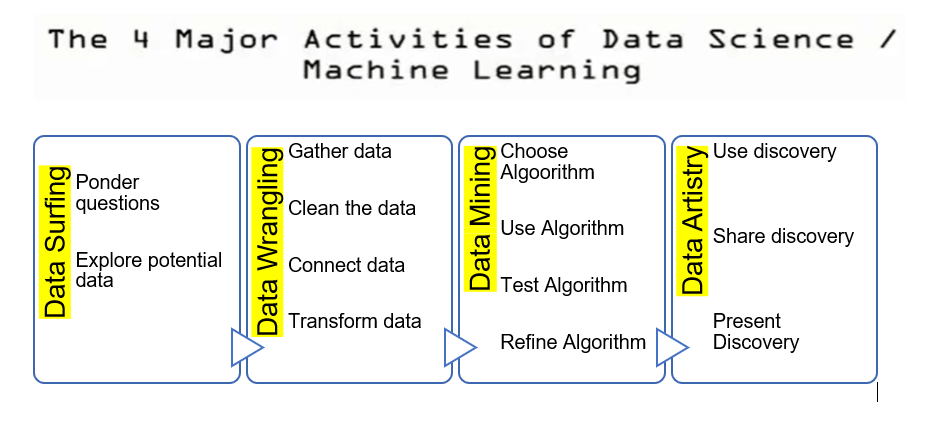
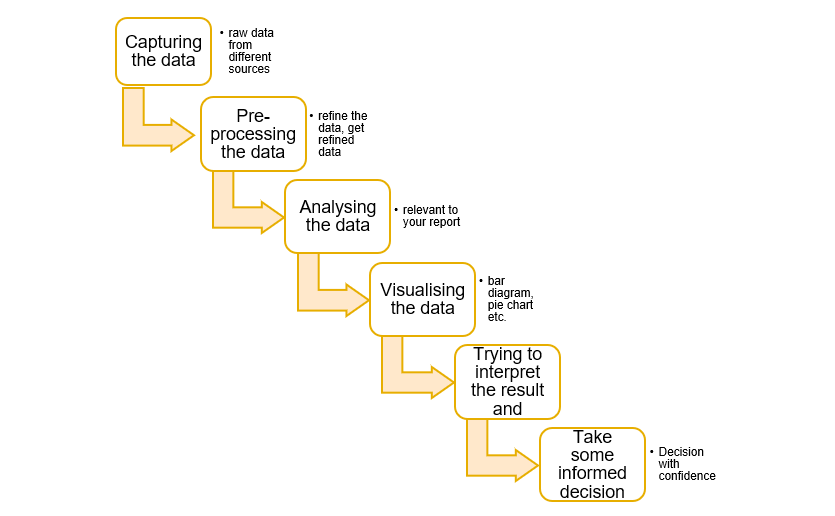
Major tasks of Data Science

Data science involves a plethora of disciplines and expertise areas to produce a holistic, thorough and refined look into raw data. Data scientists must be skilled in everything from data engineering, math, statistics, advanced computing and visualizations to be able to effectively sift through muddled masses of information and communicate only the most vital bits that will help drive innovation and efficiency.

Data scientists also rely heavily on artificial intelligence, especially its subfields of machine learning and deep learning, to create models and make predictions using algorithms and other techniques. 

Reference

https://builtin.com/data-science

Man making is the essence of nation building

To quote the words of Swami Vivekananda,

“Man making is the essence of nation building. “

An individual builds a family, a family builds a community, and a community builds a country.

Hence strong individuals, meaning people with values of love, compassion, respect and discipline build a strong country.

When there is righteousness in the heart, there is beauty in the character.

When there is beauty in the character, there is harmony in the home.

When there is harmony in the home, there is order in the nation.

When there is order in the nation, there is peace in the world.

The easiest means to show your love to your nation is through work. Your selfless work will convey the joy and depth of your love.

Whatever your work is, put your heart into it, it will not only make you happy but also makes the entire nation happy and prosperous.

Photo by Diva Plavalaguna on Pexels.com

Dream India

Let us unite,

And fight against those who incite,

Let’s progress with minds without fear,

And succeed in every sphere,

We are a strong nation,

All we need is a little bit of dedication,

Let us open our eyes,

And see our ‘Dream India’ rise.

Photo by Still Pixels on Pexels.com

Let us work sincerely to make India a self – reliant and a developed nation, together with the loyal legislature that makes laws, accountable executive that carries out the laws and trustworthy judiciary that evaluates the laws.

How machines learn?

Machine learns through experience

Like humans,

machines also learn from experience. They analyse the existing data, figure out the pattern, and find what to do with the new data.

Learning from Medical records

based on combination of attributes i.e., symptoms, it determines an outcome variable i.e., whether the patient is covid positive or not by learning from the existing data.

Learning from Energy usage patterns

smart homes optimize the energy usage by learning from the energy usage patterns of its residents (by capturing the motion of residents), hence saving the electricity bills.

Learning from User interests

learns from user interests and gives suggestions and recommendations accordingly

Learning to target customers

learns from the travel history of customer and gives discounts, coupons, offers to the customers travelling more often during a certain period, to attract them to travel more (to retain the customer to themselves)

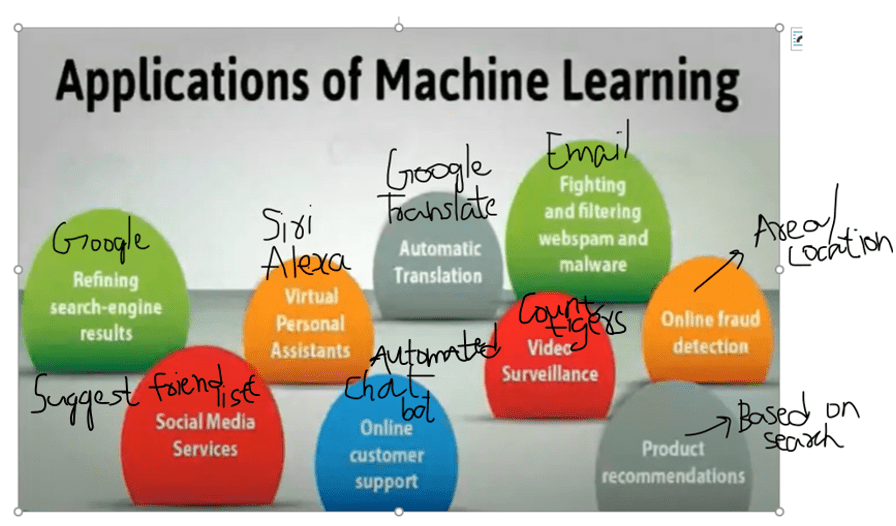
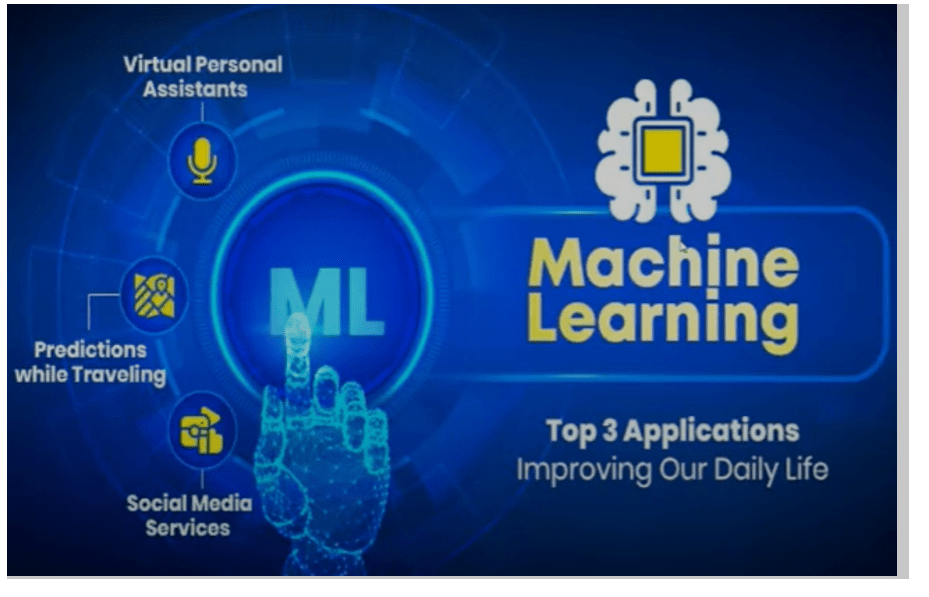
Applications of machine learning

Machine learning in finance

  • Financial Monitoring

Simultaneously multiple micro transactions to multiple accounts.

  • Risk Management

Giving loans based on credit score of the customer. (Credit worthiness)

  • Money laundering prevention

Machine learning in medicine

  • Personalized medical reports and treatments
  • Smart watches
  • Predicting whether a cell is cancerous cell or not
  • Based on the attributes (lifestyle, food habits, exercise, sleep etc.), determining whether a person is prone to certain disease (say cardiac arrest).

Equipment maintenance records

Combustion chamber, rockets

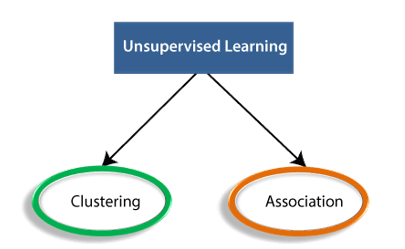
Types of Unsupervised Learning Algorithm:

The unsupervised learning algorithm can be further categorized into two types of problems:

Clustering

Clustering is a method of grouping the objects into clusters such that objects with most similarities remains into a group and has less or no similarities with the objects of another group.

Cluster analysis finds the commonalities between the data objects and categorizes them as per the presence and absence of those commonalities.

Association

An association rule is an unsupervised learning method which is used for finding the relationships between variables in the large database. It determines the set of items that occurs together in the dataset.

Association rule makes marketing strategy more effective.

Such as people who buy X item (suppose a bread) also tend to purchase Y (Butter/Jam) item. A typical example of Association rule is Market Basket Analysis.

Unsupervised Learning algorithms:

K-means clustering

KNN (k-nearest neighbors)

Hierarchal clustering

Anomaly detection

Neural Networks

Principle Component Analysis

Independent Component Analysis

Apriori algorithm

Singular value decomposition

Advantages of Unsupervised Learning

Fast process as task of data labelling is not involved.

Provides unique and disruptive insights.

Disadvantages of Unsupervised Learning

The result of the unsupervised learning algorithm might be less accurate as input data is not labelled, and algorithms do not know the exact output in advance.

Difficult to measure accuracy

Dealing with high-dimensional data- when the dimension of data and the number of variables is more, the process becomes difficult.

Unsupervised Learning

As the name suggests, unsupervised learning is a machine learning technique in which models are not supervised using training dataset.

Instead, models itself find the hidden patterns and insights from the given data.

It is much similar as a human learns to think by their own experiences, which makes it closer to the real AI.

In real-world, we do not always have input data with the corresponding output (training or labelled data referred to as supervisor). So, to solve such cases, we need unsupervised learning.

Steps:

Step 1: The very first step is to load the unlabeled data into the system.

Step 2: Once the data is loaded into the system, the algorithm analyses the data.

Step 3: As the analysis gets completed, the algorithm will look for patterns depending upon the behavior or attributes of the dataset.

Step 4: Once pattern identification and grouping are done, it gives the output.

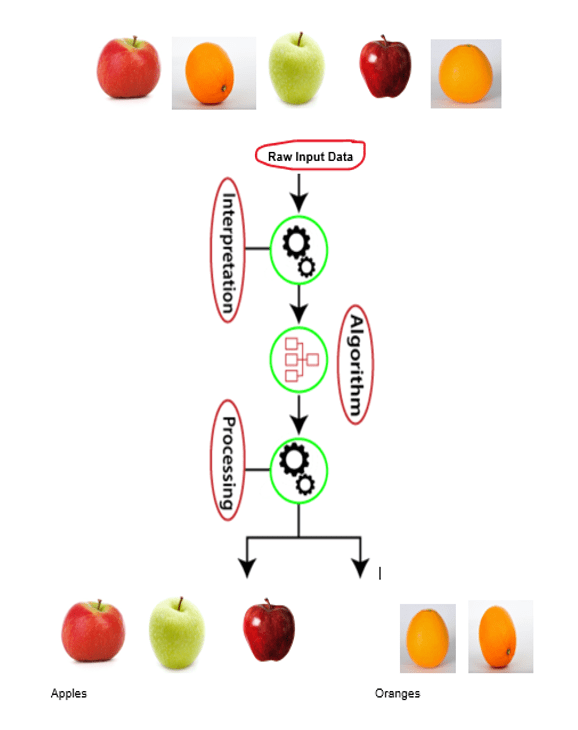
Example: Input dataset containing images of different types of fruits.

Now, let’s take these fruits and feed them to an unsupervised learning model.

The model determines the features associated with the data and understands that all the apples are similar in nature and thus groups them together.

Similarly, it understands that all the oranges have the same features and thus group them together and the same is the case with all the mangoes (in case we have mangoes in this example)

Here, the unsupervised learning algorithm will perform this task by clustering the image dataset into the groups according to similarities between images.

Example 2:

For instance, given a data base of movie reviews, you could identify clusters of users who rate action movies similarly, and use those correlations to predict how one member might like a particular movie he had not yet seen, but others have rated.

Types of Supervised learning

  1. Classification

Supervised learning can be further divided into two types of problems:

Classification algorithms are used when the output variable is categorical, which means there are two classes such as Yes-No, Male-Female, True-false, etc.

Multiple classes may also be present.

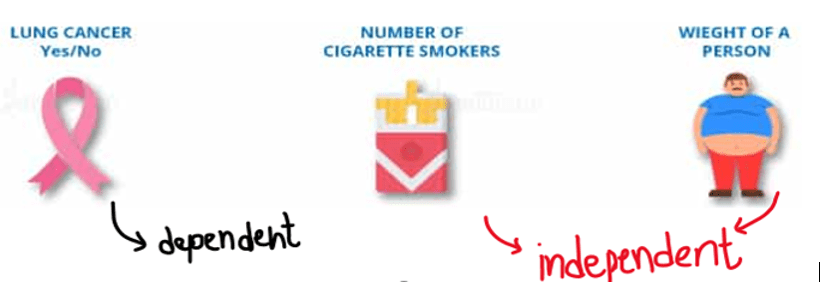
The output variable or the dependent variable should be categorical in nature.

Example:  Diagnosis

“Prone to lung cancer” (output variable) is the dependent variable and “Weight” and “Number of cigarettes smoked” are the independent variables.

  1. Regression

Regression algorithms are used if there is a relationship between the input variable and the output variable. It is used for the prediction of continuous variables, such as Weather forecasting, Market Trends, etc.

  • Analyse the existing data and
  • Predict the future data parts.

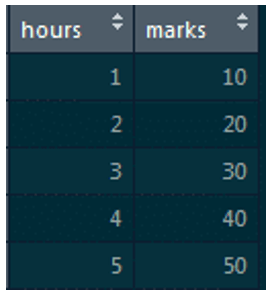
Let’s say you have two variables, “Number of hours studied” & “Number of marks scored”. Here we want to understand how the number of marks scored by a student change with the number of hours studied by the student, i.e.

“Marks scored” is the dependent variable, and “Hours studied” is the independent variable.

You need to note that “marks scored” is the dependent variable and it is a continuous numerical.

Question: “How many hours should a student learn to get 60 points?” 

Ans: The regression model would understand that there is an increment of 10 marks for    every extra hour studied and to score 60 marks the student must study for 6 hours.

Example: Weather app in our mobile

                This app predicts the weather of the entire next week. How does it do?

By analysing the previous data (say past 10 years weather report data) and predicts the pattern for the next week.

Here, since we deal with large amount of data, it may be difficult for humans to work on it. Hence, the machines are fed with large amount of data and made to predict the future data parts.

How supervised learning works?

In supervised learning, models are trained using labelled dataset, where the model learns about each type of data.

Once the training process is completed, the model is tested based on test data (a subset of the training set), and then it predicts the output.

Example:

Task

Suppose we have a dataset of different types of shapes which includes square, rectangle, triangle, and Polygon. Now the first step is that we need to train the model for each shape.

Training Experience

If the given shape has four sides, and all the sides are equal, then it will be labelled as a Square.

If the given shape has three equal sides, then it will be labelled as a triangle.

If the given shape has six equal sides, then it will be labelled as hexagon.

Now, after training, we test our model using the test set, and the task of the model is to identify the shape.

Performance

The machine is already trained on all types of shapes, and when it finds a new shape, how well it classifies the shape based on number of sides and predicts the output.

Steps involved

  • First, determine the type of training dataset
  • Collect/Gather the labelled training data.
  • Split the training dataset into training dataset, test dataset, and validation dataset.
  • Determine the input features of the training dataset, which should have enough knowledge so that the model can accurately predict the output.
  • Determine the suitable algorithm for the model, such as support vector machine, decision tree, etc.
  • Execute the algorithm on the training dataset. Sometimes we need validation sets as the control parameters, which are the subset of training datasets.
  • Evaluate the accuracy of the model by providing the providing the test set. If the model predicts the correct output, which means our model is accurate.

References

https://www.javatpoint.com/supervised-machine-learning

Supervised learning

The machines are trained using well “labelled” training data, and on basis of that data, machines predict the output.

The labelled data means some input data is already tagged with the correct output.

Supervisor is this training data (labelled data) which helps to predict the output correctly when a new input data point is given as input.

The aim of a supervised learning algorithm is to find a mapping function to map the input variable(x) with the output variable(y).

Step 1: The very first step of Supervised Machine Learning is to load labelled data into the system. This step is a bit time-consuming because the preparation of labelled data is often done by a human trainer.

Step 2: The next step is to train and build connections between inputs and outputs(function). This step is also known as the training model.

Step 3: Then comes the step known as the testing model. As the name suggests, you test the model by introducing it to a set of new data.

Here, the input is an independent variable, and the output is a dependent variable. The goal is to generate a mapping function that is accurate enough so that the algorithm can predict the output when we feed new input.

Example of labelled data:

We have a labelled dataset that consists of images of apples and oranges, with different attributes such shape, colour etc.

Consider the image of an apple shown above with the labels- shape, colour, and apple.

We train the model with this image. Then, we repeat the same training process with other images of both apples and oranges with their attributes.

What we are doing is-

Here, the input data is the independent variable and “Apple” or “Orange” is dependent variable as it is dependent on the input picture given.

Our goal is to generate a mapping function between the dependent and independent variable so we can determine the output when we feed a new data point.          


Once the model is trained and the algorithm is built, the accuracy can be tested with the help of a test dataset.

When we feed the model with a new apple image, it scans the image and matches the attributes of the image with other trained images. Then depending upon the accuracy of the model, it returns the output ‘apple’.

When new data point is given as input, say,

The machine should be able to guess the output as  “Apple”.

This labelled data or the training data (acts as supervisor), helps to predict the output as “Apple”.

Machine learning

Machine learning (ML) is a type of artificial intelligence (AI) that allows software applications to become more accurate at predicting outcomes without being explicitly programmed to do so.

Machine learning algorithms are readily available. For example, Python has many libraries which support these machine learning algorithms.

Using this we can:

  1. Import a data set
  2. Fit a model to the data set
  3. Find the accuracy (how well it predicts a new data point)

Then why to learn the basics when instead we can use the pre-built algorithms that are readily available?

Still, we should learn the basics (the mathematics behind these concepts) of machine learning to be able to take an informed decision about the performance of the model.

Photo by Alex Knight on Pexels.com

We can fit the model to a data set and get some performance, but how to justify whether the performance given by the machine learning algorithm is proper or not?

The design of experiment                                                                                                                                              

Design of experiment

To be able to take the decisions with confidence we should know the fundamental concepts.

Category management in supermarkets: what's important for newcomers to know?

Category management is a categorisation of products according to buyers’ shopping habits. It is used within any retail store, including the supermarket or its website with the possibility of ordering goods for home delivery. Category management for one retail chain (for example, several supermarkets) is similar to physical stores and online trading. However, the categories may vary from point to point. This is because it depends on the customers who often visit the store.

What does a manager have to know when starting to work on categories in the supermarket?

It’s going to be difficult to analyze customer segments

Simply because they are going to be buying goods offline. When you move at least 50 per cent of your goods online to collect goods in-store or pay for home delivery, the whole situation will improve. Although, this still does not guarantee that the customer segments will meet your expectations. Yes, you can track customers through recurring patterns in receipts. You can also come up with hypotheses based on the data obtained from your competitors and other market analyses. Still, you won’t be able to study your customers under a microscope.

The cost of a product will often take precedence over its other qualities

It is a major problem for category management in supermarkets and retail in general. Most likely, grocery store visitors care more about the product’s price, and low cost always wins over other characteristics. Therefore, it will be more challenging to create categories: inevitably, you should be guided by the price of the goods.

At some point, it will be difficult to fight off competitors

You will be selling the same items which are available in other supermarkets. Some manufacturers may agree to cooperate exclusively with your chain of stores; however, this is unlikely because this arrangement is simply unprofitable for the supplier. Moreover, it’s impossible to lower the bar and start undercutting, that is, trading at a loss. After all, a business needs to earn money. In some instances, it may only be achievable through introducing discounts.

You will be able to test hypotheses only on a small number of consumers

Why? Most trade will occur in offline stores rather than in their online equivalents. And this, as we remember, complicates the task of marketers and, unfortunately, category managers. Only a small percentage of consumers shop online. That makes sense: you have to pay for delivery. You can’t select your products or ensure that all your fruit and vegetables are intact. Your delivery guy might also be late or you may face logistical problems like mixed-up orders.

How can you test your hypotheses on those customers who have turned to your supermarket website? First, you have to study your portal analytics: how users have found you, how they behave on the site, which tabs they open first, and how their filter products in various categories. If you have social media accounts, be sure to use them. The statistics offered by Instagram will demonstrate who your customers are and how they behave. By understanding the core of your audience accessing your resources, you can create category management hypotheses and test them on users before displaying the goods in stores. Of course, many of your customers will not shop online. Still, you can learn all about them, for example, through their choice of purchases on receipts.

The variety of categories will depend on the location of the supermarket

This limits your ability to influence the profits of the business. The categories will depend largely on areas where your shops are located, as well as people who live there and their buying power. For example, it is pointless to introduce a category of personal care products if jars of face cream have been sitting on the shelves for months in a particular store. It makes no sense to reduce the number of household goods with an above-average price tag if they sell like hotcakes. If you work in a supermarket in a deprived area, be prepared for a succession of identical categories with low-cost products.

Start learning category management now to secure a job within this field in a few weeks! This area has been actively booming in India and the surrounding regions. Therefore, your knowledge will definitely be in demand.

Why You Should be Getting into Podcasts

Of all the different types of media available to us today, podcasts may be the ones we have the least exposure to. Even while podcasts are less popular compared to other media forms like videos and blogs, the number of podcast listeners has risen steadily each year since it started in 2004. The Covid-19 pandemic and the worldwide lockdowns are what kickstarted my habit of listening to podcasts. Whether the episode features experts’ advice on topics like mental health and exercise, celebrity interviews, or film and TV show reviews, listening to podcasts has been both educational and entertaining for me.

When I talk to people about podcasts, a lot of them are confused about what it is. A podcast refers to a series of digital audio files prepared and distributed through RSS feeds or apps (Spotify, Apple Podcasts, etc), that can be accessed through the internet or downloaded. The audio files can be about anything – you name it, you can probably find podcast episodes on it. It can be news, comedy, science, and niche topics. You can find great reviews of new and old films, TV shows and series. Podcasting initially started as an easy and inexpensive way for individuals like bloggers and musicians to communicate their ideas and opinions and build a close community of similar-minded people. Comedian Joe Rogan’s The Joe Rogan Experience is the most popular podcast globally. Dear Hank and John by authors and YouTubers John and Hank Green discuss almost everything their listeners want answers to.  Podcasts today have also been adopted by large and small companies, radio networks (BBC, for example), and media organizations like NPR and New York Times. For a lot of businesses, it is an effective content marketing technique for cultivating brand loyalty and customer relationships.

One of the greatest advantages of listening to podcasts is how easy it is to access. Users can listen to any podcast from their mobile phones at any time of the day. If you are like me, you will appreciate how it makes a lot of your daily chores like cleaning or washing dishes fun. It makes multitasking so much easier. You can listen and learn new things while you go through your daily chores or travelling to work/class. It is also a very effective way of reducing the time you spend looking at the laptop or mobile phone screen. Listening to podcasts is a great way of learning and unlike visual media, it doesn’t exert strain on your eyes. It also keeps your brain active as you use your imagination more with podcasts. The vast variety of topics on which podcasts are made also means you get to learn unique stuff often directly from the subject experts. That is a lot of education and entertainment guaranteed.

Many popular podcasts have seasons with a series of episodes in each season. These episodes may be released daily, weekly, or at any time the podcaster wishes. You can subscribe to podcasts and get notified when a new episode is posted. People get into podcasting because it is a comparatively easier and cheaper way of producing your own show. You do not need to depend on radio broadcast stations and can talk about anything you like. You just have to make sure you have the right audio recording equipment and audio editing software, and choose the right topic to talk about. Podcasts can go as short as a few minutes or be longer than an hour. You can use any of the popular podcast hosting websites and apps to search for podcasts on the topics you like.

Forms of Content Marketing

As regular consumers of the media and the internet, all of us must have come across some form of content marketing at some point. Content marketing refers to the creation and distribution of valuable, relevant content for a clearly defined audience to cause a profitable customer action. The goal of content marketing is to provide valuable information to the audience through content such that they willingly consume it rather than avoiding it. We build brand loyalty and trust by providing solutions to problems faced by them.

There are mainly 5 forms of content marketing we can see today. They are:

Blogging

Many brands use blogs, often including it as part of their website. It is one of the most popular forms of content marketing techniques, being very cost-effective for small businesses. Blog posts usually contain written material about useful information on topics related to your product or service. When the written material provides relevant knowledge and effective solutions to customers’ problems, they earn an audience and build good customer relationships. The length of the post depends on the topic of the blog, audience demographics and the writer’s unique writing style. Whether it is long or short in length, make use of catchy headlines and simple language. Search Engine Optimization (SEO) also comes into play in driving web traffic to the blog.

Podcasts

The immersive field of podcasting has seen a rise in its number of listeners every passing year. Podcasts are audio content posted on topics ranging from interviews, discussions to reviews on the internet. Even though it is a smaller market compared to blogging, it still garners a loyal group of listeners because of how easy it is to indulge in podcasts. Unlike blogs and videos, the audience can listen to podcasts while doing anything else like travelling or cleaning. Listening to the podcaster’s voice, the information they give and their opinions on stuff builds a stronger relationship with the audience, They choose topics closely related to their product or service and post content consistently to various podcast hosting platforms like Spotify, Google Podcast, Apple Podcast, etc. Quality audio recording equipment and software are also important for good podcasts.

Videos

Nobody can deny how popular videos are among the general public. All of us watch YouTube at least once a day and short-form videos on platforms like TikTok and Instagram are all the rage. Videos could be vlogs, reviews for products, step-by-step guides or even animated/sketched whiteboard videos. While it is expensive and time-consuming, it is also very efficient as it can communicate quicker than any other form of content marketing, provided it is produced in the right setting with good characters and equipment. Whether they are product reviews or instructional videos, they are the closest you get to having real contact with someone. The video content you created can also be used in other forms, like in social media and blogs.

Infographics

Infographics refer to long representations of graphs, statistics, and other relevant information. You may have across interesting graphical representations of information and statistics related to various interesting topics. These simple, valuable graphics are useful in summarizing and breaking down the important points of a complicated, large area of study or a survey. A well-made infographic can grab a lot of attention. It usually gets shared a lot on the internet and on social media. They can be supporting content for blogs or standalone content.

Social Media

Everybody has social media these days and it goes without saying that it is one of the easiest and most effective forms of content marketing. Posting consistently and making relevant and shareable content is essential for social media marketing. When you have such a large amount of people online exposed to your content, you need to make sure your content is relatable and engaging with the audience. Make use of social media analytics to figure out which social media platform and what kind of content (written, videos, etc) works best with your audience.

Guide to Choose the Best School ERP Software?

 Due to the pandemic, there was a complete turn of events, and the children are attending classes online at peak times. Though the situation is getting normal these days, it is essential and beneficial to have a school ERP software that helps maintain accurate academic and operational excellence information.


What is School ERP Software?

A school ERP is an advanced technology where you can perform a set of programs specially made to perform administrative tasks of a school in an appropriate manner. This is also known as school management ERP software that can manage all the tasks without the presence of a person, pen, and paper. 

This is a software platform where all the people, including students, teachers, principals, parents, and management, can access the software to know vital information.

Uses:

      Teachers can spend their most time teaching and progress of the student

      Parents get aware of their child’s performance

      Easy to handle all the administrative tasks

      Principals can observe and take action, respectively

Different modules are present in the ERP software, do consider while choosing the best one for your school.

1. Online Registration:

A student can get registered on a school database by filling out all the details like date of birth certificate, Aadhar card, parents information, etc. This is a kind of eligibility, where schools allow admission from any side of the world. Parents have to fill out the form about the student details and then submit the form.

Benefits:

This process is time-saving; you can access it globally and eco-friendly.

2. Student Information Module:

This is the primary and most significant module and acts as a central part of the entire software. This is the main part of the software where all the modules are interlinked to this module to check all the data with just one click. Any information can generate in the software system, including fees due, attendance, etc.


Benefits:

It is easy to use, simple to get the details, and a hassle-free process. Some divisions are separated session-wise to simplify the process.

3. School Fee Management:

It helps every school collect the school fees online, and the software can also maintain an accurate database of every transaction. There is a process where notifications can be sent to parents in case of late payment, due fees, etc.

Benefits:

It is a simple process for both parents and school management; the benefits include no late fees, online payment, reconciliation, and checking for defaulters.

4. Exam and Result Management:

This module can present wonderful report cards and check them with just one click. Parents can view these report cards using the school ERP software, and it is a great advantage for parents as they cannot visit the school frequently. 

Benefits:

The software is simple and easy to analyze student performance by comparing the past and present results. There are no irrelevant results or misprinting; it is highly reliable and shows accurate results.

5. School Library Management:

This is an excellent module as the software can handle a lot of books, magazines, textbooks, videos, newspapers, school albums, etc., by an automated process.

Benefits:

No need to worry about issuing the books; you can check the database for a specific book that is available or not. No delays while you are issuing the book.

Bottom Line:

<

p class=”MsoNormal” style=”line-height: 15.693333625793457px;margin-bottom: 8pt”>You can easily select the best ERP software for your school by considering all the modules, making things and processes more simple for your convenience.