Journey Of Vitamins

vitamins: Sources,Physiological role and Deficiency.

In our daily life, we take various types of food material. For our good and healthy life, our diet should be rich in all elements such as minerals, proteins, carbohydrates, vitamins, etc. A good diet gives us healthy life. so let’s know about vitamins…..

Vitamins are organic molecules that are essential to the body. they are micronutrients needed in small quantities for the proper functioning of the body. it is not synthesized in the body therefore taken from the diet. there are different vitamins essential for our body. they are vitamins- A, B, C, D, E, K. they are divided into two types- 1)fat-soluble vitamins: A, D, K, E. 2) Water-soluble vitamins: B, C.lets see in detail…

FAT-SOLUBLE VITAMINS:

1)Vitamin A= It is also called Retinol. It is present in marine fish(cod, shark) liver oil, Egg yolk, Milk, Butter, Papaya, carrots. Its physiological role in the body is to maintain the visual cycle. Retinal is important for pigmentation in the eyes. it also plays a vital role in spermatogenesis. the deficiency of vitamin A causes Xerosis of the eye,bitot’s spot, phrynoderma (dry skin), sterility in males.

2)Vitamin E= Its other name is alpha-tocopherol. it is obtained from Wheat germ oil, cereals, nuts, spinach. Physiological role in antioxidant and also avoid free radicle damage, keep immunity strong. A deficiency causes abortion, degenerative changes in the spinal cord, neuromuscular and neurological defects.

3)Vitamin D= It is a group of two vitamins -D2(Calciferol), D3(Cholecalciferol). Calciferol is obtained from yeast, bread, milk while cholecalciferol is obtained from UV rays. Calciferolhelps help in the absorption of calcium and phosphorus from the intestine. It is also important to strengthen the bone. Deficiency results in Ricketts in children and osteoporosis in adults.

4)Vitamin K= There is a combination of three vitamins- K1(phytonadione), K2(menaquinone), K3(synthetic). K1 is obtained from Alphalfa grass and K2 is obtained from Saradine sea fish. It plays important role in clotting. It helps in the synthesis of Prothrombin, Factor VII, IX, X. its deficiency causes Bleeding tendency(ecchymoses) and haematuria.

WATER-SOLUBLE VITAMIN:

1) Vitamin B= There are various subclasses – B1(Thiamine), B2(Riboflavin), B3(Niacin), B6(Pyridoxine), B12(cyanocobalamin).

  • Thiamine is obtained from cereals, nuts, pulses. it bplays major role in carbohydrate metabolism. its deficiency cause dry or wet beriberi.
  • Riboflavin is present in Milk, leafy vegetables, Egg yolk. sore and raw toughs, dry skin, loss of hair results due to deficiency.
  • Niacin present in fish, meat, husk, nut. It play major role in Elecron transport chain. Deficiency cause Pllegra, dermatitis, dementia.
  • Pyridoxine is rich source in soyabean, egg yolk, meat. Its physiological role in synthesisi of non essential amino acid. Deficiency shows Seborrheic dermatitis,glottis’s.
  • cyanocobalamin derived from fish, egg, animal liver. This nutrient helps to keep blood and nerve cells healthy. The deficiency results in anemia.

2)Vitamin C= it is ascorbic acid. It is rich in citrus fruit such as lemon, oranges. other sources are tomatoes, chilies, cabbages. its physiological role is an oxidative reaction. its deficiency cause scurvy.

Vitamins are micronutrients essential for the body. Daily intake should be from a daily diet.

Do we really use only 10% of our Brain?

We  have  been  studying  about  a  complex  organ  in  our  body  for  centuries  and  we  are  still  learning  a  lot  about  it,  Do you  know  what  it  is?.  Yes,  the  Brain  is  the  most  complex  and  fascinating  organ  which  is  made  up  of  more  than  100  billion  neurons  that  can  transmit  an  enormous  amount  of  information  through  electrochemical  signal.  The  brain  is  the  major  organ  of  the  central  nervous  system  and  the  control  center  for  all  the  body’s  voluntary  and  involuntary  activities.  It  is  also  responsible  for  the  complexities  of  thought,  memory,  emotion,  and  language.  In  adults,  this  complex  organ  weighs  about  1.4  kilograms.  The  brain  has  three  major  parts,  the  cerebrum,  cerebellum,  and  brainstem.

  • The  Cerebrum,  which  consists  of  the  right  and  left  cerebral  hemispheres  joined  by  the  corpus  callosum,  is  the  sight  of  most  conscious  and  intelligent  activities.
  • The  Cerebellum,  its  main  functions  are  the  maintenance  of  posture  and  the  coordination  of  body  movements.
  • The  Brainstem,  which  controls  vital  body  functions,  such  as  breathing  and  digestion.

Myth  or  Fact?

                    There  are  about  two  third  of  the  people  believes  that  we  only  use  10  percent  of  our  brain,  even  50%  of  science  teachers  also  do.  These  are  all  started  in  1908  when  William  James  known  as  the  father  of  American  psychology  mentioned  in  his  book,  The  Energies  of  Men  that  “we  are  making  use  of  only  a  small  part  of  our  possible  mental  and  physical  resources”.  He  only  meant  this  a  challenge  to  encourage  the  people  to  develop  ourselves  mentally.  But  later  in  1936  Dale  Carnegie  mentioned  the  10%  figure  in  his  book  and  thus  people  started  to  believe  this  thing.  It  may  also  come  from  a  simple  confusion  that  our  brain  is  10%  neurons  and  90%  glial  cells.  There  are  different  types  of  neurons  that  take  care  of  different  functions  in  our  brain  but  in  general  your  neurons  enable  you  to  process  and  transmit  information  and  glial  cells  surround  our  neurons  providing  them  with  support  and  insulation.

How  much  we  actually  use  our  Brain?

                  For  an  adult  at  resting  position,  our  brain  consumes  about  20%  of  the  body’s  overall  energy  for  just  breathing,  digesting  and  keeping  itself  warm,  even  though  our  brain  makes  up  only  2%  of  the  body  weight.  It  means  that  it  requires  350  to  450  calories  per  day  just  to  transmit  signals.  For  5  years  old,  their  brain  consumes  over  50%  to  60%  of  the  total  energy.  So  imagine  how  much  energy  it  takes  to  attain  100%  efficiency  of  your  brain  at  once,  even  if  you  can  access  your  brain’s  full  capacity  you  can’t  use  it.  Because  your  brain  would  be  limited  by  your  body’s  survival  needs.  As  we  have  been  evolving  as  a  human  from  2.4  million  years  ago,  our  brain  learned  to  use  the  necessary  parts  at  any  one  time  ,  a  process  called  ‘Sparse coding’,  with  this  we  can  carry  the  most  information  using  the  least  energy.  Consider  your  house  for  an  example,  it  has  living  room,  bedrooms,  kitchen  etc,  and  there  will  be  some  electrical  appliances  in  each  room,  so  when  you  are  in  a  particular  room,  you  don’t  use  all  the  electrical  appliances  at  once  because,  you  don’t  have  to  when  it  is  unnecessary,  that’s  what  happens  with  your  brain  too.  We  actually  use  1  to  16%  of  our  brain  for  more  efficient  use  of  energy.  We  use  more  than  10%  of  our  brain  even  while  sleeping,  our  brain  process  all  the  day  events  and  our  subconscious  data  to  our  conscious  memory.

Conclusion:

                  So  how  can  you  be  smarter?  You  have  to  train  your  brain  like  a  muscle,  try  to  learn  new  things,  stimulate  it  frequently,  take  on  challenges  and  get  enough  sleep.  We  are  using  our  brain  100%  but  not  at  the  same  time.

   “Everything we do, every thought we’ve ever had, is produced by the human brain. But exactly how it operates remains one of the biggest unsolved mysteries, and it seems the more we probe its secrets, the more surprises we find”.  –Neil deGrasse Tyson

SCHEME FOR GOOD SAMARITAN

 The Ministry has launched the “Scheme for grant of Award to the Good Samaritan who has saved life of a victim of a fatal accident involving a motor vehicle by administering immediate assistance and rushing to Hospital/Trauma Care Centre within the Golden Hour of the accident to provide medical treatment” on 03.10.2021.  As per the Scheme Guidelines, the amount of award for each Good Samaritan would be Rs. 5,000/- per incident. The Scheme has been widely publicized through social media including PIB Note.

As per the information available with the Ministry, total number of road accidents in the country during the last three calendar years from 2018 to 2020 is given in the table below:


Year

Total Number of Road Accidents

(in numbers)

% change

2018

4,67,044

2019

4,49,002

-3.86

2020

3,66,138

-18.46

As may be seen, there is marginal decrease in the number of road accidents.

Based on the FIR data received from various States/UTs, the yearly analysis are done at Transport Research Wing of this Ministry. As per analysis of the reasons for road accidents, these mainly occur due to multiple causes such as over speeding, use of Mobile phone, drunken driving/consumption of alcohol / drug, overloaded Vehicle, vehicular condition, poor light condition, jumping red light, overtaking, neglect of civic bodies, weather condition, fault of driver, driving on wrong side, defect in road condition, defect in condition of motor vehicle, fault of cyclist, fault of pedestrian etc.  Further, based upon the various studies the Ministry has formulated a multi-pronged strategy to address the issue of road safety based on Education, Engineering (both of roads and vehicles), Enforcement and Emergency Care.

As part of operation and maintenance of the National Highways under National Highways Authority of India (NHAI), there is provision of Ambulances with paramedical staff / Emergency Medical team with Technician / Nurse which are stationed near the toll plazas.


Ministry of Road Transport and Highways has formulated Rules regarding the rights of Good Samaritan vide notification dated 29.09.2020 (GSR 594(E) to motivate the general public to help the road accident victims in emergency situation. As per the notification, a Good Samaritan who has informed the police of any accident involving a motor vehicle, or who has transported a victim of an accident involving a motor vehicle to the hospital, shall not be subjected to any further requirements by the police or the hospital, and shall be permitted to leave immediately. Besides, this Ministry has also issued a scheme on 21.09.2021, namely “Scheme of Financial Assistance for Administering Road Safety Advocacy and Awards for the outstanding work done in the field of road safety” through which various NGOs and other organizations organize different road safety related activities including activities to motivate general public to help the road accident victims in emergency situation and awareness about it.


The Timeline of Social Media

As millennials or members of Gen Z, most of us have been exposed to some form of social media from quite a young age. Our parents’ generation saw social media begin its growth, we grew up with it, and the coming generation is not going to know a life without it. So, where did it all start, and how did we reach here?

Precursors:

In simple terms, social media refers to computer-based platforms that can be used to share thoughts, ideas, and information through the internet. It gives users quick electronic communication of content, such as personal information, documents, videos, and photos.

But before the internet, there was the Morse Code as a precursor to the social media we know of today. Morse code used a series of dots and dashes which were tapped out by hand on a telegraph machine to communicate some information. The first message using Morse code was sent on 24 May 1844 from Baltimore to Washington D.C.

The emergence of ARPANET (Advanced Research Projects Agency Network) in 1969 by the United States Department of Defense and NSFNET (National Science Foundation Network) in 1987 by the National Science Foundation was crucial for laying the technical foundation of the Internet.

The Timeline:

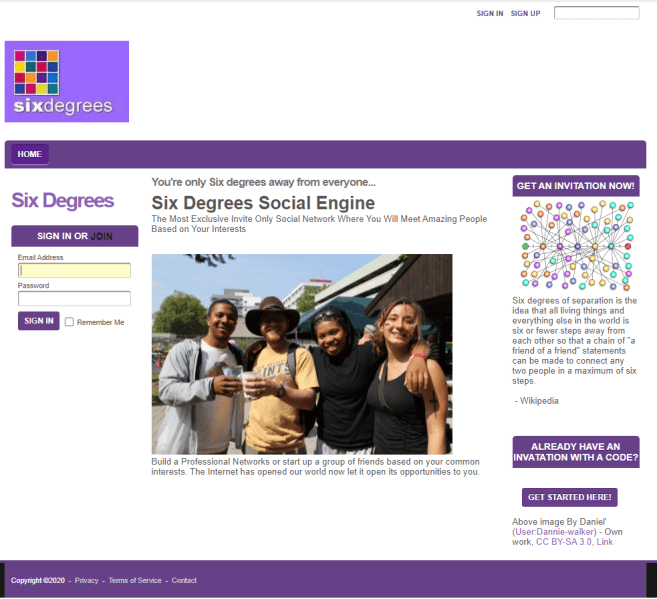
With the advent of the Internet, there were a lot of communication services coming up in the U.S such as CompuServe, America Online, and Prodigy. They provided users digital communication services through email, bulletin board messaging, and real-time online chatting. But the first online social media is considered to be Six Degrees which was the first platform that made it possible for users to have a profile. A profile is like a virtual character that resembles the user’s identity. Six Degrees was developed by Andrew Weinreich in 1997 and the name was derived from the “six degrees of separation” theory according to which “everyone in the world is connected to everyone else by no more than six degrees of separation”. This platform was shut down in 2000 but is now active again and you can find it with a simple Google search!

The landing page of Six Degrees

A lot of instant messaging applications came up between 1997 and 1999, like AOL Instant Messenger, Yahoo Messenger, and Microsoft’s MSN Messenger. Brad Fitzpatrick founded LiveJournal which caused a large number of people to get into blogging.

Friendster was another platform that was launched in March 2003. It allowed users to contact other members, maintain those contacts, and share online content and media with those contacts. Users could share videos, photos, messages, and comments with other members via profiles and networks. it was redesigned as a social gaming platform in June 2011.

Both LinkedIn and MySpace were launched in 2003. LinkedIn was founded as a networking site for career-minded professionals and still remains the social media site of choice for job-seeking people as well as employers looking for qualified professionals. MySpace allowed users to share new music on their profile pages and was the most visited website on the planet by 2006. It was beaten in popularity by Facebook in 2008, which has now grown into a huge networking service that literally everybody knows about.

Modern Social Media:

Facebook was founded in 2004 by Mark Zuckerberg and his Harvard collegemates and gained popularity over other social media sites because it provided frequently updated content in their News Feed. “The Wall” feature also enabled its users to post publicly. The “Like” button was introduced in 2009 and “The Wall” was replaced by the “Timeline” feature which organized the user’s posts chronologically. Over the years, Facebook has also been the subject of various controversies, including issues related to user privacy, mass surveillance, and political manipulation. The platform has 2.8 billion active monthly users, as of 2020.

Steve Huffman launched Reddit in 2005 as a web-content rating and discussion website where users can vote content up or down. In 2006, Jack Dorsey launched Twitter as a microblogging site where users can post and interact with messages known as “tweets”. As of 2020, Twitter has 186 million active users.

Instagram is another big social media site that was launched in 2010 by Kevin Systrom. It was launched as a photo-sharing website but has now included sharing of media content that can be edited using filters and featuring hashtags. Viewers can like, browse other users’ posts, and view trending content. Instagram was purchased by Facebook in 2012. It has since then come up with several features like messaging, ‘stories’ and live-stream features, and ‘reels’ which allows users to post quick 15, 30, or 60-second video clips. It is said to have 1.386 billion active users as of 2022.

Pinterest was launched in 2010 by Ben Silbermann as an image sharing and social media service site. Users can save and find information using images, GIFs and animated videos. Snapchat is another popular site that was launched in 2011 by Evan Spiegel. Instagram developed its ‘stories’ feature because of the competition from Snapchat which allows users to post pictures and messages that are available only for a short time.

Other popular social media platforms include TikTok, which was founded in 2016 by a Chinese company called ByteDance. Users can post very short videos on the site and it has rapidly grown to be hugely popular among teens and young adults across the world. As of 2021, it has about 1 billion users, even though it has been banned in various countries due to issues with content and security.

Over the years, social media has grown from being a place for people to connect with friends and family, to also being a major platform for businesses and corporations. Sponsored advertisements have been a part of all the modern social media sites like Facebook, Twitter, and Instagram. Companies use organic social media marketing to increase brand awareness, develop and nurture relationships with customers, generate leads and increase conversions, and learn from competitors. Social media sites like Facebook, Instagram and Twitter also regularly come under fire for spreading fake news, and causing psychological effects like addiction, and self-esteem issues in teenagers and young adults.

The landscape of social media is rapidly changing and we can only wait and watch how this industry grows and changes in the future.

YONKERS POWER PLANT

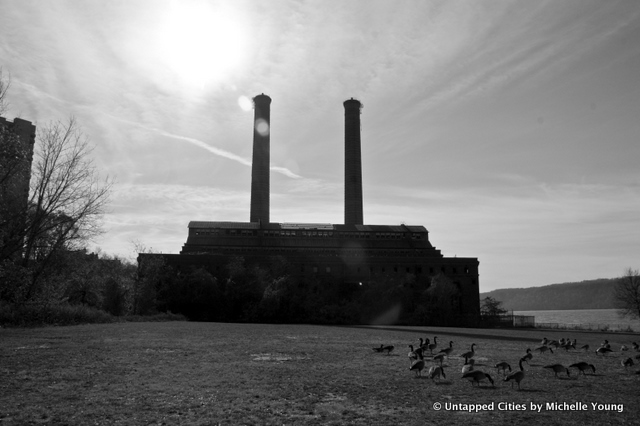
Located seven miles north of the Island of Manhattan stands the ruin of the Glenwood/Yonkers power station associated with the New York Central and Hudson River Railroads. Built as a result of an act passed after 1900 to electrify the urban railroads of New York, the plant was designed by Minnesota-based architects Reed and Stern. Due to the infancy of electrical transportation power, the New York Central and Hudson River Railroad leadership commissioned the architects to build two power plants: the Glenwood/Yonkers plant and its sister plant in Port Morris of the Bronx.

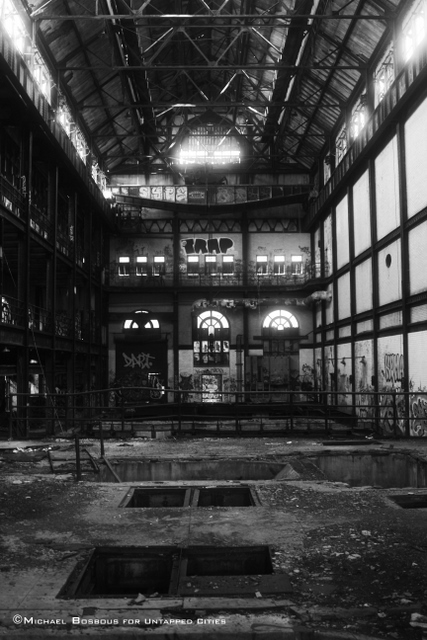
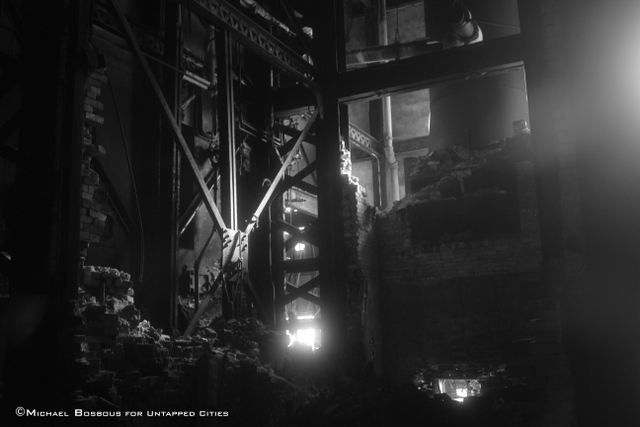
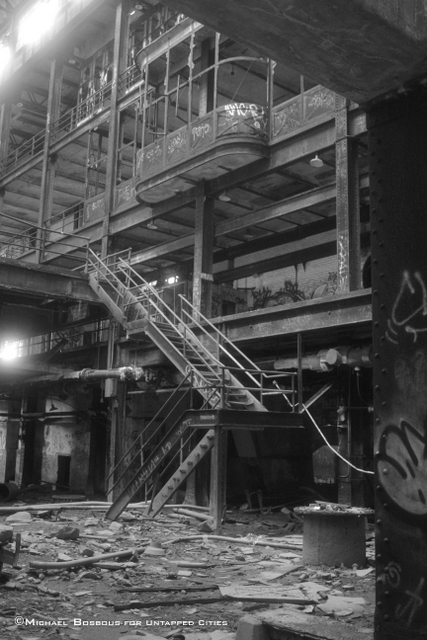
The decline of the Glenwood plant began in 1936 when the New York Central Railroad began buying its electricity rather than producing it. This change proved to be more efficient and economical than producing electricity at separate railroad power plants. The plant was sold to New York’s Consolidated Edison and continued to produce energy until its decommissioning in 1963. Shortly after its closure, the large turbines and boilers were broken down and scrapped. The majority of circuit boards, furniture, and other generic pieces were left behind. Over time, the remains of the plant slowly disintegrated into a mid-20th century urban industrial ruin. Some walls have collapsed into piles of bricks. The remaining graffiti-adorned standing exterior frames smashed windows and a blighted interior.

Here is how it stands today: a monument to the decline of industry along the Hudson River.

The main generating building is split into two halves: the turbine hall and the boiler room. The turbine hall presents an early 19th century French arcade ambiance with its vast open middle that is surrounded by four floors of walkways topped with a giant glass roof. A historical impression is sensed from the structure’s untouched architecture and objects. The main turbine hall is amazing due to its immense size and Piranesi-like walkways and staircases. Its spectacular all-glass ceiling allows vast amounts of light into the great hall and evokes early steel construction design, a time when structure became longer and taller and took on lightness in its architecture. The astonishing glass ceiling has endured more than a century of time.

South of the turbine hall is the boiler room, an area that has unquestionably seen better days. The majority of the boilers have collapsed, producing a long hallway bordered by giant cross beams and piles of bricks. Desks, cubbies, shoes and hangers remain in their original resting places, covered in layers of mud and dust.

To the north of the main generating building is the substation that was turned into some sort of catchall. This building, while not as arresting as the generating building, contains many offices, bathrooms, and locker rooms. The highlight of the substation is its roof access. The roof heralds a beautiful view of the Hudson River as well as a bird’s eye view of the power plant grounds.

We hope this adventure is as stimulating for viewers as it was for us. A word of caution for those who wish to visit: wear comfortable boots and gloves when exploring the fallen plant, even on a beautiful day. Explore at your own risk. And officially, we can’t tell you how to trespass onto the property but if you get off at the Glenwood Metro-North Station you’ll be able to figure it out.copywrite GOOGLE

The Lady's Mine

“The Lady’s Mine”
by Francine RiversNew York Times bestselling author Francine Rivers returns to the California frontier in this sweeping, romantic tale of a displaced New England suffragette, a former Union soldier disinherited by his Southern family, and the town they join forces to save.Kathryn Walsh arrives in a tiny mining town in the Sierra Nevadas, coming to claim an inheritance of a defunct newspaper office. The town is overflowing with brothels and saloons, and a seemingly worthless mine. Kathryn relaunches her uncle’s newspaper and finds herself pitted against the town’s most powerful men.When local saloon and hotel owner Matthias Beck keeps finding himself on the same side of the issues as the opinionated Miss Walsh, his restless search for purpose becomes all about answering the call of his heart.

Specters of Sapience

“Specters of Sapience”
by Alex HackettThe Sapience series is a dark, mature twist on the magical school concept. In the second book of the series, a big story is compressed into a quick read that alternates between jolting moments of terror and deep moments of love and self-reflection, which will resonate with any reader.Around Sapience University, fallen combatants are emerging from their graves as undead creatures called Lifeless. Some hope to resurrect the Lifeless, while others want to return them to their graves. When everyone returns to Sapience for the winter semester, some students seem eerily different. Students continue their magical studies unaware that enemies walk among them. However, it won’t be long until the enemy strikes and sends the school back into chaos.

Terriers in the Jungle

“Terriers in the Jungle”
by Georja UmanoRoxie and Romeo, two spunky dogs, ponder, philosophize and crack jokes as they express underlying feelings of loneliness, fear and love. We watch them transform from unwanted street canines to beloved companions and pets. The two adore each other, their home and their mom Kate.But Kate, being an ardent animal conservationist, decides the family will move to Kenya to help save endangered elephants. The dogs must now learn to survive in the midst of wildlife, dangerous people and circumstances far from most American dogs’ understanding. We experience their journey as they adapt and grow into international heroes, in their own words. Inspired by real events!

Comfort in the Wings

“Comfort in the Wings”
by Jennifer Collins”A story of love, loss and the possibility of redemption that brings home the feeling of loss in a way that no words can truly express.”Larissa Whitcomb flounders in the wake of unimaginable losses. Forget about coping; she can barely function. Life as she has known it evaporates, and she isolates herself from work and friends. Aware, however, of the dangers of her bleak existence, she reluctantly agrees to embark on a unique business opportunity, which becomes Larissa’s journey of grieving.She will be challenged by unwelcome encounters, confronted by emerging secrets and emotions and startled to find joy in the most unexpected places. Can her battered heart open to new possibilities?

For Adult Survivors Of Childhood Sexual Assault, AB218 Is A Chance For Justice

On January 1, 2020, the state of California took a bold step in confronting the epidemic of child sexual assault when it enacted Assembly Bill 218 (AB218).This landmark bill took on the problem in three major ways — it broadened the definition of child “sexual abuse” to “sexual assault”; it extended the civil statute of limitations from age 26 to age 40; and it allowed for a three-year “lookback window” for those who had suffered sexual assault as a child but missed the prior statutory deadline.The deadline for filing claims under the three-year lookback window is rapidly approaching. It’s an important opportunity for anyone across the nation who suffered sexual assault in California decades ago to finally seek justice for the abuse they endured, as well as help others who have suffered like they have.A Major Step ForwardAB218 represents a major step forward for the state of California in recognizing the seriousness of the problem and its long-lasting impact on the victims. By relabeling what was formerly known as “sexual abuse” to “sexual assault,” it helps to emphasize what a serious and damaging crime it really is.This new definition not only more broadly defines what constitutes sexual assault, it also allows victims to sue organizations such as school districts, clubs and membership organizations, religious organizations and others for these crimes. What’s more, those organizations that are found to have been involved in covering up sexual assault can now be subjected to triple the damages than they were before the act was passed.And by extending the statute of limitations to age 40, the bill takes on one of the most important roadblocks that prevents victims of sexual assault from obtaining justice, which is that unique combination of social and psychological factors that deter many victims from coming forward until they have reached adulthood.Courageous ActionsStudies have shown that child sexual abuse is committed most often by a trusted adult, whether a clergy member, teacher, coach, adult family member or other person close to the child.Many times, when a child or adolescent is sexually assaulted, the predator will use a combination of threats and/or psychological manipulation to keep the child silent.And sadly, in many cases, if the child is brave enough to come forward, they are met with disbelief or told to keep quiet by a parent or authority figure.Furthermore, in many instances, the child may block out the memory of the trauma and not recall the details until much later in life.The truth is that most victims of childhood sexual assault don’t have the courage to come forward until they are well into adulthood. In many cases, they may not know that what happened to them was in fact sexual assault, due to their age and trust of the person who perpetrated it. In fact, a recent study suggests that the average age that victims feel comfortable in coming forward with the details of their assault is 52, by which time the statute of limitations has long since passed.Fortunately, the AB218 lookback window offers a new opportunity for those who suffered sexual assault during their lifetime to get the help they need and to finally get justice. There are a number of resources and attorneys who advocate for sexual assault survivors, including attorney Raymond Boucher of Boucher LLP (www.boucher.la) in Woodland Hills, Calif.Boucher has dedicated much of his practice to helping victims of child sexual abuse and assault, including bringing in over $1 billion in settlements for victims who were sexually abused by Catholic priests. He is a fierce advocate of legislation such as AB218 and encourages victims, regardless of age, to come forward to take advantage of the unique lookback window for claims.”Those individuals who decide to come forward and pursue their case under the AB218 lookback window are courageous and selfless pioneers who not only seek justice for the lifetime of pain they endured but are forging the way for others who are suffering like they did, and are paving the way for meaningful change,” says Boucher.

Incentives for Adoption of Renewable Energy

 Posted On: 03 FEB 2022 8:45PM by PIB Delhi

The Government has taken several steps to promote renewable energy in the country. These include :

  • permitting Foreign Direct Investment (FDI) up to 100 percent under the automatic route, 
  • waiver of Inter State Transmission System (ISTS) charges for inter-state sale of solar and wind power for projects to be commissioned by 30th June 2025, 
  • declaration of trajectory for Renewable Purchase Obligation (RPO) up to the year 2022, 
  • setting up of Ultra Mega Renewable Energy Parks to provide land  and transmission to RE developers on a plug and play

basis, 

  • schemes such as Pradhan MantriKisanUrja Suraksha evamUtthaanMahabhiyan (PM-KUSUM), Solar Rooftop Phase II, 12000 MW CPSU Scheme Phase II, etc,
  • laying of new transmission lines and creating new sub-station capacity under the Green Energy Corridor Scheme for evacuation of renewable power,
  • setting up of Project Development Cell for attracting and facilitating investments,
  • Standard Bidding Guidelines for tariff based competitive bidding process for procurement of Power from Grid Connected Solar PV and Wind Projects. 
  • Government has issued orders that power shall be dispatched against Letter of Credit (LC) or advance payment to ensure timely payment by distribution licensees to RE generators.

The Ministry supports a scheme “Renewable Energy Research and Technology Development Programme” through various research institutions and industry which is being implemented to enable indigenous technology development and manufacture for wide spread applications of new and renewable energy in an efficient and cost effective manner across the country.

The scheme encourages research and technology development proposals in collaboration with the industry and provides upto 100% financial support to Government/non-profit research organizations and upto 50-70% to Industry, Start-ups, Private Institutes, Entrepreneurs and Manufacturing units.

***

Bajrang Punia

Bajrang Punia wins BRONZE in one-sided match at the Tokyo Olympics — India’s medal contender Bajrang Punia has won another medal, bringing India’s total to six, as he competes against Kazakhstan’s Daulet Niyazbekov. Bajrang Punia decided to play the match despite sustaining a knee injury during the semifinals and won.

Photo by Jim De Ramos on Pexels.com

After overcoming Kazakhstan’s Daulet Niyazbekov here at the Makuhari Messe Hall A Mat B on Saturday, grappler Bajrang Punia won a bronze medal in the men’s freestyle 65kg category at the ongoing Tokyo Olympics. Punia won the bronze medal match 8-0 over Niyazbekov. Bajrang held his own in the final three minutes, keeping his opponent at bay and taking home a bronze medal.

Wrestler Bajrang Punia started his Tokyo 2020 campaign with a resounding victory in both games. In the 1/8 Final, the Indian wrestler defeated Kyrgyzstan’s Ernazar Akmataliev, and in the 1/4 Final, he pinned Iran’s Morteza Ghiasi Cheka to the mat (winning by fall).

In the men’s freestyle 65kg category, Bajrang suffered a humiliating defeat in the semifinals of the Tokyo Olympics to Haji Aliyev of Azerbaijan. Balwan Singh, the father of wrestler Bajrang Punia, is optimistic that his son will bring a medal to India from the Tokyo Olympics.

Neeraj Chopra- The Golden Boy of India

07th of August, 2021; as the flag was getting higher and higher, and after a few moments; the beautiful hymn- Jana Gana Mana, was played, every Indian had goosebumps and water in their eyes. One day before the closing ceremony, when almost all hope was lost, Neeraj Chopra with a massive throw of 87.58m, brought a gold medal to out country. India had shined at the Olympics this time bagging a total of 7 medals, compared to last times 2, which has already raised hopes for the next Olympics. Till date not even a single Indian has won a gold medal at the Olympics for athletics. By winning a gold medal, Neeraj carved his name into our history books. In the coming years, when students will hear his name, not only will they remember the achievements he has done or yet to, but also this 23 year old young lads inspiring journey to the Olympics.

Photo by Anthony on Pexels.com

How many of you know, that unlike PV Sindhu or Mirabai Chanu, our Neeraj Chopra is not a full time athlete. He is currently in the Indian Army and holds the position of Naib Subedar. One great lesson that we can learn from Neeraj aside from his great skill would be balancing. He balanced his career and sports, not lagging behind anywhere. But a decade ago, if you were to meet this lad, you would be surprised to find him that way. An obese kid from Panipat, who was very mischievous and also often ridiculed by his friends for weighing 90 kilos and looking like a sarpanch aka a village head, Neeraj had started to hit the gym to reduce his weight. He used to visit a gym at Madlauda, cycle 24 kilometers to and fro to reach it. He was the youngest member at the gym and he later shifted to a gym at Panipat. Here, he used to visit the Panipat Sports Authority of India, and the magic happened here. Jaiveer Singh, another Javelin thrower found the potential and skill in Neeraj Chopra, when he was able to throw the javelin for more than 40 meters that too without any prior coaching or knowledge. After this incident, Jaiveer started coaching Neeraj Chopra for Javelin throw. After an year of training from Jaiveer, Neeraj headed to Panchkula, four hours away from his home to train for Javelin and his maximum throw now was about 55m. His coach Naseem Ahmad, described Neeraj to be a very attentive student who took notes about how to be better from other players and asked more questions than usual. After this he went on the achieve a new national record a throw of 68.40 meters. Soon there was no turning back and for each competition Neeraj started to shine even better than usual and soon was throwing more than 70 meters. He had won many golds at prestigious competions like the Asian Games, Commonwealth, South Asian Games, Asian Championships, World Junior Championships and the historic recent Olympics. He has also bagged a silver medal at the Asian Junior Championships. Neeraj Chopra indeed still has a lot more to see and win, but at such a young age, he inspired and made many people proud and will continue to do so. Something that we all shpuld learn from Neeraj Chopra would be, “Dream Big, Work Hard, Stay Positive and Enjoy the journey.”

How to read efficiently

Snehajansi's avatarTrack2Training

“Reading maketh a full man” states the great English essayist FrancisBacon. Indeed, reading habbit can even be considered as virtue, as it gives us immense knowledge and pleasure. But nowadays our reading is getting diminished because of the advent of mobile phones. Even if you are a beginner or someone who reads daily, sometimes you may find it hard to read or lack interest. Don’t be bothered, this article will aid you in such cases.

If you are a beginner in reading, you must find your genre of books. Each person have seperate tastes so they may like fiction or non-fiction. You must find what interests you the most either fiction or non-fiction. Non-fiction and fiction is like an umbrella term in reading, because there different types inside this division. For example, non-fiction consists of self-help books, journals, autobiographies and biographies whereas fiction consists of fantasy…

View original post 375 more words

Service Sector in India

The service sector is the quickest and the largest developing sector in India, it also has the highest productivity of labour and is predicted to keep developing at a faster rate. By providing employment, intensifying investment and advancing infrastructure, the service sector can contribute greatly to economic growth. It is significant for a growing country such as India with a huge population to provide standard employment and cope up with the development. Private funding is needed for services of configuration which includes telecommunications, energy and transport.

In India, there are various service sectors that signify and execute robust prospects for the upcoming development in economic field.

Fintech/ IT-BPM: The biggest component of ITs is export. The growth potential is around 10-15% per annum and the gross value addition provided by sections of Fintech and IT/ITs is above $ 155 billion. Till now, low-priced investment of labour was beneficial in countries, where mainly English is spoken. In order to expand the growth, the sections of IT/ITs are required to make subsequent changes by upgrading from a ‘service provider of low-value addition’ to a ‘service partner of high value addition’. IT companies can provide Fintech measures to intercontinental pecuniary clients by upgrading their skills to the maximum extent. The high value addition services provided by India to international clients are all sorts of services related to pecuniary risk, indemnity, refunding and management of circumstances beyond human control.

Tourism and Healthcare: Healthcare industry’s contribution is expected to reach $ 372 billion by 2022. The accessibility of elite proficient doctors, healthcare facilities, medicinal etc has greatly added up in the development of the service sector. By 2022, the Indian government is intended to increase Medicare by contributing 3% to the gross domestic product (GDP). In this Covid pandemic, two vaccines, namely Covaxin and Covidshield have preserved the population of India, including a number of countries as well.

The tourism industry in India is expected to reach $ 488 billion with a contribution of about 9.2% to the Indian economy in total and about 39 million jobs were offered from this sector in FY20. After the pandemic is over, topographical tourism is expected to come in light for the tourists of Asian countries in the south. Free loans by the government are provided to MSMEs in order to deal with the post crisis of the pandemic and resuscitate the tourism industry.

Transportation and Logistics: In India, the extensive meshwork of rivers and coastlines gives rise to extensive back and forth competition to services related to logistic and transportation. These services include warehousing, e-logistics, the port service, abroad trading etc. By 2032, the logistic industry is expected to reach $ 360 billion.

By 2022, the government has targeted the construction of 65,000 km of national highways at a price of about $ 741.51.

Space: Globally, India made a record of launching the highest number of space satellites. This could only be possibly done by the powers sustained from other spaces. Skilled experts in various technological sections of the launch plan have made possible such advancement in the industry of space transportation over its worldwide associates. The launch competence is nearly 100% in the record. Great developments can be seen in this field, but more improvement can be made by further building measurements in non-military and military implementations.

Top sector companies in India:

  • Tata Consultancy Services Ltd (TCS): It is a transnational information technology (IT) services in India. In the world, TCS is the largest IT services in terms of market value of worth $ 200 billion. It has its headquarters located in Mumbai and has large estate in Chennai.It is the most worthy brand of IT service around the globe and second largest company in India by market value. It is a corporation that provides explanation and counseling in context to business via its erratic Global Network Delivery Model (GNDM) which is regarded as the standard of brilliance in the advancement of software.  ICS has proposed a consolidated collection of infrastructure, IT, engineering and guarantee services. It also justifies a degree of reliability which is unattainable by other organizations. TCS is a part of the Tata group and has around 453,540 pre-eminent skilled consultants in about 46 countries.
  • HDFC Bank: HDFC Bank Limited is a company that holds the security interests and shares of other companies. It has about 5,608 branches and 14,897 ATMs, in around 2,902 cities. The different sections of the bank includes consumer or personal banking, exchequer, large scale banking of wholesale and various other services related to banking. On the side of retail banking, it includes transferable banking and on the wholesale banking side, it includes financial and business banking. The section of exchequer comprises of net profit income from the consolidated collection of Bank’s funding, funding profits or losses, lending or borrowing of money in the market and cognate contracts and commercing in overseas exchange. In the consumer banking section, different delivery mediums and branch matrix serves the customers. Earning from para banking services such as mutual fund services, investment services, portfolio management business etc. are also included in different sections of the bank. The conventional and business clients of the bank are provided a gamut of transferable and trading products. In 2021, the integrated earning of the bank is about $ 19.91 billion.
  • Bharti Airtel: Globally, Bharti Airtel Limited is considered as a chief company of telecommunication, connecting over 1000 corporates leading in India. In India, the product of the company proposes 2G, 3G, 4G and now even 5G wireless networking services, high speed wifi at home, wired networks, DTH, and other venturing services such international calling network services. Total income drawn from both wired and wireless network is about $ 3.65 billion with a huge number of mobile service customers.

How Atomic clocks are so accurate?

Most types of clocks rely on the oscillation of a slid body, be it a pendulum, a balance-wheel, or a quartz crystal, but each suffers from the effects of temperature, pressure, and gravity. Time measuring devices depended on the spin of the earth, but these suffer from seasonal effects and tidal friction. The moon causes tides to occur on earth and it causes friction between moon and the earth. This friction slows down the earth’s rotation by few milliseconds. This is called tidal friction. The atoms, however, vibrate a fixed number of times per second. Both the U.S. National Bureau of Standards and the United Kingdom’s National Physics Laboratory tried to take advantage of these vibrations.

Four atomic clocks are used in each of the many satellites of the global positioning system and comparisons of electromagnetic-wave travel times enable positions of earth to be measured very precisely. The clocks are also used by geophysicists to monitor variations in the spin rate of earth, and the drifting of the continents. Since record began, earth recorded the shortest day on July 19, 2020, when the day was 1.4602 milliseconds shorter than 24 hours.

In 1949 the Americans built a quartz clock that was synchronized by the 24-GHz vibrations of low pressure gaseous ammonium molecules. The British, under the leadership of physicist Louis Essen (1908-1997), used the oscillations of an electrical circuit synchronized to the vibrations of caesium atoms, the first caesium was kept in a tunable microwave cavity and the clock relied on the fact that were 9,192,631,770 transitions between two hyperfine ground state energy levels every second. This number defined the second, as opposed to the old definition of there being 86,400 seconds in one day. A good atomic clock was accurate to one part in 1,014, and therefore would take about 3 million years to lose or gain a second.

Why atomic clocks is used in GPS?

The Global Positioning System (GPS) consists of 24 satellites orbiting the earth. A GPS receiver uses the position of four of these satellites to locate itself. One to correct the time on the receiver, and three to locate its position. A signal is sent to the receiver from the first satellite that contains the satellites location and the signal’s time of departure. The receiver then multiplies the signal’s travel time by the speed of light to calculate its distance from the satellite. With one satellite the receiver knows that it’s located o a sphere around that satellite with a radius equal to the calculated distance. So, it does the same calculation with a second satellite. The intersection of these two spheres narrows the location to the circumference of a circle. Then with a third satellite, the receiver can reduce the location to a single point. Since signals are travelling at the speed of light, being off by even a millisecond means an error off about a million feet, or 300 kilometers. But with atomic accuracy, the receiver can locate itself to about 3 feet. Global Positioning System (GPS) satellites fly in medium earth orbit (MEO- Medium Earth Orbit) at an altitude of approximately 20,200 kilometers from ground.

The NIST-F1 is one of the most accurate time standards based on microwave atomic clocks. The most accurate atomic clocks lose about a second over 138 million years.

PHARMACOVIGILANCE: NEW INSIGHT IN PHARMA FIELD

Pharmacovigilance support safe and effective use of drugs.the safety concern of drugs now becoming priority of area.In developing countries drug safety is more focused area. Here is detailed information about role of pharmacist in pharmacovigilance.

According to WHO ” pharmacovigilance is the science and activities relating to detection, assessment, understanding and prevention of adverse effect and any other drug related problem.” Let’s see how pharmacovigilance work? And also the role of pharmacist in pharmacovigilance. It contains various steps such as adverse event Reporting, individual Case Safety Report, medical coding, aggregate reporting, signal detection and risk management.

  1. Adverse case management- It is the first step where Adverse event is reported in various platforms such as hospital, regulatory agencies, review of manufacturing company. After reporting validation of event is done by using 4 parameters that are – patient, product, report, adverse event.
  2. Individual Case Safety Report- When the event is validate then individual safety report is created.here special/ separate report of adverse event is made by detail study of patient and product.
  3. Medical coding- The ICS report come to medical coding to create medical report. The translation of medical report into short code used in healthcare industry is called as medical coding.
  4. Aggregate reporting- It is the process of compilation and submission of aggregate report to regulatory agencies over the period of the product life cycle.there are various types of aggregate report such as DSUR, PSUR etc.
  5. Signal detection- the process of actively searching for and identifying safety Signal from wide variety data source. It done in two ways – qualitative and quantitative.
  6. Risk management- Drug undertaken to promote safe use of medicine and safeguard health of patient. Risk: Benefit ratio is calculated and depending upon that drug given in market or withdraw from market.

In each step of pharmacovigilance there requires good knowledge of drug use , it’s formulation and detailed analysis of Adverse event. The pharmacist know drug in all way so he/she has better understanding ability of adverse event than any other healthcare professionals. There are various drugs developed regularly and they also has some side effects. To avoid that effect and giving better life to patient is most important. pharmacovigilance is essential field for drug safety. That’s why it is new insight in pharma field.

3 Simple Inventions that changed the world

Catseyes – Road Reflectors

When you are driving at night, you see reflective objects on road. These objects reflect the light and guide people to drive safely. It may seem so simple, but the idea of this invention came in an interesting way. One night in 1933 when the road mender Percy Shaw was driving home in Yorkshire, he saw the light of his car headlamps reflected in the eyes of a cat beside the road. This gave Shaw the inspiration that by replicating this effect he could produce a practical way of helping drivers navigate poorly lit roads. Shaw’s challenge was to create a device bright enough to illuminate roads at night, robust enough to cope with cars constantly driving across it, and that also required minimum maintenance. Shaw came up with a small device that could be inserted into the road as a marker. It consisted of fur glass beads placed in two pairs facing in opposite directions, embedded in a flexible rubber dome. When vehicles drove over the dome, the rubber contracted and the glass beads dropped safely beneath the road surface. The device was even self-cleaning. The cast-iron base collected rainwater and whenever the top of the dome was depressed, the rubber would wash the water across the glass beads to cleanse away any grime, just as the eye is cleaned by tears. The patent for the catseye was registered in 1934. And in 2001 the product was voted the greatest design of the twentieth century, ahead even of Concorde.

Catseye – Road Reflectors

Fountain pen

The invention of the modern fountain pen is really more a story of perfection than invention. In 1883, more than fifty years after the fountain pen was first invented, a New York insurance broker, Lewis waterman, was set to sign an important contract and decided to honor the occasion by using the standard ink-filled pen of the day. However, fountain pens were notoriously unreliable, especially in their capacity to regulate their ink low, so that it could not be signed, waterman decided to do something about it. Within a year Lewis waterman had designed the world’s first practical, usable, and virtually leak proof fountain pen. To regulate the flow of ink he successfully applied the principle of capillary action, with the inclusion of a tiny air hole in the nib of the along with grooves in the feeder mechanism to control the flow of ink from his new leak proof reservoir to the rib.

As early as the beginning of the eighteenth century, the chief instrument-marker to the king of France, M.Bion, crafted fountain pens with nibs, five of which survive to this day. The first steel pen point was manufactured in 1828, thought to be invented by Petrache Poenaru, and in the 1830s the invented James Perry had several unsuccessful attempts at designing nibs that employed the principle of capillary action. But it was Lewis waterman who overcome every obstacle and crafted a successful pen. It was so successful that by 1901, two years after waterman’s death, more than 350,000 pens of his design were sold worldwide.

Safety pin

When it comes to simple engineering, we can’t avoid safety pin. This useful object is found in households across the globe, it even gained status as a fashion accessory, with the movement in 1970s. Walter Hunt was a New York mechanic who, in 1849, sat wondering how to pay off a $15 loan. He spent around three hours twisting a length of wire in his fingers before he created the answers to his problems, the humble safety pin. Pins were by no means a new idea, having existed for centuries before Walter’s twist on the design. However, his creation was unique as it provided a solution to the potential problem of pricking oneself with the old style variety. His pin has a clip at the top which locks the pin and keeps us safe from not pricking. At the bottom it has a spring like structure made by bending the same pin to maintain the tension of the pin. Hunts design was patented in April 1849, and he sold the rights to his creditor, clearing a $385 profit. Unfortunately hunt had no idea how popular his invention was set to become. Even after 150 years, we are using this safety pin which works on a very simple engineering.  He also designed America’s first sewing machine with an eye pointed needle. But fearing the loss of jobs his creation may cause, he did not patent the idea. It was left to a fellow American, Elias Howe, to claim the credit for this invention some twenty years later.

“A man who could invent a safety pin . .  . was truly a mechanical genius . . .” – New York Times