International Journal of Research (IJR)is an international scholarly refereed research journal which aims to promote the theory and practice of engineering management, innovation, technology, management science, technology forecasting, and management engineering consulting. But the topics are not limited to these. We welcomes the submission of manuscripts that meet the general criteria of significance and scientific excellence. The current issue of the journal is available online at https://ijrjournal.com/index.php/ijr
Send papers for publication to editor@pen2print.org
The topics related to this journal include but are not limited to:
•
Operations Management, Operations Research, and Supply Chain Management
•
New Product Development and Product Engineering
•
Systems Engineering
•
Industrial Engineering
•
Management Science
•
Management Engineering Consulting
•
Seamless Integration of Heterogeneous Technologies
•
Emergent Complex Engineering Problems
•
Management of Technology
•
Technical Professionals
•
Technical Organizations
•
The Practice of Engineering Management
•
Technology Forecasting
•
Managing Research
•
Engineering Activities
•
Engineering Science and Technology
•
Engineering Design
•
Philosophical Foundations of Management in Theory and Practice
International Journal of Research (IJR)is an international peer-reviewed journal from eContent. It provides global perspectives on economic behavior and organization of benefit to scholars, educators, students, practitioners, policy-makers and consultants worldwide.IJR publishes articles from across the organization discipline. Original articles which inform organization research and practice from outside the discipline – such as from psychology, education, political science, sociology, statistics and research design – will also be considered. Current issue of the journal is available at https://ijrjournal.com/index.php/ijr
Send papers for publication to editor@pen2print.org
The topics related to this journal include but are not limited to:
International Journal of Research (IJR)serves as an essential resource and provides practical information for people who apply economics on their jobs. The aim of IJR is to publish research articles on business and economics sciences, and other social sciences that are related to business and economics for contributing to the international social sciences literature. Original studies in accounting, finance, economics, international business, management, and marketing are appropriate for publication consideration in the journal. Although IJR has a preference for academic studies, it also welcomes studies that are written by other researchers and practitioners. Current issue of the journal is available at https://ijrjournal.com/index.php/ijr
Send papers for publication to editor@edupub.org
The topics related to this journal include but are not limited to:
International Journal of Research (IJR)publishes good quality research papers in the areas of accounting, finance, risk management and their interfaces. Using a wide range of research methods including statistical analysis, analytical work and case studies, articles examine good research questions from a broad range of perspectives. The Editor may also welcome contributions that use other empirical research methods. Access the current issue of journal from https://ijrjournal.com/index.php/ijr
Send papers for publication in IJR to editor@edupub.org
The topics related to this journal include but are not limited to:
International Journal of Research (IJR)is a scientific journal to provide a platform for researchers, scholars of universities, institutions and businessmen to exchange their ideas on important issues and views that are unique and insightful, focusing on business and management in the context of the changes in Europe and worldwide. The journal is published bimonthly. IJR is a peer-reviewed open access journal.
Send papers for publication in IJR – International Journal of Research to ijr@ijrjournal.com
When we talk about women’s empowerment, gaining formal education, a career or some form of a stable means of livelihood forms an important part. From not allowing girls entry into schools and colleges to witnessing women make pioneering discoveries in the fields of science, technology, medicine, and space, the world has come a long way.
However, let us also not forget the fact that only 33% of researchers globally are women (UN Women 2022). They are also provided fewer funds than men and promoted less. According to a study conducted by The Times of India in 2018, women made up only about 25% of the scientific faculty of universities and institutions. While they form a significant fraction of science teachers in both government and private schools and colleges, the number of women sitting in top positions and with successful careers in these fields is quite small. This is mostly because women more often than not face the pressure of balancing their careers with their families. There remains an inherent belief among many that maintaining the family is primarily the women’s responsibility and cannot be compromised because of their job. A portion of female students enrolled in PG courses and female Ph.D. researchers end up unable to complete their courses due to family pressure regarding marriage. More than 50% of female graduates end up choosing a teaching career, rather than working as professionals in physics, mathematics, and engineering.
Then there are also the numerous complaints of harassment and biased and discriminatory behavior reported in such institutions. The representation of women in the overall field of science is small because people generally see science as a profession for men.
Despite all this, there have been many women visionaries in India who have made significant contributions in the field of science. Here are some of the well-known females in India’s scientific field:
Kamala Sohonie {1912-1998} was the first female student of C.V. Raman and was the first woman to obtain a Ph.D. degree in a scientific discipline. She discovered that every cell in a plant tissue contained the ‘cytochrome c’ enzyme which was involved in the oxidation of all plant cells.
Anandibai Gopalrao Joshi (1865-1887) was the first Indian woman to have graduated with a degree in western medicine in the U.S and went on to become the first woman physician in India.
Janaki Ammal (1897-1984) was a talented botanist who worked on developing different varieties of homegrown sugarcane and eggplant. She received the Padma Shri award in 1977 and was also appointed the Director-General of the Botanical Survey of India.
Asima Chatterjee (1917-2006) was a chemist well-known for her contribution in the fields of organic chemistry and phytochemistry.
Tessy Thomas (1963-) is the Director-General of Aeronautical Systems of DRDO. She is also the first woman scientist to head a missile project in India.
Major women scientists of ISRO, like Ritu Karidhal, T.K. Anuradha, Nandini Harinath, and V.R. Lalithambika among many others have received widespread praise and recognition for their work on various successful space missions like Mangalyaan, Chandrayaan, etc.
All of this goes to show us that science is not just a men’s field of play. It is as much a woman’s subject as it is a man’s and this is definitely not the last we will see of women in the field of science.
International Journal of Research (IJR)is an international, open access and peer-reviewed journal that dedicates itself to mathematical economic theory, with an emphasis on microeconomics. In addition, the journal seeks research findings and commentary on international developments in economics. Articles on economic issues between individual nations, emerging and evolving trading blocs will be particularly welcomed. Contributors are encouraged to spell out the practical implications of their work for economists in government and industry.
Send papers for publication in this indexed journal to editor@edupub.org
The topics related to this journal include but are not limited to:
International Journal of Research (IJR)is a blind-reviewed, open access, both online and print journal, publishes original full-length research articles, review articles, case studies, original brief research articles, literature review, and others. This journal is published quarterly, and it is a global platform for publishing precise basic and applied business, management, marketing, finance, HRM, accounting and its analysis of the rationales. The main focus of the journal is on empirical research which would be helpful in carrying out business research attitude. The journal seeks to prop up communication amongst policy-makers, practitioners and researchers to make out prospective financial decision for the countries. This journal publishes high-quality original research articles and case studies in the areas of international finance, corporate finance, behavioral finance, public finance, stock markets, industrial finance, bank finance, insurance markets, financial management, taxation, accounting standards, auditing standards, etc. The journal is dedicated to improving research openings for the finance and related disciplines in the globe.
To get published in this journal, send your papers to edior@edupub.org
The topics related to this journal include but are not limited to:
International Journal of Research (IJR)is a peer-reviewed and open access journal, which aims to provide profound contributions to operations management theories and applications. The journal prefers the submitted manuscript, which meets the internationally accepted criteria and the style of the journal for the purpose of both reviewing and editing. This journal is committed to providing a platform for educators, scholars, researchers and practitioners, with an international collection of all operations management research facets.
International Journal of Research (IJR)is a scholarly open access, peer-reviewed, interdisciplinary journal, it provides a global forum for the dissemination of research in environmental and resource economics. It is international in scope, publishes both theoretical and applied work, and contains studies on a wide area, such as study of environmental behavior and responses to regulation, analyses of exhaustible, renewable and non-renewable, resources and resource policy, notably the economics of fisheries, forestry and fossil fuels, analyses of the carbon cycle, and accumulating pollutants.
JAWAHAR LAL NEHRU AND SECULARISM PANDIT JAWAHARLAL NEHRU (1889-1964) was a freedom fighter and seasoned statesman of modern India. He was the architect of modern India, always yearned to build a secular nation. Nehru regarded secularism as the basic law of Indian nationhood. Nehru was an ardent champion of the Indian view of Secularism. In a multi-religious societylike India, Nehru defined a secular state that protects all religions but does not favour anyone at the expense of the other. It does not adopt any religion as the state religion. During the Independence movement of India, Nehru drafted the congress Resolution on fundamental Rights stated that the state should observe neutrality regarding all religions. After the Independence of India when the Indian Constitution(1950) had been in force for over a decade, Nehru observed (1961) in an important speech:- “ We have laid down in our Constitution that India is a secular state. That does not mean or irreligion. It means equal respect for all faiths and equal opportunities for those who profess any faith”. Nehru did not conceive secularism as indifference to religion. Nehru strongly condemned those forms of religion which sow the seeds of hatred between different religious communities. Nehru used every single opportunity to express the danger of mixing religion and politics. He visualized a secular state as one in which every individual had the full freedom to function according to his way either culturally or in matters of religion. It was Nehru’ a vision that shaped the Constitution of India in such a manner that it should provide for a secular state. Nehru emphasized four different aspects of secularism :- · In the first place, he insisted that secularism meant grant of equal status to all religions in India and opposed grant of special privileges to any religion. · Second, Nehru’s Secularism implied the neutrality of the state in religious matters. · Third, Nehru viewed secularism as a mental attitude on the part of various communities which could bring about harmony and feeling of fraternity towards one another. · Concluding, Nehru’s concept of secularism implied the existence of a uniform civil code for the people of India. Nehru was a secularist. He disapproved both the Hindu communism as well as the Muslim communism. Today’s the secular ethos for which Nehru strived hard through his life is facing a multi-prolonged challenge from the hydra headed communalism.
India is the world’s second-largest consumer of liquor. The WHO study also illustrates that India’s consumption was 2.4 liters per person in 2005, which surged up to 5.7 liters per person in 2016. The Research and Markets on changing behavioral patterns of Indian Alcohol consumption, says that the estimated consumption of alcohol would reach up to 16.8 billion liters by 2022. The report also says that the alcohol industry in Indian markets is growing at a CAGR of 8.8 percent. The figures infer that there is always a thriving market that creates an opportunity for the alcohol industry in India to strengthen its sales and revenue.
Despite pervasive alcohol harmful effects, India does not have a national alcohol policy system. Instead, alcohol policy solutions rely on state governments. Even though alcohol benefits the economy of India more than the revenue it generates. The state governments think of alcohol as a revenue-generating product. This thinking led to alcohol policy-making such as excise alcohol taxation being centered around revenue instead of public health.
Reason for online services
Alcohol stores were closed nationwide from March 25, 2020, accepting social distancing protocols due to the deadly pandemic of COVID-19. While the reopening in May 2020 caused people to throng outside stores in massive numbers, and the government had to quickly re-analyze. Meanwhile, the New Delhi authorities introduced a “Special Corona Fee” of 70% on top of retail liquor costs. On the other hand, Mumbai shut down its liquor stores entirely within two days of its reopening. So, the administration exercised online home delivery of alcohol. On May 8, 2020, the Supreme Court of India examined that the states should find alternatives to liquor delivery. Here is where players like Zomato and Swiggy came into the process.
Methods
As alcohol is regulated by the state government so different states are using different methods for online delivery of alcohol. These include,
Online purchase and issuing e-tokens for pickup,
Online purchase and home delivery through the alcohol portal, or
Online purchase and home delivery through a third-party delivery platform.
Difficulty faced during service
However, the delivery of liquor and its products is not as simple as the food delivery market. It is a highly regulated market. Different states have established different legal ages for alcohol consumption. Also, the suppliers have to obey multiple regulations and rules assessed by the government to stay within legal holds to deliver liquor.
The solution to ensure safe delivery
To secure the safe delivery of alcohol in obedience to laws, Swiggy introduced compulsory age confirmation and user authentication features on their application. Customers have to verify their age by uploading a picture of a valid government ID. A selfie is then also instructed for authentication that is verified by the platform using an AI-powered system. Every order carries a special OTP, which is expected at the time of delivery and needs to be procured by the customer. There is also control over the quantity of liquor ordered.
Zomato, as well, has acquainted consumption and identity confirmation procedures, several safety procedures and inspections, to ensure credible and safe ordering and delivery of alcohol. There are age checks at the time of ordering as well as the delivery. There are product category maxima to stimulate responsible consumption. The application only has licensed alcohol retailers who have opted for the service.
Drawbacks
Although this move by the delivery companies like Zomato and Swiggy has opened a new way for alcohol orders through smartphones, which promotes social distancing and consumer safety. But there is a high possibility that the delivery man can be attacked by goons for the bottles and, we know, what a person can do if he does not get goods to which he is addicted. Moreover, the young generation knows how to use the internet very well. So there is a possibility of a bad influence on the young generation of the country.
Some of your favorite accessories are the ones you reach for again and again, those items that are portable, easy, and convenient. When shopping for accessories for everyday use, special events, or travel, several factors stand out. The following tips will help you identify accessories that will make your life easier.
• Easy. Ease of use is a top consideration in everyone’s favorite, go-to accessories. Be it a wallet with just the right number of slots, a purse with pockets in just the right place, or a smartphone case that doubles as an ID holder, the right accessories make your life easier. If you’re a smokeless tobacco user, a portable spittoon that can be open and shut with one hand makes it easy to enjoy smokeless tobacco on the go. The portable spittoon from Atlanta-based FLASR features a one-hand operational design for ease of use.
• Convenient. Everyone wants accessories that are convenient. Smokeless tobacco users seeking a convenient spittoon for on-the-run use will appreciate the latest product from FLASR. The 4-ounce portable spittoon is designed to stay securely shut to minimize the risk of spills and leaks when not in use, and the one-hand, open/close feature is engineered to help maximize convenience and discreet use while on the go.
• Portable. The right accessories will enhance your life, not hinder it. Otherwise, what’s the point? To that end, nothing gets in the way of having a good time on a date or at a party like a poorly designed purse that falls open, a wallet that won’t close, or a smartphone case that’s bulky. For smokeless tobacco users, portability is paramount if they want to have a subtle spittoon on hand in order to enjoy dip, chew or snuff at an event away from home. FLASR’s single-hand design and 4-ounce size is designed to fit in a pocket for easy, subtle storage that won’t attract attention.
• Personal. Of course, the best accessories are the ones that let you showcase your personality and style, such as that unique handbag, or customized smartphone case. Smokeless tobacco users seeking a portable spittoon have a choice of several designs
The Government of India has launched Self Reliant India (SRI) Fund, a fund of funds which aims to extend growth funding to MSMEs.
The highlights of SRI Fund are as under:-
To provide funding support to Daughter Funds for onward provision as growth capital through equity, quasi-equity and debt (as permitted under relevant SEBI guidelines).
To support faster growth of MSMEs and thereby ignite the economy and create employment opportunities.
To support MSMEs to graduate beyond the MSME bracket and become National/International Champions.
To support MSMEs which help making India self-reliant by producing relevant technologies, goods and services.
Daughter Funds which are interested in investing in MSMEs shall be empanelled.
20% of the funds invested in MSMEs shall be provided by SRI Fund.
MSMEs as per the definition given in the MSMED Act shall be eligible provided, after assessment, they are found viable, have a positive growth trajectory, and have a defined business plan for growth. Previous 3 years CAGR will be considered.
Non Profit institutions, NBFCs, financial inclusion sector, micro credit sector and other financial intermediaries shall not be eligible for consideration.
Assuming an average investment of Rs. 10.00 Crore per MSMEs, approximately 5000 MSME are likely to be benefited.
The financial support under this scheme intends to increase the financial capacity of viable MSMEs for growth to expand their business and become National/International Champions.
The scheme is being implemented by a special purpose vehicle named “NSIC Venture Capital Fund Limited”. As informed by NSIC Venture Capital Fund Limited, a Commitment of Rs.1,080 crore has been approved so far.
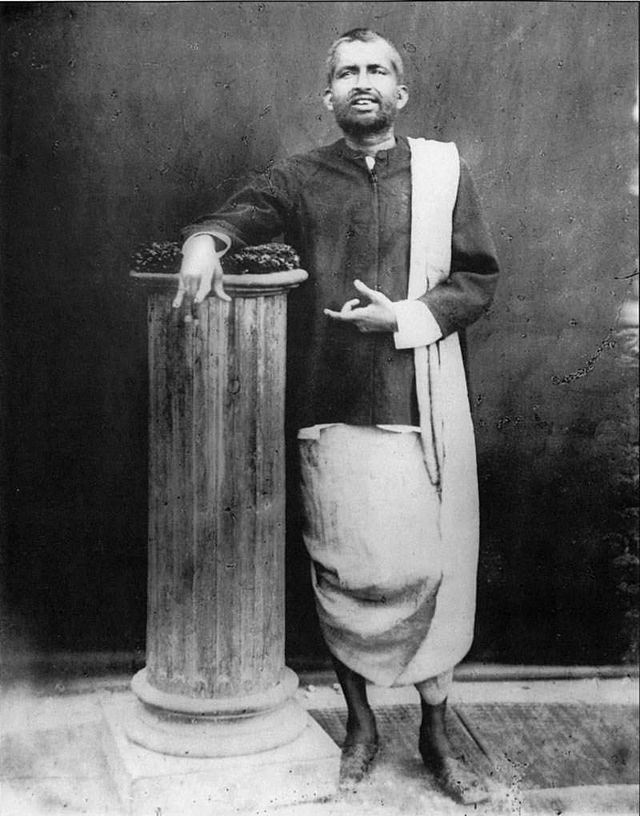
Sri Ramakrishna was an Indian Hindu religious leader and saint of 19th century Bengal who is known for his enlightening teachings on God and religion. On his 186th birth anniversary, let us take a look into his compelling life and ideals which has influenced and still remains influencing a great number of minds.
Sri Ramakrishna Paramahamsa
Sri Ramakrishna was born on 18 February 1836 to Kshudiram Chattopadhyaya and Chandramani Devi, in the village of Kamarpukur, West Bengal, in India. Born in a very poor, yet pious and orthodox household, he did not show much interest towards formal education, saying that he was not interested in “bread-winning education”.
Spirituality, Priesthood and Marriage
It was at the age of six that he went through his first experience of spiritual trance, when he came across the sight of a flock of white cranes flying against a background of black rain clouds and continued to have similar experiences throughout his childhood. He was also interested in spiritual discourses from an early age. The death of his father when he was just seven years old added to his introspective nature.
At sixteen, Ramakrishna travelled to Kolkata to help his brother Ramkumar who was the chief priest at the Dakshineshwar Kali Temple. When his brother died after a few months, Ramakrishna was made the priest. He now became completely absorbed in the worship of Goddess Kali. He spent days and nights in prayer, singing devotional songs and meditating, forgetting his priestly duties, longing for the divine vision of Mother Kali. Finally, on an occasion when he was in utmost despair yearning for Mother Kali, he was blessed with her vision, later describing it as an infinite sea of radiation and light which enveloped him and everything around him.
Rumors of Sri Ramakrishna’s unstable life resulted in his concerned family getting him married to Sarada, a five-year old from the neighboring village of Jayarambati. She later joined him in Dakshineshwar at the age of eighteen. Sri Ramakrishna had by this time been ordained a Sannyasin and thus observed the basic vows of monastic life. Thus, their marital life remained truly spiritual. He even worshipped Sarada as the Divine Mother while performing the Shodashi Puja in his room at Dakshineshwar.
After his marriage, Sri Ramakrishna returned to Dakshineshwar, where he proceeded to learn and experience different aspects of God he followed, with the help of various Gurus, and realized God through each path. Bhairavi Brahmani, an ascetic well-versed in scriptures, was the first Guru to arrive at Dakshineshwar in 1861 and teach Sri Ramakrishna various disciplines of the Tantric path. A Vedanta monk named Tota Puri arrived in 1865 and guided him to Nirvikalpa Samadhi, which is the highest spiritual experience according to Hindu scriptures. Sri Ramakrishna also went on to practice Islam and Christianity, wanting to experience God in all forms. He was able to attain the highest realization through each of them in a short span of time. He spent 12 years practicing various forms of religion and spirituality, finally expressing his spiritual realization as “So many religions, so many paths to reach one and the same goal”.
Disciples and Final Years
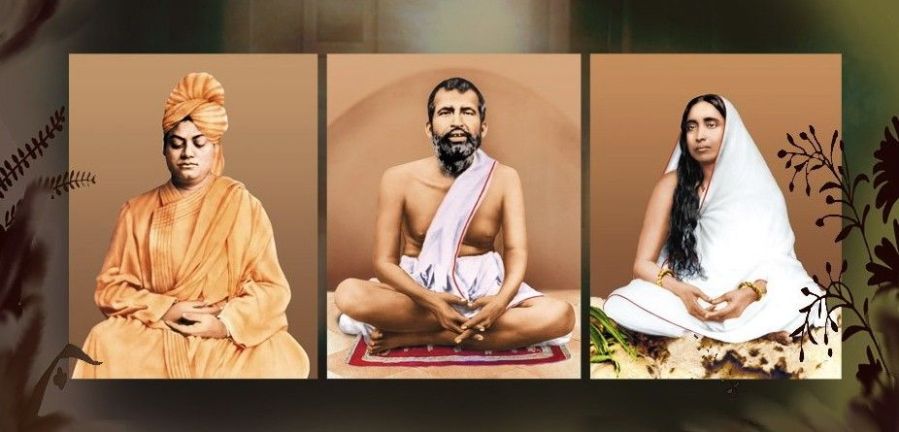
As his name and spiritual messages spread all over the country, it attracted people from different backgrounds. Disciples arrived from all over, wanting to learn from him. He divided his disciples into householders, who were taught to realize God while performing their family duties, and young, educated monks, who were tasked with spreading the universal message of Vedanta. One of his most influential disciples was Swami Vivekananda, who re-invigorated Hinduism and remains one of the most celebrated spiritual leaders in India.
Swami Vivekananda, Sri Ramakrishna Paramahamsa and Sarada Devi
In 1885, Sri Ramakrishna was diagnosed with throat cancer after which he was shifted to a suburban villa where he was nursed by his disciples and Sarada Devi. He gave up his physical body on 16 August 1886, uttering “Ma” before passing away. Sri Ramakrishna’s disciples, led by Swami Vivekananda founded the Ramakrishna Math and Ramakrishna Mission. His illuminating conversations with visitors and disciples have been noted down by his disciple Mahendranath Guptha and published as a book “The Gospel of Sri Ramakrishna“, released in 1942.




 Eduindex
You must be logged in to post a comment.