Indoor and outdoor Games


By: Astha Raghav. 

Indoor games for kids don’t have to mean sedentary play. Many kids love to kick soccer balls and shoot hoops outside, but they can’t always do that if it’s dark, or if their playing area is covered with snow and ice, or the temperature is dangerously high. For those situations, the solution is to bring active outdoor games inside.

These simple—and fun—ways to turn the outdoor play into indoor games are a great way to motivate kids to play more actively inside, and to help them practice their sports skills even when weather or other challenges keep them indoors.

Get Indoor Game Gear

Using your child’s favorite sports as inspiration, invest in some simple toys and supplies that they can use to play indoors. Usually, that means equipment that’s smaller, lighter, and/or softer than what you use outdoors, such as:

Balloons, beach balls, fabric balls, Nerf balls, or bean bags to kick, roll, and throw

Mini basketball hoops, knee hockey goals, boxes, or baskets for targets

Indoor versions of horseshoes, darts, or bowling

Knee hockey sticks and knee pads

Hula hoops and jump ropes (if you have some room to use them; for jump ropes, you need a reasonably high ceiling)

Ping-pong table, or improvise with paddles, balls, and a portable net (or even a piece of painter’s tape stretched across a large table)

Practice Outdoor Sports Skills Indoors

Depending on what kind of space you have available indoors, kids may be able to practice some of the skills they need for their favorite sports, even in the off-season!

Soccer: Dribble a ball along the floor; juggle with feet (in a space free of breakables)

Tennis: Gently bounce a ball up or down with racquet held horizontally; or play ping-pong

Golf: Putt into a practice cup, or even just a plastic drinking cup turned on its side (secure to the ground with painter’s tape if needed). Or go all out and challenge kids to build their own mini-golf course with cardboard and other recyclables and household items.

Basketball: Dribble the ball (in a garage, carport, or basement)

Hockey: Shoot pucks or wooden training balls into an indoor net, or a wall reinforced with cardboard or plywood

Figure skating: Practice spins with a skate spinner (buy from Amazon)

Lacrosse: Practice tossing the ball using a CradleBaby (buy from Amazon).

<

p class=”comp mntl-sc-block mntl-sc-block-html” id=”mntl-sc-block_1-0-10″ style=”background: 0px 0px rgb(255, 255, 255);border: 0px;color: #212121;font-family: Merriweather, Verdana, Arial, serif;font-size: 16px;margin: 1.2rem 0px;padding: 0px;vertical-align: baseline”>Thank you!

Effect of pollution on quality of life.

 By: Astha Raghav. 

Clean air is considered as one of the basic requirements for human being. Pollution-related diseases due to air pollution continue to rise at an alarming rate and affect people’s quality of life. Air pollution also adversely affects welfare inequality. Air pollution as a significant risk factor affects health and sense of subjective well-being (SWB). In this study, the effect of air pollution on subjective well-being (life satisfaction, happiness, and optimism) is investigated. Relationship between well-being and air quality is a fundamental issue to design public policies. Hence, the studies about the link are of grooving interest in the literature. The results show that air pollutants have an effect on subjective well-being. The link between life satisfaction and happiness is very strong. Optimism is also positively correlated with life satisfaction and happiness. Good air quality and optimism make people happier. Air quality is likely to have an effect on people’s sense of life satisfaction, happiness, and optimistic view. The results indicate that the PM 2.5 level is significantly and negatively related to on optimism. It is obvious that there is a very strong relationship between air quality and subjective wellbeing. Relationship between wellbeing and air quality is a fundamental issue to design public policies.

Thank You!

Analyse the current economic conditions of India after lockdown.

 By: Astha Raghav. 

The current economic conditions of the COVID-19 pandemic in India has been largely disruptive. India growth in the fourth quarter of the fiscal year 2020 went down to 3.1% according to the Ministry of Statistics.  The Chief Economic adviser to the Government of India said that this drop is mainly due to the corona virus pandemic effect on the Indian economy Notably India had also been witnessing a pre- pandemic slowdown, and according to the World Bank, the current pandemic has “magnified pre- existing risks India’s economic outlook “. Manufacturing and the urban economy had come to a grinding halt while the rural economy continued to move because of less strict lockdown. While the lockdown took a toll on the economy, the number of infection cases continues to climb with growth prospects for the current quarter collapsing.  The country’s lockdown began in late March and was subsequently extended several time. Stringent restrictions halted most economic activities and caused millions of people, many of them daily wage earners, to lose their jobs and revenue streams. To mitigate the economic fallout, Prime Minister Narendra Modi’s government had announced a $266 billion support package containing both fiscal and monetary measures, said to becworth around 10% of India’s GDP. b
But economists have said the package will do little to stimulate growth, as it includes very little planned government spending and benefits of several measures are expected to only be seen in the medium term. While the impact on India GDP  for the current quarter will not be known for a few more months.
Thank You!

Neutraceuticals as an alternative of pharmaceuticals

 By: Astha Raghav 

Neutraceuticals is a broad umbrella term is used to describe any product derived for food sources with extra health benefit in addition to the basic nutritional value found in foods. 

Neutraceuticals are products, which other than nutrition are also used as medicine. A neutraceuticals products may be defined as a substance, which has physiological benefit or provides protection against chronic diseases. Neutraceuticals may be used to improve health, delay the aging process, prevent chronic diseases, increase life expectancy or support the structure or functions of the body. Nowadays, neutraceuticals have received considerable interest due to potential nutritional, safety and therapeutic effects. In recent studies have shown promising results for these compounds in various complications. The recently published papers about different aspects of neutraceuticals as alternative for pharmaceutics were searched using scientific sites such as Medline, PubMed and Google Scholar. It included neutraceuticals and allergy, Alzheimer, cardiovascular, cancer, diabetes, eye, immune, inflammatory or Parkinson. 

Thank You!

Ad copies & Taglines of five different existing brands

JBI earphones

Headline-Feel the heavenly music anywhere at anytime
Tagline -Your solace place
Tired of carrying those huge headphones ?Try getting one pair of your JBI earphones at the lowest price up to 50% off grab now for best offers.

GOBIBO
Headline- Get the first rate experience
Tagline-Live better
Get your tickets booked for Mega travel sale and get amazing offers for your first booking up to rupees 1200 off on domestic flight and up to rupees 5000 off for international flights. Hurry!

BURGER KING
Headline-The smooth taste will melt Your Heart Away
Tagline-Happiness at your eyes
Fill your tummies with the most lighted 7 incher burger filled with deliciousness combining single beef patty ,cheese and crispy onions .Order today at flat Rs. 200 and experience in deliciousness.

AMITY UNIVERSITY
Headline-To make your destiny shiny is our responsibility
Tagline-Your home away from home
Book your seats today at the top most University providing you varieties of courses designed according to your interest. Seats are limited, apply to Amity and learn at your pace.

NATUREBOX
Headline-Get best snacks at your doorstep
Tagline-Taste at its best
Try a free sample of our snacks starting at just Rs. 60 filled with awesomeness health benefits, sweetness and flavours. Hurry now.

Transcription

Story based on Srivaibhavi’s interview


An interview with Ms. Srivaibhavi
Srivaibhavi is a student from CMR university where she pursued her B. Com and completed in the year
of 2017.She was very much fascinated about social work since childhood and started volunteering since
a very young age. She started working for mercy homes basically known as old age homes in Kannauj,
UP. As a student of KV school even the teachers noticed how she was into social work she started
volunteering since 8th grade and her teachers supported her. Later in her 11th grade she took an
initiative to call out her friends to join her and form a small ngo known as ‘Bring smile’, she along with
her friends started volunteering for government schools teaching unprivileged kids hindi, english,
maths.She along with her friends started to raise funds for the school so that they can provide the
school with good cupboards, school bags, notebooks etc. She inspired a lot of students and her friends
during her schooling days and was also awarded from her school principal. In her university days she
was very well known for the cause she was working for and it inspired people to join her and work for
the underprivileged students. She has worked for many causes for bihar floods, assam floods, kerela
floods, plantation around the city etc along with her team. After all these years of work, she tells one
must follow their heart and put their 100 percent into it to make it a success, she gains happiness by
sharing the happiness of the underprivileged kids she has worked for during her entire journey.
Interview Transcription
Acronyms:Srivaibhavi:SV
Interviewer:IN


IN:Hello miss vaibhavi, Thankyou for giving me your precious time.


SV:It’s my pleasure.


IN:Shall I begin the interview?


SV:Yes, please


IN:So since when have you been interested in social work?

SV:My aunt served her entire life for the society, she was into social work and I always found it very fascinating and interesting. She has been my inspiration and I always looked up to her. I even started accompanying her when I was in 6th grade so it started since then. IN:When did u get the thought that u also should follow your aunt’s step?

SV:I actually started it from 7th grade when I told my aunt that I also want to start social work. She recommend me an old age home and that was the first ngo I started working as a school student.

IN:How was your first experience?

SV:I still remember washing their clothes, bedsheets, combing their hairs, helping them in taking bath and there was an old lady known as mala she adored me a lot as a kid and would offer me sweet milk everyday, I still miss those days.

IN:As u said you were in 7th grade, how was your teachers reaction towards it?

SV:I studied in KV Kannauj, UP and KV conducts lots of activities and volunteering options are also given and my teachers always supported me and through me many of my classmates also were interested to work along with me. My school even awarded me for my work and maybe that was my first achievement.

IN:So when did you take the major step to start your own NGO? SV:I was in 11th grade, I took major in commerce in the same school and I thought of starting my own organization ‘Bring smile’ And lot of my friends we’re a part of it.

IN:Which cause did you focus into?

SV:I then wanted to devote my life for the unprivileged kids who had no source to pursue education, as you know education is a major part of our life and I was always curious to work and mould kids who were in need of my help. I started working for a government school and I along with my maths, hindi etc. We started raising funds to provide them notes, pen, books etc. We even started to work so that I along with my team can provide them a proper place to sleep I’m their school as they had a hostel in school which had no proper beds, walls, cupboards neither clothes. IN:What were the other things which were also included ?

SV:I also thought of showcasing their talents through art like painting, dancing and singing. So we would reach out to students who were good in these field and in weekends they would visit the school to teach particular art according to the interest of the kids. We at the final day conducted a program where all the kids got a chance to showcase their talent.

IN:Did all this affect your studies?

SV-Not really, I was happy by helping people and that also motivated me to concentrate in my studies. I was sn average student but my passion never affected my studies.

IN:I see, I heard u pursued B. Com as your major? How this sudden thought come into your mind?

SV:My dad wanted me to pursue B. Com as he said it might be helpful for my carrier my parents were always supportive but I choosed bcom because my dad suggested it to me.

IN-That’s really thoughtful of you. So how long it has been now? SV:It has been years I’m into this field inspiring the youth of the country to choose this particular field. During my university days I conducted lots of events for raising funds for the kids. I even took part in the plantation drive around the Bangalore city. I worked as a volunteer for assam floods, kerela floods and bihar floods. It’s very necessary to put your time into other things too. Today we do a lot of activities all around UP conducting self defence classes for girls and many other activities.

IN:This is so inspiring,Are u satisfied making it your proffession? SV:I am very much happy because I don’t work here for money, money was never my thought, my choice was to bring change and to bring a smile in their face. That was my main motive. I always believe follow what your heart say and put your 100 percent into it to make it a success, I gained happiness by sharing the happiness of the underprivileged kids and many other causes which I have worked for during her entire journey.

IN:You have been so inspiring and have also inspired lots of people who are with you today. Thank you for your time.

SV:It was my pleasure.

Barak valley flaunting COVID-19 rules during pujo
Anindita sinha
Last Tuesday during vijaya dashami residents of barak valley were seen to unfollow the Covid-19 guidelines
which are imposed by the barak valley government for the city residents especially. There were strict
rules and guidelines issued by the district administration for silchar, karimganj and many others nearby
districts whereas the protocols were maintained for the initial days of the pujo. It was for the first time
there was no huge celebration for the festival as it remained quite and calm due to the pandemic and
heavy rainfall, there was continuous rainfall for the past 3 days of the festival except for the last day of
the festival which is known as the dashami. Barak valley people belive that the festival have bought light
into their hearts and this might be the end of the pandemic too.There has been no distribution of prasad
among the pandal and no offering of ‘anjali’ to the chanting of mantras by priests during the initial days
but it didn’t last during the last day of the festival. However the active cases are increasing rapidly and
whatever steps taken by people should be considered by them so that they can be safe, till now there is
no news of people getting affected by the virus which is a good news however one must consider it not
to follow the same step again as the virus is still on its process of catch holding people .

What has led today’s younger generation to be devoted towards the Korean language and its culture & where can you meet native Korean speakers in India?

Rise of the Korean culture:
The vibrant and mind-blowing Korean culture has fascinated a lot of youth as of today’s date. The culture and its awesomeness have urged lots of youths as well as adults to learn the Korean language, so that it could be easier to watch K-dramas and also K-POP songs. The influence of the culture has urged lots of people to major in Korean language in India. As a result, people not only throng the institutes where Korean language is being taught, but also opt for those classes online even from rural areas. In the past decades, people were eager to learn
Western languages like French, German, Spanish etc., and would spend tons of dollars learning these.

Obsession towards the culture and it’s language:
The Korean industry is on the pinnacle of its glory due to its technology, K- beauty and K-pop. It has inspired a significant population of the youth, converting people into Korean language learners and Korean culture enthusiasts. Additionally, it also inspires them to meet native Korean speakers, so that they could learn from them and watch Korean dramas with ease instead of relying on the English subtitles. Moreover, it lets you experience the culture with deep insight and also helps you to learn the language more fluently. Today, the number of Korean language learners has increased exponentially in India especially during the pandemic which led them to enroll for different Korean language courses online, where they find proper guidance. Nonetheless, meeting a native speaker can add a huge impact.

Where can you meet Korean native speakers?

1.Hellotalk-A social media app designed for users to learn and exchange language and cultures.
2.Meff-Another social media app to make connections and friendships through social media.
3.Churches-You can find lots of Korean native speakers at churches as well, especially on
Sundays (it specifically includes metro cities).
4.Korean Restaurants-Another great place where you can find native speakers.
5.Tourist spots-Taj Mahal has never ceased to surprise and captivate the hearts of Koreans. It
tops the list of the tourists’ spots that are chosen by Koreans during their visits to India. Yes!!!!
every year there is a huge multitude of Koreans visiting the Taj Mahal.

korea#korean#Korean Language#foreignlanguage#kdramas#kpop#culture

Discovery and working of an MRI

      The MRI (Magnetic resonance imaging) scan is a medical imaging procedure that uses a magnetic field and radio waves to take pictures of our body’s interior. It is mainly used to investigate or diagnose the conditions that affect soft tissue such as tumors or brain disorders. The MRI scanner is a complicated piece of equipment that is expensive to use and found only in specialized centers. Although Raymond Vahan Damadian (1936) is credited with the idea of turning nuclear magnetic resonance to look inside the human body, it was Paul Lauterbur (1929-2007) and Peter Mansfield (1933) who carried out the work most strongly linked to Magnetic resonance imaging (MRI) technology. The technique makes use of hydrogen atoms resonating when bombarded with magnetic energy. MRI provides three dimensional images without harmful radiation and offers more detail than older techniques.

       While training as a doctor in New York, Damadian started investigating living cells with a nuclear magnetic resonance machine. In 1971 he found that the signals carried on for longer with cells from tumors than from healthy ones. But the methods used at this time were neither effective nor practical although Damadian received a patent for such a machine to be used by doctors to pick up cancer cells in 1974.

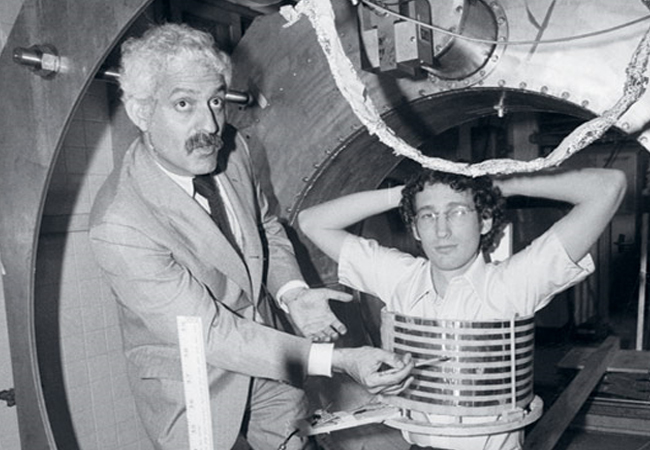
The first full body MRI scanner at the University of Aberdeen in Scotland (1970)

       The real shift came when Lauterbur, a U.S, chemist, introduced gradients to the magnetic field so that the origin of radio waves from the nuclei of the scanned object could be worked out. Through this he created the first MRI images in two and here dimensions. Mansfield, a physicist from England, came up with a mathematical technique that would speed up scanning and make clearer images. Damadian went on to build the full body MRI machine in 1977 and he produced the first full MRI scan of the heart, lungs, and chest wall of his skinny graduate student, Larry Minkoff – although in a very different way to modern imaging.

Working of an MRI machine

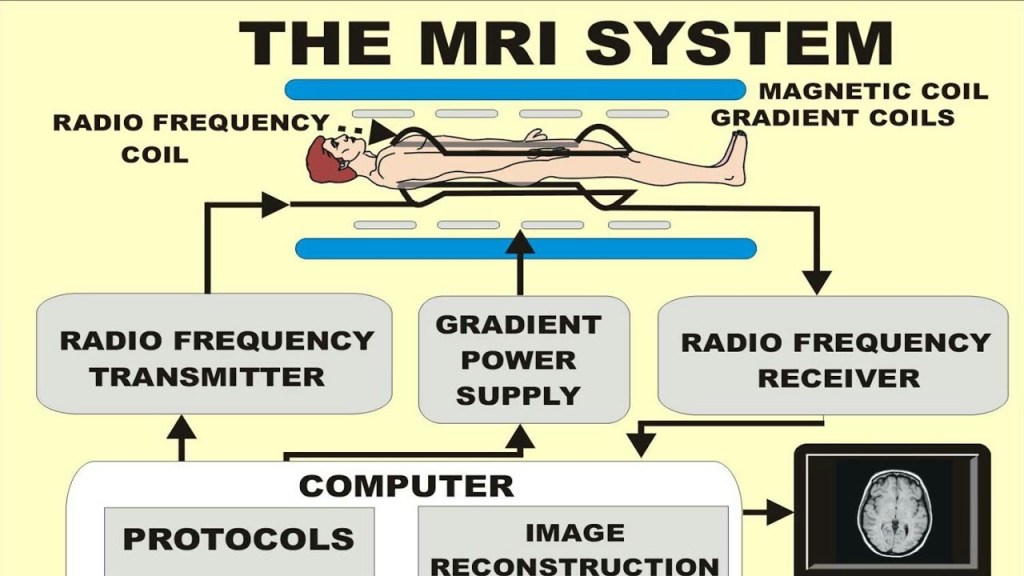
        The key components of an MRI machine are magnet, radio waves, gradient, and a super advanced computer. We all know that human bodies are made up of 60% water, and water is magnetic. Each of the billons of water molecules inside us consists of an oxygen atom bonded to two hydrogen atoms that are called as H2O. Small parts of the hydrogen atoms act as tiny magnets and are very sensitive to magnetic fields. The first step in taking an MRI scan is to use a big magnet to produce a unified magnetic field around the patient. The gradient adjusts the magnetic field into smaller sections of different magnetic strengths to isolate our body parts. Take brain as an example, normally the water molecules inside us are arranged randomly. But when we lie inside the magnetic field, most of our water molecules move at the same rhythm or frequency as the magnetic field. The ones that don’t move along the magnetic field are called low energy water molecules. To create an image of a body part, the machine focuses on the low energy molecules. The radio waves move at the same rhythm or frequency as the magnetic fields in an MRI machine.

       By sending radio waves that match or resonate with the magnetic field, the low energy water molecules absorb the energy they need to move alongside the magnetic field. When the machine stops emitting radio waves, the water molecules that had just moved along the magnetic field release the energy they had absorbed and go back to their position. This movement is detected by the MRI machine and the signal is sent to a powerful computer which uses imaging software to translate the information into an image of the body. By taking images of the body in each section of the magnetic field the machine produces a final three dimensional image of the organ which doctors can analyze to make a diagnosis.

“Medicine is a science of uncertainty and an art of probability”. –William Osler

Pradhan Mantri Jan Dhan Yojana

Pradhan Mantri Jan Dhan Yojana which was announced on 2014 has completed its seven years. It has various objectives too. It make sure that people can get access to different services related to finance like you will get access to the credit, insurance and also the pension to those who belongs to weaker section of the society or has low income. This Yojana also helps in using of technology to lower cost and hence wide area of people can get them.

Basically, it’s a national mission for financial inclusion. It will help that you all get access to different financial services like saving and deposit accounts, credit, insurance, pension, remittance too.

Few achievements

PMJDY accounts have grown three time from 14.72 crore in 2015 to 43.04 crore in 2021. If talk about who are getting benefits then it is observed that mostly the women who are enjoying it and it is also found that people are from rural and semi-urban areas too. Deposits under this account has increased upto 6.38 times till 2021. The use of Rupay card has much increased. There are various app too that are created for easy banking. About 5 crore accounts are getting Direct Benefit Transfer under various government schemes.

Impacts And Challenges

Through DBTs, there are very less chances of any leakages. Total security to the account is provided. This yojana has nearly completed its initiative to provide every adults with a bank account. It provides path to the poor so that they can bring their savings into the formal financial system.

But there is lack of physical and digital connectivity to the hilly areas. Sometimes there is technical issues too. Village people don’t want to deposit their money to a far located place. There is still a lack of awareness, knowledge and also skills. There are chances that people can make multiple accounts so that they can get much benefits.

References

Is Bollywood distracting Indian Youth

what is the first thing that comes to your mind when you hear the word Bollywood? An Item number or a random song which is having no meaning. Nowadays most of the Bollywood movies are just filled with item number, a lot of songs with no specific meaning and a repeating storyline. To just be specific, I am not talking about all the movies, I am taking about most of the movies. There are meaningful movies too like Dangal, Neerja, Hichki, Mary Kom etc, that makes sense and gives motivation to the youth for good things.

The Bollywood is actually started decreasing the quality of story, they are just focusing on the songs and weird sense. Without even thinking that what message do they give to the youth who are following them. Most of the movies that are being made now are love story with actually giving no meaning or motivation to the youth.

the youth after watching such movies gets distracted as they feel that they should follow their idols. The actors for the producers should realise their responsibility as they are the role model for many who are following them. They should make movies which have good impact on the youth and increases them to do hard work to achieve their goals.

And the youth too should understand and know to whom to follow and what to watch and not randomly follow anybody. So pick up everything very carefully with the what to watch and whom to follow.

Job Creation

Getting job is like climbing Mount Everest nowadays. If you are employed you have achieved they greatest hight in your life.

But here we are not going to take about the problems we face for like population explosion etc in getting employment, instead we are going to take about the solutions for it.

Some solutions

  • Encouraging people to do startups : this is the first and foremost step to increase job creation as if one do startup then automatically job creation begins and economic gets and boost.
  • Is in getting loans for startups : the banks should make the process of getting the loans for startup much easier as to encourage people to do it.
  • Improvement in academic curriculum : there should be improvement in academic curriculum as 2 to encourage the young mind to do their own startup.
  • Making foreign investment easier : the process for the multinational companies to invest in India should be eased up, by reducing unnecessary paper works and Taxes.
  • Increase in living standards : if the living standard of the general citizen of the country increases it automatically increases their needs like car, expensive gadgets etc, and to fulfill these needs more companies will bi setup and ultimately increases the employment.
  • Policy to control population growth : government should introduce policy that encourages people to have less children and ultimately getting a control on the population.

There can be many more ways to create employment. Everybody should contribute their ideas in what ways India can achieve full employment of their people, to get rid of this problem. These were some solutions from my side.

Superstitions Prevalent in India

By – Supriya

Superstition may be defined as an illogical or unreasonable belief, or acceptance of a certain phenomenon as it is without trying to know it’s cause. It also involves belief in omens, charms ,demons,witches,useless ceremonies and in the existence of supernatural beings.Superstitions mostly are the outcome of ignorance , outdated and unwarranted beliefs and backwardness. In this age of scientific reasoning ,logic and progress , superstitions still cloud the mind of a common man. Although western influence- to an extent has been successful in erasing out superstitious beliefs through the spread of education and public awareness ,yet superstitions have great hold on the all developing countries including the Orient.Somehow the Orient i.e., the East has always been equated to exotic settings , remote places and strange happenings. The forests of Africa were believed to have a hypnotizing and mesmerizing quality and it was suspected that people changed and got transformed in Africa. Even India, for long, was considered a land of snake – charmers , magicians ,witches and strange sights ,by the westerners.

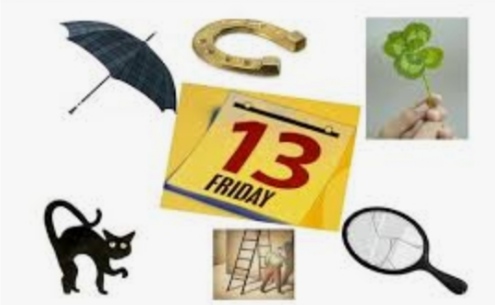
The Indian society, in the modern era, still seeped into ignorance and lack of education,has deeply fallen into the ditch of superstitions. Only a small fraction of society which is educated and open- minded is free from the clutches of superstitions to some extent. The condition of rural class or uneducated masses is the worst as they don’t even want to change.One should not leave home if anyone sneezes or sees a man with an empty pitcher or if a cat crosses the path and heaven protects if the cat is black – these are believed to be early signs of unsuccessful ventures or ill -luck. To see a one -eyed person early in the morning or a widow is sure to bring a bad day. The hooting of an owl and the howling of a dog are all signs of I’ll – luck or even death.The crowling of a crow or the falling of a comb indicates the forthcoming guests. One should not wear perfumes while crossing a cemetery or walk under a peepal tree during afternoon time or eat sweets and pass through a graveyard or else one will surely get afflicted by ghosts. One should not walk through cross – roads from right in the middle as again ghosts might capture you. If one drinks milk of a domesticated cow, one should never stand and drink milk as it might reduce the milk production of the cow. Itching of the right palm signifies good luck and of the left palm I’ll – luck . A similar thing is believed with the twitching of the eyes. Itching of the sole of the feet indicates that a journey is to be undertaken in the near future.
The list of such superstitions is endless and all of them are amusing in their own ways. The belief in evil eye, wearing of tabeez and charms to ward off ill- luck or to bring good luck are different kinds of superstitions found in India. It is the most discouraging to see that many a times educated people are in the habit of indulging into superstitions as much as the illiterate ones in the country. Beliefs regarding ghosts ,evil- eyes , charms etc are nothing but manifestations of human weaknesses. Weak minds cling to such things in case of failures to attribute their share of blame instead of acknowledging their faults and working hard to remove it.The dead cannot harm as much as the living can be kind to their fellow beings.

Generally, women are found more susceptible to Superstitions, may be because it was the female sections of the society that remained uneducated and ignorant for years. Now, women are trying to break free from the unprogressive shackles of superstitions. The only effective weapon against the cobwebs of superstitions is education, awareness and development of scientific attitude as well as aptitude. Firstly, there is a need to educate women who are responsible for educating the entire family. Besides, nothing should be accepted without any scientific reasoning. Then only can we shake off the deep and age-old roots of superstitions which have now become a part of our tradition ,ritual, culture and religion. With advancement in science and technology, although we have been successful in evaluating superstitions to an extent, yet a little more effort is needed to completely remove these from our daily lives.

THANKYOU

Population Explotion

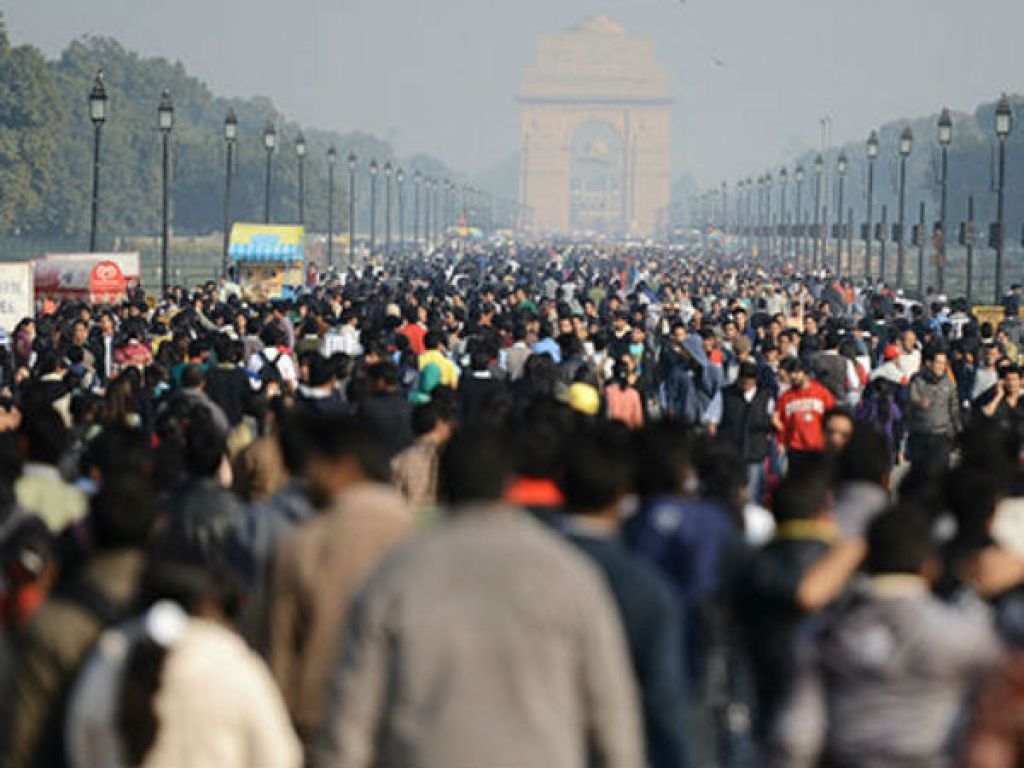
Do you know the evergreen asset and even problem of India? From the title you have already got the answer for it, our increasing population. It has been a strength and a hinders too. Let’s look as some positive and negative sides of it.

Positive aspect

  • Helps in economic growth : having a large population always impact economic growth as more and more companies would like to invest in India, as there are availability of cheap and skilled labours.
  • Strength of the country : being one of the largest democracy in the world, help India to have a significant and important place in the world to play.
  • Large number of killed people : as there is large number of skilled labour available in India so they are in huge demand in the foreign Nation.
  • Large market : because of the large population India has a very large market for which there is huge competition among the multinational companies to invest in India for that they can get profit.

Negative aspects

  • Increase in unemployment : there is large population so the competition to get job increases which increases the unemployment among the people.
  • Shortage of space : as the population grows the area of country remains the same and it creates problem for people to have a property for oneself.
  • And equal wealth distribution : There is huge competition for job so there is huge difference between the salaries too, which increases the gap between the rich and the poor.
  • Difficulty in controlling population : As there is huge population it is difficult for the government to handle their issues and make a plan which is good for everyone.
  • Huge competition : having large population means having competition for everything and everywhere.
  • Dissatisfaction some social group : as having one of the largest population in the world whatever the policies are made there is always a dissatisfaction among some group of society i.e., you can’t make everyone happy.

There is always a positive and negative aspect for everything we should always look at the positive side and should try to get the solution for the negative aspects as well. No the government is also looking the add population control as type so as to have a better future ahead.