WHY BIHAR CONSIDERED BACKWARD
Tardigrades

The tardigrade, better known as a water bear or moss piglet, is the real star in the race of survival. This eight-legged, water-dwelling animal, which is a closer relative to nematodes (roundworms) than they are to their look-alikes, the arthropods (insects, myriapods, arachnids and crustaceans), has gone unseen for a significant part of our existence. Astonishingly, there are over 1200 different species of tardigrades, and it is believed that less than 10% of the species have been identified.
How big are tardigrades?
The biggest adults reach a body length of only around 1.5 mm, while the smallest is less than 0.1 mm. Newly hatched tardigrades may be even smaller than 0.05 mm. You would need microscopic vision to see these impeccable wonders of nature. Tardigrades are nearly translucent and they average about half a millimeter (500 micrometers) in length, about the size of the period at the end of this sentence. In the right light you can actually see them with the naked eye. But researchers who work with tardigrades see them as they appear through a dissecting microscope of 20- to 30-power magnification—as charismatic miniature animals.
What do tardigrades eat?

They feed on the fluids of plant and animal cells, piercing their cell walls and membranes, with the help of primitive piercing mouthparts, called stylets. Some species of water bears are known to engulf entire live organisms, such as rotifers. Tardigrades even eat other tardigrades! Yes, cannibalism is very much alive and well among certain species of tardigrades. When they have enough food and water to support their bodily functions, they live out the natural course of their lives. They are probably the most paradoxical animals on this planet. These organisms are impossibly cute, like tiny blimps bumbling around harmlessly on their stubby little legs, but they also enjoy a legendary reputation as the toughest and most indestructible creatures on Earth.
Tiny but Robust

Tardigrades have been reported to survive the piping hot sulphur springs amidst volcanic mountains; they have survived atop the Himalayas, beneath layers and layers of thick ice, remaining unscathed by the immense pressures and exceedingly low temperatures. Tardigrades are fully capable of surviving complete global mass extinctions caused by astrophysical events, such as gamma-ray bursts and giant meteorite impacts.
Tardigrades and Ant-Man
Pop culture seems to love tardigrades. And with good reason! Tardigrades have been a part of several sci-fi movies, shows, and documentaries. Science fiction loves good space monsters that are biologically dominant to their heroic counterparts. Tardigrades are no stranger to this culture; they have been featured in various movies like Star Trek: Discovery, Ant-Man, and Harbinger Down. However, was it just their terrifying and gruesome appearance that inspired the filmmakers to caste these critters, or were they well aware of their dominant stature amongst other mortal creatures? Either way, they weren’t wrong!
Tardigrades in Space
In 2007, a group of researchers pushed the resilience of these extraordinary animals to the extreme, in conditions that would be impossible for any other known living creature to survive. A sample of dehydrated tardigrades was exposed to outer space for ten whole days. The vacuum of space, which results in severe dehydration and cosmic radiation, was not a problem for water bears. When those same specimens were returned to earth and rehydrated, 68% of those shielded from the radiation survived; even a handful of those without radiation protection not only came back to life but also produced viable offspring.
Cryptobiosis

The adaptation that allows tardigrades to live through such barbarous conditions is their ability to enter a dehydrated state, one that closely resembles death, and this is what makes all the difference. When encountered with environmental stresses, a tardigrade will moult its skin, and inside the shed skin, it curls up into a dry, lifeless ball called a tun. This reduces its metabolic activity immensely, to around 0.01% of its normal levels, but still protects their DNA. To do this, their body produces trehalose, a natural protective sugar that forms a gel-like medium that suspends and preserves the cell organelles and membranes. In the tun, a tardigrade can survive for decades or more. Once immersed in water, their bodies return to a normal metabolic state over the course of a few hours. In one such incident, a group of dehydrated tardigrades was reportedly taken from a museum sample of 100-year-old dried moss and was brought back to life by simple rehydration. That being said, the longer a tardigrade persists in a dehydrated state, the lower are its chances of being successfully revived.
Conclusion
Whether it is the scorching heat of thermal vents, the icy cold of subglacial lakes, or even the vacuum of space, these hard little critters will survive it all. Boil them, mash them, stick ’em in a stew… they are versatile and probably the most durable creatures on the planet. Having survived five great mass extinctions over a period of half a billion years, they might be the strangest combination of cute and terrifying that anyone has ever experienced while looking through a microscope. Extreme conditions that terrify us and would most certainly kill almost any life form, barely even faze them. These tiny tots have expanded the notion of habitable environments, and understanding their indestructibility will have profound implications for both earthbound medicines and survival on other worlds.
A Brief History of Pandemics
The world is still fighting with the coronavirus, after more than a year of it being officially declared as a pandemic by the World Health Organization (WHO). A pandemic is an epidemic that crosses the borders of one country. Pandemics can have a severe and long term impact on humankind.
Pandemics in History
There have been several instances of pandemics since the ancient times, when modern medicine and science was not much developed. Earlier, people believed that a disease was caused by gods or spirits to inflict destruction upon those who deserve it. But this unscientific perception prevented them from treating the patient properly and led to the death of millions of people.
There were a number of plague epidemics and pandemics in history, especially in the times of war. The Anthenian plague was spread between 430 to 26 B.C. It originated in Ethiopia during the Peloponnesian War. It spread to different parts of Egypt and Greece. The overcrowded city of Athens became severely affected and many lives were lost due to the rapid spread of the disease. Similarly, the Antonine Plague between 165-180 A.D, infected the Roman Empire.
The Justinian plague was known as the “real plague” epidemic. It originated in Ethiopia and spread to different parts through trade. It was one of the most severe plagues which led to lonely and deserted streets as trade activities were abandoned. The Black Death of 1334, originated in China and spread to several parts of central Asia, North India, Russia and Europe.
Spanish Flu was caused between 1918 to 1920 by the H1N1 strain of the Influenza virus. Its spread happened in the middle of World War-1. This avian borne flu was one of the most spread pandemic, it infected almost all the parts of the globe. It had a higher mortality than the previous virus and had a deeper impact on humankind. It caused nearly 50 million deaths worldwide. Even after its deadly impact, the virus faded away easily from everyone’s attention because of the ongoing World War at that time. Some writers have written about it as the “forgotten pandemic”.
The Ebola outbreak was one of the most recent outbreaks, between 2014 and 2016. It mostly affected Central and Western Africa. But it was efficiently contained and did not spread rapidly all over the world.
Covid-19 Pandemic
The pandemic caused by coronavirus originated in China in November, 2019. It was officially declared as a pandemic by WHO, on March 11, 2020. By that time it had spread to 114 countries. Methods such as quarantine, isolation and lockdown were implemented to curb its spread. New developments related to medicines, treatment, and vaccination have been developed over time.
The vaccines stand as a ray of hope to overcome the Covid pandemic in near future.
BUDDHIST PILGRIMAGES IN INDIA

Buddhism, an esoteric tradition and way of life, arose to teach people how to experience life in a more meaningful way, bringing intrinsic serenity and pleasure. It aspires to live in perfect harmony with the greatest outpouring of love, honesty, and compassion possible. There’s a lot to discover about this 2500-year-old religion and its global appeal. Explore these locations to be awestruck by their beauty and to learn more about Buddha’s teachings.
Bodh Gaya
Bodh Gaya is India’s Buddhist epicenter. The tiny village of Bodh Gaya in Bihar reverberates with a serene atmosphere infused with profound devotion. This 2,500-year-old Buddhism cradle, studded with temples and monasteries, welcomes people from all across the globe to soak up its spiritual and holy vibes, follow Lord Buddha’s footsteps, and hear about his teachings at the very spot where he attained enlightenment. The serenity pervades every wind in this tiny village. Prince Siddhartha, better renowned as Lord Buddha, is claimed to have taken shelter under the most sacred tree in the vicinity, the Bodhi tree, there he meditated till enlightenment.
The beautiful Mahabodhi Temple, a UNESCO World Heritage Site, is one of Lord Buddha’s four sacred shrines. The renowned sandstone temple stands 52 meters tall in the heart of Bodh Gaya town, amidst lush green gardens. The existing Bodhi tree, most likely the sixth generation of the first, a prominent emblem in Buddhism, is located to the left of the Mahabodhi Temple. It commemorates the spot where Lord Buddha attained enlightenment underneath the first Bodhi tree. Buddha meditated for about a month in Bodhgaya under a holy fig tree. Bodhi Day, which honors Buddha’s enlightenment under the Bodhi tree, is observed every year on Dec 8 by Buddhists all around the world.
It’s a delightful surprise, with exquisite engravings and arch motifs on the tower. A golden figure of Lord Buddha in his renowned bhumisparsha mudra, with one finger touching the ground and asking it to witness his enlightenment, can be found inside the temple. A statue of Mayadevi, Lord Buddha’s mother, is housed in a room at the top.
Sarnath

Sarnath,10km from Varanasi, was the starting point for Buddha’s teachings and preaching. Buddha gave his first lectures after nirvana in this very location. Sarnath is one of India’s four holiest Buddhist sites, with constructions like the Dhamekh Stupa and Chaukhandi Stupa highlighting its historical importance.
The solid cylindrical structured Stupa made of red bricks and stone reaches a height of 43.6 m and a diameter of 28 m. This historic site is significant because it represents the site where Lord Buddha delivered His first teaching to His 5 monks following achieving enlightenment in Bodh Gaya. Buddhist pilgrims from all across the world come to Sarnath to worship Lord Buddha.
Lord Buddha’s remains were dispersed and buried beneath 8 mounds after his enlightenment, with the embers and urn buried beneath 2 additional mounds, for a total of 10 such memorials housing Lord Buddha’s relics.
Great Indian Emperor Ashoka of the Maurya Dynasty, who reigned over almost the entire Indian subcontinent from c. 268 to 232 BCE, constructed multiple Stupas across India bearing relics of Lord Buddha and his disciples, to spread Buddhism. At 249 BCE, he ordered the construction of the Dhamek Stupa at Sarnath, which was later reconstructed in 500 CE, as well as several other Sarnath structures.
Kushinagar
Kushinagar is a well-known tourist destination associated with Gautama Buddha, located 51 kilometers east of Gorakhpur on National Highway No. 28. Buddha delivered his last and final preaching here in 483 BC. The statue of Lord Buddha in nirvana, which towers 6.10 meters tall and dates from the 5th century A.D., is built of monolith red-sandstone. The ‘Resting-Buddha’ is seen lying on his right side, facing west. It is a holy pilgrimage place since it is where Lord Buddha breathed his last.
Kushinagar’s other attractions include the Indo-Japanese Temple, Burmese Temple, Chinese Temple, Thai Temple, Korean, Sri Lankan, Tibetan temples, 15-acre Meditation Park, and Museum.
Tawang Monastery
Tawang Monastery, the largest monastery in India and the second largest in the world, located in Tawang city of Tawang district in the Indian state of Arunachal Pradesh, serves as the valley’s social, cultural, and spiritual hub. This monastery, perched on a hill about 10,000 feet above sea level, is India’s largest, with views of ravines to the south and west, a short ridge to the north, and a gradual slope to the east. During the winter, it is buried in snow, which enhances its splendor.
The Mandalas or Kying-Khores are painted on the Kakaling’s ceilings and inner roofs, while saints and divinities are depicted on the inside walls. On the monastery’s northern flank, after Kakaling, is the main gate. It has a 925-foot-long eastern wall. A 25-foot-high golden statue of Lord Buddha, perched on a lotus throne and flanked by his two chief attendants, Maudgalyayana and Sariputra, each bearing staff and a bowl, is a major attraction of the monastery. The Tawang Monastery, which is three stories tall and is enclosed by a 925-foot high compound wall, houses 65 residential buildings.
The monastery is historically notable as it was founded in 1681 per the wishes of Ngawang Lobsang Gyatso, the 5th Dalai Lama. The word ‘Tawang’ translates to ‘chosen by a horse,’ and legend has it that a horse belonging to the founder, Mera Lama Lodre Gyatso, chose the current monastery’s location. Tsangyang Gyatso, the sixth Dalai Lama, was born at Tawang, making it a significant Tibetan Buddhist pilgrimage destination.
Ajanta Caves
The Ajanta Caves, 107 kms from Aurangabad and 60 kms from Jalgaon, were designated as a UNESCO World Heritage Site in 1983. A protected monument in the care of the Archaeological Survey of India, it is a cluster of 32 Buddhist caves not far from a medieval village of the same name. Ajanta’s thirty rock-hewn caves, built into a cliff’s scarp, are either chapels or monasteries. Paintings adorn the cave walls, many of which retain their original colors. Exquisitely carved sculpture adorns the building’s outer walls. The Ajanta paintings’ Buddhist motif embodies the essence of Lord Buddha’s life and previous earthly events.
Intellectual disability
INTELLECTUAL DISABILITY
Abstract
One of the tenth person in the world have some kind of disorder related to the intellectual disability. This disability are in different form -mild to profound. In this article we are going to discuss about the intellectual ability, it cause and diagnosed.
Introduction.
Some child are slow learner. They learn the things very late but they do. But when the child is not able to perform the milestone of their age it could be matter of rethink. The child could have some kind of intellectual disability.
Intellectual disability, formerly labeled “mental retardation,” is defined by the Individuals with Disabilities Education Act (IDEA) as “significantly subaverage general intellectual functioning, existing concurrently [at the same time] with deficits in adaptive behavior and manifested during the developmental period.
Intellectual disability has limitations in two areas-
- Intellectual functioning- in this a person’s ability to learn reason make decisions and solve problems can be affected. The intellectual function is also known as IQ.
- Adaptive behavior- in these day-to-day life skills can be affected as communication, taking care of yourself, and interacting with others.
Sign of Intellectual disability in children-
- Difficulty in rolling over, walking late, sitting up, crawling. trouble in talking , Feeding themselves, problem-solving and logical thinking. Other problems can be a mood disorder, autism, motor skills, anxiety, etc.
Cause-
- Genetic conditions
intellectual disability could be gentic. One of the both parents have same disability such as Down syndrome and Fragile X syndrome which innated in the offspring.
- Problem during pregnancy and childbirth
Due ro some complicaion during the pregency or birth, the brain’s nerve get damage or lack of oxygen. This cause the intellectual disability in the child
- Illness or injury
Sometime child suffer from high fever, measles and head injuries could be the reason of intellectual disability.
- Environmental influence:
Environment of the mother during pergnancy or after birth the tension environment of home leads intellectual disability.
- None of the above- in some cases children who are facing this disability the cause is unknown.
Prevention-
- Time to time ultrasound during pregnancy.
During the pregnancy mother should be go for ultrasound time to time and take care of her health.
- Not drink during pregnancy, parental care, taking a parental vitamin.-
Drinking, smoking and drugs during the pregancy leads multiple complication and fetal alochol syndrome in the child. The would be mother should ignoure the alcohol during pregnancy and take vitamin and mineral which are required in brain development of child.
- Vaccinated against certain infections And diseases.
The mother and new born should be properly vaccinated againsr the certain infection and disease. Some virus directly attacked on brain and brain nerves (measles). It is important that child is vaccinated so the anti-bodies can support immune system of the child.
- Genetic testing if there is a history of a genetic disorder in families.
The parents should go with the history of the family. If their is such cases in their family they must consult to doctor to prevent the child from the same disability.
Diagnosed-
- Through testing like blood tests, urine tests, imagining tests, etc.
- Counseling with parents and children for testing intelligence and behavior.
Services-
- Early Intervention Program- speech therapy, occupational therapy, Physical therapy, family counseling training, nutrition services.
- Disabilities Education Act- special schools. parents and educators work together to create an individualized education program (IEP).
Conclusion
The intellectual disability is known as mental retardation. It could be mild or profound. ID could be gentic or cause of illiness and injuires. Diagnosed is really simple. We need to watch out the behaviour of the child and consult to expert.
MUSIC – A GOOD COMPANION!!!
We may live in different place, different state, different country but we a got together by music. Would you agree if say like that? Yes, music is a good companion which helps us to express our feelings. It may be any form of music but we may feel accompanied with music rather than being lonely. Let me tell you about how music has an great effect on us.

Music is something that we enjoy as a part of our life. It accompanies us from birth to death. During our childhood, our parents and grandparents used to sing songs to make us sleep. Crying is a kind of music. When we woke up, we can hear the birds chirpping and trees rustling which is the most lovely feel in the morning. Music is everywhere, all we need is to open our ears to listen to it.
One who knows to create music on their own with musical instruments is called a Musician. The different music instruments include – Percussion, Brass, String, woodwind and keyboard. Brass music instruments are played using mouth. Those instruments include Trombone, Trumpet etc. String music instruments give rythym to music and those instruments include Guitar, Veena, Violin etc.

Percussion musical instruments gives main beat and feel to the song and those include Drums, Tabla, Dolak etc. Woodwind instruments are made of wood and they are also played using mounth like brass instruments and these instrument include Flute. The keyboard consists of keys which has high pitches.When you add another voice to an instrument, it is called singing and is a vital part of the music. When people who play different instruments come together to play them together, it is called a band.
There are different genres of music such as rock, pop, classical, blues, jazz, R&B, hip-hop, etc. All of these genres of music are characterized by how the instruments work together. Rock music is often louder and is played using percussion and string instruments. In Jazz music, Saxophone is very popular. In this modern world, the newest genres of music is electronic dance music (EDM) which consists of loud percussive beats and is very popular to young people.

We all have our favorite music director, singer, band, etc. Music is a universal language that unite people regardless of boundaries. This has the sense of familiarity among the people. Eventhough, we don’t understand the meaning of the lyrics of a song, we like it because of the tune and voice. Music is not just a sound but a communicable language which makes feel good. I love to hear music when am alone. But I used to play music when I am with my friends and family and it unites us very much. Listening to your favourite song can completely uplift your mood if you are feeling down. Everybody has their own kind of music that they love, which is why it is special to us all in our own unique ways.
My best advice for you is to enjoy the music when you are alone and enjoy more than that when you are with your family. This feel cannot be explained in words and you’ll understand by experiencing it. Often hear songs; make everyone around you happy. Be happy; lead a helathy life.
Read more;
India’s medal in Tokyo Olympic 2020
India Medal Tally Tokyo Olympics – 1 Gold, 2 Silver, 4 Bronze, Medal table is given here. Check the Tokyo Olympic Medal tally for India from here. Tokyo Olympic 2020 is organized in Japan this year. Players from all around the world are performing to win medals for their country. India already has broken its previous record of 6 medals in a single Olympic as they have won 7 medals on Tokyo Olympic 2021 already.
India finished 48th on the medal tally in Tokyo, its highest ranking in over four decades (if one were to go by the total number of medals, India would have actually finished 33rd. However, ranking is done primarily based on gold medals won). The previous best in this period was the 51st rank finish at Beijing in 2008, when India won three medals, including Abhinav Bindra’s gold.India has finished significantly higher in the era in which it used to win gold in hockey, but that time is not really comparable both because of the dozens of countries that have come into being since then and the expansion in the number of sports and hence medals. In Moscow, for instance, India finished at 23rd rank but with just a solitary medal, the hockey gold. A repeat of that at Tokyo would have placed India at joint 63rd, a measure of how different the two eras are.In London 2012, India had finished 57th despite winning more medals than in Beijing because the medal table ranks countries by gold, silver and bronze in that order and India didn’t win a gold in London. In Rio in 2016, the medal tally crashed to just two and so did the ranking to 67th. From there, it’s now gone up nearly 20 places.
The saven warriors
1gold, 2 silver, 4 bronze – India produced it’s richest-ever medal haul and the finest performance of all time at the 2020 Tokyo Olympics, which ended on Sunday. Here are the men and women of steel and thunder who made India proud and gave the nation something to cheer about in these dark times of a deadly pandemic.
1.neeraj chopra
There were bigger names with better records in Tokyo. But while most succumbed to the pressure of the big stage, the 23-year-old boy from Haryana’s Panipat district relished and revelled in the moment. Following his golden throw, millions became emotional on hearing the national anthem at the Olympics for the first time since Beijing 2008. A fitting climax to the story of Neeraj Chopra, who chanced upon the sport while trying to lose weight and who overcame a clutch of injuries to give Indian athletics its greatest moment on the world’s biggest sporting stage .
| Game | Athlete | Medal |
| Javelin throw | neeraj chopra | Gold |
2.Saikhom Mirabai chanu
Much was expected from Mirabai Chanu at Rio 2016. She flopped, failing to make a single clean and jerk lift. The pressure to deliver was crushing at Tokyo 2020. But coached by Vijay Sharma, the amiable 26-year-old from Manipur made light work of the heavy weights to clinch a silver with a smile in the 49kg category. Redemption had never been more satisfying and sweeter for the woman who picked up logs to gather winter fuel for her family as a child.
| Game | Athlete | Medal |
| Weight Lifting (49 Kg Women) | Mirabai Chanu | Silver |
3.Ravi Kumar Dahiya
He was ranked world no. 4. But in the run-up to the Olympics, the focus was hardly ever on the 23-year-old Olympic debutant from Sonipat. Unmindful, Kumar produced a performance of stunning audacity and endurance while trailing 2-9 against opponent Nurislam Sanayev in the semis. Desperate to get out of his iron grip, the Kazakh bit him badly in his forearm but Dahiya wouldn’t let go till the tide was turned. Dahiya fought hard but lost in the final to become India’s second silver medal-winning wrestler after Sushil Kumar. A fiercely determined athlete, he could well improve upon his medal colour in 2024.
| Game | Athlete | Medal |
| Wrestling (57 KG) | Ravi Kumar Dahiya | Silver |
4.Men’s team ( hockey)
None of them was born when India last won an Olympic medal in hockey. But nothing, not even a potentially morale-sapping 7-1 loss to Australia, could stop captain Manpreet Singh’s boys from their tryst with the podium. The defeat spurred them to deliver one superlative performance after another, resulting in a bronze playoff. The match against Germany was for the ages. You can keep watching India’s 5-4 triumph for the rest of your lives. But this team holds the promise of many more wins to come.
| Game | Athlete | Medal |
| Hockey | Indian Hockey Team | Bronze |
5.pv sindhu
In the early stages in Tokyo, she looked below her best. But like a finely-tuned precision instrument, Pusarla Venkata Sindhu hit the perfect notes as the tournament peaked. She simply swatted aside Chinese He Bing Jiao 21-13, 21-15 in the bronze medal playoff to add a second Olympic medal in her kitty. When it’s PV Sindhu, once is not enough.
| Game | Athlete | Medal |
| Women’s Singles Badminton | PV Sindhu | Bronze |
6.Lovlina Borgohain
Covid-19 affected her preparation. But the tall pugilist from Assam tried to make the best of the situation. She lifted LPG cylinders, worked in the paddy fields to keep fit. In Tokyo, Lovlina showed the world she could fearlessly box with the best. Five feet, nine inches tall, she used her long reach to devastating effect to fashion an amazing medal story.
| Game | Athlete | Medal |
| Women’s Welterweight Boxing | Lovlina Borgohain | Bronze |
7.Bajrang punia
Wrestler Bajrang Punia, also in his debut appearance at the quadrennial event, beat Kazakhstan’s Daulet Niyazbekov in the men’s 65kg freestyle wrestling playoff to claim the bronze medal. Punia, who belongs to Khuddan village in Jhajjar district, pinned Kazakhstan’s Daulet Niyazbekov.It was India’s sixth medal of the Tokyo Olympics – equalling their best-ever haul at a single edition of the Olympics.
| Game | Athlete | Medal |
| Wrestling (65 Kg) | Bajrang Punia | Bronze |
for more sports news related to Olympics visit the site link given below 👇
THE SOUL OF INCREDIBLE INDIA – ODISHA

Odisha , formerly Orissa , is an Indian state located in Eastern India. It is the 8th largest state by area, and the 11th largest by population. The state has the third largest population of Scheduled Tribes in India. It neighbours the states of West Bengal and Jharkhand to the north, Chhattisgarh to the west, Andhra Pradesh to the south, and a very negligible border with Telangana to the southwest. Odisha has a coastline of 485 kilometres along the Bay of Bengal. The region is also known as Utkala and is mentioned in India’s national anthem, “Jana Gana Mana”. The language of Odisha is Odia, which is one of the Classical Languages of India.
The ancient kingdom of Kalinga, which was invaded by the Mauryan emperor Ashoka (which was again won back from them by king Kharavela) in 261 BCE resulting in the Kalinga War (The lethal war with Kalinga transformed the vengeful Emperor Ashoka into a stable and peaceful emperor, and he became a patron of Buddhism), coincides with the borders of modern-day Odisha. The modern boundaries of Odisha were demarcated by the British Indian government when Orissa Province was established on 1 April 1936, consisting of the Odia-speaking districts of Bihar and Orissa Province. The first of April is celebrated as Utkala Dibasa. Cuttack was made the capital of the region by Anantavarman Chodaganga in c. 1135, after which the city was used as the capital by many rulers, through the British era until 1948. Thereafter, Bhubaneswar became the capital of Odisha.
The economy of Odisha is the 16th-largest state economy in India with ₹5.33 lakh crore in gross domestic product and a per capita GDP of ₹116,614 . Odisha ranks 32nd among Indian states in human development index.
CUISINE –
Odisha has a culinary tradition spanning centuries. The kitchen of the Shri Jagannath Temple, Puri is reputed to be the largest in the world, with 1,000 chefs, working around 752 wood-burning clay hearths called chulas, to feed over 10,000 people each day.
The syrupy dessert Pahala rasagola made in Odisha is known throughout the world. Chhenapoda is another major Odisha sweet cuisine, which originated in Nayagarh. Dalma (a mix of dal and selected vegetables) is widely known cuisine, better served with ghee.
The “Odisha Rasagola” was awarded a GI tag 29 July 2019 after a long battle about the origin of the famous sweet with West Bengal.
DANCE –
Odissi dance and music are classical art forms. Odissi is the oldest surviving dance form in India on the basis of archaeological evidence. Odissi has a long, unbroken tradition of 2,000 years, and finds mention in the Natyashastra of Bharatamuni, possibly written c. 200 BC. However, the dance form nearly became extinct during the British period, only to be revived after India’s independence by a few gurus.
The variety of dances includes Ghumura Dance, Chhau dance, Jhumair, Mahari dance, Dalkhai and Gotipua.
TOURISM –
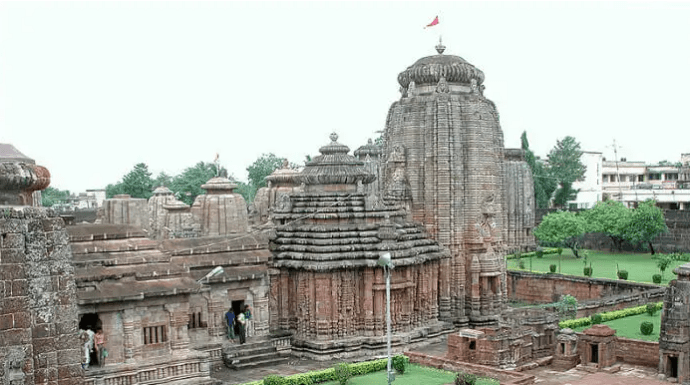
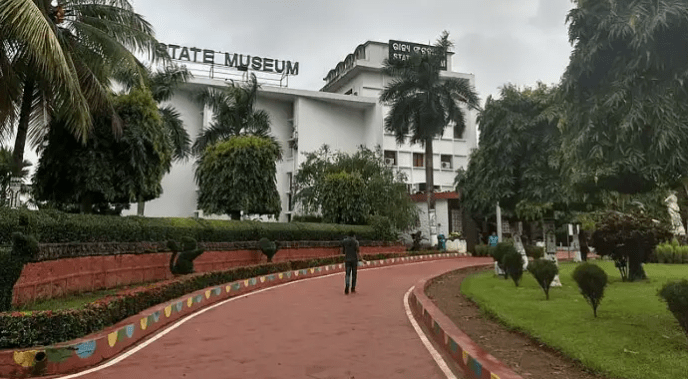
The Lingaraja Temple at Bhubaneswar has a 150-foot high deula while the Jagannath Temple, Puri is about 200 feet high and dominates the skyline. Only a portion of the Konark Sun Temple at Konark in Puri district, the largest of the temples of the “Holy Golden Triangle” exists today, and it is still staggering in size. It stands out as a masterpiece in Odisha architecture. Sarala Temple, regarded as one of the most spiritually elevated expressions of Shaktism is in Jagatsinghpur district. It is also one of the holiest places in Odisha and a major tourist attraction. Maa Tarini Temple situated in Kendujhar district is also a famous pilgrimage destination. Every day thousands of coconuts are given to Maa Tarini by devotees for fulfilling their wishes.
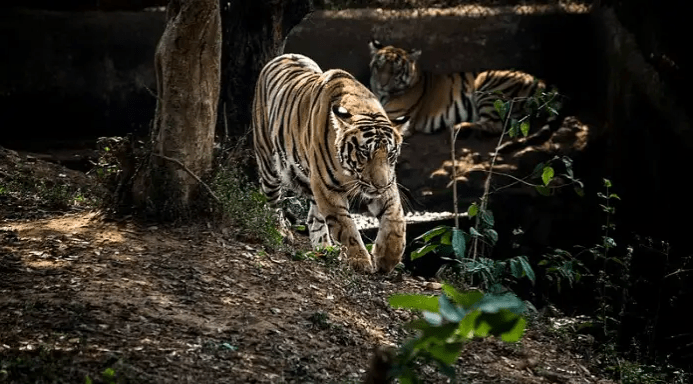
Odisha’ s varying topography – from the wooded Eastern Ghats to the fertile river basin – has proven ideal for evolution of compact and unique ecosystems. This creates treasure troves of flora and fauna that are inviting to many migratory species of birds and reptiles. Bhitarkanika National Park in Kendrapada district is famous for its second largest mangrove ecosystem. The bird sanctuary in Chilika Lake (Asia’s largest brackish water lake). The tiger reserve and waterfalls in Simlipal National Park, Mayurbhanj district are integral parts of eco-tourism in Odisha, arranged by Odisha Tourism.
Daringbadi is a hill station in the Kandhamal district. It is known as “Kashmir of Odisha”, for its climatic similarity. Chandipur, in Baleswar district is a calm and serene site, is mostly unexplored by tourists. The unique specialty of this beach is the ebb tides that recede up to 4 km and tend to disappear rhythmically.
In the western part of Odisha, Hirakud Dam in Sambalpur district is the longest earthen dam in the World. It also forms the biggest artificial lake in Asia. The Debrigarh Wildlife Sanctuary is situated near Hirakud Dam. Samaleswari Temple is a Hindu temple in Sambalpur city, dedicated to the goddess known as ‘Samaleswari’, the presiding deity of Sambalpur, is a strong religious force in western part of Odisha and Chhattisgarh state. The Leaning Temple of Huma is located near Sambalpur. The temple is dedicated to the Hindu god Lord Bimaleshwar. Sri Sri Harishankar Devasthana, is a temple on the slopes of Gandhamardhan hills, Balangir district. It is popular for its scenes of nature and connection to two Hindu lords, Vishnu and Shiva. On the opposite side of the Gandhamardhan hills is the temple of Sri Nrusinghanath, is situated at the foothills of Gandhamardhan Hill near Paikmal, Bargarh district.
In the southern part of Odisha, The Taratarini Temple on the Kumari hills at the bank of the Rushikulya river near Berhampur city in Ganjam district. Here worshiped as the Breast Shrine (Sthana Peetha) and manifestations of Adi Shakti. The Tara Tarini Shakti Peetha is one of the oldest pilgrimage centers of the Mother Goddess and is one of four major ancient Tantra Peetha and Shakti Peethas in India. Deomali is a mountain peak of the Eastern Ghats. It is located in Koraput district. This peak with an elevation of about 1,672 m, is the highest peak in Odisha.
The share of foreign tourists’ arrival in the state is below one percent of total foreign tourist arrivals at all India level.
RACISM
Racism is not just an added stress to individuals of minority ethnic groups, but is a pathogen which generates depression.
Racism usually occurs at workplace and schools and is mostly experienced by immigrants and refugees.
The immigrants and refugees are often taken advantage as labour force, human trafficking and even cases of rape and child marriage.
Their human rights must be protected, so they will have the right to life and liberty, freedom from slavery and torture, freedom of opinion and expression, the right to work and education to eradicate poverty, and end child marriage.
Being racist towards someone can impact that person a lot, as it can cause depression, low self-esteem, losses in a psychological sense and a sense of helplessness.
Even preteens and teenagers have experienced racism at school and on social media platforms.
If we search on the net we can get a lot of results about teenagers’ suicide due to racism and discrimination, because they felt isolated, hated, not accepted in their own society or even worthless.
Racism and discrimination should be stopped because we should be ONE to make this world a greater place. The planet is for everyone to live in, because everybody is equal as we all bleed the same color.
Everyone should change their mindset to treat everyone equally, regardless of race, sex, nationality, ethnicity, language, religion, or any other status.
It’s up to the parents to nurture their children because racism isn’t something you are born with, it is taught.
Thermoregulation in Camel
Camel is a desert mammal. It is called the ship of the desert as it is well adapted to live in hot sand of deserts. The camel has the following adaptations for desert life:
1. Camel is an eurythermal animals as it has the ability to tolerate wide variations in temperature. 2. Camel is a warm blooded animal (homeotherm) as it can keep its body temperature well above the ambient temperature as other mammals and birds. 3. Camel is also a hypothermic animal as it can keep its body temperature abnormally low during night. 4. Camel is an endothermic animal as it has the ability to generate temperature from the body. 5. The camel is a temporal heterothermic animal as their body temperature is very high during hot day and very low during cool night. It cannot maintain the body temperature within a narrow range. It absorbs heat and allows its body temperature to go high up 58°C*, on a hot day. Similarly, during night, it allows its body temperature to drop several degrees below normal. 6. Camel is a large animal. It cannot hide into a burrow like small animals during hot days. 7. As it is a large animal, its surface/mass ratio is low and heat capacity is high. 8. Camel has a thick pelagic that helps insulate from external heat. 9.Low surface area and thick pelagic retard the absorption of heat from the surrounding. 10. Camel has high specific heat of tissue water.This helps camel to absorb relatively large quantities of heat for a given rise in body temperature. 11. The dehydrated camel can also tolerate an elevation of its core temperature by several degrees, further increasing its heat absorbing capacity. 12. The camel allows its body temperature to go high up without sweating. This prevents loss of water from the body. 13. Camels fur acts as an effective barrier to heat transfer. It helps conserve water and retard heating up of the body. 14. Camel drinks large quantity of water in a short time.15. The camel has long eyelashes that keep its eyes safe from wind borne sand. 16. It has muscular nostrils that it can completely or partially close at will.
CHILD LABOUR
Children are the future. But when instead of helping them discover themselves, they are directed to labour it indirectly affects the growth of the country. Children, they need to play, they need to fall and learn to get up, they need to enjoy being a kid. But with child labour, this all is just a dream. Even now, there are those children, who are working hard day and night, just so they could eat one times food, those children who are studying from the worn-out books, from whom you can barely read.
Government has set many rights and laws to eradicate child labour, to get children to school. Eg- the right to education act, etc. But still, we need to take some concrete steps, to ensure that no child will be deprived of education, childhood, that no child will be forced to work. Child labour is a curse, for every child. Their potential is dug deep into the ground, they are withheld from the opportunities to prove themselves. Where they could possibly be learning, dreaming, they are forced to labour.
We all need to come together. We need to take actions. We need to stop wherever child labours are working. We need to provide them with education, the food so that they won’t need to work. We need to stop those people who are forcing homeless children to work. Actions speak louder than work. So if you agree with me think about the ways you can child labour near your locality, school anywhere you see. Think about those ways and put them to work. If determined, Even one person can make a change.
Section 45 in The Income- Tax Act, 1995
45. Capital gains 1(1) 2 ] Any profits or gains arising from the transfer of a capital asset effected in the previous year shall, save as otherwise provided in sections 34 ] 54, 54B, 5 ] 67 54D, 8 54E, 54F 9 , 54G and 54H]]]]], be chargeable to income- tax under the head” Capital gains”, and shall be deemed to be the income of the previous year in which the transfer took place.
(2) 10 Notwithstanding anything contained in sub- section (1), the profits or gains arising from the transfer by way of conversion by the owner of a capital asset into, or its treatment by him as, stock- in- trade of a business carried on by him shall be chargeable to income- tax as his income of the previous year in which such stock- in- trade is sold or otherwise transferred by him and, for the purposes of section 48, the fair market value of the asset on the date of such conversion or treatment shall be deemed to be the full value of the consideration received or accruing as a result of the transfer of the capital asset.]
(3) 11 The profits or gains arising from the transfer of a capital asset by a person to a firm or other association of persons or body of individuals (not being a company or a co- operative society) in which he is or becomes a partner or member, by way of capital contribution or otherwise, shall be chargeable to tax as his income of the previous year in which such transfer takes place and, for the purposes of section 48, the amount recorded in the books of account of the firm, association or body as the value of the capital asset shall be deemed to be the full value of the consideration received or accruing as a result of the transfer of the capital asset.
(4) The profits or gains arising from the transfer of a capital asset by way of distribution of capital assets on the dissolution of a firm or other association of persons or body of individuals (not being a company or a co- operative society) or otherwise, shall be chargeable to tax as the income of the firm, association or body, of the previous year in which the
Artificial Intelligence: Can the AI take over?
Artificial Intelligence is a topic with a vast appeal to the en masse. People believe that it is the future of human techologies. But beyond that, people are of various school of thoughts. The first group assumes that AI shall help humanity achieve singularity – a point in technological development that shall mean an utopia. We shall spend all our time towards spiritual and emotional development while most of the crude tasks shall be taken care by machines. The second school of thought assumes that AI shall take over humanity as its overlords. Let us analyse both.
The history of animated, self-thinking, free willed machines is not new at all. It has been imagined for centuries by fiction writers. However, the modern conception of AI in scientific thinking started about 80 years ago. John McCarthy, an American mathematician proposed the idea of such machines back in the first half of the 20th century. Alan Turing, the inventor of the Turing Machine, a British mathematician also proposed his idea of intelligent machines, his proposal now famously called the Turing Test. However, for the next 40 years or so, no important research occurred in the field. It was only in the last decades of the 20th century, when the research started again and not before humanity entered into the 21st century that something formidable was created.
As of today, AI has invaded all spaces of human endeavor. Mechanics, mechatronics, smart devices, our smartphones – all of it is infiltrated with AI. But this AI is what most scientists call ‘weak AI’. It cannot really think. It has a predefined algorithm and then it uses that algorithm to capture inputs and ‘learn’ about new scenarios as per its algorithmic definitions. This AI cannot work without human input and can certainly not take over the world. It can however carry out some actions that are equivalent to evolution as the AI at the Facebook research Center developed their own language to communicate. However, this evolution still does not mean that the AI is “thinking”. It is just evolving its learning based on a preprogrammed code. It is nothing like human beings where discretion is a thing. Even the famous robot AI, Sophia is but a weak AI – a little better than SIRI and google assistant but that is all there is to it. It is not a self-thinking, free-willed machine.

Researchers have tried hard to create strong AIs with a completely different set of ethical concerns – the main obviously being how would such machines live with humans if they are free to think – but have failed so far. And believe it or not, strong AIs might really not be a thing for at least another 50-100 years at the very least. Maybe even a couple of centuries after that.
So, if you’ve watched the movie Prometheus or Covenant and are scared of the possibility of David being a reality, grab a cup of coffee and relax. By the way, both the movies are really good!

FEMINISM
Term ‘Feminism’ was initially brought up as a Label for women to fight against the discriminations happening towards them under it’s name. The purpose of the concept was to retrieve back the rights of women, breaking all the Stereotypes and putting an end to the prejudice beared by females since the earliest times. The beginners fought for women rights but never had a mission to demean males’ in any form or lower their status or rights so as to provide a higher position to women. Feminism was never invented to disregard men’s existence but all it was meant for is making the society aware of the fact that women deserve to have the same standard and respect EQUAL to that of Men. Majority of each and every person who has come across the notion, considered it worthy of all the attention and a very important agenda for empowerment. Feminism raised several issues and even unveiled injustices occurrings taking place against women in tremendous ways worldwide. For example, To receive an equal pay – as of the Male worker in the company while working on the same position, To get the freedom of working, dressing and living with their own choice, To ensure safety, To fight against domestic violence, sexual harassment and the superstitious harmful practices such as Female genital mutilation / cutting.

HOWEVER!!!
Likewise every law has a loophole, there are always Some people in a crowd who just couldn’t think Right! So Here’s where came a wave of demolishing the concept of Feminism. While, the movement was bringing a good change in the social norms and actually convincing the people about the shortcomings on the grounds of Building Equality, the fake flag bearers of Morality amd virtue started exaggerating the agenda. They created a state of Gender Bias all around. Some women would try to take unfair benefits in the name of feminism namely, a practice called PSEUDO FEMINISM. This includes examples such as; women’s income tax slab is higher than men’s. A woman who earns till 3,00,000-3,50,000 is exempt from tax payment. If both men and women earn the same account, why should it only be the men who pay tax. Another example is As of 2009, 175 men had been kidnapped and abducted for the purpose of illicit intercourse, according to the 2012 NCRB data. As per a reliable source the cases were registered under the Indian Penal Code (IPC) Sec 363 to 369, 371 to 373. Such cases are not dealt with in the same way as the abuse committed on women, even under regulation.
A Dilemma…
But Why can’t we just accept, respect and treat both the genders equally at the same time? We are already living in a culture where both Women and Men face so many challenges everyday due to Orthodox mindsets of people. Upon that, these Psuedo feminists suggest that women deserve more respect, priority, benefits than any other genders everywhere. They believe that the world should be governed/ controlled by females and they also potray all men as nemesis, responsible for all crimes against women. Little do they know, The most brutal crimes against women are conducted by another women themselves at many places. You get enough proofs of this on daily basis especially, when you are an Indian citizen. As here, there’s no place to be where you won’t find an elder Lady or even young girls judging others for one’s clothes or casual behaviour. The biggest example to this (in India) is when “A women is proclaimed as responsible for her own rape. She is ashamed for wearing certain clothes and provoking Men herself to do this injustice to them”. Now this is why Not only the “Men” But every single person irrespective of their gender or age having that narrow mindset with preconceived representations in their head of how a Women is a weaker gender, supposed to be kept and treated like slaves, etc. are responsible. And an even bigger mistake that Pseudo feminists do here is to blame and hurt those who are innocent considering it their right. Such incidents not only could hurt the image as well as emotions of the ones who are actually decent but also can pave a way for their thoughts to turn in a wrong direction. It creates an unjust impression of the actual concept of Feminism in everyone’s mind specially, in today’s era where every news is spread on social media at an incredible pace amd affects millions of brains which could even change the supporters and drive their views to become Feminism’s antagonists.
CONTRACT OF INDEMNITY
A contract of indemnity basically involves one party promising the other party to make good its losses. These losses may arise either due to the conduct of the other party or that of somebody else.
To indemnify something basically means to make good a loss. In other words, it means that one party will compensate the other in case it suffers some losses.
For example, A promises to deliver certain goods to B for Rs. 2,000 every month. C comes in and promises to indemnify B’s losses if A fails to so deliver the goods. This is how B and C will enter into contractual obligations of indemnity.
A contract of insurance is very similar to indemnity contracts. Here, the insurer promises to compensate the insured for his losses. In return, he receives consideration in the form of premium. However, the Contract Act does not strictly govern these kinds of transactions. This is because the Insurance Act and other such laws contain specific provisions for insurance contracts.
Parties under Indemnity Contracts
There are generally two parties in indemnity contracts. The person who promises to indemnify for a loss is the Indemnifier. On the other hand, the person whose losses the indemnifier promises to make good is the Indemnified. We can also refer to the Indemnified party as the Indemnity Holder. For example, in the earlier example, C is the Indemnifier and B is the Indemnity Holder.
Nature of Indemnity Contracts
An indemnity contract may be either express or implied. In other words, parties may expressly create such a contract as per their own terms. The nature of circumstances may also create indemnity obligations impliedly. For example, A does an act at the request of B. If B suffers some losses and A offers to compensate him, they impliedly create an indemnity contract.
Rights of an Indemnity Holder
When parties expressly make a contract of indemnity, they can determine their own terms and conditions. However, sometimes they may not do so. In such a case, the indemnity holder can enforce the following rights against the indemnifier:
1) The indemnifier will have to pay damages which the indemnity holder will claim in a suit.
2) The indemnity holder can even compel the indemnifier to pay the costs he incurs in litigating the suit.
3) If the parties agree to legally compromise the suit, the indemnifier has to pay the compromise amount.
Contract of Guarantee
Apart from indemnity contracts, the Contract Act also governs contracts of guarantee. These contracts might appear similar to indemnity contracts but there are some differences between them.
In guarantee contracts, one party contracts to perform a promise or discharge a liability of a third party. This will happen in case the third party fails to discharge its obligations and defaults. However, the burden of discharging the burden will first lie on the defaulting third party.
The person who gives the guarantee is the Surety. On the other hand, the person for whom the Surety gives the guarantee is the Principal Debtor. Similarly, the person to whom he gives such a guarantee is the Creditor.
Differences between Indemnity and Guarantee
There are some important differences between the contracts of indemnity and guarantee.
Firstly, there are just two parties in indemnity, while there are three in contracts of guarantee.
Secondly, in a guarantee, there is an existing debt/duty which the surety guarantees to discharge. On the other hand, liability in indemnity is contingent and may not arise at all.
Thirdly, an indemnifier might act without the debtor’s behest, while a surety always waits for the principal debtor’s request.
Finally, the liability of an indemnifier towards the indemnity holder is primary. Whereas, in guarantee, the surety’s liability is secondary. This is because the primary liability lies on the principal debtor himself.


You must be logged in to post a comment.