World Nature Conservation Day 2021

“Only if we understand, will we care. Only if we care, will we help. Only if we help, shall all be saved.”

– Jane Goodall

Introduction

Every year July 28th is celebrated as World Nature Conservation Day. This is to raise awareness to protect the planet we live on, our Mother Earth. The meaning of conservation is carefully using valuable natural substances that exist in limited amounts to make certain that they will be available for as long a time as possible. The practice of not using resources carefully has also led to the extinction of many species. Conservation will help in the growth of biological, economic, cultural, and recreational values. Non-conservation for so many years has also resulted in Climate change which we know is affecting the planet in many negative ways.

Significance

It is important to recognize that we need nature for our survival, if we let that go, it will disturb the environment which will then disturb the climate harming the harvests and the well-being of all humans. Not just that, we also need nature for all the non-renewable resources we keep using for our industries. Celebration of this day recognizes the importance of a healthy environment which is the foundation of a stable and productive society, it ensures the well-being of present and future generations. The aim of this day is to introspect on how we Homo sapiens are exploiting nature and the effects we are facing because of it, such as global warming, natural disaster, increased temperature, and various diseases. 

Theme for this year

The theme for this year’s World Nature Conservation Day is “Forests and Livelihoods: Sustaining People and Planet”. This theme highlights the importance of co-existing with nature.

Forests are often underestimated and looked upon as just a source of wood, but it is important to know their importance. We greatly depend on forests for our survival, be it the air we breathe or the wood we use. Forests provide habitat for animals and also a livelihood for humans, it also offers watershed protection. Forests help in preventing soil erosion and help in the mitigation of climate change. Over 2 billion people rely on forests for shelter, livelihoods, water, food, and fuel security. Forests are home to over 80% of the world’s terrestrial biodiversity and 60 million indigenous people. Forests provide jobs for more than 13 million people across the world. They are the second-largest storehouses of carbon which is very important to solve the issue of global warming and to reach the goals described in the Paris Agreement.

Things to do to Conserve Nature

Cut Down on plastic use – Although the use of plastic is convenient for us, it is non-biodegradable and leaves its trace for a very long time, it not only stays in the environment but also impacts other species, like choking animals and birds because of plastic.

Save Electricity – Electricity is produced by using non-renewable resources. If we control how much electricity we use, and don’t waste it, less non-renewable resources will be used. The creation of electricity produces extra carbon waste which increases global warming. 

Save Water – Wasting water is resulting in decreasing levels of drinking water. Not only that but it also creates a lot of energy to treat, pump, and heat water. We should use water judiciously. 

Recycle-Reuse – Following the practice of recycling and reusing will help in reducing the amount of waste we create.

Conclusion

We have learnt about the importance of nature and its conservation above. It is high time to realize the importance of following this practice as we are in deep waters already. This summer the world has experienced nature’s wrath all across, floods in China and Europe, high temperatures in Canada, the US, and the UK. The last few years have seen a rise in forest fires and if this isn’t warning enough of the damage we have caused, then we’re just waiting for a big disaster to hit us.

References

𝑷𝑨𝑻𝑹𝑰𝑶𝑻𝑰𝑺𝑴

” A MAN IS A PATRIOT IF HIS HEART BEATS TRUE TO THE COUNTRY”

Patriotism refers to the passionate love one has for their country. This virtue pushes to citizens of a country to work for their country selflessly and make it better. A truely  🅓︎🅔︎🅥︎🅔︎🅛︎🅞︎🅟︎🅔︎🅓︎ 🅒︎🅞︎🅤︎🅝︎🅣︎🅡︎🅨︎ is made up of true patriots. In other words, patriotism means keeping the country’s interest first and then thinking about oneself. Patriotism can be specifically seen during times of war. Moreover, it helps in building the nation stronger. There are other significances of patriotism as well.

Significance of Patriotism

Usually, we refer to our country as our motherland. This further proves that we must have the same love for our country as we have for our mother. After all, our country is no less than a mother; it nurtures us and helps us grow. Everyone must possess the virtue of patriotism as it makes it better.

In addition, it also enhances the life quality of the Ⓒ︎Ⓘ︎Ⓣ︎Ⓘ︎Ⓩ︎Ⓔ︎Ⓝ︎ It does that by making people work for the collective interest of the country. When everyone works for the betterment of the country, there would be no conflict of interest. Thus, a happier environment will prevail.

After that, peace and harmony will be maintained through patriotism. When the citizens have the spirit of brotherhood, they will support one another. Hence, it will make the country more harmonious.

In short, patriotism does have great importance in developing the country. It eliminates any selfish and harmful motives which in turn lessens corruption. Similarly, when the government becomes free of 𝙘𝙤𝙧𝙧𝙪𝙥𝙩𝙞𝙤𝙣 the country will develop faster.

Great Patriots of India:

  1. India has had a fair share of patriots from the very beginning. The struggle for independence gave birth to various patriots. These patriots have made a lot of sacrifices for the county to flourish and prosper. Their names have gone down in history and are still taken with respect and admiration. Some of the greatest patriots of India were Rani Lakshmi Bai, Shaheed Bhagat Singh, and Maulana Azad.

2. Rani Lakshmi Bai was one of the most famous patriots of the country. Her courage and bravery are still talked about. Her name always comes up in the revolt of 1857. She revolted against the British rule and to fight for independence. She gave her life fighting on the battlefield for our country.

3. Shaheed Bhagat Singh is another name that is synonymous with patriotism. He was determined to free India from the clutches of the British rule. He was a part of several freedom struggles. Similarly, he also started a revolution for the same. He dedicated his life to this mission and died as a martyr for the love of his country.

4. Maulana Azad was a true patriot. The first education minister of India played a great role in the freedom struggle. He traveled through cities and created awareness of the injustices by the British. He united people through his activism and led India to freedom.

Conclusion:

In conclusion, these are just a few who were patriots of the country. They lived for their country and did not hesitate before devoting their lives to it. These names are shining examples for the generations to come. We must possess patriotism and work for our motherland to see it succeed.

Ethical Business

“A business that makes nothing but money is poor business.” This is a well known and most commonly used quote of Henry Ford, an Amercian Industrialist and the founder of Ford Motor company. This quote clearly expresses that a business should not only aim for profit maximisation , there are various other responsibilties that one should bear. Ethical business not only means to have a good relationship with the customer but also to protect the health of consumers and other citizens. But how of many businesses are following such practices? How many are following the guidelines provided by the government? How many are ensuring the life protection of the workers?

A common agenda of most of the businesses these days is ‘profit-maximisation’ and in order to achieve this goal they tend to forget that if they are taking something from the society , they need to give something back. The enrionmental havoc that many industries are creating just to earn profit is beyond imagination and unfathomable. Top four industries that contribute to global warming and other environmental hazards are Fertilizer industry, Tannery industry , Pesticides industry, Chemical industry. Central Pollution Control Board classified The Indian Fertilzer Industry under ‘red catregory’ which is really a matter of concern. Not only this , CPCB also stated that out of 52% plants, assessed in study, 12 plants received directions or show cause and even closure notices for water pollution and air pollution and solid waste management. All these figures clearly indicates the irresponsibility and carelessness of businesses.

In the era where every industries and businesses focusses on gaining profit there are certain businesses which are balancing both ethics and profits.One of such corporation is Anand Milk Union Limited (Amul). Amul is really setting an example for ethical business by providing jobs to around 12 million small farmers. They do not lean on big farmers rather they collect milk from small farmers, benefitting both the service industry and the Corporation. These small producers are grouped in nearly 108547 village – level dairy corporation society. According to data, India’s milk production has increased from 21.2 million metric tons in 1968-69 to 88.1 million metric tons in 2003-2004. These figures are gradually increasing year by year. Not only Amul , in 2018 seven leading industries namely Adidas , Method, Norton Point, West Paw, Clifbar, Waitrose, Rubbermaid, took up ‘End Plastic Pollution’ Campaign in order lessen the plastic pollution.

All the above examples suggests that it is possible to do business keeping ethics in mind. In a run long for a business to survive and thrive , community service and profit should go hand in hand . There are many ways through which a business can cater service to the needy or environment. ‘Cleaning Campaigns’, ‘charitable works’, ‘donation,’ ‘providing jobs to the lower class people’ are some of the ways to balanace profit and ethics. If business follows “one must clean his own mess” rule it will not only gain public support and profit , but also it will set example for other businesses to follow.

Manchester United confirm Varane agreement with defender set for £41m Old Trafford switch

Manchester United have confirmed an agreement with Real Madrid for the signing of Raphael Varane.

The 28-year-old centre-back will become Ole Gunnar Solskjaer’s second major signing of the summer after the arrival of Jadon Sancho earlier in the month. 

The two clubs agreed a fee, understood to be £34million ($47m) plus add ons, on Monday and the deal is now subject to medical before Varane signs what will be a four-year contract at Old Trafford.

The two clubs have announced the 28-year-old defender will be moving to the Premier League, with final terms now being ironed out

DELUGE: A CONCERN

Every year, monsoon season occurs in various parts of the world. It has been coming sooner in recent years, accompanied by rising amounts of rainfall, or later than normal, with a considerably drier start. While monsoon-affected nations plan for the monsoons on a yearly basis, the changes due to covid-19 are making it more difficult for them to respond without help.

Recently, the heavens have opened up in the highlands of north India and along the coasts of western India in the last ten days, unleashing severe weather phenomena. More than 150 people have died because of landslides and flash floods across Himachal Pradesh, Uttarakhand, Maharashtra, and parts of Karnataka. At least 53 people were killed when a hilltop collapsed south of the city in Raigad, Maharashtra’s hardest-hit district. The floods in Goa are the worst since 1982. The Indian monsoon is rapidly becoming known for its unpredictable behavior of the elements. However, the country’s weather forecasters, planners, and lawmakers have yet to accept climate change as a threat. 

Most Indian cities, including Delhi and Mumbai, are ill-equipped to deal with such severe rains, with drainage systems blocked at many locations. The defense of city residents against weather oddities is jeopardized by urbanization that is uninformed by basic hydrological principles. 

Farmers in several areas have discovered that rain is falling in torrents rather than being evenly distributed throughout the season, resulting in floods and erosion, followed by times of drought. Increasing automation, on the other hand, entails heavy machinery tamping down soil and producing rutting, all of which are detrimental to the orchard and vineyard floor. Furthermore, Aquifers that used to recharge groundwater and convey rainfall to bigger water bodies have been replaced by concrete in most cities.

Therefore, it is vital to tackle this problem as soon as possible because these disasters affect the poor in return. The scale of the devastation witnessed in the preceding examples, as well as what occurred in the Bay of Bengal last year, demonstrate a lack of disaster preparedness and mitigation, an issue that affects most of the country’s metropolitan areas. 

We propose that the government develop long-term disaster management plans to reduce the impact of floods in Indian states. It is critical to enhance flood-forecasting techniques and install flood-warning systems in low-lying areas as a first step in this direction. Second, the government should devote greater resources to flood prevention, mitigation, and preparation. Third, river connection and the development of multifunctional structures and flood shelters in low-lying regions should be done on a mission-mode scale to assist minimize flood-related deaths. However, these methods will go a long way toward reducing and avoiding flood damage in Indian states. But its better to do something to prevent it all rather than sitting and watching the god’s show. 

Scholars in development studies have written on these issues, but in ecologically vulnerable places, the political costs of altering the current development paradigm are frequently substantial. The Gadgil committee report on the Western Ghats, for example, which recommended for controlling development operations, was met with opposition in the region and largely ignored by mainstream political parties. 

What Makes Some Countries Happier than Others?

What makes a country happy? A recent report found that people in the happiest countries have a higher per capita gross domestic product (GDP), and have less corruption, its citizens live longer and healthier lives, they have more social support and freedom to make life choices.

The nation of Bhutan was the first society to determine policy based on the happiness of its citizens, when the king of Bhutan famously claiming in 1972 that Gross National Happiness (GNH) was a more important measure of progress than Gross Domestic Product (GDP).

Some of the factors that enhances a country’s happiness are its human resources, standard of living, natural resources, capital formation, social and political factors, among various others. The most important thing for improving the overall development of the entire nation depends on the education system. The nations which focus towards serving people with quality education always contribute to the development of the country also.

From 2013 until today, every time the World Happiness Report has published its annual ranking of countries, the five Nordic countries – Finland, Denmark, Norway, Sweden, and Iceland, have all been in the top ten, with Nordic countries occupying the top three spots in 2017, 2018, and 2019. In Denmark, citizens enjoy tuition-free access to high-quality education and free public health care. The country comes up as having the happiest people in the world in almost every international survey conducted. Having a good education motivates the citizens to do something new, innovative and extraordinary from their daily lives thus raising their standard of living.

Professor Jeffrey Sachs, the director of the Earth Institute at Columbia University, said “Rather than taking a narrow approach focused solely on economic growth, we should promote societies that are prosperous and environmentally sustainable”. He said that the US focuses more on economic growth at the expense of happiness. “There is a very strong message for my country, the United States, which is very rich, has gotten a lot richer over the last 50 years, but has gotten no happier”, “The message for the United States is clear. For a society that just chases money, we are chasing the wrong things. Our social fabric is deteriorating, social trust is deteriorating, faith in government is deteriorating,” he explained.

Unlike the US, Costa Rica, a relatively poor Latin American country, came in 14th, ahead of many wealthier countries. This is perhaps due to its focus on human and environmental health, rather than economic growth alone. All of the countries that ranked in the top 10, have different political approach than in the United States. Lower levels of happiness in the United States could be driven by social conflict, lack of access to affordable health care, high tax rates and income inequality.

External factors like economic and political turmoil caused a significant drop in happiness levels in some countries like Greece, Italy, Spain, and Ukraine. Other countries that suffered economic crises or natural disasters, like Ireland, Iceland, and Japan, were able to maintain their happiness levels, perhaps because of high levels of social support.

Therefore, a government truly committed to enhancing the well-being of all its citizens can obviously do so, regardless of the size of its GDP, or political situation. But this commitment, can only be made by a government that is devoted to the broad public interest, instead of the narrow interests of the rich and powerful.

THE SOCIAL NOVEL

The Social Novel may be defined as a fictional narrative that focuses on the varieties of human behavior in society and the way in which the characters reflect or contradict the values of that society.

In this genre, the characters are seen in the background of their social milieu and culture. The inner life of the characters find the place in such novels, greater importance is given to their conflicts and collisions with classes and believes. The essence of a social novel is the conflict between the individual and the society that surrounds him based on different concepts of values.

Two Groups of Social Novel:

Social novels can be divided into two groups.

  • The novel of Manners.
  • The novel of Civilization.

The novel of Manners:

The novel of manners is concerned with social behavior and its correctness in a given society. The concept of behavior achieves some grant moral effect as we find in the novels of Jane Austen “Pride and Prejudice” and Emma are the best examples. The novelist is preoccupied with the niceties of social conduct and often, commerce by the employment of Irony and satire exposes undesirable passions like arrogance, hypocrisy, and snobbery. Henry James’ novel ‘The ambassador’ is a successful social novel of manners. It depicts with great humor and delicacy the reaction of different American types to a European environment. Evelyn Waugh’s “A handful of dust” is a social novel of manners that presents The vision of sin and guilt in the modern world. The social novel of manners has a satiric structure as we find in Jane Austen. Even modern novelists make use of the same formula. For instance, Philip Roth satirizes the self-protective attitude of the modern middle class in his novel ‘Goodbye Columbus’.

The novel of Civilization:

The social novel of Civilization takes a comprehensive view of the whole Civilization. The best examples are Charles Dickens’s “Little Dorrit” and Tolstoy’s “War and Peace” the novel Civilization aims at revealing the meanings, principles, and social styles that govern people’s lives. The action of individuals is examined in the light of the Civilization that surrounds them. In “Little Dorrit” Dickens explores the English society dominated by the corrupt business class. In the novel Civilization characters or viewed as part of the developing environment. The splendor or shame of their past is exploding. The significance of the character’s behavior becomes clear only in the background of the Civilization which he represents. In “War and Peace” Tolstoy presents the different stages in the development of each character. The novel Civilization, sometimes, depicts the different stages in the growth of the writer’s consciousness as in Marcel Proust’s ‘Remembrance of Things Past’. Sometimes it uses our family story as in Faulkner’s ‘Sartoris’ or Galsworthy’s ‘Forsyte Saga’.

The Social Novel is a technique in literature. In which the authors express and illustrate society, ethics, etiquette, and protocols. Nowadays, various authors are following this technique in their writings. Especially, to illustrate the Epic society, Dynasty, and fictional Mythologies. This literary form serves as a device to illustrate society.

The Detective Novels

The Gothic Novels

Powers and Duties of the President of India

Nature of the powers of the President:- The Constitution says that “executive powers of the Union shall be vested in the President”. The President of India shall thus be the head of the “Executive Powers” of the Union. The ambit of the executive powers has been thus explained by our Supreme court— it may be possible to frame an exact definition of what executive function means and implies. Ordinarily, the executive powers connote the residue of governmental functions that remain after legislative and judicial functions are taken away, subject, of course, to the provisions of the Constitution or of any law.

Limitations on President’s Powers:- Firstly, he must exercise these powers according to the Constitution [Article 53(1)]. Thus, Article 75(1) explicitly requires that Ministers can be appointed by the President only on the advice of the Prime Minister. If the President violates any mandatory provisions of the Constitution, he will be dismissed by impeachment. Secondly, the executive powers shall be exercised by the President of India only on the advice of the Council of Ministers [Article 74(1)].

Executive powers of the President are discussed under the following heads:-

(1) The Administrative Powers:- The President is the formal head of the administration. He shall not have any administrative function to discharge or to control or supervise the Department of Government. Though the President shall have the power to appoint —

• The Prime Minister of India

• Other Ministers of the Union

• The Attorney General of India

• The comptroller and Auditor General of India

• The Governor of a State

• The Finance Commission

• The Election Commission

• The judges of the Supreme Court

• The judges of the High Court

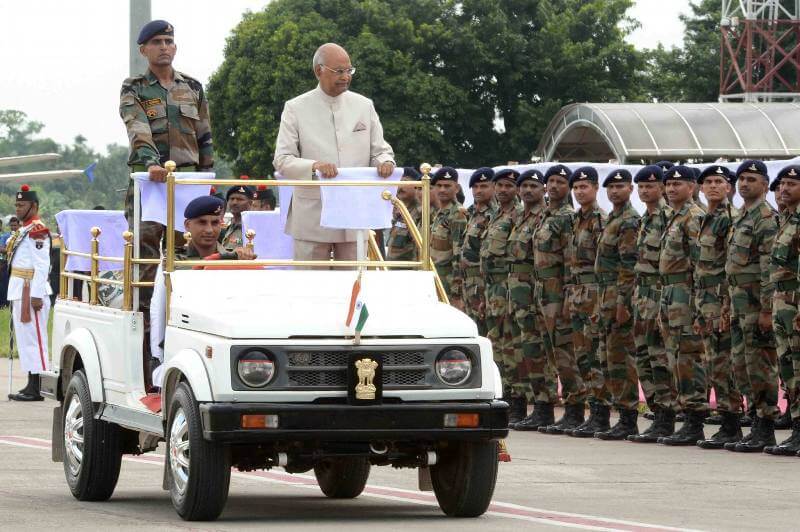
(2) The Military Powers:- The supreme command of the Defense Forces vested in the hand of the President of India, the powers regulated by [ Article 53(2)]. The President may have the powers for declaration of any war or peace or the employment of the Defense Forces.

(3) The Diplomatic Powers:- The task of negotiating treaties and agreements with other countries are subject to ratification by parliament, therefore belong to the President. The President of India represents India in International Affairs and has the powers to appoint Indian representatives for other countries and receiving diplomatic representatives of the other states, acknowledged by the Parliament.

(4) The Legislative Powers:- The Legislative powers of the President, indeed according to Ministerial advice [Article 74(1)] and may discuss in the following heads:

• Summoning, Prorogation, and Dissolution

• The Opening Address

• The right to Address and to send Messages

• Nominations of the members of the Houses

• Laying reports before the Parliament

• Previous sanction to Legislation

• Assent to Legislation and Veto power

• Disallowance of State Legislation

• The Ordinance-making power

(5) Pardoning Power:- The President of India has the power to grant a pardon in case of :

• Punishment by a court-martial.

• Offence against the laws made under the Union and Concurrent Lists.

• Pardoning a sentence of death.

(6) Emergency Powers:- The President of India shall have certain extraordinary powers to deal with emergencies, which deserve a separate treatment. These extraordinary powers of the President arise at the time of:

• “Proclamation of Emergency” on the ground of threat to the security of the Nation or any part thereof by war, external aggression, or armed rebellion.

• Break down of the Constitutional machinery may take place either as a result of a political deadlock or the failure by a state to carry out the directions of the Union [Article 356,365].

• Financial stability or credit of India or any part thereof is threatened [Article 360].