What are Folkways ?

What are social norms ?

Social norms refer to the group shared standards of behaviour .It is a pattern setting limits on individual behaviour .
Norms are said to be ” blueprints ” for behaviour .
They determine , guide , and control human behaviour .
Norms are not systematically classified by Sociologists . But they are grouped into –
” Folkways “, “mores ” , “fashions “, “rites “, “ceremonies “, “customs ” etc. .

What are folkways ?
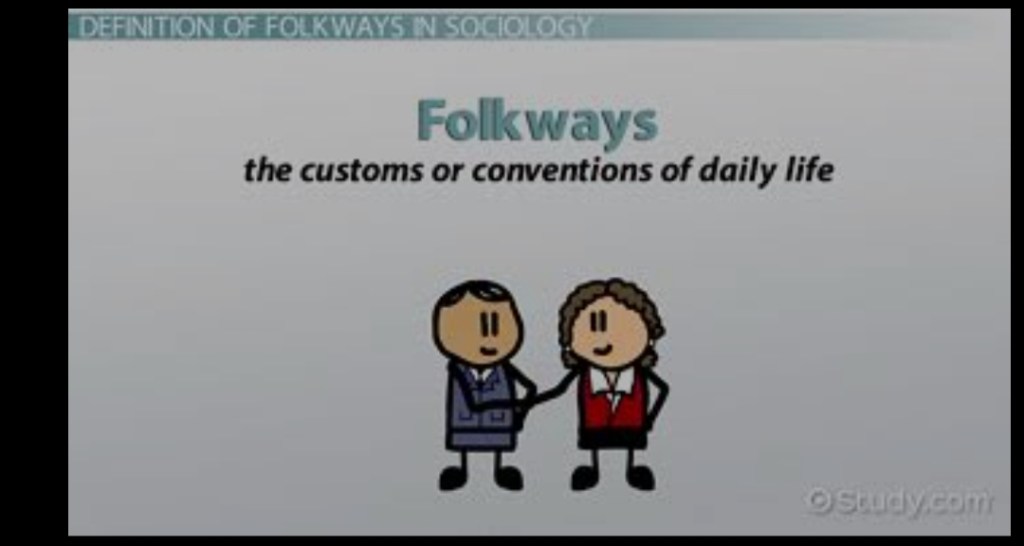
In general , folkways means “ the ways of folk “.
The term ‘folk’ represents people and ‘ways’ represent their behavioural habits .
Folkways are the customary, normal and habitual ways of the group to meet certain needs or solving day-to-day problems.

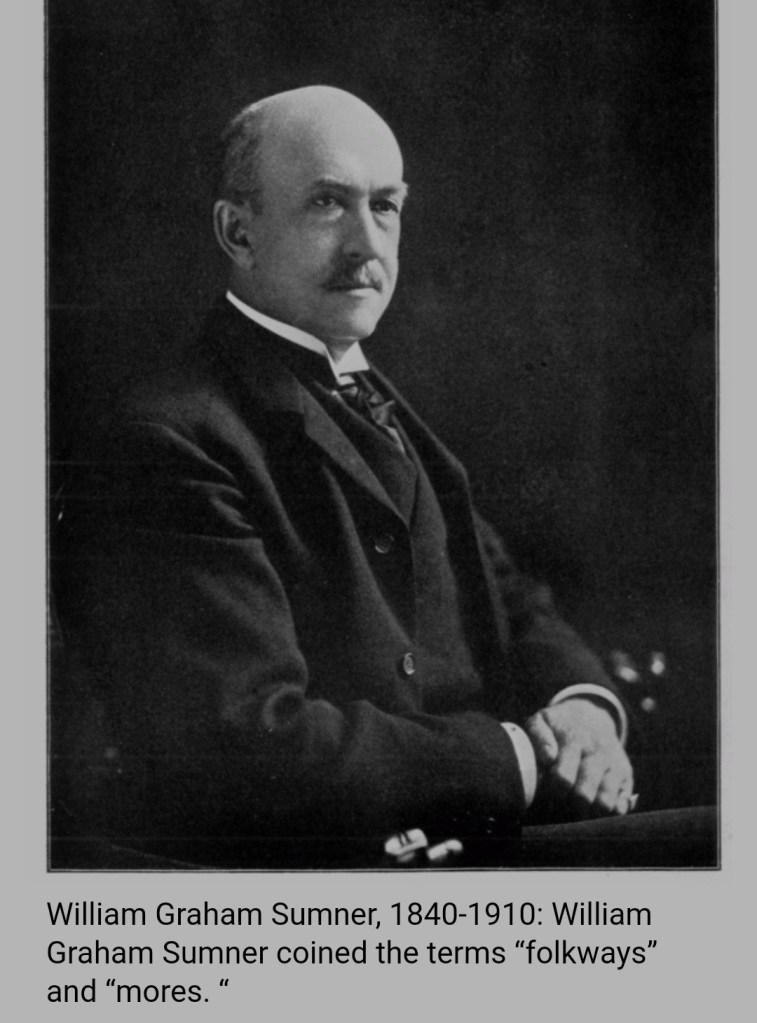
The term folkways was introduced into Sociology literature by W.G .Summer in a book with the title , ” Folkways: A Study of the Sociological Importance of Usages, Manners, Customs, Mores, and Morals ” published in 1906.
Folkways are accepted ways of behaviour.
According to Summer ,
” folkways represent man’s unique means of adapting himself to the environment .

Examples of Folkways :-

The ways of eating , talking , dressing , playing , walking , working , greeting , conversing ,etc. represent folkways .

The daily activities become an individual’s habits ,but folkways are termed as habits of a group though Not all (group) habits become general. They differ from individual to individual and place to place.

Folkways are a learned process of socialisation. They become the second nature of the individual.

Habits are socially approved habits which are followed by a number of persons in a society are referred as folkways,

Habits of exchanging greetings and courtesies like bidding ‘Namaste’ with joined palms is an.examples of Indian folkways .

Walking on right side if the road , taking three meals a day , Wearing different clothes at different occasions, showing respects to elders , love and affection to younger ones ,
Wearing a cap, hat or turban,.shaking hands, eating with forks and knives, driving on the left or right hand side of the street, attending classes in paints and skirts rather than gowns or bathing suits etc..are some folkways followed by difficult individuals.

Definitions :-

Folkways are behavioural patterns of e everyday life which generally arise unconsciously in s group .”
-.Gillin and Gillin

According to Reuter and Hart (1933),
“The folkways are simple habits of action common to the members of the group; they are the ways of the folks that are somewhat standardised and have some degree of traditional sanction for their persistence”.

Maclver and Page (1949) defined it as:
“Folkways are the recognized or accepted ways of behaving in society.”

A.W. Green opines ,
Those ways of acting that are common to a society or a group and that are handed down from one generation to the next are known as folkways .

Lundberg stated ,
“. Folkways are the typical or habitual beliefs , attitudes and styles of conduct observed within a group or community .”

In simple words , folkways are “repetitive petty acts of the people .”
___________________________________________

Characteristics of Folkways

• Social in Nature :- Folkways are the products of man’s group life . They are created by the groups for their sustenance and maintenance . Individuals get social recognition by comforting the folkways .

Repetitive in Character:– A social practice becomes a folkway when the majority of people observe it constantly and regularly . The often repeated practices of the majority normally become the folkways . These practices become standardized practices by constant repetitions .

Unplanned Origin :– The origins of Folkways are very obscure . Summer believed that they arise automatically and unconsciously . They are not the result of any advance planning . Someone in the group starts a new way and in course of time it becomes popular and a good number of people may start following it but by the time it becomes folkways the origin trace fades away.

Informal Enforcement :– Folkways constitute one of the types of informal means of social control . Folkways are not as compulsive and obligatory as that of laws or morals . Conformity to the folkways is neither required by law nor enforced by any special agency of society. They are not absolutely obligatory though they are considered as necessary .

Folkways Differ a Lot :- Folkways Differ from group to group and society to society . They may also undergo changes in course of time within the same group or society .
For example , table meals are common in the West whereas the majority of Indians used to squat on the floor and take their meals with their hands .

Folkways vary with age and sex in almost all places . They even vary according to social status , religion , ethnic groups , racial groups etc .

Folkways are Numerous :- It is not possible for anyone to enlist all the folkways . There are so diverse and numerous folkways . They range from most trivial acts and behaviour patterns to the most serious ones .

Folkways are subject to Change :- Just like everything folkways are also subject to change . Folkways change according to changes in social conditions .
Summer is referred to as ” fashion ” .
Fashion related to dress , hairstyle , architecture designs , etc. undergo rapid changes .
___________________________________________

Social importance of Folkways

The folkways are the foundation of every culture . They give us a better understanding about a particular culture.
When fully assimilated they become personal habits .

Summer believed , ” the life of society consists in making folkways and applying in them . The science of society must be construed as the study of them .

Folkways have become a universal characteristic of human societies. No society does or could exist without them . Hence they constitute an important part of the social structure . They are most powerful and control the behaviour of individuals in society even more than the state action.

They become a part and parcel of the personality of the infant through the process of socialisation. An individual learns different folkways at different stages of socialisation . They become a form of unstated premises of our mental life .

Folkways play a major part in social control in society, as folkways are informal means of social control.

Hence , folkways are not compulsory or obligatory but constitute an important part of social structure as they become personal habits that contribute stability and order in social relations .

Mauryan Empire

Sources

Mauryan Empire – India’s First Empire

Chandragupta Maurya

The Mauryan Empire was the first largest empire in India.Chandragupta Maurya established the empire in Magadha.
Bhadrabahu,a Jain monk,took Chandragupta Maurya to the southern India
Chandragupta performed Sallekhana(Jaina ritulas in which a person fasts unto his death) in Sravanbelgola (Karnataka).

Bindusara

Real name of Bindusara was Simhasena.He was the son of Chandragupta Maurya.Greeks called Bindusara as Amitragatha, meaning`slayer of enemies ′.During Bindusara’s reign Mauryan Empire spread over large parts of India.He appointed his son Ashoka as a governor of Ujjain.After his death , Ashoka ascended the throne of Magadha.

Ashoka

Ashoka was the most famous of the Mauryan kings.He was known as ‘Devanam piya’ meaning’beloved of the gods’.

Ashoka fought the Kalinga war in 261 BC (BCE).He won the war and captured Kalinga.
The horror of war was described by the king himself in the Rock Edict XIII.

Lion capital of Ashoka

The Emblem of the Indian Republic has been adopted from the Lion capital of one of Ashokas pillars located at Sarnath.The wheel from the circular base,the Ashoka chakra is a part of the National Flag.

Chandasoka (Ashoka,the wicked) to Dhammasoka (Ashoka the ringteous)

After the battle of Kalinga,Ashoka became a Buddhist.He undertook tours ( Dharmayatras) to different parts of the country instructing people on policy of Dhamma.The meaning of Dhamma is explained in Ashoka’s – pillar Edict II
It contained the noblest ideas of humanism,forming the essence of all religions.He laid stress on

  • Compassion
  • Charity
  • Purity
  • Saintliness
  • Self-control
  • Truthfulness
  • Obedience and respect for parents, preceptors and elders.

Ashoka sent his son Mahinda and Sanghamitta to Srilanka to propagate Buddhism.He also sent missionaries to west Asia, Egypt and Eastern Europe to spread the message of Dhamma.The Dhamma – mahamattas were a new cadre of officials created by Ashoka.Their job was to spread dhamma all over the empire.Ashoka held the third Buddhist council at his capital Pataliputra.

Edicts of Ashoka

The 33 Edicts on the pillars as well as boulders and cave walls made by the Emperor Ashoka, describe in detail Ashoka’s belief in peace, righteousness, justice and his concern for the welfare of his people.The Rock Edicts II and XIII of Ashoka refer to the names of the three dynasties namely Pandyas,Cholas ,the Keralaputras and the Sathyaputras.

Mauryan Administration

Centralized administration King

  • The king was the supreme and sovereign authority of the Mauryan Empire.
  • Council of ministers known as mantriparishad assisted the King.Assembly of ministers included a Purohit,a senapathi,a Maha mantri and the Yuvaraja.
  • King had an excellent spy system.

Revenue system

  • The land was the most important source of revenue for the state.Ashokan inscription at Lumbini mentions bali and bagha as taxes collected from people.The land tax(bhaga) collected was 1/6 of the total produce.
  • Revenue from taxes on forests,mines,salt and irrigation provided additional revenue to the government.
  • Much of the state revenue was spent on paying the army,the officials of the royal government,on charities and on different public,road construction etc.

Judical system

  • The king was the head of the Judiciary.He was the highest court of appeal.
  • King appointed many judges subordinate to him.The punishments were harsh.

Military Administration

The king was the supreme commander of the army.A board of 30 members divided into six committees with five members on each,monitored

  • Navy
  • Armoury (transport and supply)
  • Infantry
  • Cavalry
  • The war chariots
  • The war elephants

Municipal Administration (cities and Towns)

  • Board of 30 members divided into six committees.Each had 5 members to manage the administration of the city.
  • Town administration was under Nagarika.He was assisted by Sthanika and Gopa.

Currency

Money was not only used for trade; even the government paid its officers in cash.
The punch marked silver coins (panas) which carry the symbols of the peacock,and the hill and crescent copper coins called Mashakas formed the imperial currency.

Trade and Urbanization

Trade flourished particularly with Greece (Hellenic) Malaya, Ceylon and Burma.The Arthashastra refers to the regions producing specialized textiles-kasi (Benares), Vanga(Bengal),Kamarupa (Assam) and Madurai in Tamilnadu

Mauryan coins

Mauryan Art and Architecture

Mauryan Art can be divided into two

Indigenous Art – statues of Yakshas and Yakshis
Royal Art. – palaces and public buildings
– Monolithic pillars
– Rock cut Architecture
– Stupas

Stupas

Sanchi near Bhopal, MP

A stupa is a semi- spherical dome like structure constructed on brick or stone.The Buddha’s relics were placed in the centre of the dome.

Monolithic pillar – Sarnath

The crowning element in this pillar is Dharma Chakra.

Monolithic pillar – Sarnath

Beginning of Rock cut Architecture

Rock – cut caves of Barabar and Nagarjuna Hills.

Lomas Rishi cave, Barabar

There are several caves to the north of Both Gaya.Three caves in Barabar hills have dedicative inscription of Ashoka. and three in Nagarjuna hills have inscriptions of Dasharaths Maurya ( grand son of Ashoka)

Reasons for the Decline of the Mauryan Empire

  • Ashoka’s successors were very weak
  • Continuous revolts in different parts of the empire.
  • Invasion by the Bactrian Greeks weakened the empire.
  • Invasion by the Bactrian Greeks weakened the empire.
  • Last Maurya ruler Brihadratha was killed by his commander Pushyamitra Sungha who established Sungha dynasty.

Mauryan Empire

Sources

Mauryan Empire – India’s First Empire

Chandragupta Maurya

The Mauryan Empire was the first largest empire in India.Chandragupta Maurya established the empire in Magadha.
Bhadrabahu,a Jain monk,took Chandragupta Maurya to the southern India
Chandragupta performed Sallekhana(Jaina ritulas in which a person fasts unto his death) in Sravanbelgola (Karnataka).

Bindusara

Real name of Bindusara was Simhasena.He was the son of Chandragupta Maurya.Greeks called Bindusara as Amitragatha, meaning`slayer of enemies ′.During Bindusara’s reign Mauryan Empire spread over large parts of India.He appointed his son Ashoka as a governor of Ujjain.After his death , Ashoka ascended the throne of Magadha.

Ashoka

Ashoka was the most famous of the Mauryan kings.He was known as ‘Devanam piya’ meaning’beloved of the gods’.

Ashoka fought the Kalinga war in 261 BC (BCE).He won the war and captured Kalinga.
The horror of war was described by the king himself in the Rock Edict XIII.

Lion capital of Ashoka

The Emblem of the Indian Republic has been adopted from the Lion capital of one of Ashokas pillars located at Sarnath.The wheel from the circular base,the Ashoka chakra is a part of the National Flag.

Chandasoka (Ashoka,the wicked) to Dhammasoka (Ashoka the ringteous)

After the battle of Kalinga,Ashoka became a Buddhist.He undertook tours ( Dharmayatras) to different parts of the country instructing people on policy of Dhamma.The meaning of Dhamma is explained in Ashoka’s – pillar Edict II
It contained the noblest ideas of humanism,forming the essence of all religions.He laid stress on

  • Compassion
  • Charity
  • Purity
  • Saintliness
  • Self-control
  • Truthfulness
  • Obedience and respect for parents, preceptors and elders.

Ashoka sent his son Mahinda and Sanghamitta to Srilanka to propagate Buddhism.He also sent missionaries to west Asia, Egypt and Eastern Europe to spread the message of Dhamma.The Dhamma – mahamattas were a new cadre of officials created by Ashoka.Their job was to spread dhamma all over the empire.Ashoka held the third Buddhist council at his capital Pataliputra.

Edicts of Ashoka

The 33 Edicts on the pillars as well as boulders and cave walls made by the Emperor Ashoka, describe in detail Ashoka’s belief in peace, righteousness, justice and his concern for the welfare of his people.The Rock Edicts II and XIII of Ashoka refer to the names of the three dynasties namely Pandyas,Cholas ,the Keralaputras and the Sathyaputras.

Mauryan Administration

Centralized administration King

  • The king was the supreme and sovereign authority of the Mauryan Empire.
  • Council of ministers known as mantriparishad assisted the King.Assembly of ministers included a Purohit,a senapathi,a Maha mantri and the Yuvaraja.
  • King had an excellent spy system.

Revenue system

  • The land was the most important source of revenue for the state.Ashokan inscription at Lumbini mentions bali and bagha as taxes collected from people.The land tax(bhaga) collected was 1/6 of the total produce.
  • Revenue from taxes on forests,mines,salt and irrigation provided additional revenue to the government.
  • Much of the state revenue was spent on paying the army,the officials of the royal government,on charities and on different public,road construction etc.

Judical system

  • The king was the head of the Judiciary.He was the highest court of appeal.
  • King appointed many judges subordinate to him.The punishments were harsh.

Military Administration

The king was the supreme commander of the army.A board of 30 members divided into six committees with five members on each,monitored

  • Navy
  • Armoury (transport and supply)
  • Infantry
  • Cavalry
  • The war chariots
  • The war elephants

Municipal Administration (cities and Towns)

  • Board of 30 members divided into six committees.Each had 5 members to manage the administration of the city.
  • Town administration was under Nagarika.He was assisted by Sthanika and Gopa.

Currency

Money was not only used for trade; even the government paid its officers in cash.
The punch marked silver coins (panas) which carry the symbols of the peacock,and the hill and crescent copper coins called Mashakas formed the imperial currency.

Trade and Urbanization

Trade flourished particularly with Greece (Hellenic) Malaya, Ceylon and Burma.The Arthashastra refers to the regions producing specialized textiles-kasi (Benares), Vanga(Bengal),Kamarupa (Assam) and Madurai in Tamilnadu

Mauryan coins

Mauryan Art and Architecture

Mauryan Art can be divided into two

Indigenous Art – statues of Yakshas and Yakshis
Royal Art. – palaces and public buildings
– Monolithic pillars
– Rock cut Architecture
– Stupas

Stupas

Sanchi near Bhopal, MP

A stupa is a semi- spherical dome like structure constructed on brick or stone.The Buddha’s relics were placed in the centre of the dome.

Monolithic pillar – Sarnath

The crowning element in this pillar is Dharma Chakra.

Monolithic pillar – Sarnath

Beginning of Rock cut Architecture

Rock – cut caves of Barabar and Nagarjuna Hills.

Lomas Rishi cave, Barabar

There are several caves to the north of Both Gaya.Three caves in Barabar hills have dedicative inscription of Ashoka. and three in Nagarjuna hills have inscriptions of Dasharaths Maurya ( grand son of Ashoka)

Reasons for the Decline of the Mauryan Empire

  • Ashoka’s successors were very weak
  • Continuous revolts in different parts of the empire.
  • Invasion by the Bactrian Greeks weakened the empire.
  • Invasion by the Bactrian Greeks weakened the empire.
  • Last Maurya ruler Brihadratha was killed by his commander Pushyamitra Sungha who established Sungha dynasty.

SAVING LIVES OR SAVING THE ECONOMY ?

A strong economy is the source of national strength .

In an economy , the production & consumption of goods & services are used to fulfill the needs of those living & operating within. In short an economy is an area of the production , distribution & trade , as well as consumption of goods & services by agents & these agents are not someone other but are we only. These agents are individuals , businesses , organizations, or government.

Till here we can conclude that people makes up an economy.

Now lets jump on the topic which is saving lives or saving economy . In this situation of pandemic i.e., COVID 19 , lakhs of people have lost their lives , their livelihood , their families . For controlling this situation , which can be controlled only by not coming in contact with an affected person & by maintaining social distancing & self consciousness , government has laid many rules & one such rule is ” lockdown” . Never before we have heard of this word of this word but in past 2 years each one pf us has experienced it . It is a situation where every one is restricted to move out of their houses , factories were shut , many people last their jobs , because of which employment rate decreased , those who have lost their jobs migrated to their villages, All & all we can say that lockdown had the most drastic effect on the economy . lockdown is one among the reason for falling of the economy.

But lockdown was not applied to do so , rather it was meant to protect people , so that we could break the chain of Corona virus . Because of this rule of lockdown , people avoided gathering & because of this lockdown only we are able to defeat & break the chain of COVID 19 . Government took this step though knowing that this will have negative impact on the economy but we all know that it is ‘we’ who makes up an economy , & if we are safe the economy will improve for sure . Because for production you need people , for consumption you need people, for trade you need people , & for distribution you need people. So if people are safe economy is safe .

So this pandemic taught us the importance of lives , we all should thank the all mighty & our health workers for saving many lives & according to me saving lives is more important than saving economy but this doesn’t mean ignoring economy & economic development . Saving lives with holding economy & adopting every measure to save it , will leads to development of both , because both the factors are directly proportional to each other & fall in one will leads to fall in other. Hence saving lives will improve economy because at the end we all know people makes up an economy.

SAVING LIVES OR SAVING THE ECONOMY ?

A strong economy is the source of national strength .

In an economy , the production & consumption of goods & services are used to fulfill the needs of those living & operating within. In short an economy is an area of the production , distribution & trade , as well as consumption of goods & services by agents & these agents are not someone other but are we only. These agents are individuals , businesses , organizations, or government.

Till here we can conclude that people makes up an economy.

Now lets jump on the topic which is saving lives or saving economy . In this situation of pandemic i.e., COVID 19 , lakhs of people have lost their lives , their livelihood , their families . For controlling this situation , which can be controlled only by not coming in contact with an affected person & by maintaining social distancing & self consciousness , government has laid many rules & one such rule is ” lockdown” . Never before we have heard of this word of this word but in past 2 years each one pf us has experienced it . It is a situation where every one is restricted to move out of their houses , factories were shut , many people last their jobs , because of which employment rate decreased , those who have lost their jobs migrated to their villages, All & all we can say that lockdown had the most drastic effect on the economy . lockdown is one among the reason for falling of the economy.

But lockdown was not applied to do so , rather it was meant to protect people , so that we could break the chain of Corona virus . Because of this rule of lockdown , people avoided gathering & because of this lockdown only we are able to defeat & break the chain of COVID 19 . Government took this step though knowing that this will have negative impact on the economy but we all know that it is ‘we’ who makes up an economy , & if we are safe the economy will improve for sure . Because for production you need people , for consumption you need people, for trade you need people , & for distribution you need people. So if people are safe economy is safe .

So this pandemic taught us the importance of lives , we all should thank the all mighty & our health workers for saving many lives & according to me saving lives is more important than saving economy but this doesn’t mean ignoring economy & economic development . Saving lives with holding economy & adopting every measure to save it , will leads to development of both , because both the factors are directly proportional to each other & fall in one will leads to fall in other. Hence saving lives will improve economy because at the end we all know people makes up an economy.

Media Law in India

Communication is considered to be a procedure, which people use to exchange information on a daily basis by various methods which are present and media is known to be the medium or an instrument of communicating or storing information. ‘Media’ is the popular term which is used as ‘Press’ which denotes the electronic and print information carriers – all the newspapers and all the magazines, television and radio and presently it includes the Internet as new form of Media. It is hailed as the “Fourth Pillar” of the democracy, media is considered to be the watchdog of all the public affairs in the country, informing the people, it mainly acts as a forum to advocate the opinions and views of the society as a whole to the people who are at the helm of the public affairs of the country. Media Law is not considered to be a conception which is primarily used to touch upon a uniform or an integrated body of law of crimes or the law of contracts. It is known to be an amalgamation of a variety of media laws and ethics that are regarded as the most crucial for media industry and a working journalist.  Media law is known to envelope a part of law which largely involves media of all types like Movies, Television, publishing, music, advertisements and also the new media which is the internet and etc.  and it covers over many legal fields, including but not only limited to finance, corporate or any intellectual property, privacy and publicity. Media law is considered to be a law field that is referred to the following: broadcasting, advertising contempt, censorship, copyright, confidentiality, defamation, corporate law, freedom of information, entertainment, information technology, privacy, internet and telecommunication. on one hand the media law regulates principles of the media goods and on the other hand is regulates the formatting and the content of all the media goods which might confer as business. It is due to the technology advances and the emerging and present status of the new media content distribution strategies which are present, the broadcasting and media industry sector in the country is growing on a fast space each day. Media is considered to help and initiate a lot for carrying out many emerging and existing businesses and guarantees various business opportunities to individuals. It contributes in publicizing the business ideas and views and also check the smooth functioning of the same. It largely attracts various investors and it tries to find that the same can be maintained or not. The paper is used to mainly deal with the new business opportunities which are present and so provided by the media to many Start up projects or other different investors. Thus, the Media plays a very active role in various corporate affairs and does thereby help in the growing of the many new businesses and makes strong the existing businesses. Thereby it can be concluded that the media laws in India have its relevance in the business opportunities.

The Fault In Our Stars: An unforeseen expedition from novel to screen

_Aditi Raj

This is a romantic novel by John Green which was published on January 10,2012. A love story which was crazily liked by the teens. A story of joy along with devastating loss. It will make you laugh and rejoice and with fill you with gratitude at the same time. Also it will forever change the way you hear the word “okay” and yeah you will cry reading the novel. If you are one of the millions of people who have read the masterpiece ,you know this already. And still if you haven’t read this already prepare yourself-once you start reading this you couldn’t stop yourself until you complete this book, or this film unaltered. okay? okay.

It’s September 2013 on a bright afternoon in Pittsburgh, a city in Pennsylvania, and Shailene Woodley, who plays 16 year old Hazel Grace Lancaster, stands in a simple blue dress the colors of cornflowers and adjusts cannula tubes in her nostrils. Hazel is a jeans-and-tee-shirt girl. No makeup, no fuss. She also has thyroid that has spread to her lungs, so is connected to a portable oxygen tank to breathe. Not too long ago she met a boy named Augustus “Gus” Waters played by Ansel Elgort in a cancer support group. Hazel is forced by her parents to attend a support group where she later falls in love with Augustus Waters. This novel has a beautiful beginning but an unexpected and sad ending where Augustus dies.

Along with an American film adaption which was released on June06,2014 this novel was also released on Hindi feature film adaptation of the film titled” Dil Bechara” which was released on July 24,2020.Both the novel and its American and Indian film adaption were met with strong critical and commercial success.

Media Law in India

Communication is considered to be a procedure, which people use to exchange information on a daily basis by various methods which are present and media is known to be the medium or an instrument of communicating or storing information. ‘Media’ is the popular term which is used as ‘Press’ which denotes the electronic and print information carriers – all the newspapers and all the magazines, television and radio and presently it includes the Internet as new form of Media. It is hailed as the “Fourth Pillar” of the democracy, media is considered to be the watchdog of all the public affairs in the country, informing the people, it mainly acts as a forum to advocate the opinions and views of the society as a whole to the people who are at the helm of the public affairs of the country. Media Law is not considered to be a conception which is primarily used to touch upon a uniform or an integrated body of law of crimes or the law of contracts. It is known to be an amalgamation of a variety of media laws and ethics that are regarded as the most crucial for media industry and a working journalist.  Media law is known to envelope a part of law which largely involves media of all types like Movies, Television, publishing, music, advertisements and also the new media which is the internet and etc.  and it covers over many legal fields, including but not only limited to finance, corporate or any intellectual property, privacy and publicity. Media law is considered to be a law field that is referred to the following: broadcasting, advertising contempt, censorship, copyright, confidentiality, defamation, corporate law, freedom of information, entertainment, information technology, privacy, internet and telecommunication. on one hand the media law regulates principles of the media goods and on the other hand is regulates the formatting and the content of all the media goods which might confer as business. It is due to the technology advances and the emerging and present status of the new media content distribution strategies which are present, the broadcasting and media industry sector in the country is growing on a fast space each day. Media is considered to help and initiate a lot for carrying out many emerging and existing businesses and guarantees various business opportunities to individuals. It contributes in publicizing the business ideas and views and also check the smooth functioning of the same. It largely attracts various investors and it tries to find that the same can be maintained or not. The paper is used to mainly deal with the new business opportunities which are present and so provided by the media to many Start up projects or other different investors. Thus, the Media plays a very active role in various corporate affairs and does thereby help in the growing of the many new businesses and makes strong the existing businesses. Thereby it can be concluded that the media laws in India have its relevance in the business opportunities.

The Fault In Our Stars: An unforeseen expedition from novel to screen

_Aditi Raj

This is a romantic novel by John Green which was published on January 10,2012. A love story which was crazily liked by the teens. A story of joy along with devastating loss. It will make you laugh and rejoice and with fill you with gratitude at the same time. Also it will forever change the way you hear the word “okay” and yeah you will cry reading the novel. If you are one of the millions of people who have read the masterpiece ,you know this already. And still if you haven’t read this already prepare yourself-once you start reading this you couldn’t stop yourself until you complete this book, or this film unaltered. okay? okay.

It’s September 2013 on a bright afternoon in Pittsburgh, a city in Pennsylvania, and Shailene Woodley, who plays 16 year old Hazel Grace Lancaster, stands in a simple blue dress the colors of cornflowers and adjusts cannula tubes in her nostrils. Hazel is a jeans-and-tee-shirt girl. No makeup, no fuss. She also has thyroid that has spread to her lungs, so is connected to a portable oxygen tank to breathe. Not too long ago she met a boy named Augustus “Gus” Waters played by Ansel Elgort in a cancer support group. Hazel is forced by her parents to attend a support group where she later falls in love with Augustus Waters. This novel has a beautiful beginning but an unexpected and sad ending where Augustus dies.

Along with an American film adaption which was released on June06,2014 this novel was also released on Hindi feature film adaptation of the film titled” Dil Bechara” which was released on July 24,2020.Both the novel and its American and Indian film adaption were met with strong critical and commercial success.

CIVIL SERVICES EXAMINATION

Nowadays, exams become the thing that brings us fear, anxiety, etc., Especially during this pandemic all our academic and studies has been changed from live classes to online classes. For some online classes can be a flex but not for all. Speaking of exams, we all know about competitive exams which has been conducted all over the world to students to get into some point and also it is set as an start for their higher studies and career. Exams like Civil services examination, Indian Economic Services examination, GATE etc.

WHAT IS CIVIL SERVICES EXAMINATION? :

Civil services examination is one among the top most competitive examinations conducted by Union Public Service Commission for recruitment to various civil services for the Government of India. There are around 24 services which come under civil service categories such as IAS, IPS, IFS, IRS etc.

NAME OF THE RECRUITING BODY:

Union Public Service Commission (UPSC)

TYPES OF SERVICES:

IAS, IPS, IFS and more than 20 services with 712 vacancies which also include 22 vacancies for benchmark disablility persons

CANDIDATES ELIGIBLITY:

The person who is taking up the exam should be 21 to 32 years old.

EDUCATION:

A degree holder (recognized by UGC/AICTE) of any major is a eligible person to take up the exam.

AGE LIMIT AND NO. OF ATTEMPTS:

The total no of attempts and age limit of exam are based on community which differ from one to one.

PROCESS OF EXAMINATION:

The eligible persons first level exam will be Preliminary exam with two papers total of 400 marks. The qualified person can move on to next level which is main exams with 9 papers total of 1750 marks. The last level will be the interview (oral) for 275 marks.

HOW TO PURSUE:

To pursue civil service and Defence service as a carrer the individual should deserve some reputation or achievement because civil service and defence service does not merely offer them another job for earning livelihood, it provides a great opportunity to realize their potentials. The person should enjoy every assignment, activity to really purse his/her job. They should have the satisfaction of serving the country, and eventually lead the country.

HOW A EXAM CAN FULFILL THE DREAMS OF SEVERAL GENERATIONS? :

In the recent years Civl services and other services have fulfilled dreams among several generations in India. Civil services have attracted a wider pool of talents. A large number of professionals led by Engineers, IT and Management professionals, doctors, lawyers and other meritorious students who could have got lucrative jobs with the corporate sector have started appearing in the civil service exams. The main reason of their attraction is the balanced combination of class, status and power. It is well known that all the civil services Examination through its various stages, tests a canfldidate’s suitability to top rank position of Indian bureaucracy.

REAL AIM OF AN CIVIL SERVICES EXAMINATION:

The exams aim is not only to provide them job by testing his/her subject knowledge but also his understanding and interpretation. The preparation of the exam entails much more than the academic grasp of the subject. An ideal candidate beside acquiring depth knowledge of the subject but also have to work upon building his logical reasoning. They should alsna work upon problem solving and writing skills along with developing cheerful and optimistic outlook towards life.

All these are secondary, first the person should be confident about themselve. They have to face more struggles than they could think about. The fear of rejection can make you to not to try. So first face that fear then face the problems.

CIVIL SERVICES EXAMINATION

Nowadays, exams become the thing that brings us fear, anxiety, etc., Especially during this pandemic all our academic and studies has been changed from live classes to online classes. For some online classes can be a flex but not for all. Speaking of exams, we all know about competitive exams which has been conducted all over the world to students to get into some point and also it is set as an start for their higher studies and career. Exams like Civil services examination, Indian Economic Services examination, GATE etc.

WHAT IS CIVIL SERVICES EXAMINATION? :

Civil services examination is one among the top most competitive examinations conducted by Union Public Service Commission for recruitment to various civil services for the Government of India. There are around 24 services which come under civil service categories such as IAS, IPS, IFS, IRS etc.

NAME OF THE RECRUITING BODY:

Union Public Service Commission (UPSC)

TYPES OF SERVICES:

IAS, IPS, IFS and more than 20 services with 712 vacancies which also include 22 vacancies for benchmark disablility persons

CANDIDATES ELIGIBLITY:

The person who is taking up the exam should be 21 to 32 years old.

EDUCATION:

A degree holder (recognized by UGC/AICTE) of any major is a eligible person to take up the exam.

AGE LIMIT AND NO. OF ATTEMPTS:

The total no of attempts and age limit of exam are based on community which differ from one to one.

PROCESS OF EXAMINATION:

The eligible persons first level exam will be Preliminary exam with two papers total of 400 marks. The qualified person can move on to next level which is main exams with 9 papers total of 1750 marks. The last level will be the interview (oral) for 275 marks.

HOW TO PURSUE:

To pursue civil service and Defence service as a carrer the individual should deserve some reputation or achievement because civil service and defence service does not merely offer them another job for earning livelihood, it provides a great opportunity to realize their potentials. The person should enjoy every assignment, activity to really purse his/her job. They should have the satisfaction of serving the country, and eventually lead the country.

HOW A EXAM CAN FULFILL THE DREAMS OF SEVERAL GENERATIONS? :

In the recent years Civl services and other services have fulfilled dreams among several generations in India. Civil services have attracted a wider pool of talents. A large number of professionals led by Engineers, IT and Management professionals, doctors, lawyers and other meritorious students who could have got lucrative jobs with the corporate sector have started appearing in the civil service exams. The main reason of their attraction is the balanced combination of class, status and power. It is well known that all the civil services Examination through its various stages, tests a canfldidate’s suitability to top rank position of Indian bureaucracy.

REAL AIM OF AN CIVIL SERVICES EXAMINATION:

The exams aim is not only to provide them job by testing his/her subject knowledge but also his understanding and interpretation. The preparation of the exam entails much more than the academic grasp of the subject. An ideal candidate beside acquiring depth knowledge of the subject but also have to work upon building his logical reasoning. They should alsna work upon problem solving and writing skills along with developing cheerful and optimistic outlook towards life.

All these are secondary, first the person should be confident about themselve. They have to face more struggles than they could think about. The fear of rejection can make you to not to try. So first face that fear then face the problems.

DIGITAL Marketing

Digital marketing as the words means to use digital media to market their products.In this pandemic digital marketing grow very fast as people have only oftion to explore anything in just one click.Now digital marketing is very big from pen to car everything we buy digitally lost of shopping site provides Products at very low cost and at home .

Not only in shopping but in education digital marketing now a very big industry . everyone is now online every student doing their online class .we can easily search any topic and read . There are lot of new industries come up to provide different platforms to explore but the challenge is for the right information of the right products to reach the right customer. This is where digital marketing comes in.

Through data mining, it is easy for marketers to target the right audience with the right advertisement of products that they might need. This is what makes digital marketing successful more than anything. Finding and targeting the right audience can increase sales drastically. Some tools can be used to analyze and suggest better options for marketing as well. This helps sellers market their products.

Photo by Pixabay on Pexels.com

We must use this opportunity to develop our skill and knowledge and ready for the future because everything is going to be online.BE THE PART OF CHANGE&MAKE THE CHNGE .

Photo by Canva Studio on Pexels.com

In today’s era, everything has gone online. Internet has made our lives better and through this we can enjoy many facilities only through phone or laptop.We can do many things like online shopping, ticket booking, recharges, bill payments, online transactions (online shopping, ticket booking, recharge, bill payment, online transactions) etc. through internet. Due to this trend of users towards Internet, businesses are adopting Digital Marketing.If we look at market stats, about 80% of shoppers do online research before buying any product or before taking service. In such a situation, digital marketing becomes important for any company or business.

What does digital marketing?

Digital marketing is the response to marketing your goods and services through digital means. Digital marketing is done through the Internet. We can connect to it through internet, computer, mobile phone, laptop, website advertisements or any other applications.The first few attempts were made in the 1980s to establish a digital market but this was not possible. Its name and usage started in the late 1990s.

Digital marketing is a simple way to reach new customers. It carries out marketing activities. It can also be called online marketing. Digital marketing is marketing to reach more people in less time. It is a technological developing area.Digital marketing allows the producer to reach his customer as well as keep an eye on their activities, their needs. Where the customer is trending, what the customer is looking for, all these can be discussed through digital marketing. Simply put, digital marketing is a means of reaching customers through digital technology.

Future of Digital Marketing

Change is the law of life, you all know this. How much has changed in the first time and in today’s life and today is the age of the Internet. People of all varnas are connected to the Internet today, due to all this it is easy to collect all the people in one place, which was not possible in the first time. Through internet, we can also establish the connection of all businessmen and customers.

The demand for digital marketing is being seen very strongly in the present times. The merchant who is making his goods is easily passing on to the customer. This is giving a boost to digital business.

Earlier, had to resort to advertisements. The customer looked at him, then liked, then he bought it. But now goods can be sent directly to the consumer. Every person is using Google, Facebook, YouTube, etc., through which the trader shows his product to the customer. This trade is within the reach of all – traders and consumers too.

Every person gets every use thing without any hard work. The businessman does not even have to think of resorting to newspapers, posters, or advertisements. In view of the convenience of all, there is demand for it. People’s trust is also moving towards the digital market. This is a matter of joy for a businessman. The saying goes, “What you see is what sells” – the digital market is a good example of this.

The Rise of Digital Marketing in the Modern Era

Digital marketing, as the term implies, involves using digital media to promote products and services. The COVID-19 pandemic has significantly accelerated the growth of digital marketing, as people turned to online platforms for their needs. Today, digital marketing spans a vast range of products, from everyday items like pens to large purchases like cars. Numerous shopping websites offer products at competitive prices, delivering them right to customers’ doorsteps.

Digital Marketing in Education

Digital marketing isn’t limited to shopping; it’s also revolutionizing education. With the shift to online learning, students attend classes and access educational materials digitally. Numerous platforms have emerged to meet this demand, although the challenge remains to ensure the right information reaches the right audience. This is where digital marketing shines.

The Power of Data in Digital Marketing

Through data mining, marketers can effectively target the right audience with relevant advertisements. This precision in targeting not only boosts sales but also enhances the overall efficiency of marketing campaigns. Various tools help analyze and optimize marketing strategies, making it easier for sellers to connect with potential customers.

Embracing the Digital Future

As we move towards an increasingly online world, it’s essential to develop digital skills and knowledge. The internet has transformed our lives, enabling us to shop, book tickets, pay bills, and perform numerous other tasks with just a phone or laptop. With around 80% of shoppers conducting online research before making a purchase, digital marketing has become crucial for businesses.

Understanding Digital Marketing

Digital marketing involves promoting goods and services through digital channels. This includes the internet, computers, mobile phones, websites, and various applications. Although attempts to establish digital marketing began in the 1980s, it truly gained momentum in the late 1990s.

Digital marketing allows businesses to reach new customers quickly and efficiently. It provides insights into customer behaviors and trends, helping marketers tailor their strategies accordingly. In essence, digital marketing leverages digital technology to connect with customers.

The Future of Digital Marketing

Change is inevitable, and the internet age has brought significant transformations. The widespread use of the internet makes it easier to connect businesses with their customers. The demand for digital marketing is growing, as it enables merchants to directly reach consumers. Platforms like Google, Facebook, and YouTube have become vital tools for showcasing products.

Digital marketing has made shopping convenient for consumers and streamlined advertising for businesses. The shift from traditional advertising methods to digital platforms has fostered trust and convenience, benefiting both traders and consumers. The adage “What you see is what sells” aptly describes the impact of digital marketing.

Conclusion

Digital marketing is an ever-evolving field that plays a crucial role in today’s interconnected world. As everything moves online, embracing digital marketing strategies is essential for businesses to thrive. By harnessing the power of data and digital tools, companies can effectively reach and engage their target audiences, driving growth and innovation in the digital age. Be part of the change and make a difference in this dynamic landscape.

Memories – The unforgettable demons

Memories are reminders of what you have lost. They remind you of a good time in a bad way. They are out there challenging you to face them, to remember them and to be devastated by them. They hurt you sometimes and sometimes they don’t. You can’t control them. Nobody can. They break your heart, they hurt you in a way nobody does and probably nobody can and you don’t even know it. They remind you of what you can’t have anymore. They make you suffer. They remind you of what happened. Or they silently accuse you of what you did to lose it all. They cover you in so much guilt that you can never get out of it. They hurt you in more ways than you can imagine. They attract you with the hope of remembering everything in a beautiful way. Instead they set you up for hurt, for betrayal, for lies. Lies you didn’t know were not true. And you fall into their trap, thinking there is still hope for something good.

Photo by KoolShooters on Pexels.com

They make you addicted to them in such a way that you can’t stay away from them ever. They bind you with such a strong rope of expectations that maybe someday you can have it all back, even if it is all in your head. For a long time or maybe forever, they haunt you, they never leave your back, never let you go off them. You are forever bound to them whether you know it or not, whether you like it or not. You always come looking back for them, for more good times, for happy moments, even if you suffer even more. They make you believe that maybe you can live with the idea of what could have happened.

Memories are the unforgettable demons living in our minds. They don’t go away. They eat you alive and let your mind rot. They are like the uninvited guest in your house. They live rent free in your mind and create chaos to remind you of everything. They clog your mind with the thoughts of the past and that hinders your thinking for the future. They don’t let you live in the moment, in the present. Memories force you to regret your bad deeds when all you want is to let them go. When you try to move on from something, memories come back rushing and fill your mind. Don’t let them overpower you. Don’t let them control your thoughts. Control yourself from walking straight into their trap hole. They will suck you right into the past and will hold on to you for eternity. You don’t hold onto memories instead the memories hold onto you. You want to let go but they have such a strong hold on you that you can’t find the strength to run away from them.

They will always and forever be with you no matter what. But this is not in a good way. They will never let you out of that hole you fell in. Sometimes they will not let you live in the present or think about your future, without having to deal with your past. Just don’t let them ruin you. Try to take control of yourself as much as you can.

TEA CONNOISSEUR

Tea is not a word but an emotion for Indians. Be it masala chai, black tea, green tea or even kashmiri kahwa. A hot cup of tea suit’s every season and emotion. Happy? It will add up to your mood. Anxious? It will calm you down. Sleepy? It will keep you awake. Insomnia? It will help you relax and sleep.
So now you might be wondering, how does one tea provide so many services where most of them contradict one another?

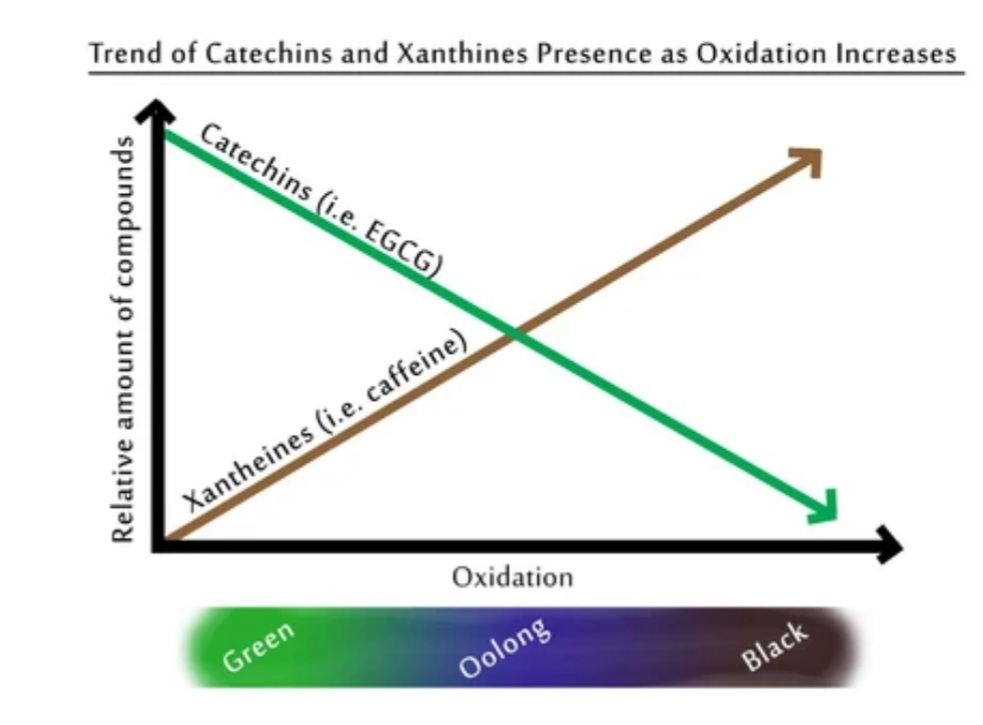
To answer that, the quality and benefits of the tea depends on its Level of Oxidation. The four major types of tea i.e. WHITE TEA, GREEN TEA, OOLONG TEA and BLACK TEA, comes from the same plant called Camellia sinensis. However, they are differentiated by the level of oxidation they undergo. This adds to its level of flavour, aroma and health properties.

The two major compounds in tea are Catechins and Xantheines. Catechins is present in the form of ECGC which are naturally occurring antioxidants that reduces the oxidative cellular damage in the body and Xantheines in the form of caffeine that provides a gentle energy boost without the harmful side-effects of coffee. The presence of these compounds depends on the oxidisation of the tea leaves. Higher oxidisation leads to more of Xantheine and less of Catechins, where’s lower oxidized leaves contain higher Catechines and less Xantheine.

White Tea is most delicate of all the tea’s as it’s uncured and unfermented. Famous for it’s floral, fruity and naturally sweet flavour, it contains the highest amount of antioxidants as is least oxidized (So it has most of it’s natural Catechins). Hence, it possesses major health benefits because of the absence of caffeine. It’s known for its anti-aging and most potent anti-cancer properties.


Green Tea is the most famous health tea for the past few decades. It is darker compared to White tea as it is slightly more oxidized, however it contains high number of antioxidants that is beneficial for promoting good metabolism and weight-loss. Some of the numerous health benefits of green tea include growth of bladder, stomach, pancreas, lungs; reduced risks of neurological disease like Alzheimer’s; lower blood pressure; prevent cancer; lowers cholesterol levels; prevents tooth decay and many more.


Oolong Tea comes after green tea in terms of its antioxidant content as it’s more oxidized compared to the latter. Its properties depend upon the level of oxidation which is mostly between 30% -70%. It is aromatic and highly fragrant. It is known to lower bad cholesterol levels (LDL) and increase the production of good cholesterol (HDL). It has higher amount of caffeine hence it is known to increase mental alertness and increases concentration


Black Tea is rich, hearty and bold. It’s over 80 % oxidized and hence contain highest levels of caffeine compared to all the others. Hence, this makes it best for an instant energy boost. It is known to protect the skin against excess UV radiation exposure, boost immunity, protect lungs, improve heart health and lower the risk of kidney stones.


Hence, who wouldn’t want to enjoy a hot cup of tea on a pleasant evening (Specially, if it’s good for your health as well as taste buds).