THE HIMALAYAN RIVERS; PART 2

The river Indus as said about the Ganga is a transboundary river that flows Ladakh and Kashmir northwards, passes leftwards towards Nanga Parbat Massif, and  Pakistan southwards and ends its journey in the Arabian sea by Karachi. The Indus is termed to be one among the world’s largest rivers in average annual flow, with an estimate of 243 cubic km, which is twice and thrice of the river Nile and the Tigris with the Euphrates combined respectively. The Indus originates from the Tibetan plateau near Lake Manasarovar and enters India in Ladakh. It cuts through the Himalayas in a deep gorge near Nanga Parbat to enter Pakistan. It has five main tributaries – the Sutlej, the Beas, the Ravi, the Chenab and the Jhelum. These rivers give Punjab its name, for the word ‘Punjab’ means ‘five rivers’. This Himalayan river is both snow-fed and rainfed, and therefore flow continuously throughout the year. The river Indus, also known as the Sindhu river, flows for 2897 km, mostly through Pakistan. Since the river moves slowly across the plain, it deposits accumulated silt on its bed. The river bed is thus higher than the sandy plain. When the river is in flood, this results in much destruction. The Indus finally branches into distributaries that join the sea at Karachi. The very river is also famous for the Indus river dolphin, a freshwater dolphin, and one of the world’s rarest mammals. It is, also the second most endangered freshwater river dolphin.
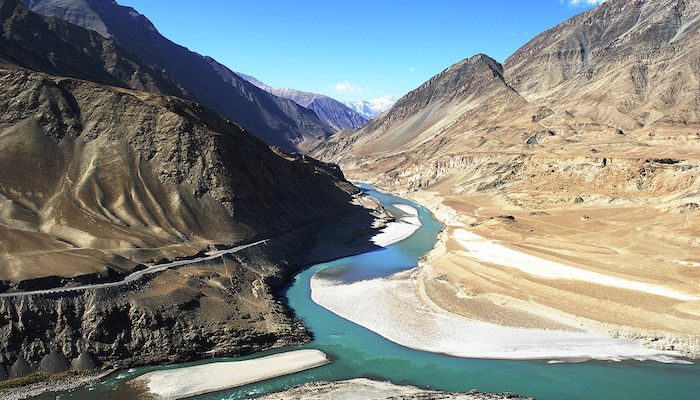
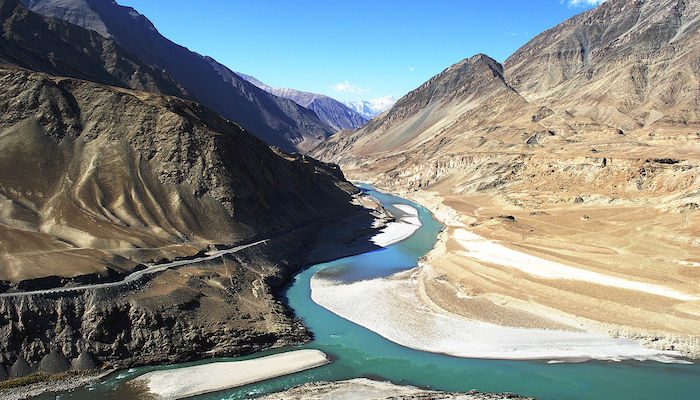
Regions through which the Indus flows

The Indus rises in southern Tibet at a height of about 5500 metres. It flows through a high plateau, then the ground falls away, and the river drops rapidly, and gathers momentum. It rushes northwest and collects the waters from innumerable glacier-fed streams. It flows between the greatest mountain ranges, the Karakoram and the Himalayas. generally, the river becomes slower and has a wider channel as it approaches its delta on the Arabian sea. Agriculture in Pakistan wouldn’t be even possible without this river. In addition, it supplies essential ingredients for human life for many urban areas. These include the Pakistani cities of Islamabad, Lahore, Peshawar and Karachi. Therefore the Sindhu is Pakistan’s longest river with a total length of 3180 km.

The Chenab

The Chenab rises in the upper Himalayas, in the district of Himachal Pradesh in India. Its waters begin from snowmelt from the Bara Lacha Pass. During the Vedic period, it was known as Chandra Bhaga, and it begins at the confluence of two rivers, the Chandra and the Bhaga in Himachal Pradesh. It flows through the Jammu, into the plains of Pakistan. It is first joined by the Jhelum, and then by the Ravi rivers. Later, it meets Sutlej, which has earlier been joined by the Beas. Altogether, these form the so-called ‘five rivers of Punjab’. After, 960 km, it flows into the Indus. The river is dear to the people of Punjab. Moreover, it forms an important part of the land’s history and culture. 

Fact: The world’s highest railway bridge – the Chenab bridge – spans the Chenab. It crosses the river in Jammu and Kashmir.
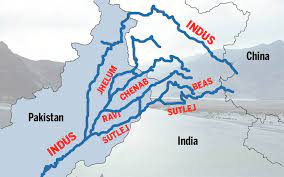
map showing the path of the Indus river

The Jhelum

The Jhelum is the largest, and most western Punjab’s five rivers. It is an ancient river that has been mentioned both by the ancient Greeks as well as ancient Egyptians. It rises from a deep spring, the Verinag Spring in the southeastern part of the valley of Kashmir in India. the river wanders northwards through the valley of Kashmir to the Wular Lake. After emerging from the lake, it continues winding its way through a deep gorge into Punjab. It widens out into an alluvial plain and then goes south to join the Chenab at Trimmu after 813 km. its flow is controlled by snowmelt and the monsoon. In its lower course, the river is famous for its hydroelectric power generation. The Mangla dam and the reservoir on the  Jhelum irrigate around 3 million acres of land.

The Ravi

The Ravi, one of the five rivers that create Punjab, crosses national boundaries. It rises in the majestic Himalayas in the state of Himachal Pradesh in India. It crosses Jammu and Kashmir and then flows into Pakistan. After 725 km, it empties itself into the Chenab. It is fed by glacier melt and is the smallest of all rivers of Punjab. In Vedic times, the Ravi was known as Iravati or Airavati river. It is a trans-border river of India and Pakistan. After partition, the river waters were divided between India and Pakistan. 

Fact: It irrigates a large area in Punjab through a canal. This canal is known as the upper bari doab canal.

The Beas

The river Beas, one of the five rivers of Punjab, is famous in world history. It is one of the rivers that created problem’s in alexander the great’s conquest of India. His troops mutinied here in 326 BC, refusing to go any further, as they had been away from home for eight years. The Beas rises from the Rohtang Pass in the western Himalayas of Himachal Pradesh and flows south through the Kulu valley. It then enters Punjab and flows in a southerly direction. Thereafter, it finally meets the Sutlej after flowing for 470 km. the chief tributaries of the Beas are bain, Banganga, Luni and Uhal. The river was known in ancient India as the Vipasha, while the ancient Greeks called it the Hyphasis. In the 20th century, it was developed for irrigation and hydroelectric power generation.

The Sutlej

The Sutlej, the longest Punjab’s five rivers, has its source in the Rakshastal lake in Tibet. Sometimes called the red river, it is the easternmost of the Indus river’s tributaries. Further next, it rushes through the Himalayan gorges, and crosses Himachal Pradesh, before entering Punjab. It then joins the Chenab and they empty into the Indus. There are many irrigation projects along its 1400 km long course. They include the Bhakra- Nangal project, and the Sirhind canal. In addition, there is also the Sutlej valley project which benefits both India and Pakistan. 

Fact: In the villages of the Sutlej valley you will find descendants of the yak traders of the olden times. These traders were known as Zhang Zhung.

The Indus: the cradle of civilization
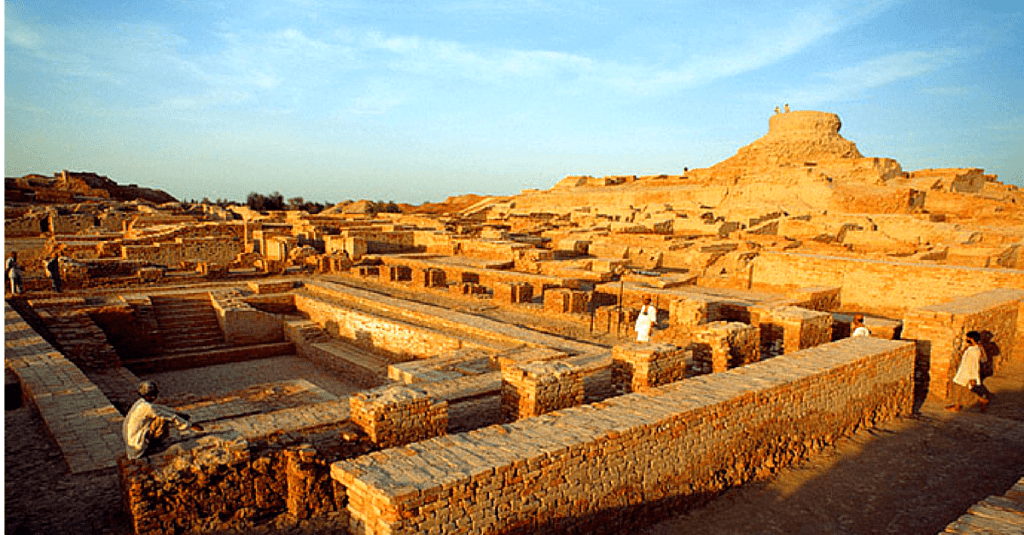
One of the greatest civilizations of ancient times flourished on the banks of the river Indus. Around 3300 BC, there were two great cities in the Indus valley, Harappa and Mohenjo Daro. They were very planned and had houses built with bricks, and even a proper drainage system. The town planning, water supply, sewage and drainage system were of very high quality – there were bathhouses and granaries in plenty, too. These cities prove to the world that the most sophisticated urban civilization of its time flourished in India, more than 5000 years ago! The wonders of engineering and architecture, the richness of the culture, and the quality of the life enjoyed by the people all prove that the valley stood to be the cradle of civilization. 

The river basin covers an area of around one million square kilometres and extends to four countries. They are China, India, Afghanistan and Pakistan. Snow and glacier meltwater is the main source of water for this river system, as rainfall is low in the region. It ends in a delta, which includes numerous mangroves. The Indus basin stretches to the Karakoram and Haramosh ranges in the north, the Arabian Sea in the south, the Sulaiman and Kirthar ranges in the west, the Himalayas in the east. In India, the basin spreads over the states of Jammu and Kashmir, Himachal Pradesh, Punjab Rajasthan, Haryana and the union territory of Chandigarh. 

Indus Water Treaty

India and Pakistan are two of the four countries through which the Indus river flows. The waters of the same and its tributaries support life in vast areas in these two countries. The Indus river system consists of three western tributaries of the Indus and three eastern rivers. The treaty was a result of Pakistani fears that since the sources of the rivers of the Indus basin were in India, India would have total control of the water. So, the world bank drew up a water-sharing treaty called the Indus water treaty. According to this treaty, the Ravi, the Beas and the Sutlej, which constitute the eastern rivers, are allocated for exclusive use by India, before they enter Pakistan. Similarly, Pakistan has exclusive use of the western rivers the Jhelum, the Chenab, and the Indus. The treaty was signed in Karachi on September 19th, 1960.

Major cities in the Indus basin

Industries in the Indus river basin are mainly based on agriculture and allied products. These include the textile, woollen, sugar, oil and paper Industries, as well as Industries manufacturing agricultural equipment. Other Industries in the region are cement, automobiles, machine and machine parts. These Industries have led to the growth of many towns and cities in the river basin. Important urban centres and towns in the basin are Chandigarh, Srinagar, Shimla, Ambala, Bikaner, Bathinda and Patiala. Chandigarh serves as the capital of Punjab and Haryana while Srinagar is the capital of Jammu and Kashmir. Shimla, a beautiful city on the forested hillside of the Himalayas, is the capital of Himachal Pradesh.

Problems faced by Indus rivers

Rapid population growth

As the Indus is one of the longest rivers in Asia, and many civilizations shaped near it, the rapid population growth has a serious hand on the pollution caused. As the number of people around it increases so does the manipulation and excessive use of river water. Thus it could be concluded that the human actions that affect the river pollution counter affect them. 

Increased cultivation rate

As the population increases, so does the need for food. Thus for achieving this the cultivations as a whole should be raised to a certain level covering the need. Added to this the Indus basin highly supports cropping. The exploitation caused by chemical fertilizers and pesticides used had serious effects on the river. The 

Issues related to reservoir

The inefficiency of the reservoir had been in great discussions among authorities over the years. the increased freshwater need has come to a greater problem. Added to the low capacity of reservoirs, is the issue of inefficient management of the same.

Sewage management

The untreated sewage disposal to the rivers had adversely affected their condition for too long. The urban sewage added to the industrial waste is strengthening the damage caused. Proper treatment of the sewage is the only possible way to counterattack this issue.

Excessive industrialization

The Indus is a cradle of civilization, many industries grew near it, making it a great industrial site from time immemorial. So is the industrial waste disposal to the water bodies. The extensive water manipulation on the industrial need and discharge of the harmful by-products to the rivers marks the need for sustainability over the industrial sector. It is said that it is one of the top rivers that end up polluting the oceans.

Regional climate change

The fast-paced climatic changes such as the overheated summers causing glacier melts in a higher level are the representations of unstable weather conditions. This then leads to a decrease in river water flow. Well, it isn’t a new fact that global warming the main enemy. When fossil fuels are burned which then increases the greenhouse effect leading towards glacier melts. The minute changes in water flow can even cause not so smaller but undesirable changes in crop production and the organisms.

Diabetes insipidus

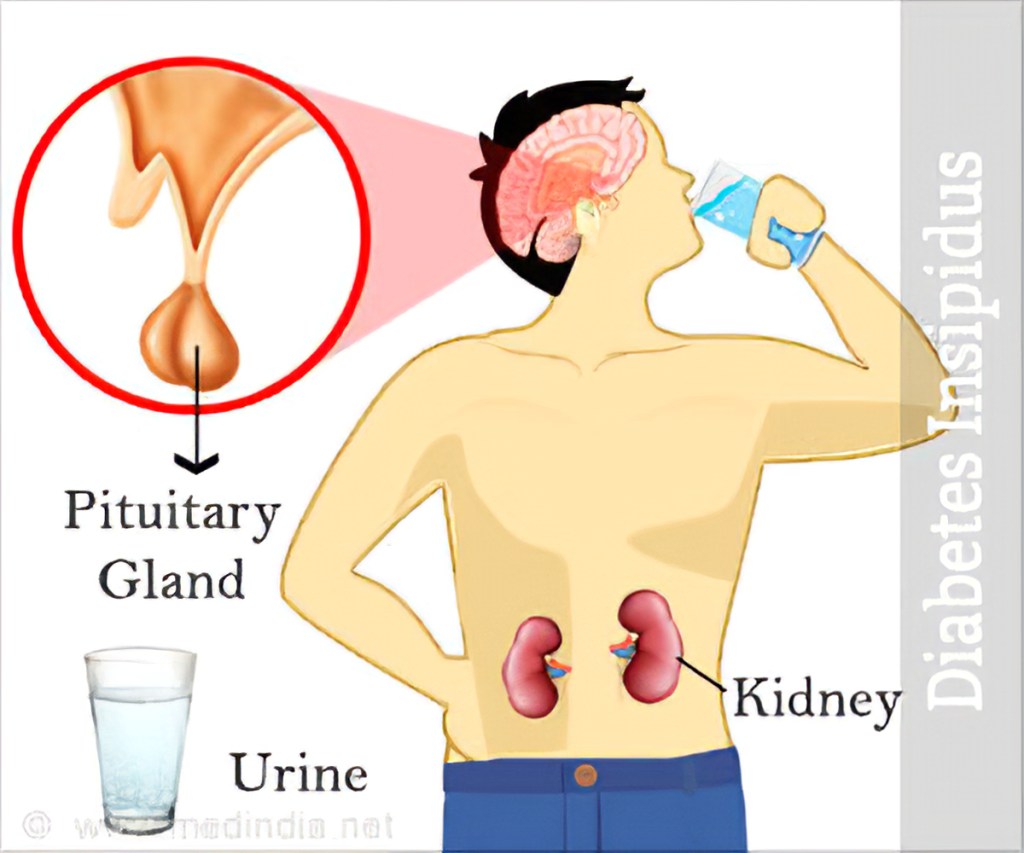
Diabetes insipidus is an uncommon disorder that causes an imbalance of fluids in the body. This imbalance leads to the production of large amount of urine. It also makes the person feel very thirsty even if they have something to drink. While the terms “Diabetes mellitus” and “Diabetes insipidus” sound similar but they are not. Diabetes mellitus- involves high blood sugar levels and can occur as type 1 or type 2 is very common whereas Diabetes insipidus involves excess of urination and is very rare.

WHAT ARE THE CAUSES OF DIABETES INSIPIDUS?

Diabetes insipidus occurs when the body can’t properly balance the body’s fluid levels. The kidneys filter the fluid portion of our blood to remove the waste products. The majority of the fluid is returned to the bloodstream while the waste and a smaller amount of fluid make up urine. Urine is excreted from the body after being temporarily stored in the bladder. A hormone called anti-diuretic hormone(ADH) or vasopressin, is needed for the fluid that’s filtered by the kidneys to go back into the bloodstream. ADH is made in a part of the brain called the hypothalamus and stored in the pituitary gland, a small gland found in the base of the brain. Conditions that cause a deficiency of ADH or block the effect of ADH result in production of excess urine.

TYPES OF DIABETES INSIPIDUS:-

  1. Central Diabetes insipidus– damage to the pituitary gland or hypothalamus from surgery, a tumor, head injury or illness can cause central diabetes insipidus by affecting the usual production, storage and release of ADH. An inherited genetic disease also can cause this condition.
  2. Nephrogenic Diabetes insipidus– occurs when there’s a defect in the structures of the kidneys that make them unable to properly respond to ADH. The defect may be due to an inherited(genetic) disorder or a chronic kidney disorder. Certain drugs such as lithium or antiviral medications such as foscarnet (Foscavir) also can cause nephrogenic diabetes insipidus.
  3. Gestational Diabetes insipidus– is a rare condition. It occurs only during pregnancy when an enzyme made by the placenta destroys ADH in the mother.
  4. Primary Polydipsia– also known as dipsogenic diabetes insipidus, this condition can cause production of large amounts of diluted urine from drinking excessive amounts of fluids.

SYMPTOMS:-

  • Being extremely thirsty.
  • producing large amounts of pale urine.
  • frequently needing to get up to urinate during the night.
  • trouble sleeping
  • fever
  • vomiting
  • delayed growth and weight loss.
  • electrolyte imbalance- can cause an imbalance in minerals in our body such as sodium, potassium that maintain the fluid balance in our body and can lead to weakness, nausea, loss of appetite, muscle cramps etc.

TREATMENT:-

  • For mild diabetes insipidus, we only need to increase our water intake.
  • if the condition is caused by an abnormality in the pituitary gland or hypothalamus(such as a tumor) then the doctor first treats the abnormality with a synthetic hormone called desmopressin that replaces the anti-diuretic hormone(ADH) and decreases urination.
  • available as a nasal spray, a tablet or by injection.

What is Web Hosting? And its Types

Web hosting is an online service that enables you to publish your website or web application on the Internet. When you sign up for a web hosting service, you basically rent some space on a physical server where you can store all the files and data necessary for your website to work properly.

A server is a physical computer that runs without any interruption so that your website is available all the time for anyone who wants to see it. Your web host is responsible for keeping that server up and running, protecting it from malicious attacks, and transferring your content — such as text, images, files, etc. — from the server to your visitors’ browsers.

Types of Web Hosting Packages

  1. Shared Hosting

This type of hosting is the most common answer for most web hosting needs and it’s an excellent solution for most small businesses and personal blogs. With this type of hosting, you’re sharing one server with other clients. Websites hosted on the same server share all its resources, such as memory, computing power, disk space, and others.

  • Pros :
  • Low cost, excellent for small online business websites
  • No need for specific technical knowledge
  • Pre-configured server options
  • User-friendly control panel — hPanel
  • Maintenance and server administration is taken cared for you
  • Cons :
  • Little or no control over server configuration
  • Traffic surges on other websites can slow down your website

2. VPS Hosting

When you’re using a Virtual Private Server — or VPS for short — you’re still sharing a server with other users. However, your web host allocates an entirely separate partition for you on that server. This means you get a dedicated server space and a reserved amount of resources and memory. In fact, VPS hosting can be great for medium-sized businesses with a rapidly growing number of websites and traffic.

  • Pros :
  • Dedicated server space
  • Traffic surges on other websites have no effect on your performance
  • Root access to the server
  • Easy scalability and high customizability
  • Cons :
  • More expensive than other types of hosting
  • Technical and server management knowledge is a must

3. Cloud Hosting

Cloud hosting is currently the most reliable solution on the market. With cloud hosting, your host provides you with a cluster of servers — your files and resources are replicated on each server. When one of the cloud servers is busy or encounters a problem, your traffic is automatically routed to another server in the cluster. This results in little to no downtime, which is excellent if you own a very busy website.

  • Pros :
  • Little to no downtime
  • Server failures have no effect on your website
  • Allocates resources on demand
  • Pay-as-you-pricing strategy — you only pay for what you use
  • More scalable than other web hosting types
  • Cons :
  • Hard to estimate the actual costs
  • Root access is not always provided.

4. WordPress Hosting

WordPress hosting is a particular form of shared hosting, created for WordPress site owners. Your server is configured specifically for WordPress and your site comes with pre-installed plugins for crucial tasks, such as caching and security.

  • Pros :
  • Low cost and beginner-friendly
  • One-click WordPress installation
  • Good performance for WordPress sites
  • Customer support team trained in WordPress issues
  • Pre-installed WordPress plugins and themes
  • Cons :
  • Recommended only for WordPress sites, which can be a problem if you want to host more than one website on your server

5. Dedicated Hosting

Dedicated hosting means that you have your own physical server that’s dedicated solely to your website. Therefore, you’re given incredible flexibility over how you want to manage your website. You can configure your server as you wish, choose the operating system and software you want to use, and set up the whole hosting environment according to your own needs.

  • Pros :
  • Full control over server configuration
  • High reliability and security options
  • Root access to your server
  • Cons :
  • High cost, more oriented towards larger businesses
  • Technical and server management knowledge is a must

Top 3 tourist places in INDIA

1.TAJMAHAL

Tajmahal is also treated as memorial of love .It was located in AGRA. It is also one of the seven wonders of the world.It was built by shah Jahan for his wife mumtaz. Therefore this wonder is also known as mumtaz Mahal. This most beautiful of mausoleums was begun upon her death in 1631 and took 20,000 working men until 1648 to complete .this implies it took over 17 years to build this beautiful moment

Incorporating many elements of ismalic design including arches,minarets, an onion shaped doom, and black calligraphy inlaid around the entrance, the tajmahal is largely constructed of white marble decorated with delicate inlaid floral patterns and precious and semi precious stones such as jade,lapis lazuli,diamonds and mother of pearl

The best time to visit is either at dawn or at dusk when the atmosphere is brilliantly altered by the change in lighting .If possible try to catch a view of tajmahal’s reflection far from the bank of the yamuna River it makes for a memorable selfie

2.THE HOLY CITY OF VARANASI

A major pilgrimage centre for Hindus, holy city of varanasi has long been associated with the mighty ganges. River,one of the faithes most important religious symbols. Dating back to 8th century’s BC ,varanasi is one of the most oldest still inhabited cities in the world

It offers many reasons to visit mnot least of them the chance to explore the old Quarter adjacent to the ganges where you will find kashi Vishwanath temple, built in 1780

Bathing in ganges is of great importance to Hindus, and numerous locations known as “ghats” feature stairways leading to the water where the faithful bathe before prayers

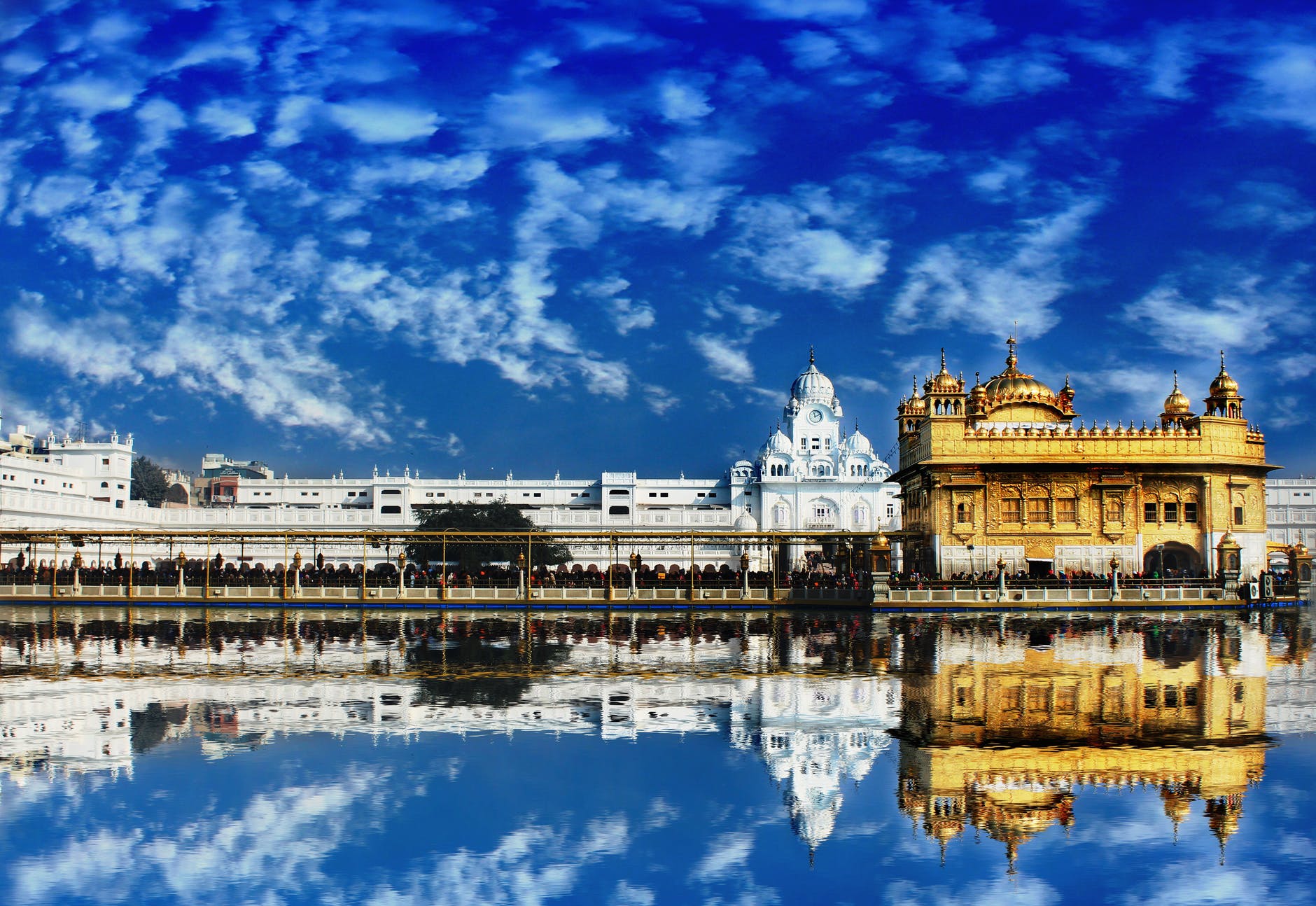
3.HARMANDIR SAHIB :THE GOLDEN TEMPLE

It was founded in 1577 by ram das, Amritsar is an important hub of sikh history and culture .The main attraction here is Harmandir Sahib ,opened in 1604 and stillmoften referred to as golden temple for its beautiful gold decoration. The holiest of India’s many Sikhs shrines,the temple was built in a blend of Hindu and ismalic styles, its lower marble section featuring such flourishes as ornate inlaid floral and animal motifs ,while the large golden dome represents a lotus flower ,a symbol of purity of Sikhs

In addition to it’s splendid design ,visitors are equally impressed with temple’s spiritual atmosphere, an effect enhanced by the prayers continuously chanted from the sikh holy book and broadcast throughout the complex.

Hill Stations Getting Overcrowded

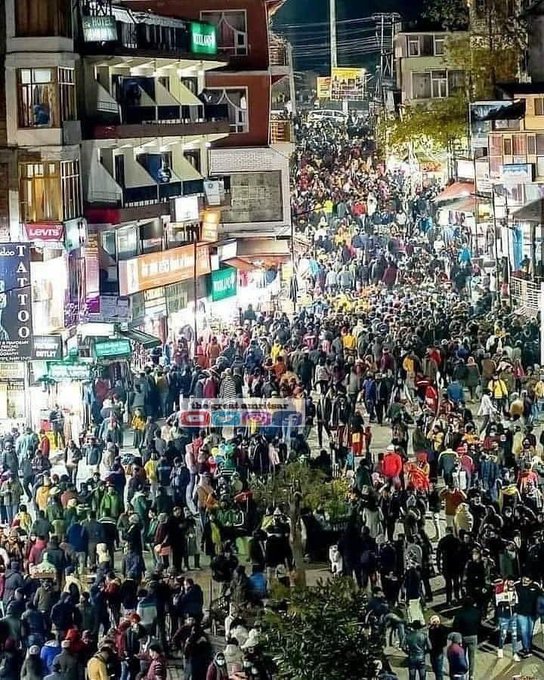
Visuals from Manali

Amidst the heat waves in various places across the country people are setting off to the hill stations . Manali, Shimla, Mussoorie and many more hill stations are now packed up by people. Hotels are running out of beds .

The pandemic has tested the patience and strength of all of us since it has been over a year now Covid has infiltrated our lives. With lockdown imposed regularly the number of tourists declined in the previous year. It was now when the lockdown has just been lifted and the second wave has started to ease out that people decided to visit the hill stations . Moreover most of the people have summer vacations at this point of time.

Nainital administration has announced that once the parking reaches the limit ,tourists will be allowed to enter according to the availability of the space. Although the hoteliers are enthralled since the occupancies of the rooms has peaked, but it is adding a lot of problems to the tourists especially when the rainy season has set off. As a result a lot tourists are returning midway.

Image result for overcrowding in manali

Last year Shimla faced utter water crisis and the tourists were urged not to visit. Therefore with this overcrowding water pollution , air pollution aggravates and the whole purpose of setting off to hill stations in the lap of nature demolishes. There are even some cities where even RT PCR is not compulsory .

Although the second wave is at its departure , the third wave is at large which is speculated to arrive in end August and is supposed to peak in September. Therefore it is advised to be careful and not to assume that Covid is over and avoid visiting to the hill stations especially when it is overcrowded . Although vaccinations shields from the virus but since its efficacy is not 100% the protocol of wearing mask, using sanitizer and keeping distance should be followed.

Use of MS Excel in today’s world.

Excel is typically used to organize data and perform financial analysis. It is used across all business functions and at companies from small to large. The main uses of Excel include: Data entry.

Excel is a software program created by Microsoft that uses spreadsheets to organize numbers and data with formulas and functions. Excel analysis is ubiquitous around the world and used by businesses of all sizes to perform financial analysis.

The main uses of Excel include:

1 Data entry
2 Data management
3 Accounting
4 Financial analysis
5 Charting and graphing
6 Programming
7 Time management
8 Task management
9 Financial modeling
10 Customer relationship management (CRM)
** Almost anything that needs to be organized!

Excel is used extensively in finance and accounting functions. In fact, many organizations run their entire budgeting, forecasting, and accounting functions entirely out of Excel spreadsheets.

While Excel is defined as a “data” management tool, the data that is most commonly managed is financial. At CFI, we would define Excel as the ultimate financial software. While there are other pieces of financial software that are tailored toward performing specific tasks, the strongest point about Excel is its robustness and openness. Excel models are as powerful as the analyst wishes them to be.

Accountants, investment bankers, analysts, and people in all types of financial career paths rely on excel to perform their daily job functions.

And one should know how to use MS Excel. Its on of the most important skill in today’s corporate world.

National Workaholic Day

National Workaholics Day is on July 5th, and it might remind us to balance our work and home life better. Work isn’t everything – right? Do you come in early, skip your lunch and stay late or know someone who does? This day is dedicated to the people who fit that description

Today, July 5th, is National Workaholics Day… are you working?

By definition, a “workaholic” is a person addicted to their work. While dedication is certainly an admirable trait, a healthy work-life balance is also important.

For all the workaholics of the world, today is the day to step back and take it easy. If you fall into this category, take an afternoon nap, read a book, or spend a few hours watching videos on YouTube. You’ll have plenty of time to finish your work tomorrow!

For everyone else, today is the perfect opportunity to celebrate the workaholics in your life and to recognize all they have accomplished. To celebrate Workaholics Day, arrive at the office a little earlier than usual and tackle a project that you’ve been avoiding. Happy Workaholics Day!

The Theory of Broken Windows

The “Broken Windows” policing strategy, which has been used in New York and other large American cities since the early 1990s, has been credited with lowering crime in some areas. According to the hypothesis, stopping, warning, and even prosecuting perpetrators of low-impact crimes such as vandalism and disruptive behavior adds to a more cohesive neighborhood and a setting less likely to attract serious crime. In 1982, James Q. Wilson and George Kelling developed the broken window theory, which used the window as a metaphor for a crime. Their idea focuses on preventing crimes in the first place so that they do not escalate into more serious crimes. According to James Q. Wilson, the degree to which a society governs itself has a profound impact on crime and disorder. The “broken windows” referenced in the theory’s name refers to the belief that where one broken window is left un-replaced, there will be many more. A broken window is a tangible manifestation of the fact that the residents of a specific neighborhood do not care about their surroundings and that low-level criminality is permitted. The hypothesis had considerable impact on policymakers on most notably in New York in the 1990s.

According to this theory, there are several stages of a crime but most importantly:

  • Disorder
  • Crime

It is claimed that disorder is nothing more than little visual evidence of a crime, and that the authorities must regulate those obvious signs in order to minimize the crime rate. Their approach was zero – tolerance policy, in which the criminal justice system took low-level crime and anti-social behavior far more strictly than it had previously. This included “three strikes and you’re out” regulations, under which people may face substantial jail time for repeating minor offenses like unsolicited windshield washing, prostitution, drunk and disorderly behavior, and so on.

The concept was that low-level crime should not be accepted and strong punishments for anti-social behavior and minor infractions should be imposed in order to prevent more serious crime and assure that collective consciousness and social cohesion are maintained through clear boundary enforcement.

As we all know, India has yet to put this idea into practice. One of the most populous countries on the planet, as well as one of the hardest impacted by crime, but if India needs anything like this? Stopping the minor visible disorder, in my opinion, is one method to stop the larger crime. It takes a lot of effort to execute something like this in India, and not just the police, but also societal awareness among the general public, is required to reduce India’s crime rate. We can reach the conclusion that the broken window theory is the best tool for reducing crime rates, but we must keep in mind that instead of a zero-tolerance government policy, we can try to accomplish the financial needs of the country.

Beauty of Kashmir!

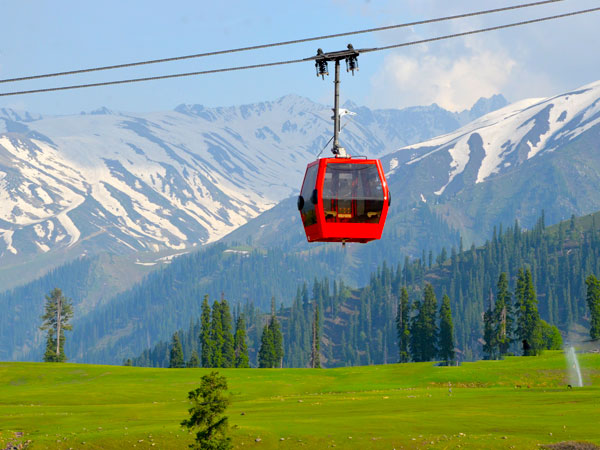
Kashmir is located on the Jhelum River in north India. It is always cold here. It is very beautiful. It is called Paradise on Earth. Its beauty seems very captivating in every season. In summer there is greenery everywhere and in winter everything is covered with snow. The red apples hanging on the apples look very beautiful. There are many tourist places to see in Kashmir like Gulmarg, Sonmarg etc. Gulmarg is called the life of Kashmir. Sarovars like Vullar add to the beauty of Kashmir.

The people of Kashmir are called Kashmiri Pandits and they are very beautiful. They are also non-vegetarians and consume kebabs etc. After eating here, it is rotated in sweets. Saffron is cultivated here. Whoever goes to this place makes sure to buy show pieces made of walnut wood, apple, Pashmina shawl and saffron. Kashmir is a matter of great dispute between India and Pakistan. Kashmir has its own flag and it has its own constitution under Section 370 of the Constitution of India. No person outside Kashmir can buy land in Kashmir.

The poet has rightly said about Kashmir that “if there is heaven on earth, it is here, it is here”. We have been fortunate enough to spend some of our holidays in Kashmir, but this happened a few years before the disturbances started in the valley. We usually visited Kashmir during our summer holidays. We took a train to Pathankot. Steal the bus from Srinagar. The last time we were there, we went to Chandan Van. A trip in the Kashmir valley is a beautiful experience. Green plains, long There are trees, lakes, springs, snow-capped mountains. Both sides of the streets are lined with Apple and Peer Orchard.

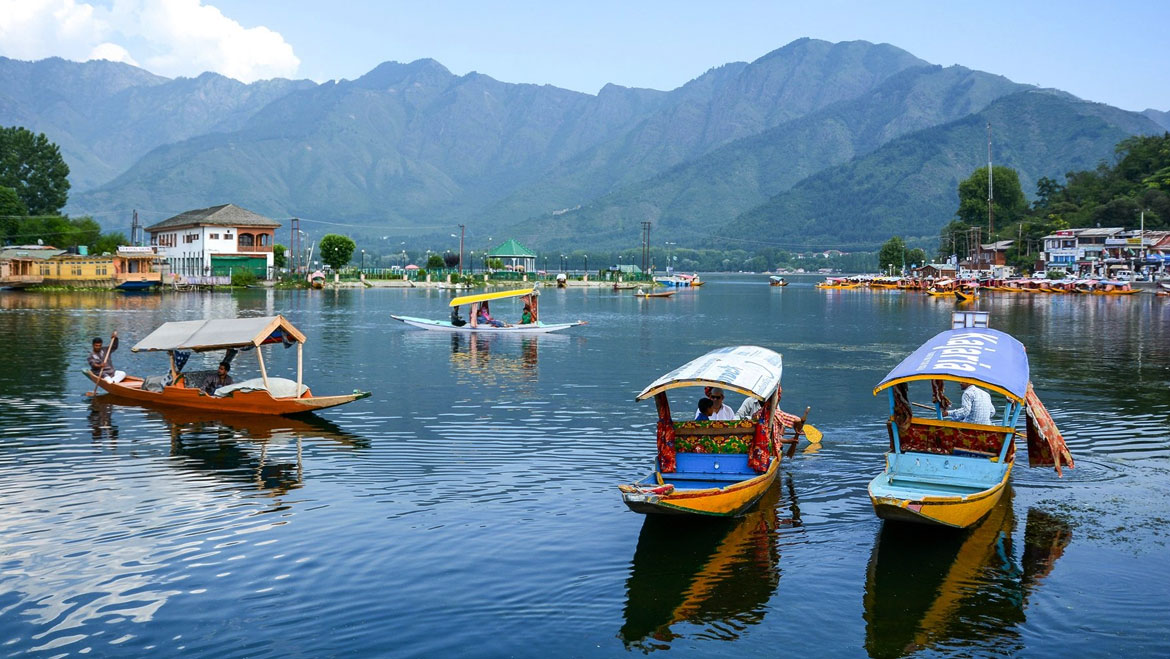
Wild strawberry grows in abundance everywhere, flowers and fragrant saffron are cultivated here. Kashmir relies on its image of being a paradise on Earth. A visit to the Shalimar and Nishat Gardens is a lake dating back to the Mughal era, when Nur Jahan’s favorite queen of Emperor Jahangir visited these gardens. There are beautiful poplar trees, flowers and fountains all over the place. Many Hindi films have been shot here. We often visited the lakes of Kashmir. Dal Lake, which is a major tourist attraction, has many home boats. Many foreigners come here and stay during their holidays. Many boats called the gazelle between these house boats and the shores of this lake. Likewise, there is the famous Wular lake, which is a large fresh water lake.

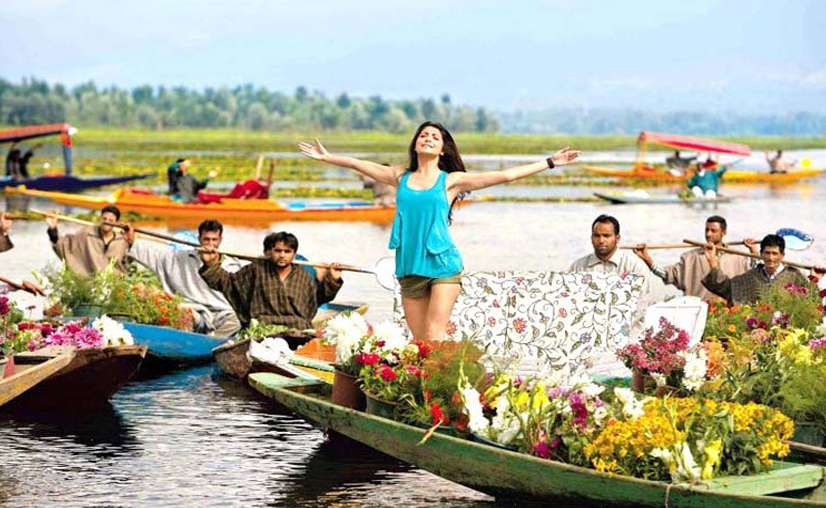
shooting of jab tak hai jaan movie, song jiya re

However, among all the lakes of Kashmir, my favorites were Evanabal and Gangarbil lakes. Mansabal Lake is situated between the mountains and the Indus River. While the Gangarbal Lake is considered the source of the Ganges. It is closed in the rocky center of Harmok, Kashmir also has many springs for their healing powers. The most famous among all is Chashma – Shahi, or Shahi Vasant. It is known for its medicinal values. There is also a sulfur lake called ‘Tatta Pani’ in Kashmir. It is believed that if all take a bath in these springs, then all types of skin diseases can be cured. Kashmir is a trekker’s paradise. There are several trails scattered all over the valley which are ideally suited for trekking. They are variously known as Gulmarg or path of flowers, Sonamarg or path of gold etc. In fact the beauty of Kashmir binds a person and does not allow him to leave the place.

reference-https://articles.pk/kashmir-land-of-heaven.html

An Inhumane Incident:Case of Bruno

Death of Bruno:
Bruno was the name of the dog that went through the unpleasant fate. Bruno was a friendly black Labrador in the care of Christuraj.The heart-breaking incident that lead to the death of Bruno took place in Adimalathura Beach,kottukal.The atrocious act happened in the state of Kerala, India.

On June 28,Monday three men at the Adimalathura Beach assaulted Bruno to death by hanging the dog to a fish hook of a boat and then Bruno was beaten by sticks. The accused Sunil(20), Silvester(22), and a 17 year old boy were arrested after this incident was filed as a complaint by the owner Christuraj. This vicious act was done to Bruno as it was resting under the boat of the accused.This incident came to light after the video of Bruno being beaten to death went viral on social media.The video was shared by the dog’s owner,christuraj. According to the police, Sunil one of the miscreants seemed to have some issues with his neighbour, Christuraj. The owner Christuraj was threatened by the culprits after the incident.

Bruno Dog:
The owner Christuraj was shocked after this brutal incident done to Bruno. He claimed Bruno as a friendly dog. Bruno was a 9-year old dog that usually has a habit of playing in the beach everyday.

Bruno’s Case:
Following the barbarous incident, Celebrities like Alia Bhatt, Tiger Shroff have raised their voices against the culprits. Kerala HC renamed Bruno’s case as “Tribute to dog brutally killed”.The court believed that this would be a tribute to the deceased dog.A great number of people raised their voices against this ruthless incident.
A similar case have been reported in Bangalore, two weeks ago. A man has brutally murdered a stray dog in the city and threw it in a drain. The video of the incident have been caught on camera and surfaced online. The police have filed a case against the man under the Prevention of Cruelty to Animals Act, 1960.

Picture of Bruno with his caretaker, Christuraj.

Laws against animal brutality:
The amendment to the Prevention of Cruelty to Animals Act, 1960 have been proposed by the Union Government. Importance of Animal safety must be ensured as much it is ensured for the human beings.

Importance of Animal safety:
Animals are the most affectionate and lovable beings. Taking care of them with extreme protection is a primary duty to all of us. Animals must never be subjected to violence. In case of any difficulty caused unknowingly by them, it should be reported to helplines.The wide prevalence of today’s technology enables one to find help trouble-free.
Similarly animal cruelty must be reported to defend the animals. Laws can help to punish the culprits against the brutal act. Animals would never try to harm human beings unless we act as a threat to them. Hence, Violence against animals is a punishable offense and atrocious. Not only animals, other creatures must also never be harmed unnecessarily. It can later lead to serious consequences.

#CaseofBruno#Brunodog

Also Read:

https://indianexpress.com/article/opinion/when-anti-cruelty-laws-dont-protect-animals-and-only-harm-humans-7245350/

https://indianexpress.com/article/cities/delhi/ex-armyman-son-booked-in-noida-for-assaulting-man-feeding-stray-dogs-7367377/

WRONGFUL CONVICTIONS

The integrity of the criminal justice system is primarily determined by its competence and fairness. Its competence is measured by its ability to investigate and detect crime, identify criminals, and impose appropriate punishments on those convicted of crimes. Wrongful convictions jeopardize the integrity of the criminal justice system. If a person is wrongfully convicted, he or she is punished for an offense that he or she did not commit, but the true perpetrator of the crime is not punished. So wrongful convictions also harm the public since imprisoning an innocent person allows the true perpetrator to go free. In addition, when unjust convictions are discovered, public trust in the system decreases. Condemning the innocent defies justice, depriving men and women of dignity, relationships, time, opportunity, and freedom.

The criminal justice system is founded on the fundamental legal principle that an accused person is deemed innocent until conviction following a trial. This runs counter to the public’s belief that the vast majorities of people accused with criminal offenses are, and will be found to be, guilty. Wrongful convictions undercut both this fundamental legal principle and this public expectation because they demonstrate that the presumption of innocence can be maintained even when it is violated and that the justice system does not simply deal with the guilty. The tragedy of wrongful convictions is caused by a number of circumstances. The great majority of cases involve eyewitness mis-identifications as a result of inadequate crime scene visibility and poor police conduct. Every wrongful conviction exemplifies a unique set of flaws in the criminal justice system that has stopped it from functioning properly and fairly. Because wrongful conviction results reflect a fundamental undermining of the integrity of the criminal justice system, the mechanisms designed for reviewing such cases are exceptional in nature and are hardly found useful. To do differently would be to call the criminal justice system’s legitimacy into doubt and, by drawing attention to its flaws, to destroy public trust.

Immediate action should be made to ensure that no more men and women are wrongfully imprisoned. To improve the accuracy of witness identifications, police personnel conducting lineups should be knowledgeable of the suspect’s identity so as not to impact witnesses’ decisions, should ask witnesses to evaluate their confidence in their identifications, and should film the entire procedure. Confessions from defendants should also be filmed. This safeguard against coercion by authorities attempting to show guilt. Only the most advanced forensic science procedures should be employed to determine guilt. Prosecutors should be trained in ethical principles as well as the grounds of wrongful convictions. States should keep teams of skilled defense lawyers on hand who can dedicate the necessary time to each accused. Furthermore, all states should pass compensation statutes that offer adequate money for defendants to rebuild their lives. No matter what changes are implemented, the reconsideration of convictions will always be an exceptional event; an effective method of carrying out this duty will increase the effectiveness and integrity of the criminal justice system. It has the potential to lessen the likelihood of wrongful convictions while also improving the integrity of our justice system.

Climate Change

Climate change incorporates both an Earth-wide temperature boost driven by human-initiated discharges of ozone harming substances and the subsequent huge scope shifts in climate designs. However there have been past times of climatic change, since the mid-twentieth century people remarkably affect Earth’s environment framework and caused change on a worldwide scale. The biggest driver of warming is the outflow of gases that make a nursery impact, of which over 90% are carbon dioxide and methane. Fossil fuel consuming (coal, oil, and gaseous petrol) for energy utilization is the principle wellspring of these outflows, with extra commitments from agribusiness, deforestation, and manufacturing.[4] The human reason for environmental change isn’t questioned by any logical assortment of public or global standing.[5] Temperature rise is sped up or tempered by environment criticisms, for example, loss of daylight reflecting snow and ice cover, expanded water fume (an ozone harming substance itself), and changes to land and sea carbon sinks.

Temperature ascend ashore is about double the worldwide normal increment, prompting desert extension and more normal warmth waves and wildfires. Temperature rise is additionally enhanced in the Arctic, where it has added to liquefying permafrost, frigid retreat and ocean ice loss. Warmer temperatures are expanding paces of vanishing, causing more serious tempests and climate extremes. Impacts on biological systems incorporate the movement or eradication of numerous species as their current circumstance changes, most quickly in coral reefs, mountains, and the Arctic. Climate change compromises individuals with food weakness, water shortage, flooding, irresistible sicknesses, outrageous warmth, financial misfortunes, and relocation. These effects have driven the World Health Organization to call environmental change the best danger to worldwide wellbeing in the 21st century. Even if endeavors to limit future warming are fruitful, a few impacts will proceed for quite a long time, including rising ocean levels, rising sea temperatures, and sea acidification. Energy streams between space, the air, and Earth’s surface. Current ozone depleting substance levels are causing a radiative lopsidedness of about 0.9 W/m2.

Large numbers of these effects are as of now felt at the current degree of warming, which is about 1.2 °C (2.2 °F).The Intergovernmental Panel on Climate Change (IPCC) has given a progression of reports that project huge expansions in these effects as warming proceeds to 1.5 °C (2.7 °F) and beyond. Additional warming likewise builds the danger of setting off basic edges called tipping points. Responding to environmental change includes moderation and adaptation. Mitigation – restricting environmental change – comprises of decreasing ozone harming substance discharges and eliminating them from the atmosphere strategies incorporate the turn of events and arrangement of low-carbon fuel sources, for example, wind and sun oriented, an eliminate of coal, upgraded energy proficiency, reforestation, and backwoods safeguarding. Transformation comprises of changing in accordance with genuine or expected climate, for example, through further developed coastline assurance, better fiasco the board, helped colonization, and the advancement of more safe yields. Transformation alone can’t deflect the danger of “serious, far and wide and irreversible” impacts.

Under the 2015 Paris Agreement, countries on the whole consented to continue to warm “well under 2.0 °C (3.6 °F)” through moderation endeavors. Notwithstanding, with promises settled on under the Agreement, a dangerous atmospheric deviation would in any case reach about 2.8 °C (5.0 °F) before the finish of the century. Limiting warming to 1.5 °C (2.7 °F) would require splitting outflows by 2030 and accomplishing almost zero emanations by 2050.

A worldwide temperature alteration is the drawn out warming of Earth’s environment framework saw since the pre-mechanical period (somewhere in the range of 1850 and 1900) because of human exercises, essentially petroleum derivative consuming, which builds heat-catching ozone harming substance levels in Earth’s climate. The term is habitually utilized reciprocally with the term environmental change, however the last alludes to both human-and normally delivered warming and the results it has on our planet. It is most normally estimated as the normal expansion in Earth’s worldwide surface temperature.

Since the pre-modern time frame, human exercises are assessed to have expanded Earth’s worldwide normal temperature by around 1 degree Celsius (1.8 degrees Fahrenheit), a number that is as of now expanding by 0.2 degrees Celsius (0.36 degrees Fahrenheit) each decade. A large portion of the current warming pattern is very possible (more noteworthy than 95% likelihood) the aftereffect of human movement since the 1950s and is continuing at an extraordinary rate over a long time to centuries.

Environmental change is a drawn out change in the normal climate designs that have come to characterize Earth’s nearby, territorial and worldwide environments. These progressions have an expansive scope of noticed impacts that are inseparable from the term. Changes saw in Earth’s environment since the mid twentieth century are fundamentally determined by human exercises, especially petroleum product consuming, which builds heat-catching ozone depleting substance levels in Earth’s climate, raising Earth’s normal surface temperature. These human-created temperature increments are regularly alluded to as an unnatural weather change. Regular cycles can likewise add to environmental change, including inside changeability (e.g., recurrent sea designs like El Niño, La Niña and the Pacific Decadal Oscillation) and outside forcings (e.g., volcanic action, changes in the Sun’s energy yield, varieties in Earth’s circle).

Researchers use perceptions starting from the earliest stage, and space, alongside hypothetical models, to screen and concentrate past, present and future environmental change. Environment information records give proof of environmental change key markers, for example, worldwide land and sea temperature expands; rising ocean levels; ice misfortune at Earth’s posts and in mountain icy masses; recurrence and seriousness changes in outrageous climate like tropical storms, heatwaves, fierce blazes, dry spells, floods and precipitation; and cloud and vegetation cover changes, to give some examples.

Colorism In British India .

British colonialism further exacerbated colourism. The British Raj, or the official British rule over India, began in 1858 and lasted until the independence of India and the partition of Pakistan in 1947. During this time, a pseudo-scientific concept called “social Darwinism” became popular. The term, a reference to Charles Darwin’s work on evolution, describes the common belief that factors such as skin colour, bone structure, and facial features were determinants of levels of intelligence, and it became part of the justification for Britain’s treatments of its colonised natives. In India, Britain’s general strategy seemed to involve keeping fair-skinned Indians as allies by privileging them over darker-skinned Indians. A system of institutionalised segregation was established and, while some institutions segregated against all “[coloured] people”, many segregated only against “black Indians”, with signs clearly stating: “Indians and dogs not allowed”. Conversely, lighter-skinned Indians were given preference over their darker counterparts and were hired more frequently.

Although there was some pushback against this mistreatment by the British, the Indian people were, in general, less motivated to protest because the caste system had already cemented clear divisions along racial lines. Centuries of rule by foreigners had already cemented the idea that power belonged to light-skinned individuals, and it meant that when an external, more malicious force came in to uphold those divisions, people were less inclined to object.

However, colourism has always been an intersectional issue. The oppression people face due to colourism is often paired with, and/or magnified by their gender, caste, social status, financial status, and education. Despite the longevity of the issue, civil society is only now beginning to dismantle institutional colourism. “Dark is Beautiful” is an organisation fighting colourism by organising workshops to educate the youth on the dangers of colourism and by creating petitions and lobbying against the leading fairness cream brands. In the future, it seeks to “involve… many people and [organisations], including politicians, sportspersons, and influential people.” “India’s Got Colour” is another campaign that aims to end systemic bias against skin colour. One of its ambassadors, Nandita Das, an actress and producer, travels around the country to educate children in schools on the pervasiveness of colourism and to share her story and recount the different treatment she received from the media due to her skin colour. In Bollywood, instances of brownface, the act of intentionally darkening one’s skin, have started receiving more public backlash than ever before.

Colourism refers to prejudice against individuals with a dark skin tone. In India, it is reflected in many parts of society, from advertisements on billboards to lyrics in songs to household anecdotes. It can manifest itself in very apparent ways, such as in advertisements for skin lightening products showcasing women achieving their dreams only after lightening their complexion, but it can also take on more subtle forms. Regardless, its influence is pervasive. In 2015, the Indian National Museum conducted a study where they surveyed one hundred college students from across the country, inquiring about the skin colour they considered to be a beauty ideal. When asked to describe “pretty”, 71% of the respondents cited words alluding to lighter skin tones, including “fair” and “light”. While this study featured a relatively small sample size, the trends it highlights are common in Indian society and perpetuated through the media. In fact, 90% of all Indian advertisements show lighter-skinned models, and most Bollywood movies feature a cast of exclusively light-skinned actors.

Beyond a lack of representation of dark-skinned individuals in the media, having darker skin is seen as a disadvantage for many other prospects as well, from “hireability” to chances of marriage. The latter is especially true in rural villages wherein women with a darker skin tone are seen as less desirable and face greater challenges in finding a spouse. Another damaging result of colourism is the rise of the ever-growing skin lightening market and the health risks this market presents. The Tata Institute of Social Science (TISS) conducted a study in which they surveyed 1,238 women and 746 men on their use of fairness creams. Of those, 59.6% of women and 46.1% of men reported using fairness products at some point in their lives. When asked why, 31.2% said they wanted to look “beautiful” and 36.2% believed looking fairer would help them “feel culturally accepted”. These skin lightening products have serious, and often long-lasting, side effects. In 2006, the Food and Drug Administration (FDA) released a notice stating that it no longer recognises over-the-counter skin bleaching products as safe or effective. Despite this, India’s skin lightening market is projected to continue growing with an April 2018 study estimating that by 2023, it would be worth “Rs. 5,000 crore”, or about $700 million USD.

HUMANITY

Being kind is the biggest asset in you.

I’m very sure humanity dead in this generation. Everyone are busy with their works, they forget helping others. In this world, each day has 24 hours and we ourself not even spend a single minute to see others. This is the only place where richer gets rich and poorer stays poor. How to get off the imbalance the rich should take over the poor. The life is undefined, even next minute may take our breathe after that there’s no use of hiding money. Just a single paper of currency can bring smile among many.

For an instance, while you’re walking in a road a man before you suddenly gets fainted there’s nobody noticing him even yourself never bought a bottle of water to wake him instead we all just take our mobile and tape him and put them in social media’s tagging RIP HUMANITY, yes humanity dead and the first accused is you.

There are many people in search of God and spending lot to find where’s the origin and who he belongs. But the actual truth is no such thing, don’t search God among others search God on you. If a hunger begger gets feed by you, then you’re the God to him. Feel the God in you, if you sow smile I’m others by helping then you can see the good aura in you.

There are many developed countries and many developing countries, between these two there’s another category countries which could be developed. The majority businessmen are failed to take care of their own motherland. Think others with a open communal mind, if the hungry of you gets over and still you have food then why you hesitate of storing it instead you could share it.

The question is where does it starts or whom does it should be. The answer is within you. Search yourself and start helping others. As a human you should take care on others too that’s why we are declared as 6th sensed beings.

HUMANITY IS NOT THE BEST QUALITY, IT’S A BASIC QUALITY.

The Rule of Harmonious Construction

Law has an important place as a representative for social evolution. In this democratic system of governance, there are many intersections between legal order and social evolution. The source of the law in legislation is called statute law. It is made very fast, definite and does not have to wait for identification by the courts. The courts acknowledge a statute because it is law; it is merely not law because the courts recognize it. The cause for uncertainty of legislation is the basic nature of language. It is not always likely to perfectly turn the real intend of the legislation into written words. The ability to adopt the language inevitably means that there will be equally good or unconvincing arguments for both competing interpretation. Many of times the provisions are having more than one meaning or the uncertainty in the language. The legislature becomes functus officio when after enacting the statues. The interpreters cannot revert back to the legislature and ask the exact meaning of the statute because the legislators would not have take up such a wide variety of conditions while making any particular statute. Thus it is totally depend on the Judges to interpret such provisions to make both effective. To avoid further uncertainty, the legislation has provided us with some of the primary rules of interpretations. Harmonious Construction is one of the most significant rules where it is said that if the two or more or more than two provisions of the same act are conflicting with each other then it must be interpreted in such a manner that effect should be given to both, and the provision which has a wider concept will always prevail.

When there is a conflict or inconsistent between two or more provisions or two or more parts of a statute then the rule of harmonious construction is implemented. This rule follows a very simple theory that each and every statute has a purpose and intent as per the law and should be read as a whole. The interpretation should be adopted when all of the provisions are consistent. In the case in which it is totally impossible to harmonize both the provisions, the court’s decision regarding the provision shall prevail. Harmonious rule brings harmony among the various lists referred to in Schedule 7 of Constitution of India. (The 3 Lists of Legislation – Union list, State list, and Concurrent List). This doctrine follows a settled rule that an interpretation that results in hardship, injustice, inconvenience and anomaly should be avoided. The interpretation with the nearest compliance to justice must be picked.

Harmonious Construction has helped Judges to interpret between two conflicting laws easily and has proved easily in providing the justice to society at large. This does not mean that judicial interpretations always thought to be the true and as per the intention of the legislation. More but not the less their interpretation power has given a space for their own ideas to flourish. Although they in most of the cases they gave their best to bring sense out of miserably worded statute. The legislative inability to anticipate all conceivable future scenarios is understandable, and hence it is the task of the judiciary to make existing laws practical by rational interpretations. Judges must control themselves from their own thoughts and philosophy which affects the judgment and many a times they end up in making of new laws. Filling up of such space will ensure that the interpretation by judiciary in the future will produce fruit bearing results for all.