What is Pradhan Mantri Fasal Bima Yojana

Today we are going to talk about Pradhan Mantri Fasal Bima Yojana, many farmer brothers of India do not know about what is crop insurance scheme and how to take advantage of it, so today we are going to tell you complete information about it. If you do not have complete information about the scheme launched by the Prime Minister, then you should read our article completely so that you can get complete information about it.

Today we are going to tell you the information related to the Pradhan Mantri Fasal Bima Yojana in this article, many people do not have complete information about what it is and how to apply it, what kind of benefits can we get in this, so today’s This article of ours has been written to give you information related to this so that you can get complete information about PMFBY.

We all know that every year somewhere or the other, farmers suffer heavy losses due to natural calamities etc. That farmer takes out all the expenses on his crop, in such a situation, if his crop gets spoiled, he would have to face many problems, due to which the government has started this scheme to benefit the farmers in such situations.

What is Pradhan Mantri Fasal Bima Yojana?


What is Pradhan Mantri Fasal Bima Yojana


First of all, let us tell you what is Pradhan Mantri Fasal Bima Yojana because most people do not know about it, then you all know that farmer is the only person who can do farming and the same if we talk about India. So here more than 70% of people are farmers, who earn their living by farming day and night.

We all find their life easy because we see them outside, but there are many types of fears and thoughts in their hearts and minds, from which we are all oblivious, today farmers feed all the living beings of the whole country, but very It is a pity that even after so many years of independence of our country, farmers are still compelled to commit suicide and we all often hear and see about it.

After independence, you all know that different governments were formed by many parties, but no government could do such a thing that the farmers could get good and maximum benefits, but in 2016 the Government of India gave a very big gift to the farmers. Due to this, there was a wave of happiness among the farmers, and that scheme was Pradhan Mantri Fasal Bima Yojana.

As you all know that the biggest crisis for farmers is natural calamity because it completely ruins the crop of the farmers, which is related to many expectations of the farmers, so to give security of the crop to the farmers, the government has given the crop. An insurance scheme was started so that farmers could get compensation from the government in case of such loss.

Benefits of crop insurance scheme


The Prime Minister’s Fasal Bima Yojana was started for many special purposes, we are telling you about some of its main benefits so that you can get the benefit of it.

This scheme was launched by Prime Minister Narendra Modi on January 13, 2016, under this, farmers have to insure it within ten days of sowing the crop and if there is any damage to their crop due to flood or rain or hail and other natural calamities. Farmers are given the benefit of insurance.

A farmer may or may not have his farm, but if he cultivates, then he can get this insurance and compensation for the damage caused by any natural calamity or natural calamities like flood, rain, hail, drought or storm etc. can obtain.

It has also been laid in this that it is mandatory to get your insurance within 10 days of the harvest and after 14 days of harvesting, if the crop is damaged due to rain or any natural calamity, then the farmer will get the insurance money.

In case of crop failure, the farmer has to inform the insurance company. If for some reason the farmer is not able to contact the insurance company, then he can also inform any nearest bank or official.

Information related to crop insurance scheme


Now we are telling you some very important information about it, of which you need to be aware.

  • In this scheme, there is no upper limit on government subsidy and the remaining premium is up to 90%, which is borne by the government.
  • The remaining premium will be given to the insurance company by the government, which will be shared equally between the central and state governments.
  • The premium rate of this scheme has been kept very low so that any farmer can easily bear its instalment.
  • This scheme will also work psychologically for the benefit of the farmers.
  • Keep in mind that human-made disasters like fire,You will not get compensation for damage caused by theft, burglary etc.

These are all important things about which you need to know so that you do not have any kind of problem later.

Main Objectives of Pradhan Mantri Kisan Yojana


Along with starting this scheme, the government has also set various objectives, due to which farmers can get the maximum benefit from the government and more and more farmers can join this scheme. like.

If there is any loss in any type of crop due to natural calamity or due to insect or disease etc., then under this scheme the farmers will get insurance.

provide cover and financial assistance

To provide a permanent income to the farmers to keep the farmers engaged in agriculture and to bring growth to agriculture.

To encourage the farmers of the country to adopt modern methods

The main objectives of starting this scheme were to ensure the availability of credit in the state.

These were the main objectives of starting the Pradhan Mantri Fasal Bima Yojana, which all farmers should know.

Documents Required for Pradhan Mantri Fasal Bima Yojana


If you want to apply to this scheme and want to take advantage of this scheme, then you must have some necessary documents only then you can apply to this scheme.

  1. I’d card of the applicant (Aadhar card, PAN card, Identity card, Driving license etc.)
  2. Address Proof (Electricity Bill, Aadhar Card, Identity Card, Passport etc.)
  3. Latest passport photo of the applicant
  4. If you have a farm, keep its account number and measles number with you.
  5. You have to give proof that you have sown in the field, for this you can write a letter from Patwari, Sarpanch, Gram Sevak etc. For proof.
  6. If you are cultivating another’s farm on rent, then you must take a photocopy of the agreement with the owner of the farm for that.
  7. Take a cancelled check of your bank account, this will give you the amount directly in the bank if there is a loss in the crop.

If you want to take advantage of this scheme, then you need to have all these documents, if you have these documents then you will be able to take advantage of this scheme.

How to apply in PMFBY


If you want to apply in this scheme, then you can apply in 2 ways, in this, you can apply both online and offline.

If you want to apply offline, then you have to contact any nearest bank branch, there you get complete information about it so that you can get information about this scheme, after that you will get a form from there. It has to be filled, after that, you will be able to take advantage of this scheme.

If you want, you can also apply for this scheme online, for this you have to first go to the official website of PMFBY, after that, you will get complete information about this scheme on this website, in that you have to click on the option of apply online. After that you will be asked to fill in some important information, there you have to fill in the information asked and there you have to upload all the documents that are asked from you, in this way you can also apply online in it.

Friends, you can easily apply for the Prime Minister’s Fasal Bima Yojana through our mentioned method and can take advantage of this scheme. You must have understood the information about how to do it and what documents you need to have to apply for it.

Conclusion – If you want to ask any other questions about PMFBY, then you can tell us through comment, we will be happy to answer your questions and if you like the information, then share it with your friends. Get information about this.

What is Land Suitability Analysis

and suitability assessment is a method of land evaluation, which identifies the major limiting factors for planting a particular crop. Land suitability assessment includes qualitative and quantitative evaluation. In the qualitative land suitability evaluations, information about climate, hydrology, topography, vegetation, and soil properties is considered and in quantitative assessment, the results are more detailed and yield is estimated. At present study we prepared land suitability assessment map for rain-fed wheat and barley crops based on FAO “land suitability assessment framework” using parametric method and machine learning algorithms in Kurdistan Province, located in west of Iran. This is a unique study that compared two machine learning-based and traditional-based approaches for mapping current and potential future land suitability classes. Moreover, potential yield of rain-fed wheat and barley crop were computed by FAO model.

1. Introduction

Rapid population growth in developing countries means that more food will be required to meet the demands of growing populations. Rain-fed wheat and barley, as major grain crops worldwide, are planted under a wide range of environments and are a major staple source of food for humans and livestock [1][2][3][4]. The production of such staple crops influences local food security [5]. Rain-fed wheat and barley are cultivated on approximately 6 and 0.64 million ha in Iran, respectively [6]. They are well adapted to the rain conditions of western Iran, where mean precipitation is 350–500 mm. The production of rain-fed wheat and barley per unit area in Iran is low compared to developed countries worldwide [2]. One of the main causes for this low yield is that the suitability of land for their cultivation has not been determined. To overcome this problem, land suitability assessment is needed, which can help to increase crop yield by growing these crops in the locations that are most suited to their growth [7].

The first step in agricultural land use planning is land suitability assessment which is often conducted to determine which type of land use is suitable for a particular location [8]. Land suitability assessment is a method of land evaluation, which identifies the major limiting factors for planting a particular crop [9][10]. Land suitability assessment includes qualitative and quantitative evaluation. In the qualitative land suitability evaluations, information about climate, hydrology, topography, vegetation, and soil properties is considered [11] and in quantitative assessment, the results are more detailed and yield is estimated [12]. The FAO land evaluation framework [13][14] and physical land evaluation methods [15] have been widely used for land suitability assessment.

Land suitability maps provide the necessary information for agricultural planners and are vital for decreasing land degradation and for assessing sustainable land use. There is a lack of land suitability mapping and associated information in Iran because land suitability surveying and mapping in Iran have followed the traditional approach [16][17][18][19][20]. In the traditional approach, abbreviation of the soil variability through a soil map unit to a representative soil profile may cause the precision of the land suitability maps to be lacking and ignores the continuous nature of soil and landscape variation, resulting in the misclassification of sites and discrete and sharply defined boundaries [21][22]. Moreover, the traditional approach is time-consuming and costly [23].

Machine learning (ML) models are capable of learning from large datasets and integrate different types of data easily [24][25]. In digital soil mapping framework, these ML models have been applied to make links between soil observations and auxiliary variables to understand spatial and temporal variation in soil classes and other soil properties [24][26][27][28]. These ML models include artificial neural networks, partial least squares regressions, support vector machines, generalized additive models, genetic programming, regression tree models, k nearest neighbor regression, adaptive neuro-fuzzy inference system, and random forests [26][27][28]. It should be noted that random forests and support vector machines have been the most commonly used techniques in the digital soil mapping community in the last decade due to their relatively good accuracy, robustness, and ease of use. The auxiliary variables can be obtained from digital elevation models(DEM), remotely sensed data (RS), and other geo-spatial data sources [24][29][30][31][32][33][34][35].

2. Discussion

Although in recent years, ML models have been widely used to create digital soil maps [24], little attempt has been made for using ML models to digitally map land suitability classes [36][37]. For instance, Dang et al. [38] applied a hybrid neural-fuzzy model to map land suitability classes and predict rice yields in the Sapa district in northern Vietnam. Auxiliary variables included eight environmental variables (including elevation, slope, soil erosion, sediment retention, length of flow, ratio of evapotranspiration to precipitation, water yield, and wetness index), three socioeconomic variables, and land cover. Harms et al. [39] assessed land suitability for irrigated crops for 155,000 km2 of northern Australia using digital mapping approaches and machine learning models. They concluded that the coupling of digitally derived soil and land attributes with a conventional land suitability framework facilitates the rapid evaluation of regional-scale agricultural potential in a remote area.

Although Kurdistan province is one of the main agriculturally productive regions of Iran and holds an important role in the country’s crop production rank, the mean yield of rain-fed wheat and barley in these regions is lower than 800 kg ha−1 [40]. Land suitability maps can classify the areas that are highly suitable for the cultivation of the two main crops and can help to increase their production. However, such information is commonly scarce in these semi-arid regions.

References

  1. Dawson, I.K.; Russell, J.; Powell, W.; Steffenson, B.; Thomas, W.T.; Waugh, R. A translational model for adaptation to climate change. New Phytol. 2015, 206, 913–931. [Google Scholar] [CrossRef] [PubMed]
  2. FAO. FAO Year Book; FAO Publication: Rome, Italy, 2013. [Google Scholar]
  3. Houshyar, E.; Esmailpour, M. The impacts of tillage, fertilizer and residue managements on the soil properties and wheat production in a semi-arid region of Iran. J. Saudi Soc. Agric. Sci. 2018, 93, 43–51. [Google Scholar] [CrossRef]
  4. Jamshidi, A.; Javanmard, H.R. Evaluation of barley (Hordeum vulgare L.) genotypes for salinity tolerance under field conditions using the stress indices. Ain Shams Eng. J. 2018, 9, 2093–2099. [Google Scholar] [CrossRef]
  5. Qader, S.H.; Dash, J.; Atkinson, P.M. Forecasting wheat and barley crop production in arid and semi-arid regions using remotely sensed primary productivity and crop phenology: A case study in Iraq. J. Saudi Soc. Agric. Sci. 2018, 613–614, 250–262. [Google Scholar] [CrossRef] [PubMed]
  6. FAO. Fertilizer Use by Crop in the Islamic Republic of Iran; Food and Agriculture Organization: Rome, Italy, 2005. [Google Scholar]
  7. FAO. Land Evaluation: Towards a Revised Framework; Food and Agriculture Organization of the United Nations: Rome, Italy, 2007. [Google Scholar]
  8. Bodaghabadi, M.B.; Faskhodi, A.A.; Saleh, M.H.; Hosseinifard, S.J.; Heydari, M. Soil suitability analysis and evaluation of pistachio orchard farming, using canonical multivariate analysis. Sci. Hortic. 2019, 246, 528–534. [Google Scholar] [CrossRef]
  9. De la Rosa, D.; Mayol, F.; Diaz-Pereira, E.; Fernandez, M. A land evaluation decision support system (MicroLEIS DSS) for agricultural soil protection. Environ. Model. Softw. 2004, 19, 929–942. [Google Scholar] [CrossRef]
  10. Halder, J.C. Land suitability assessment for crop cultivation by using remote sensing and GIS. J. Geogr. Geol. 2013, 5, 65–74. [Google Scholar] [CrossRef]


how to control anger and anxiety

Hello friends, in this article we are going to tell you about how to control anger and anxiety and with this, we are going to give you information related to how to control anger, if you get angrier and even after every effort, your anger is not calm. If this happens, then with the way we are telling you, you will be able to control your anger very easily.

Often many people make many types of mistakes due to anger, which people realize when anger is calm, but by adopting some methods, you can calm your anger, there are many ways through which you can reduce your anger. And we will give you information about many important and useful methods today so that you will be able to control your anger easily.

how to control anger and anxiety

how to control anger and anxiety


To reduce anger, you have to keep many things in mind, only then you will be able to calm your anger and if you get angrier then it can make you mentally ill and if you do not control it in time, With this problem becomes even more serious, so it is very important to treat it on time, for this you can adopt these methods.


1- avoid worrying

Many accidents happen with every person, which people cannot forget and remember them gives us mental pain and it can cause more anger, so you should avoid remembering those things which are worrying or your The less you remember such things that have a bad effect on the mind, the less you will get angry.

2. Sit quietly in solitude when angry

If you are getting angrier then you should spend some time in a good environment in solitude, this will calm your anger. Therefore, you can also adopt this method to reduce anger.

3. Get plenty of sleep

Taking less sleep can have a bad effect on your brain and if you do not get enough sleep for a long time, it can make your nature irritable, for this you should get enough sleep every day, at least you should sleep for 8 hours. Your mind will remain calm and you will not get angry again and again.

4. Quit Drunk

Addiction makes you mentally and physically unwell and in such a situation, if you want to avoid more anger and deadly diseases, then it is necessary to give up an addiction, although it is not easy for many people to give up intoxication, recently the doctor has many treatments for which Through this you can leave your addiction without any problem and it will also make you angry much less than before.

5. Wait

Whenever anger comes, we are not able to wait for anything and without thinking, try to hurt the next person etc., which is very wrong, if you are getting angrier then only you stay calm and when your anger If it gets cold, after that you talk to the next person and solve your problem.

6. Control your mind

If a person is unable to control his mind in anger, then that person is like a madman and he needs to consult a doctor, but if you do not lose your temper in anger, then you should try your best to keep control over yourself. Before doing anything in anger, think about the consequences that come out of it and think about what is right and what is wrong.

7. Do Yoga

If you want to control your anger, then it is most important that you start doing yoga, this will keep you physically and mentally healthy and when you are mentally and physically healthy, then you will also get less anger, for this many, There is yoga so that you can control your anger and if you get angrier, you can do yoga, yoga, jumping rope, silent meditation, Sarvangasana etc. This will reduce your anger to a great extent and your mind will remain calm.

8. Eat a nutritious diet

A nutritious diet is useful for every person in many different ways and if you want to control anger, then for this you should take a nutritious diet regularly, this will give you a lot of benefits and your brain will get better by taking nutritious food regularly. So it will remain calm and with this, you will also be saved from many other types of diseases, so you can always consume curd, milk, green vegetables, fruits, fruits, pulses, eggs etc.

9. Play Games

If you are getting angrier then you can play the game of your choice, this will entertain you very much and with this, playing the game will keep your attention in the game so that your anger will gradually decrease, you can choose any of your choices. You can calm your anger by playing this game on your mobile or computer.

10. Share your thought

Many times if we have any doubt or doubt in our mind, then we get very angry in such a situation, whenever this type of situation arises, then talk to the next person and find out the right thing and solve any problem with love. Try this, you will get less angry and you will not get angry about every little thing.

Conclusion – In this article, we have tried to tell you how to control anger and anxiety and how to control anger, so that you can control your anger very easily and you want to ask any type of question-related to it. If yes, then you can comment on us and if you like the information, then definitely share it with your friends.


Linkages between development and spread of extremism

Development and extremism have been linked to each other in a complex manner.

All people have the right to improve their standard of living with adequate food, clothing, housing, quality education, health and a decent lifestyle.
History shows us that the lack of these necessities drives people to revolt against colonial authorities as they did at the time. The lack of development has led the general public to rely on radical means to claim their rights.

The relationship between the development and extremism

Undeveloped is creating conditions for the spread of uprisings and extremist ideologies among those who recognize that the government does not meet their needs. It’s a fact. It is the policy of governments around the world today to emphasize comprehensive development, but there are always groups in every state that feel marginalized because they feel left out of development efforts. These perceptions, coupled with inefficient and corrupt governance, set the stage for extremist and radical growth. Lack of effort, mismanagement, and the inability of systems to engage communities left out of society fuel violence and extremism more than lack of actual development. In the context of India, left-wing extremism or Naxalite is a good example of the correlation between development and extremism.

It has been observed that extremist activities are limited to certain areas where there is an administrative and development vacuum. Government growth programs have not trickled down to these regions.

Here are the reasons why underdevelopment activities lead to extremist actions:

Tribal grievances: Tribes that depend on forest products have been banned from using forest products under the Conservation Law Forest in 1980. The mass displacement of tribal people due to development projects, mining activities and other factors also angered the tribal community. The Naxals/Maoists took advantage of these emotions and provided these vulnerable people with weapons and money.

Unemployment: unemployment, poverty, lack of health care, lack of education and awareness, lack of access to electricity, internet connection and communication, are the list of problems that the government has not yet addressed. in these fields. The widening gap between rich and poor between such a backward region and the rest of the country has become the fuel for Naxalism to spread like wildfire.

Lack of management: Irregular management, lack of management in remote areas, poor implementation and poor management of government programs have caused people a feeling of suffering. Development projects are poorly executed, fueling extremism in the region. Social repression: Social discrimination against vulnerable communities and tribal communities is one of the main reasons for extremist activities when the Naxalites provide them support to promote the movement.

Travel: Tourism is doing more harm than good to the tribal areas of the Naxal belt. The introduction of foreign influence and commercialization caused the disintegration of tribal society, leading to radical activism.

Development and fall of extremism

Revolutionary ideology has lost its former appeal, evident in the residents’ disinterest in joining the militia. The improved performance of the state on the development and governance front makes it difficult for the insurgents to develop in the way they once did. The center initiated the development and good management practices deprived the insurgents of support for the affected populations. The most important steps taken by the Center were the enactment of a number of landmark laws that recognized the Adivasis’s right to access to forest resources and self-governance – the passage of the Forest Residents Act in 2006 in defiance of the strong opposition from environmentalists and NGOs. Strengthen security-focused measures to counter the burgeoning Maoist movement. They have arrested more than 7,000 activists in the past three years, while an equal number of Maoists have surrendered to authorities in various states. The loss of strongholds, a decline in ideological attractiveness, and a crisis of leadership, as well as the improved performance of affected states on the socio-economic fronts, could cause The uprising is unlikely to regain the momentum it had decades ago. Significant improvements in security agencies, especially the police force, improved security and intelligence infrastructure, as well as better command and control systems for tracking rebels and Their movement also contributes to security.

CONCLUSION

It is important to strengthen the State’s protective shield against the multifaceted exploitation of these populations. Civil and constitutional rights protections related to the law need to be made more effective against Scheduled Actors and Scheduled Tribes. Land policies must be made easier for the vulnerable classes of agrarian society. Developing beneficial land policies will improve food security and livelihoods, and reduce acts of extremism.

Livelihood security can be ensured by establishing quality infrastructure, technical assistance services and effective market linkages at the village or village group level to promote subsistence and sustainable activities in the region. livestock, aquaculture, gardening, growing mulberry, raising silkworms and poultry. The state needs to ensure more development work and its practical implementation with high priority, requiring a clean, corruption-free and accountable administration at all levels. grant. As we have seen, developments and extremism are closely related and must be approached from the same angle.

The National Rural Employment Guarantee Act (MGNREGA) is a critical component in ensuring that the poorest of the poor have access to livelihood support and protection.

Science and Technology- developments and their applications and effects in everyday life.

Science and technology are widely recognized as important tool to promote and enhance the country’s socio-economic development. India has made considerable progress in various fields of science and technology over the years and can now boast of having a strong network of Science & Technology institutions, skilled manpower and infrastructure. innovative knowledge. Given the rapid pace of globalization, the rapid depletion of raw materials, the increasing competition between countries and the growing need for intellectual property protection, the importance of strengthening the knowledge base becomes even more important. Agenda is to enhance application-oriented research and development to create technology; promote human resource development, including encouraging bright students to pursue scientific careers; encouraging research and application of science and technology for forecasting, prevention and mitigation of natural disasters; integrate the development of science and technology into all areas of national activities; and exploiting science and technology to improve livelihoods and create jobs; environmental protection and ecological security. Science and technology is of great importance for economic growth at the macro level and for enhancing the competitiveness of enterprises at the micro level. Globalization and liberalization have created great opportunities and some challenges for Science and technology.

DEVELOPMENTS

In India, the role of science and technology in national development has been recognized by the government. The second five-year plan emphasizes that “the most important factor to promote economic development is the will of the community to apply modern science and technology”. In 1971, the Department of Science and Technology (DST) was established to promote new fields of science and technology. Similarly, State Councils of Science and Technology have also been established at the state level. As part of national policy, the government promotes various research and development programs to encourage scientific activities. Thus, we see that modern scientific and technological knowledge has had an impact on almost all fields such as agriculture, industry, nuclear energy, space technology, electronics, medicine and science. Development of Health Sciences. In addition to these key areas, India has also made progress in several other areas. These include the activities of the Petroleum and Natural Gas Commission in oil exploration and refining and the National Environmental Planning Commission in environmental protection and solar power generation. A Central Ganges Administration has been established to control Ganga pollution using wastewater treatment plants, etc. Currently, the country has a solid foundation in modern technology. It also has the third largest science and engineering workforce in the world. India has become a major destination for outsourced R&D activities. We currently have more than 1,100 R&D centers established by multinational enterprises (MNCs) such as IBM, Google, Microsoft, Intel, Lupin, Wockhardt, etc. These R&D centers cover areas such as information and communication technology, biotechnology, aerospace, automotive, chemical and materials technology. India’s relatively strong intellectual property regime will enable the country to emerge as a major R&D hub. Indian scientists are at the forefront of some of the world’s ground-breaking works. Recent contributions by Indian scientists to cutting-edge research and technology have been encouraging. For example, 37 Indian scientists from 9 Indian institutions who played a key role in the discovery of gravitational waves received the 2017 Nobel Prize in Physics. Indian scientists also contributed. on the discovery of neutron star mergers at the Laser Interferometer Gravitational-Wave Observatory (LIGO), USA. The development of Brahmos, advanced supersonic anti-aircraft interceptors, various types of missiles and missile systems, remote control vehicles, light combat aircraft, etc. are examples. highlights India’s advances in strategic and defense technology. India currently ranks among the few countries with reliable space technology capabilities. The upgrade of SLV to ASLV and PSLV to GSLV, the first lunar orbiter project Chandrayan-1, the Mars Orbiter Mission and the recent simultaneous launch of 104 satellites are remarkable achievements of India. India is currently the third largest country in terms of number of startups. This number is predicted to grow exponentially in the coming years. The government has established the Atal Innovation Mission (AIM) to completely transform the country’s innovation, entrepreneurship and startup ecosystem.


Applications and Effects in Everyday Life

Science and technology affect us all, every day of the year, as soon as we wake up, day and night. Our digital alarm clocks, the weather, the vehicles we drive, the buses we take, our decision to eat a baked potato instead of fries, our cell phones. me, antibiotics for your sore throat, clean water and all the lights have brought us the contributions of science. It affects socialization and productivity. The power of the Internet has made it easier for global communities to form and share ideas and resources. The modern world would not be modern at all without the knowledge and technology created by science. The influence of science on people’s lives is growing. Although the recent benefits to humanity are unprecedented in human history, in some cases harmful or long-term effects raise serious concerns. Today, the public distrust of science and fear of technology is a significant metric. This is partly due to the belief of some individuals and communities that they will be the ones to bear the indirect negative consequences of technical innovations introduced for the benefit of a special minority. permission. The power of science to bring about change forces scientists to proceed with caution in what they do and what they say. Scientists should reflect on the social consequences of technology applications or partial disclosures about their work and explain to the public and policymakers the degree of uncertainty. or the scientific incompleteness of their findings. At the same time, however, the exploitation of the full predictive power of qualified science should not be avoided to help humans cope with environmental change, especially in the face of direct threats such as natural disasters. or water shortage. Science and Technology offers simple and affordable science-based solutions that help individuals save time, energy and increase income. Technology adds value to handicraft products, playing an important role in enhancing their competitiveness. In general, S&T can play an important role in extending informatics to the most remote areas of the country by emphasizing computer literacy, making it accessible to those without formal education. Information Technology. Thus, “problem populations” can be transformed into valuable “human resources” through activity-oriented training and skill upgrading, which develop entrepreneurship and facilitate for independent employment through the use of new technologies. S&T provides solutions to long-term problems such as drought, disease, lack of domestic water, nutrition, sanitation, health, housing, etc. and other everyday issues, including the transition to unconventional energy sources and product packaging. Knowledge of science and technology helps to find ways for people to have the habit of using natural resources more wisely such as wood, bamboo, medicinal plants, etc. through the application of environmentally friendly technologies.

INCLUSIVE GROWTH AND ISSUES ARISING FROM IT

Inclusive growth means economic growth that creates job opportunities and contributes to poverty alleviation. This means that the poor have access to basic education and health services. This involves ensuring equal opportunities for all, as well as empowering everyone through education and skills development. For rapid and sustainable poverty reduction, everyone must be able to both contribute to and benefit from economic progress. Rapid growth is necessary for poverty alleviation, but it must be widespread across all sectors and include a large portion of the country’s workforce to be sustainable in the long term.

FEATURES OF INCLUSIVE GROWTH

About Overcoming the constraints of excluded and marginalized people. Participation of all segments of society, Reduce the disparity in per capita income between: Different sectors of the economy, Different segments of society Rural and urban areas different genres

No – discrimination Poverty reduction potential is higher Ensure people have access to basic infrastructure and basic services/capabilities such as health and basic education. This approach should include not only the quantity but also the quality of these basic services. Includes poor and lagging socio-economic groups and lagging regions, as well as partners in this growth.

ELEMENTS OF INCLUSIVE GROWTH

The elements of inclusive growth are Skills development. Harnessing the demographic dividend will depend on the employability of the working-age population, their health, education, vocational training and skills. Skills development plays an important role here. India faces a dual challenge in skills development: Firstly, there is a shortage of skilled labor Second, there is no employment of conventionally trained young people.

UNICEF 2019 reports statistics that at least 47% of young Indians do not have the education and skills necessary to get a job by 2030. Financial inclusion Financial inclusion is the process of ensuring access to financial services at a reasonable cost to vulnerable groups. Financial inclusion is necessary for inclusive growth because it leads to a culture of thrift, creating a virtuous circle of economic development. Technological Advancement The world is moving towards the era of industrial revolution 4.0. These technological advances have the potential to reduce or increase inequality depending on how they are used. Several initiatives have been taken by the government, e.g. Digital India Mission, so that a digitally literate population can leverage technology for endless possibilities. Technology can also help address other challenges, for example: Agriculture – Modern technology can make the agricultural value chain from farmer to consumer more efficient and competitive. Production – Technology can solve financial problems, provide raw materials, land and link with the user market. GST is only possible with the help of solid technology. Education – Advanced digital technologies can create new forms of adaptive and peer-to-peer learning, increase access to faculty and mentors, and deliver actionable data in real time. Health technologies can transform the delivery of public health services – expanding care through telemedicine services Governance – Technology can reduce delays, corruption and inefficiencies in public service delivery Economic growth India is one of the fastest growing major economies in the world. However, the Indian economy is currently facing a slowdown due to both cyclical and structural challenges. However, the goal of becoming a $5 trillion economy by 2024-25 could enable India to reduce inequality, increase social spending and provide jobs for all. Social development This means empowering all marginalized sections of the population such as SC/ST/OBC/Minorities, Women and Transgenders. Empowerment can be accomplished by improving the institutions of the social structure, i.e. hospitals, especially primary care in rural areas, schools, universities, etc. Investing in social structures will not only promote growth , but also create a healthy and capable generation. for future work management.

INDIA’S NEED FOR INCLUSIVE GROWTH

Many thinkers and government officials have emphasized the importance of inclusive growth for long-term prosperity and fair income distribution. Comprehensive growth is a difficult task in India. In a democratic country like India, the vast majority of people live in rural areas, and integration into society is a major concern. The Government of India faces the daunting task of spreading progress across all sections of society and across the country. The best way to achieve inclusive growth is to empower people. Government officials argue that progress requires a multifaceted approach to education and skills development. Public-private partnerships can help solve the problem of lack of skills. Since independence, India’s economic and social growth has improved significantly, enabling India to prosper in the 21st century.

The factors listed below allow India to focus on inclusive growth.

Poverty

Unemployment

Agricultural backwardness

Regional disparities

Issues relating to social development

GOVERNMENT MEASURES FOR INCLUSIVE GROWTH

  1. Pradhan Mantri Jan Dhan Yojana
  2. MUDRA (Micro Units Development and Refinance Agency)Bank
  3. SETU(Self Employment and Talent Utilization)
  4. Skill India
  5. Mahatma Gandhi National Rural Employment Guarantee Act (MGNREGA)
  6. Kisan Card
  7. Pradhan Mantri Krishi Sinchayee Yojana (PMKSY)
  8. National Agriculture Market (NAM)
  9. Pradhan Mantri Jeevan Jyoti Beema Yojana
  10. Pradhan Mantri Jeevan Suraksha Yojana
  11. Atal Pension Yojana(Social Security Schemes)
  12. Digital India programme

All these measures and policies will help in achieving inclusive growth and hence will help in developing country.

Issues relating to development and management of Social Sector/Services relating to Health, Education, Human Resources.

For inclusive growth and employment, spending on social services as a share of GDP and investment in social infrastructure are of prime importance. The social sector pursues economic and social goals and is involved in providing social services to disadvantaged groups and communities, whether in urban or rural areas. Recent Economic Research focuses on social services including education, sport, arts and culture; public health and medical, family welfare; water supply and drainage and environmental sanitation; hotel; Urban Development; SC, ST and OBC welfare, labor and labor benefits; social security and welfare, nutrition, disaster relief, etc.

As education and health are two major areas of concern in the context of social sector development and human development achievements, this article explores their situation in India.

ISSUES REGARDING DEVELOPMENT AND MANAGEMENT OF SOCIAL SECTORS

In this regard, issues related to the development and management of social sectors/services are as follows:

1) Fundamental changes in the design of policies/programs needed to approach all segments of society.

2) Expand outreach equitably through people participation, outreach, use of technology, and direct transfer of benefits.

3) Access to education at all levels in rural and urban areas with necessary reforms of the education system to encourage career development.

4) Intensify efforts to impart skills needed to face the 4th industrial revolution, which is a fusion of the physical, digital and biological worlds.

5) An increase in total formal employment in the economy.

6) Challenges of providing both access to health care and access to quality health care nationally.

7) Construction rate of pucca structure housing in rural and urban areas.

EDUCATION

The liberalization of India’s economy has had a major impact on the country’s Gross Domestic Product (GDP) growth, with its economic growth accelerating f. The literacy rate has increased from 77.7% in 2020, while primary education universalization has largely been achieved and the dropout rate has decreased. However, despite significant progress, strong exclusions and disparities exist. Combining accessible affordability and quality assurance with good governance and adequate funding is always a concern.

HEALTH

Significant progress has also been made on the medical side, some diseases have been eradicated or are on the verge of eradication. There have been significant declines in the Index of Fertility (ISF) and the Infant Mortality Rate (IMR), and life expectancy has fallen from 36.7 years in 1951 to 69.66 In 2019. These achievements are impressive, but at the same time, our failures are more prominent. As such, this volume brings together the contributions of leading Indian scholars on a wide range of social issues, including the link between growth, poverty, and the social sector; efficiency of social sector spending in India; disparities in health status; Protecting IPRs in Health Innovations; pollution and health; universal primary education; problems encountered at higher education levels; and child labor issues.

ROLE OF CONSTITUTION IN ENSURING ECONOMIC AND SOCIAL JUSTICE

The right to health is not directly included as a fundamental right in the Constitution of India. The maker of the Constitution placed this obligation on the State to ensure economic and social justice. The fourth part of the Indian constitution is the Directive Principles of State Policy which has imposed obligations on the states. If we just look at these terms, we see that some of them are directly or indirectly related to public health. The Indian constitution does not stipulate the right to health care as a fundamental right. The Constitution orders the State to take measures to improve the health care conditions of the people. Thus, the preamble of the Constitution of India, among other things, aims to ensure social and economic justice for all its citizens. It provides a framework for achieving the goals set out in the introduction. The preamble is amplified and developed in the Guiding Principles of State Policy.

Article 38 of the Indian Constitution places on the state the responsibility that states must ensure social order to promote the welfare of the people, but without public health we cannot achieve this. this. This means that without public health, everyone’s happiness is impossible. Article 39(e) concerned workers to protect their health. Article 41 imposes on the State the obligation to provide public assistance mainly to the sick and disabled. Article 42 provides for the protection of the health of children and mothers through the maternity regime. In India, the guiding principle of state policy under Article 47 states that the primary duty of the state is to improve public health, ensure justice, the human condition at work, and prolong time sickness, old age, disability and maternity benefits are also being considered. In addition, state duties include the prohibition of intoxication and drugs harmful to health. Section 48A ensures that the state strives to protect and enforce a pollution-free environment for good health.

SUSTAINABLE DEVELOPMENT

Sustainable Development has been the buzzword for a while now. People are constantly asking what it looks like and how to implement it. There have been many differing opinions on what sustainable development actually is, however some key principles remain:

  • The concept of sustainable development is about making sure that you live in a world where people are able to stay self-sufficient and thrive indefinitely.
  • Sustainable development does not need to take the form of major changes, but rather building upon what we already have.
  • A major component of any successful Sustainable Development project is social-justice based thinking.

The Principles of a Sustainable Development Project:

A sustainable development project is one that will allow you to reach the following principles:
-Managing resources efficiently.
-Responsible consumption.
-Treating others with respect and dignity.
These four principles are what make up an overall healthy and productive society. The management of resources, responsible consumption, and treating others with respect and dignity can be applied to almost anything we do; whether it is being environmentally conscious, being respectful of your parents, or being a good soccer player. The real issue here is that these principles go hand in hand. If we constantly abuse a resource and consume in a way that hurts the environment, we are not being respectful of the Earth. If we are being very selfish in our consumption, then we are not being respectful of our fellow human beings. Lastly, if we do not treat people with respect and dignity, then they will not be treated with respect and dignity by their neighbors.

These four principles allow us to have a healthy society. This can be seen clearly in the following quote by E. F. Schumacher: “The great first commandment is to love the Earth and that means loving it enough to take care of it for the sake of future generations”.

The way we approach development affects everyone. The decisions that we make also impacts the society, and has very real consequences for people’s lives. Poor planning of communities, for example, reduces the quality of life for the people who live in them.

Sustainable development provides an approach to making better decisions on the issues that affect all of our lives. By incorporating health plans into the planning of new communities, for instance, we can ensure that residents have easy access to healthcare and other facilities.

Sustainable development should provide a solution in terms of meeting basic human
needs, integrating environmental development and protection, achieving equality,
ensuring social self-determination and cultural diversity, and maintaining ecological
integrity. Although the concept of sustainable development has undergone certain
changes during the past, its fundamental principles and goals have contributed to a
more conscious behaviour adapted to the limitations of the environment. This is the
reason of adopting the concept in different areas of human activities. Numerous international organizations have been involved in implementation of the concept, while
it has found positive implementation locally, but it did not produce significant results
on a global scale. This fact proves environmental problems which, 30 years after the
introduction of the concept, are still ongoing. Contemporary understanding of the
concept of sustainable development is considered through the United Nations Millennium Development Goals focused on a complex global situation, such as population
growth, hunger and poverty, wars and political instability, and further degradation
of the environment. There is a huge gap between developed and underdeveloped country and many of the countries are not even close to sustainable development. Fundamental constraints of the implementation of the concept of sustainable development are the degree of socio-economic development that many countries have not yet achieved, associated with a lack of financial resources and technology, but also the diversity of political and economic goals on a global scale.

Source: https://www.unesco.org/en/education/sustainable-development

What is Town Development Plan

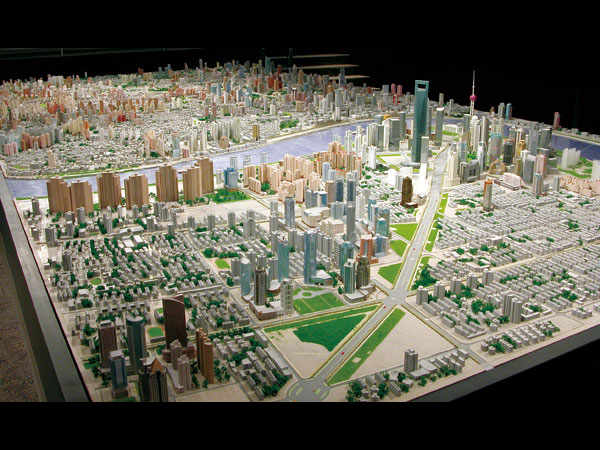
 Development is a process of enhancement of quality of life through production, provision and utilization of goods and services with people’s choice and environmental sustainability. Developmental planning is the process of organizing resources, people and their activities over space and time to achieve some objectives. 

For a successful town planning there must be a plan which envisages the entire town as a single unit. The development or expansion of a town takes a long time and therefore, the development is required to be controlled at any time on the basis of a plan. Such a plan is called as Development Plan or Master Plan. The development plan is generally prepared to improve the old conditions of the town but it is also equally necessary for the new cities to be planned and built on virgin land. e.g. New Delhi, Gandhinagar, Chandigarh, etc. A development plan is an ideal plan showing the full development of the town at some future date. A master plan or a development plan or a town plan may be defined as a general plan for the future layout of a city showing both the existing and proposed streets or roads, open spaces, public buildings etc. A master plan is prepared either for improvement of an old city or for a new town to be developed on a virgin soil. A master plan is a blueprint for the future. It is an comprehensive document, long range in its view, that is intended to guide development in the township for the next 10 to 20 years. Urban planning involves forecasting future population growth and planning for possible changes. Planners consider rate of growth, rates of natural increases and migration, age profile of the forecasted population, housing types and employment services required for making proposals. To be successful the development planning process must be:

  • Visionary and realistic i.e. it must raise the aspirations for the people and area and provide a vehicle for consensus building and implementation 
  • Fully integrated into land use planning system, but also allow new uses and market opportunities to exploit the full development potential of the area 
  • A flexible process, providing the basis for negotiation and dispute resolution 
  • A participative process, providing all the stakeholders with a means of expressing their needs and priorities 
  • Equally applicable to rethinking the role, function and form of existing neighborhoods as creating new neighborhoods. 
Development Plans are prepared to achieve an orderly growth of urban settlement which forms part of the regional plans. Jurisdiction of the development plans are normally urban areas in the case of smaller urban settlements and it includes the surrounding inter dependent areas in the case of major urban settlements. The plan period for such development plan is generally 15 to 20 years. Here also the population for the plan period is projected and the spatial extent for not only the existing population but also for the future population is given in the plan. It is necessary that development plans also prioritize and phase out the developments. As in the regional plans, the agencies for planning, monitoring and implementation are identified. Such development plans contain the following in detail:
  • The manner in which land in the planning area shall be used 
  • Allotment and reservation of land for residential purpose, commercial purpose, industrial purpose, agricultural purpose, parks, play fields and open spaces, improvement and conservation of urban renewal areas and amenities, services and utilities 
  • Provision of areas for housing, shopping, industries, civic amenities and health, educational and cultural facilities 
  • Control of architectural features 
  • Provision of zoning regulation 
  • Phasing of development proposals
A development plan is a document which details the overall strategy of the council for the proper planning and sustainable development of an area and generally consists of a written statement and accompanying maps. The plan usually includes the broad aims of the council for specific topics, e.g. housing, infrastructure, community facilities which are reinforced by more detailed policies and objectives. A human settlement is a living organism and has an origin, growth, decay and regrowth. The settlement is subjected to various types of forces like physical, social, economical and political, which influence its form ad structure. It is necessary to channelize these forces in a planned manner to create such environment which is healthy, efficient and satisfying for working, living and recreation. The developmental plan is an instrument to achieve these objectives.

How to be emotionally strong and independent

Hello friends, today we are going to tell you about How to be emotionally strong and independent. If you want to be mentally strong then this information is going to be very useful for you.

Recently people become mentally weak due to many different reasons and they get to see many bad consequences of this, in such a situation everyone wants that they remain mentally fit and for this people also make many different efforts. We are going to tell you a very special and useful way in this article about How to be emotionally strong and independent, by which you can become mentally strong in a very short time.

How to be emotionally strong and independent


how to be emotionally strong and independent


If you want to become mentally strong, then for this you have to work very hard and you have to adopt the right method, only then you can stay mentally fit, there are many different ways that you can adopt, we will give you that Will tell all the ways which can make you emotionally strong in a short time, for this you can adopt these methods.

Never feel weak

Often a person’s mental weakness starts from there when he starts to consider himself weak, if you want to become mentally strong then you have to practice it yourself and if you consider yourself weak then from today Stop thinking that you are weak, rather think that you are physically and mentally fitter than many people.

Often people come under such negative feelings in their mind, they come under their emotions and even after everything is right, they see a lot of flaws in themselves, sometimes it is related to feelings only, so in this situation, you have to take care of yourself. It is very important to change your thinking and sometimes you make a mistake, then think that every person makes a mistake and in return for that mistake, you will see everyone doing a lot less.

Always be happy

You should be happy in every situation, often there are many good and hard situations in a person’s life, due to which there are changes like the person etc. If you learn to be happy, then it directly affects your mental state and you start getting mentally fit due to being happy, so, first of all, you have to make a habit of being happy always, if there is any problem then this is Think that that problem is not forever and very soon that problem will also go away, in this way you will be able to keep yourself happy.

Be prepared for a bad situation

Often many people have this flaw that they are always preparing for a good situation, while they never think about the bad situation, but if you are doing any work etc. then you have to give yourself both good and bad situation. It should be prepared so that whenever the result is contrary to your thinking and you get to see its bad results, you can always be ready for it and you do not have to be mentally disturbed because of it.

Learn to change according to the situation

Recently, you get to see a lot of changes happening in everything and a lot changes with time, in such a situation, it is very important to make changes over time to stay mentally fit, if you change your behaviour with time. And if you bring a change in thinking, then it will make you feel very good mentally and with time, you also remain mentally fit, so you need to make changes time.

Overcome your fear

Many times a person becomes very weak mentally due to the fear of his mind and if you have any kind of fear etc. After that, you will feel very active and your stress will also go away from it, along with removing the fear inside you, you get to see many benefits and you will start feeling very fit and good mentally as well.

Become independent

As long as you are on the support of others, you will never be able to keep yourself mentally fit and for this, you will have to learn to depend on yourself and the more self-reliant you are, the better person you will become mentally, often many people Like to be self-reliant to keep himself mentally fit and strong.

You can take any decision by yourself by becoming self-reliant and can think about it, along with this you can live your life according to your rules, due to this you will start feeling very good and strong mentally.

Keep learning something

A person should never stop the process of learning in his life and it is very important to always keep learning something new for those who want to be mentally strong.

It is important that the more you learn, the better it will prove to be for you and you can achieve the same great success in your life, if you get to learn anything good from anywhere, then always keep your focus on learning that thing. And whatever you learn can prove to be very useful in your life.

Forget the old

Often the past a person has gone through many different incidents, many times a person gets into a lot of stress about old things in his life even if he does not want to, and due to this you can become very weak mentally and you may become mentally weak. To be strong, it is very important to forget the old things, if you keep on forgetting the old things, then only you can stay mentally fit, and if you keep getting lost in the old things, then you will never be able to be happy in your life. Nor will you be able to become mentally strong.

Conclusion – In this article, we have given you information about How to be emotionally strong and independent, we hope that you have found the information given by us useful, if you like the information, then do share it on social media and want to ask any kind of question-related to it. So you can tell us through comments etc.

Korean wave in India.

The  Korean wave has certainly seen a significant  rise in India during the pandemic, and K-Drama and K-Pop are seeing massive demand from fans and new followers as well. In response to the growing popularity of the Korean wave in the country, many  online and offline events are held to show people  what they are consuming online. And these extend not only  to K-Drama and K-Pop, but also  to food, beauty and culture in general.
Korean singer PSY’s 2012 viral hit “Gangnam Style” may have started the Korean wave in India, but it certainly wasn’t the origin. The existence of K-POP in India dates back to the late 90’s when in Northeastern part  in Manipur Bollywood films were not allowed to watch because law imposed by the Separatist group Revolutionary Peoples Front to make Manipur independent.Not so much offered, the locals turned to Korean content and it got it’s popularity from their on.

Increasing demand for Korean content is fueling competition between India’s Amazon Prime Video and Netflix. Amazon Prime Video is the first company to launch Parasite and Minari in the country. Hotstar, MX Player, Viki and Viu are also involved in the Korean wave effect. Discovery + launched the “Star vs Food” series featuring the Korea Tourism Organization (KTO) and K-POP idols to introduce Korean food to India. Some prominent dramas are: Crash Landing on You, Squid Games, Descendants of the Sun and many more more , the reason of these Korean content popularity is that as an audiance, Indian’s  find Korean content relatable to them.

According to Hyun Woo, Kross Komix co-founder, president and CEO Thomas Kim predicts that South Korea’s webtoon, or digital comics, will be the next big thing.Kross Komics is India’s only webtoon platform  launched in December 2019. In just about 1.5 years of operation, the app has been downloaded more than 4.5 million times, about half of which are women. “With the numerous webtoons in the romance / romantic comedy category and the world’s best-selling stories, this new format of content has become a very interesting alternative to the dramas and movies”.

“In 2020, the blockade caused by Covid-19 is said to be one of the reason to the popularity and acceptance of Korean culture in India through dramas available on multiple video streaming platforms and the different Korean music band whose craze is extraordinary. South Korea’s food exports hit a record high,  boosted by social media posts from Asian celebrities and the popularity of the movie like “Parasite” and drama like”Crash Landing on You”. The widespread  of k-pop, k-movies, and k-drama has evolved into a  fan culture, especially among the  urban youth of the country. Following k-pop music and movies, K-Food and cooking have undergone a major makeover to reach the larger Indian market. K-cuisine is all the rage, especially on social media, in the form of food challenges like Mukbang, “said Hwang Il-young, director of the Korean Culture Center India .

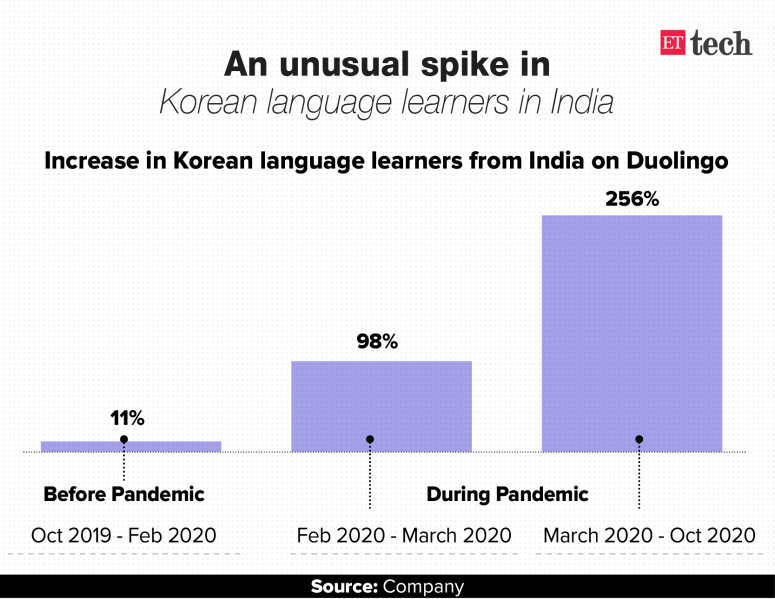
The Korean wave,  the growing global popularity of  Korean culture, swept India a few years ago, but  exploded during a pandemic. Supported by the OTT platform, which has a large investment in Korean programs, the number of people who started watching K-Drama and listening to K-Pop has skyrocketed. Recently, the language learning app Duolingo surveyed 1,013 people in 10  cities in India and found that Korean is  the fastest growing language in India. It was the 7th most popular language for Indians in 2020, but it has risen to the 5th in 2021 and will  continue to rise. Duolingo’s 2021 audio report attributed this primarily to the release of Squid Game in 2021.

Can India’s rural economy change due to revival in agriculture and cottage industry?

so what comes to your mind when you hear the words economy ,agriculture and industries ,they are somewhere linked right ?we do have a basic idea that agriculture does contribute to our country’s economy and so do these industries but how do they?

India is known as an agricultural country, as most of the population of villages depends on agriculture. Agriculture forms the backbone of the country’s economy. The agricul­tural sector contributes most to the overall economic development of the country.

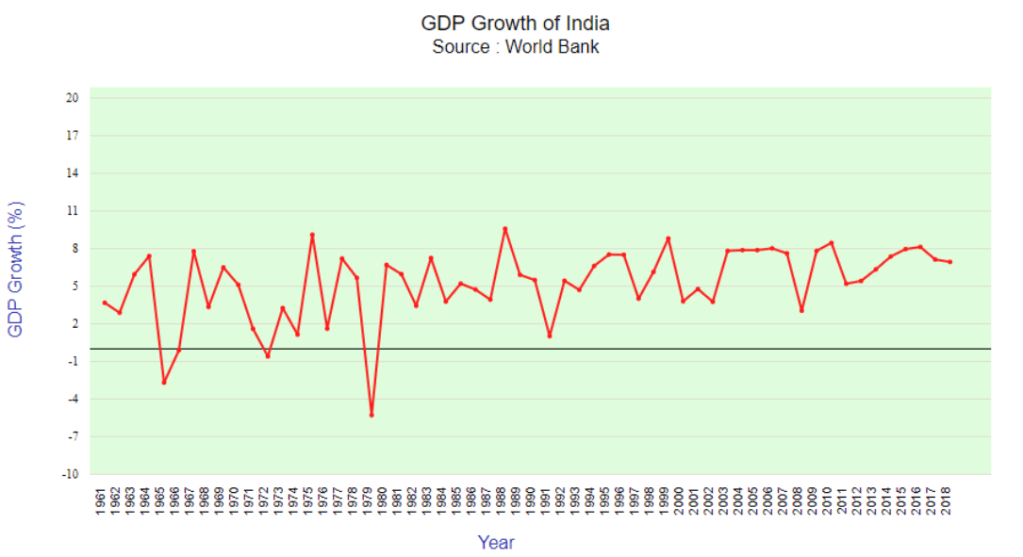
Did you know that historically, India was the  largest economy of the world for most of two millennia from the 1st until the 19th century .Since the start of the 21st century, annual average GDP growth has been 6% to 7%,and from 2013 to 2018, India was the world’s fastest major growing economy, surpassing China. . The economy slowed in 2017, due to shocks of “Demonetisation” in 2016 and the introduction of the goods and service tax in 2017.In 2020, pandemic has affected trade and India was the world’s 14th largest importer and the 21st largest exporter.

For a continuous duration of nearly 1700 years from the year 1 AD, India was the top-most economy, constituting 35 to 40% of the world GDP .Under British rule, India’s share of the world economy declined from 24.4% in 1700 down to 4.2% in 1950. India’s GDP (PPP) per capita was stagnant during the mughal empire and began to decline prior to the onset of British rule .India’s share of global industrial output declined from 25% in 1750 down to 2% in 1900. At the same time, the United Kingdom’s share of the world economy rose from 2.9% in 1700 up to 9% in 1870.

There is no doubt that our grievances against the British Empire had a sound basis. As the painstaking statistical work of the Cambridge historian Angus Maddison has shown, India’s share of world income collapsed from 22.6% in 1700, almost equal to Europe’s share of 23.3% at that time, to as low as 3.8% in 1952. Indeed, at the beginning of the 20th century, “the brightest jewel in the British Crown” was the poorest country in the world in terms of per capita income. -MANMOHAN SINGH

In the 1980s and early 1990s the tides began to change. Liberalisation came to India and a growing belief contrary to what Nehru believed, began to rise . By the turn of the 21st century, India had progressed towards a free-market economy, with a substantial reduction in state control of the economy and increased financial liberalisation .

 India experienced high growth rates, averaging 9% from 2003 to 2007. Growth then moderated in 2008 due to the global financial crisis. In 2003, Goldman Sachs predicted that India’s GDP in current prices would overtake France and Italy by 2020, Germany, UK and Russia by 2025 and Japan by 2035, making it the third-largest economy of the world, behind the US and China. India is often seen by most economists as a rising economic superpower which will play a major role in the 21st-century global economy.

India started recovery in 2013–14 when the GDP growth rate accelerated to 6.4% from the previous year’s 5.5%. The acceleration continued through 2014–15 and 2015–16 with growth rates of 7.5% and 8.0% respectively. For the first time since 1990, India grew faster than China which registered 6.9% growth in 2015. However the growth rate subsequently decelerated, to 7.1% and 6.6% in 2016–17 and 2017–18 respectively, partly because of the disruptive effects of 2016 Indian banknote demonetisation and to goods and service tax India. India’s GDP growth has been slowing rapidly, from a high of 8.3% in 2016 to just 4.2% in 2019.

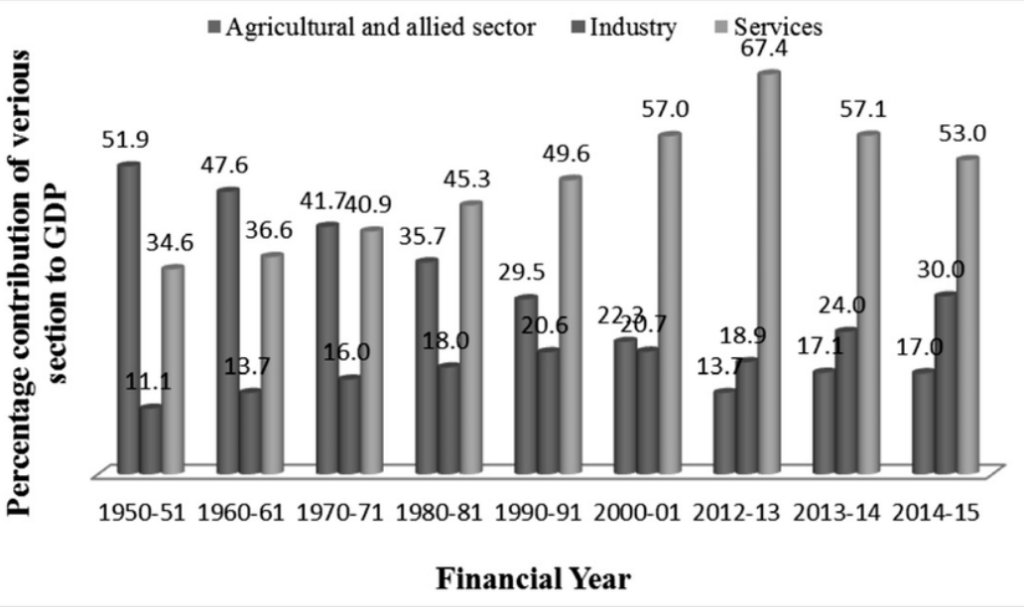
Historically, India has classified and tracked its economy and GDP in three sectors: agriculture, industry, and services.

Agriculture and allied sectors like forestry, logging and fishing accounted for 17% of the GDP, the sector employed 49% of its total workforce in 2014.Agriculture accounted for 23% of GDP, and employed 59% of the country’s total workforce in 2016. As the Indian economy has diversified and grown, agriculture’s contribution to GDP has steadily declined from 1951 to 2011, yet it is still the country’s largest employment source and a significant piece of its overall socio-economic development. Crop-yield-per-unit-area of all crops has grown since 1950, due to the special emphasis placed on agriculture in the five-year plans and steady improvements in irrigation, technology, application of modern agricultural practices and provision of agricultural credit and subsidies since the Green Revolution in India. However, international comparisons reveal the average yield in India is generally 30% to 50% of the highest average yield in the world. The states of Uttar Pradesh, Punjab, Haryana, Madya Pradesh, Andhra Pradesh, Telangana, Bihar, West Bengal, Gujarat and Maharashtra are key contributors to Indian agriculture.

At around 1,530,000 square kilometres (590,000 sq mi), India has the second-largest amount of arable land, after the US, with 52% of total land under cultivation.

Agriculture farming in India is a century-old activity, and is currently the highest contributor to the GDP of India. Agriculture remains the largest contributor to the country’s GDP and farmers constitute 58% of India’s population .Farming is one of the oldest economic activity in our country.

As per 2018, agriculture employed more than 50% of the Indian work force and contributed 17–18% to country’s GDP.

The economic contribution of agriculture to India’s GDP is steadily declining with the country’s broad-based economic growth. Still, agriculture is demographically the broadest economic sector and plays a significant role in the overall socio-economic fabric of India.

The main pillar of the rural economy is based on agriculture. Agricultural land and livestock are the primary means of production for people of the rural areas in any society. Livestock farming consists of the major part of the economy of the majority of people. It relies typically on labor-intensive methods for raising crops and healthy livestock. Livestock feed is shipped all over the country, and land is frequently needed for cultivation, farrowing, watering, and other activities.

 The advent of modern technology has also revolutionized the agriculture sector. Farmers are adopting more sophisticated techniques to get more production from small pieces of land. So the use of advanced techniques is urging the farmers to focus on small land in order to get more production. But the farmers also need support from the government and also they need help in hard times like no enough rainfall or over rainfall etc. The government must extend a helping hand towards the farmers ,they are the ones who work selflessly and for the sake of the whole country’s population and they do not worry about in which season they are working in ,they put all their hard work and efforts into their work and they are the ones who worship their proffesion .

The rural economy mainly depends upon agriculture. Even though traditional farming still exists, the use of advanced technology has revolutionized the agriculture sector. It has proved a blessing for small-scale farmers. They can adopt modern agricultural techniques to get more produce from their small farms. Organic farming is another window of opportunity for farmers. They can grow more food to generate better revenue. 

The cottage industry or the small scale industry plays a vital role in the rural economy of India. Majority of the population of India lives in rural areas; it is where the real India resides. Apart from agriculture, the cottage industry is the primary source of livelihood in rural India. Cottage industry or the small scale industry are those where the business is carried on at home with small numbers of workforce or labours . the members may be of the same family, religious groups or the community. Most of the workers of the small scale industry are the traditional artisans who have inherited their work as art from their ancestors.

In India, more than 74 per cent of the total population lives in the villages where their lot is linked with agriculture. They have to live in the villages as they cannot leave their fields which give them their ‘living’. Side by side they must be provided with some kind of cottage industries upon which they can depend during that period in which they remain idle and unengaged’.

After independence, our country has been taking gigantic strides towards industrialisation. Cottage industries can become and alternative means of employment for the people living in the rural areas. Cottage industries will be of benefit for our villages, which form the back bone of the nation.

The place of cottage industries in the national economy in the country has been unique since time immemorial. India was famous, in the past, for the wealth of the land and for the high artistic skill of her craftsmen. India was exporting wonderful jewellery and superfine embroideries to Europe. European merchants were attracted towards India more by her craft and industry than by the rich raw material.

It must not be forgotten that cottage industries are the back-bone of our rural economy and no rural uplift is possible without the protection of and encouragement to these small-scale industries. Apart from all other considerations, small-scale or cottage-industries are essential for providing employment to our tillers of soil in their leisure time or when they remain idle.

To improve and encourage the cottage-industry in our country we have to change the views of the general public. The people should be made interested in patronizing home-made goods. A ready market is a further urgency in this direction.

Rural Co-operatives and Rural Banks should be established and stabilized by the Government for advancing short-term loans on nominal interest.

Lastly, adequate marketing facilities should be arranged for them, as sale of goods has now-a-days become as complicated an affair as production itself.

Hence, the artisans must be helped to get the best price of their goods. Frequent exhibitions should be organized to enable the artisans to show their art and industry and give them impetus and inspiration to create still better patterns of handicrafts.

Basically the agriculture and cottage industries are the main sources of livelihood in India and they contribute most to our economy , we all know that these both professions are being practiced from very long period of time ,like around some centuries in India ,they have been contributing to the country’s economy from very beginning. the rural economy’s most percentage is received from agriculture and cottage industry and without their contribution our country’s economy might destroy or decline very rapidly ,even a small change in their contribution percentage might affect the economy of country ,but its economy right and GDP ,it wont stay constant there are many ups and downs ,in a year our GDP might good where as in the other it might be bad we cannot predict that ,there might be various reasons for the decline of GDP, like in 2017 it was demonitisation and in 2020 the pandemic hit us and it affected the whole world’s economy , and India’s GDP has been declined by 23.9% by 2020.

Agriculture and cottage industry are major contribution of rural economy , and for these people if government is trying to extend a helping hand to them then probably our economy might go to better figures and it’s a fact that our rural economy can be developed by agriculture and cottage industries and the Rural Economy in India is wholly agriculture based and it is of tremendous importance because it has vital supply and demand links with the other Indian industries. Agriculture is the main stay of the Indian economy, as it constitutes the backbone of rural India which inhabitants more than 70% of total Indian population.

Can India's rural economy change due to revival in agriculture and cottage industry?

so what comes to your mind when you hear the words economy ,agriculture and industries ,they are somewhere linked right ?we do have a basic idea that agriculture does contribute to our country’s economy and so do these industries but how do they?

India is known as an agricultural country, as most of the population of villages depends on agriculture. Agriculture forms the backbone of the country’s economy. The agricul­tural sector contributes most to the overall economic development of the country.

Did you know that historically, India was the  largest economy of the world for most of two millennia from the 1st until the 19th century .Since the start of the 21st century, annual average GDP growth has been 6% to 7%,and from 2013 to 2018, India was the world’s fastest major growing economy, surpassing China. . The economy slowed in 2017, due to shocks of “Demonetisation” in 2016 and the introduction of the goods and service tax in 2017.In 2020, pandemic has affected trade and India was the world’s 14th largest importer and the 21st largest exporter.

For a continuous duration of nearly 1700 years from the year 1 AD, India was the top-most economy, constituting 35 to 40% of the world GDP .Under British rule, India’s share of the world economy declined from 24.4% in 1700 down to 4.2% in 1950. India’s GDP (PPP) per capita was stagnant during the mughal empire and began to decline prior to the onset of British rule .India’s share of global industrial output declined from 25% in 1750 down to 2% in 1900. At the same time, the United Kingdom’s share of the world economy rose from 2.9% in 1700 up to 9% in 1870.

There is no doubt that our grievances against the British Empire had a sound basis. As the painstaking statistical work of the Cambridge historian Angus Maddison has shown, India’s share of world income collapsed from 22.6% in 1700, almost equal to Europe’s share of 23.3% at that time, to as low as 3.8% in 1952. Indeed, at the beginning of the 20th century, “the brightest jewel in the British Crown” was the poorest country in the world in terms of per capita income. -MANMOHAN SINGH

In the 1980s and early 1990s the tides began to change. Liberalisation came to India and a growing belief contrary to what Nehru believed, began to rise . By the turn of the 21st century, India had progressed towards a free-market economy, with a substantial reduction in state control of the economy and increased financial liberalisation .

 India experienced high growth rates, averaging 9% from 2003 to 2007. Growth then moderated in 2008 due to the global financial crisis. In 2003, Goldman Sachs predicted that India’s GDP in current prices would overtake France and Italy by 2020, Germany, UK and Russia by 2025 and Japan by 2035, making it the third-largest economy of the world, behind the US and China. India is often seen by most economists as a rising economic superpower which will play a major role in the 21st-century global economy.

India started recovery in 2013–14 when the GDP growth rate accelerated to 6.4% from the previous year’s 5.5%. The acceleration continued through 2014–15 and 2015–16 with growth rates of 7.5% and 8.0% respectively. For the first time since 1990, India grew faster than China which registered 6.9% growth in 2015. However the growth rate subsequently decelerated, to 7.1% and 6.6% in 2016–17 and 2017–18 respectively, partly because of the disruptive effects of 2016 Indian banknote demonetisation and to goods and service tax India. India’s GDP growth has been slowing rapidly, from a high of 8.3% in 2016 to just 4.2% in 2019.

Historically, India has classified and tracked its economy and GDP in three sectors: agriculture, industry, and services.

Agriculture and allied sectors like forestry, logging and fishing accounted for 17% of the GDP, the sector employed 49% of its total workforce in 2014.Agriculture accounted for 23% of GDP, and employed 59% of the country’s total workforce in 2016. As the Indian economy has diversified and grown, agriculture’s contribution to GDP has steadily declined from 1951 to 2011, yet it is still the country’s largest employment source and a significant piece of its overall socio-economic development. Crop-yield-per-unit-area of all crops has grown since 1950, due to the special emphasis placed on agriculture in the five-year plans and steady improvements in irrigation, technology, application of modern agricultural practices and provision of agricultural credit and subsidies since the Green Revolution in India. However, international comparisons reveal the average yield in India is generally 30% to 50% of the highest average yield in the world. The states of Uttar Pradesh, Punjab, Haryana, Madya Pradesh, Andhra Pradesh, Telangana, Bihar, West Bengal, Gujarat and Maharashtra are key contributors to Indian agriculture.

At around 1,530,000 square kilometres (590,000 sq mi), India has the second-largest amount of arable land, after the US, with 52% of total land under cultivation.

Agriculture farming in India is a century-old activity, and is currently the highest contributor to the GDP of India. Agriculture remains the largest contributor to the country’s GDP and farmers constitute 58% of India’s population .Farming is one of the oldest economic activity in our country.

As per 2018, agriculture employed more than 50% of the Indian work force and contributed 17–18% to country’s GDP.

The economic contribution of agriculture to India’s GDP is steadily declining with the country’s broad-based economic growth. Still, agriculture is demographically the broadest economic sector and plays a significant role in the overall socio-economic fabric of India.

The main pillar of the rural economy is based on agriculture. Agricultural land and livestock are the primary means of production for people of the rural areas in any society. Livestock farming consists of the major part of the economy of the majority of people. It relies typically on labor-intensive methods for raising crops and healthy livestock. Livestock feed is shipped all over the country, and land is frequently needed for cultivation, farrowing, watering, and other activities.

 The advent of modern technology has also revolutionized the agriculture sector. Farmers are adopting more sophisticated techniques to get more production from small pieces of land. So the use of advanced techniques is urging the farmers to focus on small land in order to get more production. But the farmers also need support from the government and also they need help in hard times like no enough rainfall or over rainfall etc. The government must extend a helping hand towards the farmers ,they are the ones who work selflessly and for the sake of the whole country’s population and they do not worry about in which season they are working in ,they put all their hard work and efforts into their work and they are the ones who worship their proffesion .

The rural economy mainly depends upon agriculture. Even though traditional farming still exists, the use of advanced technology has revolutionized the agriculture sector. It has proved a blessing for small-scale farmers. They can adopt modern agricultural techniques to get more produce from their small farms. Organic farming is another window of opportunity for farmers. They can grow more food to generate better revenue. 

The cottage industry or the small scale industry plays a vital role in the rural economy of India. Majority of the population of India lives in rural areas; it is where the real India resides. Apart from agriculture, the cottage industry is the primary source of livelihood in rural India. Cottage industry or the small scale industry are those where the business is carried on at home with small numbers of workforce or labours . the members may be of the same family, religious groups or the community. Most of the workers of the small scale industry are the traditional artisans who have inherited their work as art from their ancestors.

In India, more than 74 per cent of the total population lives in the villages where their lot is linked with agriculture. They have to live in the villages as they cannot leave their fields which give them their ‘living’. Side by side they must be provided with some kind of cottage industries upon which they can depend during that period in which they remain idle and unengaged’.

After independence, our country has been taking gigantic strides towards industrialisation. Cottage industries can become and alternative means of employment for the people living in the rural areas. Cottage industries will be of benefit for our villages, which form the back bone of the nation.

The place of cottage industries in the national economy in the country has been unique since time immemorial. India was famous, in the past, for the wealth of the land and for the high artistic skill of her craftsmen. India was exporting wonderful jewellery and superfine embroideries to Europe. European merchants were attracted towards India more by her craft and industry than by the rich raw material.

It must not be forgotten that cottage industries are the back-bone of our rural economy and no rural uplift is possible without the protection of and encouragement to these small-scale industries. Apart from all other considerations, small-scale or cottage-industries are essential for providing employment to our tillers of soil in their leisure time or when they remain idle.

To improve and encourage the cottage-industry in our country we have to change the views of the general public. The people should be made interested in patronizing home-made goods. A ready market is a further urgency in this direction.

Rural Co-operatives and Rural Banks should be established and stabilized by the Government for advancing short-term loans on nominal interest.

Lastly, adequate marketing facilities should be arranged for them, as sale of goods has now-a-days become as complicated an affair as production itself.

Hence, the artisans must be helped to get the best price of their goods. Frequent exhibitions should be organized to enable the artisans to show their art and industry and give them impetus and inspiration to create still better patterns of handicrafts.

Basically the agriculture and cottage industries are the main sources of livelihood in India and they contribute most to our economy , we all know that these both professions are being practiced from very long period of time ,like around some centuries in India ,they have been contributing to the country’s economy from very beginning. the rural economy’s most percentage is received from agriculture and cottage industry and without their contribution our country’s economy might destroy or decline very rapidly ,even a small change in their contribution percentage might affect the economy of country ,but its economy right and GDP ,it wont stay constant there are many ups and downs ,in a year our GDP might good where as in the other it might be bad we cannot predict that ,there might be various reasons for the decline of GDP, like in 2017 it was demonitisation and in 2020 the pandemic hit us and it affected the whole world’s economy , and India’s GDP has been declined by 23.9% by 2020.

Agriculture and cottage industry are major contribution of rural economy , and for these people if government is trying to extend a helping hand to them then probably our economy might go to better figures and it’s a fact that our rural economy can be developed by agriculture and cottage industries and the Rural Economy in India is wholly agriculture based and it is of tremendous importance because it has vital supply and demand links with the other Indian industries. Agriculture is the main stay of the Indian economy, as it constitutes the backbone of rural India which inhabitants more than 70% of total Indian population.

Green initiatives undertaken for the development of Green Ports & Green Shipping in India

 Union Minister for Ports, Shipping and Waterways Shri Sarbanand Sonowal chaired a meeting with all major ports, Cochin shipyard Limited (CSL) and IWAI (Inland waterways Authority of India) to review the progress on various green initiatives being implemented, as per Maritime India Vision(MIV) 2030, for the development of Green Ports & Green Shipping in India. 

Shri Sonowal reviewed the progress of initiatives undertaken for development of green ports planned under Maritime India Vision 2030. As part of MIV 2030, Total of 963 initiatives have been identified for implementation across major ports with an estimated investment of Rs. 6,77,720.24 crores, of which a total of 208 initiatives with estimated investment of Rs. 44,424.47 crores have been completed in FY 2021. Further 504 initiatives with estimated investment of Rs. 48,256.14 crores are under implementation.

A number of initiatives have been taken in India to promote green ecosystem in maritime sector. These are in line with International Maritime Organization (IMO)’s 2030 Decarbonization strategy and 2050 Green House Gases (GHG) strategy. Initiatives are being implemented by Major Ports of India that include areas, such as increase share of renewable energy to more than 60% across major ports by 2030, setting up of solar power plants, availing of shore power supply to vessels via berths, multi-clean fuel adoption for vehicles within port ecosystem, gradual phasing out of diesel locomotives at ports, etc.

The green port initiatives include acquisition of equipments for monitoring environmental pollution, acquisition of dust suppression systems, setting up of sewage/ waste water treatment plants, setting up of garbage disposal system for ports and ships, developing shore reception facility for wastes from ships, setting up projects for energy generation from renewable energy sources, providing shore power to ships at berths, creating Oil Spill Response (Tier-1) capabilities at all ports, taking actions to improve harbour water quality, inclusion of sustainable practices in terminal design, development and operation, increasing green cover within port premises etc.


Ministry is also working on draft of a “Green Port Policy” document to suggest framework and guidelines for incorporation of green initiatives in the port sector. The Policy document captures the focused areas, measured outcomes, implementation roadmap and cost recovery mechanism for the port operators and port authorities. The proposed target outcomes will help India in achieving the “Intended Nationally Determined Contributions (INDCs) target, as well as the International Maritime Organization (IMO) 2030 target.

In order to enhance the share of Green Shipping, various projects are being implemented by Cochin Shipyard Ltd., India’s largest shipbuilding and maintenance facility. These include green urban mobility solutions like Hybrid Electric Ferries, autonomous Zero-emission vessels, pilot project on Hydrogen Fuel Cell Ferry, Electric Catamaran Water Taxi, Hybrid Electric Ro-Ro, Hybrid LNG-Electric Inland Cargo Carrier, Hybrid Tugs, etc.

Possibilities are also being explored for deployment of fully electric ferry and hydrogen fuelled ferries on Inland Waterways for enhancement of river cruise tourism in the country. For instance, Electric Catamaran Water Taxi deployment is being considered at Varanasi and Guwahati in first phase. Additionally, use of Hybrid Electric Roll on -Roll off (Ro-Ro) vessels having dual fuel system (LNG+ battery) is being considered at Guwahati for river crossings. Use of Hybrid LNG-electric Inland Cargo Carrier vessels is also being considered on NW2 and NW1 . Possibility of deploying CNG vessels at Varanasi is also being explored.

The pace at which the Green initiatives are undertaken by the 12 major ports will surely bring a green revolution in the sector making the ports cleaner and greener, which is also a key component of ‘Blue Economy’, creating environmental benefits and balancing the investments and cash flow.

In his concluding Remarks, Shri Sonowal thanked all officials for their crucial contribution towards realization of Prime Minister’s Vision for Indian Maritime Sector. He further directed all Ports to take the Green Initiatives forward by putting dedicated proactive efforts towards greening of maritime sector including finalization of green port policy.

****

Eliminating the barriers of the progress of the country

 The DMs shared their experience which has led to improvement of performance of their districts on a host of indicators. The Prime Minister sought direct feedback from them about the key steps taken by them which has resulted in success in the districts, and about the challenges faced by them in this endeavour. He also asked them about how working under the aspirational districts programme has been different from their work done earlier. The officers discussed how JanBhagidari has been a key factor behind this success. They spoke about how they kept people working in their team motivated on a daily basis, and made efforts to develop the feeling that they were not doing a job but were performing a service. They also spoke about increased inter-departmental coordination and benefits of data driven governance. 

If you wish to get solutions for your electrical need, you can visit at https://lyntec.com/

CEO, NITI Aayog gave an overview of the progress and implementation of the Aspirational District programme. He mentioned how the programme leveraged competitive and cooperative federalism, driven by a Team India spirit. The efforts have resulted in these districts performing remarkably better in every parameter, a fact which has been recognized independently by global experts as well. The best practises like smart classroom initiative from Banka, Bihar; Mission Aparajita to prevent child marriages in Koraput, Odisha etc. were replicated by other districts as well. Analysis of performance of districts vis-a-vis stability of tenure of key officials of the district was also presented.

Rural Development Secretary gave a presentation on a mission to uplift 142 selected districts, on the lines of the focussed work done in the aspirational districts. Centre and State will work together to uplift these identified districts to address the pockets of under-development. 15 sectors corresponding to 15 Ministries and Departments were identified. In the sectors, key performance indicators (KPIs) were identified. The aim of the government is to ensure that the KPIs in the selected districts surpass the state average in the next one year and that they come at par with national average in two years. Each concerned Ministry/Department has identified its set of KPIs, on the basis of which, districts were selected. The initiative is aimed at achieving saturation of various schemes by various departments in the districts in mission mode, in convergence with all stakeholders. Secretaries of various Ministries and Departments presented an overview of an action plan about how their ministries will go about in achieving these targets.

Addressing the officials, the Prime Minister noted that when the aspirations of others become your aspirations, when fulfilling the dreams of others becomes the measure of your success, then that path of duty creates history. Today we are seeing this history being made in the aspirational districts of the country, he added.

The Prime Minister noted that various factors led to a situation where aspirational districts, in the past, started lagging behind. In order to facilitate holistic development, special hand-holding was done for the aspirational districts. The situation has changed now as today, Aspirational Districts are eliminating the barriers of the progress of the country. The Aspirational Districts are becoming an accelerator instead of an obstacle. The Prime Minister underlined the expansion and redesigning that has taken place due to the campaign in the Aspirational Districts. This has given a concrete form to the federal spirit and culture of the Constitution, the basis of which is the team work of centre-state and local administration, the Prime Minister said.

The Prime Minister stressed that for development in aspirational districts, a direct and emotional connect between the administration and the public is very important. A sort of ‘top to bottom’ and ‘bottom to top’ flow of governance. Important aspect of this campaign is technology and innovation, he said. The Prime Minister also mentioned districts where excellent results have been obtained by the use of technology and innovation in the fields like malnutrition, clean drinking water and vaccination.

The Prime Minister noted that convergence is a major reason for the country’s success in the aspirational districts. All resources are the same, government machinery is the same, officials are the same but the results are different. Seeing the entire district as a unit enables the officer to feel the enormity of her efforts and give a sense of purpose of life and satisfaction of bringing meaningful change.

The Prime Minister noted that during the last 4 years, Jan-Dhan accounts have increased by 4-5 times in almost every aspirational district. Almost every family has got a toilet and electricity has reached every village. A new energy has been infused in people’s lives, he said. The Prime Minister said due to a tough life the people of Aspirational Districts are more hard-working, courageous and capable of taking risks and this strength should be recognized.

The Prime Minister remarked that aspirational districts have proved due to the elimination of silos in implementation optimum utilisation of resources takes place. He emphasized the exponential benefits of this reform and said when silos end, 1+1 doesn’t become 2, 1+1, becomes 11. We see this collective power in the Aspirational Districts today, the Prime Minister said. Elaborating on the approach of governance in the Aspirational Districts, the Prime Minister said that, firstly, people were consulted in identification of their problems. Second, the working style kept on being refined on the basis of experiences in the Aspirational Districts and measurable indicators, real time monitoring of progress, healthy competition among the districts and replication of good practices were encouraged. Thirdly, through reforms like stable tenures of the officers, creation of effective teams was encouraged.  THis helped in getting big results even with limited resources. The Prime Minister asked for developing detailed guidelines for field visits, inspections and night halts for proper implementation and monitoring.  

The Prime Minister drew the attention of the officers towards the changed mindset of New India. He reiterated that today, during the Azadi ka Amrit Kaal, the country’s goal is to achieve 100% saturation of services and facilities. That is, we have a long way to go compared to the milestones we have achieved so far and have to  work on a much bigger scale. He stressed time-bound targets for taking roads to all the villages of the districts, ayushman cards, bank account  to every person, Ujjwala gas connection, insurance, pension housing for everyone. He called for a two year vision for every district. He suggested that every district can identify 10 tasks to be completed in the next 3 months to improve ease of living for common people. Similarly, 5 tasks may be associated with the Azadi Ka Amrit Mahotsav to achieve historical success in this historical epoch.

The Prime Minister said the country is witnessing a silent revolution in the form of Digital India. No district should be left behind in this. He stressed the importance for digital infrastructure reaching every village and becoming a means of door-step delivery of services and facilities. He asked NITI Aayog to devise a mode of regular interaction between the district DMs. Central Ministries were asked to document the challenges of these districts. 

The Prime Minister said various ministries and departments of the government have prepared a list of 142 districts which are not so much lagging in development but are weak on one or two parameters. The Prime Minister emphasized the need to  work with the same collective approach as is being done in the Aspirational Districts. “This is a new challenge for all the governments- the government of India, the state government, the district administration, and the government machinery. Now we have to complete this challenge together”, Shri Modi said

The Prime Minister urged the Civil Servants to remember their first day in their Services and recall the passion and urge to serve the country. The Prime Minister asked them to move forward with the same spirit.