To reduce the dominance of e-commerce giants like Flipkart and Amazon, the government rolled out its big initiative — Open Network for Digital Commerce (ONDC) — for public in Bengaluru. With the help of ONDC, government plans to help small retailers and create an alternative to dominant global giants like Amazon and Walmart, who controls over half of India’s fast-growing e-commerce market.
The platform aims to create new opportunities, curb digital monopolies and by supporting micro, small and medium enterprises and small traders and help them get on online platforms. It is an initiative of the Department for Promotion of Industry and Internal Trade (DPIIT) under the Ministry of Commerce and Industry.
The government says existing platforms work in silos and are tightly controlled, keeping out many small players. It expects ONDC to increase competition and foster innovation by start-ups. It also hopes to bring in logistics firms and others who can collaborate with sellers to deliver products to customers.
The focus would be on small merchants and rural consumers, with apps in Indian languages. ONDC officials liken the network to a mall with 1,000 gates instead of just two, thereby limiting opportunities for selected sellers to receive preferential treatment – a common accusation against major e-commerce companies. Users will be able to rate service providers on ONDC, which will be applicable and visible across the network. The government says ONDC will help to end “predatory pricing, especially in high-margin, high-value products”. Amazon and Flipkart deny that they have engaged in predatory pricing.
How does ONDC work?
The ONDC platform lies in the middle of the interfaces hosting the buyers and the sellers. So far, the buyer side interface is being hosted by Paytm, whereas the seller side interface is being hosted by other players like GoFrugal, etc.
When a buyer searches for an item on the Paytm app, from where ONDC has gone live, the app will connect to the ONDC platform, which will connect it to seller side interfaces that will list all the companies from where you can buy the particular item.
On ONDC, there will be several other backend partners such as logistics service providers, enterprise resource planners, e-commerce store hosting service providers, etc.
Covid-19 worldwide pandemic was one of the 2020’s defining events and it still is. It has changed everything even the e-commerce world. The internet and e-commerce industries have grown amid the COVID-19 issue and experienced extraordinary and unexpected development.
Many restaurants, pubs, movie theatres, and gyms are closing in major cities. Meanwhile, many office workers are encountering new problems as they transition to full-time remote employment. However, People are adjusting to the reality of our interconnected society and the difficulty of briefly separating oneself from others. It would be an understatement to suggest that we are living in extraordinary times. In these times, lockdowns became the latest trend therefore, companies and customers progressively “went digital,” and started delivering and purchasing more products and services over the internet which in turn boosted e-share commerce’s of global retail trade from 14% in 2019 to almost 17% in 2020 as per the statistics. The epidemic has sped up the transition from physical to digital purchasing by around five years.
Customers are avoiding public locations, and non-essential enterprises are being forced to close in these trying times due to covid-19 situation where cities are going under lockdowns. Shopping for only the bare necessities is becoming the new normal. So, To satisfy shifting requirements, brands are adapting and becoming adaptable by consumers.
Millions of individuals turned to e-commerce platforms this year, not only in metropolitan area but also in tier III and beyond, due to the need for social distance and prioritizing safety during the epidemic, according to companies like Amazon and Flipkart as well as industry analysts. It is expected that the coronavirus pandemic influence will increase e-commerce business by 84% to $111 billion by 2024. Mobile shopping will fuel India’s e-commerce sector, which is expected to increase at a rate of 21% annually over the next four years. The most common payment methods online in 2020 were digital wallets, credit cards, and debit cards. As well all know that Physical retail has merged with the digital world and e commerce capacity is no longer restricted to traditional websites. Consumers are becoming habitual with this e-commerce world and want the same hassle-free and convenient shopping experience whether they purchase via an app, through their social feeds, or in person in near future.
However, despite several governments’ attempts during the COVID-19 crisis to promote e-commerce, persisting digital inequalities mean that not everyone has been able to participate. Furthermore, in the event of growing universal sales models or novel modes of delivery, rules that are not suited to e-commerce might create hurdles for businesses. While many of these issues existed before to COVID-19, the present crisis, as well as the growing role of e-commerce for consumers and businesses, has increased the need for governmental intervention.
Systemic issues in connection, financial inclusion, skills, and trust (for instance- digital security, privacy, and consumer protection) have been brought to the forefront for consumers. To solve this issue, governments may provide rural and underdeveloped areas with inexpensive and high-quality internet, improve financial inclusion, and encourage trust and the development of skills needed to participate in e-commerce.
Governments must also maintain fair system in the context of online platforms. It’s also critical to provide enough competition in the retail sector and a well-functioning enabling environment for e-commerce, which includes communication services, logistics, and trade.
As the Economist Joseph Schumpeter said Entrepreneurs can’t sit idle and try to innovate. They are the people who have an uncanny sense of using the resources from less productive use to more productive use. They are the ones who do Value creation, this is what we call innovation.
E-commerce belongs to this generation and Technology is irreversible; no one can hold it back and only curiosity won’t help us. Research activity is also needed. Scientific knowledge is essential (supported). Research is also supplemented by Developmental activities (R&D), closer to practical uses.
The Technological Innovation world involves product and process development activities (converted into manifestation forms). Then it transcends to the market/people with practical uses. Invention and discoveries constitute the technology world/innovation world- product process- market development activities (Administrative capabilities needed as well).
This all has to be assembled holistically and make the tech happen/forward driven with innovation. Business world needs tech entrepreneurship and administrative skills.
We have to question what value the tech will bring to our product. Simple innovation without value creation cannot create Blue Ocean/has no meaning.
Technological importance means the value that the technology brings to a product/potential product
We have to ensure not to bring value to other products in the competition. We need technological positioning. Frontier-ending R&D investment is needed to compete with the rival companies that are deeply entrenched in technology. Keep competitive parity is not an advantage.
A technology portfolio consists of- Bet, Draw, Cash, and Fold
Regime of Appropriability
Is the effectiveness of legal mechanisms of protection of technology, Patents, copyrights, trade secrets, tacit knowledge, and codified knowledge.
Process innovation can’t be protected by patents.
Codified knowledge is very prone to industrial espionage, in other words, Hiring people from other companies. The regime of appropriability can be from high to low depending on the technology. E.g. KFC spice formula (easy to safeguard) or a new search algorithm (hard to seep safe).
Any innovation passes through two stages-
Pre Paradigm and Paradigm stage
Pre Paradigm is when a technology is in the process of innovation. Every innovation goes through this stage when it remains in the domain of the innovators and scientists.
In the Paradigm stage product designs are fluid and the manufacturing process is loosely organized whereas in the Paradigm stage less uncertainty for the design emerges and a final design emerges. The focus is now on process design.
Our objective is to transit from the pre paradigm stage to the paradigm stage as fast as possible. Successful transit of tech to practical use is called commercialization and has to be ensured with another set of capabilities called complementary assets.
The tinkering or invention needs to be followed by research and then a complimentary stage in development. Entrepreneurs have to ensure that complementary assets have to be built around innovation to be successful. Innovators need to have certain complementary assets which are not generic (highly specialized).
There is a third category of assets called Co specialized. These assets have a bilateral dependence. These assets have no other use other than their intended use. E.g.: A spacecraft manufacturing facility.
Many innovators fail and succumb and they don’t have the complementary assets. To counter that, entrepreneurs can do collaborative strategy by collaborating with partners with complementary assets. It should exclude the possibility of any other collaboration.
Technology has to be adopted by people otherwise, it has no meaning. Early adopters need to leverage by patronizing the products. This gives way to the early majority who are more market-orientated. If they are satisfied they give way to the late majority. This transition will secure our position in the market.
But there is a catch, when technology falls between the transition space of early adopters and the early majority. This is known as ‘Chasm’. This change in emphasis poses a problem for innovating firms since incumbents are often much better equipped to meet the desire for complete products and low-risk purchases,and once you fall into this space. It gets really difficult to get out of it. A tornado (another group of people) is needed to take it out of the chasm and hit it into the mainstream.
E-commerce implementation can have two strategies:
Bottom-up approach and Top-down approach
Introduction of Ecommerce has complemented traditional business. This has also made traditional businesses more competitive.
Top-down approach implementation is preferred on a large scale and national level but when it comes to administrative (meeting the requirements of civil services), local trade and commerce services are suited to have a bottom-up approach.
Digital infrastructure is essential for making e-commerce successful.Cradle to grave digital identity is emerging as the new measure to the unique identification of people.
Common service center: Helps in providing e-Services to rural and remote locations where availability of computers and Internet is negligible or mostly absent. With the help of Interoperability and common information center data and information can be accessed at any location.
Mobile banking is another approach that is also increasing its proliferation. But it’s still in its nascent stages.
Another concept that is emerging is Cashless transactions where all the POS and banking services can be attained remotely. Although the security issue remains which has to be taken care of by a central agency (Government).
One of the most important things to consider is Digital literacy. A certain amount of literacy is needed for availing all these digital infrastructure and access. For a widespread utilization of digital services, we have to ensure that more people are digitally literate.
We also have to keep in mind that common support ICT infrastructure and adequate private and public partnership will help to make these services more efficient and better. With the help of aforementioned knowledge, an E-commerce can certainly endure in the realm of digital world.
The internet is quite crucial in our everyday lives. We utilise the internet practically every day for almost every task. Before e-commerce, purchase and sale were done physically in marketplaces, but with the introduction of e-commerce in India, our lives have become more comfortable due to a variety of benefits. Online shopping is a subset of ecommerce that is primarily done by users thanks to e-commerce websites in India that allow us to purchase and sell items of our choosing at reasonable prices. E-commerce websites have a wide range of effects on various marketplaces and merchants. In this article, we will explore the various marketplaces and merchants, as well as the effects of ecommerce on them.
INTRODUCTION:-
E-commerce is the purchase and sale of products and services through the internet. Earlier e-commerce, buying and selling were done physically in marketplaces, but with the introduction of e-commerce in India, our lives have become more comfortable due to a variety of benefits. The benefits of e-commerce include online purchasing of anything at any time and from any location; buyers may find items on e-commerce websites that are not accessible in physical marketplaces; it saves money and time; and we can obtain our product without leaving our homes. Along with e-commerce, there is also a common word known as e-business, which refers to how businesses have expanded electronically with the assistance of the internet, allowing them to reach a larger number of consumers and so improve their sales. The phrases E-commerce and E-business are used interchangeably and have no precise definition. In reality, E-commerce is a subset of E-business that focuses on external operations, whereas E-business focuses on a company’s internal and external activities. Ecommerce has a variety of positive and negative effects in many sectors. The key to establishing a successful e-commerce is to limit the negative consequences while increasing the advantages.
DIFFERENT MARKETS AND RETAILERS IN INDIA:-
[A] Markets
Physical Markets:- A physical market is one in which clients come to the market and engage with the vendor face to face before purchasing a product or service in return for money. Shopping malls, department stores, and other physical markets are examples.
Non-Physical Markets/Virtual Markets:- Non-Physical Market is a market in which clients do not go to the vendor physically and do not engage face-to-face. The customer purchases the merchandise via the internet and exchanges money electronically. These markets include Flipkart, Amazon, and eBay, among others.
Knowledge Market:- In this market Information and knowledge based products are sold.
Market for Intermediate Goods:- In these markets, raw materials are offered, while final products are created by combining them.
Auction Market:- The auction market is one in which items are auctioned to the highest bidder while lower bids are disregarded.
Black Market:- Unauthorized items like as narcotics, guns, and alcohol are sold at these markets, which are controlled by illegal vendors.
Financial Market:- This market exchanges liquid assets or money. Financial markets are classified into three types: Stock exchange, where equities are traded; Bond market, in which debt securities in the form of bonds are exchanged; The foreign exchange market, often known as the currency market, is where currencies are exchanged.
[B] Retailer
Department Store–A department business is a store that combines several small stores under one corporation and offers a large range of items. It offers value for clients by providing a diverse range of items at one location.
Supermarkets–Supermarkets traditionally sell food and drinks, but owing to client demand, they increasingly now sell fashion and electronic products. It has strong purchasing power, which explains why it sells at low prices.
Warehouse Retailers–Warehouse retailers are located in areas where the premises rent is relatively inexpensive, allowing them to store, display, and sell a huge number of items.
Convenience Store–These stores can be found in residential areas. sells a restricted number of items at a premium price because they bring value in the form of convenience
Discount Retailer–Discount retailers are those that give discounts on less trendy goods by purchasing them from suppliers, reselling them till the end of the line, and then returning the remaining products at the discounted price to the source.
Specialty Retailers–Specialty retailers provide a unique service or product and give consumers with professional expertise and excellent service. They offer value by selling accessories and related items at the same location.
E-tailer–E-tailers are vendors who allow clients to buy products via the internet and offer home delivery, allowing them to reach customers in a large geographic region and supply items to them. Because they have little rent and overhead, they can provide reasonable pricing.
IMPACT OF E-COMMERCE ON MARKETS AND RETAILERS:-
Impact on Markets
Product Promotion-Through Ecommerce, products can be promoted in an interesting way and with lots of information directly to customers, lowering the cost of offline promotion because the internet can interact with a large number of customers and save money on advertisements that can be used in other areas of business.
Customer Service-Customer service may be improved since customers can look for specific information about a product or marketplace that sells the product and compare pricing from other market places.
Brand Image– New business owners may develop their brands on the internet by employing beautiful pictures at a low cost.
Advertisement– Traditionally, advertisements were one-way to attract customers and inform them about a new product or market place; however, with the advent of e-commerce, advertisements are now two-way, allowing customers to browse the market place and products, compare prices, and ask questions to online retailers.
Customization-Customized items can be made accessible to consumers based on their specific requirements. It will be an excellent site to do business in the market, and new consumers will be drawn in.
Ordering Process-Traditionally, intermediaries are employed to take orders from consumers, which takes a lot of time and money, but with ecommerce, order taking is so simple that it saves a lot of time and money, and they can generate more sales.
Customer Value-Traditionally, obtaining a high value from consumers was the primary goal. Consumers were the only ones who were drawn, and they were the most important goal, but now sellers cultivate long-term connections with customers in order to achieve long-term value by providing them with unique discounts.
Impact on Retailers
Customer Service– Offline businesses provide a variety of services that internet stores do not. Repair and items of services, home delivery, and after sales services, as well as online stores, are examples of such services.
Window Shopping– Due to the low costs given by internet retailers, people visit physical locations to window shop before purchasing a product online. As a result, they have more prospective consumers than actual customers.
Advertisement– Offline shops concentrate only on ads in order to attract customers and improve sales. They don’t miss a single opportunity to market.
Discount– Offline merchants sell their items at reduced prices since online stores provide substantial discounts to customers, and in order to remain competitive and attract customers, they must sell their products at reduced prices.
Variety of Stocks– Online stores provide a wide range of items that offline merchants cannot compete with since excess stock at the end of the year might result in a significant loss for the retailer.
Turnover– As a result of e-commerce, the turnover of offline shops has decreased, which is a warning indicator for the business.
Profit Margin– With the introduction of internet stores into the market, traditional businesses have suffered from price issues. To stay in business, businesses must offer their products at legal rates that cover only their operating expenses, with no profit margin.
CONCLUSION:-
This paper concludes that e-commerce is highly beneficial to us since it offers us with a broad range of items and services, as well as a wealth of information and appealing images, at a cheap price, right at our doorstep. It is convenient for clients and helps businesses to extend their operations over the internet. Ecommerce has a positive impact on markets because it reduces the cost of advertising because many customers can be attracted through the internet, it allows for the development of new brands, it allows for the maintenance of good relationships with customers, and it allows for the creation of customized products based on the needs of the customers. However, e-commerce has a negative influence on offline retailers since people buy at low prices from online shops, forcing them to cut their prices as well, resulting in no profit. Retailers cannot maintain a vast stock like online shops have stores because it would cost them a tremendous loss. To entice customers, they must spend more money on offline marketing. Along with the benefits, e-commerce has some limitations in terms of markets and retailers. These limitations include website cost, which is required to create and maintain a website; infrastructure cost, which is required to fulfil orders online retailers must maintain a large stock in a large warehouse, which is costly; security and fraud, which is due to the popularity of online shops. Criminal elements are also drawn to them, since they may hack personal information and exploit it; consumer trust, it is difficult for customers to trust a new brand without viewing, touching, and face-to-face connection.
2020 did not bring sexy back but it bring comfort back.2020 was all about comfortable clothing and it seems like 2021 is going to follow the same. Dresses were swapped for PJ’s and heels for slippers. Accessories were swapped for essentials. And the biggest fashion statement was the mask you wore. The future of fashion is happening online, and brands will have to adjust how they create and sell clothing to make it work in a digital world.
With more shoppers taking advantage of online shopping, fashion retailers have to follow suit. Aside from changing Covid-19 restrictions, consumers increasingly prefer the convenience and speed of online shopping, even if it means not being able to try an item on in person. Fuelled largely by Covid-19 changes, fashion is simplifying, both in its styles and in its delivery.
Fashion trends themselves will also become more simplified. With many people working from home and social distancing for the foreseeable future, fashion brands have toned down their styling in favour of comfortable loungewear and clothing that works for sleeping and living. Even after the pandemic, clothing will likely stay simple and comfortable.
An Act to provide for protection of the interests of consumers and for the said purpose, to establish authorities for timely and effective administration and settlement of consumers’ disputes and for matters connected therewith or incidental thereto.
The Indian Parliament, on 6 August 2019, passed the landmark Consumer Protection Bill, 2019 which aims to provide the timely and effective administration and settlement of consumer disputes. The Consumer Protection Act, 2019 (New Act) received the assent of the President of India and was published in the official gazette on 9 August 2019. The New Act will come into force on such date as the Central Government may so notify. The New Act seeks to replace the more than 3 (three) decades old Consumer Protection Act, 1986 (Act).
While e-commerce has opened new avenues and has made transactions faster and more convenient, they have also been prone to unfair trade practices. Although e-commerce platforms tried to resolve the grievance of the customers, there was a need to streamline the functioning of the same. With this perspective, the Central government notified the Consumer Protection (E-commerce) Rules, 2020.
From Amazon to Walmart and now Facebook and Google, through Reliance Jio are all betting on India being their next big online consumer market.
Walmart has invested $1.2 billion in Flipkart in an equity round, two years after it bought a 77% stake in the Indian retail giant for $16 billion. Walmart’s investment came just days after Amazon invested ₹2300 crore or $305 million into its Indian arm, following Jeff Bezos’ $1 billion investment promise to India. Earlier this year, Amazon had also signed a long-term business agreement with Kishore Biyani’s Future Group.
Meanwhile, Facebook’s $5.7 billion investment and Google’s $4.5 billion bet on Reliance Jio come at a time when Reliance chairperson Mukesh Ambani is betting on retail as the next big venture. One of the most significant factors of the Facebook-Jio deal was that Reliance Retail and WhatsApp are now in a commercial partnership to accelerate JioMart’s growth. Through JioMart and WhatsApp, the entities will now help support consumer businesses.
E-commerce Rule, 2020
The intention of the Legislature to specifically deal with e-commerce and online transactions was evident from the very enlargement of the definition of consumer under Section 2(7) of the Act by including both online and offline transactions within the scope of ‘buying goods’ and ‘hiring services’. Further, the Act categorically defines relevant e-commerce, electronic service provider and misleading advertisement while specifically addressing the most commonly faced issues such as refusing to take back defective goods or refusing to refund the amount.
The Rules are pretty exhaustive in their sweep and, at the outset, declares its application to:
(i) All goods and services bought or sold over digital or electronic network including digital products;
(ii) All models of e-commerce, including marketplace and inventory models of e-commerce;
(iii) All e-commerce retail, including multi-channel single brand retailers and single brand retailers in single or multiple formats; and
(iv) All forms of unfair trade practices across all models of e-commerce.
A bare perusal of the same demonstrates that the intention of the Legislature is, clearly, to encompass every aspect of e-commerce and keep consumer interests on the highest pedestal while streamlining the functioning of e-commerce platforms. This is also demonstrated from the fact that the Rules clearly define the relevant players of the e-commerce space, such as e-commerce entity, inventory e-commerce entity, marketplace e-commerce entity and seller.
Earning money has always been associated with and restricted to traditional ‘offline’ route. With the Internet taking over a large part of our lives, more people are looking to ways to earn money online to increase their financial inflows.
However, you should be careful of the platform that you opt for. While there are numerous ways to earn money online, some of these might be fake, thus taking you for a ride. Also, do not expect to earn a huge amount quickly when using online avenues.
1- TEESPRING
Teespring is a free platform that lets you create and sell over 50 kinds of products with no upfront cost or risk. We handle everything, from printing to shipping to customer service. Teespring is for everyone—from entrepreneurs looking to start their own online business, to Creators wanting to offer awesome merch to their fans, to charities looking for a hassle-free way to raise funds, and everyone in between.
Use Teespring tools like stores, promotion codes, buyer messaging, and more to maximize your sales! We can even list your products within the most powerful global marketplaces like Amazon, eBay, and more through Teespring’s Boosted Network.
How do I make money using Teespring?
You choose the selling price and profit for all of your products. When a product sells you get to keep the profit. For example, the base cost of a t-shirt is $10 and your selling price is $24; when you sell a shirt you will earn $14. Once the orders are processed your profit will be available for withdrawal in the Payouts section of your Teespring account. Don’t forget the more you sell the more profit you can earn per product per month.
2- Merch by Amazon
Basically, if you have 100 t-shirts in your account, you could expect to make about … This is a conservative estimate, about $150 a month. If you have 1,000 t-shirts in your account, you can expect to make maybe $1,500 a month. If you have 8,000 t-shirts in your account, you could expect to make about $12,000 a month.
Merch by Amazon is a very cool startup type program by Amazon. It is a pod program where you can sell tshirts, sweatshirts and hoodies in USA. Anyone can participate as long as you have payoneer. For Indians, there is a 15% tax on earnings. (No wonder taxation is theft as we have to pay tax on those earnings in India as well. But then IRS are a bunch of thieves)
3- REDBUBBLE
The designers earn royalties from the sale of their creations. They receive a percentage of the profit and the rest of the funds account for the fee paid to Redbubble and the manufacture of the merchandise. The site then handles the inventory and shipping transactions on your behalf.
The designers earn royalties from the sale of their creations. They receive a percentage of the profit and the rest of the funds account for the fee paid to Redbubble and the manufacture of the merchandise. The site then handles the inventory and shipping transactions on your behalf
4- UDEMY
One of the best features of selling classes on Udemy is the fact that it can become an excellent source of passive income. Once you create and post a course, it can earn you money for a long time without additional work. It just might take more work to market your course to potential students.
For example if a student purchases your course using an Instructor Coupon code, either from promotions to your own audience (e.g., your email list or YouTube subscribers) you can make 97% revenue share. Alternatively if the course is sold via an Affiliate, the split is 50% affiliate, 25% Instructor and 25% Udemy.
5- AFFILIATED MARKETING
Affiliate marketing is one of the oldest marketing practice which gains affiliates a commission in the case of sale based on the affiliate’s recommendation. It is one of the cheapest and easiest ways of marketing as you don’t need to create and sell a product. Just one thing you need to do is to enable a linked connection between buyer and seller and take your commission when the sale is made.
As you see, affiliate marketing is a passive income source. It is highly competitive it is true but still it may be so easy to make money online with affiliate marketing. To be successful, you need to learn what works and what doesn’t while promoting your products.
There are many affiliate marketing works. So, you need to be patient. You can feed your website with qualified content to get high ranking positions and raise awareness, attend affiliate marketing events, seminars or webinars and join a discussion forum or online communities to meet new people. All make a great contribution to develop you. Naturally after these contributions you will be more passionate to make money from affiliate programs. If you are patient enough you will make money with affiliate programs.
6- YOUTUBE AFFILIATED MARKETING
You can make money on YouTube by doing affiliate marketing, which is including links to products you review and use in your videos that will track a purchase. If someone makes a purchase using your affiliate link, you receive a small commission for the sale.
Another thing about affiliate marketing is the payout percentages as well as how these people track your viewers who are clicking on these links. Every time someone clicks on one of your special tracking affiliate links, a little cookie is put onto that person’s computer to track what they purchase. The best part about the cookies is that if you link to a specific product, they don’t have to purchase that product. Anything they purchase on that website, you get commissions for. So they could click over with your affiliate link and that cookie and decide not to purchase that, but purchase a whole bunch of other things, and you get paid commission off it.
7- EBATES REFERRALS
You can still make money without a blog! In fact, you can make some major coin with the Rakuten Referral Program simply by inviting friends and family, using your social media networks to the fullest – including Pinterest – and even promoting in neighborhood groups and forums.
Have friends and family share your link. If you are saving for something special, and they feel like they can be a part of it, they will likely glady share the opportunity with their followers.
Of course, using the strategies above won’t hurt either. Pay special attention to numbers 3 through 5 and remember – have fun with it, but own it!
The Consumers can now cheer as the Consumer Protection Act, 2019 has recently replaced the three decade old Consumer Protection Act, 1986. The Consumer Protection Act, 2019 which came into effect on Monday (July 20) has replaced the earlier Consumer Protection Act, 1986.
The new Act as per the Experts say that “it gives more power to the consumers”. It seeks to revamp the process of administration and settlement of consumer disputes, with strict penalties, including jail term for adulteration and misleading ads by firms.
On July 20, 2020 certain provisions of the Consumer Protection Act, 2019 came into force as notified by the Central Government. Following the the key features of the relevant provisions:-
Key features of the Consumer Protection Act, 2019 which came into effect on July 20, 2020:-
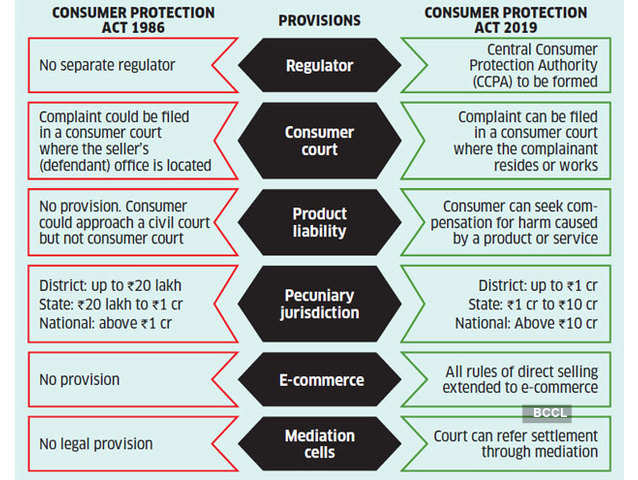
1) Consumers can now institute a complaint from where they reside or work for gain.
2) The original pecuniary jurisdiction of the District Commissions has increased upto ₹1 crore from ₹20 lakh earlier.
3) The Pecuniary jurisdiction of State Commissions has been increased from ₹1 crore to Rs. 10 crore.
4) The National Commission can hear cases above ₹10 crore when compared to above ₹1 crore earlier.
5) While the provisions relating to e-commerce are not yet notified, a section relating to electronic service provider (covering software services, electronic payments) is notified.
6) The opposite party needs to deposit 50% of the amount ordered by the District Commission before filing an appeal before the State Commission. Earlier, the ceiling was a maximum of ₹25,000, which has been removed.
7) The limitation period for filing of appeals to the State Commission has been increased from 30 days to 45 days.
8) The Parties can be allowed to settle the disputes through mediation.
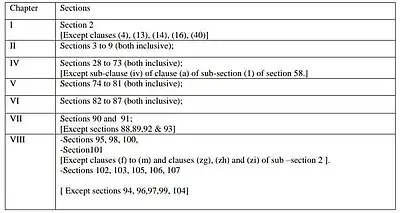
Following are the Sections which came into force:
Above mentioned provisions pertain to the Consumer Protection Councils, Consumer Disputes Redressal Forum, Mediation, Product Liability, punishment for manufacturing, selling, distributing etc spurious good or products which contain adulterant.
As per the rules, the e-commerce players will have to display the total ‘price’ of goods and services offered for sale along with break-up of other charges. Only a few certain miscellaneous provisions with regards and respect to the powers of the Central and State Government to make the rules and regulations have also been enforced.
On misleading advertisements there is provision for jail term and fine for manufacturers. There is no provision for jail for celebrities but they could be banned for endorsing products if it is found to be misleading.
For the first time there will be an exclusive law dealing with Product Liability. A manufacturer or product service provider or product seller will now be responsible to compensate for an injury or damage caused by the defective product or deficiency in services.
The Act has also defined an “e-commerce” as the buying or selling of goods or services including the digital products over digital or electronic networks. The existing definition of e-commerce has been adopted from India’s FDI Guidelines on e-commerce.
The definition of ‘e-commerce Entity’ as provided under the FDI Guidelines includes inventory and market place models.
There is also a provision for class action law suit for ensuring that rights of consumers are not infringed upon. The authority will have power to impose a penalty on a manufacturer or an endorser of up to 10 lakh rupees and imprisonment for up to two years for a false or misleading advertisement.
Information Technology has been playing a vital role in the future development of financial sectors and the way of doing business in an emerging economy like India, Bangladesh etc. Increased use of smart mobile services and internet as a new distribution channel for business transactions and international trading requires more attention towards e-commerce security for reducing the fraudulent activities. The advancement of Information and Communication technology has brought a lot of changes in all spheres of daily life of human being. E-commerce has a lot of benefits and many acts which hurts the small businesses or business aspects. This study predicts some challenges in an emerging economy.
What is E-Commerce ?
E-commerce means buying and selling of goods over electronic and digital platforms. Thete have been many allegations that big e-commerce are responsible to harm healthy competition in the market. Economies of scale and advancement of logistical companies has helped e-commerce companies to ship goods to anywhere.
Why E-commerce?
With the increasing diffusion of ICTs, more specifically the Internet, the global business community is rapidly moving towards Business-to Business (B2B) e-Commerce. The buyers gain a clear advantage when the Internet gives them access to the global market, by which they can compare prices across regions, find out whether prices vary by order fragmentation and get awareness about substitute products. Due to transparency of the market, customer can compare the services of various e-commerce sites easily. For instant, in case of e-commerce the competitors are one click away from customer. If clients are not happy with the products, prices or services offered by a particular e-commerce site, they are able to change much more easily than in the physical. From the Sellers’ point of view, they don’t need to have physical existence of shop.
E-commerce Hegemony ?
Recently The competition commission of India ordered a probe into alleged competition law violations by Flipkart Amazon over allegations that the e-commerce major promoted and gave discounts to preferred sellers, entered into exclusive partnerships with smartphone brands and abused their dominant position.
Flipkart Amazon is good provider by online marketplace for selling goods in India. Flipkart and Amazon is a wholesaler which is in the business of seeking the good to reseller.
Section 4 of the competition act 2002 is very important as we know completion act is not against possessing dominant position in the market but is objects abusing such dominant position. Section 4 of this act deals with abuse of dominant position.
Dominant position in a market means positions of strength enjoyed by any enterprise in relevant market. Like any enterprise operate independently of competitive forces prevailing in the relevant market Affects it’s competitors or consumers or relevant market in its favor. Recent example of abuse of power should be Amazon Flipkart how they give heavy discounts to customer directly pick-up the good from company that hits the shopkeeper or small enterprises.
Conclusion
As e-commerce industry is emerging sector with high potential of growth govt has to introduce some policies to promote healthy competition in this industry. Govt has to anticipate current loophole in regulations and amend it is such a way that instead of harming msme sector. The e-commerce industry will be a leader with popularity in electronic business world in the upcoming years. The e-commerce revolution has fundamentally changed the business of transaction by giving new opportunities and breaking borders easily. In India, it has strongly impacted the traditional business system and changing the life of people by making it easier. While it gives benefits to customer and seller, e-commerce gives challenges to traditional business for competitive position. Developing countries face many obstacles that affect the successful implementation of e-commerce with the help of comparing with developed country. When the internet cost will be low then the e-commerce will flourish easily and will make many of traditional business to run out of their business. Convenience is one of the benefits that customer gets from the e-commerce and thus increasing customer satisfaction. This is due to customer can place a purchase an order from anywhere with internet connection. E-commerce business provider should give importance on every customer by giving smooth service and many options for payment and have more functions available online. Other benefits are expanded product offerings and expanded geographic reach. But e-commerce business faces a lot of challenges in flourishing their business.
New Delhi: The government had taken yet another big step after ban on 59 Chinese apps to make it compulsory for E-commerce sites to display ‘country of origin’ tag so that users can identify Indian products and help make Atmanirbhar Bharat a success. The online shopping sites have agreed with government to display’country of origin’ and are cooperating with government.
The Government e-Marketplace (GeM) portal, which is used by government departments for public procurement, on Tuesday made it mandatory for sellers to enter the “country of origin” while registering all new products.
The Department for Promotion of Industry and Internal Trade (DPIIT) asked e-commerce players including Amazon and Flipkart to display mention ”country of origin” on each product sold at their platforms.
While GeM says it has taken this step to promote ‘Make in India’ and ‘Aatmanirbhar Bharat’ (Self-reliant India), the move also comes days after a deadly border clash between Indian and Chinese soldiers. Sub-standard and cheap Chinese products often make their way into the Indian market, more so through online platforms. The government has ramped up efforts to curb the inflows of such low-grade imports and their consumption here.
The government has taken such steps to reduce dominance of Chinese products in Indian market and make India self-reliant country. We must support the efforts of government and use as much as possible made in India products.











 Eduindex
You must be logged in to post a comment.