
Top 5 Must-Read Self Help Books


A self-help book is one that is written with the objective to help its readers on solving personal problems. For those interested in becoming a better version of themselves, self-help books are a must-read. The term self-help is derived from a 19th-century book of the same name by Samuel Smiles, a Scottish author.

Although these books aren’t any sort of miraculous solutions to instant happiness, but they do provide a window into new ways of thinking, relating, loving and problem-solving. The first and foremost benefit of reading self-help books is that the experience puts the reader on a path to read, practice the strategies learned, and make improvements in their lives without asking others for help.

However, all self-improvement books are not equal. Some help to start out your journey, while others give a boost when you’ve achieved experience in certain areas.

Here are some of the best ones from my library that I recommend you to read no matter how old you are.


The Power of Your Subconscious Mind
by Joseph Murphy
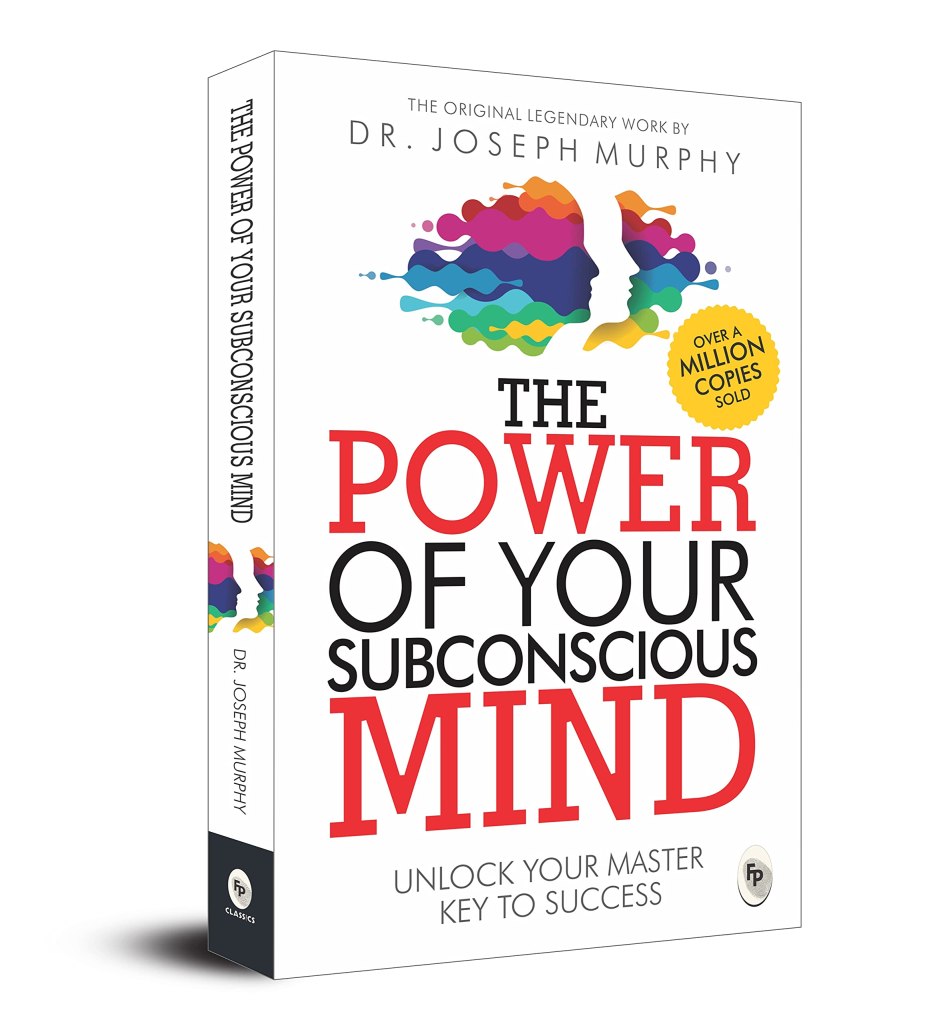
As is evident from the title, it is a book that promises to be an insightful look into powers beyond the scope of our daily prowess.

Since its first publication in 1963, It has been a bestseller, selling many millions of copies. It is among the most loved self-help works of all time which can help you heal yourself. The techniques provide inside the book are very simple to apply and results come quickly. You can work it out to improve your relationships, your finances, your physical well-being, and whatnot.

The author of this book, Dr. Joseph Murphy, explains that life events are a result of the workings of our conscious and subconscious minds. He suggests practical techniques to change our destiny, principally by focusing and redirecting this miraculous energy. Years of research and studying the world’s major religions convinced him into believing that some Great Power lay behind all spiritual life and that this power is within each of us.

The Alchemist by Paulo Coelho
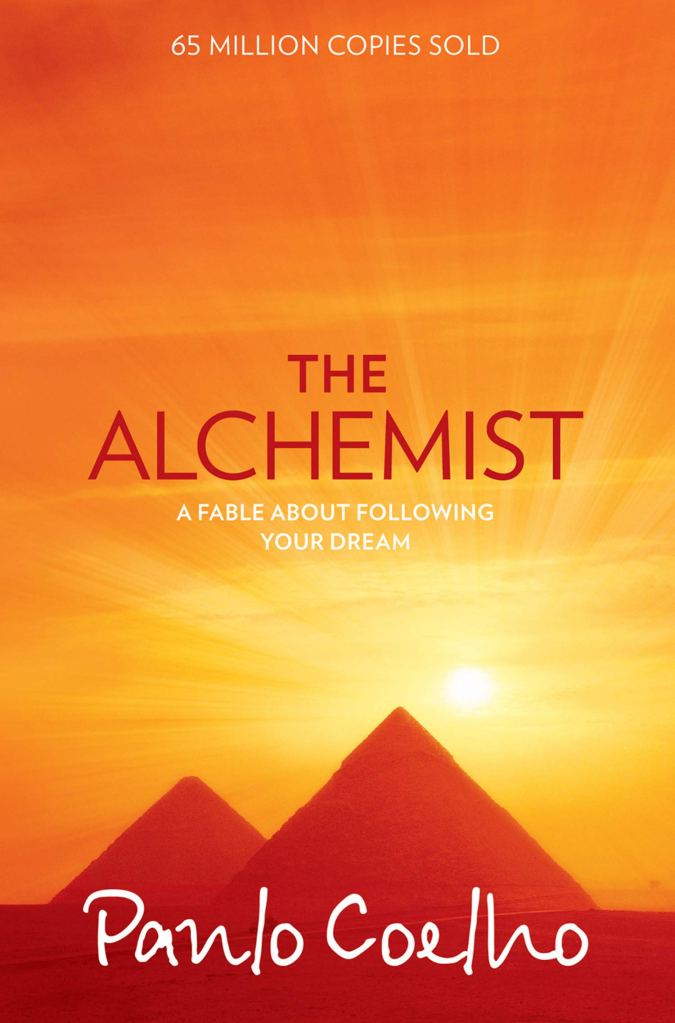
Written by Brazilian author Paulo Coelho in 1988, The Alchemist, is one of the best-selling books in history. Initially written and published in Portuguese, It has now been translated to more than 70 languages. The theme of the book is to find one’s destiny or purpose in life.

It is the magical story of an Andalusian shepherd boy, Santiago, who wants to travel in search of an extravagant treasure. This story portrays the essential wisdom of listening to our hearts, learning to read the signs along life’s path, and, above all, following our dreams as the treasure, the boy finds on his journey.

The 7 Habits of Highly Effective People by Stephen Covey
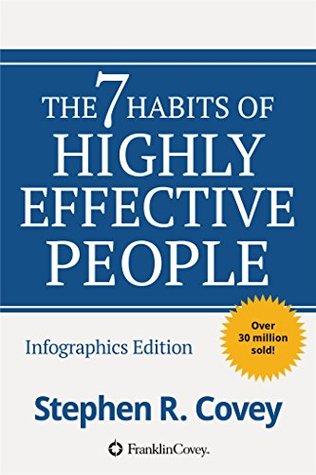
First published in 1989, The 7 Habits of Highly Effective People, is a business and self-help book written by Stephen R. Covey. This book changed the world of self-improvement forever and quickly became an international bestseller and a go-to resource for anyone who wanted to improve themselves.

This book is centered around the average person’s personal and professional habits. The prime focus of the book is ‘habits’ because it is these habits that make up a person’s character. The book focuses not only on eliminating bad habits but also on building up good ones. It reveals a pathway to live with fairness and human dignity giving us the power to adapt to change and to take advantage of the opportunities that change creates.

How to Win Friends and Influence People by Dale Carnegie
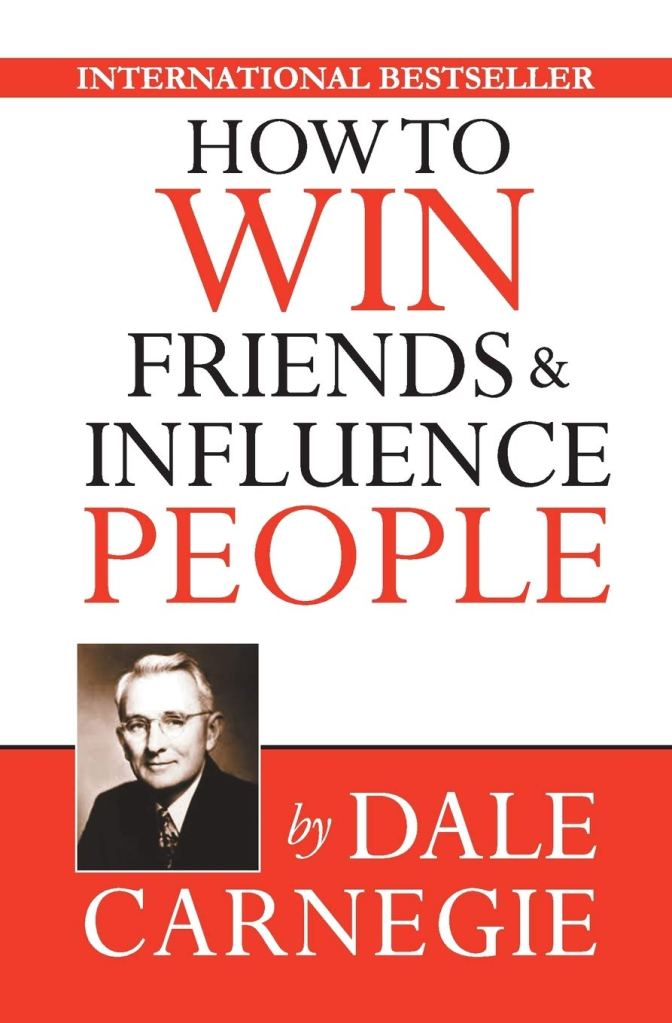
Released in 1936, How to Win Friends and Influence People, is one of the most timeless self-help books ever written and has sold more than 15 million copies till date. It’s an eternal text which proves that people still want the same thing they have always wanted – friends and influence.

The Author Dell Carnegie believed that the most essential component to being successful is the ability to communicate effectively and have brilliant insights. The book teaches these skills by demonstrating how to value people and help them feel appreciated rather than manipulated.
It’s a classic self-help book that will help in building self-esteem, become a better communicator, and connect with people like never before.

Think and Grow Rich by Napoleon Hill
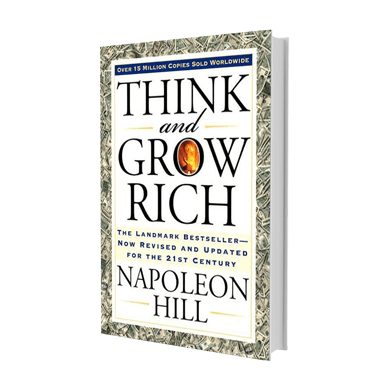
Written by Napoleon Hill in 1937, Think and Grow Rich is one of the most powerful books which develops thinking power and provides the best rules for success. It was promoted as self-improvement and a personal development book.

This book has been able to withstand the destruction of time and is incredibly relevant even today. From basics such as planning, decision making, and persistence to more advanced techniques such as auto-suggestion, transmutation, It covers all the aspects.

This is not a grow-rich book, but a timeless guide to find out what actually matters. As it says clearly in the beginning ‘Riches can’t always be measured in money!’


Languages you should try! [Part 2]

[Bhoomika Saini]

Photo by Monstera on Pexels.com

Mandarin Chinese

With over one billion Mandarin Chinese speakers in the world, of course it tops the list of most important languages to learn in 2020.

Most speakers are located within China, however, so is it still one of the most important languages to learn? The answer is yes — with China emerging as a global power, it becomes increasingly more important for businesses to have team members that know Chinese.

Arabic

Arabic started as a nomadic language, spoken between moving tribes. Today it is the official language of the Arab League, consisting of 22 countries such as Egypt, Jordan, Morocco, and the United Arab Emirates. These popular travel destinations make it worthwhile to learn Arabic. Not just that, it is the language of the entire Muslim civilization and all of its texts. With over 1.8 billion Muslims around the world, no wonder Arabic made the list.

Portuguese

Portuguese is spoken all over the world — it is the official language of countries in Europe, South America, Asia, and Africa. If that wasn’t enough to prove that this language is one of the most important languages to learn, here’s more: Brazil is emerging as one of the world’s newest economic powerhouses. Tourism in the country is growing and global companies are setting up shop, so the demand for Portuguese speakers is growing.

Hindi

With some of the highest numbers of speakers in the world, Hindi is one of the most important languages to learn without a doubt. But like with other languages, it’s not just the sheer number of speakers that should entice you to learn the language, but the global power of where the language comes from. India is a huge part of today’s world economy, and as Hindi is the most spoken language in India, it’s the one to learn.

Italian

Italian may not have the most speakers on this list, but that doesn’t mean it isn’t an important language to learn. Italy is steeped in arts, culture, and history. Many world heritage sites are located in Italy, and many historical texts are written in Italian. This country is a popular travel destination, and knowing Italian will help you on a trip. Plus, knowing any of these similar romance languages — Spanish, French, Italian, and Portuguese, will make it much easier to learn the others in the group.

Languages you should try! [Part 1]

[Bhoomika Saini]

French

French, also called the language of love, was actually the international, diplomatic language for centuries. Only recently, historically speaking, with the rise of the United States as a global power, did English prevail as the language of diplomacy. France is still quite the economic powerhouse, and a popular travel destination, so French is definitely a language to learn!

Spanish

Spanish has a large number of native speakers, and a large number of overall speakers as well. Most Spanish speaking countries are located in South and Central America, which are extremely popular travel destinations in recent years. For this reason, you will find many across the world who speak Spanish. In addition, due to the large number of Spanish speakers in the US, if you live, work, or travel in the United States, Spanish is the one to learn!

Russian

Russian is an extremely influential language among many Eastern European and Europeasian countries. The Russian language also has the second highest percentage of internet content (following English), and the leading percent of internet content in Europe. This makes the Russian language one of the most important languages to learn for European business.

Japanese

While the Japanese language is not spoken widely outside of Japan, it’s still an important one to know. Whether you want to travel in Japan, love the culture and food, or the technology, knowing Japanese can get you far in many ways. It’s also an excellent introduction to other Asian languages. There are some Chinese characters in Japanese, and with similar grammar to Korean, learning Japanese puts you on the path to learn all three.

German

Germany is the most widely spoken language throughout Europe, as Germany remains Europe’s most dominant economy. For this reason, if you do business or plan to do business in Europe, German is one of the most important languages to learn. It’s a funny language to learn, with endings tacked on to words to give them specific meanings. But it is also a surprisingly easy language to learn.

Benefits of learning different languages. [part 2]

[Bhoomika Saini]

Learning languages is an important part of being very soft and friendly welcomed in different countries. Even only one language cans totally change the way of the communication, the attitude towards you and the impression which you will make in people with which you conduct a conversation.

Nowadays it is like must to study and learn new languages, in terms of self development, comfort and confidence. During the years of studying and later when you want to work the knowledge of language is a big advantage. Studying abroad gives opportunity for better education which leads to a better working position after graduation. But this cause is reachable only when you know forage languages.

Let’s learn some more benefits of learning languages.

1. Connect!

One of the most rewarding aspects of the human experience is our ability to connect with others. Being able to communicate with someone in his or her language is an incredible gift. Bilinguals have the unique opportunity to communicate with a wider range of people in their personal and professional lives. Knowing the language makes you a local no matter where you are, opening up your world literally and figuratively. You will be shaped by communities. You will be humbled by the kindness of strangers. You will build lifelong friendships. And for these reasons alone, you will see the reward of learning languages for many years to come.

2. Deepen Your Connection to Other Cultures

Language is the most direct connection to other cultures. Being able to communicate in another language exposes us to and fosters an appreciation for the traditions, religions, arts, and history of the people associated with that language. Greater understanding, in turn, promotes greater tolerance, empathy, and acceptance of others—with studies showing that children who have studied another language are more open toward and express more positive attitudes toward the culture associated with that language.

3. Go to the Source

In a world of more than 6,000 spoken languages, we sometimes require translation, but speaking at least one additional language empowers us to access information that would otherwise be off-limits. For example, individuals proficient in other languages are able to navigate the Internet as genuine global citizens—consuming and assessing foreign media and entertainment.

4. Strengthen Your Decision Making

Studies show that decisions made in your second language are more reason-driven than those made in your native language.4 Contrary to popular assumptions, when we deliberate in a second or third language, we actually distance ourselves from the emotional responses and biases deeply associated with our mother tongue. The result? Systematic and clear-headed decisions based on just the facts.

5. Gain Perspective

As we explore a new language and culture, we naturally draw comparisons to what is most familiar. Learning about another culture sheds light on aspects of our own culture—both positive and negative—we may not have previously considered. You may find a greater appreciation for what you have, or you may decide to shake things up!

6. Become a Polyglot

Not only does learning a second language improve communication skills and multiply vocabulary in your first language—yes, really!—but research shows that it makes picking up additional languages a much easier feat, especially among children.3 That’s because when you learn a new language, you develop new brain networks that are primed and ready when you embark on learning a third language.

7. Boost Your Confidence

Any language learner can attest to making his or her share of mistakes while discovering a new language—often in front of an audience. It’s a necessary part of the learning process! Learning a language means putting yourself out there and moving out of your comfort zone. The upside is the amazing sense of accomplishment you’ll feel when conversing with someone in their native language.

PLAY WITH RIDDLES

IN THIS WONDERFUL DAY , LETS MAKE OUR BRAIN CRISP AND SHARP BY SOLVING THESE RIDDLES.

NOTE: TRY TO SOLVE THEIS RIDDLES BY YOURSELF BEFORE SEEING THE ANSWERS IT WILL MAKE THIS READING INTERESTING.

1) I speak without a mouth and hear without ears. I have no body, but I come alive with wind. What am I? 

2)You measure my life in hours and I serve you by expiring. I’m quick when I’m thin and slow when I’m fat. The wind is my enemy. 

3)I have cities, but no houses. I have mountains, but no trees. I have water, but no fish. What am I? 

4)What English word has three consecutive double letters? 

5) I come from a mine and get surrounded by wood always. Everyone uses me. What am I? 

6)What disappears as soon as you say its name? 

7)This belongs to you, but everyone else uses it. 

8)First you eat me, then you get eaten. What am I?

ANSWERS:

1) An echo , 2) A candle , 3) A map , 4) Bookkeeper , 5) Pencil Lead , 6) Silence , 7) Your name , 8) A fishhook.

Overthinking (The Beauty and the Beast)

Mannat Sandhu

“Rule number one is, don’t sweat the small stuff. Rule number two is, it’s all small stuff.”
– Robert Eliot

Now imagine this , after a tiring day at work , you’re finally getting to sleep on that oh so soft mattress of yours. But wait , the moment you’re ready to surrender yourself to 6 hours of sleep ( if you’re lucky ! ) , you suddenly remember, “Did I turn off the gas stove ?” ” What if the entire house just explodes and there I am dreaming about how I am going to answer the questions at Koffee with Karan ( yes I also have a struggle to talk about ! ), and many such more fake,over the top scenarios are being flashed in front of your eyes.

Over-thinking Cartoons and Comics - funny pictures from CartoonStock

THE BEAST

This constant feeling of your head being constantly overburdened with unwanted thoughts, the ones you’re being involuntarily surrendered to , is my friend ,the beast.Often you put yourself under a lot of pressure , and you consider yourself responsible for every little thing happening around you. You overthink about a situation to such an extreme extent , that you’re no longer able to differentiate between reality and delusion.You want to stay in the reality but at the same time have one foot dangling in the realm of delusion.

Its that constant battle in your head between trying to stay the same and trying to stay sane.

THE BEAUTY

Sometimes thinking about any particular situation, whether in the past or future, helps you give a different perspective towards it and life as a whole.I mean the fact that Newton really over thought about a fallen apple, was pretty useful.But the key is to know when to stop.

I often think about a saying by Sylvia Plath

If i didn’t think, I’d be much happier.

and most of the times I resonate with it so much.This beautiful brain of yours which holds this massive power of creativity and imagination often turns into this beast you never could’ve expected.

THE PANACEA

1.Meditation

If I tell you that meditation is going to help you, I’d be only 50% correct. Just because you sit down, cross your legs and close your eyes , does not mean that you’re meditating; because your mind is still at loggerheads with your thoughts.So to begin with, whenever you feel like you need to calm down , take a deep breath and try to clear your mind. Then slowly try to give your mind enough space to breathe ( Yes it needs to! ). I know its easier said than done , but hey you got to begin somewhere.

2. Binge watch something

Well, well well..if it isn’t the solution to all our problems. I’m not even going to lie how many times I’ve resorted to this option ! And i just love it. Even if it temporarily helps you to distract your mind, then go for it.

3. Walk it out

Whether on your terrace, in your verandah or outside in a park, there’s nothing a quiet peaceful walk cannot solve .

4. Sleep it off

Sometimes i just feel ,I use this option as an excuse to get out of everything.

Feeling stressed ; Go to sleeep

Don’t feel like doing anything ; Go to sleep

There’s a fire ; Go to sl….NO WAIT..Buddy you got to run!

Maybe you’ll be at the same stage after you wake up , but hey at least you got a few hours of peaceful sleep, and boy that’s rare.

5. Call a friend

Sometimes talking to a friend really helps you either find a solution or help you take your mind off it.And if you don’y feel comfortable , you can seek professional help or contact at the official helplines.

Overthinking does not sound like a disorder , but don’t wait for it to become one.

6. Let go off things you cannot control

The most difficult one on the list yet the most effective. Take a minute and ask yourself, will I be able to do something to solve the situation,

If yes ; then work on a solution.

If no ; then remind yourself,

It is not your job to be everything to everyone.

– Paulo Coelho ( The Pilgrimage )

A penny for your thought ? If only it was a penny for every time I over thought, I’d be a millionaire, no wait a billionaire, no wait…you know what let me just go think about it.

CORONAVIRUS AND ITS IMPACT ON EDUCATION

The COVID-19 was first identified in Wuhan, China in December 2019. The global outbreak of COVID-19 is still ongoing.

The current coronavirus pandemic is having a perplexing impact, not only on people’s health, but also on how they learn and work. The pandemic has introduced uncertainty into major aspects of society, including the education sector. Thousands of schools, colleges and other educational institutions are closed nationwide. This situation challenged the education system across the globe and forced institutions to shift to an online mode of teaching.

Photo by Ann Nekr on Pexels.com

Challenges of Online education

Schools and colleges have been impacted significantly by the rapid spread of the COVID-19 outbreak. Closures have pushed countries towards a modernized, digital style of teaching. However, this solution comes with its own unique set of challenges. Among the most important challenges created by the coronavirus is how to adapt to a system of online education.

There are various technological devices available for online education but sometimes they create a lot of problems. These difficulties and problems associated with modern technology range from downloading errors, installation issues , login problems, poor connectivity, etc. Sometimes student also finds online teaching to be boring. Students want face to face interaction which is not possible with online mode of learning

Universities across the globe have adjusted their courses in response to the spread of the coronavirus. Moving all the educational programs online may prove very challenging. While some universities or schools may already have strong online systems, smaller universities may struggle with the technology. Some students also don’t have reliable internet access or technology and they struggle to participate in online learning. This gap is seen across countries and between income brackets within countries.

Photo by Ann Nekr on Pexels.com

Advantages of Online Learning

  • More flexible than offline classes.
  • Saves time by avoiding transportation.

Disadvantages of Online Learning

  • Loss of interest
  • Small children have low concentration power, and they don’t want to sit for a longer time in front of the blue screen.
  • The availability of internet to students living in rural areas.
  • Speed and cost of internet.
  • Spending long time in online learning makes the students lose their motivation to participate.
  • Lots of poor students do not have access to laptops, computers, tablets, cell phones, etc.
  • Less interactive.

Conclusion

The COVID-19 pandemic lockdown has affected the academic performance of most of the students with varying degrees. Online education helps the students with an opportunity for self-study. However many subjects need practical classes; therefore, it is not easy to understand all the subjects online. The learning process cannot reach its full potential until students practice what they learn. This may impact their career in the future.

Educational Sites Which Can Provide You Free Courses

Whether you’re five or ninety five, the internet has a lot to offer. Particularly when the topic is education, the resources on the internet are endless. Best of all, many high quality sites are completely free. From history to coding, excellent, free online education awaits you.

1. Coursera:

Coursera is a website that partners with universities and organizations around the world. This brings a wide variety of topics and perspectives to one searchable database. Coursera is a powerful tool for free online education and includes courses from many top universities, museums and trusts. This gives the site an extremely wide range of in-depth courses. Coursera is extremely useful if you’re looking to study many different topics, or want courses from different schools and groups. 

2. Khan Academy:

Partnering with many post secondary schools, Khan Academy offers a useable, well-organized interface. Also curating many courses from around the web, Khan Academy offers impressive depth on many different subjects. Among the more well-known educational sites, Khan Academy is also incredibly user-friendly, which may make it easier to keep learning goals. If you’re looking for a free online education, you can’t go wrong with Khan Academy.

3. Open Culture Online Courses:

If you are struggling to find exactly the material you are looking for, try Open Culture’s listing of free online education courses. The page highlights 1000 lectures, videos, and podcasts from universities around the world. The site features a lot of material found only on universities’ private sites, all in easy-to-browse categories. This means you can find hundreds of university courses without having to visit and search each university’s site. Open Culture’s list features courses from England, Australia, Wales, and many state universities around the United States. It’s a very helpful resource for finding many courses in one area of study.

4. Udemy:

Udemy’s free courses are similar in concept to Coursera’s but additionally allows users to build custom courses from lessons. Working with many top professors and schools, the site mixes the customizable platform of other sites with a heavy emphasis on top-quality content. This is another site, however, that mixes free and paid content.

5. Lifehack Fast Track Class:

Lifehack believes in skills that multiply your time, energy, and overall quality of life. In this rapidly changing world, traditional education skills just don’t cut it anymore. You can’t afford to take years learning a skill you’ll never really practice. Besides offering some paid courses that will help you become a better self, it offers a list of free courses which aim to train some of the Core Life Multipliers.

6. Academic Earth:

Another site with courses from many different schools is Academic Earth. Academic Earth brings together top notch courses from many different sources and focuses on offering a wide variety of subjects. Academic Earth lists courses by subject and school, so it might be easier to find what you’re looking for.

7. edX:

Another great option for free online education is edX. Also bringing together courses from many different schools, the site has impressive, quality information for everyone. edX covers a great range of topics from universities such as Harvard, MIT, and Berkeley, meaning a high-quality, free online education is entirely possible here.

8. Alison:

Alison is a free education site offering certification in some areas. Alison offers courses mainly in business, technology, and health, but also includes language learning courses. It’s a great option if users need a professional certificate for their learning, as Alison also offers school curriculum courses.

9. iTunesU Free Courses:

A very convenient place for free online education is iTunesU, because it integrates seamlessly with your iPod or any app-ready Apple mobile device. On an iPad, iPhone, or iPod touch, users download the iTunesU app. Desktop users can access iTunesU on the upper right hand corner of the iTunes Store. iTunesU is also convenient because the store is categorized much like iTunes. Users can search learning materials in many different ways, including by genre and topic. However, courses are often a mix of free podcasts or videos and paid content. iTunesU does include courses on a variety of topics, but it does not integrate with Android, Google or Windows mobile devices.

10. Stanford Online:

Stanford Online is a great site for high-quality courses, though the topics are somewhat limited compared to sites partnered with more than one school. If you’re looking for free courses, make sure to mark the “free” option on the left-hand side.

11. Open Yale Courses:

Open Yale Courses echoes Stanford Online, in that it offers only courses from Yale. While the site is similarly limited to topics taught at the school, Open Yale Courses offers a lot of videos of actual campus lectures. The availability of videos makes the site a great option if you’re looking for quality courses but learn better by watching than by reading.

12. UC Berkeley Class Central:

Much like the other schools on this list, UC Berkeley has a variety of free online education options. The school has slightly fewer courses than the schools above, but it includes some supplementary lectures and webcasts.

13. MIT OpenCourseWare:

Similarly, MIT offers a variety of free courses. The school has a comparable number of courses to the schools above, and it includes very in-depth course materials on the subjects available.

14. Carnegie Mellon Open Learning Initiative:

Carnegie Mellon’s free online education site is comparable with the other school’s on this list. However, Open Learning Initiative also covers a smaller range of topics, but for the topics that are covered, impressive, in-depth material is available.

15. Codecademy:

Codecademy is a website dedicated specifically to teaching coding. Where other coding sites follow an example/practice session workflow, Codecademy includes a live practice window. This means you can practice coding while still viewing the lesson material. The courses at Codecademy are well-written and easy to follow, and the website is organized very nicely. Codecademy features a centralized dashboard where you can monitor your progress, and it organizes lessons into complete modules. This lets you learn an entire language without needing to pick the next course manually.

16. Code:

Code is another website focused on coding and app writing. A site with high-quality courses, Code also features learning options for kids. In addition to kid-friendly courses, Code offers free online education classes on a wide variety of technology topics. These classes include app writing, robotics, and Javascript. Most of the courses are also geared in a such a way that they can be useful in a classroom setting. This makes Code a great resource for harder to find coding topics, as well as various learning settings.

17. TED-Ed:

Another great destination for more general learning and free online education is TED-Ed. From the same people that brought you the all-encompassing, motivational web series comes a site chocked full of educational videos. Most include impressive animation, and all are ten minutes long or less. Not only is TED-Ed an excellent site for the curious, but it also includes supplemental materials and quizzes on the videos. This makes the site extremely useful in formal education settings, as well as in entertaining ways to brush up on new discoveries and topics. 

18. LessonPaths:

LessonPaths is another great tool for those looking for a more usable and convenient way to access learning material. On this site, users create link playlists of their favorite learning materials from other sites. Users then rank these collections, making it easy to find many different high-quality, accessible sources on a given topic.

19. Memrise: 

Another impressive free online education site offering ease of use and convenience is Memrise. Available both on desktop and as an app, Memrise is a particularly powerful tool if you are studying a language. The site encompasses many other topics as well, though some of the course material is user generated content. Part of what makes Memrise special is their integration of games into the learning materials, mixing learning with entertainment.

20. Fun Brain:

Fun Brain is another great option for kids looking for free online education, as it focuses on games and fun puzzles. Particularly focused on math and reading, Fun Brain’s game-based approach can be valuable if the child in question struggles to pay attention. Fun Brain offers rewards and challenges as well. 

Tales of younger inspiration leads the roads to newer innovation

Modern world has opened the doors for newer technologies. Every day, people bring new ideas to transform the way of thinking and doing things. Stories from all over the world from different fields influence many to pursue with their field of interest. There are several successful women in many fields in India also; they become true inspiration to all the young dreamers. Moreover, this pandemic have also taught us to be more skillful to achieve success and continuous growth in our lives.

One of the inspiring stories that have made young girls believe in their dreams is that of P.V. Sindhu. She started playing Badminton at the age of 8 and made her international debut when she was 17 yrs old. After tremendous hard work and with constant learning she became the World’s 6th Ranking Women in Single Badminton. This dedication and her constant efforts are real inspiration for the women out there who believe on themselves.

Image: Sports24

Likewise, Sharanya a 24 yr old young junior doctor who treated the victims of the Kozhikode Plan Crash. After working for 1 year at Kozhikode General Hospital,she quits to start preparing for her NEET exams. On one of the fateful night, when the hospital needed all hands on deck, she jumped into help without a second thought.

12 year old Haaziq from Pune came up with ingenious innovation- Ervis – which is a prototype ocean cleaner ship that can suck out plastic from the surface of the ocean. The picture of a young whale that died of intestinal blockage after consuming huge amount of plastic is what made this 12 year old to wage war against plastic. His novel idea received global attention and he got a chance to present this idea before audience through TED-X club.

India is one of the countries having most number of youths; the need is to give them a proper direction to think and to bring a change. Engagement of young people at local, national and global levels is impacting lives. The more they explore the more idea they collect. At this stage of confusion and uncertainty youths from different part of India are setting examples for others. No talent should be wasted, because they are capable of much more. But due to societal pressure and constant discouragements they often confused to choose their field of interests.

Image: Rightful Owner

The 22 year old a Haimanti founder of the NGO Junoon, is the inspiration for people who want to bring a change in the field of education especially for underprivileged children. Since May 2018, she has been on a mission to equip them with necessary skills along with education that will enable her to enroll them in a regular school under the Right to Education Act.

There are several more tales of young minds whose acts inspire us to work towards innovative methodologies. A young regular college student from Palakkad district, Shahinsa belongs to an agrarian family from the Panamanna village have deep passion for farming and finds the time to grow crops using modern technology in the fields.

Sriya Donepudi (15), a school going girl from Khajaguda started an initiative to recycle used flowers after social functions. She collected discarded flowers from various events and with the help of women from economically weaker sections they made soaps, paper-weights and other items from floral waste. According to The New Indian Express, this initiative made her bag The Diana Awards of 2020.

In the year 2017, Malhar and his friends collected the garbage thrown by visitors at Dadar Beach. Earlier, they started it as a weekend activity that gradually turned into a fully fledged cleanup movement engaging over 20,000 Mumbaikers. Collectively they have gathered 1000 tonnes of waste including plastics, stale food and religious offerings that had been cleared from the beach side. His efforts for this cleaning drive recognized globally when United Nations felicitated him on the International Volunteer Day.

Most of Indian startup and innovation landscape provide opportunity to young inventors to bloom. Their keen observations combined with deep sense of strategic ideas helps them in dealing with various problematic situations in the field of technology. These tales not only made us proud but also inspire us to build a new India with innovative thoughts.

Image : Shutterstock

Each of us is great in our own fashion. Even a tiny story of inspiration can influence thousands of youngsters to pursue their dream; each act can impact the world.  Every one of us has that hidden power, the requirement is to have faith and continue our work with relentless efforts. These tiny tales of youths inspires many to pursue their dream . This pandemic is really tough and a challenging time for all the innovators but if you’re passionate enough to achieve your goal, you should continue with perseverance and patience.

Juggernaut was borrowed from Jagannath; Rath Yatra 12/07/2021

EVENTS

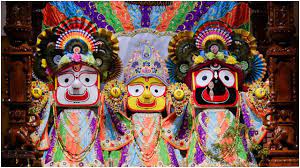
The Puri Rath Yatra begins on the Dwitiya Tithi in Ashadha, Shukla Paksha. This year, Ratha Yatra is being celebrated on July 12, 2021. The festival of Puri Rath Yatra is devoted to Lord Jagannath who is believed to be one of the incarnations of Lord Vishnu. Jagannath Rath Yatra is a nine-day festivity marked by various rituals and traditions. On this day, Lord Jagannath, Balbhadra and Subhadra proceed towards the Gundicha temple (a monument built in the memory of the Queen of Indradyumna) from the Puri shrine on their giant wooden chariots. It is believed that in order to pay their respects to Queen Gundicha, wife of the legendary King Indradyumna, who built the Puri Jagannatha temple, Lord Jagannatha along with brother Balabhadra and sister Subhadra leave their regular abode from the main temple and spend some time in this temple built by Gundicha in their honour. Lord Jagannatha, after resting for eight days in Gundicha temple, returns to his main abode. This day is known as Bahuda Yatra or Return Yatra. It is observed on the eighth day after Ratha Yatra on Dashami Tithi.

During Bahuda Yatra, the Lord makes a short stoppage at Mausi Maa temple, which is dedicated to Goddess Ardhashini. Remember, Lord Jagannatha, returns to his main abode just before Devshayani Ekadashi, when Lord Jagannatha goes to sleep for four months.

The rituals of Ratha Yatra start much ahead of Ratha Yatra day. Approximately 18 days before Ratha Yatra, Lord Jagannatha, his brother Balabhadra and his sister Devi Subhadra are given a famous ceremonial bath which is known as Snana Yatra. Snana Yatra day is observed on Purnima Tithi in Jyeshtha month, which is popularly known as Jyestha Purnima.

On the occasion of Puri Ratha Yatra, having a mere sight of Lord Jagannath on his chariot is considered very auspicious. Three chariots are made for the three respective deities.

Name of the three chariots

The names and important characteristics of the three raths (Chariots) belonging to the three deities are:

Lord Jagannath: Nandighosa

NANDIGHOSA
  • Lord Jagannath’s chariot is made of approximately 16 wheels
  • Lord Jagannath’s chariot is about 45 ft. high
  • Red and yellow canopy

Lord Balabhadra: Taladhwaja

TALDHWAJA
  • Lord Balabhadra chariot is made of 14 wheels
  • Lord Balabhadra chariot is 45.6 feet high
  • Red and bluish green canopy

Goddess Subhadra: Darpadalana

DARPADALANA
  • Goddess Subhadra’s chariot is made with 12 wheels
  • Goddess Subhadra’s chariot is 44.6 feet high.
  • Red and black canopy

Jagannatha literally means Lord of the Universe. It is believed that, if a person participates with full devotion in the Rath Yatra will be free from the cycle of birth and death. Rath Yatra symbolises harmony, brotherhood and unity. Thousands of devotees come here from different corners of the country to take part in this yatra and get good luck by pulling the chariot of the Lord. However in accord with the Covid 19 regulations, devotees were not allowed in the procession. Only the priests and workers with negative reports were allowed.

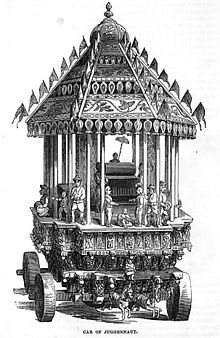
Car of Juggernaut as depicted in 1851. Source: Wikipedia

  Lord Jagannath is one of the avatars of Lord Krishna. It is said that Rath Yatra is equal to hundred sacrifices. If a devotee takes part in this Rath Yatra and pulls the chariot of God, then he gets god’s blessings. Jagannath Rath Yatra is a ten-day festival. The preparations for the yatra begin with the construction of the chariots on the day of Akshaya Tritiya. According to religious beliefs, just by watching this Rath Yatra one gets freedom from all kinds of sins and salvation is attained after death.

ETYMOLOGY OF JUGGERNAUT

Jagannath is also the etymological origin of the English word ‘Juggernaut’. When the British first observed the Rath Yatra in the 18th century, they were so amazed that they sent home shocking descriptions which gave rise to the term ‘juggernaut’, meaning “destructive force”. They misunderstood that people sacrificed themselves infront of the chariot. However these were accidents which often occur during commotion in pulling of chariot. As a matter of fact sacrificial rituals are banned in Jagannath temple.

The Origin of Buddhism .

We are what we think. All that we are arises with our thoughts. With our thoughts, we make the world.
Peace comes from within. Do not seek it without.

Lord Buddha

Introduction.

He was a spiritual personality . An ancient teacher and enlightened many . A founder of world religion Buddhism . He was popularly known as Gautama Buddha (also known as Siddhattha Gotama or Siddhārtha Gautama or Buddha Shakyamuni ) .

The Enlightened One who rediscovered an ancient path to release clinging and craving and escape the cycle of birth and rebirth. He taught for around 45 years and built a large following, both monastic and lay. His teaching is based on his insight into the arising of duḥkha (the unsatisfactoriness of clinging to impermanent states and things) and the ending of duhkha—the state called Nibbāna or Nirvana (extinguishing of the three fires).

Buddhism

Buddhism, one of the major religions and philosophical systems of southern and eastern Asia and of the world. Buddha is one of the many epithets of a teacher who lived in northern India sometime between the 6th and the 4th century before the Common Era.

The title buddha was used by a number of religious groups in ancient India and had a range of meanings, but it came to be associated most strongly with the tradition of Buddhism and to mean an enlightened being, one who has awakened from the sleep of ignorance and achieved freedom from suffering.

According to the various traditions of Buddhism, there have been buddhas in the past and there will be buddhas in the future. Some forms of Buddhism hold that there is only one buddha for each historical age; others hold that all beings will eventually become buddhas because they possess the buddha nature (tathagatagarbha).

According to Buddhist doctrine, the universe is the product of karma, the law of the cause and effect of actions, according to which virtuous actions create pleasure in the future and nonvirtuous actions create pain.

Your work is to discover your world and then with all your heart give yourself to it.

Lord Buddha

History

Gautama Buddha ( born c. 6th–4th century BCE, Lumbini, near Kapilavastu, Shakya republic, Kosala kingdom [now in Nepal]—died, Kusinara, Malla republic, Magadha kingdom [now Kasia, India]).

Buddha is one of the many epithets of a teacher who lived in northern India sometime between the 6th and the 4th century before the Common Era.

Learnings from Gautama Buddha.

1. “Three things cannot be hidden: the sun, the moon and the truth.”

2. “You will not be punished for your anger; you will be punished by your anger.”

3. “You can search throughout the entire universe for someone who is more deserving of your love and affection than you are yourself, and that person is not to be found anywhere. You, yourself, as much as anybody in the entire universe, deserve your love and affection.”

4. “We are shaped by our thoughts; we become what we think. When the mind is pure, joy follows like a shadow that never leaves.”

5. “Believe nothing, no matter where you read it, or who said it, no matter if I have said it, unless it agrees with your own reason and your own common sense.”

Link

Technical skills

Technical skills are the abilities and knowledge needed to perform specific tasks. They are practical, and often relate to mechanical, information technology, mathematical, or scientific tasks. Some examples include knowledge of programming languages, design programs, mechanical equipment, or tools.

Some of the very famous tech. Skills:

1. Project Management. Being able to effectively coordinate resources, people and budgets as a project manager is one of the best technical skills that you can have.
2. Analysis of Big Data and Business 3.Intelligence.
4. Information Security.
5. Designer.
6. Marketing Assistant.
7. Writer. And many more…

Create a dedicated Technical Skills section for the resume.

If they’re heavily emphasized in the job description, then your Technical Skills section should be at the top of your resume, just below your introduction, and above your professional experience. A bulleted list will make it easy to read.

These are some of the basic tech. Skills:

* Word Processing Skills.
* Spreadsheets Skills.
* Database Skills.
* Electronic Presentation Skills.
* Web Navigation Skills.
* Web Site Design Skills.
* E-Mail Management Skills.
* Digital Cameras

How can you improve your technical skills? So, here are the steps to improves ones technical skill.

1. Enroll in Technical Classes or Workshops.
2. Get Technical Books.
3. Volunteer for Technical Projects.
4. Subscribe to Technical Sites and Magazines.
5. Develop Knowledge of a Second Language.
6. Practice What You Learned.

IMPORTANCE OF SEX EDUCATION

BY: VAIBHAVI MENON

“Everyone has bodies, right? It’s nothing to be ashamed of.” Sex education is the instruction of issues relating to human sexuality, including emotional relations and responsibilities, human sexual anatomy, sexual activity, sexual reproduction, age of consent, reproductive health, reproductive rights, safe sex, birth control and sexual abstinence. Sex Education is something that should be taught to individuals from a young age. Due to it being a sensitive topic not a lot of people are comfortable learning or teaching the subject because of which much importance isn’t given and this causes negative effects. Most people get aware of the word “sex” during their teen years but they dont get proper education on it and that negatively impacts their life. Sex education talks about protection from diseases like STD’s which could range from AIDS TO HIV, how to avoid teen pregnancies through different methods such as surgical methods or physical methods.

In India especially, enough significance is not given cause unwanted pregnancies or getting a disease. Therefore Evidence-based sexual health education can improve academic success; prevent dating violence, and bullying; help youth develop healthier relationships; delay sexual initiation; reduce unplanned pregnancy, HIV, and other STIs.  Evidence-based sexual health education reduces sexual risk behavior by delaying sexual initiation, reducing pregnancy and STIs, and increasing contraceptive use thereby protecting student health. There’s nothing simple about teaching kids about sex. In these times of precocious pre-teens, pregnancy among teenagers, and sexually transmitted diseases (STDs), children and adolescents need much more than a one-time chat about the birds and the bees. Pregnancy prevention and safe sex really should be ongoing, age-appropriate topics. Ideally, children will get all of the information they need at home from their parents, but school should also be an important source of information. Research has shown time and time again that abstinence-only education doesn’t work. Over the past 20 years, numerous studies have consistently demonstrated that teaching comprehensive sex education in schools doesn’t have the downside most people are afraid of. In other words, providing condoms in schools doesn’t encourage adolescents to start having sex earlier, or even more often. Having those condoms available does seem to encourage teens to use them, but only if they would be having sex anyway. Only 20 states require sex and HIV education be taught in schools. Sex is a fundamental part of being human; but less than half of our states require sex and HIV education, and most of what is taught is sub-par. Just because we refuse to talk about sex doesn’t mean it’s just going to go away. Only 20 states require sex and HIV education be taught in schools. Sex is a fundamental part of being human; but less than half of our states require sex and HIV education, and most of what is taught is sub-par. Just because we refuse to talk about sex doesn’t mean it’s just going to go away. Sex education is important. It’s been proven time and time again. We know students who receive formal sex education in schools are shown to first have sexual intercourse later than students who have not had sex education. Sex education does not encourage teenagers to have sex, it does quite the opposite. Every teenager should have sex education incorporated into their schooling. It shouldn’t be opt-in or opt-out but mandatory. Why should parents be able to opt their children in or out of a subject that they’ll need later in life, one way or another?

Sex education should be mandatory, comprehensive, medically accurate, and taught throughout student’s school years, just like math. It’s been shown to help students, not hurt. Not only is having access to sex education that is not only comprehensive but medically accurate a human right; it’s our fundamental duty as a society to educate the next generation. Currently, we are failing.  

Education during the Pandemic

There is a paradigm shift witnessed in the education sector in India for last two months. Schools and teachers have been forced to adapt to e-learning leaving the traditional way of teaching. The adaption of technology was reluctant for many teachers and schools.

That new technology added a competitive edge to the e-learning sector. The ed-tech firms strike gold in the pandemic as both private and government schools ensure education through e-platforms. In India, online tutorials including Coursera, Collpoll and many more are gaining immense popularity during this crisis.

Lockdown changed the perspective of schools. With schools closed for months, e-learning came to the forefront, across the world. Even in developed countries, students have been the primary movers of this initiative. Teachers followed the new trend, hoping to return to the classrooms soon.

Also read: ‘Technology in hands of good teachers, a boon for education system’

However, such expectations are unlikely to materialise any time soon. When schools re-open, they have to operate with reduced classroom strength, to ensure social distancing. It means the scope for classroom education will remain curtailed and e-learning has to fill the gap in the education sector. With blended learning as potential solutions for schools, e-learning will continue to dominate the sector for a longer period.