Ministry of Power issues order for waiver of ISTS charges on transmission of electricity generated from new hydro-power

 In a further step to realise the Government of India’s commitment to achieve its power requirement from renewable energy sources, Ministry of Power has issued an order for the waiver of Inter-State Transmission system (ISTS) charges on transmission of electricity generated from new hydro-power projects. The said waiver is already available to solar and wind power projects.

Government has set an ambitious plan to have 500 GW of generation capacity from non-fossil energy based sources by 2030. Hydro power projects, being clean, green and sustainable will be of paramount importance in our clean energy transition journey. They are also essential for the integration of solar and wind power, which are intermittent in nature.

In acknowledgement of the aforesaid inherent qualities of hydro-power, Government of India declared hydro power projects as the renewable source of power in March, 2019, However, waiver of inter-state transmission charges, provided to solar and wind projects had not been extended to hydro power projects.

In order to remove this discrepancy and to provide a level playing field to hydro projects, Ministry of Power in Government of India has now decided to extend the waiver of ISTS Charges on the transmission of power from new hydro power projects, for which construction work is awarded and PPA is signed on or before 30.06.2025.

ISTS charges shall be levied for transmission of power from Hydro Power Projects where construction work is awarded and PPA is signed after 30.06.2025 as per the following trajectory:


S. No.

Award of construction work + Signing of PPA
 

ISTS charges

1.

01.07.25 to 30.06.26

25% of applicable ISTS charges

2.

01.07.26 to 30.06.27

50% of applicable ISTS charges

3.

01.07.27 to 30.06.28

75% of applicable ISTS charges

4.

from 01.07.28

100% of applicable ISTS charges


The waiver/or concessional charges as shown in table above shall be applicable for a period of 18 years from the date of commissioning of the hydro power plants. The waiver shall be allowed for Inter-state transmission charges only and not losses. The waiver would be made applicable from prospective date.

This step is expected to provide a boost to the hydro sector, which will also help improve India’s water security and bring development benefits to hilly states namely North Eastern States, Uttrakhand, Jammu and Kashmir, Himachal Pradesh etc. where most of the hydro potential is located.

***

Shortage in Indias Power Supply.

India has the fourth largest coal deposit in the world. It is the second largest fossil fuel producer after China and is home to Coal India, the world’s largest coal mining mine, which accounts for 80% of domestic production. Already allocated coal block mining capacity exceeds expected demand in 2030 by approximately 15% to 20%.


So why are India’s power plants facing coal shortages each year, leading to widespread power outages, exposing parts of the country to darkness and endangering industry?
There are several factors. India has a long time policy of minimizing coal imports. In February 2020, Coal Minister Pralhad Joshi announced that the country would stop importing steam coal from 2023 to 2024.
Mr Joshi said the Ministry of Coal will work with the Ministry of Railways and the Ministry of Shipping to allow Coal India, prisoners and commercial miners to discharge more coal from their supply by 2030. And the coal supply at power plants is running out at an alarming rate. The Department of Energy is currently blaming the decline in coal imports due to the current crisis. In 2018-19, 21.4 million tonnes of coal were imported for mixing, down to 23.8 million tonnes in 2019-20 and 8.3 million tonnes in 2021-22.


Power plant coal inventories have fallen by about 13% since April, reaching pre-summer lows. And for the first time since 2015, Coal India will import fuels used by state-owned and private power companies. The Ministry of Energy said almost all states showed that multiple state bids for coal imports would cause confusion and that the decision was made after calling for centralized procurement by Coal India.
Imported coal costs five times as much as domestic mining, so the center is being pushed back by the state.
Recently, the government has also pressured utilities to increase imports to mix with local coal. Last year, after a two-year break, three tranches of coal auctions were held and nine blocks were successfully awarded.

In September 2021, the Ministry of Coal issued a strict warning to owners of confined coal blocks, stating that their mines should increase production or face restrictions on coal supply by the CIL.
The ministry has discovered that these mines are producing below target.

Of the 43 coal mines outsourced to private companies in the energy, steel and metals sectors, none have met their annual production targets.
On May 6, Coal India announced that it would provide the private sector with 20 closed and abandoned underground coal mines and reopen and operate its revenue sharing model.

According to journalist Shreya Jai the current power supply chain does not seem ready to handle periods of high growth and state discos cannot pay gencos, but the power supply chain starts with state discos and needs repairs. Railroads, on the other hand, are struggling to align the thermal power industry’s demands for faster coal supply with those from other industries. Rakes must be prepared to meet the growing demand for almost all other bulk commodities, from cement and steel to sand and edible grains. By strengthening the value chain of the electric power sector, it is possible to resolve the coal supply-demand mismatch in the long run.

Electricity (Promotion of generation of Electricity from Must-Run Power Plant) Rules, 2021

 The Ministry of Power in the current year has undertaken an array of reforms. Union Minister for Power and NRE Shri R.K Singh highlighting the reforms said that we have put in place rules and procedures for ease of doing business and ease of living. As a result of the reforms, power sector is poised for greater growth and more reforms are on the anvil in the next year, he remarked.

Shri Singh mentioned that the power sector has shown strong growth in demand in 2021 as it is 14 percent higher than in the previous year, this is indicative of the fact that our economy is recovering and the 28 million new consumers we have added are adding more appliances. The minister noted that the government has continued with reforms in the power sector and efforts also continue to keep the price of power low.

The reforms can be placed in the following categories:

  1. Reforms and Restructuring (R&R)
  • Electricity (Rights of Consumers) Rules, 2020

The Ministry of Power has notified Electricity (Rights of Consumers) Rules, 2020 on 31.12.2020 under section 176 of the Electricity Act, 2003. These Rules shall empower the consumers of electricity and emanate from the conviction that the power systems exist to serve the consumers and the consumers have rights to get the reliable services and quality electricity.  

Implementation of these Rules shall ensure that new electricity connections, refunds and other services are given in a time bound manner.  Wilful disregard to consumer rights will result in levying penalties on service providers.

An amendment to Electricity (Rights of Consumers) Rules, 2020 was also notified on 29.09.2021 wherein the limit for net metering was increased to 500KW from 10KW.

  • Late Payment Surcharge Rules 2021

Electricity (Late Payment Surcharge) Rules, 2021 have been notified by the Central Government on 22nd February, 2021.Late Payment Surcharge means the charges payable by a distribution company to a generating company or electricity trader for power procured from it, or by a user of a transmission system to a transmission licensee on account of delay in payment of monthly charges beyond the due date. Late Payment Surcharge shall be payable on the payment outstanding after the due date at the base rate of Late Payment Surcharge applicable for the period for the first month of default.

  • Waiver of ISTS Transmission Charges and Losses for Solar & Wind Power

In Order to promote generation from renewable sources of energy, Ministry of Power has issued an Order on 5th August 2020 for extension of waiver of Inter State Transmission System (ISTS) charges and losses for transmission of the electricity generated from solar and wind projects commissioned till 30th June 2023.Further an order was issued on 21.06.2021 for extension of waiver of Inter State Transmission System (ISTS) charges for transmission of the electricity generated from solar and wind projects up to 30.06.2025.Moreover vide this order the waiver of ISTS charges shall also be allowed for Hydro Pumped Storage Plant(PSP) and Battery Energy Storage System(BESS).

  • Issuance of Renewable Purchase Obligations (RPO) Trajectory

Long term RPO growth trajectory for the period 2016-17 to 2018-19 has been notified by Ministry of Power on 22.7.2016. .An order on RPO Trajectory for a further period of three years i.e. from 2019-20 to 2021-22 under the provisions of Tariff Policy has been issued by Ministry of Power on 14.06.2018. In super-session of orders dated 22.7.2016 and 14.06.2018, Ministry of Power has specified new RPO trajectory vide order dated 29.01.2021. Trajectory for HPO has also been issued through this order.

This would help in meeting the renewable energy generation targets set by the Central Government.

  • Introduction of Green Day Ahead Market (GDAM)

Green Day Ahead Market (GDAM) is a marketplace for trading of renewable power on a day-ahead basis. This would facilitate accomplishment of green targets as well as support integration of green energy in a most efficient, competitive and transparent manner. GDAM was launched on 25.10.2021.

The Green day Ahead Market will be available through the Power Exchanges. The GDAM market structure will be within the existing Day Ahead Market (DAM) structure but will create a separate clearing mechanism and price discovery for renewable and conventional energy sources.

It will give opportunity to the RE generators to sell their power and reduce curtailment and also the buyer of RE to transparently purchase green power from the market. It would also facilitate the obligated entities to meet its Renewable Purchase Obligation (RPO).

  • Electricity (Timely Recovery of Costs due to Change in Law) Rules, 2021

Timely recovery of the costs due to change in law is having importance as the investment in the power sector largely depends upon the timely payments. At present the pass through under change of law is taking a lot of time, forcing the drying of the investment in the power sector. If payment is not made in time, it impacts the viability of the sector and the developers get financially stressed. If this is not addressed now, the investment will not come and the electricity consumers may face shortages of power once again. In order to address this issue, Ministry of Power has notified Electricity (Timely Recovery of Costs due to Change in Law) Rules, 2021 on 22.10.2021.

  • Electricity (Promotion of generation of Electricity from Must-Run Power Plant) Rules, 2021

Ministry of Power has notified Electricity (Promotion of generation of Electricity from Must-Run Power Plant) Rules, 2021 on 22.10.2021. This rule is mainly to achieve this goal and will help in promotion of the generation from renewable sources. This will ensure that the consumers get green and clean power and secure a healthy environment for the future generation. 

  • Implementation of Phase- 1 of Market Based Economic Despatch (MBED)

With the objective of Redesigning of present market mechanism for lowering the cost of power purchase to Consumers, Framework for Implementation of Phase1 of Market Based Economic Despatch (MBED) wherein mandatory participation by ISGS ( Inter State Generation Stations) plants and voluntary participation by other generators, was communicated to CERC for  implementation from 1st  April, 2022.

  • Redesigning the Renewable Energy Certificate(REC) Mechanism 

Ministry of Power assent was given to make amendment in the existing Renewable Energy Certificate (REC) mechanism, in order to  align the  present REC mechanism with the emerging changes in the power scenario and also to promote new renewable technologies.

  1. Power Market Reforms:
  • Green Term-Ahead Market (GTAM):Pan-India Green Term-Ahead Market in electricity was launched on 1st September, 2020. As a market segment, it has provided one more avenue to renewable to trade electricity which will, inter-alia, help to achieve ambitious renewable energy capacity addition targets of the Government of India. GTAM Contracts will enable obligated entities to procure renewable power at competitive prices at the power exchanges and help meet RPOs.  This would also reduce burden on renewable rich States which can trade the surplus renewable generation generated within the State pan-India. The total cleared volume in G-TAM was 785.83 MU in 2020-2021. In 2021-22, till September, 2021, the total cleared volume was 2744 MU.
  • Green Day Ahead Market (GDAM): After the successful launch of Green Term-Ahead Market (GTAM) in August 2020, “Green Day Ahead Market (GDAM) – a Marketplace for trading of renewable power on a day-ahead basis” has been launched by Sh. R K Singh, Hon’ble Minister of Power and New & Renewable Energy on 25th October, 2021. The intent is to promote merchant green power plants and provide additional sale avenues to existing renewable power plants that are either facing payment risk with the distribution companies (DISCOM) under the existing PPA or have surplus energy. Expected Benefits from the introduction of GDAM are deepening the Green Market, Accelerating the addition of Renewable Capacity, Shift from PPA based Contract to Market-Based Models and Reduction of Curtailment of Green Power. In the Green Day Ahead market launched in October 2021 about 211 MU have been traded from 27.10.2021 to 07.12.2021 at average Price Rs.4.52 per unit.
  • Govt. has introduced Pan India Real Time Market (RTM) of electricity on 3rd June 2020. The introduction of RTMas an organized platform for energy trade closer to real time to the buyers and sellers has not only facilitated grid integration of renewables but also brought greater market efficiency. With RTM, Buyers/sellers have the option of placing buy/sell bids for each 15-minute time block. RTM is benefitting all stakeholders viz. generators including renewable generators having opportunity to sell their surpluses, better management of variability of renewable generation, better utilization of transmission systems, opportunity for distribution utilities to buy or sell power closer to real time and finally consumer getting reliable power supply.In FY 2020-21, the total cleared volume in Real Time Market was 9467.96MU. In FY 2021-22, the total cleared volume in Real Time Market was 9933.4 MU till September, 2021. The highest daily volume of 98.334 MU was traded on 28thAugust, 2021.
  • Despite the Covid 19 pandemic,All India demand continued to achieve the new benchmarks. The highest All India demand of 200570 MW was achieved on 07th July 2021.
  1.   Integrated Power Development Scheme (IPDS)

Government of India notified “Integrated Power Development Scheme” (IPDS) in December’14 to extend financial assistance against capital expenditure to address the gaps in sub transmission and distribution network and metering in urban areas to supplement the resources of Discoms/ Power Departments.

The scheme has an outlay of Rs. 32,612 crore including a budgetary support of Rs 25,354 crore from Government of India during the entire implementation period.

Progress (From 01.11.2020  to 31.10.2021)

  • Total funds invested under the IPDS by GOI + States in this period: around Rs.  3800Cr. with around Rs. 2,290 Cr released as GOI grant from MOP
  • System strengthening of sub-transmission and distribution network has been completed in over 70 circles covering over 500 towns inspite of COVID Pandemic and addition of following infrastructure:
        • 45 new Power Sub-Stations commissioned;
        • Capacity augmentation of more than 50 exiting Power Sub-Stations completed
        • More than 7,000 ckm of Aerial Bunched/Underground cables laid to reduce losses
        • About 3,000 new Distribution Transformers charged for improving power supply in towns
        • Around 1MwP of Solar Panels installed on Govt buildings and Substations as contribution towards green energy
      • Gas Insulated Switchgear (GIS) Substations commissioned for first time in NE States, Haryana; works completed in 25 Substations of AP, Assam, Bihar, Haryana, Rajasthan & Uttarakhand
      • Major projects completed–Underground cabling work under IPDS in Varanasi andKumbh Area, Haridwar
      • Rs.240 Cr approved for around 1000ckm of Underground cabling in Ayodhya
      • Over 5Lakh Smart Meters installed in Andaman Nicobar Islands, Bihar, HP, MP, Punjab& Rajasthan etc.
      • IT enablement of smaller towns completed in 6Discoms&Enterprise Resource Planning (ERP) for improvement in Operational Efficiencies of Discoms completed/upgraded in 5 Discoms during this period.
      • Overall IPDS has contributed in increase in hours of Power supply in urban areas to 22 hours/day and improved consumer convenience though Digital payments etc.

Further, Revamped Reforms Based and Results Linked Distribution Sector Scheme has been approved by Ministry of Power in July 2021 with an outlay of Rs. 3,03,758 crore over a period of five years from FY 2021-22 to FY 2025-26 for providing conditional financial assistance for supporting DISCOMs to undertake reforms and improve performance in a time bound manner with following objectives

      • Improve the quality, reliability and affordability of power supply to consumers through a financially sustainable and operationally efficient Distribution Sector
      • Reduce the AT&C losses to pan-India levels of 12-15% by 2024-25
      • Reduce ACS-ARR gap to zero by 2024-25
  1.    Hydro Power Development:
    • Guidelines for providing Budgetary support for Flood Moderation / Storage Hydro Electric Power projects and Cost of Enabling Infrastructure i.e. roads and bridges were issued by the Ministry on 28.09.2021 to promote the Hydro Sector.
    • All the 04 units of Kameng Hydro Power Project (600 MW) constructed by NEEPCO in Arunachal Pradesh have been fully commissioned and have commenced their operation from 12.02.2021.
    • Luhri Stage-I HEP (210 MW): Investment Approval accorded by GoI on 20.11.2020. Award of EPC package for Civil and HM works awarded on 24.11.2020 and EM works awarded on 16.07.2021.
    • Dhaulasidh HEP (66 MW): Investment Approval accorded by GoI on 01.10.2020. Award of EPC package for Civil and HM works awarded on 06.05.2021.
    • The Model Contract Document for Dispute Avoidance Mechanism in Hydro CPSUs through “Independent Engineer” has been issued vide O.M. dated 27.09.2021.
    • Kholongchhu (600 MW) Hydro Electric Project in Bhutan

The Concession Agreement for the project was signed between Royal Government of Bhutan (RGoB) and Kholongchhu Hydro Energy Limited (KHEL) [Joint Venture (JV) Company of SJVN Ltd (Indian CPSU) & DGPC Bhutan (RGoB PSU)] at Bhutan in the presence of Hon’ble Minister of External Affairs, GoI and Hon’ble Foreign Minister, RGoB on 29.06.2020.  All three main Civil works packages have been awarded on 04.03.2021 & the project is scheduled to be commissioned by Feb., 2026.

    • Lower Arun Hydro Electric Project (679 MW) in Nepal

Lower Arun project was allotted to SJVN Ltd by Government of Nepal (GoN) on Build Own Operate and Transfer (BOOT) basis through international competitive bidding on 04.02.2021.  MoU has been signed for the development of 679 MW Lower Arun HEP between SJVN Ltd and Investment Board Nepal (IBN) on 11th July 2021. 

    • Investment approval for 850 MW Ratle Hydro Electric Project has been accorded on 11.02.2021 with an estimated project cost of Rs. 5281.94 crore (November 2018 PL). The project is scheduled to be completed within 60 months from the date of investment approval.
    • Investment approval for 120 MW Rangit-IV Hydroelectric Project has been accorded on 30.03.2021 with an estimated project cost of Rs.938.29 crore (October 2019 PL). The project is scheduled to be completed within 60 months from the date of investment approval.
  1. Thermal Power:
  • Revised/New Coal Stocking Norms in Coal Based Thermal Power Plants

Central Electricity Authority (CEA), monitors the coal stocks being maintained at the power stations along with their daily coal consumption requirements. The earlier coal stocking norms were advisory in nature, at times; power plants do not maintain coal stock as per the norms, which is not desirable for a sustained plant operation. In view of this, the existing coal stocking norms have been revised and issued by Central Electricity Authority (CEA) on 06.12.2021 to ensure more fuel security to the power plants, reflect true picture of the stocks being maintained at each power stations and ensure sufficient coal stock even during the period of less supply by CIL/SCCL during the month of July to September.

The revised norms mandates 12 to 17 days of coal stock at pit head stations and 20 to 26 days coal stock at non-pit head stations with month-wise variation based on coal despatch/coal consumption pattern during the year corresponding to 85% PLF, and prescribes the coal stocks to be mandatorily maintained by the power plants and penalty mechanism for not maintaining the stocking norms. The coal stock for 17 days at pit head plants and 26 days stocks at non-pit head power plants have been made mandatory during February to June every year.

The power plants are graded as red, yellow and green for not maintaining the coal stocks; and would be penalized for not maintaining their normative availability due to reduced coal stocks and their fixed charges shall be reduced in a graded manner.

  • National Mission on use of Biomass in coal based power plants:

Ministry of Power on 17th November, 2017 issued Policy on biomass utilization for power generation through co-firing in coal based power plants. In this earlier Policy, it was advised in the policy that coal based thermal power plants, except those having ball and tube mill, of power generation utilities, to endeavor to use 5-10% blend of biomass pellets made, primarily, of agro residue along with coal after assessing the technical feasibility, viz. safety aspect etc.   In order to support the energy transition in the country and to achieve the target of cleaner energy sources, the policy has been modified and issued on 08.10.2021. This modified policy would provide the necessary direction in achieving the desired goals.

  • Fuel Linkages under SHAKTI:

Govt. of India, Ministry of Coal had approved a new coal linkage allocation policy on May 17, 2017 named SHAKTI (Scheme for Harnessing & Allocating Koyala Transparently in India). Linkages granted under SHAKTI Policy in the last one year:

Shakti Policy Para B (ii) –  Linkage on auction basis for Independent Power Producers (lPPs) with PPA based on domestic coal. Under clause B(ii) of the SHAKTI Policy, the lPPs participating in auction bid for discount on existing tariff.

    • 4th round auction got completed on 28.09.2021 by PFCCL wherein 3.1983 MT (G11 Grade) was provisionally allocated.

Shakti Policy Para B(viii)(a) – Linkage on auction basis for non-PPA capacity for Short Term & DAM: Ministry of Power issued a methodology in this regard on 02.12.2019 to carry out such auction at every quarter to cater to the dynamic requirements of short term and day-ahead markets (DAM). Amendment to the methodology was issued on 12.05.2020.

    • Till date 5.39 MTs (G13 grade equivalent) of coal have been allocated to various power plants in auctions held for six quarters viz. Apr-June’20, July-Sep’20 and Oct-Dec’20, Jan-Mar’21, Apl-June’21 and July-Sep’21.

    Pilot project for procurement of 2500 MW power:

In order to address the problem of lack of Power Purchase Agreements (PPAs) in the country, the Ministry of Power had notified a scheme for procurement of 2500 MW on competitive basis for a period of 3 years from the generators with commissioned projects having untied capacity.

2nd Round (2500 MW):

    • 21 Bidders (Generating Companies) submitted their Technical and Financial Bid. Financial Bids were opened on 07.02.2020. After e-Reverse Auction Rs 3.26/kWh (Fixed Charge of Rs 1.63 per unit and Variable Charge of Rs 1.63 per unit) tariff was discovered.
    • As per Status report provided by PTC on 10.11.2021, PTC have executed PPAs with the Bidders to whom PFCCL have issued LOAs and PSAs with Utilities/Discoms for a total quantum of 820 MW.
  • Stressed Assets in Thermal Power Sector

Department of Financial Services (DFS) sent a list of stressed projects in the power sector on 22.03.17 to Ministry of Power (MoP). The 34 non-captive coal based power projects mentioned in the DFS list are mostly private and have a total installed capacity of 40,130 MW. Status of 34 thermal power projects of capacity 40,130 MW which are under stress as reported by DFS is as follows:

    1. 17 projects with a total capacity of 20,290 MW have been resolved.
    2. 7 projects with a total capacity of 9,310 MW are at various stages of resolution.
    3. 10 projects with a total capacity of 10,530 MW are at very initial stage of construction and are totally stalled. Such projects have either been ordered to be liquidated or heading towards liquidation.
  1. Highlights under Energy Efficiency :
  • Energy Efficiency Initiatives Launched under the Bharat ka Azadi Ka Amrit Mahotsav
    • With an objective to accelerate Energy Transition in Industrial Sectors, Union Minister of Power released “User Manuals” for different stakeholders of PAT scheme such as BEE, CERC, POSOCO etc. through Video Conferencing on 1st March, 2021.
    • The detailed outcome of PAT Cycle-II including energy savings, investment reported, technology up gradation as well as reduction in CO2 emission was documented by BEE as “Pathways for Accelerated Transformation in Industry Sector” and was released on 1st March 2021 by the Union Minister.
    • Under the vision for ‘Aatmanirbhar Bharat’ Union Minister of Power launched “Energy Efficiency Enterprise (E3) Certifications Programme for Brick manufacturing Sector” in March, 2021 .
    • “Aiming for Sustainable Habitat: New Initiatives in Building Energy Efficiency 2021”Union Minister of Power announced various initiatives being taken by Government of India towards energy efficiency in the building sector on 16th July, 2021. The initiatives launched included:
    • Specifying code compliance approaches and minimum energy performance requirements for building services, and verification framework with Eco Niwas Samhita 2021.
    • The web-based platform ‘The Handbook of Replicable Designs for Energy Efficient Residential Buildings’ as a learning tool, which can be used to create a pool of ready-to-use resources of replicable designs to construct energy-efficient homes in India.
    • Creating an Online Directory of Building Materials that would envisage the process of establishing Standards for energy efficient building materials.
    • Announcement of NEERMAN Awards, (National Energy Efficiency Roadmap for Movement towards Affordable & Natural Habitat), with the goal of encouraging exceptionally efficient building designs complying with BEE’s Energy Conservation Building Codes.
    • Online Star Rating tool for Energy Efficient Homes created to improve energy-efficiency and reduce energy consumption in individual homes. It provides performance analysis to help professionals decide the best options to pick for energy-efficiency of their homes.
    • Training of over 15,000 Architects, Engineers and Government officials on Energy Conservation Building Code (ECBC) 2017 and Eco Niwas Samhita (ENS) 2021).
  • Energy Efficiency in Industry Sector:
    • PAT cycle –II ended on 31st March 2019 wherein 621 Designated Consumers (DCs) from 11 sectors have achieved total energy savings of about 14.08Million tonnes of Oil Equivalent (MTOE) translating into avoiding of about 66 million tonnes of Carbon dioxide. These savings exceeded the notified target by about 18%.The energy saving of PAT Cycle II have been converted to Energy Saving Certificates (ESCerts) tradable at the Power Exchanges. Under the second cycle of PAT, a total of 57.38 lacs ESCerts to 349 industrial units have been issued and 193 industrial units are entitled to purchase 36.68 lacs ESCerts.
    • PAT Cycle –VII has been notified commencing from 2022-23 to 2024-2025 wherein 509 Designated Consumers from 9 sectors have been notified with total energy consumption reduction target of 6.627 MTOE.
  • Energy Efficiency in SME
    • 600 Small Scale Projects have been implemented in 5 Sectors (Ceramics, Dairy, Foundry, Hand Tools, Brass) leading to savingsof about 11452 toe of energy, mitigating 61515 Tonne of CO2 emission, attracted investment of 88 Crs so far. The project is currently in scale-up phase in 23 Clusters.
  • Energy Efficiency in Appliance Sector:
    • 28 appliances in labelling programme.10 Mandatory appliances and 18 Voluntary Appliances.
    • Voluntary star labelling program for UHD TV and Air Compressor launched on 11th January, 2021.
    • Amendment Notification of Tubular Fluorescent Lamps (TFL), LED, Storage Water Heater, Room Air Conditioners, ColorTV  and Refrigerators (FFR and DFR) notified.
    • Existing energy consumption standards for Chillers, Washing Machines, Microwave Ovens has been extended by a period of 1 year starting from 1st January, 2022 to 31st December, 2022.
  • Energy Efficiency in Building Sector:
    • 20 States and Uts namely, Rajasthan, Odisha, Uttarakhand, Punjab, Karnataka, Haryana, Himachal Pradesh, Kerala, Andhra Pradesh, Telangana, Tripura, West Bengal, Uttar Pradesh, Arunachal Pradesh, Sikkim, Assam, Mizoram, Madhya Pradesh and Union Territories (Uts) of Andaman & Nicobar and Puducherry have notified ECBC for their states.
    • Energy Conservation Building Code (ECBC) Cells of BEE, housed at State Designated Agencies (SDAs), are supporting implementation of ECBC at State level. As on 31s October, 2021, 48 ULBs from 8 States have incorporated provisions of ECBC for building approval process.
    • As on 31st October,2021, 264 buildings have been awarded star rating under various categories.
  • Energy Efficiency in Transport Sector:
    • Hon’ble Minister for Road Transport & Highways and Union Minister of Power, launched the “Go Electric” Campaign on 19th February, 2021 to spread awareness on the benefits of e-mobility and EV Charging Infrastructure in India. The launch witnessed the unveiling of “Go Electric” logo which depicts the evolution of e-mobility eco-system.
    • BEE conducted 9 stakeholder consultationwith EV stakeholders to address the challenges faced by implementing agencies in deployment of charging infrastructure.
    • Under the Go- Electric Campaign, State Nodal Agencies / State Designated Agencies have conducted 15 roadshows, 35 webinars and various other awareness activities radio jingles, EV Carnival, hoardings, pamphlets advertisements on electricity bills in multiple states across the country.
  • Strenghthening Energy accounting in DISCOMs:
    • Amendment in exiting Notification: Ministry of Power issued a notification to include all the Electricity Distribution Companies (DISCOMs) under the preview of EC Act. As per the notification (S.O. 3445(E) dated 28th September, 2020), which was formulated in consultation with BEE “All entities have been issued distribution license by State/Joint Electricity Regulatory Commission under the Electricity Act, 2003 (36 of 2003)” are notified as Designated Consumers (DCs). Earlier, the DISCOMs whose annual energy losses were equal to or above 1000 MU were only covered as Designated Consumers.
    • Regulation under EC Act notified by BEE on 6th Oct, 2021 to mandate Energy Accounting by DISCOMs.
  • State Designated Agencies
    • State-wise Actions on Annual targets and Headways on Energy Efficiency (SAATHEE) Portal Launched on 11th January, 2021. It is an interactive web portal for SDAs and will be helpful in capturing physical and financial progress of energy efficiency activities being implemented by States/ Uts across the country.
    • Union Minister for Power chaired a virtual meeting on 22nd October, 2021 with senior officials from State Governments and industry partners to review the current level of activities in the field of energy efficiency and clean energy transition being implemented by State Agencies.   During the meeting, the following reports were released as given below:
      • State Energy Efficiency Index – 2020 – The report of State Energy Efficiency Index – 2020 to help the states in monitoring their programmes by contributing for National Climate Action Goals
    • eBook on Best Operating Practices by SDAs –The e-book on best energy efficiency practices of State Designated Agencies to facilitate the coordination of peer groups and adoption of best practices by other states.
  1. Initiatives for strengthening  Transmission infrastructure
  • Formation of Central Transmission Utility of lndia Ltd (CTUIL): Central Transmission Utility of lndia Ltd (CTUIL), a 100o/o subsidiary of Power Grid Corporation of lndia Ltd, has been notified as the Central Transmission Utility under Section 38 of the Electricity Act 2003 on 9th March 2021 and CTUIL has started functioning w.e.f. 1st April 2021. In due course it will be fully independent and 100% Government owned company.
    • Monetisation of Transmission Assets of Power Grid Corporation of lndia (PGCIL) through lnfrastructure lnvestment Trust (lnvlT)

Based on approval of the CCEA conveyed by MoP vide order 15.09.2020, PGCIL monetised five TBCB projects through POWERGRID lnfrastructure lnvestment Trust (PGlnvlT) in May’21. This is the 1’t lnvlT sponsored by a CPSE and largest public offer by any lnvlT/RelT. PGCIL received Rs.7,735 crore. As per National Monetisation Plan issued by NlTl Aayog, POWERGRID is targeted for carrying out monetisation of Rs. 45,200 crore of assets during FY 2021-22 lo FY 2024-25 (including Rs. 7735 crore already raised during FY 2021-22).

Rules/Policies adopted for robust transmission infrastructure 

  1. MoP Letter dated 06-08-2021 regarding Revised Guidelines and SBDs for procurement of ISTS through TBCB process along with Standard Bidding Documents (SBDs) issued on 06.08.2021 includes Standard Single Stage Request for Proposal for Selection of TSP through TBCB process to establish ISTS projects and Standard Transmission Service Agreement for Development and Operation of ISTS System for Transmission of Electricity through TBCB Route
    • Ministry of Power, in August 2021, has released the revised the Standard Bid Documents (SBDs), containing Request for Proposal (RfP) and Transmission Service Agreement (TSA) for award of Inter-State Transmission System (ISTS) Projects on TBCB. Last SBDs were issued in 2008. Similarly, Ministry of Power had earlier notified “Tariff Based Competitive Bidding (TBCB) Guidelines for Transmission Service” and “Guidelines for Encouraging Competition in Development of Transmission Projects” in April 2006. These Guidelines were also revised and notified in August 2021.
  1. MoP Resolution on Guidelines on Encouraging Competition in Development of Transmission Projects and on TBCB Guidelines as published in Gazette of India on dated 10th Aug 2021
    • Based on extensive stakeholders’ consultation, revised SBDs for award of ISTS systems on TBCB and revised Guidelines have been prepared.   Revised SBD and revised Guidelines would promote ease of doing business for private developers in transmission sector, address concerns of developers on risk sharing, encourage competition in transmission, and facilitate timely completion of transmission lines. All these provisions would bring in more private investment in transmission sector.

3) Electricity (Transmission Planning, Development and Recovery of ISTS Transmission Charges) Rules, 2021 issued on 01.10.2021

    • The Central Government has promulgated the above Rules  paving the way for complete overhauling of transmission system planning to give power sector utilities easier access to electricity transmission network across the country. The rules underpin a system of transmission access which is termed as a General Network Access in the inter-state transmission system.  This providesz flexibility to the States as well as the generating stations to acquire, hold and transfer transmission capacity as per their requirements. Thus, the rules will bring in rationality, responsibility and fairness in the process of transmission planning as well as its costs. 

4) MoP order dated 20.10.2021 for dissolution of 5 Regional Power Committees (Transmission Planning)

    • Prior to this order, regional consultation for planning of ISTS system is done at Regional Power Committee (Transmission Planning) [RPC-TP] and Regional Power Committee [RPC]. In order to fast-track the ISTS planning process, it was agreed to have regional consultation on planning of ISTS system only with RPC and to dissolve RPC-TP. Accordingly, the order will facilitate doing away with dual consultation with regional constituents during ISTS planning process.

5) MoP advisory to all states dated 1.9.2021, along with the Report, for bringing 33 kV system under Transmission for performance improvement of sub-transmission system

    • Ministry of Power had constituted a Committee under the Chairmanship of CMD, POWERGRID, with representatives from Central Electricity Authority, State Transmission Utilities of Haryana, Maharashtra and Odisha and Central Transmission Utility of India Ltd to suggest measures for reduction of losses in the sub-transmission system & for ensuring reliability and efficient performance and to make recommendation for promoting investment in sub-transmission system. The Committee had observed high losses and outage rate at 33 kV level compared to higher voltage level.

Accordingly, to improve the performance of 33 kV system, Ministry of Power has issued advisory to State/Uts on 01.09.2021 to take following actions:

i)33 kV system should be the handed over from DISCOMs to the STU for better planning, loss reduction and increased supply reliability. It can be done in phased manner. In the first phase, incremental assets in 33 kV network and existing overloaded assets/assets can be handed over to STUs.

ii)State Govt. would need to provide financial assistance to STU for upgrading/modernizing their 33 kV assets.

iii)In the event, the State Govt. is not in a position to provide financial assistance to STU, then STU can be asked to form JV with POWERGRID on 50:50 equity basis for mobilising their financial resources.

6) MoP order for Re-constitution of the “National Committee on Transmission” (NCT)

    • As a part of energy transition goal, India has set a target of 500 GW of Renewable Energy capacity by 2030. In view of shorter gestation period required for construction of Renewable Energy Sources compared to that of transmission system, the transmission planning and approval process has been revamped by Ministry of Power to reduce the time taken for planning and approval of transmission system required for evacuation of power from Renewable Energy sources especially.

In order to simplify the process of Inter State Transmission System (ISTS) planning and approval to further facilitate RE development in the country in consonance with energy transition goal, Terms of reference of National Committee on Transmission (NCT) have been modified on 28.10.2021 with delegation of powers to CTU and NCT among others to fast-track ISTS meant for RE.

7) MoP Letter to State & Uts on Report of Task Force on Cyclone Resilient Robust Electricity Trans & Distribution Infrastructure in the Coastal Areas along with Report of Task Force  on Cyclone Resilient Robust Electricity Transmission & Distribution Infrastructure in Coastal Area

    • On the basis of representation received from State, a Task Force was constituted by this Ministry, vide order dated 02.06.2020 to recommend preventive and mitigation measures for minimizing the damages to transmission and distribution infrastructures due to Cyclone in coastal areas of the country.

The task force suggested a multi-pronged approach, which encompasses the change in design philosophy, better planning and adoption of modern technological solutions required to safeguard the T&D infrastructure 

from natural disasters and to increase resilience, reliability and availability of the system. 

After acceptance of the Report by the Ministry, the Report was shared with coastal States and UTs vide MoP’s letter dated 10 June 2021 with a request that each Coastal States/Uts may mark out areas prone to cyclones within 20-30 kms of Coast line and any new construction / reconstruction of Power systems in these areas will follow the design parameters laid down in this report.

***

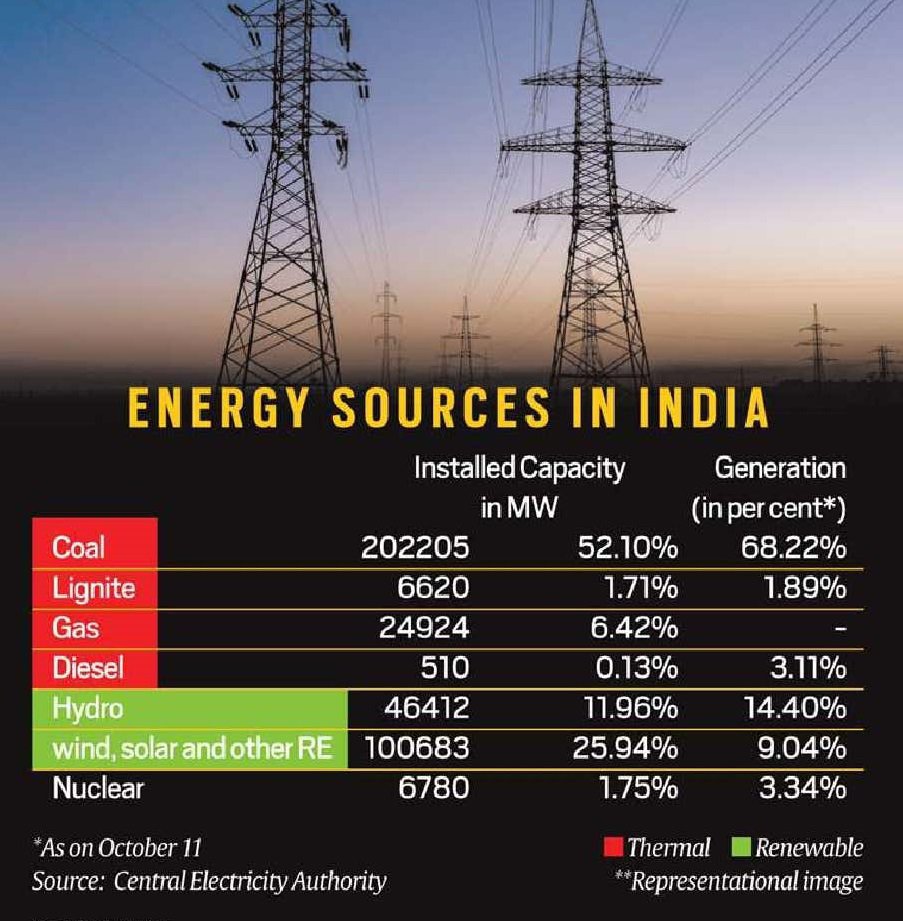
India has achieved its NDC target with total non-fossil based installed energy capacity of 157.32 GW which is 40.1% of the total installed electricity capacity

 At COP 21, as part of its Nationally Determined Contributions (NDCs), India had committed to achieving 40% of its installed electricity capacity from non-fossil energy sources by 2030. The country has achieved this target in November 2021 itself. The country’s installed Renewable Energy (RE) capacity stands at 150.54 GW (solar: 48.55 GW, wind: 40.03 GW, Small hydro Power: 4.83, Bio-power: 10.62, Large Hydro: 46.51 GW) as on 30.11.2021 while its nuclear energy based installed electricity capacity stands at 6.78 GW. This brings the total non-fossil based installed energy capacity to 157.32 GW which is 40.1% of the total installed electricity capacity of 392.01 GW. In line with the Hon’ble Prime Minister’s announcement at the recently concluded CoP26, the Government is committed to achieving 500 GW of installed electricity capacity from non-fossil fuel sources by the year 2030.

During the last 7.5 years, India has witnessed the fastest rate of growth in renewable energy capacity addition among all large economies, with renewable energy capacity (including large hydro) growing 1.97 times and solar energy expanding over 18 times.


  1. Investment in Renewables
  • India’s renewable energy programme is driven by private sector investment. As per REN21 Renewables 2020 Global status Report , during the period 2014 -2019 renewable energy programmes and projects in India attracted an investment of US$ 64.4 billion. In the year 2019 alone, US$ 11.2 billion were invested. New opportunities have emerged, and altogether new business space has been created. Indian companies have begun to explore foreign stock exchanges as a source of funds. India is progressively becoming a favored destination for investment in renewables.
  • As per Foreign Direct Investment (FDI) data Cell, DPIIT, the Indian ‘Non-Conventional Energy’ sector received approximately US$ 7.27 billion as FDI from the year 2014-15 upto June 2021. Of this, FDI of US$ 797.21 million was attracted during 2020-21. Liberal foreign investment policy allows the foreign investors to enter into joint ventures with an Indian partner for financial and/or technical collaboration and for setting up of renewable energy-based power generation projects. Upto 100 per cent foreign investment as equity qualifies for automatic approval, under the extant FDI policy of the Government.
  1. Major Programmes and Schemes:
  • Pradhan Mantri Kisan Urja Suraksha evam Utthaan Mahabhiyan (PM-KUSUM): To provide energy and water security, de-dieselise the farm sector and also generate additional income for farmers by producing solar power, Government launched PM-KUSUM Scheme for farmers. The Scheme consists of three components:
  • Component A: Installation of 10,000 MW of Decentralized Grid Connected Solar Power Plants each of capacity up to 2 MW
  • Component B: Setting up of 20 lakh standalone Solar Powered Agriculture Pumps
  • Component C: Solarisation of 15 Lakh existing Grid-connected Agriculture Pumps

The Scheme aims to add 30.8 GW of solar capacity with central financial support of over Rs. 34,000 Crore. Based on the learning during first year, business models for feeder level solarisation was included as new variant under Component-C. Convergence of Scheme with PM-KSY and Agriculture Infrastructure Fund also accomplished. For ease of availability of finance the Reserve Bank of India  has included the three components of the Scheme under Priority Sector Lending Guidelines. Cumulatively, about 5000 MW capacity of small solar power plants under component-A, 3.6 lakh standalone solar pumps under component-B and solarisation of over 10 lakh grid connected pumps under the two variants of component-C have been allocated in various States. After restrictions on COVID-19 pandemic were relaxed, installation has picked up and as on 30.11.2021, over 75000 stand-alone solar pumps have been installed under the Component-B, total 20 MW capacity solar power plants installed under Component-A and over 1000 pumps reported solarised under individual pump solarisation variant of Component-C. Implementation of feeder level solarization variant under Component-C, which was introduced in December, 2020 has also started in a number of States.

  • Production Linked Incentive (PLI) Scheme: On 28.04.2021, the Government introduced, Production Linked Incentive Scheme “National Programme on High Efficiency Solar PV Modules” with an outlay of Rs. 4500 crores to support and promote manufacturing of high efficiency solar PV modules, including the upstage vertical components like cells, wafers, ingots and polysilicon in India and thus reduce the import dependence in Solar Photo Voltaic (PV) sector. In pursuance of the decision, a tender for invitation of bids for manufacture of high efficiency solar PV modules was issued. The tender received very encouraging response wherein 18 bids were received which could add another around 55 GW of solar PV module manufacturing to present solar PV module manufacturing capacity of around 11 GW. Letter of Awards have been issued by IREDA on 11.11.2021/02.12.2021 to three successful bidders for setting up 8737 MW capacity of fully integrated solar PV manufacturing units.
  • Solar Parks Scheme: To facilitate large scale grid connected solar power projects, a scheme for “Development of Solar Parks and Ultra Mega Solar Power Projects” is under implementation with a target capacity of 40 GW capacity by March 2022. Solar parks provide solar power developers with a plug and play model, by facilitating necessary infrastructure like land, power evacuation facilities, road connectivity, water facility etc. along with all statutory clearances. As on 30.11.2021, 52 solar parks have been sanctioned with a cumulative capacity of 37.92 GW in 14 states. Solar power projects of an aggregate capacity of around 9.2 GW have already been commissioned in these parks.
  • Roof Top Solar programme Phase-II: Roof Top Solar programme Phase-II for accelerated deployment of solar roof top systems with a target of 40 GW installed capacity by the year 2021-22, is also under implementation. The scheme provides for financial assistance of upto 4 GW of solar roof top capacity to residential sector and there is a provision to incentivise the distribution companies for incremental achievement over the previous year. For residential sector use of domestically manufactured solar cells and modules have been mandated. This scheme is expected to act as catalyst for adding solar cell and module manufacturing capacity in India. As on 30.11.2021, a cumulative 5.7 GW solar roof top projects have been set up in the country. Against the target of 4GW for Residential sector under Rooftop Solar programme Phase-II, allocation of 3.4 GW already made to various states/ UTs and 1.07 GW already installed.
  • Central Public Sector Undertaking (CPSU) Scheme: A scheme for setting up 12 GW Grid- Connected Solar PV Power Projects by Central Public Sector Undertakings with domestic cells and modules is under implementation. Viability Gap Funding support is provided under this scheme. Apart from adding solar capacity, the scheme will also create demand for domestically manufactured solar cells/modules, and thus help domestic manufacturing. Under this scheme, Government has sanctioned around 8.2 GW of projects, as on 30.11.2021.
  • Wind Power

India’s wind power potential at hub height of 120 meters is 695 GW. The wind power installed capacity has grown 1.9 times during past 7.5 years to about 40 GW and 9.67 GW of projects are at various stages of commissioning (as on 30.11 2021). India has the 4th largest wind power capacity in the world.

The wind energy sector is led by the indigenous wind power industry with a strong project ecosystem, operation capabilities and a manufacturing base of about 12 GW per annum. All the major global players of Wind Turbine Manufacturing field have their presence in the country and over 35 different models of wind turbines are being manufactured by more than 15 different companies, through joint ventures under licensed production, subsidiaries of foreign companies, and Indian companies with their own technology. The unit size of wind turbine in India has gone up to 3.6 MW.

Government of India has notified the offshore Wind Energy Policy to harness the potential of offshore wind energy along India’s coastline. Ministry is developing strategy and roadmap for installation of offshore wind projects off the coast of Gujarat and Tamil Nadu.

The Ministry has notified the wind solar hybrid policy, providing a framework for promotion of large grid connected wind-solar PV hybrid projects for optimal and efficient utilization of transmission infrastructure and land, reducing the variability in renewable power generation and achieving better grid stability. As on 30.11.2021, capacity of 3.75 GW of wind-solar hybrid projects have been awarded, out of which 0.2 GW capacity is already commissioned. In addition, capacity of 1.7 GW wind-solar hybrid projects are at various stages of bidding.

  • Off-Grid Solar PV Applications Programme Phase III: Phase-III of the Off-Grid Solar PV Applications Programme for Solar Street Lights, Solar Study Lamps and Solar Power Packs was available as on 31.03.2021. As on 30.11.2021 over 1.45 lakh solar street lights installed, 9.03 lakh solar study lamps distributed and 2.5 MW solar power packs have been set-up as reported by State Nodal agencies (SNAs).
  • Atal Jyoti Yojana (AJAY) Phase-II: The AJAY Ph-II Scheme for installation of solar street lights with 25% fund contribution from MPLAD Funds was discontinued from 1 April 2020 as the Government decided to suspend the MPLAD Funds for next two years i.e. 2020-21 and 2021-22. However, installation of 1.5 lakh solar street lights sanctioned under the scheme till March 2020 was under progress and as on 30.11.2021 around 1.21 lakh solar street lights have reportedly been installed and balance are targeted to be completed by December 2021.
  • Green Energy Corridor

In order to facilitate renewable power evacuation and reshaping the grid for future requirements, the Green Energy Corridor (GEC) projects have been initiated. The first component of the scheme, Inter-state GEC with target capacity of 3200 circuit kilometer (ckm) transmission lines and 17,000 MVA capacity sub-stations, was completed in March 2020. The second component – Intra-state GEC with a target capacity of 9700 ckm transmission lines and 22,600 MVA capacity sub-stations is expected to be completed by June 2022. As on 30.11.2021, 8434 ckm of intra-state transmission lines have been constructed and 15268 MVA intra-state substations have been charged.

  • Other renewables for power generation

The following Bio-energy schemes were under implementation by the Ministry:

  • Programme on Energy from Urban, Industrial and Agricultural Wastes/ Residues
  • Scheme to support Promotion of Biomass based cogeneration in sugar mills and other industries
  • Biogas Power (Off-Grid) Generation and Thermal application Programme (BPGTP)
  • New National Biogas and Organic Manure Programme (NNBOMP)

Ministry of New and Renewable Energy has been implementing above-mentioned schemes 2020-21. The programmes which were valid till 31.03.2021, has been recommended for continuation by EFC for the period FY 2021-22 to 2025-26 only for meeting the already created liabilities. Thus, no new projects after 31.03.2021 are to be sanctioned.

As on 31.11.2021, installed capacity of biomass power and cogeneration projects stood at about 9.4 GW(Bagasse) and 0.77 GWeq (Non-Bagasse) , waste to energy projects capacity was 199.14 MW(grid connected) and 234.97 MWeq (off grid), and about 4.83 GW small hydro power capacity from 1146 small hydro power projects which were operational.

  1. Policies and Initiatives:
  • Waiver of Inter State Transmission System (ISTS) charges for inter-state sale of solar and wind power for projects to be commissioned by 30.06.2025,
  • Keeping in view India’s long-term goals of decarbonising the electricity systems, and achieving energy security, and in keeping with our international commitments, in July 2016, long term Renewable Purchase Obligation growth trajectory, uniformly applicable to all States/UTs up to the year 2021-22, was notified. Further, the Ministry of Power on 29.01.2021 included Hydropower Purchase Obligation (HPO) within Non-Solar Renewable Purchase Obligation (RPO) and notified the long term updated RPO trajectory from 2019-20 to 2021-22 including HPO till 2029-30.
  • Competitive Bidding guidelines for procurement of solar and wind power have been notified under section 63 of Electricity Act, 2003. These Guidelines provide for standardization and uniformity of the procurement process and a risk-sharing framework between various stakeholders, thereby encouraging investments, enhancing bankability and improving profitability for projects. The Guidelines also facilitate transparency and fairness in the procurement processes which have resulted in the drastic fall in solar and wind power prices over the past few years. Solar PV power tariff had dropped to an all-time low of Rs. 1.99 per unit in an auction of projects of 500 MW capacity by Gujarat Urja Vikas Nigam Ltd (GUVNL) in December 2020.
  • To build investor trust by ensuring payment security and tackle the risks related to delays in payments to independent power producers, DISCOMs have been mandated to issue and maintain letters of credit (LCs);
  • Efforts have been undertaken to strengthen and expand the domestic manufacturing eco-system. Schemes namely PM-KUSUM, Solar Rooftop and CPSU have a precondition of Domestic Content Requirement, directly creating a domestic demand of more than 36 GW solar PV (cells & modules). In order to curb proliferation of imported solar PV cells and modules, a Safeguard Duty was imposed w.e.f. 30.07.2018 for two years. It has been extended for one more year at the rates of 14.90 per cent for imports during 30.07.2020 to 29.01.2021; and 14.50 percent for imports during 30.01.2021 to 29.07.2021. Government has decided to impose Basic Customs Duty (BCD) on import of solar PV modules @40% and on import of solar PV cells @25% with effect from 01.04.2022.
  1. Hydrogen Mission

In the Independence Day speech on 15.08.2021, Prime Minister announced the launch of National Hydrogen Mission and stated the goal to make India a global hub for Green Hydrogen production and export. The draft National Green Hydrogen Mission document is under inter-ministerial consultations.

The Mission proposes a framework for inter alia creating demand for Green Hydrogen in sectors such as petroleum refining and fertilizer production; support for indigenous manufacturing of critical technologies; Research & Development activities; and an enabling policy and regulatory framework. The proposed steps will lead to the development of additional renewable energy capacity for Green Hydrogen production.

  1.        One Sun – One World – One Grid (OSOWOG)

A tripartite Memorandum of Understanding (MoU) was signed between the Ministry of New and Renewable Energy (MNRE), the International Solar Alliance (ISA) and the World Bank on 08.09.2020 for a study on the OSOWOG initiative. Currently, the implementation plan, road map and institutional framework is being developed by a consultant appointed for this purpose. The inception report has already been submitted by the consultant in September’2021. The complete study is expected to be completed by mid of 2022.

  1. International Solar Alliance

International Solar Alliance (ISA) was launched by Hon’ble Prime Minister of India, and the President of France on 30.11.2015 at Paris, France. With the signing and ratification of the ISA Framework Agreement by 15 countries, on 06.12.2017, ISA became the first international intergovernmental organization to be headquartered in India.

On 15.07.2020, this amendment came into force, which enables all member States of the UN, including those beyond the tropics, to join the ISA. As on 30.11.2021, 101 countries have signed the Framework Agreement of the ISA. Of these, 80 countries have also ratified the same.

  1. Issues/Challenges ahead
  • Mobilization of the necessary finance and investment on competitive terms: Gearing up the banking sector for arranging finances for larger deployment goals, exploring low-interest rate, long-term international funding, and developing a suitable mechanism for risk mitigation or sharing by addressing both technical and financial bottlenecks are major challenges. Need for mobilization of funds on attractive terms has further increased with launch of PM-KUSUM, which provides farmers an opportunity to become entrepreneurs and participate in India’s growth story. The ongoing efforts for mitigating investment risks, and easing approval processes would also need to be strengthened.
  • Land acquisition: Land acquisition is one of the major challenges in renewable power development. Identification of land with RE potential, its conversion (if needed), clearance from land ceiling Act, decision on land lease rent, clearance from revenue department, and other such clearances take time. State governments have to play a major role in acquisition of land for RE projects.
  • Creating an innovation and manufacturing eco-system in the country;
  • Integrating larger share of renewables with the grid;
  • Enabling supply of firm and dispatchable power from renewables;
  • Enabling penetration of renewables in the so called hard to decarbonize sectors.
  1. Some Steps by MNRE for facilitating RE Sector amid COVID-19 Pandemic:
  • Ensuring uninterrupted operation of Renewable Energy (RE) Plants in lockdown:

MNRE had requested States/UTs for facilitating ensuring uninterrupted essential operation of Renewable Energy Generating Stations (REGS) (solar power plants, wind power plants, solar-wind hybrid power plants, small hydro power plants, biomass / biogas based power plants, etc.) and provide facilitation /permission for material movement needed by them during the nation-wide lockdown for COVID-19 outbreak.

  • Time-Extension of around 7.5 months on account of lock-down and disruption due to COVID-19:

MNRE had issued orders regarding treating lockdown due to COVID-19, as Force Majeure and granting of time-extension of around 7.5 months for renewable energy projects on account of lockdown and disruptions on account of COVID-19.

  • Facilitating Invoicing: by non –insistence on signed hard copy.

MNRE had issued directions regarding accepting invoices over email without insisting on submission of signed hard copy and in cases where Joint Meter Reading (JMR) cannot be signed due to lockdown, acceptance of Invoices generated by RE Developers on basis on photograph of meter reading/ downloaded meter data.

  • Insisting on Must-Run, Timely Payments & no Curtailments:

MNRE had issued clarifications that Renewable Energy (RE) Generating Stations have been granted ‘Must-Run’ status and this status of ‘Must-Run’ remains unchanged during the period of lockdown, and further directing DISCOMs that since RE Generating Stations comprise only a minor portion of the total electricity generation in the country, the payments to RE generators be done on regular basis as was being done prior to lockdown as per established procedure. MNRE further issued directions reiterating that Renewable Energy remains ‘Must-Run’ and any curtailment but for grid safety reason would amount to deemed generation.

Unemployment

Unemployment has become one of the biggest problems around the world. When an individual is an implied, he or she will know very less about the mankind. It is so difficult to face situation and handle situations when the individual is unemployed. Unemployment leads to many silly mistakes. And an unemployed person cannot take over the family and lead the family as well. There is a huge competition in highly populated countries like India. In order to be employed, the only method is to study hard and improve the skills and score better. Basically, the students are not showing good amount of interest towards the studies. Let us now see how to motivate them.

Covid crisis has made many people unemployed. It has taken away the basic need of living. Many people are left with the unfilled stomachs. Some people are dead about by not finding a way to live.

Types of unemployment :

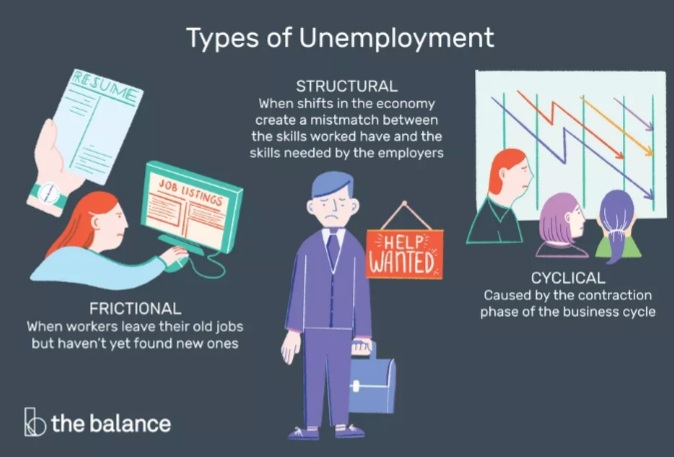
There are four main types of unemployment in an economy frictional, structural, cyclical, and seasonal and each has a different cause.

1. Frictional unemployment :

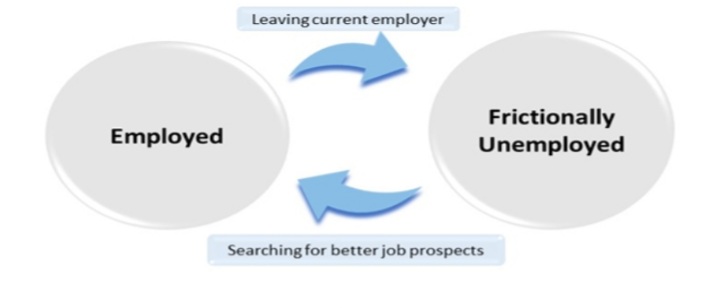
Frictional unemployment is caused by temporary transitions in workers lives, such as when a worker moves to a new city and has to find a new job. Frictional unemployment also includes people just entering the labor force, such as freshly graduated college students. It is the most common cause of unemployment, and it is always in effect in an economy.

2. Structural unemployment :

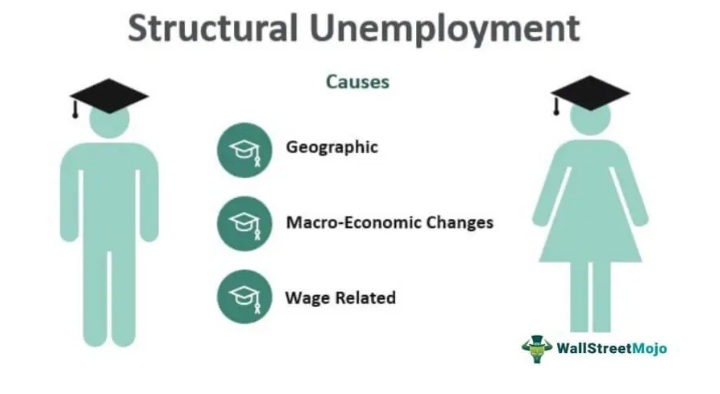
Structural unemployment is caused by a mismatch in the demographics of workers and the types of jobs available, either when there are jobs available that workers don’t have the skills for, or when there are workers availabes but no jobs to fill. Structural unemployment is most obvious in industries undergoing technological advancements.

3. Cyclical unemployment :

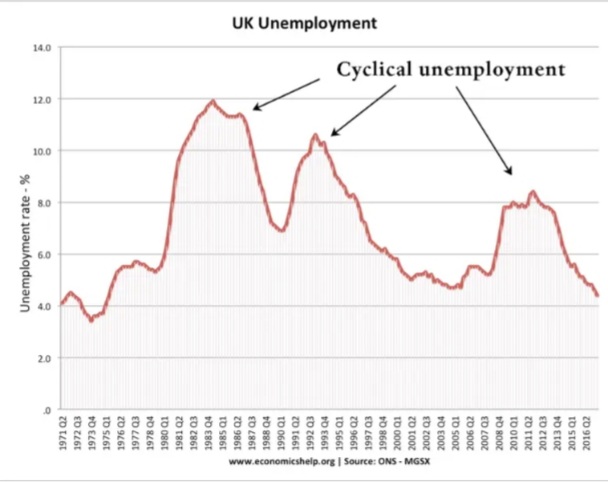
Cyclical unemployment is caused by declining demand. When there is not enough demand in an economy for goods and services, businesses cannot offer jobs . According to keynesian economics , cyclical unemployment is a natural result of the business cycle in times of recession: if all consumers become fearful at once, consumers will attempt to increase their saving at the same time, which means there will be a decrease in spending, and businesses will not be able to employ all employable workers.

4. Seasonal unemployment :

Seasonal unemployment is caused by different industries or parts of the labor market being available during different seasons. Fot instance, unemployment goes up in the winter months, because many agricultural jobs end oncr crops are have harvested in the fall, and those wotkers are left to find new jobs.

Consequences of unemployment in an Economy :

Low unemployment is key to economic stability High and long- term unemployment can cause significant stress on a nation in three key areas.

* Individuals :

Unemployed people have no ability to fulfill their financial obligations and can become mentally stressed, ill, and even homeless.

* Economic efficiency :

During times of high unemployment many job seekers will accept new jobs below their skill level, a situation called “underemployment ” which translates to a loss of human capital for an economys labor market. Unemployed workers will also significantly decreases their consumer spending, which is one of the driving forces of economic growth. Without consumer spending, the economy will slow dramatically.

* socio- political stability :

If unemployment remains high, citizen dissatisfaction can rise to the point of widespread civil unrest.

Possible solutions for Unemployment :

Solving unemployment is a hotly debated topic, and no economists agree on one simple way to do it. However, in the U.S ,if unemployment rises noticeably, the government usually steps in with specific policies designed to lower the total number of unemployed people.

1. Monetary policy :

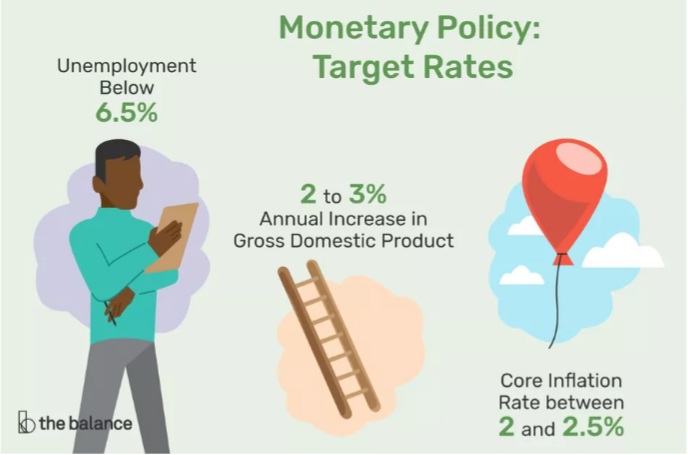
Monetary policy is financial influence implemented by a central bank . Monetary policies usually come in the form of lower interest rates, which increase the total money supply within an economy by allowing banks and businesses more access to loans and therefore, more accessible spending power.

2. Fiscal policy :

If expansionary monetary policy doesn’t adequately lower the unemployment rate government agencies will turn to fiscal policy. Fiscal policy is fiscal stimulus implemented by the national government and fiscal policies include spending on infrastructure, proposingtax cuts , increasing the minimum wage, or implementing unemployment benefits. These methods are designed to inject more demand into private economy and strengthen economic activity.

Let us now see some of the ways to motivate the students to study and get employeed.

Make things easier :

Showing the things easier and explaining them with clarity helps the students to show better interest on the subject and makes them to pay more attention on what the teacher is trying to convey. When the topics are shown easier for the students, they start learning them and they feel achieved and they pay more attention to study. When a student learns a particular topic or a question, he/she feels comfortable and happy for getting it. Once if they start reading, they develop the interest in them and they continue to read more and more.

Tell the importance :

The students must be motivated with good number of words to understand the need of studying and what happens if they don’t study. A student is like a bird without the wings when they don’t study. So, it is very important to motivate students to study and to make them understand the need of the situation. Motivation brings the right change in the students who are not interested in learning. It develops the interest in them to study.

It seems good if the government provides good number of jobs.

What Is Causing Punjab’s Severe Electricity Crisis?

As temperature levels are on the rise in Punjab, where paddy transplantation is also in full swing, the state is experiencing a severe power outage. Even when the farm sector has still not received the guaranteed eight-hour electricity supply residential consumers have now been forced to suffer as a result of extended electricity outages

Furthermore, the state-owned power company PSPCL has enforced a two-day mandatory reduction on high-consumption industries in order to redirect electricity to farms and the household sector There is also a restriction on operating air conditioning units in government offices, as their hours have been reduced from 8 a.m. to 2 p.m. due to the shortages

The requirement for electricity has reached 14,225 MW as temperatures have risen and it is the peak season for paddy transplanting. The electricity providers, though, have only been able to deliver 12,800 MW. The 1,425 MW shortfall has resulted in power outages lasting up to 14 hours in the residential sector. Now, businesses have been closed down for two days to guarantee that the farming industry receives adequate supplies and also that the critical window for paddy transplanting is not missed. Farmers and residential customers took to the streets in protest a few days earlier. Industry groups are protesting that this was the last thing they wanted in the midst of a pandemic that has devastated all businesses.

What may have caused the state’s electricity problem?

The shutting down of the government-run thermal plant in Bathinda and two units of yet another government thermal plant in Ropar, with a total capacity of 880 MW, was one of the first actions taken by the current Congress administration in Punjab. There were no backup plans in place to compensate for the loss of output once these factories were closed.

Furthermore, in 2018, the government rejected PSPCL’s intention to build a 100-MW solar facility at the Bathinda thermal plant, which could have been operational within a year. A PSPCL request to upgrade a Bathinda thermal facility to utilize biomass fuel from paddy straw was also denied.

In addition, a unit of the private TSPL Power Plant located in Talwandi Sabo has been shut down since March 8 due to a lack of repairs. The plant generates 660 MW. According to former PSPCL chairman Baldev Singh Sra, the plant had to be closed down due to defective Power Purchase Agreements (PPAs).

Why is it that Punjab seems unable to purchase electricity then?

PSPCL is experiencing financial difficulties. The state owes it Rs 5,000 crore for agricultural subsidies, while government institutions owe PSPCL Rs 2,000 crore. During one latest power meeting held, Chief Minister Amarinder Singh instructed the finance department of the state to provide Rs 500 crore towards the usability for power purchase. Furthermore, even if it purchased additional electricity, the state of Punjab has a transmission capacity of 13,000 MW only.

What has the Punjab government said?

A. Venu Prasad, CMD of PSPCL, blamed the power outage on the collapse of the Talwandi Sabo power plant. He also stated that the hailstorm that occurred between June 10 and 15 contributed to the problem and that it took them many days to fix the plant. Because the destruction was so extensive, several areas are still being repaired.

Prasad also stated that the state’s water table was dropping and that more electricity was needed to extract water from the ground bore wells. He stated that the administration was dedicated to delivering electricity and that they had already begun acquiring power from other sources to hold them over till the situation passed. He said that the issue is now under order.

Longest running light bulb since 1901: The case of Planned Obsolescence

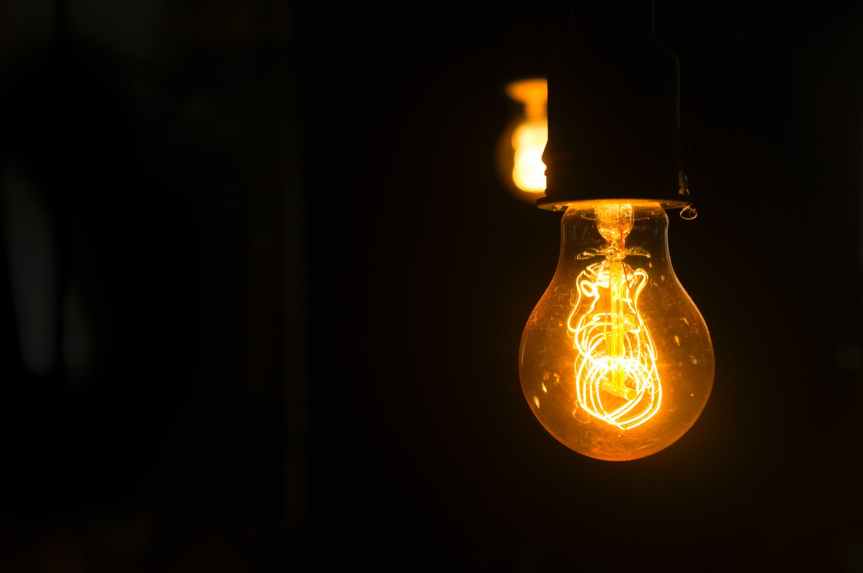
Centennial Light is the longest-running electric light bulb on record. It has been running continuously since 1901 and it has never been switched off. It is located in Fire Station 6 in Livermore, California. The ordinary dim light bulb looks like any other bulb and there is also a camera that live-streams the light bulb onto the internet.

Link for the official website and live webcam of the light bulb.

http://www.centennialbulb.org/photos.htm

It was manufactured in the late 1890s by the Shelby Electric Company, of Ohio, using a design by the French-American inventor Adolphe Chaillet. It has operated for over 100 years with very few interruptions. In 2011, it passed a milestone: One million hours of near-continuous operation. In 2015 it was recognized by Guinness World Records as the world’s longest-burning bulb.

The 60-watt bulb uses a carbon filament. One of the reasons for its longevity is that it seems to have an incredibly durable vacuum seal. There have been some researches done on bulbs manufactured by Shelby Electric Company of that era. But no one really exactly knows how these eternal bulbs were made as they were experimenting with various but the company was experimenting with a variety of designs at the time.

The electric model was quite different when first homes in The U.S had electricity. The servicing was the responsibility of the electric companies and customers would purchase entire electrical systems manufactured by a regional electricity supplier. The companies would also take care of the installation and servicing of any burned out electric bulbs would be replaced for free.

It made more logic for the suppliers to manufacture bulbs that would last longer and would burn out as least as possible. But this business model was later replaced and homeowners were responsible to change the light bulbs. It was soon realized that it would be more profitable to make cheaper bulbs that burned out faster. Since the mid-1900s goods were manufactured with a pre-determined expiry date aimed at forcing consumers into repeat purchases. This phenomenon has only been exacerbated in recent years. This can also be called planned obsolescence.

In 1924, the life span of the light bulbs was at least 2,500 hours. Phoebus cartel was formed in 1925 in Geneva. It comprised of the major incandescent light bulbs manufacturers at that time: Osram, General Electric, Associated Electrical Industries, and Philips. The cartel had directed their engineers to cut the life of the bulbs to 1,000 hours, which the engineers did by adjusting voltage and current. The cartel was intended to operate for 30 years but it was starting to fall apart in the early 1930s after General Electric patents expired and as the cartel faced competition from non-member manufactures from other regions. The cartel ceased its operations after the outbreak of World War II in 1939.

Planned obsolescence is a very critical area it does not only decrease the lifespan of the good but as a consequence, it is also wasteful. It is not sustainable for the environment and the main focus of this practice is to maximize profits. It also reminds us that technological innovations are often not accessible in favor of corporate greed.

References:

Solar air conditioning and efficient, low-consumption cooling systems work together.

Researchers from the Universitat Politècnica de València (UPVCMT-Motores )’s Térmicos (Thermal Engines) group are developing new, more efficient cooling systems that use solar air conditioning, which will assist in addressing the summer increase in electricity bills Their study results made an appearance in the International Journal of Refrigeration.

“In the last month, the ‘perfect storm’ has occurred in all aspects of the electricity bill. On the one hand, there is the so-called rate change, which is divided into three segments, and on the other, there are consumption peaks in the summer during the hottest days of the year. In these days of high temperatures, air conditioning units and cooling systems consume more electricity, raising the cost of electricity significantly—without going any further, the price of electricity surpassed its annual record last Saturday. Solar air conditioning, while an oxymoron, has the potential to be a solution to this perfect storm, says “José Ramón Serrano”, a CMT researcher.

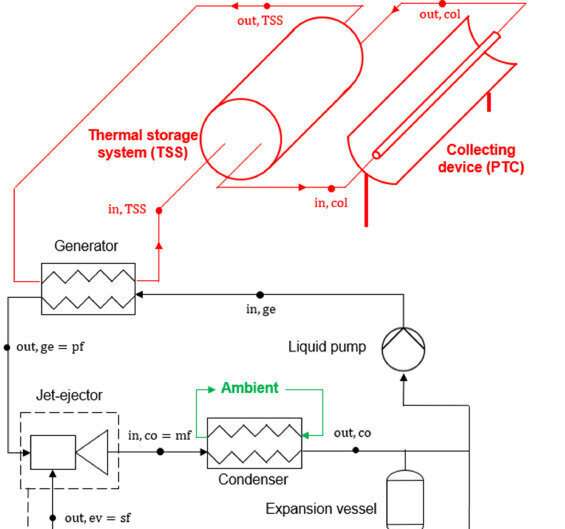
Solar-assisted thermal storage tank jet ejector cooling system.

Solar air conditioning equipment

Solar air conditioning is the equipment used to cool a space with solar energy. Two main groups are involved, as explained by Serrano: on the one hand, photovoltaic panels are used to produce traditional air conditioners. The problem with these solutions is their low efficiency: barely 10 percent, which means the nearly 1,000W per sqm that we get with the most solar radiation during the summertime, generates only 100W of electricity. “This represents about 300 W of cooling power in a traditional cold unit,” Serrano describes.

Solar thermal cooling systems, on the other hand, are more efficient and versatile. In this case, thermo-solar panels are used in place of photovoltaic panels that warm up a liquid by using surfaces that absorb or concentrate solar rays. These systems are used in the cold winter months in households to heat sanitary water and solar heating systems. The CMT-Motores Térmicos researchers concentrate their efforts on the latter to use them during the summer.

They propose coupling these panels to absorption or ejection cycles, which would allow them to cool the room using the sun’s heat as the source of energy. The 1,000 W per square meter received in these cases can be converted into 500 W of heating power using the thermal oil that flows through the thermo-solar panels. The 500 W can then be converted into 600 W of cooling power via high-efficiency absorption cycles.

“One advantage of using this equipment is that the cooling capability increases in tandem with the solar radiation, which coincides with periods of higher cooling demand,” says Vicente Dolz, UPV professor and CMT-Motores Térmicos researcher.

And how would this allow you to save money on electricity?

A typical household air conditioning unit in the living room has a cooling capacity of around 3,500 W. According to the UPV researchers, these values can be achieved with around 6 m2 of thermo-solar panels coupled to an absorption cycle during the hours of highest irradiation (midday in the summer) to completely replace the traditional air conditioning unit with the absorption cycle.

“A traditional air conditioning unit consumes approximately 1,170 W of electricity to achieve the 3,500 W of cooling power.” The technology that we propose would allow us to eliminate said consumption from our bills while enjoying the greatest level of comfort possible thanks to the combination of solar panels and absorption cycles.

CMT-Motores Térmicos proposed that solution can also be implemented as a hybrid system that provides part of the traditional system’s cooling capabilities or improves its efficiency while also reducing global electricity consumption by providing the solar air conditioning system.

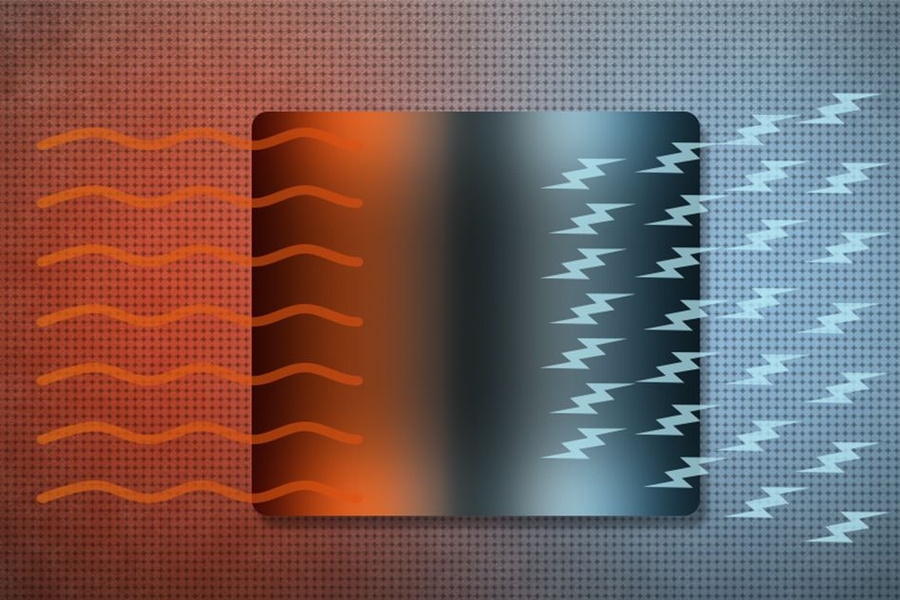
Energy-harvesting design aims to turn high-frequency electromagnetic waves into usable power

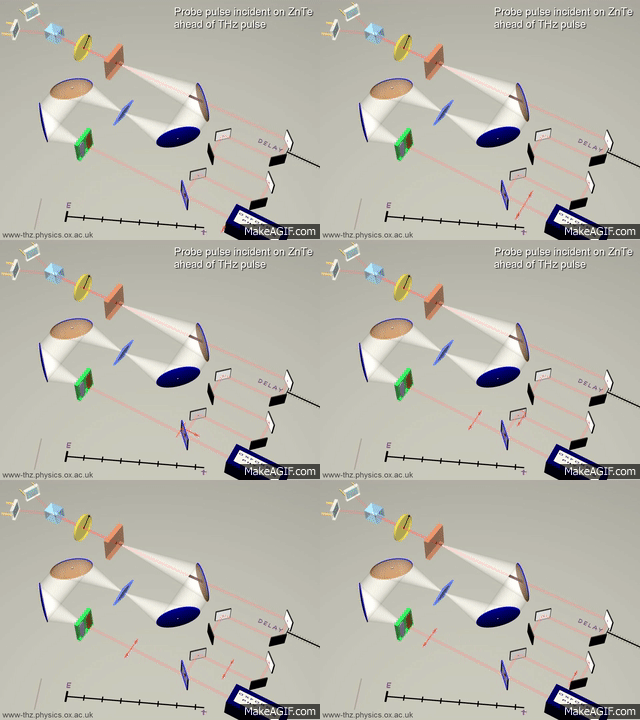
Device for harnessing terahertz radiation might help power some portable electronics.

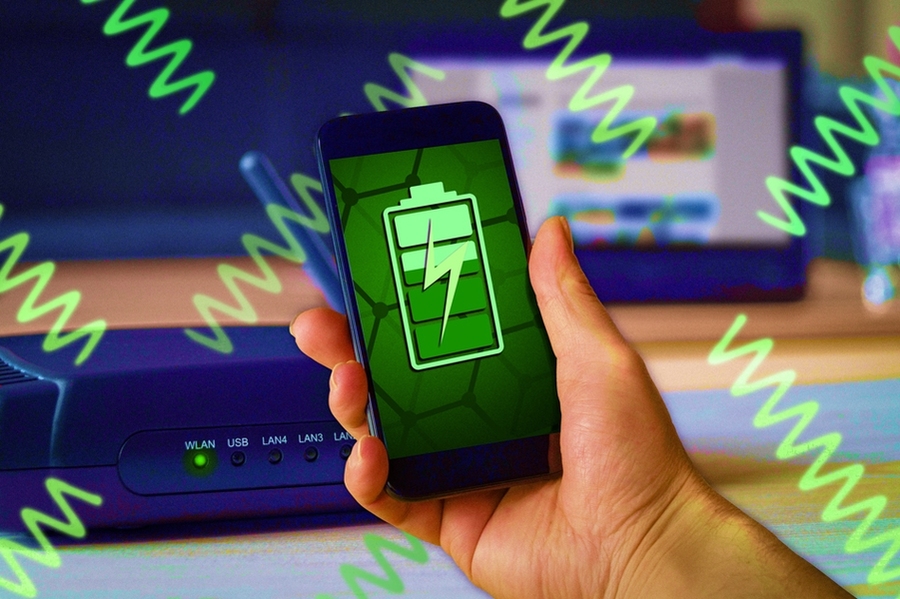
Terahertz waves are pervasive in our daily lives, and if harnessed, their concentrated power could potentially serve as an alternate energy source. Imagine, for instance, a cellphone add-on that passively soaks up ambient T-rays and uses their energy to charge your phone.

Terahertz waves are electromagnetic radiation with a frequency somewhere between microwaves and infrared light. Also known as “T-rays,” they are produced by almost anything that registers a temperature, including our own bodies and the inanimate objects around us.

Terahertz waves are pervasive in our daily lives, and if harnessed, their concentrated power could potentially serve as an alternate energy source. However, to date there has been no practical way to capture and convert them into any usable form.

Now physicists at MIT have come up with a blueprint for a device they believe would be able to convert terahertz waves into a direct current, a form of electricity that powers many household electronics.

Their design takes advantage of the quantum mechanical, or atomic behavior of the carbon material graphene. They found that by combining graphene with another material, in this case, boron nitride, the electrons in graphene should skew their motion toward a common direction. Any incoming terahertz waves should “shuttle” graphene’s electrons, like so many tiny air traffic controllers, to flow through the material in a single direction, as a direct current.

The researchers have published their results today in the journal Science Advances, and are working with experimentalists to turn their design into a physical device.

“We are surrounded by electromagnetic waves,” says lead author Hiroki Isobe, a postdoc in MIT’s Materials Research Laboratory. “If we can convert that energy into an energy source we can use for daily life, that would help to address the energy challenges we are facing right now.”

Isobe’s co-authors are Liang Fu, the Lawrence C. and Sarah W. Biedenharn Career Development Associate Professor of Physics at MIT; and Su-yang Xu, a former MIT postdoc who is now an assistant professor chemistry at Harvard University.

Breaking graphene’s symmetry

Over the last decade, scientists have looked for ways to harvest and convert ambient energy into usable electrical energy. They have done so mainly through rectifiers, devices that are designed to convert electromagnetic waves from their oscillating (alternating) current to direct current.

Most rectifiers are designed to convert low-frequency waves such as radio waves, using an electrical circuit with diodes to generate an electric field that can steer radio waves through the device as a DC current. These rectifiers only work up to a certain frequency, and have not been able to accommodate the terahertz range.

A few experimental technologies that have been able to convert terahertz waves into DC current do so only at ultracold temperatures — setups that would be difficult to implement in practical applications.

Instead of turning electromagnetic waves into a DC current by applying an external electric field in a device, Isobe wondered whether, at a quantum mechanical level, a material’s own electrons could be induced to flow in one direction, in order to steer incoming terahertz waves into a DC current.

Such a material would have to be very clean, or free of impurities, in order for the electrons in the material to flow through without scattering off irregularities in the material. Graphene, he found, was the ideal starting material.

To direct graphene’s electrons to flow in one direction, he would have to break the material’s inherent symmetry, or what physicists call “inversion.” Normally, graphene’s electrons feel an equal force between them, meaning that any incoming energy would scatter the electrons in all directions, symmetrically. Isobe looked for ways to break graphene’s inversion and induce an asymmetric flow of electrons in response to incoming energy.

Looking through the literature, he found that others had experimented with graphene by placing it atop a layer of boron nitride, a similar honeycomb lattice made of two types of atoms — boron and nitrogen. They found that in this arrangement, the forces between graphene’s electrons were knocked out of balance: Electrons closer to boron felt a certain force while electrons closer to nitrogen experienced a different pull. The overall effect was what physicists call “skew scattering,” in which clouds of electrons skew their motion in one direction.

Isobe developed a systematic theoretical study of all the ways electrons in graphene might scatter in combination with an underlying substrate such as boron nitride, and how this electron scattering would affect any incoming electromagnetic waves, particularly in the terahertz frequency range.

He found that electrons were driven by incoming terahertz waves to skew in one direction, and this skew motion generates a DC current, if graphene were relatively pure. If too many impurities did exist in graphene, they would act as obstacles in the path of electron clouds, causing these clouds to scatter in all directions, rather than moving as one.

“With many impurities, this skewed motion just ends up oscillating, and any incoming terahertz energy is lost through this oscillation,” Isobe explains. “So we want a clean sample to effectively get a skewed motion.”

One direction

They also found that the stronger the incoming terahertz energy, the more of that energy a device can convert to DC current. This means that any device that converts T-rays should also include a way to concentrate those waves before they enter the device.

With all this in mind, the researchers drew up a blueprint for a terahertz rectifier that consists of a small square of graphene that sits atop a layer of boron nitride and is sandwiched within an antenna that would collect and concentrate ambient terahertz radiation, boosting its signal enough to convert it into a DC current.

“This would work very much like a solar cell, except for a different frequency range, to passively collect and convert ambient energy,” Fu says.

The team has filed a patent for the new “high-frequency rectification” design, and the researchers are working with experimental physicists at MIT to develop a physical device based on their design, which should be able to work at room temperature, versus the ultracold temperatures required for previous terahertz rectifiers and detectors.

“If a device works at room temperature, we can use it for many portable applications,” Isobe says.

He envisions that, in the near future, terahertz rectifiers may be used, for instance, to wirelessly power implants in a patient’s body, without requiring surgery to change an implant’s batteries.

“We are taking a quantum material with some asymmetry at the atomic scale, that can now  be utilized, which opens up a lot of possibilities,” Fu says.

This research was funded in part by the U.S. Army Research Laboratory and the U.S. Army Research Office through the Institute for Soldier Nanotechnologies (ISN).

Wireless Energy Transfer-Tesla’s Dream

WPT- Wireless Power Transmission
Wireless Power Transfer holds the promise of freeing us from the tyranny of power cords. This technology is being incorporated into all kinds of devices and systems.

Wireless Power Transfer holds the promise of freeing us from the tyranny of power cords. This technology is being incorporated into all kinds of devices and systems. Let’s take a look!
The Wired Way
The majority of today’s residences and commercial buildings are powered by alternating current (AC) from the power grid. Electrical stations generate AC electricity that is delivered to homes and businesses via high-voltage transmission lines and step-down transformers.
Electricity enters at the breaker box, and then electrical wiring delivers current to the AC equipment and devices that we use every day—lights, kitchen appliances, chargers, and so forth.
All components are standardized and in agreement with the electrical code. Any device rated for standard current and voltage will work in any of the millions of outlets throughout the country. While standards differ between countries and continents, within a given electrical system, any appropriately rated device will work.
Here a cord, there a cord. . . . Most of our electrical devices have AC power cords.


Wireless Power Technology
Wireless Power Transfer (WPT) makes it possible to supply power through an air gap, without the need for current-carrying wires. WPT can provide power from an AC source to compatible batteries or devices without physical connectors or wires. WPT can recharge mobile phones and tablets, drones, cars, even transportation equipment. It may even be possible to wirelessly transmit power gathered by solar-panel arrays in space.
WPT has been an exciting development in consumer electronics, replacing wired chargers. The 2017 Consumer Electronics Show will have many devices offering WPT.
The concept of transferring power without wires, however, has been around since the late 1890s. Nikola Tesla was able to light electric bulbs wirelessly at his Colorado Springs Lab using electrodynamic induction (aka resonant inductive coupling).
 

An image from Tesla’s patent for an “apparatus for transmitting electrical energy,” 1907.
 
Three light bulbs placed 60 feet (18m) from the power source were lit, and the demonstration was documented. Tesla had big plans and hoped that his Long Island-based Wardenclyffe Tower would transmit electrical energy wirelessly across the Atlantic Ocean. That never happened owing to various difficulties, including funding and timing.
WPT uses fields created by charged particles to carry energy between transmitters and receivers over an air gap. The air gap is bridged by converting the energy into a form that can travel through the air. The energy is converted to an oscillating field, transmitted over the air, and then converted into usable electrical current by a receiver. Depending on the power and distance, energy can be effectively transferred via an electric field, a magnetic field, or electromagnetic (EM) waves such as radio waves, microwaves, or even light.

 
Qi Charging, an Open Standard for Wireless Charging
While some of the companies promising WPT are still working to deliver products, Qi (pronounced “chee”) charging is standardized, and devices are currently available. The Wireless Power Consortium (WPC), established in 2008, developed the Qi standard for battery charging. The standard supports both inductive and resonant charging technologies.
Inductive charging has the energy passing between a transmitter and receiver coil at close range. Inductive systems require the coils to be in close proximity and in alignment with each other; usually the devices are in direct contact with the charging pad. Resonant charging does not require careful alignment, and chargers can detect and charge a device at distances up to 45mm; thus, resonant chargers can be embedded in furniture or mounted in shelving.
 

The Qi logo displayed on the Qimini wireless charging plate. Image courtesy of Tektos.
 
The presence of a Qi logo means the device is registered and certified by the Wireless Power Consortium.
When first introduced, Qi charging was low power, about 5W. The first smartphones using Qi charging were introduced in 2011. In 2015, Qi was expanded to include 15W, which allows for quick charging.
Only devices listed in the Qi Registration Database are guaranteed to provide Qi compatibility. There are currently over 700 products listed. It is important to recognize that products with the Qi logo have been tested and certified; the magnetic fields they use will not cause problems for sensitive devices such as mobile phones or electronic passports. Registered devices are guaranteed to work with all registered chargers.  
For more information on Qi wireless charging, check out this article, and for an introduction to and technical evaluation of Qi-compatible transmitter/receiver WPT evaluation boards, click here and here.
 
The Physics of WPT
WPT for consumer devices is an emerging technology, but the underlying principles and components are not new. Maxwell’s Equations still rule wherever electricity and magnetism are involved, and transmitters send energy to receivers just as in other forms of wireless communication. WPT is different, though, in that the primary goal is transferring the energy itself, rather than information encoded in the energy.


WPT transmitter/receiver block diagram.
The electromagnetic fields involved in WPT can be quite strong, and human safety has to be taken into account. Exposure to electromagnetic radiation can be a concern, and there is also the possibility that the fields generated by WPT transmitters could interfere with wearable or implanted medical devices.
The transmitters and receivers are embedded within WPT devices, as are the batteries to be charged. The actual conversion circuitry will depend on the technology used. In addition to the actual transfer of energy, the WPT system must allow the transmitter and receiver to communicate. This ensures that a receiver can notify the charging device when a battery is fully charged. Communication also allows a transmitter to detect and identify a receiver, to adjust the amount of power transmitted to the load, and to monitor conditions such as battery temperature.
The concept of near-field vs. far-field radiation is relevant to WPT. Transmission techniques, the amount of power that can be transferred, and proximity requirements are influenced by whether the system is utilizing near-field or far-field radiation.
Locations for which the distance from the antenna is much less than one wavelength are in the near field. The energy in the near field is nonradiative, and the oscillating magnetic and electric fields are independent of each other. Capacitive (electric) and inductive (magnetic) coupling can be used to transfer power to a receiver located in the transmitter’s near field.
Locations for which the distance from the antenna is greater than approximately two wavelengths are in the far field. (A transition region exists between the near field and far field.) Energy in the far field is in the form of typical electromagnetic radiation. Far-field power transfer is also referred to as power beaming. Examples of far-field transfer are systems that use high-power lasers or microwave radiation to transfer energy over long distances.
 
Where WPT Works
All WPT technologies are currently under active research, much of it focused on maximizing power transfer efficiency (PDF) and investigating techniques for magnetic resonant coupling (PDF). In addition to the idea of walking into a room equipped for WPT and having your devices charge automatically, much more ambitious projects are in place.
Across the globe, electric buses are becoming the norm; London’s iconic double-decker buses are planning for wireless charging, as are bus systems in South KoreaUtah, and Germany.
Using WiTricity, invented by MIT scientists, electric cars can be charged wirelessly, and those cars can wirelessly charge your mobiles! (Using Qi charging, of course!) This wireless technology is convenient, to be sure, but it may also charge cars faster than plug-in charging can.
 

Graphic of a wireless parking charge setup built into a parking space. Image courtesy of Toyota.
 
An experimental system for wirelessly powering drones has already been demonstrated. And as mentioned above, ongoing research and development is focused on the prospect of supplying some of Earth’s energy needs using WPT in conjunction with space-based solar panels.
WPT works everywhere!
 
Conclusion
While Tesla’s dream of having power delivered wirelessly for everyone’s use is still far from feasible, many devices and systems are using some form of wireless power transfer right now. From toothbrushes to mobile phones, from cars to public transportation, there are many applications for wireless power transfer.

Turning heat into electricity.

Study finds topological materials could boost the efficiency of thermoelectric devices.

MIT researchers, looking for ways to turn heat into electricity, find efficient possibilities in certain topological materials.

What if you could run your air conditioner not on conventional electricity, but on the sun’s heat during a warm summer’s day? With advancements in thermoelectric technology, this sustainable solution might one day become a reality.

Thermoelectric devices are made from materials that can convert a temperature difference into electricity, without requiring any moving parts — a quality that makes thermoelectrics a potentially appealing source of electricity. The phenomenon is reversible: If electricity is applied to a thermoelectric device, it can produce a temperature difference. Today, thermoelectric devices are used for relatively low-power applications, such as powering small sensors along oil pipelines, backing up batteries on space probes, and cooling minifridges.

But scientists are hoping to design more powerful thermoelectric devices that will harvest heat — produced as a byproduct of industrial processes and combustion engines — and turn that otherwise wasted heat into electricity. However, the efficiency of thermoelectric devices, or the amount of energy they are able to produce, is currently limited.

Now researchers at MIT have discovered a way to increase that efficiency threefold, using “topological” materials, which have unique electronic properties. While past work has suggested that topological materials may serve as efficient thermoelectric systems, there has been little understanding as to how electrons in such topological materials would travel in response to temperature differences in order to produce a thermoelectric effect.

In a paper published this week in the Proceedings of the National Academy of Sciences, the MIT researchers identify the underlying property that makes certain topological materials a potentially more efficient thermoelectric material, compared to existing devices.

“We’ve found we can push the boundaries of this nanostructured material in a way that makes topological materials a good thermoelectric material, more so than conventional semiconductors like silicon,” says Te-Huan Liu, a postdoc in MIT’s Department of Mechanical Engineering. “In the end, this could be a clean-energy way to help us use a heat source to generate electricity, which will lessen our release of carbon dioxide.”

A path freely traveled

When a thermoelectric material is exposed to a temperature gradient — for example, one end is heated, while the other is cooled — electrons in that material start to flow from the hot end to the cold end, generating an electric current. The larger the temperature difference, the more electric current is produced, and the more power is generated. The amount of energy that can be generated depends on the particular transport properties of the electrons in a given material.

Scientists have observed that some topological materials can be made into efficient thermoelectric devices through nanostructuring, a technique scientists use to synthesize a material by patterning its features at the scale of nanometers. Scientists have thought that topological materials’ thermoelectric advantage comes from a reduced thermal conductivity in their nanostructures. But it is unclear how this enhancement in efficiency connects with the material’s inherent, topological properties.

To try and answer this question, Liu and his colleagues studied the thermoelectric performance of tin telluride, a topological material that is known to be a good thermoelectric material. The electrons in tin telluride also exhibit peculiar properties that mimic a class of topological materials known as Dirac materials.

The team aimed to understand the effect of nanostructuring on tin telluride’s thermoelectric performance, by simulating the way electrons travel through the material. To characterize electron transport, scientists often use a measurement called the “mean free path,” or the average distance an electron with a given energy would freely travel within a material before being scattered by various objects or defects in that material.

Nanostructured materials resemble a patchwork of tiny crystals, each with borders, known as grain boundaries, that separate one crystal from another. When electrons encounter these boundaries, they tend to scatter in various ways. Electrons with long mean free paths will scatter strongly, like bullets ricocheting off a wall, while electrons with shorter mean free paths are much less affected.

In their simulations, the researchers found that tin telluride’s electron characteristics have a significant impact on their mean free paths. They plotted tin telluride’s range of electron energies against the associated mean free paths, and found the resulting graph looked very different than those for most conventional semiconductors. Specifically, for tin telluride and possibly other topological materials, the results suggest that electrons with higher energy have a shorter mean free path, while lower-energy electrons usually possess a longer mean free path.

The team then looked at how these electron properties affect tin telluride’s thermoelectric performance, by essentially summing up the thermoelectric contributions from electrons with different energies and mean free paths. It turns out that the material’s ability to conduct electricity, or generate a flow of electrons, under a temperature gradient, is largely dependent on the electron energy.

Specifically, they found that lower-energy electrons tend to have a negative impact on the generation of a voltage difference, and therefore electric current. These low-energy electrons also have longer mean free paths, meaning they can be scattered by grain boundaries more intensively than higher-energy electrons.

Tin telluride - Wikipedia

Sizing down

Going one step further in their simulations, the team played with the size of tin telluride’s individual grains to see whether this had any effect on the flow of electrons under a temperature gradient. They found that when they decreased the diameter of an average grain to about 10 nanometers, bringing its boundaries closer together, they observed an increased contribution from higher-energy electrons.

That is, with smaller grain sizes, higher-energy electrons contribute much more to the material’s electrical conduction than lower-energy electrons, as they have shorter mean free paths and are less likely to scatter against grain boundaries. This results in a larger voltage difference that can be generated.

What’s more, the researchers found that decreasing tin telluride’s average grain size to about 10 nanometers produced three times the amount of electricity that the material would have produced with larger grains.

Liu says that while the results are based on simulations, researchers can achieve similar performance by synthesizing tin telluride and other topological materials, and adjusting their grain size using a nanostructuring technique. Other researchers have suggested that shrinking a material’s grain size might increase its thermoelectric performance, but Liu says they have mostly assumed that the ideal size would be much larger than 10 nanometers.

“In our simulations, we found we can shrink a topological material’s grain size much more than previously thought, and based on this concept, we can increase its efficiency,” Liu says.

Tin telluride is just one example of many topological materials that have yet to be explored. If researchers can determine the ideal grain size for each of these materials, Liu says topological materials may soon be a viable, more efficient alternative to producing clean energy.

“I think topological materials are very good for thermoelectric materials, and our results show this is a very promising material for future applications,” Liu says.

This research was supported in part by the Solid-State Solar Thermal Energy Conversion Center, an Energy Frontier Research Center of U.S. Department of Energy; and the Defense Advanced Research Projects Agency (DARPA).

Online mode of Education: Is it really advantageous to the Indian youth or there are any limitations too?

Article by – Shishir Tripathi

Intern at Hariyali Foundation
In collaboration with
Educational News

After the arrival of Corona Virus into the country after the months of February and March, educational institutions including schools and colleges were shut down and the normal teaching learning process was hampered. After, a certain time, the Teaching process again started through online mode and till now the same process is being followed.

Now, the question arises that the available mode of teaching is accessible to all the students across India or there are other students left who still are not connected with their respective educational institutions through the new mode of learning?

The normal classroom learning is not possible at present because of transmission of virus amongst the students and that will make the situation even worse than before. Therefore, lectures and notes to the students are given via the online mode with help of apps like Zoom, Google meet, Jio meet, Google Classroom and many more. These apps can only be accessed with the help of a Smartphone. Now, being a developing country, unequal distribution of wealth and resources is genuine in a country like India.

According to a survey by Central Board of Secondary Education (CBSE), at least 27% students do not have access to Smart phones, tablets or laptops for online classes. Such college and school students are facing a lot of problems in their studies

According to a real time progress tracker, 83% of households in India had electricity connection till 2018, and after some tome Modi government claimed that they have electrified India to 100% but everyone knows that laying wire lines, and transformers doesn’t mean that electricity reaches to the place.

Though the data is unavailable, there are villages still left waiting for electricity and hence in such remote areas it is so difficult for a student having a phone or any other electronic device and charging it properly for uninterrupted attendance in the online classes.

Now, there are sudden prolonged power cuts too which occur and can obstruct the power supply to electronic devices which can hamper the delivery of education through online mode from teachers and professors to the students and scholars. The all India average duration of power cuts was 5 hours and 28 minutes on May 2, 2019. And also, in villages sometimes the reason is all unknown to the people behind the sudden power cuts.

There is also a problem of slow speed in congested localities, small towns, villages and remote areas of the country. According to the Akamai Q1 2017 State of the Internet Report, the average internet connection speed in India is 6.5 Mbit/s and the average peak connection speed is 41.4 Mbit/s. Globally, India was ranked 89th out of 149 countries/regions by average internet connection speed and 97th by average peak connection speed. According to telecom industry experts, the slow bandwidth speed in India is due to the high cost of spectrum leading to Internet Service Providers (ISPs) not investing much into the spectrum. The growing number of telecom users and Smartphone users are also cited as one of the reasons for slow speed in the country.

Therefore, taking into consideration the present situation, the online mode of education is the best way possible to deliver knowledge to the students in these tough times of Corona. Also, the problems of unavailability of electronic devices and slow internet speed and proper supply of electricity to each and every household must be ensured so that the youth which is the future of the nation gets uninterrupted education and training through online mode.

The Power Sector of India

Following the independence of India in 1947 the decades of economic planning placed significant emphasis on the development of the power sector in the country. India has the fifth largest generation capacity in the world with an installed capacity of 152 GW as on 30 September 2009, which is about 4 percent of global power generation. The top four countries, viz., the US, Japan, China and Russia together consume about 49 percent of the total power generated globally.  

The average per capita consumption of electricity in India is estimated to be 704kWh during 2008-09. However, this is fairly low when compared to that of some of the developed and emerging nations such as the US (~15,000 kWh) and China (~1,800 kWh). The world average stands at 2,300 kWh2. The Indian government has set ambitious goals in the 11th five-year plan for power sector owing to which it is poised for significant expansion. Electricity generation capacity with utilities in India had grown from 1713 MW in December 1950 to over 124,287 MW by March 2006 (CEA, 2006a). However, per capita electricity consumption remains much lower than the world average and even lower than some of the developing Asian economies. Total installed capacity for power in India as on 31.12.06 was 127,753 MW and Government of India plans to add capacity of 100,000 MW by 2012.   

India had been traditionally depending on thermal power as a major source of power generation, which constitutes about 65% of current capacity. Balance is contributed by Hydel power (26%), Nuclear (3 %) and Renewable energy (6%). Some of the major sectors of power generation are :

Coal : At 51%, Coal is the single-largest source of energy at the disposal of the power sector. By 2011– 12, demand for coal is expected to increase to 730 MMT p.a., creating a supply shortage of over 50 MMT. India has the fourth largest proven coal reserves in the world, pegged at 96 billion tones, creating an investment opportunity of USD 10 – 15 billion over the next 5 years.   

Oil : The demand for oil which is currently the second most important source of energy – is expected to grow from 119 MTOE in 2004 to 250 MTOE in 2025 at an annual growth rate of 3.6%. However, domestic production for the corresponding period is expected to increase at approximately 2.6% only. As a result, our reliance on oil imports is likely to increase from its present level of 72% to 90% by 2025. To combat this issue, the government has opened up the domestic oil sector for private participation under the New Exploration Licensing Policy (NELP). Under the competitive bidding process prescribed under the NELP, investment commitments of USD 8 billion towards oil exploration projects have already been received.   

Natural Gas : India has vast reserves of natural gas. More than 700 billion cubic meters of natural gas have been discovered in the last decade alone. Demand for Natural Gas is expected to grow at a CAGR of 12% over the next 5 years to reach 279 MMSCMD by 2012. It is mainly because of three reasons: Rising popularity of compressed natural gas (CNG) as an alternative source of automotive fuel; increased penetration through availability of “piped gas” at residences; and imminent depletion of traditional energy sources such as coal and oil.  

Hydro Power : With its intricate network of rivers, substantial opportunities for generation of hydro-power exist in India. Only 22% of the 150 GW hydroelectric potential in the country has been harnessed so far. Private participation will play a key role in meeting the target requirement of an additional 45 GW over the next 10 years.  

Wind Energy : India is the 4th largest country in the world in terms of installed wind energy. India’s potential of wind power is pegged at 45,000 MW while its current capacity stands at only 7,660MW. Tax incentives, including availability of accelerated depreciation @ 80% under WDV method on cost incurred on setting up of wind turbine generators have resulted in significant private investment in this area  

Solar Energy : Despite the prevalence of an inherent advantage in the form of solar insulation, the potential for solar energy is virtually untapped in India. India’s installed solar – based capacity stands at a mere 100MW compared to its present potential of 50,000MW. Based on the substantial investment opportunities that exist in this sector, it is estimated that by 2031–32, solar power would be the single largest source of energy, contributing 1,200 MTOE i.e. more than 30% of our total expected requirements.   

Nuclear Energy : By 2032, the government plans to raise the contribution of nuclear energy from the current level of less than 3% to around 10% of the country’s installed capacity. The signing of the Indo-US nuclear deal has created significant opportunities for several players across the entire power supply chain, with an estimated investment opportunity of USD 10 billion over the next five years.   

Further, India has among the world’s largest reserves of alternative nuclear fuel – thorium. Accordingly, substantial investment opportunities are also likely to arise once commercial production based on thorium becomes feasible. Over 87% of the current installed capacity in the country is by the government; with the state governments having lion’s share of over 52% and the balance by central (federal) government. Due to the initiative of government of India to encourage Public Private Partnerships in power sector, share of private companies’ power generation capacity has gone up to steadily to 17,112.62 MW, about 13 % of the installed capacity.

With Government of India opening up Ultra Mega Power Projects (UMPP) for private investments, a number of private companies, including overseas companies, have been increasingly showing interest in investing in power projects.   State-owned Power Finance Corporation, which is the nodal agency for the UMPP, has set up nine Special Purpose Vehicles (SPVs) to conduct preliminary studies and obtain government approval for the planned projects. Once these SPVs will become operational it will generate a capacity of 36,000 MW power. Renewable energy offers a huge potential as a physical target of 15,000 MW with an outlay of Rs.39, 250 million is proposed for grid interactive / distributed renewable power generation during 2007-12. The total investment required would be about Rs. 600 billion.  

In the Constitution of India “Electricity” is a subject that falls within the concurrent jurisdiction of the Centre and the States. The Electricity (Supply) Act, 1948, provides an elaborate institutional frame work and financing norms of the performance of the electricity industry in the country. The Act envisaged creation of State Electricity Boards (SEBs) for planning and implementing the power development programmes in their respective States.   

The Act also provided for creation of central generation companies for setting up and operating generating facilities in the Central Sector. The Central Electricity Authority constituted under the Act is responsible for power planning at the national level. In addition the Electricity (Supply) Act also allowed from the beginning the private licensees to distribute and/or generate electricity in the specified areas designated by the concerned State Government/SEB. During the post independence period, most of the States have established State Electricity Boards. In some of these States separate corporations have also been established to install and operate generation facilities. In the rest of the smaller States and UTs the power systems are managed and operated by the respective electricity departments. In a few States private licenses are also operating in certain urban areas.  

It is evident that the deficit in power availability in India is a significant impediment to the smooth development of the economy. In this context, bridging the gap in demand and supply has become critical and consequently, large projects are being undertaken in different segments of the sector i.e. 

  • Generation : In order to provide availability of over 1000 units of per capita electricity by year 2012, it has been estimated that need-based capacity addition of more than 100,000 MW would be required.
  • Transmission : The current installed transmission capacity is only 13 percent of the total installed generation capacity. With focus on increasing generation capacity over the next 8-10years, the corresponding investments in the transmission sector is also expected to augment. The Ministry of Power plans to establish an integrated National Power Grid in the country by 2012 with close to 200,000 MW generation capacities and 37,700 MW of inter-regional power transfer capacity. 
  • Distribution : While some progress has been made at reducing the Transmission and Distribution (T&D) losses, these still remain substantially higher than the global benchmarks, at approximately 33 percent. In order to address some of the issues in this segment, reforms have been undertaken through unbundling the State Electricity Boards into separate Generation, Transmission and Distribution units and privatization of power distribution has been initiated either through the outright privatization or the franchisee route; results of these initiatives have been somewhat mixed. 

While there has been a slow and gradual improvement in metering, billing and collection efficiency, the current loss levels still pose a significant challenge for distribution companies going forward. The story remains pretty much the same in power transmission and distribution space. The central and the state utilities own nearly 40 percent and 60 percent, respectively of the total transmission lines of 2.7 million circuit kilometers (ckm). Power Grid Corporation of India Ltd (PGCIL), the central transmission utility (CTU), is the largest transmission company in India. Similarly, in distribution, the SEBs own nearly 95 percent of the distribution network.  

However, there are some challenges facing the Indian power sector which is expected to grow at 10 per cent but is currently going through a critical phase as the existing capacity is ageing very fast. The most important cause of the problems being faced in the power sector is the irrational and not remunerative tariff structure. Although the tariff is fixed and realized by SEBs, the State Governments have constantly interfered in tariff setting without subsidizing SEBs for the losses arising out of State Governments desire to provide power at concessional rates to certain sectors, especially agriculture.

If the SEBs were to continue to operate on the same lines, their internal resources generation during the next ten years will be negative, being of the order of Rs.(-) 77,000 crore. This raises serious doubts about the ability of the States to contribute their share to capacity addition during the Ninth Plan and thereafter. This highlights the importance of initiating power sector reforms at the earliest and the need for tariff rationalization.   

The power sector was predominantly dominated by the thermal power plants, whose share was expected to rise up to 75 per cent from the current 64 per cent in the coming years. But after 2013, there might be some shortage due to capacity addition. As India has not witnessed such a large scale of implementation before, there is a need to review and enhance project execution capabilities to help ensure targets are met.   

This strongly necessitates employing a comprehensive project management structure to address the major challenges of the power sector projects and to be able to deliver them as per the planned targets. Historical records also indicate the presence of a weak project management structure which does not assess all the key project aspects.

Uttarakhand to generate electricity from waste

The Uttarakhand government has decided to convert waste generated in the state to electricity under an initiative titled ‘Waste to Energy’. The government is ready with the draft and the chief minister would hold a meeting regarding it soon.
The hill state is said to produce about 900-tonnes of waste everyday. Out of which half is organic in nature while 17 per cent falls in a recyclable category followed by 21 per cent biomedical waste and 11 per cent of inert nature. The above amount of waste is speculated to generate 5 megawatts of electricity and the scheme also aims to solve the problem of unavailability of land fills to dispose of waste across the state.
Earlier, in January this year, Dehradun city featured as almost 11 times more polluted than prescribed standards of World Health Organization standards and worse than Kanpur according to a Greenpeace report. That is why Last month, UEPPCB approved the state fuel policy to reduce air pollution in the coming years including ban on the use of petroleum coke as fuel in a few years, which has a large-scale impact on air pollution. Petroleum coke also known as petcoke is a final solid by-product that derives from the oil refining process and is very rich in carbon. Given its high carbon content, it contributes more pollution, greenhouse gases. According to a meeting that was held in second week of June the government has set a deadline to ban the use of petroleum coke and furnace oil as fuel in the state which is March 2024.