Rs. 2000 notes were introduced by the Government of India after the announcement of the demonetisation of 500 and 1000 rupees notes in November, 2016. Currently, it is the highest denomination currency note of the country. According to the annual report of the RBI, the Rs 2000 denomination note was not printed at all during 2019-2020. These notes were introduced after the government announced demonetisation of old Rs 500 and Rs 1,000 notes 4 years back. At that time, those two denominations had accounted for 86% of the then total currency in circulation.
The number of Rs 2,000 denomination notes had peaked at 3.36 billion units in 2017-18. This number had dropped to 3.29 billion in the years 2018-19. It has again fallen to 2.73 billion in 2019-20. The currency note presses of the Reserve Bank of India (RBI) did not print even one Rs 2,000 note in the last year. This happened because the presses did not receive any order for printing those. This seems to indicate a conscious decision for starting the trend of decreasing the number of notes which are circulated. The 2000 notes under circulation was 50% in 2016-17 and it has come down to almost 22% in 2019-20. These figures are based on RBI’s Annual Report for 2019-20, which was released on August 25 2020.
It is also known that RBI has also disposed a disproportionate share of Rs 2,000 notes in the soiled category. This has raised many questions on the government’s plan about the 2000 denomination note. In January, 2019 the was an indication that the Rs. 2000 notes were not being printed any further because there was adequate supply.
A total of 176.8 million pieces, which is quite a high number, of Rs 2,000 notes under the category of soiled notes were disposed of in 2019-20 by the RBI. While in 2018-19, just 1 million Rs 2,000 notes were disposed of and in 2016-17 or 2017-18, no Rs 2,000 notes were disposed of. Both the 2000 and 500 denomination notes were introduced after demonetization. In 2019-20, the share of Rs 2000 notes which were disposed of was 6.5% while that of Rs.500 notes was 0.6%. Out of the 22 billion currency notes printed in 2019-20, more than 50% of those were of the Rs 500 denomination. Due to these changes in currency composition, the Rs 500 notes has reached a very high share in the total currency under circulation.
The Minister of State for Finance Anurag Singh Thakur had told the Lok Sabha on March 16 2020 that, “Printing of bank notes of particular denomination is decided by the government in consultation with RBI to maintain the desired denomination mix for facilitating transactional demand of public. No indent was placed with the presses for printing of Rs 2,000 denomination notes for 2019-20. However, there is no decision to discontinue the printing of Rs 2,000 bank notes.”
A government official said that, “The Rs 2,000 notes were introduced in 2016 to quickly fill the gap created by demonetization of Rs 500 and Rs 1,000 notes. It was the need of the hour. Gradually, with increased supply of smaller notes, including new notes of Rs 100 and Rs 200, and with growing popularity of digital transactions, the urgency to issue new Rs 2,000 notes is no longer there. But this does not mean that there is any move to discontinue Rs 2,000 notes. Increasingly, commercial banks are also using more and more smaller notes because their customers often find difficulties in getting change for Rs 2,000 notes.”
WELL AWARE OF HOW OUR INDIAN ECONOMY IS DETORIATING AND WILL KEEP ON DIMMING IN THE MONTHS AHEAD AS DECLARED BY INTERNATIONAL MONETARY FUND IN 2019 THAT INDIA WILL BE THE WORST EFFECTED COUNTRY FROM THE GLOBAL ECONOMIC SLOWDOWN. OUR GDP GROWTH IS 4.2% AND FORECASTES TO LOWER DOWN IN NEGATIVE . THE GOVERNMENT IS TAKING BOLD STEPS AND ENSURING TO BRING THE ECONOMY AT THE FAST PACE BY TRYING TO UPLIFT THE PROFIT MAKING. RECENTLY , YOU HEARED OF PRIVATISATION IN RAILWAYS SECTOR , AS DUE TO THE UBIQUITOUS QUALITY OF THE PRIVATE SECTOR , THE INTREST BEING ONLY IN THE ANTICIPATION OF PROFITS . IN MY OPINION , THERE IS NEED OF INCREASE IN PUBLIC INVESTMENT IN THIS SITUATION AS INFLATION IS HIGH DUE TO WHICH , WE ARE FACING ECONOMIC SLOWDOWN AND PEOPLE ESPECIALLY LOWER CLASS AND LABOURS ARE GOING THROUGH THE HARD TIME . ATLEAST WE ARE SITTING AT HOME AND WORKING , BUT , THEY ARE JOBLESS AND VULNERABLE , TIED UP WITH UNEMPLOYMENT AND POVERTY . THEY ARE LEFT SHATTERED , I THINK IF YOU WANT GROWTH , YOU NEED TO ERADICATE POVERTY BECAUSE WHEN IT BACKFIRES , IT WILL MAKE ECONOMY LOOSE ITS BREATH , WHICH IS UNDENIABLY HARMFUL FOR THE COUNTRY . PRIVATISATION EYES ONLY ON MAKING PROFITS WITHOUT GIVING ANY PERKS AND INCENTIVES TO THE EMPLOYEES AS IN PENSIONS AFTER RETIREMENT ETC . ATLEAST GOVERNMENT JOBS ARE SAFE IN THIS ASPECT. MULTINATIONAL COMPANIES WILL OPEN THEIR BRANCHES HERE AND HIRE OUR PEOPLE. THEY WILL MAKE INVESTMENT IN OUR COUNTRY AND PROVIDE LIQUIDITY TO OUR COUNTRY . IS IT WE DON’T HAVE ENOUGH FUNDS WITH US OR INVESTMENTS ARE MADE ONLY IN CORRUPTION JUST TO IBNCREASE THEIR WORTH ? .
THEY GOVERNMENT HAS COME UP WITH THE IMPLEMENTATION OF THE SCHEME NAMED ” ATMA NIRBHAR BHARAT ” WITH THE STRONG MESSAGE OF MAKING “A SELF RELIANT INDIA ” . I THINK IT SHOULD HAVE BEEN DONE EARLIER ,NOT AT THE TIME OF DIFFICULTY , SO THAT WE COULD HAVE NOT FACED THIS ICEBERG IN OUR PATH . THE SCHEME IS GRANTING FUNDS FOR DIFFRENT SECTORS , BUT , THIS MUCH IS NOT SUFFICIENT , THAT’s WHEN THE PRIVATISATION ENTERS. HERE , I AM GOING TO REIMAGINE THE EVENTS AND PUT IT IN FRONT OF YOU .
MAIJOR FUELS
LARGE BUSINESSES ARE THE BEST CONTRIBUTOR IN GENERATING A HUGE SHARE TO GDP , ENHANCING THE GROWTH IN THE ECONOMY . WE ALL KNOW IN OUR COUNTRY , MAIJORLY BUSINESS HOUSES ARE THE ECONOMIC DRIVERS.
MICRO , SMALL , MEDIUM ENTREPRISES ARE LIFELINES TO OUR ECONOMY AS IT TARGETS MIDDLE INCOME POPULATION OF THE ECONOMY WHICH IS ABUNDANT IN OUR COUNTRY.
THE TREND OF START UPs HAS A HUGE CONTRIBUTION TO THE ECONOMIC GROWTH AND DEVOLOPMENT. IT IS THE MEANS OF INJECTING INNOVATIONS AND NEW TECHNOLOGIES IN OUR COUNTRY ALONG WITH THE CREATION OF EMPLOYMENT OPPORTUNITIES.
WE ALSO HAVE PEOPLE LIVING ABROAD AND ARE RESIDENTS OF INDIA , BRINGING BUNDLE OF INVESTMENTS IN INDIA , WHICH IS ADDING TO OUR ECONOMY.
SUPPORT TO FUELS
GOVERNMENT IS SUPPORTING LARGE BUSINESSES TO SUPPORT THEIR OPERATIONS BY WAY OF GRANTING THEM TAX INCENTIVES , PROCUREMENT OF RAW MATERIALS AND OTHER GOODS AND SERVICES , POWERING CONSUMER DEMAND AND FUNCTIONING OF VENDORS , MSME’s.
RSERVE BANK OF INDIA , ANOTHER HELPING HAND WE ALSO CALL IT THE LENDER OF LAST RESORT , PROVIDE RESTRUCTURING OF LOANS TO ALL THE BANKS , SO THAT THEY CAN GIVE LOANS TO SMALL ENTREPRISES TO START OFF THEIR BUSINESSES.
PREPARATION OF FIVE YEAR PLANS BY THE GOVERNMENT AS 60% OF THE COMPANIES IN CHINA HAVE MOVE OUT FOR INVESTING IN INDIA . IT IS A GOOD NEWS BUT WHAT ABOUT SELF RELIANT INDIA?.
FRAMEWORK OF GLOBAL TRADING OPERATIONS FROM INDIA , A GLOBAL TRADING HUB. EXPORTING FINISHED GOODS OUTSIDE INDIA , YES, IT IS A STEP TO SELF RELIANCE.
ESTABLISHMENT OF INDEPENDENT INDUSTRIAL CELLS , COMMERCIALS , MARK SPACE MANUFACTURING , EDUCATION , RESIDENTIAL AND IMPROVING SOCIAL INFRASTRUCTURE.
THEY ARE TOTAL TEN SECTORS THAT RESIDE IN MAKE IN INDIA , FOCUSING IN ATTAINING SELF RELIANCE – ELECTRICAL , PHARMACEUTICAL , MEDICAL DEVICES , AUTOMOTIVE , MINING , ELECTRONICS , HEAVY ENGINEERING , FOOD PROCESSING , RENEWABLE AND CHEMICLA TEXTILES . THIS WILL HELP US TO ACHIEVE THE SUSTENANCE. COUNTRIES LIKE JAPAN , USA , SOUTH KOREA HAVE SHOWN INTREST IN INDIA .
SUNRISERS
ENCOURAGING NATURAl RESOURCES INDUSTRIES SUCH AS BATTERY MANUFACTURE , SOLAR PANEL , BLOCK CHAIN , ROBOTICS , ARTIFICIAL INTELLIGENCE , MACHINES LEARNING , AUGMENTED REALITY , DATA ANALYTICS AND CYBER SECURITY .
AS I SAID EARLIER , THE BENIFITS OF HAVING START UPS IN OUR COUNTRY . THERE IS NEED TO SUPPORT START UP SYSTEMS AS PILING UP OF PRESSURE DUE TO LACK OF LIQUIDITY . THIS RESULTS IN DRIVING INNOVATION AND JOB CREATIONS .
THE CONTRIBUTION TO AUTOMOBILE INDUSTRY , CONTRIBUTING 9% TO GDP , REDUCING GST RATES , OLD VEHICLE SCRAP POLICY AND TABLE THE TAX INCENTIVES EMPHASISING DEMAND CREATION FOR NEW VEHICLES .
MAHARASTRA HAS COME OUT WITH THE PLUG AND PLAY MODEL FOR FOREIGN INVESTORS THAT STATES MUST ACT TOGETHER IN LAND ACQUISITION , LABOUR LAWS , PROVIDING SOCIAL ENVIROMENT AND INFRASTRUCTURE.
REFORMS IN LABOUR LAWS , PROVIDING FACILITIES TO THE TO THEM AND MANTAINING DISCIPLINE WITHIN FACRTORY PREMISES, DEMANDING HIGHER PRODUCTIVITY , PROVIDING HEALTH INSURANCE FACILITIES.
NRI’s AND OCI’s INVESTING IN INDIA IN DIVIDENDS AND INTRESTS OF INDIAN COMPANIES . DIRECT INVESTMWENT SHOULD BE INCENTIVISED . REDUCTION IN CURRENT RATE OF DIVIDENDS OF FOREIGN COMPANIES FROM 15% TO 5% , RESULTING IN MORE FUNDS TO SUPPORT LOCAL PROJECTS.
TAX INCENTIVES
INCOME EARNED FROM DIVIDENDS , INSTRESTS , MUTUAL FUNDS BY NRI’s . THE CAPITAL GAINS ARE TAXED AT 50% OF THE RATES APPLICABLE IN NEXT 30 YEARS.
INTRESTS , ROYALITY DIVIDENDS SHOULD BE TAXED AT 5% FOR OVERSEAS INDUSTRIES . GOVERNMENT HOLDING 3 TO 4 YEARS OF MONOTARIUM FOR LOW COST BORROWINGS .
SHARES ISSUED BY NRI’s WILL BE PROVIDED RELAXATION ON THE FUNDS RECIEVED BY THEM . THEY ARE SUBJECT TO SIMPLE DOCUMENTS SUCH AS BANKS FOREIGN INWARD , KYC DOCS ETC.
TO STRUCTURE OUTSIDE BUSINESSES IN INDIA , SO INDIAN LAWS WILL BE APPLICABLE . FOR INSTANCE , SETTLE THE BUSINESS IN MUMBAI FROM SINGAPORE , AN OFF SHORE INVESTMENT.
EVERYTHING WITH THE OBJECTIVE OF BECOMING SELF-RELIANT !
Among the triumphant and majestic inventions of the modern world, is widespread transportation. Compared to other transports available today, railways transport as one of the eloquent one. No doubt aeroplanes and automobiles have provided much ease in everyday life but the importance of railway transportation is perpetual.
Railways have edge roadways as it carries more passengers and loads of heavy goods to long distance. Perhaps journey is more comfortable and faster also. Its operation is less affected by adverse weathers conditions like rain, floods, fog, etc. Railways also make it possible to conduct different activities like business, sightseeing, and pilgrimage along with transportation of goods over longer distances. Railways in India bind the economic life of the country as well as accelerate the development of the industry and agriculture.
World’s first railway line was opened between Stockholm and Darlington in northern England in 1825 and railways became important mode of transport. It occupies an important place in land transport system of India and is the most dependable mode of transport to carry goods and passengers over a long distance. Besides long distance, local transport of passengers is also provided by local trains or metro-rail in some metropolitan cities. Rail transport is available throughout the country except some hilly or mountainous regions.
Indian Railways plays a role of national integration. The railways were introduced in the country in 1853 by the British almost immediately after it established in England. The first railway on Indian sub-continent ran over a stretch of 21 miles from Bombay to Thane on 16 April 1853. The first passenger train steamed out of Howrah station destined for Hooghly, a distance of 24 miles, on 15 August 1854. In South, the first line was opened on 1 July 1856 by the Madras Railway Company. It ran between Veyasarpandy and Walajah Road (Arcot), a distance of 63 miles. In the North, a length of 119 miles of line was laid from Allahabad to Kanpur on 3 March 1859.
In 1947, at the time of independence, there were forty-two rail systems exist in the country. 40 percent of the railways then passed through the newly independent Pakistan and thirty-two lines owned by the former Indian states, spanning a total of 55,000 km, later these were merged into the Indian railways.
In 1951, the systems were nationalized as one unit, becoming one of the largest networks in the world. Thus Indian Railways was born.
India has a large network of railways throughout the country. There are two types of rails rolling on Indian railway tracks. One is passenger train and other is goods train. While passenger trains carry both human beings and a limited quantity of goods, the goods trains are exclusively used for carrying goods from one place to another. At present the Indian Railways have three types of engines – Steam engines, Diesel engines and the Electric engines. The Indian Railways is the largest public sector undertaking in the country.
Today, Indian Railways has one of the largest and busiest rail networks in the world. It transports20 million passengers and more than 2 million tones of freight daily and is one of the world’s largest commercial employers, with more than 1.6 million employees. Indian Railways covers total 63,140 route kilometers as on 31.3.2002, including broad gauge (total 45,099 kilometers), narrow gauge (total 3,265 kilometers) and meter gauge (total 14,776 kilometers). The Indian Railway system is operated through several zones and other operating divisions. It is considered as the main part of the India’s transportation system.
Some major statistics related to Indian Railways are as follows :
East Indian Railway established a Carriage and Wagon Department as part of the Locomotive Works in 1855 in Howrah. Established in 1986, the Rail Coach Factory (RCF)was the second coach manufacturing unit of Indian Railways. Its foundation stone was laid by the then Prime Minister of India Mr. Rajiv Gandhi. At present there are few more rail coach factories like Internal coach factory which located in Chennai, Chittaranjan Locomotive works, West Bengal and Diesel Locomotive works, Varanasi.
Apart from being fast, comfortable and cheap, railways play an important role in the economy of a country. Indian Railways carry more than a million ton of freight traffic encompassing around 6,856 numbers of rail stations. Being the primary infrastructural sector of India, Railways has been developing to maintain a pace with the development of Indian economy. Indian Railways is a department owned and controlled by the Government of India, under the aegis of Ministry of Railways. It is administered by the Railway Board.
The Himsagar Express, between Kanyakumari and Jammu Tawi, has the longest run in term of distance and time on Indian Railways network. The Indian Railways started introducing the prestigious Rajdhani and Shatabdi services during the ‘70s and ‘80s respectively or to match the best in the world. The Bhopal Shatabdi : Express is the fastest train in India which has a maximum speed of 150 m/h on the Faridabad-Agra section.
Fares on the Indian Railways across categories are among the cheapest in the world. In the past few years, despite a recessionary environment, the Indian Railways have not raised fares on any class of service. On the contrary, there has been a minor dip in fares in some categories. Indian Railways makes 70 per cent its revenues and most of its profits from the freight and uses these profits to cross-subsidies the loss-making passenger sector. It also owns locomotive and coach production facilities.
Since 1924-25, railway finances have been separated from General Revenue. Indian railways have their own funds in the form of Railway Budget presented to the Parliament annually. This budget is presented to the Parliament by the Union Railway Minster two days prior to the General Budget, usually around 26th February. It has to be passed by a simple majority in the Lok Sabha before it gets final acceptance. Indian Railways are subject to the same audit control as other government revenues and expenditure. The government of India has initiated a scheme, ‘National Vikas Yojna’ for the development of the Indian Railways. The scheme would focus on completion on strategic projects within a stipulated period of time. Railways are doing very useful service to the nation. This also creates impact on the Indian Economy.
To conclude, Indian Railways has played a vital role for the transportation needs of the country & Indian Railways have also emerged as the major strength of the Indian economy.
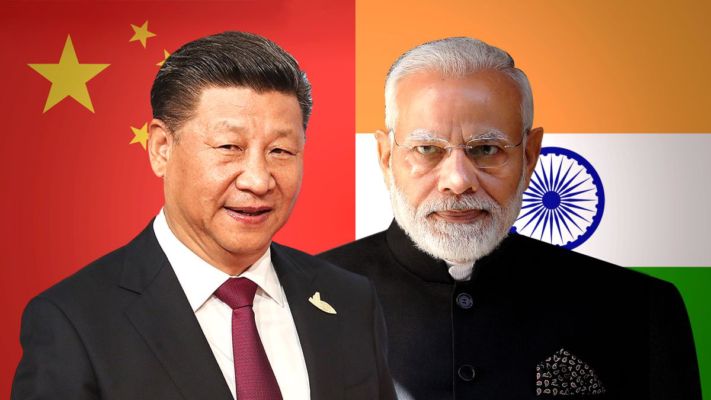
The President of China (Left) and The Prime Minister of India (Right)
China and India are the two fastest growing Asian economies. Respective governments have left no stones unturned to project the two nations as ideal investment destination on global platform, inviting industrialists with the lure of a business-friendly atmosphere. The two countries have always been at loggerheads for political reasons, making their bilateral relationship really rocky. The leaders at the helm of power of these two neighbours are known for their reformative approach and the similarities between Indian Prime Minister Narendra Modi and Chinese President XI Jinping are conspicuous. Both of them are known to rub shoulders with ten-figure friends to draw investments. While China has wowed the world with its bullet trains, India is pacing ahead in its space mission, launching valuable communication satellites.
Here’s a list of four fronts in which India is ahead of China in terms of growth:
India Being one of the Greatest Economy Balancer
An important metric where India beats China is financial market development. India ranks 38, while China ranks 56. Though the two nations introduced separate sets of reforms at different points of time, China started moving towards the pro-market economy in 1978 and India did the same in 1991. But India is 15 years ahead of China with regard to reforms in economic and financial markets. Experts are of the opinion that India has performed better than China in the financial sector. Indian bond market is known as one of the most liquid in Asia, which is well regulated by the RBI and is fully electronic. India is known as one of the best countries in the world in the way the financial sector is managed. As far as equity markets are concerned, reporting standards in India maintain global standards.
Tight Competition Among India and China in Space Technology
Though China is doing really good in space missions, India is not much behind with its successive launching of communication satellites. Recently, India has sent its heaviest communication satellite with its own GSLV MK III. India reportedly aims to win a bigger share of the $300-billion global space industry. It has successfully launched record 104 satellites, earning praise even from its northern neighbour. China started its space missions in the late 1950s while India entered the space in 1962 and is racing fast.
India being a Top Pharmaceutical Manufacturer and Exporter
India regards pharmaceutical production and exports as one of its biggest strengths. It has consistently beaten China in exports of pharmaceutical products to Latin America in the past five years. In 2016, India exported products worth $651 million to Latin America, as compared to China’s $404 million-worth exports, stated the IBEF report. Fortunately, India has never suffered regulation bottlenecks in the sector, ensuring the ease of doing business for Indian manufacturers and vendors.
What makes our country’s growth in this sector more interesting is the fact that it imports the bulk of its raw materials from China. This sector is not really the focus area of Beijing. A study by Assocham forecasted in june 2016 that India’s pharma exports could reach $20 billion by 2020. It has already crossed this mark and in fact the impact of covid-19 in 2020 has led to major medicinal demands from India than any time before. Demands of hydroxychloroquine from India have surged to a point where many countries like US, Australia, UK & other European countries are all lined up for getting these and many other medical drugs.
India has improved drastically in the World Bank’s ‘Ease of Doing Business’ 2020 international ranking by moving up to 63 out of 190 countries in the list. India was at rank 130 in a list of 189 countries in 2016. A sudden jump in rank from 130 to 63 is definitely remarkable and shows true business potentials of new India. Although this sounds good there is a lot more to be done for India to continue rising up. Hrishikesh Datar, Founder and CEO of Vakilsearch, a technology driven company empowering Indians with access to trustworthy legal solutions for entrepreneurs, gives his insights into what more can be done to push India further up the ranking.
The World Bank has said “In the year of 2015, India eliminated the paid-in minimum capital requirement and streamlined the process for starting a business. More reforms are ongoing—in starting a business and other areas measured by Doing Business—though the full effects are yet to be felt”.
Doing business in India – a country which the economic pundits say will be the world’s second-largest economy by 2030 (with China top and the USA pushed into third place). Going back a decade or so this assertion might have seemed nothing more than a fantasy, but everybody now seems to agree that India is finally going places. With a rapidly growing population of 1.3 million which boasts a vibrant middle class and a demographic which is heavily weighted towards youth, the potential of India seems almost limitless.
In the past, many developed economies saw India as a destination for the low-cost outsourcing of back-office or R&D-type functions and, whilst this area of the economy continues to thrive, India needs to be viewed in a very different light these days. India is, quite simply, the world’s largest potential market for goods and services. Where China has already developed much of its infrastructure and service economy, India still has enormous work to do. Look around on the streets of Delhi, Bangalore or Chennai and the need for development is obvious – move into the second or third tier cities and this need becomes even more acute.
What does all of this point to? Opportunities. India is a land of endless possibility where the people are aspirational, energetic, open and eager for progress.
Research
The biggest mistake organisations make when looking at India as a market is that they fail to do adequate research. To say that India is enormous would be a massive understatement. A country with 1.3 billion people, multiple languages, ethnicities, climates and geographies cannot be approached as a homogenous unit. You can’t really have an ‘India strategy’ – you probably need multiple India strategies.
The first question has got to be is: ‘Is India the right market for your products or services at this stage of your development, taking into consideration the current needs of India?’ This is not an easy question to answer. So many factors come into play when addressing this – what is your price point, and how does that sit against the competitive landscape in India? Who are your major competitors and how are they faring? Can you afford to invest in India knowing that the returns might not accrue for a number of years? Which city or region would be a good starting point?
All of these questions need answers, but good quality information is not always easy to come by in India. You will need to engage people on the ground in India who can really get under the skin of the local market and get back to you with honest, trustworthy answers to key strategic questions. Don’t convince yourselves you can do all your research via a laptop back in your office or home– you quite simply can’t.
Finding Manpower
India is full of really great potential employees. On the whole, Indians are well-educated, ambitious, enthusiastic and motivated. Lack of local talent definitely isn’t the issue; finding and retaining good people though can be very difficult.
The Indian employment market is very fast-moving. Indians are always on the lookout for ways of improving their career prospects, job titles and income. How are you going to convince good people that you offer them a bright future? Why should they join your company when there is a myriad of opportunities for the type of people you are looking for?
Culture in India
The underlying factors which drive Indian business culture are deeply rooted in the country’s religious, societal and ethnic past. People are often fooled into thinking that because Indian’s often speak good English and because the country has a western-influenced history, that the cultural challenges they might face will be minimal. Nothing could be further from the truth.
You simply cannot hope to succeed in India unless you gain a very good understanding of the local cultural landscape.
Though with huge efforts of Indian government like launching a start-up India portal, Mudra Loan scheme for MSME (medium small & micro enterprises), there’s a lot to be done in collaborate efforts of Indian citizens and Indian government to get into top economic powers of the world.
India the only major Asian economy that’s grown its export share since the start of the tariff wars in 2018 is the one with the fewest trade links to China. India’s share of world exports rose to 1.71% in the first quarter of 2019 from 1.58% in the fourth quarter of 2017, data compiled by Bloomberg show. The share of every other economy among Asia’s 10 biggest exporting nations fell in the same period.
The two largest goods traded by India are mineral fuels (refined or unrefined) and gold (finished gold ware or gold metal). In the year 2013-14, mineral fuels (HS code 27) were the largest traded item with 181 billion USD worth imports and 64.685 billion USD worth re-exports after refining. In the year 2013-14, gold and its finished items (HS code 71) were the second largest traded items with 58.465 billion USD worth imports and 41.692 billion USD worth re-exports after value addition. These two goods constitute 53 per cent total imports, 34 per cent total exports and nearly 100 per cent of total trade deficit (136 billion USD) of India in the financial year 2013-14. The services trade (exports and imports) are not part of commodities trade. The trade surplus in services trade is 70 billion USD in the year 2017-18.
Part of the reason for India’s outperformance is that it’s not as integrated into global manufacturing supply chains as peers, which means exporters are cushioned from rising trade tensions in the region.
It’s a sentiment that was flagged by central bank Governor Shaktikanta Das in an interview.
“India is not part of the global value chain,” he said. “So, U.S.-China trade tension does not impact India as much as several other economies.”
China is the biggest buyer of goods from South Korea and Japan, whose share of world exports have fallen the most in Asia. For India, China is the third-largest market, after the U.S. and the U.A.E.
“Our biggest advantage is that our product basket and market basket are both quite diversified,” said Rakesh Mohan Joshi, a professor at the Indian Institute of Foreign Trade in Delhi.
Trade tensions between the U.S. and China have given India an opportunity to ramp up exports to both countries, according to Ajay Sahai, director general and chief executive officer of the Federation of Indian Export Organisations.
India’s exports to the U.S. grew at the fastest pace in six years in the year ended March 2018, while exports to China surged 31%, the second highest annual pace of growth in more than a decade, data from India’s Ministry of Commerce show.
“China is more willing to give market access to India than ever before,” said Sahai, pointing to increased access for products such as rice, fruits and vegetables, with potential for greater exports of pharmaceuticals and automobile components to China.
On the other hand, India’s exports to the U.S. could lose momentum. President Donald Trump has criticized India for its tariffs on U.S. products, and withdrew trade concessions on $6.3 billion of Indian goods on June 1. India responded with higher tariffs on about 30 American products.
India stands at number 16 in the list of global trading partners and the nation is running with its pace to reach under top 10 in the list but the covid-19 pandemic has hit not just Indian economy but the entire world economy. The all of world would take steep financial dive with this epidemic before reaching on its initial status, till then let’s hope for the betterment of not just India, but the whole of world and the severely impacted victims of this contagious virus.
We all work right from graduating till retirement for five days a week -sometimes six days – only to spend what we have earned. In the midst of this daily hustle, how much time do we actually devote to plan for financial independence? Hardly any! Is financial independence a plan only for retirement? The answer is NO.
The first step towards financial independence is to not procrastinate it. A single drop of penny today will contribute to an ocean of financial resource. Then comes the below mentioned road map to a start of a great solo journey of life.
Financial planning – First, define clear and realistic financial goals like child’s education or a comfortable retired life. It is critical to factor in inflation while drawing up your financial plan. If you are planning your child’s education, you should be aware that a professional degree that costs Rs.4 lakhs today, is likely to cost around Rs.20 lakhs, 10 years from now.
Personal research – While a qualified financial planner can give you investment advice, the importance of doing your own research cannot be undermined. You can rely on credible websites to understand the pros and cons of each financial instrument.
Personalized financial plan – A common mistake is to opt for a particular plan simply because others are doing so. An investment plan must be customized according to personal factors such as your risk appetite, financial goals and life-stage needs.
Adequate time horizon – It is necessary to align the investment plan and the expected time frame for getting returns out of it. It is irrational to expect immediate returns from long term products like insurance, PPF etc.
Risk diversification – A smart investor would always ensure that the risk is distributed over a variety of instruments. A high risk instrument such as, an equity should ideally be balanced with a stable one such as bonds. Your investment portfolio should be a judicious mix of equity, debt, life insurance, real estate etc.
Planning for unforeseen events – Along with the current assessment of your future needs, risk of unexpected events must also be factored in. As a woman, it is crucial to be financially prepared to deal with unfortunate events like death, divorce etc.
Regularly track your investment – It is common to become complacent and expect the returns to flow in, once the investments are done. However, it is every investor`s responsibility to keep a tab on the performance of their portfolio.
Proper paperwork – There have been several instances where an investor is unable to claim returns from a bona fide investment simply because of misplaced or wrongly-filled documents. Proper documentation is a must to safeguard your investments. Also, ensure that someone other than yourself is fully aware of all your investments.
Securing your future: As a working member of the family, it is crucial for you to have adequate insurance to ensure that in your absence, your family does not go through any financial stress. Investing in a simple term insurance plan will ensure financial continuity.
Plan and execute – Last, but most important is to begin planning for all your financial needs from an early stage. The cost of postponement will weigh heavily on you in the later years when investing will become a compulsion rather than a choice.
In this world of instant gratification, have patience and watch as your pot fills with money one sweat and hard work at a time. Kudos to being financially independent!
COMPANY COMPLIANCES DURING THE COVID-19 ERA: AN INTRODUCTION
The global outbreak of the novel coronavirus has taken the world by storm. While the issue pertaining to the public health is the talk of the town, the impact of COVID-19 on businesses and corporates seems to be least talked about.
Day to day business of the corporates is being affected due to decreased inflow of the human resource and a decrease in the workflow. While technologies have provided a relief to the human resource for physical attendances and conferences, there seemed to be unsettled trouble regarding legal compliances that required various filings and physical meetings.
Pursuant to the ongoing global COVID-19 pandemic and the Finance Minister, Ms. Nirmala Sitharaman’s announcements on March 24, 2020, the Ministry of Corporate Affairs (“MCA”) has issued various circulars to provide relief to companies from certain compliances under the Companies Act, 2013 (“Act”) and associated rules. This has been done as a measure to reduce the compliance burden on entities during the unprecedented health and economic situation caused by COVID-19. Following are the measures:-
1. Company Affirmation of Readiness towards COVID-19
Social distancing has gained its importance as a way to contain the spread, morbidity, and mortality of COVID-19. Government of India (“GOI”), responsible for the public welfare at large, has realised that social distancing can be achieved in its true sense only if the employers of the Indian public make the same application in their respective premises.
Considering that major employers of the nation belong to the companies or limited liability partnership (“LLP”) type entity, GOI as part of disaster management have advised all companies/LLPs to put in place an immediate plan to implement the “work from home” policy as a temporary measure up till March 31, 2020.
Further, in case of a requirement of physical visits of the essential staff to such offices by the employers, staggered timings may be followed in order to minimize physical interactions of all kinds.
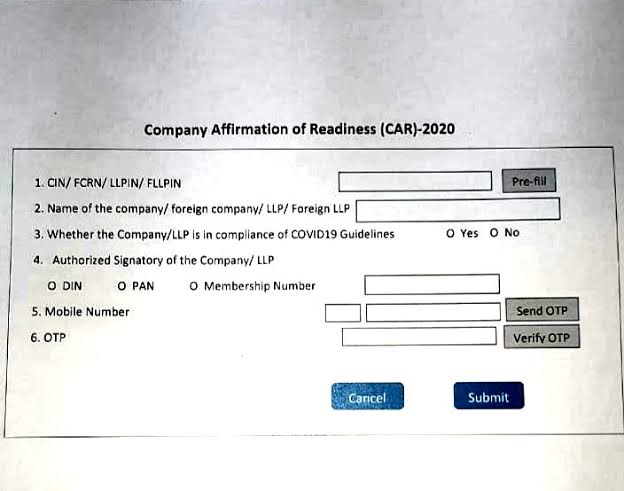
A simple webform for companies/LLP shall be deployed by MCA on March 23, 2020, in order to confirm the readiness of the employers to deal with COVID-19 threat. The webform shall be called CAR (Company Affirmation of Readiness towards COVID-19) and would be required to be signed and submitted by the authorised signatory of the company/LLP.
Therefore, it shall be expected by each company/LLP to ensure reporting of the compliance through CAR instantly from the date of its deployment.
2. Companies Fresh Start Scheme 2020
The MCA issued a circular on March 30, 2020, introducing the Companies Fresh Start Scheme, 2020 which, inter alia, grants a one-time opportunity to defaulting companies to complete all belated filings, including, without limitation, annual filings and filings required under IEPFA (Accounting, Audit, Transfer and Refund) Rules, 2016 in relation to transfer of money remaining unpaid or unclaimed for a period of seven years under Section 124(5) of the Act and transfer of relevant shares in the name of the ‘Investor Education and Protection Fund’ under Section 124(6) of the Act, with the MCA21 registry, without incurring additional fees on account of any delay.
This scheme came into force on April 1, 2020, and is valid till September 30, 2020. The application for seeking immunity for belated filings under this scheme should be made within a period of six months from September 30, 2020, through Form CFSS-2020. Thereafter, an immunity certificate will be provided by the designated authority on the basis of the declarations made in such form.
However, no immunity shall be provided under the scheme in a matter where (i) an appeal or management dispute is pending before any court or tribunal, or (ii) a court has ordered a conviction, or the adjudicating authority under the Act has imposed a penalty, and in respect of such orders, no appeal has been filed prior to the scheme coming into force.
Further, the scheme shall not apply: (i) where an application has been filed or an action for final notice for striking off the name of the company has already been initiated; (ii) where the company has been amalgamated; (iii) when application of obtaining dormant status has been filed; (iv) to vanishing companies; and/or (v) where charge related documents or an increase in authorised capital is involved.
3. CSR Spending
The MCA has by way of circular dated March 23, 2020 and the office memorandum dated March 28, 2020, clarified that the spending of CSR funds by companies in relation to COVID-19, including by way of contribution to the PM CARES Fund, is an eligible CSR expenditure under the Act.
The MCA has further clarified by way of FAQs dated April 10, 2020 that contributions made to the State Disaster Management Authority will also be eligible CSR activity, but contributions towards (a) ‘Chief Minister’s Relief Fund’ or ‘State Relief Fund for COVID-19’; and (b) payment of salary/ wages to employees and workers (including contract labour/ temporary/ casual/ daily wage workers) during the lockdown period will not be considered as eligible CSR expenditure.
However, ex-gratia payment over and above the disbursement of wages to temporary/ casual workers/ daily wage workers, specifically for the purpose of fighting COVID-19, will be admissible towards CSR expenditure, provided there is an explicit declaration to that effect by the board of the company, which is duly certified by the statutory auditor.
4. Meetings of Board and the Shareholders
The Companies (Meetings of Board and its Powers) Rules, 2014 were amended by a notification dated March 19, 2020, to enable companies to hold board meetings on the following matters (which earlier had to be necessarily held at a physical meeting) through video-conferencing or other audio-visual means (collectively “VCC”) till June 30, 2020: (i) approval of annual financial statements and board’s report; (ii) approval of prospectus; (iii) audit committee meetings for consideration of financial statements; and (iv) approval of amalgamation, merger, demerger, acquisition and takeover.
MCA has, by way of a general circular dated April 8, 2020, requested companies to pass all decisions of an urgent nature requiring shareholder approval, other than those of ordinary business or business where any person has right to be heard, through postal ballot/ e-voting in accordance with the relevant statutory provisions without holding a physical general meeting. However, in cases where holding an extraordinary general meeting (“EEGM”) is unavoidable, these have now been permitted to be held through VC until June 30, 2020. The circular further lays down certain conditions to be met for conducting an EGM through VC and the key conditions, inter alia, include: (i) attendance of at least one independent director (where a company is required to appoint one) and auditor (or his authorised representative who is qualified to be the auditor); (ii) maintenance of recorded transcripts of the EGM and, in case of a public company, such transcripts to be uploaded on the company website (if any); and (iii) e-voting facility being available. All other provisions relating to general meetings under the Act (and relevant rules) will continue to apply.
Due to difficulties faced by various stakeholders in serving and receiving notices/responses by post on account of COVID-19, the MCA, on April 13, 2020, provided that notice of EGMs to be held through VC (and for passing shareholder resolutions through postal ballot/ e-voting) may now be given to shareholders only through email addresses of the shareholders registered with the company or with the depository participant/ depository. This circular also specifies various conditions which companies must comply with while sending email notices to shareholders.
CONCLUSION
Business entities in India are requested and expected to keep an eye on the major government websites to ensure timely compliance with all such immediate requirements and mandates issued by GOI as need of the hour from time to time.
WEBSITES REFERRED:-
1) MCA General Circular No. 10/20 dated March 23, 2020 on Clarification on spending of CSR for COVID-19.
2) MCA General Circular No. 12/20 dated March 30, 2020 on Companies Fresh Start Scheme, 2020
3) MCA Notification dated March 19, 2020 on Companies (Meetings of Board and its Powers) Amendment Rules, 2020
4) MCA General Circular No. 14/2020 dated April 8, 2020 on Clarification on passing of ordinary or special resolutions by companies under the Companies Act, 2013 and rules made thereunder on account of threat posed by Covid-19.
5) MCA General Circular No. 17/20 dated April 13, 2020 on clarification on passing ordinary and special resolutions by companies under the Companies Act, 2013 and rules made thereunder on account of threat posed by COVID-19.
India has been under lockdown phase 4 until May 31st with some relaxations. Prime Minister Mr. Modi announced a relief package of 20 lakh Crores INR for various sectors to propel economic growth on May 17. Some relaxations which were provided to Red, Orange and Green zone areas during the Lockdown 3.0 like opening of some of the individual shops of non-essential items were extended to Medium and small scale industrial sector, farm and trading sector. Malls, Cinemas, restaurants and places with probable high foot fall remained closed. India now is ranked third in the world in terms of coronavirus cases, after the US and Brazil.
The COVID-19 pandemic pushed economies into a Great pushback, which helped contain the virus and save lives, but also triggered the worst recession since the Great Depression. Over 75 per cent of countries are now reopening at the same time as the pandemic is intensifying in many emerging market and developing economies. Few countries have started to recover. However, in the absence of a medical assistance, the strength of the recovery is highly uncertain and the impact on sectors and countries are uneven.
The entire country remained under lockdown till May 31, 2020 followed by Unlock phase-1 from June 1 and June 14. Up to May 31, was the Lockdown 4. Earlier the Lockdown 3 was up to May 17, Lockdown 2 was upto May 3 and before that the Lockdown 1 was from March 22 to April 16, 2020. Prime Minister Mr. Modi announced measures with some relaxations. According to experts, this is being done to ensure that the Food Safety of India is protected as Rabi harvesting season is on anvil. PM Modi said detailed guidelines have kept in mind the needs of the informal sector and farmers. India now joins countries such as France, USA which are moving with the idea of unlock phases after extended lockdowns.
The Harsh Effects on World Economies
A high degree of uncertainty surrounds this forecast, with both upside and downside risks to the outlook. On the upside, better news on vaccines and treatments, and additional policy support can lead to a quicker resumption of economic activity. On the downside, further waves of infections can reverse increased mobility and spending, and rapidly tighten financial conditions, triggering debt distress. Geopolitical and trade tensions could damage fragile global relationships at a time when trade is projected to collapse by around 12 per cent.
This pandemic like no other will have a recovery like no other. First, the unprecedented global sweep of this crisis hampers recovery prospects for export-dependent economies and jeopardises the prospects for income convergence between developing and advanced economies. We are projecting a synchronised deep downturn in 2020 for both advanced economies (-8 per cent) and emerging market and developing economies (-3 per cent; -5 per cent if excluding China), and over 95 percent of countries are projected to have negative per ca-pita income growth in 2020. The cumulative hit to GDP growth over 2020–21 for emerging market and developing economies, excluding China, is expected to exceed that in advanced economies. Sooner or later this crisis will vanish and it has to because change is the undisputed law of nature. The only thing waiting for us after this epidemic is a shattering or rather say, a collapsing economy for many nations. We are fighting this pandemic together hence same should be our spirit in handling the ruptured economy. With confirmed case count for India crossing a million and more than 26000 deaths, all we can do is to get more strongly committed to all guidelines and suggested precautions by governments and health agencies worldwide.
The COVID-19 pandemic is a major public health crisis which has affected the entire Economy and it’s stakeholders especially from the macro economy angle. Due to the novel coronavirus which spread widely the entire supply chain has been badly hit, not only has it disrupted and cut-off the Indian Economy but this has resulted in widespread economic losses across all the economies of the world.
It has caused widespread damages, hinderances and inconvenience especially in regards to the interruptions of people’s movement which has in turn halted and jolted the entire production line and activities which also poses as a serious risk to the macro economy.
Apart from having devastating and damaging effects on human lives, it has claimed over 543,605 lives and infected over 11 million people all around the world. The novel coronavirus (COVID- 19) has significantly knocked down not just the Chinese economy from where it emerged but also the global economy.
Kristalina Georgieva, Managing Director of the International Monetary Fund has officially confirmed that we have entered into a recession as bad as or even worse than that of 2009.
In order to revive the economy by 2021 we first must contain the virus at the earliest by hook or by crook. In Italy the number of confirmed cases are increasing and depicting a spiking up trend with over 1.8 million in the United States and also the number of deaths increasing in Italy and the UK which was under a 6 months long lockdown, this seems like a far blown possibility.
FACTORS REQUIRED TO DETERMINE THE EFFECTS OF COVID–19
There are 3 factors which is to be analysed and discussed in order to get a clear understanding about the plausible damages caused due to this pandemic, they are as follows:-
1) Demand
2) Supply
3) Finance.
On the demand side declining income, fear of contagion, reduced working hours, possible layoffs, absence of vaccine has detrimental effect especially in the service sector.
On the supply chain as the manufacturing line took a bad hit and almost came to a standstill, the manufacturing activities in the most affected regions were badly affected and this resulted in bottlenecks in the global value chain
China is reopening its factories but due to the COVID-19 pandemic the manufacturing companies abroad are finding it exceedingly difficult to purchase products in and ship them out of China.
The Covid-19 is posing an unprecedented Global Public Health Emergency and this has resulted in also creating financial distress in the form of drying up of liquidity, providing credit and meeting contractual obligations.
As a matter of fact, demand, supply or financial disruptions, might not directly affect but they do have a profound indirect effect on the legal field.
IMPLICATIONS OF COVID-19 PANDEMIC ON THE LEGAL FRATERNITY
The last two decades have seen an exponential growth in the legal field. As per the Bar Council of India( apex body of Indian Legal Professionals) the Indian legal profession consists of approximately 1.2 million registered advocates, around 950 law schools and approximately 400-500 thousand law students across the country and high numbers are seen across the world. This data is as per the Vision Statement of the year 2011-2013.
While the supply side of the legal education remains almost the same year after year, barring minor changes, this recession will surely contract the manufacturing and service sector. Thus, the demand for the new entrants in the legal industry might observe a sharp fall.
As the economy is in a recession due to COVID-19 pandemic, the legal industry will be affected by it, but How? In order to predict the future the past must be examined. In 2008 Global economic crises the event’s that took place need to be analysed and only then we will know how brave the 2020 recession shall be as the contours of legal landscape look more or less the same.
The impact of an economic recession on the legal profession has been disastrous as this has resulted in mass layoffs, hire freezing and salary decreases and this has in turn rendered an overwhelming amount of law graduates unemployed.
The legal field in the last decade witnessed methodical changes, remoulding and a tremendous shift of power from the hands of providers to the hands of consumers.
Also new skillsets have been developed, multi-disciplinary problem solving as well and technological adoption all of those has resulted in the rise of data and digital transformation.
The law firm dominance and an emerging global legal community in order to Analyze the industry trends it is easy to predict and also which category of lawyers will fare better or worse during this COVID-19 scenario is a must due to the consequent economic downturn.
VARIOUS NEW AVENUES AND AREAS OF OPPORTUNITIES OF LAW THE COVID-19 PANDEMIC HAS CREATED
People/Businesses will always require trained legal professionals in the long run. Certain areas of law will be in great demand in comparison to others.
With increasing health crisis all over the globe, there will be a great requirement for health care lawyers. High value mergers and acquisition areas of corporate law may dry up. A
Attention will turn towards restructuring, insolvency, bankruptcy and litigation work. Firms with varied practice areas are more likely to perform better during recession. Policy lawyers will be in favour as new companies will aggressively invest on policy lawyers to move far ahead from traditional industries.
With business downsizing, decline in job market and hire freezing there will be a lot of scope for Public Interest Litigation/Class Action, Labour and Employment lawyers. Global Environmental Catastrophe is not far away and Environment will be a highly litigated issue. Thereby creating a need for efficient Environmental and Animal Right Lawyers.
As part of Alternative Dispute Resolution, Conciliation, Mediation and Arbitration are effective ways of resolving a dispute. Parties to the dispute will lack the means viz., time and money to pursue litigation post the covid-19 pandemic and will prefer arbitration, mediation and negotiation.
International Arbitration is facing challenges during the COVID-19 pandemic due to the travel restrictions in place but, even with inhibiting factors of the currently available technology the post covid phase will see tremendous growth in usage of technological methods for dispute resolution i.e., online dispute resolution; video conferencing; chats; teleconferencing etc.
Lease disputes will burst at the seams, tenants are already serving notices invoking Force Majeure clause. Hence, Property Law will have scope for development.
SUPPLY CHAINS MOVING OUT OF CHINA
Due to existing trade war between USA and CHINA and thepending legal suit against China for the spread of COVID-19, hedging the risks of MNC’s corporations are mulling, moving their production out of China. The ongoing pandemic has only worked as a catalyst to this process.
Japanese, South Korean and Taiwanese multinational companies have already started moving their Chinese production facilities to countries with favourable business policy regime and friendlier International relations viz.Vietnam and other South East Asian Countries.
The warm ties between India and the USA pegs India as a potential production hub. In case of such an eventuality Asian transactional lawyers will benefit tremendously.
TECHNOLOGICAL ADVANCES
Providers that have embraced technological advances have a sure shot success through the recession period.
The Supreme Court of India has started hearing urgent matters via video conferencing. E-filings make the courts productive as it saves time from lengthy paperwork. Such circumstances will give young techno savvy lawyers an edge over the established lawyers.
JOBS
The Post Covid-19 phase will open the doors for a lot of young and aspiring lawyers as well as experienced lawyers who are open to the idea of juggling between different practice areas.
Senior Advocates who are otherwise experts in their respective fields but not adept at using technology will now be forced to employ younger and technologically savvy lawyers in their traditional offices.
The legal process analyst will have the job of analyzing a piece of legal work, subdividing the assignment into meaningful and manageable chunks, and identifying the most appropriate supplier of services for each. This task requires deep legal insight and experience. This individual will often be employed within an in-house legal department, rather than at a law firm.
Legal Risk Managers will emerge who will have to anticipate a problem and propose solutions.
AI/Algorithm/Blockchain Dispute Resolution will emerge to deal with matters related to Motor Accidents or Consumer Compensation etc.
Virtual law libraries will emerge and the experience of Senior Advocates or Lawyers will be necessary for writing monographs and book reviews.
Online Legal Services will throw open an array of a lot more new practice areas for lawyers, who were till now, practicing their skills using traditional methods.
CONCLUSION
We are living in an era of revolutionary changes and technological advancements and we must consider how vast and far stretched the paradigm shifts in information technology have taken place which is a boon for the entire legal fraternity.
Even biomedical research, genetic discoveries, biotechnological advances and nanotechnology have changed our world.
One must observe how deeply the LPG has influenced the exchanges of legal and other professional services. This has led to the homogenization of cultural trends and consumption patterns across the world.
What more, even the viruses of both biological as well as software kinds have become all pervasive. This has resulted in the reduction of the mortality rates across the country, as a by-product of which we are experiencing a massive population growth.
Due to the Global climate change and acute scarcity of resources which has resulted in mass migration of the humanity in search of better pastures, it has resulted in the shifts of each day which generates the fundamental questions and answers which shall alter the shape of the human experience.
It is certain that lawyers will play an indispensable role in tackling it with the help of these developments and harnessing the opportunities to secure an orderly change and which will in turn enhance the human welfare in the much larger context.
The period of Economic Downturn is critical for every field. It has a huge impact on global healthcare facilities and legal professionals around the world. Though, the legal profession is more resilient to the recession than many others but it hops in the economic downturn.
The law firms and individual practitioners who widen their horizons by welcoming the opportunities will adapt to and triumph the current situation.
The legal profession should take advantage of the ongoing paradigm shift to develop liberalized business structures that allow the firms to build and develop a sustainable and competitive practices so that it will result in the evolution of the market for legal services.
Till date no panacea exists for the situation at hand unless there is an immediate containment of the disease and invention of the vaccine, the world as we know it will never be the same again.
This will not only require targeted and active macroeconomic measures but a series of medical policies as well. Until a permanent solution is found, the legal fraternity has to proactively explore the fields of law for upcoming opportunities and sow seeds of progression, which will bear fruits for the generations to come. “
The economic impact of the Covid-19 pandemic in India has been largely disruptive. India’s growth in the fourth quarter of the fiscal year 2020 went down to 3.1% according to the Ministry of Statistics. The Chief Economic Adviser to the Government of India said that this drop is mainly due to the coronavirus pandemic effect on the Indian economy. Notably India had also been witnessing a pre-pandemic slowdown, and according to the World Bank, the current pandemic has “magnified pre-existing risks to India’s economic outlook”.
Economists slashed GDP rates for the predictable future due to the obvious impact of the lockdown. However, it was also estimated that the country might bounce back quickly because its industry composition, with unorganized markets being largely dominant. Losses from organized sectors amounted to an estimated nine trillion rupees in late March, projected to increase with the prolonging of the lockdown. As expected, the most affected industries included services and manufacturing, specifically travel & tourism, financial services, mining and construction, with declining rates of up to 23 percent between April and June 2020.
Recently an industry survey that is jointly conducted by industry body Ficci and tax consultancy Dhruva advisors and took responses from about 380 companies across the sectors. It is said that businesses are grappling with “tremendous uncertainty” about their future.
According to the survey, COVID-19 is having a ‘deep impact’ on Indian businesses, over the coming month’s jobs are at high risk because firms are looking for some reduction in manpower. Further, it is added that already COVID-19 crisis has caused an unprecedented collapse in economic activities over the last few weeks.
The present situation is having a “high to very high” level impact on their business according to almost 72 per cent respondents. Further, 70 per cent of the surveyed firms are expecting a negative growth sales in the fiscal year 2020-21.
Ficci said in a statement, “The survey clearly highlights that unless a substantive economic package is announced by the government immediately, we could see a permanent impairment of a large section of the industry, which may lose the opportunity to come back to life again.”
The survey found:
–In respect to the approved expansion plans, around 61 per cent of the respondents expect to postpone such expansions for a period of up to 6 or 12 months, while 33 per cent expect it to for more than 12 months.
–Surveyed firms of around 60 per cent have postponed their fund-raising plans for the next 6-12 months. Also, nearly 25 per cent of the firms have decided the same.
–Surveyed firms around 43 per cent have reported that they do not predict an impact on exports. Further, 34 per cent said that exports would take a hit by more than 10 per cent.
According to Du & Bradstreet, COVID-19 no doubt disrupted human lives and global supply chain but the pandemic is a severe demand shock which has offset the green shoots of recovery of the Indian economy that was visible towards the end of 2019 and early 2020.
Almost four months has passed, 1.3 Billion Indians have gradually adjusted to the new normal and its completely alright because there isn’t any option left for us. Health workers, security services are working tirelessly to ensure our safety. Centre and State government machinery along with supply chains for essential goods & services are doing best to ensure that food & financial security is available for those who need it the most. Let us all do a favour to our Incredible Nation by helping to constrain the virus, make wise use of unlock period to avoid another lock-down period.
India is one among the world’s fasting growing economies. It had been touted as an economic and geopolitical counterweight to China. But recently its growth fell to its slowest pace in six years. Investment has weakened, and unemployment has risen. So what’s causing the slowdown, and how can it be reversed? Since the turn of the century, India’s economy has grown at a rapid rate, helping transform the country. Between 2006 and 2016, rising incomes lifted 271 million people out of poverty, meaning the proportion of Indians still living in poverty has fallen dramatically, from around 55% to twenty-eight . Access to electricity has also improved. In 2007 just 70% of the population had access to power. By 2017, that grew to nearly 93%.
More recently, the Indian government constructed around 110 million toilets — a huge step towards better sanitation designed to prevent the practice of open defecation. It’s a signature program of Prime Minister Narendra Modi, known as Swachh Bharat, or Clean India. All this development has been supported by a booming economy, but as lately , that expansion has begun to run out of steam. In the third quarter of 2019, India’s economic output grew by 4.5% – making it the primary time the country’s growth dipped below 5% since 2013. For context, 4.5% growth remains much above that of developed economies just like the U.S., But with 12 million Indians entering the workforce per annum , economists say the country needs annual growth rates to remain above nine percent to make sure there are enough jobs. So, what’s causing this recent slowdown? Well, officialdom argue turbulence in international financial markets is guilty.
Political uncertainty and U.S.-China trade tensions mean confidence levels among investors and consumers everywhere have sunk. The United Nations has even warned that a global recession in 2020 is now a “clear and present danger”. But back to India – many economists say the country’s growth problems are literally self-inflicted. One obvious culprit is the shadow banking sector. During the 2000s, India saw an investment boom. It was fuelled by state banks dispensing a load of loans for giant infrastructure projects. But some of the companies taking advantage of these loans couldn’t keep up with the repayments. That meant the state banks weren’t getting paid back and therefore struggled to give out new loans. To keep business moving, shadow banks stepped in. These financial institutions, which operate like ordinary commercial banks but don’t follow traditional banking rules, eventually made up an estimated third of all new loans nationwide. The loans played a pivotal role for the millions of small businesses and consumers who would otherwise have no access to credit. But in 2018, shadow banking giant Infrastructure Leasing & Financial Services, defaulted on its debt repayments. Its collapse sent shockwaves through the economy and shook up more traditional banks that had supported the world.
It became harder for people to shop for expensive items like cars. That hurt India’s automotive industry, which is one among the country’s biggest. It employs about 35 million people and makes up about 7% of India’s GDP. Last summer, the industry suffered its worst sales performance in nearly 19 years, and reports suggest tens of thousands of workers are laid off. The agriculture and construction sectors have also been hurting, with small and medium businesses being hit the hardest. The country’s percentage has been on an overall upward trend since July 2017, rising several percentage points to 7.7%. Higher unemployment means consumers are buying less, resulting in the unfortunate cycle of slower manufacturing, production, investment and job creation.
A survey from the Reserve Bank of India found consumer confidence has fallen to its lowest level in five years. But Indians still have a positive outlook for the longer term , with most consumers expecting to feel more optimistic during a year. However, if things don’t improve, debt could become another issue. Expecting better days ahead, many households have continued to spend, by taking out loans and dipping into savings. Household savings as a proportion of GDP has fallen from 23.6% to 17.2%. Meanwhile, household debt has surged to 10.9% during the same period. Critics say the govt in New Delhi has did not spot these risks and hasn’t done enough to urge the economy moving again. The Reserve Bank of India’s former governor Raghuram Rajan recently blamed the lack of significant reforms and a slowdown in investments since the global financial crisis. Even the country’s chief economic advisor recently admitted reforms are needed to form India more friendly to investors.
India has cut its corporate rate , but labor and land laws are still extremely strict. He also says the country must become pro-market, instead of just pro-business, to avoid costly government bailouts of failing sectors. But not all reforms have been good to the economy. In 2016, Prime Minister Modi tried to crack down on corruption, counterfeits and evasion by banning high value bank notes. In one night, the cash ban made 86% of all cash invalid. Three years later, many analysts say the policy disrupted the economy and did not achieve many of its original goals. In 2017, a replacement nuisance tax placed small businesses struggling and a few of them were forced to shut . In mid-2019, India’s government introduced a controversial new tax on foreign investors. Consequently, India’s stock exchange suffered its worst July performance in 17 years. Just one month later, the measure was scrapped.
The government has now refocused its efforts on international trade and investment, and thus the recent changes to the corporate rate could indeed help attract businesses and investors to India. But if the country wants to be a part of the world’s largest supply chains, it’ll need low and consistent tariff levels to encourage outsiders to take a position for the long term.
The country’s shifting export policy has harmed several of its largest industries, particularly clothing. India’s share of the worldwide apparel market has increased only slightly within the past 20 years. And though the Indian workforce is vast, both Bangladesh and Vietnam now export more. On top of that, the country’s import tariffs on the average are much above the world’s biggest economies. They’re also among the highest of the world’s emerging economies. Even U.S. President Donald Trump has called for the country to bring down its duties.
Has India’s growth actually slowed the maximum amount as we think? The government’s former chief economic advisor Arvind Subramanian caused a good little bit of controversy in June 2019, when he claimed the country’s official stats probably overstated GDP growth by 2.5% from 2011-2012 to 2016-2017. He says the bottom line is that India never recovered from the global financial crisis. The government denies this. But none of this has hurt Prime Minister Modi at the polls – he won by a landslide in the most recent election. So how will he keep his promise and double the dimensions of the economy by 2025? Many economists insist a well-explained economic vision would help. As would more long-term investment, better skilled workers and enhancements to infrastructure. It may not matter who or what’s responsible for India’s recent economic challenges, but bottom line – India’s economic process must recover , and fast.
As the whole world is waiting for discovery of corona virus , the next big challenge in front of world is large scale production of vaccine so that it is feasible to common man.India is going to play major role in vaccine production as it has past experience as well as skilled doctors. India is responsible for providing 2/3 of world’s children with vaccine.
Prime Minister Narendra Modi, in his inaugural address at the India Global Week 2020, said that India will play an important role in developing and in scaling up production of the vaccine once it is discovered.
“Vaccines made in India are responsible for 2/3rd of the vaccine needs of the world’s children. Today also our companies are active in international efforts for development and production of #COVID19 vaccine. I’m certain that India will have an important role in developing and in scaling up production of the vaccine once it is discovered,” PM Modi said.
Speaking on India’s economy, PM Modi said, “India remains one of the most open economies in the world. We are laying a red carpet for all global companies to come and establish their presence in India. Very few countries will offer the kind of opportunities India does today.”
“The pandemic has once again shown that India’s pharma industry is an asset not just for India but for the entire world. It has played a leading role in reducing the cost of medicines, especially for developing countries,” the Prime Minister said.
He also further said that India will lead world in the path of revival post corona virus pandemic in terms of economic as well social development.India is power house of young talents may it be technological or scientific or doctors field.
World over, you have seen the contribution of India’s talent-force. Who can forget the Indian tech industry & tech professionals. They have been showing the way for decades. India is a power-house of talent that is eager to contribute. In these times, it is natural to talk about revival. It is equally natural to link global revival and India. There is faith that the story of global revival will have India playing a leading role,” PM Modi said.
Hope there will be discovery of vaccine soon and life comes back on track.
Every country in today’s era is working hard so as to make their economies strong and thus increase their GDP. This surely gives rise to better job opportunities to flourish, better infrastructure of the countries and also a tourism sector to thrive. India is one of the developing countries and has been able to mark it’s high GDP growth irrespective of its high population rate. But still there are various factors which makes it a bit tough for India to develop completely and cope up as a developed nation. The factor is dependency on other countries for most of the manufacturing technologies and products. India prefers importing most of the goods and services from other countries, and thus lacks its own manufacturing and research technologies. One of the most prominent country from which India is importing is China. China has been one of the most successful countries in exporting most of its products and thus achieving maximum productivity growth as compared to other big nations like the USA and Japan.
India is dependent on Chinese products for most of its cost saving benefits. Most of the products we do acknowledge and bully are Chinese as we do find them more feasible and lying in our budget. But still India is fighting back and stopping the import from China and various other countries and focusing on increasing it’s export to other countries. The mission and scheme as launched by our Prime Minister Mr. Narendra Modi of “Make In India ” has brought up various startups and investment in manufacturing technology and has led to growth of the country’s economy and job opportunities.
But still India does lack production and manufacturing of products at cheaper rates as compared to what China does. There are various things which do affect the cause of same which include:
Availability of cheap skilled labour: India being 2nd in world’s population, still lacks much of a literacy rate, which is not a case in China and other countries. People in China are much more skilled and educated . So companies do acquire much of these as a resource for their company at cheaper rates and thus reduce their manufacturing cost. While in India we lack much of literacy rate, thus affecting our availability of skilled labour
High production: Productivity as mentioned above of China is much more as compared to other countries. This reflects that they have an abundance of material which not only can be used for manufacturing products in their own country but also exported to other countries. India lacks much of the raw material required for manufacturing anything, so they do rely on foreign factors for manufacturing.
Selling products at cheaper rates : Chinese products are well known for their cheap rates. This mostly fascinates people to buy them. This surely leads to reduction in the sales of the other similar product and thus the company faces losses thus the company’s only 2 choices “Either to merge with that Chinese brand or to shut down”. It’s frequently bseen that most businesses and companies get off the business which gives these Chinese products a plus point and they become the lone survivor.And in future times they do raise the prices which market them with huge profits.
Production of duplicate or matching product: China has been investing more of its money in coping things,since we know for manufacturing of any new or original product, companies invest in it’s research work, qualified labour and number of tests and thus find the best and feasible product. China misses this step and jumps off to the production which saves a lot of money and also the manufacturing cost.
“There are many more reasons which give China and it’s product great power in our country. But we should understand the requirement of not investing our money in those Chinese products and rather bring up products manufactured in our own country so as to keep the countries money within the country. Also more startup ideas must be motivated to flourish and thus growth productivity must be targeted so as to manufacturers and use products made in our country only and rather from buying it from other countries, we must export them . These few efforts would bring out significant change which would lead our country to prosper be one of the developed countries in coming years”.















 Eduindex
You must be logged in to post a comment.