
Misuse of Section 375 .

Section 375 of the Indian Criminal Code was created to protect women from rape. In Indian criminal law, in section 375 Men are said to commited rape if he :
(a) pierce the penis in some way or force a “rape” on a woman’s vagina, mouth, urethra, or anus.
(b) in some way insert an object or body part other than the penis into the woman’s vagina, urethra, or anus, or have the woman do so to him or others.
(c) manipulate any part of a woman’s body to penetrate or penetrate the woman’s vagina, urethra, anus, or other parts of her body.
(d) place the mouth in the woman’s vagina, anus, urethra.

Under Section 370 , If a person rape woman and do so in any of the following seven situations.
1) Against to their will. 2) Without their consent. 3)With consent and consent for fear of death or injury to them or those they are close to.
4) Consent is given because a man knows he is not her husband and believes that he is another man who is married, or that he is legally married. If so, with her consent
5) If she is under the age of 18, with or without her consent.

Abuse of power
One of the famous sayings used in connection with Section 375 is “Men are guilty until proved innocent, and women are not guilty until proved innocent.”
Laws enacted to empower women and reassure them in patriarchal societies soon turned into swords that killed the dignity of men in society by false accusations, or women misused laws and power made to protect them. The problem that is occurring in our world today is that women use verbal consent to have sexual intercourse and later refuse or refrain from having sexual intercourse or falsely accuse men that they had it without thier consent. In both cases, the man has the responsibility of proof and must prove his innocence.

According to an article published in The Times of India , only one person was convicted in each of the fourth cases of rape, and high probability that anyone who did not proven guilty after a full trial could be innocent. Leads to the high assumption that innocent people have been accused of rape. India’s conviction ratebin rape cases is 32%, which is self-evident from the fact that numerous false reports related to rape have been registered in India.

Being a victim of false rape allegations is as bad as being a victim of rape. You can’t imagine the shock, trauma, ridicule, and humiliation that someone experienced after being falsely accused of rape. Not only the man, but his family and close friends suffer from various consequences, and isolation and ridicule are just a few of them. Their future is shattered, the humiliation and shame that society suffers is enough to shatter it, and no one can think of them living as they used to.

What can be done ?
The creators of Article 375 of the 2013 Act and the Criminal (Amendment) having only one vision in context to the problem, consider only the safety of women and have not developed any means of protecting innocent men in society. Therefore, there is usually a debate about what we can do to protect innocent people from society who are falsely accused. Provision (Section 375) cannot be said to be gender-neutral to remove the slight justice that this section offers, as it acts as a hurdle for women to file genuine rape cases.
Then the question arises. What can you do? In such situations, the legislature and judiciary need to work together to strike the right balance between men and women so that the virtues of justice are provided to them equally.


Animal Cruelty is a heinous crime which should be stop .

Animal Cruelty :
Simply put, animal cruelty harms animals, whether intentional or negligent. While certain activities  such as animal cruelty are generally perceived as cruel, the specific actions that make up animal cruelty vary from person to person and from places to places or different countries. Many  argue that docking a piglet’s tail without anesthesia is cruel, while others say it is common in meat production to prevent injuries later  in the pig’s life.  Animal cruelty defination is different in different areas due to countries laws.
Animal abuse is an pervasive problem which often  is difficult to detect. No species or community is spared from experiencing animal cruelty and neglect. Understanding what animal cruelty means and what it doesn’t mean is one of the first steps to  prevent it from happening again. Animals, whether it’s the food, cosmetics, entertainment, or  pet industry, don’t deserve to suffer.

Is Animal Cruelty Illegal:
The legality of  animal cruelty depends largely  on where the activity takes place . For example,  cruelty to farms and laboratory animals that is illegal in some countries may not be considered banned animal cruelty in some countries, due to differences in national law. In the United States, the best-known legislation to prevent animal cruelty excludes both livestock and laboratory animals from registration.

Animal cruelty in India:
Recently, cases of animal cruelty are increasing in India. The same began to discuss animal rights and the extent of legal protection that  current law provides to animals. The problem is that most of these crimes are either unreported or face disappointing legal responses, as some of the 1960 Animal Cruelty Prevention  Act  and  the Indian Criminal Code are obsolete.
SS Rithika an social activist in context to animal writes about common scenarios of animal cruelty and current laws, procedures, and court decisions dealing with animal cruelty in India. Rithika is also pushing for amendments to these laws to curb the rise in atrocities against animals.

Law related to animal cruelty in India:
The Animal Cruelty Prevention Act of  1960 was amended in 1982. Under India’s newly amended 2011 Animal Welfare Act, animal abuse is a criminal offense  with a fine of at least 10,000 rupees, a fine of up to 25,000 rupees for the first violation, or upto two years of imprisonment. For the second and subsequent violations, a fine of 50,000 rupees or more  and imprisonment of 1 year or more upto 3 years or less. This amendment is currently awaiting approval by the Government of India.  The 1962 law is the law currently in force. The maximum fine under the 1962 Act is  50 rupees (less than $ 1). Many organizations, including  local SPCA, PF, A, Fosterdopt, etc., are actively involved in reporting cases of atrocities to police and assisting the general public in bringing perpetrators to justice. For this reason, there are many changes in the subcontinent.
Under IPC sections 428 and 429, causing mischief by killing or amputating an animal worth more than 10 rupees  is a recognizable crime punishable by two years’ imprisonment, a fine, or both.

Some of the campaign toward animal cruelty:#NoMore50 , #RespectForAnimals , #FarmedAnimals etc.

Bailment

Section 148 defines the terms ‘bailment’, ‘bailor’ and ‘bailee’.

A bailment is the delivery of goods by one person to another for some purpose upon a contract that they shall when the purpose is accomplished be returned or otherwise disposed of according to directions of the person delivering them. The person delivering the goods is called the bailor and the person to whom the goods are delivered is called the bailee.

Essentials of Bailment

1.Delivery of the goods for some purpose

2.Return of the goods after the purpose is achieved, or their disposal according to the bailor’s directions.

Kinds of Bailment

  1. Gratuitous Bailment: In gratuitous bailment it is without any consideration for benefit of bailor or bailee.
  2. Non-Gratuitous Bailment: Benefit for both bailor and bailee. Also known as bailment for reward.
  3. Bailment for benefit of bailor: Bailor delivers his goods to bailee for safe custody without any benefit or reward.
  4. Bailment for benefit of bailee: Bailor delivers his goods to a bailee without any benefit for his own use.
  5. Bailment for benefit of bailor and bailee: It is beneficial for both i.e. bailor and bailee.

Duty of Bailor

Section 150 mentions the following duty of bailor in respect of the goods bailed by him:

  1. The bailor is bound to disclose the faults to the bailee in the goods bailed, of which the bailor is aware and materially interfere with the use of them, or expose the bailee to extraordinary risks; and if he does not make such disclosure, he is responsible for the damage arising to bailee directly from such faults.
  2. If the goods are bailed for hire, the bailor is responsible for such damage, whether he was or was not aware of the existence of such fault in the goods bailed.

Duties of Bailee

  1. Duty to take reasonable care of the goods bailed (Section 151 and 152).
  2. Duty not to make unauthorised use of the goods bailed (Section 153 and 154).
  3. Duty not to mix the bailor’s goods with his own goods ( Section 155,156,157).
  4. Duty to return the goods on fulfillment of the purpose (Section 160,161 and 165,166,167).
  5. Duty to deliver to the bailor increase or profit on the goods bailed (Section 163).

Nature of Partnership

When two or more persons join hands to set up a business and share its profits and losses it is called Partnership. Section 4 of the Indian Partnership Act 1932 defines partnership as the ‘relation between persons who have agreed to share the profits of a business carried on by all or any of them acting for all’.

Partners are the persons who have entered into partnership individually with one another. Partners collectively are called ‘firm’. The essential features of the partnership are as follows:

Two or More Persons:
There should be at least two persons coming together to form the partnership for a common goal. In other words, the minimum number of partners in a partnership firm can be two.
Indian Partnership Act, 1932 has put no limitations on maximum numbers of partners in a firm. But however, Indian Companies Act, 2013 puts a limit on a number of the partners in a firm as follow:
1.For Banking Business, Partners must be less than or equal to 10.
2.For Any Other Business, Partners must be less than or equal to 20.
3.If the number of partners exceeds the limits, the partnership becomes illegal.

Agreement
The partnership is an agreement between two or more persons who decided to do business and share its profits and losses. To have a legal relationship between the partners, the partnership agreement becomes the basis. The agreement can be in written form or oral form. An oral agreement is equally valid. But, preferably the partners should have a written agreement, in order to avoid disputes in future.

Business
To carry on some business there should be an agreement. Mere co-ownership of a property does not amount to the partnership. The business must also be legal in nature, a partnership to carry out illegal business is not valid.

Mutual Agency
The business of a partnership firm may be carried on by all the partners or any of them acting for all. This statement has two important implications. First, to participate in the conduct of the affairs of its business, every partner is entitled. Second that a relationship of mutual agency between all the partners exists.
For all the other partners, each partner carrying on the business is the principal as well as the agent. He can bind other partners by his acts. And also is bound by the acts of other partners with regard to the business of the firm.

Sharing of Profit
The agreement between partners must be to share profits and losses of a business. Sharing of profits and losses is important. The partnership is not for the purpose of some charitable activity.

Liability of Partnership
Each partner is liable jointly with all the other partners. And also when is a partner, severally liable to the third party for all the acts done by the firm. Liability of the partner is not limited. This implies that for paying off the firm’s debts, his private assets can also be used.

Partnership Deed
Agreement to carry on a business between the partners, partnership comes into existence. The partnership agreement can be either oral or written. The Partnership Act does not require that the agreement must be in writing. But when the agreement is in written form, it is called ‘Partnership Deed’. Partnership deed should be duly signed by the partners, stamped & registered.

Partnership deed generally contains the following details:
1)Names and Addresses of the firm and its main business;
2)Names and Addresses of all partners;
3)A contribution of the amount of capital by each partner;
4)The accounting period of the firm;
5)The date of commencement of partnership;
6)Rules regarding an operation of Bank Accounts;
7)Profit and loss sharing ratio;
8)The rate of interest on capital, loan, drawings, etc;
9)Mode of auditor’s appointment, if any;
10)Salaries, commission, etc, if payable to any partner;
11)The rights, duties, and liabilities of each partner;
12)Treatment of loss arising out of insolvency of one or more partners;
13)Settlement of accounts on the dissolution of the firm;
14)Method of a settlement of disputes among the partners;
15)Rules to be followed in case of admission, retirement, a death of a partner; and
16)Any other matter relating to the conduct of business. Normally, all the matters affecting the relationship of partners amongst themselves are covered in partnership deed.

Termination Of Agency

Introduction

In a contract of agency, a person appoints another to act on his behalf with the third party it is called ‘Agency’. According to Section 183 of the said Act, Principal must be competent to contract. Any person may be an agent (Section 184). According to Section 185, in the contract of agency, consideration is not necessary. Termination of agency means putting an end to the legal relationship between principal and agent. Section 201 to 210 of the Indian Contract Act 1872 lay down the provision relating to the termination of Agency.

As above said termination of agency means putting end to the legal relationship between principal and agent. Section 201 to 210 of the Indian Contract Act 1872 lay down the provision relating to the termination of Agency.

Section 201, Indian Contract Act 1872 provides for termination of an agency –

An agency is terminated by the principal revoking his authority, or by the agent renouncing the business of the agency; or by the business of the agency being completed; or by either the principal or agent dying or becoming of unsound mind; or by the principal being adjudicated an insolvent under the provisions of any Act for the time being in force for the relief of insolvent debtors.

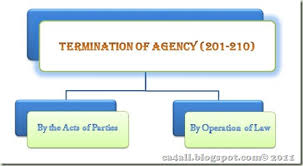
Agency may be terminated two ways –
1) By the Act of the Parties
2) By Operation of Law

1) By the act of the parties
i) By agreement – The Contract of Agency can be terminated at any time by mutual agreement between the principal and agent.
ii) By revocation of the principal – The Principal revoke agency at any time by giving notice to the agent.
iii) By Renunciation of an agent – Renunciation which means withdrawing from responsibility as Agent. Like Principal, Agent can also renounce the agency. According to Section 206 of the Indian Contract Act 1872, the agent must give to his Principal reasonable notice of renunciation. Otherwise, he will be liable to make good for the damage caused to the principal for want of such notice.

2) By operation of law
Agency can be terminated by operation of law-
i) By the completion of agency – Agency can become to an end after the completion of work for which the agency is created.
ii) By expiry of the time – Agency can also be terminated by the expiry of time. if the agency is created for the specific period, it is terminated after the expiry of the time.
iii) Death or insanity of principal or agent – Section 209 of the Indian Contract Act 1872 imposes an agent, duty to terminate the contract of agency on the death of the principal. In other words, Agency comes to an end on the death or insanity of the principal or agent.
iv) Insolvency of principal – According to Section 201 of the Indian Contract Act 1872, an insolvent or bankrupt is a person who is unable to run the business due to Excess of liabilities over assets. In this way, if the principal becomes an insolvent agency can be terminated.
v) Destruction of the subject matter – If this subject matter of the agency is destroyed agency comes to an end.
For example – Any agency is created for sale of an Airplane if the Airplane caught fire before the sale the agency comes to an end. In this contract Airplane is the subject matter.
vi) Principal becoming an alien enemy – If the Principal becomes an alien enemy the contract of agency comes to an end. vii) Dissolution of company or firm – A Firm or company may be regarded as a Principal in the contract of Agency. If the company or firm is dissolved the agency comes to an end.

Relationship between Principal agent and sub agent

Relationship between principal agent and sub-agent depends on the question whether the agent has an authority to appoint sub-agent and whether the sub-agent is properly appointed.
If then sub-agent is properly appointed:
1) The principal is bound by and responsible for the acts of a sub agent;
2) the agent is responsible to the principal for the acts of the sub-agent;
3) the sub agent is responsible for his acts to the agent, but not to the principal except in case of fraud or willful wrong.

It is of interest to observe clause (3) above. Sub-agent is responsible and accountable to the agent and not to the principal by clause (1). Principal is liable for acts of the sub-agent if he is properly appointed. Sub-agent is not responsible to the principal because there is no privity of contract between the principal and sub agent. It is case of fraud or willful wrong that the principal can proceed against the sub-agent. Principal can, however, against the agent for acts of a sub-agent. As far as the rights of a third party are concerned, he can enforce the wrongs of a sub-agent on the principal if the sub-agent is properly appointed. Principal is therefore liable for acts of the sub-agents if he is properly appointed.

If the sub-agent is not properly appointed: Where an agent has appointed a person to act as sub agent without having authority to do so, the principal shall not be deemed to be represented or responsible for the acts of the sub-agent so employed, nor is such a sub-agent responsible to the principal. The agent is responsible for the acts of such a sub- agent both to the principal and to third persons.

Sub-agent is said to be improperly appointed where agent delegates his powers without authority from the principal or where none of the circumstances stated above exist which necessitate appointment of a sub agent.

It will be observed that where a sub-agent is not properly appointed, the liability of agent is also towards third parties. As a rule, we have seen that an agent is responsible to the principal and it is the principal who is responsible for the acts of his agent to the third party. However, the section throws additional liability on the agent where he has improperly appointed a sub-agent. Agent stands liable to the third party for the acts of a sub-agent.

Termination of sub-agent’s authority: (Sec 210) Lastly it must be noted that the termination of the authority of an agent causes the termination of the authority of all sub-agents appointed by him

Liabilities of principal, agent and sub-agent: The agent is responsible to the principal for the acts of a sub-agent and the sub-agent is responsible for his acts to the agent but not the principal, except in cases of fraud and willful wrong.

Where an agent improperly appoints a sub-agent, the agent is responsible for his acts both to the principal and to third parties. The principal in such cases is not responsible for the acts of the sub-agent nor is the sub-agent responsible to the principal. But where a sub-agent is properly appointed, the principal as regards third person, is represented by the sub-agent, and is bound by and responsible for his acts, as if he were an agent originally appointed by the principal.

Where an agent under an express or implied authority has named another person to act for the principal, such a person is not a sub-agent, but an agent of the principal. There is no liability on the agent appointing him provided the agent so appointing exercises discretion as a man of ordinary prudence would exercise is his own case (Sec 194 & 195). Such an agent is called a substitute agent.


New Forms of Punishment

Section 53 prescribes five types of punishments to be meted out to a person convicted of a crime under the Code, depending on the nature and gravity of the offence,viz .:

(i) Death; (ii) Imprisonment for life; (iii) Imprisonment, rigorous with hard labour, or simple; (iv) Forfeiture of property; and (v) Fine.

It is suggested to add five new forms of punishment to the existing ones in section 53, IPC with a view to deter particular types of criminals. Such punishments will have more psychological, social and moral impact on the criminals and will go a long way in curbing crimes. The proposed punishments are: (i) Externment, (ii) Compensation to victims of crime, (iii) Public Censure, (iv) Community service, and (v) Disqualification from holding public office.

(i) Externment: Externment or banishment is a form of punishment in which an accused is sent out of the place of his residence to another place for a specified period of time as mentioned in the order issued by the court. This is done to deprive the accused of the company of his family members, friends and associates so that he or she may not indulge in criminal activities. Externment is resorted to primarily in case of anti-social, hardened and habitual criminals.

(ii) Compensation to victims of crime: Unfortunately, the victims of crime in our country do not attract the attention of law makers. Of late, Civil Procedure Code, 1973 in section 357 has empowered the court to award compensation to the victims of crime in very limited cases at the time of passing the judgment. No doubt, the higher judiciary has on times provided compensation to the victims of crime of custodial violence, sexual assault, rape, illegal detention by invoking Article 21 of Constitution, but such instance will not serve the plight of helpless victims.

(iii) Public Censure: Public Censure or social censure is one of the methods of punishment prescribed in some of the countries, such as Russia, Columbia etc., in respect of certain offences of anti-social nature, such as white-collar crimes, tax crimes, food adulteration, etc. In ancient India, public censure was considered suitable punishment for certain class of criminals.

(iv) Community Service: Community service or corrective labour is a form of punishment in which the convict is not deprived of his liberty. Corrective labour is the standard penalty given in those cases where it is considered that the accused need not to be isolated from the society. The period ranges between one month to one year in such cases. This system is used in Soviet Russia with good results. An important feature of this type of punishment is that the accused is not deprived of his liberty and he may go home after the day’s work.

(v) Disqualification from holding public office and contest elections: Disqualification to hold public office and contest election of legislature and local bodies as a form of punishment will have the adequate and desired deterrent sanction, if sincerely implemented. Representation of the People Act, 1951 disqualifies a person convicted for a period of two years or more to contest election for a period of six years. But the provisions are very limited in scope and are being abused with impunity.

Theories of Punishment in Indian Penal Code,1860

Introduction

Punishment is the sanction imposed on an accused for the infringement of the established rules and norms of the society.

Objective

The object of punishment is to protect society from mischievous and undesirable elements by deterring potential offenders, by preventing the actual offenders from committing further offences and by reforming and turning them into law abiding citizens.

Types of Theories

  1. Deterrent Theory
  2. Preventive Theory
  3. Retributive Theory
  4. Reformative Theory
  5. Multi Approach Theory

a) Deterrent Theory: According to this theory, the object of punishment is not only to prevent the wrong-doer from doing a wrong second time, but also to make him an example to others who have criminal tendencies. Salmond considers deterrent aspects of criminal justice to be most important for control of crime. Deterrent punishment is likely to harden the criminal instead of creating in his mind a fear of law. Hardened criminals are not afraid of imprisonment.

b) Preventive Theory: According to Paton:’The theory concentrates on the prisoner and seeks to prevent him from offending again in the future. The death penalty and exile serve the same purpose of disabling the offender’. Critics point out that preventive punishment has the undesirable effect of hardening first offenders, or juvenile offenders, when imprisonment is the punishment, by putting them in association of hardened criminals.

c) Retributive Theory: In primitive society punishment was mainly retributive. The person wronged was allowed to have revenge against the wrong-doer. The principle of ‘an eye for an eye’, ‘a tooth for tooth’, was the basis of criminal administration. According to Justice Holmes: ‘It is commonly known that the early forms of legal procedure were grounded in vengeance’. The advocates of this theory plead that the criminal deserves to suffer.

d) Reformative Theory: According to this theory, the object of punishment is reformation of criminals. The object of the punishment should be to reform the offender. The criminal must be educated and taught some art and craft or industry during his term of imprisonment, so that he may be able to lead a good life and become a responsible and respectable citizen after release from jail.

e) Multi Approach Theory: In fact, a perfect system of criminal justice could never be based on any single theory of justice. Every theory has its own merits and every effort should be made to extract the good points of each and integrate it so that best of all could be achieved. Punishment should be proportionate to the nature and gravity of the crime. The object of any concession given to an offender should be to convince him that normal and free life is better than life in jail.

Conversion to Islam and Marital Rights

Introduction

Muslim law applies to-
        1)   Mohammedans by birth, as well as to,.                                                               

2) Mohammedans by conversion.

A non-muslim , who has attained majority and is of sound mind may embrace Islam in any of two modes:-

a) He may simply declare that he believes in the oneness of God and the Prophetic character of Mohammad,or

b) He may go to a mosque, to a person who is well versed in Islamic theology (Alim), where he utters Kalma (Lailaha-ill-Allah Muham-mad-ur Rasoolullah) before Imam, whereupon he is given a muslim name by the Imam. It is however, necessary that the conversion must be bona fide; the Court will not permit any one to commit a fraud upon the law by pretending to be a covert Islam in order to elude te personal law by which he is bound .

In Rikhya Bibi v. Anil Kumar , a hindu women accepted Islam in order to get rid of her Hindu husband, who was impotent. It was held that her conversion to Islam was colourable and was effected with the intent to commit a fraud upon the law, and was therefore invalid and ineffective.

Conversion to Islam and Marital Rights

According to Muslim Law, a distinction, is made between conversion to Islam of one of the spouses when such conversion takes place-
1) In a country subject to Muslim Law, and

2) In a country where the Law of Islam is not the law of the land

In the first case, when one of the parties embraces Islam, he should offer Islam to the other spouse , and of the latter refuses, the marriage can be dissolved. In the second case, the marriage is automatically dissolved after the lapse of a period of three months after the adoption of Islam by one of the spouses. The courts in India do not administer the laws of any particular community but they administer such laws as are valid in India. Muslim Laws is administered only in those cases where it happens to be the law of India and where the parties are muslims. In India , the spouse who has become a convert to Islam can sue for divorce or a declaration of dissolution of the marriage on the ground that the other spouse has refused to adopt the Muslim religion. It has been held in Pakistan that a marriage of a Hindu married woman on her conversion in British India to Islam should be regarded as dissolved on the completion of three of her monthly couses without any decree or order of the court.

In Sarla Mudgal v. Union of India, the Supreme Court has held that the second marriage of a Hindu husband after conversion to Islam without having his first marriage dissolved under law would be invalid. The second marriage would be void in terms of the provision of Section 494, IPC and the apostate husband would be guilty of the offence under Section 494 of IPC.

In Lily Thomas v. Union of India, the Supreme Court has observed that if hindu wife files a complaint for the offence of bigamy under Section 494, IPC on the ground that, during subsistence of marriage her husband had married a second wife under the other religion after converting to that religion, the offence of bigamy pleaded by her would have to be investigated and tried in accordance with the provisions of the Hindu Marriage Act. Since under Hindu Marriage Act, a bigamous marriage is prohibited and has been constituted as an offence under Section 17 of the Act, any marriage solemnized by the husband during the subsistence of that marriage in spite of his conversion to another religion, would be an offence under Section 17 of the Hindu Marriage Act read with Section 494 of IPC. Change of religion does not dissolve the marriage performed under the Hindu Marriage Act between two hindus. Apostasy does not bring to an end the civil obligation or matrimonial bond but it is a ground for divorce under Section 13 as well as ground for judicial separation under Section 10 of Hindu Marriage Act.

Conversion to Islam and Rights of Inheritance

In the absence of a custom to the contrary, in case of a Hindu converts to Islam, succession and inheritance are governed by Mohammedan Law and not by Hindu law.

Where a Hindu, who had a Hindu wife and children, embraced Islam and married a Muslim woman and had children by her,his property would pass on his death to his Muslim wife and children and not to his Hindu wife or children because under Muslim Law, a Hindu cannot succeed to the estate of a Muslim.

Effects of conversion to Islam

The legal consequences that follow by conversion, may be summarised as under:

1) The religion of Islam is substituted for the previous religion of the convert to Islam, with so much of the personal law as necessarily follows from that religion;

2) The rights and status of the convert become subject to the Mohammedan law;

3) His apostasy (abandonment of religion) has an immediate and prospective effect, from the moment of the conversion and is not retrospective;

4) Conversion of the both spouse, without any intention to commit fraud upon the law, will have the effect to altering the rights incidental to marriage, but this question was left undecided by the Privy Council in Skinner v. Orde.

5) Succession to the estate of a convert is governed by Muslim Law.

Effect of renunciation of Islam

Under the pure Muslim Law Mohammedan after renouncing Islam loses all rights to succeed as Muslim. But now under the provision of the Caste Disabilities Removal Act XXI of 1850, the apostate will lose such rights. The question here arises as to what amounts to apostasy, i.e., abandonment of one’s religion. The answer is that mere deviation from non-fundamental provisons of Mohammedan religion does not amount to apostasy. So long as a person is prepared to accept the fundamental tenets of Islam, he is not an apostate.

Apostsy of guardian – According to Mohammedan Law an apostate has no right to contract a minor in marriage: Hedaya, 392. It is enacted however, by Act XXI of 1850, that no law or usage shall inflict on any person who renounces his religion any “forfeiture of rights of property”, and it was accordingly held in Muchoo v. Arzoon that a Hindu father is not deprived of his right to the custody of his children and to direct their education by reason of his conversion to Christianity. It is submitted that the decision in Muchoo’s case is correct . But the court may in its discretion deal with each case on its own merits.

Effect of renunciation of Islam on Marriage

Marriage of a Muslim husband with a Muslim wife is dissolved ipso facto on the renunciation of the husband of the Islamic religion, their marriage remains intact and is not dissolved.

The renunciation of Islam by a married Muslim woman on her conversion to a faith other than Islam does not by itself dissolve her marriage. But were a woman converted to Islam from some other faith re-embraces her former faith, her marriage with the Muslim husband stands dissolved .


Manali flooded with tourist amid third wave warning; covid protocols getting ignored.

Inspite of third wave warning lakhs of tourists have thronged Himachal Pradesh in less than a month.Videos emerging from Manali and Shimla show that social distancing norms put in place to contain the coronavirus pandemic have gone for a toss.Highways choked, hotels fully booked after the Himachal Pradesh government relaxed Covid-19 related restrictions.Hotel occupancy in major tourist spots, including Shimla, Manali and Dharamshala, is almost full and tourists have been heading to less popular tourist spots in a bid to find accommodation and in guest houses.

Even though the governments, health experts have been warning against large crowds, a sea of tourists was seen in Manali town in Kullu district as the Himachal Pradesh government eased COVID restrictions.the increase in the number of tourists has posed a challenge for the authorities who are struggling to ensure implementation of Covid protocols amid fears of an impending third wave of coronavirus infections.

Reason behind this huge influx of tourist

  1. The prime reason is that the Himachal administration has withdrawn the mandatory need of a negative RTPCR report and e-Covid pass to enter the hill state.
  2. Another reason, behind the rush of tourists, is the ongoing heatwave in North India.
  3. while the third reason is that some people fear that lockdown-like restrictions may be imposed if the third wave of coronavirus strikes the nation. So many have decided to use this opportunity to visit some places

Twitterati reaction

Social media was abuzz with pictures of crowded Manali markets and tourist spots. While some were concerned over the violation of Covid protocols by the tourists, others shared memes and took taunt at the carelessness of the public.

for more news related to covid vist the link👇

https://www.timesnownews.com/india/article/tourism-with-a-vengeance-in-himachal-pradesh-shimla-manali-jampacked-covid-protocols-thrown-to-wind/780836

https://news.google.com/covid19/map

Child Custody laws in India

Child custody laws in India

The Best Security blanket a child can have is parents who respect each other”


Marriage is a legally and socially sanctioned relationship, usually between a man and a woman, governed by laws, norms, conventions, beliefs, and attitudes that define the spouses’ rights and responsibilities as well as the status of their children.
When a marriage falls apart or ends in divorce, the children born out of the union are the ones who suffer the most, despite the fact that the parents have the legal right to custody of their children.
The Guardian and Wards Act of 1890 in Indian law gives the court complete authority to choose a child’s guardian. In layman’s terms, it’s known as “Legal Custody.”
The custody of a child after a divorce and the end of a marriage in India is classified as follows:
1.Sole Custody: When a child is cared for by only one parent.

2. Joint Custody :-When both parents are liable and responsible for the child, this is known as joint custody.


3.Third-Party Custody :- It occurs when neither the father nor the mother agrees to hand over custody of their kid to the court.
Then there’s the problem of deciding what to do. Who will assume responsibility for the child’s upbringing? The child’s custody may be given to Grandparents or someone other than the parents (child).The Standard State of Affairs in Indian Society, when throughout divorce cases, they battle over the money for maintenance, i.e. money to be paid by the stable and earning partner to the other.
The method of gaining custody of a kid in order to avoid having to pay child support to the other partner. They are caring for the youngster as a result of this. If the child is of legal age (over 18), they have the right to choose their guardian, and even if the child is a juvenile, the court may request that the youngster express their opinions.


What factors does the court consider when deciding who should be the child’s custodian?


1.The Custodial Parents’ Financial Stability.


2.Custodial parents’ physical and mental well-being.


3.Comfort of the child with his or her custodial parents.


4.Custodial parents’ intention (Wrong or false intention that may harm the child).


5.The judge has complete authority and authority to choose what is best for the child’s future. Additionally, the child has the option of selecting.

Custody of child shall be handed over to such a person who fosters him with care, love and affection” – Honorable Justice Vinod Prasad.

WHAT ARE THE CONTEMPORARY TRENDS IN THE VOTING BEHAVIOR OF THE INDIAN ELECTORATE

Studying about the voting pattern and election pattern of the world’s largest democracy is a challenge. India has seen a tremendous change in the voting pattern since the first elections of 1952. Election during that time was solely based on the leader and there was principal focus on only one political party but now the situations have changed. India has grown through the 21st century to see a lot of changes within the political system. Starting from the changes during the time of independence till today.

The voting pattern has seen considerable changes lately. During the time of independence the pattern of voting was solely based on the legacy of the nationalist movement. This was because people only voted for the single largest party at that time and that is the Indian National Congress. INC was people’s first choice since it had the legacy of the Independence struggle as well as it had an all India background which accommodated people from all kinds of religion and caste unlike other political parties which had its ground on only a single community of people.

While Today’s political system is quite complicated. The voting pattern has also become quite complex unlike earlier times. These days people’s voting pattern and behaviour have changed a lot. There are many factors for this change. It is quite a complex study where we have to unravel things from the core. For this we have to take a look from where this change in voting period has started from.

       Till the 1977 elections congress party ruled India. The INC consecutively won the elections till 1977. Only to be defeated by the Janata Party. In 1989 INC was again defeated for the second time due to the unpopular rule of the congress and the lack of representation of the regional parties, lower or backward castes, minorities etc. 1989 put an end to the rule of single party system and welcomed in the multi-party coalition system in India.

Most striking trend in the Indian politics is the political competition between the Indian Political Parties that have grown past these years. This rise in the number of the political parties in India is due to the lack of representation of the various regionalities and communities. There has been a constant competition between various communities in the country for power. People are being voted mainly because they belong to a particular community or religion. This pattern of politics emerged only very recently within the country.      

The behaviour of a voter in India is defined by the various factors

  • Religion
  • Caste
  • Performance of the party in power
  • Money
  • Policy

The political parties make use of these factors to attract more voters. Although no party can convince a person to vote for them in the name of religion and caste, this is an important factor

In the elections. Since India is a secular country the political parties nor the government cannot have a tilt towards a single religion. Even still political parties use religion and caste to catch the polls.

RELIGION is one of the main factors which affect the voting behaviour these days in our country. People are more interested to elect for candidates to more or less belong to their same religion or community since they feel that then only they can identify themselves with the leader. Despite India being a secular country and the fact that no religious affiliations can be used in the election matters we can still see that people use the religious sentiments of the people to make use of their vote. Political campaigning’s are also done for the same. For an example the Bharatiya Janata Party (BJP) is the leading political party of India which is said to have the ideology of Hindutva. The party has a tilt towards the Hindu religion. Another example of a political party is the Indian Muslim League which is as the name says a Muslim political party.

The establishment of a secular state along with the freedom of religion – that is to choose to practise, profess and propagate any religion of our choice, treating all religions equally and not putting any religion one above the other , the political parties have failed to keep their word. Even after all these laws the use of religion in politics hasn’t come to and end and it seems like it never will according to the recent political activities and trends. The continued existence of political parties which are one way or the other linked with a religion is the main reason why religion cannot be put away from politics. The very existence of these religious acts as a black hole to the act of secularism in our country. The existence of religious pluralism affects the political system. The selection of a candidate is sometimes solely based on religions preferences. The religionization of socio- political issues by the political parties is one of the methods by which they continue to get the voters in their consideration.

CASTE is yet another important factor in determining the voting behaviour of the people. Caste has always had its root in all kinds of problems in India. Caste is an important determinant in the politics of India. It constitutes an important basis for social relations in the country. Despite the various measure taken stop the discrimination,  caste still continues to an important basis for election. Politics in caste and caste in politics are very common in the Indian political scenario as we all know. Sometimes for the elections to various constituencies people are selected on the basis of their caste. Also while formulating various policies, election strategies and programme caste is taken as a major factor in the backdrop.  Caste system has had its roots for years and so it will take a lot of time for people to weed out these roots even from the political scenario. Votes are brought in the name of caste by the candidates.

Caste is an important determinant for the selection of candidate for the rural population. Despite the various laws and the adoption of secularism, uneducated people mostly living in the rural India choose to vote for people who belong to their own caste. The candidates despite the laws in the country make use of their sentiments to seek vote for them. Although recently this trend has been changing at least in the urban households since as you go up the social ladder caste tends to be invisible. While in the rural areas caste tends to be an important factor in the selection of their leader.

PERFROMANCE OF THE PARTY IN POWER. The performance of the party already ruling is also another important determinant. Each political party comes into power with a election manifesto and various promises. After the elections it is their duty to fulfil all of this and meet the various aspirations of the people. And so the performance of the party during the time it rules is an important factor in determining whether the people should elect for the party next time too.

Improper ruling of the party during its tenure can result in it being not chosen for the next time. The way the party rules influences the people in a big way. We can see an example of this by looking at the example of the elections during 1989. The parties which got elected only stayed in power for a short period of time due to their political instability and the lack of a charismatic leader during the time of ruling. Their unpopular rule with the lack of ideology since it was a coalition lead the people to choose another political party.

MONEY influences people in different ways. Usually people with money and power tend to stay in high positions and rule the people according to their wishes. India is a developing country and most of people live under the poverty line. And so the people having money and power tend to rise to the top. Without other factors like political wave getting involved usually it’s the people with money and power who wins the elections. Rich and the powerful throw around the money to catch the ballot. But this is not always true though because in the 1989 elections congress used a lot of money and power but it couldn’t win the elections. BJP won the elections.

POLICY. Various policies taken by the government or the political parties stand out as an important deciding factor in elections by a common man. When a party announces its political manifesto the policies it takes for the people is an important determinant in voting. A person who doesn’t know much about politics and party tends to take a look at the policies of the party or what it has done in the past years. And so creating a policy that attract the crowd and implementing it in a proper way is important for any party.

These are the various trends which are seen across the country during the election time. The voters turnout has consistently increased from the time of independence till today. People has started to see election as an important way of choosing their leaders. As people are getting educated they started to look into the doings of the party and make a proper decision when it comes to who to vote for. Voting behavior is a form of electoral behavior and understanding it can help us understand how and why people choose to vote for certain people. And the above study was about voting behavior and its determinants.

Public and Private Administration

These are a few terms we have familiarized in the past years. Administration means ‘to administer’ , derived from a Latin word ‘ad’ and ‘ministrare’, it means to serve or manage. We all do know the difference in the meaning of Public and Private.

Administration came as a activity from the times of men and women but as a discipline it emerged only a century and decade ago. In order to live together harmoniously there was a need for a system of control and rules. A leader was much needed to make amendments and negotiations.

As this became a discipline there was a need to categorize it and so the two broad categories of Public and Private administration emerged.

Public Administration can be briefly said as implementation of public policy, as laid down by a competent authority, economically and efficiently for the benefit of the people.

Private Administration refers to the implementation of policy and management of private property or administration.

The following are the similarities between Private and Public Administration

  • Skills

No matter which sector you work for, private or public the usage of your skill is the same. The skills and techniques adopted by both the sector are the same. The work of an engineer or a teacher is the same in both private and public sector.

  • Influence

There has been a profound influence on each other. Public corporations are set up as an idea to import the private administration into it. Likewise big and private firms have taken up policies like welfare and insurance too.

  • Administrative set up

The administrative set up is the same for both the administration. There is a certain level of hierarchy existing in both. And people are recognized according to it. The work is divided on this basis of this structure.

  • Public Relations

Both of the administrations make sure to have contact with the masses. Even though private administration work on their self-interest, they work according to the needs of the people too. Public administration is for the people. Many private industries are taken up by the government too and vice versa. This proves the how much alike they are.

  • Research and Improvement

No matter how far both the industries have come, they always improve and make alternative changes. They constantly try to bring innovations and changes according to time.

Differences between Public and Private Administration.

  • Prestige

Prestige for public administration is very much important. Public administration works for the people and what people think about the government is very Important for them and hence there are a wide range of opportunities available to the public.

  • Political direction

Sometimes public administration is pushed according to the party’s needs. There is can be a bias due to the influence of a particular party, after all it’s the party which wins the election.

  • Profit motive

Private administration run on the basis of profit and their own self- interest, while public administration is for public welfare. There is no other motive like private administration, their duty is to serve people.

  • Uniformity of treatment

Public administration is bound by certain laws and regulations, there is equality of treatment for everyone, No one is treated indifferently. But the same cannot be said for private administration, there is a chance of personal bias in it.

  • Monopolistic

Some services of the public administration are monopolistic, the government does not allow a second party to invest or make business out of it, this is done for the welfare of the people of the nation.

  • Responsibility to Public

Public administration is made for the people and so it is accountable to the law and its people. It owes a certain amount of responsibility to the government.

These are the similarities and differences of private and public administration. Both of these are necessary for a nation of succeed

Road Safety

We all live in a world where we take our lives for granted, we always forget safety measures and put ourselves in constant risk especially while driving. Driving safely and using appropriate measures not only saves our lives but also of the ones around us. Everyday we can see new cases being reported of accidents been caused due to carelessness. These happen due to our own little mistakes, if we take proper precautions we can always be safe from these kind of accidents. Wearing safety belts and helmets whenever we go out always ensures us of our safety while driving.

It is advisable to not mix drinking and driving together. Using phones while driving leads to a lot of accidents these days. Drunken drivers had often ended up bringing  trouble to other passengers too. Many accidents have been reported across the countries where drunken dries has run over homeless people especially during night time .

Road safety is an important part of our lifestyle. We take issues like this so lightly that we forget its gravity and how it can affect us. Driving rashly can cost us our lives. There is no point in regretting after things have happened, we always have to be careful and fully aware of our surroundings while driving and on road.

It is high time that we take issues like road safety very seriously. Government of India has taken up various policies for the safety of its citizens but what’s more disturbing is that people do not follow it. People have gained ignorance and have not so caring attitudes towards road safety. Often we see people paying fine for overspeed or not wearing a helmet or seatbelt.

Listed below are a few basic road safety rules that applies to everyone.

  • As per the Indian law, you should have minimum 18 years of age to avail a driving license.
  • While driving, you should not use mobile phones  as it can cause serious road accidents
  • Drinking and driving is not allowed as it seems to be a deadly combination for you
  • You need to wear seat belt while driving a four wheeler
  • Helmets are necessary when you use two wheelers for travelling.
  • Make sure that you keep left on the road, when you use cycles for travelling.

Recently road safety has gained enough amount of attention among people, especially the youth. They have taken up initiatives to rise the issue in various platforms. Many organisations have been build by students across the country to spread awareness on the need for road safety.

Hoping to see people taking issues like road safety more into perspective so as to see a budding nation of responsible adults. As a citizen of India it is very important for us to follow the rules and regulations made for us. It is in the best interest of the citizens of the nation these laws are made. Traffic signs provide valuable information to drivers and other road users. They represent rules that are in place to keep you safe, and help to communicate messages to drivers and pedestrians that can maintain order and reduce accidents. Neglecting them can be dangerous.