Operant conditioning by B.F Skinner

B.F Skinner is considered one of the most influential psychologist of this era. He studied human aspects and behaviourism of the day to day life that most of us fail to observe and put it into theory .His discovery are used till date to treat, diagnose and find solution to psychological problems. B. F. Skinner was an American psychologist best-known for his influence on behaviourism.

Early life

Burrhus Frederic Skinner was born and raised in the small town of Susquehanna, Pennsylvania. His father was a lawyer and his mother a homemaker. During high school, Skinner started to develop an interest in scientific reasoning from his extensive study of the works of Francis Bacon. After earning his undergraduate degree he decided to become a writer, a period of his life that he would later refer to as the “dark year. He wrote short newspaper articles and receiving some encouragement and mentorship from the famed poet Robert Frost. While working as a clerk at a bookstore, Skinner happened upon the works of Pavlov and Watson, which became a turning point in his life and career. Inspired by these works, Skinner decided to abandon his career as a novelist and entered the psychology graduate program at Harvard University.

He Best Known for Operant conditioning, Schedules of Reinforcement, Skinner Box Cumulative Recorder, Radical Behaviourism. Among his many discoveries, inventions, and accomplishments were the creation of the operant conditioning chamber (aka the Skinner Box), his research on schedules of reinforcement, the introduction of response rates as a dependent variable in research, and the creation of the cumulative recorder to track these response rates. Skinner’s operant conditioning process, an operant referred to any behaviour that acts on the environment and leads to consequences. He contrasted operant behaviours (the actions under our control) with respondent behaviours, which he described as anything that occurs reflexively or automatically such as jerking your finger back when you accidentally touch a hot pan.

Operant conditioning and experiments

Skinner identified reinforcement as any event that strengthens the behaviour it follows. The two types of reinforcement he identified were positive reinforcement (favorable outcomes such as reward or praise) and negative reinforcement (the removal of unfavourable outcomes).Punishment can also play a role in the operant conditioning process.

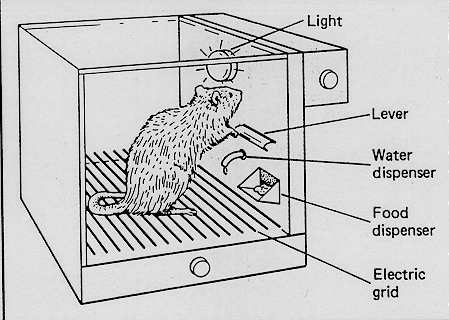
Skinner distinguishes between two types of behaviour respondent and operant. Respondent behaviour is directly under the control of a stimulus. Operant behaviour appears to be spontaneous rather than a response to specific stimulus .Stimulus that may influence operant behaviour is called discriminative stimulus the word operant derived from the fact that operant behaviour of the rates and the environment to produce some effect. Thus, the telephone rings going to where it is and receiving our operant acts that lead to a telephonic conversation. To demonstrate operant conditioning in the laboratory, a rat is placed in a box called the skinner box that is deprived of food for some specified period and so was assumed to be motivated by hunger drive inside the Skinner box there is a protruding bar with the food dish beneath that small light bulb above the bar can be lit at the experimenters discretion. Left alone in the box, the rat move absolutely restlessly and by chance occasionally presses the bar. The rate at which it first pushes the bar defines the preconditioned of operant level of bar pressing after establishing the opponent level the experimental attaches the food dispenser so that every time the rat presses the bar, a palette of food falls into the dish. The rat eats and soon presses the bar again. The food reinforces by pressing and the rate of pressing increases dramatically. If the food dispenser is disconnected and pressing the bad no longer no longer delivers would the rate of bar pressing will diminish .Experimenter can set up a discrimination by presenting food if the bar is pressed while the light is on and not giving these reinforcement if the response is made in the dark. Selective reinforcement leads to the rats pressing the bar only in the presence of light operant conditioning refers to the increase in the probability of response in a particular stimulus environment by following the response with reinforcement. Usually reinforcement is something that can satisfy a basic drive like food to satisfy your hunger. Operant behaviour is consequences that lead to change in voluntary behaviour person.

Operant conditioning is not just something that takes place in experimental settings while training lab animals. It also plays a powerful role in everyday learning. Reinforcement and punishment take place in natural settings all the time, as well as in more structured settings such as classrooms or therapy sessions. Examples in real life include-     Homework Completion-A student tends to complete his/her homework daily; because he/she knows that he/she will be rewarded with a candy (action) or praise (behaviour). Incentives and Bonus-Workers are often offered with the incentives and bonus in return of completing their targets in time or for regular attendance. It makes the workers to perform better, so that, they can continuously get those incentives and bonus.

Top 10 Urban planning tools

As an urban planner, you know the importance of legibility and comprehensibility in communicating plans for the built environment. Developing an understanding of the tools and techniques of urban design is a crucial benefit to the implementation of effective plans.
Urban Planners are often required use urban planning software which bridges the various disciplines involved in city planning. While not always the case, the softwares and tools used within the urban planning can be quite expensive. Especially when you are self employed. Fortunately, there are free urban planning software alternatives available, which does well in completing the necessary tasks. However, unfortunately some of the paid software do not have alternative free and open source software.
We have attempted to summarise the key urban planning software and tools used today, both free and paid. This list has been made in an effort to make it easy to understand the software that exists and is used today. Although, the list is currently not fully comprehensive it gives an overview. The list will moreover be updated once in a while to reflect software not listed here. 
We hope this list is useful and provides some help in finding urban planning software and tools that can support your work. \
Whether you’re a professional in the urban planning field or an urban planning student, learning basic design principles doesn’t require a graphic design degree. Thankfully, there are a number of free software tools available to take your plans to the next level, here are some of the urban planning tools that every planners need to know:

1. GIMP
GNU Image Manipulation Program, commonly known as GIMP, is a raster-based image manipulation software. If you’re familiar with Adobe Photoshop, you will find GIMP to be an effective (and free!) alternative with similar capabilities. In the context of urban design, GIMP is used to edit images, add text to images, and overlay graphic content on maps. Additionally, GIMP offers some great free educational resources and tutorials.
SketchUp is an indispensable tool to urban planners and urban designers alike. Unique in its ability to quickly and accurately render 3-dimensional forms, Sketchup provides users with an effective tool to visualize buildings, neighborhoods, and even cities. There are some limitations to the freeware version as opposed to SketchUp Pro, but there are workarounds you can learn in the Urban Design for Planners: Software Tools. What’s more, SketchUp integrates easily with Google Earth (read on to learn more!).
Inkscape is vector-based, open graphic manipulation tool often used as a counterpart to GIMP. For the urban designer, Inkscape is used to draw and manipulate shapes and lines on maps. Comparable to Adobe Illustrator, Inkscape offers a user-friendly alternative for planners and designers.
4. QGIS
QGIS is a free, open source Geographic Information System with powerful capabilities. Compatible with Esri (the industry standard maker of ArcGIS), QGIS is perfect for the planner looking to expand their design capabilities. Use QGIS to view multiple layers of mapped data relative to one another, group locations or elements with sets of criteria, determine distance calculations, examine proximities, and quickly create figure ground maps. QGIS makes it simple to quickly get up to speed with the program with an extremely active support community.
Google Earth is a crucial tool that lends itself to a variety of professional applications. Particularly useful to urban planners and urban designers alike is the ability to explore cities from an axonometric view (from the perspective of a low flying plane). Other settings provide the ability to experience a 3D perspective, accurately measure distance, and integrate with GIMP and SketchUp. Beyond these practical aspects, the potential to explore cities and landscapes around the world makes Google Earth a ground-breaking resource.
6. ESRI ArcGIS is the most widely used GIS software in the world. It allows 
The ArcGIS software have allowed planning agencies to carry out both traditional and previously impossible tasks more efficiently and easier. With the various functions the GIS programs offer, urban planners can create and assess different development scenarios and test the potential impacts they will have on future land use, demographics and employment options. Consequently, ArcGIS has created a spatial tool that provides more informed planning decisions.
7. ArcGIS CityEngine is another 3D modelling software. It is used by urban planners, urban designers and architects to create a large city without the need to model each building separately. The software allows you to measure areas, distances and paths, and compare various development proposals and analyse design solutions.
8. ArcGIS Urban is another ESRI application focused on the urban planning and design professions. The ArcGIS Urban software provides an 3D experience allowing for better understanding of potential land use and development. Thereby decision-making is better formed by visualising and understanding how development projects will fit into the local surroundings.
9. Modelur is a simple and inexpensive SketchUp extension that is somewhat similar to CityEngine. While Modelur is lacking rendering options and extensive functionality as included in CityEngine, it provides a powerful 3D tool to quickly create conceptual urban massing. It calculates your design’s urban planning parameters in realtime, such as Floor Area Ratio (FAR), Gross Floor Area (GFA), Built-up Area (BUA), Site Coverage, recommended parking lots and green area. Therefore you can easily adjust your design to be aligned with the requirements for the site in question. Furthermore, the software tool provides well informed decisions.
Modelur offers free student licenses, but you need to provide proof of university enrollment.
10. Streetmix is an online open source street design tool. It provides a user-friendly and fun way to create fast proposals for street and public space improvements. The tool was created for city planners, public and private companies, pedestrian and bike advocates to make street-making accessible for everyone.

Learning with toys develop the creativity and sensitivity in students and give wings to their imagination

 Learning with toys develop the creativity and sensitivity in students and give wings to their imagination said Dr Subhas Sarkar,  Minister of State for Education while addressing the valedictory session of the International Webinar on ‘Toys and Games to Play, Make and Learn’ organized by the NCERT under the agies of Ministry of Education with an objective to promote Toy Based Pedagogy in school education for joyful learning.

Shri Sarkar said that toys teach children from being possessive to sharing, co-operative to empathy, exploring toys to make one on their own, inculcates among them imagination, creativity, and much more. It is the need of hour that parents teach their children through the toys as it will make things comprehensible for the students.

The Minister highlighted that we have a rich heritage of traditional toys which has originated in the subcontinent several thousand years ago in the Indus Valley civilization. Indian toys not only entertain, but also teach us scientific theories such as ‘Lattu’ teaches us gravity and balance, ‘Gullel’ teaches us potential and kinetic energy, he added.

He expressed that the International webinar is an important step towards reinventing a timeless tradition of toys and games. He hoped that the webinar has provided a roadmap for the school education which has been envisaged by the National Education Policy of 2020 to be based on India’s rich heritage and knowledge systems and prepare our youth for the challenges of the 21st century.

On the  2nd day of the webinar today,  there were two technical sessions on Toys and Games to Play, Make and Learn, and Toys to address different societal concerns, mainly to address the concerns of Children With Special Needs and 9 scholars presented their papers.  There was a panel discussion on Innovative Toys and Technology, where innovators, educationists and entrepreneurs from different countries shared their views on the need for promoting innovation and entrepreneurship in toy making. There were 7 presentations by the practitioners and case studies on toys, toy design and startups.

 The Session started with Prof. Sridhar Srivastava, Director, NCERT welcoming the dignitaries present on the occasion and the participants who had joined from different locations of various countries. Prof. Anupam Ahuja, Head, Division of International Relations, NCERT and a member of the Organizing Committee of the Webinar presented the brief report of two days of deliberations. Smt. L. S. Changsag, Joint Secretary (Instt), Ministry of Education shared the initiatives taken by the Ministry of Education in regard to Toy Based Pedagogy and the way forward. Prof. Anil D. Sahasrabudhe, Chairman, AICTE addressed the participants and enlightened them with his views.

Towards the closing of the 2 days deliberations of the International webinar, Prof. Jyotsna Tiwari, Head, Department of Gender Education, NCERT and the coordinator of the webinar proposed a vote of thanks to all the dignitaries, participants and invited audience.

*****

Learning how to learn!

“Focused” and “Diffused” Modes

When learning, there are times in which you are focused and times in which you allow your mind to wander. Both modes are valuable to allow your brain to learn something.
Take regular breaks, meditate, think about other things, and give yourself plenty of time in both modes.

Chunking

This is the idea of breaking what you want to learn into concepts. The goal is to learn each concept in a way that they each become like a well-known puzzle piece. 
To master a concept, you not only need to know it but also to know how it fits into the bigger picture.

Beware of Illusions of Competence

There are many ways in which we can make ourselves feel like we have “learned” a concept. Instead of highlighting or underlining, rather take brief notes that summarize key concepts.

Recall

Take a couple of minutes to summarize or recall the material you are trying to learn. It goes a long way to taking something from short-term memory to long-term learning.

Bite-Sized Testing

To avoid breakthrough illusions of competence, you should test yourself as you’re encountering new material. The recall is a simple example of this mini-testing.

Over-Learning

Do not spend too much time in one sitting going over the same material over and over again. The law of diminishing returns certainly applies. Spread it out over many sessions and many different modes of learning.

Interleaving

Once you have a basic understanding of what you are trying to learn, practice jumping back and forth between problems that require different techniques. This will solidify your understanding of the concepts by learning how to choose to apply them in various situations. Knowing when to apply a particular concept is as important as knowing how.

Process over Product

When facing procrastination, think of the process over the product.
Instead of thinking that you have to get X done, rather think to spend an hour on X. It is then not overwhelming and doesn’t require a long breakdown of tasks.

Metaphors and Analogies

They are often talked about as helpful study techniques. 
Try to make a deliberate effort to teach what you learn to someone else and, in doing so, you will likely be forced to explain concepts with relatable metaphors and analogies.

Study Groups / Teamwork

This has proven to be most beneficial to maintain continued progress and hold each other accountable. Finding the right group is key.

Reference

https://medium.com/learn-love-code/learnings-from-learning-how-to-learn-19d149920dc4

Scientific ways to learn anything faster

Say it out loud

Learning and memory benefit from active involvement. When you add speaking to it, the content becomes more defined in long-term memory and more memorable.

Take notes by hand

Most of us can type very fast, but research shows writing your notes by hand will allow you to learn more.
Taking notes by hand enhances both comprehension and retention.

Chunk your study sessions

Studying over some time is more effective than waiting until the last minute.
The distributed practise works because each time you try to remember something, the memory becomes harder to forget.

Self-testing is highly effective

Regularly testing yourself will speed up learning. When you test yourself and answer incorrectly, you are more likely to recall the right answer after you look it up. You will also remember that you didn’t remember.

Change the way you practice

Repeating anything over and over might not be the best way to master that task. If you practice a slightly different version, you will learn more and faster. For example, if you want to master a new presentation:

  • Rehearse the basic skill. 
  • Wait at least six hours to allow your memory to consolidate.
  • Practice again, but speak a little faster. 
  • Practice next by speaking slower.
  • Break your presentation into smaller steps. Master each chunk, then put it back together.
  • Change the conditions. It will prepare you better for the unexpected.
Exercise regularly

According to research, regular exercise can improve memory recall.
Exercise also increases a protein (BDNF – brain-derived neurotrophic factor) that supports the function, growth, and survival of brain cells.

Sleep more, learn more

When you sleep, most of the consolidation process occurs.
In contrast, sleep deprivation can affect your ability to commit new data to memory and consolidate any short-term memories.

Concepts in parallel

Interleaving – studying related concepts or skills in parallel – improves your brain’s ability to differentiate between concepts or skills. It helps you to learn and gain an understanding at a deeper level.
Instead of focusing on one subject during a learning session, learn several subjects or skills in succession.

Teach someone else

Research shows that those who teach, speed up their learning and remember more.
Even just preparing to teach means that you will seek out key points and organize information into a coherent structure. 

Build on what you know

When you have to learn something new, try to associate it with something you are already familiar with. Then you only have to learn where it differs. You’ll also be able to apply greater context, which will help with memory storage and retrieval.

Reference

https://www.inc.com/jeff-haden/these-10-scientific-ways-to-learn-anything-faster-could-change-everything-you-know-about-dramatically-improving-your-memory.html

New skills you can start learning today.


This is an image of New skills you can start learning today.

There’s a curiosity in all of us that acts as a driving force for learning new things. There are a variety of fields of specializations in the 21st century that kindle the curious cat inside us. Our desire can influence us to learn about almost everything that exists in this world. But the constraints of time and lengthy periods of learning a course can put the curious cat inside you to sleep. 

However, the 21st century that brought along with it the various fields of specializations has also brought some simple means of learning. There are several apps and websites that enable learning from the comfort of your home. You can begin learning online and learn at your own pace. Free demo lectures are also offered by many institutions to help you understand what you are signing up for. 

Following are some of the skills you can start learning today from the comfort of your home. 

1.Photography

This is an image of photography


Whether you want to learn some basic photography skills to post beautiful shots on your status, or you want to dive deep into the world of photography. Educational platforms such as Coursera, Skillshare and Shawacademy are here to offer both free and value added photography courses to aspirants. 

2. Try filmmaking

This is an image of filmaking


With video streaming platforms like YouTube welcoming small scale content creators and beginners, filming and editing has become much easier. Your mobile phone or a handycam is enough to get you started. You can start by looking for what’s trending and film a short video explaining your take on it. 

There are filming courses available on educational platforms like Udemy, Coursera and edX that you can learn from to gain more knowledge in this field. 

3. App making

This is an image of App making


If you have an idea that can be transformed into an app, or simply want to learn how to make an app. There are several app building courses available online that have got you covered. 

4. Writing a book

This is an image of Writing a book


Every reader dreams of writing his or her book which they can publish someday. So why not begin chasing that dream with a few pages at a time? Start by writing an outline based on the idea you have in mind. You can further add other interesting elements to it with the help of your feelings, emotions and experiences. 

5. Learning a new language

This an image of learning a new language.


There’s nothing more sassy than being able to speak in a foreign language, at a foreign place. Being well-versed with a few more languages other than your mother tongue puts you at ease with different people from different places. It also gives you the privilege of visiting different places without the fear of the unknown. 

There are several online applications such as Duolingo and Babbel that can aid you with your efforts. 

6. Learn Typing

This is an image of learning typing


Nothing wastes your time like having to search for the keys you need to press while typing an important document. Learning to type familiarises you with the positioning of the keys that can help you type faster than before. I would recommend the Typing Master portal to learn typing. It comprises tutorials, tests, and games to get you better acquainted with your keyboard. 

7. Learning a new sport

This is an image of learning a new sport

Unless you are looking up some tricks and moves of the game on the internet, this activity might require you to go beyond what an electronic device can offer. Learning a new sport can help build a rapport between you and your team. It improves your skill of coordination and sportsmanship. The pleasure of seeing the shuttlecock soaring in the air after swinging a badminton racket at it has always been incompatible for me.  

These are some of the activities you can start learning today. 


How to overcome your feeling of shyness.


Image by Pixabay

Imagine this. It’s the beginning of a new academic year in a new school or college and you enter a classroom full of chattering students. Does that sound like a nightmare to you? Do you wish that a teacher or a professor should enter the class soon so that there will be silence and you won’t feel left out? If you do, you know that you are a shy person. Shyness is an obstruction that prevents you from presenting yourself in a social situation. One might even find ways to avoid a social situation due to his or her shyness. 

Shy people often wait for the others to begin a conversation and hope to be invited into their friend circle. Once they become comfortable around a bunch of people, they seem to have overcome their shyness and become the life of the party around them. 

Why could you be shy?


Image by Pixabay

During such daunting social situations, you might have had this question in your mind, “Why am I so shy?” The answer could range from something serious such as being bullied, or subtle such as lack of experience with social situations. There are also biological aspects such as genetics that influence the trait of shyness within a person. Shyness is often the result of the environment and an individual’s relationship with their parents. 

Having had strict or doting parents during childhood could result in the development of shyness in an individual. Shy parents could also render their children to be shy. Public humiliation or overly critical workspaces develop a sense of shyness among adults. 

 How to overcome your feeling of shyness


image by Pixabay

You might be racking your brain right now, trying to figure out how you can overcome the feeling of shyness like me. But let us first take a moment to figure out our strengths as a shy person. It might seem less likely but you might get pleasantly surprised! 

  • Being shy puts you at an advantage in certain kinds of job profiles. In this aggressive and competitive world, being calm and considerate is valued and anticipated among therapists, counselors and other social-service oriented careers. 

  • Your shyness, which results in a calm and composed stature may seem as less intimidating and approachable for many people. Newbies might feel more comfortable approaching you than the competitive and loud person nearby. 

  • Being a shy person, you might rethink choices you need to make in difficult situations. It might probably slow you down but would help you arrive at the right decision. 

With our strengths out of the way, let us focus on the steps you can take to overcome shyness. 

Observe your friends or a family member


Image by Pixabay

There are people around us like close friends and family members who relatively lean on the bolder and talkative side of the spectrum. They might be able to get things done by talking and socialising at an event might be easier for them. You can take cues from them and act accordingly when you feel shy. 

Start simple

Initiating a conversation with a stranger is often intimidating as we might not always know what to say. You can start simple by introducing yourself and asking questions such as “Where are you from?”, “What kind of hobbies do you enjoy?”, or you can ask for a simple favor or information. Asking questions can help you know the person better and you may find some similar hobbies and interests that you can talk about. 

Join groups with similar interests

Find groups of similar interests and hobbies, you will have a lot to talk and share about with people in such places. 

Visualise being bold


Image by Pixabay

One of the effective ways to overcome shyness is to imagine yourself as bold and confident. An upcoming social situation need not be feared with the imagination of embarrassment and humiliation. Instead, visualise yourself having a good time talking to people. 

So there you go! These are some of the ways you can overcome shyness. Do embrace yourselves as you make progress with overcoming your shyness. There are considerate and helpful people who are willing to accept you the way you are. 

How is digital marketing important for business?

With the skewing needs of consumers, every field is customizing according to their needs. Whether it is the education system, health care facilities or our cravings for cars, everything has evolved. The businesses and marketing field is not behind! They have adapted to the changing times and needs of the consumers with the tool “Digital Marketing”.

The unseen, boring pamphlets strewn across the alleys have been replaced with compelling, interactive ads all across the online platforms. The Internet played a vital role in bringing evolution. The shift from traditional marketing techniques to digital marketing has helped many established as well as emerging businesses.

Digital marketing ensures the advertisement of the product or service in a cost-effective and time-saving manner along with building the trust between the customers and marketers.

Still, wondering? How digital marketing is important for your business? What does it really do?

What should digital marketing be used for?

  • Know your customers: The most crucial part and the first step of digital marketing is to have a deep understanding of your customers to know their needs. “Stop selling. Start helping.” – Zig Ziglar
  • Hunt customers: With the advancement of internet technologies, we can find almost everything online, even voracious customers. Your potential customers are online, just one click away! It is quite likely that they are looking for a product or service just like yours, but due to your absence, they might choose someone else. Make your web presence significant with digital marketing tools and ace the marketing field.
  • Keep your competitors closer: You might have heard, “Keep your friends close, and enemies closer”, it’s time you stick to the phrase in order to survive the cut-throat world of marketing. Learn from their mistakes and modify your strategy. ” In the world of Internet Customer Service, it’s important to remember your competitor is only one mouse click away.” – Doug Hammer

Let’s have a look at some of the innumerable benefits provided by digital marketing to businessess.

Benefits of Digital Marketing

  1. Real-time interaction with customers: The world of digital marketing allows the interaction between the customers and marketers in real-time. For any business or deal to take place, it is essential to have an interaction between the two parties in order to establish a bond of trust. No business deal or purchase can be made without the factor of trust.
  2. Affordable: It is undeniable that Digital Marketing is a cost-effective way to reach the desired audience. Social media campaigns, email marketing content marketing, etc. are some highly effective yet cheap methods of digital marketing.
  3. Better ROI: The use of digital marketing provides better ROI, reaching targeted customers.
  4. Increase brand awareness: The trust-building approach of digital marketing also helps in creating brand awareness among consumers. It reflects the ideals and aspirations of the brand strategy and explicitly represents the brand.
  5. Keeping up with the trends: Digital marketing tools help you to keep up with the changing trends and adapt to the present needs of the consumers. It analyses consumer behaviour and engagement.

For sure, Digital Marketing is the canopy of businesses, especially during today’s time. It is up to the efficiency of its usage and strategies.

How we create equality

While surfing through linkdein I came across a post where a doctor sir Ganeshan, he was providing free medical deliveries to girl. Many people of community have distinct view of it as if it is a right way and right thing.

In my view, this is how we create equality,
there are two ways
first, we share everything we have equally and eventually with time everything gets equalize,
another way is we try balancing both sides like if people are not happy after having girl child we will free them from fee charge(its temporary solution of a big part of solution) and as societies are progressing they will learn and improve with time.
Example of first one is colonized countries they doesn’t got support from developed countries and they got bullied many time but we are slowly progressing toward equality,
Example of second one is solutions for girl equality by indian govt, it involves temporary(situation based) solution like dowry punishment to educating and reservation, the benefits of having second way is it’s fast, and it has lots of temporary solution to big problems like girl foeticide case.

You can see post here

https://www.linkedin.com/posts/ashwini-mahesh_activity-6846473782144630785-ZcoR

Connect me on LinkedIn here

https://www.linkedin.com/in/shivam-soni-a99a4a186

REGARDING CORRECT CERTIFICATE FROM EDUINDEX

From few days I am writing emails to give me certificate of date 16 june to 16 july. since month of july i am doing so but AGAIN and AGAIN I am rcieving wrong certificate. I need to prepare summer internship report. i cant attach wrong certificate. This is my last option to write here. I am in a complusion otherwise I would have not written here.

Its my humble request to everyone who is reading it please like . So that it can come in front of the team.

And if team you are reading this please prepare a certificate from the 16 june to 16 july. In my offer letter too you have mentioned same date. COMMENT ME IF YOU HAVE PREPARED. I WILL SEND U DETAILS.

I am quite depressed with such an unlawful behaviour.

Toxicology and its effects

Toxicology deals with the science of poisons. Chemicals/substances which are toxic in nature are present in the environment and find their way to the organisms through food chain, contact or respiration. The lower doses of these chemicals get accumulated in the body tissues and impair the growth/function while their higher doses are lethal. The human environment gets affected through these chemicals when they become part of the food chain. Soil-water-plant-animal activities are resulting in environmental degradation in form of deforestation, erosion, silting up of reservoirs, wastelands, air, soil and water pollution and desertification. Changing land uses, faulty irrigation systems, excessive use of chemicals in agriculture are causing the problems of soil and water pollution, toxic residues in food items and resource degradation. This in turn affects land productivity and human health.

Technological development and economic growth have brought about a rapid increase in the production of a variety of chemicals including pesticides for use in agriculture, industry and public health. This has brought countless benefits to our society in a way to improve our living standards, food production and sanitation. These man-made chemicals while on one hand are beneficial, also cause hazards to men and environment. With increasing stress on industrial and agricultural expansion programmes, in both developed and developing countries, the environmental risks of these chemicals on animal and plant life are also increasing at threatening rate as more than 1000 new molecules are introduced into the environment every year. The emergence of these chemicals and their environmental consequences have lead to the evolution of new branch of science, generally known as environmental toxicology which include the hazardous effects that these toxins have on humans, other animals and plants.

The toxicological studies on these chemicals in different laboratories of the world have established the hazardous potential of carcinogenicity, mutagenicity and teratogencity of some of the commonly used chemicals in agriculture and industry. A few of them have also been found to cause injury to immune system causing immuno-toxicological problems leading to depleting competence of the living organisms to mount resistance to viral, bacterial and fungal infections, In fact, immunotoxicological processes may be a basis of well documented toxic and allergic hypersensitivities as well as a myriad of disease entities of unknown etiology including autoimmune disorders and malignancy.

The Challenge

Lester Brown of World Watch Institute in 1997 cautioned that all the basic indicators of food security, grain production per person, carry over stock of grain, area of croplands signal a tightening situation during 1990’s Growth in food production is slowing with the grown in demand, driven by population growth and the rising affluence continues to be strong. The population growth is a big challenge. Stabilizing climate means reducing carbon emissions and hence fossil fuel burning. Improving energy efficiency is equally important. Securing future food supplies will affect every facet of human existence from land use policy to water use policy. Environmental concerns will have over riding priority if a healthy human life is the goal. He further states that environmental disruption could disrupt the economic progress.

Human Life Style and Environment

Modern life style with sufficient food, comfort, luxury, leisure and changed cultural habits also introduces in the environment thousands of chemicals, machinery and equipment’s. The polluted surroundings are the bonus. In addition to disastrous effect on environment, the environmental pollutants may have direct effect on human health which may be again acute in the long term. The long term effect cannot be known immediately, it is expressed only after long time of the exposure and this is of great human concern. Long term health effect lead to induction of genetic damage and/or cancer caused by environmental pollutants associated with some of our modern life style. Here mutagenic and carcinogenic efficiencies of indoor pollutants like cigarette smoke (both main stream and side stream), smoke released during burning of mosquito repellents and radiations emitted from our housing materials and consumer goods are noteworthy.

Today, cancer has become the biggest “killer” after heart disease. It is well established that alteration in gene(s) of a normal cell i.e. mutation, is responsible for initiation of cancer thus cancer is genetical in origin and starts from somatic mutation. This is ample evidence that mutations in human somatic calls are indicators of cancer.

Top Non-Fiction Books of 2021 far till now

“Think Again: The Power of Knowing What You Don’t Know” by Adam Grant

Adam Grant is an organizational psychologist who studies how people find motivation and meaning. In this book, Grant encourages people to not only learn from being wrong, but explore how it makes us feel. He examines why we’re uncomfortable “thinking again,” how we can develop greater introspection, and how we can teach others to think again in a way that is often more productive than getting everything right the first time. This book encourages readers to overcome overconfidence and embrace not knowing everything.

“How To Avoid A Climate Disaster: The Solutions We Have and the Breakthroughs We Need” by Bill Gates

Backed by ten years of research, Bill Gates uses this book to explain why and how we must work towards a goal of zero greenhouse gas emissions. Split into three main parts, Gates describes the environmental fate we currently face, the ways in which technology can function to help us reduce or eliminate our greenhouse gas emissions, and an accessible, well-defined plan by which all individuals, corporations, and governments can abide to reach this goal. This read is urgent and practical, an ambitious plan but one that is optimistic about the future of our environment. 

“Between Two Kingdoms: A Memoir of a Life Interrupted” by Suleika Jaquad

In a trans formative story that grips readers from the first pages, we meet Suleika Jaquad in the summer after graduating from college with a world of opportunities ahead of her. After a swarm of strange itches, inescapable exhaustion, and a flurry of tests, Suleika is diagnosed with leukemia just before her 23rd birthday. After four years in a hospital bed, Suleika finally beats cancer to find a new set of challenges ahead of her: How to live rather than survive. Full of emotional truths, this is a story of heartbreak and triumph from a survivor with a chance to begin again. 

“Broken (in the best possible way)” by Jenny Lawson

Jenny Lawson is a popular blogger known for her sarcasm and unique outlook on life. She’s been open about her struggles with depression and her mental health journey and, with this book, encourages readers to humanize and destigmatize mental health in her own notoriously hilarious ways. With a series of funny anecdotes, Jenny hopes readers feel less alone in their own experiences with depression and anxiety, especially in a time where more people are struggling with their mental health than ever before. 

“Crying in H Mart: A Memoir” by Michelle Zauner

Michelle Zauner explores growing up Korean American, feeling the high expectations of her mother, and bonding with her grandmother over late-night food in Seoul. As she grows into adulthood, she feels more and more distant from her Korean heritage — until her mother is diagnosed with terminal pancreatic cancer. Forced to reconnect with her identity, Zauner offers the truest look at her most difficult days, portraying every bit of grief and conflict mixed with stunning food descriptions.

“Four Hundred Souls: A Community History of African America, 1619-2019” edited by Ibram X. Kendi and Keisha N. Blain

This is a chronological account of 400 years of previously silenced Black history in America. Curated by two historians, this book begins with the arrival of 20 enslaved Ndongo people in 1619 and continues to tell stories of slavery, segregation, and oppression over 80 chapters. There are also celebrations of African art and music, a life-changing collection that concludes with an essay from Alicia Garza on the Black Lives Matter movement.

“A Swim in a Pond in the Rain” by George Saunders

George Saunders teaches Russian short stories to MFA students at Syracuse University, focusing on what makes stories great, what fiction can tell us about ourselves, and the ways in which literature reflects our world today. This book is a version of his class, using Russian short stories across seven essays to demonstrate how relevant great writing still is. This book is highly accessible, abandoning complex literary concepts in the search for more straightforward answers, making it a perfect new publication for those who loved Stephen King’s “On Writing”. 

“The Light of Days: The Untold Story of Women Resistance Fighters in Hitler’s Ghettos” by Judy Batalion

This is a nonfiction book that reads like a thrilling historical fiction novel, a previously forgotten story of Jewish women who became resistance fighters in World War II after watching the Nazi destruction of their communities and the murders of their family members. The author is the granddaughter of Polish Holocaust survivors, transporting readers to 1939 where Jewish women bribed German soldiers, paid off guards, hid revolvers, and bombed train lines to fight for the freedom of their people.

“The Sum of Us: What Racism Costs Everyone and How We Can Prosper Together” by Heather McGhee

Heather McGhee is an economist who explains how racism and white supremacy have negative social and economic effects on white people, too. She uses the concept of “zero-sum” (the idea that progress for some comes at the expense of others) to introduce her own new concept: The Solidarity Dividend, an idea that progress is felt amongst all when people come together across race and achieve what cannot be done alone. Heather uses historical examples and individual stories to explain how racism against minorities has had negative consequences for everyone, and to offer real solutions for a better future.

“Aftershocks: A Memoir” by Nadia Owusu

“Aftershocks” is a memoir from a woman who was raised all around the world, struggling to understand all the pieces of herself. Nadia Owusu’s memoir is a beautifully written story about a complicated earthquake of a young life and understanding the aftershocks of trauma and vulnerability. When Owusu’s mother abandoned her at two years old and her father died when she was 13, she was raised by her stepmother, unable to shake the feelings of loneliness. Her story is a weave of memoir and generational history, a journey of understanding the compilation of experiences and cultures that comprise an identity. 

“You’ll Never Believe What Happened to Lacey: Crazy Stories About Racism” by Amber Ruffin and Lacey Lamar

Amber Ruffin and Lacey Lamar are sisters who collaborated to create a compilation of what seem like absurdly unreal stories of racism, yet are all true and sometimes regular experiences for Black people. Told with hilarious sibling banter, the sisters swap stories of people mistaking them for Harriet Tubman, putting their whole hand in their hair, and their interaction with a racist donut store owner. Amber and Lacey shed light on these ridiculous moments of racism with which Black people can commiserate and others can learn from.

“Last Call: A True Story of Love, Lust, and Murder in Queer New York” by Elon Green

This is a true crime book about the Last Call Killer, a serial killer who targeted gay men in New York in the 1980s and ’90s. Because of the high murder rates, the AIDS epidemic, and the sexuality of the victims, the Last Call Killer had been mostly forgotten despite the graphic and horrifying nature of the murders. This book traces the decades-long search for the murderer while also sharing the stories of the victims and the resilience of the gay community. 

THREE TIPS FOR GOOD COMMUNICATION

From our childhood we are speaking daily with your family, friends, relatives but we can’t speak a good communication skills we the people who are strange to us. But few people have brilliant skill in communication. So, here are some steps to improve the communication skills.

1)BUILT A COMMUNICATION WITH EYE CONTACT

First and main steps to build the communication is eye contact. This plays a important role in the communication. Many of us do mistake while we are speaking like we don’t look at them, we use cellphone during the communication. So, first of all we should correct them and practice eye contact. Many business people use eye contact as the advantage in the negotiation for their purpose. So practice eye contact.

2) Be patience for their speech

Always be patience to the speaking partner. Patience is one of the most valuable skill in the world which may enables us to help in improve decision making, communication and power solving situation. Listen and explore them with your mind what they are taking.

PEOPLE WHO ARE GOOD COMMUNICATOR ARE THE GOOD LISTERS.

Here are some tips practising patience

  1. Be a good listener
  2. Be in present moment
  3. Make smile

3)Look them with smile

When you are starting the conversation starts with smile which may boost your confidence and ensure that you will be kind. Many people things smiling may unwelcome to others but smiling will help you to better communications. Smile is the way to tell the feedback to your partner and also boost our mood.

THE GREATEST SELF IS A PEACEFUL SMILE, THAT ALWAYS SEES THE WORLD SMILING BAD

_

Agile for Non-Techies

Agile Methodology

Going by the term, agile denotes an active and fast process of performing a task. It is a method that can be applied in a variety of fields but nowadays it is gaining fame in Software development and Project Management areas. Let’s have a look at both distinctively:

Agile Methodology in Software Development

  • Agile Methodology in Software creation and development is a very effective and preferable method in present times. Agile enables the company to meet the software requirements of its customers in a very short span of time.
  • With this method, the company is flexible enough to handle N no. of requirement change at any given time, and the secret recipe for this flexibility is its working process. Agile is a iterative (repeats same process of requirement – design – development -testing) and incremental (keeps on adding new features and requirements during the iterative process) model where requirements keep changing.
  • In agile, a software demanded is broken into different pieces (called sprints) and are delivered to the customer in these sprints form and hence enabling the company to make any change desired by the customer at any stage of development.

Agile Methodology in Project Management

  • It is the same process as followed in Software Development where task of Software Building is replaced by any kind of project or in simple terms, to generalise the method for any field.
  • It has a flexible approach to build a project. A project is divided into mini-projects called sprints, and instead of delivering the complete major project as a whole to the customer, the company works on delivering the desired project in sprints on weekly or say monthly basis (whatever suitable).
  • It includes the following steps in Agile Development Cycle.
    • Sprint Backlog enlists the tasks to be completed in each sprint like planning, designing, execution, testing and development stages.
    • Product Backlog explains new features, changes in the existing features and several other significant improvements in the project.
    • Sprint includes the cycle of >>Planning >> Designing >> Testing >> Release >> Planning >>
    • Final Product received at the end of the whole mini-project deliveries.

Principles of Agile Methodology

  • Changes required by customers at any stage can be fulfilled.
  • Releases will be very fast.
  • Aims to achieve customer satisfaction.
  • Good communication link between customers, business analyst, developers and test engineers.
  • Easier to adopt than traditional Waterfall Method.
  • Modification at every stage result in best quality achievement.
  • Error in a small sprint can be easily corrected instead of error in a whole major project.