Female foeticide – Bitter truth of society

The process of finding out the sex of a foetus and then undergoing abortion if it is a girl is called Female foeticide.
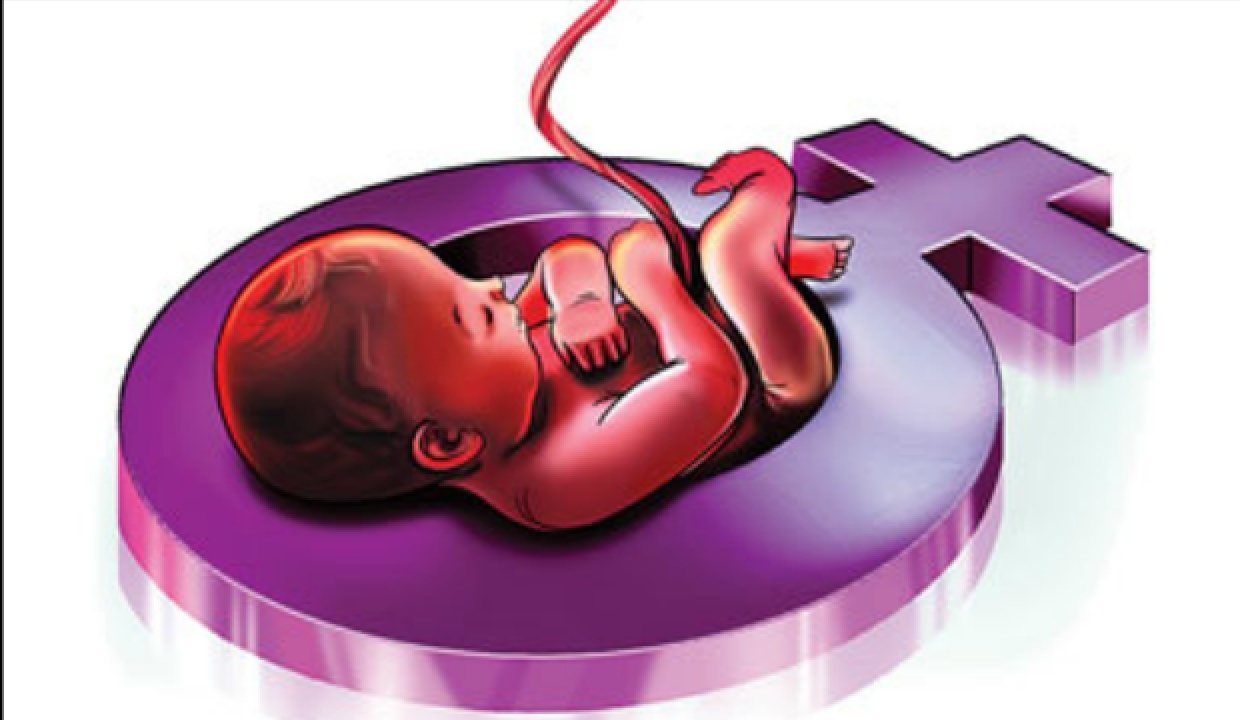
According to certain section of the Indian penal code for forced abortion ,causing death of an unborn child or intentionally preventing a child being born alive are punishable offence.

The Indian government has passed Pre-Conception and Pre-Natal Diagnostic Techniques Act (PCPNDT) in 1994 to ban and punish prenatal sex screening and female foeticide.

It is currently illegal in India.

Besides this the prenatal diagnostic technique regulation and prevention of misuse act consider engaging and sex selective abortion using prenatal diagnosis technique are punishable.

Why I am killed by my parents
Why??
Could I harm someone
Or can I do something wrong
If no then why I am  killed by my parents
Why they killed me
Just tell me
Were my dreams only for dying…?
Was I meant nothing for you?
Why your hand don’t tremble while taking my life?
Why..?
Please don’t kill me …
I also wants to live
I also want to enjoy every moment of my life
Please don’t kill me
Please….

The natural sex ratio is assumed to be between 103 and 107, and any number above it is considered as suggestive of female foeticide.

Sex selection is a practice which takes place among some uneducated,poor sections or a particular religion of the Indian society.

According to the decennial Indian census, the sex ratio in 0 to 6 age group in India has risen from 102.4 males per 100 females in 1961, to 104.2 in 1980, to 107.5 in 2001, to 108.9 in 2011.

Child sex ratio is significantly higher in certain western and northwestern states such as MaharashtraHaryanaJammu and Kashmir (118, 120 and 116, as of 2011, respectively).

The western states of Maharashtra and Rajasthan 2011 census found a child sex ratio of 113, Gujarat at 112 and Uttar Pradesh at 111.

Urban India has higher child sex ratio than rural India according to 19912001 and 2011 Census data, implying higher prevalence of female foeticide in urban India.
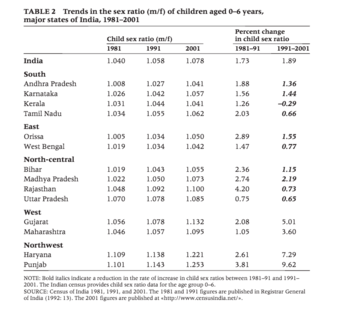
The following table presents the child sex ratio data for India’s states and union territories, according to 2011 Census of India for population count in the 0-1 age group.The data suggests 18 states/UT had birth sex ratio higher than 107 implying excess males at birth and/or excess female mortalities after birth but before she reaches the age of 1, 13 states/UT had normal child sex ratios in the 0-1 age group, and 4 states/UT had birth sex ratio less than 103 implying excess females at birth and/or excess male mortalities after birth but before he reaches the age of 1.

Due to male dominancy in society ,the male babies are preferred because they provide manual labour and success to the family lineage.

A son is preferred as an asset since he can earn and support the family but a daughter is a liability since she will be married off to another family or she will not contribute financially to her parent or due to dowry system.

Dowry is the payment from bride’s family to the groom family at the time of marriage.

Dowry is the main reason behind the female foeticide.

Dowry system legally ended with the dowry prohibition act of 1961 ,the impossibility of monitoring families and prevalence of corruption have led to its continuance all over India.

The advancement in technology is the major cause of female foeticide.

Some doctors do this act to fulfill their moneydesire

People in India usually see men’s work as “productive” and contributing the family, while the social perception of female labor does not have that connotation. This also ties to the fact that it is easier for men in India to get high paying jobs and provide financially for their families.
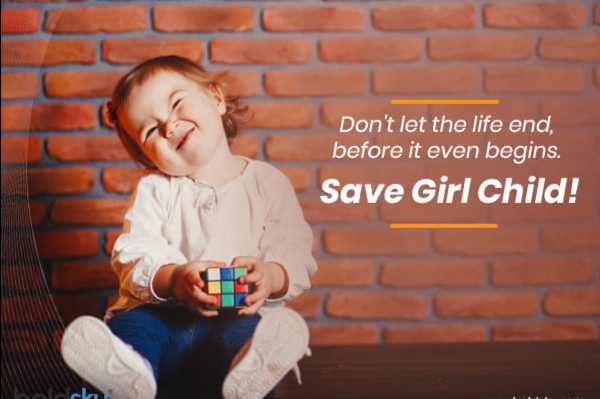
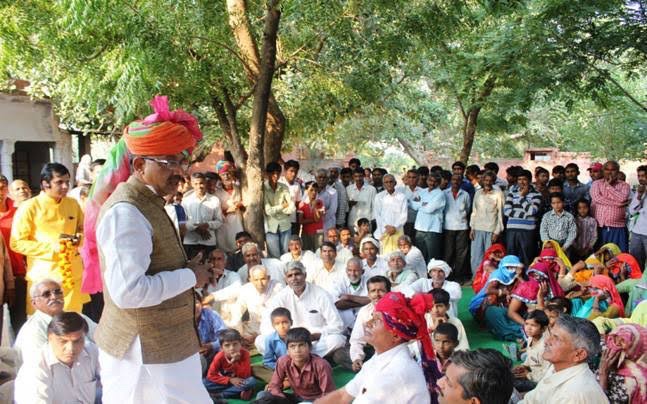
Role of panchayat members


Panchayat members should

  • give accurate information on the laws pertaining to this issue
  • find out where it is being practiced in the village and investigate it immediately
  • register all births and deaths under the purview of the panchayat
  • raise awareness about gender sensitivity through public education programmes
  • prevent female foeticide with assistance from the ANM and local mid-wife.

Increasing awareness of the problem has led to multiple campaigns by celebrities and journalists to combat sex-selective abortions.

CHILDHOOD – BEST DAYS

I don’t know when I lost my childhood
I think I lost my childhood
When I started focusing on my studies,
Maybe I lost it
When I start overthinking about tomorrow
Maybe when I get jealous of my cousin
Maybe I lost it when my parents compare me with others
May be when I started doing something to please my parents
Maybe when I feel guilty for saying something
Maybe when I came to know that everything that I learnt in my childhood is just a bookish line
And no one takes that seriously in real life
Not even my parents
Maybe then I lost my childhood

We have to learn from our childhood
●To be happy for no reason
●To always be curious
●To fight tirelessly for something

I think Childhood was the best memories of everyone.


My childhood was also very memorable to me.
I used to play till 7pm without any thought of my homework or my parents.
At that time my father was in Indian army that’s why he couldn’t live with us.I was living with my mom and grandma
Thus whenever I come from school I have to go to market for food supplies or everything that is needed for home.And that’s why I am always onMy angry mood because my friends were playing when I had to go to market
And as a child I also wanted to play.
Thus whenever I return to the market I started playing with my friends till 7 pm.
My grandma is always waiting for me to come back after playing.
My grandma loves me so much.I usually sleep with my grandma and she always sang a song for me, tells bad time stories.She loves to irritate me..
She was my best friend at that time.I think I was closer to my grandma even more than my mom.
My grandma and I were just like friends.
Whenever grandma borrows some money from me then I always get it back with some intrest.


Whenever I went to my maternal grandmother’s home I enjoyed a lot there.My uncle always takes me to a resturant for my favorite foods.He took me to a fair.And in my grandfathers shop I played a lot.I used to irritate every customer but my grandfather never scolds me for that.
In the evening grandmother took me to the tour of village and I enjoyed it a lot.
Best thing is that I was known by my mothers name there.And I am proud of them.


My Childhood was definitely the best memory for me.
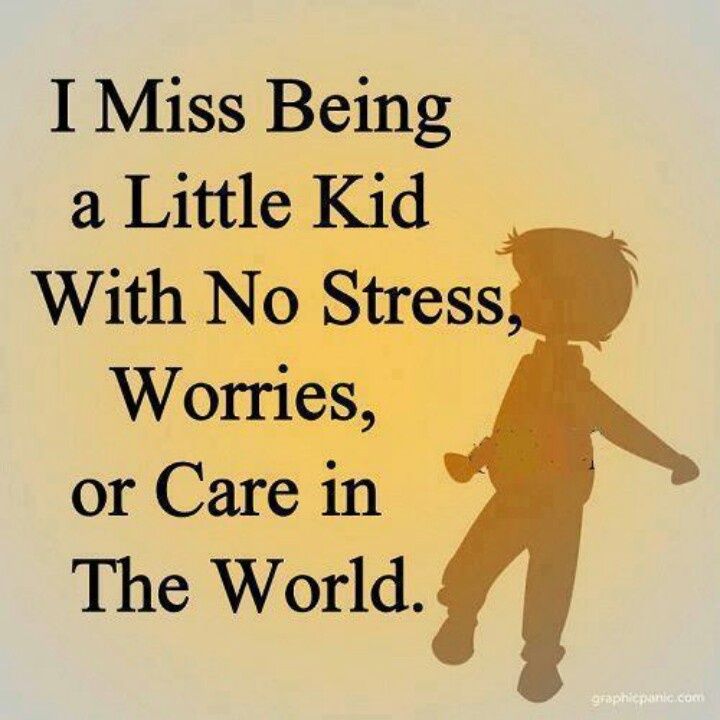
There was no tension for homework, assignment, exams career, future
We just enjoy our lives but now everything is the opposite.


We always complete some tasks.Always always always…..
In the morning we wake up and keep doing our work whether we enjoy it or not.As it is our duty and we have to do it because we get paid for it or to get a job we have to study hard.


Some have dreams to achieve it thus they also enjoy their everywork that brings them closer to their dreams
But some don’t have, they are just doing things because their parents want them to do or they want to earn money for their livelihood.

But what do you think about it?Are they enjoying their lives?
Of course not.


So according to my best things for happiness is stop questioning yourself and be proud of yourself for enjoying your life

●You have a roof over your head.

●You ate today.

●You have clean water.

●You have a good heart.

●You wish for others.

●You are breathing.

●Atleast one person care for you.

●You have clean clothes.

Be grateful for the little things…

Sometimes we stress over things that we don’t have and not thankful for the things we already do have.

17 Sustainable Goals by United Nations.
Sustainable development is development that meets the needs of the present without compromising the ability of future generations to meet their own needs. Sustainable development has continued to evolve as that of protecting the world’s resources while its true agenda is to control the world’s resources. Environmentally sustainable economic growth refers to economic development that meets the needs of all without leaving future generations with fewer natural resources than those we enjoy today. Let us know 17 Sustainable Goals set by UN and their progress by now.

1) Poverty Eradication:

The 2030 Agenda acknowledges that eradicating poverty in all its forms and dimensions, including extreme poverty, is the greatest global challenge and an indispensable requirement for sustainable development.

2) ENDING HUNGER:

The total number of persons suffering from severe food insecurity has been on the rise since 2015, and there are still millions of malnourished children. The economic slowdown and the disruption of food value chains caused by the pandemic are exacerbating hunger and food insecurity.

3) Ensure healthy lives and promote well- being for all at all ages

Progress in many health areas continues, but the rate of improvement has slowed and will not be sufficient to meet most of the Goal 3 targets. Globally, an estimated 295,000 maternal deaths occurred in 2017, resulting in an overall maternal mortality ratio of 211 maternal deaths per 100,000 live births, a 4 per cent reduction compared with 2015 and a 38 per cent reduction compared with 2000. The majority of the deaths occurred in low- and lower-middle-income countries, and roughly 66 per cent of them occurred in sub-Saharan Africa. At the current pace of progress, the world will fall short of the target of the Goal.

4) Ensure inclusive and equitable quality education and promote lifelong learning opportunities for all:

At the end of 2019, millions of children and young people were still out of school, and more than half of those in school were not meeting minimum proficiency standards in reading and numeracy.

5)Achieve gender equality and empower all women and girls

The commitment to advancing gender equality has brought about improvements in some areas, but the promise of a world in which every woman and girl enjoy full gender equality and all legal, social and economic barriers to their empowerment have been removed remains unfulfilled.

6)Ensure availability and sustainable management of water and sanitation for all

In 2017, 3 billion persons lacked soap and water at home. In 2016, 47 per cent of schools worldwide lacked handwashing facilities with available soap and water, and 40 per cent of health-care facilities were not equipped to practise hand hygiene at points of care.

7) Ensure access to affordable, reliable, sustainable and modern energy for all

The world is making good progress on increasing access to electricity and improving energy efficiency. However, millions of people throughout the world still lack such access, and progress on facilitating access to clean cooking fuels and technologies is too slow.

8) Promote sustained, inclusive and sustainable economic growth, full and productive employment and decent work for all:

In 2018, the rate of growth of global real GDP per capita was 2 per cent. In addition, the rate for least developed countries was 4.5 per cent in 2018, less than the 7 per cent growth rate targeted in the 2030 Agenda.

9) Build resilient infrastructure, promote inclusive and sustainable industrialization and foster innovation:

In 2019, 14 per cent of the world’s workers were employed in manufacturing activities, a figure that has not changed much since 2000. The share of manufacturing employment was the largest in Eastern and South-Eastern Asia (18 per cent) and the smallest in sub- Saharan Africa (6 per cent).

10)Reduce inequality within and among countries

In 73 of the 90 countries with comparable data during the period 2012–2017, the bottom 40 per cent of the population saw its incomes grow. Moreover, in slightly more than half of those countries, the bottom 40 per cent experienced a growth rate in income that was higher than the overall national average.

11) Make cities and human settlements inclusive, safe, resilient and sustainable:

Rapid urbanization has resulted in a growing number of slum dwellers, inadequate and overburdened infrastructure and services and worsening air pollution.

12) Ensure sustainable consumption and production patterns:

As at 2019, 79 countries and the European Union reported on at least one national policy instrument that contributed to sustainable consumption and production in their efforts towards the implementation of the 10-Year Framework of Programmes on Sustainable Consumption and Production Patterns.

13) Take urgent action to combat climate change and its impacts.

The year 2019 was the second warmest on record and the end of the warmest decade, 2010 to 2019. In addition, with a global average temperature of 1.1°C above estimated pre-industrial levels, the global community is far off track to meet either the 1.5 or 2°C targets called for in the Paris Agreement.

14. Conserve and sustainably use the oceans, seas and marine resources for sustainable development:

Oceans and fisheries continued to support the global population’s economic, social and environmental needs while suffering unsustainable depletion, environmental deterioration and carbon dioxide saturation and acidification.

15) Protect, restore and promote sustainable use of terrestrial ecosystems, sustainably manage forests, combat desertification, and halt and reverse land degradation and halt biodiversity loss:

Forest areas continued to decline, protected areas were not concentrated in areas of key biodiversity and species remained threatened with extinction.

16) Promote peaceful and inclusive societies for sustainable development, provide access to justice for all and build effective, accountable and inclusive institutions at all levels:

Conflict, insecurity, weak institutions and limited access to justice remain a great threat to sustainable development. Millions of people have been deprived of their security, human rights and access to justice.

17) Strengthen the means of implementation and revitalize the global partnership for sustainable development:

Strengthening multilateralism and global partnerships is more important than ever before. The global nature of the pandemic requires the participation of all governments, the private sector, civil society organizations and people throughout the world.

FRIENDSHIP DAY

True friendship is a way of being mutually lovable to each other! In fact every flourishing relationship has a whiff friendship into it. It’s that transparent and lucid bond between two people.

Friendship is all about  trust, emotional attachment, caring each other or compassion, responsible relationship, mutual support in both sadness and happiness and its sharing of all things between two peoples who emotionally attached with each other.

We do not have boundation to select our friends on any ground including caste, age, sex, creed or any such differentiation that exit within the society.

Friendship Day is a day in several countries for celebrating friendship.
In India, National friendship day is celebrated every year on first Sunday of August. This year the Indian Friendship Day will be celebrated on 1 August, 2021.

It was first proposed in 1958 in Paraguay as the “International Friendship Day“.
Friendship Day was originated by Joyce Hall, the founder of Hallmark cards in 1930, intended to be 2 August and a day when people celebrated their friendships by holiday celebrations.
Peace – The Most Precious Feeling

” The day I understood everything, was the day I stopped trying to figure everything out. The day I knew peace was the day I let everything go. ” This is a beautiful quote by C. Joybell C. Peace has different meaning for different people. Some consider peace as a way of detaching from the world, while some believe it to be the way to find themselves. I personally think peace is happiness.

Peace is the most satisfying feeling in the whole world. It is when you just don’t care anymore. When you stop thinking about anything over and over again. When you are not bothered by anything anymore. When you don’t care what other people think about you. When you stop having expectations about something or maybe from someone. When you aren’t expected to do anything. When you don’t have to fight anymore. When you are patient. When you just don’t trust anyone but yourself.

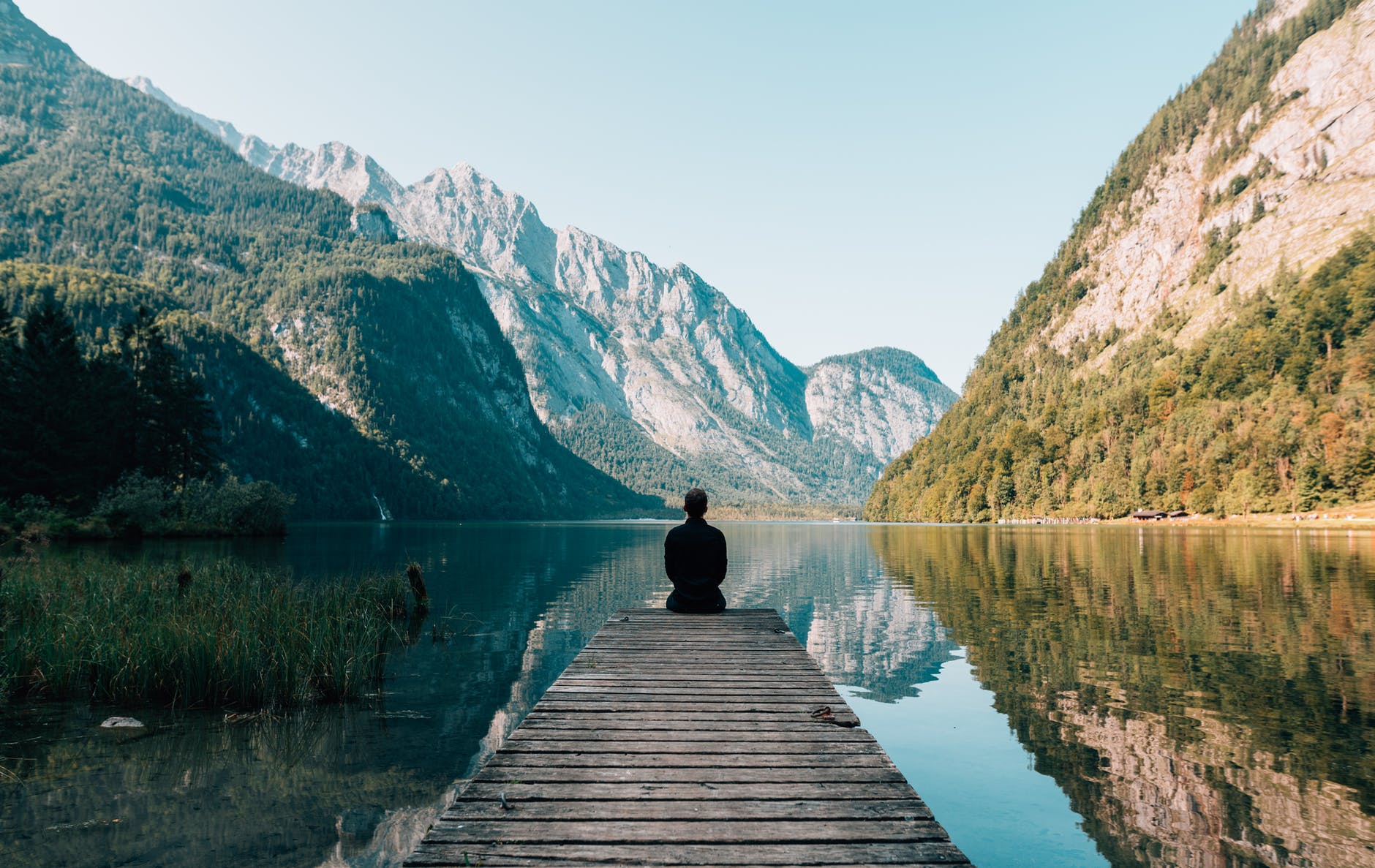
Peace is eternal. If you find it once truly, it will stay with you forever. If it’s really peace that has come your way, it will never go away. Peace is when you are standing in the open and cold wind blows through your hair. You don’t do anything or think about anything. Then you close your eyes and whatever you see first, any thing or anyone or any feeling, that is peace.

Photo by S Migaj on Pexels.com

Peace is when all your regrets are forgotten. All the mistakes forgiven. All the problems solved. The self doubts cleared. The pressure gone. The hurt healed. The sadness removed. The bad deeds neglected. The guilt ignored. The desperation turned into patience. The anger calmed. The thoughts organized and the mind cleared. That is peace. You feel it, you sense it.

Peace is the most supreme feeling anyone can have. It is greater than happiness. Even greater than the hurt. It is endless while others are temporary. Most difficult to find but the most valuable, most eternal and satisfying emotion. It subsides the anger, it heals the most dreaded hurt and fills the heart with calmness. It’s the ultimate goal of someone’s life. To not care, to not be angry, to not be hurt by betrayal, to be happy and content, to feel nothing but peace, this is life.

Search for peace and when you find it, claim it yours and never let go. Peace makes the soul last forever and ever. The crave for peace is undeniable when you are on the verge of ending everything. When you just can’t tolerate anymore, you desire the sense of calmness, the inner peace. The want doesn’t subside easily. It never ends until you do find your precious peace. Peace makes you wholesome.

The power of peace and calm is unbeatable. The crazy hunger to find peace turns into anger and that anger flows out in the form of tears. The strongest, most desired and the most overwhelming feeling is peace. It consumes you from inside out. It grabs your fear of being lost, throws it away and puts you back on the track of your life. When you have it, you will know the true meaning of peace.

Evolution of Panchayati Raj System in India.

Since the beginning of India’s foundation, Panchayats have been the pillar of Indian rural set up. According to Mahatma Gandhi, development and governance in India should not be in big cities and towns but in rural areas and small villages because majority of Indian population resides in villages.

A Panchayati Raj meeting in India. Picture Credits: India Today.

The Panchayati Raj system in India derives its existence from Indian Constitution under Part IX under the head The Panchayats. When power is taken away from Central and State Governments and given to local government, it is called decentralisation.

Most of our Indian states like Uttar Pradesh, Maharashtra are internally very diverse. There is thus a need for power sharing within these states. Federal power sharing in India needs another tier of government, below that of the State governments. This is the rationale for decentralisation of power. Thus, this resulted in a third-tier of government, called local government. People have better knowledge of problems in their localities.

The need for decentralisation was recognised in our constitution. Since then there have been several attempts to decentralise power to the level of villages and towns. Panchayats in villages were set up in all states. An independent institution called the State Election Commission has been created in each state to conduct Panchayat elections.

A major step towards decentralisation was taken in 1992. The Constitution was amended to make the third-tier of democracy more powerful and effective. Now it is constitutionally mandatory to hold regular elections to local government bodies.

Now it is constitutionally mandatory to hold regular elections to local government bodies. Seats are reserved in the elected bodies and the executive heads of these institutions for the Scheduled Castes, Scheduled Tribes and Other Backward Classes. At least one-third of all positions are reserved for women. The State governments are required to share some powers and revenue with local government bodies. The nature of sharing varies from State to State.

Rural Local Governments is popularly known by the name panchayati raj. Each village or a group of villages in some states have a gram panchayat. This is a council consisting of several ward members often called panch, and a president or sarpanch. They are directly elected by all the adult population living in that ward or village. It is the decision making body of the entire village. The Panchayat works under the overall supervision of the gram sabha. All the voters in the village are its members. It has to meet at least twice or thrice in a year to approve the annual budget of the gram panchayat and to review the performance of the gram panchayat.

The local government structure goes right up to the district level. A few gram panchayats are grouped together to form what we call as a panchayat samiti or block or mandal. The members of this representative body are elected by all the panchayat members in that area. All the panchayat samitis in a district together constitute the zilla parishad.

Despite of the many flaws, Panchayats have contributed a lot maintaining the rule of law inside villages and educating the rural population about various different matters pertaining to their interests.

Soft Skills.

Soft skills… Every one of us has heard this phrase. Also, you might have heard from employees, grad students, millennials, school students, or young people complaining that they lack certain soft skills. 

There is a wide range of skills that falls under the term “Soft Skills”. These skills are also known as “transferable skills”. 

A definition of Soft Skills:-

Soft skills are certain sets of traits and interpersonal skills that don’t depend on the acquired knowledge. Soft skills include common sense, the ability to deal with people, a positive flexible attitude, or how you approach life and work.

The good news is one can learn and enhance their soft skills over some time. Though it is often hard to do so. Like Hard skills, one can work on their Soft skills and can make themselves capable of using them. One can’t measure Soft skills by any exam, the only way to measure the development of one’s Soft skills is by knowing how one manages relationships around them. 

What are the most important Soft Skills?

Well, there are a lot of Soft skills. But, mentioned below are five skills that you need to learn/enhance:-

★ Communication Skills

The most essential skills include Communication skills. People with good communication skills can maintain/build good relationships around them. Also, they are likely to avoid misunderstandings and can make any workplace better. 

★ Decision Making

Being able to make decisions is a crucial part of life. Everyone one of us has to make decisions in our day-to-day life from what we want to eat to what we should wear.  But sometimes the actual decision doesn’t seem to matter; what matters is that you have made one and moved on.

★ Time management

Time management can help you finish any work within the deadline. Time management is sometimes described as having a ‘good work ethic’. Also, it is very useful for organizing family or team.

★ Leadership skills

These skills are needed to take the lead when necessary. These skills include the ability to manage and motivate others, and to commissioner work. One can learn leadership skills by enrolling in many leadership training courses. 

★ Creativity and problem-solving skills

These skills are as highly valued as leadership skills because they are hard to develop. Although it is being believed that creative thinkers are born not made. But like any other skill, these skills can also be developed. 

The skills mentioned above along with other Soft skills are required in every field whether you are a student, an employee/employer, a business owner, etc. You can reach to various programs to develop and enhance your soft skills. 

Mental Health- still a taboo?

Just because no one else can heal or do your inner work for you, doesn’t mean you can, should or need to do it alone.

Lisa Olivero

Have you ever felt the stark desire to inevitably scream in a room full of people, hoping they just care enough to notice the signs you have been leaving regarding your deteriorating mental state and how desperately you need help? But instead, you just accept your solitude in an empty chair and try to repress your bottled-up emotions deep within the realms of your consciousness.

A lot of us might have gone through the same situation at a certain point in our lives. The primary reason behind this subconscious aversion to the expression of thoughts is the mere fact that humans have been conditioned to do so throughout their lives. Men are typically the most vulnerable victims of this detrimental mindset. From an early age, they are frequently instructed to not cry like a girl. According to a survey, a significant percentage of men in the nation are currently depressed, and they themselves admitted that they lack a support system.

Mental health is still a deeply rooted stigma that people aren’t ready to accept. In order to understand the concept one needs to broaden the perspective of understanding humans and follow certain ways like-

  1. Instead of asking,”How are you?” ask,” How are you, really?”
  2. Look for obvious signs in a person- whether they feeling low from abnormal no. of days.
  3. Asking your closed ones to describe their day in detail and be a good listener.
  4. Do not mistreat someone who is already going through some sort of trauma.
  5. Treat people with kindness, you never know what someone is going through.

Additionally, in India, therapists continue to be overlooked as a useful resource for treating a person’s mental health. A person is called a “lunatic” if they see a therapist. In light of the increased public awareness during the pandemic’s lockdown time, these issues are being explored on social media, and many people now see psychology as a crucial component of the educational system. People have now started considering mental health as being equally essential as physical health as because of an alarming spike in suicide incidents during this period.
Still, awareness needs to be assured at ground level and there is still a long way to go to see the day when all of us are not reluctant to lend a helping hand to our fellow humans.

A fundamental aspect of any society should be understanding, accepting, and embracing each and every emotion one feels which makes them human.

Green Lives Matter

We always get a positive vibe when we see plants around us. Growing plants on the balcony is a dream for many of us. We all love growing plants in our house, balcony, office, etc but very few of us know how to take care of it. It is very essential to give them proper time and care. Like humans even they need proper nutrition to go. Sunlight, water, soil, proper temperature are essential for them to live. Lack of nutrition may result in withering, yellowing of the leaves, stunted growth, etc.

To avoid these conditions in our plants one must provide them nutrition.

Things to keep in mind while growing a plant in your surrounding.

 • Research about the plant
Before growing a plant, one should study the plant and its needs. The need for sunlight, water, etc may differ from plant to plant. Provide them everything accordingly.

 •  Proper size of the pot
The size of the pot matters a lot in the growth of plants. Plants need an area to grow. Make sure the roots are not crowded and have proper space to spread and grow.

 • Perfect amount of sunlight
Sunlight is very essential for them to grow but all plants don’t need a lot of sunlight. The need for sunlight differs from plant to plant. For example, a snake plant can grow with very little sunlight whereas, a marigold plant needs a lot of sunlight.


• Providing water from time to time
The right amount of water should be provided to plants. Don’t water them a little or don’t water them too much. Study the need for water according to the plant you’re growing.

These are some most basic things to keep in mind before you grow any plant. Plants have life to and it is our responsibility to keep them healthy because we need them more than they need us.

LAST DAY OF LIFE

What do you want to do when God tells you that today is your last day?


I don’t know about you but I do everything that I want to do in my life.


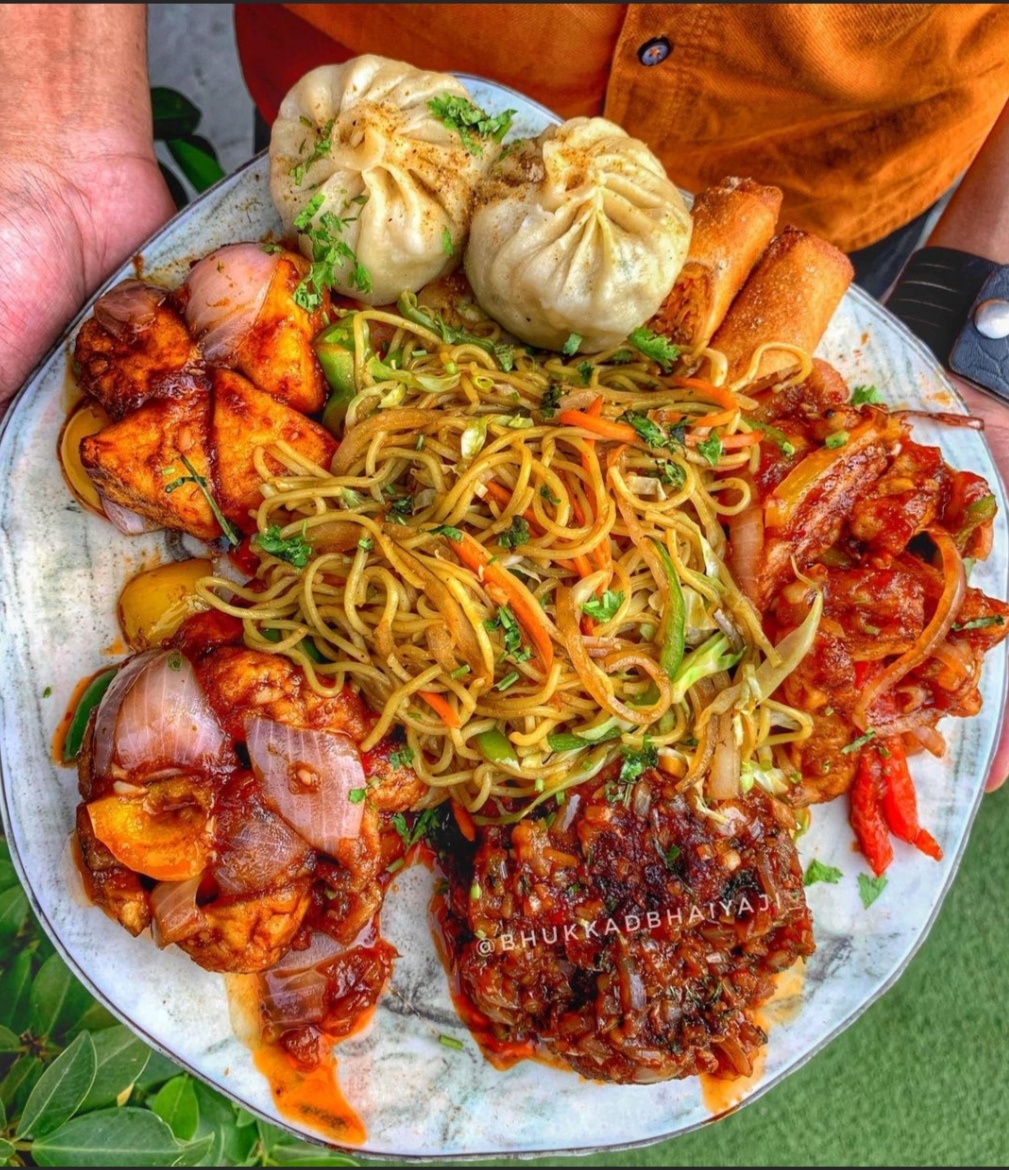
Firstly, I eat my favorite foods like rajma chawal, chhole bhature, sahi paneer, chicken biryani, pav bhaji and much more.And how can I forget junk food – momos, pani puri, burger, noodles, manchurian, soosa, chat, pizza.

Momos, it is my life. And Manchurian and noodles are the best combination ever…

My favorite food list is long so I can’t write everything.


Then I go for a movie trip with my friends and in way to the movie hall I listen to the best songs.


Which songs do you want to hear on loop of on the last day of your life?


I like to hear all the best songs.Here, I can’t tell my favorite songs because I like various songs and it depends on the current situation.The songs are- Waqt ki baatein , Nadan parindey, Tu Jane na, shape of you, Agar tum sath ho, Zindagi ek safar hai suhaai suhaana, O mere dil k chain.


I spend time with my family and with them I am going to talk as much as I can.And I am going to dance recklessly with my mom on the last day
I always wanted to do that but My mom always scolds me.


In my whole life I haven’t talked to boys because I am not allowed to do this.  I don’t know the name  of boys  (not even)  Five) of my class.


I mean really… How?  I am not allowed to do these things but leave it.


I want to fight with a stranger and I’ll do that on my last day
I am definitely going to enjoy that day.


Everyone just thought that it was the way she is going to enjoy the last day.Really?
And my answer is yes because in my whole life I haven’t even visited a theater.I have never gone outside of my house.I am not allowed to go out with my friends.Last time I saw my friend on the last day of school.

I want to explore the world…


I want to do so many things in life. I want to enjoy every moment of my life but when I come to know that today is my last day then everything that I think about it is useless.

Life is too short. Make the most of it. You don’t know when your last day is. Live the way you want to live

Religion in 21st Century: Survival or Revival

Ever Since the history of mankind religion existed although their purposes differ in many ways. The first religion that came into existence as of known today is the Hinduism, we understand this from different Vedas which were said to existent from around the 5th CE. From the very beginning of religion, there was a structured system keeping different people at different levels giving them no space to breath or escape. This system was widely prevalent and as communications and technologies grew more people started to adopt it, keeping the structure rigid to cross. Not just Hinduism but religions such as Islamism, Christianity, Judaism and the list is exhaustive in terms of their structural and rigid norms which only favors a certain category of people. 

The question here we have to ask is that, what has changed so much in religion that now everyone and anyone is following it? How the human beings who believed in Science could believe in religion after all these decades? The answers to these questions are very simple and unbelievable. “Not much” is the best answer to the first question. Religion has remained the same across times, across thousands of years even when human beings evolved and became better and best versions of themselves. Even when human beings could fly, they choose to believe in religion, Why?

Answering these questions would need us to go through lots of facts and understanding of not just how religion have adapted and changed mankind but also about human behaviors too. Human beings are creatures with a mind which cannot always be rational. Even though we outsmart the whole animal kingdom with our brain, it is the very thing which makes us lose our rational and believe in things which might not even have any sources or valid resources to back with. 

Human beings simply were taught to believe in a divine power which will save them through prayers, donations and disturbing sacrifices. These people were groomed from a very young age to believe in it, that even when we don’t know we unintentionally call out god’s name, like it was stuck to our tongues. Dogmatic beings wrote scriptures which have no valid evidence or sustainable outcome to begin with, and these were forced upon children from a very young age, not giving them the choice of becoming who they want to be devoid of their religious identity so much that even before someone could find their own selves, they learn their religious identity completely nullifying who we actually are. 

People chose to believe in lies when truths are bitter, this can be deciphering the fact that people need someone to always save them, to always cry for help, to always turn for beliefs and if one day someone argues that this is not real with evidence or facts resonating their statements, human beings won’t believe it as such or their rationality won’t be a match to their savior who they haven’t seen or which science have no answer too. 

These patterns in human behavior’s make it impossible for religion to fade away from peoples lives. Although this cannot be said for everyone. Recently there has been a decline in the number of people actively following religion, people have come to grasps with certain loopholes in them and calling them out for more people to come out of the trances they were forced to believe in. Most of who are actively calling them out are women who were forced into always being the submissive gender throughout all the religions across the world. The sufferers were always women, wailing women depicted across pictures stereotyping their roles as potential nurturers and never letting them out of their cycle. Women were forced into crowd control actively pursued by these religions, always putting the burden on women. 

Different Feminist movements took into terms these issues and addressed them in various waves, making people and specifically women of their rights. This led to a downfall in the religious followers of many religions across the globe. Added to this was the problem with many religions believing in law of the nature and condemning homosexual relations. This put many religions at a potential risk of losing their followers. Religion wasn’t ready to let their walls down and accommodate people and factions into them. They held their walls so high that it choked its own people and these people turned against each other, questioning the viability of the religion.

Will we be better off without religion?

This essay focuses the critical review of the debate on ‘whether we will be better off without religion’. The debate is between two very famous scholars in religious studies, Raza Azlam who is an author of the book called ‘God: A human history and the other a physicist and atheist Lawrence Krauss. Both of them hold two very different opinions as to how religion affects people emotionally and morally while holding the same opinions on matters of religious violence and influence of it in the society. 

The debate begins with Raza talking about how religion is both good and bad because its man-made institution and how we are inherently attached to it like a second skin. He moves on to lay the floor for faith and discussion to be discussed as two concrete elements so that it becomes easier to debate on a concrete premise. Raza also talks about how we cannot separate religion as an entity from people’s life as it has become a part of who we are and its so much of an identity to people. He also brings into account that the fact the religion causes conflicts, wars and no other entity does this is completely flawed since people go to war for various other reasons too by quoting the example of world wars. And also, how we shouldn’t categorise Islam as violent force inherently since violence is found in all religions not just a specific one.

On the other hand, Lawrence talks about the idea of accepting reality and how important it is to believe in something that is true and you have facts and evidences on. He completely takes over the idea of Raza talking about divine power by asking him how such a human made institution can proclaim such statements. He talks about how people aren’t identifying themselves with religions as they used to before and even people who do aren’t even aware of the basic doctrines.  He questions the idea of God in life and what exactly is the purpose of god or how it has actually helped the world. He brings in an important argument of how people’s morality is connected to religion and they aren’t ready to let go of the wrong side of it.

What is fundamentally wrong about this debate was that it failed to reach a consensus or give us a basic idea of which would be the best option, the idea of the debate was to understand if religion is needed or not and this was something that wasn’t addressed at the end of the debate. Problems of individual identity and group identity weren’t discussed in wide scope and questions based on the scared use of Quran and Bible addressed to Raza did not really have a concrete answer. In so many ways questions of absolutism was also not answered by Lawrence. Both the sides failed to grasp the fundamentals of the debate taking it to extremes

THE EXCRETORY SYSTEM

Excretion

Removal of nirogenous waste produce during metabolism of protein and nucleic acid.

Human excretory system includes:-
Pair of kidney
Pair of ureter
Urinary bladder
Urethra

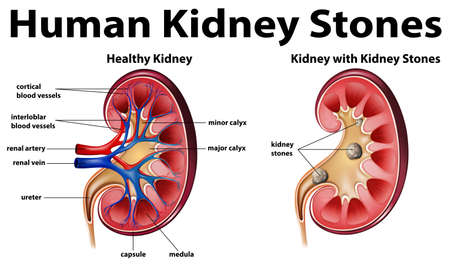
Function of kidney

Kidneys regulate the osmotic pressure of a mammal’s blood through extensive filtration and purification, in a process known as Osmoregulation.

  • Kidneys filter the blood; urine is the filtrate that eliminates wastes from the body via the ureter into the urinary bladder.
  • The kidneys are surrounded by three layers:
    1.  Renal fascia
    2. perirenal fat capsule
    3. Renal caps

EXTERNAL ANATOMY

A typical adult kidney (mass – 135–150 g) is:

10–12 cm- long
5–7 cm – wide
3 cm cm- thick

  • The concave medial border of each kidney faces the vertebral column. 
  • Near the centre of the concave border is an indentation called the Renal hilum, through which the ureter emerges from the kidney along with blood vessels, lymphatic vessels and nerves.
  • Human kidney are Retroperitoneal(covered with peritoneum) 
  • Present between 12th thoracic vertebrae to 3rd lumber vertebrae. 
  • Left kidney is higher than the right kidney due to position of liver in right side. 

Three layers of tissue

a) .The Renal capsule(Deep layer) – Smooth, transparent sheet of dense irregular connective tissue that is continuous with the outer coat of the ureter.

  •  It serves as a barrier against trauma and helps maintain the shape of the kidney. 

b) The adipose capsule (middle layer) – Mass of fatty tissue surrounding the renal capsule. 

  •  Protects the kidney from trauma and holds it firmly in place within the abdominal cavity.

c) The renal fascia(superficial layer) – Thin layer of dense irregular connective tissue 

  •  Anchors the kidney to the surrounding structures and to the abdominal wall 

On the anterior surface of the kidneys, the renal fascia is deep to the peritoneum

Internal anatomy

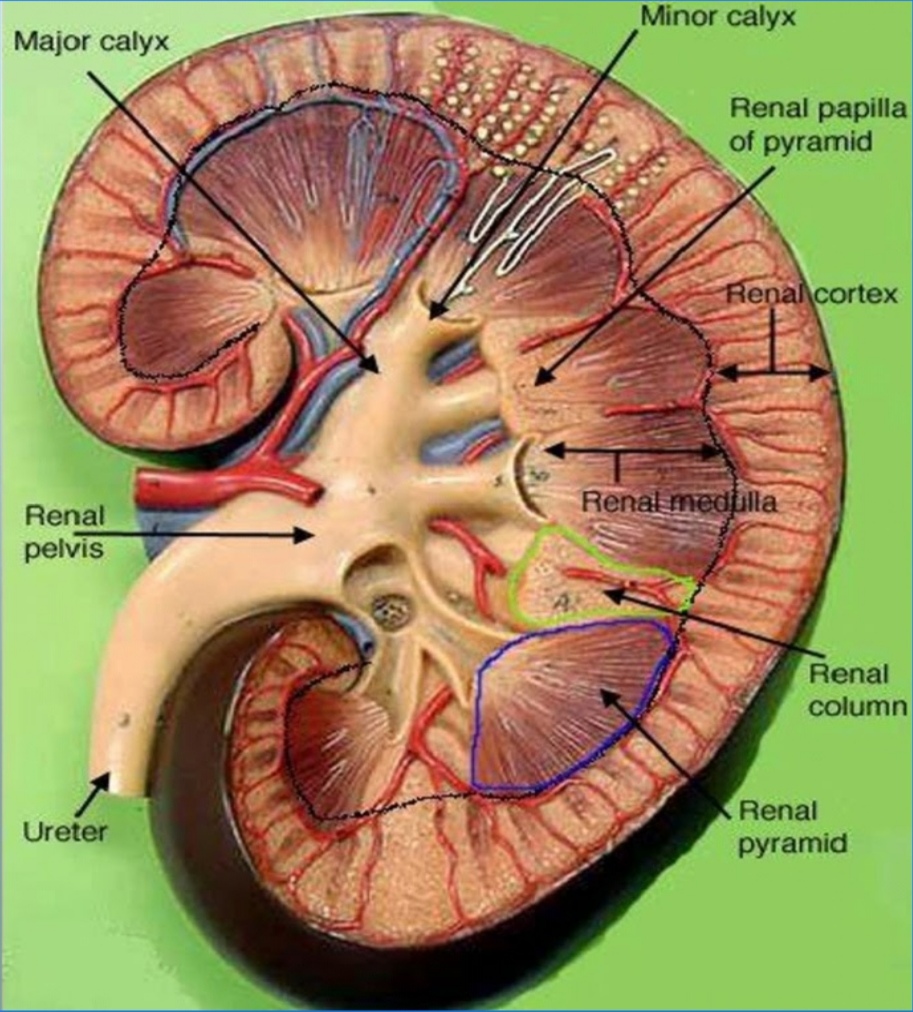
A frontal section through the kidney reveals two distinct regions: 

  1.  Renal cortex (outer)
  2.  Renal medulla (inner). 

The renal medulla consists of several cone-shaped renal pyramids. 

The base (wider end) of each pyramid faces the renal cortex, and its apex (narrower end), called a renal papilla, points toward the renal hilum. 

The renal cortex, smooth textured area extending from the renal capsule to the bases of the renal pyramids. 

It is divided into an outer cortical zone and an inner juxtamedullary zone.

Ureter

Muscular tubes of 25-30cm length, 3m in diameter. 

Wall of Ureter

  • Innermost-Transitional epithelium
  • Middle layer-Muscular(longitudinal and circular muscle) 
  • Outermost layer – Tunica adventita. 

Urine is move through ureter by peristalsis.

Urethra conduct the urine from urinary bladder to outside.
Female urethra is short.
Male urethra is long.


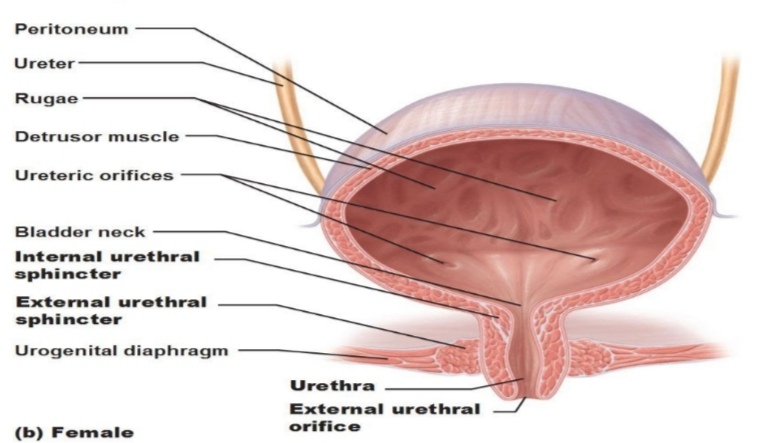
Urinary bladder

It is hollow muscular organ  that stores urine from the kidneys before disposal by urination. 

In humans the bladder is a hollow distensible organ that sits on the pelvic floor

Nephron

Structure and functional unit of kidey.

Each kidney contain about 1 million nephron 

Each nephron has 2 part 

  • Glomerulus
  • Renal tubules.
  • Take a simple filtrate of the blood and modify it into urine.
  • Cleanse the blood and balance the constituents of the circulation.
  • Many changes take place in the different parts of the nephron before urine is created for disposal. 
  • The term urine will be used here after to describe the filtrate as it is modified into true urine. 
  • The principle task of the nephron population is to balance the plasma to homeostatic set points and excrete potential toxins in the urine.

RENAL CORPUSCLE

It CONSISTS OF A GLOMERULUS SURROUNDED BY A BOWMAN’S CAPSULE. 

THE GLOMERULUS ARISES FROM AN AFFERENT ARTERIOLE AND EMPTIES INTO AN EFFERENT ARTERIOLE. 

THE SMALLER DIAMETER OF AN EFFERENT ARTERIOLE HELPS TO MAINTAIN HIGH BLOOD PRESSURE IN THE GLOMERULUS.

THE BOWMAN’S CAPSULE IS DIVIDED INTO THREE LAYERS:

  • OUTER PARIETAL LAYER- MADE UP OF EPITHELIAL CELLS WITH MINUTE PORES OF DIAMETER 12NM.
  • MIDDLE BASEMENT MEMBRANE-IT IS SELECTIVELY PERMEABLE.
  • INNER VISCERAL LAYER-IT CONSISTS OF LARGE NUCLEATED CELLS CALLED PODOCYTE(BEAR FINGER-LIKE PROJECTIONS CALLED PODOCEL) 

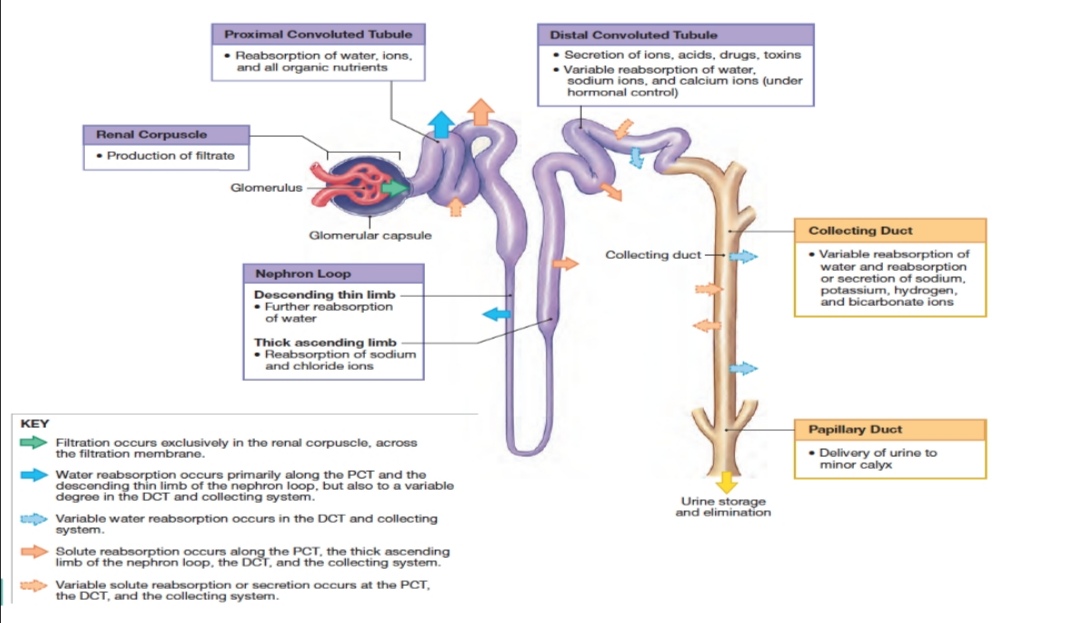
Renal tubule

It IS A LONG AND CONVOLUTED STRUCTURE THAT EMERGES FROM THE GLOMERULUS 

IT CAN BE DIVIDED INTO THREE PARTS BASED ON FUNCTION:-

  1.  PROXIMAL CONVOLUTED TUBULE (PCT) –  IN THE RENAL CORTEX.
  2.  THE LOOP OF HENLE, OR NEPHRITIC LOOP – IT FORMS A LOOP (WITH DESCENDING AND ASCENDING LIMBS) THAT GOES THROUGH THE RENAL  MEDULLA.
  3. DISTAL CONVOLUTED TUBULE (DCT)- IN THE RENAL CORTEX.

Loop of Henle

Thick segment-Simple cuboidal epithelium
Thin segment-Simple squamous epithelium.

DCT

Distal  convoluted tubules

Cuboidal epithelium with fewer mitochondria and microvilli

  • Conditional reabsorption of water under the effect of ADH.
  • Na+ – Aldesteron
  • Ca²+ – parathyroid hormone
  • Reabsorption ofHCO3¯and secretion of H+, K+and NH3 to maintain pH. 

Collecting duct

Cuboidal epithelium

Conditional reabsorption of water, Na+, Ca²+. 

Permeability for urea 

PCT

⅔rd of water reabsorption and 60% of glomerular filtrate is reabsorbed. 

Water, Na+, Cl-, HCO3-, Glucose, vit. C, amino acid, K+and little amount of urea and uric acid.

Descending Limb-permeable to water only. 

Ascending Limb– permeable to ions only. 

Na+, Cl-, k+, Mg²+, Ca²+

Reabsorption is minimum. 

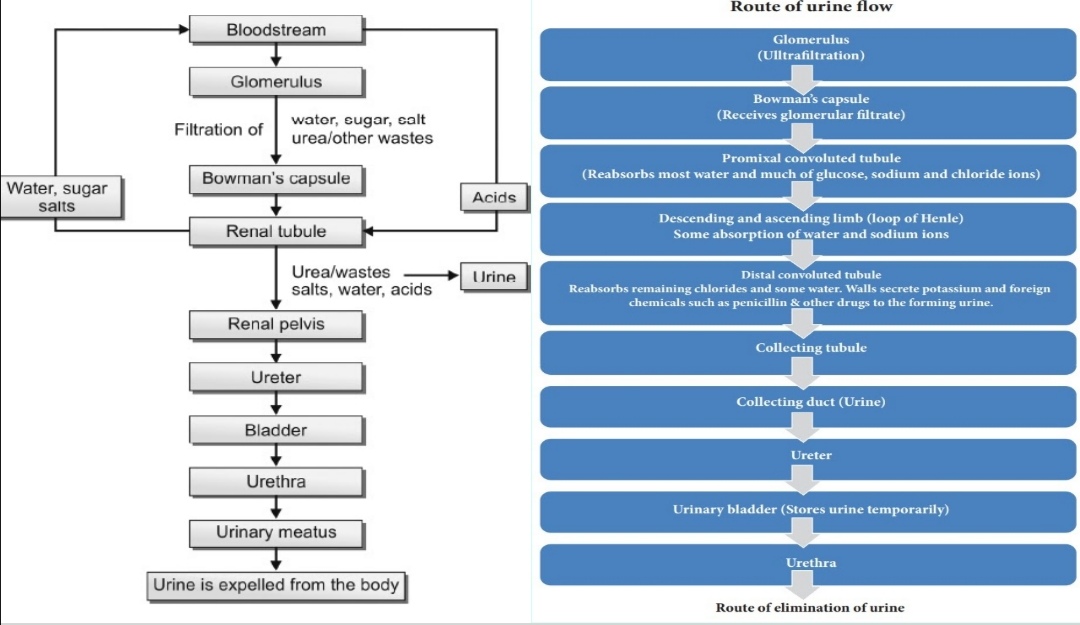
Urine formation

1) Glomerular filtration
2) Tubular reabsorption
3) Tubular secretion

Glomerular filtration 

  • WATER AND SOLUTES ARE FORCED THROUGH THE CAPILLARY WALLS OF THE Glomerulus INTO THE BOWMAN’S CAPSULE (GLOMERULARCAPSULE)
  • FILTRATE –THE FLUID THAT IS FILTERED OUT INTO BOWMAN’S CAPSULE. 
  • Glomerulus filtrate-same as plasma but protein are absent. 

Contains-Water, ions, Glucose, amino acid, water soluble vitamin, urea, uric acid etc. 

Tubular reabsorption

OCCURS BOTH PASSIVE AND Actively. 

GLUCOSE, AMINO ACIDS, AND OTHER NEEDED IONS (NA, K, CL, CA, HCO3) ARE TRANSPORTED OUT OF THE FILTRATE INTO THE PERITUBULAR CAPILLARIES ( REABSORBED BACK INTO THE BLOOD)

ABOUT 65% OF THE FILTRATE IS REABSORBED IN THE PCT. 

AS THESE SUBSTANCES ARE Reabsorbed, THE BLOOD BECOMES HYPERTONICSO WATER EASILY FOLLOWS BY OSMOSIS. 

REABSORPTIONIN THE DCT IS UNDER Hormonal CONTROL ALDOSTERONE CAUSES MORE SALT TO BE ABSORBED

 ADH CAUSES MORE WATER TO BE ABSORBED

TUBULAR SECRETION

WASTE PRODUCTS SUCH AS UREA AND URIC ACID, DRUGS AND HYDROGEN AND BICARBONATE IONS ARE MOVE OUT OF THE PERITUBULARCAPILLARIES INTO THE FILTRATE; THIS REMOVES UNWANTED WASTES AND HELPS REGULATE PH

Urine

It is pale yellow in colour due to Urochrome pigment that is byproduct of red blood corpuscles(RBC) breakdown. 

Around 1-1.5 litre of urine is formed per day. 

PH =6 (vary 4.2 – 8.2) 

It can be four times as concentrated as the blood i. e-1200mosmol/L.

Heavier than water

  • contain
  • 95% =water
  •  5%= urea, uric acid, K+, H+, NH4+, sulphate, hippuric acid, oxalate


Ocean acidification

Ocean acidification is a serious environmental problem, it is equivalent to the problem of climate change or much bigger. As there are many changes happening around in the environment, some of which we can hardly see. Ocean acidification is related to the water bodies and the aquatic life as a result, the ultimate impact is faced by the aquatic creatures and indirectly by the humans.
Ocean acidification is associated with natural process, the carbon dioxide present in atmosphere is absorbed by the ocean bodies. It is a natural process that is actually beneficial for the environment as the extra amount of carbon dioxide gases present in the environment are absorbed this leads to reduction in the temperature. But the problem started when the absorption amount increased over the years and it keeps on increasing by every passing year. This might seem fine initially but, it is a matter of concern for scientists and researchers, just like any other major environmental problem this is not good for aquatic biodiversity.
There are multiple causes of ocean acidification and why ocean acidification can become a big challenge in future –
The raise in atmospheric carbon dioxide, due to excessive pollution, emission of harmful gases and other activities has increased the absorption level in the oceans as well.
Fossil fuels is another top reason for ocean acidification as the burning of fossil fuels like coal, petroleum produces carbon dioxide gas, which indirectly contributes to ocean acidification.
The waste that is disposed off in the ocean contaminates the water bodies and increases the level of acidity of water. This waste includes agricultural waste, industrial waste etc.
These are the main causes of ocean acidification, they directly or indirectly become hazardous sooner or later. The changes occurring in the ocean is not visible to us but, it can not be ignored in long run.
The process of acidification increases the PH level of water, this acidity can actually be determined by tests. The chemical composition of water is destroyed slowly and gradually. The effect can be seen on the aquatic life and aquatic organism, the corals can detoriate at a higher rate, the shells of animals can not form and the tiny organism which plays a significant role in the aquatic world can not adapt to this acidic level and thus can not survive. Basically, different aspects are targeted, which can create hurdles in the balance of aqua diversity.
This issue is widely discussed in international conferences and some countries have already started monitoring the condition. They are further working to take steps to answer the problem many people are dependent on ocean a fisherman earns his livelihood, a sailor sails in ocean and if not, profession wise; but we all are drinking water which come from these water bodies only. If not today then in future we will be drinking this acidic water. The fact that with development came higher amount of waste generation, pollution, deforestation, climate change, global warming, and new problems. If all the problems are not resolved responsibly at global level the earth and its people are going to suffer a lot in near future. We can already experience the impact in the form of frequent droughts, tsunami, earthquake, landslide, forest fires etc.

Animal Farm- For those who wish to understand the world

When I picked up the book first, I did it with the assumption that the book would be circling around basic morals and lessons that our children usually learn when they get acquainted with their surroundings, this assumption was based on the mere fact, that the book is based on the lives of farm animals. But a very much-needed reality check came, once the short intricate book progressed in my hands. 

George Orwell, the author of this 112 pages worth book, uses his gift of simple writing to bring forth a complex life cycle. His writing explains and describes the enormity, complexity, and the need for various important concepts like war, education, laws, government, development, etc in the most straightforward way possible. 

While this book may only last for a few hours, it gives various lessons, that can last you a lifetime. George Orwell manages to explain the recurring need for war, the persisting inequality in our society, the struggles of an updated education system, and many more concepts in detail, with just the help of a few farm animals. 

Further George Orwell not only provides a wholesome end to the book, but he also manages to bring a conclusion to the vicious cycle of life, in his effortless way. 

In the end, the book makes you question a lot of things around you. It opens your eyes to the realities of life in the most captivating way. And persuades you to question, analyze, and conclude everything around you in your way. 

Classics are usually stereotyped as boring and hard to understand. But rest assured that not only will this book end in just the knick of time, but it will also provide you a much-needed understanding of life, in the most simplistic way. 

Should you read this book ?

Yes, absolutely. Don’t get intimidated by its must-read classic status, Because it will be a book to treasure for a lifetime.