Industrial Ice Equipment: Key Considerations for Buying Used Machines

Daily writing prompt
List your top 5 grocery store items.

When it comes to acquiring industrial ice-making equipment, businesses have to balance cost with functionality and reliability. Buying new machines guarantees the latest technology and warranties but comes with a steep price. On the other hand, used industrial ice equipment presents an opportunity for significant savings, provided you do your homework. It’s essential to assess various factors such as machine condition, maintenance history, and compliance with industry standards. Below, we delve into the key considerations to keep in mind when buying pre-owned industrial ice machines.

Assessing the Quality and Condition of Pre-Owned Industrial Ice Machines

Determining the condition of used industrial ice equipment is paramount. Start with a visual inspection to look for signs of wear or damage, which may indicate how well the machine has been maintained. Pay attention to rust, dents, and any other irregularities that could affect the machine’s performance.
It’s also important to inquire about any recent repairs or parts replacements. These could either be a sign of good upkeep or indicate potential future problems. Requesting a demonstration of the machine’s operation can provide insights into its functionality and output efficiency.
When assessing the quality of used ice equipment, don’t forget to consider the brand and model. Renowned brands often have a reputation for durability and longevity, which can be a promising factor when looking at second-hand options.

Evaluating the Cost-Benefit Ratio: When Does Buying Used Make Sense?

Buying used industrial ice equipment can be cost-effective, but it’s crucial to weigh the immediate savings against long-term costs. Compare the price of the used machine with new models, considering the remaining lifespan and potential needs for repairs or upgrades.
Consider the warranty and service agreements available for new versus used equipment. While used ice machines come with a lower upfront cost, the lack of a warranty could result in higher expenses if the machine malfunctions.
Examine your business’s operational demands. A used machine might suffice if your ice production requirements are modest or you have backup options. However, if ice production is central to your operations, the reliability of a new machine might justify the extra cost.

Key Features to Look for in Used Industrial Ice Equipment

When searching for second-hand ice equipment, certain features are critical to consider. Capacity should align with your business’s needs, ensuring that you can meet demand without overextending the machine’s capabilities.
Efficiency is another key feature. Older ice machines may use more energy and water than newer models, so calculate potential increases in utility costs when evaluating different options.
The type of ice produced is just as important. Different industries require specific ice types, like flake, cube, or nugget. Ensure the used machine you’re considering produces the appropriate ice for your purposes.

Regulatory and Safety Compliance of Second-Hand Ice Machinery

Compliance with health and safety standards is essential when purchasing used ice equipment. Check that the machine meets current Food and Drug Administration (FDA) regulations, as non-compliance can pose health risks and lead to penalties.
Look for machines that also adhere to energy standards set by organizations like ENERGY STAR. Compliance not only ensures better efficiency but can also signify that the machine is up to date with current industry standards.
It’s advisable to have a qualified technician evaluate the machine for safety hazards such as electrical issues or malfunctioning safety features.
Overall, purchasing used industrial ice equipment can offer significant financial benefits if due diligence is taken to ensure quality, longevity, and compliance. By thoroughly examining the machine’s condition, maintenance history, cost-effectiveness, and feature set while keeping regulatory standards in mind, businesses can make a well-informed decision that aligns with their operational needs and budgetary constraints.


Top Ten Conferences in the World

 Identifying the absolute top ten conferences in the world is subjective and can vary depending on the field, relevance, impact, and attendee experience. However, here’s a diverse list that often garners significant attention and participation:

  1. CES (Consumer Electronics Show): Held annually in Las Vegas, CES is a premier global event for showcasing cutting-edge consumer technologies, innovations, and trends across various industries.

  2. World Economic Forum Annual Meeting (WEF Davos): An influential gathering of global leaders, business tycoons, policymakers, and intellectuals in Davos, Switzerland, discussing key economic, political, and societal issues.

  3. TED (Technology, Entertainment, Design) Conference: Known for its powerful talks on diverse topics, the TED Conference brings together thought leaders, innovators, and influencers sharing inspiring ideas and stories.

  4. SXSW (South by Southwest): Held in Austin, Texas, SXSW is a multifaceted event encompassing technology, music, film, and culture, attracting a diverse global audience.

  5. Mobile World Congress (MWC): A leading event in the mobile technology industry held in Barcelona, MWC showcases the latest advancements in mobile devices, networks, and technology trends.

  6. Web Summit: Europe’s largest tech conference gathering global tech leaders, startups, and innovators discussing emerging technologies, entrepreneurship, and digital transformation.

  7. IEEE International Conference on Robotics and Automation (ICRA): A prestigious conference in the field of robotics and automation, attracting researchers, engineers, and industry professionals worldwide.

  8. American Association for Cancer Research (AACR) Annual Meeting: A significant conference in oncology and cancer research, featuring cutting-edge research and discussions on cancer prevention and treatment.

  9. International Conference on Machine Learning (ICML): One of the prominent conferences in machine learning and artificial intelligence, gathering researchers and experts to discuss the latest advancements.

  10. United Nations Climate Change Conferences (COP): These annual global events bring together countries, organizations, and stakeholders to address climate change and environmental sustainability.

Each of these conferences has its unique focus, audience, and impact within its respective field, attracting a diverse range of attendees and speakers from around the world. The significance of these conferences often lies in their contribution to knowledge exchange, networking opportunities, and shaping global discussions and innovations.

Numeraire (NMR) and Machine Learning: Revolutionizing Financial Prediction

 In today’s rapidly evolving financial landscape, maintaining a competitive edge is paramount for achieving success. The ongoing advancements in technology have ushered in a transformative era, with the integration of machine learning into financial prediction standing out as a significant game-changer. Numeraire (NMR), a cryptocurrency, leads this financial revolution by pioneering innovative approaches to predictive analytics. This article aims to provide an in-depth exploration of how Numeraire and the power of machine learning are reshaping the financial industry, offering traders and investors invaluable data-driven insights to enhance their decision-making processes and achieve more informed financial outcomes. For those seeking a platform to navigate the online trading landscape, consider exploring immediate-growth.com. Their resources and insights can provide a deeper understanding of topics like Numeraire (NMR) and the role of machine learning in financial predictions.

Photo by Worldspectrum on Pexels.com

The Rise of Numeraire (NMR)

What is Numeraire (NMR)?

Numeraire (NMR) is a unique and groundbreaking cryptocurrency introduced in 2017. Created by Numerai, a hedge fund based in San Francisco, NMR serves as a utility token that incentivizes data scientists to participate in their machine learning competition. The competition allows data scientists from around the world to develop predictive models on financial data.

How does the Numeraire Competition Work?

Numerai releases encrypted financial data to data scientists who compete to create the most accurate predictive models. Unlike traditional data competitions, Numerai does not know the real identities of its participants, fostering a trustless and decentralized environment. Participants use NMR to stake their predictions, and if their models perform well, they are rewarded with additional NMR tokens. This unique structure aligns the interests of data scientists with those of the hedge fund, creating a symbiotic relationship between the two.

Machine Learning and Its Role in Financial Prediction

Machine learning has transformed numerous industries, and the financial sector is no exception. Its ability to analyze vast amounts of data and identify patterns enables more accurate predictions. Financial institutions are increasingly integrating machine learning algorithms into their decision-making processes, and the results are promising.

Data-Driven Insights

Machine learning models can analyze historical market data, economic indicators, and even social sentiment to generate insights and predictions. These data-driven insights provide a significant advantage to traders and investors, allowing them to make well-informed decisions.

Risk Management

Managing risk is a critical aspect of financial trading and investment. Machine learning algorithms can assess risk more effectively than traditional methods, identifying potential pitfalls and mitigating losses.

Trading Algorithms

Automated trading algorithms driven by machine learning are gaining popularity. These algorithms can execute trades at lightning speed, reacting to market changes and opportunities instantly. They eliminate human emotions from the trading equation, leading to more rational and disciplined decision-making.

The Synergy of Numeraire and Machine Learning

Empowering Data Scientists

Numeraire’s unique approach empowers data scientists to build better predictive models. By providing them with encrypted financial data and rewarding successful predictions with NMR tokens, Numerai attracts top talent from around the world. The competition cultivates a community of data-driven enthusiasts who collaborate and push the boundaries of financial prediction.

Enhanced Accuracy and Performance

Combining machine learning with the Numeraire competition creates a dynamic environment where participants continuously improve their models. This leads to enhanced prediction accuracy over time. As the pool of talent and data grows, the predictions become more robust, enabling better financial decision-making.

Democratizing Financial Prediction

Numeraire and machine learning have the potential to democratize financial prediction. Traditionally, sophisticated financial forecasting tools were limited to large institutions with substantial resources. However, Numeraire’s decentralized model opens the door for anyone with data science expertise to contribute and be rewarded for their skills.

Real-World Applications

Asset Management

The integration of Numeraire and machine learning has significant implications for asset management firms. Hedge funds, mutual funds, and other investment institutions can leverage these technologies to generate alpha and improve portfolio performance.

Quantitative Trading

Quantitative trading, or algorithmic trading, relies heavily on data and mathematical models to identify trading opportunities. Numeraire’s competition and machine learning algorithms can enhance quantitative trading strategies, making them more effective and profitable.

Risk Assessment and Fraud Detection

The financial industry faces various risks, including credit risk, market risk, and fraud. Machine learning models can analyze historical data and patterns to assess risks accurately and detect fraudulent activities in real-time.

Conclusion

Numeraire (NMR) and machine learning are a formidable duo that is reshaping the financial landscape. The integration of these technologies empowers data scientists, improves prediction accuracy, and democratizes financial forecasting. As the financial industry continues to evolve, embracing innovation will be crucial for staying competitive. Numeraire and machine learning offer a glimpse into the future of finance, where data-driven insights drive smart decision-making, and the boundaries of possibility are continually pushed.

Health Estimates: A Crucial Tool for Informed Healthcare Decision-Making

 Health estimates play a pivotal role in shaping healthcare policy, resource allocation, and individual health decisions. These estimates, often based on rigorous research and data analysis, provide valuable insights into various aspects of health, including disease burden, healthcare utilization, mortality rates, and the efficacy of public health interventions. In this essay, we will delve into the significance of health estimates and their impact on healthcare systems and individual well-being.

Photo by cottonbro studio on Pexels.com

Understanding Health Estimates

Health estimates encompass a wide range of quantitative assessments related to public and individual health. They can be broadly categorized into the following key areas:

  1. Disease Burden: Health estimates provide essential information about the prevalence and incidence of diseases within a population. These estimates help policymakers and healthcare professionals understand the scope of health challenges, allocate resources effectively, and prioritize interventions.
  2. Healthcare Utilization: Analyzing healthcare utilization patterns allows for the assessment of healthcare access, disparities, and the efficiency of healthcare delivery systems. It helps identify areas where healthcare services may be underused or overused.
  3. Mortality Rates: Estimations of mortality rates are fundamental for tracking the impact of diseases and interventions over time. These estimates guide public health initiatives, especially during epidemics and pandemics.
  4. Efficacy of Interventions: Health estimates are crucial for evaluating the effectiveness of healthcare interventions, such as vaccination programs, treatment modalities, and preventive measures. They aid in evidence-based decision-making and can inform policy adjustments.

Importance of Health Estimates

  1. Informed Decision-Making: Health estimates serve as the bedrock of informed decision-making for healthcare policymakers and practitioners. By providing accurate and up-to-date data, estimates enable the formulation of targeted strategies to address health challenges.
  2. Resource Allocation: Limited healthcare resources must be allocated judiciously. Health estimates guide resource allocation by identifying areas with the greatest need, thus optimizing the utilization of healthcare funds and infrastructure.
  3. Monitoring and Evaluation: Health estimates provide benchmarks for evaluating the impact of healthcare policies and interventions. Regular assessments help refine strategies and ensure that resources are directed toward the most effective initiatives.
  4. Public Health Preparedness: In the face of emerging threats, such as infectious disease outbreaks, health estimates are indispensable for gauging the potential impact and planning effective response measures. Timely and accurate estimates can save lives during public health emergencies.
  5. Personal Health Decisions: On an individual level, health estimates can empower people to make informed decisions about their own health. For instance, understanding the prevalence of risk factors for certain diseases can motivate individuals to adopt healthier lifestyles and seek timely medical care.

Challenges and Limitations

While health estimates are invaluable, they are not without challenges and limitations. Some of these include:

  1. Data Quality: The accuracy of health estimates relies heavily on the quality and availability of data. In some regions, data collection may be incomplete or unreliable, leading to less accurate estimates.
  2. Assumptions and Modeling: Many health estimates are based on mathematical models that involve assumptions. These assumptions can introduce uncertainty into the estimates, making it important to communicate the limitations associated with them.
  3. Resource Constraints: Conducting comprehensive health surveys and studies can be resource-intensive. Some countries, particularly low-income ones, may face challenges in obtaining sufficient data for accurate estimates.

Conclusion

Health estimates are a vital tool in modern healthcare. They guide policymakers, healthcare providers, and individuals in making informed decisions about public health, resource allocation, and personal well-being. As we continue to navigate the complex landscape of healthcare challenges, the importance of accurate and up-to-date health estimates cannot be overstated. Investing in data collection, research, and analysis is essential to improve our understanding of health trends and to develop effective strategies for promoting better health outcomes for all.

What is machine learning?

Today’s digital world
relies heavily on our ability to build intelligent and smart systems by
deploying artificial intelligence successfully. One of the applications of AI
is Machine Learning which supports systems and enables them to learn and
improve from experience. It focuses on developing programs that can access data
and use it to draw decisions without being programmed as such. In the growing
field of data science, machine learning has tremendous applications. By using
statistical methods, programmers write algorithms and train them to classify
data and make predictions. It is used to uncover deep data insights and use
them to drive decisions. Machine Learning has a growing impact on global
business applications and with greater impact, comes a greater scope for job
opportunities in this field.

How does machine learning work?

According to UC
Berkley, the algorithm of a machine learning model that enables the system to
make predictions is divided into three parts

1. A Decision
Process –
Making predictions
or classifying data is the first step of a machine learning model. Depending on
what data we input, it is possible to label it by producing an estimate about
patterns in data and how closely they are related to something that the model
has seen before.

2. An Error
Function –
It serves to
evaluate the accuracy of the model by checking if the prediction is correct.

3. An Model
Optimization Process –
In
order to fit the machine learning model to the data points used in the training
set, we can adjust the weights to get rid of the inconsistency in the
predictions. The algorithm is trained such that it will repeat this process to
optimize the model.

Applications of machine learning

There are numerous
applications of machine learning including:

1. Speech recognition
This model is used in
converting speech to text and visa-versa and uses a natural language process to
process speech into a written format. A common example of this is included in
many mobile phones to perform a voice search. For e.g. Siri, Alexa, etc.

2. Customer Service
With the introduction of
online chatbots, the services have improved across businesses. Redundant tasks
are recognized and replaced with bots to provide a better and seamless flow to
users. They answer all frequently asked questions and take the place of a
virtual assistant to make our lives easier.

3. Computer Vision
The advancement of AI
technology has led programmers to derive useful information from digital
images, assets, videos, and visual inputs. Computer vision helps in taking the
action based on the inputs and is powered by convolutional neural networks.
This technology is being used in computer vision applications such as photo
tagging, radiology imaging, etc.

Best Machine Learning courses in the
market

1. Google AI – ML
Crash Course

2. Coursera – Machine
Learning with Python

3. Coursera – Deep
Learning Specialization

4. EdX – Machine
Learning

5. Fast.ai –
Introduction to Machine Learning for Coders

6. Coursera – Advanced
Machine Learning Specialization

7. Udemy – Machine
Learning

8. Udacity – Machine
Learning for Beginners


How Automation is Changing Workplace Everywhere?

Credit: Prospects

Introduction

There was a time when the term “automation” was synonymous with advanced manufacturing plants full of robotics. While replacing human labor with machine labor is a prime example of workplace automation, it’s far from the only example. Automation is present in modern businesses of all sizes – including subtle features in common software applications, and more obvious implementations like self-driving vehicles or autonomous robots. There is much debate about where workplace automation will lead the economy, but observers tend to agree that the trend is gaining momentum. Every business process is on the table for automation, especially as technology becomes more sophisticated. 

What is Workplace Automation?

Here’s a common misconception that automation involves towering robotics, but it can be as simple as a set of tools housed within common business software programs. At its core, automation is about implementing a system to complete repetitive and easily replicated tasks without the need for human labor. “Automation takes a lot of forms,” said Fred Townes, chief product officer at READY Education. “For small businesses, the most important thing is [repetition]. When you find something you do more than once that adds value … you want to look into automation.”

Machine Learning as the Driver for Automation

Machine learning and artificial intelligence enable new forms of “smart” automation. As the software learns, the more adaptable it becomes. These technologies open the door for the automation of higher-order tasks in addition to the basic, repetitive tasks. “I think there’s a lot of focus at the moment on these tasks that humans don’t want to do,” Sharma said. “But what’s going to happen in the future is … automation will not just be about automating those tasks humans are doing today, but it will be about realizing potential opportunities.”

Example of Common Workplace Automation

1. Email marketing

Many small business owners already use at least one form of automation: email marketing. Companies like Zoho and Constant Contact offer software that allows users to tailor the parameters of their email marketing campaign to their liking and then set it to run automatically. 

2. Customer service

Customer service departments are also getting an automation makeover with the introduction of tools like chatbots and automated text message marketing solutions.

3. Human resources

Given the predictable and repetitive nature of HR duties – like payroll and timesheets – digitization can transform the efficiency of a department.

Conclusion

Economic insecurity displaced workers feel is very real, but automation is not the enemy. Instead, Wallace hopes to educate people about leveraging this powerful technology to create their own incomes – essentially establishing a society of entrepreneurs and small companies. “If we can establish a way to make sure we all have enough food, clothing, and shelter to survive … and allow people to repurpose their gifts, unique abilities, and enable them to proliferate that and sell it as a good or a service, then we’re adding income,” Wallace said. “We can create an opportunity to generate income for next to nothing, so why not teach people to leverage the tech that disrupted the marketplace in the first place to embrace it and use it for something more in line with who they are, as an expression of their unique abilities?”

References

Operators and Expression in Python

Operators :-

Python consists a set of operators which are used to specify operations to be performed in an expression.

  • Unary Operators :- Operators that used only one operand. ‘+’ and ‘-‘ sign can be used as a sign of addition and subtraction and also as unary operators.
  • Binary Operators :- Operators which use two operands are known as binary operators like multiplication (*), addition (+) etc. are example of binary operators.
  • Membership Operators :- The membership operators (in and in not) are used to test for membership of a sequence, such as string , lists or tuples.
  • Identity Operators :- Identity operator ( is and is not) is used to compare the memory location of two objects by using id (object) functions.

Expression :-

  • Arithmetic Expression :- It is a combination of operands and arithmetic operators such as +,-,*,/ etc.
  • Relational/Conditional Expression :- The Expression that compares two operands using relational operators like >,<,>=,<=, etc. is called relational/conditional expression.
  • Logical Expression :- The logical expression uses logical operators like and, or and not. The logical expression produces boolean result such as True or False.

What is Data Science?

As the world entered the era of big data, the need for its storage also grew. It was the main challenge and concern for the enterprise industries until 2010. The main focus was on building a framework and solutions to store data. Now when Hadoop and other frameworks have successfully solved the problem of storage, the focus has shifted to the processing of this data. Data Science is the secret sauce here. Data Science is a blend of various tools, algorithms, and machine learning principles with the goal to discover hidden patterns from the raw data. But how is this different from what statisticians have been doing for years? The answer lies in the difference between explaining and predicting. 

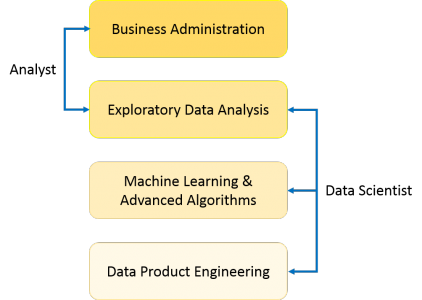
From the above image, it is clear that a Data Analyst usually explains what is going on by processing history of the data. On the other hand, Data Scientist not only does the exploratory analysis to discover insights from it, but also uses various advanced machine learning algorithms to identify the occurrence of a particular event in the future. A Data Scientist will look at the data from many angles, sometimes angles not known earlier.

So, Data Science is primarily used to make decisions and predictions making use of predictive causal analytics, prescriptive analytics (predictive plus decision science) and machine learning.

  • Predictive causal analytics – If you want a model that can predict the possibilities of a particular event in the future, you need to apply predictive causal analytics. Say, if you are providing money on credit, then the probability of customers making future credit payments on time is a matter of concern for you. Here, you can build a model that can perform predictive analytics on the payment history of the customer to predict if the future payments will be on time or not.
  • Prescriptive analytics: If you want a model that has the intelligence of taking its own decisions and the ability to modify it with dynamic parameters, you certainly need prescriptive analytics for it. This relatively new field is all about providing advice. In other terms, it not only predicts but suggests a range of prescribed actions and associated outcomes.
  • Machine learning for making predictions — If you have transactional data of a finance company and need to build a model to determine the future trend, then machine learning algorithms are the best bet. This falls under the paradigm of supervised learning. It is called supervised because you already have the data based on which you can train your machines. For example, a fraud detection model can be trained using a historical record of fraudulent purchases.
  • Machine learning for pattern discovery — If you don’t have the parameters based on which you can make predictions, then you need to find out the hidden patterns within the dataset to be able to make meaningful predictions. This is nothing but the unsupervised model as you don’t have any predefined labels for grouping. The most common algorithm used for pattern discovery is Clustering.

Why Data Science?

Traditionally, the data that we had was mostly structured and small in size, which could be analyzed by using simple BI tools. Unlike data in the traditional systems which was mostly structured, today most of the data is unstructured or semi-structured. One can understand the precise requirements of your customers from the existing data like the customer’s past browsing history, purchase history, age and income. No doubt you had all this data earlier too, but now with the vast amount and variety of data, you can train models more effectively and recommend the product to your customers with more precision. The self-driving cars collect live data from sensors, including radars, cameras, and lasers to create a map of its surroundings. Based on this data, it takes decisions like when to speed up, when to speed down, when to overtake, where to take a turn – making use of advanced machine learning algorithms. Data from ships, aircraft, radars, satellites can be collected and analyzed to build models. These models will not only forecast the weather but also help in predicting the occurrence of any natural calamities. It will help you to take appropriate measures beforehand and save many precious lives.

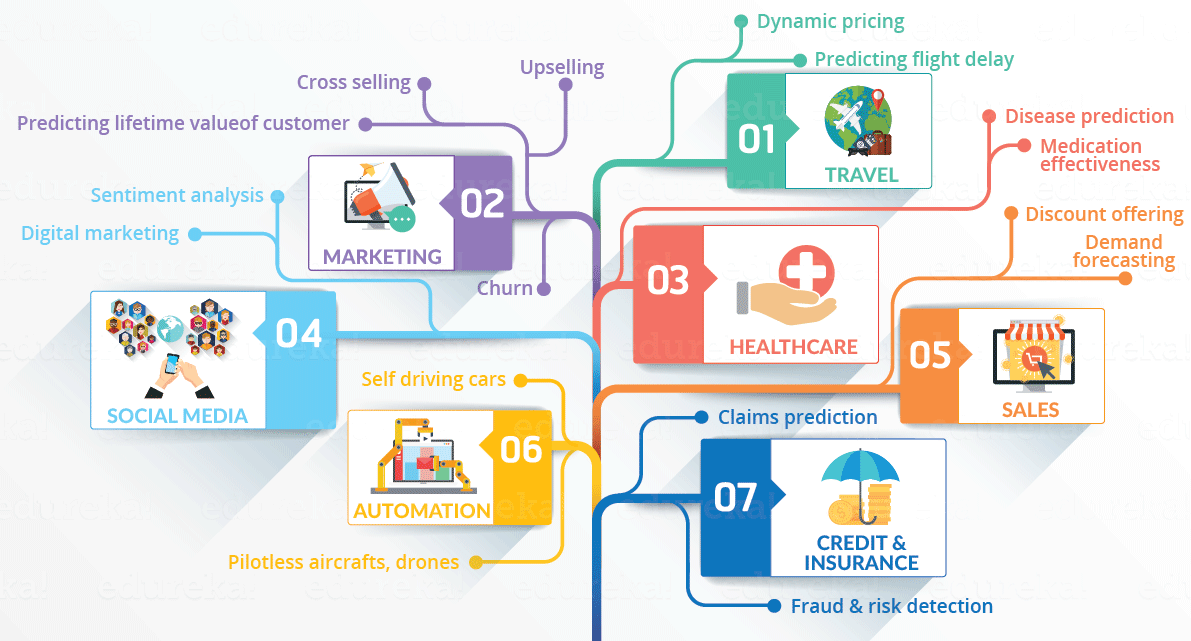
The following infographic shows the various domains in which Data Science is creating its impression:

Role of a Data Scientist

Data scientists are those who crack complex data problems with their strong expertise in certain scientific disciplines. They work with several elements related to mathematics, statistics, computer science, etc (though they may not be an expert in all these fields). They make a lot of use of the latest technologies in finding solutions and reaching conclusions that are crucial for an organization’s growth and development. Data Scientists present the data in a much more useful form as compared to the raw data available to them from structured as well as unstructured forms.

Machine Learning Algorithms

According to Arthur Samuel (1959), Machine Learning is a field of study that gives computers the ability to learn without being explicitly programmed.

Tom Mitchell (1998) Well-posed Learning Problem: A computer program is said to learn from experience E with respect to some task T and some performance measure P, if its performance on T, as measured by P, improves with experience E.

Machine learning algorithms

  1. Supervised learning
  2. Unsupervised learning
  3. Reinforcement learning

Supervised learning

It is machine learning task of at function that maps an input to on output based on example input-output pair. Basically Supervised learning is learning in which We teach or train the machine using data which is well labelled that means Some data is already tagged with correct answer. We pass data, train it and predict output.

Example 1 – House price prediction : In this data set can be given a which contain locality, size of house, age, no. of rooms, price at which it sell. In this are example locality, size of house are independent variables from which we can we predict house price. In this we can take prices of other houses to train our data. We take real prices map them and can predict price.

Example 2 – If we have different kinds of Fruits. To train the machine with all different Fruits one by one like shape of fruit, colour. Since machine has already learned from previous data this time it will classify fruit with its colour and shape and give output.

  • supervised learning allows collecting data and produce data output from previous experience.
  • It helps to solve various types of real world computation problems.

Unsupervised learning:

It is the training of machine using information that is neither classified nor labeled and allowing the algorithm to act on that without guidance. In this past data is pointless and we need to club similar data together. There is no way to measure similarity before we run the program. It is less accurate.

Example 1 – Google news : In google news, clustering where they use to club similar types of news together. They find some keywords, club similar news and show it on feed.

Example 2 – Feature selection : Assume that we want to predict how capable an applicant is of repaying a loan from the perspective of a bank now, we need to help the bank set up machine learning system so that each loan given to applicant who can repay the loan. So by gathering the Information about applicants average monthly income, debt credit & history we can predict this

Reinforcement learning

It means to establish & encourage a pattern of behavior. It is area of machine learning concerned with how software agent ought to take actions in an environment in order to maximize the notion of cumulative reward.

Example 1 – Chess game : In chess game there are different types of pieces which can move differently. The next move will depend om opponent move or your previous. It is trial and error and decision is dependent.

Example 2 – Web system configuration : there are so many parameters in web system and the process of tuning the parameters requires a skilled operator. This can be automated by using reinforcement machine learning technique to learn from different trial & error phases.


How AI will shape our future

Artificial intelligence has had a huge impact on many industries in recent years and will continue to benefit them in the future. The pandemic-induced acceleration of technology adoption has led many sectors, both private and public to leverage AI for their advantage and growth. In the last few years, AI has enabled many innovations and driven the proliferation of technologies like IoT, robotics, analytics, and voice assistants. According to a report, AI topped the patent filings in 2020. This is not new, AI has been securing a large number of patents in the last few years.

Impact of AI

Artificial Intelligence has had huge impacts in the healthcare sector, especially since the pandemic last year. AI and other disruptive technologies powered a patient-centered healthcare system. This new care scenario is all digital and highlights the importance of data and analytics. Predictive analytics, machine learning, and AI played a pivotal role in drug discovery and vaccine development. In the coming years, the use of these advanced technologies will become the norm, and easily accessible electronic medical records will simplify diagnostics. AI will enable healthcare systems to track and monitor patients in real-time, gain genetic data, and each person’s lifestyle. Algorithms will take up the charge of diagnosing health conditions and prescribing suitable treatments.AI has a lot to offer to the transportation and manufacturing sectors. In the coming years, we might witness the perfect evolution and commercialization of smart and autonomous vehicles. Self-driving cars are already available today, but by the next two to three decades, the world will witness more people using them. The manufacturing sector will also gain benefits from AI. Increased use of robots in factories and predictive analytics in the sector will enhance the quality of products and streamline the logistics and supply chain. Other potential impacts of AI would be in elder care systems, education, finance and business,  customer services, media, space exploration, smart cities, and smart homes.

Will AI Dismantle the Human Workforce?

his fear has always been looming on artificial intelligence. Experts and tech giants like Elon Musk and Stephen Hawkings have warned humans against the adverse consequences and threats of the technology. One of the widely claimed consequences is AI taking over the human workforce and causing massive job losses. This claim is highly overblown and researchers agree that although AI might displace humans from some job roles, it will not replace the whole workforce. AI is likely to replace routine jobs and repetitive tasks like picking and packaging goods, separating and segregating materials, responding to repetitive customer queries, etc. Even today some of these functions are still done by humans and AI will take over these tasks in the future. Thus, the human workforce engaged in these simple and routine jobs should be upskilled and trained to perform new skills. As we are very far from reaching artificial general intelligence, the current technology cannot augment human intelligence fully. This is the reason people should be trained to do high-skilled tasks like programming, coding, and others that are essential for the future. The transition from the old to the new job should be smoothened to reduce the massive impacts.

Should we fear Apocalypse?

Recently, a paper published by researchers at AMOLF’s Soft Robotic Matter group, exhibited how self-learning robots can easily adapt to changing circumstances. These small robotic units were connected to each other for them to learn on their own to move. The future will harness the hidden capabilities of AI and encourage the creation of self-learning robots. Reinforcement learning and training algorithms based on Generative Adversarial Networks will be explored. AI will also prove a flagbearer for sustainable technologies and will be used against fighting climate change by reducing pollution levels and encouraging green AI research. Another threat posed by AI is the violation of human rights by impacting privacy. For example, voice assistants like Alexa and technologies like facial recognition have been blamed for invading the privacy of humans and probably eavesdropping into their lives. These technologies are feared to be used by the powerful state and federal authorities against specific minorities and will curtail the freedom of speech and expression. Thus, AI needs to evolve much to move ahead of these criticisms and enable an ethical and trustworthy system in the future.

Hence, AI as such might not become a threat to human existence. However, there are chances that humans might misuse the capabilities of the technology for causing harm. The scenario of war robots being used to feed harmful motives through their algorithms can be an example. Therefore, in the years ahead, it is necessary to develop an ethical AI ecosystem without human biases and this might alleviate the potential risks of AI in the future.

GitHub Copilot

GitHub Copilot is an AI service which suggests line completions and entire function bodies as a programmer types. GitHub Copilot is powered by the Open-AI Codex AI system. It is trained on public Internet text and millions of lines of code that are publicly available on websites like StackOverflow, GeeksforGeeks, and many more. While Copilot might be a major time saver that many people would consider “magic” ,it’s also been met with criticism by other developers, who worry that the tool could violate individual users’ copyrights.

How Copilot works?

GitHub describes Copilot as the AI equivalent of pair-programming, which is a term coined for two developers who work together at a single computer. Pair programming is when one developer write code for the problems stated and the other observes and make changes(debugging). In practice, though, Copilot is more of a time saver, which integrates the resources that developers might otherwise have to look up elsewhere. As users type into Copilot, it will suggest lines/blocks of code to add by just clicking a button. That way, they don’t have to spend time searching through various documentations or looking up sample code on sites like StackOverflow.

GitHub also wants Copilot to get more efficient over time based on the collected data from users. So whenever users accept or reject Copilot’s suggestions, its powerful machine learning model will use that feedback to improve future suggestions. This would make Copilot only better with time

Criticism

Not long after Copilot’s launch, many developers started ranting about the use of public code to train the tool’s AI. The major concern being commercial use of open source code without proper licensing. The major reason why developers are criticizing it is: Microsoft, the company that owns GitHub, has access to all the repositories. Training a machine learning model that uses all the public repositories and charges a subscription fee for others to use it will benefit Microsoft. So what do people who contribute to open-source get in return? The tool could also leak personal details that the developers may have posted publicly.

Microsoft’s Policy

The developers, programmers and the open-source community cannot complain, nor can they sue Microsoft. This is because there are absolutely no rules or regulations on how Microsoft plans to use open-source repositories. Even if the open source community decide to sue Microsoft, that would just mean a new set of rules would be imposed on how open-source software is used

The open-source community has mixed feelings regarding Microsoft’s Policy. Some people think that GitHub Copilot doesn’t work the way it’s advertised. A large portion of what Copilot outputs is already full of copyright/license violations, even without extensions. Some think, the code is still AI generated and not a copy-paste block from some repository, so the production is still the programmer’s responsibility.

Conclusion

It’s true that Microsoft is using the public repositories for their own good, but there are no laws based on which people can sue them. This is why most are moving their code from GitHub. It’s indeed copyright infringement for sure, but it’s going to be a little longer before Copilot will deliver a genuine productivity boost. Right now, the suggested snippets do look very accurate, but when dug beneath the surface and you will find that it doesn’t always do what you expected. Can we really find ourselves working with an AI pair-programmer in the future? As for now, it does look skeptical. But with Copilot, the future doesn’t look so far off.

Database Concepts

Database :- It is collection of information in such a way that computer program can quickly retrieve desired pieces of data and do operations.

DBMS ( Database management system) :- It is collection of programs that allows us to store, modify and extract information from database.

Data Independence :- Data independence implies that data stored at different levels should not affect each other when get changed.

Table :- A predefined row/column format for storing information in relational databasse.

Attributes :- Columns of table are called attributes.

Tuples :- Rows of table are called tuples.

Degree :- Number of attributes (columns) in a relation is called its degree.

Cardinality :- The number of tuples (rows) in relation is called cardinality.

Key :- Keys help in identifying, retrieving and establishing relationship among tables. There are various keys some of them are primary key, foreign key, alternate key, etc.

Data Integrity :- It means that one person can correctly and consistently navigate and manipulate the tables in database.

Entity Integrity :- It state that value of primary key can never be null and for each roe, it should be unique.

Referential Integrity :- It state that if a relational table has foreign key, then every value of foreign key must be either null or match the value in the relational table in which foreign key is a primary key.

Join :- It is used to combine related tuples from two relation. The join operator is cross product of two relations.

SQL (structured Query Language ) :- It is standard language used for communicating with RDBMS. It looks like English language.

DML ( Data Manipulation Language ) :- It is a part of SQL that provides statements for manipulating database. DML statements can modify the data stored in a database, but they can’t change its structured. Some of DML statements are : Insert Into, Delete , Select, Update, etc.

DDl ( Data Definition language ) :- It is a part of SQL that provides statements for creation and deletion of database. DDL statements are : Create Table, Alter Table, Drop Table, Create Index, etc.

Tokens in Python

Token :- A token is the smallest unit of program. There are various tokens in python some of them are literals, keywords, identifiers, delimiters, operators, statements and expressions.

1. Literals

It refers to data item that have a constant value. Various type of literals are string literals, None (special literal), numeric literal and boolean literal.

2. Keyword

Python has some reserve words which have predefined meaning to its interpreter. It can’t be used as variable, mrthod or class name.

3. Identifiers

It is a name used to identify a variables, arrays and functions.

4. Variable

Variables are used as containers to store data. The data stored in a variable can be modified whenever needed.

5. Delimiters

Delimiters can be defined as a sequence of one or more character that is used to specify the boundary between separate independent region in plain text or other data streams.

6. Statements

A statements is a unit of code that python interpreter can execute.

7. Operators

Operators are used to specify operations to be performed in an expression.

3 great ways AI will enrich our society

AI ( Artificial Intelligence ) is basically a computer program that is designed to automate processes that are generally to be done by humans. It is very closely related to Machine Learning which is a program that evolves itself with time. These are implemented from everyday mundane tasks such as showing daily news on your news app based on your previous likes and dislikes to show ads on YouTube or Google are targeted specifically to you based on your recent searches. This may look like a breach of privacy, but this is the world we live in.

This is just a small preview of what AI is capable of now. AI runs a lot of servers and computational things that humans are not physically capable of. In addition, AI-assisted software runs many necessary informational and logistical programs necessary for the running of our society. AI basically uses programming structures called neural networks which basically change and evolve with time to learn new things. It is even used in camera face recognition technology.

Whenever you open your phone using your face, the AI program in your phone can do that. It recognizes small things unique only to your face like the cheekbone structure, the width of your forehead, the breadth of your nose, the distance between your chin and lip, and so on to recognize it is you and then allows you to open the phone.

Now, the question which has taken over the pioneers in this field is whether AI can be given more autonomy in other sensitive fields like finance. AI can be evolved into such a program where it can be seen as a completely different human in and off of itself. A program that has attained consciousness, a program that can control any device linked to the internet. That is the future of AI. Here I will tell you 3 ways that it will be useful to us.

AI-assisted protocols in surgery and science ( Useful ):

In such places, AI will provide a useful tool to assist humans in surgery wherein a human hand cannot be steady enough to go through with the procedure. It can also help humans find patterns in medicine and molecules which are not perceivable by the human mind. Thus, it can help to develop medicine much beyond what is capable now. It can also help in fields of sciences in various ways, from developing complex algorithms for sorting data to giving the best possible course of action.

AI-Assisted decision-making processes:

Decision-making processes are prevalent in a lot of places. Knowingly or unknowingly, we make a lot of decisions every single day. It would be so much better if AI-assisted us in deciding to get only the best result out of it. Decision-making plays a vital role in finance, where the goal is to make a profit. Wrong decisions may ruin someone’s entire life in a matter of seconds. Hence, it would be very vital for those to make wise choices.

AI-assisted automation:

Automating many tasks won’t make them lose their jobs; it will only divert them elsewhere where it is more important. Diverting engineers from manufacturing cars to manufacturing delicate space parts would help humanity advance much farther in space technology. Space is the final frontier. Humanity is not destined to live on earth. Having AI assist us in our mundane day-to-day tasks, much of the human resources can be diverted towards making our society a space-age one.

Hence, when AI assists us in our day-to-day lives, it will drastically improve our quality of living. Society will evolve towards a utopic. AI-assisted technology and society are something to really look forward to.

Data Scientist Evergreen Career – Demand for Data Scientist is growing around the World

Data consumption has already increased manifold during the global pandemic anyway. As much data is being generated, its consumption is also being done accordingly. Mobile phones, social media, apps, payment wallets are generating so much data that the need of experts is being felt to manage it.

According to a study, the demand for data scientists around the world is estimated to increase by about 28 per cent. At the same time, India is second after the US in terms of making the most appointments in the field of data science or analytics.

Actually, data scientists study data. By analyzing the data, they help companies or institutions plan for the future. Under this, they first collect data. Then store them and then sort them into different categories i.e. packaging of data. Finally, data delivery takes place. Simply to say that data scientists know how to visualize data better. Apart from all this, they also help in finding the lost data, removing the chaos and avoiding other flaws.

Important skills with academics

To become a data scientist, a candidate must have an M.Tech or MS degree in Maths, Statistics, Computer Science, Engineering, Applied Science. Under Data Science people have to study Maths, Algorithm Techniques, Statistics, Machine Learning and Programming languages like Python, Hive, SQL, R, etc. which requires a lot of hard work, time and patience. The data scientist should also have a good understanding of the business and strong communication skills. Also, it is good to gather complete information about any program or course before selecting it. 

Course

Many top institutes in the country offer courses related to it. For example, the Post Graduate Diploma in Business Analytics (Data Science) program jointly run by IIM Calcutta, ISI Calcutta and IIT Kharagpur is quite popular. Apart from this, you can also do a course from IIIT Bengaluru. If you want to learn online, you can explore the platforms of Simplilearn, Jigsaw Academy, Edureka, Learnbay, etc. According to experts, the maths background is beneficial for making a career in data science.

The possibilities

By 2026, it is expected to be around 11 million new jobs coming in this sector. Talking about India, the demand for data scientists in 2018 was seen to increase by 4.17 per cent, which is likely to continue in the coming time. Youngsters aspiring to pursue a career in this field can work on the profiles of data engineers, data administrators, statisticians, data and analytics managers, etc. There will be good demand in sectors like agriculture, healthcare, aviation, cybersecurity etc.

Hiring will increase even after COVID 19

Data scientists play a key role in building business analytics, data products, and software platforms. Today, 2.5 quintillion bytes of data is being created in the world every day, which will require skilled professionals to manage. There will be tremendous opportunities for them. Especially in Big Data Analytics and IT industry, they will have special demand.

According to a global study, after COVID 19, millions of data science professionals will be needed in the US alone. Global companies will hire a large number of data scientists to manage their businesses.

A similar situation will prevail in India. For this, youth can enrol in postgraduate courses offered in different universities of the country or can also take online courses from Coursera, Metis, MIT (EDX), Harvard or Udemy. But doing a full course would be better. If you can work with machine learning in deep learning frameworks like Neural Networks, TensorFlow, Keras, PyTorch, and have working knowledge of Hadoop and Spark, then there can be golden opportunities to move forward in the industry. It is also important for the data scientist to have critical thinking.

Premier Institutes:

ASI Calcutta

http://www.isical.ac.in

IIM, Calcutta

https://www.iimcal.ac.in/

IIT Kharagpur

http://www.iitkgp.ac.in/

Indian Institute of Management, Bangalore

https://www.iimb.ac.in/

Great Lakes Institute of Management, Tamil Nadu

https://www.greatlakes.edu.in/

IIIT Bangalore

https://www.iiitb.ac.in/