Mines Ministry Inks MoU with Shakti Sustainable Energy Foundation for Providing Knowledge Support in the Field of Critical Minerals

 The ‘Critical Minerals Summit: Enhancing Beneficiation and Processing Capabilities’ commenced at the India Habitat Centre, New Delhi today. The summit, designed to foster collaboration and innovation in critical minerals beneficiation and processing, was inaugurated under the patronage of the Ministry of Mines, with Shri V L Kantha Rao, Secretary of Mines, presiding over the opening ceremony.
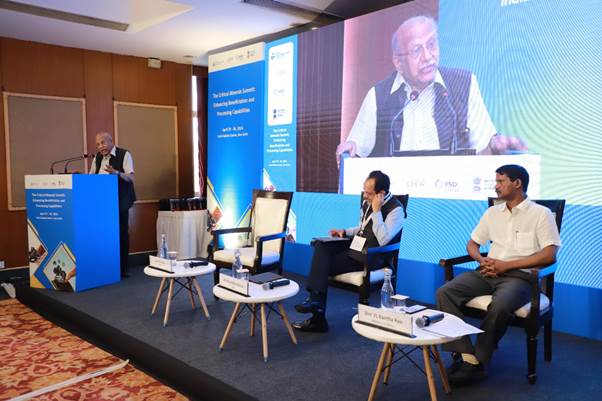


The summit featured exhibition pavilions showcasing a diverse array of minerals sourced from both terrestrial and marine environments, providing attendees with a comprehensive view of the critical minerals landscape.

Shri V L Kantha Rao, in his keynote address, underscored India’s urgent need for robust exploration and utilization of critical minerals to support the nation’s rapid economic growth and clean energy aspirations. He highlighted recent government initiatives, including mineral block auctions, aimed at accelerating domestic mineral exploration and production.
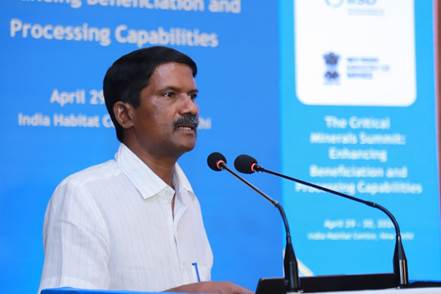


On the sidelines of the summit, a Memorandum of Understanding (MoU) was signed between the Ministry of Mines and Shakti Sustainable Energy Foundation. This MoU initiates a partnership between Ministry of Mines, Shakti Sustainable Energy Foundation, Council on Energy, Environment and Water (CEEW) and TERI. This partnership will focus on providing knowledge support in the field of Critical Minerals which are crucial for India’s economic development, national security, and low-carbon energy transition.
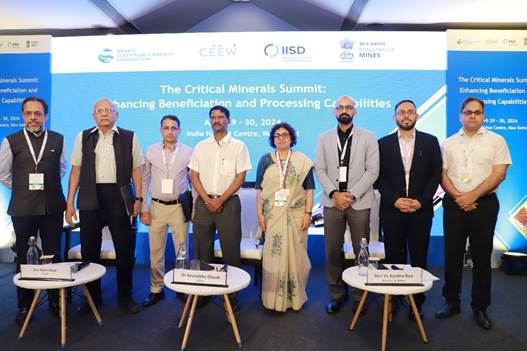


The summit also hosted dynamic panel discussions on crucial topics such as building India’s processing and beneficiation capabilities and scaling strategies for domestic and global markets. Notable discussions revolved around the Ministry’s commitment to infrastructure development for research and development in mineral processing, with initiatives like the Indo-Australian Critical Minerals Research Hub at IIT Hyderabad.
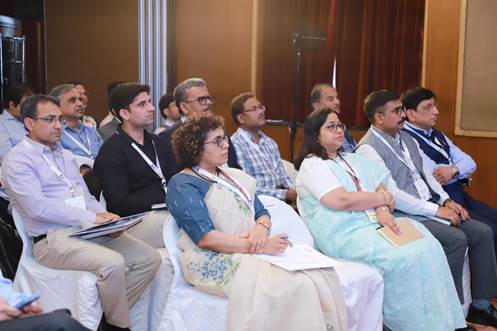


Thereafter, a technology session was held where private companies, R&D institutions, academia as well as GSI and NFTDC showcased India’s Mineral potential and technology available for processing and beneficiation of critical minerals in India through a presentation.
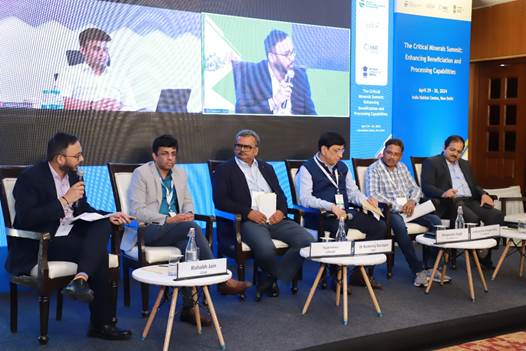


Dr. Veena Kumari D., Joint Secretary of the Ministry of Mines, concluded the day by emphasizing the need for efficient processing technologies amidst global policy uncertainties. She underscored India’s potential as a leading player in electric vehicles, energy storage technologies, and other critical sectors, stressing the importance of nurturing a robust domestic supply chain.

The summit, poised to continue its deliberations over the next day, aims to position India as a global hub for critical mineral processing, thereby supporting the nation’s ambitions of becoming a self-reliant and globally competitive player in the critical minerals arena.

****

KERALA’S BIGGEST SOLAR FLOATING POWER PLANTS COMMISSIONED AT COCHIN INTERNATIONAL AIRPORT

Cochin International Airport, the largest and busiest airport in Kerala which handles about 10 million passenger movements in and out the state annually, is located at Nedumbassery in the outskirts of Cochin city. With the inauguration of a dedicated solar plant in 2015, Cochin International airport won the title of world’s first fully solar-powered airport. The CIAL solar power project comprises 92,150 solar panels laid across 94 acres, generating 100,000 units of electricity on a daily basis. The airport authority has been honoured with the Champion of Earth award by the United Nations in 2018 for their excellence in the large-scale introduction of sustainable energy sources.

On 17th January 2021, CIAL crossed yet another glorious milestone with the commission of one of the biggest floating solar power plants in Kerala. The cost-effective high-density polyethylene floats, using most modern French technology, are laid over two artificial lakes in the CIAL golf course. The floats consist of 1300 photovoltaic cells and have a capacity of 452 KWh helping the airport to produce around 1.60 lakh units of power a day as against its daily consumption stands around 1.30 lakh units, the authorities said.

CIAL sets an example of Total Sustainability Management by treating the sewage water for water harvesting in its golf course with the help of 12 artificial lakes. The water from these lakes was earlier used for irrigating the lawns but now with the installation of these floating solar panels, they have taken another step forward in sustainable and environment friendly resource management.

The Managing Director of CIAL, Mr V J Kurian said, “The pre-commissioning trials showed that these panels which cost around Rs 2 crore to the company are producing power with maximum output efficiency among the eight solar power plants installed by CIAL at various locations in the airport premises. CIAL has been reinventing itself since its formative days. One of our innovations which proved that relying upon green energy is possible even for the high energy consumers like an airport has won us the champions of the earth award instituted by the United Nations. We are committed to the protection of nature and trying our best to reduce carbon footprints.” 

The installation of floating solar panels are usually very expensive when compared to the ground-mounted and rooftop ones. CIAL was able to overcome these limitations and bring down the cost using the novel technology as the  French company CIEL TERRA provided technical assistance. The solar panels are also connected to the KSEB power grid which helps them to bank the excess energy produced.

Indian Railways go Solar: Clean Energy

Indian Railways has over 960 solar powered railway stations and placed an order for 198 MW solar rooftop capacity for 550 stations. This is going to speed up Indian Railways’ goal of becoming ‘Net Zero Carbon Emission Railway’ and being100% self-sustainable for its power consumption.

The Railways recently organised a meet of leading solar power developers who shared their expectations of being partners in the journey of Indian Railways to become “net zero carbon emitter” before 2030. About 51,000-hectare vacant land is available for the Indian Railways to extend support to the developers for installing solar power plants.

Some solar powered stations are New Delhi, Old Delhi, Jaipur, Varanasi, Kolkata, Guwahati, Secunderabad, Hyderabad and Howrah.

Railways is also seeking for 100% electrification by the year 2023 by utilizing solar energy to meet its traction power needs and become a complete ‘Green mode of transportation.’ This will contribute to national solar power needs.

All this is in line with the recent orders of Prime Minister Narendra Modi to solarise railway stations and use vacant railway land for renewable energy projects. These solar projects will also protect the land by the construction of boundary walls along the track.

Eco-Friendly Lifestyle 101

Leading an eco-friendly (ecological/environment-friendly) lifestyle is imperative for healthy and sustainable living in the current extreme climatic conditions and environmental degradation and pollution. All this leads to life-threatening atmosphere because of poisonous air, water and soil, global warming, scarcity of resources, man-made disasters and increased intensity and risks of natural disasters.

Apart from industrial and organizational initiatives towards eco-friendly operations, individual and collective household acts and changes in personal lifestyle choices and living practices of common citizens contribute to sustainable and healthy living.

Environmental friendly living is not that difficult. It can even prove to improve mental health along with physical health and environmental health. Let’s learn about some easy eco-friendly practices.

  1. Resource management: The baby steps. The easiest and the ones which we learned when we were kids, but forget to apply.
    • Limit and manage your water, electricity and fuel usage. Do not make unnecessary usage.
    • Eliminate any kind of wastage. Do not forget to switch off lights and fans when not in use.
    • Bath in shower or use bucket and mug instead of bathtubs.
    • Reuse water. For example- Reuse the water used to wash food items for watering the plants, instead of pouring it into the sink.
    • Brush your teeth with a glass of water. Do not use the tap water.
  2. Resource conservation:
    • Practice rainwater harvesting. We can use this water for bathing and washing clothes, utensils, etc. It is easy to install rainwater harvesting system. Look at these multiple ways to do it.
    • Use solar energy and solar panels if affordable for water heating, cooking, electricity supply, etc.
    • Buy a limited amount of food. Do not depend entirely on refrigeration. Switch it off when not needed, mostly in winters, when food items do not stale for many hours even when kept outside.
  3. Buying essentials:
    • Install LED lights instead of incandescent lighting.
    • Practice biogas cooking, use solar cookers, biogas stoves, etc. You can either buy or build a biogas plant at home easily. See the benefits of biogas here.
    • Use a car fueled with CNG or use battery vehicles. Go on foot, or ride a bicycle to reach nearby places.
    • Use desert coolers or eco- friendly air coolers and do not install air conditioners.
    • Use eco-friendly paper/tree-free paper and buy refilling pens instead of single use pens.
    • Eliminate plastic materials and storage boxes. We can easily live without plastic. There are many alternatives to daily-life plastic materials. Use and carry aluminium bottles and refill them instead of buying plastic water bottles. Use glass containers for microwave and storage.
    • Buy products only from those companies which use eco-friendly methods to manufacture. There are many such alternatives out there. You just need to search the net.
  4. Materialism:
    • Decorate your home with indoor plants, beautiful mud or clay lamps, eco-friendly handicrafts, glass decorative, etc.
    • Install indoor plants which purify the air. Use loads of them.
    • Build a terrace garden or porch garden.
    • Stop the air, water and sound pollution in the name of festivities. Instead, go out on festivals to plant trees in wastelands, empty lands, barren lands, schools, boundaries of roads.
    • Donate to and plant trees and saplings with old-age homes, special schools, orphanages, etc. It will bring happiness to you and to those people too. Do not use firecrackers, river dumpings, etc.
    • Do not buy chemical based beauty, body care and healthcare products. Shift to Ayurved or organic and eo-friendly products. They are healthier, more effective, and have no side effects.

Indoor plant decorations

Image source: ipinimg.com

5. Eating habits:

  • Plant-based diet- Industries which process animal-based products, take-up thousands of more gallons of water and KW of energy for processing. It leads to water wastage, ozone depletion, global warming, etc. There are many health risks involved with an animal-based diet. If not eliminate, try reducing and limiting the intake.
  • Separate and store plastic waste and organic waste. Plastic waste includes milk packets, medicine packets, chocolate and biscuit wrappers, etc. Use the organic waste (vegetable peels, animal waste, food leftovers, etc.) as manure for plants and ingredient for biogas.
  • Shift to Ayurvedic medicine and treatment rather than allopathy.

Start small scale organic farming at home. It is very easy and does take much time and effort. It can be installed in small spaces like a balcony, roof, porch, veranda, and even in a well lit room. Know more about organic home farming here.

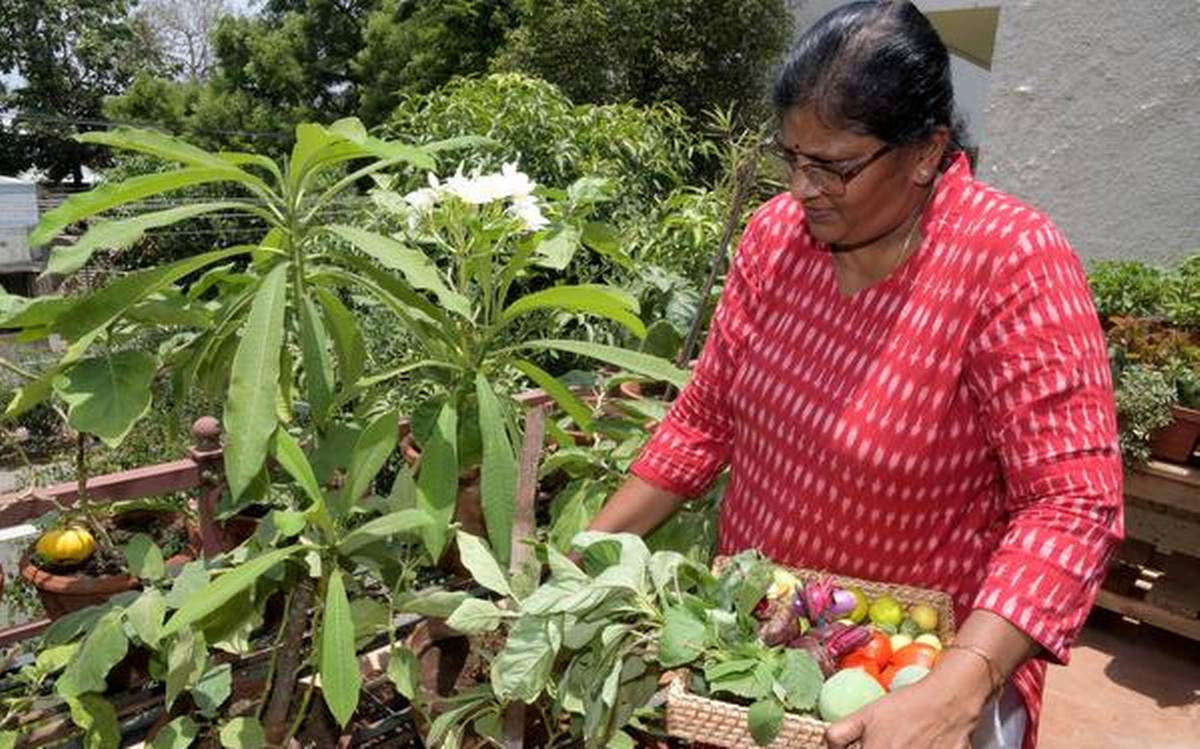
Vegetable, spices, and fruits grown at home.

Picture source: The Hindu, Nursery live, Gardening know how and Balcony garden web.

All this may take some amount of time and effort, but it is worth it. You will experience a positive difference in your life. You can even inspire the people around you. We can start many of these living practices within a village, colony, township or a society to improve effectiveness with collective efforts. Such as rainwater harvesting, solar energy, biogas energy, farming, etc. Take one step at a time and you will find your motivation.

“Can Human’s Bear the Risk of Terminating Fossil Fuel Consumption?”

 Humans have been working for ages so as to find better food resources, water reserves, better places for shelter and many more.With times and hard work, everything has changed, man doesn’t need to move places in search of most of these resources which are the basic necessities in life. They are available with a minimum of efforts. Science and technologies have helped humans to find more comfort and facilities and thus has made life for most of the humans more easier. The industrial revolution brought humans to a different phase of life, by providing better jobs, product and resources to mankind. But these technologies and industry do require a better source of input to provide the best of their output as efficiency. Humans have been using most of the natural resources and reserves for ages like wood, coal petroleum, natural gas and many for so as to generate power as a fuel. The use of these natural resources and fossil fuels was a better option in earlier days when they were present in heavy amounts and their harms were also less.But as the time has passed, we see these resources getting faded away and also giving birth to various phenomena such as Global Warming and Climate Change. These changes have been recorded, and it’s side effects have been seen in various parts of the world, especially the polar areas, where most glaciers and ice mountains have just turned into liquid water. Many countries have been coming together to fight this problem and have been figuring out their best ways so as to make ourselves and our others better and safe from natural calamity due to these changes. 

So what can we do? The prior and the foremost action which clicks to stop our mind is to stop the consumption of fossil fuel and natural resources and rather shift to better and cleaner fuel, which are more sustainable and pure. But is that easy and how would it affect your life if we stop the usage of these natural resources today?

Possible Results could be:

  1. It seems to put a break in various activities around the world, since we use vehicles to travel , be it cars, trucks, ships or airplanes. All these run on liquid fuel which come from these natural resources.
  2.  Stopping the use would make our travel mostly impossible as we still fight to make most of the vehicle electric.
  3.  Also we do have electric cars, we won’t be able to use them as more than 66% of electricity is generated through burning coal, thus we wouldn’t be able to do so. 
  4. Also some of the countries do have natural power generation plants, but still many countries do lack this technology.
  5.  Most of our work won’t be possible as we would lack electricity to run our PC’s and charge our mobile phones
  6. Also this is more a cheap source of generating power, people have to invest much other money in buying and installing them also the installation and learning how to operate sustainable energy would also require skill, thus could take a while to do so. 
  7. Since carbon dioxide from vehicles and industries do get released in the air and is thus increasing the deterioration of our planet. Global warming and climate change are phenomena which are occurring and most of the resources which have been depleted cannot it be brought back.
  8.  Also many experts suggest that if we do stop the burning of these fossil fuels, it is still expected that earth will take time to recover as temperature will still grow due to trapped heat for several decades, thus increasing the temperature of our earth. 

The facts are really not great to visualize but are true this surely opens our eyes to stop the consumption and utilization of these natural resources so as to control its ill effects. It’s high time to invest money in both sustainable energy resources as well as skilled people to operate them so as to get rid of these fossil fuel consumption forever and shift to a better and purest form of our energy which could help us in future. It’s High time to come together not only for sake of humanity but for the sake of saving our coming generation for the sake of good times and for the sake of saving our planet. 

“Deserts-A solution for Rising Global Environment Crises”?

Global warming, climate change, melting of ice, earth temperature increasing and many more are some common natural phenomena happening these days with a sure shot affect on our future life. Even today, we acknowledge many examples of these phenomena as well as well researched papers which surely don’t deny the fact that these are surely happening. Countries across the world have been discussing this serious issue of climate change and global warming and have been coming up with brilliant ideas and policies to fight back. These technologies and various steps include a shift from Non sustainable resources to more Sustainable ones so as to reduce carbon emission and from them and getting a better and pure form of energy in endless quantities. Many nations have shifted to wider use of wind energy and solar energy as a mode of generation of power from them in various day to day activities. Many countries have also come up with a policy of carbon tax, which surely is charged from the companies and industries from which the emissions of carbon content is more. Also if any country buys fuel from the other country, carbon tax is included in it, which surely motivates people to cut down usage of these resources and also slow down their extra money cost in the form of fines. 

So we all know that it’s really an important issue and need to work on till it becomes too late. But we do lack some of the technologies which could have a stronger impact on these or the resources which are available like sustainable one, it proves somewhat expensive to most of the countries with low economy so what’s the solution,”Is there any way we could undo and alter these activities and thus make our environment cleaner”. There are various researches and thoughts on these activities which can be done and varius good engineering methods have come into existence to fight these. One of those and widely accepted one is “Afforestation”. The term is self explanatory which means to increase the growth of plants and trees around the world and thus increase their quantity and improve quality of air as these would absorb more of the carbon-dioxide present in air. It’s a well known phenomenon and a lot many countries have been into it for quite a few years. But the main issue with this is, that we humans so lack the availability of land for the same. For trees to be grown, we need the required environment and the important is the space and fresh water resources. But we do lack it’s availability , also for the reason that we require much of our land for building hotels and other commercial activities in response to the growing population. But there are various regions which have large amounts of space and area, and are not used by humans and are widely available. These are the toughest terrain and known as deserts. These deserts have large space and thus can be used to plant trees without much human getting affected. The main issue is how can we irrigate, as we know they are desert because they lack water, then how is it possible. And if it is possible, will it not become desert again?

It’s possible as per many people doing research on this as they believe by the growing technology of desalination of water, we could utilize the water for irrigation. The benefits of utilizing these spaces are that these have lesser people living in it . So selecting the trees which are friendly to these climatic conditions would be the better option. Which could grow easily and used for commercial activities also. The benefit of growing more trees in these areas would be the amount of carbon content absorption would increase. Also we could cut down some of the trees as for the new ones to grow since it wouldn’t affect much this cycle since this would be practising around the world. We would use them for construction activities, for feeding animals and also liquifying most of them to biomass fuel, thus a pure and much better source of power for our other activities also, reducing the carbon content, and increasing economies. Also we know that most of these deserts acquire large amounts of ground water hidden under them, for example- Sahara. Which could initially be used for irrigation initially. Also the power required for the technology for the same could easily be generated from the solar energy trapped in there solar panel 

So it seems according to research being done by various scientists and weather experts. But there are some other problems which could be faced in doing these projects. The water required would be clean, and thus desalination must be done carefully. But it’s output of concentrated salts dissolved in water in oceans could be harmful for the aqua life. Still this is just a thought which might affect the resulting increase in carbon content to reduce down. But still it seems difficult to make these ideas go on since they do require a large sum of money and also success of these are sureshot not acknowledged, since it’s still a question that wouldn’t these lands again transform into deserts again and lead us to big economic loss around the world. 

“Various steps and policies are into actions with faster growing technologies so as to reduce the carbon content from them and shifting towards  pure form of energy which is much cleaner, much cost effective and much safer for our planet”. 

“Nuclear Energy And Fight For Its Credibility”

Humans, since the age of their existence have invested money, efforts and ideas into developing new sources of energy generation. Which earlier focused on mostly focused manual work and manpower or animals usually has shifted to machines making the work more easily and efficiently done. The transition after the industrial revolution and drastic drift towards these technologies gave new origin to energy sources. While initially more of the non sustainable resources like coal were used as a source of energy, be it in trains, or for ironing of clothes or be it for warming oneself from the freezing cold environment. Cutting of woods for fire and cooking was also an opted source of energy in earlier times. But sooner the effects if these machines were seen and how they deteriorated our health, glaciers of the antarctic and most important lead to phenomenon called global warming which has nowadays led to climate change. The need for sustainable and eco-friendly sources of energy was a great demand in the early 40’s and then came the idea of “Nuclear Power Generation”

As soon as the nuclear atomic bomb was used as a weapon, it came into the mind of people,that it has an enormous amount of energy in it and thus could be used so as to generate energy from it and utilize it in a better and peaceful way. It was thought to be a classic idea to fight back every problem , people warriors facing. Nuclear power generation meant the cost of electric utility to go down while it’s production to achieve height,shifting to this house would lead to less consumption of fossil fuel like coal and other sustainable resources like petrol as a source of energy to run vehicles, and thus the problem of global warming could drop. And many other factors which seemed to solve energy related problems for mankind. 

But soon as most of the companies started investing in nuclear plants , it turned out to be totally different as it was assumed to be. The technicality and most important the cost to build it were more as they were right of. Complexities in the design and working were still unknown to many of the scientists. But still most of the counties thought of investing in these plants. The growth of nuclear plants significantly grows as soon as the oil prices hit the stock to highest amounts. Thus nuclear energy was thought of to be the best and better alternative. But it was soon seen that this nuclear power generation was too risky not only for the company but also for their country as well as the whole world, if not properly taken care of, since many accidents were observed in quick span

But still various countries are using nuclear energy as a energy generation with almost covering 10% of total energy demand around the world while most of the power still depending on coal. But the main question which comes to mind is “Do we really need these nuclear plants knowing their harmful effect to humanity”. There have been many accidents which have led man to lose life and still it’s outcome are observed in the future genes. Nuclear energy has enormous power to destroy the population around the world if used in the other way. So “Why do we still focus on nuclear energy rather than investing in other sustainable energy resources easily available with almost the same setup cost”. Also the waste of these plants which are mostly chemicals is very dangerous and the smoke which comes out in the form of emissions is too toxic, which could lead to breathing problems in living beings and also add up to the pollution. 

“The results show the how the disadvantages of these nuclear plants are way ahead of its positive outcomes as being positive being the fact that it leads to reducing of carbon dioxide emissions in the environment or be it providing more jobs as workers in construction and worker in the plant but still seen the bad side of these, it seems to be more dangerous and harmful for the humanity. We believe that it’s high time to think for nature and shift towards more better energy sources like sustainable energy sources which are present in enormous amounts and which do not harm nature , along with the fact of not risking life’s and finding alternatives at the cost of human life”. 

“Ushering Towards Better Reforms “

“Clean was our environment and so were our surroundings,animals were happy and strong were the bondings. In the race to change our selves, we changed everything around, with scarcity of resources, and humanity deeply drowned”. In todays era, where work culture is mostly preferred, and least preferences are given to people, their feelings,emotions and most importantly to the nature. With increasing pollution and leading scarcity of resources all around, human has destroyed the purest form of living standards and shifted to the artificial ones. Man is using all sorts of natural resources available around him for his own benefits and is harming our health as well as nature indeed. But the Awareness and concern has been seen since last few years and people are getting aware about the bad affects of these and how it’s utilization is harming our health and nature and how few terms like “Global warming” and “Climate change” have come up. Most of the countries are working on this issue and trying best resources to counter the effects of these.

But the main thought which comes into mind is that ” Do we humans really care for our nature and thus saving it’s resources from getting replenish” or there is some more in addition to it, which may include the “Thought of utilizing these resources in future,when the other alternatives are not more effective”. And will this shift towards more cleaner resources or sustainable resources prove to be more effective and efficient.

But the major concern for the same is that do we really care for these non-sustainable resources and want them to be with us forever. Possible thoughts could be :
1. That yes, we do care for the natural and non sustainable resources and we want their presence with us for a longer duration of time so as to maintain a proper balance in our environment.
2. Most of the countries are shifting towards cleaner energy. But if they have a thought of saving these for future reserve, it’s still better, as these will remain with us, till further usage.
3. But the truth is that most people hardly care about these natural and non-sustainable resources and believe in just working as it’s going on without any change, which surely needs to be changed.


But the question still arises is that why should we shift to sustainable energy as a source of energy and stop using these resources which we know are less and are harming our nature. This may include-
1. Quantity of these resources is endless
2. These are Ecofriendly.
3. These are more cost effective and require just installation charges.

We have these alternatives and know about these, then why are we still not shifting to these new methods and still using the old traditional ones. The main points include:
1. Technological deficiency.
2. Basic information on how these resources can be brought into physical form and bring out maximum output.
3. Lack of interest of people, as most of them hardly care and others are afraid to shift to new things.

Having a glance around our surroundings, we can easily acknowledge that we have made our life’s horrible and also destroyed or nature. The need to shift to natural and clean source of energy is the prior requirement at present as well future so as to live in a clean environment . Saving our nature through the act of finding alternatives to the energy as a source generation can be the change we want and thus make our planet “Greener” and “Cleaner”

NIT Srinagar working on material science & electrochemistry for sustainable energy

Dr. Malik Abdul Wahid from National Institute of Technology (NIT) Srinagar is a recipient of the INSPIRE Faculty award instituted by the Department of Science & Technology, Govt. of India working in the area of energy research towards marriage of material science and electrochemistry to develop sustainable energy and affordable energy sources. His focus is mainly on electrodes and electrolyte material electrochemistry.

Fig: Dr. Malik Abdul Wahid in his lab

The major components of Dr. Malik’s current research interests include material research on the electrode development for Sodium-ion (Na-ion) battery, which offers a 20% cost reduction compared to present Lithium-ion (Li-ion) technology.  He has been focusing on the two aspects, i.e., cost reduction and efficiency elevation. For the former, he is currently focused upon stabilization of a combination of carbon-based anodes and organic cathodes. While for the latter, he is exploring the new cathode chemistries. Two of his recent projects are development of layered high capacity cathodes by suitable doping that offers high capacity and stability and Sulphate-phosphate hybrid cathodes. Similarly, Sodium (Na) metal anode hosts with heavy Na deposition capacities are being developed.  The mentioned projects are a new direction to the field of Na ion battery research.

Along with his collaborators at IISER Pune, Dr. Malik developed a Si-Phosphorene nano-composite material for efficient Si stabilization as an anode in Li-ion battery, which was published in the journal Sustainable Energy Fuels. The obtained material delivers five times more capacity than carbon-based electrodes and can be fully charged in about 15 minutes.

His team at NIT Srinagar employed a simple hydrothermal strategy to synthesize reduced graphene oxide (rGO) wrapped high aspect ratio 1-dimensional SbSe nano-structure. The work has been published in the journal Chem Phys Chem. They achieved a decent performance with the reversible capacity of 550 mAhg-1 at a specific current of 100 mAg-1which implies that 5 to 6g of synthesized material would run a high range android cell phone.

“INSPIRE Faculty award is a prestigious award and should be distinguished from a regular faculty position in any institute. To honour the positions, I have co-founded a center of excellence (COE), namely, the Interdisciplinary Division of Renewable Energy and Advanced Materials (iDRAEM) at NIT Srinagar. The COE primarily worked with my & collaborator’s research grant, but recently institute promised funding support. Additionally, with the possible support of MHRD (under the FAST scheme), the center is set to blossom and cater to some high-quality research.” Dr. Malik said.

At present, this centre co-founded by Dr. Malik caters to the research in the advanced areas of energy storage and super-hydrophobic surfaces for water harvesting, besides focusing on the local resources of J&K. Dr. Wahid has already published a paper on the application of walnut shell derived carbon as Na ion battery anode applications (ACS Omega, 2017, 2 (7), pp 3601–3609). The material has a lot of scope to be employed for advanced electrode applications. Similarly, waste dairy products and aquatic flora of Dal lake appear to have appropriate morphology to be employed as precursors for the electrode grade carbon.  Energy storage activities under iDRAEM partly focus on the synthesis of high-quality carbon materials from local precursors. Lotus stem is very promising in being porous to be employed as precursor for electrode grade carbon material.  It also undertakes challenges of developing high-quality hydrophobic surfaces by replicating the hydrophobic leaf structure of local plants of DAL lake.

[Related publications:

  1. Sustainable Energy Fuels, 2019, 3, 245-250
  2. ChemPhysChemdoi.org/10.1002/cphc.201901011
  3. Energy & Fuels, doi.org/10.1021/acs.energyfuels.0c01046
  4. Surfaces and Interfaces, 2020, 19, 100476]

(For more detail, please contact Dr. Malik Abdul Wahid, Email: malikwahid15@gmail.com)