Shortage in Indias Power Supply.

India has the fourth largest coal deposit in the world. It is the second largest fossil fuel producer after China and is home to Coal India, the world’s largest coal mining mine, which accounts for 80% of domestic production. Already allocated coal block mining capacity exceeds expected demand in 2030 by approximately 15% to 20%.


So why are India’s power plants facing coal shortages each year, leading to widespread power outages, exposing parts of the country to darkness and endangering industry?
There are several factors. India has a long time policy of minimizing coal imports. In February 2020, Coal Minister Pralhad Joshi announced that the country would stop importing steam coal from 2023 to 2024.
Mr Joshi said the Ministry of Coal will work with the Ministry of Railways and the Ministry of Shipping to allow Coal India, prisoners and commercial miners to discharge more coal from their supply by 2030. And the coal supply at power plants is running out at an alarming rate. The Department of Energy is currently blaming the decline in coal imports due to the current crisis. In 2018-19, 21.4 million tonnes of coal were imported for mixing, down to 23.8 million tonnes in 2019-20 and 8.3 million tonnes in 2021-22.



Power plant coal inventories have fallen by about 13% since April, reaching pre-summer lows. And for the first time since 2015, Coal India will import fuels used by state-owned and private power companies. The Ministry of Energy said almost all states showed that multiple state bids for coal imports would cause confusion and that the decision was made after calling for centralized procurement by Coal India.
Imported coal costs five times as much as domestic mining, so the center is being pushed back by the state.
Recently, the government has also pressured utilities to increase imports to mix with local coal. Last year, after a two-year break, three tranches of coal auctions were held and nine blocks were successfully awarded.

In September 2021, the Ministry of Coal issued a strict warning to owners of confined coal blocks, stating that their mines should increase production or face restrictions on coal supply by the CIL.
The ministry has discovered that these mines are producing below target.

Of the 43 coal mines outsourced to private companies in the energy, steel and metals sectors, none have met their annual production targets.
On May 6, Coal India announced that it would provide the private sector with 20 closed and abandoned underground coal mines and reopen and operate its revenue sharing model.

According to journalist Shreya Jai the current power supply chain does not seem ready to handle periods of high growth and state discos cannot pay gencos, but the power supply chain starts with state discos and needs repairs. Railroads, on the other hand, are struggling to align the thermal power industry’s demands for faster coal supply with those from other industries. Rakes must be prepared to meet the growing demand for almost all other bulk commodities, from cement and steel to sand and edible grains. By strengthening the value chain of the electric power sector, it is possible to resolve the coal supply-demand mismatch in the long run.


HOW I SPENT TIME IN SUMMER VACATION:

Summertime is the most awaited time of any student’s life. It gives them a break from the scorching sun and blazing heat. The summer months are quite hot, however, students love them because they bring a sense of calmness due to the vacations. It frees them from the monotonous and dull routine of school and studies.Most importantly, summer vacations give us a chance to explore new things. We can adopt new hobbies like painting, dancing, singing and more during this time.

Furthermore, it gives us a chance to visit our grandparents or to someplace abroad. Summer vacations bring all types of fun, however, these particular summer vacations were the most memorable for me. My parents made me join a summer camp which was too much fun and then we visited our grandparents’ place.Summer Camp:As the first day of my summer vacations started, I started getting bored easily. Mostly so because all my friends had gone to someplace or the other. My parents noticed this and decided to send me to a summer camp.

Our school itself was organizing one in which my parents got me enrolled.At first, I thought it would be of no use and would be equally boring. However, to my surprise, I was wrong. The summer camp was one of the best experiences of my life. I got the chance to indulge in so many activities and in fact, it was the first time where I discovered my talent for painting.We got up early in the morning at 7 o’clock, despite no school. We had trainers who would teach us different things each day.

On the first day, I got to learn karate, which was very amusing and helpful. Further, I learned how to play sports like basketball, table tennis, and volleyball.Finally, came my most awaited part. We were taught painting and unique tips to master this art. I learned it quickly and started enjoying painting. My passion for painting began from this summer camp, and I will forever be indebted to it.

My Grandparents’ Place:

After my summer camp ended, my whole family decided to visit my grandparent’s village. It is situated away from the city and is full of lush and greenery. I love spending time with my grandparents so I was very excited to visit their village.We stayed there for over two weeks, and that throughout that time, I was at my best behavior. I used to get up at 7 o’clock in the morning to take a stroll with my grandfather.

Then all the family members would get together to have breakfast full of healthy things and fresh fruits from the farm nearby.In the evening, we would sit by our grandmother’s bed and listen to stories. Then, my siblings and I used to go to the terrace and play games. We would also gaze at their stars all night, as we did not get that in the city.In short, this is how I spent my summer vacation. It was definitely one of the best times of my lives. I got to learn new things and spend valuable time with my grandparents. I feel blessed to have a loving family with whom I can enjoy my summer vacation.

Why are summer vacations important?

Summer vacations are the most important and awaited time of a student’s life. It gives them a break from their monotonous routine. Furthermore, summer vacations protect students from the scorching heat and give them a chance to visit hilly stations.

How can one utilize their summer vacation?

There a lot of ways to utilize a summer vacation. It can be done through indulging in many activities. One can join summer camps which teach new skills to students. One can also pay a visit to their grandparents or to some chilly place or abroad to enjoy it to the fullest.

Time management techniques

Automate Decisions
  • Transfer money to your savings account every time you receive a paycheck
  • Choose all your outfits for your week on Sunday and hang them in the closet in order
  • Subscribe to a weekly fresh delivery of organic vegetables and fruits to your home
  • Standardize the typical daily meals you like the most, saving time in cooking and grocery shopping
  • Prepare your sports bag every night and put it in your car. If you prefer running in the morning, leave your running shoes near the bed
  • Automate all electronic gadgets to go into sleep mode at a certain hour

“Time management is not a peripheral activity or skill. It is the core skill upon which everything else in life depends.” – Brian Tracy

Work Around Your Energy Levels

Productivity is directly related to your energy level.
Find your most productive hours — the time of your peak energy — and schedule Deep Work for those periods. Do low-value and low-energy tasks (also known as shallow work), such as responding to emails or unimportant meetings, in between those hours.

Plan Your Day the Night Before

Before going to bed, spend 5 minutes writing your to-do list for the next day. These tasks should help you move towards your professional and personal goals.
You’ll be better prepared mentally for the challenges ahead before waking up and there won’t be any room for procrastination in the morning. As a result, you’ll work faster and smoother than ever before.

Start the Day with Critical Work

A golden time management technique: Find your most important task (MIT) for the day and tackle it first. 
Your MIT should be the one thing that creates the most impact on your work. Getting it done will give you the momentum and sense of accomplishment early in the day. That’s how big life goals are achieved: small continuous efforts, day after day.

Prioritize Tasks
  • Write down all your tasks.
  • Identify what’s urgent and what’s important. After each task, mark them with “U” for Urgent and “I” for Important. 
  • Assess value: look at your “I” tasks and identify the high-value drivers of your work. You want to find which tasks have priority over others and how many people are impacted by your work
  • Estimate time to complete each task. Order them from the most effort to the least effort.
Delegate or Outsource Tasks
  • Find the right person: he should have all the necessary skills and is capable of doing the job
  • Provide clear instructions: write down the tasks in a step-by-step manual be as specific as possible
  • Define success: be specific about what the expected outcome is and the deadline to have the task completed
  • Clarity: have the tasks explained back to you and offer clarification when something is unclear, rewriting the specifications if needed
Automate Repetitive Tasks

Putting some of your daily tasks on autopilot is key to working smarter.

  • Create canned responses for emails you keep writing over and over again
  • Set reminders in your calendar so you never forget anything
  • Proofread your writing automatically
  • Schedule and automate your social media posts in advance
  • Automatically fill online forms,  saving all your passwords in one place
  • Create spreadsheet templates for reports you have to do weekly/monthly.
Set Time Constraints

Set deadlines even when you don’t need to. Schedule less time to complete tasks and force your brain to focus.
Parkinson’s law states: “work expands to fill the time available for its completion”. So, if you reduce the time you have to complete a task, you force your brain to focus and complete it.

Eliminate Distractions
  • Turn off all notifications on your phone, computer, and tablet
  • Leave your phone in odd places that prevent you from immediately finding it
  • Work with headphones as people are less likely to approach you.
  • If you find interesting articles, save them  to read later, such as during the commute
  • Turn off your Wi-Fi when your tasks don’t require internet connectivity
  • Don’t browse social media at work at all. 
  • Use “Do Not Disturb” functions on chat systems.
  • If you have an office, shut the door.
Track Your Time

Track your time to have real data on your work and uncover insights on how you can improve your productivity.
After a couple of weeks, you’ll start noticing patterns and knowing where and how your time is leaking. By being aware of how exactly you are using your time, you can devise a plan to attack your leaks and how to get rid of them.

The 2-Minute Rule
  • If it can be done in two minutes, just do it. Don’t add it to your to-do list, put it aside for later, or delegate it to someone else. Just do it.
  • If it takes more than two minutes, start it. Once you start acting on small tasks, you can keep the ball rolling. Simply working on it for two minutes will help you break the first barrier of procrastination.
Say No More Often Than Yes

Say “no” by default to anything that doesn’t contribute to your top 5 career goals.
Your time is a limited resource and you can’t let people set your agenda in life.

Use “Gap Time” Effectively:
  • Learn a new skill, either for your professional or personal life
  • Read books or articles you saved for later
  • Organize your computer, folders, calendar or work
  • Plan your week, tomorrow, or the rest of your day
  • Listen to a podcast
  • Learn a language
  • Take a walk and think and let your mind wander
  • Take a productive pause to clear your mind.
80/20 Your Time

The 80 20 rule states that “80% of the output or results will come from 20% of the input or action”. In other words, the little things are the ones that account for the majority of the results.
Use the 80/20 rule in your life and work to prioritize the input that brings the majority of the output.

Break Down Big Tasks

Break down big tasks into smaller ones to avoid procrastinating and help you stay on track to achieve your final goal.
Never put a huge project down as just one to-do on your list. Instead, put bite-sized to-dos that you can do one at a time. Take it to step by step.

Work From the Calendar

Schedule tasks, working from your calendar instead of the to-do list. When an event is consistently scheduled on your calendar, it’s much more likely to transform into an unconscious habit
Using your calendar forces you to rethink your work from tasks to time units. That small change increases the likelihood of getting things done.

reference

https://dansilvestre.com/time-management-techniques/amp/

Power of Time

You had heard of the film ‘No time to die’, you have heard of the phrase ‘no time to waste’, you had heard of people saying ‘time is money’. From all these examples you have understood that time has very much importance in our life.

Have you ever thought that something which is not even visible have so much importance in our life. Everybody says this one thing that the person who knows how to manage his time knows all the secret of success.

Time management has gained so much importance in today’s world that there are even courses to let people learn and understand how to manage their time. This is the one thing which we have to follow as we all know that time never follows anyone or stops for anyone.

This is the one thing which everybody has in eaqual amount, whether you are rich poor lives in America India anywhere in this world you all have a 24 hour in a day. The thing which make time different is how we utilise it.

We all know that the strongest thing in this world is time. We all should understand and utilise at a time in useful things. And by this way I am not saying that you should not have a relaxing time what time for your hobbies you should absolutely have those time. You should have time for everything in life. And you should do all the thing at the right time.

Don’t misspend your teenage time

We are very well know how important teenage life is important and the most crucial part of life. It is the time you make the most important decisions in life and realize your goals and dreams. It is really a small age wherein, we are asked to make decisions on how our next 10yrs of life should be or wish to be. It is not acceptable and stressful to take such huge decisions in a confused state of mind. Do we never know what we really want to ask ourselves what do you really want? most of us don’t get the answers. We all are streamlined to travel in certain paths in life as others did or elders did and that is what we should be doing irrespective of interests, likes, or talents. It is ruthless to have pressure on teenagers to decide on their life. But, we definitely know that we have enough time to build a proper career and assemble the stones properly to see the view behind those huge rocks. This time you will never ever get it back never set back to relax keep running with mild breaks but do not lose the consistency and zeal to run to succeed in the race. We have enough time to gain experience in our interests, skills, and talents.

Most of us really don’t know what to do with so much idle time and misspend it on other unwanted things. But using it in the right way will lead to the best life. Use this time to hustle, learn, grow, ask, think, restructure, reframe, understand and be honest to your work. It is okay to make mistakes that’s when you learn how to face the next and prevent making another one. Mistakes teach you so much than one could ever. They shouldn’t be intentional but if it is accidental it should help you open your eyes and grow from the mistakes. Learn new skills, and improve on your interests they help a lot for your future.

These may sound boring and exhausting now but few years down the line you will be thankful to your past self for not misspending time and using it for career building. Even such small things help a lot in resume building. The users look for other qualities in your resume alongside your degree. They improve your chances of getting jobs and may experience an increase in stipend for the qualities you possess. This may sound so much now but taking slow-steady steps will add so much. Develop these qualities in this time and your experience has a lot of value in the future. You never know what really happens and people your age may waste their time partying and hang out with friends limitlessly. But, it is your option to choose whether to misspend or use it wisely. Because it is not their future or career, they are there today and not tomorrow but, your time never comes back to you. Your future your time is completely in your hands. Know what you need to spend time on at the end of the day it is you who is hustling hard and strongly wanting to have the best life. Find your stones and build them wisely.

How to manage time.

Time management is an art rather skill that is not easy for everyone. Often, we spend our entire time after college work or office work and it became difficult for us to take out time for our family. Time is very necessary for strengthening the bond that we often take for granted. Everyone is having a busy schedule these days especially because of online classes or work from home situations, but some manage time quite well and manages everything and have a balanced life, while others stay pretty engaged in their official work only that makes the situation stressful.

“Time management” refers to the way that you organize and plan how long you spend on specific activities. Failing to manage your time effectively can have some very undesirable consequences. Being conscious of time will result in self-improvement and goal achievement.

Here are some ways to manage time effectively.

  • Have a to-do list : Having a list is always a time saver. If you have a list, you’ll never have to wonder what’s on the daily agenda or what to do next. Indeed, a list keeps you focused and motivated, focused on feeling that sweet satisfaction every time you tick off a task from your list. Lists also let you see – and monitor – your progress. Even if you’re surrounded by distractions, your list will keep you on the right track.
  • Plan Ahead : Planning ahead is a critical part of time management. Ideally, you should plan ahead for the week or at least the day before. When you know exactly what needs to get done for the day or week, you’ll stay organised and focused. You can break tasks across days to see, in advance, how much time is needed to complete a project. Even spending just a few minutes planning ahead can transform how you work.
  • Be Decisive : Decide each day what the goals are by order of importance and stick to them. If you work in a shared office, avoid unnecessary conversations until you’ve done your task. Don’t get stuck on long telephone calls when you have a deadline looming and write short, polite responses to emails to keep lines of communication open.
  • Stay focused : Try not to let distraction get the better of you. Staying focussed on the particular job at hand is key to your success as a small business start-up. Try staying focused for short amounts of time, say 20 minutes at a go, and then have a short break before diving in again. Being mindful of how long you have to spend per task will help ensure you stay within your timeframe.

Penpals – Digitalized to be rediscovered!

Letters are probably the most graceful way of communication between people. It probably was the most common way of distant communication for more than 3000 years of our recorded history. Until very recently, letters were used by professionals and by common folks alike. You pick up a culture – Indian, English, American, Japanese etc. – all of them have a dedicated space for letter writing – often considered an art. However, mobile phones, instant messaging and e-mails changed the way in which communication was carried out between people forever. It is not that instant messaging is bad. It is better than what was, but certainly fails to have the element of gracefulness that was imbibed in the culture of letter writing.

However, until very recently, letters were also used for the tradition of penpals. Wikipedia defines penpals as – “Pen pals (or penpals, pen-pals, penfriends or pen friends) are people who regularly write to each other, particularly via postal mail. Pen pals are usually strangers whose relationship is based primarily, or even solely, on their exchange of letters. Occasionally pen pals may already have a relationship that is not regularly conducted in person.” And this was a very flourishing tradition between cultures. But of course, life becomes faster with technology and the social changes that come with it.

However, the ones who love and the ones who adore find more ways to hold on to things than the ways in which the others discard the same. There are several penpal clubs that run through magazines. But COVID has certainly put a halt on a large number of them. However, a better thing happened because of this – the innovation of digital letters. For instance, the 2019 Google Apps winner app Slowly built by a Hong Kong Based firm facilitates letter writing online. The time taken by a letter to reach the recipient is proportional to the distance the letter needs to travel geographically, essentially emulating a real-life letter experience. Several other websites that do not necessarily work on the letter based penpal format i.e. they work more like a chat between strangers erupted in market due to the pandemic. The most famous of them is perhaps Omegle which also offers face-time options.

While many may lament that the smell of paper and ink and the post man coming and delivering letters meant a lot to them, a reality is that our realities have changed. The present generation, mostly people born after 2004 might not have many recollections of letters at all in India- thanks to the massive cell-phone boom that has occurred since. However, letters are a good thing. Because the slow modality ensures that a person works upon his language and choice of words. If that isn’t training for soft skills and practicing writing, one may wonder what is. So, the author wishes the ones now planning to write to new people across the world, all the best!

A STITCH IN TIME SAVES NINE

“A Stitch in Time Saves Nine” is a phrase and has a lot of wise meanings inside it when understood. This phrase reflects the hole in a cloth and tries to make the people understand that, a small hole in a cloth keeps on getting bigger if it is not fixed on time. It means that timely effort will help in preventing more work in future and also tries to teach – Prevention is Better than Cure. Hence, if a problem exists then one must fix it immediately. If not fixed in time. then even small problem can lead to a bigger problem.

Importance of “A Stitch in Time Saves Nine”

  • This phrase tells about the “Importance of Time“. Time is the most important part of life and according to many successful individuals, time is money. Time is precious because time is limited. There are 24 hours in a day and its constant and the human life of a particular person is also fixed, which shows that we can’t afford to waste time at all. And this is what the phrase describes.
  • Another concept that the phrase describes is “Effort in Time“. This is possible by dealing with problems in proper time. While dealing with a problem, there’s a need to contribute proper amount of effort in the right time and when the problem is not solved and delayed, then it will make the problem more hard to solve and more time will be consumed. So, following “Stitch in Time Saves Nine” saves effort and time.
  • Another advantage of the phrase is “Better Decision Making“. Following this concept ensures that a person has sufficient time to handle the problem and this is the most wise decision. This shows that within problem time interval, the person will solve the problem efficiently. And when the person delays the problem the time available for solving problem will be reduced . This will cause shortage of time. This will make the person more stressful and nervous. This would lead to poor decision.

This proverb is a learning for everyone. It is an important advice for everyone. It doesn’t target any specific person or age group or people rather a lesson for all, for everyone from different phases of life and walks of life. It advices the individual to carry out the responsibilities and immediately solve problem, how ever small and simple it may be.

FOR EXAMPLE: To students, it advices to get their doubts cleared from the beginning itself otherwise they will keep getting bigger and will need more time, affect the performance. Small doubts when not cleared will lead to bigger doubts and finally affect the scores. This advice is also important for officials and professionals and suggests them not to neglect the problems and postpone them. It is important to solve every problem with keen interest and sense of responsibility. Have you noticed, how with time the problems keep getting bigger and get things complicated ? This is what the proverb tries to teach everyone and warn us.

Action at right time and required moment saves a lot of time and effort in the future. Delayed actions, adds to the problems and aggravates them. Thus, we should tackle them before it gets difficult. This saying has a very valuable and rational meaning and has a lot to learn from.

Time Management

“Time and tide wait for no one,” as the saying goes. To be successful in all parts of life, a person must grasp the value of time. People who waste time are those who have not developed their own personality.

What is Time Management ?

  • Time management is the process of properly managing time so that the appropriate amount of time is allotted to the appropriate task.
  • Individuals who use effective time management can assign particular time slots to tasks based on their value.
  • Time management is the process of making the best use of one’s time, which is constantly finite.

Consider which activity is more essential and how much time should be devoted to it. Determine which tasks should be completed first and which may wait a bit longer. Time Management plays a very important role not only in organizations but also in our personal lives.

Time management includes the following:

  • Planning that works:- Make a detailed plan for your day. Make a To-Do List or a “TASK PLAN.” Make a list of the key tasks that must be completed in a single day, together with the amount of time that should be allotted to each task. High priority tasks should be prioritised first, followed by those that do not require much of your attention at the present. Complete all outstanding chores one by one. Do not start new work until you have completed your prior assignment. Tick the ones you’ve already finished. Make certain that you complete the assignments within the time period specified.
  • Establishing goals and objectives:- Working in an organisation without goals and aims is like to the captain of a ship being disoriented at sea. Yes, you’d be lost. Set goals for yourself and make sure they are reasonable and attainable.
  • Establishing deadlines:- Set deadlines for yourself and work hard to do projects ahead of time. Don’t wait for your bosses to ask you every time. Learn to accept responsibility for your job. You are the only one who has the authority to establish deadlines. Consider how much time and how many days you need to commit to a specific activity. Use a calendar to keep track of crucial dates and deadlines.
  • Responsibilities are delegated:- Learn to say “NO” at work. Don’t try to accomplish everything on your own. There are others as well. Accepting something that he knows is tough for him is not a good idea. Employees’ roles and duties must be allocated based on their interests and specialisations in order for them to complete assignments on time. A person who is unfamiliar with something requires more time than someone who is well-versed in the subject.
  • Organizing tasks according to their importance:- Sort the jobs according to their significance and urgency. Understand the distinction between significant and urgent tasks. Determine which chores should be completed within a day, which should be completed within a month, and so on. The most critical tasks should be completed first.
  • Investing the appropriate amount of time in the appropriate activity:- Make it a habit to do the right thing at the right time. Work completed at the wrong time is of little value. Don’t squander a whole day on something that can be completed in an hour or two. Also, set aside some time for personal calls or monitoring Facebook or Twitter updates. After all, a human is not a machine.

For Effective Time Management one needs to be:

  • Organized:- Keep piles of files and mounds of paper away from your desk. Throw away whatever you don’t need. Make folders for crucial papers. Keep the files in their designated drawers, with labels on the top of each file. It saves time that would otherwise be spent on ineffective searches.
  • Don’t misuse time:- Do not kill time by loitering or gossiping around. Concentrate on your work and finish assignments on time. Remember your organization is not paying you for playing games on computer or peeping into other’s cubicles. First complete your work and then do whatever you feel like doing. Don’t wait till the last moment.
  • Be Focussed:- One needs to be focused for effective time management.

Benefits of Time Management:

  • Time management teaches a person to be punctual and disciplined. As a result of efficient time management, one learns to work only when necessary. Individuals should construct a “TASK PLAN” or a “TO DO” List at the start of the day to jot down tasks that need to be done in a certain day based on their significance and urgency against the precise time slots allotted to each activity. A Task Plan provides employees with a feeling of direction at work. An individual understands how his day will unfold and works appropriately, resulting in greater productivity.
  • As a result of efficient time management, one gets more organised. Keeping things in their appropriate placements saves time spent searching for documents, essential files, folders, stationery items, and so on. Individuals maintain their workstations, study zones, cubicles, and meeting places clean and tidy to improve time management. People learn to manage their time well as a result of Time Management.
  • Effective time management increases a person’s morale and confidence. Individuals become well-known in their organisations and among their peers as a consequence of their ability to complete assignments within the time constraints imposed by Time Management. People who appreciate the value of time are the ones who stand out in a crowd. Individuals who complete their task on time are looked up to by others and are constantly the centre of attention.
  • Individuals that stick to a time schedule achieve their goals and objectives in the least amount of time. Effective time management enables staff to fulfil objectives well ahead of deadlines and complete tasks just when they are needed.
  • Effective time management enables an individual to reach the peak of success fast and to remain there for an extended period of time. An employee who works just for the purpose of working makes no impact and is never taken seriously at work. Effective time management is critical to enhancing an individual’s productivity. When people manage their time properly, their output improves significantly.
  • Better time management contributes to better planning and, ultimately, better forecasting. Individuals learn to prepare ahead of time and know where they stand in five years.
  • According to research, those who complete activities on time are less likely to experience stress and worry. Remember that spending time and cribbing afterwards is pointless. Finish any outstanding job on time, and you’ll have enough of time for your friends, relatives, and family members.
  • Time management allows a person to prioritise jobs and activities at work. It is stupid to continue to be overwhelmed. You should not accept everything that comes your way.
  • Time management enables an individual to take a methodical approach.

TIME DILATION-That makes you age faster

Dark energy explained by relativistic time dilation? – Astronomy Now

Time Dilation

It turns out that as an object moves with relativistic speeds a “strange” thing seems to happen to its time as observed by “us” the stationary observer (observer in an inertial reference frame). What we see happen is that the “clock” in motion slows down according to our clock, therefore we read two different times. Which time is correct??? well they both are because time is not absolute but is relative, it depends on the reference frame. Let’s look at the following classic example. There is a set of twins, one an astronaut, the other works for mission control of NASA. The astronaut leaves on a deep space trip traveling at 95% the speed of light. Upon returning the astronauts clock has measured ten years, so yhe astronaut has aged 10 years. However, when the astronaut reunites with his earth bound twin, the astronauthe sees that the twin has aged 32 years! This is explained due to the fact that the astronaut’s twin is traveling at relativistic speeds and therefore his “clock” is slowed down.

Let’s see how we can calculate the time “difference”. The equation for calculating time dilation is as follows:

t = t0/(1-v2/c2)1/2

where: t = time observed in the other reference frame

t0 = time in observers own frame of reference (rest time)

v = the speed of the moving object

c = the speed of light in a vacuum

so in our problem we will let v = .95c, t0 = 10 years and we will solve for t which is the time that the earth bound brother measures.

t = 10/(1- (.95c)2/c2)1/2

t = 10/(1- .952)1/2

t = 10/ .312

t = 32 years
(the time the earth bound brother measures)

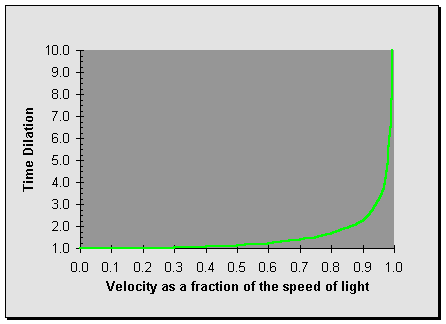
Now let’s have a closer look at the equation and determine just what impact the speed of the object has on time dilation. We can see that is the velocity is small compared to the speed of light the quantity v2/c2 approaches 0 and the equation simplifies t0: t = t0/1 which is simply t. So at relatively slow speeds (our everyday speeds) time dilation is not a factor and Newton’s Laws are still applicable. Now let’s look at high speeds (close to the speed of light), from the equation that as velocity increases the quantity v2/c2 approaches 1 (but will never quit reach it), causing the quantity(1-v2/c2)1/2 t0 become smaller and smaller….therefore causing the time measured by the other observer t0 become greater thus making our time appear slower (refer back to the example). I know its so confusing!!! read it again, think about it, then study the graph below. As one can see in the graph time dilation starts t0 “show up” between .4c and .5c. Also notice that the closer one gets to the speed of light the greater impact speed has on time dilation (notice how steep the curve gets towards the end)..

Antikythera-The Modern Invention in the Past.

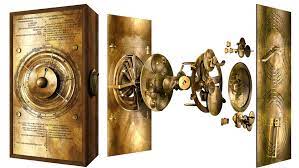
After 2,000 years under thesea, three flat, misshapen pieces of bronze at the National Archaeological Museum in Athens are all shades of green, from emerald to forest. From a distance, they look like rocks with patches of mold. Get closer, though, and the sight is stunning. Crammed inside, obscured by corrosion, are traces of technology that appear utterly modern: gears with neat triangular teeth (just like the inside of a clock) and a ring divided into degrees (like the protractor you used in school). Nothing else like this has ever been discovered from antiquity. Nothing as sophisticated, or even close, appears again for more than a thousand years.

For decades after divers retrieved these scraps from the Antikythera wreck from 1900 to 1901, scholars were unable to make sense of them. X-ray imaging in the 1970s and 1990s revealed that the device must have replicated the motions of the heavens. Holding it in your hands, you could track the paths of the Sun, Moon and planets with impressive accuracy. One investigator dubbed it “an ancient Greek computer.” But the X-ray images were difficult to interpret, so mainstream historians ignored the artifact even as it was championed by fringe writers such as Erich von Däniken, who claimed it came from an alien spaceship. It wasn’t until 2006 that the Antikythera mechanism captured broader attention. That year, Mike Edmunds of Cardiff University in Wales and his team published CT scans of the fragments, revealing more details of the inner workings, as well as hidden inscriptions—and triggering a burst of scholarly research. 

The Antikythera mechanism was similar in size to a mantel clock, and bits of wood found on the fragments suggest it was housed in a wooden case. Like a clock, the case would’ve had a large circular face with rotating hands. There was a knob or handle on the side, for winding the mechanism forward or backward. And as the knob turned, trains of interlocking gearwheels drove at least seven hands at various speeds. Instead of hours and minutes, the hands displayed celestial time: one hand for the Sun, one for the Moon and one for each of the five planets visible to the naked eye—Mercury, Venus, Mars, Jupiter and Saturn. A rotating black and silver ball showed the phase of the Moon. Inscriptions explained which stars rose and set on any particular date. There were also two dial systems on the back of the case, each with a pin that followed its own spiral groove, like the needle on a record player. One of these dials was a calendar. The other showed the timing of lunar and solar eclipses.

Experts have been working to decipher inscriptions hidden inside the mechanism, in particular to understand the mechanism’s missing pieces, some destroyed, some probably still at the bottom of the sea. Though the pointers on the front face don’t survive, Alexander Jones, a historian at the Institute for the Study of the Ancient World in New York, says an inscription reveals that they carried colored balls: fiery red for Mars, gold for the Sun. 

Also missing are the parts that drove the planetary pointers, leading to debate about exactly how they moved. Because planets orbit the Sun, when viewed from Earth they appear to wander back and forth in the sky. The Greeks explained this motion with “epicycles”: small circles superimposed on a larger orbit. According to Michael Wright, a former curator at London’s Science Museum who has studied the mechanism longer than anyone, it modeled epicycles with trains of small gears riding around larger ones. Though some experts have dismissed this as beyond the Greeks’ abilities, Jones says he will publish evidence supporting the idea later this year.

Other inscriptions hint at where the mechanism was made. Paul Iversen, a classicist at Case Western Reserve University in Cleveland, reports that the calendar includes month names used in Corinth and its colonies in northwest Greece. A dial that displayed the timing of major athletic festivals, including the Olympics, lists Naa, a festival held in northwest Greece, and Halieia, held to the south on the island of Rhodes. Perhaps the mechanism hailed from Rhodes and was being shipped north. The ancient philosopher Posidonius had a workshop in Rhodes that could have been the source; according to Cicero, Posidonius made a similar model of the heavens in the first century B.C.

The tradition of making such mechanisms could be much older. Cicero wrote of a bronze device made by Archimedes in the third century B.C. And James Evans, a historian of astronomy at the University of Puget Sound in Tacoma, Washington, thinks that the eclipse cycle represented is Babylonian in origin and begins in 205 B.C. Maybe it was Hipparchus, an astronomer in Rhodes around that time, who worked out the math behind the device. He is known for having blended the arithmetic-based predictions of Babylonians with geometric theories favored by the Greeks. 

Regardless, the Antikythera mechanism proves that the ancient Greeks used complex arrangements of precisely cut wheels to represent the latest in scientific understanding. It’s also a window into how the Greeks saw their universe. They came to believe that nature worked according to predefined rules, like a machine—an approach that forms the basis of our modern scientific views. Edmunds argues that this “mechanical philosophy” must have developed as a two-way process. The ancient mechanics who captured the cosmos in bronze weren’t just modeling astronomical theories but were also inspiring them.

FEB15_J03_Antikythera.jpg

TACHYON A PARTICLE THAT HELPS US TO TIME TRAVEL…

Tachyonhypothetical subatomic particle whose velocity always exceeds that of light. The existence of the tachyon, though not experimentally established, appears consistent with the theory of relativity, which was originally thought to apply only to particles traveling at or less than the speed of light. Just as an ordinary particle such as an electron can exist only at speeds less than that of light, so a tachyon could exist only at speeds above that of light, at which point its mass would be real and positive. Upon losing energy, a tachyon would accelerate; the faster it traveled, the less energy it would have.

The name ‘tachyon’ (from the Greek ‘tachys,’ meaning swift) was coined by the late Gerald Feinberg of Columbia University. Tachyons have never been found in experiments as real particles traveling through the vacuum, but we predict theoretically that tachyon-like objects exist as faster-than-light ‘quasiparticles’ moving through laser-like media. (That is, they exist as particle-like excitations, similar to other quasiparticles called phonons and polaritons that are found in solids. ‘Laser-like media’ is a technical term referring to those media that have inverted atomic populations, the conditions prevailing inside a laser.)

an experiment at Berkeley to detect tachyon-like quasiparticles. There are strong scientific reasons to believe that such quasiparticles really exist, because Maxwell’s equations, when coupled to inverted atomic media, lead inexorably to tachyon-like solutions.

“Quantum optical effects can produce a different kind of ‘faster than light’ effect (see “Faster than light?” by R. Y. Chiao, P. G. Kwiat, and A. M. Steinberg in Scientific American, August 1993). There are actually two different kinds of ‘faster-than-light’ effects that we have found in quantum optics experiments. (The tachyon-like quasiparticle in inverted media described above is yet a third kind of faster-than-light effect.)

“First, we have discovered that photons which tunnel through a quantum barrier can apparently travel faster than light (see “Measurement of the Single-Photon Tunneling Time” by A. M. Steinberg, P. G. Kwiat, and R. Y. Chiao, Physical Review Letters, Vol. 71, page 708; 1993). Because of the uncertainty principle, the photon has a small but very real chance of appearing suddenly on the far side of the barrier, through a quantum effect (the ‘tunnel effect’) which would seem impossible according to classical physics. The tunnel effect is so fast that it seems to occur faster than light.

“Second, we have found an effect related to the famous Einstein-Podolsky-Rosen phenomenon, in which two distantly separated photons can apparently influence one anothers’ behaviors at two distantly separated detectors (see “High-Visibility Interference in a Bell-Inequality Experiment for Energy and Time,” by P. G. Kwiat, A. M. Steinberg, and R. Y. Chiao, Physical Review A, Vol. 47, page R2472; 1993). This effect was first predicted theoretically by Prof. J. D. Franson of Johns Hopkins University. We have found experimentally that twin photons emitted from a common source (a down-conversion crystal) behave in a correlated fashion when they arrive at two distant interferometers. This phenomenon can be described as a ‘faster-than-light influence’ of one photon upon its twin. Because of the intrinsic randomness of quantum phenomena, however, one cannot control whether a given photon tunnels or not, nor can one control whether a given photon is transmitted or not at the final beam splitter. Hence it is impossible to send true signals in faster-than-light communications.

Pin on The Laws of Relativity

THE PAST

Past gets linked with today and tomorrow where our activities affects us.

The past is never where you think you left it

Everyone have their very own past. Someone had success story in it. Someone had failures too. But it doesn’t matter the past is something that shows who you are up to oru what you’ve been brought up.

The past is very important to anybody because it allows oneself to self evaluate himself, before he is judged by others. There’s lot of interesting things behind everyone’s past. If a guy knows his past, he knows what would happen in future.

The mistakes what we’d done in our past will let us and spare us time to change ourself before being struggled in future. There are many right thins too, which should be carried to the future. But there’s wrong too which should be left in past itself.

I’m very sure a successful man had a very bad past. The past influence a person to take an elevation of fall to rise. Many people nowadays running to fix things what we’d done in past, but the saddes truth is we can’t. Yesterday’s right may be wrong in future. Great things takes great time.

The past encourages us to lead a worthy life. The name, the position, the emotions, the character everything changes if we compare our today with yesterday. Every new day is new born to ourself. Peaceful life can be lead by us if we leave our past and work today so that good things joins at tomorrow. Yesterday is a comma today is a question mark and never let your tomorrow to be your fullstop.

You realize that our mistrust of the future makes it hard to give up the past.

HOW I SPENT TIME IN SUMMER VACATION:

Summertime is the most awaited time of any student’s life. It gives them a break from the scorching sun and blazing heat. The summer months are quite hot, however, students love them because they bring a sense of calmness due to the vacations. It frees them from the monotonous and dull routine of school and studies.Most importantly, summer vacations give us a chance to explore new things. We can adopt new hobbies like painting, dancing, singing and more during this time.

Furthermore, it gives us a chance to visit our grandparents or to someplace abroad. Summer vacations bring all types of fun, however, these particular summer vacations were the most memorable for me. My parents made me join a summer camp which was too much fun and then we visited our grandparents’ place.Summer Camp:As the first day of my summer vacations started, I started getting bored easily. Mostly so because all my friends had gone to someplace or the other. My parents noticed this and decided to send me to a summer camp.

Our school itself was organizing one in which my parents got me enrolled.At first, I thought it would be of no use and would be equally boring. However, to my surprise, I was wrong. The summer camp was one of the best experiences of my life. I got the chance to indulge in so many activities and in fact, it was the first time where I discovered my talent for painting.We got up early in the morning at 7 o’clock, despite no school. We had trainers who would teach us different things each day.

On the first day, I got to learn karate, which was very amusing and helpful. Further, I learned how to play sports like basketball, table tennis, and volleyball.Finally, came my most awaited part. We were taught painting and unique tips to master this art. I learned it quickly and started enjoying painting. My passion for painting began from this summer camp, and I will forever be indebted to it.

My Grandparents’ Place:

After my summer camp ended, my whole family decided to visit my grandparent’s village. It is situated away from the city and is full of lush and greenery. I love spending time with my grandparents so I was very excited to visit their village.We stayed there for over two weeks, and that throughout that time, I was at my best behavior. I used to get up at 7 o’clock in the morning to take a stroll with my grandfather.

Then all the family members would get together to have breakfast full of healthy things and fresh fruits from the farm nearby.In the evening, we would sit by our grandmother’s bed and listen to stories. Then, my siblings and I used to go to the terrace and play games. We would also gaze at their stars all night, as we did not get that in the city.In short, this is how I spent my summer vacation. It was definitely one of the best times of my lives. I got to learn new things and spend valuable time with my grandparents. I feel blessed to have a loving family with whom I can enjoy my summer vacation.

Why are summer vacations important?

Summer vacations are the most important and awaited time of a student’s life. It gives them a break from their monotonous routine. Furthermore, summer vacations protect students from the scorching heat and give them a chance to visit hilly stations.

How can one utilize their summer vacation?

There a lot of ways to utilize a summer vacation. It can be done through indulging in many activities. One can join summer camps which teach new skills to students. One can also pay a visit to their grandparents or to some chilly place or abroad to enjoy it to the fullest.

Time Blocking: Improve Your Focus And Get More Meaningful Work Done

Do you have a list of priorities or goals that you want to achieve this year? And do you struggle with allocating time to them? Time blocking might be helpful.

It certainly helped me. Look, I’m not any different from you. Life can be messy. Most of us juggle a lot of different things at the same time. Even though the simple solution is to stop juggling, it’s not always realistic. Or even needed.

What if you could do more things without losing your time? It’s possible. But you must work in an organized way.

Time Blocking a simple productivity exercise that many people use. It’s not fancy or revolutionary. The only thing you need is a calendar, which is something everyone with a smartphone and computer has.

Time Blocking is simply using your calendar to block time for your most important priorities. During that time, you only work on that one thing. And, you let your calendar lead the way. That way, you don’t have to think, “What should I do next?”

But Time Blocking is more than just a productivity tool. It’s about self-awareness.

The road to high productivity starts with awareness.

For instance, one of my priorities this year is to write a book on pragmatic thinking. However, there’s a problem: I haven’t been writing.

How did I come to this conclusion? I simply looked at my list of priorities for 2017, and I then I looked at my calendar.

I hadn’t scheduled any time for writing in a while. Now, you might think, “do you really have to look at your calendar to realize that?”

Yes, I do. I’m not some kind of supercomputer that remembers everything. I’m a regular human being. I think of something to do, start working on it, life gets in the way, and then I FORGET about it.

It happens to all of us. We need self-awareness and tools that keep us in check. And that’s why I like Time Blocking.

Some people love Time Blocking. Some people hate it.

Computer science professor and author of Deep Work, Cal Newport, also uses time blocking. He says:

“I take time blocking seriously, dedicating ten to twenty minutes every evening to building my schedule for the next day. During this planning process I consult my task lists and calendars, as well as my weekly and quarterly planning notes. My goal is to make sure progress is being made on the right things at the right pace for the relevant deadlines.”

The last sentence is exactly why I schedule everything I want to do. Working is not the same thing as making progress. And Time Blocking helps me to improve my focus so I can get meaningful things done. Things that have an actual impact on my life.

I know there are a lot of successful people who work with empty calendars. I’ve read the articles. They simply work two, three or four hours per day.

And to be honest, that sounds very attractive to me too. However, one must look at his/her own life situation.

What are you trying to achieve?

And more importantly: What resources do you have?

Often, people who don’t have a lot of money, do have a lot of time. So why not use it wisely? Either way, I think that planning serves a purpose.

I plan my days and weeks in advance because I want to make sure I’m working on the RIGHT things. Too often, I get lost in completing daily tasks.

Think about it this way. I’m pretty organized already. And I only work on one big thing per area of my life.

But there are many different areas of my life: My family business, my blog, podcast, online courses, relationship, friends, investments, etc.

It might sound like I’m doing many different things. But it depends on how you look at it. Everything I do leads to one thing: Living a meaningful and independent life.

But let’s not get philosophical here. If you’re lacking focus, not making progress, and want to work in a more organized way, give time blocking a try.

Here are some things I’ve learned that may help:

  • Take 10 minutes every evening and plan your next day. Rearrange blocks if you must create time for other important things.
  • Use recurring blocks for recurring tasks. For instance, I’ve scheduled two hours to write my new book every Tuesday and Thursday.
  • Don’t over-schedule. Realistically, you can’t be productive 10 hours straight. Give yourself some time between tasks.
  • And always schedule more time than you think you need.

“Wow, time blocking sounds like too much planning to me.”

No problem. Plan less. There’s always a counter-movement for everything. People who do the exact opposite and advocate an anti-productivity lifestyle. You know, folks who claim they have empty calendars and don’t care about anything.

People who pretend they are always “enjoying” themselves. They like to go with the flow and daydream.

You know what that reminds me of? Those kids in school always said, “Ah dude, I didn’t have time to study for this class,” but always ended up getting straight A’s.

People just want to make you believe they don’t work hard. It’s facade. And when they do well in life, it seems like it came easy.

As far as I know, achieving meaningful things is hard. I don’t think there’s anything cool about pretending it’s easy. Nor do I believe that it’s cool to work yourself to death.

I often think of this question: Are you an amateur or a pro?

It’s Steven Pressfield’s famous analogy, from his book The War Of Art, for getting work done.

The amateur-only works when inspiration strikes. The pro sits down every day and puts in steady work. The key is steady. Not irregular or extreme.

Pressfield says:

“The sure sign of an amateur is he has a million plans and they all start tomorrow.”

Don’t start tomorrow.