Photo by Reynaldo #brigworkz Brigantty on Pexels.com
Stagflation is a situation wherein there persists both inflation(consistent rise in the prices of all the goods and services available in a country) as well as stagnation(lack of any economic development). Since 1970, there have been paradoxical developments in most developed nations of the world. There has been a considerable fall in the level of production and employment on one hand, and rise in the general price level on the other. That is nothing but inflation and stagnation coexisting. Inflation and unemployment are mutually exclusive economic phenomena. There has always been an trade off between these two in an economy. Thus, when both of this coexist, it leads to the rise of a paradoxical situation called Stagflation.
The features on stagflation include:
Rise in general prices.
Rise in the wage rate.
Reduction in the level of demand for goods and services.
Reduction in the level of production.
Emergence of excess capacity.
Increase in involuntary unemployment (a situation wherein people are willing to work at the prevailing wage rate but do not get any work).
Causes of stagflation:
Increase in the supply of money.
Rise in wage rates under pressures from trade unions.
Consistent rise in agricultural prices, owing to the government policy.
Rise in administered prices.
Credit expansion by the banks.
Increase in saving and investment.
Reduced demand for labor resulting in unemployment.
Rise in prices of petroleum and coal.
Increase in industrial capacity.
Stagflation is certainly a more difficult proposition than inflation. In the words of Haberler, “The combination of unemployment and inflation is a very delicate matter, if we fight recession, we stimulate inflation and if we fight inflation, we stimulate recession.
Some measures to control stagflation:
Creation of bank credit and supply of money must be checked.
Excise duty and other indirect taxes need to be reduced to stimulate production.
Consumption level is to be very carefully encouraged.
Labour intensive enterprises are to be encouraged to stimulate employment.
Appropriate income policy needs to be pursued to strike against the problem of inflation.
Wage rate must be suitably regulated.
Stagflation not only causes economic unrest but also leads to social instability. There are many instances where the rich gets richer and the poor gets poorer. There seems a moral dispute within the people resulting in hoarding, black marketing ,etc. Thus, stagflation is an serious economic hindrance which needs to be kept in check.
It is not a new thing for any economy to go through phases of economic problems and in certain cases falling short of actually putting those problems under control. These economic problems include inflation, unemployment, deflation and so on. No matter if it is a developing country or a developed one, both are equally subject to fall prey to such problems. While the economy goes through this period of uncertainty many people think that it is feasible to print more money to tackle the economic issues such as inflation, etc. But this is not a very feasible option in the reality.
The monetary decisions of any country is taken by the government of the respective country i.e., the government decides which denominations are printed and the design of bank notes and other security measures. It is the responsibility of the head bank of the country to follow the protocols while printing the money. There is always a limit that is set with respect to the printing of money. No country can singlehandedly print money in an unlimited manner whatsoever maybe the reason as more money leads to more economic issues.
Reasons why printing more money leads to more problems:
Whenever there is an increase in the supply of a certain good or commodity in the market with respect to its demand, the price of the commodity falls. This is also true in case of money. When there an uncalculated, increased production or printing of money, the money output gets divided within the entire population accordingly. Now each member of the society owns a greater amount of money. This leads to a fall in the value of money since everyone now has more money irrespective of the actual amount that they are supposed to have/ own. As the value of money falls, there is a rapid increase in the prices of the goods and commodities present in the market resulting in inflation i.e., an increase in the overall level of prices in the economy. For example, in January 1921, a daily newspaper in Germany cost 0.30 marks. Less than two years later, in November 1922, the same newspaper cost 70,000,000 marks. All other prices in the economy rose by similar amounts. This inflation was a result of a three times rise in the quantity of money present in the economy which further led to fall in the value of money. This example clearly shows inflation not only depends on the production of goods and services but also depends on the value and quantity of money present in an economy. Inflation further gives rise to another economic problem i.e., unemployment. As the prices of the goods and commodities rise, people, especially the firms in certain cases fall short of adequate resources to continue with the production activities. This further leads to the decision of reducing the number of workers working at the firm or leads to the termination of the working periods of workers in the firm. When this occurs at an widespread and increased basis, it leads to unemployment on a mass scale and causes widespread economic disruption and gives rise to a state of unrest in the society.
To conclude the answer of the question asked, “does printing more money solve all the economic issues?” The answer is “NO”. Rather it leads to further disruption in the economy and gives rise to unprecedented social unrest. Thus the government puts a limit on the production of Money in each year and makes its decision after analyzing the every single data so that there is no place of such economic disruption in near future due to hasty and uncalculated decisions.
Getting job is like climbing Mount Everest nowadays. If you are employed you have achieved they greatest hight in your life.
But here we are not going to take about the problems we face for like population explosion etc in getting employment, instead we are going to take about the solutions for it.
Some solutions
Encouraging people to do startups: this is the first and foremost step to increase job creation as if one do startup then automatically job creation begins and economic gets and boost.
Is in getting loans for startups : the banks should make the process of getting the loans for startup much easier as to encourage people to do it.
Improvement in academic curriculum : there should be improvement in academic curriculum as 2 to encourage the young mind to do their own startup.
Making foreign investment easier : the process for the multinational companies to invest in India should be eased up, by reducing unnecessary paper works and Taxes.
Increase in living standards : if the living standard of the general citizen of the country increases it automatically increases their needs like car, expensive gadgets etc, and to fulfill these needs more companies will bi setup and ultimately increases the employment.
Policy to control population growth : government should introduce policy that encourages people to have less children and ultimately getting a control on the population.
There can be many more ways to create employment. Everybody should contribute their ideas in what ways India can achieve full employment of their people, to get rid of this problem. These were some solutions from my side.
Unemployment refers to a situation in which the workers who are capable of working and willing to work do not get employment. Unemployment also refers to a situation where the persons who are able to work and willing to work, fail to secure work or activity which gives them income or means of livelihood.
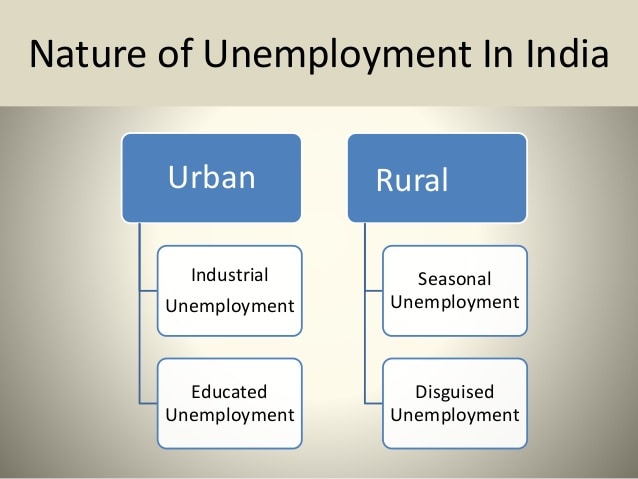
RURAL EMPLOYMENT:
In Rural employment, both unemployment and underemployment exist side by side. The increasing population implies an increasing pressure on land. This pressure on land has resulted in an increase in number of agriculturists, and this has largely contributed to the problem of ununtilized labour in the agriculture sector.
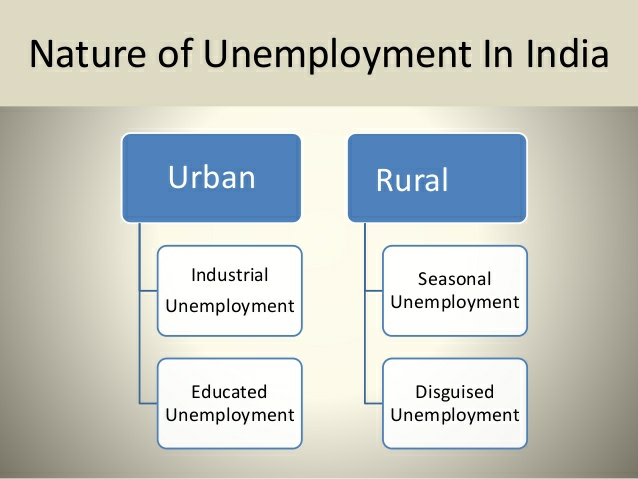
1. SEASONAL UNEMPLOYMENT- caused by seasonal varieties in production or demand or both. When the works are engaged in a particular work or occupation, get employment only for a limited period and remain idle for the remaining period.
2. DISGUISED UNEMPLOYMENT- In Indian villages, people are found to be apparently engaged in agricultural activities. In such a situation, even if many works are withdrawn, same work will continue to be done by fewer people. It follows that all the workers are not needed to maintain the existing level of production. The contribution of such labourers to production is zero or near zero.
URBAN EMPLOYMENT:
Urban employment is largely the off-shoot of rural employment. With the growing process of making of peasantry very poor in the wake of introduction of the capitalist system of farming, and in the face of increasing pressure of population on land, a mass departure of population from rural areas to urban areas take place.
1. STRUCTURAL UNEMPLOYMENT- caused by structural changes like rapidly growing population, fall in the rate of capital formation, technological change etc., in the economy. It is of long run nature.
2. DISGUISED UNEMPLOYMENT- A person is apparently employed bit their marginal product is zero. Marginal product means the product and the produce added to the existing production due to the addition of new employee/ worker.
3. EDUCATED UNEMPLOYMENT- Even a person who is educated/trained and skilled fails to obtain a suitable job suited to his qualification he is said to be educated unemployed.
4. OPEN UNEMPLOYMENT- The labourers when live without any work and they dont find any work to do they come under the category of unemployment. Educated unemployment and skilled labourers unemployment are included in open unemployment. The migration from rural to urban areas in search of work is very often found in India is an example of open unemployment.
5. UNDER UNEMPLOYMENT- refers to the underutilization of manpower available both in terms of time and skill. If a master of engineering graduate work as a clear or an office assistant in an office, he is underutilized in terms of man power.
6. VOLUNTARY UNEMPLOYMENT- Though jobs are available some person may want to remain idle come under the category of this kind. The people who do not have the mind set to work regardless of their economic position and lazy people are included in this category.
7. NATURAL UNEMPLOYMENT- Unemployment ranging between 2 to 3% in the country is considered natural and inevitable. This minimal percentage of unemployment cannot be eliminated at all.
CAUSES OF UNEMPLOYMENT:
The unemployment problem in India has assumed alarming dimensions since independence.
1. POPULATION GROWTH- The galloping in population of our country during the last decades has increased the unemployment problem in the country.
2. INSUFFICIENT RATE OF ECONOMIC PROGRESS- The rate of growth is inadequate to absorb the entire labour force in the country. The opportunity of employment are not sufficient to absorb which are taking place as result of the rapidly increasing population in India.
3. ABSENCE OF EMPLOYMENT OTHER THAN AGRICULTURE- Agriculture is the principle area of employment in the country A major cause of rural unemployment refers the extremely low rate of growth of agriculture.
4. JOINT FAMILY SYSTEM- Existence of joint family system in India promotes disguised unemployment. Usually the members of a family work on their family farms or do family business.
5. SLOW DEVELOPMENT OF INDUSTRIES- Industrialization is not rapid in our country and industrial labours finds few job opportunities. The surplus labour in the agriculture sector labour is not absorbed by the industrial sector.
6. INAPPROPRIATE TECHNOLOGY- An important cause in the urban industrial sector is the use of inappropriate technology. Instead of using technology suited to our requirement of utilizing abundant labour supply available in the country, western modern highly capital-intensive technology is adopted which minimizes use of labour.
The need of hour to fight poverty and unemployment is to have belief approach towards education system and employment generation programmes in rural areas through recent initiatives such as skill India which is a campaign launched by Prime Minister Damodardas Modion 15 July 2015 which aim to train over 40 crore people in India in different skills by 2022.
According to a Reuters poll, the Brazilian economy will continue to experience a so-called “jobless recovery” following this year’s inflation spike, while forecasts for recovery in Mexico appear stronger amid concerns about a possibly tougher monetary policy in the United States.
On the outside, Brazil’s macroeconomic picture appears to have improved as consumers shake off the COVID-19 epidemic, firms experience a resurgence of M&A activity, and the agriculture industry flourishes on huge international demand. Recent increases in GDP estimates, however, are at conflict with a number of issues. Rising inflation, which is presently the major topic, is expected to be followed by consistently high levels of joblessness into next year’s national elections in Brazil.
Because the economy will need some more time to reabsorb people and restore jobs, average unemployment is estimated to stay in the double digits this year, reaching around 13.6 percent. The rising unemployment rate will restrain services inflation, which accounts for nearly 40% of the headline figure.
According to the median estimate of 20 economists surveyed between July 5 and July 13, Brazil’s average jobless rate for 2021 was projected at a record 14.2 percent in the Reuters survey. This is in contrast to a large increase in GDP estimates.
According to a larger group of 40 respondents, Latin America’s No. 1 economy is expected to grow 5.1 percent in 2021, considerably above the relatively moderate 3.2 percent growth rate recorded in April’s survey. Inflation forecasts have also risen, reaching 6.5 percent from 5.1 percent in the previous quarter.
Many Brazilians have lost their livelihoods as a result of the virus. Many also point the finger to President Jair Bolsonaro’s pro-business stance. Other figures suggest robust employment creation, according to the government.
Bolsonaro and his expected opponent, former center-left President Luiz Inacio Lula da Silva, have not formally announced their candidacies yet, despite the fact that the 2022 presidential election remains just a year away.
President Andres Manuel Lopez Obrador of Mexico, however, looks to be on a more solid foundation than his Brazilian counterpart. Although both are embroiled in corruption allegations, Lopez Obrador is under far less scrutiny. Similarly, Mexico’s economy is getting better, with stronger growth and relatively low inflation than that of Brazil. Mexico’s GDP and consumer pricing are anticipated to grow 5.9 percent and 5.1 percent this year, respectfully, compared to 4.7 percent and 3.9 percent in the April survey.
Mexicans are keeping a very close eye on the Federal Reserve of the United States’ intention to gradually phase off its massive assistance. Thus far, this has been welcomed positively from across the border, instead of as a hindrance to financial movements.
In contrast to a drop in Brazil’s anticipated growth in 2022 to 2.2 percent from 2.3 percent, the study predicts Mexico’s GDP would increase 2.9 percent next year, up from 2.5 percent in April.
Analysts at BBVA Mexico said in a statement that they have raised their 2022 GDP projection to 3.0 percent from 2.8 percent due to a better investment picture. This increase will most probably encourage formal private employment to return to pre-pandemic levels in 1Q22.”
When we talk about development, education is the major factor and has a direct or indirect influence on other factors as well. “Our education system rests on the pillars of accessibility, affordability and quality,” quotes our Late ex- President Pranab Mukherjee.
Unemployment is a phenomenon that occurs when a person who is actively searching for employment is unable to find work. A widespread phenomenon which came into existence is educated unemployment or graduate unemployment. A college graduate actively is not able to seek job due to lack of opportunity is termed as graduate unemployment.
In recent times this problem has come to assume a frightening level. A variety of factors including a large population and the defects in the educational system as well as the inability to provide a diversified and vibrant economy can be considered to be the prime reasons for the problem of educated unemployment.
In India, present scenario is that parents are putting lots of money for their child education and dreams their child as a person with successful career and same is the dream of child But reality turns to frustration out of unemployment.
The root of the unemployment begins at the systematic and policy making level. The policies making and their implementation should be incompatibility to the citizens of the state. The people of the nation should be the beneficiaries of these policies, but the case differs at the grass root level. The people in rural areas, which are approx 70% of our total population, have no or least access to such policies. One the causes of graduate unemployment are the quality of education which passes after three to four year of college, employers look for people who have learned how to learn, and have gained substantial communication skills as well as critical thinking abilities. Graduates are not meeting employer’s needs.
“An educated mind with an empty stomach and ample of time doing nothing but cursing the system, is more harmful for an individual or the society than any other problem.”
India is a country having 1.21 billion population and 66% of this population are under the age of 35 (Census 2011). Due to the increased education level in the recent years, the modern youth is well-educated and possess a good degree like B.Tech, B.E., MBA, MBBS, Ph.D. etc. Hence, a major workforce of our country is seeking for a well-paid job in their respective fields. But due to limited access to skill based education and drop in the financial market; it’s hard for them to get a desired job and this entire scenario creates “Educated Unemployment”.
The problem arises when a degree holder is not getting a skilled job due to not being skilled during their degree course. Due to this problem India lacks in skilled labour. According to a survey,“90% of the educated youth is unemployable due to lack of skills i.e. 60% due to lack of communication skills, 25% due to lack of analytical skills, 5% due to lack of knowledge in their respective field”.
Consequences of educated unemployment:
“One year of unemployment reduces the life expectancy by five years”, states a report.
Frustration, anxiety, stress, depression are the common behaviors of an educated unemployed. They are filled up with the rage against the society that has made them develop low self-esteem and fell like they are not among the productive members of the society. To take revenge against the system they indulge in wrong ways of earning money like robbery, chain snatching, rapes, violence, kidnapping, and murders etc. Studies tell that due to the higher rates of educated employment crime rates are drastically increasing day by day. Terrorism, drug trafficking, anti-social groups are the other hazardous outcomes of educated unemployment.
How to solve the problem of educated unemployment:
If we talk about reforms and solution of the unemployment plight about India, multiple technical and vocational institutions should be the establishment in the country and the significance of vocational courses to be instilled in the mind of people and efforts to break the taboo about their job insecurity. A campaign to present and promote more educational fields except engineering and medical should be recited to the people in the rural areas. The higher education like post graduation and PHD courses should be promoted to divide the job opportunity. Pradhan Mantri Kaushal Vikas Yojana, Swarnajayanti Gram Swarozgar Yojana, Mahatma Gandhi national rural employment guarantee act and several other should be promoted and implemented efficiently throughout the country.
Conclusion:
Economy and employment are the backbones of any state, the regular reforms and policy making should always be considered for the enshrouded growth. With the population which I possess, carrying youngsters as liabilities whereas they should be the support and help the nation go further ahead is an enormous devastating thought.
India is a over-populated country. It is the second most populated country in the world, after China. However, researchers say that India is all set to surpass China in population density by 2024. That means India is about to become the country with the highest population density across the world.
The population of India is increasing at an alarming rate. India is not the country with the highest number of people. There are countries which has more number of people than India like Russia. But they are not overpopulated. Those countries have enough space to fit in the number of people. India has more people than the country could fit in. The number of people residing in per unit square of land in India is much higher than that of other countries. This makes India an over-crowded country.
The huge population of India makes a lot of people live in poverty. The country’s economy is not enough to sustain its population. Adding to the problem, the country’s wealth is not equally distributed. The economic gap between the rich and the poor is widening. The major chunk of the country’s wealth is held by the rich and the powerful who are quite few in number compared to the country’s huge population. A large chunk of the population live below poverty line who do not have enough money to afford their meals thrice a day.
Also, the country does not have enough employment opportunities for all its citizens. This leads to unemployment, economic distress, stress and mental health problems. Unemployment increases the amount of crimes, theft and illegal business practices.
Along with wealth and job opportunities, India’s natural resources are also limited and not enough for its huge population. Over-consumption of natural resources would exhaust them and leave none for our future generations. Overpopulation is also a threat to our environment. The air and water bodies are becoming more and more polluted day by day. Too much burning of fossil fuels, congested roads and too many vehicles are releasing toxic gases in the air.
Accommodation is also a problem in India. Thousands of people live in slums which are over-crowded with unhealthy living conditions. More houses and buildings are being constructed which leaves no place for plants and nature. Forests are cut down to make room for construction projects. The cutting down of trees leads to increase in the level of carbon dioxide in the atmosphere.
Population explosion is a serious problem which needs to be addressed at any cost. The Indian population should be controlled to improve the lives of the people. Awareness drives and contraceptive alternatives should be adopted with immediate effect.
Unemployment and poverty goes side by side. Young people after a long time of unemployment find the wrong way to earn money.To get rid from the unemployment stress, they accept alcohol or drugs.Unemployed youths accepts suicide as the last option of their life.Lower economic growth.Unemployment means a person willing to work but unable to find a qualified job. Our country is facing many problems but one of the serious problem is of unemployment. Many graduates, doctors, engineers, scientist are unemployed or working underemployed.
Due to unemployment we are wasting our country’s human resource. The unemployed rate in between age group 15- 29 has been increased since 2009-2010. According to the Global Employment Trends 2014 the unemployment rate has raised to 3.8%, last year it was 3.7%. The International Labour Organisation (ILO) has said in the recent report that India has shown rise in the unemployment in the last two years.If the problem of unemployment is solved it will help in development of the country. With Population of1.20 billion in our country the unemployment rate is increasing day by day.
The problem of unemployment is rising but still many industries are facing the problem of skilled candidate for their company. There is a boom of software companies, Outsourcing companies in India, but still facing the problem of unemployment. Here are some of the reasons why there is unemployment in India.
There are employment opportunities in India, but the rising population problem creates the unemployment. If the population grows in the same rate the next generation will face more problems of unemployment. If there is vacancy for 1 position 100 or 1000 apply for the position and only one gets the job and others remain unemployed.InflationIndians don’t take jobs which are below their grades. Many find it difficult to work at the below qualification level job.Low wages or salary below the market rate.Many big industries look for the skilled candidate only, for their company.RecessionMany Employers give preference to the experienced candidates only and not the fresher.Not enough or new jobs: As per the experience & analysis from Get Sarkai Naukri, number of new government jobs is decreasing every year. Government is not able to create enough jobs keeping in mind the Indian population.Slow business expansion Advanced Technology: Earlier for a task hundreds or thousand people were required to do a work but now due to the advanced technology only one person can do many people’s work. With the advanced technology companies are hiring few persons to operate the machine. Give a command on computer and the work is done this has cut off the employment of many.Corruption: In Government sector and in some private sector people get the job by giving the bribe. Even though the candidate is not that qualified but if he gives the bribe he gets the job. So to get a government job give a bribe.The qualified candidate remains unemployed as no money to give the bribe. Even though the candidate is not that qualified but if he gives the bribe he gets the job. So to get a government job give a bribe.The qualified candidate remains unemployed as no money to give the bribe. The problem of unemployment gives rise to the problem of poverty. As the employed youth don’t have anything to do they start doing robbery, murder etc.Health issues i.e it affects mentally as well as physically Solutions to the unemployment in India .
1. The very first solution for the unemployment is to control the rising population of our country. Government should motivate people to have small families. Indian government has started initiatives to control the population but still the population is rising.
2. The quality of Indian education should be improved. The current education system is not upto the level. Government should keep a strict watch on the education system and try to implement new ways to generate skilled labour force. Government should select a committee to look after the schools and universities. The syllabus taught is of no use to the industries so the education should be as per the current requirements of the industries. Before completing the education a practical knowledge should be given.
3. Also today’s youth should join the institute or select the course where proper training is given and the course is as per the current industries requirements. Take the course as per your interest and which will bright your future.
4. Government should encourage and develop the agriculture based industries in rural areas so that the rural candidates don’t migrate to the urban areas. More employment should be generated in rural areas for the seasonal unemployment people.
5. Rapid Industrialization should be created.
6. Development of the rural areas will stop the migration of the rural people to the urban cities and this will not put more pressure on the urban city jobs.
7. Government should allow more foreign companies to open their unit in India, so that more employment opportunities will be available.
India as a nation is faced with massive problem of unemployment. Unemployment can be defined as a state of worklessness for a man fit and willing to work. It is a condition of involuntary and not voluntary idleness.
Some features of unemployment have been identified as follows:
1.Unemployment rates for women are higher than those for men.
2.The incidence of unemployment is much higher in urban areas than in rural areas.
3.The incidence of unemployment among the educated is much higher than the overall unemployment.
4.There is greater unemployment in agricultural sector than in industrial and other major sectors.
TYPES OF UNEMPLOYMENT IN INDIA
1.Open Unemployment: Open unemployment is a situation where in a large section of the labor force does not get a job that may yield them regular income. This type of unemployment can be seen and counted in terms of the number of unemployed persons. The labor force expands at a faster rate than the growth rate of economy.
Therefore all people do not get jobs.
2. Seasonal Unemployment: It is unemployment that occurs during certain seasons of the year. In some industries and occupations like agriculture, holiday resorts, ice factories etc., production activities take place only in some seasons. So they offer employment for only a certain period of time in a year. People engaged in such type of activities may remain unemployed during the off-season.
3. Cyclical Unemployment: It is caused by trade cycles at regular intervals. Generally capitalist economics are subject to trade cycles. The down swing in business activities results in unemployment. Cyclical unemployment is normally a shot-run phenomenon.
4. Educated Unemployment: Among the educated people, apart from open unemployment, many are underemployed because their qualification does not match the job. Facility education system, mass output, preference for white collar jobs, lack of employable skills and dwindling formal salaried
jobs are mainly responsible for unemployment among educated youths in India.
5. Structural Unemployment: This type of unemployment arises due to drastic changes in the economic structure of a country. These changes may affect either the supply of a factor or demand for a factor of production. Structural employment is a natural outcome of economic development and technological advancement and innovation that are taking place rapidly all over the world in every sphere.
6. Underemployment: It is a situation in which people employed contribute less than their capacity to production. In this type of unemployment people are not gainfully employed. They may be employed either on part-time basis, or undertake a job for which lesser qualification is required.
7. Casual Unemployment: When a person is employed on a day-to-day basis, casual unemployment may occur due to short-term contracts, shortage of raw materials, fall in demand, change of ownership etc.
8. Chronic Unemployment: If unemployment continues to be a long term feature of a country, it is called chronic unemployment. Rapid growth of population and inadequate level of economic development on account of vicious circle of poverty are the main causes for chronic unemployment.
9. Frictional Unemployment: Frictional unemployment is caused due to improper adjustment between supply of labor and demand for labor, lack of correct and timely information, seasonal nature of work, etc.
CAUSES OF UNEMPLOYMENT IN INDIA
The important causes of unemployment in India are:
“An unemployed existence is the worst existence of life than the death itself”
Unemployment is a very serious issue not only in India but in the whole world. Many people do not have employment. The problems of unemployment are severe in India due to population growth. It is not a problem to be neglected but a problem to which a solution is a must. If this problem is neglected, it turns down to be the doom of the nation.
In a population of 1.32 billion, it is really hard to make everyone employed. From a survey of unemployment-employment based on expenditure which was carried out in July 2011-June 2012, the employment rate was 2.7%. But a survey based on educational levels for July 2017-June 2018 reported the rate as 6.1%. This reveals a crisis of quality jobs among the educated youth. The unemployment rate among people of 15-29 stood at 27.2% for women, 18.7% for men in urban areas, and 13.6% for women, 17.4% for men in rural areas in 2017-2018. This shows a genuine increase in the unemployment rate. As the education levels are rising, the aspirations are also rising. The categorization is that one with a job is considered employed and the one without a job and trying to find a job is considered unemployed.
THE PROBLEM
Unemployment emerges as a major problem because we are more concerned about our status in society than grabbing the opportunities. If everyone tries to opt for a white-collar job, that particular field will be crowded and the remaining left empty. Unemployment is first and foremost an economic and social problem as it brings about money for the unemployed as well as for the nation. It can be sorted out by entrepreneurship and by focusing on agriculture. There are many causes for unemployment but a few among them share a larger part. The caste discriminations fail to treat every individual equally. As a result, low caste people remain unemployed on a large scale than the high caste people. Another cause is our education system. The education should be technical and practical but we are guided theory-oriented. The education we gain must be job-oriented to overcome unemployment. The rising population creates unemployment and this, in turn, will create a serious impact. Awareness about the increasing population alone cannot help, implementation could only help.
As unemployment touches its peak, poverty also starts to touch its peak. This unemployed condition paves the way for an individual to choose the illegal way to get money. They tend to take alcohol, drugs or at last commit suicide out of stress. Unemployment increases crimes and also it affects physical and mental health.
THE SOLUTION
These problems could be solved by improving the education system as said earlier. Developing the rural areas could stop the migration of people to urban areas thereby reducing the population in urban areas. Government should encourage and develop agriculture-based industries in rural areas. More opportunities can be created if we allow foreign companies to start their unit in India. On the whole, we must follow the saying, “United we live divided we fall” to bring all these into action.
Since then the rural unemployment rate has been on the rise to stand at 8.37% for the week ended August 9 and further to 8.86% in the week ended August 16.Compared with a week earlier, the employment rate and labour participating rate (LPR) also increased to 38.4% and 42.2% from 37.09% and 40.62%, respectively, the Centre for Monitoring Indian Economy (CMIE) said.“There is a big increase in rural India in both employment and unemployment rates. This reflects increased agricultural activities,” CMIE’s managing director and CEO Mahesh Vyas said.Buoyed by hectic sowing activity and jobs offered under rural employment guarantee scheme, MG-NREGS, the unemployment rate in rural India steadily plummeted to 6.34% for the week ended July 12 from 17.92% for the week ended May 31, but it again headed north to 7.10% for the week ended July 19 and further to 7.66% in the very next week; but fell to 6.47% in the week ended August 2.In urban India, the unemployment rate has been steadily decelerating from 25.14% for the week ended May 31 to 8.73% for the week ended August 2; but since then the graph is on the rise to 9.31% for the week ended August 9 and further to 9.61% for the week ended August 16.India’s unemployment rate was a tad higher at 24.3% for the week ended May 24 compared to 24% in the preceding week or the average unemployment rate of 24.2% in the past eight weeks of the lockdown. The unemployment rate stood at 8.8% in March.“A combined factor of demand and supply, lack of opportunities in rural India, crop seasons coming to an end will increase the unemployment scenario in the short to medium term. The micro-lockdowns imposed by stated to curb the spread of covid-19 are having their impact as well,” said K.R. Shyam Sundar, a labour economist and professor at XLRI Jamshedpur.“The economic adjustments via scheme jobs like national employment guarantee scheme will not be able to solve employment problems. Because works provided through those schemes has a wage and skill mismatch for many workers who had returned,” explained Sundar.
Article by – Shishir Tripathi Intern at Hariyali Foundation In collaboration with Educational News
An individual for living a life with pride and respect with a roof above the head and Food on the dining table, a steady employement is required. But after the arrival of Covid19 into the scenario the whole situation has been changed and the virus has affected a lot of bindividuals’ livelihood to a very great extent.
The economy was suffering since the slowdown which came into the country after the year 2018-19. The automobile sector wasthe kne which was affected to the maximum extent. Sales were low and the market was lesser and lesser demand from the marketside and as a result after the end of the fiscal year, a lot of inventory was left with the automakers.
India’s automobile industry accounts for 49% of the country’s manufacturing GDP, and it directly and indirectly employs 37 million workers. According to the Society of Indian Automobile Manufacturers (SIAM), 3, 50,000 jobs (mostly contractual) have been lost because of this slowdown and over a million are at a risk due to plant shutdowns and bankruptcy of dealers and component makers.
The services sector is the largest sector in India. The services sector accounts for 53.66% of total India’s GVA of Rs. 137.51 lakh crore. The industrial sector is at the second spot and contributing around 31% of the Indian GDP.
As many as 41 lakh youth in India lost jobs due to the Covid-19 pandemic with most job losses in the construction and farm sector, according to a joint report by the International Labour Organization and the Asian Development Bank. Youth will be hit harder than adults (25 and older) in the immediate crisis and risk bearing higher longer-term economic and social costs, said the report.
There are job disruptions in the form of reduced working hours and earnings, and job losses for both paid workers and the self-employed; disruptions in their education and training; and difficulties in transitioning from school to work, and moving between jobs in a recession.
Data from the Centre for Monitoring Indian Economy (CMIE), an independent body that measures and tracks economic indicators, has said that salaried jobs took a big hit during the COVID-19 lockdown, with the total loss estimated to be at 18.9 million during April 2020-July 2020.
The plight of salaried employees has worsened since the lockdown, with a loss of 17.7 million salaried jobs in April, additional 0.1 million jobs in May, followed by a gain of 3.9 million jobs in June and then again a loss of 5 million jobs in July.
Salaried job loss are very rare, but once lost they are further so difficult to be retrieved again. Another report says that salaried jobs were nearly 19 million short of their average in 2019-20.
As per the World Economic Forum (WEF), the Coronavirus pandemic is putting up to 50 million jobs in the global travel and tourism sector at risk. Of the 50 million jobs that could be lost, around 30 million would be in Asia.
Data from bloombergquint.com, timesofindia.com and theeconomicstimes.com
Moving ahead from the data of organized sector, there’re huge job losses in the unorganized or informal sector where there are no regulations, no rules and hence no correct data. Over 122 million people in India lost their jobs in April, according to estimates from Centre for Monitoring Indian Economy. Around 75% of them were small traders and wage-labourers. Local manufacturers previously also were not in a very good state because of big foreign producers availing goods at cheaper prices, but after the lockdown and the corona virus, their condition have turned to be even more inferior.
Small street food sellers, vendors who generally earn on daily basis, without savings and without sale have shut down their small business and are in a very bad state prolonging to have some credit and start the business again.
Even after introduction of various budgets and relief funds by the department of finance but still, daily wage labourers, and the small businesses are still suffering. Though the relief funds and other budgetary measures are taken by the government but this help is not reaching to the people at the root level. Proper disbursement of financial help directly to all the concerned groups should be there and the benefits of the schemes and other employment generation programs should reach to every sufferer.
Cumulative efforts by the government and other bodies will help the working population and various business to grow again and retaining their same positions like earlier in comparatively lesser time.
Even though money won’t buy happiness in today’s era most people are willing to sacrifice their happiness for money and we cannot blame them because everyone judges you based on how much money you earn and spend. If you earn a lot then you hold a special place in society.Inequality has been surging sharply since the last three decades. The wealthiest have cornered an enormous portion of the assets built through cohort capitalism and legacy. They are becoming richer at a very faster speed while the underprivileged are still trying to earn a minimum wage and access standard education and healthcare services, which continue to suffer. People in poverty are those who are considerably worse-off than the majority of society. Their level of need means they are powerless to obtain gains and aids that most people hold necessary to an adequate measure of existing.The best example is inequality in healthcare facilities which has taken a serious.
Inequality, by distinction, is always a comparative term that relates to the disparity within levels of living standards, wages, etc. across the entire financial division. Poverty and inequality oftentimes up rise and befall collectively though this need not surely be the fact. Inequality can be high in a society without great levels of poverty due to a huge distinction within the top and the middle of the revenue spectrum. An important part of inequality is apparent because of the high numbers of labor organizations work in sectors with low productivity for example agriculture. To overcome inequality, low- productivity workers should be incentive to shift to more fecund sectors. Concurrently, structural improvements require to be fulfilled to improve the fecundity of these divisions.
Technology should not be made a substitute or deemed a rival. It should be seen as a means to address inadequacy and inequality. Enhanced technology can create more prominent demands. These next can enable more inclusive hiring of the low and the medium-skilled. Technology can enhance the potency of the agrarian sector. It can further promote versatility to sectors with tremendous productivity, as is apparent from the vast numbers of people foregoing farming for jobs in the help sector.
Education is the foundation for a fulfilling and leading a satisfactory life. For a nation to be packed with the understanding it has to adopt education as it is the solitary guarantee for a stable economy and a secure domain. Education shapes people into efficient and hardworking individuals. The importance of such an accomplished and knowledgeable society would help nurture a community that is operating as one for the economic advancement of the entire nation. The proficient workforce would be formed by education. Also of vital importance is the contribution of education towards the development of best economic policies. The government should break the cruel progress of poverty which makes inequality, which does not only negatively harms sustainable financial growth but also creates various socio-economic problems. The government should create job opportunities and employment that will be the key strategy to eradicate poverty and inequality.
Pour one out for 2020 grads. It’ll be hard to find a job in this market
Says Los Angeles Times
The current economic conditions could take this year’s grads 10 years or more to recover from
The Atlantic
The unemployment rate has been growing in the country for the last couple of years. The rates were higher in urban areas than in rural areas and saw a similar trend among gender. The unemployment situation in the country was the major cause of worry and anxiety among many Indians. The coronavirus (COVID-19) pandemic had only accelerated the unemployment rates, and the situation is expected to improve with many joining the labor force in the days following lifting of lockdown restrictions.
As of now, it’s not clear for just how long their progress will be stalled. “I would talk [in terms of] years,” Till von Wachter, an economist at UCLA who has studied how young workers fare during and after economic downturns, told me. “If [the economy] recovers in the first year, there’s some hope. If it’s bad into the spring of 2021”—an eventuality that seems more and more likely—“then these individuals should worry.”
The cause for worry is the record of previous graduates who stumbled into an inhospitable economic climate. Researchers have shown that the economic scars of graduating into a recession—sustained higher rates of unemployment (for high-school graduates) and lower earnings (for everyone) compared with peers graduating as little as a year or two earlier or later—can last for as long as 10 or 15 years. This bad luck may also be dangerous for people’s health: Workers who were launching their careers during the recession of the early 1980s were found to have a heightened risk of dying in middle age, often due to increased incidence of heart disease, lung cancer, or drug overdoses.
In line with previous research, the cohort that graduated into the most recent economic catastrophe, the Great Recession, is still struggling overall. According to a paper by Jesse Rothstein, an economist at UC Berkeley, the pay and employment rate of those who graduated from college during the downturn remained relatively low throughout the 2010s.
As per the budgetary estimates by the Indian government, there has been a deficit in the estimates of the number of jobs to be created compared to the actual jobs created over the years. Even though only 24 percent graduates were being hired, the organized sectors of employment in the country grew at nearly 29 percent in financial year 2020.










 Eduindex
You must be logged in to post a comment.