"Working From home"

 Union Minister of State (Independent Charge) Science & Technology; Minister of State (Independent Charge) Earth Sciences; MoS PMO, Personnel, Public Grievances, Pensions, Atomic Energy and Space, Dr Jitendra Singh today reached out to employees “Working From home” and also officers and staff of Ministry of Personnel DoPT DARPG, Public Grievances and Pensions who are in quarantine or infected by COVID-19.
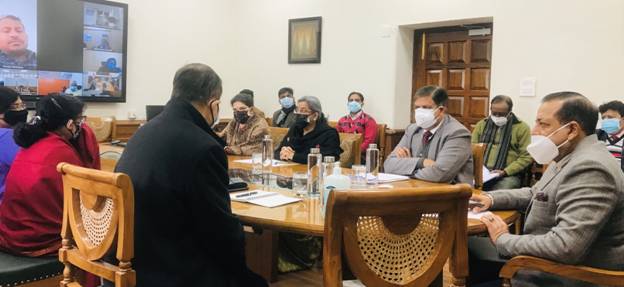
 

He inquired about the well -being of each one of them and also asked them to share their experience as well as suggestions.

During the meeting, Dr Jitendra Singh noted with satisfaction that all the eligible employees of the age of 18 years and above got vaccinated with both the doses and made a general appeal to people who are yet to get vaccinated against COVID-19 should do so immediately in the wake of surge because of Omicron spread.

The Minister was apprised that out of 663 officers and staff of DoPT, 46 got infected with mild symptoms and 20 of them already recovered. Similarly, 8 persons out of 158 from DARPG and 6 employees out of 58 from Department of Pensions got infected in the third wave, however not a single case of hospitalisation was reported so far.

Dr Jitendra Singh lauded the efforts, dedication and commitment of the officers and staff toward the office functioning without interruption during the pandemic and noted with appreciation that work output has not suffered and rather in some cases work output increased because of target oriented work culture with flexi timing. He said, the overall output was also better due to near total adoption of e-office mode. Moreover, Work from Home (WFH) also resulted in employees working during weekends and holidays to achieve the given target, the Minister added.
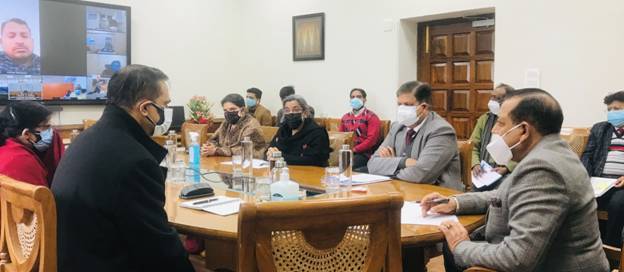
 

Several officers and staff of the Ministry shared their experiences online with Dr Jitendra Singh and all of them reiterated their commitment for target oriented work culture. The Minister assured those affected and their family members all help and support from the Ministry. Virtual Private Network (VPN) connection has been provided to all the employees to facilitate WFH.

Dr Jitendra Singh said, as per the latest O.M. of DoPT, pregnant women employees and Divyang employees have been exempted from attending office and the physical attendance of government servants below the level of Under Secretary has been restricted to 50% of the actual strength and the remaining 50% shall work from home. However, the Minister said, the officials/staff who are not attending the office and are working from home shall remain available on telephone and other electronic means of communications at all times.

The Minister advised all the officers/staff to ensure strict compliance of COVID-appropriate behaviour i.e. frequent washing of hands/sanitisation, wearing face mask/face cover and observing social distancing all the time. Proper cleaning and sanitisation of the workplace, particularly frequently touched surfaces, may also be ensured.

Secretary, DoPT P.K.Tripathy, Secretary, DARPG and Pensions, V.Srinivas, Additional Secretary, DoPT Rashmi Chowdhary, Additional Secretary and EO, DoPT Deepti Umashankar, Jaya Dubey, Joint Secretary, DARPG and other senior officials joined the meeting.

*******

"Working From home"

 Union Minister of State (Independent Charge) Science & Technology; Minister of State (Independent Charge) Earth Sciences; MoS PMO, Personnel, Public Grievances, Pensions, Atomic Energy and Space, Dr Jitendra Singh today reached out to employees “Working From home” and also officers and staff of Ministry of Personnel DoPT DARPG, Public Grievances and Pensions who are in quarantine or infected by COVID-19.


He inquired about the well -being of each one of them and also asked them to share their experience as well as suggestions.

During the meeting, Dr Jitendra Singh noted with satisfaction that all the eligible employees of the age of 18 years and above got vaccinated with both the doses and made a general appeal to people who are yet to get vaccinated against COVID-19 should do so immediately in the wake of surge because of Omicron spread.

The Minister was apprised that out of 663 officers and staff of DoPT, 46 got infected with mild symptoms and 20 of them already recovered. Similarly, 8 persons out of 158 from DARPG and 6 employees out of 58 from Department of Pensions got infected in the third wave, however not a single case of hospitalisation was reported so far.

Dr Jitendra Singh lauded the efforts, dedication and commitment of the officers and staff toward the office functioning without interruption during the pandemic and noted with appreciation that work output has not suffered and rather in some cases work output increased because of target oriented work culture with flexi timing. He said, the overall output was also better due to near total adoption of e-office mode. Moreover, Work from Home (WFH) also resulted in employees working during weekends and holidays to achieve the given target, the Minister added.


Several officers and staff of the Ministry shared their experiences online with Dr Jitendra Singh and all of them reiterated their commitment for target oriented work culture. The Minister assured those affected and their family members all help and support from the Ministry. Virtual Private Network (VPN) connection has been provided to all the employees to facilitate WFH.

Dr Jitendra Singh said, as per the latest O.M. of DoPT, pregnant women employees and Divyang employees have been exempted from attending office and the physical attendance of government servants below the level of Under Secretary has been restricted to 50% of the actual strength and the remaining 50% shall work from home. However, the Minister said, the officials/staff who are not attending the office and are working from home shall remain available on telephone and other electronic means of communications at all times.

The Minister advised all the officers/staff to ensure strict compliance of COVID-appropriate behaviour i.e. frequent washing of hands/sanitisation, wearing face mask/face cover and observing social distancing all the time. Proper cleaning and sanitisation of the workplace, particularly frequently touched surfaces, may also be ensured.

Secretary, DoPT P.K.Tripathy, Secretary, DARPG and Pensions, V.Srinivas, Additional Secretary, DoPT Rashmi Chowdhary, Additional Secretary and EO, DoPT Deepti Umashankar, Jaya Dubey, Joint Secretary, DARPG and other senior officials joined the meeting.

*******

Ways To Improve Your Work-Life Balance While Working From Home

Work is an important aspect of everyone’s lives. Our income ensures that the lights are kept on, that there is food on our table, and the rainy-day fund is full. In today’s volatile and incredibly quick corporate environment, achieving work-life balance is a difficult challenge.

As we become more linked via social media and the internet, it becomes increasingly difficult to distinguish our workplace from our personal life. It is standard practise to read emails at all periods of the day and night, to handle business calls at the dinner table, and to work on our computers on weekends. How did this come to be regarded as acceptable?

Jobs are starting to require more and more from their employees, putting them under intense pressure to provide better outcomes. As a result, employees work harder and longer and spend less time at home.

Despite overwhelming proof that working longer is damaging to both individuals and employers, several workers continue to struggle to alter their beliefs — and strongly established behaviours — about work hours.

Establishing a healthy work-life balance is not only beneficial to one’s health and wellbeing, but it could also boost one’s efficiency and, consequently, performance. Simply stated, if your employees do not see work as a chore, they will work even harder, commit fewer errors, and are much more inclined into becoming company supporters.

How To Improve Your Work-Life Balance While Working From Home

Allow yourself to just let go of perfection

We should constantly aim for excellence rather than perfection; this really is especially crucial when balancing work and life while working remotely. You are unlikely to have everything you need to do your tasks exactly as you would at the office. You won’t have access to all of your files, computer, copier, or even the fax machine you barely use once a month. It’s time to make changes and just do the utmost you can with the resources you have. It’s a little mental adjustment, but it makes a massive impact.

Disconnect

If you’re always available, your working hours never conclude. You require those periods when you switch off. Allow yourself some time away from work. It might be something as easy as not reading emails in the evenings or on weekends. Give yourself periods of tranquilly rather than racing through each activity.

Exercise

Exercise should always be the first thing we make time for when our routine is interrupted in such a major way. It decreases stress, increases endorphins, and improves your mood. Don’t even have an hour to work out? Begin by stretching for 15 minutes with yoga. It will provide you with the same benefits (although on a smaller scale) as well as an extra sense of achievement and self-care.

It’s understandable that when gyms and sports centers are shut, it might be difficult to find alternative forms of exercise. Several trainers and gyms now offer online lessons, and you may even find free classes on YouTube. When working at home, exercising is a wonderful method to attain work-life balance.

Have proper meals

While munching on snacks during the day while working from home may sound appealing, it does nothing for your productivity or feeling of work-life balance. At work, we may feel more driven to take a lunch hour when our colleagues urge us to do so – this doesn’t really occur when you are working from home. Ensure that you schedule time in your day for a decent break. Create a calendar or phone alert about it.

Create transitions going in and out of the work mindset

We frequently take our transit time for granted and wish we can get there sooner. However, we rarely recognise the chance it provides to psychologically prepare. You don’t usually sign off on a large project and then head home to cook dinner. Allow your mind to press the reset button. Get a signal to serve as a buffer at the start and conclusion of your day.

Remember to socialise

When the whole company begins working from home, you are shut away from several informal everyday contacts. If you’re not accustomed to working alone, this might be isolating. Occasional social contacts can break up your day and make it feel unique, whereas isolation may make each day seem like Groundhog Day, except we’re all working.

Resist this by speaking with your coworkers several times during the day. Take a video coffee break, inquire how they did over the weekend, check up on their personal happenings, reach out and exchange that joke or meme, or simply talk about the series you’re currently binge-watching. Continue to chat to them on a certain issue if you typically do.

When working from home, these small encounters might help you maintain your work-life balance.

How Tik-Tok changed the World!!!

2020 has been a year of chaos, uncertainty and grief. A global pandemic, record unemployment and nationwide protests have left people reeling. Through it all though, there’s been TikTok, providing moments of levity and new dance crazes, interspersed with more serious commentary on the issues that we face.

New TikTok CEO Kevin Mayer Explains Why He Left Disney – Variety
TikTok, it’s like the party you want to be at, a t the moment. You’ll see hair tutorials, cooking tutorials. People can create challenges, they can create duets, they can interact, they can engage. TikTok is the most downloaded app of 2020. Since its global release less than two years ago, TikTok and its Chinese counterpart, Douyin, have amassed 800 million monthly active users, more than Reddit, Snapchat or Twitter. Its parent company, ByteDance, is the most valuable startup in the world. Its reach might surprise you unless you’re a member of Gen Z or the parent of one. But as millions scramble for connection amidst quarantines, more and more users of all ages are hopping aboard.

EXCLUSIVE: TikTok CEO Kevin Mayer to address 2,000 panic-stricken ...
The Chinese-owned app faces a slew of regulatory hurdles, privacy concerns and allegations of censorship. Amidst these struggles, it’s brought in a new CEO. This guy is Kevin Mayer. Formerly the Head of Streaming at Disney. That’s basically what Kevin Mayer’s first priority needs to be, is to make sure that Americans trust TikTok. In the end of the day , t hat may prove complicated. But in the short term, it hasn’t prevented tens of thousands of new users from signing up. The predecessor to TikTok was an app called Musical.ly. Founded in 2014, it provided a platform for users to create short, 15 second videos set to a song of their choice. The content mostly involved lip-syncing and dancing, and it took off quickly among preteens and teenagers within the U.S. This is an app that was built around the fact that there was music that was licensed to be used on this app. This was something that Musical.ly decided really to invest in, because they knew that music and sharing music was inherently social.

Reddit CEO claims TikTok app is 'fundamentally parasitic' and ...
In July 2015, a year after its launch, Musical.ly reached number one in the iTunes app store. It continued to grow and was bought by the Beijing-based startup ByteDance for one billion dollars in 2017. ByteDance already owned Tik Tok, a similar video sharing platform, and merged the two apps less than a year later. Now TikTok’s main office is in Los Angeles, California. They’re essentially an American startup that is subsidized by a successful Chinese tech company. As the app has grown, it’s given rise to a whole new pack of social media celebrities. Content is public by default TikTok, and therefore the algorithm that determines what appears on a user’s home page gives every creator the prospect to place their video in front of millions. Really what we saw was a different style of humor. It wasn’t the sketches that you saw on Vine, and it wasn’t longer-form YouTube videos. It was meme culture or like the general public’s take on a meme. What I enjoyed about it is there was some deeper humor in there if you were paying attention to the trends that were happening.
On TikTok, King uses creative video editing to make it look like he’s performing magic tricks, a skill which has earned him over 44 million followers, the second most on the app as of June 2020. But at 30, King represents the rare millennial that’s broken into TikTok’s top ranks. Many of the most followed users are in their teens, and lip syncing and dancing remain wildly popular. So I originally started when I was 14 years old, and so I started using my facial expressions and hand motions to make these like larger than life lip sync videos. And as I grew up, I think the app also grew up. Now there’s so much more that you can do. While Martin has found her niche with dancing and lifestyle content, she says there’s something out there for everyone. There’s like creators who are huge when it comes to comedy, some still do lip syncing, some cooking videos, tutorials. You can do whatever you want as long as it’s fun, it’s quick and it catches people’s eye. Stay at home orders have propelled the app’s rapid growth in the United States. The U.S. is third in terms of downloads and second in terms of revenue, and its influence continues to grow.
Viral dances and memes have propelled a number of songs to the top of the U.S. charts, most famously, Old Town Road in 2019 . And now the moms, dads and siblings of the TikTok o bsessed have began to get in on the trends also , learning dances and performing challenges together. You’re still laughing at them, but actually the fact that parents are getting on it, I mean they needed that demo so badly to even make it to this level that they’re at now. In order to build out a sustainable revenue model, e xperts say that TikTok eventually needs to attract older users. Advertisers are going after broader demographics and especially those with purchasing power. TikTok claims that all American user’s data is stored within the U.S. and is not subject to Chinese law, many security experts remain skeptical. Similar concerns exists in India, where data protection laws are weaker and thus citizens are more vulnerable. Regulators are going to be very weary of that separation. Most recently, the app received criticism for what it said was a technical glitch, in which post tagged with #BlackLivesMatter and #GeorgeFloyd appeared to have zero views when they actually have over two billion. And in the past, both India and Indonesia have instituted brief bans on the app due to concerns over inappropriate content like violence and pornography. Lastly, there are ongoing issues regarding children’s privacy.

TikTok Ban Hits Advertisers and Brands; CEO Mayer Addresses Indian ...

Experts say that TikTok’s long-term prospects depend upon its ability to keep users engaged while building out a sustainable monetization strategy. YouTube could be seen as a model in the way that YouTube shares advertising revenue with its content creators. Mayer’s background in streaming services also has both analysts and creators excited about what new forms of content may lie on the horizon. I have been begging TikTok to get into the streaming game. People have speculated that TikTok might get involved in original programming. To make TikTok sustainable, you’re going to have to do long-form content. I don’t see a version where you make 60 second videos forever and it stays cool for another two to three years. King also says TikTok’s live-streaming feature has room to grow. It’s super popular in China, but hasn’t yet taken off in the U.S. I think what’s next for TikTok is how they figure out how to make money, how they figure out how to create a home for advertisers, and how they make sure that content creators themselves want to stick around and don’t want to go jump off to whatever the next cool app is going to be.

How Starbucks captured the coffee & the world…!!!

With nearly 30,000 cafes across the world , Starbucks has become over just a household name. From its iconic cups, often adorned with misspelled names, to the espresso inside them, Starbucks has catapulted from one coffee bean shop in Seattle to a sprawling $80 billion business over the last 47 years.

Starbucks has a 'void in innovation' and healthy beverages won't ...

Starbucks sales account for 57 percent of the total cafe market. Yes, 57 percent, nearly two-thirds of all coffee sold at cafes in the U.S. comes from a Starbucks. But this impressive expansion hasn’t come without growing pains. With more than 14,000 locations in the U.S. alone, Starbucks has spread itself too thin. Having too many stores has led to fewer transactions at individual stores. To compensate, the company has raised prices. But doing this too quickly or too often can drive customers away. So how did this happen? And what’s a coffee giant to do about it? The year is 1970.
Three college friends, Zev Siegl, Jerry Baldwin and Gordon Bowker decide to get into the coffee business. They found a mentor in Alfred Peet, founder of Peet’s Coffee and the man responsible for bringing custom coffee roasting to the U.S. He knew the coffee industry inside and out, especially the gourmet end. He was the most educated coffee guy in the country at that time. So with Peet’s help, the three friends open Starbucks, a coffee bean shop and roastery at Seattle’s famous Pike Place Market in 1971. Peet provided the young entrepreneurs with roasted coffee beans and connected them with coffee brokers until they could set up their own roastery and source their own beans. For the first decade, the founders opened five more locations in Seattle. At this point, contemporary coffee consumers might have noticed a glaring absence: actual coffee drinks. But that’s the thing about the 70s coffee culture: it didn’t really exist outside the home. There were no coffee bars nor was there much of a requirement for espresso-based drinks. You purchased coffee beans and you either took them home as beans or we ground them for you in the store. Nobody expected to urge a beverage at a Starbucks coffee store until after 1980.

Starbucks Story - CEO, Founder, History | Coffee Company | Success ...
Starbucks’ initial focus was bringing high quality beans to consumers who were more accustomed to instant or canned coffee, but that changed with the addition of one man. The company hired its first really professional Director of Marketing and Sales, and that man was Howard Schultz. And he couldn’t figure out why we weren’t selling beverages. In 1983, Schultz travels to Italy and returns with an idea: turn the coffee bean stores into cafes. Starbucks served its first latte the next year. The experiment was a success, and four years later, Schultz partnered with investors and bought Starbucks for $3.8 million. He was only 34 at the time. Schultz pursued a strategy of aggressive expansion. By the time the company went public in 1992, it had 165 stores, in 1996 it had opened more than a thousand locations, including its first international cafes in Japan and Singapore.
Growth was so rapid that, just three years later, Starbucks opened its 2,000th location. Schultz switched from CEO to Executive Chairman in 2000, at which era Starbucks operated 3,500 stores in additional than a dozen countries. Between 2000 and 2007, the number of Starbucks cafes more than quadrupled, from 3,500 to over 15,000. During this era , the corporate opened a mean of 1,500 stores per annum , including 2,500 in 2007 alone. Sales shot up from $2 billion to $9.4 billion. Consumers were increasingly ditching their kitchen mugs for these iconic paper to-go cups. But then, Starbucks hit a wall: the 2007 financial crash. That year, its rapid growth screeched to a halt and its stock price plummeted by 50 percent as cash-strapped consumers backed away from pricey coffee habits. So, Starbucks brought back Howard Schultz. This news alone caused Starbucks stock to increase by 9 percent.

Xed Knowledge
Schultz halted growth and focused on customer experience. He shuttered cafes – more than 600 in 2008 and another 300 in 2009 – and laid off around 6,700 baristas. A month after his return, Schultz ordered Starbucks to shut all of its U.S. locations for one afternoon so he could retrain more than 135,000 baristas about how to make its signature espresso. Schultz’s goal was to remind customers what they loved about the brand by making the stores an experience, not just a place to get a quick coffee. They stopped selling breakfast sandwiches and brought back in-house grinding, infusing the cafes once again with that fresh coffee aroma. Schultz even mandated the removal of automatic espresso machines. These made service faster, but removed much of the romance and theatre of watching baristas craft each cup of coffee. Schultz’s makeover worked.

Starbucks | Description, History, & Facts | Britannica
The company’s stock soared more than 143 percent in 2009 and same-store sales rebounded. Starbucks has posted positive same-store sales ever since. During Schultz’s makeover of the cafes, Starbucks barely opened any new stores. But the pace picked up again in 2012. By 2017, Starbucks opened nearly 3,000 more locations, ending the year with 28,000 cafes round the world. However, this brings us back to the first problem: profit cannibalization. Over-saturation, particularly in urban locations, has spread sales thin. Because Starbucks has numerous locations, customers do not have to be loyal to only one. So albeit Starbucks overall sales are growing, its individual same-store sales won’t reflect it. Compounding this problem are changing consumer preferences. People are shying away from sugar-laden calorie bombs. which happens to be one of Starbucks’ staples. These signature Frappuccinos contain an average of 57 grams of sugar. That’s more than double the recommended daily limit of sugar. So, to combat these problems, Starbucks is changing once more . The company announced the closure of 150 stores in 2019. That may seem like a drop in the bucket for a sprawling company like Starbucks.

Starbucks App Users Now Drive 17 Pct Of Sales | PYMNTS.com

The company’s biggest undertaking is its new line of upscale stores: Starbucks Reserve Roasteries. These massive, 20,000-square foot stores are designed to be a tourist destination. Here, Starbucks baristas and bartenders’ experiment with different brewing methods and craft new, innovative beverages. These have proven popular. In the first weeks, the Shanghai Roastery made an average of $64,000 every day, which is double what a regular cafe makes in a week.

Working from Home

By- Rohit Kumar Pandey


Working from home — some people love it, other people hate it. Regardless of which camp you fall into, you’re likely spending an increased amount of time in the confines of your own home these days.

Even before the coronavirus was impacting our physical work environment, the number of telecommuters had been steadily ticking up. According to Global Workplace Analytics, telecommuting has grown 173% since 2005, with 4.7 million people now working at least part time from home.

Below are 10 tips for establishing an efficient, productive, and sustainable home office setup. Whether you’re in this situation temporarily or for the long haul, we hope this working from home advice will help you adjust and stay productive.

coronavirus-and-worklife-tips-to-make-working-from-home-easy

  1. Set a schedule.

When you go into an office every day, you typically adhere to a routine with fairly consistent start and end times. Those lines are blurred when you work from home. No one is paying attention to your arrival or departure times, so there’s less accountability. For some, this may make it hard to stay on track. For others who already maintain long hours to accommodate heavy workloads, the lack of a schedule can make it even harder to maintain work-life balance.

  1. Get dressed.

Even if you won’t see anyone else for the entire day besides your cat, it’s hard to feel productive psychologically in your pajamas. In the early days of telecommuting, staying in sweats might feel like a perk. But for many remote workers, this habit can cause a sense of sluggishness by the end of the workday. Even if you’ve accomplished a lot, it can feel like your work day never really started if you skip getting dressed.

  1. Stay connected.

Depending on your line of work, you may still feel connected through conference calls and virtual team meetings. But even if you’re independent and don’t join as many of those, try to find excuses to have regular, virtual check-ins with key colleagues. Consider starting your calls chatting with them about what’s going on in their lives or big projects they’re working on. This helps to make up for some of the water cooler conversations you miss out on when working remotely.

  1. Take a walk.

Chances are, working from home means a much more sedentary lifestyle than you’d otherwise lead. Especially if you’ve suddenly made the switch to working from home, the shift can be jarring. Taking a walk — whether it’s around your neighborhood, up and down your apartment building’s stairs, or even just around your backyard — can provide a much-needed break to clear your head, get your blood flowing, and to look at something other than a screen.

  1. Designate an official home office.

Just as you don’t want to roll out of bed and start working in your pajamas, it’s also not a great idea to roll over in bed and grab your laptop from your bedside table. Having an established workspace will help you maintain boundaries between home and work life.

  1. Limit distractions.

By far, one of the biggest challenges when it comes to telecommuting is finding ways to limit all of the distractions around you. That book you’ve almost finished is calling you name. That TV show you recorded is waiting for you to watch. The kids’ laundry might be piling up in the laundry room.

  1. Listen to music.

For some people, it’s too quiet at home. There’s no office buzz going on around them, and they miss it. For others, playing music — especially with headphones in — can help cut out the noise from family members or roommates who might also be working or schooling from home. Figure out what works for you, whether it’s quiet background noise from a playlist, your favorite band’s music channel, or even the sound of a noise machine or a TV in the next room.

  1. Create house rules.

It’s easy to put this pressure on yourself, too. Maybe one of the benefits of working from home is that you can take small breaks to tackle things like laundry, but that shouldn’t be an expectation. You need to give yourself permission to focus solely on work when you’re working, otherwise you’ll never get anything done. Don’t feel guilty about putting off other things on your to-do list. This is where that schedule comes in handy.

  1. Set team norms.

When teams are working remotely, check-in meetings are more important than ever. So is setting clear expectations with team norms. But before you send out a meeting invite, consider your colleagues’ schedules and preferences. Are they also working remotely, and if so, from what time zone? What is their ideal teleconference platform? Will you use video or not? Nobody likes logging on and find everyone on camera when you’re still in your pajamas (again, get dressed each day!) or haven’t run a comb through your hair.

  1. Be patient.

In this time of uncertainty, it’s particularly easy to feel stressed out or overwhelmed. As much as possible, try to practice patience — with yourself, with your colleagues, and with anyone you live with. Cultivating and expressing gratitude can make you a better leader, and it can also help you thrive in the face of change. Even if your organization, routine, or other aspects of your life are upended or changing dramatically, taking the time to de-stress and build your resilience and react patiently is worth the time and effort. It will also help you deal with uncertainty and anxiety.