IIT Bhubaneswar opens Faculty Recruitment Window; First IIT to adopt Tenure Track system

Bhubaneswar: Indian Institute of Technology (IIT) Bhubaneswar invites applications for faculty positions from Indian nationals including Persons of Indian Origin (PIO) and Overseas Citizen of India (OCI).  Faculty posts are available at the following levels: Professor; Associate Professor;  Assistant Professor Grade-I; Assistant Professor Grade-II; and Visiting Faculty Position.

As per the recruitment notification, the recruitment of Assistant Professor Grade-II position will be based on tenure track basis as per the decision of the 53rd IIT Council in its meeting held on 27th September, 2019 for implementation in all IITs.  As per tenure track system, the performance of such faculty members will be reviewed by an Internal Review Committee after three years, and by an External Review Committee after fifth year based on which the decision for their retention or promotion to the next higher grade will be decided.

Photo by Pressmaster on Pexels.com

Departments where vacant posts exist:

Computer Science and Engineering

Electronics and Communication Engineering

Electrical Engineering

Civil Engineering

Mechanical Engineering

Metallurgical and Materials Engineering

Chemistry

Physics

Mathematics

Geology and Geophysics

Atmosphere and Ocean Sciences

Humanities, Social Sciences and Management: (Economics, English, Psychology, Management, Philosophy).

Minimum Qualification:

PhD with first class or equivalent in the preceding degree in appropriate branch, with a consistently very good academic record and evidence of ability to pursue independent high quality research. University toppers at Bachelors and Masters Level are encouraged to apply.

Experience:

Professor:

A minimum of 10 years teaching/research/industrial/professional experience of which at least 4 years should be at the level of Associate Professor in IITs, IISc Bangalore, IIMs, IISERs or at an equivalent level in any such Indian or foreign institutions of comparable standards.

The candidate should have demonstrated leadership in research in a specific area of specialization in terms of guidance of Masters and Ph.D. students, strong record of sponsored research, publications in reputed journals and referred conferences, patents, laboratory/course development and/or other recognized relevant professional activities.

Associate Professor:

At least 6 years teaching/research/industrial/professional experience of which at least 3 years should be at the level of Assistant Professor in IITs, IISc Bangalore, IIMs and IISERs or at an equivalent level in any such Indian or foreign institutions of comparable standards OR Senior Scientific Officer/Senior Design Engineer in a research organization or industrial enterprise.

The candidate should have demonstrated capability and adequate experience of independent research in terms of guidance of Masters and Ph.D. students, sponsored research, publications in reputed journals and referred conferences, patents, laboratory/course development and/or other recognized relevant professional activities.

Assistant Professor Grade-I:

Eligible candidates with at least 3 years teaching/research/industrial/professional experience preferably in IITs, IISc Bangalore, IIMs and IISERs or at an equivalent level in any such Indian or foreign institutions of comparable standards excluding the experience gained while pursuing Ph.D, may be considered for the position of Assistant Professor Grade-I*. Candidates should be highly motivated towards teaching and research and should have demonstrated research capabilities in terms of publications in reputed journals and referred conferences.

Assistant Professor Grade-II:

Eligible candidates with less than 3 years of relevant experience (as described for Assistant Professor Grade-I), may be considered for the position of Assistant Professor Grade-II* with appropriate starting pay. Once selected in this position, the candidate will be considered for the post of Assistant Professor Grade-I upon gaining the required experience.

Visiting Faculty Position

Depending on the immediate teaching requirement of the Schools/discipline, an applicant called for interview for regular position may be offered Visiting Faculty position for a period not exceeding 3-years with annual review. For such positions, select candidates will be offered consolidated monthly remuneration and other benefits as per Institute rule.

This recruitment notification is based on rolling advertisement.  For further details, and online submission of application against this rolling advertisement, the candidates should visit http://www.iitbbs.ac.in/faculty-advt-02/2019.php

The notification informed that those who had applied against the advertisement no. Rectt/01/Acad/2017-18 & Rectt/01/ 2019 are requested to update their biodata available in the new portal.

Sexual Harassment At Workplace Is An Affront To Women’s Fundamental Rights: SC

While displaying zero tolerance for sexual harassment of women at workplace, the Supreme Court Bench comprising of Justice Dr DY Chandrachud and Justice Ajay Rastogi have just recently on February 25, 2020 in a notable judgment titled Punjab and Sind Bank and Others Vs Mrs Durgesh Kuwar in Civil Appeal No. 1809 of 2020 have minced no words to make it abundantly clear that sexual harassment at the workplace is an affront to the fundamental rights of a woman. This was so remarked while upholding a Madhya Pradesh High Court judgment that had quashed a transfer of a woman bank employee! Very rightly so! There must be no tolerance for sexual harassment at any workplace and those indulging in it must be made to face the music of law!

Sexual Harassment At Workplace

To start with, the ball is set rolling in para 2 of this noteworthy judgment authored by Justice Dr Dhananjaya Y Chandrachud for himself and Justice Ajay Rastogi wherein it is observed that, “A senior officer of a public sector banking institution complains that her reports about irregularities and corruption at her branch and her complaints against an officer who sexually harassed her met with an order of transfer. The case involves the intersection of service law with fundamental constitutional precepts about the dignity of a woman at her workplace.”

Be it noted, para 3 then discloses that, “This appeal arises from a judgment of a Division Bench of the Indore Bench of the High Court of Madhya Pradesh dated 18 March 2019 in a Writ Appeal arising out of an order of the learned Single Judge dated 11 February 2019.”

To recapitulate, it is then remarkably laid bare in para 4 that, “The respondent was appointed as a Probationary Officer of the Punjab and Sind Bank, the first appellant, on 8 October 1998 in Junior Management Grade Scale 1. She was promoted to the post of Chief Manager in Scale IV. On 2 September 2011, the respondent was transferred to the Zonal Office at Mumbai. On 7 October 2011, she was transferred to the Branch Office at Indore. In September 2016, the first respondent was promoted to the post of Chief Manager in Scale IV. On 23 September 2016, the competent authority of the bank decided to continue her at the branch in Indore upon promotion. On 11 December 2017, the respondent was transferred from the Branch Office at Indore to the Branch Office at Saraswa in the district of Jabalpur. Intimation of the transfer was furnished to her on 14 December 2017. On 31 January 2018, the respondent submitted a representation to the Zonal Manager, recording a reference to the circulars of the bank governing the posting of women officers. She made a request for being retained at Indore. Following the earlier representation, she submitted a reminder on 15 February 2018 and a representation on 19 February 2018 to the Executive Director of the Bank.”

Women’s Fundamental Rights

After hearing both sides, the Bench then observes in para 17 that, “We must begin our analysis of the rival submissions by adverting to the settled principle that transfer is an exigency of service. An employee cannot have a choice of postings. Administrative circulars and guidelines are indicators of the manner in which the transfer policy has to be implemented. However, an administrative circular may not in itself confer a vested right which can be enforceable by a writ of mandamus. Unless an order of transfer is established to be malafide or contrary to a statutory provision or has been issued by an authority not competent to order transfer, the Court in exercise of judicial review would not be inclined to interfere. These principles emerge from the judgments which have been relied upon by the appellants in support of their submissions and to which we have already made a reference above. There can be no dispute about the position in law.”

women sexual harashment

For the sake of brevity, the key issue in real terms that is raised in para 18 is as stated that, “The real issue which the Court needs to enquire into in the present case is as to whether the order of the High Court quashing the order of transfer can be sustained, having regard to the above principles of law. The material on record would indicate that commencing from 31 December 2016 and going up to 15 November 2017, the respondent, who was posted as Chief Manager in her capacity as a Scale IV officer at Indore branch, submitted as many as six communications drawing attention to the serious irregularities which she had noticed in the maintenance of bank accounts of and transactions by liquor contractors. The contents of the complaints raised serious issues. The order of transfer was served on the respondent within a month of the last of the above representations, on 14 December 2017. On 19 February 2018, the respondent levelled allegations specifically of sexual harassment against the Zonal Manager. The bank initially constituted an ICC. The respondent raised an objection to the presence of some of the members of the Committee.”

Going forward, para 19 then stipulates that, “The report of the ICC contains a reference to the objections which the respondent raised to the members at serial numbers (ii), (iv) and (vi) above. These objections were noted in the course of the report of the ICC dated 26 February 2019. The respondent drew the attention of the Presiding Officer of the ICC to the fact that Ms Rashmita Kwatra, AGM is the spouse of a retired General Manager, who was part of the process of the transfer of the respondent. As against Ms Seema Gupta, who was nominated as an independent member, the respondent noted that she was a panel advocate of the bank and was regularly contesting cases in court involving the bank. The respondent also raised an objection in regard to the presence of Mr Vimal Kumar Attrey as a member of the Committee. The report of the Committee contains a reference to the fact that following the objections which were raised by the respondent, the Committee was reconstituted, as a result of which Ms Rashmita Kwatra and Mr Vimal Kumar Attrey were substituted by two other officers of the bank. However, Ms Seema Gupta, Advocate continue to be a member of the ICC.”

Most significantly, it is then elegantly postulated in para 20 that, “The Act was enacted to provide protection against sexual harassment of women at the workplace as well as for the prevention and redressal of complaints of sexual harassment. Sexual harassment at the workplace is an affront to the fundamental rights of a woman to equality under Articles 14 and 15 and her right to live with dignity under Article 21 of the Constitution as well as her right to practice any profession or to carry on any occupation, trade or business.”

What’s more, it is then rightly brought out in para 22 that, “Clause (c) of Section 4(2) indicates that one member of the ICC has to be drawn from amongst a non-governmental organization or association committed to the cause of women or a person familiar with issues relating to sexual harassment. The purpose of having such a member is to ensure the presence of an independent person who can aid, advise and assist the Committee. It obviates  an institutional bias. During the course of hearing, we have received a confirmation from the learned senior counsel appearing on behalf of the bank that Ms Seema Gupta was, in fact, a panel lawyer of the bank at the material time. This being the position, we see no reason or justification on the part of the bank not to accede to the request of the respondent for replacing Ms Seema Gupta with a truly independent third party having regard to the provisions of Section 4(2)(c) of the Act. This is a significant facet which goes to the root of the constitution of the ICC which was set up to enquire into the allegations which were levelled by the respondent.”

Simply put, the Bench then goes on to add in para 24 that, “The material which has been placed on record indicates that the respondent had written repeated communications to the authorities drawing their attention to the serious irregularities in the course of the maintenance of accounts of liquor contractors and in that context had levelled specific allegations of corruption. The respondent was posted on 14 December 2017 to a branch, which even according to the bank, was not meant for the posting of a Scale IV officer. The sanctity which the bank attaches to posting officers of the appropriate scale to a branch commensurate with their position is evident from the Board’s Resolution to which we have adverted earlier. Admittedly, the branch to which the respondent was posted was not commensurate to her position as a Scale IV officer. There can be no manner of doubt that the respondent has been victimized. Her reports of irregularities in the Branch met with a reprisal. She was transferred out and sent to a branch which was expected to be occupied by a Scale I officer. This is symptomatic of a carrot and stick policy adopted to suborn the dignity of a woman who is aggrieved by unfair treatment at her workplace. The law cannot countenance this. The order of transfer was an act of unfair treatment and is vitiated by malafides.”

To put it succinctly, it is then observed in para 25 that, “In view of the above analysis, we are of the view that the High Court cannot be faulted in coming to the conclusion that the transfer of the respondent, who was holding the office of Chief Manager in the Scale IV in Indore branch to the branch at Saraswa in the district of Jabalpur was required to be interfered with. At the same time, a period of nearly four years has since elapsed. Despite the order of stay, the respondent was not assigned an office at Indore and had to suffer the indignity of being asked to sit away from the place assigned to a Branch Manager. Considering the period which has elapsed, it would be necessary for the Court to issue a direction, which, while sub-serving the interest of the bank, is also consistent with the need to reserve the dignity of a woman employee who, we hold, has been unfairly treated.”

Now coming to the concluding paras, para 26 holds that, “We accordingly direct that Ms Durgesh Kuwar, the respondent officer, shall be reposted at the Indore branch as a scale IV officer for a period of one year from today. Upon the expiry of the period of one year, if any administrative exigency arises the competent authority of the bank would be at liberty to take an appropriate decision in regard to her place of posting independently in accordance with law keeping in view the relevant rules and regulations of the bank, in the interest of fair treatment to the officer.”

Lastly, it is then held in para 27 that, “While affirming the decision of the High Court, the appeal is disposed of in terms of the above directions. The respondent would be entitled to costs quantified at Rs 50,000 which shall be paid over within one month.”

Summing Up the Discussion

To sum up, the crux of this latest, landmark and extremely laudable judgment is that there has to be zero tolerance for sexual offences directed against women . Those men who dare to still indulge in it have to be made to suffer most swiftly the penal consequences of their reprehensible actions! The sum and substance of this noteworthy judgment is that sexual harassment of women at workplace is an affront to the fundamental rights of a woman to equality under Articles 14 and 15 and her right to live with dignity under Article 21 of the Constitution as well as her right to practice any profession or to carry on any occupation, trade or business. The provisions of the Sexual Harassment of Women at Workplace (Prevention, Prohibition and Redressal) Act, 2013 must be strictly and swiftly implemented so that the woman victim gets the due relief at the earliest! There can be no denying or disputing it!

Sanjeev Sirohi, Advocate,

s/o Col BPS Sirohi,

A 82, Defence Enclave,

Sardhana Road, Kankerkhera,

Meerut – 250001, Uttar Pradesh

Make paper airplanes that fly far, really far

Atria University offers free online workshop with Guinness World Record holder, John Collins

Bengaluru May 3, 2020:  Give flight to your learning capability, while in COVID-19 lockdown.  Atria University is offering students various free online opportunities to learn, explore, and interact with experts to help them with academic and career decisions.

Atria University will host a free online Paper Plane Workshop with John Collins, Guinness World Record Holder on Sunday, 5 April at 7 PM.

Paper plane making workshop

Collins holds the World Record for designing and folding the world’s farthest flying paper airplane. He will be hosting the online workshop with high-school students where they learn how to make the farthest flying paper airplane.

Collins has spent decades mastering the art of origami and aerodynamics. He has also published books on how to make paper airplanes and sees paper airplanes as an educational tool that helps one study aerodynamics and geometry. He has spent many years creating and improving flying wonders made of paper.

Speaking about the workshop, Collins said, “The series of online engagement efforts for students by Atria University is a great way to keep the learning going especially in such fearful times when most students worry about what the future holds. It is a great initiative. These online workshops and events give students a chance to learn, discover, and explore various facets of their personalities.”

“The online workshop will help students learn how to make my world record paper airplane. We’ll also adjust the airplane to do something a bit crazy, so students can experiment in real-time and get feedback,” he added.

Shaheem Rahiman, Chief Executive Officer of Atria University said “Learning should not be confined in the four walls of a classroom. At Atria University, the closest form of a classroom is a workshop. We believe project based learning is the most effective way of learning, I am glad to see COVID-19 lockdown is helping a lot of people realize effective learning can happen in the comfort of one’s home. We have lined up several free online student engagement activities for students, such as the paper plane workshop with John Collins. I personally am amazed how John is able to help me appreciate complex science and math concepts while making paper planes. I want students to understand learning can be a lot of fun, when taught like the way John does.  We are certain our series of online workshops will help students make more well-informed undergrad choices.”

Those interested in learning how to make a paper airplane can register for the workshop here:  https://bit.ly/2JypIc4

Day Three – Panel

The last part of the panel session was about the Future of learning 2027:
Generic off-the-shelf products are no longer in vogue and businesses have moved out of the tertiary organisations. “The only sure thing is that things will change”. There may be holographs accessed via smart cards as learner needs them.
Also the 4 Rs – “Right information to the right person at the right time and in the right way”. Situated learning in the workplace.

“Not everything is possible” and “we’re just all going to be lazy” or “work too hard” – we already do. what can we do that computers can’t – creative stuff. Skill sets instead of knowledge because information is doubling constantly – need to know how to handle all the information. We will be moving between careers more rapidly. ‘Don’t afraid to jump on the technology train. We’re not and it is going to be exciting!” (Miria Royal, 2007.)

The workplace will be the new university. “The illiterate of 21st century will not be those who cannot read or write but those who cannot learn, unlearn or relearn” (Rachel Skudder, 2007).

The law of more! More bandwidth, web 2.0, 3.0, 4.0. More creating content. speed – faster, faster. Just-in-time products. Pull vs push, m-Learning. Open education resources. Content rich courses will not longer be norm. Push rather than pull…RSS. Power shift to the learner.

Day Three – Panel

The last part of the panel session was about the Future of learning 2027:
Generic off-the-shelf products are no longer in vogue and businesses have moved out of the tertiary organisations. \”The only sure thing is that things will change\”. There may be holographs accessed via smart cards as learner needs them.
Also the 4 Rs – \”Right information to the right person at the right time and in the right way\”. Situated learning in the workplace.

\”Not everything is possible\” and \”we\’re just all going to be lazy\” or \”work too hard\” – we already do. what can we do that computers can\’t – creative stuff. Skill sets instead of knowledge because information is doubling constantly – need to know how to handle all the information. We will be moving between careers more rapidly. \’Don\’t afraid to jump on the technology train. We\’re not and it is going to be exciting!\” (Miria Royal, 2007.)

The workplace will be the new university. \”The illiterate of 21st century will not be those who cannot read or write but those who cannot learn, unlearn or relearn\” (Rachel Skudder, 2007).

The law of more! More bandwidth, web 2.0, 3.0, 4.0. More creating content. speed – faster, faster. Just-in-time products. Pull vs push, m-Learning. Open education resources. Content rich courses will not longer be norm. Push rather than pull…RSS. Power shift to the learner.

Demise of Indian Football and Cricket Icon Chuni Goswami

On 30 April 2020 within few hours, two famous Indian personalities who entertained us – one through football and cricket and another one through film passed away.  Since I have already paid my tribute through my publication to Rishi Kapoor so in this article few lines about great footballer, who was one of the architects to take Indian football at the zenith, is presented. He was also a well-known cricketer and popularly known as ‘Chuni’ Goswami. Although his birth name was Subimal Goswami (15 January 1938 – 30 April 2020), but commonly Indians know him as ‘Chuni’ Goswami. As a footballer he played in the forward position as we know goalkeeper, defence and forward are normally three positions played in football and all are having equal importance in the game.  Chuni captained both the Mohun Bagan Football club and the Indian National Team. He was an Olympian, representing India national team at the 1960 Summer Olympics. He also led Indian team to attain gold medal in 1962 Asian Games and in 1964 Indian team was the runners-up at AFC Asian Cup. It is worthy to mention that great football icons P.K. Banerjee, Chuni Goswami and Tulsidas Balaram were part of famous Indian forward line which scored nine out of 11 goals in the Asian Games that fetched gold medal to us. Anyway, it is sad to mention that P.K. Banerjee passed away one month before Goswami’s death.

Cricket Icon Chuni Goswami

A Brief History of Cricket Icon Chuni Goswami

Chuni Goswami as footballer joined the Mohun Bagan Junior Team in 1946 at the age of 8 years. He was a part of the junior squad up to 1954 and then graduated to the Mohun Bagan senior team.

According to frontline.thehindu.com, Chuni made his debut in the national side “at the age of 19, when he was selected for India’s tour to the Far East. In 1958, he played in the Tokyo Asian Games, and in 1959, in the Merdeka Tournament”. He was last seen for the national team in 1984 at the age of only 27 years.  He was brilliant cricketer also. In 1971-72, Goswami led Bengal team to the Ranji Trophy (in Ranji cricket, Bengal is mentioned not West Bengal) and reached in the final but lost against Bombay.

Chuni Goswami was awarded with many laurels, inter alia of which are – 1962 Best Striker of Asia Award, 1963 Arjuna award, 1983 Padma Shri and in 2005 Mohun Bagan Ratna. He enthralled spectators through his football skill. Indian football expert and commentator Novy Kapadia wrote in his book “Barefoot to Boots: The Many Lives of Indian Football”, “Goswami belonged to a golden period for the Mariners (a fond nickname for the club given by the fans) in the 1960s, where he was part of a squad that also included the likes of Jarnail Singh and T.A Rahman in defence, centre-forward Ashok Chatterjee and goalkeeper Peter Thangaraj”. But what made Goswami different? As a player he was renowned for his entertaining football. “His superb speed with the ball, excellent trapping and shrewd passing had made him a household name, but it was his dazzling dribbling and body swerves that ultimately set him apart from the other greats of his era,” as mentioned by Kapadia (www.livemint.com).

Chuni Goswami was popular among all sections of people because of his amicable nature. Plethora of condolences was poured after his death. The Chief Minister of West Bengal Mamata Banerjee expressed her condolences; State Sports Minister Arup Biswas visited the hospital and paid his last respect to the departed soul.  The many leading personalities sent condolence messages and few are –    the Indian football icons Sunil Chhetri and Bhaichung, Bhutia, boxer Vijender Singh,   Indian news anchor Rajdeep Sardesai, cine personality Boney Kapoor, cine artiste Rituparna Sengupta and many others. BCCI in their condolence message, mentioned “Subimal ‘Chuni’ Goswami, an all-rounder in the truest sense. He captained the Indian national football team & led to them to gold in the 1962 Asian Games. He later played first-class cricket for Bengal & guided them to the final of Ranji Trophy in 1971-72”

Chuni Goswami is survived by his wife Basanti and son Sudipto. And millions of sports lover will remember him for his splendid performance in football and cricket.

I am as a sportsperson is deeply saddened for his death and pray almighty May His Soul of Rest in Peace

Dr. Shankar Chatterjee

Former Professor& Head (CPME)

NIRD &PR (Govt. of India),

Hyderabad-500 030

Telangana, India

Email <shankarjagu@gmail.com>


The following websites were consulted for writing the article.

eLearning guidelines project day

All the project leaders involved in the eLearning guidelines project gathered today at the Wellington airport conference centre. The steering committee meeting held yesterday was used to plan today’s event.

The main aim for today was to introduce project leaders to each other and to discuss items around managing the projects. There were some group activities around finding common ground, sharing ideas and resources, and risk factors. The risk analysis brainstorm session highlighted a lot of concerns. or example, staff turnover, keeping to milestones, budgets, project management skills. It was a very useful exercise. The show and tell after lunch was an excellent way to keep everyone awake and informed about who was doing what. The short snappy explanations about the projects were just the right length (two minutes) to inform. Also the session where we had to migrate into groups of similarity was also very useful.

I joined the design group and it became apparent that everyone was keen to keep the discussion going around best practice in design, and also to share resources developed for the projects. For example, several people are gathering material for a literature review. The Otago Polytechnic project is called: The power of design on flexible learning and digital network literacy

The eLearning guidelines that the project will use are listed below:
  • TD11 Should staff use a team approach to develop and teach the course?
  • TD12 Is the design of learning informed by research on effective eLearning?
  • TO9 Are staff encouraged to participate in networks and learning communities involved in reviewing, developing or sharing good practice in the use of e-learning?

For the demo session today , I added some information about the project to the Otago Polytechnic project space on WikiEducator. This was essentially the project application. The plan is to have a meeting as soon as possible with Leigh and Terry to discuss the way forward for the project and who will be involved.

It was very good to meet most people involved in the projects, and people seemed keen to keep the contact going on group email and to support each other. Motivation and pastoral care from John, the project manager will be very important in keeping us all on track. And I hope people will take the time to log what they are doing regularly and share their progress in an open manner and support each other.

eLearning guidelines project day

All the project leaders involved in the eLearning guidelines project gathered today at the Wellington airport conference centre. The steering committee meeting held yesterday was used to plan today’s event.

The main aim for today was to introduce project leaders to each other and to discuss items around managing the projects. There were some group activities around finding common ground, sharing ideas and resources, and risk factors. The risk analysis brainstorm session highlighted a lot of concerns. or example, staff turnover, keeping to milestones, budgets, project management skills. It was a very useful exercise. The show and tell after lunch was an excellent way to keep everyone awake and informed about who was doing what. The short snappy explanations about the projects were just the right length (two minutes) to inform. Also the session where we had to migrate into groups of similarity was also very useful.

I joined the design group and it became apparent that everyone was keen to keep the discussion going around best practice in design, and also to share resources developed for the projects. For example, several people are gathering material for a literature review. The Otago Polytechnic project is called: The power of design on flexible learning and digital network literacy

The eLearning guidelines that the project will use are listed below:
  • TD11 Should staff use a team approach to develop and teach the course?
  • TD12 Is the design of learning informed by research on effective eLearning?
  • TO9 Are staff encouraged to participate in networks and learning communities involved in reviewing, developing or sharing good practice in the use of e-learning?

For the demo session today , I added some information about the project to the Otago Polytechnic project space on WikiEducator. This was essentially the project application. The plan is to have a meeting as soon as possible with Leigh and Terry to discuss the way forward for the project and who will be involved.

It was very good to meet most people involved in the projects, and people seemed keen to keep the contact going on group email and to support each other. Motivation and pastoral care from John, the project manager will be very important in keeping us all on track. And I hope people will take the time to log what they are doing regularly and share their progress in an open manner and support each other.

Higher Education Leadership Development programme

UK-India Education and Research Initiative (UKIERI) is a bilateral partnership between UK and India which aims to promote institutional excellence through academic/research linkages and leadership development programme.

University Grants Commission (UGC) and British Council under the auspices of UKIERI is going to deliver a Higher Education Leadership Development programme focusing on training of mid and senior level educational administrators in Universities in India.

In addition to leadership training being provided to top level leaders like Vice-chancellors and academic faculty, higher education sector also needs leadership development for mid and senior levels functionaries so as to bring about a professional transformation of our Universities.

British Council has identified Advanced HE, a UK based not-for-profit institution, specializing in governance and leadership development of higher education for delivering the programme. The programme will be jointly funded under UKIERI.

ugc - University Grants Commission
ugc – University Grants Commission

OBJECTIVES

  • Ø  Train the academic administrators so as to enable them to bring about systemic changes with renewed approaches, capacity, tools and skills in the higher education institutions
  • Ø  Identify and train potential future leadership development programme trainers in order to provide a framework for dissemination and cascading of leadership training to other HEIsØCreate and Strengthen sustainable relationship between UK and Indian Higher Education Institutions and utilize UK’s expertise in the field of Higher Education Administration and leadership

WHO CAN APPLY

  • Central Universities funded by University Grants Commission
  • State Public Universities included under section 2(f) & 12B of the UGC ActTARGET GROUP• Administrative functionaries at the level of Registrar and Joint/Deputy/Assistant Registrar of the eligible Universities

    HOW TO APPLY

    • Eligible Universities shall apply in the prescribed format (Annexure I)
    • Universities shall nominate 3-5 functionaries in order of preference at the level ofRegistrar and Joint/Deputy/Assistant Registrar of the eligible Universities
    • To ensure gender diversity on the programme, at least one of the top three nomineesshould be a female.
    • The application may be duly forwarded and signed by the Vice Chancellor/authorisedsignatory of the university.
    • The filled in application in the form of .pdf file should be sent to heldpa.ugc@gmail.com
    • The last date for receipt of application is 16th March 2020.GUIDELINES FOR FILLING IN THE APPLICATION
  • Section A: Provide basic information like Name, Address, Contact Person, Contact details of your institutions
  • Section B: Provide details of 3-5 programme nominees at the level of Registrar and Joint/Deputy/Assistant Registrar. Please provide information about their designation, department, role, strength etc.
  • Section C: Statement of support from Vice Chancellor duly signed and stamped and the preference of the nominees must be mentioned. Out of the first three nominees, one nominee should preferably be a female.
  • Section D: A brief proposal identifying a real time change project which are strategically improtant to your university. Some of the project theme are mentioned, but are not in any way limited to the same. In case a change project is Not Yet Known please insert “NYK”
  • Section E: Please indicate who according to you, among your nominees can be the potential leadership developer. If this is not yet known, please insert “NYK”

page2image2546770672

PROCEDURE FOR SELECTION

  • The application shall be assessed on the basis of criteria such as Participating Institution’s commitment to the programme; Experience, achievements and potential of the participants; Clarity of programme goals; Potential impact of the programme; and Sustainability and transferability beyond the programme.
  • The names of the selected universities and participants along with the schedule of training shall be announced by the end of March 2020.PROGRAMME DELIVERY
    • Participants will attend two 5-day blocks of development workshops to be held between April and December 2020 in various locations in India. The dates and venues of workshops shall be communicated later on.
    • 30 potential future leadership development programme trainers will be selected amongst the participants.
    • The expenditure related to the travel, boarding and lodging of the Indian participants shall be borne by UGC.

eLearning guidelines project day

All the project leaders involved in the eLearning guidelines project gathered today at the Wellington airport conference centre. The steering committee meeting held yesterday was used to plan today\’s event.

The main aim for today was to introduce project leaders to each other and to discuss items around managing the projects. There were some group activities around finding common ground, sharing ideas and resources, and risk factors. The risk analysis brainstorm session highlighted a lot of concerns. or example, staff turnover, keeping to milestones, budgets, project management skills. It was a very useful exercise. The show and tell after lunch was an excellent way to keep everyone awake and informed about who was doing what. The short snappy explanations about the projects were just the right length (two minutes) to inform. Also the session where we had to migrate into groups of similarity was also very useful.

I joined the design group and it became apparent that everyone was keen to keep the discussion going around best practice in design, and also to share resources developed for the projects. For example, several people are gathering material for a literature review. The Otago Polytechnic project is called: The power of design on flexible learning and digital network literacy

The eLearning guidelines that the project will use are listed below:
  • TD11 Should staff use a team approach to develop and teach the course?
  • TD12 Is the design of learning informed by research on effective eLearning?
  • TO9 Are staff encouraged to participate in networks and learning communities involved in reviewing, developing or sharing good practice in the use of e-learning?

For the demo session today , I added some information about the project to the Otago Polytechnic project space on WikiEducator. This was essentially the project application. The plan is to have a meeting as soon as possible with Leigh and Terry to discuss the way forward for the project and who will be involved.

It was very good to meet most people involved in the projects, and people seemed keen to keep the contact going on group email and to support each other. Motivation and pastoral care from John, the project manager will be very important in keeping us all on track. And I hope people will take the time to log what they are doing regularly and share their progress in an open manner and support each other.

eLearning guidelines project day

All the project leaders involved in the eLearning guidelines project gathered today at the Wellington airport conference centre. The steering committee meeting held yesterday was used to plan today\’s event.

The main aim for today was to introduce project leaders to each other and to discuss items around managing the projects. There were some group activities around finding common ground, sharing ideas and resources, and risk factors. The risk analysis brainstorm session highlighted a lot of concerns. or example, staff turnover, keeping to milestones, budgets, project management skills. It was a very useful exercise. The show and tell after lunch was an excellent way to keep everyone awake and informed about who was doing what. The short snappy explanations about the projects were just the right length (two minutes) to inform. Also the session where we had to migrate into groups of similarity was also very useful.

I joined the design group and it became apparent that everyone was keen to keep the discussion going around best practice in design, and also to share resources developed for the projects. For example, several people are gathering material for a literature review. The Otago Polytechnic project is called: The power of design on flexible learning and digital network literacy

The eLearning guidelines that the project will use are listed below:
  • TD11 Should staff use a team approach to develop and teach the course?
  • TD12 Is the design of learning informed by research on effective eLearning?
  • TO9 Are staff encouraged to participate in networks and learning communities involved in reviewing, developing or sharing good practice in the use of e-learning?

For the demo session today , I added some information about the project to the Otago Polytechnic project space on WikiEducator. This was essentially the project application. The plan is to have a meeting as soon as possible with Leigh and Terry to discuss the way forward for the project and who will be involved.

It was very good to meet most people involved in the projects, and people seemed keen to keep the contact going on group email and to support each other. Motivation and pastoral care from John, the project manager will be very important in keeping us all on track. And I hope people will take the time to log what they are doing regularly and share their progress in an open manner and support each other.

A time for transformational Change


The ‘New Normal’ – Post COVID 19

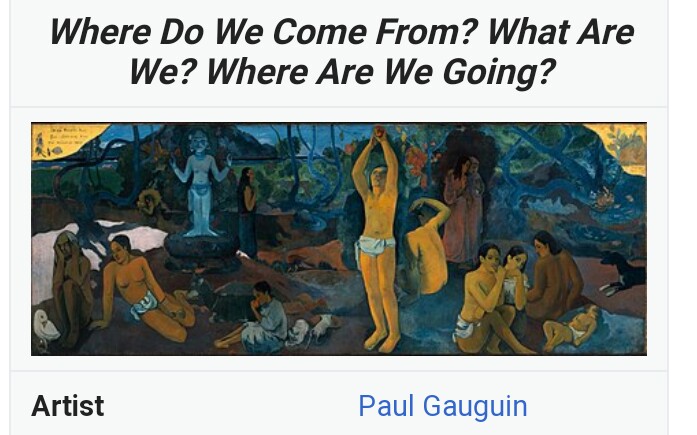
Where have come from? where are we now?
and where are we going?
This is the title of a painting by Paul Gauguin when he was feeling depressed and suicidal. Which when he completed it he felt better illustrating the power of creativity in moments of despair?
In the midst of the pandemic Covid 19 it seems relevant.
We cannot go back to the ‘old normal’!

The question is where are we going in the futures because it seems we cannot go back to ‘normal’ because the normal it no answer to challenges that lie ahead, most of all Global Warming, which requires a real change in values, behaviors and creative action.

We can learn from the past, where we have come from, because there are obviously lessons to be learnt. Mark Twain was said to have said that ‘history doesn’t repeat itself but it sure rhymes’.
The Black Death
If we go back to the Black Plague, which killed a third of Europe’s population, this plague created a change of attitude towards authority and led to new ideas, and with the invention of printing now called the Reformation.

Covid 19 provides such an opportunity for new ideas.

I am aware that Twain also said that ‘prediction if difficult now even if we have no real idea of what will unfold; if direction is important –means will be found

The world goes to big epochs of change each one requiring different behaviors, values and most important of actions

 First we were hunters and gatherers, then humans developed a more settled Agricultural Age, followed by an Industrial Age marked by mass production – now, it seems, we are moving into an Information Age (based on the disruptive power of modern information technology) or even a Creative Age – a Second Renaissance.
Cycles of change in recent history
Franklin Delano Roosevelt

The above are rather big changes but recent times political thinking seems to go in smaller cycles lasting three or four decades.

The ‘Roaring Twenties’ – ‘free market’ capitalism
In the 1920s, often called the ‘roaring twenties’, free market politics was the thing until in 1929 when it came to a sudden end – the Great Depression A depression leading to unheard of unemployment and extreme poverty. Maybe this is the’ rhyming’ Twain talked about.
The rise of the New Deal
The world struggled along until new thinking evolved (not really new but up until then largely ignored) resulting in the election in America of Democrat Franklin Delano Roosevelt. Roosevelt developed an unheard of programme of government assistance called the New Deal. Sounds familiar?
The Welfare State of Michael Joseph Savage

In New Zealand the Great Depression equally caused great dislocation and as a result voters elected the First Labour Government led by Michael Joseph Savage. Savage introduced extensive life saving welfare provisions.  In the UK Clement Atlee was elected to replace war leader Winston Churchill and introduced similar reforms.

The importance of the State to protect all citizens
The importance of the state, or central government, worldwide was made more pertinent by World War Two by returning troops who, along with their families, felt the need to develop a better fairer world.
Years of rebuilding and prosperity
The years following the War lead to decades of prosperity, led by the state, that all provided social security for all.

Up until the 1970s all went well but with the expensive oils shocks, and with an economy felt by many to be dictated by union power, and added to this, the increasing costs of the welfare state, new ideas were in the air (ideas not seen since the twenties).
The rise of Neo Liberal politics
Reagan and Thatcher

There were those who believed ‘big’ government was limiting enterprise and creativity. This was best expressed by Republican President Ronald Reagan whose stated ‘the government is no longer the solution, it is the problem’. Social welfare politics worldwide were demonized as being a ‘nanny state’ and worse still ‘socialism’ – one step, for many, away from communism.

The rise of the self-interested individual
In the UK Conservative Margaret Thatcher was elected saying, ‘there is no such thing as community only self-interned individuals and their families’. Ironically, in New Zealand, it was a Labour Government, under Prime Minister David Lange and Finance Minister Roger Douglas, who introduced privatization politics known as ‘Rogernomics’
And so began the introduction in Western countries of ‘market knows best ‘politics and that brings us up to present day
  •        State assets were sold off, often at low prices, to private enterprise to be made more         efficient and profitable.
  •    The power of unions limited and the idea of personal contracted workers introduced.
  •    The cult of privatization was introduced and loosening up on regulations
  •     And the ‘big sell’, wealth created by privatization would ‘trickle down ‘and benefit all.
  •      All of this was based on a disdain for the public sector and a reduced role for the state

The promise of ‘trickle down ‘economics

The key phrase of ‘trickle down’ used by the supports of ‘market force’s,’ has resulted today’s troubling list of social problems along with housing problems and growth in personal debt
Beyond Covid 19 – Climate Change
The focus on economic growth at all costs has contributed to the biggest issue facing us today – beyond the challenge of Virod 19 – –  that of global warming and sustainability of the environment and human civilization as we know it.

Apposing politician views

The National Party is still wedded to Market Force ‘free market’ politics (sometimes called neo –liberal politics) if somewhat watered down over the years.

 As yet the Labour Coalition Government has not made a dramatic shift from neo liberal politics, no doubt because to voting public still support the previous conservative government. Up until now there has been no real anger about the inequality – it has become ‘normal’.
This brings up to ‘where we are now’ – and the challenge of the current pandemic or more to the point, ‘where to from here’.
Returning to the old ‘normal’ no longer seems an alternative except for hard line neo conservatives. Private enterprise word wide has had to be supported by central governments – this is a return to social welfare on a large scale. Some might call this state assistance socialism!


Beyond Covid 19
The Covid 19 Crisis provides an opportunity to face up to the challenge of climate change and to develop push new ideas to encourage new ideas of responsible regenerative systems of production and consumption. Ideas that bring together the ‘well-being’ of people and our planet as we face a bigger challenge of climate warming.
Where to from here? What sort of country do we want to become?
To ensure transformation requires anger to be expressed at the inequality and environmental despoliation that has been created by the past three decades of growth at all costs – the basis of the market forces and privatization policies implemented, with the false promise of wealth ‘trickling down’ since the 1980s
There is now an alternative.


Those who implemented market policies convinced all that ‘there was no alternative (TINA) and demonized the ‘nanny state’, believing in less government, and to achieve privatization they demonized the union movement.
A reason for anger and need for change.
Up until this day all governments have implemented ‘market force’s policies including Helen Clark, Bill Clinton and Tony Blair. In New Zealand Helen Clark’s Labour Governments did their best ameliorate the worst aspects by introducing policies like ‘working for families’ to assist those most affected. Never the less inequality and despoliation of the environment has been the result; the rich have got richer and the poor poorer.

For thirty-five years the corporate world has ruled supreme. Particularly in the USA, but now ironically they are being rescued by the state that they have seen as ineffective.  Neo liberalism was all about individuals deciding for themselves, based on self-interest, and by competing with each other. Such an approach did not tap the power of community energy, communal collaboration and cooperation and this is where we now need to turn.

The need for change in a few dramatic weeks

Who would’ve thought in a few short weeks, as a result of Covoid 19, the world would change so dramatically providing challenges well beyond self-interested private enterprises – all a sudden only the state can assist in such dire situations. Greater social welfare and assistance is now essential.

So time to demonize and discredit the ‘trickle down’ market forces politics to change the consciousness of people to be able to envisage a better world. In times of crisis impossible ideas become possible. We cannot go back to the ‘normal’ destructive road of market forces politics.
The Challenge for the Coalition Government.
The challenge for the Labour Coalition Government, as we move out of the Covid 19 crisis and under the leadership of Jacinda Ardern, is develop a new vision or direction for our future based on the ideas of ‘well-being’ of all citizens and the sustainability of the environment.
Labour is well placed to articulate such a people centred community and environmentally sustainable vision. A government led by Jacinda Ardern could see New Zealand being a world leader, something we could all be proud of.
Need to rebalance state and private enterprise
What is required is to rebalance the influences of state direction and private enterprise; to focus and reward private enterprises who focus on developing a sustainable New Zealand.’ Let the market decide’ is now a failed dogma.
There are a number of ideas to consider, none original:

·         To introduce a ‘Green New Deal; for state agencies to implement and for private enterprises to be rewarded for positive actions. To encourage investment in productive areas of the economy and not just for individual reward This relates to the ideas introduced by Franklyn Delano Roosevelt following the Great Depression as well as the policies of the First Labour Government in New Zealand.
·       

  t      To  build on the ‘well-being’ philosophy underpinning the Coalition Government and to move away from a narrow misleading emphasis on GDP. A focus on GDP emphasizes the idea of infinite growth serving, first and foremost, the richest 10% and says little about non material well-being such as mental health and capturing the fullness of human flourishing.

·         To upgrade infrastructure needs – the ‘shovel ready ‘projects. Consider the possibility of the government buying into firms currently struggling and to develop a Ministry of Works to coordinate projects.
·       To continue developing a range of state innovative low cost housing and accommodation including communal concepts.
·         To build on the regional development being led by Minister Shane Jones.

·          It might be time to consider rebalancing the central and local Government.  There is a need to provide greater finance and flexibility for local government making local government more attractive for voters to be involved.  This could also more power sharing with local organizations and identifying steps to be taken to build community and strengthen the local community.
·         As part of the Green New Deal to encourage and assist land owners to develop regenerative agricultural approaches.
·         To come to terms with the possibility that unemployment (and under employment) will become endemic with the continued application of automation and to introduce a Universal Basic

Income. Not only would this simplify the plethora of welfare benefits but it would remove any stigma that people currently feel as well as providing a much needed sense of security.  There are numerous article outlining benefits and problematic issues to be taken into consideration. I believe a UBI would encourage innovative creative activities for many creative individuals. An extra payment could be given to people working as teacher aides or similar worthwhile occupation such as working in rest homes or working with adults with special needs

·         Even with a UBI progressive tax required rising to a higher percentage of income earned over a generous certain amount.
·         A reconsideration of a Capital Gains Tax (needing cross party agreement) as a lack of a Capital Gains Tax is a major factor in driving up house prices Wealth Tax is another option although I’m not sure what this involves. Plus, raising taxes on fossil fuel fertilizer to encourage regenerative agriculture.

·         Encouraging renewable clean energy projects   and to reduce extractive industries to move New Zealand to a post carbon economy. Further subsidizing house insulation and including solar panels.
·         A greater focus on protecting New Zealand’s natural environment – investment in preserving the environment would provide much needed jobs. A New Green Deal workforce. There is a need to encourage ‘degrowth’ – a deliberate downscaling of segments of the economy harmful to the ecosystem such as the fossil industry while at the same time valuing people such as those working in the care industry.
·         Providing greater Research and Development finance to encourage an environment of innovation and to share and upscale successful projects.
·      

   Consider the circular regenerative economy outlined by economist Kate Raworth in her book The Doughnut Economy. The book sets out the minimum we need to lead a good life and sustain the environment. It highlights boundaries across which human kind should not go in contrast to current greed based economics.

With Covid 19 and the Climate Change challenge provides motivation for transformational change.
The free market promised to liberate the individual from the supposedly restrictions of the ‘nanny state’ but instead it has weakened safety nets, increased insecurity for far too many and put the entire planet at risk
Covid 19 and the Climate Warming crisis has given us an opportunity and the resolve to move away from self-interested capitalism to a kinder, fairer and more creative world – one we have a chance to hand on to future generations.
 It is possible to imagine a new world and a different type of society with new values and behaviours. – where human values of fairness, mutual aid and compassion are paramount.  It Hs happened before after the Great Depression and we can do it.
 It must have looked equally challenging in the days after WW2 when social democratic governments, including our own led by Michael Joseph Savage and Peter Fraser developed socially secure states leading to an era of unparalleled prosperity.


Keep your soul diligently

We’ve all seen those memes on Facebook and other places where the letters of each word are scrambled, but the first and last letters are kept unchanged. Sometimes these memes are accompanied by statements such as, “Only intelligent people are able to understand this message.” Actually, most adept readers are able to read them; as we learned to read, our brains developed shortcuts that recognize words even when the internal parts of the words have been changed.

But, by the same token, sometimes we mistake one word for another. The slip-up can be amusing, such as confusing “immorality” and “immortality.” Usually a second glance fixes the misreading. But this morning in my Bible reading, I faced a misreading that indicates just how overwhelming our current virus crisis has become.

I was reading Deuteronomy chapter four. I got to verse nine, which says, “Only take care, and keep your soul diligently, lest you forget the things that your eyes have seen, and lest they depart from your hearts all the days of your life. Make them known to your children and to your children’s children.” This is a trustworthy saying. But when my eyes first scanned the verse, my brain changed the beginning to, “Only take care, and keep your social distancing.”

Of course a second glance fixed the misreading. I suppose the words “take care” only added to the tendency to expect s…l d……..y to be “social distancing.” But my mildly amusing experience only shows how overwhelming this virus crisis has become, that I even expect the holy Word of God to command social distancing.

My experiences with the virus crisis are like those of most people. As an introvert, I don’t mind keeping my distance from other people. Three times a week I take a two-mile walk through the neighborhood. I do what I was taught as a child: I walk on the left-hand side of the road, facing the traffic. But now, with social distancing, if someone is coming toward me on the same side of the road, I cross to the other side to avoid that person. I’ve always wanted to do that. Now, not is it not rude to cross the road to avoid people—it’s recommended.

I’m very much blessed to have three jobs that all paid me my regular salary while I worked from home. Every week I write a sermon, and every Saturday I email it to the members of the congregation. Our church musician presents a concert of church music on Facebook every Sunday. We mail in our offerings, and my check comes in the mail. My history class was changed from classroom to online. Some students dropped out, and a couple have fallen behind on the work, but several are faithfully taking their quizzes (open book, since we don’t have the classroom discussion before the quiz) and—I expect—writing their essays that are due next week. But my full time job at the library raised the biggest concerns. How can a library function when the doors are locked and the workers are told to stay home?

The first week the library was closed, we were told that it was like snow days—we would stay home and be paid. The second week, they began encouraging us to do tasks at home that were somehow job related. Since I am an archivist, I began sorting and arranging the family pictures I brought from my father’s house several years ago. After they were arranged, I even started putting them on Facebook and tagging family members. I also explored the family genealogy. More than half the people who visit our research room in the library are doing genealogy—some in great depth, others just getting started. I’ve always been able to guide people to resources, but now I have much more experience in genealogical research and will be more helpful.

By the third week, we had a process of reporting how we were spending our time “on the clock.” But after that, the library decided that 75% of our hours had to be of direct benefit to the library system; the other 25% could be for learning and wellness activities. Some library branches began experimenting with curb-side services. Four branches are providing free meals to neighborhood children who usually get fed at school. My department remains locked up; but we are taking turns being in the building to answer the phone and help patrons.

Last week, with the phone-answering system in place, I was invited to return to my desk and continue processing archival materials. I must wear a mask everywhere in the building except at my desk; I must wash my hands frequently and wipe down surfaces often. This procedure might last for the rest of the summer.

Since it is losing some money—parking and meeting room fees, and overdue fines—the library director decided that he would reduce or eliminate some positions temporarily to save the library money. All positions will be restored when the crisis is over. People in eliminated positions retain their health insurance and other benefits but must apply for unemployment. Those who are reduced will—if the state government allows—work only part-time and receive unemployment money for the hours lost. I have been placed in the second category.

I do not feel comfortable with the likelihood that I will be receiving unemployment compensation for ten weeks or so. It’s not that I don’t need the money. It’s that every person thrown into the unemployment system is added to the financial burden that taxpayers like me and my children will be reimbursing for years to come. I disagree with the library’s decision to lower its costs by putting its workers temporarily into unemployment. In fact, I cannot help but view this as a cynical political ploy to deepen the crisis (and the feeling of crisis) at the expense of the current administration.

We will all get through this together. Stress and anxiety are high right now. (I spend little time on social media precisely because I rapidly tire of all the talk of virus and quarantine. It makes me shaky and queasy.) Meanwhile it’s important for each of us to take care, and keep our social distancing… I mean, keep our souls diligently. J.

Part Two: Open Pedagogy – What is web-based Open Education Practice, really?

A study in organizational openness by Opensourceway

What is web-based Open Education Practice?
Open Educational Practices (OEP) constitute the range of practices around the creation, use and management of open educational resources with the intent to improve quality and innovate education (OPAL, 2011).

This definition is simple, yet the concept is more complex than realised at first. What are these open education resources (OER) and how did they come about? What is their potential for learning and teaching? How can they be created, used and managed in our educational organisations? Why could they potentially improve quality and innovation in education? What are the benefits and what are the barriers? Who should be doing this? This series will hopefully assist you to identify the meaning of open education practices and find answers to these questions.

A history
To understand what the terms Open Education Resource (OER) and Open Education Practice (OEP) mean, it is necessary to look back at how the concepts has arisen. The arrival of the Internet probably triggered the widespread use of this term because it was considered a disruptive technology when it landed on our educational doorstep many years ago. This “global platform” disrupted or changed how learners and teachers could access and share information and materials, and encouraged a new culture of learning.  A culture where learners could access any materials they needed with or without the help of a teacher, and share anything and everything (Thomas & Seely Brown, 2011).

Disruptive technology 
A term attributed to electronic tools that change the way we think, act and work. The Internet has led to significant changes in society and is therefore regarded as disruptive as are many technologies associated with it.   

In the mid-2000s, when Web 2.0 tools and approaches emerged as a phenomenon, they enabled global sharing of information, knowledge, ideas and also the materials that educators created (Brake, 2013). According to Conole, de Laat, Dillon and Darby (2008) the arrival of “new forms of mobile, internet and social software technologies” enabled “distributed collaboration” and a new direction for learning and the way we could  “consume and produce new artefacts’ (p. 511).  This changed the status quo. Teachers and learners could now interact more easily, share their work and collaborate in the learning environment. This disruption, or as some practitioners believe, innovation, led to the Open Education Resource (OER) movement and the Cape Town Open Education Declaration inviting managers and practitioners to engage with open educational resources (Open Society Institute & Shuttleworth Foundation, 2007 –  http://www.capetowndeclaration.org/). Presently, 2712 signatories have contributed to the Declaration.

Otago Polytechnic signing the Cape Town Open Education Declaration by Leigh Blackall

Otago Polytechnic signed the declaration in 2008 when educational development work at the organization was foremost in international efforts for Open Education (Blackall & Hegarty, 2011).
In the declaration, open education is described as more than open educational resources and is regarded as a mechanism that makes use of open technologies to “facilitate collaborative, flexible learning and the open sharing of teaching practices that empower educators to benefit from the best ideas of their colleagues” (para 4). It also has the potential to change not only how we teach and learn but also how we assess.

How has history changed Open Education Practices?
Disruptive technologies are the foundation of open education resources and practices. They can be a good thing for pedagogical innovation and act as a catalyst to transform practice (Conole, de Laat, Dillon & Darby, 2008). However, the changes may occur too fast and exceed the rate at which teachers can adopt them confidently or before the infrastructure of an organization is prepared enough to manage them.  Ruth Jelly has compiled an overview of the literature and therein presents a number of case studies describing the evolution of the open education movement in Open Education Practices: A User Guide for Organisations and Individuals written by Leigh Blackall and edited by Bronwyn Hegarty (2011).

Out of the disruption caused by open education resources, web-based social learning and informal learning was born. Participation is the core component of social learning. Knowledge and understanding is constructed through the conversations and interactions learners have with others, generally about issues and actions (Brown & Adler, 2008). The focus shifts from what is learned to how people learn, and the connectivity amongst learners is enhanced.

In the new culture of learning, the “stable infrastructure of the twenty-first century” has become a more dynamic infrastructure where technologies are changing constantly (Thomas & Seely Brown, 2011, p. 17). Even so, learning environments in this new culture do need boundaries and structure. These need to be designed to inspire the learner to move freely within the educative opportunities provided, regardless of whether this occurs in formal education or in everyday life (Thomas & Seely Brown, 2011).

This new wave of learning is considered by Thomas and Seely Brown (2011) to be “arc-of-life learning”, where play, questioning and imagination are pivotal to the continual quest for knowledge (p. 19).  The key is that learning occurs seamlessly between the classroom and everyday activities. Most importantly the concepts of ‘play’ and ‘tinkering’ are encouraged so that learning throughout life becomes more like a game; it is fun. This new culture of learning requires two things, according to Thomas and Seely Brown (2011), firstly, ready access to a network of information and secondly a “bounded and structured environment” with unlimited scope to experiment (p. 19).  To facilitate this, open and collaborative networks and communities and openly shared repositories of information that are readily accessible and in which anyone can participate are essential. In the new culture of learning, engagement in the process is key (Thomas & Seely Brown, 2011).

Having “time and permission to play, openness and learning from play” were key themes that emerged from case study research conducted into digital information literacy by Jeffrey, Hegarty, Kelly, Penman, Coburn and McDonald in 2011 (p. 394). For participants, engagement in accessing open digital web-based networks and platforms led to a transformation in how they learned and in their personal development.

Keeping openness in mind when designing learning is also discussed by Conole (2013) and she acknowledges several challenges associated with this, for example, the varying definitions and lack of agreement on what the term means. Some aspects of openness were explained in part one of this series using a model for Open Education Practices.

How do you currently use web-based Open Education Resources in your context?

Coming up next –  Part Three: Why should we share and be open? 

References
Blackall, L., Hegarty, B. (2011).  Open education practices: a user guide for organisations/models of open education. Retrieved from http://akoaotearoa.ac.nz/ako-hub/ako-aotearoa-southern-hub/resources/pages/blackall_oep_wiki

Brown, J., Adler, R. (2008). Minds on fire: open education, the Long Tail, and Learning 2.0. Educause Review, 43(1), 16-32. Retrieved from http://www.educause.edu/ero/article/minds-fire-open-education-long-tail-and-learning-20

Conole, G. (2013). Designing for learning in an open world. Springer: New York.

Conole, G., de Laat, M., Dillon, T. & Darby, J. (2008). Disruptive technologies, pedagogical innovation: What’s new? Findings from an in-depth study of students’ use and perception of technology. Journal of Computers & Education, 50, 511–524. doi:10.1016/j.compedu.2007.09.009

Jeffrey, L. & Hegarty, B., Kelly, O., Penman, M., Coburn, D., & McDonald, J.  (2011). Developing Digital Information Literacy in Higher Education: Obstacles and Supports. Journal of Information Technology Education, 10, 383 – 413. Retrieved from http://www.jite.org/documents/Vol10/JITEv10p383-413Jeffrey1019.pdf

OPAL.  (2011). Beyond OER. Shifting focus to open educational practises. Opal report 2011. Essen, Germany: Open Education Quality Initiative. Retrieved from https://oerknowledgecloud.org/content/beyond-oer-shifting-focus-open-educational-practices

IUT conference

The last few days have been spent attending the IUT conference (Improving University Teaching). Yes university teachers do care about good teaching! I went as a Doctorate in Education student and because it was nearby at the University of Otago. There were some interesting sessions on offer, and it was a different conference to the ones I normally go to – not eLearning but education.

The highlights were hearing Tom Angelo (University of Victoria) speak again and seeing him in action using interactive methods in a big lecture theatre. The man is magic…and he gets the audience to think and do!

Kathleen Weigert, Georgetown University USA was intriguing when speaking about justice. She asked us to define justice and then talked about three kinds of justice – commutative (fairness in exchange), distributive (allocation and how things are shared), social (contributive – contribute to common good and remove barriers e.g. education).

My definition was: “Doing the right thing to serve the needs of people”. She mentioned the importance of policies in institutions matching their practices, and whether the mission statements in our organisations had included statements about justice. I was interested in the Community-Based Learning programme she teaches in where students undertake community-based work to complement their academic learning. For example, students taking courses about homelessness actually work in the community with people experiencing homelessness.

Another speaker, Bland Tomkinson, spoke about the integration of interdisciplinary topics, sustainable development and global citizenship. Although he wasn’t a particularly receptive speaker when I approached him afterwards, and and there wasn’t any discussion about his topic, he had some good ideas. I will have to read his conference paper.

The first workshop on Teaching Philosophy (Elaine Laflamme) was partially useful in that it made me think about to which category of teacher I belong – my result from the inventory is that I am a humanist, progressive teacher.

I also found Robert Aitken’s presentation about using audio journaling techniques with students very relevant – he believes that people think while they talk so the audio recordings demonstrate more thinking about the process whereas written journals tend to be censored and the actual process is rarely documented. The session I was particularly interested on metacognition was presented by someone who didn’t know the subject very well, a co-author, so I will have to read the paper.

It was also good to meet up with friends and colleagues from my past biology life, and find out about Rob Wass and his research topic of looking at the Zone of current development (ZCD) and how it moves to the zone of proximal development (ZPD) during study in Zoology.

The podcasting and vodcasting workshop was okay, particularly because I was able to promote Leigh’s courses. A little bit was covered on good practice so this was good. A bit gobsmacked to talk to someone who was planning to record biology lectures and put them up on Blackboard. Good for review I suppose. but the idea of taking them down if people stop coming to lectures is ludicrous. surely the measure would be if students liked them and actually learned better.

And the worst presentation by far had to be Gerrie Jacobs and his Powerpoint Karaoke. some good messages about integrity and credibility but too many flashy bits and not enough substance. good lessons for what not to do to an audience.

There were some very good posters – eportfolio at Massey university in an engineering programme, Rob’s research study about Learning in the Zone and another one about pharmacy and experiential learning in the curriculum. I also got a couple of free books – one on Curriculum transformation and disability: Implementing universal design in HE and effective tutorial teaching. The former book also had a poster about their work. Oh yes the workshop where L Meyer used a questioning instrument to stimulate self-questioning was very useful. Qs such as how, why etc matched with other words which could be attached to a statement about a topic to get a class to generate their own questions to go away and research and think about. we had to throw a dice and choose the words which matched each number. The game aspect instilled a bit of fun, and the class shared the questions they came up with.

The next step is to look at some of the conference papers, especially the sessions I missed because of the flexible delivery operations committee inaugural meeting – papers on transformative learning – a subject close to my heart.

Persona activity for Facilitating eLearning Communities

I have just finished reading through the discussion on Blackboard around creating personas. The individual persona exercise, quite rightly, became a group persona which reverted back to being a suggestion to create two general personas which are representative of the group. David started off the exercise with a persona based on an analysis of the learning styles and some of the information posted in the introductions.

A suggestion was also made by Cheryl is to name the two personas according to the learning styles for each group.
1) Reflective, Global, Intuitive, Visual; 2) Active, Sequential, Sensing, Visual
Person 1 – Virg; Person 2 – Vass
If you collect up all the posts it is very clear to see the personalities of the group emerging. The characteristics of the group who participated have demonstrated they have a range of skills and can do the following:
  • analyse and organise information,
  • facilitate others towards action,
  • mediate,
  • reflect,
  • become impatient with no progress,
  • get confused,
  • suggest solutions.
I am impressed with how far you have come towards developing a persona or two. It is not an easy task. As stated by Yvonne, “As facilitators we could use a single persona to help focus learning activities and experiences based on shared characteristics and I can see how this would work in some circumstances but are we finding this tricky because we’re the learners and not the facilitators?
I thought there may have been some discussion about what should/shouldn’t be included so that everyone would feel ‘represented’ and we’d end up with a final persona. So I’m wondering why we’ve found it so difficult to do?
Does anyone have a response to Yvonne’s post? I wonder why was this exercise so challenging? Is it worthwhile to do this in your own classes so you get an understanding of who you are facilitating?
Every suggestion has been from a different perspective, but it appears that although confusion has been expressed, some progress has been made. There was also a name suggested for the group persona and some characteristics, such as below:
Name: The Colossal Squid – not sure if this really fits with the new pic I have added.
Age: Average 45
Gender: female
Learning Goals: 1. To gain more familiarity, skills & ideas for teaching online. 2 To discover new ways/methods to deliver effective learning experiences – not necessarily for full online delivery but as an additional teaching/learning tool.
Background Story: Teaching background (10-15 years), (mostly) married (some partnered), 3 kids (ages 8,10,13), Interests include music, the outdoors, family & friends. Fairly computer literate.
A telling quote:??? I get the sense this will come as the background story develops
email address: Gmail? Generic polytech email?
Job Title: 1/2 time lecturing/teaching (with some online component), 1/2 time consulting on e-learning projects
Photo: Attached – provided by David
Learning Style: Visual preference, global slant, huge active preference
There was also a suggestion by Linda to create two personas based on the fact that “some learners are experienced with technology while others are very new to it,” rather than using learning styles.
Individual personas
Three people have asked others to form a group with them and we are still waiting to hear the outcome of those sessions. For example, an Elluminate meeting was organised last Fiday 17 August. If it went ahead, and am interested to see what came out of that exercise.
Learning styles: There was certainly a lot of emphasis on learning styles, and a virtual chocolate fish to David for getting the ball rolling. This was as good a way as any to get a “feel” for the learners and sometimes learning styles may be the first bit of information you get. Of course if you take the time to look at your students’ enrolment forms you will also find out some demographic information.
Think about how you actually get to know who your learners are in the f2f classroom and online?
Because of the difficulties in getting to know students online, lots of lecturers now take the time to do a learning styles exercise at the start of a course.
Luckily nine people also posted some information about themselves in the introductions forum. As you have found out it is an exercise which may be a lot easier to complete over more than one week when you get to know your fellow class mates through interacting with them in discussions and with them on their blogs.
Once everyone has their blogs up and running, and if they add information about themselves on there, it will be easier to confirm the personae. And maybe as leigh suggests it is a dynamic process which will evolve over the length of the course. In any case, the activity though not immediately satisfying or conclusive has certainly stimulated a lot of thought around who you all are as learners…don’t you agree?
So where to now?
I really like Yvonne’s observations about why the exercise has appeared to pose difficulties. Meaning that it took longer than a week and also seemed challenging for people to get an immediate outcome. It certainly started on time, and it is evident that the exercise needs more than a week and this should be stated from the outset. Maybe it is an exercise which should be started later in the course when we have a better grip on who we all are – personality-wise and professionally.

eLearner profiles: Diversity in Learning

I was very interested in a report of a Tertiary eLearning research fund project 2005 which looked at learner profiles – learning styles and preferences of students for elearning. Samuel Mann was on the research team and you may have seen the questionnaire. i have requested a copy of the questionnaire on CD from the lead researcher.

Jeffrey, L. Atkins, C. Laurs, A. & Mann, S. (2005). eLearner profiles: Diversity in Learning. Ministry of Education, TeLRF project report. Available at: http://cms.steo.govt.nz/eLearning/Projects/Tertiary+eLearning+Research+Fund.htm you need to scroll down the page.

What I liked about this research report is the comparison between student preferences for traditional lectures, tutorials and blended forms of online and f2f learning. You may find that these findings mirror some of the feedback you may be getting from your students about online learning. For example, they do not particularly want to be self-directed and do group work. They want lectures and are not particularly keen on online learning which can cause them a lot of anxiety. This is a NZ-based project

“The sample size was 1811 and came from six universities, five polytechnics or institutes and six private training organisations.”

Also the researchers categorised the learner profiles as: cognitive voyagers, strategic competitors and multimedia collaborators. If you read the executive summary of the report you will get the gist of the different profiles.

The researchers measured things such as extrinsic and intrinsic motivation, learning styles, dependent versus independent learning preferences, achievement motivation, relativistic reasoning rather than factual,working collaboratively rather than alone, time poorness, global versus sequential learning and reflective versus analytical and much more. It is a fascinating study. I hope you will take a look. Do you believe that this is the same situation for your students.