Causes of World war -|

European Alliances and Counter – Alliances

In 1900 five of the European Great powers were divided into two armed camps.One camp consisted of the Central powers-Germany, Australia-Hungary and Italy.Under the guidance of Bismarck,they had formed the Triple Alliance in 1882.The understanding was that Germany and Austria would help each other.The other camp consisted of France and Russia.Their alliance was formed in 1894 with the promise of mutual help if Germany attacked either of them.An isolated Britian wanted to break her isolation and approached Germany twice but in vain.As Japan was the ally of Russia,it preferred to ally with Britain (1902).The Anglo-Japanese Alliance prompted France to seek an alliance with Britain (1902).The Anglo-Japanese Alliance prompted France to seek an alliance with Britain to resolve colonial disputes over Morocco and Egypt.This resulted in the Entente Cordiale(1904).In return in the Entente Cordiale (1904).In return for letting the French have a free hand in Morocco, France agreed to recognize the British occupation of Egypt . Britain subsequently reached an agreement with Russia over Persia,Afghnis an and Tibet.Thus was formed the Triple Entente of Britain, France and Russia.

Violent Forms of Nationalism

With the growth of Nationalism,the attitude of”my country right or wrong I support it” developed.The love for one country demanded hatred for another country.England’s jingoism, France’s chauvinism and Germany’s kultur were militant forms of Nationalism,contributing decisively to the outbreak of war.

Aggressive Attitude of German Emperor

Emperor Kaiser Wilhelm || of Germany was ruthlessly assertive and aggressive.The Kaiser proclaimed that Germany would be the leader of the world.The German navy was expanded.The sea being considered a presserve of England ever since Napoleon’s defeat at Trafalgar (1805), Germany’s aggressive diplomacy and rapid building of naval bases convinced Britain that a German navy could be directed only against her.Therfore , Britain embarked on a naval race, which heightened the tension between the two powers.

Hostility of France towards Germany

France and Germany were old rivals.Bitter memories of the defeat of 1871 and loss of Alsace and Lorraine to Germany rankled in the minds of the French.German interference in Morocco added to the bitterness.The British agreement with France ovr Morocco was not consented by Germany.So Kaiser Wilhelm|| intertionally recognissed the independence of the Sultan and demanded an international of the Sultan and demanded an international conference to decide on the future of Morocco.

Imperial power politics in the Balkans

The young Turk Revolution of 1908 ,an attempt at creating a strong and modern government in Turkey, provided both Austria and Russia with the opportunity to resume there activities in tha Blankans.Austria and Russia met and agreed that Austria should annexe Bosnia and Herzegovina,while Russia should have freedom to move her warships, through the Dardanelles and the Bosporus ,to the Mediterranean.sokn after this , Austria announced the annexation of Bosnia and Herzegovina.Austria’s action aroused intence opposition from Serbia.Germany gave Austria firm support.Germany went to the extent of promising that if Austria invaded Serbia and in consequence Russia helped Serbia, Germany would come to Austria’s assistance.The enmity between Austria and Serbia , Germany would come to Austria’s assistance.The enmity between Austria and Serbia led to the Outbreak of war in1914.

The Balkan wars
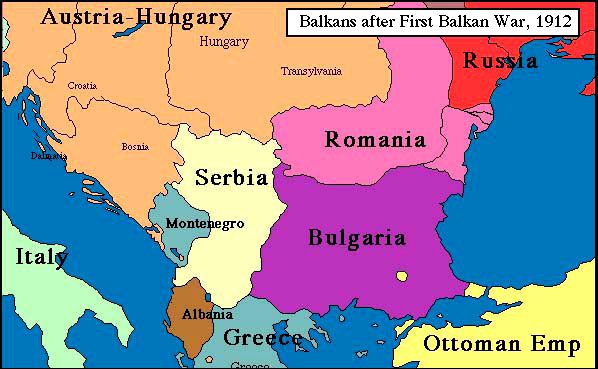
Turkey was a powerful country in the south west of Europe in the first half of eighteenth century.The Ottoman Empire extended over the Balkans and across Hungary to Poland .The Empire contained many non-Turkish people in the Balkans.Both the Turks and their subjects of different nationalities in the Balkans indulged in the most frightful massacres and atrocities.The Armenian genocide is a frightful example.Taking advantage of the political and economic instability of the Turkish Empire from the second half of the eighteenth century,Greeks followed by others began to secede,one after another,from Turkish control.Macedonia had a mixed population.There were rivalries among Greece ,Serbia,Bulgaria and later Montenegro for the control ofbit.In March 1912 they formed the Balkan League.The League attacked and defeated Turkish forces in the first Balkan war (1912-13). According to the Treaty of London signed in May 1913 the new state of Albania was created and the other Balkan states divided up Macedonia between them.Turkey was reduced to the area around Constantinople.
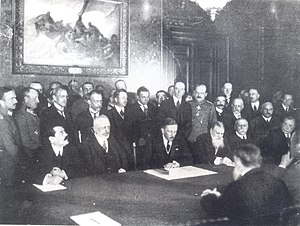
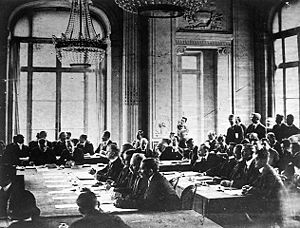
The division of Macedonia, however,did not satisfy Bulgaria.Bulgaria attacked Serbia and Greece.But Bulgaria was easily defeated.The second Balkan war ended with the signing of the Treaty of the Treaty of Bucharest in August 1913.

Immediate cause

The climax to these events in the Balkans occurred in Bosnia.On 28 June 1914 the Archduke Franz Ferdinand,nephew and heir to Franz Joseph, Emperor of Austria-Hungary,was assassinated by Princip ,a Bosnian serb.Austria saw in this an opportunity to the eliminate Serbia as an independent state.Germany thought that it should strike first.It declared war on Russia on 1Augest . Germany had no quarrel with France,but because of the Franco-Russia Alliance ,the German army which was planning a war against both France and Russia wanted to use the occasion to its advantage.The German violation of Belgian neutrality forced Britain to enter war.


Digital India

Digital India initiative is one the key initiative launched by government of India on 1st July 2015. The initiative is counted among one of the most prestigious projects just like made in India, Swach Bharat Abhiyaan etc. it consists of some major objective towards the development of better services and infrastructure in terms of digital modernisation of the country.
It comes under the ministry of Electronics and information and ministry of finance, officially launched by Prime minister of India Shree Narendra Modi. it has 3 main area of focus which includes:
• The utility of Digital infrastructure for the citizens of India
Improvement of digital infrastructure so that the citizens can utilise the services of internet.
• Internet and other services requirement
There are areas where people still do not have access to basic internet services, and additionally providing all the advance services to the population of the country.
• Digital empowerment
It refers to overall empowerment that will occur when the digital structure strengthens in the country.
The initiative serves multiple purpose, starting from improving the basic facilities to introducing modern technology at various level.
the initiative stands upon many important aspects which are:
• Broadband highways
• IT for all
• Electronic manufacturing
• E governance
• E Kranti etc
These aspects have their own significance in long run and can bring the much-needed changes in the country. Digitisation of the already existing facilities for the convenience of people and implementing new changes and development in the country.
Implementing a big initiative like digital India on a very large scale takes to answer a lot of challenges. Highlighting the challenges which occurred are:
• Adaptation
adapting to the ongoing and upcoming changes is going to be a big task for many Indians, it is also a time taking process.
• Illiteracy
The portion of population which is not well educated will find is very challenging, as they are not even aware about the basics. To make them aware and making them digitally literate is a major challenge.
• Providing better facilities to all
India has a huge population, ensuring that each and every one has access to the latest facilities
and convenience is important.

Conclusion
Digital India has proven beneficial for many specially the ones who had minimal access to such facilities, this is important from the perspective of both economic development and individual development. Technology, if used wisely can-do miracles in different sectors like education, employment, agriculture etc. the ongoing pandemic crisis has made us totally dependent on laptops and smartphones. Every developing country aim is to be technologically advanced in the coming years is a common goal. Even the developed nations are getting advanced each day.

Thus, an initiative like this can support and enhance the development taking place in the country. Despite, the challenges faced progress is visible. The initiative is already running since 2015 and within the reach of this initiative many changes are successfully implemented too.

Introduction about different Schools, Colleges, Universities

Every student wants to join a dream college or university.

After schooling, we desire to join a top college or university for the security of our feature

Is a college the same thing as a university? What does “liberal arts” mean? Why are some colleges called public and others private? Here are the basics of the types of colleges.

Let me know about NIT AGARTALA

Institute is committed to developing highly competent young Engineers, Scientists, and Management Professionals to cater to the ever-increasing techno-managerial needs of national and international standards fulfilling professional ethics and societal commitment.

MISSIONS

• To produce techno-managerial human resources in line with global needs, offering a state-of-the-art facility, research, and engineering and allied disciplines.

• To enhance the effectiveness of technical education with innovative systems and devising a mechanism to facilitate the application of research findings to solve real problems of industries/academics.

• To nurture and sustain an academic ambience conducive to the development of intellectually capable and committed professionals so that effective growth is obtained for the region’s economic development and the nation as a whole.

• To establish as the corridor of higher education for the South East Asian countries.

EDUCATION SYSTEM

Presently the Institute offers eight UG courses and PG courses in several fields along with Post Doctoral Fellowships. This Institute is autonomous under NIT being act passed by the parliament.

The Institute recently introduced a new curriculum in IITs where more elective subjects are being offered to make the system flexible. Previously, the Institute used to follow the mark based system of evaluation, but have been switching over to a credit-based system to keep track of the global evaluation methods. Industrial training, Undertaking projects are parts of the education system and students are also encouraged to take various activities for social development through NSS and NCC.

Initiatives

The Institute recently has been converted from State Engineering College to National Institute of Technology. The total seats have been increased from 250 to 420 for the academic session 2007-2008. Recently three Under Graduate courses has been introduced in Electrical & Electronics Engineering, Transportation Engineering and Production Engineering. The Civil Engineering Department will start a PG programme in Structural Engineering to fulfil the requirement of the State. The nonresidential campus is to be made residential with the reopening of two boys hostels and one girl’s hostel for the students admitted for the session 2007-2008. A master plan is under preparation for 335 acres of land where a new campus will be built with modern facilities for the overall requirement of the Institute. The Institute is getting a 33 VK dedicated power supply through Tripura State Electricity Corporation Limited for uninterrupted power supply in the campus. The R. D. Department of Govt. of Tripura took total renovation work of the existing buildings after conversion to NIT. The Institute has also obtained a grant of 12 crore rupees from DoNER for the development of infrastructures like the extension of the Library Building, an extension of the Academic Building, the Centralized Computer Centre, a new water treatment plant and boys and girls common room. The campus is now totally connected through Wi-Fi with WiMAX wireless backbone and all e-journal facilities are available in the digital library of NIT Agartala.

Building Blocks of IoT

Sensors

Sensors can be found all over the world. They may be found in our homes and offices, as well as retail malls and hospitals. They’re built into cellphones and play a key role in the Internet of Things (IoT). Sensors are the IoT devices’ front-end. In the Internet of Things, they actually mean “things.” Their primary responsibility is to collect required data from the environment and transmit it to databases or processing systems. Because they are the primary front-end interfaces in a vast network of other devices, they must be individually identifiable by their IP address. Sensors gather real-time data and can be self-contained or controlled by the user. Sensors are vital to the success of many modern enterprises. They can alert you to possible issues before they turn into major issues, allowing firms to undertake preventative maintenance and avoid costly downtime.

Gas sensors, water quality sensors, moisture sensors, and other sensors are examples of sensors.

Processors

Processors, like computers and other electrical systems, are the IoT system’s brain. Processors’ primary function is to turn raw data acquired by sensors into useful information and knowledge. In short, its role is to provide intelligence to the data. Applications can readily manage processors, and one of their most essential functions is data security. They are in charge of data encryption and decryption.

Processors built within microcontrollers, embedded hardware devices, and other devices may process data.

Gateways

A gateway for the Internet of Things (IoT) is a physical hardware or software program that connects the cloud to controllers, sensors, and intelligent devices. An IoT gateway, which can be either a specialized hardware appliance or a software application, is responsible for transferring data between IoT devices and the cloud. An intelligent gateway or control tier is another name for an IoT gateway. The primary function of gateways is to route processed data to appropriate databases or network storage for suitable use. In other terms, the gateway facilitates data transmission. IoT systems require communication and network access to function.

LAN, WAN, PAN, and other gateways are examples.

Applications

Another end of an IoT system is applications. Because it is adaptable to practically any technology capable of giving useful information about its own operation, the execution of an activity, and even the environmental conditions that we need to monitor and manage at a distance, IoT technologies have a wide range of applications. Many organizations from many industries are now using this technology to simplify, enhance, automate, and control various operations. Applications make good use of all acquired data and offer users an interface through which they may interact with it. These apps might be cloud-based and are in charge of rendering the data acquired. Applications are controlled by the user and serve as delivery points for certain services.

Smart home apps, security system control apps, industrial control hub apps, and so on are examples of applications.

The raw data collected by the sensors is transmitted to embedded processors in the IoT Building Blocks. Processors convert raw data into useful information, which they subsequently send to remote cloud-based apps or database systems via gateway devices. The data is subsequently transferred to the apps for effective application and data analysis through big data.

PARIS CLIMATE AGREEMENT – A STEP TOWARDS SUSTAINABLE FUTURE

The Paris Agreement is a legally binding international treaty on climate change. It was adopted by 196 Parties at COP 21 in Paris, on 12 December 2015 and entered into force on 4 November 2016.

Its goal is to limit global warming to well below 2, preferably to 1.5 degrees Celsius, compared to pre-industrial levels.

To achieve this long-term temperature goal, countries aim to reach global peaking of greenhouse gas emissions as soon as possible to achieve a climate neutral world by mid-century.

How does it work ?

The Paris Agreement works on a 5- year cycle of increasingly ambitious climate action carried out by countries. By 2020, countries submit their plans for climate action known as nationally determined contributions.

In their NDCs, countries communicate actions they will take to reduce their Greenhouse Gas emissions in order to reach the goals of the Paris Agreement. Countries also communicate in the NDCs actions they will take to build resilience to adapt to the impacts of rising temperatures. 

To better frame the efforts towards the long-term goal, the Paris Agreement invites countries to formulate and submit by 2020 long-term low greenhouse gas emission development strategies (LT-LEDS).

LT-LEDS provide the long-term horizon to the NDCs. Unlike NDCs, they are not mandatory. Nevertheless, they place the NDCs into the context of countries’ long-term planning and development priorities, providing a vision and direction for future development.

How are countries supporting one another ?

The Paris Agreement reaffirms that developed countries should take the lead in providing financial assistance to countries that are less endowed and more vulnerable, while for the first time also encouraging voluntary contributions by other Parties. Climate finance is needed for mitigation, because large-scale investments are required to significantly reduce emissions. Climate finance is equally important for adaptation, as significant financial resources are needed to adapt to the adverse effects and reduce the impacts of a changing climate.

The Paris Agreement speaks of the vision of fully realizing technology development and transfer for both improving resilience to climate change and reducing GHG emissions. It establishes a technology framework to provide overarching guidance to the well-functioning Technology Mechanism. The mechanism is accelerating technology development and transfer through it’s policy and implementation arms.

Not all developing countries have sufficient capacities to deal with many of the challenges brought by climate change. As a result, the Paris Agreement places great emphasis on climate-related capacity-building for developing countries and requests all developed countries to enhance support for capacity-building actions in developing countries.

How it tracks progress made by countries ?

With the Paris Agreement, countries established an enhanced transparency framework (ETF). Under ETF, starting in 2024, countries will report transparently on actions taken and progress in climate change mitigation, adaptation measures and support provided or received. It also provides for international procedures for the review of the submitted reports. 

The information gathered through the ETF will feed into the Global stocktake which will assess the collective progress towards the long-term climate goals.

THE MIRROR

The mirror is the real you, where you run to prove it not. Not only mirror shows your external appearance also it shows how your thoughts and attitude be. Even a accused can confess his feel of guilt on the court, but a man doesn’t on mirror. Lot of people don’t ever look at windows, as they try to hide their original in themselves.

The mirror can question you anytime, it has the power to touch your soul where nobody cannot. The mirror influence either you in good or bad ways but it runs through you. Mirror knows a demon behind your smile and an angel behind your anger.

The mirror smiles on you if you smiles at seeing it or it cries if you’re in tears. It will not only helps you to beautify your skin,hair it also influences your habit. If you’re in love, then definitely you’ll always with a mirror. If you’re in depression, then you’ll never take a look on it.

Literally you’re naked before the mirror, your cunning skills, your intelligence, your knowledge, your everything fails before a mirror. You can’t hide anything from it. So try to be yourself whatever the situation demands. You should be only,the you.

CSR: TYPES OF CORPORATE SOCIAL RESPONSIBILITY

CSR is the process by which an organisation thinks about and evolves its relationship with stakeholders for common goods and demonstrate its commitment in their regard by adoption of appropriate business process and strategies.

CSR is no charity or mere donations but is a way of conducting business, by which corporate entities visibly contribute to social good. Socially responsible companies use CSR to integrate economic, environmental and social objectives with companies operations and growth.

TYPES OF CORPORATE SOCIAL RESPONSIBILITY

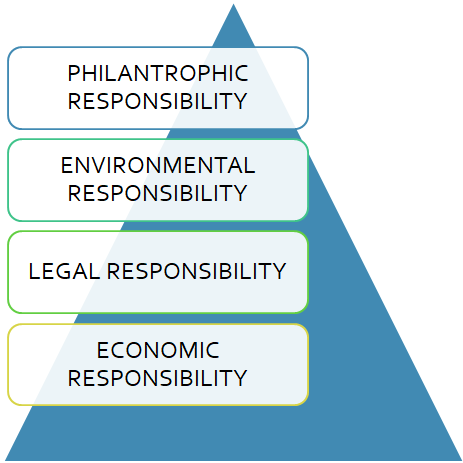
1.Philanthropic Responsibility

At the top of the pyramid, occupying the smallest space is Philanthropic Responsibility. Businesses have long been criticized for their carbon footprint, their part in pollution and exploitation of natural resources. To counterbalance these negatives a business stands a responsibility to “give back” to the community they take from.

Philanthropic responsibility include things such as:-

i) Funding educational programs

ii) Supporting health initiatives

iii) Donating to causes

iv) Supporting community beautification projects

2. Environmental Responsibility

Environmental CSR aims to reduce any damaging effects on the environment from operations of business.

 It may focus on:

1. Energy use

2. Water use

3. Waste Management

4. Recycling

5. Emissions

6. Eco-friendly office and business travel policies

Advantages of Environmental CSR

1. Green CSR can reduce business risk

2. Improve reputation

3. Provide opportunities for cost savings

Even the simplest energy efficiency measures can generate savings and make a difference for firm.

3. Legal Responsibility

Legal responsibilities are not only liable to the individuals in the society but also to the businesses in the society. As business is an entity itself, it must also follow laws and rules.

Every business has a responsibility to operate within the boundaries set by the various commissions and agencies at every level of the Government. These rules and regulations are set for maintaining balance and the greater good of the society.

A law-abiding enterprise is a socially responsible enterprise as well. The business is free to do business however it wants but only within the boundaries of regulations of various laws 

Some Laws are as follow:-

1. Labour Law

2. Environmental Law

3. Criminal Law

For example, it’s a business’s duty to pay taxes to the government and keep its account books clean as it helps the government to track the economic state of the company.

4. Economic Responsibility

The first and most important responsibility of a business is to be profitable. It is the foundation and base on which all other responsibilities rest. Without profit, the company would not be able to pay their workers, employees will lose their jobs even before the company starts CSR activities.

Being profitable is the only way for a company to be able to survive long term, and benefit society. Additionally, this also means that it is a company’s duty to produce goods and services that are needed/wanted by the customers, at a reasonable price.

Economic responsibility is an interconnected field that focuses to strike a balance between business, environmental, and philanthropic practices.

Performing this responsibility companies try to find out a solution that can facilitate their business growth and generate profits by benefiting the community and society.

Is India ready for the third wave of Covid-19?

We’ve been through this pandemic since 2019. It’s only in January 2020 we came to know about it, too late to take any precautions as such. The nation started to witness a huge number deaths and got to understand the severity of this virus. The only option left for the government was a nationwide lock down. On the evening of March 24, 2020, the government of India under Prime Minister Narendra Modi, announced a nationwide lockdown for 21 days, i.e till 14th April 2020, but was extended further for months.

This affected the nation in a drastic manner with the downfall in the economy of the country, rise in unemployment, poverty, theft and robbery. Everything brought into the nation a complete chaos. It not only affected the country economically but also the mental health of the people. The suicide rate during the pandemic has increased drastically. We humans need companions. Maintaining social distance and not to talk and meet anyone in person is really difficult for a normal human. It’s just that we are not use to, though it has become a new normal now.

The education system collapsed completely during this pandemic. Online mode of education can never replace the offline mode, no matter how much technically capable we become. Never in the history had matriculation and intermediate examination be cancelled. Now as it has, students have taken things so lightly that examination don’t fear them anymore. Children now, are the future of our country. What will these students grow up and do? How will our country develop further? Will our country be safe in their hands? We don’t have an answer to these. This pandemic no matter how soon we wish to end, is going to have a long term effect on everybody’s life.

‘COVID third wave to hit India in August’

A research report has predicted that India may witness the third wave of COVID-19 in mid-August 2021, raising the alarm bells for policymakers and citizens. The research claims that the COVID third wave peak will arrive in the month of September 2021. According to the SBI report, the global data shows that on average, peak COVID-19 cases reached during the third wave are nearly twice or 1.7 times those from the second wave of the pandemic.

Are we ready for the next wave to hit? Everything that’s happening to happen once again?

No, right? The people of our country are not at all, though the government is arranging for beds, oxygen and all other necessities. The people on the other hand are planning trips and vacations. Just a month ago, people were struggling to get oxygen and a bed at the hospital. Now the same people are struggling to get rooms at a resort in Manali.

India registered 43,393 new COVID-19 cases today from peak of 4 lakhs in the 3rd week of May. 44,459 recoveries, and 911 deaths in the last 24 hours, as per the latest update by the Health Ministry this morning. As per the data shared by the Ministry of Health and Family Welfare (MoHFW), there has been been a slowdown in the downward trend of daily COVID infections and a slight increase in the positivity rate. Yet, third wave is knocking the door. Beware!

Vaccination

The only way you can be a little safe during the third wave is through vaccination. Though it’s very difficult to get your slots booked, try and vaccinate yourself as soon as possible. Vaccination too cannot protect you from the virus completely. Go out only if necessary and wear masks properly. It’s better to stay away from crowded places to avoid being caught by the virus.

Get yourself vaccinated and stay home!

CLIMATE CHANGE AND ITS EFFECT ON EARTH

The planet is warming, from North Pole to South Pole. Since 1906, the global average surface temperature has increased by more than 1.6 degrees Fahrenheit (0.9 degrees Celsius)—even more in sensitive polar regions. And the impacts of rising temperatures aren’t waiting for some far-flung future–the effects of global warming are appearing right now. The heat is melting glaciers and sea iceshifting precipitation patterns, and setting animals on the move.

While many people think of global warming and climate change as synonyms, scientists use “climate change” when describing the complex shifts now affecting our planet’s weather and climate systems—in part because some areas actually get cooler in the short term.

Climate change encompasses not only rising average temperatures but also extreme weather events, shifting wildlife populations and habitats, rising seas, and a range of other impacts. All of those changes are emerging as humans continue to add heat-trapping greenhouse gases to the atmosphere, changing the rhythms of climate that all living things have come to rely on.

The “greenhouse effect” is the warming that happens when certain gases in Earth’s atmosphere trap heat. These gases let in light but keep heat from escaping, like the glass walls of a greenhouse, hence the name. humans have increased the amount of carbon dioxide in the atmosphere by more than a third since the Industrial Revolution. Changes that have historically taken thousands of years are now happening over the course of decades.

EFFECTS OF CLIMATE CHANGE ON OUR FUTURE

The direct consequences of man-​made climate change include:

  • rising maximum temperatures
  • rising minimum temperatures 
  • rising sea levels 
  • higher ocean temperatures 
  • an increase in heavy precipitation (heavy rain and hail)
  • shrinking glaciers
  • thawing permafrost

The indirect consequences of climate change, which directly affect us humans and our environment, include: 

  • an increase in hunger and water crises, especially in developing countries
  • health risks through rising air temperatures and heatwaves 
  • economic implications of dealing with secondary damage related to climate change 
  • increasing spread of pests and pathogens
  • loss of biodiversity due to limited adaptability and adaptability speed of flora and fauna  
  • ocean acidification due to increased HCO3 concentrations in the water as a consequence of increased CO₂ concentrations
  • the need for adaptation in all areas (e.g. agriculture, forestry, energy, infrastructure, tourism, etc.)

10 Best Apps For Your Fitness

Exercise is the miracle cure we have all been waiting for. It is free, easy to start, has few side effects when done properly, and does not need a prescription. If exercise were a drug, it would be the most cost-effective medicine of all time.

Being physically active has an overwhelming number of attached benefits, such as helping you maintain a healthy weight, strengthening your heart, improving lung function, and reducing your risk for coronary heart disease. Furthermore, physical activity lowers your risk of depression, cognitive decline, diabetes, and cancer.

1.RunKeeper:

RunKeeper tracks walks, runs, and any other physical activity. From the casual stroller to the 5K runner and those building up to a marathon, this GPS app boasts a community of 50 million users and is suitable for everyone. You can build, save, and discover new routes with GPS to keep your workout stimulating.

Whether your goal is to train for a race, lose weight, or hit a particular pace target, RunKeeper can help you to plan your route to get there. The My Plan dashboard provides custom training plans based on your answers to a series of questions, or there are ready-made schedules that can be selected.

It is easy to stay motivated with RunKeeper. You can join challenges to push yourself, win rewards for your workouts, and share your progress with friends. You can also create your own challenges, invite friends to join you, and encourage and cheer each other on along the way.

2. Strava:

Strava aspires to connect the world’s athletes by providing an inspiring experience minus the junk posts you might find on other social networks. They say that you might join Strava for the app’s tracking ability, but you will stay for their motivating and competitive community. Strava is our top pick for social training.

Strava’s community involves millions of cyclists, runners, active adventurers, and pros that record their activities. Strava’s activity tracking provides key statistics such as speed, pace, distance, elevation gained, and calories burned during and after exercise. An interactive map of your activity is also displayed.

You can compare your performance with other users and connect with the community, as well as share highlights of your activity, stories, and showcase photos of the best moments from your run or ride. Encouragement and motivation can be gained or given through comments and kudos. A bit of friendly competition can also be injected into your workout by shooting for the best time on the leaderboard.

3. Yoga Studio:

Yoga Studio is the most highly recommended yoga app and for a good reason. With more than 70 ready-made yoga and meditation classes with levels ranging from beginner to advanced and lasting from 15 to 60 minutes, there is something for everyone.

You can customize classes and choose whether you want to focus on strength, balance, flexibility, relaxation, or a combination of all four. The commentary provides clear and easy-to-follow instructions on how to do a pose and how to move from one pose seamlessly to the next.

With step-by-step instructions of more than 280 poses, plus their benefits, modifications, variations, and cautions of those poses, you have an instant yoga library in your pocket. You can also sync classes with your phone calendar to make sure you can fit regular yoga practice into your busy schedule.

4. Sworkit:

Sworkit is a simple and customizable workout app rated number 1 by the American College of Sports Medicine for quality of instructional exercise standards. Sworkit has delivered more than 40 million workouts to people of all levels of fitness.

After entering your personal data, you can select your motives and goals to make sure every second counts. The workout dashboard introduces numerous exercises for strength, cardio, yoga, and stretching demonstrated by your coach. Individual exercises can be viewed using the custom dashboard to compile your personalized workout.

You can choose workout plans to become “Leaner,” “Fitter,” or “Stronger,” and each of the three categories contain workouts, which are free for 7 days, for the beginner, intermediate, and advanced. 

5. J&J Official 7 Minute Workout:

The J&J Official 7 Minute Workout is a science-based workout method designed by Chris Jordan, director of exercise physiology at the Johnson & Johnson Human Performance Institute. The app is centered around research on HIIT and circuit training that shows that short bursts of hard exercise with short recoveries can improve aerobic fitness quickly.

Setup is fast. You can jump straight into a 7-minute workout, or 9.07 minutes with a warmup. Swiping between workout views on the slick interface displays time, video, or music, which can be selected from your phone music library. You can also give a thumbs up or thumbs down for exercises that you like or dislike.

Browsing through the video tutorials teaches you how to perform each of the 72 exercises safely and effectively. Your progression is tracked in the performance dashboard to indicate the days, number of cycles completed, and effort. A snapshot of your training can be shared with your friends to help keep you motivated, or perhaps to involve a little healthy competition.

6. Couch to 5K:

Couch to 5K helps you go from couch potato to running 5K in just 9 weeks by following their easy and fun training plan. The app is designed for complete beginners to spend around 20 to 30 minutes working out, three times per week, to get 5K-ready.

The race training tools allow you to log your workouts and share progress on Facebook. Your distance and pace progress can be monitored in the graphs section, and workouts can be manually entered if you train on a treadmill.

The app syncs with your phone’s playlists so that you can listen to your favorite tracks while running.

7. JEFIT: Workout Tracker Gym Log:

JEFIT is the essential app for gym-goers. Say goodbye to pen and paper for good, and use JEFIT to log the weight and repetitions on each gym machine in one-click. JEFIT enables you to track your workout routines and your rest time, and log and graph all body measurements as you progress.

If you are a gym beginner, JEFIT provides you with more than 60 routines devised by the JEFIT team, or you can access more than 2,000 community-created plans to get you started. An exercise dashboard displays an excess of 1,300 exercises for weight lifting equipment and cardio machines, and it provides visual step-by-step instructions on how to complete the exercises, as well as useful tips.

JEFIT has an active workout community. There are millions of other users to connect with, or you can add friends to keep you motivated and on track. You can share your training progress with the community and compare statistics.

8. Zombies, Run!:

Zombies, Run! is an immersive running game and audio adventure. Upon installation, you are presented with a story detailing that you are runner en route to one of humanity’s last remaining outposts after the zombie epidemic. Your job is to gather supplies, rescue survivors, and defend their homes.

By running in a park, walking trails, or even jogging on a treadmill, you can save hundreds of lives and discover the truth about the zombie apocalypse. Your mission and music channels play through your headphones, and if you are chased by zombies, you must speed up.

The first four missions are free, and a new mission can be unlocked each week. Upgrading to Pro unlocks unlimited access to more than 260 missions and interval training. If you want to get your heart racing and have an adrenalin rush, this is the app for you.

9. Charity Miles:

If you fancy making a real difference with your training, Charity Miles is for you. By going out to grab a coffee, walking your dog, biking around the neighborhood, or shoveling some snow, not only will your health benefit from being physically active, but charities will also benefit too. 

On setup, you can select from more than 40 charities to support. Once you start your activity, you are sponsored by a brand to complete your task. Your activity, distance, duration, and the total amount earned by the community for your chosen charity is displayed on the dashboard.

As all physical activity contributes to charity, you will be motivated to go that extra mile and move more. As a bonus, you will also increase your fitness levels and improve your health. The more steps you do, the more you earn; “Every Mile Matters.”

10. CARROT Fit:

CARROT Fit is the fun way to get fit with your sadistic computer-generated coach. CARROT has one goal – “to transform your flabby carcass into a Grade A specimen of the human race” – and will stop at nothing to achieve her objective. CARROT bribes, inspires, threatens, and ridicules, saying, “You will get fit – or else!”

The app is based on the same 7-minute science-based method as the J&J Official 7 Minute Workout. However, those 7 minutes are sweat-and-pop-culture soaked, involving activity such as Celebrity Face Punches, Dragon Mating Dances, and Mt. Doom Climbs. You can take part in 30 seconds of punishing exercise, followed by 10 seconds rest, “just in case you need to hydrate, catch your breath, or vomit into a bucket.”

CARROT tracks how many steps you have taken and your weight loss, as well as displays your workouts on a calendar. CARROT will pass judgment on your progress. If CARROT is upset by your progress, her harsh demeanor has a 74.9 percent chance of making you cry. However, if CARROT is impressed by your progress, she will reward you with app upgrades and permission to watch a friend eat a bag of potato chips, and she may even present you with cat facts. Lucky you!

Derinkuyu-The Underground city

We know the term “city “that is on the ground,but there is another term when associated with the term city gives of a thrilling vibes and piques the curiosity of people and the term is “UNDERGROUND”

“Underground city” it is a city which is literally as the name says underneath the ground.
So today we are going to discuss about a city called “Derinkuyu”.

From viator.com

It is an ancient multi-level underground city in Turkey.

It is the deepest excavated underground city in Cappadocia and a stunning wonder.

The city is said extends to a depth of 200 feet and could have sheltered as many as 20,000 people together.

Derinkuyu city is famous for its capacity to hold thousands of families that is one of the highest among many underground cities that were found.

It’s said that this city dwelling not only could hold thousands of people, but also contained everything an entire population would need to survive any crises.

There are numerous subterranean dwellings and secret tunnel passages that were used as shelters.

From:Getyourguide

The underground city at Derinkuyu could be closed from the inside with large stone doors enhancing the security measures up a notch and each floor could be closed off separately.


It had aminities such as wine and oil presses, stables, cellars, storage rooms, refectories, and chapels.

On the second floor is a spacious room with a barrel-vaulted ceilings ,and rooms were used as a religious school and for study purposes.


There is a series of vertical staircases between the 3rd and 4 th floor leading to the church located at lowest level.

From:Shutterstock


There is a large 55-metre ventilation shaft a which seemed to provide water to both the villagers above and, if the outside world was not accessible, to those in hiding.

What fascinates me is how did they build this city without having any access to the technology and designed it beautifully and they took all kinds off possibilities into account making a city which is anytime ready to face any kind of problem.

It is said to be one of the top most tourist destinations in Turkey. You can also visit this by booking tickets in a trusted website.

Thankyou^^.

RISING NPA IN INDIA’S BANKING SYSTEM

As per the Reserve Bank of India (RBI), a loan is considered a “bad loan”, or an NPA when the interest due for any quarter is not fully paid within 90 days from the end of the quarter. However, this time period may vary based on the terms and conditions agreed upon by the bank and the borrower.

When a bank offers a loan, it charges interest on the amount, which is why it is regarded as an asset to the bank. When the borrower stops paying the interest, or the principal, or both, the lender loses money. Such a loan then becomes a non-performing asset (NPA) for the bank. The banking industry in India is seriously affected by the NPA crisis with the rising number of defaulters.

he economic fallout of the pandemic is expected to push up non-performing assets (NPAs) of the banking sector, Reserve Bank of India (RBI) said on Friday, estimating the ratio of gross NPAs may rise to 12.5% by March next year, in a baseline scenario.  The central bank’s Financial Stability report (FSR), noted the NPA ratio could jump to as high a level as 14.7% in the event of severe stress.

the report reveals that nearly half of the outstanding credit till April 30, was under moratorium, somewhat higher than estimates provided by bankers.  A total of 48.6% customers by number and 50.1% by value had made use of the moratorium till April 30. While 66.6% of borrowers at state-owned banks opted for the deferral, the share for customers at private sector banks was 49.2%.  Non-banking financial companies (NBFCs) had granted a moratorium to 49% of their customers.

The level of deferrals, availed of by borrowers, is being closely monitored as it reflects the potential stress in the system. Analysts at Macquarie had estimated the extent of loans under moratorium at 25-30% at the end of May. “The regulatory dispensations that the pandemic has necessitated in terms of the moratorium on loan instalments and deferment of interest payments may have implications for the financial health of banks going forward,” RBI cautioned.

Banks have observed there is a declining trend in the number of borrowers who want to delay repayments. HDFC said the share of its retail loan book, under moratorium, was down to 7% as of June 15 from 21% in May. Axis Bank reported that 9.7% of its outstanding loan book was under moratorium as of June 30; in April this number was 25%.

Purchasing method

A method used by businesses to buy products and/or services.
A purchasing system manages the entire acquisition
process, from requisition, to purchase order, to product
receipt, to payment.
Purchasing systems are a key component of effective inventory
management in that they monitor existing stock and help
companies determine what to buy, how much to buy and when
to buy it.

FUNCTIONS OF PURCHASE DEPARTMENT

Purchase materials at lowest possible cost while maintaining quality. Maintain good relationship with the suppliers. Take advantage of economies of scale. Maintain records efficiently. Develop highly competent personnel. Co-ordinate with all the departments of the organization.

TYPES OF PURCHASING SYSTEM Tender System Stockless Purchase System Blanket Order E-Purchasing / E-Procurement Subcontracting Rate Contract Method Petty Cash System Capital Equipment Purchase

Subcontracting refers to the process of entering a contractual agreement with an outside person or company to perform a certain amount of work. The outside person or company in this arrangement is known as a subcontractor. Many small businesses hire subcontractors to assist with a wide variety of functions

. Example: A small business may use an outside firm to prepare its payroll.Subcontracting is probably most prevalent in the construction industry, where builders often subcontract plumbing, electrical work, drywall, painting, and other tasks. In some cases, a general contractor may only be used as the construction manager or supervisor. In that case, subcontracting accounts for all of the physical work done on the premises. The general contractor’s only responsibility is to approve the contracts, keep the project within budget, and inspect the work.

https://www.google.com/url?sa=t&source=web&rct=j&url=https://www.vskills.in/certification/tutorial/methods-of-purchasing/%3Famp&ved=2ahUKEwjr6o6LvdbxAhVUOysKHSTHAmMQFjAHegQIBBAG&usg=AOvVaw1jnaDBnawTcfblhlrQ4p7q&ampcf=1

https://www.google.com/url?sa=t&source=web&rct=j&url=https://www.yourarticlelibrary.com/purchase-management/methods-of-purchasing-materials-8-methods/53168&ved=2ahUKEwjr6o6LvdbxAhVUOysKHSTHAmMQFjAQegQIIxAC&usg=AOvVaw1Tu70iCs1-rQ6pDorj59D5

Human Intelligence And Artificial Intelligence Related

Human Intelligence:-

INTRODUCTION:-

Human intelligence is the intellectual capability of humans, which is marked by complex cognitive feats and high levels of motivation and self-awareness.Through intelligence, humans possess the cognitive abilities to learn, form concepts, understand, apply logic, and reason, including the capacities to recognize patterns, plan, innovate, solve problems, make decisions, retain information, and use language to communicate. There are conflicting ideas about how intelligence is measured, ranging from the idea that intelligence is fixed upon birth, or that it is malleable and can change depending on an individual’s mindset and efforts.Several subcategories of intelligence, such as emotional intelligence or social intelligence, are heavily debated as to whether they are traditional forms of intelligence.They are generally thought to be distinct processes that occur, though there is speculation that they tie into traditional intelligence more than previously suspected.

Various definitions of intelligence tend to converge around similar notions designed to capture the essence of this psychological factor. Jensennotes Carl Bereiter’s definition of intelligence: “what you use when you don’t know what to do” (p 111). After their extensive survey, Snyderman and Rothmanunderscored reasoning, problem solving, and learning as crucial for intelligence. The “mainstream science on intelligence” report coordinated by Gottfredsonhighlights reasoning, planning, solving problems, thinking abstractly, comprehending complex ideas, learning quickly, and learning from experience. The American Psychological Association (APA) report on intelligence acknowledges that “individuals differ from one another in their ability to understand complex ideas, to adapt effectively to the environment, to learn from experience, to engage in various forms of reasoning, to overcome obstacles by taking thought.

An external file that holds a picture, illustration, etc.
Object name is DialoguesClinNeurosci-12-489-g001.jpg

For more than a century, psychologists have developed hundreds of tests for the standardized measurement of intelligence with varying degrees of reliability and validityThe resulting measures allowed for the organization of taxonomies identifying minor and major cognitive abilities. J. B. Carroll,for example, proposed a threestratum theory of intelligence after the extensive reanalysis of more than 400 datasets with thousands of subjects from almost 20 different countries around the world.shows a simplified depiction of the taxonomy of cognitive abilities.

An external file that holds a picture, illustration, etc.
Object name is DialoguesClinNeurosci-12-489-g002.jpg

This survey of factor analytic studies supports the view that intelligence has a hierarchical structure (ie, like a pyramid). There is strong evidence for a factor representing general intelligence (g) located at the apex of the hierarchy (stratum III). This g factor provides an index of the level of difficulty that an individual can handle in performing induction, reasoning, visualization, or language comprehension tests. At a lower order in the hierarchy (stratum II), several broad ability factors are distinguished: fluid intelligence, crystallized intelligence, general memory, visual perception, auditory perception, retrieval, or cognitive speed. Lastly, stratum I is based on specific abilities, such as induction, lexical knowledge, associative memory, spatial relations, general sound discrimination, or ideational fluency.

Artificial Intelligence:-

INTRODUCTION:-

Artificial intelligence (AI), the ability of a digital computer or computer-controlled robot to perform tasks commonly associated with intelligent beings. The term is frequently applied to the project of developing systems endowed with the intellectual processes characteristic of humans, such as the ability to reason, discover meaning, generalize, or learn from past experience. Since the development of the digital computer in the 1940s, it has been demonstrated that computers can be programmed to carry out very complex tasks—as, for example, discovering proofs for mathematical theorems or playing chess—with great proficiency. Still, despite continuing advances in computer processing speed and memory capacity, there are as yet no programs that can match human flexibility over wider domains or in tasks requiring much everyday knowledge. On the other hand, some programs have attained the performance levels of human experts and professionals in performing certain specific tasks, so that artificial intelligence in this limited sense is found in applications as diverse as medical diagnosis, computer search engines, and voice or handwriting recognition.

Guide To Understanding Artificial Intelligence - ReadWrite

Today, Artificial Intelligence is a very popular subject that is widely discussed in the technology and business circles. Many experts and industry analysts argue that AI or machine learning is the future – but if we look around, we are convinced that it’s not the future – it is the present.With the advancement in technology, we are already connected to AI in one way or the other – whether it is Siri, Watson or Alexa. Yes, the technology is in its initial phase and more and more companies are investing resources in machine learning, indicating a robust growth in AI products and apps in the near future.

The following statistics will give you an idea of growth!

– In 2014, more than $300 million was invested in AI startups, showing an increase of 300%, compared to the previous year (Bloomberg)

– By 2018, 6 billion connected devices will proactively ask for support. (Gartner)

– By the end of 2018, “customer digital assistants” will recognize customers by face and voice across channels and partners (Gartner)

–  Artificial intelligence will replace 16% of American jobs by the end of the decade (Forrester)

– 15% of Apple phone owners’ users use Siri’s voice recognition capabilities. (BGR)

Unlike general perception, artificial intelligence is not limited to just IT or technology industry; instead, it is being extensively used in other areas such as medical, business, education, law, and manufacturing.

In the following, we are listing down 9 very intelligent AI solutions that we are using today, marketing machine learning as a present thing – not the future.

  • Siri
  • Tesla
  • Cogito
  •  Netflix
  • Pandora
  •  Nest (Google)
  • Boxever
  • Flying Drones
  • Echo

1. Siri

Siri is one of the most popular personal assistant offered by Apple in iPhone and iPad. The friendly female voice-activated assistant interacts with the user on a daily routine. She assists us to find information, get directions, send messages, make voice calls, open applications and add events to the calendar.Siri uses machine-learning technology in order to get smarter and capable-to-understand natural language questions and requests. It is surely one of the most iconic examples of machine learning abilities of gadgets.

2. Tesla

Not only smartphones but automobiles are also shifting towards Artificial Intelligence. Tesla is something you are missing if you are a car geek. This is one of the best automobiles available until now. The car has not only been able to achieve many accolades but also features like self-driving, predictive capabilities, and absolute technological innovation.If you are a technology geek and dreamt of owning a car like shown in Hollywood movies, Tesla is one you need in your garage. The car is getting smarter day by day through over the air updates.

3. Cogito

Cogito originally co-founded by Dr. Sandy and Joshua is one of the best examples of the behavioral version to improve the intelligence of customer support representatives, currently on the market. The company is a synthesis of machine learning and behavioral science to enhance customer collaboration for phone professionals.Cogito is applicable on millions of voice calls that take place on a daily basis. The AI solution analyzes the human voice and provides real-time guidance to enhance behavior.

5. Pandora

Pandora is one of the most popular and highly demanded tech solutions that exist. It is also called the DNA of music. Depending on 400 musical characteristics, the team of expert musicians individually analyzes the song. The system is also good at recommending the track record for recommending songs that would never get noticed, despite people’s liking.

6. Nest (Google)

Nest was one of the most famous and successful artificial intelligence startups and it was acquired by Google in 2014 for $3.2 billion. The Nest Learning Thermostat uses behavioral algorithms to save energy based on your behavior and schedule.It employs a very intelligent machine learning process that learns the temperature you like and programs itself in about a week. Moreover, it will automatically turn off to save energy, if nobody is at home.In fact, it is a combination of both – artificial intelligence as well as Bluetooth low-energy because some components of this solution will use BLE services and solutions.

7. Boxever

Boxever is a company that heavily relies on machine learning to enhance the customer experience in the travel industry and conveys micro-moments or experiences that can please the customers.Boxover significantly improves customer engagement through machine learning and Artificial Intelligence to rule the playing field, helping customers to find new ways and make memorable journeys.

8. Flying Drones

The flying drones are already shipping products to customers home – though on a test mode. They indicate a powerful machine learning system that can translate the environment into a 3D model through sensors and video cameras.The sensors and cameras are able to notice the position of the drones in the room by attaching them to the ceiling. Trajectory generation algorithm guides the drone on how and where to move. Using a Wi-Fi system, we can control the drones and use them for specific purposes – product delivery, video-making, or news reporting.

9. Echo

Echo was launched by Amazon, which is getting smarter and adding new features. It is a revolutionary product that can help you to search the web for information, schedule appointments, shop, control lights, switches, thermostats, answers questions, reads audiobooks, reports traffic and weather, gives info on local businesses, provides sports scores and schedules, and more using the Alexa Voice Service

Conclusion

Artificial Intelligence is gaining popularity at a quicker pace; influencing the way we live, interact, and improve customer experience. There is much more to come in the coming years with more improvements, development, and governance.

Difference Between Artificial Intelligence and Human Intelligence

Artificial Intelligence: Artificial Intelligence is based on the human insights that can be decided in a way that can machine can effortlessly actualize the tasks, from the basic to those that are indeed more complex. The reason for manufactured insights is learning, problem-solving, reasoning, and perception.
This term may be connected to any machines which show related to a human intellect such as examination and decision-making and increments the efficiency.
AI covers assignments like robotics, control systems, face recognition, scheduling, data mining, and numerous others.

Human Intelligence: Human intelligence or the behaviour of the human being has come to past experiences and the doings based upon situation, environment. And it is completely based upon the ability to change his/her own surroundings through knowledge which we gained.
It gives diverse sorts of information. It can provide data on things related to the particular aptitude and knowledge, which can be another human subject, or, within the case of locators and spies, diplomatic data to which they had to get to. So, after concluding all it can give data on interpersonal connections and arrange of interest.

Below is a table of differences between Artificial intelligence and Human intelligence:

FeatureArtificial IntelligenceHuman Intelligence
EmergenceAI is an advancement made by human insights; its early improvement is credited to Norbert Weiner who theorized on criticism mechanisms.On the other hand, human creatures are made with the intrinsic capacity to think, reason, review, etc.
Pace/Rate of AI and humanAs compared to people, computers can handle more data at a speedier rate. For occurrence, in the event that the human intellect can solve a math problem in 5 minutes, AI can solve 10 problems in a minute.In terms of speed human cannot beat the speed of AI, or, machines.
Decision MakingAI is profoundly objective in choice making because it analyzes based on absolutely accumulated data.Human’s choices may be affected by subjective components which are not based on figures alone.
PerfectionAI frequently produces precise comes about because it capacities based on a set of modified rules.For human insights, there’s more often than not a room for “human error” as certain subtle elements may be missed at one point or the other.
Energy ConsumptionModern computer generally uses 2 watts energy.On the other hand, human brains uses about 25 watts
Modification of AI and HumanAI takes much more time to adjust to unused changes.Human insights can be adaptable in reaction to the changes to its environment. This makes individuals able to memorize and ace different skills.
VersatilityAI can as it were perform less assignments at the same time as a framework can as it were learn duties one at a time.The human judgment skills underpins multitasking as prove by differing and concurrent roles.
Social NetworkingAI has not aced the capacity to choose up on related social and enthusiastic cues.On the other hand, as social creatures, people are much way better at social interaction since they can prepare theoretical data, have self-awareness, and are delicate to others’ feelings.

Reference Links:-

https://www.ncbi.nlm.nih.gov/pmc/articles/PMC3181994/

https://www.iqvis.com/blog/9-powerful-examples-of-artificial-intelligence-in-use-today/

https://www.geeksforgeeks.org/difference-between-artificial-intelligence-and-human-intelligence/

Conversation skills that you need

communication plays a very important role in human life. It helps in the exchange of information and knowledge, it helps in developing relationships, the bonding on which the human life dwells itself. Conversations are key to language development. Ideas and thoughts also find a way to enhance through conversations. They make learning easier when combined with perfect facial and body expressions.

how do you define conversation skills?

A perfect conversation is the one which “serves the intention” and “transfers the information” perfectly. People may define it differently, But for the most part, conversation skills include ability to initiate, sustain and end a conversation. You may have the best information, but how you share, matters a lot. And also Engagement- an attempt to perfectly involve others in the conversation, is important.

“Conversation skills refer to a collective set of skills needed to communicate effectively with another person”. Better skills allow to understand and comprehend better to every person in the conversation.

The pandemic which hit the world very badly is forcefully making people to isolate themselves, replacing in person conversations to Vedio calls. Obviously there is a difference when you talk to a person when he is in front of you and when you talk through a screen. But rise in social media popularity did this before pandemic. Conversations have been changed to texting. These all are taking important conversation skills away from people. Clearly avoiding screen is not a solution, but maintaining a balance is very important.

ways to improve conversation skills

LISTEN ACTIVELY: Listening shows that we are in the person and the topic of conversation. Listening is as vital as speaking since a conversation involves sharing which needs both giving and receiving end. Practice active listening by paying attention, Asking questions to clarify confusions and repeating the message or its summary back to the speaker.

LOOK FOR NONVERBAL CUES: Non verbal communication has importance exactly as the words person chooses to do conversation. For example, consider body language. Try to have a good eye contact with the person in front of you. By saying a good eye contact I mean, the eye contact shouldn’t be making the person uncomfortable. Nodding your head to show your agreement or disagreement also helps. Keeping yourself in a position that makes you hear them correctly will also help. And if you are the speaker, make sure the message you are sending is consistent both verbally and non verbally.

HAVE EMPATHY: When you are listening to other person, try to put yourself in his/her shoes. Try to understand their point of view. Use statements which shows that you are understanding. For example ” I can understand your situation”. This will help to build trust. Learn to “agree to disagree”. Respect them even if you disagree. Be polite throughout the conversation.

PAY ATTENTION TO THE DETAILS: A person with strong conversation skill will absorb more from the conversation than the average person just by noticing extra details. This will help you have more accuracy in the information. Noticing the accent and the motive in the conversation will help in long term.

OFFER INTRESTING INSIGHTS: People with good conversation skills frequently yell you things you didn’t know and find interesting. Increase your knowledge by reading books, magazines and listening to podcasts. Observe how they are choosing words or expressing them. Be Honest when you don’t know, that will not make you anything lesser.

TALK SLOWLY: A good conversationalist often act as they have abundance of time. Don’t hurry or cut others sentences. Take your time while speaking and be confident. Try to take a time before what you say to just reflect on it. be thoughtful.

USE RIGHT WORDS: A well ability to communicate has a lot to do with the words you choose. Bad choice of words will create misunderstandings. Constantly work on your vocabulary and practice communicating accurately.

A good communication skill will help you regardless of the field you are going to be in. Develop these skills as soon as possible and shine on!