Irena Sendler daughter of Dr Staninslaw a physician and his wife Janina. Her father died from typhus contracted from the patients he was treating, mainly Jews whom other physicians had rejected.
She, later on, went to study at the University of Warsaw and was suspended shortly afterwards because of her public protests.
Her most dangerous and valuable possession was the glass jar which contained names of over 2000 children whom she had smuggled to safety. Her entire life was that glass jar.
When the Nazis had invaded Poland, they made further laws that eroded Jewish rights. Hitler forced the Jews into just one square mile of land. They were subjected to constant surveillance and the families eventually became sick and starving.
Sendler and her colleagues secured passes into the Ghetto and claimed to be checking for typhus outbreaks. They tried to smuggle food and medicines to the people with the help of the Polish. But the scenario was different inside. People were desperate to help their children escape through sewage and over fences.
It was when Irena and her group of 10 realized that they had to change their plan of action. They developed rescue missions –
Make use of an ambulance to take a child out hidden underneath the stretcher.
Escape through the courthouse or church.
Children could escape through the sewer pipes and other underground passages.
A trolley was used to aid in carrying out a child in a sac, suitcase, coffin etc.
If a child pretends to be very ill – he could be legally removed using an ambulance.
The children were sent to convents, foster families and orphanages.
The names of all these children were written down on cigarette papers and stored in glass jars.
The police captured Sendler but her records remained safe. She was repeatedly tortured and finally sent to be executed. But the German officer diverted her course as he was paid a lump sum amount for her release.
She continued her mission of smuggling children out of the Ghetto camps till the defeat of the Nazi’s in 1945.
Ina v.s, Ann M.kennedy, Miachel O Martin ,Maraian Sainsbury
(International Association for the Evaluation of Educational Achievement).
Reference
PIRLS 2006 assessment framework and specifications
The study was conducted in 2004 under the supervision of IEA (International Association for the Evaluation of Educational Achievement).
The study is consists four parts:
Overview of IEA’s PIRLS Assessment.
PIRLS Reading Purposes and Processes of Reading Comprehension.
Contexts for Learning to Read.
Assessment Design and Specifications
Reading is the first step to being literate. Reading is a multifaceted process involving word recognition comprehension, fluency and motivation. For the development of a country it is really important to have literacy.
The PIRL also have a look over the improvement of reading and literacy achievement around the world. IEA was founded in 1959 and its main purpose was focusing on educational policies all over the world.
Reading abilities are important for the progress of one individual. Reading skill is the basis for the upcoming education. It is not about language. Reading literacy helps to grow ones personally and professionally and prepare for communication with the world. The PIRL conducts a framework which is revised every five years, to help to understand the achievement of children across the world in reading literacy.
PRIL defines reading literacy and its importance in IEA framework 2001. Readers are regarded as actively constructing meaning and as knowing effective reading strategies and how to reflect on reading.
Reading literacy also brings changes in the behavior and attitude including the construction of meaning from a variety of text and behavior which is going to support lifelong reading. It helps the children to develop a positive attitude, self-confidence and gain valuable experiences with the help of different texts. Reading literacy establishes an individual/reader as a member of a literate community.
The process of comprehension and purpose of reading are two elements which help to understand the importance of reading literacy. The process of comprehension helps the reader to examine their understanding and adjust their approach.
The texts could vary on the basis of length, complexity, abstractness of idea and structures. Readers not only get information from the content but also focus on relevance to the question posed. It makes straightforward inference about the ideas and information. The purposes of reading are
Reading for literacy experience.
Reading to acquire and use information.
The context of reading literacy is also important. There are contexts which impact on the reading of children such as school, home, community, national and international.
The study also focuses on assessing/evaluating the children on the basis of their reading literacy. They focus not to put a burden on the student so they provide a comprehension to evaluate.
Reflection
The article had old data and its focuses on reading literacy only. But I feel the writer should focus on the other aspects too. How reading literacy influenced the other aspects of literacy? The whole study is conducted over the fourth class students. The fourth class students were literally very small to answer the questions. I think the writer can involve more people of different ages because a child is still in the learning process so they can answer the question with their cognitive ability. According to me, the writer should consider the people who have left their studies or continue their study or have interest in studying and fulfilling their desire by reading the texts. We can get better results from them too.
The four parts are very well explained by the writers. The study consists of the appendix, research and questionnaires. The questionnaire consisted of multiple choice, short and long questions.
In the end there is Comparison between the Progress in International Reading Literacy Study (PIRLS) and the Programme for International Student Assessment (PISA).
Sounds are all around us,from birds chirping and waves lapping against a costline to cars honking in traffic. But sometimes sounds are put together in purposeful ways to create a specific atmosphere or to express ideas or emotions. Such organized sounds are called Music
Music is a collection of coordinated sound or sounds. Making music is the process of putting sounds and tones in an order, often combining them to create a unified composition. People who make music creatively organize sounds for a desired result,like a Beethoven symphony or one of Duke Ellington’s jazz songs. Music is made of sounds, vibrations,and silent moments,and it doesn’t always have to be pleasant or preety. It can be used to convey a whole range of experiences , environments,and emotions.
Music is a language of emotions in that it can represent different feelings and barge into the soul with no boundaries or limitations. People are always challenged by the fact that”no one understand them” or know how they “really feel”,so they turn to music… music also has the capacity to imitate emotions.
Music treated in a number of articles. For the history of music in different regions,see African music; Oceanic music and dance; western music; Central Asian arts: Music; Chinese music; Japanese music; Korean music; Islamic arts; Native American music; South Asian arts: Music; and Southeast Asian arts: Music. See also folk music. Aspects of music are treated in counterpoint, harmony, instrumentation,mode,music criticism,music composition, music performance, music recording,musical sound,music notation, rhythm,scale and tuning and temperament. See also such articles as blues, Chamber music,choral music,concerto, electronic music,fugue,jazz, opera, rhythm and blues,rock, symphony,sonata, theatre music,and vocal music. Musical instruments are treated in electronic instrument, keyboard instrument, percussion instrument,stringed instrument,and wind instrument,as well as in separate articles on individual instruments, such as clarinet,drum,guitar,kayagum,piano,tabla and theremin.
“There is growing Scientific evidence showing that the brain responds to music in very specific ways,”says Lisa Hartling,PhD, professor of pediatrics at the University of Alberta and lead author of the study.”Playing music for kids during painful medical procedures is a simple intervention that can make a big difference”.
“There’s just something about music–– particularly live music–– that excites and activates the body,”says Loewy, whose work is part of a growing movement of music therapists and psychologists who are investigating the use of music in medicine to help patients dealing with pain, depression and possibly even Alzheimer’s disease.”Music very much has a way of enhancing quality of life and can,in addition, promote recovery”.
” Music is a higher revelation than all wisdom and Philosophy “.
Lakshadweep is the smallest Union Territory of India and covers an area of 32 sq. km. It has 36 islands out of which 10 are inhabited. The island is directly under the control of Central Government through an administrator. It has 3 main group of islands:
Amindivi Islands (Northernmost Island)
Laccadive Islands
Minicoy Islands (Southernmost Island)
It has tiny islands of coral origin and are surrounded by fringing reefs (hence called as Atoll). The capital is Kavaratti, which is the principal town of the UT and the Pitti Island (uninhabited) has a Bird Sanctuary.
The island has a population of 64,429 (according to Census of India, 2011). More than 93% of the population is indigenous and are Muslims. Because of the populations economic and social backwardness, the entire population is classified as Scheduled Tribes and there are no Scheduled Castes in the UT. The main occupation of the people is fishing, coconut cultivation and coir twisting. And tourism is an emerging industry. Under Participatory Guarantee System (PGS) of India, the entire island was declared as an Organic Agricultural Area.
WHAT IS LDAR 2021 ?
The latest Draft Lakshadweep Development Authority Regulation, 2021, for the creation of a Lakshadweep Development Authority (LDA) which will be the administrative body for the island and will pan the development of the island.
PROVISIONS
CONSTITUION OF LAKSHADWEEP DEVELOPMENT AUTHORITY : The LDAR empowers the government to be identified as the administrator of the island and has the power to constitute Lakshadweep Development Authority. The authority will plan the development of any area in the island, which could be identified in a bad layout or in obsolete condition. This authority has power to prepare land use pans, zonation’s of land uses, indicate areas for different types of development etc. And only Cantonment areas are exempted from this.
Definition of ‘Development’: Development is defined as the process of carrying out of building, engineering, mining, quarrying or other operations, in, on, over or under land, cutting of a hill or any portion thereof or the making of any material change in any building or land or in the use of any building or land.
LEGAL PENANLTIES: As per the DDAR, the development plan will not be questioned by anyone, either before or after being approved. It empowers the administering body to forcibly relocate or remove residents or citizens from their own property for carrying out any developmental activity. It establishes penalties for those who will violate the laws. Such as imprisonment for obstructing the development plan’s work or workers.
FEES FOR CHANGING ZONES: It stipulates that islanders and citizens must pay a processing fee for changing zones, which implies that localities will be paying fees to gain approval for altering or changing zones as per the development plan as well as for permission to develop their own land.
CRITICISMS
Following concerns were raised by the people of Lakshadweep:
VIOLATION OF FUNDAMENTAL RIGHTS : The LDAR provides the Government and Development Authority constituted by Government, the supreme powers to acquire, alter and transfer the properties owned by the residents of the island which violates the fundamental rights of the residents of Lakshadweep as guaranteed in Article 14 and 21 of the Constitution.
INTERESTS ON REAL ESTATE : Many residents have been suspecting and fearing that LDAR might seeking real estate interests to usurp the small landholdings and properties owned by the native islanders. There have been proposals of bringing “Transferable Development Rights” to the island which has raised another major concern and fear among islanders for being migrated forcefully.
FORCIBLE RELOCATION AND EVICTION:The LDAR has given the power to relocate people for development plans has become one of the major concerns and issues. According to the regulations provided, the owner has to develop his holding as per the plan prepared by the authority or else they will be penalized in case of non-compliance with the regulation.
ECOLOGICAL CONCERNS: Lakshadweep is a part of coral ecosystem and it has inherited this cultural and ecological uniqueness as well as fragility. This ecosystem can get destroyed easily if the development activities around them are not regulated. The regulations which provide the government supreme powers for acquiring and developing land can be disastrous for this ecosystem.
THREATEN THE CULTURE AND LIFE:The island is very vulnerable to destruction and any further large-scale infrastructural development can have large ecological and social footprint which can negatively affect the potentiality and sustainability of the area as well as the life forms present in the island.
IGNORES PEOPLE’S NEEDS AND GEOGRAPHICAL REALITIES: Lakshadweep has unique geography, ecology and culture and for protecting and preserving this uniqueness it is important to limit the development activities in the island. The LDAR tries to expand the road connectivity ignoring the geographic conditions of the island and the interests of the people. And the LDAR has also provided the regulation that no one can raise or question the strategies or actions provided by the development authority, before or after being approved. This shows that the needs, interests and concerns of the people are undermined.
VIOLATES THE OBJECTIVES OF LAND ACQUISITION ACT, 2013: The Act promotes the consultation with institutions of self-government and Gram Sabha’s, local people and tries to have a transparent and informed process for land acquisition.
As the world entered the era of big data, the need for its storage also grew. It was the main challenge and concern for the enterprise industries until 2010. The main focus was on building a framework and solutions to store data. Now when Hadoop and other frameworks have successfully solved the problem of storage, the focus has shifted to the processing of this data. Data Science is the secret sauce here. Data Science is a blend of various tools, algorithms, and machine learning principles with the goal to discover hidden patterns from the raw data. But how is this different from what statisticians have been doing for years? The answer lies in the difference between explaining and predicting.
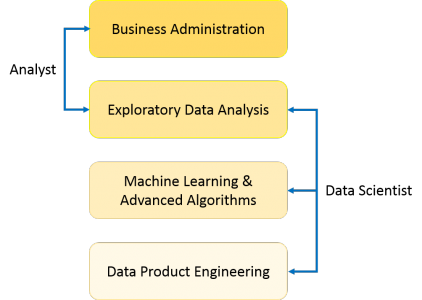
From the above image, it is clear that a Data Analyst usually explains what is going on by processing history of the data. On the other hand, Data Scientist not only does the exploratory analysis to discover insights from it, but also uses various advanced machine learning algorithms to identify the occurrence of a particular event in the future. A Data Scientist will look at the data from many angles, sometimes angles not known earlier.
So, Data Science is primarily used to make decisions and predictions making use of predictive causal analytics, prescriptive analytics (predictive plus decision science) and machine learning.
Predictive causal analytics – If you want a model that can predict the possibilities of a particular event in the future, you need to apply predictive causal analytics. Say, if you are providing money on credit, then the probability of customers making future credit payments on time is a matter of concern for you. Here, you can build a model that can perform predictive analytics on the payment history of the customer to predict if the future payments will be on time or not.
Prescriptive analytics: If you want a model that has the intelligence of taking its own decisions and the ability to modify it with dynamic parameters, you certainly need prescriptive analytics for it. This relatively new field is all about providing advice. In other terms, it not only predicts but suggests a range of prescribed actions and associated outcomes.
Machine learning for making predictions — If you have transactional data of a finance company and need to build a model to determine the future trend, then machine learning algorithms are the best bet. This falls under the paradigm of supervised learning. It is called supervised because you already have the data based on which you can train your machines. For example, a fraud detection model can be trained using a historical record of fraudulent purchases.
Machine learning for pattern discovery — If you don’t have the parameters based on which you can make predictions, then you need to find out the hidden patterns within the dataset to be able to make meaningful predictions. This is nothing but the unsupervised model as you don’t have any predefined labels for grouping. The most common algorithm used for pattern discovery is Clustering.
Why Data Science?
Traditionally, the data that we had was mostly structured and small in size, which could be analyzed by using simple BI tools. Unlike data in the traditional systems which was mostly structured, today most of the data is unstructured or semi-structured. One can understand the precise requirements of your customers from the existing data like the customer’s past browsing history, purchase history, age and income. No doubt you had all this data earlier too, but now with the vast amount and variety of data, you can train models more effectively and recommend the product to your customers with more precision. The self-driving cars collect live data from sensors, including radars, cameras, and lasers to create a map of its surroundings. Based on this data, it takes decisions like when to speed up, when to speed down, when to overtake, where to take a turn – making use of advanced machine learning algorithms. Data from ships, aircraft, radars, satellites can be collected and analyzed to build models. These models will not only forecast the weather but also help in predicting the occurrence of any natural calamities. It will help you to take appropriate measures beforehand and save many precious lives.
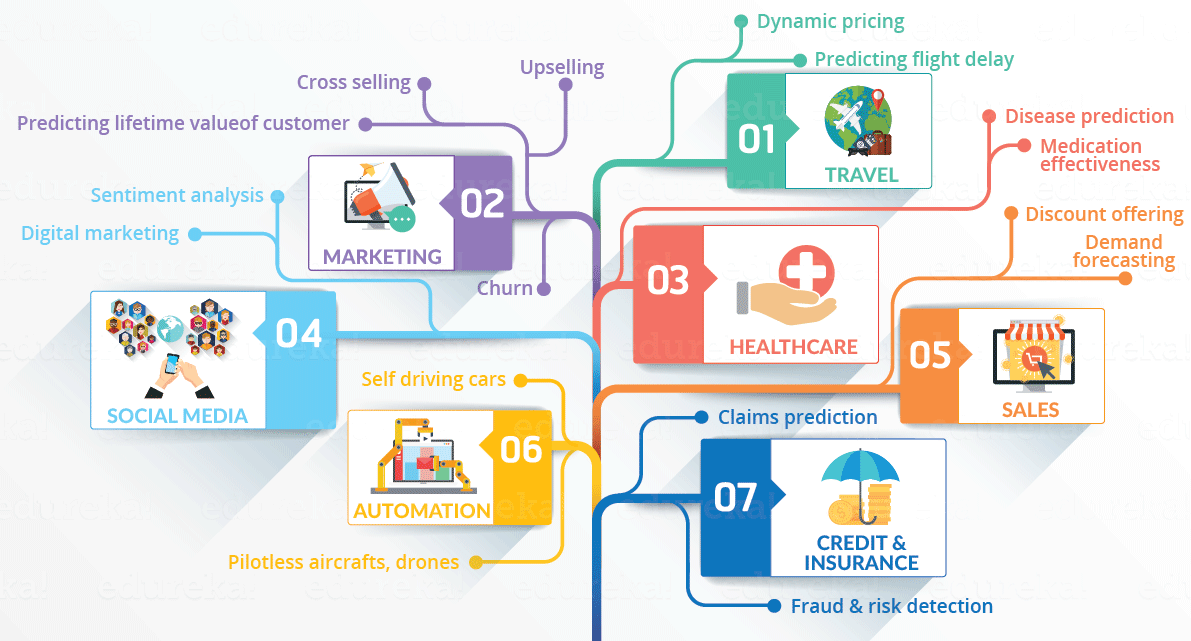
The following infographic shows the various domains in which Data Science is creating its impression:
Role of a Data Scientist
Data scientists are those who crack complex data problems with their strong expertise in certain scientific disciplines. They work with several elements related to mathematics, statistics, computer science, etc (though they may not be an expert in all these fields). They make a lot of use of the latest technologies in finding solutions and reaching conclusions that are crucial for an organization’s growth and development. Data Scientists present the data in a much more useful form as compared to the raw data available to them from structured as well as unstructured forms.
As you all know that the origin of the yoga is Ancient India . Yoga is a Sanskrit word , which means UNION . From ancient time to modern time , yoga is an important health benefactor . WHO also have agreed that yoga have a very good effect on human health .Yoga is the best way for self care . It gives benefits to all ages people , from children to old aged person . United Nation had acknowledged 21st June as the “World Yoga Day” .WHO also comes up with a 2018 – 2030 Yoga Practice plan for all the people from every country . Several researches are conducted to know the effectiveness of yoga & expectedly everyone have given positive feedback about it .Yoga enriches the mental & physical health & helps to flourish the spirituality .
Jen
Various types of Yoga : There are some yoga asana are below —- Adho Mukha Shavasanan or Downward-Facing Dog pose ; Adho Mukha Virakhaasana or Yoga Handstand ; Bhadrasana or Cobbler’s pose ;Makarasana or Crocodile pose ;Padmasana or sitting pose(The most common meditational yoga pose) ; Shirshasana or Headstand pose ;Gomukhashasana or cow faces pose ; Dhanurasana or Bow Posture ; Sukhasana or Easy Posture yoga ; Naukasana or Boat Posture & many other yoga are there .
Adho Mukha Shavasanan or Downward-Facing Dog Adho Mukha Virakhaasana or Yoga Handstand Dhanurasana or Bow Posture Padmasana or sitting pose Shirshasana or Headstand pose Bhadrasana or Cobbler’s pose
Yoga Time : There is no particular time for yoga .But there are some asana which have a particular time to conduct ,like Surya asana which should be conducted at dawn when the sun rises . Starting the day with yoga practice give you immense energy & healthy fresh mind to start a work .You can also do yoga for 5 to 20 min when you are exhausted or in sour mood .That will helps you with your tiredness & lift up your mood . Doing weight losing yoga after dinner or, lunch will keep you fit.
Effectiveness of Yoga : 1) ’Downward Dog’ yoga make your body relax from head to toe . 2) ’Tree Pose’ yoga helps you to stabilize .It balances your body & increase flexibility & strength . 3) ‘Cat cow Pose’ helps in back pain & it improve mobility . 4) According to Johnas Hopkin’s review paper on yoga ,yoga is very much effective in Arthritis . 5) ‘Downward Dog Pose’ works for the protection of human heart health . 6) Many researches show that ‘Legs up the wall’ yoga & many other yoga helps in insomnia & let you sleep better . 7) yoga improves mental health & makes you energetic with a bright good mood . 8) ‘Corpse Pose’ or, ‘Ssvasana’ helps in hyper tension & stress relief which improves your mental health . 9) Yoga helps to improve anxiety problems . It also fight against PTSD (Post Traumatic Stress Disorder) . 10) A research in 2015 showed that , yoga works against chronic inflammation , which prevents the heart problems . 11) Yoga also works effectively for high blood pressure patients . Yoga helps to reduce bad LDL Cholesterols in blood & lowers the high bold pressure . 12)It also works on depression .Yoga lowers the level of Cortisol with & prevents our mind from being depressed. 13) Yoga not only do the above works .It also effective for other body organ or, parts . Yoga also works on our respiratory systems , digestive systems ,Reproductive systems ,Blood circulation ,Mussel growth , Nervous systems etc. Every yoga has its own effectiveness in every parts of our body .So we should practices those yoga which we needs for our benefits .
Android is a mobile system operating system based on the modified version of Linux kernel and other open source software which mainly designed for the touchscreen device such as smartphone, tablet etc. Android is developed by the Open Handset Alliance and commercially sponsored by Google.
History:
Android Inc. was founded in Palo Alto California, in October 2003 by Andy Rubin, Rich Miner, Nick Sears and Chris white. The early intention of the company were to develop n advance operating system for digital cameras, and this was the basis of its pitch to investors in April 2004. peculation about Google’s intention to enter the mobile communications market continued to build through December 2006. An early prototype had a close resemblance to a BlackBerry phone, with no touchscreen and a physical QWERTY keyboard, but the arrival of 2007’s Apple iPhone meant that Android “had to go back to the drawing board”. Google later changed its Android specification documents to state that “Touchscreens will be supported”, although “the Product was designed with the presence of discrete physical buttons as an assumption, therefore a touchscreen cannot completely replace physical buttons”.
Feature:
Interface: Android’s default user interface is mainly based on direct manipulation, using touch inputs that loosely correspond to real-world actions, like swiping, tapping, pinching, and reverse pinching to manipulate on-screen objects, along with a virtual keyboard. Game controllers and full-size physical keyboards are supported via Bluetooth or USB.
Home Screen: Android devices boot to the home screen, the primary navigation and information “hub” on Android devices, analogous to the desktop found on personal computers. Android home screens are typically made up of app icons and widgets; app icons launch the associated app, whereas widgets display live, auto-updating content, such as a weather forecast, the user’s email inbox, or a news tickers directly on the home screen.
Status Bar: Along the top of the screen is a status bar, showing information about the device and its connectivity. This status bar can be pulled (swiped) down from to reveal a notification screen where apps display important information or updates, as well as quick access to system controls and toggles such as display brightness, connectivity settings (WiFi, Bluetooth, cellular data), audio mode, and flashlight. Vendors may implement extended settings such as the ability to adjust the flashlight brightness.
Notification: Notifications are “short, timely, and relevant information about your app when it’s not in use”, and when tapped, users are directed to a screen inside the app relating to the notification. Beginning with Android 4.1 “Jelly Bean”, “expandable notifications” allow the user to tap an icon on the notification in order for it to expand and display more information and possible app actions right from the notification.
App List: An “All Apps” screen lists all installed applications, with the ability for users to drag an app from the list onto the home screen. A recent screen lets users switch between recently used apps. The list may appear side-by-side or overlapping, depending on Android version.
File manager:Since Android 6 Marshmallow, a minimalistic file manager codenamed Documents UI is part of the operating system’s core, and based on the file selector. It is only accessible through the storage menu in the system settings.
The animal realm is as ruthless as it is compassionate, as peculiar as it beautiful, as fascinating as it is perplexing. As a result of the fierce competition, species have evolved some of the most bizarre, incredible, and odd defense mechanisms. Below are a few instances of these one-of-a-kind creatures.
HORNED LIZARD
A number of predators prey on desert horned lizards in North America. As an unusual survival tactic, blood is pumped into their ocular sinuses, the tissues beneath their eyes. When a horned lizard is confronted by a predator, it will, as a defensive weapon, spew blood from its flooded sinuses and eye sockets. As a result, the predator usually becomes scared and flees. The lizard uses this approach to clean foreign particles from the surface of its eyes. It has the ability to strike a four-feet-long blood stream. this process can be repeated multiple times in a short span of time if essential.
green basilisk lizard
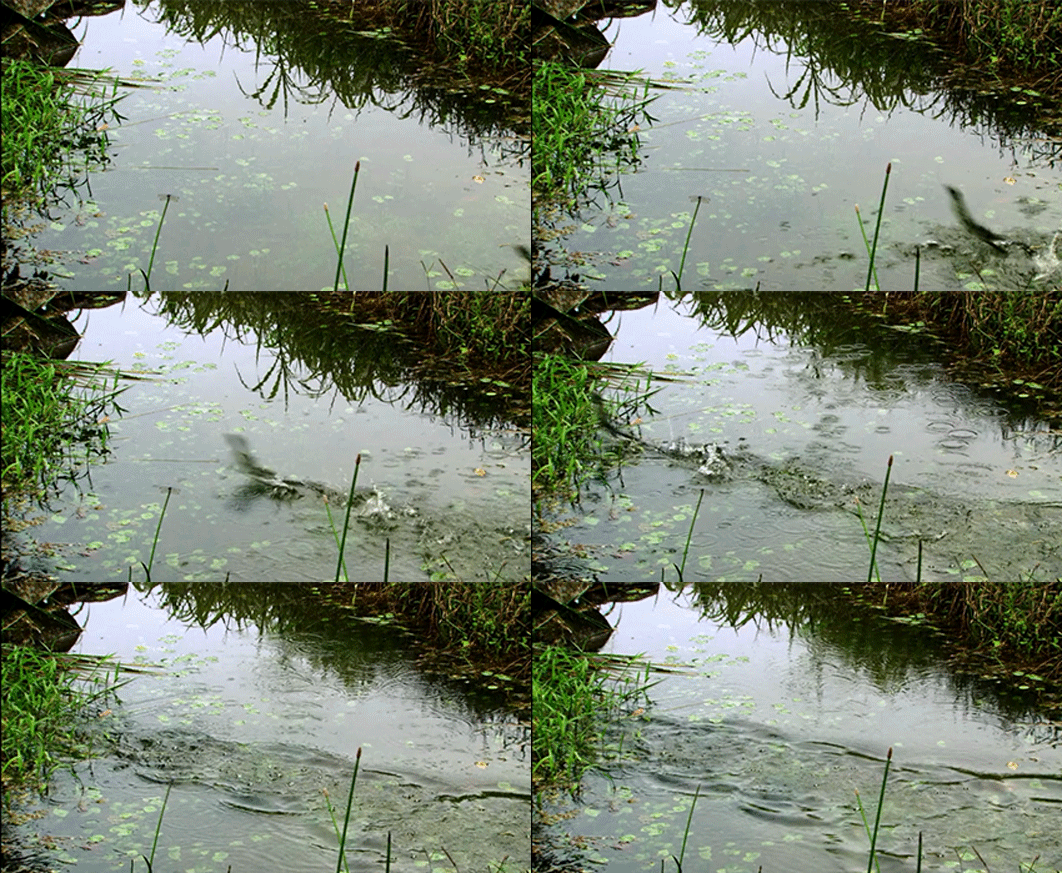
Famed for its exceptional ability to run on water, this unique lizard is ‘The green basilisk lizard’ also referred to as a plumed or double-crested basilisk. Green basilisks can be found in Central America’s tropical rain forests, from southern Mexico to Panama. They spend a lot of time in the woods and are seldom far from a waterway. When startled, they fall from the tree into the water and dash through the water at a rate of about 5 feet per second.
Long toes on its back foot, together with skin fringes that unfurl in the water and enhance the surface area, are what allows them to perform this incredible feat. They strike their wide feet into the water with power and immediately rotate their legs, generating a tiny air pocket that saves them from sinking as long as they remain going. They can travel up to 15 feet along the surface as a result of this. The basilisk uses its incredible swimming abilities to stay airborne until gravity finally catches up with it. Green basilisks, members of the iguana family, grow to a height of about 2 feet, including their long, whip-like tail.
Male seahorses
Male seahorses (and their near cousins) are the only male animals in the animal kingdom that can become pregnant and give birth to children. Male seahorses carry the eggs but do not produce them. The female seahorse places her eggs into the male’s pouch after the male and female have spent time mating. After that, the male fertilizes the eggs in the pouch. Their pouch gives oxygen and nourishment to the maturing eggs while also regulating temperature, blood circulation, and salinity. Male seahorses normally carry their eggs for 2 to 4 weeks, depending on the species and can give birth to 100 to 1,000 babies.
Cymothoa exigua
Cymothoa exigua is a parasitic isopod that is born male but can change sex later in life. The parasites penetrate a host fish’s gills and establish a stronghold to grow. The female then crawls out of the gills and latches onto the fish’s tongue. This is where things start to go horribly wrong. It penetrates the tongue and begins sucking blood as a source of nutrition, progressively getting larger and larger until it inhabits a huge portion of the mouth. It doesn’t drink enough to kill the fish, but she drinks enough that the parasite’s tongue dries away and falls off, putting the parasite as a faux in its stead. The fish lives on, with the infiltrator ingesting whatever the host consumes.
TERMITES
In the rainforests of French Guiana, a termite species appears to take selflessness to a new level by growing sacks of dangerous blue liquid that they blow up on their enemies in a suicidal deed of self-sacrifice. Neocapritermes taracua’s “explosive backpacks” are filled with blue crystals secreted over the course of their life by a specialized pair of glands on their abdomens. Older workers carry the heaviest and most dangerous backpacks.
France has decided to remove India from the red list to amber as COVID cases decreased in India. The French government has classified amber-listed countries as nations where there is active circulation of the virus in controlled proportions, without further spread. After this news, VFS centres in Delhi and Mumbai have now opened and are accepting all visa categories. Also for kids, there won’t be any quarantine mandate in France.
Protocols to be followed
1) Fully vaccinated travellers holding a valid C-type Schengen visa for 3-5 years, can travel without any restriction to France. But the travellers must be vaccinated with any EMA-approved vaccines, which are Pfizer/ Comirnaty, Moderna, AstraZeneca/Vaxzevria/Covishield.
2) Passengers must travel after seven days of getting their second vaccine shot.
3) Travellers need to have proof of vaccination status. They must also have a attest statement saying they don’t have any infection symptoms.
4) The restriction will be applicable to unvaccinated travellers as well as those vaccinated with unapproved (yet) vaccines including Covaxin.
5) Those with ‘talent passports’, (students and researchers), fall under the list of compelling reasons. So they are allowed to travel to France. But they need to show their negative PCR test not older than 72 hours. A negative antigen test, not older than 48 hours before departure, is also acceptable.
INTRODUCTION: In any communication system, during the transmission of the signal or while receiving the signal, some unwanted signal gets introduced into the communication, making it unpleasant for the receiver, and questioning the quality of the communication. Such a disturbance is called as Noise.
Most common examples of noise are − Hiss sound in radio receivers
Buzz sound amidst of telephone conversations
Flicker in television receivers, etc
TYPES OF NOISE: The classification of noise is done depending on the type of the source, the effect it shows or the relation it has with the receiver, etc. There are two main ways in which noise is produced. One is through some external source while the other is created by an internal source, within the receiver section. External Source: This noise is produced by the external sources, which may occur in the medium or channel of communication usually. This noise cannot be completely eliminated. The best way is to avoid the noise from affecting the signal.
Most common examples of this type of noise are Atmospheric noise (due to irregularities in the atmosphere). Extra-terrestrial noise, such as solar noise and cosmic noise. Industrial noise. Internal Source: This noise is produced by the receiver components while functioning. The components in the circuits, due to continuous functioning, may produce few types of noise. This noise is quantifiable. A proper receiver design may lower the effect of this internal noise. Examples: Most common examples of this type of noise are Thermal agitation noise (Johnson noise or Electrical noise) Shot noise (due to the random movement of electrons and holes) Transit-time noise (during transition) Miscellaneous noise is another type of noise which includes flicker, resistance effect and mixer generated noise, etc. Effects of Noise: Noise is an inconvenient feature, which affects the system performance. Following are the effects of noise. Noise limits the operating range of the systems: Noise indirectly places a limit on the weakest signal that can be amplified by an amplifier. The oscillator in the mixer circuit may limit its frequency because of noise. A system’s operation depends on the operation of its circuits. Noise limits the smallest signal that a receiver is capable of processing. Noise affects the sensitivity of receivers: Sensitivity is the minimum amount of input signal necessary to obtain the specified quality output. Noise affects the sensitivity of a receiver system, which eventually affects the output.
Adolf Hilter was a German politician and leader of the Nazi Party (National Socialist German Workers Party). In 1993, Hilter rose to power as the chancellor of Germany and became the leader in the year 1934. From 1933-1945, under his dictatorship, Hitler initiated World war II and invaded Poland on September 1, 1939. Hilter was also involved in military operations and was responsible for the Holocaust, where six million Jews and another five million non-combatants died.
Adolf Hilter: Early Life, Family and Education
Adolf Hitler was born on April 20, 1898, to a Christian family as Adolphus Hitler in Braunau am Inn, a town in Austria-Hungary (now Austria). Adolf Hitler was the fourth child born to the couple Alios Hitler and his wife Klara Polzl (Alios’s third wife). Hitler died on April 30, 1945, at the age of 56 years by shooting himself. Hitler lived with Alios’s children from the second marriage in the same house. When Hitler was three years old, his family moved to Germany where he acquired lower Bavarian dialect instead of Austrian German.
In 1984, Hitler’s family moved to Austria and Hitler attended a state-owned primary school in Fischlham, Austria. Hitler’s father was very strict and beat him up on several occasions. In 1897, after the failure at Hatfield (where Hitler’s father farmed and kept bees), the family moved to Lambach. In 1898, Hitler’s family permanently moved to Leonding and in the 1900s, Hitler’s younger brother died of measles.
Hitler’s father Alois became successful in the customs bureau and wanted Hitler to follow him. However, Hitler was of the opposite view and wanted to become an Artist, which his father Alois dismissed. In September 1900, Alois sent Hitler to Realschule (secondary school in Germany). Hitler in Mein Kampf stated that he rebelled his father’s decision of sending him to Realschule in Linz and did poor in school hoping that his father would look at his grades and would allow him to follow his passion
Like other Austrian Germans, Hitler too was of the German nationalist ideas and would sing “Deutschlandlied” (National Anthem of Germany) instead of Austrian Imperial anthem.
After his father’s sudden demise on January 3, 2020, Hitler did poor at school and his mother allowed him to leave the school. In September 1904, Hitler enrolled himself at Realschule in Steyr, where his performance improved. In 1905, Hitler passed the repeat of the final examination and left secondary school.
In 1907, Hitler moved to Vienna to study Fine Arts at the Academy of Fine Arts Vienna but was rejected twice. The director of the Academy of Fine Arts Vienna advised Hitler to apply to the School of Architecture but he couldn’t do so as he didn’t finish his Senior Secondary schooling.
On December 21, 1907, at the age of 47, Hitler’s mother died of breast cancer. In 1909, 20 years old Hitler ran out of money and spent his life in homeless shelters and a men’s dormitory. He survived by selling his paintings of Vienna.
Hitler was exposed to racism for the first time in his life in Vienna. Hitler in his book Mein Kampf states that he became anti-Semite (hostility or prejudice or discrimination against Jews) in Vienna while his friends disagree. August Kubizek (Hitler’s friend), claimed that Hitler was a “confirmed anti-Semite” before he left Linz.
In 1913, Hitler upon receiving the final part of his father’s estate moved to Munich, Germany. On February 5, 1914, Hitler was conscripted into Austro-Hungarian Army and travelled to Salzburg but was declared unfit for service and returned to Munich. However, Hitler later stated that he didn’t want to serve the Austro-Hungarian Empire due to the mixture of races in the army.
Adolf Hitler: Personal Life
Hitler dedicated his entire life to his political mission and the nation. In 1929, Hitler met his lover, Eva Braun and married her on April 29, 1945, (a day before the couple committed suicide). In September 1931, Hitler’s half-niece, Geli Raubal, took her own life with Hitler’s gun at his Munich apartment. This gave rise to several rumours that Geli was in a romantic relationship with Hitler and her death was a source of deep, lasting pain. In June 1960, Paula Hitler (younger sister of Hitler), the last living member of his immediate family died.
Adolf Hitler in World War I
When World War I started in August 1914, Hitler voluntarily joined the Bavarian Army. However, as per a report by Bavarian authorities in 1924, Hitler’s service was an administrative error as he was an Austrian citizen. Hitler was posted to the Bavarian Reserve Infantry Regiment 16. He served as a dispatch runner on the Western Front in France and Belgium and spent half of his time at the regimental headquarters behind the front lines. Hitler was present during the First Battle of Ypres, the Battle of the Somme, the Battle of Arras, and the Battle of Passchendaele and was wounded at the Somme.
In 1914, Hitler was also awarded the Iron Cross (Second Class) for bravery and in 1918, received Iron Cross (First Class) upon the recommendation of Lieutenant Hugo Gutmann. On May 18, 1918, Hitler received the Black Wound Badge. While rendering his service at headquarters, Hitler drew cartoons for an army newspaper.
In October 1916, Hitler was injured during the Battle of the Somme and was wounded in the left thigh. He spent rest two months in the Hospital at Beelitz and returned to the regiment on March 5, 1917. On October 15, 1918, in a mustard gas attack, Hitler became temporarily blind and was admitted in the hospital at Pasewalk.
Anime is hand-drawn and computer animation originating from Japan. It describes all animated works, regardless of style or origin. However, outside of Japan and in English, anime is colloquial for Japanese animation and refers specifically to animation produced in Japan. If you want to try something new then you can always jump into anime.
People usually turn up to sad songs or even sad books, but no doubt that anime has some of the most heartbreaking and sad stories to ever exist. If you are a person who likes a good crying and feel the emotions to the soul, then here is a list of anime you must watch!
A SILENT VOICE
A silent boice can be very difficult to watch. It deals with the effects of bullying, mental health and suicide. The story is a bout a young boy who bullies and young deaf girl who is a new student in his class. The girl soon leaves the school and everyone turns against the boy for treating the deaf girl harshly. Ages later they happen to meet again and the boy now is trying to pay for his guilty actions of the past. They become good friends and find a way to like each other. But the universe is not on their side and uncertain events take place that turns the entire story.
YOUR LIE IN APRIL
This anime has a great set of music and melodies as this anime about a girl who plays violin and a boy who played piano but stopped after the death of his mother. Music and loss are at the heart of the series. The time someone has with their loved ones is limited. Like a song, it will be over before they know it. But we never forget the melody. A short tale of love and friendship that touches your heart with great classical performances.
CLANNAD AFTER STORY
This anime is the sequel to the acclaimed slice-of-life anime Clannad, Clannad After Story follows it’s high school characters into adulthood. This anime gives us a box full of joys, self discoveries, and disappointments. The anime is filled with heartbreaking circumstances that can get us confused, and give us joy at the same time. At the climax of the anime Clannad After Story asks, “It is really better to have loved and lost than to never love at all?” No matter what the answer is, the anime is meant to make you cry.
BANANA FISH
Banana fish is the story of a young gang leader investigating a strange drug. It has a dark theme with characters that have complex relationships. Banana Fish deals with the devastating events that lead a person to believe they are not worthy of love, and the healing potential of unconditional love. The tears could be out of rage or sorrow, but tears are definitely going to make its way out the viewers eyes.
I WANT TO EAT YOUR PANCREAS
Yes! I was confused of the name as well as it seems so random but once you watch this movie you will realize how deep the meaning of those words is. This anime talks about a simple and cute love story of an outgoing chaotic girl who is dying of pancreatic cancer, and a shy and introverted boy who happened to be the only one to know about her illness other than her family. They both dedicated their time in completing the bucket list of the girl as she knows she will be dying very soon. This anime is a tear-jerker but not in the way audiences would expect. There are some twists that help the movie subvert its genre. What makes I Want To Eat Your Pancreas remarkable is how it deals with the idea of chance and the choices we make when we no longer have a say in our fate.
ORANGE
This anime is about the letter that a 16 year old starts to receive from her future self. The letters inspires the 16 year old to not take any decisions that will make her regretful in the future. Her biggest regret turns out to be a friend of her’s who is no longer alive in the next ten years. Orange asks its viewers to examine their past regrets and ask if those regrets weigh more than the happiness they enjoy now.
Environmental change incorporates both a worldwide temperature alteration driven by human-prompted discharges of ozone depleting substances and the subsequent huge scope shifts in climate designs. However there have been past times of climatic change, since the mid-twentieth century people remarkably affect Earth’s environment framework and caused change on a worldwide scale.
The biggest driver of warming is the emanation of gases that make a nursery impact, of which over 90% are carbon dioxide (CO2) and methane. Petroleum product consuming (coal, oil, and flammable gas) for energy utilization is the fundamental wellspring of these emanations, with extra commitments from agribusiness, deforestation, and assembling. The human reason for environmental change isn’t questioned by any logical assemblage of public or global standing. Temperature rise is sped up or tempered by environment inputs, for example, loss of daylight reflecting snow and ice cover, expanded water fume (an ozone harming substance itself), and changes to land and sea carbon sinks.
Temperature ascend ashore is about double the worldwide normal increment, prompting desert extension and more normal warmth waves and out of control fires. Temperature rise is additionally intensified in the Arctic, where it has added to dissolving permafrost, icy retreat and ocean ice misfortune. Hotter temperatures are expanding paces of dissipation, causing more serious tempests and climate limits. Effects on biological systems incorporate the migration or annihilation of numerous species as their current circumstance changes, most promptly in coral reefs, mountains, and the Arctic. Environmental change undermines individuals with food instability, water shortage, flooding, irresistible infections, outrageous warmth, monetary misfortunes, and relocation. These human effects have driven the World Health Organization to call environmental change the best danger to worldwide wellbeing in the 21st century. Regardless of whether endeavors to limit future warming are fruitful, a few impacts will proceed for quite a long time, including rising ocean levels, rising sea temperatures, and sea fermentation.
Energy streams between space, the air, and Earth’s surface. Current ozone depleting substance levels are causing a radiative unevenness of about 0.9 W/m2.
A considerable lot of these effects are as of now felt at the current degree of warming, which is about 1.2 °C (2.2 °F). The Intergovernmental Panel on Climate Change (IPCC) has given a progression of reports that project huge expansions in these effects as warming proceeds to 1.5 °C (2.7 °F) and past. Extra warming additionally expands the danger of setting off basic edges called tipping focuses. Reacting to these effects includes both relief and transformation. Relief – restricting environmental change – comprises of lessening ozone depleting substance discharges and eliminating them from the climate. Techniques to accomplish this incorporate the turn of events and organization of low-carbon fuel sources, for example, wind and sun powered, an eliminate of coal, improved energy proficiency, and backwoods protection. Transformation comprises of acclimating to genuine or anticipated environment, for example, through further developed coastline insurance, better calamity the executives, helped colonization, and the improvement of more safe yields. Transformation alone can’t turn away the danger of “serious, far reaching and irreversible” impacts.
Under the 2015 Paris Agreement, countries altogether consented to continue to warm “well under 2.0 °C (3.6 °F)” through moderation endeavors. In any case, with vows settled on under the Agreement, a dangerous atmospheric devation would in any case reach about 2.8 °C (5.0 °F) before the century’s over. Restricting warming to 1.5 °C (2.7 °F) would require splitting emanations by 2030 and accomplishing almost zero discharges by 2050.
Law is a system of rules created and enforced through social or governmental institutions to regulate behaviour, with its precise definition a matter of longstanding debate. It has been variously described as a science and the art of justice. State-enforced laws can be made by a group legislature or by a single legislator, resulting in statutes; by the executive through decrees and regulations; or established by judges through precedent, usually in common law jurisdictions. Private individuals may create legally binding contracts, including arbitration agreements that adopt alternative ways of resolving disputes to standard court litigation. The creation of laws themselves may be influenced by a constitution, written or tacit, and the rights encoded therein. The law shapes politics, economics, history and society in various ways and serves as a mediator of relations between people.
Given below are the various Definitions for law by most famous legal authors worldwide.
John Austin
“Province of Jurisprudence Determined”
Duhaime’s Law Dictionary
“All the rules of conduct that have been approved by the government and which are in force over a certain territory and which must be obeyed by all persons on that territory (eg. the “laws” of Australia). Violation of these rules could lead to government action such as imprisonment or fine, or private action such as a legal judgement against the offender obtained by the person injured by the action prohibited by law. Synonymous to act or statute although in common usage, “law” refers not only to legislation or statutes but also to the body of unwritten law in those states which recognize common law”
Greek philosopher Plato and Aristotle
“An embodiment of Reason”, whether in the individual or the community’.
Aristotle
“By ‘particular’ law mean that which an individual community lays down for itself; and by ‘universal’ law I mean the law of nature. For there is a natural and universal notion of right and wrong, one which all men instinctively apprehend.”
Importance of Law in our Society:-
The law is a set of proper guidelines and orders accepted by the society as a norm of conduct for citizens. It is the pivot of the society and the citizens follow according to it. Without the existence of a law, there would be the situation of chaos and conflicts among communities and social groups. Law is man-made and is very important as it introduces justice to the society. There must be ground rules and principles set for modulation of society and its proper conduction. Law has helped society and its citizens in each and every aspect of life. Due to laws, there have been changes brought to our society like- abolition of practices like Sati, child marriage, dowry, etc.
Law can provide justice to the victims and punish those who are responsible for unlawful actions.
In courts, a law is used to settle conflicts among the people.
The main function of law is to ensure all-round development of people by providing security, peace, and protection.
Without law, people were free to do anything they wish. But, a law has imposed certain limitations and restrictions that have to be followed by each and every citizen. Failing or violation of which would be a punishable offense.
An example of the role of law in our lives is Health Insurance. Nowadays people are able to secure their lives just because of law.
It is the law that is responsible for the behaviour of people among each other. Without it, there would be actions like stealing, damaging one’s property, hurting one’s sentiments, etc.
Tip-off on adult film shoot, led cops to Raj Kundra!! Know More
It was February 4. The Mumbai Police received a tip-off: a porn movie being shot at a bungalow in Madh Island. In a prompt raid on the bungalow that followed, the police found two persons in a state of undress being filmed in intimate poses in an uncomfortable position.
According to the police five persons assisting in the filming process were arrested and a woman was rescued from the house that day. Later a complaint was made in the case which eventually led to the arrest of businessman and Bollywood actor Shilpa Shetty’s husband, Raj Kundra, five months later on July 19.
Kundra was produced in a court on Tuesday that sent him to police custody till July 23 and got extended till July 27 in connection with the alleged making of pornographic films and publishing them through some mobile applications.
Police said that five persons, arrested from the Madh Island bungalow, would promise aspiring actresses coming to Mumbai, from areas like Beed in rural Maharashtra or states like Jharkhand, roles in web series. On the day of the shoot, the accused would tell the women the script had been changed. They would allegedly ask them to undress and shoot intimate scenes.
If the women refuses, police claimed, they would be threatened with the bill for setting up the shooting. Coming from humble backgrounds, most of these women would succumb to the pressure, the police stated.
Once the movies were shot, the accused allegedly put them on mobile applications like Hot Hit Movies and Hotshots. They allegedly also offered subscriptions on the lines of mainstream OTT platforms and also put up advertisements on social media platforms.
According to the police in June 2020, the Hotshots app was removed from the Apple store and from Google Store in November 2020 following complaints that it was streaming pornographic material.
The crime branch said that during the probe, they found that these adult movies were normally shot within a day at a rented bungalow on the outskirts of Mumbai, like Madh Island. There would be minimal staff of five to six people, who would double up as directors, dialogue writers, location scouts and web app developers. These apps became especially popular during the lockdown, with some gaining a subscriber base of lakhs, the police claimed.
Initially, during the course of its investigation, the Mumbai Police had focused on producers and others who assisted in the process of shooting. Those arrested included Rowa Khan, producer of such films, small-time actor of Gandi Baat web series Gehna Vasisht among others.
Later, the crime branch started focusing on platforms to which such films were sold. It was during this probe that the police arrested Umesh Kamat, who worked with UK-based Kenrin Pvt Ltd, a production company that owns the Hotshots app where some of these movies were uploaded.
Based on Kamat’s questioning and going through his call records, the police found that while Kenrin owned the app, it was allegedly being run by Raj Kundra through his Mumbai-based company Viaan Industries. A charge sheet filed in April, however, did not name Kundra.
After further probe and a scan of the technical data on Kamat’s laptop, the police sought the court’s permission to search Kundra’s office. Eventually, a police team raided the place on Monday and claimed to have found “incriminating evidence” based on which he was arrested late that night.
The police is still investigating in this case and can find big evidences against this case!!!!
































 Eduindex
You must be logged in to post a comment.