Understanding the Role of Social Media in Marketing.


These days, everyone from small business owners to some of the biggest companies in the world is using social media to spread the word about their brands, products, and services.

Whether it’s Twitter, Instagram, or Facebook, companies use these low-cost tools to combine technology and social interaction with the use of words, images, and video. Social media gives marketers a voice and a way to communicate with peers, customers, and potential consumers. It personalizes your brand and helps you to spread your message in a relaxed and conversational way.

The downfall of social media, if you could call it that, is that it must be a part of your everyday life to keep the momentum and attention you need for it to be successful. Let’s look at who is using social media to promote their brand—and what you can learn from them.

Companies That Use Social Media

Here are just a few examples of brands you may have seen actively using social media:

  • Absolut Vodka: The popular vodka brand has used online videos on YouTube and hosted bartender fan pages on Facebook.
  • BMW: The iconic car brand has turned to Facebook to promote its 1-Series Road Trip and created a Bimmerfest Page for fans.
  • Dunkin’ (formerly Dunkin’ Donuts): The ubiquitous doughnut brand is now everywhere online, with its microblogging Twitter account and National Donut Day social media blasts.

The Benefits of Social Media Marketing


What role should social media play in your marketing? Marketing is a tool we use to inform consumers about our products, who we are, and what we offer. Social media accomplishes all of these goals. Here’s how:

  1. You can use social media to define your brand identity and the products or services that you offer.
  2. Social media allows you to create relationships with people who might not otherwise know about your products and services or what your company represents.
  3. Social media can make you “real” to consumers. If you want people to follow you, don’t just talk about the latest product news, but share your personality with them.
  4. You can use social media to associate yourself with peers that may be serving the same target market.
  5. Social media makes it easy to communicate and provide the interaction that consumers look for.

How to Use Social Media for Your Marketing


Social media clearly carries a lot of potential value for your business. But gaining that value isn’t guaranteed unless you do it right. Here are a few tips:

  1. You cannot just depend on social media; you must integrate it with other vehicles of marketing. While social media will create awareness, it won’t usually help you sell $1 million worth of products right out of the gate. That’s not to say that it can’t one day, once you’ve built up your social media “stardom,” but it probably won’t happen tomorrow.
  2. Be yourself and reflect your personality. There are no written right or wrong rules when it comes to social media. Only you can determine what will work for you and fits your brand.
  3. Be consistent. Social media requires ongoing engagement. If you don’t plan on being consistent, don’t do it at all.

Social media success stories are abundant, from headhunters that find job applicants to new businesses that want to introduce a new product, as well as established Fortune 500 companies that want to strengthen their brand.

A thread to tie

Photo by Erika Pugliese on Pexels.com

It is just a thread, but it can hold so many emotions and feelings representing the unbreakable bond of sister and brother. The ancient root of this festival is deeply rooted in the idea of the all-life protection of sisters from every evil out there by their brothers. The tying thread on the wrist of the brother is the symbol of his blessing and a promise which they service throughout their lives in every up and down of the sister’s life.

As the auspicious day of Rakhi is celebrated today on this very day of Purnima, let’s find out its importance and a glance at its past.

History

The history of any festival is very enriched and secures great importance in today’s life. As we are pacing fast with the changing time, we are somewhere just enjoying the festival. We are so not into why and when of their origins.

But don’t worry with few incidents which can show how important the tying of the thread is in our culture I have written them in this article.

Draupadi:

Once when Krishna Ji was using his Sudarshan Chakra on the King Shisupala, during the time he injured his finger which Draupadi Ji tried to treat by wrapping the piece of her cloth around Krishna Ji’s finger and that time Krishna Ji vowed to always protect Draupadi from all the evil.

That is the importance of tying thread around the wrist on the festival of Rakshabandhan nowadays.

A Peace Offering

During the time of the Britishers, they believed in the rule and divide policy which did have many severe effects on the relationship of the mostly Hindu and Muslims,

To overcome this difference between themselves our freedom fighters tried to mend the relationship between the two by saying we are brother and sister of the same mother nation and that is why many women of both sides at the time tied the Raksha thread to ensure and again build the trust and love of brotherhood and sisterhood between two different mindsets.

DEEP LEARNING SERIES- PART 10

This is the last article in this series. This article is about another pre-trained CNN known as the ResNet along with an output visualization parameter known as the confusion matrix.

ResNet

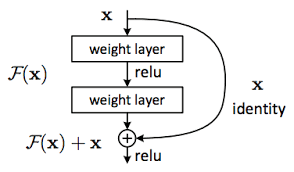
This is also known as a residual network. It has three variations 51,101,151. They used a simple technique to achieve this high number of layers.

Credit – Xiaozhu0429/ Wikimedia Commons / CC-BY-SA-4.0

The problem in using many layers is that the input information gets changed in accordance with each layer and subsequently, the information will become completely morphed. So to prevent this, the input information is sent in again like a recurrent for every two steps so that the layers don’t forget the original information. Using this simple technique they achieved about 100+ layers.

ResNet these are the three fundamentals used throughout the network.

  (conv1): Conv2d (3, 64, kernel_size= (7, 7), stride= (2, 2), padding= (3, 3))

  (relu): ReLU

  (maxpool): MaxPool2d(kernel_size=3, stride=2, padding=1)

These are the layers found within a single bottleneck of the ResNet.

    (0): Bottleneck

  1    (conv1): Conv2d(64, 64, kernel_size=(1, 1), stride=(1, 1))

  2    (conv2): Conv2d(64, 64, kernel_size=(3, 3), stride=(1, 1), padding=(1, 1))     

  3    (conv3): Conv2d(64, 256, kernel_size=(1, 1), stride=(1, 1))    

      (relu): ReLU(inplace=True)

   Down sampling   

   Conv2d(64, 256, kernel_size=(1, 1), stride=(1, 1))

    (1): Bottleneck

  4    (conv1): Conv2d(256, 64, kernel_size=(1, 1), stride=(1, 1))

  5    (conv2): Conv2d(64, 64, kernel_size=(3, 3), stride=(1, 1), padding=(1, 1))     

  6   (conv3): Conv2d(64, 256, kernel_size=(1, 1), stride=(1, 1))     

      (relu): ReLU(inplace=True)

    )

    (2): Bottleneck

  7    (conv1): Conv2d(256, 64, kernel_size=(1, 1), stride=(1, 1))

  8    (conv2): Conv2d(64, 64, kernel_size=(3, 3), stride=(1, 1), padding=(1, 1))

  9   (conv3): Conv2d(64, 256, kernel_size=(1, 1), stride=(1, 1))

   (relu): ReLU

There are many bottlenecks like these throughout the network. Hence by this, the ResNet is able to perform well and produce good accuracy. As a matter of fact, the ResNet is the model which won the ImageNet task competition.

There are 4 layers in this architecture. Each layer has a bottleneck which comprises convolution followed by relu activation function. There are 46 convolutions, 2 pooling, 2 FC layers.

TypeNo of layers
7*7 convolution1
1*1, k=64 + 3*3, k=64+1*1, k=256 convolution9
1*1, k=128+ 3*3, k=128+1*1, k=512  convolution10
1*1, k=256+ 3*3, k=256 + 1*1, k=1024 convolution16
1 * 1, k=512+3 * 3, k=512+1 * 1, k=2048 convolution9
Pooling and FC4
Total50

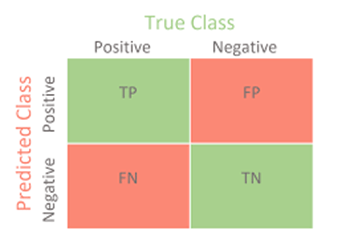
There is a particular aspect apart from the accuracy which is used to evaluate the model, especially in research papers. That method is known as the confusion matrix. It is seen in a lot of places and in the medical field it can be seen in test results. The terms used in the confusion matrix have become popularized in the anti-PCR test for COVID.

The four terms used in a confusion matrix are True Positive, True Negative, and False positive, and false negative. This is known as the confusion matrix.

True positive- both the truth and prediction are positive

True negative- both the truth and prediction are negative

False-positive- the truth is negative but the prediction is positive

False-negative- the truth is positive but the prediction is false

Out of these the false positive is dangerous and has to be ensured that this value is minimal.

We have now come to the end of the series. Hope that you have got some knowledge in this field of science. Deep learning is a very interesting field since we can do a variety of projects using the artificial brain which we have with ourselves. Also, the technology present nowadays makes these implementations so easy. So I recommend all to study and do projects using these concepts. Till then,

HAPPY LEARNING!!!

DEEP LEARNING SERIES- PART 9

This article is about one of the pre-trained CNN models known as the VGG-16. The process of using a pretrained CNN is known as transfer learning. In this case, we need not build a CNN instead we can use this with a modification. The modifications are:-

  • Removing the top (input) and bottom (output) layers
  • Adding input layer with size equal to the dimension of the image
  • Adding output layer with size equal to number of classes
  • Adding additional layers (if needed)

The pre-trained model explained in this article is called the VGGNet. This model was developed by the Oxford University researchers as a solution to the ImageNet task. The ImageNet data consists of 10 classes with 1000 images each leading to 10000 images in total.

VGGNet

I/p 1     2   3     4     5        6       7         8      9          10     11            12       13   o/p

Credit: – Nshafiei neural network in Machine learning  Creative Commons Attribution-ShareAlike 4.0 License.

This is the architecture for VGGNet. This has been found for the CIFAR-10 dataset, a standard dataset containing 1000 classes. This was used for multiclass classification. Some modifications are made before using it for detecting OA. The output dimension is changed into 1*1*2 and the given images must be reshaped to 224*224 since this dimension is compatible with VGGNet. The dimensions and other terms like padding, stride, number of filters, dimension of filter are chosen by researchers and found optimal. In general, any number can be used in this place.

The numbers given below the figure correspond to the layer number. So the VGGNet is 13 layered and is CNN till layer 10 and the rest are FNN.

Colour indexName
GreyConvolution
RedPooling
BlueFFN

Computations and parameters for each layer

Input

224*224 images are converted into a vector whose dimension is 224*224*3 based on the RGB value.

Layer 1-C1

This is the first convolutional layer. Here 64 filters are used.

Wi =224, P=1, S=1, K=64, f=3*3

Wo =224 (this is the input Wi for the next layer)

Dim= 224*224*64

Parameter= 64*3*3= 576

Layer 2-P1

This is the first pooling layer

 Wi =224, S=2, P=1, f=3

Wo=112 (this is the input Wi for the next layer)

Dim= 112*112*3

Parameter= 0

Layer 3-C2C3

Here two convolutions are applied. 128 filters are used.

Wi =112, P=1, S=1, K=64, f=3

Wo=112 (this is the input Wi for the next layer)

Dim= 112*112*128

Parameter= 128*3*3=1152

Layer 4- P2

Second pooling layer

Wi =112, P=1, S=2, f=3*3

Wo =56 (this is the input Wi for the next layer)

Dim= 56*56*3

Parameter= 0

Layer 5- C4C5C6

Combination of three convolutions

Wi =56, P=1, S=1, K=256, f=3*3

Wo = 56 (this is the input Wi for the next layer)

Dim= 224*224*64

Parameter= 64*3*3= 576

Layer 6-P3

Third pooling layer

Wi =56, P=1, S=2, f=3*3

Wo =28 (this is the input Wi for the next layer)

Dim= 28*28*3

Parameter= 0

Layer 7-C7C8C9

Combination of three convolutions

Wi =28, P=1, S=1, K=512, f=3*3

Wo =28 (this is the input Wi for the next layer)

Dim= 28*28*512

Parameter= 512*3*3= 4608

Layer 8-P4

Fourth pooling layer

Wi =28, P=1, S=2, f=3*3

Wo =14 (this is the input Wi for the next layer)

Dim= 14*14*3

Parameter= 0

Layer 9-C10C11C12

Last convolution layer, Combination of three convolutions

Wi =14, P=1, S=1, K=512, f=3*3

Wo =14 (this is the input Wi for the next layer)

Dim= 14*14*512

Parameter= 512*3*3= 4608

Layer 10-P5

Last pooling layer and last layer in CNN

Wi =14, P=1, S=2, f=3*3

Wo =7 (this is the input Wi for the next layer)

Dim= 7*7*3

Parameter= 512*3*3= 4608

With here the CNN gets over. So a complex 224*224*3 boil down to 7*7*3

Trends in CNN

As the layer number increases,

  1. The dimension decreases.
  2. The filter number increases.
  3. Filter dimension is constant.

In convolution

Padding of 1 and stride of 1 to transfer original dimensions to output

In pooling

Padding of 1 and stride of 2 are used in order to half the dimensions.

Layer 11- FF1

4096 neurons

Parameter= 512*7*7*4096=102M

Wo= 4096

Layer 12- FF2

4096 neurons

Wo= 4096

Parameter= 4096*4096= 16M

Output layer

2 classes

  • non-osteoarthritic
  • osteoarthritic

Parameter= 4096*2= 8192

Parameters

LayerValue of parameters
Convolution16M
FF1102M
FF216M
Total134M

It takes a very large amount of time nearly hours for a machine on CPU to learn all the parameters. Hence they came with speed enhancers like faster processors known as GPU Graphic Processing Unit which may finish the work up to 85% faster than CPU.

HAPPY LEARNING!!

WHY DIAMONDS ARE SO EXPENSIVE ?

Diamonds are allotropes of carbon like graphite. But, the difference between them is tremendous. What makes diamonds so costly ? Well some might say that the extraordinariness, challenges in mining, toughness, cut, clearness, shading, and carat of diamonds make them costly and popular. Gold and silver are likewise uncommon, mining them is additionally troublesome however why just diamond is so costly ? Why people give diamond ring when they propose one another ?

Why Are Diamonds So Expensive? – EVEVIC JEWELRY

A few years ago it was not a trend to give diamond rings while proposing. There are many stones rarer than diamonds. They are costly as a result of a company called De Beers. Each diamond you find in this world comes from this company not because diamonds are very rare to find. There are numerous diamond mines in this world however this organization don’t let those diamonds to arrive at the market.

At the point when supply of a specific item is less however demand is high, this outcomes in making that item more costly. This company made the stock of diamonds exceptionally less. But, how ? Few years back diamonds were found only in India and Brazil. But then it was also found in Africa and that too in very large quantity. De beers was also one of the company which found a lot of diamonds in Africa. But the other mines company started selling diamonds because the supply of diamonds were increasing which can make them less expensive. They were in loss. De beers would have also done that but instead it started buying those diamonds by taking loans and because of that it became the owner of all mines in Africa. It became a monopoly and a monopoly does what it wants. Soon when other mines company discovered diamonds in Serbia and other countries De beers bought all of them. It became owner of all the diamonds in the world.

Yet, De beers never let people to realize that they have diamonds in exceptionally huge amount because then people won’t buy it. They restricted the stock of diamonds which made them uncommon. They further began promoting diamonds by giving statements like “A diamond is forever”. Because of this, the interest of people towards diamonds increased and they became expensive.

RESOURCES:

2. https://francisalukkas.com/why-are-diamonds-so-expensive-5-reasons/

HOW TO WAKE UP EARLY IN THE MORNING ?

How to get up early in the morning(8:00am) - Quora

Rising up early not only gives a good start to your day but also make you more concentrated. Many of us want to wake up early in the morning but we can’t because of our laziness. We always make commitments at night that we will wake up early in the morning to complete our work but we can’t. And when we wake up late in the morning we feel lazy and dizzy which affect our work. We keep procrastinating our work saying that “I will start it fresh from tomorrow”. But the same thing happens tomorrow and we keep saying this phrase. This same thing happens every single day and we start questioning “What’s wrong with my life ?”.

This can be avoided if we wake up early in the morning. Some tips to wake up early in the morning are:

1.Get on a sleep schedule

Figure out how much hours of sleep you require to feel fresh and active in the morning.


2.Improve your bedtime routine

It is advised to sleep early in order to wake up early. Even if you can’t fall asleep early, try to sleep. You will become habitual of sleeping early if you continue.


3.Move your alarm to avoid hitting snooze

Keep your alarm away from your bed. If possible keep it in other room so that you have to walk to snooze it.


4.Eat better and get regular exercise

Eating lots of fruit and vegetables can help you getting good sleep. Regular exercise can keep you healthy and you will feel less lazy in the morning.