Famous people

Famous is the person who has done something extraordinary in her life which made her earn the title famous. These days it’s totally unpredictable to determine the famous the reason behind this is wide reach of internet, which has provided everyone a platform in the form of social media to show their creativity, sarcasm or talent in various form. Almost everyone is using a cell phone and so is the internet this has given an opportunity to every person and now its no more limited to a particular section of people. It can be anyone the prime minister of a country, an educator, a street artist, a homemaker or anyone. This introduces us to the fresh and unheard talent from around the world. Here is a list of many such people specifically from India-

  1. Narendra Modi
    Narendra Damodardas Modi, the Prime Minister of India who has sworn as the primeminister for the second year. He was born in vadnagar, Gujrat. Earlier he was the chief minister in Gujrat, he was elected as the party head and became the popular choice of people first in Gujrat then in whole country, which paved his way to the prime minister’s seat.
    In a survey conducted in 2007 he was name as the best chief minister. Moreover, Forbes has ranked him as 15th most powerful person. Additionally, he has created strong inter nation bond with countries like- Russia, US, Saudi Arabia etc.
  2. Ratan Tata
    Ratan Tata is the top industrialist of Indian, he has been the chairman of tata group from 1990 to 2012. After his Father Jamshedji Tata, he is heading the group and under his leadership Tata Group has grown massively and is highly successful. He was awarded with Padma Bhushan in the year 2000 and Padma Vibhushan in 2008. A philanthropist, great leader and nation builder Ratan Tata is a truly inspiring person.
  3. Kapil Dev
    Kapil Dev is the legend of Indian Cricket. Former Indian cricketer born on 6 January 1959 when he was only 19 years old. He made his debut in Indian cricket in the year 1972 and captained the Indian cricket team in world cup of 1983. He was awarded with Arjuna award which is the highest honor in sports field ,for his great achievement he made throughout his career.
  4. Kiran Bedi
    Kiran Bedi was born in Amritsar, Punjab in 1949. She was the first woman IPS (Indian Police Services). It was an extraordinary achievement at that time further Kiran Bedi gain recognition in the Police Department for her strong decisions and working, she is also the first Indian women who was appointed as Civilian Police Adviser at United Nations. she is one of the most respected lady police officer who is also working for society welfare through her NGO.
  5. AR Rahman
    AR Rahman is big name of Indian music industry, who started a new phase of contemporary music. A singer, song writer and film producer, two times Oscar winner and Grammy award winner. He is
    The gem of music industry.

Computer technology, a boon or bane?

Computer is one of the biggest revolution for the human society today we cannot imagine a world without a computer. Computer is one of the major priority for todays world so lets talk about it in some detail one by one.

DISCOVERY OF COMPUTER

In the early 19th century ,an English mechanical engineer made the first mechanical computer and the name of  that person is Charles Babbage and also considered as a father of computer. He work on different engines and then finally invented a engine that fits with his idea of mechanical computer and that how the huge change in human society starts begin.

(source:https://en.m.wikipedia.org/wiki/Computer#:~:text=Charles%20Babbage%2C%20an%20English%20mechanical,in%20the%20early%2019th%20century)

TYPES OF COMPUTER

  1. Mainframe Computer : It is high capacity and costly computer. It is largely used by big organizations where many people can use it simultaneously.

2. Super Computer : This category of computer is the fastest and also very expensive. A typical supercomputer can solve up to ten trillion individual calculations per second.

3. Workstation Computer : The computer of this category is a high-end and expensive one. It is exclusively made for complex work purpose.

4.  Personal Computer (PC) : It is a low capacity computer developed for single users.

5 . Apple Macintosh (Mac) : It is a sort of personal computer manufactured by Apple company.

6. Laptop computer (notebook) : It is a handy computer that can be easily carried anywhere.

ADVANTAGES OF COMPUTER

1.Stores data in digital format: Computers can store millions of pages of information in digital format.


2.Huge storage: We can store huge information. The present day hard-disks can store 100s of Gigabytes (GB) of information. Large businesses store their marketing and sales data in their computer systems. Even sensitive data of customers are securely protected in a computerized environment.


3. Play games: When it comes to games, the choices are almost unlimited.


4. Calculations : Businesses are increasingly using spreadsheets and other software as a tool for performing mathematical calculations.


5.Prepare and store official documents : You can use a word processing software to prepare, edit and save any text document. The concept of paperless offices is finally taking its shape. excel- calculations


6.Presentations : If your office demands that you prepare presentations, you can prepare it in a Power Point.

DISADVANTAGES OF COMPUTER

1.Ever changing technology: The technology that is new today, may soon become obsolete. We need to regularly upgrade the hardware and software in a computerized environment. This involves additional time and cost.


2.Increased manpower cost: The computer needs to be operated by skilled person. This has led to an increase in manpower cost for organizations. Due to the inherent risks, huge expenditure are made ensure data security.


3.Computer stops responding: At times the operating system of the computer may stop responding or functioning. Though this problem is generally solved by restarting the computer, but sometimes you may have to take the support of the technician.


4.Viruses: The threat of virus and malware attack always remains in the computerized environment. To cope up with these risks, various anti-virus software are available in the market. If you are using a good antivirus, you are almost sure that your private information and other sensitive data are secured.

Indian Olympic campaign in last 120 years

Indian hockey men’s team, gold medal – Amsterdam 1928

The Indian hockey team scored 29 goals without reply in five matches to win its first Olympic gold medal. The wizard Dhyan Chand scored 14 goals, including a hat-trick in the final against the Netherlands in the final. This was Indian hockey’s first medal at the Olympics.

Indian hockey men’s team, gold medal – Los Angeles 1932

In a reduced field, the Indian hockey team first beat Japan 11-1. A 10-goal charge from Roop Singh, Dhyan Chand’s younger brother, and eight goals from the wizard himself secured a massive 24-1 win against the USA and ensured a second-consecutive Olympic gold medal.

Indian hockey men’s team, gold medal – Berlin 1936
With Dhyan Chand as captain, the Indian hockey team completed a hat-trick of Olympic golds at Berlin 1936. This time, India scored 38 goals in five matches and only conceded one in the final against Germany as Dhyan Chand’s second hat-trick in Olympic finals took them to an 8-1 victory.

Indian hockey men’s team, gold medal – London 1948

The first gold medal for India post-independence unsurprisingly came from the Indian hockey team as they regained their position atop the Olympic podium at London 1948. A new star emerged in

Balbir Singh Sr as India romped to the final with 19 goals in three matches. Balbir Singh’s brace in the final helped India beat hosts Great Britain 4-0 and win a fourth Olympic gold.

Indian hockey men’s team, gold medal – Helsinki 1952

The Indian hockey team overcame the midnight sun and cold conditions to win their fifth-consecutive Olympic gold medal. Balbir Singh Sr scored nine goals in three matches, including five in the final against the Netherlands – a record for the most goals by an individual in an Olympic men’s hockey final.

KD Jadhav, bronze medal – men’s bantamweight wrestling, Helsinki 1952

Wrestler Khashaba Dadasaheb Jadhav became India’s first individual Olympic medallist with his bronze in the men’s freestyle bantamweight category. It was just reward for the hardworking wrestler, who had to run from pillar to post to gather funds for his Olympic trip and proved his mettle on the biggest stage.

Indian hockey men’s team, gold medal – Melbourne 1956

It was six Olympic golds in a row for the Indian hockey team at Melbourne 1956. India did not concede a single goal in the entire tournament and skipper Balbir Singh Sr. played with a fracture in his right hand in the final as India beat neighbours Pakistan 1-0 in the final.

Indian hockey men’s team, silver medal – Rome 1960

India’s unparalleled gold streak in hockey came to an end at Rome 1960 as the side lost to Pakistan 1-0 in the final and had to settle for a silver medal.

Indian hockey men’s team, gold medal – Tokyo 1964

The Indian hockey team soon returned to the Olympic summit as they won gold at Tokyo 1964. India recorded four wins and two draws in the group stages and beat Australia in the semis. They faced Pakistan in the final for the third consecutive time and beat them 1-0, courtesy a penalty stroke goal.

Indian hockey men’s team, bronze medal – Mexico City 1968

With hockey gaining further prominence in Europe, the Indian hockey team was slowly losing its foothold and the bronze at Mexico 1968 was the first indication. India beat Mexico, Spain and got a walkover against Japan but were beaten 2-1 in the semi-finals by Australia. India defeated West Germany 2-1 to win the bronze medal, finishing outside the top two for the first time at the Olympics.

Indian hockey men’s team, bronze medal – Munich 1972

A second-consecutive Olympic bronze medal arrived for the Indian hockey team at Munich 1972. India won four matches and drew two before the semi-finals against Pakistan. The attack on the Israeli team then caused their semi-final to be pushed forward by two days and it affected the team’s rhythm as they lost 2-0 to Pakistan. However, they regrouped to beat the Netherlands 2-1 and clinched bronze.

Indian hockey men’s team, gold medal – Moscow 1980

A disappointing seventh-place finish at Montreal 1976 – then the Indian hockey team’s lowest at an Olympics – galvanised the team for Moscow 1980. In a reduced field, India won three and drew two matches in the preliminary rounds. In the final, the Indian team beat Spain 4-3 to win the gold medal. It remains the last hockey gold for India at the Olympics.

Leander Paes, bronze medal – men’s singles tennis, Atlanta 1996

India had gone without a medal for three straight editions before a young Leander Paes got them to winning ways in 1996 with a bronze. After losing to Andre Agassi in the semi-final, Paes went on to beat Fernando Meligani in the bronze medal match.

Karnam Malleswari, bronze medal – women’s 54kg weightlifting, Sydney 2000

Weightlifter Karnam Malleswari clinched the bronze medal in the 54kg category, becoming the first Indian woman to win an Olympic medal. She had lifted 110kg in the snatch category and 130kg in the clean and jerk for a total of 240kg.

Rajyavardhan Singh Rathore, silver medal – men’s double trap shooting, Athens 2004

Armyman Rajyavardhan Singh Rathore was the first shooter to win an Olympic medal for India. UAE’s Shaikh Ahmed Almaktoum surged into an unassailable lead and it came down to Rathore to shoot both his flying clay targets with his final attempt in the men’s double trap. The army colonel accurately down both and ensured India’s first individual silver medal at the Games.

Abhinav Bindra, gold medal – men’s 10m air rifle shooting, Beijing 2008

India’s most euphoric moment at the Olympics came at Beijing 2008 when Abhinav Bindra won a historic gold medal in the men’s 10m air rifle. The Indian shooter shot a near-perfect 10.8 with his final shot, ensuring India’s first individual Olympic gold medal.

Vijender Singh, bronze medal – men’s middleweight boxing, Beijing 2008

Vijender Singh became the first Indian boxer to win an Olympic medal. The man from Haryana defeated southpaw Carlos Góngora of Ecuador 9–4 in the quarter-final to guarantee a bronze medal before he lost 5–8 to Cuba’s Emilio Correa in the semis.

Sushil Kumar, bronze medal – men’s 66kg wrestling, Beijing 2008

After losing his opening bout, Sushil Kumar went on to win three bouts in the repechage round within 70 minutes to clinch the bronze medal. It was India’s first Olympic medal in wrestling for 56 years.

Gagan Narang, bronze medal – men’s 10m air rifle shooting, London 2012

After narrowly missing out on the final round in the previous Olympics due to countback, Gagan Narang won the bronze medal in the men’s 10m air rifle at London 2012. With the world’s eyes trained on him, Gagan Narang played out a tense final with China’s Wang Tao and Nicolo Campriani of Italy before ending in third place.

Sushil Kumar, silver medal – men’s 66kg wrestling, London 2012

India’s flag-bearer for the opening ceremony, Sushil Kumar was India’s biggest medal hope in 2012. He overcame severe body aches to make his run to the final before his body finally gave up due to exhaustion. Sushil Kumar lost to Tatsuhiro Yonemitsu in the final and ended up with silver, becoming India’s only individual two-time Olympic medallist.

Vijay Kumar, silver medal – men’s 25m rapid pistol shooting, London 2012

Barely known before the Games, shooter Vijay Kumar ensured his name in the record books with a silver medal in the 25m rapid pistol. Tied with China’s Ding Feng going into the sixth round in the final, Vijay Kumar outshot Feng to head into the last round. However, Cuba’s Leuris Pupo proved a step too far as Vijay Kumar settled for silver.

Mary Kom, bronze medal – women’s flyweight boxing, London 2012

A legend even before her maiden Olympics at London 2012, Mary Kom commemorated the first edition of women’s boxing at the Games with a bronze in the flyweight category. The Manipur-born boxer was on a fine run before being halted by eventual champion Nicola Adams of Great Britain in the semis.

Yogeshwar Dutt, bronze medal – men’s 60kg wrestling, London 2012

A veteran of three Olympics by London 2012, wrestler Yogeshwar Dutt finally achieved his childhood dream when he won bronze in the 60kg category. He defeated North Korea’s Ri Jong Myong in the last repechage round in just 1:02 minutes.

Saina Nehwal, bronze medal – women’s singles badminton, London 2012

Saina Nehwal became the first Indian badminton player to win an Olympic medal when her opponent, China’s Wang Xin, was forced to retire hurt during the match in the semi-final.

PV Sindhu, silver medal – women’s singles badminton, Rio 2016

Saina Nehwal’s feat surely propelled India’s badminton story – as PV Sindhu went one step ahead by reaching the final of the 2016 Summer Olympics before losing to Spain’s Carolina Marin in a feisty, 83-minute duel.

Sakshi Malik, bronze medal – women’s 58kg wrestling, Rio 2016

A late entrant to India’s Olympic contingent, Sakshi Malik became the first female Indian wrestler to win an Olympic medal. She beat Kyrgyzstan’s Aisuluu Tynybekova 8–5 to win the 58kg bronze and ensured India had won an Olympic wrestling medal in three consecutive Games.

Mirabai Chanu, silver medal – women’s 49kg weightlifting, Tokyo 2020

Ace weightlifter Mirabai Chanu put behind the disappointment of Rio 2016 to lift a total of 202kg to win the silver medal in the women’s 49kg category. It is her first Olympic medal and made her the second Indian weightlifter after Karnam Malleswari to win an Olympic medal. It is India’s first medal at the Tokyo Olympics.

Lovlina Borgohain – women’s welterweight (64-69kg), Tokyo 2020

On her Games debut, Lovlina Borgohain has been assured of at least a bronze medal at the Tokyo Olympics after beating Chinese Taipei’s Nien-Chin Chen in the quarter-finals of the women’s 69kg category.

That medal could yet be a gold or silver if she beats top seed Busenaz Surmeneli in the semi-finals.

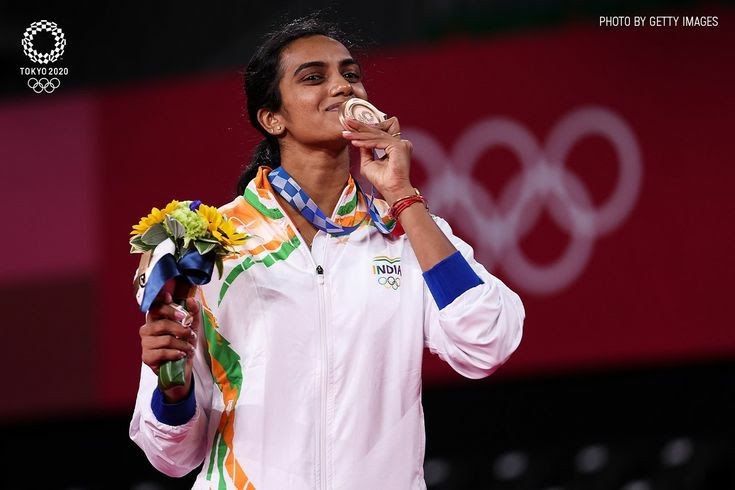
PV Sindhu, bronze medal – women’s singles badminton, Tokyo 2020

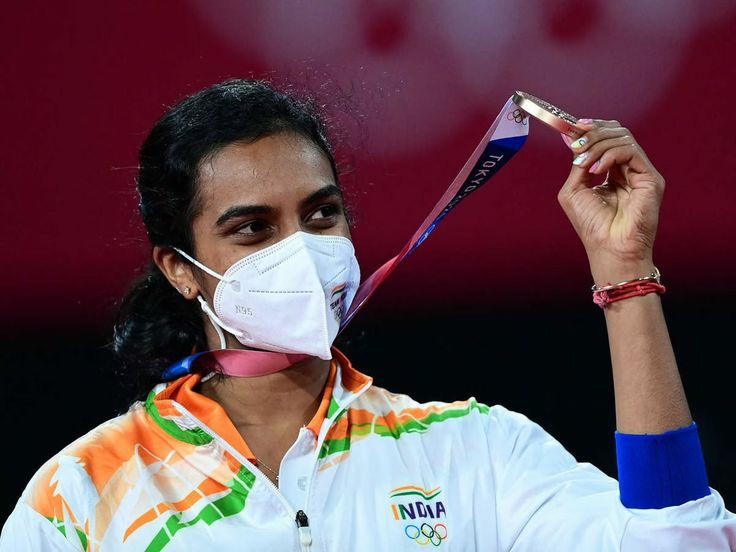
Badminton queen PV Sindhu became the first Indian woman and only the second Indian athlete – after Sushil Kumar – to win two individual Olympic medals.

PV Sindhu beat China’s He Bing Jiao 21-13, 21-15 to win the bronze medal in the women’s singles.

It is India’s third confirmed medal of Tokyo 2020 – one more than their haul at Rio 2016.

Global education summit at London

Education is a powerful tool and an educated person is an asset for the society, an educated society is essential for the overall development of the nation. Right to education is included in the fundamental right and primary education is mandatory, a child who has no access to school or educational facility will find it difficult to survive in a society without education he will be missing the growth opportunity at later stages of life. Economically, education index of a country will be poor in comparison to a nation where everyone has access to education. Above all an educated person is able to give back to the society.


Amidst of Covid crisis, education has faced loss be it education institute, the students, teachers or professors every one is bothered by it. It is still a challenge for many countries to bring back the flow because the collapse that has occurred in the past two years is going to impact the future of all the children.
The underdeveloped countries are at major loss not only in terms of education but, all other aspect they are facing crisis of even the basic requirements for instance when most of the countries were running vaccination programs for their citizen they were struggling and dyeing.
At recent a global education summit was held at London in order to address this issue at global level. Kenya and United kingdoms are co hosting the summit. The summit is conducted to analyse various issue that are a major concern for all such countries and how to deal with the same. It includes – the downfall of education system due to the pandemic, funding, inequalities in terms of resources available to different countries, a total amount of $ 5 billion was raised under Global partnership of Education that is GPE to support public education and not for commercial purpose. The call was made by 36 organisations and further GPE’s aim is to provide free primary and secondary education worldwide so that everyone will be benefited.


The issue of developing a quality education system needs to be resolved both at global and grass root level. It is a tough situation and finding a solution can be more tough, unity and support of all the nations can help overcome this. Framing of policies and donation in support is also necessary. As per GPE’s march 2021 report almost half of the children across the world were out of school due to the pandemic, which lead the schools to shut down. GPE is trying to provide education assistance to the worst affected countries, they are working upon raising fund and stabilize the falling education budget. They play a significant role and working hard to do the best.

DREAMS

Dreams don’t come true unless you take action. The best way to make your dreams come true is to live them.If you spend enough time dreaming,then the dream might eventually become real.

You can go as far as your dream takes you, when it is your turn, you will walk right into your blessing, believe in the power of your dreams. Never underestimate your dreams, no matter how little it is. Every effort, little or great is a step closer towards the accomplishment of your dreams.

Don’t give up your long term dreams to satisfy your short term desire. You are never too old to set up another goal or to dream a new dream.No matter when or where you start , your dreams are valid.

There are some people who live in a dream world, there are some people who face reality and then there are people those who turn dreams into reality, never limit yourself because the future belongs to those who believe in the beauty of their dreams.A dreamer is one who can find his way even is the moonlight.

Yesterday is nothing but today’s memory and tomorrow is not but today’s dream.

If you take responsibility for yourself, you will develop a hunger to accomplish your dreams. The best year of your life is the one in which you decide to have a dream , work for it and you control your own destiny.

The indispensable first step of getting your dream come true is this: have a dream and work for it’s fulfillment.

Dreams are fulfilled at the right time.Be patient and wait for the fulfillment of your dream.

We Want Independence!-A wide view to DEVELOPMENT

The Independence day is marked on 15th August every year in India with celebrations all across the nation. It was the day during year 1947 when our country attained freedom from the rule of the Britishers and initiated a free life without any force or restrictions held upon.

Since then we have had started to build a strong nation by empowering the citizens of the country to contribute their best towards achievement of common goals. Till now we have developed a great infrastructure to rely upon and set an example for the upcoming generations to never limit themselves. There have been a wide range of development and changes from how our nation used to be at the time of independence. Yes, it took a lot time for our nation to settle and move on from the disturbances created by the British rule but it gradually made way for itself.

But is it enough to have good machines and buildings to label the country as a developing nation ?

Development is a far wider concept than this much.

Though we succeeded in earning freedom for the country but have we been able to secure one for its citizens ?

Today we have long streets but are women free to wander anytime there ? We have laid rights and duties for our policemen but are they able to hold them and exercise them whenever it feels necessary ? There are responsibilities and obligations for the ministers but not all abide by them. There are established rules and regulations for a doctor but are the street clinics following them ? There are innumerable schemes and reliefs for underprivileged sections but do they have knowledge and sources for that ? The answer is NO. We still lag behind other countries in the world for which these are amongst the major reasons. Where is the freedom for the locals when they can’t even live their own way!

People take it as just a topic to discuss about feminism but when will we accept it in our lives is uncertain till date. There is no place where we see women walk on streets during night without any tension even after the advent of this modern era. It is still the case in villages that women be kept within walls or should not speak much or should not show their face to outsiders, etc. The lockdown time recorded more cases of domestic violence which raises the question if it is the women’s fault that the men suffer in their life. No. Females are not meant to be hushed. They do hold opinions and require justified treatment and respect to live their life. People call Bharat- Mata signifying the care and sacrifices of a mother and affection of the children for it. So, are these mere words to show off ? Isn’t it the responsibility of everyone to support and care for the women since they too are human and bear feelings as men do. They too get angry but the difference is they don’t let it become heavy on their mind. Crime against women are the reason that they are being limited by the society far below their potential. It is alarming the need for women empowerment and Yes, it is taking place, though gradually but atleast people are being responsible and ignited by the thought. Women have started to fight, women have started to rise! Only the complete support by the men is lacking..

One reason for our failed administration is loopholes in the administration system itself. The Police holds powers but they are not allowed to exercise them when they need. They can catch the criminal but can’t punish them what they deserve because the law stands in between and thinks for the welfare of those who take undue advantage of it! Also, the cases in courts get lined up in such a long queue that when the turn comes, it is no more required to be solved and we know how well this is being misused. There is always a way out when it comes to criminal offences but no way reaches out for the victims or justice seekers. These failures make up our administration. Above all are the ministers who work for money. They favour crime for their benefit without even being identified publicly. These are some of the many drawbacks that we are not able to grow as individuals. These are well known by everybody but the public is helpless! It gets trapped in the lure of fake promises and elects corruption as their representative. Who would anyway dare to confront their power or if somebody does, will the others follow up or support him ? This directs us to another big issue of “unity” among the people of the country. It is only to show off on official days that we are one and stand for nation but deep within people don’t even care for their neighbours whom we call our “first relatives”. It seems like we only say but never do. Those who does are criticised for breaking or hurting the religion code, as always!

What about those who illegally open shops and clinics without being identified and very easily they succeed in gaining attention of their target sections of the society. These fraudsters sell dangerous products and services to the public, risking lives of many. The shopkeepers selling adulterated items and doctors who are not even doctors (fake), opening clinics in local streets are some infamous examples of cheating and harming the people. Another is regarding the land owners and industry employers who are biased with poor workers and keep them untouched of their rights and reliefs.

Similar to these are many more cases where the citizens demand independence from the rule of the “more powerful”. The crimes are rising and voices being suppressed which hinders future prospects of growth of the country and arises an urgent need of bringing spotlight on the public, the locals, the less-knowns and less-identified.

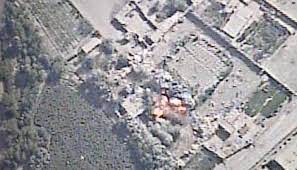
AIRSTRIKE THAT DESTROYED TALIBAN HIDEOUTS IN AFGANISTAN:

AFGHAN-TALIBAN:

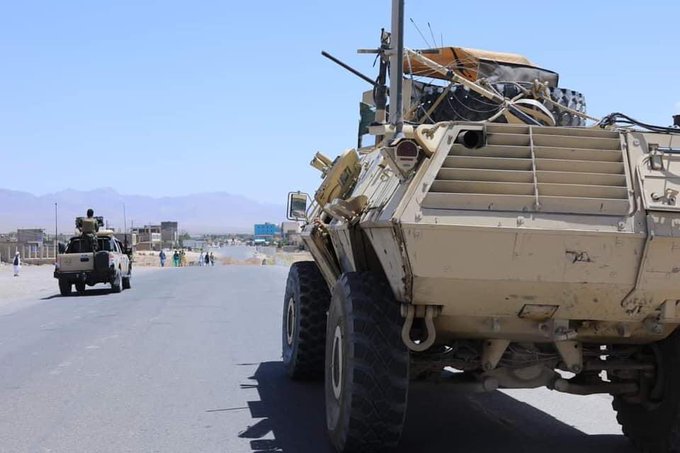
Afghan security forces have increasingly relied on airstrikes to push the militants back from cities, putting the lives of civilians at risk.

A hideout used by Taliban insurgents is seen being destroyed in an airstrike by defense forces. A video regarding the same was released by the Afghanistan government on Twitter.

 In the attack that happened in Zherai district of Kandhar province, total of 20 terrorists were killed. At least 250 such insurgents have been killed while nearly 100 were wounded in battles at several major cities over the past 24 hours, Afghan army said.

As per reports three terrorist vehicles, six motorcycles, two bunkers and a significant amount of their weapons and ammunition were also destroyed.

Ministry of defense, Afghanistan in twitter quoted ” 254 taliban terrorists were killed and 97 wounded as a result of ANDSF operations in Ghazni, Kandahar, Herat, Farah, Jowzjan, Balkh, Samangan, Helmand, Takhar, Kunduz, Baghlan, Kabul & Kapisa provinces during the last 24 hours. Also, 13 IEDs were discovered & defused by ANA “.

Over the past few weeks, Afghanistan has witnessed a surge in violence as Taliban has intensified their against their attack forces and civilians.

AFGHAN VIEWS:

Afghanistan government has repeatedly dismissed the Taliban’s steady territorial progress over the summer as “lacking strategic value”.

In this regard, the Chairman of the Joint Chiefs of Staff, General Mark Miley, made a remarkable comment that the Taliban now control about half of the 419 districts centres in Afghanistan.

He added that as the Taliban seize more territory, the Afghan security forces are consolidating their positions to protect key population center’s, including Kabul.

Minor as a Partner: Comprehensive Study

INTRODUCTION

Partnership is described as “a relationship between parties who have decided to share the proceeds of a company carried on by both or all of them working for all in Section 4 of the Indian Partnership Act, 1932.” A partnership is a relationship between two or more than two people who choose to do business together in order to make money and share profit or loss proportionately. The meaning of relationship is reciprocal trust, absolute good faith, and mind identification among the partners.”

According to the “Indian Majority Act of 1875”, a minor is anyone who has not yet reached legalage of majority. “The Indian Majority Act of 1875, Section 3 tells that a individual who is domiciled in India will reach majority at the age of eighteen.”

“Section 30 of Indian Partnership Act” regulates admission of minor within the partnership. This clause covers rights & responsibilities of minor who joins relationship. A extensive analysis of provision, specially “section 30(1) makes it very clear that a minor cannot be admitted in the partnership as a full-fledged partner, but with the authorization of the other partners, a minor can be admitted in the partnership to the benefits of the partnership.”

MINORS – ADMITTED ONLY TO BENEFITS

The basic principle is set out in “Section 11 of the Indian Contract Act, 1872, which discusses who is qualified to contract and states that a minor does not have the right to contract.”

A special committee has drafted the “Indian Partnership Act. Since partnership provisions were administered by “Indian Contract Act” prior to  passage of “Indian Partnership Act”, The special committee found that there was no reason to depart from “Section 11 of the Indian Contract Act’s definition of a minor’s failure to enter into a relationship contract.”

Following this, it was decided by special committee that minors could not become partners in a relationship, but they could be entitled to the partnership’s benefits with the permission of both of the standing partners.

In judicial decisions such as the S. C. Mandal case, the same theory is proclaimed. It was noted that a firm is described as a collective of people who have formed a partnership contract with one another. under “Section 4 of the Indian Partnership Act, and when read in conjunction with Section 11 of the Indian Contract Act, it can be inferred that a minor cannot be a party to a partnership contract.
A minor should only be in a relationship for the good of the partnership, according to the ruling. It also claimed that before a minor may be entitled to its privileges, there must be a relationship between two major partners.”

The Allahabad High Court also ruled a partnership deed void in which a partnership firm’s rights and liability were split between the minor and main partners. The court ruled that in the current case, not only the partnership’s gains but also its obligations are being imposed on the minor, which is in violation of the Indian Partnership Act.

While there were different judgments along the same line, there was also a lot of doubt about whether a minor should become a full-fledged partner in a partnership company and there were some contradictory judgments as well.

In the historic decision Commissioner of Income Tax vs D. Khaitan and Co., the Supreme Court took the legal position that if a minor is made a full-fledged partner in a company, the relationship cannot be registered with the Income Tax Department.

If the relationship is to be registered with the IRS, a new contract must be written in which the minor is only allowed to participate in the firm’s benefits, and the old contract may be nullified until the new contract is in effect. It was further specified that the revised contract would expressly specify that the minor was accepted to the relationship only for the sake of receiving compensation and that the minor is not responsible for any damages.

Except in the case of Banka Mal Lajja Ram & Co. vs. Commissioner of Income Tax, Delhi , it was determined that even though any of the other members of the relationship agree to make the minor a full-fledged partner, the decision can be implemented.

Commissioner of Income Tax vs. Kedarmall Keshardeo , a Guwahati High Court decision, holds that a contract deed is applicable when a guardian enters into a relationship on behalf of a minor, but that no responsibility should be levied on the minor, and that the minor’s income from the company should not be considered for income tax purposes.

The courts even come to the conclusion that when a guardian contracts with a minor, the damages must be measured based on the guardian’s damages, not the minor’s. The courts have also provided that if a minor contracts with a guardian, the benefits bestowed on the guardian must be approved by the guardian, but the minor may reject the arrangement if it is not entered for his benefit.

RIGHTS AND LIABILITY OF A MINOR

According to “Section 30(2) of the Indian Partnership Act, a minor is entitled to a share of the income and property of the company, as determined at the time the minor was admitted to the partnership’s benefits. A minor has the freedom to audit the partnership’s accounts under this clause, but he or she does not have the right to inspect the partnership’s other records. This restraint on the minor’s privilege, however, is fair and egalitarian, since the minor is not responsible to the same degree as the full-fledged spouses, i.e., individually. The minor will even appeal for the benefits of the relationship to which he has been admitted.”

If a minor chooses not to become a partner, he has the following rights:

  1. Up to the day of public notification, his rights and liabilities would be those of a minor;
  2. His share is exempt from liability for all actions taken by the company since the date of the notice;
  3. He has the right to sue the other partners for his share of the income and land.


Also under “Section 30(3) of the Indian Partnership Act, a minor may only be held responsible for his share of the partnership’s losses and cannot be held individually liable for the firm’s losses.” In a Calcutta High Court decision, it was reported that creditors can only recover money from a minor to the degree of his share in the company, but they cannot sue the minor personally; this advantage is not available to the main member of the firm.

POSITION/STANCE OF MINOR ATTAINING MAJORITY

“After reaching majority, a minor has two options: sever the relation with the firm or become a full-fledged partner in the firm, according to section 30(5) of the Indian Partnership Act.” Within six months of reaching majority, the minor must make a decision.

If the minor decides to become a full partner, he must give a public notice as required by “Section 72 of the Indian Partnership Act.” “The minor retains his rights as a minor before he takes a definitive determination on whether or not to enter the relationship as a full-fledged partner or to cut ties with it.”

“The presumption of arguing that the minor had no idea that he was entitled to the privileges of relationship lies with the party asserting it under Section 30(6).”

“Section 30(7)(a) of The Indian Partnership Act also specifies that if a minor partner is admitted as a full-fledged partner, he is responsible not only for the firm’s potential liabilities, but also for the firm’s past liabilities dating back to the date of his entry.

“That when a minor agrees to become a full-fledged member of the relationship, there is no split in the partnership and it continues as is, it is just that the liabilities of becoming a full-fledged partner are now upon him, Section 30(7)(b) notes that his position after he attains majority will be the same as it was when he was a minor.”

“Section 30(8) of The Indian Partnership Act specifies that if a minor refuses to remain as a full-fledged member of the partnership, he will be responsible for all of the partnership’s obligations before he gives the public notice required by Section 72 of The Indian Partnership Act.” After serving the partnership’s ties, the minor may file a lawsuit to regain the benefits to which he was entitled.

Conclusion

We may conclude from the preceding debate that a partnership company cannot be established with a minor as the only other participant. A contract establishes the partnership agreement. A minor is not competent to enter into a deal, according to “Section 11 of the Indian Contract Act.” Even in the Dwarkadas Khetan case, the country’s Supreme Court rules that a minor cannot be a full partner in the company. In the Shah Mohandas Case, the Supreme Court ruled that a minor could be admitted to the company solely for its benefits. The Indian Contract Act, Section 30. Although a minor is not a full-fledged partner in any event, he or she will only benefit from such a relationship with the consent of both partners and is not individually responsible for the firm’s losses. A guardian may enter into a relationship on behalf of a minor as long as it is not detrimental to the minor’s interests. Furthermore, a minor’s income from a relationship cannot be classified as “earning income” and therefore cannot be counted for income tax purposes. After reaching majority, the minor has the option of remaining in the partnership and becoming liable for losses, or ending the relationship entirely.


Meaning of Confidence

Confidence means having security about oneself and oneself ability. It is belief of being valuable, worthwhile and capable. Confidence turns thoughts into action.

Factors affecting Confidence

There are several factors that affect confidence both internal and external. Genetics, childhood, environment, society, media, health, experience can all add or take away how you feel about yourself and your abilities. The choices you make, risks you take and how you respond to challenges play major role in confidence development.

Tips to boost Confidence

  • Don’t compare yourself to others.
  • Surround yourself with Positive people.
  • Take care of your body.
  • Face challenges.
  • Continuous practice to sharpen your skills.
  • Good diet plan.
  • Try new things.

Pollution

Pollution is the containment of material particles or energy into the natural environment, causing adverse effects on the ecosystem.

Types of pollution

(1) Air Pollution: It occurs when any harmful gas, dust smoke enters the atmosphere and makes it difficult to survive living organisms like plants, animals, and human beings as well. And causes common respiratory diseases such as asthma, bronchitis.

(2)Water Pollution: It is due to the presence of foreign substances like sewage, algae, soluble salts, etc in water. It can also be due to the presence of some metals in water. Some metals like chromium and Arsenic cause diseases like cancer, cadium can cause Itai-Itai disease, and mercury causes Minamata disease.

For a healthy aquatic life, dissolved oxygen (DO) is 5-6ppm. For clean water, BOD (Biochemical Oxygen Demand) is less than 5ppm while for highly polluted water is 17ppm or more.

(3) Soil Pollution: It is an alternation in soil. It is caused by pesticides, insecticides, for example, DDT, BHC, etc, herbicides for example sodium chloride, fungicides like organomercury compounds.

Hazardous Effects of Pollution

Greenhouse Effect- It is the heating of the earth and its objects because of the trapping of Infra-Red radiations by carbon dioxide(CO2), methane, (CH4), nitric oxide (NO), ozone (O3), chlorofluorocarbons(CFCs), and water vapours.

.• Global Warming- It is a result of the increased concentration of greenhouse gases. It may result in the melting of ice caps and glaciers, spreading several infectious diseases like malaria, sleeping sickness, etc.

• Acid Rain- It has a pH of less than 5. It is due to the presence of oxides of nitrogen and sulphur in air that dissolve in rain water and forms nitric acid and sulphuric acid. It damages the buildings and other other structures made up of limestone and results in several diseases such as qskin infections. pH of normal rain water is 5.6.

Pollutants

There are the substances that contaminates the environment and of two types:

(1) Primary Pollutants: These persist in the environment in the form which they have produced, for example, sulphur dioxide(SO2), nitrogen dioxide (NO2), etc.

(2) Secondary Pollutants: These are the products of nitrogen of primary pollutants, for example, PAN (Perocyacylnitrates), nitrogen dioxide (NO2), etc. The order of different pollutants to cause pollution is carbon monoxide (CO, SO2 hydrocraban particulates nitrogen oxides.

Carbon monoxide (CO)- It is formed by incomplete combustion. It is colorless, odourless gas. It contains a triple bond and are fairly polar, resulting in a tendency to bind permanently to haemoglobin molecules, displacing oxygen, which has a lower binding affinity.

Particulates- These are minute solid particles and liquid droplets dispersed in the air, for example, mists, dust, smoke, fumes, etc. They result in causing many serious diseases like pneumoconiosis, due to inhalation of coal dust, silicosis due to inhalation of free silica (SiO2), black lung disease found in workers of coal mines, white lung disease found in textile workers, byssinosis due to inhalation of cotton fiber dust.

Smog- It is a consequence of particulate pollution and is of two types they are:

• Classical smog

• Photochemical smog

BOOK REVIEW: HARRY POTTER AND THE CURSE CHILD

Cursed Child begins with that famous scene from the epilogue of Deathly Hallows with Harry, Ron, Hermione and indeed Draco Malfoy seeing their children onto the Hogwarts express. The story follows an unlikely friendship between Harry’s middle son Albus Severus, and Draco Malfoy’s son Scorpius, meeting on the train to Hogwarts in a scene that consciously mirror’s Harry’s first meeting with Ron and Hermione. One major thing which this story gets spot on and which I recognized instantly is the instant complexity and realism of its characters. Despite the fact that we do not have a specific central character perspective in the script the way we do in the novels, we quickly understand Albus and Scorpius and even the attitude they have. 

The story. Also come back to Harry and the gang. All now adults in their late thirties. I praise that thing which is how well Thorns and Rowling manage to capture both the similarities and differences of the characters to their teenaged selves. I particularly loved one scene where Harry and Draco Malfoy find themselves engaging in one of the magic duels of the type familiar to anyone from the books, slipping quickly back to their teenaged attitude and Draco remarks how much fun it is, despite the fact that both men have indeed changed and realize (a little shamefacedly), exactly how they’re behaving.

The main plot of the play surrounds an illegal time turner and Albus and Scorpius’ rather ill-fated attempts to alter aspects of history reflecting upon the series. Of course, as a Doctor Who fan I can’t deny that I love time travel stories, and I can see how seeing scenes from the books on stage would be an amazing experience for any Potter fan.

These forays into time and history also let us meet characters such as Severus Snape who we otherwise wouldn’t, and made for some truly spectacular and spine tingling scenes, as well as a chance to relive things from a slightly different angle, both literally and also emotionally, since some of the points around which the plot centres are ones which any reader of the books will well remember.

Writing style wise, though this is definitely a play script not a novel, I did appreciate that the stage directions were clearly intended to be read atmospherically rather than literally, with little touches of description, albeit the descriptions that would be seen on stage rather than the descriptions of the actual environment, still descriptive nonetheless. Also, though the play script format did lack the inherent personal focus which is a major strength of Rowling’s writing, I had no trouble getting inside character emotions. My one stylistic complaint about Cursed Child is that on several occasions the dialogue felt a little heavy handed in the emotional department rather than (as is famous in the series), the way that characters of that age would actually talk. For example, one conversation in which Albus denies the rumour that Scorpius is connected to Voldemort by telling him he’s too full of kindness. 

Whilst the script is definitely not the Harry Potter we loved, it is a reminder that he has grown with us. Performed on stage I can imagine this is a spectacular show.  Regarding the script however, it is like the comfort of revisiting a childhood home; just bear in mind you’re older now and it might not be exactly the way you remember it. 

IMPORTANCE OF SELF MOTIVATION

Youtube brings to us content ranging from varied fields. From stand-up comedies to mini web series, we have wide-ranging content to choose from. One category of content that we must have encountered at least once is that of motivational videos. Videos that encourage us to do better, start from scratch or get rid of bad habits.
While we live in an era where a lot of distractions exist, it is important to keep ourselves on track to living life in an orderly way and achieve our dreams. For this, we often resort to videos to keep ourselves motivated or try seeking validation from other people.
This we do when we feel low and need the motivation to work. But one thing that we must have observed is that the external motivation that we receive does not last long. You may get all boosted up after watching one of the many Youtube videos available, but after a couple of hours or a day later, the zeal disappears.
All of us are talented and unique in some way or the other. Many of us even have a clear aim in life. Someone might want to become a footballer and might be having the requirements for the same, but at the same time, he might not be dedicated enough for the long hours of training and grind. This makes him lose hope in life. But what exactly is stopping him or what can be done to curb this?
The real motivation that stays for long is the one that comes from within. For that to happen, the real purpose of the goal is to be understood and it must be realized that why the goal matters in the first place.
For example, a person who is not very well of has a meager source of income and knows that he has to be the breadwinner of the family and the only way for this is to study hard and gain some reputed position in society. This can act as a motivation for the person to achieve his goal of providing his family with all adequate commodities of life.
A solid reason to fulfill the purpose in life is required for a person to work with grit determination.
Another example can be of a person who lost his repute at a global level in a particular sport. He knows that gaining the repute back will require a solid comeback, but he may not be willing to do so due to a lack of motivation. The only way he will be able to achieve the purpose will be by realizing the importance of the reputation he once had. It is the inner motivation to gain it back that will drive him to make a comeback in the sport.
It is nowhere said that youtube videos or experts’ guidance is not appropriate. But it constitutes a small proportion of the motivation. The real motivation comes from within. Self-motivation is important and best. Hope you give yourself some boost and achieve what you desire.
Good luck!

FRIENDSHIP – THE PRICELESS BOND

“Good friends are hard to find, harder to leave, and impossible to forget.”

Friends and friendship cannot be defined in words. It is the soulful attachment between individuals. Friends are persons who are very close to one’s heart. They are the only souls who expect nothing and don’t do something for a sake. There are no responsibilities, commitments, ego, and rules between friends. Endless gossips, sharing and caring, silly fights, memories, and trust, loyalty, love without expectation is what is present between true friends. There are no formalities and awkwardness in friendship. It is a pure bond that can never be forgotten but will be cherished forever. The relationship that brings joy and tears at the same time is friendship next to motherhood. In fact, it is as divine as motherhood. This special thing about this companionship is that there is no privacy or secrets between friends. One can never keep a secret between friends how hard they try as friends can always find that. It is such a transparent and lucid bond where the person can share every little thing without hesitation even if it is not worthy of sharing. 

Friendship is being there for each other anytime. The understanding in this relationship cannot be compared with other relationships. We don’t need to explain something to make them understand. They can automatically understand it from our eyes and behaviour. Even if we are not close to each other, it is a soul-to-soul link that remains forever and keeps us connected. No distance could weaken the strength of friendship. There is no need for daily calls or meets to sustain a true friendship. It indeed doesn’t vanish at any cost. No matter how long we didn’t meet them or we meet them after so long, the bond doesn’t even change a bit. We will always feel the same warmth and comfort that we share with each other. We may be far apart in distance but never in heart. 

Friends are God’s gift to us. They give the sweet memories that we rejoice throughout our lives. We must feel blessed and lucky to have a true friend. We always have their unconditional support in everything whether it is right or wrong. They guide us when we choose the wrong path but will never leave us alone. They are the only creatures who will be ready to listen to our 2 AM tantrums. Even if our family fails to support us, friends never leave us unattended. They are lifetime companions who are born to love as well as torture us. From showing unlimited love and care to making the worst mockery out of us, friends always have our back. They will be with us even if the universe is against us. God thought that he couldn’t be with everyone all the time. So, he sent our friends to be with us forever. Also, as we couldn’t choose our family, God gave all of us the opportunity to find and make our own close circle. We made use of the best opportunity in our lives to choose our friends and made them our family.

“There are friends, there is family, and there are friends that become family.”

HAPPY FRIENDSHIP DAY!!!

Forest and it’s Importance

Forests are an important component of our environment and are dominated by microorganisms, flowering plants, shrubs, climbers, dense trees and provide a vast habitat for wild animals. Forests also contribute to the economic development of our country. Forests are vital for human life, it is a source for a wide range of renewable natural resource. They provide wood, food, fodder, fibre and medicine.

Forests are major factor of environmental concern. They act as carbon sink , regulate climatic conditions, increase rainfall, reduce global warming, prevent natural hazards like flood and landslides, protect wildlife and also act as catchments for water conservation. They also play a vital role in maintaining the ecological balance.

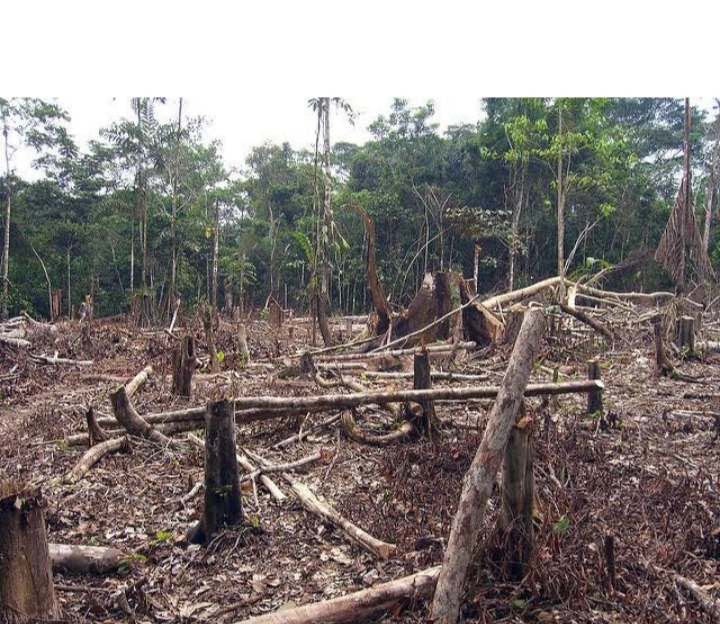
Deforestation and its Effects

Deforestation is the destruction of large area of forests. This happens for many reasons like intensive agriculture, urbanization, construction of dams, roads, buildings and industries, hydroelectric projects, forest fires, construction of mountain and forest roads. It is a threat to the economy, quality of life and future of the environment. India is losing about 1.5 million hectares of forest cover every year.

Effects of Deforestation

Deforestation gives rise to ecological problems like floods, drought, soil erosion, loss of wild life, extinction of species, imbalance of biogeochemical cycles, alteration of climatic conditions and desertification.

Conservation of Forests

India has an area of 752.3 lakh hectare classified as reserved forests and 215.1 lakh hectare as protected forests. The important measures taken for conservation of forests are as follows

Afforestation:

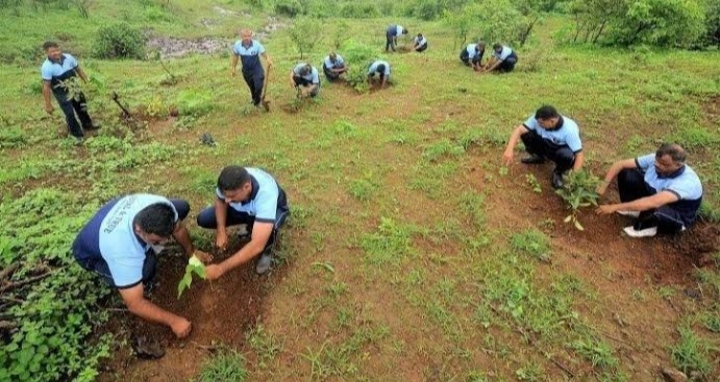
Activities for afforestation programme includes planting and protecting trees with multiple uses which help in restoration of green cover. Destruction of trees should be curtailed.

Social forestry programme:

It should be undertaken on a large scale with active participation of the public and utilization of common land to produce firewood, fodder and timber for the benefit of the rural community. This relieves pressure on existing forests and to safeguard future of tribals

Forest Conservation through laws:

Adopting stringent laws and policies to conserve and protect forests are through National Forest Policy, (1952 and 1988) and Forest Conservation Act, 1980.

Sindhu wins historic bronze; Beats He Bing Jiao to at Tokyo Olympics

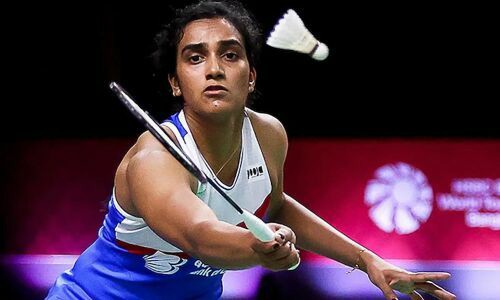
PV Sindhu created history on Sunday as she defeated He Bing Jiao of China to become the first Indian woman to win two individual Olympic medals. Sindhu defeated He Bing Jiao 21-13 and 21-15 in the bronze medal match. Sindhu was clinical throughout the contest and didn’t give her opponent any chance in the match. Sindhu had suffered a heart-breaking loss to world no.1 Tai Tzu Ying in the semi-final on Saturday. Sindhu lost the semi-final 18-21, 12-21.

Saturday was a day of heartbreaks as India’s biggest medal hope PV Sindhu crashed out of the Gold medal race with a loss against her Chinese Taipei opposition. Kamalpreet Kaur in Discuss was the big story from Saturday. Participating in her maiden Olympics, she qualified for the Discuss final in the second position. Archer Atanu Das was knocked out and so were Amit Panghal and Pooja Rani in boxing. Another good news was the fact that the Rani Rampal-led women’s hockey team beat South Africa in a must-win match.

pv sindhu India’s pride,one of our most outstanding Olympian: pm Narendra Modi

Prime Minister Narendra Modi on Sunday hailed ace badminton player PV Sindhu as India’s pride after she won bronze in the Tokyo Olympics. He tweeted, “We are all elated by the stellar performance by PV Sindhu. Congratulations to her on winning the Bronze at @Tokyo2020. She is India’s pride and one of our most outstanding Olympians.”

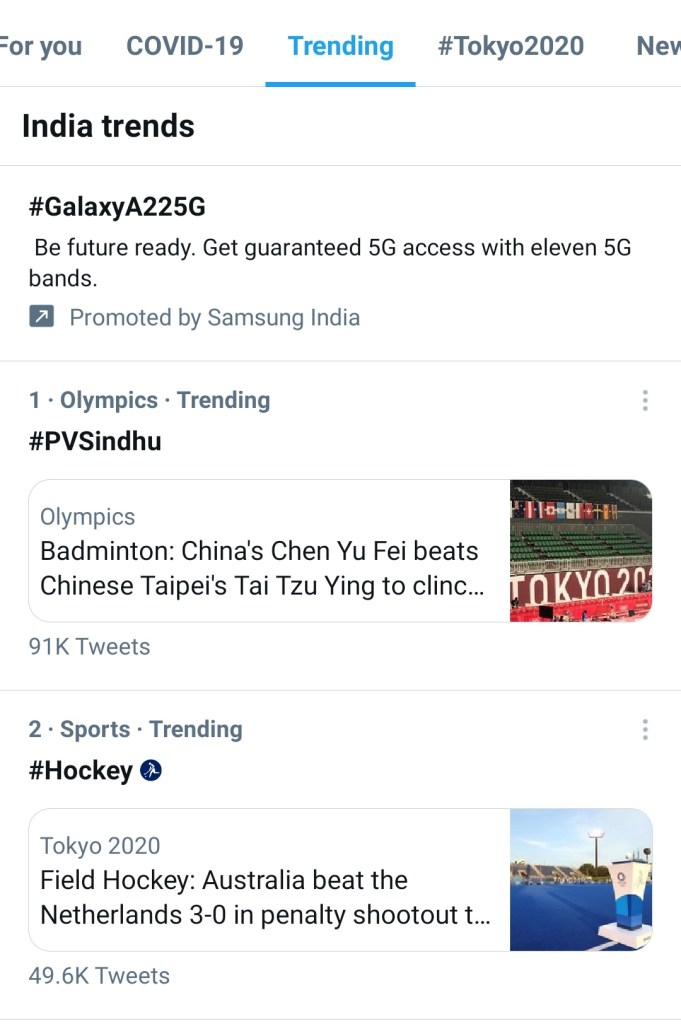
Reaction over social media

Within an hour of Sindhu’s historical victory, her name trends over the various social media plateform. #pvsindu lies at the top of twitter trend in india.