John Titor : Time Traveler

Who is John Titor?

John Titor described how he was an American historian with a specialism in the 20th century. His academic funding had been provided by the army, whilst he was as an enlisted soldier.
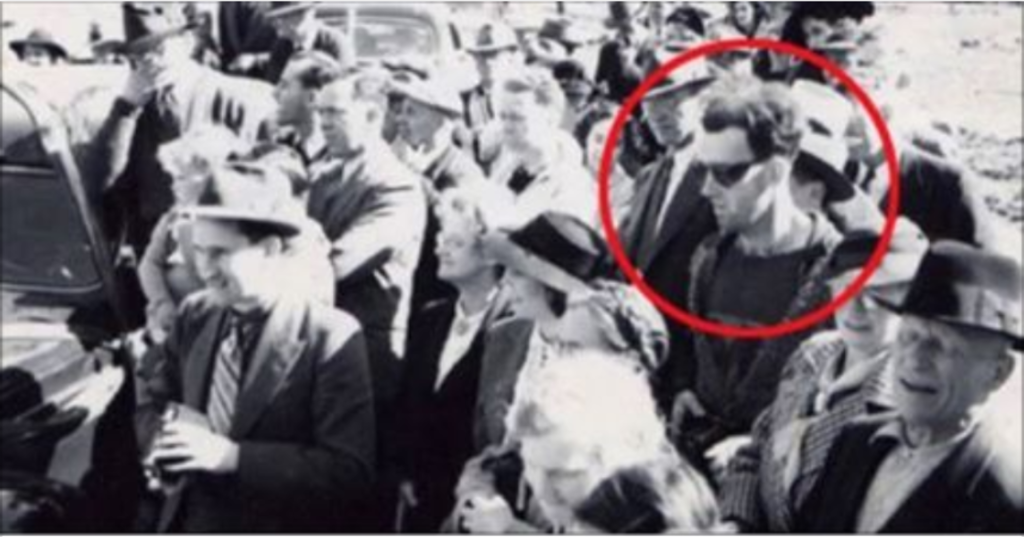
By the year 2036, he claimed, time travel had been developed by the government and had been used for several years by the time of his expedition. Titor said that he had been chosen to be sent to the year 1975, with the mission of retrieving an IBM 5100, a portable computer, which contained an outdated piece of coding that was needed in the future. The army had chosen Titor because of his historical knowledge, and because his grandfather had been one of the people who had worked on the very computer needed.

Why Did He Travel Back In Time?

According to Titor, he was sent back in time to pick up an IBM 5100, which his grandfather had helped design. Supposedly, he needed this model – one of the first portable personal computers – to correct predicted issues with Unix in his timeline. After acquiring the computer, he stopped in the year 2000 for “personal reasons” – and to warn people about the threat of Creutzfeldt-Jakob disease (which would be spread through beef products).

How Does The IBM 5100 Play Into This?

One of the oddest parts about the John Titor story is the part played by the IBM 5100. Why would someone from the future need such an old computer? In 1975, IBM released the 5100 as one of the world’s first personal computers, and it came with one feature that set it apart from other computers of the time: It could debug and emulate code written in other programming languages, such as BASIC and APL.

According to Titor, this feature would allow people of the future to keep their technological architecture running after a Unix timeout error in 2038. He said he wanted to snag a 5100 and help debug the code that would keep the world’s computers from having a meltdown.
The future according to John Titor

As well as describing his personal history, John Titor also revealed information about a future marred by warfare. A common theme in all of his posts is the detail he provides in describing alleged future events.

Titor Warns Of World War III

In his short time on the Internet, Titor made a series of interesting predictions that have seen mixed accuracy. One of his early messages warned of a Y2K disaster that would leave the US in a state of martial law.

His most dire warning was of a second American civil war that would begin in 2004. That turned out to be untrue, but his claim about the occurrence of a “Waco type event every month” – referring to the 1993 siege in Waco, TX – was not entirely inaccurate if you add up worldwide incidents of violence. He went on to say that by 2008, the world as we knew it will have disappeared, and that the US would split into multiple sovereign nations. He also predicted a short but intense World War III.

The invention of time travel

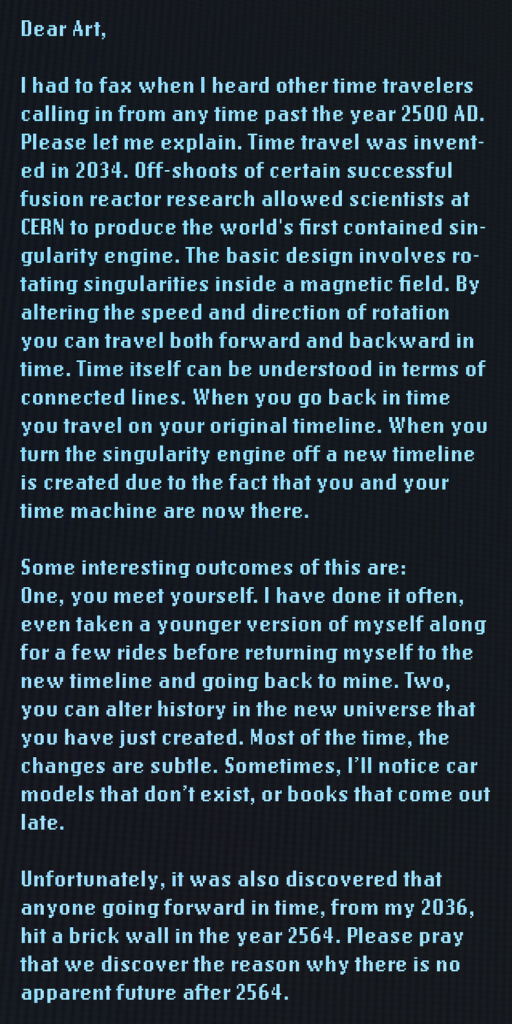
With peace reinstated, time travel was invented by the year 2034. However, Titor pointed out that – in his future – it has not yet been made available for public use.

Although it is reserved solely for official purposes, the general public are aware of its existence. In his forum posts, Titor is happy to discuss time travel at length, including its moral implications which he said are discussed in his own time. Titor claimed that the state, for example, had considered using time travel as a sort of punishment. 11

Is John Titor a Hoax?

The tenacity with which John Titor stated that he does not expect, or want to be, believed is an element of this story which – perhaps ironically – serves only to increase people’s general willingness to believe him. Unless, that was his intention all along. If an elaborate hoax, it stands to reason why someone would state this as an act of reverse psychology: a lack of motive makes the persona of John Titor inherently more enigmatic, and more importantly, more believable.

The debate surrounding the reality of John Titor is not an easy one to unpick. Both sides make genuine and sympathetic points. On the one hand, it all seems rather fantastical, and, as we already live in this future, redundant. Yet, the 2.5% divergency effect neatly explains away any inconsistencies, thus redeeming the argument.


Common Mistakes to Avoid on Your Resume


Saying YES to the mess

An unprofessional resume screams SKIP! Remember to keep it sleek and professional with proper highlighting, bullets, and minimal colours. Don’t make it fancy or too simple, don’t use any kind of word or sentence, which will look like a command or too unprofessional, make it professional.
Ensure that it isn’t too busy, too colourful or has illegible fancy font styles.

Check out my posts, ‘Tools to enhance your resume’ for more on this.

Not linking your portfolios, and recommendation

One of the most common mistakes that are made while creating a holistic resume is not providing links to these. Ensure you add a hyperlink to your port folio and recommendation. Also, ensure it is accessible to the employer to view!
Recommendations are like a golden star on your resume. Keep it short, but do provide a contact that they can reach out to, for verification.
Never forgot to add this!!

Not highlighting well enough

Sure, we did tell you what to highlight. But what do you not highlight? Unnecessary minor details, especially in a stretched – out manner. Just add what is important, that will make it look good but if you add small things, it will make your resume look bad. So just remember that you have added things which are important and don’t make it too long.
Use action verbs to describe your daily responsibilities and experience.

Sorry, they can’t come to the phone right now

Why? Because they listed an incorrect contact details on their resume or didn’t list one at all.
So many times we never check our personal information and because of this even if you got the job you will miss it.
Be careful to double and triple check your contact information. E-mail addresses and phone numbers should be highlighted for easier identification.

Too long to read

Keep it short. Your ideal resume should not exceed 2 pages. Employers usually have to go through several resumes in a single day. A super lengthy resume, just make it easier for them to glance and skip.
Make it effective and short.

Grammatical or spelling error

Not only is it extremely unprofessional, but it also implies to the employer that you are not very interested in the position. Use tools like Grammarly to run spelling and grammar checks. Additionally, you could also run it by a friend, just in case you missed something. It’s that easy!

The role of women in the civil rights movements

Introduction

The civil rights movement was an organised efforts by Black Americans to end racial discrimination and gain equal rights under the law full stop this moment was carried out from the late 1940 to 1960.

Cause of the moment

the idea of the moment was rooted in their heart over centuries. But the moment ignited only on December 1 1955 a 42 years old Rosa Park who seated on her design seat at the back of the bus due to the segregation laws at those thanks in USA. when the White man got on the bus and couldn’t locate a seat comer the driver instructor all the black passengers on the back seat to give up there seats Park refused and was arrested.

this instant started to spread as a wildfire on the black and white people parks unwittingly became the mother of the modern day civil rights movements.

The role of women in civil rights

many women played important role in the civil rights movements from serving as a lawyer to teaching in school they provide to the secretary Asian law and started to dismantle them one by one stop their efforts of UN overshadowed by men who still gets more attention under credits for the success in history.

during the moment many women experience to general discrimination and sexual harassment within the moment and delete the turn to do what the feminist movement.

FOOTBALL

Football is a family of team sports that involve, to varying degrees, kicking a ball to score a goal. Unqualified, the word football normally means the form of football that is the most popular where the word is used. Sports commonly called football include association football (known as soccer in North America and Oceania); gridiron football (specifically American football or Canadian football); Australian rules football; rugby union and rugby league; and Gaelic football. These various forms of football share to varying extent common origins and are known as football codes.

There are a number of references to traditional, ancient, or prehistoric ball games played in many different parts of the world. Contemporary codes of football can be traced back to the codification of these games at English public schools during the 19th century. The expansion and cultural influence of the British Empire allowed these rules of football to spread to areas of British influence outside the directly controlled Empire. By the end of the 19th century, distinct regional codes were already developing: Gaelic football, for example, deliberately incorporated the rules of local traditional football games in order to maintain their heritage. In 1888, The Football League was founded in England, becoming the first of many professional football associations. During the 20th century, several of the various kinds of football grew to become some of the most popular team sports in the world.

Several of the football codes are the most popular team sports in the world. Globally, association football is played by over 250 million players in over 200 nations, and has the highest television audience in sport,  making it the most popular in the world. American football, with 1.1 million high school football players and nearly 70,000 college football players, is the most popular sport in the United States, with the annual Super Bowl game accounting for nine of the top ten of the most watched broadcasts in U.S. television history . The NFL has the highest average attendance (67,591) of any professional sports league in the world and has the highest revenue out of any single professional sports league. Thus, the best association football and American football players are among the highest paid athletes in the world.

Australian rules football has the highest spectator attendance of all sports in Australia. Similarly, Gaelic football is the most popular sport in Ireland in terms of match attendance, and the All-Ireland Football Final is the most watched event of that nation’s sporting year.

How Important is Female Education?

FEMALE EDUCATION

“Women are the eyes of the country” is a universal suffrage. 

There is no doubt that the country will prosper if the light of women’s education shines. All good people will accept the need for women to be educated, which is equal to the world’s population. So let’s look at female education here. 

Importance of Female Education 

If a man is educated he will develop knowledge only for one. However, if a woman is educated, the whole family will be educated. Because the baby begins to learn in the mother’s lap. So it is natural for the whole family to be educated when all the children are educated. 

Female Education in Ancient Times 

It is a fact of history that the kings of the earth ruled and maintained the poets. Women were among the poets who brought good things to the kings of the world. 

Argument and Denial Against Female Education

Those who refused to accept the growth and importance of women uttered many words at that time. But many who felt the importance of female education supported it. It is an internationally accepted fact that a woman is hidden behind every man’s success.

The Benefits of Female Education 

The society of women who are paralyzed in the kitchen because women are educated has made many achievements. Today women have done their duty in various fields of the world.  From Kalpana Chawla to Sania Mirza, who have excelled in sports to aerospace research. Women make up the majority of the teaching profession. Indira Gandhi, who ruled India, was also a woman. Women have assumed responsibility for governance in various parts of the world; They have been performing to this day. Women are on par with men in all fields.

Women need to be educated to be healthy, prosperous and enlightened. We who worship women as gods should also educate women. We will develop female education.

Slime

Definition

a thick, wet, unpleasant substance that covers something

Slime is made from PVA school glue and a natural mineral called Borax, which is found in household items, such as eye contact solution and natural laundry detergents. When mixed, a reaction forms between the ions in Borax with the molecules in the PVA glue occurs, creating slime. We also use other safe ingredients to create different textured slimes, such as instant snow or biodegradable beads to create a unique experience with each slime.

Despite both of these products being safe to play with, slime should never be consumed. We also do not recommend people with highly sensitive skin or allergies to household items to play with slime, despite never having any complaints about such issues.

Origin and usage

The word slime likely comes from the Old English word ‘slim’ which was probably related to the Old English ‘lim’ meaning ‘sticky substance’. Slime is related to words in many other languages, including the Dutch word ‘slijm’ meaning ‘phlegm’, the German ‘Schleim’ (‘slime’), and the Latin ‘limus’ meaning ‘mud or mire’.

Difference: Fluid and Slime

Liquids consist of many small particles that are densely packed together but can move freely against each other. In thin liquids, the particles are usually small and move past each other quite unhindered. In viscous liquids, the particles are larger and often contain long chains that intertwine.

A good slime is wobbly, can be kneaded, formed, torn, and adheres easily to surfaces such as fingers without leaving any residue. It is a gel. A gel consists of at least two components: One component is solid and forms a 3D network. The other component is a liquid or gas that fills the pores of the network.

Original Slime

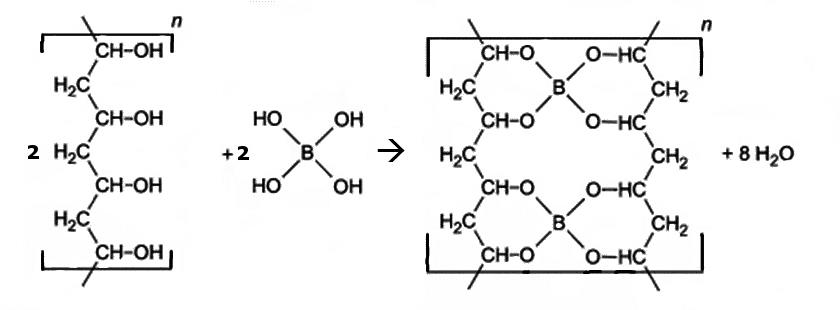
The original slime or DIY slime contains polyvinyl alcohol (PVA), borax (sodium tetraborate), and water. If borax is dissolved in water, boric acid is formed, which reacts further to tetrahydroxyborate. Tetrahydroxyborate reacts with PVA. The OH groups of both particles combine to form solid compounds so that the borate anions become “nodes” in a flexible network. In addition, water is formed which is stored in the pores of the network.

The bonds in the PVA borate network can be broken and newly formed relatively easily. Thus, the network is very changeable during kneading. This makes the slime really slimy.

Disposal

Borax and other boric acid compounds can damage unborn babies in the womb and impair fertility. Therefore, they are no longer sold to private households in EU countries and are banned from school laboratories. Borax must be disposed of as hazardous waste. If slime residues contain borax, they should be disposed of as hazardous waste.

How to make slime?

Though there are many variations, play slime can be made with a few basic ingredients and a simple recipe:

• Two 120ml bottles of liquid PVA glue

• Food colouring or glitter (optional)

• 5ml bicarbonate of soda

• 45ml saline solution (used for contact lenses)

To make slime, simply mix the ingredients in order in a large bowl. Continue stirring, then knead the mixture until it becomes thick and smooth. Slime can be stored for several weeks in an airtight container kept at room temperature.

Once you have the basic recipe perfected, you can experiment with your own slime variations by mixing colours and adding things like plastic gems, sequins or metallic confetti. Making slime is a great way to get kids busy in the kitchen, helping them practise important skills like measuring. Playing with slime is a fun, hands-on activity that can keep children occupied for hours!

Book Review – Norwegian Wood

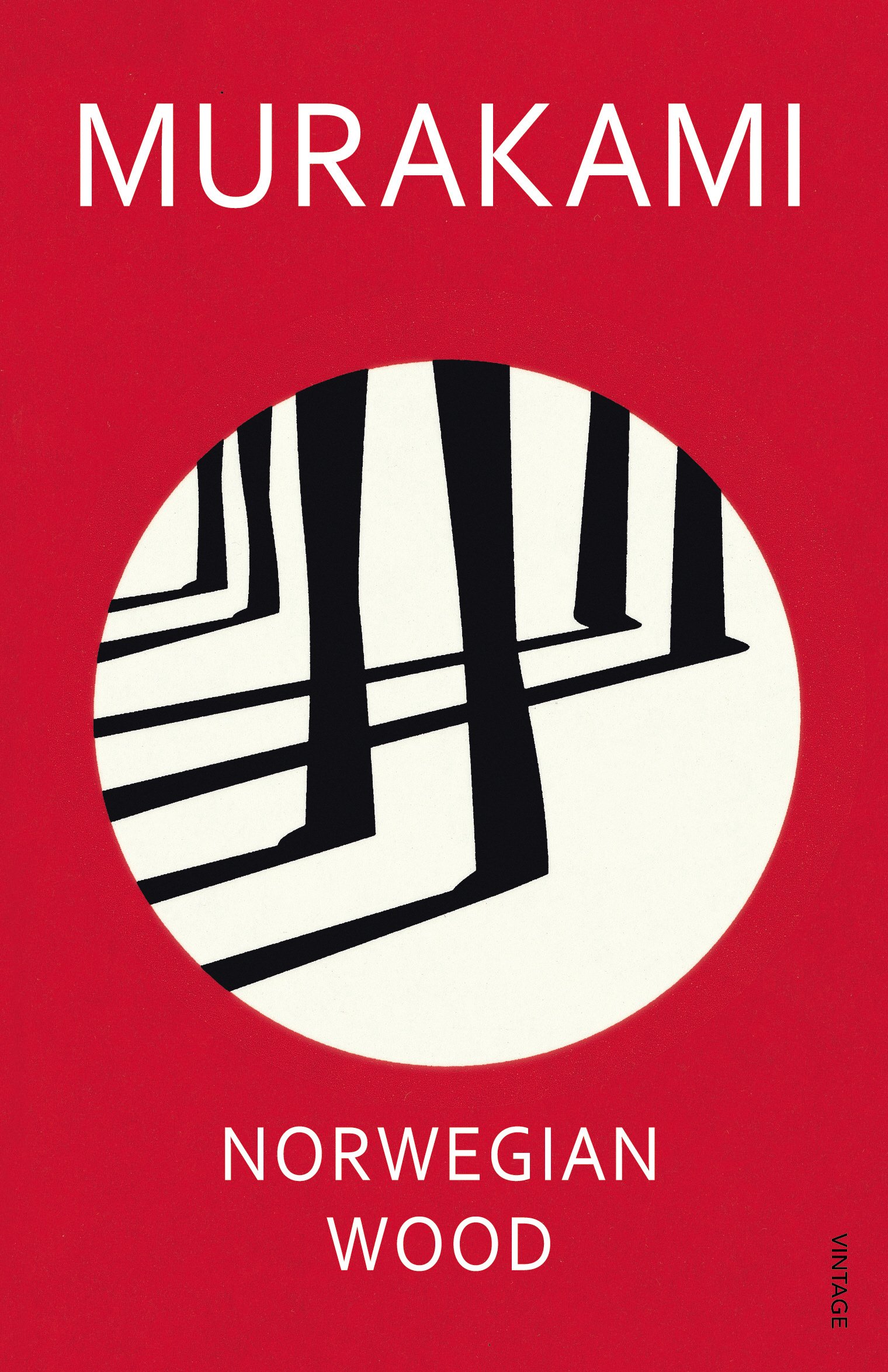
Amazon.in: Buy Norwegian Wood Book Online at Low Prices in India | Norwegian  Wood Reviews & Ratings

Norwegian Wood by Haruki Murakami is a coming-of-age story of Toru Watanabe, set in the late 1960s in Tokyo during the main character’s early student life. Toru narrates the story himself. Having lost his close friend, Kizuki, to suicide, Toru moves out of his hometown in Kobe and to Tokyo to study theater, which he clearly isn’t really interested in. Their lives in those days have a background context of a weak student revolution which fizzles out too soon, only to reveal the hypocrisy of the people leading it.

Here in Tokyo, Toru once accidentally bumps into Naoko, his deceased friend’s girlfriend. Naoko, if not more, is clearly as affected by Kizuki’s death as Toru (only to know later that Kizuki isn’t the only close one Naoko has lost to suicide). Naoko is broken and in dire need of someone’s emotional support in order to heal. And here comes ToruToru & Naoko share a bond, albeit a sad one, a bond strengthened by the death of the third partner of their group. They spend multiple Sundays together, wandering through the streets of Tokyo and, as one may expect, Toru falls for her. Unfortunately, that is where things take the melancholic path further down hill.

Naoko ends up in an institution called Ami Hostel up the hills, an hour from the city of Kyoto. Ami Hostel is a sophisticated version of (to put it subtly) a mental hospital. It’s secluded, clean, peaceful, and more of a community living where the lines between doctors & patients are blurred. While back in Tokyo, Toru finds Midori Kobayashi, his ‘History of Drama’ classmate. Midori, despite her own multiple problems — family, boyfriend, her family bookstore — to name a few, helps Toru to live through his lonely days, while he still yearns for Naoko to reach out to him. Toru is equally attracted to both Naoko and Midori. The story progresses as he sways back and forth and spends time with Naoko and Midori alternatively. While in his mind he is always rooting for Naoko to come back to his life, he doesn’t allow him to register that fact that he loves & misses Midori equally well. Naoko is troubled deeply & doesn’t want to come back to Toru until she is in a much better shape while Midori hates the fact that Toru always prioritizes Naoko over her, even though Midori Toru have never discussed Naoko even once. This is a tough choice Toru has to make and a journey he’ll have to take in his mind moving from Naoko to Midori or vice versa. What choice does he make? Do read the book to find out.

The two women in Toru’s life couldn’t have been more contradictory — One doesn’t speak much, the other doesn’t stop at all. One goes all out in showing affection for Toru while the other never confesses even though Toru keeps asking for it. Both have seen death, grief and loss, up close and personal, but one gets accustomed to it, jokes about it while the other gets crushed by it.

In the end, Toru has to make a choice between Naoko and Midori. Before he decides, you would have definitely made up yours. It’s not a grey area anymore. Norwegian Wood is a love story, with some ecstatic, arousing moments and with some dark, melancholic, heart wrenching ones as well — just like life, as one may say.

Bottom line, we will lose the people we love, friends and lovers will fall out of our lives, and there will be mistakes we make in our lives or watch others make towards other people we won’t be able to rewrite, because that’s the power of time. It can only go forward, not back. The characters interacting with each other are nostalgic; they recount the times that made them to be the person they are today. The lessons from this book aren’t any easy pills to swallow, so if you’re intending for a happy-go-lucky read, then I’d probably request you to skip Norwegian Wood.

Understanding gender- review

Title of the book: Understanding Gender 

Author: Kamla Bhasin 

Publisher:  Women Unlimited

Year of Publication: 2003 

Kamla Bhasin was born in 1946 and grew up in Rajasthan, India. She received a BA at Maharani’s College in Jaipur and an MA in Economics at Rajasthan University. In addition, she studied Sociology of Development for four semesters at Muenster University in West Germany. Bhasin’s work focuses on gender, education, human development, media, human rights, and peace. In particular, Bhasin acts as a tireless advocate for Indian and South Asian women and their right to equality.

The author, Kamla Bashin in his book Understanding gender talk about the concept of gender in feminism discourse deals with such difficult questions as the relationship between gender and women; the difference between ‘women and development’ and ‘gender and development; gender and patriarchy; and how religion, caste, and class affect gender. Bashin tries to bring light on the aspect which many people are not aware of and tries to serve reality to them. 

Gender and sex are misunderstood, as the same thing but the concept of gender us to share that sex is one thing, but gender is quite another. Everyone is born male or female and our sex can be determined by our genitalia, but the social and cultural packaging that is done for girls and boys from birth onwards is gendering. As in our society discrimination starts right away from the birth of a child if a baby boy is born then there will be decorated with blue balloons in room and many celebrations conducted on the other hand for baby girl pink balloon is preferred And there is no celebration and rituals necessarily conducted. As we can see that how gender is associated with even colors.

The author tries to readers to understand that there is nothing they do that men cannot do or that men can do and women cannot. Sex is universal but gender keeps changing according to the time and place For example middle-class girl may be limited to home or school while a tribal girl may roam around in the jungles freely. 

Every society prescribed different roles for both the gender as dresses in some societies. Women are made to cover their body from top to toe including their faces, while men are allowed to wear according to their comfort. Attributes in most society’s women are accepted to be soft, caring, and obedient while men are accepted to be strong. Another one is roles and responsibilities’ men are considered the head of the family all the decisions are controlled by him while women are trained to do household chores and look after the children. This shows the lack of education, employment.

Issues like language also gendered have been highlighted by the author. Language is patriarchal and reflects gender biases and inequalities as men can use the words they want but women are always advised to use soft words. For example words of abuse with sexual connotation mostly used by men but if women do the same then it is not considered good. Another example the words like a nurse, secretary, nursery teacher always assumed to be women whereas boss, pilot, manager, politician, etc refers to men.  It shows that public spaces and jobs continue to be dominated by men.

Bashin tries to cover patriarchy as an issue as its means male domination. Patriarchy is not the same everywhere it is different in every situation. For example, patriarchy was not the same in our grandmother’s time; it is different for tribal women and upper-caste Hindu women, for the women in the USA and women in India.  Women’s work never considers as worth because their work doesn’t count in the economic growth of the country so society mention it is worthless and it strengthens the modes of production and economic system in which women play very little roles. Therefore in reality it is women’s relationship to work and property which determines their status.

She points out that separation between private and public challenges the inequality and conflict within the household. The divide between the domestic and public sphere also creates a problem for women who take up jobs outside the home. Words like gender oppression and gender subordination. She explains that gender oppression does not mean women’s oppression; although because women are generally the ones who are subordinate, it is assumed that gender oppression and gender subordination refers to them. 

 The author tries to highlight the Developmental program leading to marginalization of women mostly major credit of agriculture field were given to males and little income activities like papad and pickle making, sewing allotted to female this is nothing but myths about masculine and feminine.

Male control over women’s reproduction and sexuality made for the world-historic defeat of the mother right. Further, the position of the middle-class women is much worse than that of working class women because middle-class women themselves are property; they are merely the carrier and producers of babies.

How “women and development” change into “gender and development” she discussed many factors under it like the difference between men and women’s achievement and participation are as a result of socially constructed gender role rather than of biological difference

A large number of women and men all over the world have made a different kind effort at different levels to change patriarchal thinking, attitude, structure, and organization some examples: – School curriculum has been analyzed and made more gender-sensitive, many laws are made, NGOs for help, etc.

 The author concludes the book by saying that gender equality requires each one of us, man and woman to look into ourselves and overcome our negative male and female qualities.

This book according to me is a good read for everyone; it is a perfect combination of reality and humor. The author has dealt with various sensitive issues like gender, patriarchy, to make understand people by giving examples and situations which can be relatable for many. Bashin leaves no stone unturned in making people understand the sensitivity of the issue and the most touching thing of this book which I feel it also talks about the pressure faced by men in our society. One thing which I felt was lacking is including the third gender (transgender) their problems and difficulties also can be talked about. This book tries to give a real picture of what happens in society.

References 

Bashin, K. (2003). Understanding gender. New Delhi: Women Unlimited

Book Review – Half Torn Hearts

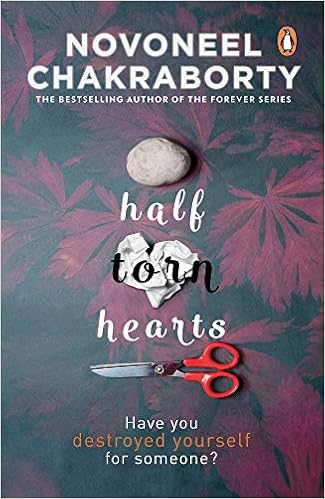
Half Torn Hearts is the 14th novel of Novoneel Chakraborty. Novoneel usually writes the suspense and thriller novel, but this novel differs from Novoneel’s other books, and is definitely a masterpiece.

Half Torn Hearts : Chakraborty, Novoneel: Amazon.in: Books

SYNOPSIS

Shanay Bansal, a young and successful entrepreneur, is looking forward to his engagement with Afsana Agarwal. But a few weeks before the engagement, he receives intriguing voice message from someone from Afsana’s past. Curious, Shanay plays the voice message and through those other such messages, a different world from the past opens up about a beautiful relationship that got broken because of a terrible lie.

PLOT

There are mainly three characters: Nirmaan, Raisa and Afsana. Nirmaan and Raisa are childhood, good friends. They meet in the year 1996 in Guwahati. Nirmaan offers her to play with him and his friends. In the beginning, she doesn’t but later agrees and becomes good friends. Besides Nirmaan, she doesn’t have any friends.

After six years, in 2002, they again meet in Kolkata in the school named St. Peter’s High. In the beginning, he gets surprised to see her. She tells how she gets admission in the school. Time has changed, and they have grown up, but Raisa doesn’t prefer to change. She wants everything to be like earlier times. She doesn’t leave Nirmaan most of the time and he gets annoyed. He tries to explain to Raisa that things have changed, time has changed, but she didn’t seem to understand. 

Later, in the same school, she meets Afsana Agrawal, and they become best friends. They become soul sisters; whereas Nirmaan doesn’t like Afsana and tells Raisa to stay away from Afsana, but she still hangs out with Afsana. Time passes and these innocent minds did not know how thier lives would turn. Raisa fails in class X whereas Afsana and Nirmaan pass the exam. They get admission to the same college. With time, both fall in love but they weren’t able to express their feelings. 

On the one hand, Afsana is in with Nirmaan and her parent has searched her guy ten years elder and her parents want her to marry when she returns 18. She couldn’t share this with Nirmaan and shares with Raisa. Raisa is one who makes them together and gets intimate with him, but she doesn’t share about her so-called soon fiancée.

With time, they get separated. What is the reason for the separation, and why is she getting married to Shanay? What will Shanay do after knowing the truth?

CONCLUSION

This story has three main characters and their selfless love and that willingness to destroy owns self for the person they love. There are quite few many difficulties in their life but the way their love has been portrayed it won my heart. Some secrets, some revelations and then an unexpected climax – everything is just so catchy that I could not put the book down till I completed reading it. So, half torn hearts will definitely win many hearts of the readers!! And the most beautiful part about this book is the Hindi poems in between the story which gave that storyline the perfect essence of emotions.

While reading the novel, we can tell that not every relationship is about flowing together forever. People who meant the world to us at one time will seem like a distant memory at another.
In conclusion, I could say it’s interesting and engaging. It’s a heart crushing story with surprising revelations and a touching climax.

The ode

Introduction:

The Ode may be defined as a ‘rhymed lyric often in the form of an address, generally dignified or exalted in the subject, feeling and style’. It is also defined as any ‘strain of enthusiastic or exalted lyrical verse directed to fixed purpose and dealing progressively with a dignified theme’. An ode is noted for its logical evolution of thoughts and it has a certain amount of complexity and elaboration, unlike a simple lyric.

An ode usually begins with an address to somebody or something. Sometimes the opening line or lines may contain an apostrophe as in the case of Shelley’s ‘Ode to the west wind’ or Tennyson’s ‘To Virgil’s. An ode may be written on an important public event or the death of a distinguished person. Marvell’s ‘Ode upon Cromwell’s Return from Ireland’ belongs to the first category and Tennyson’s ‘Ode on the Death of Duke of Wellington’ belongs to the second category.

Origin of Ode:

The ode is of Greek origin. There were two traditions of odes in Greece. The first type of the Dorian mode was so called from the district and dialect in which it arose. It is also called the Pindaric ode because Pindar, the ancient Greek poet, was its greatest exponent. The second type of ode is the lesbian old so-called because it flourished at first on the island of lesbos. It is also called the horatian ode because the great Latin poet Horace was its best practitioner. Thomas Gray’s odes ‘The progress of Poesy” and “The Bard” belong to the Dorian or Pindaric school. Marvell’s ‘Ode upon Cromwell’s Return from Ireland’ is the best example of a Horatian ode in English.

A pindaric or Dorian ade consists of three parts:

The strophe, the anti-strophe, and the epode. they correspond to the three stages of the recital of an ode during a dance. The Horatian ode consists of several short stanzas similar in length and arrangement.

In the early stages, the English ode was influenced by the two Greek models. But gradually the English ode begins to pursue a course of its own. There are two types of odes in English, the regular and the regular.

Regular odes:

The regular odes have a series of exactly similar stanzas as in the odes of Keats. Other examples of regular verbs are Collin’s ‘ode to evening’ and Shelley’s ‘ode to the west wind’.

Irregular odes:

Irregular odes have tons of different lengths and arrangements. There are sudden changes in versification, meter, and mood. Wordsworth’s Ode on Intimations of Immortality from recollections of early childhood and Coleridge’s ‘Dejection: An Ode’ are good examples of irregular odes.

Some famous odes:

  • Ode To A Nightingale John Keats. My heart aches, and a drowsy numbness pains.
  • Ode On A Grecian Urn John Keats.
  • Ode To Autumn John Keats.
  • Ode To The West Wind Percy Bysshe Shelley.
  • Ode To Wine Pablo Neruda.
  • Ode To Sadness Pablo Neruda.
  • Ode On Solitude Alexander Pope.
  • Ode To The Book Pablo Neruda.

Conclusion:

In English Ben Jonson, Milton and Gray wrote Pindaric Odes. Marvell road Horatian odes. Other important poets who wrote odes were Spenser, Collins, Keats, Shelley, and Tennyson. Perhaps the ode is the most popular lyrics form except the Sonnet.

The Lyric

The Science Fiction

India’s best Olympic ever

Today is the closing ceremony of the Tokyo Olympics 2020 , which has definitely become India’s best Olympic ever. India has managed to win 7 Olympic medals which is the highest number of medals in a single Olympic for India breaking the record of London Olympics where India won 6 medals back in 2012.

In this Olympics , there were many athletes who were considered as favourites to win a medal. some were able to cop up with the expectations of 1.3 billion Indians but some crumbled in pressure or by other reasons.

India’s first Olympic medal in Tokyo 2020 came in very first day of Olympics when India’s weightlifter Mirabhai chanu won Silver medal in 49 kg category. All of a sudden India’s medal came in day 1 of the Olympics and we thought this Olympics will be ours . But after day 1 , Indian athletes disappointed and could not increase the medal tally for few days, especially our shooters from whom we were having lot of expectations to win medals disappointed us.

But soon India was assured their second medal when Indian boxer Lovlina borgohain was qualified for semifinals in 69 kg category. she was assured of at least a bronze medal . unfortunately , she lost the semifinal match but she had already won bronze medal for India. she became 3rd boxer for India to win medal in boxing after Marykom in 2012 and Vijender Singh in 2008. In between some disappointed performances , some Indian athletes did really well. After Lovlina, it was the time for PV Sindhu , silver medalist from Rio Olympics. She started really well but lost in semifinal match against Chinese Shuttler TY Tai. But soon made great comeback and won bronze for India.

Till then , India had won 3 medals and was already better from last Olympics where we we only won 2 medals but India’s best was about to come after that . Indian Hockey team was doing consistently good from their first match and soon they qualified for semifinal after many years. Indian women hockey team started poorly but they soon came in their best and qualified for Olympics semi finals but unfortunately ,our both teams lost in semifinals after playing good throughout the match. At the same time , wrestling was also going on where Ravi Dahiya entered finals of freestyle wrestling in 57 kg category. and Deepak Punia after qualifying for semifinals , unfortunately lost his match and was later unable to win bronze medal. Ravi Dahiya later won Silver medal.

But the historic moment came soon when Indian men hockey team won bronze medal match against Germany and won an Olympic medal after 41 years. that was a very historic and special moment for Indian fans. though Indian women hockey team could not win a medal but they won our hearts by playing outstanding hockey. till now, India had won 5 medals.

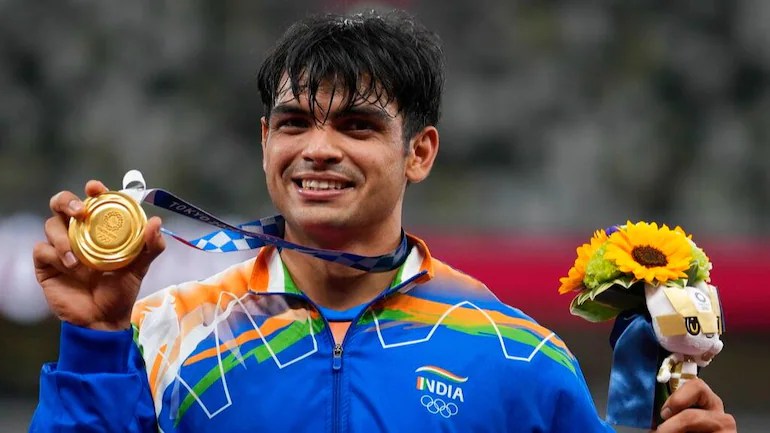
But the most historic and remarkable moment came yesterday when Indian athlete Neeraj Chopra won Gold medal in javelin throw event finals with a record 87.53 m distance. It was India’s first gold medal in Track and field events and 2nd individual gold medal after Abhinav Bindra’s gold medal in 2008 Beijing Olympics. And in the same day, India’s one of the biggest medal hopes Bajrang Punia also won a Bronze medal in 65 kg category.

That is why , this Olympic has become India’s best Olympics ever. There were some amazing performances who were not able to win a medal but won our hearts like Indian women hockey team , golfer Aditi Ashok, Kamalpreet kaur and many others.

.

Dance Forms Of India

India is the land various cultures, traditions. It is a cluster of various people who follow different lifestyles. With each different lifestyle there comes different dance tradition which goes back to their ancestors. Following are various dance forms of different states of the country.

Bharatanatyam

Earlier known as Sadir or Dasi Attam it is a dance form of Tamil Nadu widely popular in southern India. It has grown out of the art of dancers dedicated to temples. Bharatanatyam rests on principles of performance and an aesthetics set down in classics such as Bharata’s Natyashastra. It has a rich repertoire of songs in Telugu, Tamil and Sanskrit.

Kathak

It is the principal dance of northern India, and is widely practised in Uttar Pradesh, Rajasthan, Delhi, Madhya Pradesh, and even parts of western and eastern India today. It is believed to be connected with the narrative art of Kathakaras or story-tellers who have expounded the scriptures, the epics Ramayana and Mahabharata, and puranic literature to the lay masses since ancient times.

Odissi

This dance form originated in Orissa, performed as part of temple service by ‘maharis’ or female temple servants.The traditional dance was remoulded as a theatre art towards the middle of the twentieth century with reference not only to the existing dance art, but representation of dance in Orissa’s medieval sculpture, painting, and literature. In its remodelled form, Odissi dance has spread quickly across the country.

Kathakali

It is the dance form of Kerela, originated in the seventeenth century  under the patronage of the prince of Karnataka, who wrote plays for performance drawn from the epic Ramayana in Malayalam, the language of the region. Stories from the Ramayana and Mahabharata provide the content of most Kathakali plays, which have come down to us in a steady stream over three centuries.

Manipuri

Manipuri dance, evolved in Manipur in north-eastern India, is anchored in the Vaishnava faith of the Meiteis, or people of the Manipur valley. The temples of Manipur are still among the principal staging venues of the dance

Ghoomer

The Ghoomar dance is primarily performed by the female folk of Jaisalmer on special festive occasions.

Bhangra

It is a traditional dance form of Punjab with the accompaniment of short songs called boliyan and, most significantly, to the beat of a dhol(double-headed drum).

The Quit India Movement Day

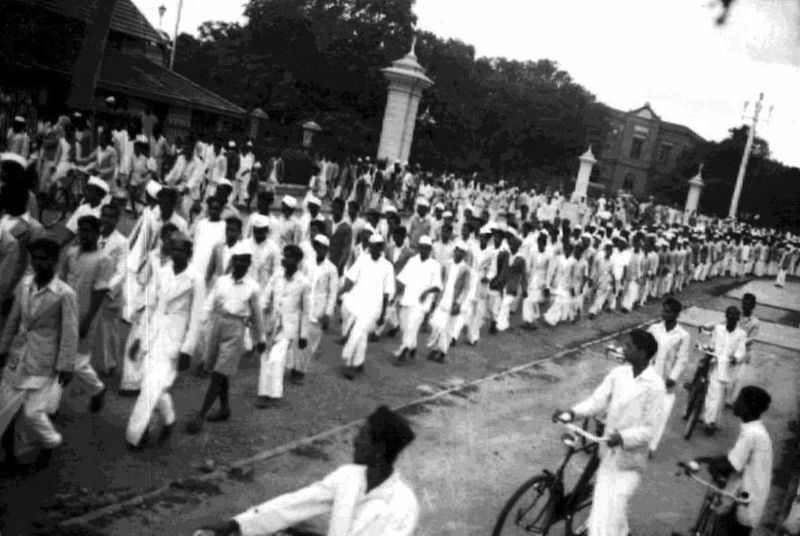
August 8th marks a very iconic day in Indian history. The Indian National Congress declared its ultimatum for the British to leave India. This movement in itself had contested set of consequences – the strengthening of the Muslim League, the rise of freedom struggle motivated Subash Chandra Bose to invade the British camps in Noth East and Gandhi, for the fist time in his career was willing to go agressive even if he had his own definitions of the word – when he announced, “karo ya maro” (Do or Die).

Quit India Movement: Who gave the slogan 'Do or Die' - Oneindia News

The Quit India movement came up at the heels of the failure of the Cripps Mission that was sent by the Raj to secure Indian cooperation towards the British war efforts in the second world war. The leader of the mission, Sir S. Cripps was left wing British statesman who was sympathetic to the cause of Indian self rule but was also a member of the war cabinet of 1942.

The proposals of the mission were refused by the Congress which had seen similar proposals in the first world war where the Raj had promised more autonomy but ended up imposing harsher taxes that resulted in the Non-Cooperation movement, the Rowlatt and Jalia Walah Bagh massacres. The Indian National Congress resigned from its positions in all provincial governments and announced the Quit India Resolution that led a national movement that was difficult for the British to look after in the face of the then ongoing second world war. Virtually all of the INC leaders were jailed for the next three years and the Muslim league got enough time to build itself a support that shook the years Gandhi had spent projecting himself and his colleagues as leaders of a secular, united state of India. To add to it was the vehement opposition Hindu nationalists showed to the movement where many, including the Hindu Mahasabha and Veer Savarakar denounced the movement pointing out to the power vacuum it might cause and quite correctly predicitng the Muslim League partially filling the same.

The British soon left the subcontinent – too weak due to the war to control a population that was showing both civil disobedience and had an army of its own – a reference to the insurgency and attacks the INA had started in the Raj’s territories.

The Quit India movement – with all its pros and cons and consequences formed a very important phase in the history of modern India.

Jinnah expected India and Pakistan to be best of friends - Telegraph India
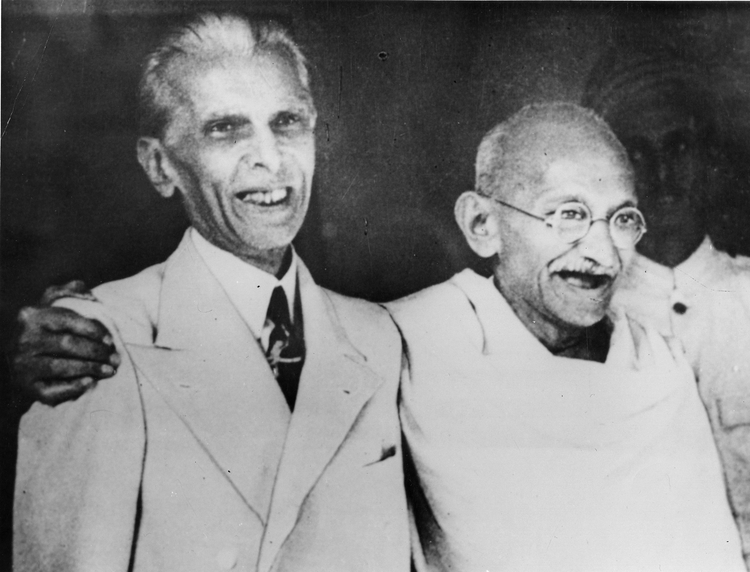
Jinnah and Gandhi had quite different outlook and faced different consequences due to the Quit India Movement – one failed in his projection of a secular and inclusive India, the other successfully used it to campaign for Pakistan

HERITAGE OF UTTAR PRADESH

The Culture of Uttar Pradesh is an Indian Culture which has its roots in the Hindi and Urdu literature, music, fine arts, drama and cinema. Lucknow, the capital of Uttar Pradesh, has several beautiful historical monuments such as Bara Imambara and Chhota Imambara. It has also preserved the damaged complex of the Oudh-period British Resident’s quarters, which are being restored.

Uttar Pradesh attracts large number of visitors, both national and international; with more than 71 million domestic tourists (in 2003) and almost 25% of the All-India foreign tourists visiting Uttar Pradesh, it is one of the top tourist destinations in India. There are two regions in the state where a majority of the tourists go, viz. the Hindu pilgrimage circuit and the Agra circuit.

The pilgrimage circuit includes the holiest of the Hindu holy cities on the banks of sacred rivers Ganges and the Yamuna: Varanasi (also considered world’s oldest city), Ayodhya (birthplace of Lord Rama), Mathura (birthplace of Lord Krishna), Vrindavan (the village where Lord Krishna spent his childhood), and Allahabad (Prayagraj) (the confluence or ‘holy-sangam’ of the sacred Ganges-Yamuna rivers).

The city of Agra, gives access to three World Heritage Sites: Taj Mahal, Agra Fort and the nearby Fatehpur Sikri. Taj Mahal is a mausoleum built by Mughal Emperor Shah Jahan in memory of his beloved wife, Mumtaz Mahal. It is cited as “the jewel of Muslim art in India and one of the universally admired masterpieces of the world’s heritage”. Agra Fort is about 2.5 km northwest of its much more famous sister monument, the Taj Mahal. The fort can be more accurately described as a walled palatial city. Fatehpur Sikri was the world-famous 16th-century capital city near Agra, built by the Mughal emperor Akbar the Great, whose mausoleum in Agra is also worth a visit. Dayal Bagh in Agra is a modern-day temple and popular tourist sight. Its lifelike sculptures in marble are unique in India.


MUSIC AND DANCE –
The state is home to a very old tradition in dance and music. During the eras of Guptas and Harsh Vardhan, Uttar Pradesh was a major centre for musical innovation. Swami Haridas was a great saint-musician who championed Hindustani Classical Music. Tansen, the great musician in Mughal Emperor Akbar’s court, was a disciple of Swami Haridas.

Kathak, a classical dance form, involving gracefully coordinated movements of feet along with entire body, grew and flourished in Uttar Pradesh. Wajid Ali Shah, the last Nawab of Awadh, was a great patron and a passionate champion of Kathak. Today, the state is home to two prominent schools of this dance form, namely, Lucknow Gharana and Banaras Gharana.


LANGUAGE –
The common state-language of Uttar Pradesh is standard Hindi. While standard Hindi (Khari boli) is the official language, several important regional Hindi ‘dialects’ are spoken in the state and among these are: Awadhi, Bhojpuri, Braj, Kannauji, Kaurvi, Gurjari, Bagheli and Bundeli, besides several local dialects that do not have a formal name. Urdu is prominent in Uttar Pradesh as Lucknow was once the centre of Indo-Persianate culture in north India.

Nutrition

Nutrition is a science dealing with the composition of food, food intake and its assimilation in the body. It includes food, ingestion, digestion, absorption and egestion.

Types of Nutrition

Nutrition is the process of obtaining nourishment. It includes food, ingestion, digestion, absorption and egestion. Protozoans exhibit 6 types of Nutrition. They are as follows:

Holophytic nutrition. Holozoic nutrition, Saprozoic nutrition,mixotrophic nutrition, parasitic nutrition and coprozoic nutrition.

Holophytic nutrition

Here the protozoans synthesize carbohydrate by photosynthesis. They are provided with chlorophyll. They synthesize carbohydrate with the help of CO_2, water and animals. Holophytic nutrition is exhibited by protozoans bearing chlorophyll. Eg. Euglena, Chlamydomonas, Volvox, etc.

Holozoic Nutrition

This type of Nutrition is like that of animals. In this type, the solid or semi-solid food is swallowed. Eg. Amoeba.

Saprozoic Nutrition

The absorption of decayed organic materials as food is called Saprozoic Nutrition. The food consists of decayed plants and decayed animals. They are absorbed in solution through the general body surface. Eg. Euglena, Entamoeba, etc.

Mixotrophic nutrition

Certain protozoans feed by more than one method. Eg. Euglena. It exhibits holophytic nutrition, holozoic nutrition and Saprozoic Nutrition.

Parasitic Nutrition

Parasites obtain their food from their hosts. They feed by holozoic method Saprozoic method. Parasites may feed on the digested food of the host or on the tissues of the host. Trypanosoma feeds on blood by Saprozoic method. Trichomonas feeds on the digested food.

Coprozoic nutrition

In this method, the faecal materials are swallowed as food. It is exhibited by Copromonas living in the faeces of vertebrates.