Financial Literacy for Students: A Practical Guide to Risk and Position Sizing

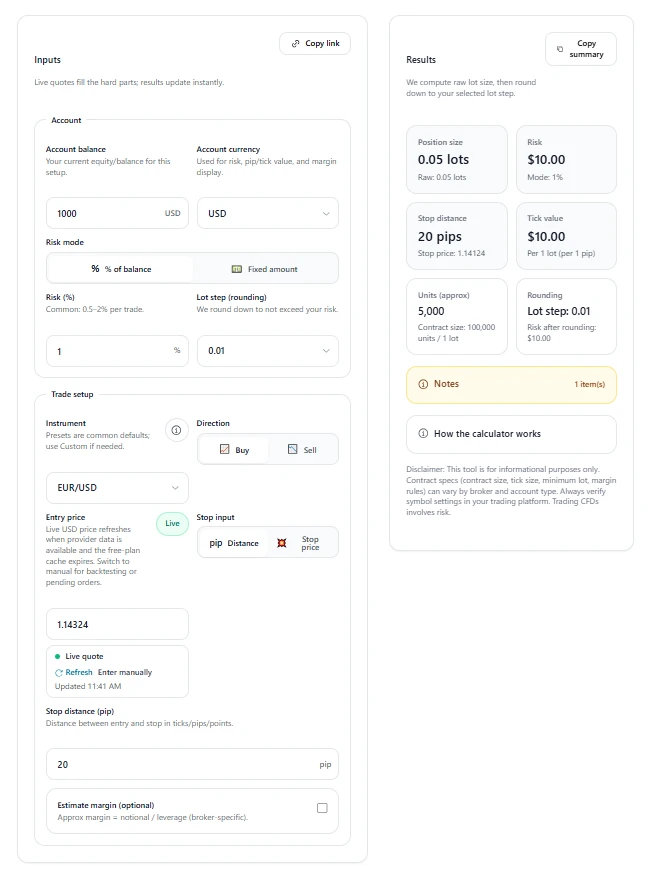
Financial literacy is often introduced through budgeting, saving, and basic money management. Yet for students who study economics, business, finance, or personal investing, one more topic deserves attention: risk. Before making any market-related decision, learners should understand how much capital is actually at risk. A practical tool such as https://iamforextrader.com/en/tools/position-size-calculator/ can help students see how position size, account balance, stop-loss distance, and risk percentage work together in a structured way.
IamForexTrader Position Size Calculator for Forex and CFDs

This article is educational in nature and does not provide investment advice. Its purpose is to explain how responsible risk calculation can become part of broader financial literacy.

Why Financial Literacy Should Include Risk Awareness

Financial literacy is not only about knowing financial terms. It is about making informed decisions under real-world constraints. Students may learn how interest rates work, how inflation affects purchasing power, or how budgets are created. However, when financial education reaches markets and investing, risk becomes central.

A financially literate student should be able to ask:

  • How much money can I afford to risk?
  • What happens if my assumption is wrong?
  • Is this decision based on calculation or emotion?
  • Do I understand the downside before thinking about the upside?

These questions are especially important in trading education, where decisions can be made quickly and emotional pressure can be high.

“Good financial education does not begin with profit expectations. It begins with understanding limits, consequences, and discipline.”

What Is Position Sizing?

Position sizing means deciding how large a trade or market position should be based on predefined risk. Instead of choosing a random amount, students learn to calculate position size using measurable inputs.

In simple terms, position sizing answers one question: How much should be placed in a position so that the possible loss stays within an acceptable limit?

For example, a learner may decide not to risk more than 1% of a practice account on a single trade. If the account size is $1,000, the maximum planned risk is $10. The position size then depends on the distance between the entry point and the stop-loss point.

This approach encourages discipline because the decision is based on a rule, not on excitement, fear, or guesswork.

Key Concepts Students Should Understand

ConceptSimple MeaningWhy It Matters
Account balanceTotal available capitalHelps define realistic risk limits
Risk percentageThe portion of capital risked on one ideaPrevents oversized decisions
Stop-loss distanceThe gap between entry and exit if wrongAffects how large the position can be
Position sizeThe calculated size of the tradeConnects risk plan with execution
Risk managementA system for limiting potential lossesSupports long-term learning discipline

A Classroom-Friendly Example

Imagine a student is using a demo account for a financial markets course. The account balance is $2,000. The student decides to risk 1% on one market idea. That means the maximum planned loss is $20.

Now the student needs to know the distance between the entry price and the stop-loss level. If the stop-loss is far away, the position size should be smaller. If the stop-loss is closer, the position size may be larger, while still keeping the planned risk at $20.

This example teaches a valuable lesson: the size of a decision should be connected to the risk, not to confidence alone.

Why This Matters for Students

Many students first encounter financial markets through social media, online videos, or simplified success stories. These sources may focus on potential returns while ignoring risk structure. Academic and educational platforms can balance that by teaching a more responsible framework.

Position sizing helps students build several useful habits:

  1. Planning before acting
    A calculated decision is usually more disciplined than an impulsive one.
  2. Understanding downside risk
    Students learn that every market decision can be wrong.
  3. Avoiding emotional overexposure
    Clear risk limits can reduce panic and overconfidence.
  4. Connecting theory with practice
    Risk formulas become easier to understand when applied to practical examples.
  5. Building transferable skills
    The same thinking can support budgeting, entrepreneurship, investing, and project planning.

Position Sizing as Part of Financial Education

Position sizing should not be taught as a shortcut to success. It should be taught as a risk-control method. In an educational setting, it fits naturally into topics such as:

  • personal finance;
  • behavioral finance;
  • investment basics;
  • business decision-making;
  • probability and statistics;
  • economics and capital allocation.

For example, a finance instructor can ask students to compare two scenarios: one where a person risks a fixed percentage per decision, and another where the person changes risk randomly. The discussion can reveal how inconsistent risk-taking may create unstable outcomes, even when some individual decisions are correct.

Common Mistakes Beginners Make

Students and beginners often make similar mistakes when learning about markets:

  • risking too much on one idea;
  • changing position size after a loss out of frustration;
  • ignoring stop-loss distance;
  • focusing only on potential profit;
  • treating demo success as proof of future real-world results;
  • copying others without understanding the calculation.

These mistakes are not only trading problems. They are financial literacy problems. They show why education should focus on process, not only outcomes.

A Simple Risk Checklist for Learners

Before studying or simulating any market position, students can use this checklist:

  • Do I know my total account balance?
  • Have I selected a fixed risk percentage?
  • Do I understand where the idea becomes invalid?
  • Have I calculated the position size before entering?
  • Am I using this as an educational exercise rather than a guaranteed result?
  • Can I explain the risk in one or two sentences?

If the answer to any of these questions is “no,” the decision may need more preparation.

Final Thoughts

Financial literacy for students should go beyond definitions and theory. It should help learners build decision-making habits that are careful, structured, and realistic. Position sizing is one practical way to teach those habits because it connects numbers, risk, behavior, and responsibility.

Students do not need to become traders to benefit from this concept. They need to understand that every financial decision has limits, trade-offs, and possible consequences. When risk is measured before action is taken, financial education becomes more practical, more honest, and more useful for real life.

Suggested image: A clean educational image showing students reviewing financial charts, calculators, and notebooks in a classroom or study environment. Recommended size: under 300 KB, JPG or WebP format.

Daily writing prompt
What’s one habit that has improved your life the most?

Realistic Ways to Save Time and Money in College

The transition to college can be stressful, no matter how prepared you are. As a student, you have many decisions to make, like what to major in, which classes to take, and how to get involved on campus.

Add in the responsibility of paying for school, keeping up with a part-time or full-time job, and a steady load of coursework, and it’s easy to become overwhelmed and financially overextended. As a college student, I learned the hard way what happens when you procrastinate and overspend.

Here are a few tips you can use to save time and money in college, so you can worry less—and feel confident about your future.

How to Make the Most of the Time You Have

Learning to manage your time is an essential skill to being successful in college (and in your future career). While the best approach to time management may look different from one person to the next, here are a few ideas to get started.

Once you’ve picked your classes and have your course syllabi for the semester, buy or create a calendar. From here, outline the semester, highlighting essential dates for midterms, papers, presentations, and other assignments. You can colour-code it and get as creative as you like—the point is to see every deadline coming your way. Once you have this completed, try these things:

1.Plan by week


Schedule out your week in a daily planner, whether on paper or on your phone. If you’re like me and like to schedule everything, record when you’ll go to the gym, break for meals, spend time with friends, study, and pursue other activities. If you prefer a rough outline of your schedule, jot in any significant deadlines for a given week. This technique will keep you on track and help you avoid pulling all-nighters, which can mess with your schedule and, potentially, your grades and mental health.


2.Start with the simple to-dos


Completing easy tasks immediately after class—or as soon as you can—are an easy way to cross off your to-do list without worrying about anything on it falling to the wayside. One of my undergraduate classes required self-reflection pieces each week. I always completed them right after class because the material was fresh in my head, which made the writing process quicker and in a way, more genuine.

For a larger writing assignment, calculate how much time you have to complete it and divide that by the minimum number of pages you’re required to write. For instance, if you’re assigned a 20-page paper and you have 12 weeks to complete it, you’ll need to write about 1.66 pages per week to get it done. It seems much more manageable when you look at it this way.

3.Back up your work


Technology is a beautiful thing, but when it fails us, it can have catastrophic effects. Ever have a 15-page paper due the next morning, and your hard drive dies? Your professor may or may not be understanding, and I would guess that you’d prefer to do without the frustration (and extra work) that a similar incident could cause.

So be sure to email yourself a copy of the writing assignment you were working on and save a copy on a USB. This way, if your computer died, I had two options for getting it back. You can also use Google docs to save your work. It never hurts to have multiple copies of your work.

4.Keep distractions at bay


I can’t stress this enough; there is no more significant time waster than setting aside time to get work done and getting distracted by friends, your cat, the weather, the TV, anything. If you know that you are easily distracted at home, then seek out time at the library or in a study room. If you struggle to focus, set aside an hour to study, take a break, and repeat.

Let’s Talk About Money Management

Money is probably one of the most significant stressors facing college students, thanks in part to growing tuition and fees, additional academic expenses like textbooks, and the limited time to devote to earning money. Here are some ideas on how to maximize your budget.

1.Change up your grocery shopping habits


Want to save money on food? Know that thinking cheap doesn’t have to mean scrimping on quality. Most towns and cities have a farmer’s market that offers seasonal produce and other goods at a severely discounted price. If there isn’t a farmer’s market in your area, consider splitting a membership to a warehouse store like spencer’s or Walmart with a few friends or roommates. Planning for regular shopping trips may be enough to let you opt-out of your campus meal plan—and save a fortune on food.

2.Skip the restaurant


As great as not having to cook is, in many cases, what you order at a given restaurant can almost always be made at home for less. For those who see heading out for a meal as a time to catch up and socialize with friends, consider inviting a group over for a communal meal. Not only will you save money, but you’ll also have leftovers and the added fun of making a meal together.

3.Look for freebies


As the old saying goes, “the best things in life are free.” This sentiment rings especially true as a college student. In my experience, most of the outings with friends, guest lectures, and concerts I attended were free and found through local paper, word of mouth, and social media. I made such a routine of it that my the second year, I had barely paid anything for entertainment and other events. The best part was, my friends, became so curious about my adventures that they all started tagging along—and saving money too.

MANAGING MONEY AND INCREASING SAVING

“Before Money becomes Wealth, it’s just Money. And for making Wealth from Money, we need to MANAGE it.”

Money Management is the broad concept which incorporates the key principles required for developing wealth and for preserving and protecting that wealth. It teaches about investing, budgeting, banking, tracking your expenses and assess the tax liabilities. This can also be called as Investment Management. Thus, Money Management is a technique where high interest output is delivered with any amount invested for money.

Spending money for satisfying needs, wishes and cravings regardless of whether they are justifies and included in a budget. can be seen in every human and is a very natural tendency and phenomenon and this idea of money management is especially developed to make the people, institutions and firms understand how to channelize and reduce the amount of money spent on different items and values which care not significant and which do not have any contribution in enhancing their living standards, long term asset or benefit. Money gives you the sense of self fulfilment and this sense of self fulfillment doesn’t come from rigorous spending of money or buying wealth but from having an amount of money which will not get outlived while fulfilling their lives needs, ambitions and providing a meaning livelihood which is convenient for them.

Thus, for money management it is also important to properly analyze the behavioral aspect of individuals or firms. Money Management also focuses on the behavioral attributes which influence the decision made by investors or organizations or individuals. And this decision making phenomena can severely affect the outcomes of long term strategies. In fact, everyone battles against the powerful elements like taxes, debt or inflation etc. which have the power to destroy and take away the wealth that we have attained by working hard. And a single wrong decision can affect and ensure our defeat.

8 Tips for Money Management:

  1. CREATING A COMPREHENSIVE BUDGET PLAN (Listing the amount of money you receive and planning how to manage your expenses by using that amount and what will be your savings.)
  2. TRIMMING UNNECESSARY DAY TO DAY COSTS (Identify different ways to save and start from small scale. Eliminate day to day unnecessary costs and avoid penalty charges and fines)
  3. FIND WAYS TO PAY LESS INTEREST ON YOUR DEBTS
  4. MAKE GOALS FOR EFFECTIVE SAVINGS AND ACCELARATE THE SAVINGS
  5. AVOID PAYING MORE TAX THAN NEEDED
  6. USE ONLINE BANKING (because they help in setting up payment reminders, scheduling future bills and help in reviewing and analyzing the amount of money spent.)
  7. SAVE FOR RETIREMENT AND PLAN ACCORDINGLY
  8. WORK WITH AN ADVISOR (To reduce financial stress and feel secured. They help in analyzing your financial status and set up goals.)

NEED OF MONEY MANAGEMENT

  • Money and Finance Management is a vital part of personal and business life. Hence, it is hard to ignore and needs to be planned with proper vision, career, finances, goals etc. and these will drive your future. Proper financial knowledge is important for starting any successful business and it is the ability to manage one’s money.
  • It develops the ability of a person to understand financial concepts which will help him in managing money better. And ensures financial well being.
  • Money Management and Financial literacy is one of the major life skill and it increases the financial ability of a person. One can start investing in his 50s also but starting early has its own benefits.
  • Today, the rich is getting richer, poor is getting poorer and the middle class people are getting indebted. The reason is the lack of knowledge of money management. People learn about money management from their parents and families and not in school. What will the children of poor people learn about money management for them? The only thing that they know is to study hard for getting a job. That’s why even after having proper knowledge, skills and expertise they don’t get proper job and don’t get enough savings.