Three Winners and 15 Internships: Results of SheLeads by Sergey Tokarev’s Foundation and uBoost

Investing in youth development is a guarantee of a bright future. With this in mind, SheLeads was launched – an educational program aimed at giving young women the opportunity to become founders and launch their own products. The finals were recently held in Kyiv, where the jury selected three winning ideas, and 15 participants have already received internship offers from leading tech companies.

How SheLeads Works

Launched by uBoost and the Tokarev Foundation, the program is an educational project consisting of several stages. This season, more than 300 young women participated in the project. Of these, 220 completed the full course, and 120 were assigned personal mentors to help them develop their business ideas. The finale featured presentations before an expert jury, which selected the winners.

Every participant’s journey – from submitting an application to the final presentation to the jury – is built around hands-on experience. According to Sergey Tokarev, founder of the Tokarev Foundation, this is the best way to achieve meaningful results.

“This program isn’t just about ambition; it’s about experience, growth, and networking. Its results prove that the future of Ukraine’s tech sector is in good hands. SheLeads isn’t a competition; for each participant, it’s an opportunity to prove herself, gain the necessary resources and connections, and launch her own product. These founders will help shape the future of Ukraine,” emphasized Sergey Tokarev.

SheLeads Finals: Which Projects Made It to the End

Every stage of the project is crucial, from submitting an application to pitching before the jury. This season, the jury selected three projects as winners, each addressing pressing issues:

  • Soil restoration – the ReGrow project, presented by Iryna Terekhova. The project combines microbiology with sustainable packaging innovation. The product is packaging made from straw and micro-seeds. Once the packaging decomposes, it avoids harming the soil and helps restore it.
  • Gamification of workouts – the GymGames project, presented by Solomiya Andriychuk. Solomiya’s product combines software and exercise equipment, turning an ordinary workout into a game. With the support of mentor Anna Chorna, this product passed all stages and became one of the best among those presented.
  • Efficient Solar Energy – a project presented by Sofia Kedria. With the support of her mentor, Oleksandra Marchenko, she developed a product capable of significantly improving the efficiency of conventional solar panels by concentrating sunlight through specially designed lenses.

Every season brings new ideas, approaches, and technologies. According to Anastasia Deeva, the entire project once again confirms that Young Ukrainian women are eager and capable of creating the technologies of the future. “Every stage brings new achievements, new solutions, and new results. Each time, we see talented young women who join the project with their own perspective on the problem, and by the time they finish, they gain not only experience but also a fully developed product. We aim to scale this experience, because investing in young people is our future,” said Deeva.

How It All Began

SheLeads was launched by uBoost and the Tokarev Foundation for young women interested in STEM, artificial intelligence, and entrepreneurship. It gives participants the opportunity to become founders and take an idea all the way from concept to the final pitch. In the finals, participants compete for the chance to secure an internship at one of the tech giants. This season’s program partners are Sigma Software Labs, Ukrainian Startup Fund, Healthy Mind, and AI HOUSE.

The Tokarev Foundation plays a key role in the project. It is an organization focused on technology and the future. The foundation’s goal is to build a sustainable, inclusive, and technologically advanced Ukraine. The foundation was established by IT entrepreneur Sergey Tokarev, founder of Pava Studio.

Daily writing prompt
What’s one habit that has improved your life the most?

Financial Literacy for Students: A Practical Guide to Risk and Position Sizing

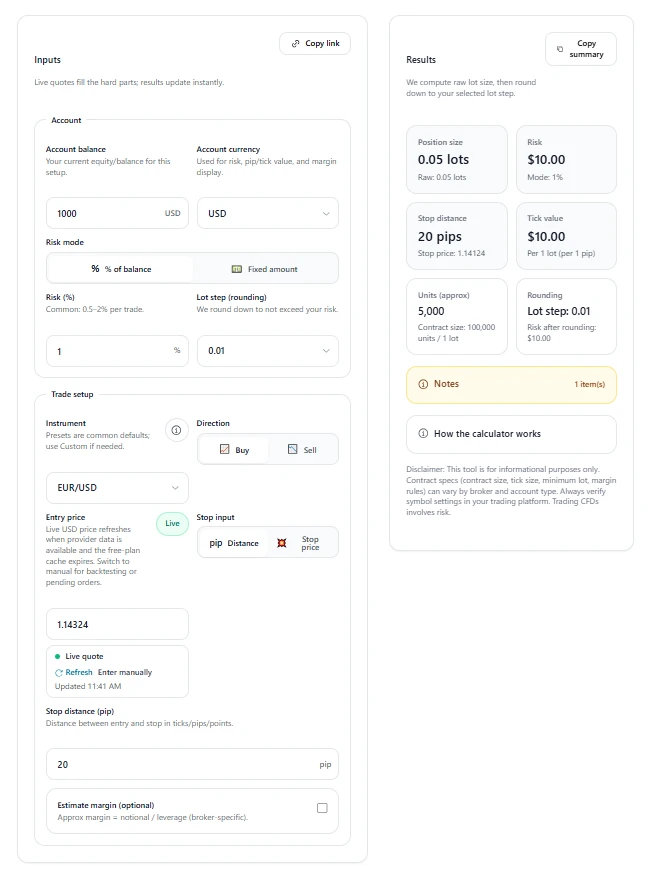
Financial literacy is often introduced through budgeting, saving, and basic money management. Yet for students who study economics, business, finance, or personal investing, one more topic deserves attention: risk. Before making any market-related decision, learners should understand how much capital is actually at risk. A practical tool such as https://iamforextrader.com/en/tools/position-size-calculator/ can help students see how position size, account balance, stop-loss distance, and risk percentage work together in a structured way.

IamForexTrader Position Size Calculator for Forex and CFDs

This article is educational in nature and does not provide investment advice. Its purpose is to explain how responsible risk calculation can become part of broader financial literacy.

Why Financial Literacy Should Include Risk Awareness

Financial literacy is not only about knowing financial terms. It is about making informed decisions under real-world constraints. Students may learn how interest rates work, how inflation affects purchasing power, or how budgets are created. However, when financial education reaches markets and investing, risk becomes central.

A financially literate student should be able to ask:

  • How much money can I afford to risk?
  • What happens if my assumption is wrong?
  • Is this decision based on calculation or emotion?
  • Do I understand the downside before thinking about the upside?

These questions are especially important in trading education, where decisions can be made quickly and emotional pressure can be high.

“Good financial education does not begin with profit expectations. It begins with understanding limits, consequences, and discipline.”

What Is Position Sizing?

Position sizing means deciding how large a trade or market position should be based on predefined risk. Instead of choosing a random amount, students learn to calculate position size using measurable inputs.

In simple terms, position sizing answers one question: How much should be placed in a position so that the possible loss stays within an acceptable limit?

For example, a learner may decide not to risk more than 1% of a practice account on a single trade. If the account size is $1,000, the maximum planned risk is $10. The position size then depends on the distance between the entry point and the stop-loss point.

This approach encourages discipline because the decision is based on a rule, not on excitement, fear, or guesswork.

Key Concepts Students Should Understand

ConceptSimple MeaningWhy It Matters
Account balanceTotal available capitalHelps define realistic risk limits
Risk percentageThe portion of capital risked on one ideaPrevents oversized decisions
Stop-loss distanceThe gap between entry and exit if wrongAffects how large the position can be
Position sizeThe calculated size of the tradeConnects risk plan with execution
Risk managementA system for limiting potential lossesSupports long-term learning discipline

A Classroom-Friendly Example

Imagine a student is using a demo account for a financial markets course. The account balance is $2,000. The student decides to risk 1% on one market idea. That means the maximum planned loss is $20.

Now the student needs to know the distance between the entry price and the stop-loss level. If the stop-loss is far away, the position size should be smaller. If the stop-loss is closer, the position size may be larger, while still keeping the planned risk at $20.

This example teaches a valuable lesson: the size of a decision should be connected to the risk, not to confidence alone.

Why This Matters for Students

Many students first encounter financial markets through social media, online videos, or simplified success stories. These sources may focus on potential returns while ignoring risk structure. Academic and educational platforms can balance that by teaching a more responsible framework.

Position sizing helps students build several useful habits:

  1. Planning before acting
    A calculated decision is usually more disciplined than an impulsive one.
  2. Understanding downside risk
    Students learn that every market decision can be wrong.
  3. Avoiding emotional overexposure
    Clear risk limits can reduce panic and overconfidence.
  4. Connecting theory with practice
    Risk formulas become easier to understand when applied to practical examples.
  5. Building transferable skills
    The same thinking can support budgeting, entrepreneurship, investing, and project planning.

Position Sizing as Part of Financial Education

Position sizing should not be taught as a shortcut to success. It should be taught as a risk-control method. In an educational setting, it fits naturally into topics such as:

  • personal finance;
  • behavioral finance;
  • investment basics;
  • business decision-making;
  • probability and statistics;
  • economics and capital allocation.

For example, a finance instructor can ask students to compare two scenarios: one where a person risks a fixed percentage per decision, and another where the person changes risk randomly. The discussion can reveal how inconsistent risk-taking may create unstable outcomes, even when some individual decisions are correct.

Common Mistakes Beginners Make

Students and beginners often make similar mistakes when learning about markets:

  • risking too much on one idea;
  • changing position size after a loss out of frustration;
  • ignoring stop-loss distance;
  • focusing only on potential profit;
  • treating demo success as proof of future real-world results;
  • copying others without understanding the calculation.

These mistakes are not only trading problems. They are financial literacy problems. They show why education should focus on process, not only outcomes.

A Simple Risk Checklist for Learners

Before studying or simulating any market position, students can use this checklist:

  • Do I know my total account balance?
  • Have I selected a fixed risk percentage?
  • Do I understand where the idea becomes invalid?
  • Have I calculated the position size before entering?
  • Am I using this as an educational exercise rather than a guaranteed result?
  • Can I explain the risk in one or two sentences?

If the answer to any of these questions is “no,” the decision may need more preparation.

Final Thoughts

Financial literacy for students should go beyond definitions and theory. It should help learners build decision-making habits that are careful, structured, and realistic. Position sizing is one practical way to teach those habits because it connects numbers, risk, behavior, and responsibility.

Students do not need to become traders to benefit from this concept. They need to understand that every financial decision has limits, trade-offs, and possible consequences. When risk is measured before action is taken, financial education becomes more practical, more honest, and more useful for real life.

Suggested image: A clean educational image showing students reviewing financial charts, calculators, and notebooks in a classroom or study environment. Recommended size: under 300 KB, JPG or WebP format.

Daily writing prompt
What’s one habit that has improved your life the most?