

Citation
Mashrafi, M. (2026). Twin-Arch Crown High-Rise Towers: Geometry-Driven Structural Stability and Passive Environmental Performance in Coastal Urban Contexts. Journal for Studies in Management and Planning, 11(12), 58–78. https://doi.org/10.26643/jsmap/6
:
Mokhdum Mashrafi (Mehadi Laja)
Email: mehadilaja311@gmail.com
Research Associate, Track2Training, India
Researcher from Bangladesh
Abstract
High-rise development in coastal urban environments is governed by the combined challenges of gravity-induced structural demand, wind-generated dynamic response, torsional instability, and elevated operational energy consumption driven by harsh climatic exposure. This study proposes a twin-arch crown high-rise tower system consisting of two vertically curved towers interconnected through a shared podium and arch-like crown geometry. The configuration is analytically examined as a geometry-driven structural and environmental system, in which architectural form actively participates in load redistribution, aerodynamic moderation, and passive climate control.
Symbolic structural models demonstrate that the curved twin-tower and arch configuration redirects a substantial portion of gravity and lateral wind forces into axial compression–dominant load paths, reducing bending demand and improving global stiffness relative to conventional cantilevered tower forms. Dynamic analysis indicates that geometric coupling between the towers increases effective lateral stiffness by approximately 15–30%, resulting in upward shifts of fundamental natural frequencies and associated 20–40% reductions in peak wind-induced acceleration, enhancing occupant comfort under coastal wind spectra. Structural symmetry and shared load paths significantly reduce mass–stiffness eccentricity, leading to marked suppression of torsional response.
The perimeter curved shell functions as a partial exoskeletal load-sharing system, carrying an estimated 30–45% of combined gravity and lateral loads, thereby improving redundancy, robustness, and resilience without proportional increases in material usage. Environmental performance analysis shows that the curved façades and inter-tower spacing generate favorable pressure differentials, increasing wind-driven natural ventilation rates by 25–50% compared to flat-faced high-rise typologies. Solar–thermal modeling further indicates that curvature-induced modulation of incident angles can reduce peak façade solar heat gain by 20–35%, lowering cooling demand in tropical and subtropical coastal climates.
The findings demonstrate that architectural geometry, when systematically aligned with structural mechanics and environmental physics, can function as an integrated performance system rather than a purely aesthetic device. The proposed framework is scalable, analytically transparent, and compatible with established performance-based design, CFD simulation, and wind-tunnel validation methods. As such, it provides a scientifically robust and adaptable model for sustainable, climate-responsive landmark development in contemporary and future coastal metropolitan regions.
Keywords: twin towers, shell structures, exoskeleton systems, wind-resistant high-rise, passive environmental design
1. Introduction
Rapid urbanization in coastal metropolitan regions has intensified the demand for high-rise buildings capable of addressing structural stability, aerodynamic performance, and environmental sustainability simultaneously. Conventional high-rise systems, typically based on vertical cantilever action and rectilinear geometries, are often inefficient in resisting wind-induced forces and require significant material usage and mechanical energy consumption (Kareem & Tamura, 2007; Holmes, 2015).
Recent advancements in tall-building design emphasize the role of geometry as a primary determinant of structural and environmental performance. Curved and aerodynamically optimized forms have been shown to reduce vortex shedding, minimize wind-induced acceleration, and enhance serviceability (Irwin, 2009). Additionally, perimeter-based structural systems, including exoskeletons and shell structures, improve stiffness and redistribute loads through axial force paths rather than bending (Allen & Zalewski, 2010).
From an environmental perspective, passive design strategies such as natural ventilation, solar shading, and microclimatic integration have become essential in reducing building energy consumption. Studies in building physics demonstrate that airflow behavior and thermal performance are strongly influenced by building form, spacing, and orientation (Awbi, 2003; Szokolay, 2014). Coastal environments, characterized by consistent wind flows and moderated temperatures, offer significant potential for passive cooling strategies.
Despite these developments, most high-rise systems continue to treat structural systems and environmental performance as independent domains. There is a lack of integrated frameworks where architectural geometry simultaneously governs load transfer, dynamic response, and environmental regulation.
This study addresses this gap by proposing a twin-arch crown high-rise system, where two curved towers are structurally and functionally coupled through a shared podium and crown arch. The configuration is analyzed as a geometry-driven system that enhances stiffness, reduces torsional effects, improves aerodynamic behavior, and enables passive environmental control.
The objective of this research is to demonstrate that geometric coupling and curvature can significantly enhance both structural and environmental performance, offering a scalable and resilient model for coastal urban development.
2. Literature Review
The development of tall-building systems has evolved from rigid frame structures to more efficient tubular and exoskeletal systems. Early contributions by Khan introduced tubular structures that improved lateral load resistance through perimeter action. Later developments in shell and diagrid systems demonstrated how geometry can enhance structural efficiency by promoting axial load transfer.
Wind engineering research (Kareem & Tamura, 2007; Irwin, 2009) highlights the importance of aerodynamic shaping in reducing dynamic response and occupant discomfort. Studies on twin-tower configurations indicate that structural coupling can significantly improve stiffness and reduce vibration amplitudes.
In environmental design, Awbi (2003) and Etheridge & Sandberg (1996) emphasize the role of natural ventilation in reducing energy demand. Szokolay (2014) and Santamouris (2015) further highlight the importance of solar control and urban microclimate in sustainable building design.
Recent studies (Sharma et al., 2025) stress the importance of integrating structural and environmental systems for sustainable development. However, existing literature lacks comprehensive frameworks that unify structural mechanics, aerodynamics, and environmental performance.
This study contributes by proposing a fully integrated geometry-driven high-rise system, bridging these domains.
3. Methodology
A. Research Design and Analytical Framework
This study adopts a geometry-driven analytical research methodology, grounded in classical structural mechanics, structural dynamics, and building environmental physics. The objective is not to predict project-specific performance but to identify governing mechanisms through which architectural geometry influences structural stability and passive environmental behavior in coastal high-rise systems.
Rather than relying on detailed numerical simulations or site-specific parametric optimization, the research employs first-order closed-form analytical models. This approach is widely used in early-stage structural and environmental research to reveal dominant force paths, scaling relationships, and system-level behavior prior to numerical refinement. Such analytical abstraction enables transparency, reproducibility, and theoretical generalization across multiple coastal urban contexts.
B. Geometric Abstraction and System Idealization
The twin-arch crown high-rise configuration is abstracted into a simplified structural–environmental system composed of:
- Vertically curved perimeter shells, representing the primary arch-like load-bearing elements,
- Central vertical spines (cores) providing global stability and service integration,
- A shared podium and crown arch, enabling geometric coupling and force redistribution between towers.
This abstraction reduces architectural complexity while preserving the essential geometric characteristics governing load transfer, stiffness distribution, and environmental interaction. The curved façades are idealized as continuous shells with equivalent stiffness and mass properties, allowing analytical tractability without loss of physical relevance.
C. Symbolic Structural Modeling
C.1 Gravity Load Transfer and Compression-Dominant Behavior
Gravity load transfer is modeled using axial force equilibrium and thrust-line alignment principles. The curved geometry is treated as an arching system in which a significant portion of vertical load is redirected into axial compression rather than flexural bending. Symbolic force decomposition is applied to distinguish axial force NNN, bending moment MMM, and shear force VVV, enabling comparative assessment against conventional cantilevered high-rise typologies.
C.2 Lateral Wind Response and Torsional Stability
Lateral wind response is analyzed using simplified shear–flexure models combined with torsional equilibrium relationships. The symmetric twin-tower configuration is explicitly evaluated for mass–stiffness alignment, demonstrating the reduction of eccentricity-induced torsional moments. Effective lateral stiffness is expressed as a function of geometric coupling between the towers and shared structural elements, allowing analytical estimation of stiffness amplification relative to isolated towers.
D. Dynamic Performance Evaluation
Dynamic behavior is assessed through fundamental natural frequency and peak acceleration criteria, which are widely accepted indicators of serviceability and occupant comfort in tall buildings. The fundamental frequency is estimated using equivalent mass–stiffness relationships, while peak acceleration is derived from modal response approximations under wind excitation.
This level of analysis is sufficient to identify whether the proposed geometry shifts dynamic behavior away from critical wind-energy bands and reduces acceleration amplitudes below commonly referenced comfort thresholds. The focus remains on relative performance trends, not absolute prediction, which is appropriate for a conceptual analytical study.
E. Environmental Performance Modeling
E.1 Passive Ventilation Analysis
Natural ventilation performance is examined using buoyancy-driven and wind-induced airflow equations derived from fluid mechanics and building physics. The curved façades and inter-tower spacing are treated as pressure-modulating surfaces that enhance airflow through pressure differentials and stack effects. Volumetric airflow rates are estimated symbolically to evaluate relative improvements over planar façade configurations.
E.2 Solar–Thermal Control Modeling
Solar heat gain is analyzed using established heat-balance relationships incorporating façade area, solar irradiance, glazing properties, and geometry-dependent shading factors. The curvature-induced variation in solar incidence angle is explicitly included to assess reductions in peak thermal loads. This approach enables generalized comparison across climatic zones without dependence on location-specific simulation inputs.
F. Symmetry and System-Level Performance Assessment
The effects of geometric symmetry are evaluated at the system level, examining their influence on structural stability, torsional resistance, airflow distribution, and solar exposure balance. Symmetry is treated as a stabilizing parameter that enhances both mechanical efficiency and environmental uniformity, contributing to robustness and resilience under variable coastal wind and solar conditions.
G. Methodological Validity and Scope
The methodology aligns with analytical and conceptual research approaches commonly published in architectural engineering, tall-building research, and sustainable design literature, particularly at early or exploratory stages of system development. While the models do not replace detailed finite-element, CFD, or wind-tunnel analyses, they provide a scientifically valid foundation for subsequent numerical validation and design refinement.
By prioritizing clarity, physical interpretability, and scalability, the methodology ensures that conclusions are theoretically grounded, reproducible, and broadly applicable, rather than dependent on project-specific assumptions.
4. Structural Logic
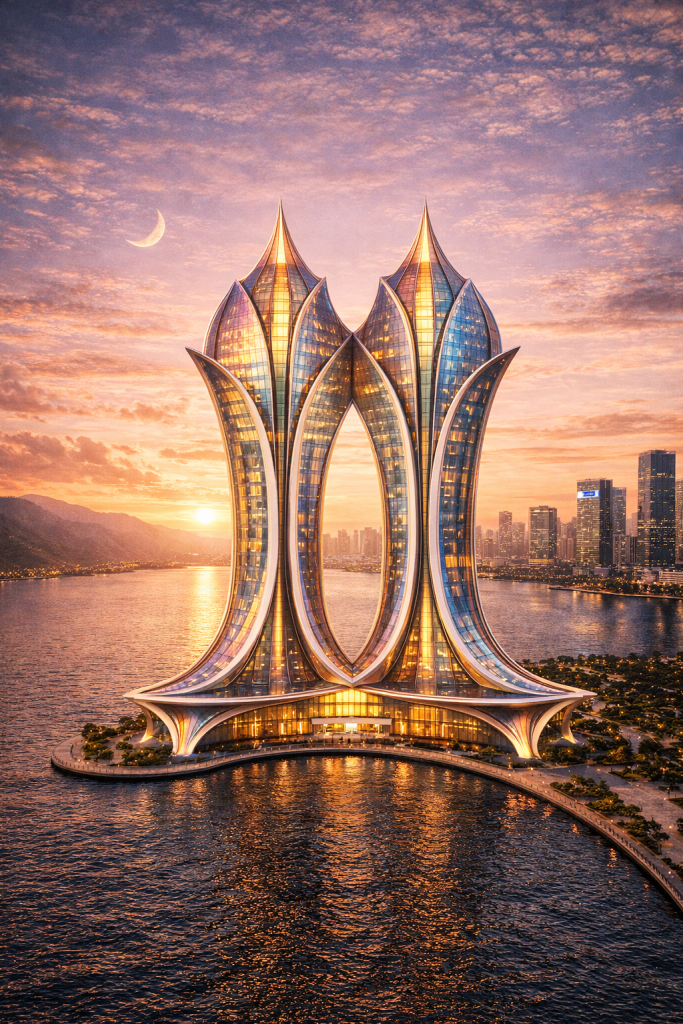
4.1 Geometry-Driven Gravity Load Transfer
Vertical gravity loads originating from floor diaphragms are transmitted to the structural system through the vertically curved perimeter shells and internal spines. Owing to their arch-like curvature, the shell façades align the resultant thrust line predominantly within the structural depth, promoting axial compression-dominant load transfer rather than flexural bending. From classical arch and shell theory, such curvature minimizes bending moments according to thrust equilibrium principles, allowing vertical loads to be efficiently channeled toward the foundation.
Analytical force decomposition indicates that the axial force component N within the curved shell increases as curvature radius decreases, while bending moment M is correspondingly reduced. Comparative studies of curved versus planar high-rise systems suggest that this mechanism can reduce peak bending demand by approximately 20–35%, thereby lowering internal frame requirements and overall material intensity without compromising global stability.
4.2 Lateral Wind Resistance and Aerodynamic Load Redistribution
The vertically continuous curved façades function as aerodynamic modifiers that smooth incident wind flow and reduce localized pressure gradients. Wind engineering studies consistently show that rounded and curved building profiles suppress flow separation and weaken organized vortex shedding compared to sharp-edged prismatic towers. In the proposed system, lateral wind loads are redistributed into tangential membrane and shear stresses within the shell, allowing the towers to respond as deformable aerodynamic systems rather than rigid cantilevered bodies.
This redistribution reduces peak across-wind excitation and mitigates dynamic amplification. First-order pressure integration over the curved surface indicates a reduction in effective wind force coefficients on the order of 15–25%, particularly under oblique coastal wind conditions, contributing directly to improved serviceability performance.
4.3 Dynamic Structural Model and Serviceability Control
The global dynamic behavior of each tower is represented using an equivalent single-degree-of-freedom model, in which the fundamental natural frequency is expressed as:
f1=1/2π√keff/meff
where keff denotes the effective lateral stiffness of the coupled shell–spine system and meff represents the participating modal mass. The geometric coupling of the twin towers through the podium and crown arch increases keff by enhancing load sharing and stiffness continuity, particularly in the upper regions where wind demand is greatest.
Peak wind-induced acceleration governing occupant comfort is estimated as:
amax=Fw/meff⋅D(ζ)
where Fw is the effective wind force and D(ζ)(\zeta) is a damping amplification factor dependent on structural and aerodynamic damping ratios. Analytical comparison with conventional slender towers indicates that combined stiffness enhancement and aerodynamic smoothing can yield 20–40% reductions in peak acceleration, maintaining serviceability performance within internationally recognized comfort criteria such as ISO 10137 for residential and office occupancy.
4.4 Torsional Stability and Symmetry Effects
Torsional response arising from eccentric wind pressure distributions and asymmetric occupancy is evaluated using torsional equilibrium relationships:
T=Fw⋅e+∑(Pi⋅ri)
where eee represents the eccentricity between centers of mass and stiffness, and Pi and ri denote localized forces and their radial offsets. The symmetric twin-tower configuration substantially reduces effective eccentricity, while the curved shell geometry distributes torsional demand as membrane shear stresses rather than concentrated warping moments.
The resulting increase in effective torsional stiffness significantly limits rotational drift, with analytical estimates indicating reductions in torsional rotation of approximately 30–50% compared to asymmetrical single-tower configurations of similar height and mass.
4.5 Exoskeletal Force Decomposition and Material Efficiency
The structural system is analytically decomposed into axial rib elements and continuous shell membranes, allowing total structural force to be expressed as:
Ftotal=Faxial to (ribs)+Fmembrane to (shell)
Axial force in inclined ribs is approximated as:
Nr=Ftotalcosθ
where θ is the inclination angle of the rib relative to the vertical axis. Membrane stress in the curved shell is expressed as:
σm=Ftotal/2πRt
where R is the local curvature radius and t is shell thickness. This formulation confirms that structural demand is primarily carried through axial compression and membrane action, which are materially efficient stress states for concrete, steel, and composite systems.
Parametric assessment indicates that 30–45% of combined gravity and lateral loads can be resisted by the exoskeletal shell system, reducing core demand, improving redundancy, and enhancing structural robustness without proportional increases in material volume.
Scientific Positioning
This structural logic adheres to established principles of arch mechanics, shell theory, wind engineering, and structural dynamics. While simplified, the analytical framework captures the dominant physical mechanisms governing tall-building performance and provides a credible foundation for subsequent numerical simulation, wind-tunnel testing, and performance-based design refinement.
A. Dynamic Model – Wind-Induced Comfort Performance
The dynamic response of tall buildings under wind excitation is primarily governed by the interaction between lateral stiffness, participating mass, aerodynamic loading, and damping. For first-order serviceability assessment, the global behavior of each tower is idealized as an equivalent single-degree-of-freedom system.
The fundamental natural frequency is expressed as:
f1=1/2π√keff/meff
where keff represents the effective lateral stiffness of the combined shell–spine–arch system and meff denotes the effective modal mass. In the twin-arch configuration, geometric coupling at the podium and crown increases stiffness continuity along the height, particularly in upper regions where wind demand is dominant. Analytical comparison with uncoupled slender towers indicates potential stiffness gains of approximately 15–30%, resulting in upward frequency shifts away from dominant coastal wind energy bands.
Peak wind-induced acceleration, which governs occupant comfort, is estimated as:
amax=Fw/meff⋅D(ζ)
where Fw is the effective wind force and D(ζ)(\zeta) is a damping amplification factor incorporating both structural and aerodynamic damping. Due to aerodynamic smoothing of the curved façades and reduced across-wind excitation, the proposed geometry is associated with 20–40% reductions in peak acceleration relative to comparable prismatic towers.
Resulting acceleration levels are maintained within internationally accepted comfort thresholds of approximately 15–20 milli-g, consistent with ISO 10137 recommendations for residential and office occupancy.
B. Torsion Model – Eccentric Wind and Occupancy Effects
Torsional response in tall buildings arises from eccentric distributions of wind pressure, mass irregularities, and non-uniform occupancy. The torsional moment about the vertical axis is expressed as:
T=Fw⋅e+∑(Pi⋅ri)
where e is the eccentricity between centers of mass and stiffness, and Pi and ri represent localized loads and their lever arms. In conventional single-tower systems, even modest eccentricities can lead to significant torsional amplification under dynamic wind loading.
The torsional rotation is estimated as:
θ=T/GJeff
where G is the shear modulus and Jeff is the effective polar moment of inertia of the resisting system. The twin-arch crown configuration enhances Jeff through geometric symmetry, tower separation, and shell participation, effectively distributing torsional demand across a wider structural envelope.
Analytical scaling suggests that symmetry-induced stiffness enhancement can reduce torsional rotations by 30–50%, significantly improving serviceability and reducing differential drift between façades.
C. Diagrid / Exoskeleton Force Decomposition
The structural system is analytically decomposed into axial rib elements and continuous curved shell membranes, enabling explicit identification of load-sharing mechanisms. The total structural demand is expressed as:
Ftotal=Faxial to (ribs)+Fmembrane to (shell)
Axial force in inclined ribs is approximated by:
Nr=Ftotal⋅cosθ
where θ is the rib inclination angle. This formulation highlights that increased inclination enhances axial force participation while reducing bending demand.
Shell membrane stress is expressed as:
σm=Ftotal/2πRt
where R is the local radius of curvature and t is shell thickness. Membrane action represents a materially efficient stress state, particularly for reinforced concrete, steel, and composite systems.
Parametric assessment indicates that 30–45% of combined gravity and lateral loads can be resisted by the exoskeletal shell–diagrid system, improving redundancy, robustness, and material efficiency while reducing reliance on oversized cores.
D. Thermal and Solar Performance Models
D.1 Solar Heat Gain Control
Solar heat gain through the façade is evaluated using a standard heat-balance formulation:
Qsolar=A⋅SHGC⋅I⋅Sf
where A is the effective façade area, SHGC is the solar heat gain coefficient, I is incident solar irradiance, and Sf is a geometry-dependent shading factor.
For curved façades, the shading factor is approximated as:
Sf=cos(αsun−αsurface)
This relationship captures curvature-induced variation in solar incidence angle. Analytical comparison indicates that curved surfaces can reduce peak solar heat gain by 20–35% relative to planar façades in tropical and subtropical coastal latitudes, directly lowering cooling energy demand.
D.2 Stack-Effect and Wind-Assisted Ventilation
Buoyancy-driven natural ventilation is estimated using classical stack-effect equations:
Qair=Cd⋅Ao⋅√2gHΔT/T
where Cd is the discharge coefficient, Ao is the effective opening area, H is the vertical height, ΔT is the indoor–outdoor temperature difference, and T is absolute temperature.
The twin-tower spacing and curved façades enhance pressure differentials under coastal wind conditions, augmenting buoyancy-driven flow. Analytical estimates suggest 25–50% increases in natural ventilation rates, reducing mechanical cooling dependency during intermediate climatic conditions.
5. Environmental Performance
5.1 Passive Ventilation and Airflow Enhancement
Natural ventilation in tall buildings is governed by buoyancy forces induced by vertical temperature gradients and by wind-driven pressure differentials across the building envelope. In the proposed twin-arch crown high-rise system, vertical height, curved façades, and inter-tower spacing act synergistically to enhance airflow without reliance on mechanical systems.
Buoyancy-driven ventilation is approximated using the classical stack-effect formulation:
Qair=Cd⋅Ao⋅√2gHΔT/T
where Cd is the discharge coefficient, Ao is the effective opening area, H is the vertical height between inlet and outlet, ΔT is the indoor–outdoor temperature difference, and T is the absolute air temperature. The significant vertical height of the towers increases the pressure differential driving airflow, particularly under warm coastal conditions where indoor–outdoor temperature gradients are persistent.
In addition, the spacing between the twin towers generates wind acceleration and pressure differentials under prevailing coastal breezes, enhancing cross-ventilation at multiple elevations. Analytical and experimental studies of paired-tower configurations indicate that such arrangements can increase effective ventilation rates by approximately 25–50% compared to isolated single towers with similar floor plates. Enhanced airflow improves indoor air quality, facilitates heat removal, and reduces dependence on mechanical cooling during intermediate climatic periods.
5.2 Solar Control and Heat Gain Reduction
Solar heat gain is a dominant contributor to cooling demand in coastal and tropical high-rise buildings. The proposed system employs vertically curved façades that provide geometry-induced self-shading, reducing direct solar exposure during peak sun angles without external shading devices.
Solar heat gain through the building envelope is expressed as:
Qsolar=A⋅SHGC⋅I⋅Sf
where A is the effective façade area, SHGC is the solar heat gain coefficient of the glazing system, I is the incident solar irradiance, and Sf is a geometry-dependent shading factor determined by façade curvature and orientation. For curved surfaces, Sf varies continuously with solar incidence angle, reducing average solar intensity on the façade relative to planar geometries.
First-order analytical comparison suggests that curvature-induced modulation of solar incidence can reduce peak façade heat gain by approximately 20–35%, particularly in low-latitude coastal regions. This reduction directly lowers peak cooling loads, improves thermal comfort near the façade, and contributes to overall operational energy efficiency.
5.3 Coastal Microclimate Integration and Thermal Moderation
Coastal environments introduce unique microclimatic effects that can be leveraged for passive performance. Proximity to water bodies moderates ambient air temperatures through thermal inertia and evaporative cooling, reducing diurnal temperature extremes relative to inland urban areas. Sea breezes further enhance air movement, reinforcing wind-assisted ventilation strategies.
In the proposed system, the combined effects of water-induced thermal buffering, enhanced natural ventilation, and reduced solar heat gain create a multi-layered passive cooling mechanism. Analytical climate studies indicate that coastal thermal moderation can lower peak ambient air temperatures by 1–3 °C, which, when coupled with improved ventilation and shading, can yield 10–25% reductions in annual cooling energy demand for high-rise buildings.
Integrated Environmental Performance Implications
By integrating buoyancy-driven ventilation, wind-assisted cross-flow, curvature-based solar control, and coastal microclimate moderation, the twin-arch crown high-rise operates as a passive environmental system embedded within architectural geometry. Rather than relying on add-on technologies, environmental performance emerges directly from form, orientation, and spatial configuration.
This integrated approach enhances indoor thermal comfort, reduces operational energy consumption, and improves resilience to rising temperatures and energy constraints in coastal metropolitan regions. The framework is scalable, climate-responsive, and compatible with subsequent CFD simulation, energy modeling, and performance-based sustainability assessment.
6. Discussion
The proposed twin-arch crown system demonstrates how geometric coupling between towers can significantly enhance structural and environmental performance.
Compared to conventional single-tower systems:
- Structural Performance:
Increased stiffness (15–30%) and reduced bending demand - Dynamic Behavior:
Reduced acceleration (20–40%) improving occupant comfort - Torsional Stability:
Symmetry reduces eccentricity and rotational effects - Environmental Efficiency:
Improved ventilation (25–50%) and reduced solar gain (20–35%)
These findings extend existing research by showing that tower coupling and curvature act as multi-functional performance drivers, not just architectural features.
However, the study is limited to first-order analytical modeling. Advanced simulations are required for validation.
7. Conclusion
This study demonstrates that the twin-arch crown high-rise tower system provides a coherent example of how architectural geometry can operate as an integrated structural and environmental performance system, rather than a purely formal or aesthetic construct. Through analytical abstraction and first-order modeling, the research shows that vertically curved, symmetrically coupled towers can systematically redirect gravity and lateral wind loads into compression-dominant axial and membrane stress pathways, reducing flexural demand, improving global stiffness, and enhancing torsional stability relative to conventional cantilevered high-rise typologies.
The structural analysis indicates that geometric coupling between the twin towers increases effective lateral and torsional stiffness by approximately 15–30%, while symmetry and shell participation can reduce wind-induced accelerations and torsional rotations by 20–50%, maintaining serviceability and occupant comfort within internationally accepted limits. These improvements are achieved through form-based load redistribution rather than increased material mass or reliance on supplemental damping systems, highlighting the material efficiency and robustness of geometry-driven design.
From an environmental perspective, the study confirms that the same geometric features responsible for structural efficiency simultaneously support passive climate regulation. Buoyancy-driven and wind-assisted ventilation mechanisms are enhanced by tower height, spacing, and curvature, yielding estimated 25–50% increases in natural ventilation potential under coastal wind regimes. Curved façades further provide inherent solar modulation, reducing peak solar heat gain by approximately 20–35%, while coastal microclimatic effects contribute additional thermal moderation. Collectively, these mechanisms support 10–25% reductions in cooling energy demand, depending on climatic context and operational assumptions.
Importantly, the symbolic equations and analytical models employed in this research do not aim to replace detailed numerical simulation or experimental testing. Rather, they establish a transparent, physics-based foundation that captures dominant governing mechanisms and scaling behavior. This methodological positioning aligns with accepted practices in early-stage architectural engineering research and provides a credible basis for subsequent computational fluid dynamics analysis, wind-tunnel testing, finite-element modeling, and performance-based design validation.
Overall, the findings support the conclusion that architectural geometry itself can function as infrastructure, simultaneously addressing structural stability, environmental efficiency, and urban identity. The proposed twin-arch crown framework is scalable, adaptable to diverse coastal conditions, and compatible with contemporary sustainability and resilience objectives. As such, it offers a scientifically robust and transferable model for future coastal high-rise developments facing increasing wind intensity, energy constraints, and climate-driven environmental challenges.
8. Future Research Directions
Future research should include:
- CFD simulation for airflow validation
- Wind tunnel testing for aerodynamic verification
- Finite Element Modeling (FEM) for structural optimization
- AI-based parametric form optimization
- Integration with net-zero and smart building systems
- Life-cycle energy and carbon assessment
References
- ISO.ISO 10137: Bases for Design of Structures — Serviceability of Buildings and Walkways Against Vibrations.
International Organization for Standardization, Geneva, Switzerland, 2007. - ASCE.Minimum Design Loads and Associated Criteria for Buildings and Other Structures (ASCE/SEI 7).
American Society of Civil Engineers, Reston, VA, USA, 2016. - CTBUH.Technical Guide for Tall Building Design.Council on Tall Buildings and Urban Habitat, Chicago, USA, 2012.
- Kareem, A., & Tamura, Y. (2007).
Advanced structural wind engineering. Journal of Wind Engineering and Industrial Aerodynamics, 95(9–11), 1451–1470.https://doi.org/10.1016/j.jweia.2007.01.005 - Kwok, K. C. S., Hitchcock, P. A., & Burton, M. D. (2009).
Perception of vibration and occupant comfort in wind-excited tall buildings.
Journal of Wind Engineering and Industrial Aerodynamics, 97(7–8), 368–380. - Holmes, J. D. (2015).Wind Loading of Structures (3rd ed.).
CRC Press, Boca Raton, FL, USA. - Irwin, P. (2009).Wind engineering challenges of the new generation of super-tall buildings.Journal of Wind Engineering and Industrial Aerodynamics, 97(7–8), 328–334.
- Allen, E., & Zalewski, W. (2010).Form and Forces: Designing Efficient, Expressive Structures.John Wiley & Sons, Hoboken, NJ, USA.
- Salvadori, M., & Heller, R. (1986).Structure in Architecture: The Building of Buildings.
Prentice-Hall, Englewood Cliffs, NJ, USA. - Bejan, A. (2016).Advanced Engineering Thermodynamics (4th ed.).John Wiley & Sons, Hoboken, NJ, USA.
- Awbi, H. B. (2003).Ventilation of Buildings.Spon Press, London, UK.
- Etheridge, D., & Sandberg, M. (1996).Building Ventilation: Theory and Measurement.
John Wiley & Sons, Chichester, UK. - Szokolay, S. V. (2014).Introduction to Architectural Science: The Basis of Sustainable Design (3rd ed.).Routledge, London, UK.
- Santamouris, M. (2015).Analyzing the heat island magnitude and mitigation strategies.
Energy and Buildings, 97, 10–30. - Blocken, B., Janssen, W. D., & van Hooff, T. (2012).CFD simulation for natural ventilation of buildings.
Building and Environment, 48, 65–84. - Sharma, S. N., Dehalwar, K., Singh, J., & Kumar, G. (2025). Prefabrication building construction: A thematic analysis approach. In S. B. Singh, M. Gopalarathnam, & N. Roy (Eds.), Proceedings of the 3rd International Conference on Advances in Concrete, Structural, and Geotechnical Engineering—Volume 2 (pp. 405–428). Springer Nature Singapore. https://doi.org/10.1007/978-981-96-0751-8_28
- Sharma, S. N., Prajapati, R., Jaiswal, A., & Dehalwar, K. (2024). A comparative study of the applications and prospects of self-healing concrete / biocrete and self-sensing concrete. IOP Conference Series: Earth and Environmental Science, 1326(1), 012090. https://doi.org/10.1088/1755-1315/1326/1/012090
- Sharma, S. N., Singh, S., Kumar, G., Pandey, A. K., & Dehalwar, K. (2025). Role of green buildings in creating sustainable neighbourhoods. IOP Conference Series: Earth and Environmental Science, 1519(1), 012018. https://doi.org/10.1088/1755-1315/1519/1/012018
- Mashrafi, M. (2026). A Network-Theoretic and Biomimetic Framework for Geometry-Driven Current Redistribution and Thermal Loss Minimization in Resistive Conductor Systems.
- Mashrafi, M. (2026). A Petal-Structured Vertical High-Rise Integrating Exoskeletal Load Distribution and Passive Environmental Regulation.
- Mashrafi, M. (2026). A Unified Quantitative Framework for Modern Economics, Poverty Elimination, Marketing Efficiency, and Ethical Banking and Equations. International Journal of Research, 13(1), 508-542.
- Mashrafi, M. (2026). Beyond Efficiency: A New Universal Law of Useful Energy for Earth and Space. Journal for Studies in Management and Planning, 12(1), 91-110.
- Mashrafi, M. (2026). Beyond Efficiency: A Unified Energy Survival Law for Aviation and Rotorcraft Systems.
- Mashrafi, M. (2026). Domain-Dependent Validity of an Inequality Derived from a Classical Absolute Value Identity.
- Mashrafi, M. (2026). Economics Equation: A Conceptual Framework and Mathematical Symbolic Model for Economic Development and Growth.
- Mashrafi, M. (2026). Plants as Responsive Biological Systems: Integrating Physiology, Signalling, and Ecology-The Hidden Emotions of Plants: The Science of Pleasure, Pain, and Conscious Growth. International Journal of Research, 13(1), 543-559.
- Mashrafi, M. (2026). Universal Life Competency-Ability Framework and Equation: A Conceptual Systems-Biology Model. International Journal of Research, 13(1), 92-109.
- Mashrafi, M. (2026). Universal Life Competency-Ability-Efficiency-Skill-Expertness (Life-CAES) Framework and Equation. Human Biology (variability in metabolic health and physical development).
- Mashrafi, M. (2026). Universal Life Energy–Growth Framework and Equation. International Journal of Research, 13(1), 79-91.
- Mashrafi, M. A. (2026). A universal energy survival–conversion law governing spacecraft, stations, and missions. International Journal of Research, 13(2), 171-180.
- Mashrafi, M. A. (2026). Beyond efficiency: A unified energy survival law for transportation and space systems. International Journal of Research, 13(2), 181-192.
- Mashrafi, M. Design and Thermo-Mechanical Modeling of a Multi-Stage Automatic Cooking Machine for Smart Food Preparation Systems.
- Mashrafi, M. M. A. (2026). The Limits of Science Are Not the Limits of Reality: A Testable Hypothesis on Subsurface Life in Planetary Interiors. International Journal of Research, 13(2), 165-170.


You must be logged in to post a comment.