Why is SQL important? What problem is it solving?

Database administration or data management is incomplete without the SQL. For comfortable use of  SQL as part of your administration or development requires that you understand the basics of SQL, which will take you a long way in your career.

Before we start with the introduction to the SQL itself, and then, understand the important features of SQL Server. It will take you through a demonstration of the internal workings of SQL, starting from SQL standards, evolution, and progresses to creating tables, understanding and defining relationships, writing Transact‑SQL commands, and so on.

You will also understand that SQL is a special-purpose programming language; special-purpose, as in, it is different from the general-purpose programming languages such as C, C++, Java/JavaScript, etc., meaning, it has a very particular purpose: manipulation of datasets. And this manipulation happens using what is known as Relational Calculus.

But isn’t studying SQL alone, restrictive? Turns out, it isn’t. Of course, we can use SQL on any kind of database or data source, but even if we cannot directly use SQL, most query languages of today have some relationship to SQL. In general, once you know SQL, you can effortlessly pick up other query languages too.

Standards are vital because every relational database must build its framework around this framework in order to ensure compatibility. This means that the learning curve is greatly reduced. SQL is ANSI as well as ISO-compliant, along with other standards, which emphasizes the fact that you have to learn the concept only once.

How to turn your old router into Range Boosting WIFI Repeater

Let’s say you have a large house including basements and upstairs floor. There must be certain area or room where you are getting buffers when you are trying to connect to network. You may often want to extend the wireless signal out too if you have outbuildings, greenhouse or garage attached to your house. Here’s how to turn your old router into Range Boosting WIFI Repeater.

You can use your old router to boost Wi-Fi range. Now there are couple of things you would require to turn your old router into Range Boosting WIFI Repeater.

1. You will need an old router.

2. You should have an Ethernet cable running from your existing router out to the location you want to extend your network. There’s few setting you need to disable and certain configuration you need to do on router to turn into extra wireless access point.

Reset router to factory default settings

The first thing you need to do with your old router is reset it back to it’s factory state. Find the little pin hole at the back of the router known as reset button. Power on the router, insert a paper clip or similar, and hold it firmly for approximately 10 seconds. Once you release the button router actually will start to reset back to factory settings and that’s all you need to do.

Note current network configurations

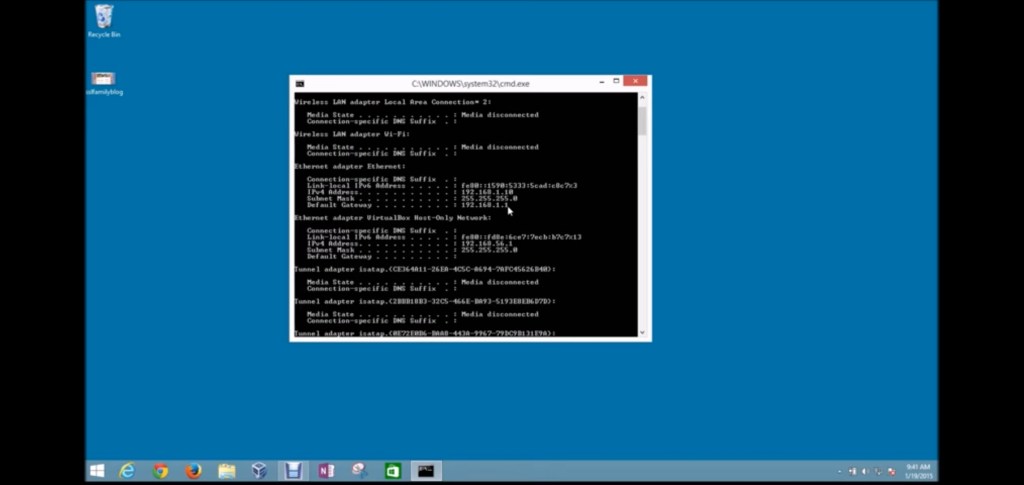
Now you need to get some preliminary information from current network that is setup in your home. First thing you need to do is just hold that window key down on your keyboard and window flag normally the bottom left hand corner of your keyboard in between Ctrl and alt. So you should hold down the windows key and then tap the letter R. This bring up a run box or run prompt. Type CMD then press enter. Now you have a command prompt. Type IP config , press enter. This pull up your some information about current network. You have to pick different IP address (150 or 220) but can’t go higher than 254 for instance 192.168.1.220.

Newly reset router log into router using default IP

Move on to the next step. You have to disconnect your laptop from other any current wireless network or any other network that is connected to do make sure that it’s not connected to internet and turn off wireless or whatever you need to do to disconnect it from your current network, power on your new reset wireless router. Just take any standard Ethernet cable and go ahead and first plug it into one of the four ports on back of your router. Plug in your Ethernet cable to the router. Router is powered on and then plug the other end of your Ethernet cable into your computer’s Ethernet port and now configure the settings in computer so that it will behave properly on your current network and act as it is just wireless extension. Press the windows keys and type R same as before. Type in CMD again and press enter. Now open a command prompt. Press IP config again and this gives same information. You need to note down default gateway IP address and close prompt command box.

Wireless network name and security configuration

Next step is to open browser. Proceed to address bar and rub out everything that’s up there. Now you have to type in that address you just notated (192.168.1.1) and press enter. Now give access directly to your router. A pop up box emerges with password and username box to log into router. Since you reset it back to factory default, there will be factory admin and factory password for the router. After filling up press ok.

DHCP is turned off

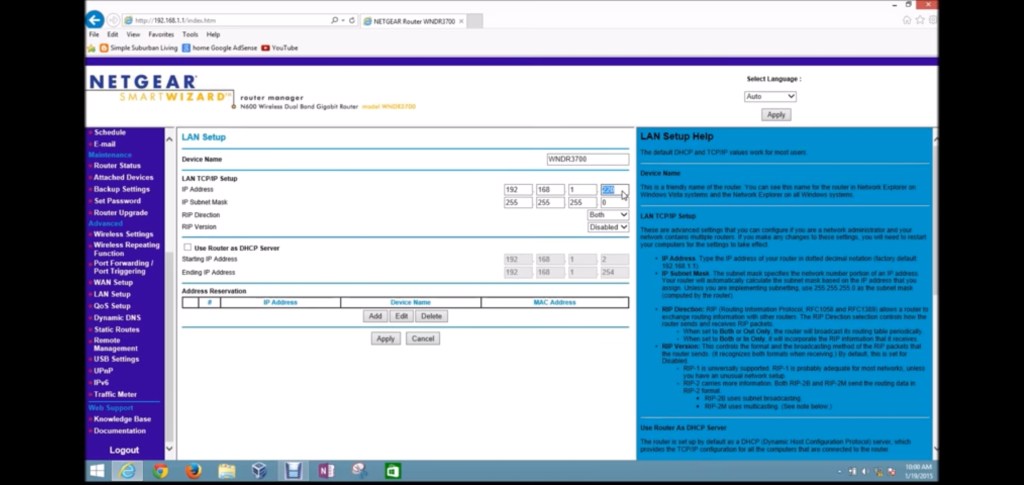
So once you are logged into your router. Just depending on brand router, you have settings and menus might be in different place but what you should look for first is your wireless settings. Click on wireless setting and this is just what you going to give name to new wireless network that you’re creating in home. You should also put security on there so no one else gets into it. If you have option select WPA 2. You’ll be asked to create a passphrase. So you’ve got your new wireless network name. You have your security type selected and you have a password selected. You need information every time you connect to this network and press apply. Now you have to select LAN setup turn off the option to use router as a DHCP server to prevent your router assigning IP address to anyone. Your main router only assign IP address. So actually it will not work as a router anymore. Now you need to change the last digital of IP address. Whenever you want to manage this access point, you’ll need to know the IP address. This acts as the IP address of wireless access point. Then hit apply button.

Router is configured to previous IP address

You have got your router all set up. It’s called access point in your home and don’t act as router. So you’ve got that all configured. Place it up on the top of desk so it’s in real high location you want to hook up wireless.

Conclusion

Strengthen throughout your house so already have Ethernet cable run up from existing router. Just put this Ethernet cable into one of the four ports on router. This is the most simple way to extend an extra wireless access point to have and turn your old router into range boosting WIFI repeater.

IJR Journal – Peer Reviewed and Google Scholar Indexed Journal

IJR, a Journal of Multidisciplinary Educational Research focuses on critical and creative research. This journal seeks to promote original research and cultivate fruitful dialogues between previous and innovative thoughts.


Scope:

International Journal of Research (IJR) promotes original academic research in Humanities, Culture, Comparative Education, Social Sciences, Rural Development, Engineering and Technology, Sciences, Art, Commerce and Management. Providing an insight, to transform lives is the motto. One can utilize the opportunities and face challenges of this changing world.


Objectives:

General

The million development goal laid its emphasis on “people centered approach” to recognize human and social capital for sustainable development. These include economic strategies and many other emerging trends. Get published in IJR

  • Goal is to create sustainable improvement in the quality of life among the common people.
  • Stake holder oriented programs, to facilitate increase in per capita income of individual facilities
  • To empower people in the areas of health, economy, polity and education.

Specific

  • To publish original empirical research and theoretical studies on adult education, lifelong learning, extension, and economic relations studies.
  • To generate interest in civil society movements, studies on democracy, problems of marginalized sections, cross border terrorism, violation of human rights, ecology, environment and issues in governance at the regional and national level.

The object is simple and that is to provide a forum for scholarly dialogue on a broad range of topics significant to our times and cultures.

Send papers for publication to ijr@ijrjournal.com 

CHILD ABUSE

Nowadays, we always hear about child abuse and there are many children being abused every year. There are many different from of abuse and many people do not realize them. They included, physical emotional, neglect and sexual abuse. Child abuse is when someone, whether through action or failing to act, causes injury, death, emotional harm, or risk of serious harm to a child.
A problem that is only beginning to come into light in India rape, sexual abuse, and sexual harassment are worldwide issues of gender violence. There is very little research done in this area in India and only a few books have been written.
Every year more than 3 million reports of child abuse are made in the United States. It’s a terrible epidemic that we at Childhelp are dedicated to put an end to. To do this, we need to first increase awareness of the issue itself.

First of all, let’s go to the physical abuse. Physical abuse of a child is when a parent or caregiver causes any non-accidental physical injury to a child. There are many signs of physical abuse.
Physical abuse includes striking, kicking, burning, biting, hair pulling, choking, throwing, shoving, whipping or any other action that injures a child. Even if the caregiver didn’t mean to cause injury, when the child is injured it is abuse. Physical discipline from a parent that does not injure or impair a child is not considered abuse; however non-violent alternatives are always available.
Physical abuse can result in:
●Bruises, blisters, burns, cuts and scratches
●Internal injuries, brain damage
●Broken bones, sprains, dislocated joints
●Emotional and psychological harm
●Lifelong injury, death.

Next, we proceed to the sexual abuse. Sexual abuse occurs when an adult uses a child for sexual purposes or involves a child in sexual acts. It also includes when a child who is older or more powerful uses another child for sexual gratification or excitement.

After that, we go to emotional abuse. When a parent or caregiver harms a child’s mental and social development, or causes severe emotional harm, it is considered emotional abuse. While a single incident may be abuse, most often emotional abuse is a pattern of behavior that causes damage over time.Child emotional abuse can be refereed to as a pattern of behavioral that impairs a child emotional development or sense of self worth. This may include constant criticism, threats or rejection as well as withholding love, support, or guidance. Emotional maltreatment is rarely manifested in physical signs. A few physical indicators of emotional maltreatment are speech disorders, lag in physical development and failure-to-thrive syndrome. The behavioral characteristics of emotional maltreatment are habit disorders, conduct disorders neurotic trait psycho-neurotic reaction behavior extremes (passive, aggressive, rigid reserved, demanding stubborn), and lag in emotional and intellectual, and attempted suicide. Four important causes emotional abuse are poverty, deficient parental control and non cordial relations within family, maltreatment faced by parents in their child hood or inter generational transmission of child maltreatment, and alcoholism of parents. A significant proportion of abusing parents were themselves abused as children
Signs of emotional abuse in parent or caregiver:
●Routinely ignores, criticizes, yells at or blames child
●Plays favorites with one sibling over another
●Poor anger management or emotional self-regulation
●Stormy relationships with other adults, disrespect for authority
●History of violence or abuse
●Untreated mental illness, alcoholism or substance abuse.

Last but not least, we proceed to neglect. Neglect is defined as a type of maltreatment that refers to the failure to provide the needed age. Neglect can be in physical and educational. Physical neglect included not providing food or clothes, appropriate medical care and not proper weather protection such as protection from rain and heat from sun. While educational neglect included failure to provide appropriate schooling or special educational needs and not allowing excessive truancies.
In sum, rape and sexual abuse of children in India is a large problem without an easy solution. Though the issue persists worldwide, India’s culture which traditionally keeps women below men, makes talk of private matters such as such unallowable, and a corrupt and weak legal system when it comes to rape makes the problems even larger. However, the situation could be improved by appropriately educating children and adults on sexual abuse, and educating police and strengthening laws. Further women’s empowerment may lead to healthy changes as well.
While child abuse and neglect is a significant public health problem, it is also a preventable one. In order to protect children from this situation, it is necessary to develop preventive programs, to raise awareness of their families-teachers-community and to make legal arrangements.
As the conclusion, prevent is better than cure. Child abuse leads to many bad effects not only for children that are being abused but also the person who abuse the children. We should prevent it from getting worse as the children today will be a leader for tomorrow.

human resorce management

Human resource management (HRM or HR) is the strategic approach to the effective and efficient management of people in a company or organization such that they help their business gain a competitive advantage. It is designed to maximize employee performance in service of an employer’s strategic objectives.[1][need quotation to verify] Human resource management is primarily concerned with the management of people within organizations, focusing on policies and systems.[2] HR departments are responsible for overseeing employee-benefits design, employee recruitmenttraining and developmentperformance appraisal, and reward management, such as managing pay and Employee benefits benefit systems.[3] HR also concerns itself with organizational change and industrial relations, or the balancing of organizational practices with requirements arising from collective bargaining and governmental laws.[4][need quotation to verify]

The overall purpose of human resources (HR) is to ensure that the organization is able to achieve success through people.[5] HR professionals manage the human capital of an organization and focus on implementing policies and processes. They can specialize in finding, recruiting, training, and developing employees, as well as maintaining employee relations or benefits. Training and development professionals ensure that employees are trained and have continuous development. This is done through training programs, performance evaluations, and reward programs. Employee relations deals with the concerns of employees when policies are broken, such as cases involving harassment or discrimination. Managing employee benefits includes developing compensation structures, parental leave programs, discounts, and other benefits for employees. On the other side of the field are HR generalists or business partners. These HR professionals could work in all areas or be labour relations representatives working with unionized employees.

HR is a product of the human relations movement of the early 20th Century, when researchers began documenting ways of creating business value through the strategic management of the workforce.[6] It was initially dominated by transactional work, such as payroll and benefits administration, but due to globalization, company consolidation, technological advances, and further research, HR as of 2015 focuses on strategic initiatives like mergers and acquisitionstalent managementsuccession planningindustrial and labor relations, and diversity and inclusion. In the current global work environment, most companies focus on lowering employee turnover and on retaining the talent and knowledge held by their workforce.[citation needed] New hiring not only entails a high cost but also increases the risk of a new employee not being able to adequately replace the position of the previous employee. HR departments strive to offer benefits that will appeal to workers, thus reducing the risk of losing employee commitment and psychological ownership.

47th G7 Summit

This year marked the 47th year of the G7 summit, which was held in Cornwall, United Kingdom. Earlier the 46th edition of the G7 summit was cancelled due to the Covid-19 pandemic. Group of Seven or G7 is the group of seven major advanced nations. It is an inter-governmental political group. It was formed on 25 March 1973 under the Library group. This year it was held between the 11th to 13th of June 2021.

Member countries of the G7 include the United States of America (USA), United Kingdom (UK), Canada, France, Germany, Italy, Japan, and the European Union (EU). The European Union is not majorly a part of the Group of Seven, but it is a welcome participant in all the meetings and decision making since 1981. These nations were represented by either their Prime Minister or President or Chancellor. The United States was represented by its President Joe Biden, alongside France’s President Emmanuel Macron. Canada, Italy, Japan was represented by their Prime Minister Justin Trudeau, Mario Draghi and Yoshihide Suga, respectively. Whereas Germany on the other hand was represented by its Chancellor Angela Merkel. European Union was represented by its President Ursula von der Leyen, who has been representing it since the start of the 38th edition of the G7 summit.

This year’s G7 summit also had its guest nation in the form of Australia, India, South Korea, and South Africa. Australia was represented by its Prime Minister Scott Morrison, India by Prime Minister Narendra Modi, South Korea by President Moon Jae-In and South Africa by President Cyril Ramaphosa. Antonio Guterres, Secretary-General of the United Nations also attended the Summit.

The agenda of this 3-day summit included the ongoing Covid-19 Pandemic and climate change. Various other agendas include the international coordination on economic policies, digital currencies, and the peace for Taiwan Strait. Japanese Prime Minister also stated Japan’s determination to host the Tokyo Olympic and Paralympic games.

China, on the other hand, reacted negatively to this summit. China accused the group of “meddling, lies, and false accusations”. China also denounced the group’s support for the violent Hong Kong protest and Uyghur militants in the Xinjiang region. A Chinese spokesperson from the embassy in London also stated its reaction to the Taiwan Strait saying, “The days when global decisions were dictated by a small group of countries are long gone.”

mental health for students

Mental health awareness is an important issue for all educators, who are often the first line of defense for their students. Education professionals have recognized the impact that a student’s mental health has on learning and achievement, and they realize that there’s a great deal that can be done to help students with mental health issues. As a high school teacher with more than 23 years of experience, I welcome the fact that mental health awareness is finally becoming an important part of a school’s function and curriculum.

Seeing the Signs in My Student

A few years ago, a student in my senior class changed drastically in a short period of time. I noticed that Melina no longer did her homework, and she didn’t even try on her essays. Previously meticulous in her appearance, Melina would come to school disheveled, wearing the same clothes. When I tried to speak to her, she was uncharacteristically distant and withdrawn. Because I had some training in mental health awareness, I knew Melina was in some sort of trouble.

Luckily, my school had social workers on staff who could speak to Melina and assess her issues. They discovered that Melina was depressed and suicidal, and she needed an immediate psychiatric intervention. Melina was hospitalized for a period of time, but she was able to return to my classroom a few months later. With the help of medication and therapy, she managed to graduate with her class.

Understanding the Impact

The National Alliance on Mental Illness estimates that one in five people live with some sort of mental disorder or disease. Despite the fact that the average age of early signs of mental illness is 14, most individuals don’t seek help until adulthood. Underlining the seriousness is the fact that 60 percent of high school students with mental illness don’t graduate.

New York mental health experts recognized that earlier intervention could result in more positive outcomes for these students. Beginning in July 2018, New York will be the first state in the nation to require mental health education for all students. The overall mission of New York’s School Mental Health (SMH) program is to promote healthy social, emotional, and behavioral development of students, and “break down barriers to learning so the general well-being of students, families, and school staff can be enhanced in collaboration with other comprehensive student support and services.”

The SMH program supports the emotional health and academic growth of all students with the following:

  • Integrating comprehensive services and support throughout every grade level
  • Assessing mental health needs through universal, selective, and targeted interventions
  • Providing access to behavioral and mental health services and programs
  • Leveraging higher-level personnel, such as those working with the Department of Education, for necessary support and services
  • Building collaborative relationships between the school and students’ families and communities

Spreading Awareness Across the Nation

Until mental health education is a mandatory aspect of all schools, teachers and administrators can work to promote awareness with their students. Key elements to shine a light on include the concept of self-care and responsibility for one’s own mental health and wellness, with an emphasis on the fact that mental health is an integral part of health, and the concept of recovery from mental illness.

Teachers and students should be provided with ways to recognize signs of developing mental health problems, and there should be opportunities around the awareness and management of mental health crises, including the risk of suicide or self-harm. Further, instruction should address the relationship between mental health, substance abuse, and other negative coping behaviors, as well as the negative impact of stigma and cultural attitudes toward mental illness.

Further reading: Social-Emotional Learning

Because teens spend most of their day at school, it just makes sense to have mental health awareness and education become part of the curriculum. When we empower students with knowledge, and encourage dialogue, students will be able to get the help they need.

biography of netaji subash chandra bose

Subhas Chandra Bose was born on January 23, 1897 in Cuttack, Orissa. His father Janaki Nath Bose was a famous lawyer and his mother Prabhavati Devi was a pious and religious lady. Subhas Chandra Bose was the ninth child among fourteen siblings. Subhas Chandra Bose was a brilliant student right from the childhood. He topped the matriculation examination of Calcutta province and graduated with a First Class in Philosophy from the Scottish Churches College in Calcutta. He was strongly influenced by Swami Vivekananda’s teachings and was known for his patriotic zeal as a student. To fulfill his parents wishes he went to England in 1919 to compete for Indian Civil Services. In England he appeared for the Indian Civil Service competitive examination in 1920, and came out fourth in order of merit. However, Subhas Chandra Bose was deeply disturbed by the Jallianwalla Bagh massacre, and left his Civil Services apprenticeship midway to return to India in 1921.

After returning to India Netaji Subhash Chandra Bose came under the influence of Mahatma Gandhi and joined the Indian National Congress. On Gandhiji’s instructions, he started working under Deshbandhu Chittaranjan Das, whom he later acknowledged his political guru. Soon he showed his leadership mettle and gained his way up in the Congress’ hierarchy. In 1928 the Motilal Nehru Committee appointed by the Congress declared in favour of Domination Status, but Subhas Chandra Bose along with Jawaharlal Nehru opposed it, and both asserted that they would be satisfied with nothing short of complete independence for India. Subhas also announced the formation of the Independence League. Subhas Chandra Bose was jailed during Civil Disobedience movement in 1930. He was released in 1931 after Gandhi-Irwin pact was signed. He protested against the Gandhi-Irwin pact and opposed the suspension of Civil Disobedience movement specially when Bhagat Singh and his associates were hanged.

Subash Chandra Bose was soon arrested again under the infamous Bengal Regulation. After an year he was released on medical grounds and was banished from India to Europe. He took steps to establish centres in different European capitals with a view to promoting politico-cultural contacts between India and Europe. Defying the ban on his entry to India, Subash Chandra Bose returned to India and was again arrested and jailed for a year. After the General Elections of 1937, Congress came to power in seven states and Subash Chandra Bose was released. Shortly afterwards he was elected President of the Haripura Congress Session in 1938. During his term as Congress President, he talked of planning in concrete terms, and set up a National planning Committee in October that year. At the end of his first term, the presidential election to the Tripuri Congress session took place early 1939. Subhas Chandra Bose was re-elected, defeating Dr. Pattabhi Sitaramayya who had been backed by Mahatma Gandhi and the Congress Working Committee. Clouds of World War II were on the horizon and he brought a resolution to give the British six months to hand India over to the Indians, failing which there would be a revolt. There was much opposition to his rigid stand, and he resigned from the post of president and formed a progressive group known as the Forward Block.

Subhas Chandra Bose now started a mass movement against utilizing Indian resources and men for the great war. There was a tremendous response to his call and he was put under house arrest in Calcutta. In January 1941, Subhas Chandra Bose disappeared from his home in Calcutta and reached Germany via Afghanistan. Working on the maxim that “an enemy’s enemy is a friend”, he sought cooperation of Germany and Japan against British Empire. In January 1942, he began his regular broadcasts from Radio Berlin, which aroused tremendous enthusiasm in India. In July 1943, he arrived in Singapore from Germany. In Singapore he took over the reins of the Indian Independence Movement in East Asia from Rash Behari Bose and organised the Azad Hind Fauj (Indian National Army) comprising mainly of Indian prisoners of war. He was hailed as Netaji by the Army as well as by the Indian civilian population in East Asia. Azad Hind Fauj proceeded towards India to liberate it from British rule. Enroute it lliberated Andeman and Nicobar Islands. The I.N.A. Head quarters was shifted to Rangoon in January 1944. Azad Hind Fauj crossed the Burma Border, and stood on Indian soil on March 18 ,1944.

However, defeat of Japan and Germany in the Second World War forced INA to retreat and it could not achieve its objective. Subhas Chandra Bose was reportedly killed in an air crash over Taipeh, Taiwan (Formosa) on August 18, 1945. Though it is widely believed that he was still alive after the air crash not much information could be found about him.

IMPORTANCE of personality development

In today’s era , personality development is an important part , one need to develop their personality along with skills and knowledge . Personality not only being intelligent or looking fashionable or classy , it means acting smartly , thinking maturely , talking less and working more. One should develop such a personality that people crave his vibes . Blindly copying others and following this character doesn’t work , one needs to make his or her own identity and be yourself . Personality development not only makes us look good but it also helps us to face the world with our smartness and smile. It helps to relieve is from mental stresses , looking physically good and healthy in turn keeps our mind healthier too. One starts thinking about the goodness of life and start looking on the positive side of the life .A charming face and a beautiful smile are enough to kill all the negativities and to live a thriller life. It helps to built positive attitude in an individual as neagative people and negative minds are more likely to get stuck in problems. It’s a worth saying , “the way we treat others , same way the others will treat us .”So ,It is essential for the individuals to behave well with other people present around us . Respect can’t be bought or earned it is only gained by behaving well and polite with others .Here are some of the tips to improve personality that are as follows: Be Impeccable to your word ,Bee yourself ,Don’t be very hard on yourself,Be kind Talk politely with everyone,Dress up in classy way , not so high class not so low , dressing simpler is the best , bee a good listener,Stay calm, Be a little fun ,Be a good communicator ,Speak only when needed ,Behave maturely , Don’t be negative ,Don’t complaint all the time ,Maintain proper eye contact and body language while communication ,Don’t be lazier ,Reach the work place at time being punctual shows that you are responsible ,Don’t fight with others ,Don’t be egoistic ,Make sure your message is understood by the reciever.One of the most important thing to be considered is education. Education is essential for all aspects of development. Personality development is a mixture of skills , knowledge, experiences and opportunities , without all theses it’s totally impossible to achieve .One should stay motivated and encouragred while performing the tasks and develop leadership qualities . Being the captain of the group directly shows that how much knowledge the person have . Be confident and don’t be nervous on tiny things , different things comes and go , nothing stays permanent , one need to understand this and must follow the flow of life .Life skills are actually needed for a successful career. One must be inspiring, motivating and be such a unique and positive in actions that it sets and example among youngster .

Tillage Practices and Their Potential to Impact the Soil Carbon Dynamics

Abstract
In dry regions, it is customary for farmers to use soil water conservation and/or water harvesting techniques. These practices have now become applicable to agriculturalists combating the adverse effects of drought on food production. In the semiarid areas of Zalingei in western Sudan, we quantified the soil erosion using traditional conservation measures and conducted experiments in two consecutive rainy seasons (2013 and 2014). A split-split plot design was used to quantify the respective influences of each variable on reducing soil erosion: A) three gentle gradients (Slope1 (0.98%), Slope2 (1.81%), and Slope3 (3.1%)); B) two cropping systems (mono-crop and mixed-crops); and C) five indigenous conservation tillage practices—chisel ploughing (CHP), cross slope tied bonding (CSTB), contour ridge with stone bonds (CRSB), cross slope bonding (CSB), and zero tillage (ZT). Our results showed that there were significant differences between the slopes in season 2 (2014); the soil eroded at Slope3 was more than that of Slope1 and Slope2 by 71% and 27%, respectively. Over two seasons, there were no significant differences between the cropping systems. Conversely, the erosion level observed with CHP was higher than with the other practices. However, the CSTB and CSB erosion levels were only higher in season 2 when compared with those of CRSB and ZT. The study concluded that under the above conditions, the rate of soil erosion was severe and exceeded the erosion tolerance. Based on these results, in western Sudan, CRSB and ZT may be the more effective indigenous conservation practices for the protection of agricultural soils and productivity.

INTRODUCTION
The level of soil degradation is increasing globally and is linked to an increased risk of drought . The growing human population faces increased pressure on its food supply, which is compounded by the limited availability of agricultural lands. To address these issues, the productivity of existing arable lands must be increased via better water use efficiency and soil conservation practices. . Moreover, climate change is also predicted to increase the incidence and severity of droughts in semiarid regions
The erosion of agricultural soils has long been a global environmental concern . Also, soil erosion is considered as one of the significant environmental problems worldwide due to its effects on water quality, soil productivity, and ecosystems. Rain flood erosion in agricultural lands strips the fertile topsoil on-site in arid and semiarid regions. Soil loss is often triggered and accelerated by poor or non-existing soil conservation practices promoting the transport of sediments and potentially hazardous pollutants via runoff to rivers and streams . In rainfed areas, the on-farm management of soil and water plays a critical role in achieving the full potential of soil conservation and water use . It is important to design conservation measures and strategies that are effective in controlling such soil losses on the Earth . Reasonable cultivation patterns combined with rainwater harvesting techniques can improve the management of degraded lands, which eventually leads to the sustainability of production, greater certainty, and lower marginal inputs. One type of soil conservation practices that are commonly used are conservation tillage practices (CTPs), which aim at no-tillage, little tillage, and cover crops . Other traditional or modern agricultural operations are used in conjunction with CTPs to reduce farmland degradation and to increase land productivity . In developing countries, the land is commonly fragile and degradable with poor vegetation as a result of the influence of frequent fires, tree logging, and free grazing. On top of these challenges, the area may suffer from climatic changes , rainfall fluctuations and the rapid advancement of the Sahara Desert. As a climatic adaptation strategy, rainfed, smallholder cultivation of grain crops is the predominant agricultural system in the hilly areas, where the terrace system is an interesting practice among indigenous water harvesting systems . However, the most effective method in conserving the soil surface is not well studied and reported so far in this area. Knowledge about the reduction in water and soil losses due to the practice of the terrace system is very limited in developing areas. Whether this traditional irrigation system helps in improving soil characteristics, crop production, and biodiversity richness in the area is also insufficiently quantified. Arid and semiarid areas account for about 60% of the national land in Sudan and account for approximately 8% of the world’s semiarid tropical regions . They are usually characterized by an unprotected soil surface, especially in clay areas, through which high-intensity rainfall cannot be infiltrated and thereby discharged dominantly by the surface runoff process . From these perspectives, this study aims to:
(A) evaluate the effect of the cultivation practices on the soil erosion;
(B) understand whether the cropping system affects water erosion, and
(C) recommend suitable field operations.
2. Method and Materials
2.1. Study Site
The field experiments were carried out during two consecutive seasons (2013 and 2014) at the experimental field of the University of Zalingei, western Sudan (between latitudes 12◦300–13◦300 N and 23◦300–23◦450 E) in the semiarid zone of North Africa. This is a mountainous area, where there are different types of waterways due to the land undulation, and large water streams (valley/wadi), streaming through from the Jebel Marra massif (approximately 100 km east of Zalingei) carrying fertile alluvial and volcanic soils [21]. The agriculture consists exclusively of small-scale family farms. Miehe [17] classified the soils of the area as Andosols with a bulk density of 1.32 g/cm3 . The climate is hot and rainy in the summer and harsh and dry during the winter. The average annual rainfall in Zalingei is approximately 600 mm/yr.; however, approximately two-thirds of it falls during July and August and about 90% from June to September, and there is very little or no rain from October to March [22,23]. The major crops for food are mostly grown during the rainy seasons (June to October) and include sorghum (Sorghum bicolor), millet (Pennisetum glaucum), and groundnuts (Arachis hypogaea), with vegetables mostly cultivated alongside the wadis’ lowland and flood plains during the winter. Water 2020, 12, 1554 3 of 11 Water 2020, 12, x FOR PEER REVIEW 3 of 12 Figure 1. The study area, located in the semiarid zone of North Africa. In the first rainy season (May–September 2013), the accumulation of rainfall was 542 mm, and it was 675 mm in the second season (June–October 2014); thus, the rainfall in the second season was 24.5% greater than in the first (Figure 2). The rain distributions were also varied, particularly during July and August of the second season, as a higher amount of rain precipitated, compared to that of the same period in the first season. To be exact, it was higher by 116.2% and 46% in July and August, respectively. Figure 2. The distribution of the rainwater per month (mm/m) and the accumulation of rainfall in each of the growing seasons, Season 1 (2013) and Season 2 (2014).
2.2. Experimental Design:
In three-factor field trials, split-split plots, each with 3 replicates, were used to quantify the influence of the following factors on soil erosion control: slope, cropping systems, and indigenous Water 2020, 12, 1554 4 of 11 conservation tillage practices. Thus, the field trial layout consisted of 90 plots, i.e., 3 whole plots × 2 subplots × 5 sub-subplots × 3 replicates. Three whole plots (each 35 m × 10 m), each with a different slope (S): S1 = 0.98%, S2 = 1.81%, and S3 = 3.1% (gradient measured by manual clinometer), were subdivided into 3 subplots (each 11 m × 10 m), each with a different cropping system (CS): mono-crop; sorghum and mixed crop; sorghum + groundnut. Each cropping type subplot was further subdivided into 5 sub-subplots (each 2 m × 5 m), each cultivated with a different conservation tillage practice (CTP): chisel ploughing (CHP), cross slope tied bonding (CSTB), contour ridge with stone bonds (CRSB), cross slope bonding (CSB), and zero tillage (ZT) (Figures 3A and 4). Water 2020, 12, x FOR PEER REVIEW 4 of 12 conservation tillage practices. Thus, the field trial layout consisted of 90 plots, i.e., 3 whole plots × 2 subplots × 5 sub-subplots × 3 replicates. Three whole plots (each 35 m × 10 m), each with a different slope (S): S1 = 0.98%, S2 = 1.81%, and S3 = 3.1% (gradient measured by manual clinometer), were subdivided into 3 subplots (each 11 m × 10 m), each with a different cropping system (CS): monocrop; sorghum and mixed crop; sorghum + groundnut. Each cropping type subplot was further subdivided into 5 sub-subplots (each 2 m × 5 m), each cultivated with a different conservation tillage practice (CTP): chisel ploughing (CHP), cross slope tied bonding (CSTB), contour ridge with stone bonds (CRSB), cross slope bonding (CSB), and zero tillage (ZT) (Figures 3A and 4). Figure 3. View of the prepared land of the experiment: (A) conservation tillage techniques; (B) collectors of soil particle deposits. Figure 4. The field layout of the simple methodology to determine the effect of conservation tillage on soil erosion. Chisel ploughing, CHP; cross slope tied bonding, CSTB; contour ridge with stone bonds, CRSB; cross slope bonding, CSB; and zero tillage, ZT. Arrows are in the flow direction.
2.3. Measurement of Soil Losses:
A small ditch (40 cm wide and 20 cm deep) was prepared, covered with a plastic sheet at the bottom end of each plot to receive the deposit of soil eroded, and transported by rain force out of the plot (Figures 3B and 4). After at least one day of rain events, the soil deposit was carefully taken from the field to the lab, where the samples were dried in an oven at 70 ◦C until a constant weight was obtained. At the rainy season’s end, the samples were weighed and the eroded soil mass per plot area was estimated.
2.4. Data Analysis
The procedure in Gomez and Gomez [24] was used for the analysis of variance (ANOVA) and all statistical analyses were performed using the SAS 9.4 software package (SAS Institute Inc., Cary, NC, USA). A least significant difference (LSD) of 5% probability was used in comparing the means of soil erosion for different treatment: (S), (CS), (CTP) (S × CS), (S × CTP), (CS × CTP) and (S × CS × CTP).
3. Results
3.1. Soil Erosion
There were significant differences in the mass of eroded soils among treatments with different land slopes in the second season (Figure 5A). However, the slope levels did not significantly affect the soil erosion in the first season. The cropping system factor also did not exhibit any significant variances among the treatment means over the two consecutive seasons (Figure 5B). The results showed differences as a result of the interaction between the land slope and the cropping system only in the first season (Figure 6A). The conservation tillage also significantly (p ≤ 5%) affected the soil erosion. There were no significant differences among treatments due to factor interactions over the two seasons: slope (S) × cropping system (CS) × conservation tillage practices (CTPs).
3.2. Effect of the Land Slopes and Cropping System
The slope factor clearly affected the magnitude of soil erosion, as we expected (Figure 5A). Only in the second season, S3 (3.1%) had significantly more eroded soil than S2 (1.81%); moreover, the masses of the eroded soil at the slopes were in the following order: S3 > S2 (by 27%), S2 > S1 (by 35%), and S3 > S1 (by 71%). However, there were no significant differences between S1 (0.98%) and S2 or S3 in the first season. The first season was unlike the second; the slope factor did not show any significant differences. The results did not show any significant differences between the mono- and mixed-crop systems (Figure 5B). Therefore, the two systems had no effects on soil erosion.
3.3. Effect of the Conservation Tillage Practices
The results in Figure 5C showed that the conservation tillage techniques in both seasons affected the soil water erosion significantly: in the first season, the CHP treatment differed significantly from CSTB and CRSB/CSB/ZT, whereas CRSB, CSB, and ZT were not markedly dissimilar from each other. In season 2, the soil loss measured in CRSB and ZT was significantly smaller than in the other three techniques. At the same time, the soil loss measured in CHP did not significantly differ from that in ZT; moreover, CSTB did not significantly differ from CSB. However, CHP and Z were not different from CRSB, but smaller than CSTB and CSB.

4. Discussion
Soil erosion occurs due to soil particle detachment, transportation, and sedimentation by erosion, such as water or wind. The problems caused by soil erosion can be both onsite and offsite, including nutrient lessening and limiting of crop production. As the topography affects these processes, the practices of CTP and CS also affect the soil erosion and crop production as a result. Not only is the quantity of annual rainfall essential to removing the soil particles from the original place, but the number of events, rain intensity in each event, and raindrop characteristics are also crucial factors. The mass of heavy rain with larger drops is more powerful for detaching and transporting the soil.


5. Conclusions
Our experiment provides a clear picture of how the conservation tillage practices (CTPs) affect the soil erosion of three slopes (S), and two cropping systems (CSs) in the hilly semiarid areas of the study area. According to the results of the experiment, we concluded that the conservation tillage practices (CTPs) strongly affected the soil erosion, such as the contour ridge with stone bonds and zero tillage. We found that the cropping systems (CSs) did not have significant effects; therefore, farmers need to apply more practices (i.e., CRSB) beside the CSs to conserve their land from soil erosion. We confirmed that the steeper the land, the more erodible the soil surface. The soil erosion due to cultivation practices in the study area is severe; therefore, the cultivation of cropland requires extensive 5. Conclusions Our experiment provides a clear picture of how the conservation tillage practices (CTPs) affect the soil erosion of three slopes (S), and two cropping systems (CSs) in the hilly semiarid areas of the study area. According to the results of the experiment, we concluded that the conservation tillage practices (CTPs) strongly affected the soil erosion, such as the contour ridge with stone bonds and zero tillage. We found that the cropping systems (CSs) did not have significant effects; therefore, farmers need to apply more practices (i.e., CRSB) beside the CSs to conserve their land from soil erosion. We confirmed that the steeper the land, the more erodible the soil surface. The soil erosion due to cultivation practices in the study area is severe; therefore, the cultivation of cropland requires extensive.


Twitter V/s indian GOVERNMENT

Recently, there is a social media war between the Indian Government and Twitter India.The major topics of the clash between the two are as follows:

1. Privacy

2. Security

3. Violent tweets

Privacy:

Twitter is a platform where users can write their views in a limited text, image, or video format called tweets. The Twitter algorithm checks whether any tweet is legal or not, based on it any tweet shows on its platform. Here Indian Government is asking for permission that it should also be allowed to decide the legality of any tweet. So, there is a fight between these two on this topic as Twitter is saying it is the distortion of the fundamental right of privacy of the Indian constitution.


Security:

The Indian government is saying that Twitter India is using the user’s tweets’ data for their advertisement purpose, but on the contrary of this, Twitter is saying this is a false obligation. In, this way, there is a users’ data security clash between these two.

Violent tweets:

My tweets contain violent content and hate speeches that provoke the people of India against the Indian government. These content are also responsible for many criminal activities in India. So, the government is asking for control on Twitter in India but Twitter is not allowing to the government.
The Indian government has issued notice to Twitter India regarding these issues and asks Twitter to follow new social media rules in India and warned twitter for a ban But Twitter files a petition against this in Supreme Court. 

Who is right and who is wrong and should twitter ban in India or not?

Guidelines


Book Chapter Publication

Authentic, scholarly and unpublished research papers are invited from academicians and writers for publication in an edited volume. The volume will be published with an ISBN (International Standard Book Number) by Edupedia Publications Pvt Ltd, New Delhi. Authors are requested to strictly follow the submission guidelines mentioned herewith in their papers. Only electronic submission via email will be accepted for publication to editor@eduindex.org

Book will be available for global readers through our distribution partners Google Books and Amazon. 

Book will be indexed in different database like Google Scholars and others to boost citation. 

Certificate of Publication will be issued to individual contributors from reputed Academic Publication of India which is UGC approved and indexed. (Edupedia Publications Pvt Ltd)

BOOK CHAPTER PUBLICATION

“Book Chapters in Upcoming Books”

Send typed manuscript in English only for publication, we don’t entertain book chapters in other languages.

Submission Guidelines

• Manuscript must be written in English language.
• File must be in Microsoft Word format (Preferably Word 2007).
• Paper size: A4, Font & size: Times New Roman 12, whereas the title must be in 14 point size, bold.
• Word limit: Minimum 1000 and Maximum 4000
• Abstract: 300 words
• The authors will have to strictly follow MLA 7th edition in their papers.
• Each manuscript must carry a self-declaration that it is an original work and has not been published/ sent for publication anywhere else.
• A brief bio-note of 150 words of the respective authors should be attached towards the end of the paper.

How to Submit Book Chapters 


Authors are requested to submit their manuscript to editor@eduindex.org

Last Date of Submission and Publication Date

The last date of submission: by the End of the Month.

Publication will be completed in
Acceptance or rejection of the paper will be intimated within 7 days of submission. A publication fee of Rs. 1500 will be chargeable after the selection of paper. Each contributor will get a complimentary copy.

NO Publication Fee 

There won’t be any publication fee as such. If authors wish to take printed copy of the published book, then he/she need to pay just Rs 1500 per copy.  Printed Certificate Rs 100 each. 

How to Pay Fee

using PayPal to editor@eduindex.org or for UPI OPEN THIS LINK


Book Publisher 

EDUindex

New Delhi, India

https://books.eduindex.org