Students are already drowning in student loan and upon that they have miscellaneous expenses to cover. Many of you would have lost hopes of studying in prestigious Universities thinking about the expensive cos of living there. However there are cities in the world which offer cheap and affordable living especially for students.
This article derives results based on the average costs indicated on the Mercer Cost of Living Survey. Each of these cities contain not only cheap living but also some of the top universities one might be delighted to get into.
Kuala Lumpur
Kuala Lumpur, Malaysia’s capital and largest city, ranks second in the world for affordability. Also featuring in joint 29th place overall in the best student cities this year, tuition fees at one of Kuala Lumpur’s five ranked universities will cost an average of only US$2,500 per year for international students. For those looking to live in the city center, a one-bedroom apartment will cost an average of US$568 per month.
Kuala Lumpur also ranks well for affordability in the Mercer Cost of Living Survey, coming 141st of 209 countries in terms of expense.
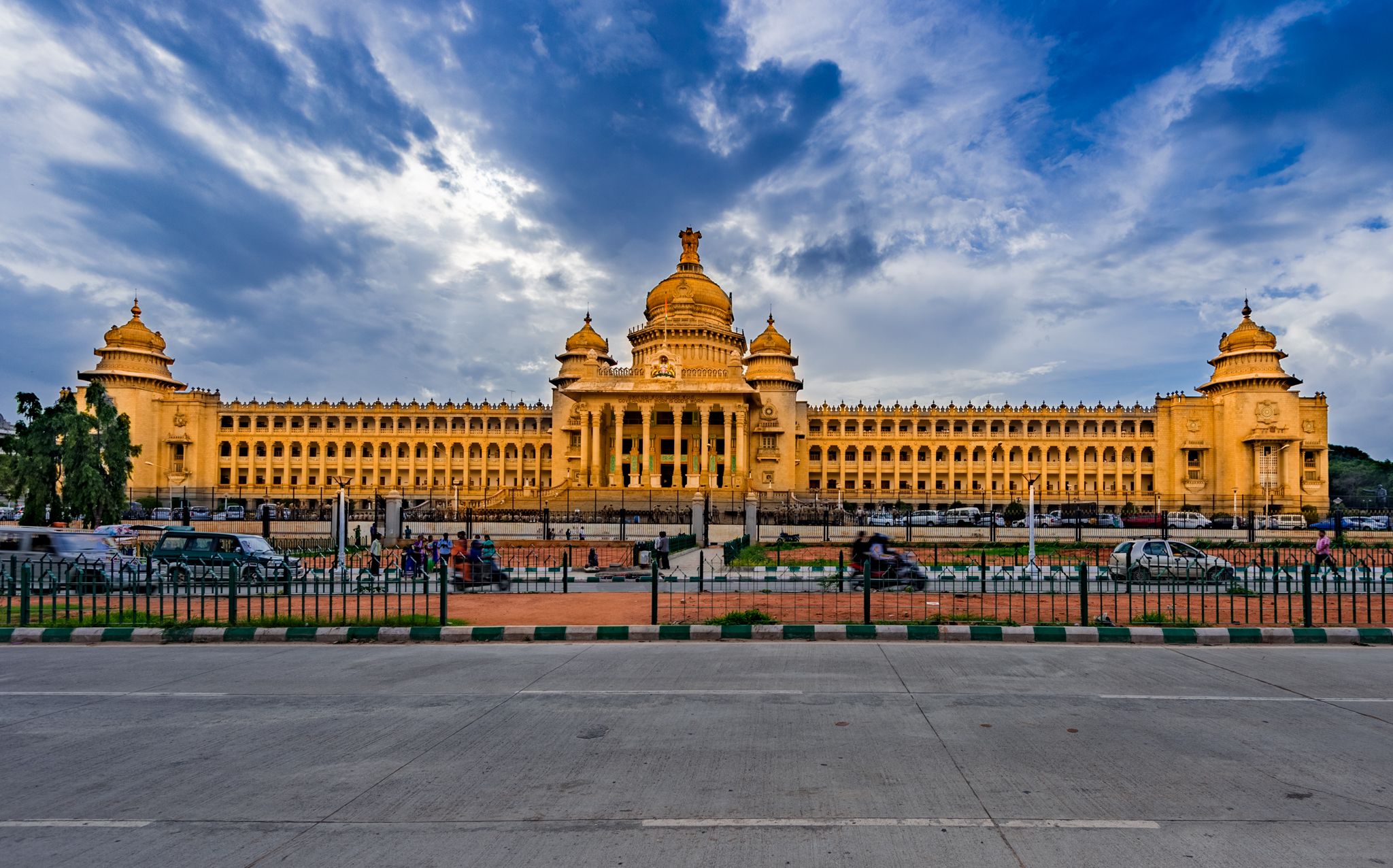
Bangalore
the Indian city of Bangalore, a new entry in this year’s Best Student Cities index at 81st, has the lowest tuition fees of all the cities on this list (only costing US$100 per year on average.) The city also has extremely low living costs , a one bedroom apartment in the city center, for example, will cost you an average of US$250 — this is extremely low compared to cities such as London, where you’d be paying a monthly average of US$2,132.
Bangalore has two universities currently featuring in the world university rankings. It also ranks highly in both the student view indicator and the employer activity indicator, suggesting that Bangalore’s graduates are viewed highly among graduate employers.
Johannesburg
Coming in at ninth worldwide for affordability in 2019, individuals in Johannesburg’s city center can expect to pay an average of US$471 in rent per month for a one bedroom apartment, excluding bills and annual tuition fees of around US$2,300. The city also ranks 185th out of 209 cities in the Mercer Cost of Living Survey (where first place is the most expensive).
This sunny South African city is ranked 78th overall in the Best Student Cities and climbed six places this year in the affordability indicator. The city is home to two institutions featured among the world’s top 550 in the world university rankings.
Budapest
Boasting three world leading universities, and home to over three million people, Hungary’s capital ranks first once again for the affordability category in 2019. Budapest also comes 43rd overall in the Best Student Cities, rising six places his year due to its improved scores in the desirability and student mix indicators (appearing in the global top 60 for both).
Budapest will cost international students an average of US$1,400 in tuition fees per year (much lower than many other study destinations). The city also ranks 164th out of 209 countries in the Mercer Cost of Living Survey.
Tomsk
Ranking 73rd overall in the Best Student Cities index, Tomsk places joint fourth for affordability in 2019 along with fellow Russian cities Novosibirsk and St. Petersburg. Tomsk gained the title of the ‘cultural capital of Siberia’ from the 1960s, when it was fill of artists, writers and film directors, and is still known today as a major educational, scientific and innovation center in Siberia.
If you’re interested in studying at one of Tomsk’s leading institutions, international undergraduate tuition fees cost an average of US$2,600 per year.
St. Petersburg
St. Petersburg is Russia’s second largest city (after Moscow, of course) and home to over five million people. Ranked 66th in the city ranking in 2019, it’s climbed four places in the affordability indicator to claim joint fourth place, with tuition fees at its three leading universities costing an average of US$2,600 per year.
Students looking to study in this awe-inspiring city will be pleased to find out that the city’s cost of living is 28.2 percent cheaper than in Russia’s capital, Moscow. And although St Petersburg’s best score overall is for its affordability, its biggest improvement this year is in the student view indicator, rising 16 places in 2019, reflecting its popularity among students.
Manila
The capital city of the Philippines and one of the oldest cities in the world, Manila is ranked eighth in the world for affordability this year, as well as joint 85th overall in the Best Student Cities index. Manila contains four excellent universities, led by the University of Philippines, which places joint 356th in the world.
With tuition fees averaging out at around US$2,400, and the city ranking 109th out of 209 in the Mercer Cost of Living Survey, Manila is a great place to get a top-quality education without breaking the bank. On top of this, Manila earns its best score in Student View this year, based on student’s experiences whilst studying in the city, and their perceptions of the availability and quantity of graduate employment.
Wroclaw
With sensational architecture and a plethora of diverse cafés and restaurants, Wroclaw, the fourth-largest city in Poland, comes third in the affordability indicator and is a new entry in the Best Student Cities index in 2019 at 108th. Students looking to study in Wroclaw will be pleased to hear that higher education is free for Polish students, and for international students willing to take the same entrance exams and to study a course taught in Polish.
However, if you’d prefer to study in English, tuition fees are still much lower than you’ll find elsewhere. The cost of living in Wroclaw is also relatively low, estimating that the monthly rent for a single person living in the center will cost on average around US$597.
Novosibirsk
Russia’s third largest city, Novosibirsk is packed full of parks and tree lined avenues, as well as being a major manufacturing and administrative center.
It climbed six places to rank 92nd in the Best Student Cities ranking this year and is rated joint fourth for affordability, with tuition fees averaging at US$2,600 per year for international students. Living costs are lower here than in Moscow, with a single metro ticket for example only costing 22 rubles (the equivalent to only 35 US cents).
Hsinchu
Perhaps those of you looking for a great place to study abroad will be blown away by Hsinchu, the second city laying claim to the title, ‘The Windy City’ (the first, of course, being Chicago). Coming 10th for affordability this year and joint 68th overall in the Best Student Cities index, Hsinchu is an excellent option for those who want to study in Taiwan without all the hustle and bustle of a big city.
Safe haven gold surged the fresh new high 50000 per 10 gram on Friday for the first time since 2011 as a worsening U.S-China row added to fears over the hit to a global economy already reeling from the coronavirus pandemic.
Spot Gold climbed 0.5% 50960 per 10 gram by 09:45 Pm IST, having earlier hit its highest since Sep 2011.
The top US pandemics expert Anthony earlier said the US coronavirus cases could grow to 100,000 daily without proper social-distancing and other safety measures and that’s going to hit economy badly.
The bullion metal is also getting support from uncertainty on the Hong Kong issue, rising COVID cases and increasing distress in the market.
Concerns about more global economic slowing due to the increasingly acerbic U.S.-China spat is seen as likely to keep global government and monetary support going even longer.
In yet another escalation, China ordered the United States to close its consulate in the city of Chengdu, responding to a U.S. demand for China to close its Houston consulate.
US Treasury Secretary Steven Mnuchin and Fed Governor Powell pledged to do more for the US economy as it battles the enormous fallout from the virus outbreak. Today market participants will focus on PMI numbers from major economies globally and private payroll numbers from the US which will give a hint on the situation of the jobs market in the country.
Non-yielding gold has surged 24% this year, underpinned by low interest rates and stimulus from central banks, which benefits bullion since it is a perceived hedge against inflation and currency debasement.
Walt Disney cancelled the August theatrical release of the widely anticipated film “Mulan” and delayed future “Star Wars” and “Avatar” movies by one year, due to Covid-19 pandemic.
This was the third time the live-action remake of the animated hit “Mulan” was postponed, and this time no new date was set. Theaters hopes the film would help bring audiences, particularly families, back to cinemas.
The action delays some of Disney’s biggest sequels. The next Avatar 2 was originally set for December 17, 2021, will now release on December 16, 2022. Avatar 3 moves from December 22, 2023 to December 20, 2024 followed by Avatar 4 from December 19, 2025 to December 18, 2026 and Avatar 5 from December 17, 2027 to December 22, 2028.
The next Star Wars film, which was set for December 16, 2022, has moved to December 22, 2023. A second Star Wars film has moved from December 20, 2024 to December 19, 2025 followed by a third film moving from December 18, 2026 to December 17, 2027.
Nine other films including “The Personal History of David Copperfield,” were either delayed or completely taken off the company’s schedule.
U.S. Secretary of State Mike Pompeo’s speech slamming China was an “angry lament” and “extended ideological rant” that would do little to change Beijing’s behavior, said Daniel Russel, former assistant secretary of state for East Asian and Pacific affairs. Later Pompeo said Washington and its allies should use “more creative and assertive ways” to press the Chinese Communist Party to change its ways, calling it the mission of our time.
He also called for the engagement and empowerment of the Chinese people whom he described as “dynamic and freedom-loving people who are completely distinct from the Chinese Communist Party.”
He said “blind engagement” with China and repeated frequently leveled U.S. charges about its unfair trade practices, human rights abuses and efforts to infiltrate American society.
He said China’s military had became “stronger and more menacing” and the approach to Beijing should be “distrust and verify,” adapting President Ronald Reagan’s “trust but verify” mantra about the Soviet Union in the 1980s.
Relations between the U.S. and China — the world’s top two economies — have been at their worst in decades. In addition to the countries’ ongoing trade war, both sides have recently sparred over a range of issues including the origin of the corona virus and China’s move to implement a national security law in Hong Kong.
Later he said one NATO ally, which he did not name, was unwilling to stand up for freedom in Hong Kong because it feared restricted access to China’s market.
While some conservative commentators praised Pompeo’s speech on social media and elsewhere, some other analysts were not impressed.
The word “fencing” comes from the verb “brandish” and this comes from the German verb “skermjam” which means to repair or protect.Fencing, organized sport involving the use of a sword, foil, or sabre for attack and defense according to set movements and rules. Although the use of swords dates to prehistoric times and swordplay to ancient civilizations, the organized sport of fencing began only at the end of the 19th century. It’s often called “physical chess” because of the similarity that each game affords only a few moves, especially few opening moves, but the first few moves can be arranged in a mind-boggling number of different combinations. Also, a good attack plan in either sport will be backed up by a second plan, in case the defender counters the first one, even a third or fourth. People who are good chess players, if physically fit, tend to make good fencers. Also, the sport brings together a wide range of people both genders, wide range of ages. It tends to be good company.Competitive fencing is one of the five activities which have been featured in every modern Olympic Games, the other four being athletics, cycling, swimming, and gymnastics.
There are three different blades in fencing
Epee– target area is full body and no priority; a double hit gives points to both fencers or teams. Points are scored by hitting the opponent with the point of the blade.
Foil– target area is chest only and there is priority*. Points are scored by hitting the opponent with the point of the blade while having priority.
Sabre– target area is upper body and there is priority. Points are scored by hitting opponent with blade while having priority.
Clothing
Protective clothing for fencing is made to the highest standard and is designed to look good and be practical.The rules lay down that the fencer must be dressed in white from head to foot, and the jacket must overlap the breeches by at least 10 cm at the waist. An ‘under-plastron’ should be worn under the jacket. This provides extra protection under the sword arm and part of the chest and back.Breeches must fasten under the knee, and long socks must cover the legs. Jackets for women have pockets for chest protectors, and these should always be used.
One glove is worn on the sword hand and this has a long cuff to cover the jacket sleeve at least halfway between the wrist and the elbow.
Early History
The earliest depiction of swordplay is a relief in the temple of Medinat Habu, near Luxor in Egypt, built by Ramses III about 1190 BCE. This relief must depict a practice bout or match, as the sword points are covered and the swordsmen are parrying with shields strapped to their left arms and are wearing masks (tied to their wigs), large bibs, and padding over their ears. Swordsmanship, as a pastime and in single combat and war, was also practiced widely by the ancient Persians, Babylonians, Greeks, and Romans as well as by the Germanic tribes.
The Romans brought sword combat to a highly systematic art that was taught to both their legions and their gladiators. Gladiators were trained in schools (ludi) by professional instructors (doctores). Beginners practiced with a wooden sword called a rudis. More-advanced training took place with weapons that were somewhat heavier than those used in actual combat.From the time of the fall of Rome through the Middle Ages, the practice of sword fighting continued unabated, although sword training became less uniform and began to reflect the ideas of the individual masters-at-arms. At this time, schools of sword fighting also developed a somewhat unsavoury quality, attracting members from the criminal element of society who wanted to learn the skilled use of weapons. Many communities found that the only way to deal with this problem was to outlaw fencing schools within their boundaries. For example, in London in 1286 King Edward I passed an edict that decried “the most unheard-of villainies” perpetrated by swordsmen and threatened swift justice for teaching sword-related skills. Despite such laws, fencing schools flourished.
FIVE MAIN RULES OF FENCING
Equipment
Fencing competitors must wear the necessary proper equipment, including a face mask, a fencing jacket, a pair of fencing pants to protect the legs and a fencing glove that covers the sleeve on the sword arm. Officials will check participants before each bout to make certain the equipment reaches all safety standards. Fencers must also wield approved weapons, whether a foil, saber or epee.
Scoring
Fencing utilizes a simple scoring system, awarding one point for each time a fencer touches his opponent with his weapon. Depending on the manner of competition, bouts may last five touches with a time limit of three minutes or 15 touches and a time limit of nine minutes, according to the rules of the U.S. Fencing Association.
Target
A fencer must touch his opponent in an approved target zone of the body to register a point, with the target changing depending on the weapon used. In epee fencing, contacting anywhere on the opponent’s body registers a touch. Sabre fencing limits the target zone to the torso, meaning anywhere above the waist. Foil fencing reduces it even further, restricting the target area to the trunk only and removing the arms and head from consideration.
Playing Area
Fencers compete on a long, narrow strip of material and must remain on the fencing strip at all times. The strip, or piste, must be 46 feet long and measure between 5 and roughly 7 feet wide. The strip contains a center line, two on-guard lines roughly 6 feet from the center line and two lines marking the rear limits of the strip roughly 23 feet from the center line.
Penalties
If a fencer steps beyond the strip’s legal side boundaries, the official will award 1 meter, or approximately 3 feet, of ground to the opponent on the restart. Stepping beyond the strip’s rear limit results in an awarded touch to the opponent. Officials may also award touches to the opponent if a fencer attacks with both hands, if a fencer doesn’t obey instructions or if a fencer displays poor sportsmanship or overly violent behavior.
Offensive
Attack: A basic fencing technique, also called a thrust, consisting of the initial offensive action made by extending the arm and continuously threatening the opponent’s target. They are four different attacks (straight thrust, disengage attack, counter-disengage attack and cutover) In sabre, attacks are also made with a cutting action.
Riposte: An attack by the defender after a successful parry. After the attacker has completed their attack, and it has been parried, the defender then has the opportunity to make an attack, and (at foil and sabre) take right of way.
Feint: A false attack with the purpose of provoking a reaction from the opposing fencer.
Lunge: A thrust while extending the front leg by using a slight kicking motion and propelling the body forward with the back leg.
Beat attack: In foil and sabre, the attacker beats the opponent’s blade to gain priority (right of way) and continues the attack against the target area. In epee, a similar beat is made but with the intention to disturb the opponent’s aim and thus score with a single light.
Disengage: A blade action whereby the blade is moved around the opponent’s blade to threaten a different part of the target or deceive a parry.
Compound attack: An attack preceded by one or more feints which oblige the opponent to parry, allowing the attacker to deceive the parry.
Continuation/renewal of Attack: A typical epee action of making a 2nd attack after the first attack is parried. This may be done with a change in line; for example, an attack in the high line (above the opponent’s bellguard, such as the shoulder) is then followed with an attack to the low line (below the opponent’s bellguard, such as the thigh, or foot); or from the outside line (outside the bellguard, such as outer arm) to the inside line (inside the bellguard, such as the inner arm or the chest). A second continuation is stepping slight past the parry and angulating the blade to bring the tip of the blade back on target. A renewal may also be direct (without a change of line or any further blade action), in which case it is called a remise. In foil or sabre, a renewal is considered to have lost right of way, and the defender’s immediate riposte, if it lands, will score instead of the renewal.
Flick: a technique used primarily in foil and epee. It takes advantage of the extreme flexibility of the blade to use it like a whip, bending the blade so that it curves over and strikes the opponent with the point; this allows the fencer to hit an obscured part of the target (e.g., the back of the shoulder or, at epee, the wrist even when it is covered by the guard). This technique has become much more difficult due to timing changes which require the point to stay depressed for longer to set off the light.
Defensive
Parry: Basic defence technique, block the opponent’s weapon while it is preparing or executing an attack to deflect the blade away from the fencer’s valid area and (in foil and sabre) to give fencer the right of way. Usually followed by a riposte, a return attack by the defender.
Circle parry: A parry where the weapon is moved in a circle to catch the opponent’s tip and deflect it away.
Counter attack: A basic fencing technique of attacking your opponent while generally moving back out of the way of the opponent’s attack. Used quite often in epee to score against the attacker’s hand/arm. More difficult to accomplish in foil and sabre unless one is quick enough to make the counterattack and retreat ahead of the advancing opponent without being scored upon, or by evading the attacking blade via moves such as the In Quartata (turning to the side) or Passata-sotto (ducking). Counterattacks can also be executed in opposition, grazing along the opponent’s blade and deflecting it to cause the attack to miss.
Point-in-line: A specific position where the arm is straight and the point is threatening the opponent’s target area. In foil and sabre, this gives one priority if the extension is completed before the opponent begins the final action of their attack. When performed as a defensive action, the attacker must then disturb the extended weapon to re-take priority; otherwise the defender has priority and the point-in-line will win the touch if the attacker does not manage a single light. In epee, there is no priority, the move may be used as a means by either fencer to achieve a double-touch and advance the score by 1 for each fencer. In all weapons, the point-in-line position is commonly used to slow the opponent’s advance and cause them to delay the execution of their attack.
Fencing is harder to pick up and start doing than many other sports. While you can pick up a ball and (more or less) start shooting baskets, learning the basic movements required to fence against another beginner can take a lot of practice.
After one and a half years of resignation, citing the personal reasons, Urjit Patel has now revealed the real reason of his resignation.
In his book Overdraft- Saving the Indian Saver, he has explained that “the moves to dilute the Insolvency and Bankruptcy Code” led the cause of his sudden exit from the central bank. Patel was served as the 24th governor of Reserve Bank of India since September 2016 to December 2018.
Reasons for the Tussle
Former governor of the Central Bank says that, “Instead of buttressing and future-proofing the gains thus far, an atmosphere to go easy on the pedal ensued,” “Until then, for the most part, the finance minister and I were on the same page, with frequent conversations on enhancing the landmark legislation’s operational efficiency.” He adds that “there were requests for rolling back the February circular” and “a canard was spread” to discredit the rules, including by incorrectly suggesting that small businesses would suffer disproportionately.
NPA build up in UPA Regime
Urjit Patel blames for the piling up of NPAs to the UPA government. He writes that, “The government is responsible for ensuring adequate capital for banks that are under its ambit on sustainable basis. The dominant owner pre-2014 didn’t question risk controls in government banks even as it received significant dividends,” He also adds that, “There was a failure to acknowledge and rectify government banks’ inability to identify poor performing assets; and restructure and react quickly to improve recovery or cut losses.
Explaining the situation at that time, he writes, “A number of government banks did not have senior management in place, and governance suffered. This is a perennial shortcoming on account of bureaucratic inertia and political meddling. Ditto for the banks’ board of directors; it is common knowledge that this has traditionally been a placeholder for sinecure to political supporters,”.
Urjit Patel’s book has released today. In this he has mostly dealt with the policy matters and the stability of the banking system.
Thirukural is one of the most prominent literary works in Tamil, known for its excellent and timeless elucidation of ways and values of life. The work itself is one of the oldest works of literature known to man, authored around 2000 years ago. To students in Tamilnadu, Thirukural is a primary literary work that is taught pretty much in every class all the way till higher education. The poems serve multiple purposes such as moral exposition to students, learning tamil itself, and even to understand the grammatical structure of ‘venpas’. The Thirukkural is an ancient non-religious literature that guides people on better living. Though written over 2,000 years ago by Thiruvalluvar in Tamil, the way of life advised by Thirukkural is still relevant today.
Thirukkural is composed of 1,330 kurals in 133 sections of ten each. A Kural is a couplet and each Kural is composed of 7 words spread across 2 lines [4 + 3 words]. The work on wisdom is divided into three major chapters – those that speak about virtue, wealth and love.
From a personal finance perspective, there are a lot of lessons that one could learn from the chapters on virtue and on wealth.
Imagine the relevance to the current financial turmoil in developed countries to the Kural No: 113; ‘nandre tharinum naduvigandhuaam aakathai andre ozhiya vidal’
It says: ‘Even when apparently giving gains, ways which are not truthful are to be abandoned.’
The sub-prime crisis can be quoted as an example of one such activity. The lenders who got carried away by the real estate boom tried to make the most of the situation and ended up going overboard due to their greed. They wound up lending money to lower value assets.
Those borrowing were also in the same mental frame to make the most of some one who is ready to lend to them. They disobedyed every fundamental law that dictates basic economics and as the act was devoid of any logic and the ways of the people involved was not fundamentally truthful, it lead to a global crisis costing trillions of dollars.
It should be highlighted at this point that, Indian banks did not suffer because of the wisdom of the Reserve Bank of India and the Securities and Exchange Board of India in not allowing them to take more risk than warranted by their core businesses.
The fall of the Western financial institutions could be compared to the get-rich-quick-schemes doing the rounds regularly now and then making lives miserable for all the greedy investors. Wealth created by the righteous means will not only serve those who earn the wealth but also their future generations.
It means: ‘Wealth (children, financial wealth, friends, charity and fame) earned by a person using fair means will protect not only the person but also his future generations.’
Thinking retrospectively, we can definitely remember those who earned their wealth by their own hard work and dedication. Only a few of the infamous are also remembered as their deeds are truly devastating.
The Thirukkural also talks about the role of the family’s head in managing money.
It means: ‘Producing, saving, protecting, regulating and equitably sharing is the way to powerful governance.’
The context can also be applied to any businessman or statesman too. The power of this wisdom can be understood by those who are in financial trouble. Most people fail miserably in managing their finances due to a lack of balance in these five factors mentioned above in the Kural.
Many of us, in today’s generation and in our parent’s generation have dedicated ourselves to earning more money only. Our parents did save most of their earning. This is missing with most of us today. As a country we hardly take efforts to protect our wealth – to monitor it and to make wealth work for us.
AMAZING FACTS ABOUT THIRUKURAL:
You can find 1330 poems with not even a single poem exceeding or decreasing 7 words.
It is the book translated to most number of languages after Bible.
It starts with the poem about God but still speaks about no religion.
It was initially rejected during the pandian sangam age because the senior poets considered the 2 lined poems not so highlighting. It is said that, avvaiyar recommended the thirukkural later and the rest is history.
Thiruvalluvar statue touching the sky in the tip of India- kanyakumari . So what’s so special about it? It’s 133 ft tall ( 133- number of poem topics – adigarangal penned by valluvar)
It covers everything in a human life. – virtue life, wealth, love and sex life.
Thiruvalluva malai – special book which has collection of dedicated to laud thirukkural and it’s author by various authors of various centuries.
Thirukkural is referred as ulaga podhumarai (world common Veda), vayurai vazhthu (word Veda), mupaal ( book of virtue, wealth and love, sex) and many more.
Valluvar kottam – A place in Chennai where you can find all 1330 Thirukkurals sculptured in stones.
First letter of thirukkural poem – அ, last letter of thirukkural last poem- ன். These are the first and last letters of Tamil language.
the spread of Corona Virus and strict lockdown in the entire nation, everybody is looking for – Work from Home options. However due to the shutting down of businesses, Companies are not in hiring instead they are laying off employees due to recession. Many home-based businesses can be started with very little money and very little experience. How do I know? Because I’ve been there and I’ve done it.
You can begin small, even part-time. And then you can grow them at your own pace. You can make excellent profits even with a very small home-based business. And if you want you can grow it into a much larger enterprise. So even if you don’t have much experience or savings, you too can start your own home-based business and become highly successful.
The key behind a successful business is finding out the DEMAND in the market depending on the situation and customer needs. With Corona Virus being the topic of this year, the demand for related products like hand sanitisers and disinfectants have surged more than these manufacturing industries could ever imagine.
But what can I do sitting at home? It all starts with an idea, hence here are the Top 7 business ideas that can be executed from home during covid-19 pandemic:
Tiffin / Lunchbox Service:
After the entire Nation shut down, many students who lived in hostels and bachelors who were dependent on outside food were left hungry and starving. At such times starting a Dabba Service will not only earn profits but also blessings from these people struggling to find home-cooked food.
In order to run Tiffin service successfully, you will require more than a passion for cooking. Furthermore, you will need good planning and management skills as well as flexibility to successfully handle any last-minute changes required by customers.
How successful your Tiffin service will be will depend mainly on having good reputation. For this business setup to succeed therefore, you must be able to meet the needs of your customers and have the ability to work well under pressure.
Things you require for a Successful Take-off:
Table cloths
Kitchen facilities
Tables
Tiffin boxes
Serving equipment
Utensils – silverware, glassware
Simple but healthy home-cooked meals preparation
Online Tuitions & Tutoring:
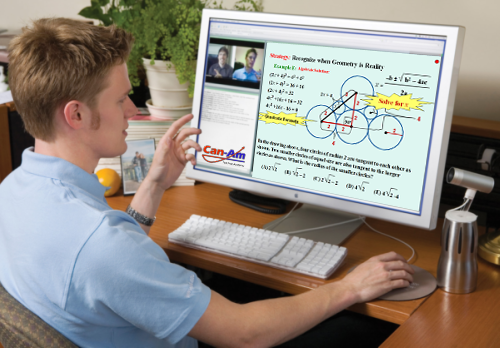
Schools and Colleges have shut down leaving a big stress among everybody. Students are concerned with completing their portion without their teachers. At such times the need for online assistance for education is at a rise.
Online tutoring is a profitable business. This industry is developing rapidly with advent of innovations, technologies and wide spread usage of the internet. Parents and students are comfortable with online tutoring websites for their personalized learning requirements.
Things you require for a Successful Take-off:
Start a face-to-face video conferencing.
Speak to each other with high-quality and excellent voice.
Write, type, erase and draw in distinctive colours on digital advanced whiteboard.
Text chat via instant messaging.
Upload and share files.
Alter message progressively with other person seeing what you are doing. Access the session from all devices.
Mask Stitching and Selling:
The world has changed. Not only has the world economy shut down, but people are also on edge. This is likely because we can’t leave our homes, and this can lead to isolation. Nowadays you cannot spot a single person on the streets without a mask covering their face.
If one is good at stitching at home, then this is a golden opportunity to not only earn money but also get creative. People are bored of the old plain mask and hence are looking for designer and customised masks. One can use their own imagination and entice people with your unique masks.
Things you require for a Successful Take-off:
Face Mask Cloth
Mask Inner Ear Loop threads
Paints, beads, needle works
Stitching machine or sewing machine
Needle and thread
Online Fitness and Yoga Coach:
The threat of coronavirus has left the fitness industry ailing and barely able to stand with smaller gyms on the verge of shutting down, larger chains contemplating huge losses and unemployment becoming a very real prospect for many thousands of trainers and support staff.
However, if you have a laptop and good functioning internet connection you can become a fitness coach for everybody missing the gym and looking for services from home. With people wanting to keep themselves fit and improving their immune system, Yoga trainers are high in demand.
Things you require for a Successful Take-off:
Create a virtual workshop using online studio software
clean background
remove clutter and distracting objects
place select “yoga” objects in frame if desired
Use a tripod if you can
Test to make sure that the camera can capture you in all your poses
Use impeccable, clear language (don’t rely on video)
Embrace imperfections! Be human and carry on.
Cake Baking for Special Occasions:
Are you the one that makes killer cakes for every birthday? Do you churn out to-die-for donuts? If you’re ready to turn your talents into a profitable bakery, you’ve come to the right place.
No matter what the situation, the show must go on. Cakes have been the symbol of any kind of situation since centuries. But with all CAKE SHOPS and bakeries shut, one cannot access them for special occasions. If you are a good baker, then this is your time to shine. Homemade cakes will be a hit and people will be assured about its safety.
Things you require for a Successful Take-off:
Mixers
Oven
Dough proofer
Bakeware
Tools for measurement
Ingredients as per flavour
Refrigerator
Bread slicer
Dough mix
Cardboard boxes
Piping bags
Dairy products
Display case
Gardening and selling Organic Fruits & Vegetables:
If you are interested in gardening at home and have enough space to grow more for everyone then organic farming is a great business idea. With today’s vegetables being produced with pesticides and chemicals
Growing a garden for profit is something that definitely needs to be kept simple. The reason is that if you try and do a whole bunch at once, then you won’t be great at any of it. If you pick a few simple and small things to start out with, then you can work to perfect those things and be much more successful.
I learned that the hard way because I wanted to sell EVERYTHING out of my garden. Well let me tell you, that is impossible without a team of employees. You just can’t do it well, so don’t try it.
Things you require for a Successful Take-off:
Put them in baskets
Order personalized boxes with your logo/brand name on them
Make signs that tell about your unique produce
Include a recipe card for how to cook with it
Organize the different colours in patterns
Put the containers on their sides so they appear to be “overflowing” with fruits or vegetables
Incorporate wheelbarrows, gardening tools, flowers, etc. into your display
Build your own shelves to sell from that stand out
Design a logo or picture to use for your new “business”
Take attractive pictures of your produce for your display
Use tablecloths or nice napkins that make it feel more high end and less dirty.
Customised T-shirts and Dresses Painting :
Whenever people think about starting a business, a t-shirt company is probably one of the first five ideas that come to their mind. Why? Well, t-shirt printing business looks like fun and cool. To some extent, they are right. Being your own boss, having own t-shirt designs, selling them with your brand label, having people supporting your work – that’s happiness. Isn’t it?
If you enjoy T-Shirt painting, then there is a whole lot of millennial generation ready to throw all their money at your unique art and designs.
Things you require for a Successful Take-off:
Plain t-shirts
Fabric paints
Tracing paper
Sunlight
Innovative and creative designs
Trendy drawings
All size t-shirts
So there you have it in a nutshell- First you need to decide where you are going to sell your produce. Then you can decide what you are going to sell.
Remember your business will grow if people are happy with what they buy from you. Make it look nice, and only sell the best you have.
Advertising has been defined as the most powerful, persuasive, and manipulative tool that firms have to control consumers all over the world. It is a form of communication that typically attempts to persuade potential customers to purchase or to consume more of a particular brand of product or service. Its impacts created on the society throughout the years has been amazing, especially in this technology age. Influencing people’s habits, creating false needs, distorting the values and priorities of our society. Furthermore, the main aim of advertising is to ‘persuade’ to consumer in order to generate new markets for production. Language is the most powerful tool\key used for advertising to grabbing the attention of the customers.
However, on the other hand, advertising has had a positive effect as a help of the economy and society. In the business market, the main and principal key to get profit is by the active consume of a product in the marketplace. Nevertheless, firms have taken advantage of that and have created false needs to consumers. According to Leiss, “The only true need, it would appear, are for nourishment, clothing, and housing.” In other words, he states that people can live without television, internet, IPod, and so forth. But the impact of commercials have made people feel the necessity of something else than food and shelter.
Commercials works through the human emotions and vanity and it appeals toward the psychologically domain turning into a temptation for weak mind people. For instance, if a person is at home watching T.V., very comfortable and suddenly, a commercial promoting any kind of food and drink comes up, that person will be hungry and thirsty in a couple of minutes. The advertising influenced his mind, provoking an involuntary reaction to do what the commercial induced him to do.
People have certain types of wants and needs, and they are perfectly capable to discover it for themselves. People today just need food, clothing and shelter everything else is superfluous and additional stuff. Advertising are able to create demand that would not exist just by manipulating people’s min and emotions. Advertising is master in manipulate reality and fantasy, by creating “magic show.” It is true that advertising has been a powerful mechanism that distorts our whole society’s values and priorities. On the other hand, advertising educate people about several issues. In political terms, it moves mass of people and persuade them to vote for a candidate. And, of course, in terms of economy, contributes in the development through the consumption of the costumer.
Advertising is used to promote goods, services, images, and anything else that advertisers want to publicize. It is becoming a major part of mass media. At times, we may view it positively; at other times we may just skip or ignore it. In order to attract audience, advertisers use various techniques on their advertisement to make people aware of the firm’s products, services or brands. Although the methods used by advertisers are infinite, they have a common goal: to persuade those who may become their customers to buy their products. An excellent advertisement will create a deep impression on its potential customers. The impact of advertising on our society is a fiercely debated topic, and has been ever since the conception of advertising in its most basic form. There are negative and positive social and economic impacts upon society from advertising in its various forms.
In today’s world, advertising reaches and influences teens in both negative and positive ways. Teens are bombarded with ads through television, teen magazines, radio, and the internet. Advertisers know teen’s buying power and their willingness to spend their money. Many companies even hire teens to be “consultants” and trendspotters. They want to know what teens are thinking and their likes and dislikes. Advertisements are found everywhere in today’s world. They have a big impact on what the consumer buys. Commercials are often aimed towards children and teens because they will ask their parents to buy the product. Another reason teens are targeted by advertisers is because they have money to spend and are willing to buy unnecessary products, especially if it is the latest and greatest. Teens feel that they need the newest electronics, clothing, and other luxury items.
Advertising promoting public welfare has a positive social impact upon society. It has been used to increase awareness in society about particular issues, and in doing so becomes a form of education. Anti drug advertising such as “It’s OK to say NO” and the “STAND” anti smoking campaign are just two examples of how society uses the advertising industry as a means to promote public welfare.
The power of advertising should be used in a way which should not have negative influence on the people’s mind.
The Code was enacted in 2016 following decades of recommendations suggesting improvements to the previous insolvency regime, which was fragmented, fraught with delays and resulted in poor recoveries for creditors. [1]
The insolvency resolution process in India has in the past involved the simultaneous operation of several statutory instruments.
These include the Sick Industrial Companies Act, 1985, the Securitisation and Reconstruction of Financial Assets and Enforcement of Security Interest Act, 2002, the Recovery of Debt Due to Banks and Financial Institutions Act, 1993, and the Companies Act, 2013.[2]
Broadly, these statutes provided for a disparate process of debt restructuring, and asset seizure and realization in order to facilitate the satisfaction of outstanding debts. [3]
As is evident, a plethora of legislation dealing with insolvency and liquidation led to immense confusion in the legal system, and there was a grave necessity to overhaul the insolvency regime.
All of these multiple legal avenues, and a hamstrung court system led to India witnessing a huge piling up of non-performing assets, and creditors waiting for years at end to recover their money. [5]
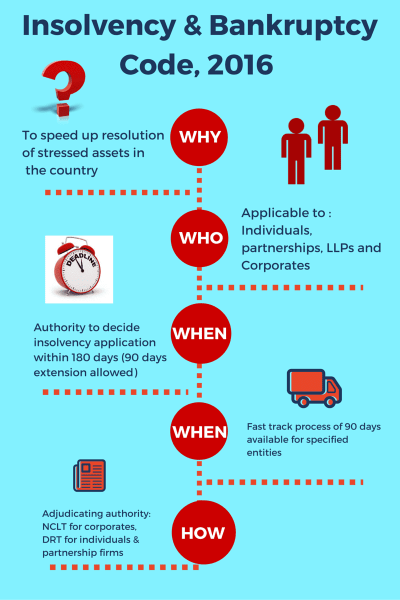
The Bankruptcy Code is an effort at a comprehensive reform of the fragmented regime of corporate insolvency framework, in order to allow credit to flow more freely in India and instill faith in investors for speedy disposal of their claims. [4]
The Code consolidates existing laws relating to insolvency of corporate entities and individuals into a single legislation.
The Code has unified the law relating to enforcement of statutory rights of creditors and streamlined the manner in which a debtor company can be revived to sustain its debt without extinguishing the rights of creditors[5]:-
1) The scheme of the Code marked a sea change from the previous regime. In respect of corporate entities, the Code introduced a creditor-in-control regime (with a focus on empowering financial creditors), a time-bound resolution process and reduced scope for judicial intervention, and established institutions such as the Insolvency and Bankruptcy Board of India, insolvency professionals and information utilities.[6]
Since the implementation of this new regime, the constitutional validity of various provisions of the Code has been challenged before various High Courts, and the Supreme Court.
Applicability
The Code provides creditors with a mechanism to initiate an insolvency resolution process in the event a debtor is unable to pay its debts. The Code makes a distinction between Operational Creditors and Financial Creditors. [7]
A Financial Creditor is one whose relationship with the debtor is a pure financial contract, where an amount has been provided to the debtor against the consideration of time value of money (“Financial Creditor”).
Recent reforms have sought to address the concerns of homebuyers by treating them as ‘financial creditors’ for the purposes of the Code. [7]
By a recently promulgated ordinance, the Insolvency and Bankruptcy Code (Amendment) Ordinance, 2018 (“the Ordinance”), the amount raised from allottees under a real estate project (a buyer of an under-construction residential or commercial property) is to be treated as a ‘financial debt’ as such amount has the commercial effect of a borrowing.[7]
The Ordinance does not clarify whether allottees are secured or unsecured financial creditors. Such classification will be subject to the agreement entered into between the homebuyers and the corporate debtor.
In the absence of allottees having a clear status, there may be uncertainty about their priority when receiving dues from the insolvency proceedings. [7]
An Operational Creditor is a creditor who has provided goods or services to the debtor, including employees, central or state governments (“Operational Creditor”). A debtor company may also, by itself, take recourse to the Code if it wants to avail of the mechanism of revival or liquidation. [7]
In the event of inability to pay creditors, a company may choose to go for voluntary insolvency resolution process – a measure by which the company can itself approach the NCLT for the purpose of revival or liquidation. [7]
What was the judicial approach to the Insolvency and Bankruptcy Code?
SERIES OF JUDICIAL PRONOUNCEMENT
With almost more than two years since the introduction of the Code, there have been various challenges in the effective implementation of the Code. However, constructive interpretation by the judiciary coupled with effective amendments to the Code has helped in eradicating most of these teething issues. [8]
Some of the key judicial pronouncements are discussed below:
The Insolvency and Bankruptcy Board of India which is the regulatory and supervisory body in charge of the IBC, has done a commendable job in proactively spreading awareness and regulating the space. [9]
Many important judgments were pronounced throughout the year, including certain landmark cases, where in the Supreme Court has tried to ensure that the spirit of the Code is given primacy over procedural requirements. [9]
Suspended Board of Directors of Corporate Debtor Entity are entitled to access the resolution plan and other related documents:-
In a significant judgments delivered on January 31, 2019, the Hon’ble Supreme Court of India decided on an important aspect with respect to the rights of the suspended board of directors of the Corporate Debtor Entity to receive and access the resolution plan and other related documents, whose case has been admitted by the Adjudicating Authority under the relevant provisions of the Code. [10]
Facts of the Case:
In respect of Mr. Vijay Kumar Jain, Director of Corporate Debtor (‘Appellant’) vs. Standard Chartered Bank and Ors. (As ‘Financial Creditors’), the NCLT had approved the appointment of Resolution Professional (‘RP’) to conduct Corporate Insolvency Resolution Process of Corporate Debtor Company i.e. Ruchi Soya Industries Limited (‘RSIL’). [10]
The appellant, being a member of the suspended board of RSIL, was given notice and agenda for the first meeting of Committee of Creditors (‘CoC’) and was permitted to attend the meeting of CoC. The appellant alleged that he was not granted permission to participate in subsequent meetings of CoC. [10]
As a result, the appellant filed a miscellaneous application before the NCLT to allow his participation in the subsequent meetings of CoC. The appellant also executed a Non-Disclosure Agreement (‘NDA’) to keep information received through participation in the CoC meeting strictly confidential and even undertook to indemnify RP. [10]
However, NCLT vide its order dated August 1, 2018 dismissed the said application of appellant with liberty to the appellant to attend the COC meetings, but not to insist upon the CoC or RP to provide information which is considered as confidential by the CoC or RP. [11]
Against the said order of NCLT, the appellant filed an appeal before the Appellate Tribunal, which recognized the right of appellant to attend and participate on the CoC meetings but Appellate Tribunal vide its order dated August 9, 2018 [12] denied the prayer of the appellant to have access to certain documents including sensitive resolution plan.
The appellant aggrieved by the order of the NCLAT, filed an appeal before the Hon’ble Supreme Court of India. [13]
Apex Court Observations and Findings:
On advertising relevant provisions of the Code and arguments of parties to the dispute, the Supreme Court opined that notice of each meeting of the CoC will have to be given to the suspended board of directors of the corporate debtor entity. [14]
The Supreme Court further noted that the statutory scheme of IBC makes it clear that though the suspended board are not members of the CoC, yet, they have a right to participate in each and every meeting held by the CoC and also have a right to discuss along with members of the CoC, resolution plan that are presented at such meeting. [14]
The Supreme Court further observed that Section 31(1) of the Code make it clear once the resolution plan is passed by the Adjudicating Authority, it shall be binding on the corporate debtor together with guarantors and other stakeholders. [14]
This being the case, it is clear that the erstwhile board of directors, which consists of persons who may have given personal guarantees for the debts owed by the corporate debtor, will be bound by the resolution plan, and therefore, have a vital stake in what ultimately gets passed by the CoC’s.[14]
The Supreme Court also made it clear that so far as confidential information is concerned, RP can take an undertaking in the form of NDA from suspended board of directors of the corporate debtor entity with an objective to maintain strict confidentiality in regard to resolution plan and other related documents. [14]
Further, according to Regulation 39(5) of IBBI (Insolvency Resolution Process for Corporate Persons) Regulations, 2016, the RP shall forthwith send a copy of the order of the Adjudicating Authority approving or rejecting a resolution plan to the participants and resolution applicant. The term ‘Participants’ includes members of the erstwhile Board of Directors of Corporate Debtor. [14]
Thus in view of the above, the Supreme Court allowed the appeal and set aside the impugned order of the Appellate Tribunal. [14]
What was the result of Insolvency and Bankruptcy Code in the present scenario? Also cite relevant case laws.
IBC came into being repealing SICA (Sick Industrial Companies Act), SICA was repealed with effect from 1 December 2016. [15]
To know the background of IBC, it is important to know more about SICA and why it failed to prevail as a law. [15]
This is the exact rationale for the existence of The Insolvency and Bankruptcy Code in India which has been into effect since 2016. [15]
To know the background of IBC, it is important to know more about SICA and why it failed to prevail as a law. [15]
The journey from SICA to IBC
The SICA, 1985:-
The name SICA, itself connotes the reason for its actuality. India witnessed an atmosphere of rampant industrial sickness in the 1980s in furtherance of which the Government of India came up with key legislation i.e. the Sick Industrial Companies Act to combat the issue. [15]
Widespread industrial sickness affects the economy in a number of ways, thus The Act came into being to spot the sick or potentially sick companies owning industrial undertakings and take speedy remedial measures for their revival or in a scenario where there is no such measure, close such units. [15]
This was an action to get the locked up investment in such industrial units released and use them in a more productive manner. SICA was repealed and replaced by the Sick Industrial Companies (Special Provisions) Act of 2003, which diluted certain provisions of SICA and filled certain gaps. [15]
One of the main changes to the new law was that, in addition to combating occupational diseases, it also aimed to reduce the growing incidence by ensuring that companies do not use a medical certificate simply to evade legal obligations and access concessions granted to financial institutions to receive. [15]
The comprehensive performance of the Act did not live up to the expected results and thus, IBC was notified as on 28th May 2016 and the repeal of SICA came into full effect from December 1, 2016. [15]
IBC Kicks In
Mistakes of the past were taken in view and The Insolvency and Bankruptcy code came into being with a wider scope and aiming to resolve the issues via more effective provisions and implementation. It is an act to consolidate and amend the laws having reorganization and insolvency resolution issues as the subject-matter. [15]
The provisions of the Act shall apply to the following in case of insolvency, liquidation, voluntary liquidation or bankruptcy; [15]
“An Act to consolidate and amend the laws relating to reorganisation and insolvency resolution of corporate persons, partnership firms and individuals in a time bound manner for maximisation of value of assets of such persons, to promote entrepreneurship, availability of credit and balance the interests of all the stakeholders including alteration in the order of priority of payment of Government dues and to establish an Insolvency and Bankruptcy Board of India, and for matters connected therewith or incidental thereto.
Whether the expression “and” occurring in section 8(2)(a) may be read as “or”?
The Court held that the expression “and” occurring in section 8(2)(a) may be read as “or” in order to further the object of the statute and/ or to avoid an anomalous situation – once the operational creditor has filed an application, which is otherwise complete, the adjudicating authority must reject the application under Section 9(5)(2)(d) if notice of dispute has been received by the operational creditor or there is a record of dispute in the information utility – So long as a dispute truly exists in fact and is not spurious, hypothetical or illusory, the adjudicating authority has to reject the application – A “dispute” is said to exist, so long as there is a real dispute as to payment between the parties that would fall within the inclusive definition contained in Section 5(6). [16]
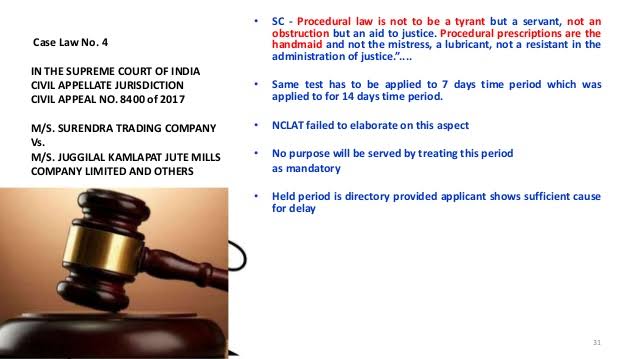
2) Surendra Trading Company Vs. Juggilal Kamlapat Jute Mills Company Ltd. & Others- Supreme Court:
The time limit prescribed in IBC, 2016 for admitting or rejecting a petition or initiation of CIRP under proviso to sub-sec. (5) of Sec. 9, is directory. [17]
The question before the NCLAT was to whether time of fourteen days under section 9(5) given to the adjudicating authority for ascertaining the existence of default and admitting or rejecting the application is mandatory or directory. [17]
NCLAT hold that the mandate of sub-section (5) of section 7 or sub-section (5) of section 9 or sub-section (4) of section 10 is procedural in nature, a tool of aid in expeditious dispensation of justice and is directory. [17]
Further question (with which supreme Court is concerned) was as to whether the period of seven days for rectifying the defects under proviso to sub-section (5) of Section 9 is mandatory or directory. The aforesaid provision of removing the defects within seven days is directory and not mandatory in nature. [17]
3) Essar Steel India Ltd. Vs. Reserve Bank of India-
RBI is authorized to direct any banking company to initiate insolvency resolution process- Gujarat High Court. [18]
A long-drawn legal battle for Essar Steel ends with this Supreme Court judgment. In one of the most discussed cases under IBC i.e. the case of Essar Steel Limited, the Supreme Court delivered its judgment which would probably be the final judgment of the case. Key highlights of the Essar Steel Supreme Court judgment are as follows: [19]
The requirement of completing the corporate insolvency resolution process within 330 days from the insolvency commencement date as introduced by the 2019 Amendment Act was held as non-mandatory. [19]
CoC can delegate its administrative powers or power of negotiation with the resolution applicants to a smaller committee (sub-committee) since such acts would be ultimately required to be approved and ratified by the CoC. [19]
Prospective resolution applicant has a right to receive complete information as to the CD, debts owed by it, and its activities as a going concern and as such it cannot suddenly be faced with “undecided” claims after the resolution plan submitted by it has been accepted. [19]
To put an end to uncertainty, parameters were laid down for limiting the scope of interference of Adjudicating Authority and Appellate Authority with the commercial decision taken by the requisite majority of CoC. [19]
The Supreme Court has re-emphasized the primacy of the commercial wisdom of the CoC in relation to resolution of the corporate debtor as well as difference in treatment of unequally placed creditors based on its earlier decisions in Swiss Ribbons and K. Sashidhar cases. [19]
Why are the judgments of the Insolvency and Bankruptcy cases pending with court?
The judgments of the cases are pending with the Court due to the Causes for the delays which range from frivolous challenges by operational creditors and promoters to basic issues like shortage of judges. [20]
There is no stipulated time-line for operational creditors to challenge the rejection of their claim, shortage of members at the bench, allowing intervention by promoters at the admission stage and long gaps between conclusion of hearing and passing of written orders are all causing delays,” said Sapan Gupta, national head banking and finance practice at Shardul Amarchand and Mangaldas. [20]
To be fair, delays are not a peculiarly Indian phenomenon. Many advanced countries struggle to provide quick, high-quality justice to citizens. But in India the scale of the problem is unprecedented. Focusing on capacity alone won’t reduce delays. [21]
A pervasive reason for the delays is adjournments. Many advanced countries struggle to provide quick, high-quality justice to citizens. But in India the scale of the problem is unprecedented.[21]
Conclusion
In conclusion, the Insolvency and Bankruptcy Code, 2016, is a progressive legislation that is intended to improve the efficiency of insolvency and bankruptcy proceedings in India. The new legislation provides for the early detection of financial distress and a time bound process for resolution. [22]
However, many details on the IBC’s implementation need to be worked out in the regulations, and its success will depend to a large extent on how quickly a high quality cadre of insolvency resolution professionals will emerge and on whether the time bound process for insolvency resolution will be adhered to in practice. [22]
The IBC has taken its first steps to regularize the insolvency process in India. It has amended over 11 legislations in India, bringing about one of the most significant changes to commercial laws in India in recent times. However, the 22 months of this nascent legislation have been ridden with controversies and speedy resolutions. [23]
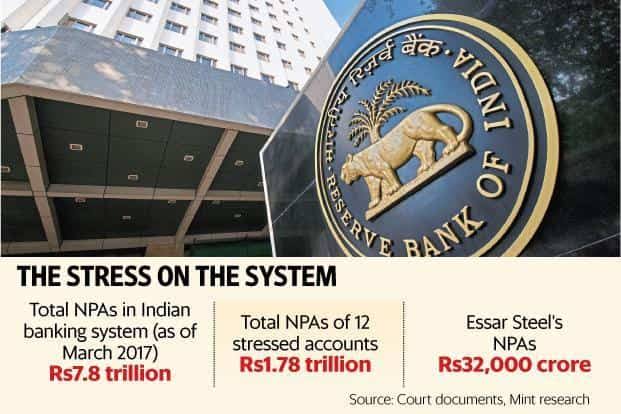
It has also become a very important tool for banks to regularize multitudes of non-performing assets plaguing the country’s economy. Within 7 months of the enactment of the IBC, the Reserve Bank of India released a list of 12 companies which held about 25% of the gross non-performing assets of the country.[23]
With more than 11% of all loans in India being terms as bad loans, the IBC has become the need of the hour. The IBC has brought a plethora of changes to insolvency laws in India and aims to reduce the amount of bad loans that has saddled the economy over the last few years. [23]
We are beginning to see this through various companies successfully concluding their insolvency process. The first successful case of a CIRP was that of Bhushan Steel wherein TATA Steel agreed to purchase Bhushan Steel for Rupees Thirty-Two Thousand Five Hundred Crores. [23]
With many more insolvency resolution processes in the pipeline, only time will tell if the IBC will prove to be a successful tool with its objective of streamlining the insolvency process in India. [23]
1) Bankruptcy Law Reforms Committee, The Interim Report of the Bankruptcy Law Reforms Committee (2015).
2) Rule 2.1.1. of RBI Master Circular – Prudential Norms on Income Recognition, Asset Classification and Provisioning – Pertaining to Advances defines an NPA as ‘An asset, including a leased asset, becomes non-performing when it ceases to generate income for the bank. A ‘non-performing asset’ (NPA) was defined as a credit facility in respect of which the interest and/ or installment of principal has remained ‘past due’ for a specified period of time.
3) It must be noted that creditors having outstanding debts continue to have the right to approach an appropriate forum like civil courts or arbitral tribunals for recovery of debts which would be a contractual right of recovery.
4) As cited in the “Abstract” of “Emerging Jurisprudence on Corporate Insolvency” by Shipra Sayal Institute of Law, Nirma University, Ahmedabad, Gujarat, India.
5) As cited in the “Introduction” Para of “A Primer on the Insolvency and Bankruptcy Code, 2016” by Nishith Desai Associates:- The Legal and Tax Counseling Worldwide.
6) As cited in the “Introduction” para of “Understanding the Insolvency and Bankruptcy Code, 2016:- Analysing the developments in jurisprudence” by “Vidhi Bankruptcy Research Programme” at the Vidhi Centre for Legal Policy and the Legal Division of the Insolvency and Bankruptcy Board of India.
7) As cited in the “Applicability” Para of “A Primer on the Insolvency and Bankruptcy Code, 2016” by Nishith Desai Associates:- The Legal and Tax Counseling Worldwide.
8) As cited in the “4th Para ,viz, Series of Judicial Pronouncement” of “Series of Judicial Pronouncement – Insolvency and Bankruptcy Code, 2016” written by Rushabh Ajmera on TaxGuru.
9) As cited in the “Introduction” Para of “Insolvency and Bankruptcy Hotline:- ANALYSING 2018 THROUGH THE LENS OF THE INSOLVENCY CODE” written on January 17, 2019 by Nishith Desai Associates.
10) As cited in the “4th Para” viz, Series of Judicial Pronouncement” of “Series of Judicial Pronouncement – Insolvency and Bankruptcy Code, 2016” written by Rushabh Ajmera on TaxGuru Website India 11 months ago.
11) As cited in “NCLT pronounced order on August1, 2018”.
13) As cited in “Facts of the Case Para” of “Series of Judicial Pronouncement – Insolvency and Bankruptcy Code, 2016” by Rushabh Ajmera 11 Months ago on TaxGuru India Website.
14) As cited in ” Apex Court Observations and Findings Para” in “Series of Judicial Pronouncement – Insolvency and Bankruptcy Code, 2016” by Rushabh Ajmera 11 Months ago on TaxGuru India Website.
15) As cited in “IBC (Insolvency and Bankruptcy Code, 2016) – The Bankruptcy Law of India” written by Vidushi Trehan, LL.M from Symbiosis Law School, Pune , Intern at Khurana & Khurana, Advocates and IP Attorneys.
16) As cited in “Brief about decision para” in ” “and” occurring in section 8(2)(a) may be read as “or”- Mobilox Innovations (P) Ltd. Vs. Kirusa Software (P) Ltd.- Supreme Court” written by IBC LAWSon September 21, 2017.
17) As cited in “Case Name: M/S. Surendra Trading Company Vs. M/S. Juggilal Kamlapat Jute Mills Company Limited and Others” written by IBC LAWS on September 18, 2017
18) As cited in “RBI is authorised to direct any banking company to initiate insolvency resolution process- Essar Steel India Ltd. Vs. RBI- Gujarat High Court” written on July 17, 2017 by IBC LAWS.
19) As cited in “The Insolvency And Bankruptcy Code In 2019 : Recent Amendments And Key Judgments” written by Mayur Shetty and Chintan Gandhi of Rajani Associates on 12th March 2020.
20) As cited in “Delay becomes the norm in insolvency & bankruptcy cases” by Joel Rebello & Saikat Das, ET Bureau on Aug 15, 2019 at 11:25pm.
21) As cited in “Hidden factors that slow our courts and delay justice” written by Arghya Sengupta.
22) As cited in “Insolvency And Bankruptcy Code” written on 12 September 2017 by Samvad Partners.
23) As cited in “2016: Overview Of The Insolvency And Bankruptcy Code, 2016” written by Namrata Bhagwatula , Senior Associate on 20 September, 2018.
Newspapers are one of the most important documents. They can be said to be the powerhouse of information. Moreover, they offer us other benefits as well which helps us in our lives. You become better informed through newspaper reading and it also broadens your perspective. However, newspaper reading is becoming a dying habit. As the world is moving towards digitalization, no one really reads the newspaper. At least not the present generation. The readership is maintained mostly because of the older generations only.
Benefits of Newspaper Reading
Newspaper reading is one of the most beneficial habits. It helps us get acquainted with the current affairs of the world. We get to know about the latest happenings through a reliable source. Similarly, we also get an insight into the different domains including politics, cinema, business, sports and many more.
Furthermore, newspaper reading also results in opening doors to new employment opportunities. Reliable companies post their ads in the newspaper for business and employment opportunities so we see how it is a good place to seek jobs.
Furthermore, we can easily promote our brands and products with the help of newspapers. The consumers learn about the latest deals and launch which connects them to businesses.
Most importantly, it also improves the vocabulary and grammar of a person. You can learn new words and rectify your grammar through newspaper reading.
In addition, a person who reads a newspaper can speak fluently on various topics. They can socialize better as they are well aware of the most common topics. Similarly, it also saves us from getting bored. You won’t need any company if you have a newspaper in hand.
The Dying Habit
Unfortunately, despite having so many benefits, newspaper reading is becoming a dying habit. As people are getting instant updates on their mobile phones and computer systems, they barely read the newspaper. Moreover, electronic gadgets are more convenient for them so they don’t bother to pick up the newspaper.
Moreover, we see that everything has become very convenient and instant now. You can learn about what is happening in the other part of the world as it is taking place. People do not wait for newspapers anymore, as they feel it only states what they have already been informed about. In addition, they do not wait for the next day to read the newspaper about current affairs, as they get it instantly thanks to the internet.
Most importantly, people are themselves running out of the habit of reading itself. Everything has become so visual now that no one bothers to read newspapers, books, novels or more. The internet has made it worse as now there is a video for everything. People won’t mind watching a five-minute video, but will however not prefer to read a five-minute-long article.
It just shows how we’re becoming so inactive and lazy. Everyone just needs things to be served on a platter. Therefore, we must not let this become a dying habit as newspapers are very reliable sources of news. In the absence of these, there will be hardly anyone left to verify the data and information we’re being fed.
It’s essential to know the exact answer to the question: “What is EEO?” The basic EEO definition (or equal employment opportunity) is the idea that everyone should be treated fairly when they’re considered for various employment decisions (including hiring, promotion, termination, compensation, etc.). This means, for example, that anyone competing for a position at a company should have the same chances of succeeding if they’re right for the job.
In the legal sense of the EEO definition, “same chances” or “equal opportunity” means that employers cannot use certain characteristics as reasons to hire or reject candidates or make other employment decisions; in other words, they cannot discriminate against those characteristics. In many countries, protected characteristics include:
Race / color
National origin / ethnicity
Religion
Age
Sex / gender / sexual orientation
Physical or mental disability
EEO doesn’t guarantee that people of underrepresented groups will get hired. The purpose of EEO regulations is to make sure nobody will face rejection or difficulties because they’re in a protected group.
For example, under several EEO laws, you cannot reject a candidate simply because they’re Jewish or Christian, African or Caucasian, or because they’re pregnant. Similarly, you cannot advertise jobs asking for candidates of a certain age, and you cannot promote men over women – you can only base this decision on each person’s proven capabilities, performance and other objective criteria, rather than biases against protected groups.
If your company fails to comply with equal employment opportunity regulations, you may face complaints, lawsuits and fines. There are also the intangible costs associated with having a uniform instead of diverse workforce; you’re missing out on the benefits of different perspectives and approaches to the work at hand.
To keep track of how EEO compliant organizations are, U.S. regulations require some employers to file the EEO-1 report. Generally, if you have more than 100 employees, or you’re a federal contractor with more than 50 employees and a federal contract worth more than $50,000, you’ll need to file an EEO-1 report.
Bona fide occupational qualification
Equal employment opportunity that concerns protected characteristics does have some exceptions. These exceptions of the EEO definition are bona fide qualifications (or “genuine occupational qualifications” in the UK) for a specific job. The nature of certain jobs may allow you to make an employment decision based on one of the protected characteristics.
For example, if you’re hiring for an actor to play a teenager, you can hire a person more closely to the age of the film character, rather than a middle-aged actor. Or, if a company makes clothes for men, it can advertise for male models. Another example is when a religious organization of a certain faith hires only candidates who share that faith if their job is related to it (for instance, when they are members of the clergy.)
Affirmative action
There’s another special case when considering specific protected characteristics. This comes in the form of affirmative action: the conscious, proactive pursuit of gender balance and diversity in an organization by supporting protected groups who are traditionally discriminated against.
For example, if your software development team is all white males, you can lawfully partner with associations of female, African or Asian engineers to find great candidates and assemble a team that is more representative of the society where they’ll be working. You still shouldn’t make the final hiring decision because of a person’s protected characteristic; you can only try to attract diverse candidates to broaden your talent pool.
This logic extends to fully formed programs that support affirmative action through education. Introducing training programs to combat hidden biases of hiring teams is an effective way to reduce unconscious discrimination.
Yet, because race-based affirmative action was banned in some U.S. states, the road is open for other effective EEO strategies. At the very least, craft an EEO policy to ensure your employees know you value fairness and diversity.
Equal Employment Opportunity should extend beyond the law
Using arbitrary and non-job-related criteria is the surest way to unfairly discriminate against people, even unwittingly. For example, when screening resumes, consider whether a person’s degree from a prestigious school truly speaks to their suitability for the job you’re hiring for. It’s not illegal to only hire candidates from Ivy League schools, but it certainly narrows your talent pool and reduces the chances of you finding the absolute best candidate out there. Make sure you always use the most objective criteria possible.
Of course, equal opportunity, diversity and relevant laws keep evolving. Different countries or states might enact new regulations, and companies might try out new EEO strategies. Be sure to check for updates regularly and don’t be afraid to test new ways of building a fair, ethical workplace.




/the-hungarian-parliament-on-the-danube-river-at-sunset-in-budapest--hungary-945207010-5c34c19346e0fb00011d477a.jpg)



















You must be logged in to post a comment.