Knowing about the Government schemes launched during COVID-19

June 2020 has seen two important government initiatives for the every-day earners for food in news. They are the Garib Kalyan Rojgar Yojana and the PM Street Vendor’s Atmanirbhar Nidhi.

First on the list is the Garib Kalyan Rojgar Yojana.  It is a central government initiative taken amidst the pandemic circumstances. The Abhiyaan was launched by the Prime Minister in June from Telihar in Bihar. As so the title suggests, the objective of the Abhiyaan is to secure, empower lives by providing livelihood opportunities. The scheme is specifically launched for that population of the country whose areas or villages have witnessed the return of a large number of migrant workers after the citizens were no longer employed following the lockdown announced for the devastating Covid-19.

This campaign is sought to be one of the components of Rs 1.70 lakh crore package under Pradhan Mantri Garib Kalyan Yojana which was set to help the poor fight against Corona Virus Pandemic.

The Campaign is nothing but a massive employment -cum- rural public works in which the public works are to be undertaken with an aim of generating a resource envelope of minimum Rs 50,000 crores. The campaign would involve 125 days of work. The public works will supposedly include rural housing for the poor along with the provision of providing drinking water through the already established Jal Jeevan mission. The infrastructure of Panchayat Bhavans, rural mandis, community toilets, rural roads, etc. are sought to be developed.

The initiative is hoped to cover 116 districts in 6 states – Uttar Pradesh, Bihar, Rajasthan, Madhya Pradesh, Odisha and Jharkhand. There are 27 aspirational districts hoped to be covered under this initiative. The mentioned are estimated to hopefully cover about 2/3 of the unemployed migrant workers. A major emphasis has also been put to the rural infrastructure. The initiative will have 25 different types of public works which is specifically to create infrastructure and importantly boost livelihood opportunities in the areas.

High speed and cheap internet are also part of the maintenances to be provided in every rural household. Thus, there shall be laying of fibre cable.

The campaign however would require a Multi-Ministerial Effort between different Departments of the Government with Ministry of Rural Development as the nodal Ministry along with the other ministries such as Panchayati Raj, Mines, Road and transport etc.

Second on the news was the PM Svanidhi. The initiative PM Street Vendor’s Atmanirbhar Nidhi was launched by the Ministry of Housing and Urban Affairs. It is launched with the aim of introducing a special micro-credit facility Scheme which would provide affordable loans to the street vendors, who recently went on losses or no business at all since the wake of the COVID-19 crisis. This scheme will thus enable the street vendors to resume work and earn their livelihoods.

The beneficiaries will include over 50 lakh people which would include the vendors, hawkers, etc. who work to supply fruits, vegetables, ready-to-eat street foods etc in the markets. It would also include the business of service providers like barber shops, laundry services etc.

The scheme shall be available for beneficiaries belonging to only those States and Union Territories which have notified been under the Rules and Scheme provided under Street Vendors Protection of Livelihood and Regulation of Street Vending Act in 2014.

The vendors or the hawkers can avail a loan (working capital) of up to Rs. 10,000 which is subject to be repayable in monthly instalments within the tenure of one year. On timely and the early repayment of the loan, credit limit was claimed to be raised and interest subsidy to be given at the rate of 7% per annum which ultimately shall be credited through Direct Benefit Transfer on a quarterly basis. 108 cities were selected, and the loan disbursement was planned to commence in July, 2020.  The eligible lenders were rated as the bank such as Regional Rural Banks, Small Finance Banks, Non-Banking Finance Companies, Micro Finance Institutions established in some States and Union territories.

The Small Industries Development Bank of India (SIDBI) is an implementation agency. It was developed to manage the credit guarantee approved to the lending institutions through Credit Guarantee Fund Trust for Micro and Small Enterprises.The SIDBI was developed through an Integrated PM SVANidhi portal. The Portal was developed to integrate  credit management and PAiSA portal of MoHUA to administer the interest subsidies automatically.

Ruskin Bond: Literally a ‘Legend’

The Indian author of British descent, Ruskin Bond was born in Kasauli in 1934. Bond marks his 70 years of writing by releasing his book, ‘A Song of India’ on 20th july. This book is the fourth part of his memoir series, the preceding are ‘Looking for the Rainbow’, ‘Till the Clouds Roll By’ and ‘Coming Round the Mountain’.
A Song of India, describes his journey of becoming a writer. In this book he is shedding light on his lesser known life before becoming a celebrated author.

The seven decades of writing
One of the most beloved writer of the country, Ruskin Bond wrote his first novel, The Room on the Roof, when he was seventeen. For this very first novel he won John Llewellyn Rhys Memorial Prize in 1957.
Since then he has written many exceptional classics, over 500 short stories and various essays and poems. For his immense contribution in English writing he received the Sahitya Akademi award in 1992. He was awarded the Padma Shri in 1999 and Padma Bhushan in 2014.


The Himalayan Impact
The literacy legend has lived in various cities of the world, yet he finds the foothills of Himalaya the closest of his heart. He says that, ‘In these seven decades, I have written hundreds of stories for children and just as many for adults too and I am still continuing to do so. I am very fortunate to have lived in a beautiful part of the country, in the Mountains’. The bonding of Ruskin Bond with Mountains is quite significant in his writings.
In these seventy years, Bond experimented with almost every genre of writing. His works include fiction, non-fiction, short stories, novels, romance and autobiographies. Some of his significant writings are, With Love From The Hills, The Room on the Roof, Rusty Runs Away, A Flight of Pigeons, The Blue Umbrella, A Tiger in the House, A Town called Dehra and many more.

MOST LOW-PRICE & AFFORDABLE INTERNET IN THE WORLD

Internet has become the most essential virtual commodity due to the Global Pandemic 2020. Its demand has reached a peak now more than ever. It has been declared as the basic necessity along with Food, Clothing, Shelter and Education.

In most Countries, schools and colleges are functioning through digitalized classrooms which require high speed data. 75% of office goers are working from home and the servers that connects the employers to the employees is kept alive on internet connections.

How can everybody afford the Internet? A recent report by Visual Capitalist reveals how much 1GB of mobile data costs in every country. Let’s have a look at what it costs to stay virtually connected in many Countries of the World:


1) India:

The Visual Capitalist report states that India has the most-affordable mobile data plans worldwide. India offers 1GB mobile data for just under Rs. 7, which is the cheapest in the world.

 Why is data so cheap in India? A significant factor is the country’s intense market competition, driven by Reliance Jio—a telecom company owned by Reliance Industries, one of the largest conglomerates in India. Reliance Jio launched in 2016, offering customers free trial periods and plans for less than a $1 a month. This forced other providers to drop their pricing, driving down the overall cost of data in the region.


2)  Sri Lanka:

Mobile internet in India’s southern neighbouring country, Sri Lanka, costs roughly Rs 38 per 1GB data. Some of the biggest Telcos in the country are Dialog, Airtel Lanka, SLT Mobitel, etc.


3)  Russian Federation:

1GB of mobile data plan in Russia costs roughly Rs 39. This makes Russia the ninth most-affordable country for cheap mobile data plans. Some of the biggest telecoms in the country, which is the fourth biggest smartphone market, are Mobile TeleSystems (MTS), Beeline, MegaFon, etc.


4)  Vietnam:

Mobile Internet in Vietnam costs roughly Rs 43, which according to the latest data, ranks 10th in the list of countries that offer the most affordable 1GB data plan. The biggest telecom operators in the Asian country are Viettel, MobiFone, Vinaphone.


5)  Italy:

Italy ranks fourth in the list of countries that offer the most affordable data plans worldwide. In Italy, 1GB of mobile data Rs.32.


6)  Israel:

 1GB of mobile data in Israel costs roughly Rs 8, making it the second most-affordable nation for internet usage.


7)  Ukraine:

Ukraine shares a similar per GB mobile data tariff cost as Kazakhstan, where 1GB mobile data costs Rs 34.


8)  Somalia:

1GB mobile data in Somalia costs roughly Rs 38, slightly cheaper than Sri Lanka’s per GB cost. The biggest telecom operators in the African country are Hormuud, Telecom Somalia, etc.


There has been a significant surge in the number of internet users over the last few years, which has led to telecom service providers competing against each other and lure consumers with the most value-for-money packs. the internet in India is quite affordable if you compare it with the rest of the world. 

Jack Ma’s Ant Group chooses Hong Kong and Shanghai for its Mega IPO

One of China’s biggest tech firms has chosen to stay home for its blockbuster IPO, shunning Wall Street where Chinese companies are facing heightened Scrutiny because of rising geopolitical tensions.

Ant Group announced on Monday that it is planning “a concurrent initial public offering” in Hong Kong and on Shanghai’s Star Market, China’s answer to the Nasdaq extending a series of mega tech listings amid the fallout in US-China trade relations.

Ant Group, previously known as Ant Financial, is an affiliate of Alibaba Group Holding, the owner of the South China Morning Post.

Ant is affiliated with E-commerce giant Alibaba, which raised a record $25 billion when it debuted on Wall Street in 2014 still the world’s second largest IPO to date. Ant owns Alipay, one of the most popular payment apps in China, and also offers online financial services such as loans, investments and credit scoring systems.

While the provider of the Alipay service is still discussing the size and timing of the share sale, the outcome is likely to be one of the largest initial public offerings in years. Stock analysts are valuing Ant at more than US$200 billion, higher than state-owned China Construction Bank and just shy of Bank of America’s market capitalisation.

Alibaba received a 33 per cent equity interest in Ant Financial in September last year under a restructuring that also ended a profit-sharing arrangement between them, according to its prospectus in November. While Alibaba does not control Ant Group, its co-founder and China’s richest man Jack Ma effectively controls about 50 per cent of the voting interest in Ant Group, according to its annual report.

The public listing will enable Ant, which operates the Alipay wallet used across Alibaba’s e-commerce networks, to work toward several goals: digitize China’s service industry, such as getting mom and pop shops in far-flung regions to use its payments service; drive domestic demands, such as being a conduit of government-issued coupons for consumers amid coronavirus pandemic; expand globally through its e-wallet partners in nine countries; and finally, invest in new technologies.

Bankers are valuing Ant at a staggering $200 billion, according to sources from Reuters. The company declined to comment on its valuation. If Ant sells 10% of the company in the IPO, it would generate $20 billion in proceeds, which would place it third in terms of the largest IPO deals ever, just behind Alibaba’s $22 billion IPO and Saudi Aramco’s $25 billion IPO.

‘Aryabhata’- Father Of Indian Mathematics

Aryabhata was one of the first Indian mathematicians and astronomers belonging to the classical age. He was born in 476 BC in Tarenaga, a town in Bihar, India. His major work, Aryabhatiya, a compendium of mathematics and astronomy, was extensively referred to in the Indian mathematical literature and has survived to modern times. The mathematical part of the Aryabhatiya covers arithmetic, algebra, plane trigonometry, and spherical trigonometry. It also contains continued fractions, quadratic equations, sums-of-power series, and a table of sines. It is however definite that he travelled to Kusumapara for studies and even resided there for some time. It is mentioned in a few places that Aryabhata was the head of the educational institute in Kusumapara. The University of Nalanda had an observatory in its premises so it is hypothesized that Aryabhata was the principal of the university as well. On the other hand some other commentaries mention that he belonged to Kerala.

Mathematical Work

Aryabhata wrote many mathematical and astronomical treatises. His major work, Aryabhatiya, a compendium of mathematics and astronomy, was extensively referred to in the Indian mathematical literature and has survived to modern times. The mathematical part of the Aryabhatiya covers arithmetic, algebra, plane trigonometry, and spherical trigonometry. It also contains continued fractions, quadratic equations, sums-of-power series, and a table of sines. His chief work was the ‘Aryabhatiya’ which was a compilation of mathematics and astronomy. The name of this treatise was not given to it by Aryabhata but by later commentators. A disciple by him called the ‘Bhaskara’ names it ‘Ashmakatanra’ meaning ‘treatise from the Ashmaka’. This treatise is also referred to as ‘Arya-shatas-ashta’ which translates to ‘Aryabhata’s 108’. This is a very literal name because the treatise did in fact consist of 108 verses.

Aryabhata worked on the place value system using letters to signify numbers and stating qualities. He also came up with an approximation of pi and area of a triangle. He introduced the concept of sine in his work called ‘Ardha-jya’ which is translated as ‘half-chord’.

Astronomical Work

Aryabhata also did a considerable amount of work in astronomy. He knew that the Earth is rotating on an axis around the sun and the moon rotated around it. He also discovered the position of nine planets and stated that these also revolved around the sun. He pointed out the eclipses, both lunar and solar. Aryabhata stated the correct number of days in a year that is 365 days. He was the first person to mention that the earth was not flat but in fact a spherical shape. He also gave the circumference and diameter of the earth and the radius of the orbits of 9 planets.

More about Aryabhata

Aryabhata was a very intelligent man. The theories that he came up with at that time present a wonder to the scientific world today. His works were used by the Greeks and the Arabs to develop further. A commentary by Bhaskara I, a century later on Aryabhatiya says:

‘Aryabhata is the master who, after reaching the furthest shores and plumbing the inmost depths of the sea of ultimate knowledge of mathematics, kinematics and spherics, handed over the three sciences to the learned world.’

Aryabhata’s Legacy

Aryabhata was an immense influence to mathematics and astronomy. Many of his works inspired Arabs more particularly. His astronomical calculations helped form the ‘Jalali calendar’. He has been honored in many ways. The first Indian satellite is named after him as ‘Aryabhata’, so is the lunar crater. An Indian research center is called ‘Aryabhata Research Institute of Observational Sciences’.

Who is Aryabhatta? What is he known for? - Quora

TIPS TO FIND YOUR PASSION

Some people are born understanding their passions, but others have to work to find them— and it is overwhelming to consider how to begin. The first step is to start. Below are five tips to help you on your journey to finding work and hobbies you are truly passionate about:

1. WHAT DO YOU DO WELL?

This question helps you uncover that unique talent that sets you apart from others. Perhaps you’re good at public speaking or motivating others. Or maybe you’re good at finding computer bugs or supporting your friends through tough times. Whether you have a hard or soft skill, knowing what you do well will put you on your way to using your talent in your purpose.

2.   WHAT DO THE PEOPLE AROUND YOU SAY ABOUT YOUR SKILLS?

Unfortunately, it can be hard to recognize your own talent. When something comes naturally, it doesn’t always seem special. To get some help, ask your family or friends what they think you’re good at doing. This question gets to the heart of recognition “Most of us are not self-aware,” says Maxwell. “We all have blind spots, but you can ask others to help you identify your talents. “Ask several people, suggests Maxwell. When you start to hear certain talents over again, you’ve identified an area of strength.

3.   IF YOU COULD DO OR BE ANYTHING, WHAT WOULD YOU DO OR BE?

This question taps into your internal desires, and can help you identify your purpose. A good way to answer this question is to consider those things you like to do in your free time or the projects at work you volunteer for or seek out. You can also think about the spots in the day when time seems to fly—what are you doing when you get lost or immersed in a project?

These things should also align with your talent, and it’s important to not confuse purpose with passion, says Maxwell. “Sometimes your passion is something you’re not any good at,” he says. “If you’re passionate about something you’re not good at, you can make it a hobby, not a career.”

4.  WHAT GIVES YOU RESULTS WHEN YOU DO SOMETHING?

Your purpose will give you a return, and this question helps you identify the things you do that generate results. For example, if your talent is sales, you likely hit your goals every month. Or if you are good at innovative thinking, you might share ideas at work that prompt new projects. Pay attention to the tasks you do that get you accolades and awards.

Strengths and purpose are more than knowledge, says Maxwell. “Knowledge is overrated,” he says. “I can ask Siri, and she’ll tell me what I need to know. But what value is something if you know it but don’t use it? The result of knowing or learning is action application.”

5.   HOW CAN YOU GET BETTER?

Once you identify your uniqueness, you need to fine-tune and work harder at it to set yourself apart. While having talent helps make you special, developing it further can make you strong. “Your growth potential is connected to your strengths,” says Maxwell. “In your weak areas, your growth potential is low, but when you’re working to improve your strength, you have a higher capacity.”

Mark Twain once said the two greatest days in a person’s life are the day they’re born and the day they discover why. Deep? Definitely. But let’s be honest: the first day is a somewhat passive experience. The second day, however, can feel like a lot of pressure. While some of us can quickly identify our purpose (in our careers, or otherwise), others may struggle to answer the question “Why am I here?”

No one has ever been successful doing something that they didn’t like, and no one has ever been successful doing something they can’t do well, says Maxwell. “I see millions of people every day doing something they don’t like doing and wondering why they’re not a success,” he says. “Success is knowing your purpose in life and having a growth plan to help you reach your maximum potential.”


Changes in Labour Laws to reduce COVID-19 impact

Amidst the COVID-19 induced lockdown, many states such as Uttar Pradesh, Madhya Pradesh, Rajasthan, and Gujarat have brought in changes to their labour laws by way of amendments. Recently, Uttar Pradesh government has passed an ordinance by virtue of which businesses and both existing and new industrial units have been exempted from the purview of most labour law provisions for the next three years. The state cabinet cleared the labour law ordinance suspending more than 30 kind of labour laws in the state. Nonetheless, the four laws that will still apply to businesses and industries are the Building and Other Construction Workers Act, Section 5 of Payment of Wages Act, Workmen Compensation Act and Bonded Labour Act.

Other labour laws likes those related to settling industrial disputes, health and working conditions of workers and trade unions, contract workers and migrant workers will be defunct for three years. By such act of the State Government, the owners of the factories have been given more powers to hire and fire without attracting punitive measures from the labour department up to a certain limit. In another departure from the past, the enforcement wing would not raid the premises of factories on minor issues.

Labour minister Swami Prasad Maurya states that suspension of such labour laws would assist in establishment of new industries and ease the problems of existing ones during present catastrophic situations which has created a severe impact on the economy. “The laws will apply to both existing businesses and new industries. We have made sure that labourers do not suffer or are taken advantage of, but we also had to ensure to remove any additional burden on the industrialist,” he said.

Since labour is a concurrent subject, states can frame their own laws but will need the approval of the Centre to enforce them. Therefore, the ordinance will also be sent to the Central government for approval.

Like Uttar Pradesh, State Government of Madhya Pradesh has exempted employers from some obligations under various labour laws, like Madhya Pradesh Industrial Relations Act and Industrial Disputes Act, as well as Contract Labour Act for 1,000 days, allowing employers to hire and fire workers “at their convenience”. The state has also allowed exempted firms flexibility of extension of working hours. Further, it has exempted new factories under the Factories Act, 1948 from inspection from the Labour Department and permitted the flexibility to conduct third party inspections at will. The state has also issued an ordinance to the Madhya Pradesh Labour Welfare Fund Act, 1982, exempting all newly established factories from filing annual returns and paying prescribed nominal amount per labourer per year to the Madhya Pradesh Labour Welfare Board for next 1,000 days. It must be noted that the changes to the Madhya Pradesh Industrial Employment (Standing Orders) Act, 1961 will exempt industries employing up to 100 workers from the law’s provisions.

In a similar attempt, State Government of Rajasthan has raised the working hours from 8 hours per day to 12 hours per day. Moreover, the State Government has also amended the Industrial Disputes Act to increase the threshold for lay-offs and retrenchment to 300 from 100 earlier. Furthermore, in order to recognize the trade union, the threshold membership of the trade union has been increased from 15 per cent to 30 per cent.

The New Consumer Protection Act,2019 in India is an upper hand and an added advantage for the consumers in manifold ways

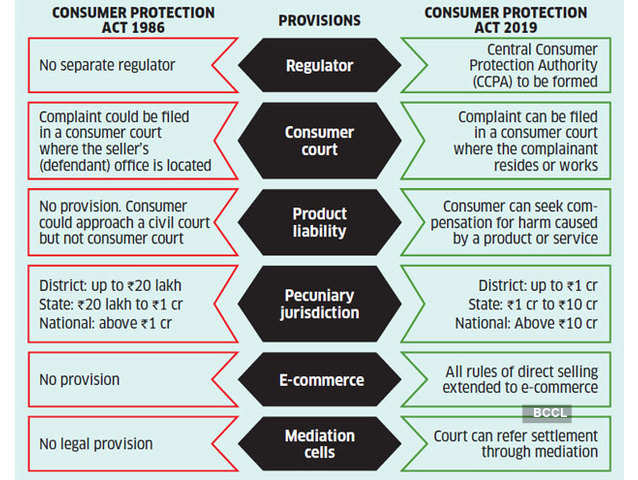
The Consumers can now cheer as the Consumer Protection Act, 2019 has recently replaced the three decade old Consumer Protection Act, 1986. The Consumer Protection Act, 2019 which came into effect on Monday (July 20) has replaced the earlier Consumer Protection Act, 1986.

The new Act as per the Experts say that “it gives more power to the consumers”. It seeks to revamp the process of administration and settlement of consumer disputes, with strict penalties, including jail term for adulteration and misleading ads by firms.

On July 20, 2020 certain provisions of the Consumer Protection Act, 2019 came into force as notified by the Central Government. Following the the key features of the relevant provisions:-

Key features of the Consumer Protection Act, 2019 which came into effect on July 20, 2020:-

1) Consumers can now institute a complaint from where they reside or work for gain.

2) The original pecuniary jurisdiction of the District Commissions has increased upto ₹1 crore from ₹20 lakh earlier.

3) The Pecuniary jurisdiction of State Commissions has been increased from ₹1 crore to Rs. 10 crore.

4) The National Commission can hear cases above ₹10 crore when compared to above ₹1 crore earlier.

5) While the provisions relating to e-commerce are not yet notified, a section relating to electronic service provider (covering software services, electronic payments) is notified.

6) The opposite party needs to deposit 50% of the amount ordered by the District Commission before filing an appeal before the State Commission. Earlier, the ceiling was a maximum of ₹25,000, which has been removed.

7) The limitation period for filing of appeals to the State Commission has been increased from 30 days to 45 days.

8) The Parties can be allowed to settle the disputes through mediation.

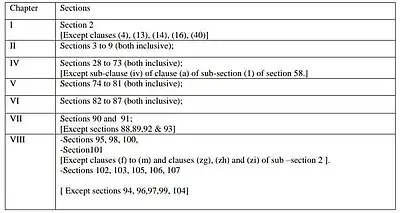
Following are the Sections which came into force:

Consumer Protection Act 2019- Sections to come into force from July 20,2020

Above mentioned provisions pertain to the Consumer Protection Councils, Consumer Disputes Redressal Forum, Mediation, Product Liability, punishment for manufacturing, selling, distributing etc spurious good or products which contain adulterant.

As per the rules, the e-commerce players will have to display the total ‘price’ of goods and services offered for sale along with break-up of other charges. Only a few certain miscellaneous provisions with regards and respect to the powers of the Central and State Government to make the rules and regulations have also been enforced.

On misleading advertisements there is provision for jail term and fine for manufacturers. There is no provision for jail for celebrities but they could be banned for endorsing products if it is found to be misleading.

For the first time there will be an exclusive law dealing with Product Liability. A manufacturer or product service provider or product seller will now be responsible to compensate for an injury or damage caused by the defective product or deficiency in services.

The Act has also defined an “e-commerce” as the buying or selling of goods or services including the digital products over digital or electronic networks. The existing definition of e-commerce has been adopted from India’s FDI Guidelines on e-commerce.

The definition of ‘e-commerce Entity’ as provided under the FDI Guidelines includes inventory and market place models.

There is also a provision for class action law suit for ensuring that rights of consumers are not infringed upon. The authority will have power to impose a penalty on a manufacturer or an endorser of up to 10 lakh rupees and imprisonment for up to two years for a false or misleading advertisement.

WEBSITES REFERRED

1)https://consumeraffairs.nic.in/acts-and-rules/consumer-protection

2)https://www.barandbench.com/news/law-policy/provisions-under-consumer-protection-act-2019-to-come-into-force-on-july-20-2020-centre-notifies

3)https://www.google.com/amp/s/www.thehindu.com/news/national/tamil-nadu/new-consumer-protection-act-gives-more-power-to-consumers-experts-say/article32135908.ece/amp/

4)https://www.google.com/amp/s/www.livemint.com/news/india/consumer-protection-act-rules-for-e-retailers-to-be-effective-by-this-weekend/amp-11595291549084.html

5)https://www.google.com/amp/s/zeenews.india.com/economy/new-consumer-protection-act-2019-comes-into-force-today-know-how-it-will-benefit-you-2297012.html/amp

6)https://www.google.com/amp/s/m.economictimes.com/wealth/spend/heres-how-consumers-will-benefit-under-the-new-consumer-protection-act/amp_articleshow/70711304.cms

7)https://www.google.com/search?q=consumer+protection+act%2C2019&tbm=isch&ved=2ahUKEwjOhv7-sN7qAhVIH3IKHTOCBfMQ2-cCegQIABAC&oq=Consumer&gs_lcp=ChJtb2JpbGUtZ3dzLXdpei1pbWcQARgAMgQIIxAnMgUIABCxAzIFCAAQsQMyBQgAELEDMgUIABCxAzoHCCMQ6gIQJzoCCAA6BwgAELEDEEM6BAgAEENQ0xRYzipg1jBoAnAAeACAAZABiAGHCJIBAzAuOJgBAKABAbABBcABAQ&sclient=mobile-gws-wiz-img&ei=e-QWX47dJsi-yAOzhJaYDw&bih=682&biw=393&prmd=ivn#imgrc=eILduqMFjleJaM

8)https://www.vecteezy.com/free-vector/consumer

9)https://www.google.com/amp/s/www.livelaw.in/amp/news-updates/most-provisions-of-consumer-protection-act-to-come-into-force-160003

Mahatma Gandhi

Mahatma Gandhi was a great patriotic Indian, if not the greatest. He was a man of an unbelievably great personality. He certainly does not need anyone like me praising him. Furthermore, his efforts for Indian independence are unparalleled. Most noteworthy, there would have been a significant delay in independence without him. Consequently, the British because of his pressure left India in 1947. In this essay on Mahatma Gandhi, we will see his contribution and legacy.

Contributions of Mahatma Gandhi

First of all, Mahatma Gandhi was a notable public figure. His role in social and political reform was instrumental. Above all, he rid the society of these social evils. Hence, many oppressed people felt great relief because of his efforts. Gandhi became a famous international figure because of these efforts. Furthermore, he became the topic of discussion in many international media outlets. Mahatma Gandhi made significant contributions to environmental sustainability. Most noteworthy, he said that each person should consume according to his needs. The main question that he raised was “How much should a person consume?”. Gandhi certainly put forward this question. Furthermore, this model of sustainability by Gandhi holds huge relevance in current India. This is because currently, India has a very high population. There has been the promotion of renewable energy and small scale irrigation systems. This was due to Gandhiji’s campaigns against excessive industrial development.

Mahatma Gandhi’s philosophy of non-violence is probably his most important contribution. This philosophy of non-violence is known as Ahimsa. Most noteworthy, Gandhiji’s aim was to seek independence without violence. He decided to quit the Non-cooperation movement after the Chauri-Chaura incident. This was due to the violence at the Chauri Chaura incident. Consequently, many became upset at this decision. However, Gandhi was relentless in his philosophy of Ahimsa.

Secularism is yet another contribution of Gandhi. His belief was that no religion should have a monopoly on the truth. Mahatma Gandhi certainly encouraged friendship between different religions.

Legacy of Mahatma Gandhi

Mahatma Gandhi has influenced many international leaders around the world. His struggle certainly became an inspiration for leaders. Such leaders are Martin Luther King Jr., James Beve, and James Lawson. Furthermore, Gandhi influenced Nelson Mandela for his freedom struggle. Also, Lanza del Vasto came to India to live with Gandhi. The United Nations has greatly honored Mahatma Gandhi. UN has made 2nd October as “the International Day of Nonviolence.” Furthermore, many countries observe 30th January as School Day of Nonviolence and Peace. The awards given to Mahatma Gandhi are too many to discuss. Probably only a few nations remain which have not awarded Mahatma Gandhi.

In conclusion, Mahatma Gandhi was one of the greatest political icons ever. Most noteworthy, Indians revere by describing him as the “father of the nation”. His name will certainly remain immortal for all generations.

Human Rights Violations

“We can disagree and still love each other unless your disagreement is rooted in my oppression and denial of my humanity and right to exist.”

James Baldwin

What are Human Rights?

We learn social and moral cues from our environment. No one teaches us norms, things that come “naturally” to us. However, the basic freedom that everyone needs can’t be left up to the general public. They need to be written down and strictly monitored. 

Human Rights are basic rights each person deserves and gets, to live, express, study freely, and more.

Towards the end of World War II, the UN and other organizations created the Universal Declaration of Human Rights as the Universal Constitution. 

There are 30 Rights given to each individual and they are entitled to them regardless of their sex, age, orientation, colour, or any other differential characteristic.

Why is Human Rights important?

Every person is unique and so is every culture, religion, and nationality. These differences and the human urge to control and dominate makes it hard to maintain human rights for everyone. So a list was of articles were made to ensure:

  • Everyone is treated with respect and given equal opportunities
  • Protects those vulnerable from exploitation
  • Give citizens the opportunity and support to stand against societal corruption and inequality
  • Encourage freedom of speech and expression
  • Provide an opportunity for education
  • Allows everyone to practice their religion or any other practice
  • Allow people to love, marry, and start a family with whomever.
  • Encourages equal work opportunities
  • Protects the environment
  • To protect the world from having another war.

Who governs the Human Rights? How to Protect Human Rights?

The UN has set up a lot of committees that govern Human Rights. 

  • Office of the UN High Commissioner for Human Rights (OHCHR)
    • The OHCHR is most responsible for promoting and protecting human rights.
    • The High Commissioner of Human Rights regularly comments on Human Rights situations in the world and has the authority to investigate situations and issue reports on them.
  • Human Rights Council
    • Established in 2006, is the key independent UN intergovernmental body responsible for human rights.
  • Human Rights Treaty Bodies
    • Is the committee of independent experts that monitor implementation of the core International Human Rights Treaties.
  • Special Procedures
    • Experts working voluntarily, who examine, monitor and publicly report and advice on Human Rights
  • UNDG-HRM
    • UN Development Group’s Human Rights Mainstreaming Mechanism pushes the mainstreaming efforts within the UN.

Enforcing International Human Rights:

  • The International Bill of Human Rights
    • The first legal document protecting universal rights
  • Democracy
    • Democracy is the ultimate means of achieving the 3 pillars of the UN Charter, international peace and security, economic and social progress, and development. 
  • Security Council
    • Main duties involve dealing with grave human rights violations. 
  • Third Committee of the General Assembly
    • Examines a range of issues including human rights questions.
  • Other Bodies
    • Secretary-General, General Assembly, Economic and Social Council, Member States, The United Nations Permanent Forum on Indigenous Issues are a few other committees that work to maintain the UDHR’s promise of providing each individual all the Human Rights.

Retribution for Violations:    

Violating Human Rights not only weakens a country’s strength, but also affects an individual socially, emotionally, and economically. Human Rights are set in place to protest people, breaking them causes deep psychological trauma for years to come. African-Americans freed from slavery centuries ago, still are restricted and living lives fighting systematic racism each day.

In 1996, the International Criminal Court (ICC) was created to prosecute any human rights violator. “The ICC is authorized to try crimes against humanity, genocide, war crimes, slavery, mass rape, torture, and racism.”

The ICC can prosecute any individual, group, or government out of power and sentence them to prison (in their state) or death.

Why hasn’t Human Rights bettered the World?

Countries that are Violating Human Rights:

Almost every country is violating at least 3 human rights. Below is a list of violations from a few countries.

Australia

  • Denying basic rights to Asylum seekers and Refugees
  • Exploiting Indigenous people
  • Unreliable cyber surveillance
  • Lacking support and rights for Disabled citizens
  • Forced labor in the form of the recent Modern Slavery Bill

Brazil

  • Horrifying Prison Conditions
  • Prisoners face torture, assault, and unfair punishments
  • High rates of Juvenile Detainees
  • Reporters being made political prisoners
  • Denying basic rights to Asylum seekers and Refugees

Cuba

  • Illegal detaining
  • Denied freedom of speech and expression
  • An increasing number of political prisoners
  • Horrifying prison conditions
  • Exploiting workers

Democratic Republic of Congo

  • Denied freedom of speech and expression
  • Frequent attacks on civilians
  • Corrupted justice system
  • Women being denied basic rights
  • LGBTQ people denied basic rights
  • Disabled people being denied rights

El Salvador

  • Police Brutality
  • Horrifying Prison Conditions
  • Degrading prisoners and abusing them
  • Increasing gang violence
  • Women being denied basic rights and reproductive rights
  • Attacks on media

France

  • Flawed Asylum and Immigration Laws
  • Denying basic rights to Asylum seekers and Refugees
  • Flawed Child Protection services
  • Increased Sexual Assault and Rapes

Germany

  • Flawed Asylum and Immigration Laws
  • Denying basic rights to Asylum seekers and Refugees
  • Xenophobic culture
  • Illegal detaining
  • Corrupted Criminal Justice System

Haiti

  • Corrupted Criminal Justice System
  • Illiteracy
  • Women being denied basic rights
  • LGBTQ people denied basic rights
  • Disabled people being denied rights
  • Child Labor
  • Illegal detaining
  • Exploiting workers

India

  • Increased violence against Dalits, Tribals, Muslims and other marginalized communities
  • Denied freedom of expression
  • Police brutality
  • Women being denied basic rights
  • LGBTQ people denied basic rights
  • Disabled people being denied rights
  • Targeting political oppositions
  • Denied freedom of speech
  • High rates of Human trafficking
  • Corrupted Criminal Justice System
  • Child Labor
  • Illiteracy
  • Forced Prostitution and Begging
  • Increased Violence against women, LGBTQ and marginalized communities
  • Honour Killings
  • Denying Inter-Caste Marriages
  • Female Foeticide
  • Conservative Abortion Laws
  • Exploiting workers
  • Racist courts, hospitals, educational institutions, work places
  • Corruption
  • Poverty
  • Alarming rise in Sexual Assault and Rapes
  • Broken Healthcare System
  • Pollution
  • inconsistent access to food
  • Inconsistent access to sanitation
  • Regionalism, Casteism
  • Increasing addiction amongst the youth
  • domestic violence
  • Double Burden of Malnutrition

Japan

  • High rates of Death Penalty
  • Denied freedom of speech
  • Women being denied basic rights
  • LGBTQ people denied basic rights
  • Disabled people being denied rights

Kenya

  • Government controlled Media
  • Open threats to oppositions
  • Lack of accountability for rape and sexual violence
  • Women being denied basic rights
  • LGBTQ people denied basic rights

Libya

  • Armed Conflicts and War Crimes
  • Illegal Detaining
  • High rates of Death Penalty
  • Denied freedom of speech
  • Denied freedom to practice one’s religion 

Maldives

  • Targeting political oppositions
  • Denied freedom of expression
  • Women being denied basic rights
  • LGBTQ people denied basic rights
  • High rates of Human trafficking

Nepal

  • Changing Criminal Codes
  • Exploiting migrant workers
  • Women being denied basic rights
  • Disabled people being denied rights
  • LGBTQ people denied basic rights

Oman

  • Denied freedom of expression
  • Women being denied basic rights
  • Disabled people being denied rights
  • LGBTQ people denied basic rights
  • Exploiting migrant workers

Peru

  • Police brutality
  • Denied freedom of expression
  • Women being denied basic rights
  • Disabled people being denied rights
  • LGBTQ people denied basic rights

Qatar

  • Women being denied basic rights
  • Exploiting migrant workers
  • LGBTQ people denied basic rights
  • Refugees being treated horribly

Russia

  • Opposing citizens are openly tortured to death
  • Denied freedom of speech
  • Denied freedom of web use
  • LGBTQ people denied basic rights
  • A high number of domestic violence cases

South Korea

  • Denied freedom of expression
  • Exploiting workers
  • Women being denied basic rights
  • LGBTQ people being denied basic rights

Tunisia

  • Inoperative Constitution and parliament
  • Denying freedom of expression
  • Women are denied basic rights
  • LGBTQ people are denied basic rights

United States of America

  • Unfair and Harsh Criminal Sentencing of marginalized communities
  • Police Brutality often leading to deaths
  • Increasing Hate Crimes
  • No Health Insurance
  • Many are denied education/employment-based on discriminatory grounds

Venezuela

  • Prosecuting political opponents and those who speak against the government
  • Dictator as the Country Head
  • Preventing peaceful protests
  • Humanitarian Crisis

Zimbabwe

  • Media is controlled by the government
  • Non-heterosexual relationships are a criminal offense
  • Right to health has been violated multiple times

What happens when a Country Violates Human Rights?

Enforcing Human Rights on an international level is difficult and often problematic. Many countries might be unwilling to cooperate. The Human Rights Council was set up in 2006 to promote and protect human rights and is the main committee that overlooks the workings. The UN has a screening process in place to filter out any breach ton human rights violations.

When the UN receives a complaint, it launches an investigation. The International Criminal Court carries out the criminal proceedings of human rights abuse. 

Why isn’t the UN and the ICC able to control Human Right Violations?

The UN has the right to intervene and fix any violations of Human Rights. The problem arises when the country in question refuses to let the UN intervene. The UN cannot carry out an investigation when the country denies consent. A debate may be held on the country’s human rights abuses. If neither the investigation, not the debate allows the UN to intervene, all the UN can do is pass a resolution condemning the country’s human rights abuse.

Unlike the UN, this court is authorized to extend legal opinions without consent from the offending country. 

The ICC may hold the authority to prosecute the North Korean Dictator. Where it lacks is the manpower force. Without support from the North Korean Police, the ICC cannot arrest the dictator. 

While International Law and Human Rights seem strong on paper, they continue to prove weak and unorganized in practice. Without complete support from a state, none of the rulings of the ICC nor the presence of the UN are of any use.

The International Criminal Court works independently from the UN and hols the authority to prosecute individuals or groups for crimes violating human rights. If the UN violates Human Rights, then the ICC, which operates separately from the UN and holds the right to call out the UN on their wrongdoings. However, without the support of manpower, the pronouncement has no merit.

Key to being Financially Independent in India

We all work right from graduating till retirement for five days a week -sometimes six days – only to spend what we have earned. In the midst of this daily hustle, how much time do we actually devote to plan for financial independence? Hardly any! Is financial independence a plan only for retirement? The answer is NO.

Photo by RODNAE Productions on Pexels.com

The first step towards financial independence is to not procrastinate it. A single drop of penny today will contribute to an ocean of financial resource. Then comes the below mentioned road map to a start of a great solo journey of life.

  • Financial planning – First, define clear and realistic financial goals like child’s education or a comfortable retired life. It is critical to factor in inflation while drawing up your financial plan. If you are planning your child’s education, you should be aware that a professional degree that costs Rs.4 lakhs today, is likely to cost around Rs.20 lakhs, 10 years from now.
  • Personal research – While a qualified financial planner can give you investment advice, the importance of doing your own research cannot be undermined. You can rely on credible websites to understand the pros and cons of each financial instrument.
  • Personalized financial plan – A common mistake is to opt for a particular plan simply because others are doing so. An investment plan must be customized according to personal factors such as your risk appetite, financial goals and life-stage needs.
  • Adequate time horizon – It is necessary to align the investment plan and the expected time frame for getting returns out of it. It is irrational to expect immediate returns from long term products like insurance, PPF etc.
  • Risk diversification – A smart investor would always ensure that the risk is distributed over a variety of instruments. A high risk instrument such as, an equity should ideally be balanced with a stable one such as bonds. Your investment portfolio should be a judicious mix of equity, debt, life insurance, real estate etc.
  • Planning for unforeseen events – Along with the current assessment of your future needs, risk of unexpected events must also be factored in. As a woman, it is crucial to be financially prepared to deal with unfortunate events like death, divorce etc.
  • Regularly track your investment – It is common to become complacent and expect the returns to flow in, once the investments are done. However, it is every investor`s responsibility to keep a tab on the performance of their portfolio.
  • Proper paperwork – There have been several instances where an investor is unable to claim returns from a bona fide investment simply because of misplaced or wrongly-filled documents. Proper documentation is a must to safeguard your investments. Also, ensure that someone other than yourself is fully aware of all your investments.
  • Securing your future: As a working member of the family, it is crucial for you to have adequate insurance to ensure that in your absence, your family does not go through any financial stress. Investing in a simple term insurance plan will ensure financial continuity.
  • Plan and execute – Last, but most important is to begin planning for all your financial needs from an early stage. The cost of postponement will weigh heavily on you in the later years when investing will become a compulsion rather than a choice.

In this world of instant gratification, have patience and watch as your pot fills with money one sweat and hard work at a time. Kudos to being financially independent!

Human Resource strategies and Industrial Relation- case study

Abstract


A diversity of opinion exists about the definition, intellectual boundaries, and major premises of the
fields of human resources management (HRM) and industrial relations (IR). To help provide a
common frame of reference for discussion and debate on the symposium topic, I endeavor in this paper to flesh out a consensus position on these matters. The method used is largely historical. Based on a review of the origins and evolution of the two fields from the early 20th century to the present day, I
show that human resources (HR) up to the early 1960s was typically considered to be a subfield of IR.
In more recent years, however, HR has largely severed its links with IR and now is widely regarded as
a separate, sometimes competing and sometimes complementary field of study. In the last part of the
paper I use this historical analysis, together with a review of the literatures in the two fields and the
findings and conclusions of the other papers in this symposium, to identity both the commonalities and
differences that distinguish the two fields in terms of their approach to science building (research) and
problem solving.

Defining HR and IR


As described more fully in a moment, the fields of HRM and IR as both subject areas in
university curriculums and vocational areas of practice in the business world were born in
North America in the late 1910s to early 1920s. In the beginning a plethora of names were
used to describe this broad subject area. Names commonly encountered include employment
management, labor management, personnel management, personnel administration, labor
relations, industrial relations, industrial relations management, and employment relations.
The term ‘‘human resource management’’ was not used, as far as I can tell, but the more
general term ‘‘human resources’’ was already employed to connote the idea that the nation’s
labor input is embodied in human beings and represents a form of capital good that can be
augmented through various forms of private and public investment, such as education,
training, and public health programs (Commons, 1919, p. 129).During the 1920s certain of these terms gained ascendancy and others largely disappeared
and, at the same time, a consensus slowly emerged about their meaning and content. All of
these terms somehow dealt with work, employment, and relations between employers and
employees.

Commonalities and differences

Commonalities
Focus on employment and workplace issues.

Gives attention to management, unions, and government policy.

Recognizes the humanness of labor.

Seeks positive-sum solutions to labor problems.

Are largely applied, multidisciplinary fields.

Have normative blind spots.

Difference

HR emphasizes employer’s solution to labor problems; IR emphasizes workers’ and community’s solutions.

HR largely takes an ‘‘internal’’ perspective on employment problems/research; IR largely takes an
‘‘external’’ perspective.

HR’s primary goal is organizational effectiveness/efficiency; IR’s goal is a combination of organizational
effectiveness/efficiency and employee well-being.

HR takes a ‘‘instrumental’’ approach to promoting employee interests; IR treats employee interests as an largely
important independent end goal.

HR focuses on creating a unity of interest between employer and employees; IR focuses on mediating a conflict
of interest.

HR views management power as necessary for organizational effectiveness/efficiency; IR assumes management
power needs checks and balances.

HR assumes conflict not inevitable and can be minimized by management; IR sees conflict as inevitable and
requiring third-party intervention. HR sees management as primary contributor to positive employment outcomes and unions and government as
occasionally necessary but often burdensome constraints; IR also sees management as key contributor but only
if supplemented by strong unions and government legislation.

Conclusion


In the introduction to this essay I noted that a good deal of controversy and uncertainty exists
as to the definitions and intellectual domains of HR and IR as fields of study and how the two
fields relate to each other. Largely through an historical analysis of the two fields’ respective
origins and developments, I have tried to shed further light on these matters. My claim is that
HR and IR in North America both have common roots in the late 1910s and arose in
universities and the business world as a progressive reform movement aimed at increasing the
efficiency, justice, and humanity of the workplace. This progressive heritage still provides a
common ethos for people in the two fields, as exemplified by the continuing effort of
researchers and practitioners to craft better solutions to a host of employment-related problems.
The HR and IR fields are also distinguished, however, by numerous differences in their
approach to research and practice. When the fields were born in the late 1910s, three
alternative ‘‘solutions’’ (or strategies) to employment problems were advanced: the ‘‘employ-
er’s,’’ the ‘‘workers’,’’ and the ‘‘community’s.’’ HR and IR envision a role for all three, but
the emphasis differs. The HR field focuses on the ‘‘employer’s’’ solution of personnel/HRM,
makes increased organizational effectiveness the primary goal, and examines the role
management and HRM practices can play in this process. IR also considers organizational
effectiveness an important goal but emphasizes, in addition, the independent importance of
protecting and promoting the interests of employees. Hence, while IR views employers as an
important actor in the employment relationship, considerable attention is also given to the
workers’ solution of trade unions and collective bargaining and the community’s solution of
labor legislation and social insurance.

References

Arensberg, C., Barkin, S., Chalmers, W., Wilensky, H., Worthy, J., & Dennis, B. (Eds.) (1957). Research in
industrial human relations. Madison, WI: Industrial Relations Research Association.
Bakke, E. W. (1958). The human resource function. New Haven, CT: Yale Labor-Management Center, Yale
University. [Reprinted in part In: E. Wight Bakke, et al. (Eds.), (1960). Unions, management, and the public,
2nd ed. (pp. 173 – 177). New York: Harcourt Brace.].

Reward system In Organisation- Gasco industrial oil company.Case Study

Abstract

This paper looks at the influence of the reward and evaluation systems in GASCO industrial oil company. The paper introduced general information of the important of the reward and evaluation in company success. Moreover, how the policy of the workforce should be designed in the company for employee to understand it. GASCO designed an effective reward and evaluation system for their employee will be presented in this paper. Finally it will present some errors that obstacle the employee from getting the good performance during the evaluation process.

Introduction

Evaluation and reward system is the most important element of any organization to success and achieving the goals. The mangers of any organization private or public should consider that the employee is the power of the work, so they need effective system to motivate them to continue working in the organization. The system of evaluation and reward are different among the companies .There are a competition between the companies to create an effective system to attract a new employee to join them.

The successful evaluation and reward system should meet the employees’ need, so each organization should consider that in their planning. The important needs that employees are looking for it in the organization are safety, fair evaluation system, good environment and good amount of salary and bonds. GASCO one of the government companies that create a good planned system of evaluations and rewards which will demonstrate in this paper. Sometimes even a success evolution system has many errors that might oppose the effective of it, so the mangers should find solution for any of these difficulties.

Brief History of Gasco

Abu Dhabi Gas Industries ltd (GASCO) is one of the gas companies in AbuDhabi in the UAE. The company is managed by Mohammed Sahoo Al Suwaidi. It was established in 1978 which following the directive of late His Highness Sheikh Zayed Bin Sultan Al Nayhan. It was a partnership Company between Abu Dhabi National oil company (ADNOC) with the majority part of % 68, Shell and Total with %15 and Partex of 2%.GASCO is operating company which responsible for producing natural gases and associated gases from onshore oil production. ADNOC was completely owned GASCO in April 2001 and gave the whole responsibilities of controlling and operating the gases in Asab Plant. Now days GASCO become the largest operating gas in the world and the biggest and important oil industrial project in the UAE. There are four deserts plant that under control of GASCO, they are Asab, Bab, Bu Hasa and Habsan. All the GASCO’S four dessert transfer the gases that produced to a Ruwais Plant for continuing the process of the gases disruptions. Moreover, the product of gases which is producing from GASCO Plants are Methan (C1), ethane (C2), propane (C3), butane (C4), pentane plus (C5 plus) and produced liquid sulphur.

The GASCO’s vision is to be the most innovative and respected supplier of Gas and Hydrocarbons in the UAE. Also this vision focuses on main principles which include honesty, integrity, and respect for people with particular focus on health, safety and environment. The GASCO’s was directed by the manger Mr. Mohamed who realized to make the main goals clear for everyone who wants to join it. GASCO’s vision faced many challenging to implement it such as cultural change, changing in the workforce, and the industrial development, so he started to build a strong vision of GASCO from inside the company and focuses on the employee. He puts a strong strategy to lead the company to achieve the goals and become the most important company in the UAE. This strategy was consisted many procedures. First it was focused on team leadership and trained the employees by organizing a strategic and leadership workshop to develop their weakness and strength their performance. Second, focus on developing the customer service by improving the skills and capacities of the entire workforce which will support the stuff, technicians, operators, engineers and supervisors. Moreover, the workshops of customer service that will arrange by the company are focused on main concept which understand others and listen up. Finally, understanding the business and capacities of the entire workforce which will support the stuff, technicians, operators, engineers and supervisors. Moreover, the workshops of customer service that will arrange by the company are focused on main concept which understand others and listen up. Finally, understanding the business and operational environment in the workforce, so every employee according to his positions should understand important concept like engineers should be familiar with hydrocarbon chain. Also the financial managers should be familiar with finance operations and how the reward system works in the company. All these steps enhance the company performance and enable the company to be one of the most oil industries in the UAE.

Employee policy

GASCO is like any company that give an opportunity for qualified people to join working the in the company. The most important aim of GASCO is achieving strategic goal by giving opportunity for their employee to utilize their talent and abilities in attractive environment. The employee policy is set in clearly written and available for all employees to motivate, make the work environment attractive and more efficient. Human Resource is the most assets for every organization and responsible for setting the employee’s policy and se the system for evaluate or reward them. Also it supplied the manger with a good plan for improving the employee skill to strength them and keep record of their progress. HR’s policies are include conditions of the work, vacations and leaves of absence, salary administration ,allowances, rewards , evaluations development and health insurance.

Reward System

Reward system in the company is playing an important role to motivate the employees. Reward in business filed refer to a producers, rules and benefits that employee get for their works like salaries, allowances and health insurances. GASCO treat their employees fairly, honestly and providing them with healthy and safety environment in the workforce. The reward system in the company is very clear for every employee and written in clear way in the annual book for employee to let them understand how they will reward according to their job. GASCO’s reward system had many objectives and designed which are maintain a competitive salary level with comparable employers in the region, reward individual employees according to their performance in the work and refer the earning to the job and know differences in skills level.

The policy of salaries depends on the grade level of the employee’s position and the grade structure consists of 20 grades. The policy of company to pay equality and competitive salaries to attract, motivate qualified employee. Moreover, that will lead employee feel satisfy and fairly. The employee gets their salaried according to their performance and contribution toward the company success. There are two formal salary scales in GASCO one for UAE national and the second one for expatriates. It structures composed of two components basic salary and supplement allowances that depended on the employee’s grade level. In addition, there is a range of the salary that allows employee’s salary to progress over period depending on their performance, implement and achieving the company’s objective. There are other benefits that employee can have it like car allowances, housing allowances, educational assistance for their children and health insurance.

Errors of the evaluation system in the company

The manger in any company should be qualified and understand how to assess their employee. Sometimes there some errors that might happen during evaluating performance.

Recent Effect

This case might happen when the supervisor assess employee on the recent performance job instead of asses him according to his performance over longer period.

Contrast Errors

This error might happen when a supervisor start to assess the employee against each other’s instead of comparing them according to slandered performance. This way will confuse the employee of understand the requirements of the jobs and how they achieve the objectives or not.

Ratting Patterns

This error might happen when the supervisor tend to rate all employee with the narrow range and everyone looks average. This is not effective because he should identify the weak and strong performing employee.

Conclusion

It was clear that how the reward and evaluation systems influence the company achievements. The mangers play the important role to set an effective policy of his company and how he can realize the employee stratifications. GASCO has a good reward system that motivate and interactive any qualified employee to join them. Also it was set a clear evolution procures that will help their employee to develop their skill and perform in a high slandered. All that understanding of the employee needs and how they motivate and feel fairly in workplace will help the company to success and be the most important company like GASCO’s achievement.

Launching of One Plus Nord in India

Vaishali Singh (Cheenu Singh Rathore)

One Plus are launching their another smartphone called One Plus Nord today in India on July 21st 2020 at 7:30 PM IST.

The expected price of this smartphone will be around ₹ 34,900

The key specifications of the phone are:

The phone comes in 3 variants 6 GB + 128 GB, 8GB + 256 GB and 12 GB + 256 GB, the entry level price for this mobile is expected to be around ₹ 25,999. The phone will come with 3 colour variants one is Nordic White, second is Arctic Blue, and another one is Amber Red. The back of the One Plus Nord will reportedly flaunt a frosted glass panel, like the previously launched OnePlus 7T.

The OnePlus Nord will come equipped with a Type-C port and will draw power from a 4,200 mAh battery unit powered by a 30W fast-charger. It is well-established that the OnePlus Nord will flaunt a 90Hz refresh rate AMOLED display with dual punch hole housing a 32MP + 8MP selfie camera setup. As far as the rear camera is concerned, we are expecting the OnePlus Nord to boast a quad-lens camera setup featuring 48MP + 8MP + 2MP + 2MP hardware. The OnePlus Nord will use the Adreno 620 GPU to handle graphics.

Features:

  • Octa core (2.4 GHz, Single Core + 2.2 GHz, Single core + 1.8 GHz, Hexa Core)
  • Snapdragon 765G
  • 12 GB RAM

Display:

  • 6.44 inches (16.36 cm)
  • 409 PPI, Fluid AMOLED
  • 90 Hz Refresh Rate

Camera:

  • 48 + 8 + 5 + 2 MP Quad Primary Cameras
  • LED Flash
  • 32 MP + 8 MP Dual Front Cameras

Battery:

  • 4115 mAh
  • Warp Charging
  • USB Type-C Port

Android system:

Android 10 Oxygen OS

More rain mean flood and meager rainfall is drought in India: causes and solutions

India is a vast country where almost every year, many regions face drought, others flood while a very few get sufficient rainfall. Most parts of peninsular, central and northwest India regions most prone to periodic drought, receive less than 1,000 mm of rainfall.

The states falling within the periphery of “India Flood Prone Areas” are West Bengal, Orissa, Andhra Pradesh, Kerala, Assam, Bihar, Gujrat, Uttar Pradesh, Haryana and Punjab. The intense monsoon rains from southwest causes rivers like Brahmaputra, Ganga, Yamuna etc. to swell their banks, which in turn floods the adjacent areas. Thus, few regions face heavy rainfall causing flood while others face meager rainfall resulting in drought.  

The principal cause of drought may be attributed to the erratic behavior of the monsoon. The southwest monsoon, or ‘summer monsoon’ as it is called, has a stranglehold on agriculture, the Indian economy and, consequently, the livelihoods of a vast majority of the rural populace. The southwest monsoon denotes the rainfall received between the months of June and September and accounts for around 74% of the country’s rainfall.

In 2011, more than 60 people died and 4 million were affected by flooding in eastern India. India, being a peninsular country and surrounded by the Arabian Sea, Indian Ocean and the Bay of Bengal, is quite prone to flood. As per the Geological Survey of India , the major flood prone areas of India cover almost 12.5% area of the country. Every year, flood, the most common disaster in India causes immense loss to the country’s property and lives.

Several traditional measures to control floods have been tried so far like building embankments to control the flow of river and constructing reservoirs to ensure release of water at a controlled rate. However experience has shown that these structural measures to control floods are negated by large scale deforestation that has taken place over the years in several parts of the country. Advancement in construction technology has also has had a negative impact on flood control as large scale construction activities have started to take place on the flood plains. Economic factors become more important and those who support the construction activity on the flood plain turn a blind eye to the disastrous impact it can have on the environment.   

It has also been argued by some environmentalists that in order to control floods, the level of water in the reservoir of the dam should be kept at minimum level. However in order to generate hydro-electricity and bring more agricultural area under irrigation, the level of the water in the reservoir is kept high which leads to flooding in the upstream areas. Thus the measure that is often touted as a solution to the flood woes itself becomes a cause of it.

For instance, 2010 Delhi floods were caused by the release of water in Hathnikund Barrage in Haryana. Release of water was essential as storage above capacity may cause flash floods aggravating the crisis. Such projects are also necessary for irrigation and drinking water supply.

Hence it is high time for the government to look for ecological measures that can help in the management of floods on a durable, long-term basis. Afforestation of the flood plains must be encouraged as trees not only absorb rainfall water but also obstruct its flow to the rivers. Those living in flood plains for these activities should have an efficient early warning mechanism that ensures their evacuation before the calamity strikes. With the advancement in space technology that India has achieved, remote-sensing should be effectively used for prediction of rainfall and floods. It is only with these comprehensive and holistic measures that an efficient management of floods can be ensured in India with least damage to life and property.   

Drought prone area should be made less vulnerable to drought associated problems through soil moisture conservation measures, water harvesting practices, the minimization of evaporation losses, and the development of the ground water potential and the transfer of surface water from surplus areas where feasible and appropriate. Pastures, forestry, or other modes of development, which are relatively less water demanding should be encouraged. Moreover, rainwater harvesting, micro-irrigation and modern irrigation facilities must be applied. In planning water resource development projects, the needs of drought-prone area should be given priority.

Thus, different regions of the country face drought and flood according to the geographical and climatic conditions and therefore, control measures should also be applied accordingly. Since no one can control the vagaries of monsoon, control and mitigation apparatus must be strengthened to minimize the effect of floods and droughts.