
Articles by WAJEEHALI

https://track2training.com/2023/03/06/a-brief-overview-of-english-literature/

The SSB (Services Selection Board) is a selection process used by the Indian Armed Forces to recruit officers for the Army, Navy, and Air Force. The SSB training process is an intense and comprehensive program that evaluates candidates on their physical fitness, mental aptitude, and leadership potential.
The SSB training process is divided into two stages: the Screening Test and the Main Test. The Screening Test is a one-day process that consists of Intelligence Tests and a Picture Perception and Discussion Test (PPDT). The Intelligence Tests assess the candidate’s cognitive abilities, including verbal reasoning, numerical ability, and spatial perception. The PPDT is a group exercise where candidates are shown a picture for 30 seconds and are then asked to write a story about it. They are then divided into groups and are asked to discuss their stories with each other.

Candidates who clear the Screening Test move on to the Main Test, which is a five-day process. The Main Test consists of the following tests:
Psychological Tests: These tests assess the candidate’s personality, including their emotional stability, social adaptability, and maturity.
Group Testing: This consists of a series of group exercises, including group discussions, group planning, and group obstacle races. These exercises assess the candidate’s ability to work in a team, leadership potential, and problem-solving skills.
Interview: The candidate is interviewed by a board of officers who assess their suitability for commissioning as an officer in the armed forces.
Physical Tests: Candidates undergo physical tests, including a 1.6 km run, push-ups, sit-ups, and a 10-meter rope climb.
The SSB training process is designed to evaluate a candidate’s overall personality, including their physical fitness, mental aptitude, and leadership potential. It is an intense and comprehensive program that requires candidates to be physically and mentally prepared. Candidates who successfully complete the SSB training process are commissioned as officers in the Indian Armed Forces, where they serve the country with honor and pride.
I’m all for the pursuit of information, but there are some things that seem best left alone. I’m talking about old Egyptian tombs, black holes, and massive, ominous caverns descending into the ocean’s depths.
Consider this: is whatever possibly horrific thing we discover really worth the lessons we learn from it?
My usual response would be no, but an exploration of Belize’s Great Blue Hole has shown that sometimes disturbing findings are worthwhile.
The massive hole in the ocean is about 60 miles off the shore of Belize and descends more than 400 feet into the water. Divers were unable to investigate much of the hole for a long time because they lacked the necessary equipment to reach its depths. But that altered as technology advanced, and when billionaire Richard Branson became interested in the hole.
When diver Fabien Cousteau traveled there to capture high-quality photographs and videos of the mysteries hidden beneath the surface, the Virgin founder went on an expedition to the hole. Unfortunately, what lay at the bottom of the beautiful, mysterious ocean formation sums up mankind as we know it in part.

Gudi Padwa is a Hindu festival that marks the beginning of the New Year according to the traditional Hindu lunar calendar. It is celebrated on the first day of Chaitra month, which usually falls in March or April. Gudi Padwa is primarily celebrated in the states of Maharashtra, Goa, and Konkan regions of India. The festival symbolizes victory, happiness, and prosperity and brings people together to celebrate the spirit of the New Year.
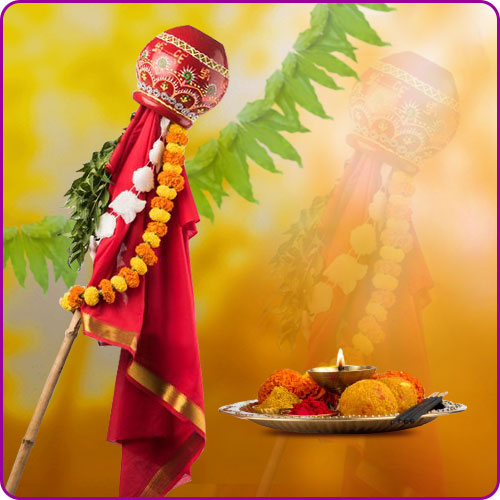
Source – https://www.rudraksha-ratna.com/
The festival of Gudi Padwa is celebrated with great enthusiasm and joy. It is believed that on this day, Lord Brahma created the universe, and it is also considered the day when Lord Rama returned to Ayodhya after his victory over Ravana. The festival is named after the ‘Gudi’, which is a special flag made of cloth or silk and is adorned with a copper or silver pot, a neem leaf, a twig of mango leaves, and a garland of flowers. The Gudi is hoisted outside homes, and it signifies victory and happiness.
The celebration of Gudi Padwa begins with the cleaning and decoration of homes. People decorate their homes with rangolis, flowers, and lights. The preparation of traditional delicacies like puran poli, shrikhand, and karanji is also an essential part of the celebration. On this day, people also wear new clothes and exchange sweets and gifts with each other.
One of the main rituals of Gudi Padwa is the hoisting of the Gudi outside homes. The Gudi is hoisted early in the morning, and it is believed to bring good luck and prosperity to the family. People also offer prayers and perform puja to the Gudi. The Gudi is taken down in the evening, and the prasad is distributed among family and friends.
Another significant aspect of Gudi Padwa is the traditional Maharashtrian dance, ‘Dindi’. Dancers dressed in colorful traditional attire dance to the beats of Dhol, Tasha, and Lezim. The dance signifies the victory of good over evil and is performed in temples and public places.
Apart from Maharashtra, Gudi Padwa is also celebrated in other parts of India with different names and customs. In Andhra Pradesh and Telangana, the festival is known as Ugadi, while in Karnataka, it is celebrated as Yugadi. In Tamil Nadu, the festival is called Puthandu, while in Punjab, it is celebrated as Baisakhi.
Being from Odisha and being raised in a different state, I have always been curious about my ground culture and traditions. One of such interesting festival celebrated in Odisha is Pakhala Divas. The article will discuss more about its History, Significance & celebration of Pakhala Divas in Odisha.
Pakhala Divas is a unique festival celebrated in the eastern state of Odisha, India. It is celebrated on March 20th every year, marking the beginning of summer in the state. The festival is dedicated to Pakhala, a traditional dish made of rice, water, and curd.

Source – pragativadi.com
The history of Pakhala Divas dates back to ancient times when Odisha was ruled by the Kalinga dynasty. During those times, Pakhala was a staple food for farmers and laborers who used to work in the scorching heat. The dish is prepared by mixing cooked rice with water and sour curd and kept overnight. This process allows the rice to ferment and gives it a unique taste and aroma.
The tradition of celebrating Pakhala Divas started in the 1990s when a group of social activists in Odisha came together to revive the traditional food culture of the state. They realized that the younger generation was losing interest in traditional dishes and were adopting western food habits. To promote traditional food habits, they organized the first Pakhala Divas in 1992.
Significance of Pakhala Divas
Pakhala Divas has significant cultural and social significance in Odisha. It is celebrated to promote the traditional food culture of the state and to create awareness among the younger generation about the health benefits of traditional food. Pakhala is a healthy dish that is rich in probiotics, which is beneficial for the digestive system. It also helps to keep the body hydrated during the scorching summer heat.
The festival also promotes the sense of community and togetherness. People in the state come together to share the meal with their friends and family, and it is a symbol of unity and brotherhood. It is also an occasion to express gratitude towards farmers and laborers who work hard to provide us with food.
Celebration of Pakhala Divas
Pakhala Divas is celebrated with great enthusiasm and fervor in Odisha. People prepare Pakhala in their homes and offer it to their friends and family members. They also distribute the dish to the poor and needy. In many parts of the state, restaurants and food joints offer free Pakhala to the public on this day.
Several cultural programs and events are also organized to mark the occasion. People dress up in traditional attire and participate in cultural activities such as folk dances and songs. The festival also includes competitions and games, including cooking competitions, pakhala-eating competitions, and quiz competitions related to traditional food culture.
The Korean mandatory military service, also known as conscription, requires all able-bodied South Korean men aged 18 to 28 to serve in the military for a period of about 18 to 21 months. The policy was first introduced in 1957, following the Korean War, and is seen as a crucial element in the country’s national security and defense.
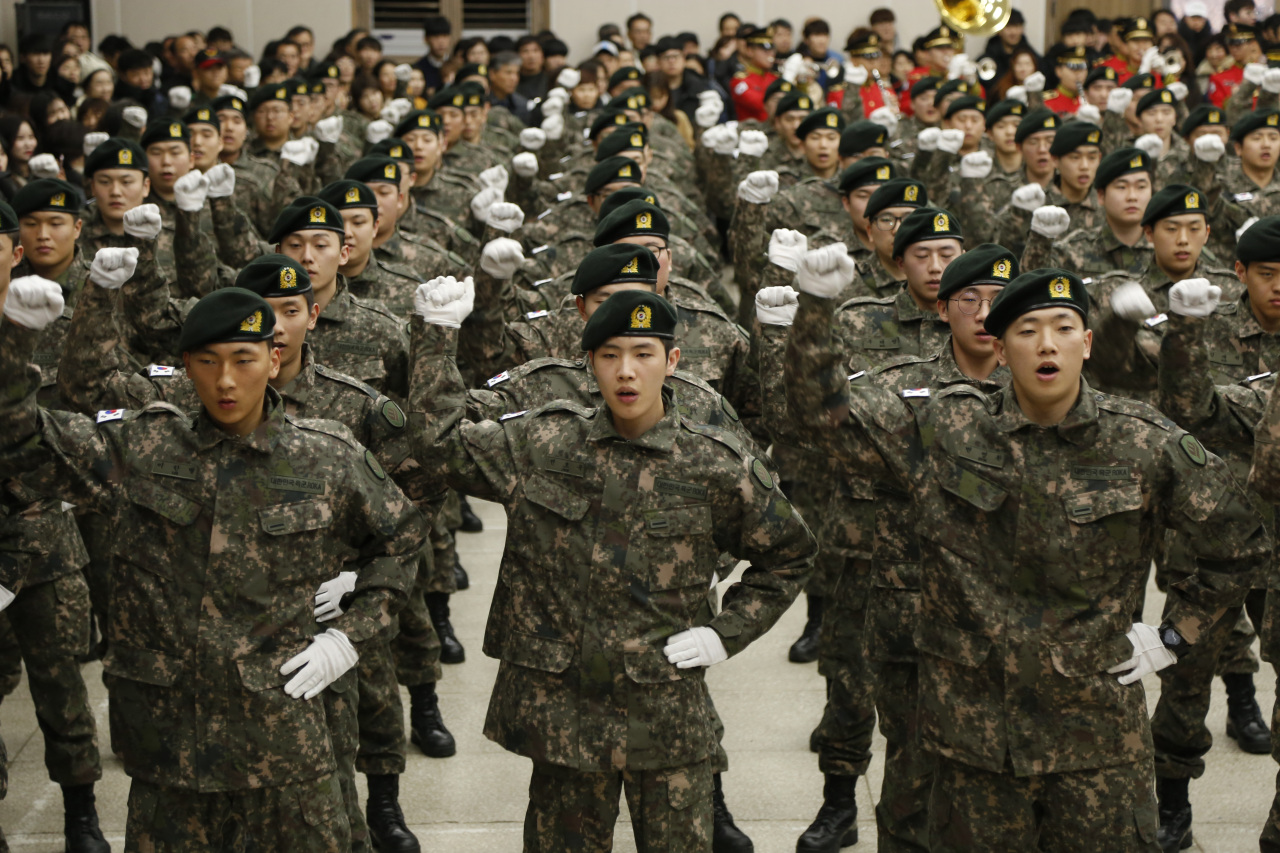
Credit : YNA
There are several reasons why the Korean government imposes mandatory military service. Firstly, South Korea is technically still at war with North Korea and thus, there is a constant need to maintain a strong military presence to deter any potential aggression. Secondly, given the country’s geopolitical location and historical tensions with its neighbors, the government believes that a strong military is necessary to ensure regional stability and security. Finally, conscription is seen as a way to promote national unity and civic duty, instilling discipline and patriotism in young men.
Under the conscription system, all eligible men are required to undergo physical and mental health assessments before being assigned to a specific branch of the military. The majority of conscripts are assigned to the Army, with smaller numbers serving in the Navy, Air Force, or Marine Corps. The training period typically involves several months of basic military training, followed by specialized training for each branch. During their service, conscripts receive a modest salary, food, and housing, and are prohibited from engaging in any commercial activities or leaving the country without permission.
While mandatory military service is a widely accepted practice in South Korea, it is not without controversy. Some argue that the policy places an undue burden on young men, disrupting their education and career prospects, and contributing to the country’s low birth rate. Others point to allegations of mistreatment and abuse within the military, including incidents of bullying, sexual harassment, and hazing.
To address some of these concerns, the Korean government has introduced several reforms to the conscription system in recent years. For example, in 2020, the government passed a law allowing alternative forms of military service, such as volunteering for social service or joining the police force, for conscientious objectors who oppose military service for religious or ethical reasons. The government has also increased funding for mental health services and improved training programs for soldiers.
In conclusion, the Korean mandatory military service is a longstanding policy that reflects the country’s commitment to national security and defense. While it is not without controversy, the government has taken steps to address some of the concerns raised by critics and to make the conscription system more equitable and humane.
Network topology refers to the arrangement of nodes, devices, and communication channels in a computer network. There are several types of network topologies, including bus, star, ring, mesh, and tree. Each topology has its own advantages and disadvantages, depending on the network’s size, scalability, and fault tolerance requirements.
Network topology has basically 5 types:
BUS TOPOLOGY – A bus topology connects all devices to a single communication channel called a bus. Data is transmitted along the bus to all connected devices, and each device listens for its specific address. This topology is simple and cost-effective for small networks, but it can suffer from congestion and is not scalable to larger networks.

Source – https://www.javatpoint.com/
STAR TOPOLOGY – A star topology connects all devices to a central hub or switch. Data is transmitted from the sender device to the hub, which then broadcasts the data to all other devices. This topology is widely used in LANs and is scalable, fault-tolerant, and easy to manage. However, it requires a larger number of cables and devices, and a single point of failure in the hub can disrupt the entire network.

Source – https://www.javatpoint.com/
RING TOPOLOGY – A ring topology connects all devices in a circular loop, where each device is connected to its neighboring devices. Data is transmitted in one direction along the loop, and each device repeats the data to the next device until it reaches its destination. This topology is simple and efficient for small networks, but it can suffer from congestion and a single faulty device can disrupt the entire network.

Source – https://www.javatpoint.com/
MESH TOPOLOGY – A mesh topology connects all devices in a fully interconnected network, where each device is connected to every other device. Data can be transmitted through multiple paths, making this topology highly fault-tolerant and scalable. However, it is complex and expensive to implement, and requires a large number of cables and devices.

Source – https://www.javatpoint.com/
TREE TOPOLOGY – A tree topology connects devices in a hierarchical structure, where branches of devices connect to a single root node or hub. Data is transmitted from the sender device to the hub, which then broadcasts the data to all other devices in the branch. This topology is scalable and fault-tolerant, and it allows for easy management and troubleshooting. However, a single point of failure in the root node can disrupt the entire network, and the network’s size and complexity can affect its performance.

Source – https://www.javatpoint.com/
In summary, network topology is an important aspect of computer networks that can affect the network’s performance, scalability, and fault tolerance. Choosing the right topology depends on the network’s requirements, size, and cost constraints. It is also important to consider network security and management issues when designing and implementing a network topology.
The Open Systems Interconnection (OSI) model is a conceptual framework for network communication that was developed by the International Organization for Standardization (ISO) in the 1980s. The OSI model provides a way to understand how data is transmitted over a network by breaking down the process into seven layers. Each layer has a specific function, and the layers work together to ensure reliable communication.
The OSI model provides a standardized way of describing network communication, which allows different network technologies and devices to communicate with each other. For example, a device that uses Ethernet can communicate with a device that uses Wi-Fi because they both follow the same OSI model. The OSI model also allows for easier troubleshooting of network issues because each layer has a specific function that can be tested independently.
However, the OSI model is a theoretical framework and does not correspond directly to the actual implementation of network protocols. In practice, network protocols are often a combination of multiple OSI layers, and some layers may be merged or omitted entirely. Nonetheless, the OSI model remains a useful tool for understanding the complex process of network communication.
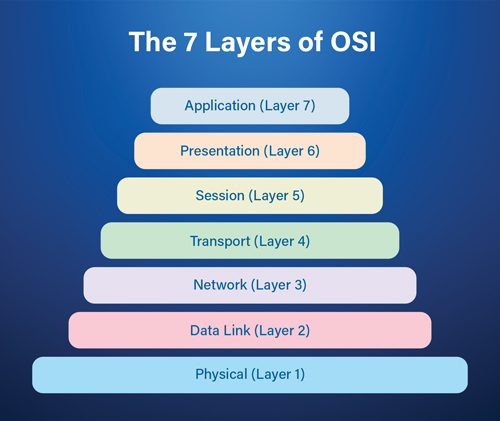
Source – https://www.real-sec.com/
The seven layers of the OSI model are:
Physical Layer: The physical layer is responsible for transmitting raw data bits over a physical medium such as copper wires, optical fibers, or radio waves. It deals with the electrical, mechanical, and physical characteristics of the physical medium. It also defines the procedures and functions that physical devices and interfaces have to perform for transmission to occur.
Data Link Layer: The data link layer is responsible for the reliable transfer of data frames over a physical medium. It establishes and terminates connections between network devices, performs error detection and correction, and manages flow control.
Network Layer: The network layer is responsible for routing data packets from the source to the destination network. It determines the best path for data to travel and manages congestion control.
Transport Layer: The transport layer is responsible for ensuring reliable end-to-end communication between applications. It segments and reassembles data into packets and provides error recovery and flow control.
Session Layer: The session layer is responsible for managing communication sessions between applications. It establishes, maintains, and terminates sessions and provides synchronization and recovery in case of failures.
Presentation Layer: The presentation layer is responsible for ensuring that data is presented in a format that can be understood by the application layer. It provides data encryption, compression, and decryption.
Application Layer: The application layer is responsible for providing network services to user applications. It provides a user interface and manages application-level protocols such as HTTP, FTP, and SMTP.

The Preamble of the Indian Constitution is an introductory statement that outlines the fundamental principles and objectives of the Constitution. It is a concise and powerful statement that reflects the aspirations and values of the Indian people. The Preamble is an integral part of the Constitution and serves as a guide to interpreting its provisions. It was adopted by the Constituent Assembly on 26th November 1949, and came into effect on 26th January 1950, when the Constitution was enacted.

Source – Timesofindia
The Preamble begins with the words “We, the people of India,” which reflects the democratic nature of the Indian Constitution. The use of the phrase “We, the people” signifies that the Constitution derives its authority from the people of India, who are the ultimate source of power in the country. The Preamble contains several important keywords, which are discussed below.
Sovereign: The term sovereign means that India is a self-governing nation, and its government is not subject to external control or influence. It implies that the Indian Constitution is the supreme law of the land, and all citizens and institutions must respect its provisions.
Socialist: The term socialist reflects the commitment of the Indian Constitution to the principles of social justice and equality. It emphasizes the need to eliminate poverty, inequality, and exploitation, and to promote the welfare of all citizens.
Secular: The term secular means that the Indian Constitution guarantees freedom of religion to all citizens, and the State does not endorse or promote any particular religion. It implies that the State is neutral in matters of religion and treats all religions equally.
Democratic: The term democratic signifies that the Indian Constitution is based on the principles of democracy, which includes free and fair elections, the rule of law, and the protection of individual rights and freedoms. It implies that the government is accountable to the people, and the people have the right to participate in the decision-making process.
Republic: The term republic means that India is a sovereign state, and its head of state is elected by the people. It implies that the Indian Constitution provides for a representative government that is accountable to the people.
Justice: The term justice reflects the commitment of the Indian Constitution to the principles of social, economic, and political justice. It implies that the State must ensure that all citizens have access to justice, and that there is no discrimination based on caste, gender, religion, or any other grounds.
Liberty: The term liberty signifies that the Indian Constitution guarantees freedom of speech, expression, assembly, and association to all citizens. It implies that the State must respect and protect the rights of individuals to live their lives as they see fit, as long as they do not infringe on the rights of others.
Equality: The term equality reflects the commitment of the Indian Constitution to the principle of equal treatment under the law. It implies that all citizens are equal before the law, and there is no discrimination based on caste, gender, religion, or any other grounds.
Fraternity: The term fraternity means a sense of brotherhood. The constitution of India promotes the feeling of fraternity by the system of single citizenship.
Dwarf planets are a category of celestial objects that are similar to planets, but are smaller in size and lack certain characteristics that define a planet. The classification of a celestial object as a dwarf planet was introduced by the International Astronomical Union (IAU) in 2006.
The IAU defines a dwarf planet as a celestial body that orbits the Sun, is spherical in shape, and has not cleared its orbit of other debris. This means that while a dwarf planet is similar to a planet in terms of its shape and orbit, it has not become dominant in its orbit and there are other objects in its vicinity. Currently, there are five officially recognized dwarf planets in our Solar System: Pluto, Eris, Haumea, Makemake, and Ceres.

Source – Shutterstock Images
Pluto is the most well-known dwarf planet and was formerly considered the ninth planet in our Solar System. It was reclassified as a dwarf planet in 2006 due to its size and orbit. Pluto is located in the Kuiper Belt, a region beyond Neptune that contains many icy objects. It has five known moons and a highly eccentric orbit that brings it closer to the Sun than Neptune for part of its orbit.
Eris is the largest known dwarf planet and is located in the scattered disc, a region beyond Neptune that contains many objects with highly elliptical orbits. It was discovered in 2005 and is named after the Greek goddess of discord. Eris has one known moon and a highly elliptical orbit that takes it far beyond Pluto.
Haumea is a dwarf planet located in the Kuiper Belt. It is named after the Hawaiian goddess of childbirth and fertility. Haumea has an elongated shape and rotates rapidly, completing a full rotation in just four hours. It has two known moons and a highly elliptical orbit.
Makemake is another dwarf planet located in the Kuiper Belt. It was discovered in 2005 and is named after the creation deity of the Rapa Nui people of Easter Island. Makemake is one of the largest known objects in the Kuiper Belt and has a highly reflective surface.
Ceres is the only dwarf planet located in the asteroid belt between Mars and Jupiter. It was the first object to be discovered in the asteroid belt and was considered a planet for a brief period in the 19th century before its size was determined. Ceres is the largest object in the asteroid belt and has a rocky surface.
In addition to these five recognized dwarf planets, there are many other objects in our Solar System that could potentially be classified as dwarf planets. These include objects in the Kuiper Belt, the scattered disc, and even some of the larger asteroids in the asteroid belt.
The study of dwarf planets is important because they provide valuable information about the formation and evolution of our Solar System. Many dwarf planets are thought to be remnants from the early Solar System, and their study can help us understand the conditions that existed during that time.
In conclusion, dwarf planets are a category of celestial objects that share similarities with planets but have not cleared their orbit of other debris. There are currently five recognized dwarf planets in our Solar System, including Pluto, Eris, Haumea, Makemake, and Ceres. The study of dwarf planets is important for understanding the history and evolution of our Solar System.
Organic compounds are compounds that contain carbon atoms covalently bonded to hydrogen atoms, and may also contain other elements such as nitrogen, oxygen, sulfur, and halogens. These compounds are found in nature and are also synthesized in laboratories for various purposes. However, these compounds may contain impurities that affect their properties and functions, making it necessary to purify them before use.

Source – Wikipedia
Purification of organic compounds involves the removal of impurities by various methods such as filtration, distillation, chromatography, and crystallization. The choice of method depends on the nature of the impurities, the physical properties of the compound, and the desired purity level.
In addition to these methods, other techniques such as sublimation, extraction, and reflux can also be used to purify organic compounds. Sublimation involves the conversion of a solid to a gas without passing through the liquid state, and it is effective for purifying solids with high vapor pressures. Extraction involves the separation of a compound from a mixture by selectively dissolving it in a solvent, and it is effective for separating compounds with different polarities. Reflux involves heating a mixture under controlled conditions to allow for the separation and purification of volatile components.
Overall, the purification of organic compounds is a critical step in many chemical processes and requires careful consideration of the nature of the impurities and the physical properties of the compound. By using appropriate methods and techniques, it is possible to achieve high levels of purity and obtain compounds that are suitable for various applications in industry, medicine, and research.


You must be logged in to post a comment.