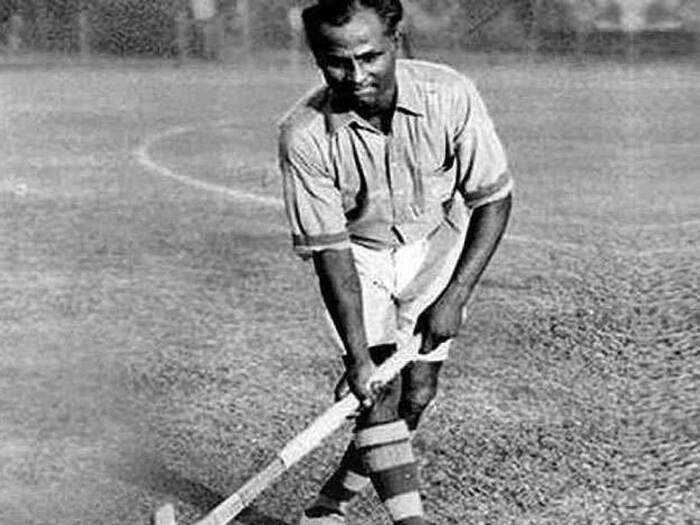
Major Dhyan Chand (29 August 1905 – 3 December 1979) was an Indian field hockey player widely regarded as one of the greatest in the history of the sport.[3] He was known for his extraordinary goal-scoring feats, in addition to earning three Olympic gold medals, in 1928, 1932 and 1936, during an era where India dominated field hockey. His influence extended beyond these victories, as India won the field hockey event in seven out of eight Olympics from 1928 to 1964.
Dhyan Chand was born in Allahabad on 29 August 1905 in a Bais Rajput family. He was the elder brother of another hockey player Roop Singh and the son of Sharadha Singh and Sameshwar Singh. Dhyan Chand’s father was enlisted in the British Indian Army, and he played hockey for the army.
Dhyan Chand had two brothers – Mool Singh and Roop Singh. Because of his father’s numerous army transfers, the family had to move to different cities and as such Chand had to terminate his education after only six years of schooling. The family finally settled in Jhansi, Uttar Pradesh, India.
Chand graduated from Victoria College, Gwalior in 1932. Being in the military, his father got a small piece of land for a house.
Young Chand had no serious inclination towards sports though he loved wrestling. He stated that he did not remember whether he played any hockey worth mentioning before he joined the Army, though he said that he occasionally indulged in casual games in Jhansi with his friends.
Some Interesting Facts:
While winning the bronze medal in hockey in the Tokyo Olympics, the players gave a chance to the countrymen to rejoice, while on Friday, Prime Minister Narendra Modi gave another chance to the hockey lovers to rejoice. He has changed the name of Rajiv Gandhi Khel Ratna Award, the biggest award in the field of sports, to Major Dhyan Chand Khel Ratna Award. Prime Minister Narendra Modi gave this information through a tweet.
For the first time this award was given in 1991-92. It is given to those sportspersons who have excelled in the field of sports at the international level. Hockey lovers have expressed their happiness after the name of this award is named after the legendary player Major Dhyan Chand, who is called the magician of hockey.
Hockey magician Major Dhyan Chand had a wonderful art of scoring goals, when his hockey rose in the playground, the opposition team was shattered. Born in Allahabad, this great player has won gold medals for India in 3 Olympic Games. Till now you must have heard many things about their game, today we will tell some interesting facts related to them.
Dhyan Singh, as he was formerly known. At the age of 16, he joined the Indian Army as a soldier and started playing hockey. Because Dhyan Singh used to practice in the moonlight at night, his friends started calling him Chand, after which he came to be called Dhyan Chand.
India defeated Germany 8–1 in the 1936 Olympic hockey final. In which Dhyan Chand alone scored 3 goals. After this victory of India, Hitler immediately left the stadium and left. In the evening, when Hitler asked Dhyanchand what do you do other than playing hockey, his answer was that I am a soldier of the Indian Army. After this Hitler offered him to join the German army. But he refused saying that it is my responsibility to take the country forward.
This great hockey player represented the country in the 1928, 1932 and 1936 Olympics and managed to get the country gold medals on all three occasions.
Residents of Vienna have erected a four-handed statue of Dhyan Chand in a sports club in honor of Dhyan Chand, holding a hockey stick in all four hands, depicting him as a hockey god.
It is said that once while playing hockey, Dhyan Chand could not score any goal, due to which he argued that the goal post was small, when the goal post was measured, it turned out to be small, everyone was surprised to see this.
Film actor Prithviraj Kapoor was a fan of Dhyan Chand, once he brought famous singer Kundan Lal Sehgal ( K. L. Sehgal ) with him to a match in Mumbai. When no goal could be scored till half time, Sehgal said that we have heard many names of both the brothers, I am surprised that neither of you could score even a goal till half time. Dhyan Chand then asked Sehgal if you would make us recite songs like Hum Jeet Gol Mare, he said yes, then in the second half, both the brothers scored 12 goals together.
The term Artificial Intelligence was coined by John Mc Carthy in the year 1956. It is the art of science and engineering, which makes intelligent machines.
WHAT IS AI IN POWE SYSTEM?
High efficiency
Problem solving
Accuracy
Critical thinking
Speed
Applicable
Easy Adoption
Especially for power systems where conventional methods which experience difficulty
Precision
Vast Data Management
Memory
Three major families of AI,
Expert system Techniques
Artificial Neural Network
Fuzzy Logic System
EXPERT SYSTEM
An expert system provides information about the specified domain from the human experts and convert into the machine implementable form.
They are computer programs which have proficiency and competency in the particular field.
They are also known as the Knowledge based system or ruled based system. They solve the problems which are very difficult to solve by human skill and intellectual.
Any modifications can be easily done because they are just computer programs. Estimation of values can be done and efficiency is easily estimated.
ARTIFICIAL NEUTRAL NETWORKS
Artificial neural networks are biologically inspired system which converts a set of outputs by a network of neurons, where each neuron are able to produce output.
The understanding and working process and the pattern are interconnected with the computers by solving real world problems of classification of patterns and pattern recognition.
As ANNs operate in biological instincts and perform biological evaluation of real world problems in generations and transmission and distribution of electric cars can be fed to ANN so that suitable solution can be obtained.
Example: The value of inductance, capacitance and resistance in a transmission and distribution can be calculated by various factors.
FUZZY LOGIC SYSTEM
Fuzzy logic is the standardization system of any logical reasoning system.
They provide Data to produce information based on the human decision making which is accurate and reliable.
It is what exactly human brain works and they can perform exactly like machines.
They provide solutions such as high excessive date, capacity for modelling data with high generality.
EXPLANATION
Fuzzy diagram can be used for the fault diagnosis.
Expert and ANNs can be used in the performance of the line. Environmental sensors sense the environment and atmospheric conditions and they give input to the system. They provide output with the validation.
CONCLUSION
The main feature of the power system technique is reliability, conventional technique and they don’t fulfil the probabilistic essence of the power system, this provides the increased operations and maintenance costs. A lot of research is now being processed for the monitoring of the efficient electricity market as they are power system which is the renewable form in the operations.
In today’s world, humans are in a very relaxed cycle: they eat, they watch television, they sleep. What most people do not realise are the health risks they are taking every day when they do their daily tasks. Humans are becoming more and more reliant on machines to do simple activities, such as changing the channel or traveling. I agree that technology does make activities uncomplicated, and genuinely makes life easier, but how can a person stay physically fit and healthy when he/she does nothing himself/herself? In Ishmael by Daniel Quinn, many environmental issues are discussed. Among the issues, Quinn talks about technology and how humans believe it to be a turning point in society, but will eventually lead to the downfall of humans.
People are at great risk to their health with the advancements in technology. Not only have individuals fabricated new ways of entertainment, but have built factories, which pollute the air they breathe and water they drink. In Ishmael, Quinn tells of man trying to fly; when man fails, he does not just simply give up and wait to fly, but creates a new way, that is not fool-proof. Humans will do anything to make life easier, but for no reason than to make life easier. But is this really making life relaxing? People still have to go to work, still have to breathe in polluted air, and other such effects, all of which may be hazardous to their health. Humans keep creating objects that are harmful to the environment, and they call this “technology.” Well, this may be “technology,” but obviously citizens do not see that it is taking control of their lives. Most technology is for luxury and entertainment, while a select few fabrications are necessities, (airplanes, food machines, etc.). People really need to stop relying on artificial intelligence for simple tasks.
“Every cloud has a silver lining.” This proverb goes well with the historic judgement passed by the Supreme court on 6th September 2018 in the favor of LGBT community rights. This has been much debated topic since a long time. Nothing could be more blessing than the enactment of Article 377 for the relief of LGBT community. The hearing of the petitions began with a bench consisting of Chief justice Dipak Misra and justices DY Chandrachud, AM Khanwilkar, Indu Malhotra,and Rohinton Fali Nariman. It was truly a landmark decision which struck down a 19th century law criminalizing homosexuality in India.
What role does the Indian Constitution play towards the emancipation of the society’s most marginalized and excluded? What vision does the Constitution espouse with respect to basic fundamental rights and freedoms? And what conception of inclusion and pluralism does the Constitution pursue in a society that remains deeply divided and disjointed? All these searching questions came to form a distinct part of the decision of the Indian Supreme Court (Court) when it was called upon to rule on the constitutional validly of Section 377 of the Indian Penal Code, 1860.It was not the first time however, that the Court was examining Section 377 on the touchstone of the Constitution, as the case previously travelled through several levels of judicial adjudication involving different jurisdictional procedures.
Embodying the ethos of Victorian morality, Section 377, a colonial-era law, criminalized ‘…carnal intercourse against the order of nature with any man, woman or animal…’. Anything that was not penal-vaginal sexual encounter was ‘against the order of nature’ and as a consequence ‘unnatural’. Through this provision, homosexual acts even between consenting adults was considered and proscribed as a criminal offense punishable with imprisonment. Thus, a significant section of the population comprising the LGBT+ community remained perpetually ostracized by the Indian society, persecuted by State authorities and marginalized in the discourse of constitutional rights. Therefore, when the Court decided in Navtej Johar v Union of India that Section 377 in so far as it criminalizes same sex acts between consenting adults, violates the constitutional mandate enshrined under the Fundamental Rights chapter, especially, Art. 21 (life and personal liberty), Art. 14 (equality and equal protection of laws), Art. 15 (non-discrimination) and Art. 19 (Freedom of expression), truly, it was a historic undoing of injustice towards the LGBT+ people. In other words, as a result of this decision, LGBT+ people who were historically and by default considered ‘criminals’ under the law, came a bit closer to acquiring an ‘equal moral membership’ of the society and the State. It was a tough as well as a long road but at the end everything seemed to be mightier.
Let us look back into the history of India from where the seeds of this discrimination were actually sown. India has a long tradition of tolerance for all kinds of beliefs, faiths, philosophies, and ways of living. This takes us back to the 1800s. Lord Macauley first created this law in 1860 when he was the President of the Indian Law Commission. The reason for this law was because the British WANTED TO “impose Victorian values” on the colony of India. Not only were such values trying to be inflicted on the Indian society but also the Constitution of India wanted to “…narrow constructions of patriarchal gender relations and heteronormativity” (Ramasubhan 91).
What’s important and a reflection of the movement itself is that the support has come not just from the queer people, but across a range of actors, movements and institutions. Progressive groups, state bodies like the National Human Rights Commission, teacher’s associations, professional associations including the medical and mental health establishments, women’s groups, student groups, trade unionists and private companies came out publicly against the judgement. Thousands across the country stood together, repeating the chant that brought together our resistance: ‘No Going Back’.
In declaring Section 377 to be unconstitutional, however, the Court was deeply reflective about the fact that for Constitutional rights to acquire a meaningful purpose for the marginalized communities, disciplining State action alone will not be sufficient. In this regard, the Court did not mince words when it stated that it is both, criminality of the law and the ‘silence and stigmatization’ of the society towards the LGBT+ community that orchestrates the marginalization and the exclusion of the former. Implicit in that claim was the understanding that inequality, hierarchy and prejudice transpires as much from State action as it does from societal sanctions, community conventions and private relationships. In the context of such social realities, what is the stated role of the Constitution and the laws? Is the mandate of the Constitution simply confined towards ordering the relationship between the State and the individual (vertical) or does the Constitution have an equal role to play in shaping normative values among individuals within the society?
The Court unequivocally embraced the latter narrative and found that the Indian Constitution envisions an expansive role for both the State and the individual to actively promote social change within the contours of the Constitution. It seeks transformative change ‘in the order of relations not just between the State and the individual, but also between individuals’. The transformative potential in Indian Constitution is a conscious ‘attempt to reverse the socializing of prejudice, discrimination, and power hegemony in a disjointed society’. Therefore, the Constitution, the Court surmises, obliges not only the State not to violate fundamental rights, but also individuals to ‘act in a manner that advances and promotes the Constitutional order of values’.
“Sexual orientation” is an essential attribute of privacy. Discrimination against an individual on the basis of sexual orientation is deeply offensive to the dignity and self-worth of the individual. This judgement can be considered as a revolutionary one in a society like India. But every judgement has two parts, one is written and other is its execution. The written part is progressive and reformist and its execution includes sensitizing the society and institutions in accepting what is written in this judgement. That may take time. Till then I would like to put forth some suggestions. The first step is sex education in schools and at homes. The second step is that the law enforcement agencies such as the police needs to be more sensitized towards the LGBT people. Similarly, our media and film fraternity can play a very important role in imparting knowledge and disseminating true information about LGBT people.
To conclude, we all are equal.Nobody should be discriminated on whatsoever ground. In the last few years LGBT are gaining acceptance in many parts of India. Many Bollywood films have dealt with homosexuality. They have also fair well at the box office. There’s a transformative constitutionalism which is happening and the real import of transformative constitutionalism lies in positive measures that the State ought to take in bringing the Constitution closer to the most deprived. Indian society needs to shrug off its old thinking and come out of the widely prevailing homophobia.
Puri, located in Odisha, became the first Indian city with 24×7 clean drinking water from tap facility. The “Drink from Tap Project” was inaugurated on 2nd August 2021. The drink from tap facility has been initiated by the Water Corporation of Odisha under the “Sujal” scheme. While inaugurating the project the CM of Odisha claimed that this project will enable the people of Puri to collect water directly from the tap and it would not be necessary to store or filter it further for the purpose of drinking.
Drink-from-Tap Project
Under the Sujal scheme, the water is taken from the Bhargavi river and then it is channelised to a reservoir. The water is then sent to Samang for water treatment procedures like purification and chlorination.
Sujal scheme aims to provide clean drinking water from taps to nearly 1.5 million people in 15 towns of Odisha by 2023. Puri’s water requirement is around 32-34 million litres per day and the plants have been claimed to purify around 42 million litres of water each day.
The “Drink from Tap” project is said to benefit the 2.5 lakh residents of Puri. As Puri is known as the holy town of Odisha, it would also benefit the 2 crore tourists who visit Puri. Another impact is that it can reduce the number of plastic bottles bought, mostly by tourists. It can drastically reduce the disposal of plastic waste. People can directly consume the water from the 400 fountains installed in the city.
But it is also important to maintain stringent rules on the quality of water supplied. Contaminated water can pave the way to a number of diseases. Constant monitoring of the water quality is essential. The scheme is in its initial stage and it is imperative to maintain the availability and purity of water in the long run.
Clean drinking water in India
According to the UNICEF reports, less than half of the people in India have access to safe drinking water. Harmful chemicals such as Arsenic and Fluoride are found in 1.96 million dwellings. The report also indicates another major concern, that is unavailability of water in many areas.
School attendance decreases in the areas where children are sent to collect water. They spend hours collecting water which affects their education. In the drought hit states, a 22% rise in school drop out rates was recorded.
Therefore it is important to ensure the availability of clean drinking water to the people. Safe drinking water is a fundamental aspect of public health.
Hey Everyone, I am sharing some inspirational quotes that I wrote to inspire you all. Below are some of the quotes written by me. Please do like if you are inspired by them…
Oral presentation based on the written document or simply the written document that gives the purpose, scope, methodology, findings and finally suggesting the best to the others.
Oral presentations are done by one of the seminar, conferences etc. Written document always starts with the issues and finally gives the solution to the audience.
TYPES OF RESEARCH REPORT
Technical report
Popular report
Analytical report
Informative report
Descriptive report
Comprehensive report
Monographs
TECHNICAL REPORT
It is based on the experiment, diagnosis, which we get information and analyze them in a technical way. It is a large documentation of the report as we have technical audience here.
CONTENTS
Summary
analysis of data
research design
findings
conclusion
bibliography
conclusions
index
POPULAR REPORT
The Report should be made in the simplest language, Objective should be short and sentences to be directed. The Report should be minimized.The Report ‘s emphasis is given based on policy implications. The newspaper information and magazines come under popular report.
CONTENTS
Findings
recommendation of action
pictures and graphs
Techniques used
results
ANALYTICAL REPORT
The Report is purely based on the scientific research. Research should be feasible and made easy for understanding purposes.
CONTENTS
Table of contents
Contrasting views
Antithesis
Bibliography
Appendices
INFORMATIVE REPORT
The Objective should provide information. The Memo should provide a reason.
CONTENTS
Introduction
Paragraphs
Graphics
Subheadings
DESCRIPTIVE REPORT
Simple report given by desired information. The actual reports are reinforced by tables.
CONTENTS
Graphical form of representations
Pie chart
Bar chart
Frequency distributions
COMPREHENSIVE REPORT
Broader Objective should be determined for future growth. Gathering data and analysis should be done for the alternative solutions. The Report should be elaborated in a detailed way.
CONTENTS
pros and cons
Basic Research on Issue
Benefit in statement of cost
MONOGRAPHS
Special type of book written on specialized topics by the researchers. It looks like a way a book looks like.
PEGASUS IS A SPYWARE DEVELOPED BY NSO GROUP , AN ISRAIL SURVEILLANCE FIRM THAT HELPS SPIES HACK INTO PHONES.
IN 2019 THEN WHATSAPP SUED THE FIRM IN A US COURT , THE MATTER CAME INTO LIGHT. IN JULY 2021 , AMNESTY INTERNATIONAL ALONG WITH 13 MEDIA OUTLETS ACROSS THE GLOBE RELEASED A REPORT ON HOW THE SPYWARE WAS USED TO SNOOP INDIVIDUALS , INCLUDING INDIANS.WHILE NSO CLAIMS THAT ITS SPYWARE IS SOLD ONLY TO GOVERNMENT AND NONE OF THE NATIONS HAVE COME FORWARD TO ACCEPT THE CLAIMS.
THE SUPREME COURT OF INDIA ON THURSDAY MADE IT CLEAR THAT THE TRUTH HAS TO COME OUT REALLY SOON IN THE PEGASUS SNOOPING ISSUE.
THIS SPYWARE TARGETED THE MINISTERS , PARLIAMENTARIES , ACTIVISTS , JOURNALISTS , CIVILIANS. IN INDIA , THE NAMES OF 125 POTENTIAL TARGETS OUT OF 300 ODD VERIFIED ONES FROM OVER 2000 INDIAN NUMBER FOUND ON THE LEAKED LIST HAVE BEEN MADE PUBLIC.
FRANCE PRIME MINISTER , EMMANEUL MACRON PHONE NUMBER ARE IN THE LEAKED DATABASE AND HE HAS ASKED THE ISREAL PRIME MINISTER NAFTALI BENETT FOR A PROPER INVESTIGATION.
INDIA ECONOMY HAS SHOWN SIGNS OF RECOVERY IN JULY AS FACTORY ACTIVITY REBOUNDED ON THE RISING DOMESTIC AND INTERNATIONAL DEMAND. A FALL IN ACTIVE CASE OF COVID 19 CASES LED TO A ALLOWING BUSINESSESS TO RAMP UP MANUFACTURING ACTIVITY.
THE REOPENING OF THE ECONOMY HAS LED TO HIGHER DEMAND AND SUPPLY. EXPORTS HAS ALSO WITNESSED A HEALTHY RISE AS ORDERS GREW AT THE FASTEST RATE SINCE APRIL.
EMPLOYMENT HAS ALSO INCREASED FOR THE FIRST TIME SINCE MARCH 20 , BREAKING 9 TO 15 MONTH CHAIN OF JOB SHEDDING. HOWEVER , THE PACE OF HIRING REMAINS MILD AND THE COUNTRY JOB CRISIS IS FAR FROM OVER. RISING INFLATION IS ANOTHER MAJOR HURDLE IN THE PATH OF ECONOMY RECOVERY.
A RECENT POLL CONDUCTED BY NEWS AGENCY REUTERS SIGNALS A FURTHER RISE IN INFLATION DUE TO HIGHER FUEL PRICES. AS THE CASES NOW FALLING THERE IS REASON TO HOPE THAT THE ECONOMY WILL GET BACK TO IMPROVED ACTIVITY IN THE NEXT QUARTER.
DUE TO THIS PANDEMIC HAS FORCED ECONOMIES ALL OVER THE WORLD TO GO INTO LOCKDOWN. OFFICIAL DATA SHOWS THAT THE DATA USAGE HAS BEEN INCREASED 400% IN RURAL AREAS. IT INDICATING THE LARGE APPETITE FOR INTERNET CONNECTIVITY.
INDIA CURRENTLY HAS 504 MILLION INTERNET USERS MAKING IT IS SECOND LARGEST INTERNET MARKET IN THE WORLD , SECOND ONLY TO CHINA WHICH HAS 850 MILLION. RURAL CONSUMPTION NOW ACCOUNT FOR ROUGHLY 45% OF OVERALL MOBILE DATA USAGE AND URBAN USAGE MARKET UP 55%.
THE MONTH OF JUNE SAW THE RURAL DATA USAGE INCREASED BY 30-35% WHEREAS THAT IN URBAN GREW BY 15-29%. COMPANIES LIKE RELIANCE JIO AND BHARTI AIRTEL ARE RESPONSIBLE FOR THE EXPANSION OF RURAL MOBILE USER BASE.
ACCORDING TO THE LATEST DATA OF A TELECOM REGULATOR JIO AND AIRTEL ADDED 2.76 MILLION AND 1.46 MILLION RURAL MOBILE USERS BETWEEN JUNE AND AUGUST. MOBILE DATA TRAFFIC IS GROWING AS MORE INDIANS SPENT TIME STREAMING LIVE VIDEOS WHICH IS EXPECTED TO ACCOUNT FOR 75% OF OVERALL MOBILE TRAFFIC BY 2024. A STUDY SUGGEST THAT BY 2025 RURAL INDIA WILL LIKELY HAVE MORE INTERNET USERS THAN URBAN INDIA.
A LATEST REPORT BY THE INTERNET AND MOBILE ASSOCIATION OF INDIA ( IAMAI ). THE REPORT HIGHLIGHTED A GREATER INCREASE A FEMALE INTERNET USERS BY 27% AS COMPARED TO MAKE INTERNET USERS BY 9%.
THE GROWTH IN INDIA INTERNET USERS ESPECIALLY IN THE RURAL AREAS HAS WITNESSED A BOOST MAJORITY BECAUSE OF CHEAP DATA PLANS AND ACCESSIBILITY TO AFFORDABLE SERVICES FOR ACCESSING THE INTERNET WAS MOBILE IN BOTH RURAL AND URBAN AREAS.
It was the first day of college. I was very nervous as I have always been an introvert. Our Professor introduced himself and challenged us to get to know each other and make some good friends.
I looked around when a gentle hand touched my shoulder. I turned around to find a wrinkled, little old man beaming up at me with a smile.
He said, “Hi beautiful. My name is Ramesh. I am eighty-five years old.” I was so delighted to see him. My enthusiasm led me to ask him, “Why are you in college at such a young age?” He laughed and replied, “I’m here to find a beautiful girl for me to get married and have kids.” Then I curiously asked him to answer me seriously as I really wanted to know what motivated him to join college at this age.
“I always dream of having a college education and now I’m getting one!” He told me. We became instant friends. We used to sit with each other in the class and talk nonstop. His life seemed to me like a “time machine”. He shared his wisdom and experience with me.
Over the course of the year, Ramesh became a campus icon. He was just like us, very cool. He was living it up.
At the end of the semester we invited Ramesh to speak at the farewell. I’ll never forget what he taught us. As he began to deliver his prepared speech, he dropped his three by five cards on the floor. Frustrated and a little embarrassed he leaned into the microphone and simply said, “I’m sorry, I’m so jittery. I had whiskey and it’s killing me. I’ll never get my speech back in order so let me just tell you what I know.”
As we laughed he cleared his throat and began, ”We do not stop playing because we are old; we grow old because we stop playing. There are only four secrets to staying young, being happy, and achieving success. You have to laugh and find humor every day.”
You’ve got to have a dream. When you lose your dreams, you die. If you are nineteen years old and lie in bed for one full year and don’t do one productive thing, you will turn twenty years old. If I am eighty-five years old and stay in bed for a year and never do anything I will turn eighty-six.
Anybody can grow older. That doesn’t take any talent or ability. The idea is to grow up by always finding an opportunity in change. Have no regrets. He concluded his speech.
One week after graduation Ramesh died peacefully in his sleep. Many people attended his funeral in tribute to the wonderful man who taught by example that it’s never too late to be all you can possibly be.
REMEMBER GROWING OLDER IS MANDATORY. GROWING UP IS OPTIONAL.
We make a living by what we get. We make a life by what we give.
Bruce Lee is a great Chinese personality, who is called by people as the best martial artist in the world. Lee is a martial artist as well as a Hong-Kong and American actor, philosopher, producer, director, screenwriter, and founder of the Jeet Kune Do martial arts. He had made a place in the hearts of people in a very short time with his work, due to which he was forever called one of the best martial artists.
He entered films at a young age and became famous as a child artist. He very soon became a martial arts instructor while doing his acting and martial arts work. People liked him a lot. But he died at the age of 32. Complete information about his life has been given in this article.
Introduction to Bruce Lee :
Name– Bruce Lee
Full Name– Lee Jun-fen
Born– 27 November 1940
Place of Birth– Chinatown, San Francisco, California, U.S.
Nationality– Chinese, American
Father– Lee Hoi-Chuen
Mother– Grace Ho
Siblings– Phoebe Lee, Agnes Lee, Peter Lee, Robert Lee
Wife– Linda Lee Cadwell
Kids– Brandon Lee, Shanan Lee
Death– July 20, 1973
Death Place– Kowloon Tong, Hong Kong
Bruce Lee’s Early Life :
Bruce Lee’s father was Lee Hoi-Chuen and his mother was Grace Ho. His family shifted to Hong Kong when he was three months old. Lee had four other siblings. He belonged to an affluent family, but was still involved in street fights and gang revelries, which was necessary for him to be trained in martial arts. His first teacher was his father, who taught Lee the basics.
At the age of 13, he began training for Wing Chun under Yip Man. He was taken to learn the art of Wing Chun privately from Yip Man and Wong Shun Leung due to their mixed lineage tradition. Academically, Lee received his early education at La Salle College. But due to not getting good marks, he was removed from there and put in ‘St. Francis Xavier’s College’.
His participation in street fights continued until 1959, relocating to San Francisco. Lee’s parents were deeply troubled by his violent behavior, and they wanted to leave Hong Kong for a safe and healthy avenue. After a few months in San Francisco, he moved to Seattle, where he enrolled to complete his further education at Edison Technical School. Meanwhile he worked as a live-in waiter for Ruby’s Chow’s restaurant. In 1961, he joined the University of Washington where he majored in drama. This is how his early life was spent.
Career :
Bruce Lee learned to speak monosyllabic words as a child before the start of his career. His father, who was a Cantonese opera star, was associated with the film background, from where his career started. He was only three months old when he did his first film “Golden Gate Girl”. The early years of his life were eventful since making his debut in the world of spectacle.
Due to this an actor was born in him and his acting skills went on increasing with every film, he did about 18 to 20 films at that time. After acting from 1959 to 1964, he left his acting career and made martial arts his profession. He started this as a teacher of kung-fu. With his time, he opened his own martial arts school in Seattle named “Lee Jun Fen Gung Fu Institute”.
In 1964, he left his college to join James Lee, a renowned martial arts instructor from Oakland. Together they opened another school in the same city, which was named Jun Fen Martial Arts Studio. In 1964, Lee competed in the Long Beach International Karate Championships, where he was popularized by his ‘2-finger push-up’ and ‘one-inch punch’.
After this he went there where he met Taekwondo master Zhu Gu Ri, there they became friends immediately and it was beneficial for both the artists. He performed very well in an event in 1967. Meanwhile, he had a personal match with Wong Jack Man, which he won. Although the result of the match was declared unanimously, there were two versions regarding its proceedings.
His exceptional performance at the Long Beach Karate Championship brought him into the limelight of Hollywood directors. His first acting stint as a mature adult was in the TV series ‘The Green Hornet’. The show started in 1966 and ran its first season till 1967.
From 1967 to 1969, she was invited as a guest in many TV series, including TV series like ‘Ironside’, ‘Here Comes the Brides’ and ‘Blondie’. In between his acting, he used to take some time out to concentrate on his martial arts as well. He realized that he was too rigid in traditional martial arts techniques. They created a new system that required them to be prepared in traits such as practicality, flexibility, speed and efficiency.
This happened when Jeet Kung Do paved the way for the intercepting fist. In 1969, he went as a guest in the film ‘Marlov’. However, he lacked the bias and key role, leaving Los Angeles for Hong Kong in the summer of 1971. Upon arriving in Hong Kong, Lee signed two films.
In 1972, he was an actor, writer, director, star and choreographer for a fight scene in the film ‘Way of Dragon’. In the same year, he got another film offer, which was named ‘Inter the Dragon’. The film was to be released on 26 July 1973. In this way he had a career in film and martial arts.
His Major Works :
Bruce Lee, an eminent martial arts artist, has done many films and TV shows. One of the films that made the most of the headlines as well as made him a hero, was The Golden Harvest and Inter de Dragon by Warner Bros Productions. The film grossed worldwide and earned about $ 200 million. This was his biggest success.
His Death :
He suddenly collapsed on 10 May 1973, when he was dubbing for the film ‘Inter the Dragon’ even after going through a headache and seizure. Immediately, he was admitted to the Baptist Hospital in Hong Kong, where he was diagnosed with cerebral edema. He was cured of the first illness. After this, on 20 July 1973, he was scheduled to meet James Bond star, George Lazenby, to which they agreed and arranged a meeting with Raymond Chow and Betty Ting Pie at Letter’s Residence to discuss the script for the film ‘Games of Death’ they wanted to make with Lazenby. He complained of headache and took the pain killer. He lay down to take a nap, and this was his last nap.
He was taken to Queen Elizabeth Hospital, where he was pronounced dead. His body was examined, in which it was found that the Meprobamate ingredient had caused an allergic reaction, due to which he died. He was buried in his wife’s hometown at Lakeview Cemetery in Seattle. In order to preserve his home in Hong Kong, it was announced that it has been converted into a tourist site by a philanthropist, Yu Pang-li.
Achievements :
After his death, his name was listed in Time magazine’s list of the “100 Most Influential People of the 20th Century”.
In 2013, he was honored with the prestigious Founder’s Awards at the Asian Awards. A statue of him was unveiled that same year in Chinatown, Los Angeles. The 7 foot tall statue was erected in Guangzhou, China, and proudly admires his achievements as a martial arts instructor to this day.
Some interesting facts about Bruce Lee :
Bruce Lee was born in San Francisco.
One of Bruce Lee’s secret hobbies was writing poetry and in fact he was very good at it.
Bruce Lee was one of Hong Kong’s most prominent child actors, having done 20 films by the time he was just 18 years old.
When Bruce was 13, he was taught ‘Wing Chun’ by Grandmaster ‘Y’ Ip.
Bruce Lee also belonged to Germany, because his mother was from Germany.
Jackie Chan started his career as a stuntman in Bruce Lee’s Fist of Fury and Inter the Dragon.
Once when asked who would win the fight to the death, Chunk Norris said – “Surely Bruce Lee, no one can beat him”.
Bruce Lee was also known as a great cha-cha dancer, he also won the Hong Kong cha-cha championship in 1958.
Bruce Lee’s last film ‘Games of Death’ also includes the scene of his actual funeral, in which he was inside the coffin.
Bruce Lee also demonstrated a ONE INCH PUNCH with which he could throw his opponent 6 feet far on the floor with just one inch gap between him and his opponent.




You must be logged in to post a comment.