Investing is a type of investment that aims to provide tangible social or environmental benefits in addition to monetary gains. Impact investment can take the form of a variety of different resource classes and can produce a variety of different outcomes. This type of investing focuses on using cash and venture capital to achieve positive social results. Impact investing is a rising business that gives funding to address the world’s most important problems. Affordable and accessible sustainable agriculture, renewable energy, conservation, microfinance, and essential services, such as housing, health care, and education, are all examples of these fields.
What are the benefits of impact investing? Impact investing contradicts the long-held belief that social and environmental problems can only be remedied through charitable giving and that market investing should only be concerned with maximising profits. The impact investing sector offers investors a wide range of viable options for promoting social and environmental solutions while also generating financial gains. Many different types of investors are entering the burgeoning impact investing market. The following are some of the most typical investor motivations. Individuals and institutions interested in general or specific social or environmental reasons might find investment options through banks, pension funds, financial advisors, and wealth management agencies. While maintaining or increasing overall donations, institutions and family foundations can use much more assets to accomplish their principal social and/or environmental aims. Government investors and development financial institutions can demonstrate financial viability to private sector investors while pursuing specific social and environmental objectives. Is it true that impact investing is effective? Most impact investors aim for returns that are comparable to market interest rates, with some impact funds even outperforming the market. In general, the rate of return for impact investments is slightly lower than the market average. The average internal rate of return for medium-impact funds was 6.4 percent in a research by the University of California, compared to 7.4 percent for search funds with no impact.
What’s the difference between environmental, social, and corporate governance (ESG) investing and impact investing? Environmental, social, and governance practises are business actions that can have an impact on a company’s performance. Companies that use child labour or discriminate against employees, for example, may find themselves at a competitive disadvantage, particularly when selling to socially sensitive customers. Impact investing, on the other hand, is a type of investment that focuses on achieving objectives other than financial rewards. Clean energy, education, and microfinance are examples of possible investments.
Conclusion Impact investment is one of a growing number of social responsibility initiatives aimed at mitigating the negative consequences of typical business operations. Impact investment generates social and environmental benefits while producing money by backing businesses and sectors that support important causes. The rising impact investment sector has made tremendous progress in the last few years. To be sure, a large portion of the problems can be attributed to the new sector’s growing pains. Impact investing will grow, histories will be created, and decisions about financial execution will be made.
Year after year, Google has been ranked as one of the top companies to work for, so it’s no surprise that the tech giant receives roughly three million applications per year. With an acceptance rate of 0.2%, you’d have a better chance of getting into Harvard.
It is difficult to get a job at Google because of their quality standards and the high number of applications they receive per year. For example, INC reported that Google receives 2 million job applications per year, which means it’s more competitive to get into than Harvard University.
Google is an employer of choice for the world’s top talent, typically receiving hundreds of resumes for every opening, which allows them to be extremely selective in their hiring.The hardest part is getting an interview. If you attend a university, go through campus recruiting.
According to the Pascale, The lowest paid Google employees are Entry Levels at $51,000.Google says there is no degree or prior experience required. In fact, 61% of learners enrolled do not hold a four-year degree. This certificate could be a perfect launchpad to a career in IT.
So if you have a keen interest in working at Google California or at any other branches of Google work hard my friend. More than studies work on yourselves, on your IQ level the interviewees are not going to ask you a question from your syllabus.
Trade cycle or business cycle refers to cyclical fluctuations in economic activities like employment, income, prices etc. It is a characteristic feature of capitalist system. In a trade cycle, there are alternating waves of expansion and contraction. These waves recur frequently and in similar patterns. It comprises of a period of good trade wherein the prices are high and unemployment is low and a period of bad trade wherein the prices are low and unemployment is high. A business cycle usually consists of four phases. These phases do not have a definite time intervals or periodicity. The four phases are: recovery, prosperity, recession and depression. Recovery is the first phase in the trade cycle. It is the revival period. Here entrepreneurs increase the level of investment. This in turn leads to increased employment and income. A increased income level means more purchasing power in the hands of people which leads to more demand for consumer goods. This leads to increase in prices for commodities and eventually leads to profit generation Business expectations improve and optimism prevails. Prosperity is the second phase in the trade cycle. In this stage, demand, output, employment and income are at the peak levels. Increased profits lead to increased stock market values. There is expansion in economic activities. Demand and prices go up. The production level is very high and known as boom. The economy surpasses the level of full employment to reach the level of over full employment. This leads to inflation and is a sign of end of prosperity. Recession is the third phase of the trade cycle. It starts when there is a downward descend from the peak. The level of investment declines and consequently the demand for raw materials decline as well. Liquidity preference rises in the economy. The margin of profit declines and a wave of pessimism spreads in the business. Recession can be mild or severe. Depression is the fourth phase of the trade cycle. It’s characteristic feature is the general fall in all economic activities. Production, employment, income decline. This general decline in economic activities lead to fall in bank deposits. Credit creation declines and bank rate falls. Distribution of national income change and margin of profit declines.
There are several factors responsible for the existence of fluctuations and trade cycles. External factors like political events, growth rate of population, migrations, discoveries, innovations etc are responsible for the cyclical fluctuations in the economy. As far as internal factors are concerned, mechanisms within the economy give rise to repetitive fluctuations. Over investment is one such factor. It is the credit availability by the banks which leads to over investment in capital goods rather than consumer goods. This eventually brings depression in the economy. Competition may be another reason for fluctuations. The profit motive causes firms to anticipate demand and subsequently do excess production. For this, firms hire more workforce and cost of production increases. This raises the prices of the commodities and decline in the demand for them. This ultimately leads to depression.
The clauses of the Indian Constitution concerning freedom of trade, commerce, and intercourse were taken from the Australian Constitution. The Australian Constitution states that there should be freedom of trade, commerce, and intercourse, which can be carried out via ocean shipping or internal conveyance.
While India borrowed this clause, it also ensured that the free flow of products is allowed not only between states, but also within a single state. As a result, both inter-state and intra-state trade is permitted in India under the Indian Constitution. Intercourse, trade, and commerce According to Article 301 of the Indian Constitution, all trade, commerce, and interaction in the country should be free. Trade involves the exchange of commodities and services between a buyer and a seller, as well as the transportation of such goods. The factor of products transmission, as well as that of men and animals, is more prominent in commerce. As a result, profit isn’t the most important consideration in business.
Article 301’s purpose Article 301 of the Constitution was added to ensure that the nation’s unity is preserved by erasing geographical boundaries that exist throughout the country. Furthermore, it ensures the free flow of commodities throughout the country by removing any limits that may be imposed.
As a result, the primary goal of this provision is to instil in all Indians a sense of belonging to a single nation, which may be difficult to do if economic operations are hindered by several barriers, as they already are owing to regionalism and language barriers.
Commerce and taxation freedom are two important aspects of freedom of trade. While Article 301’s goal is to allow for the free movement of products, this does not preclude the government from regulating some areas of trade. The state has the right to regulate trade, so if taxes are levied on goods, they do not automatically become a restriction on freedom of trade. There is a criterion that is used to determine whether or not a tax levied on goods is a violation of Article 301.
It is not possible to have complete freedom of trade, commerce, or intercourse. Despite the fact that Article 301 states that trade, commerce, and intercourse shall be free across India, this freedom is not absolute. This means that limited limitations on this right can be placed without violating Article 301’s stipulations. Part XIII of the constitution mentions these constraints, and even Article 301 states that this freedom is subject to the provisions of this section.. Article 302 of the Indian Constitution gives Parliament the ability to put some limits on the free movement of products, but this power is subject to the provisions of Article 303.
Conclusion Part XIII of the Indian Constitution contains provisions for freedom of trade, commerce, and intercourse in India. While trade freedom exists, it is not absolute in nature, and various constraints can be imposed on it. As a result of these provisions, the freedom of trade, commerce, and intercourse is granted Constitutional standing, which is important to ensure that geographical barriers and arbitrary limitations on the free flow of trade can be overcome.
Minimalism is defined as a design or style in which the simplest and fewest elements are used to create the maximum effect. Minimalism had its origins in the arts—with the artwork featuring simple lines, only a few colors, and careful placement of those lines and colors. More recently, it has become representative of a lifestyle that aims to remove clutter from all facets of life.
Minimalism is all about owning only what adds value and meaning to your life (as well as the lives of the people you care about) and removing the rest. It’s about removing the clutter and using your time and energy for the things that remain. We only have a certain amount of energy, time, and space in our lives. In order to make the most of it, we must be intentional about how we’re living each day.
There are many different approaches to minimalism, but it’s really just a tool to help you prioritize what’s important in your life.
Joshua Becker of Becoming Minimalist offers this definition: “Minimalism is the intentional promotion of the things that bring you joy and the removal of those that do not.” It might be called simple living, tiny living, intentional living, and a myriad of other things—but there is at least one common thread: the idea of curating the things we own to best reflect our priorities and vision for our lives.
If the idea of minimalism sounds intimidating to you or if you’ve seen some images and thought, “that’s a nice idea, but I’d never want to live like that,” don’t worry. You can benefit from applying minimalism in your life whether you live in a tiny home, suburban house, or a mansion. You can use minimalism as a guiding philosophy and customize based on what works best for you.
Common Misconceptions of Minimalism
Contrary to what some people think, there aren’t any actual rules to minimalism. There’s no official board of minimalism to determine whether or not you’re doing minimalism right. Minimalism truly looks different for everyone.
You don’t have to own below a certain number of items. You can still have nice things, and no, you don’t need to get rid of your favorite collection—whether it’s books, shoes, or music. Minimalism doesn’t have to look like white-walled, modern and sparse homes you’ve probably seen in magazines and videos, a common minimalism mistake. Minimalism is also not a one and done project. It is a a continual practice to ensure everything in our lives is working for us in our vision, not against us. Its used over the years to make substantial changes in our careers, home, lifestyle, buying behaviors, etc.
Everyone can benefit from applying the principles of minimalism to their lives. It’s a process of removing distractions and things that no longer add value to our lives.
Why Minimalism Is An Effective Tool For Living An Intentional Life?
In the end, minimalism is less about owning fewer items and more about actively making choices on what kind of things truly matter to you.
We exist in a society that creates false value on owning more stuff and having no time to use them much. The constant pursuit of bigger and better is an endless cycle. There will always be a nicer car to buy, a bigger boat, a larger home, and or a faster private jet. Did you know that there’s a website for billionaires to shop? Yeah. It never ends.
It may seem like an overwhelming challenge at first, but as you untangle the life you built around owning more things, you’ll find the stress disappearing and the world starting to slow down. Those choices you make will begin to build a muscle that will fundamentally change the way you live your life.
In an ideal world, people would always make optimal decisions that provide them with the greatest benefit and satisfaction. In economics, rational choice theory states that when humans are presented with various options under the conditions of scarcity , they would choose the option that maximizes their individual satisfaction. This theory assumes that people, given their preferences and constraints, are capable of making rational decisions by effectively weighing the costs and benefits of each option available to them. The final decision made will be the best choice for the individual. The rational person has self-control and is unmoved by emotions and external factors and, hence, knows what is best for himself. Alas behavioral economics explains that humans are not rational and are incapable of making good decisions.
Behavioral Economics is the study of psychology as it relates to the economic decision-making processes of individuals and institutions. Behavioral economics draws on psychology and economics to explore why people sometimes make irrational decisions, and why and how their behavior does not follow the predictions of economic models. Decisions such as how much to pay for a cup of coffee, whether to go to graduate school, whether to pursue a healthy lifestyle, how much to contribute towards retirement, etc. are the sorts of decisions that most people make at some point in their lives. Behavioral economics seeks to explain why an individual decided to go for choice A, instead of choice B.
Because humans are emotional and easily distracted beings, they make decisions that are not in their self-interest. For example, according to the rational choice theory, if Charles wants to lose weight and is equipped with information about the number of calories available in each edible product, he will opt only for the food products with minimal calories. Behavioral economics states that even if Charles wants to lose weight and sets his mind on eating healthy food going forward, his end behavior will be subject to cognitive bias, emotions, and social influences. If a commercial on TV advertises a brand of ice cream at an attractive price and quotes that all human beings need 2,000 calories a day to function effectively after all, the mouth-watering ice cream image, price, and seemingly valid statistics may lead Charles to fall into the sweet temptation and fall off of the weight loss bandwagon, showing his lack of self-control.
Let’s double down on solar energy, let’s be more energy-efficient, let’s weatherize our homes. We can build a better, healthier economy based on good-paying, clean energy jobs.”
Ian Somerhalder, Actor
Being one of the second largest country , climate change in India is having profound effect on India and all over the world . India is ranked fourth among the list of countries most affected by climate change in the period from 1996 to 2015 .
With 7% of global emissions , India emits about 3 gigatonnes (Gt) CO2eq of greenhouse gases each year; about two and a half tons per person, which is half the world average.
Due to the rise in temperature , the Tibetan plateau are causing problem to Himalayan glaciers . It directly effect in increasing the flow rate of the Ganges , Brahmaputra, Yamuna and other major rivers.
The Indira Gandhi Institute of Development Research has reported that, if the prediction of the Intergovernmental Panel on Climate Change is correct about Global warming than it may cause fall of GDP upto 9%.
In all over the world , climate change is drastically affecting the change in temperature of the globe 🌎 . Climate change includes both global warming driven by human-induced emissions of greenhouse gases and the resulting large-scale shifts in weather patterns.
Causes :
Human envision and green house gasses are two important causes in the climate change. Greenhouse gases affect Earth’s energy balance and climate .Human activities have added greenhouse gases to the atmosphere. Human activities are changing the climate.
Other causes :
Power Plants.
Farming .
Deforestation.
Fertilizers.
Oil drilling.
Natural gas drilling.
Permafrost.
Garbage .
Volcanic eruption.
Pollution.
Campaigns
There are many campaigns that are going on . One of them is The ActNow campaign . It was launched at the UN Climate Change Conference (COP 24) in December 2018, with a call from Sir David Attenborough in conjunction with the award-winning “People’s Seat” initiative.
It signifies individual action on climate change and sustainability. By changing our habits and making choices that have less harmful effects on the environment, we can tackle the climate emergency and build a more sustainable world.
It is also working with other campaigns like The Good life goals , Anatomy of action , 170 actions to combat climate change , lazy person guide to saving the world , connect4climate , climate neutral now , trash hack , stop the waste , Think. Eat. Save. , Clean seas , breathe life , glowing glowing gone . Their may be others as well .
Prevention :
Becoming more energy efficient is a great way to prevent pollution. It causes the power plants to expend less energy that can lead to the production of greenhouse gases. … Replace your light bulbs with energy-efficient light bulbs that help you save electricity too.
Speak up!
Power your home with renewable energy.
Weatherize, weatherize, weatherize.
Invest in energy-efficient appliances.
Reduce water waste.
Actually eat the food you buy—and make less of it meat.
Buy better bulbs.
Pull the plug(s).
Conclusion
In the times , where the world is changing and taking measurements for saving the globe . Many Environmentalist , Actors , Politicians , Countries are taking precautions and actions on the climate change . It is our duty to prevent our world from falling . Take Initiative To Save The World .
Climate change is real. It is happening right now, it is the most urgent threat facing our entire species and we need to work collectively together and stop procrastinating.
China and Japan India and Byzantium traveling culture and history vector geisha and samurai men and women Taj Mahal and torii gate capitol building and Great wall landmarks and heritage nationalities.
Culture and history is the main building block of our lifes
The Culture is the characteristics and knowledge of a particular group of people, encompassing language, religion, cuisine, social habits, music and arts.
The word “culture” derives from a French term, which in turn derives from the Latin “colere,” which means to tend to the earth and grow, or cultivation and nurture
History is the study of life in society in the past, in all its aspect, in relation to present developments and future hopes. It is the story of man in time, an inquiry into the past based on evidence.
As with any scholarly approach that boasts of being “new” when it bursts onto the scene, new cultural history was fairly well established as one among many ways of thinking about history by the twenty-first century. This is not to say that new cultural historians enjoyed the unanimous esteem of their more traditional colleagues, for the field still managed to draw the fire of critics from the left and the right who believed that after twenty years this approach still represented a mere “trend.” One could agree with Peter Novick that this attests to the fragmentation of the historical profession into a plethora of specializations that no longer cohered around shared principles and whose denizens had little common ground for discussion. Yet much has changed in cultural history since its heyday in the 1980s.
When new cultural history was actually “new” it provided innovations both in terms of the topics considered worthy of historical attention and in terms of the ways of theorizing such topics within their respective contexts. It is nevertheless apparent that a good portion of what was marketed in 2000 as “cultural history” reflected more of the topical rather than theoretical innovations entailed by this approach. In fact, some of these works even read more like conventional social histories with a few obligatory nods to one of many privileged theorists.
To some extent this state of affairs reflects the success of this approach in the academy and the willingness of historians to combine methodologies in a creative and eclectic manner. On the other hand, though, one might argue that cultural history lost much of its edge by becoming subsumed into a more or less nonreflective historical establishment. Some historians see less fragmentation than the cooptation of erstwhile radical approaches back into a surprisingly resilient mainstream.
“Whatever possibilities become evident,” notes Patrick Joyce, “something is needed to shake the hold of a history which continually reproduces itself, in the process sucking the erstwhile heterodox into its consensus, in much the way that ‘cultural history’ is slowly but surely becoming routinized as more methodology, yet one more subdiscipline in the house of history.” Joyce’s observation is astute, yet one wonders whether a historical approach that could successfully resist such cooptation is possible and, even if it were, whether it would still merit the name “history.” It seems evident that what makes history “history” has little to do with methodologies and innovations that are unique to it, and perhaps a more thoroughgoing interdisciplinarity would discourage the domestication of future innovations into mere additions to the mansion of conventional history.
Study finds topological materials could boost the efficiency of thermoelectric devices.
What if you could run your air conditioner not on conventional electricity, but on the sun’s heat during a warm summer’s day? With advancements in thermoelectric technology, this sustainable solution might one day become a reality.
Thermoelectric devices are made from materials that can convert a temperature difference into electricity, without requiring any moving parts — a quality that makes thermoelectrics a potentially appealing source of electricity. The phenomenon is reversible: If electricity is applied to a thermoelectric device, it can produce a temperature difference. Today, thermoelectric devices are used for relatively low-power applications, such as powering small sensors along oil pipelines, backing up batteries on space probes, and cooling minifridges.
But scientists are hoping to design more powerful thermoelectric devices that will harvest heat — produced as a byproduct of industrial processes and combustion engines — and turn that otherwise wasted heat into electricity. However, the efficiency of thermoelectric devices, or the amount of energy they are able to produce, is currently limited.
Now researchers at MIT have discovered a way to increase that efficiency threefold, using “topological” materials, which have unique electronic properties. While past work has suggested that topological materials may serve as efficient thermoelectric systems, there has been little understanding as to how electrons in such topological materials would travel in response to temperature differences in order to produce a thermoelectric effect.
In a paper published this week in the Proceedings of the National Academy of Sciences, the MIT researchers identify the underlying property that makes certain topological materials a potentially more efficient thermoelectric material, compared to existing devices.
“We’ve found we can push the boundaries of this nanostructured material in a way that makes topological materials a good thermoelectric material, more so than conventional semiconductors like silicon,” says Te-Huan Liu, a postdoc in MIT’s Department of Mechanical Engineering. “In the end, this could be a clean-energy way to help us use a heat source to generate electricity, which will lessen our release of carbon dioxide.”
A path freely traveled
When a thermoelectric material is exposed to a temperature gradient — for example, one end is heated, while the other is cooled — electrons in that material start to flow from the hot end to the cold end, generating an electric current. The larger the temperature difference, the more electric current is produced, and the more power is generated. The amount of energy that can be generated depends on the particular transport properties of the electrons in a given material.
Scientists have observed that some topological materials can be made into efficient thermoelectric devices through nanostructuring, a technique scientists use to synthesize a material by patterning its features at the scale of nanometers. Scientists have thought that topological materials’ thermoelectric advantage comes from a reduced thermal conductivity in their nanostructures. But it is unclear how this enhancement in efficiency connects with the material’s inherent, topological properties.
To try and answer this question, Liu and his colleagues studied the thermoelectric performance of tin telluride, a topological material that is known to be a good thermoelectric material. The electrons in tin telluride also exhibit peculiar properties that mimic a class of topological materials known as Dirac materials.
The team aimed to understand the effect of nanostructuring on tin telluride’s thermoelectric performance, by simulating the way electrons travel through the material. To characterize electron transport, scientists often use a measurement called the “mean free path,” or the average distance an electron with a given energy would freely travel within a material before being scattered by various objects or defects in that material.
Nanostructured materials resemble a patchwork of tiny crystals, each with borders, known as grain boundaries, that separate one crystal from another. When electrons encounter these boundaries, they tend to scatter in various ways. Electrons with long mean free paths will scatter strongly, like bullets ricocheting off a wall, while electrons with shorter mean free paths are much less affected.
In their simulations, the researchers found that tin telluride’s electron characteristics have a significant impact on their mean free paths. They plotted tin telluride’s range of electron energies against the associated mean free paths, and found the resulting graph looked very different than those for most conventional semiconductors. Specifically, for tin telluride and possibly other topological materials, the results suggest that electrons with higher energy have a shorter mean free path, while lower-energy electrons usually possess a longer mean free path.
The team then looked at how these electron properties affect tin telluride’s thermoelectric performance, by essentially summing up the thermoelectric contributions from electrons with different energies and mean free paths. It turns out that the material’s ability to conduct electricity, or generate a flow of electrons, under a temperature gradient, is largely dependent on the electron energy.
Specifically, they found that lower-energy electrons tend to have a negative impact on the generation of a voltage difference, and therefore electric current. These low-energy electrons also have longer mean free paths, meaning they can be scattered by grain boundaries more intensively than higher-energy electrons.
Sizing down
Going one step further in their simulations, the team played with the size of tin telluride’s individual grains to see whether this had any effect on the flow of electrons under a temperature gradient. They found that when they decreased the diameter of an average grain to about 10 nanometers, bringing its boundaries closer together, they observed an increased contribution from higher-energy electrons.
That is, with smaller grain sizes, higher-energy electrons contribute much more to the material’s electrical conduction than lower-energy electrons, as they have shorter mean free paths and are less likely to scatter against grain boundaries. This results in a larger voltage difference that can be generated.
What’s more, the researchers found that decreasing tin telluride’s average grain size to about 10 nanometers produced three times the amount of electricity that the material would have produced with larger grains.
Liu says that while the results are based on simulations, researchers can achieve similar performance by synthesizing tin telluride and other topological materials, and adjusting their grain size using a nanostructuring technique. Other researchers have suggested that shrinking a material’s grain size might increase its thermoelectric performance, but Liu says they have mostly assumed that the ideal size would be much larger than 10 nanometers.
“In our simulations, we found we can shrink a topological material’s grain size much more than previously thought, and based on this concept, we can increase its efficiency,” Liu says.
Tin telluride is just one example of many topological materials that have yet to be explored. If researchers can determine the ideal grain size for each of these materials, Liu says topological materials may soon be a viable, more efficient alternative to producing clean energy.
“I think topological materials are very good for thermoelectric materials, and our results show this is a very promising material for future applications,” Liu says.
This research was supported in part by the Solid-State Solar Thermal Energy Conversion Center, an Energy Frontier Research Center of U.S. Department of Energy; and the Defense Advanced Research Projects Agency (DARPA).
Mithun Bhat, born in Bhopal, could buy 2 houses within a month, Bentley, Ferrari and paid all his debts. But previously, he worked with salary under the minimum wage. So, how could he earn so much money only in a month? He tells us his story.
“I worked at pizza delivery service for a year. I was prior a collage student and did a part time job in a restaurant. I did it to support my study. In the second year of study I was close to be expelled since I could not pay the tuition. At the time, I had to take a loan. I could finally paid my tuition, but I had no money to pay the monthly installments to the bank. Honestly, studying and working all at once was beyond my endurance, and eventually, I was expelled from campus a week before the end of school year. That was the beginning of the darkest days of my life. My father lost his job and my family didn’t know how to survive. Could you imagine how hopeless I felt? I had no decent work and no education, and my father lost his job. I could do nothing to help them.
One night, I was delivering a pizza to the last location. A guy opened the door. He was with his friends, and while he was paying the pizza, I heard their discussion about where would they invest Rs. 2,000,000 they earned 10 minutes ago. I just made a glance and saw a sort of graph and figures on the laptop screen. The guy opening the door gave me Rs. 1,000 but the price was only Rs. 600. He told me to keep the change.
I was absolutely surprised and after I got back home, I took my laptop and tried to recall about their discussion. After 5 minutes, I remembered that they told about online trading. On the Broker website I found the graphs and figures I saw at the guy’s laptop.
After reading all information about the broker and watching tutorial videos, I opened a demo account where I got virtual money. I quickly understood what I had to do, it was very easy. I earned some money after my very first transaction. Then I thought… I did not lose anything, so I decided to open a real account and deposited my last money there. At the morning, I woke up and saw that I earned Rs. 30,654 over that night. After 2 weeks I could paid my debts off, bought a car, and I could help my father while he was searching for a new job and pay his expenses for the next few months. 2 weeks later, I already had 2 houses in the suburb. And all I did without leaving my home and getting higher education.
That’s my luck. It would never happen if I did not meet the rich guy while delivering the pizza. I know there are a lot of people having not good times like me, that’s why I tell you: if you want to live without any problem, I can tell you how to earn money with Trading Resource. It is very easy if you would try it.
A job is something you simply do for the money. Usually, jobs have a small impact on future resumes because they aren’t typically related to what your career is or will be. Also, jobs usually offer less networking opportunities because your coworkers often won’t be continuing on to the same field as you in your future career.
Most jobs consist of hourly wages, are more short-term, and focus on getting a task done.
What is a career ?
A career is all about building up skills through various employment opportunities, giving you the ability to move on to higher paying and more prestigious ones. Careers provide a foundation of experiences that help fuel your professional life for many years.
Careers are more long-term and are about learning, gaining experience, building connections, and putting yourself in the right position for promotions and raises. Also, careers tend to be more salary based, as opposed to hourly based like jobs, and often include benefits such as paid time off and healthcare.
While more education is often required for a career, you don’t need to spend the rest of your life in school just to get ahead. South College offers many associate degree programs that can be completed in just two years, getting you started on your new career before you know it.
If you’re interested in finding out what your future career should be or in getting the right education to put you there, contact us today!
That’s not to say that jobs aren’t valuable. Jobs show your work ethic, which is important to future employers, and money pays the bills! Jobs can help prepare you for a career by providing you with valuable skills like time management and communication.
DIFFERENCE
A job is more short-term oriented and tends to focus purely on earning money. On the other hand, a career is a series of related employment in one field that provides experience for your future and helps you earn a better paycheck and living status
7 Strategies to Build A Successful Career
Identify with Your Goals. Before even considering following a career route, you must get to know yourself. …
Demonetisation is a condition where in the Central Bank of a country withdraws the previous currency notes of certain denomination as the official mode of payment. It occurs when there is a change in national currency. The current form of money is removed from circulation and new notes are introduced in the market.
History of Demonetisation in India
The first wave of demonetisation in India occurred back in the year 1946 on the notes of Rs 1000 and Rs 10,000 which was done to stop unaccounted money. Out of 143 crores of money being circulated in the market only 134 crores were collected by the government and rest 9 crores were not exchanged hence demonetized. The government didn’t receive much profit and it turned out to be more like a currency conversion drive.
The second wave of demonetisation was seen during the year 1978 when the government decided to recall the reintroduced notes of Rs. 1000, Rs. 5000 and Rs. 10,000 from the market since the country was going through a rough time.
The third wave of demonetisation was in 2016.
2016 DEMONETISATION:
On 8th November 2016, the Prime Minister of India, Narendra Modi announced the demonetisation of existing higher denomination currency that is Rs. 500 and Rs. 1000 within four hours of time. It was also declared that new Rs. 500 and Rs. 2000 notes will be issued soon.
Aim: The main agenda of this act was to cut down the shadow economy and diminish the use of illicit and counterfeit cash used to fund illegal activities and terrorism.
India wanted to curb corruption, promote cashless transactions, promote digitalisation and increase transparency in all the legal transactions occurring within the country.
Implementation: 50 days of time was given to people to exchange their demonetized notes for the new notes at banks i.e. until 30th December 2016. But new notes couldn’t be printed fast enough and caused millions of Indians cashless or standing in queues for hours each day to receive only small sums of money.
The imposition of daily limits on cash withdrawals from ATMs, weekly limits on withdrawals from bank accounts and checking the source of cash deposits in the banks helped the government to carry out the process. Demonetisation caused prolonged shortage of cash in the weeks that followed and also caused a large disruption in the economy.
PROS
Majority of Indians would deny that there were no benefits derived from demonetisation. Only, the problem for general public increased. But this is not the complete truth.
Eradication of black money– It helped the government to track people who were having large sums of unaccounted cash. After demonetisation, they had only two options- either reduce it to zero or to deposit it in their bank accounts and pay taxes on them. It was the main motive and biggest advantage behind this step that it is going to affect the corrupt practices. The government claimed that large sums of black money were kept hidden by tax evaders and demonetisation has helped it uncover the huge amount of unaccounted cash. According to estimates made by RBI during the demonetisation drive, people had deposited more than rupees 3 lakh crores worth of black money in the bank accounts.
Reduction in illegal activities– Huge sum of money especially in 500 and 1000 denominations were used in several illegal activities like terrorism, money laundering, Naxalites, gambling and also inflating the prices of major assets of the economy. But, after this step there was shortage of funds for these organisations to run. So, this reduced the illegal activities occurring within India or outside, that was occurring with help of Indian currency.
Cashless economy– This step had made possible in transforming India into a cashless economy. The proportion of hard cash had reduced and with help of digital payment modes like- Paytm, credit cards, debit cards, etc made the transformation possible. It even increased the transparency in the financial sector.
Reduction in government liability– For those people, who choose not to disclose the money, now that money was worthless. Thus, it reduced the governments liability to that extent. It reduced the risk and liability of handling liquid cash as compared to soft money and was much easier than hard cash. As every currency is government’s liability to pay and with fall in hard currency circulation, it reduced the liability.
Closure of shell companies– After the ban, approximately 2.24 lakh companies were closed which did not do any work for 2 years. Also, 3 lakh directors were disqualified. The purpose of these firms was to evade taxes.
Rise in tax revenue– When people started depositing their unaccounted cash into their accounts, they had to pay a significant amount of tax penalties on that money and even other taxes had increased considerably. Different taxes had increased the tax revenue of government. And, this revenue was used towards the betterment of the society.
CONS
Fall in GDP– This action of the government has directly affected the growth of the cash driven economy of India. The GDP of India fell from 8.01% of 2015-16 to 7.11% of 2016-17. This was because of the less availability of cash. It effected the primary working of every industry like production and manufacturing, even the banking department as they could not lend loans to the citizens.
Daily wagers– A large part of Indian economy includes people working on the daily wage purpose. They lost their jobs and couldn’t meet their daily expenses.
Agriculture Industry– It has affected the agriculture industry as the farmers are not able to purchase fertilizers and seeds to harvest. Most of the Indian population is indulged in the agriculture sector. In the agriculture sector the transactions are on cash basis and due to demonetisation they faced a lot of problem.
It impacted all sectors– All sectors came to a halt temporarily. Even the stock market, the investors and started withdrawing money from it, by selling the temporarily slump in the market. The real estate business had a massive loss as it mostly worked on black money.
Conclusion
As mentioned above, the primary aim of demonetisation was to a) weed out black money and b) introduce and promote the concept of digitalisation as a preventive measure against corruption.
The government had estimated that a sum of 3 lakh crore or 20% of demonetised banknotes would be removed from circulation in the market.
However, according to the 2018 report from the Reserve bank of India approximately 99.3% of the demonetised banknotes that is ₹15.30 lakh crore of the ₹15.41 lakh crore that had been demonetised, were deposited to the banking system. This implies that banknotes of worth ₹10,720 crore were not deposited.
Hence, analysists concluded that the government had failed to achieve the motive of eradicating black money from the market. However, it succeeded in promoting digital transactions and electronic payments. The shortage of cash led to a sudden increase in electronic payments, usage of m-wallets etc. By April 2018, it was observed that the number of digital transactions had doubled. Apps like Paytm, BHIM, GPay gained a lot of new users during this period.
Moreover, an increase in the tax revenue was also observed but studies show that there hasn’t been any substantial rise in the number of tax payers or direct tax collection due to demonetisation.
In addition to this, the GDP fell from 7.5 to 5.7 by June 2017 as it was extremely difficult for all sectors of the economy to recover from the losses and hardships that resulted from the flawed implementation process.
Due to the unavailability of cash, all the manufacturing and service industries experienced an unforeseeable halt which led to a decrease in the industrial output. The agricultural sector took a huge hit as it was heavily dependent on cash for purchase of seeds and other resources which inevitably led to an increase in the prices of crops. Henceforth, the workers employed in these sectors also suffered. According to a report from Centre for Monitoring Indian Economy, 406.5 million were employed in September-December 2016. Post demonetisation, the number fell to 405 million in January-April 2017.
To conclude, Demonetisation was a bold move, although sudden and could have been a revolutionary move to combat corruption if implemented properly. The long-term aim of the government was to curb corruption and promote cashless transactions.
However, reports say that it failed to remove black money from the market. As a result of unavailability of cash, it succeeded in promoting cashless transactions but only for a short period of time.
Due to the flawed implementation process, the major contributors of the economy took a huge hit which some of the sectors still haven’t recovered from. Hence, we can say that the cons outweigh the pros and demonetisation failed not only as a measure taken to eradicate illegal practices in India but also caused major inconvenience to the general public and different sectors of the economy.
It could have been a huge success if a practical plan that dealt with all possible consequences was made beforehand as it affected all aspects and participants of the economy and hence, a back-up plan for all contingencies was a must. Also, the involvement of bankers and government officials in corrupted acts during the implementation of demonetisation slowed down the movement. Hence, diligent participation could have boosted the process.
Land reforms refer to the efforts made by the government to reform the ownership and regulation of land. Land reforms play a great role in the rural agrarian economy. During the pre independence period, there were three types of land tenure systems in India.
The Zamindari System– This system was created by the East India Company as a result of the permanent settlement between Lord Cornwallis and landlords. In this system revenue was collected from farmers by the zamindars or the landlords.
The Mahalwari System– This system was introduced by William Bentinck in Oudh and Agra and was latter extended to Madhya Pradesh. In this system the revenue was collected by village headman on behalf of whole village and here whole village was treated as a unit.
The Ryotwari System– This system was introduced in Tamil Nadu and was extended to Maharashtra, East Punjab, Assam, Coorg and Baar. In this system the land revenue was collected was paid directly by the farmers to the state.
In all three systems, there was exploitation and deprivation. Zamindari system created a class of zamindars who did not work and took away surplus from the cultivators. The lives of tenants and sub tenants was miserable. In the post independent India, land reforms were introduced to stop the exploitation that had been prevailing in the land tenure systems. https://www.indiaagronet.com/indiaagronet/agri_economics/CONTENTS/Land%20Tenure.htm The first and foremost step in doing so was abolition of intermediaries. The main reason of exploitation was zamindars. The Zamindari Abolition Act took four and a half years to become a law. Official documents state that zamindari has been abolished now and zamindars are now the big landowners. This has lead to a decline in the exploitation of tenants and the feudal rural structure has crumbled down. Another step taken was the tenancy reforms. Under this, regulation of rent was done. Security of tenure was provided as well. This was done to protect tenants and grant them permanent rights in land. Ownership rights for tenants were also given. Reorganisation of Agriculture was another land reform. Here ceilings on agricultural holdings were provided. Ceiling refers to the legal limit on the amount of land which an individual can hold. However, in rural India, implementing ceiling laws is rather difficult because of the balance of power is weighted against the landless. Another land reform was the consolidation of holdings. This reform was done to solve the problem of fragmented land holdings. In this method one consolidated holding is provided equal to the total of scattered plots. The problem that arises in this reform is the fertility and location of the new land which is provided. Cooperative farming is another land reform which has been advocated to solve the problems created by subdivision of holdings. In this method, farmers who have small land holdings work together for cultivation. It has many advantages. Expensive implements can be bought by clubbing money together. Market surplus of food grain can be obtained more easily. It also encourage the spirit of cooperation. https://www.rauias.com/daily-current-affairs-for-upsc-ias/land-reforms-in-india-an-analysis-upsc/
The internship program is designed to provide students engaged in a field experience with an opportunity to share their insights, to explore the links between students’ academic preparation and their field work, and to assist participants in developing and carrying out the major research project which will serve to culminate their internship experience. Internships are individualized and tailored to the needs and interests of each student in the program. As part of the internship experience, students are expected to take an active role in finding an appropriate internship for themselves. Many students pursue their own contacts, however, information is available on Locating Internship Sites.
There is something in internships that is all the more inescapable than the sweet fragrance of a rose flower – Learning. An adage suggests, “Learning is not preparation for life; Learning is life itself.” Learning in every point of life is cardinal in its own way. When students experience a continuous learning environment, they get an opportunity to explore diverse and unexplored territorial domains. What thus follows is a phantasmagoria of constructive and highly rewarding events. This eventually leads to new ideas. Internships are cherished by students and multiple internships are mandated in a few reputed organizations.
Here is a curated list of reasons why internships are important–
1. Employers’ Perspective − In this ultra-competitive world where getting a job is an achievement in itself, the perspectives of potential employers and recruiters cannot be undermined. In a survey conducted by National Association of Colleges and Employers (NACE), an overwhelming 95% of employers opined that ‘candidate experience’ is ‘necessary’ and ‘desirable.’ In other words, when it comes to hiring candidates, candidates who have interned with startups or corporates get an edge over other inexperienced candidates.
2. Hiring Decisions and Hiring Avenues − ‘Hiring from the interns’ program has become the latest corporate fad. During their gig as interns in various corporates, interns acquaint themselves with several industry best practices. They get accustomed to the corporate environment. Internships improve the quality of candidates as they are delegated with a few responsibilities and monitored constantly. Thanks to the responsibilities entrusted to interns, creativity kicks in and candidates start giving their very best. Interns who have surpassed the expectations of their employers will be offered jobs.
3. Building Critical Professional Contacts − College students clamoring for profound change should solicit advice from experienced professionals and build a rich professional network. Students should therefore create a dedicated profile and stay in touch with others. This helps them while searching for new jobs.
4. Career Path and Career Goals − Students are generally lost in the vagaries of the so-called ‘Student life’ and hence, they begin to abandon a precise and a thorough understanding of ‘Career Path’ and ‘Career Goals.’ Once students start interning with startups or corporates, they start taking matured decisions. The concepts of ‘Career Path’ and ‘Career Goals’ no longer seem abstract.
5. Theory vs Implementation − In colleges, students seldom get an opportunity to implement and put into practice what they had learnt. On the contrary, interns gain a valuable hands-on experience by implementing what they had learnt. Internships thus helps interns to apply academic knowledge to solve industry problems.
6. Monetary Value − John Maynard Keynes, the celebrated British economist once said, “The importance of money flows from it being a link between the present and the future.” Internship is undoubtedly a voyeuristic invasion of one’s full-fledged salaried life. In other words, students get an opportunity to take a glimpse into their full-time professional lives. As interns, students are generally paid a decent amount. As full-fledged employees, they are paid even better. Moreover, ‘Earn while you learn’ becomes an actuality rather than an abstraction.
7. Intangible Benefits − There is no gainsaying that students begin to exude the joy of life by enjoying the inherent thrills of internship. They master the ability to take calculated risks. Warren Buffet, the celebrated multi-billionaire owes his wealth to his ability of taking calculated risks. On an optimistic note, students can become the next Warren Buffet. As much clichéd as it sounds confidence matters. The fantastic learning experiences as interns will bolster the confidence levels of students. Commitment to work and dedication to job automatically follow the suit. Self-confidence and self-esteem are welcome additions.
8. Resume − Internships make a student’s resume impactful and impressive. They provide the necessary momentum and fillip and eventually make their resumes all the more effective. During the hiring process, companies generally ask for references. After duly taking the permission of the Line Manager and Project Manager under whom you have interned as XXX (designation), students can mention their names and contact details preferably email-ids and mobile phone numbers in the reference section of their resume. As an alternative, students can obtain reference letters one each from their Project Manager and Line Manager. Remember, there are no better testimonies other than the reference letters drafted by the officials concerned. All in all, internships serve as resume builders.
9. Multi-faceted Traits − College students are multi-talented and multi-faceted individuals. They are extremely versatile and brilliant. By participating in various internships that are in no way related to their majors, students get an opportunity to fine-tune their extra-curricular skills. For example, a student who may be a brilliant programmer can also be an excellent content writer. He can opt for content writing internships and draft quality content.
NOTE:-The benefits of an internship are endless and enormous. Today an intern, tomorrow a top-notch professional!
Skill Development
INTRODUCTION:-
Skill development is a process of identifying your skill gap and ensuring you develop these skills. Your skills determine your ability to execute plans and achieve your goals. Skill development and training is an integral part of an employee’s life.Skill development is a vital tool to empower people, to safeguard their future and for the overall development of an individual. It is an important aspect that enhances employability in today’s globalisation. Skills are as essential as one’s academic status. Education and skills should now go hand in hand.
* It identifies the gaps and develops the skills which enable the person to achieve their goals.
* An ability and capacity acquired through deliberate, systematic, and sustained effort to smoothly and adaptively carryout complex activities or job functions involving ideas (cognitive skills), things (technical skills), and/or people (interpersonal skills).
* The recognition, practice, and internalization of skills towards improved execution of skills.
* Skill development is the method of detecting skill gaps and improving these skills.
FEW Ways To Improve Your Personal Development Skills:-
Key takeaways:
Personal development skills can be soft or technical skills.
Select which skills to develop by performing a self-analysis on your areas for improvement and necessary skills to advance in your career or industry.
Focus on transferable skills that make you a competitive candidate in any job.
What are personal development skills?
Personal development skills are qualities and abilities that help you grow both personally and professionally. In other words, they are skills that help you nurture your personal development. Understanding and improving these skills can help you maximize your potential. This process is also known as self-development or personal growth.
Why are personal development skills important?
Personal development skills are important because they allow you to create strategic and tactical plans for personal and professional growth towards your goals. It can be helpful to hone personal development skills so that you can naturally work them into your daily routines and use them to:
Achieve personal and career goals
Advance in your career
Improve your strengths and talents
Better yourself
Find fulfillment and satisfaction
Examples of personal development skills:-
Personal development skills can be traits or qualities you already have or ones you can gain through education and training. Individuals will value different personal development skills depending on their goals, but here are some examples of skills people commonly practice to facilitate personal growth :
Communication
Interpersonal
Organization
Problem-solving
Self-confidence
Adaptability
Integrity
Work ethic
Leadership
Communication:-
Communication includes your ability to speak, write and listen. With these skills, you can understand what others are saying and feeling and also convey your own ideas and feelings. Good communicators can speak clearly and confidently, using a tone that is positive and appropriate for the situation.
Interpersonal:-
Also called people skills or social skills, interpersonal skills are the verbal and nonverbal behaviors and reactions to interactions with other people. They affect your ability to build relationships and make impressions on others in social situations.
Organization:-
Organization skills include the tidiness of your physical and digital spaces as well as your ability to plan, schedule and prioritize. Good organization can help save time, prevent miscommunications and improve efficiency.
Problem-solving:-
Problem-solving is your ability to handle challenging or surprising situations. Good problem-solvers can stay calm when they encounter obstacles and assess all their options to find the best solution.
Self-confidence:-
Self-confidence is the belief in your abilities, actions and decisions. If you have confidence in yourself, you might be more likely to pursue ambitious goals, try new things and believe you can succeed.
Adaptability:-
Adaptability is your ability to adjust quickly and easily to new things. People who handle change well often get along with a variety of personalities and thrive in any environment. They can also remain calm in surprising situations.
Integrity:-
People tend to trust those who are honest and stand by their values. Integrity means doing what is right and telling the truth, even if doing so presents challenges. Having integrity can lead to a good reputation and opportunities for advancement.
Work ethic:-
Work ethic includes not only hard work but also reliability, responsibility, quality, determination and discipline. People with good work ethic tend to be productive and have a positive attitude.
training
INTRODUCTION:-
Training refers to the teaching and learning activities carried on for the primary purpose of helping members of an organization acquire and apply the knowledge, skills, abilities, and attitudes needed by a particular job and organization.Training constitutes a basic concept in human resource development. It is concerned with developing a particular skill to a desired standard by instruction and practice. Training is a highly useful tool that can bring an employee into a position where they can do their job correctly, effectively, and conscientiously. Training is the act of increasing the knowledge and skill of an employee for doing a particular job.
Definition of Training:–
Dale S. Beach defines training as ‘the organized procedure by which people learn knowledge and/or skill for a definite purpose’. Training refers to the teaching and learning activities carried on for the primary purpose of helping members of an organization acquire and apply the knowledge, skills, abilities, and attitudes needed by a particular job and organization.
According to Edwin Flippo, ‘training is the act of increasing the skills of an employee for doing a particular job’.
Need for Training:–
Every organization should provide training to all the employees irrespective of their qualifications and skills.
Specifically the need for training arises because of following reasons:–
1. Environmental changes:–
Mechanization, computerization, and automation have resulted in many changes that require trained staff possessing enough skills. The organization should train the employees to enrich them with the latest technology and knowledge.
2. Organizational complexity:–
With modern inventions, technological upgradation, and diversification most of the organizations have become very complex. This has aggravated the problems of coordination. So, in order to cope up with the complexities, training has become mandatory.
3. Human relations:–
Every management has to maintain very good human relations, and this has made training as one of the basic conditions to deal with human problems.
4. To match employee specifications with the job requirements and organizational needs:–
An employee’s specification may not exactly suit to the requirements of the job and the organization, irrespective of past experience and skills. There is always a gap between an employee’s present specifications and the organization’s requirements. For filling this gap training is required.
5. Change in the job assignment:–
Training is also necessary when the existing employee is promoted to the higher level or transferred to another department. Training is also required to equip the old employees with new techniques and technologies.
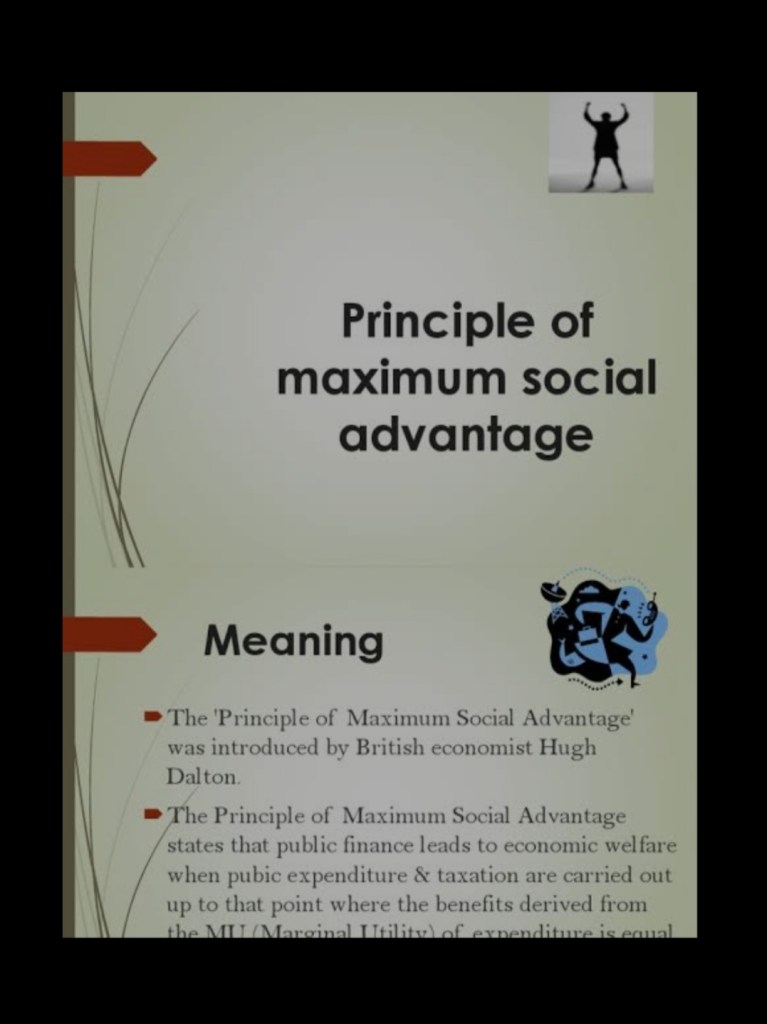
“The Principle of Public Finance means the fundamental rule by which the financial policy of the state is determined. This fundamental rule of principle of public finance is called “The Principle of Maximum Social Advantage “
The credit for the implementation of this principle goes to Prof. Pigou and Prof. Dalton . Just like an individual seeks to maximize his satisfaction or welfare by the use of his resources ,the state ought to maximize social advantages or benefit from the resources at its command .
According to Dalton , principle lies “at the root of public finance “. The principles of maximum social advantage are applied to determine whether the tax or the expenditure has proved to be the optimum benefit .
He stated “The best system of public finance is that which secures the maximum social advantage from the operation which it conducts “ This principle is also called as ” Principle of Maximum Social Benefits “
Prof Pigou called this principle ” The Principle of Maximum Aggregate Welfare “
Significance of the principle :-
Public revenue and public finance are two important financial operations of the state. These operations should be performed on fundamental principles so as to obtain maximum social benefit .
Prof. Hugh Dalton and Prof. Pigou were two famous economists who implemented the principle of Maximum Social Advantage to give the fundamental basis of the function performed by the state to earn revenue and to spend the revenue in the best possible way to Maximum benefit incrementation in the welfare of the public .
Prof. Dalton has expressed it in these words , “As a result of operations of public finance ,the nature and quantity of money produced and between the categories and different persons there are many changes in the distribution of that money . The question is do these changes ; leave a profitable impact on society ? If it is so then it will be considered that the operations of public finance are justified , otherwise not .The best system of public finance is that can obtain maximum social profit by the operation organised by them .”
Therefore , the Principle of Maximum Social Advantage is the principle that guides the operation of financial activities of the government to obtain economic welfare of the society .
According to Dalton , attainment of the principle requires :-
• Public expenditure and taxation should be carried out up to certain limits i.e where marginal utility received by the Government expenditure must be equal to marginal disutility due to taxation ( government income ).
• Public expenditure should be utilised among the various uses in an optimum manner
• The different sources of taxation should be so trapped that the aggregate sacrifice entailed is the minimum .
Assumptions :-
• The public revenue consists of only taxes ( and not gifts , loans , fees ,etc.,) and the state has no surplus or deficit budgets.
•Public expenditure is subject to diminishing marginal social benefits and the taxes are subject to increasing marginal cost or disutility .
Principle Of Maximum Social Advantage:-
The Principle states that :-
“The state should collect revenue and spend the money so as to maximize the welfare of the people. When the state imposes taxes, some disutility is created. On the On the other hand, when the state spends some money, there is a gain in utility. The state should so adjust revenue and expenditure that surplus of utility is maximised and disutility is minimised.”
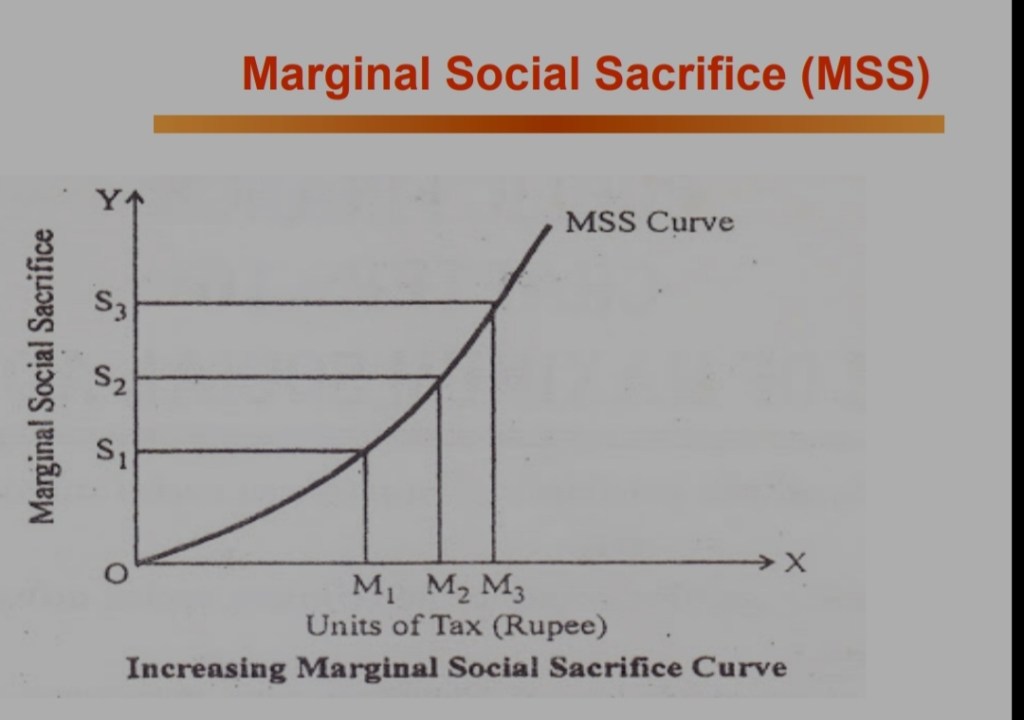
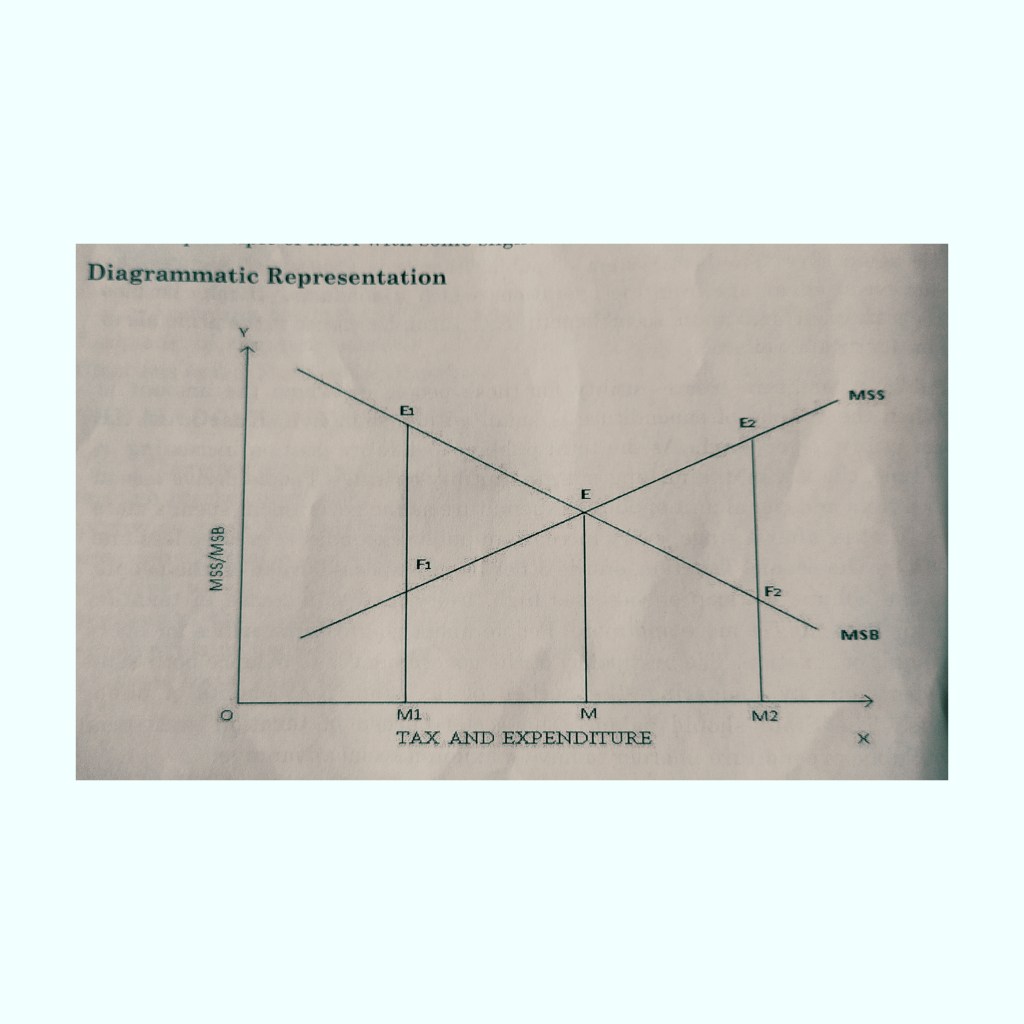
According to Dalton , “ maximum social advantage is at a point where the Marginal Social Sacrifice of Taxation ( MSS) and Marginal Social Benefit ( MSB) are equal . The point of equality between MSS and MSB is referred to as the point of maximum social advantage or least aggregate social sacrifice .
• Maximum social sacrifice of taxation :-
The amount of social sacrifice undergone by the public due to the imposition of an additional unit of tax is called Maximum Social Sacrifice of taxation . Every unit of tax imposed by the government taxes result in loss of utility.
According to Dalton , “The additional burden (marginal sacrifice) resulting from additional units of taxation goes on increasing. Every additional unit of taxation creates greater amount of sacrifice on the society”
The Marginal Social Sacrifice (MSS) curve rises upwards from left to right. This indicates that with each additional unit of taxation, the level of sacrifice also increases.
•. Marginal Social Benefit :–
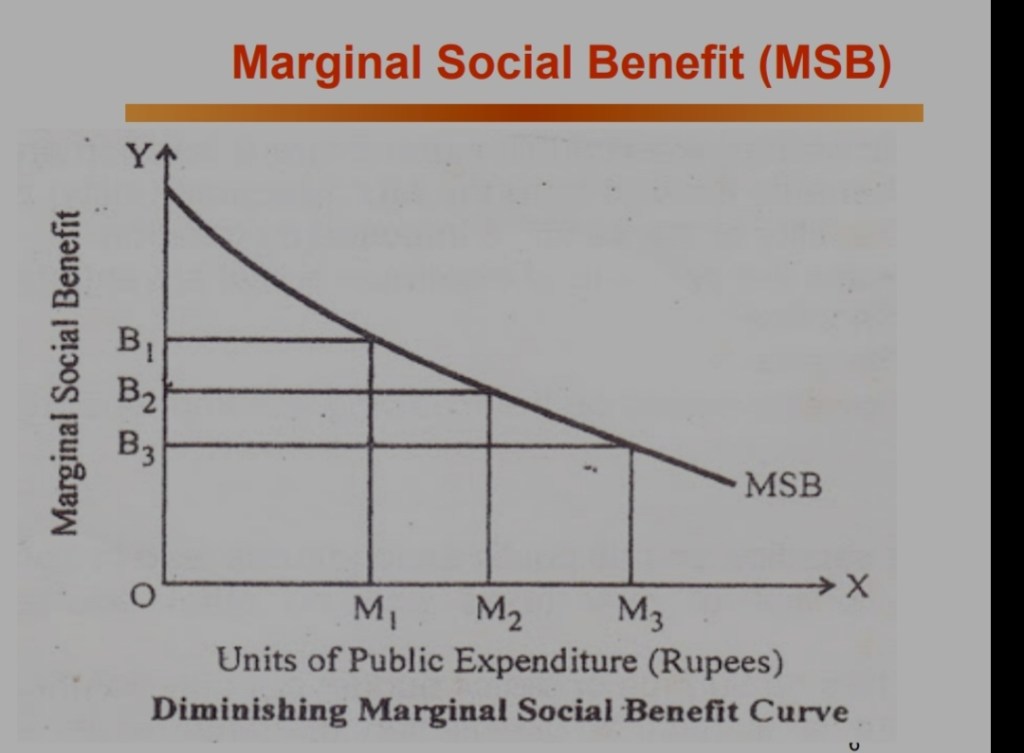
The benefit conferred on the society, by an additional unit of public expenditure is called the Marginal Social Benefit curve .
The social benefit from each additional unit of public expenditure declines as more and more units of public expenditure are spent. The marginal utility from commodity to a consumer declines as more and more units of the commodity are made available to him .
MSB curve slopes downward from left to right. This indicates that the social benefit derived out of public expenditure is reducing at a diminishing rate.
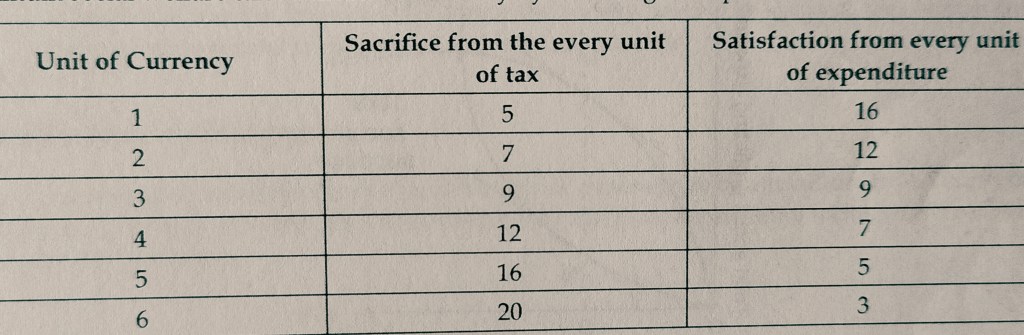
Maximum social welfare can be understood by the following example :-
Table
It can be seen in the above table that marginal sacrifice is increasing due to the increase in every unit weight of tax on society. Inversely , from every additional unit of Government expenditure ,its utilities diminish .
On the third unit of currency , marginal social sacrifice is equal to marginal social advantage ( 9 units ) . At this point the tax and public expenditure will be fixed .
In the above given figure , MSS represent marginal social sacrifice of the taxation curve , slopes upward since taxation increases resulting in Increasing of MSS,. and MSB represents the marginal social benefit of the public expenditure curve , slopes downwards showing that public benefit goes on declining with every unit increase in public expenditure.
The point E where the MSS curve intersects MSB curve , is the ideal point of financial operations where the government collects OM taxation from the society and uses it for public expenditure .
According to Dalton , “Public expenditure in every direction should be carried just so far that the advantage to the community of a further small increase in any direction is just counterbalanced by the disadvantage of a corresponding increase in taxation or in receipts from any other source of public income . This gives the ideal public expenditure and income.”
Musgrave’s View :-
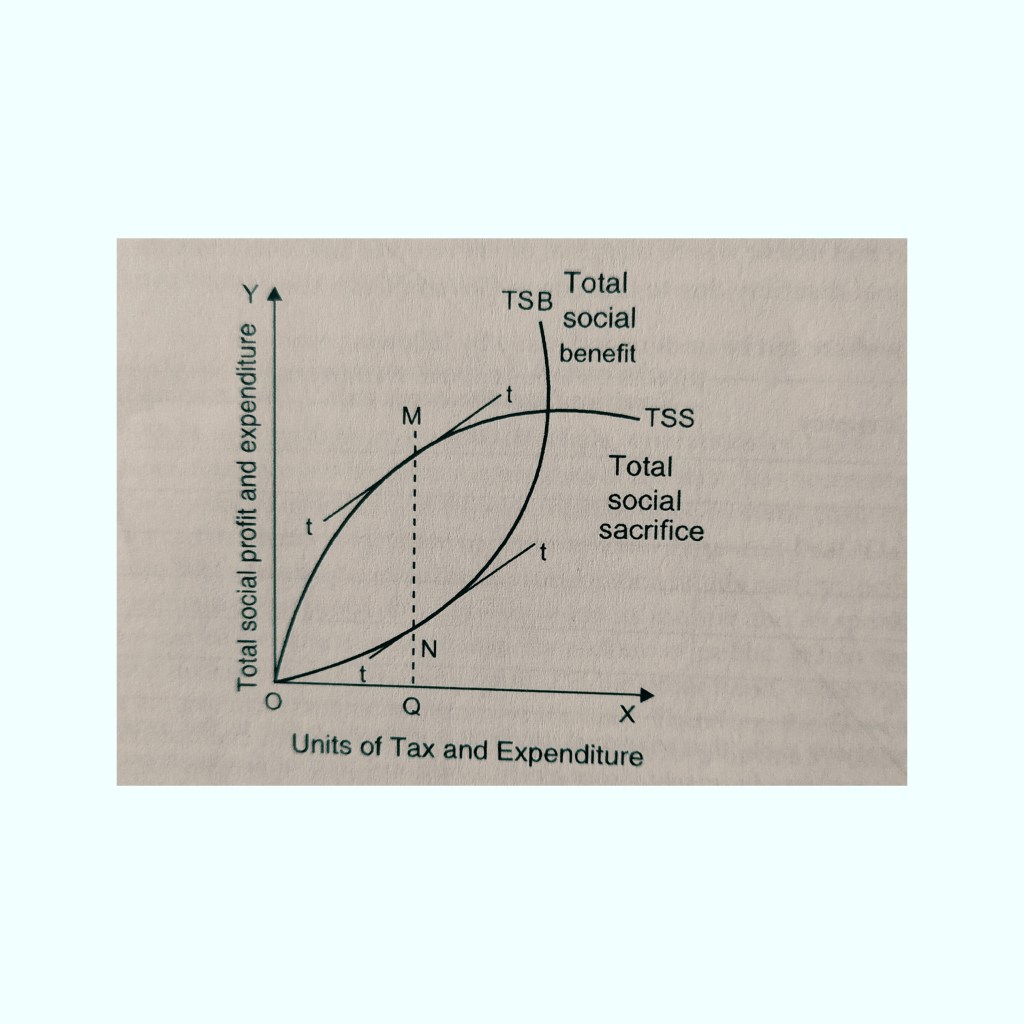
The Principle of maximum social advantage can be explained using total sacrifice and total benefit curve as well .
Musgrave called Dalton ‘s principle as “Maximum Welfare Principle Of Budget Determination “ According to him , the difference between total social benefit and total social sacrifice is the net social benefit where maximum social benefit is obtainable .
The TSB curve represents total social benefit received from public expenditure which slopes upward but decreases after some time , showing that as public expenditure increases total social benefit increases . The TSS curve represents total social sacrifice produced due to tax showing that as total social sacrifice increases with increase in amount of tax but rapidly .
Maximum social benefit will be achieved at a point where the difference between total social benefit and total social sacrifice is maximum . MN denotes the difference between TSB and TSS showing net social benefit.
Objective Tests Of Social Advantage :-
Dalton has given the following three objective Tests which can lead to Maximum Social Advantage :-
• To preserve the Community :- According to Dalton , the first test is the need to preserve the community against internal disorders and external attacks. The financial operations of the state to preserve the society in this manner leads to maximum social advantage .
• To increase Economic Welfare :- Increasing the economic welfare of the community leads to maximum social advantage . According to Dalton ,this can be achieved by improvements in production and improvements in the distribution of national product ( or income ) through state’s financial operations .
• To provide for Future Generation :- According to Dalton , the financial operations of the state should provide for the future generation . The state should prefer a larger social advantage in the future to a smaller one in the present .
Limitations of Maximum Social Advantage :-
In spite being guiding principle of financial operations of the state , the principle of maximum social advantage possesses the following limitations :-
• Vague and Abstract :- The terms “benefit ” and “sacrifice ” are vague and abstract concepts. It is not possible to quantify them and find out their exact implications.
• Different Areas :- It is not possible to compare the marginal benefits accruing to people in one area from a given public expenditure with marginal sacrifice undergone by persons who are taxed in some other areas .
• Lack of Divisibility :- In order to equate the marginal benefit from public expenditure with the marginal sacrifice from taxation , the resources are required to be divided into smaller units . But it is not possible because of the lack of Divisibility of public expenditure and taxes in small units .
• Ignores Non- Tax Revenues:– This principle takes into consideration the sacrifice on the part of direct tax payers and ignores Non- tax revenues like fines , fees ,market borrowing , profits of public undertaking ,etc., are equally important sources of revenue and in the effects on social benefit are as important as those of taxes.
• Maintaining Balance :- It is a difficult task for the state to maintain balance between disutility and utility produced due to imposing tax and utility obtained by people from the Government expenditure as the government is not a single person but different servants at different places in different departments .
• Simultaneous Calculation not Possible :- This principle requires simultaneous calculations and equating marginal social benefits from public expenditure and sacrifices from taxation which is not easy . As put by Prof. Buchana , ” To match them is a function for the’ fiscal brain ”and ‘computers ‘. “
According it Dalton , despite these limitations ,the principle of maximum social advantage is “the best system of public finance “.



























 Eduindex
You must be logged in to post a comment.