In the real world, we are learning new things every day and improving our decision-making skills on the basis of successful decisions in the past. Isn’t this human learning? If we now use computers to fully automate this process, what will it be? This will be machine learning.
Everyday applications
We use it a dozen times a day without even realizingit. Every time you perform a Google search, your machine learning software will figure out how to categorizethe pages you want to visit.Also learn thatif you read emails from your inbox, the smart spam filter can save you from browsing a lot of spam.
THE TECHNICAL UNDERSTANDING
Recently, Tom Mitchell described machine learning as a computer program. It is said that the program learns from experience E related to task T and performance metric P because its performance in T is improved by the P metric. Experience E Let us give an example of an online chess game, in which each game is a task T, and the process of the game is the experience E. Each game has a final result, which is a performance indicator P. This performance indicator is to win. Probability of a game against a new opponent. Now that the computer has the patience to play tens of thousands of games alone, it can further improve your chances of winning consecutively. Machine learning technology: a brief overview We all know how computers work, we all know How the computer works, we have simplified many operations. Now we are trying to get computers to examine all the macro and micro levels of human thought processes that lead to multiple decision-making skills. By developing truly intelligent machines, we can do almost anything you and I can do. This work consists of complex algorithms and functions of artificial intelligence applications running in expert systems. With every action you take, the computer will learn self-learning and self-esteem through progressive, keen, and precise decision-making skills. The computer learns to remember a past experience and process them according to the archived tasks and the resulting performance level. Development of actions/results in a specific context or situation.
FUTURE ASPECTS AND THE SCOPE OF IMPROVEMENT
Machine learning is not limited to Google search or Amazon prediction. It is widely used in medical diagnosis, where tiny patterns are revealed to predict disease. Machine learning can have a positive impact on treatment and subsequent procedure decisions. Financial transactions, data mining, fraud detection, speech recognition, spam prevention, and language translation are some other areas where machine learning is used. The company uses the technology to predict the relevance of products based on the collected data. Let us see what machine learning can bring to the future. A fully functional self-driving car is expected to be available at the end of 2018. Natural language processing has developed a subset of machine learning so that students can improve search results and translations based on the search context. It will also help digital assistants like Siri interact with Humans On Cyber Security Front, a machine learning model that can analyze the structure of inbound or outbound traffic to detect and stop suspicious before continuing damage occurs. activity. Decisions and code changes can be made without explicit programming, which makes machine learning an inevitable trend now and in the future.
The Korean Wave or as it is more popularly known the ‘Hallyu Wave’ is the rise in the popularity of South Korean culture globally.
The word ‘Hallyu’ finds its origin in the chinese word Hanryu meaning “Korean wave”. The Korean wave refers to a global awareness of several aspects of South Korean culture, such as television and film (especially “K-dramas”), K-pop, manhwa, the Korean language, and Korean food.
Hallyu first started gaining prominence in the 1990s and was originally only limited to Japan and China. That all changed with one movie. Released in 1999, ‘Swiri’ is a North Korea/South Korea espionage film. The film was not only popular in China and Japan but soon gained popularity in several South East Asian countries as well. This momentum was carried forward with dramas such as ‘Autumn In My Heart’ and ‘Winter Sonata’ and films like ‘My Sassy Girl’. The popularity of these entertainment products generated a lot of hype about Korean culture’s exploding prominence.
The Korean government’s decision to relax the prohibition on Koreans travelling abroad in the early 1990s was perhaps the most crucial element that ultimately paved the way for Hallyu. This allowed a number of Koreans to go to the western world, primarily the United States and Europe. These western-educated Koreans carried with them new business approaches, new nuances and interpretations of art, movies, and music, as well as new means of expression. This resulted in a massive pool of young, energetic, and highly competent people eager to explore prospects in Korea.
At the same time when the restrictions were repealed, Asia (including Korea) was experiencing the terrible Asian financial crisis of 1997-98. The Asian financial crisis was a perfect storm of bad debt, lender anxiety, and regional economic difficulties.Because many worldwide stakeholders still felt Korea was in terrible health after the crisis, the nation lost foreign direct investments, tourism, and faced global mistrust. To address the issue, the then newly elected president Kim Dae-Jung and the Korean head of global PR agency Edelman co-authored a book geared towards foreign investors titled “Korea: On Course – and Open for Business.”
Since the 2000s, the Korean Wave has seen a steady increase in popularity but that all changed with the growing use of the internet and social media. Hallyu has been spreading for over 20 years, but K-pop in particular has grown more visible to worldwide audiences in the last five to ten years. K-pop is a noticeable and distinct addition to the domain of pop music for three reasons: very high-quality performance (particularly dancing), an exceedingly perfected aesthetic, and a “in-house” technique of studio production. The international breakthrough of “Gangnam Style” was followed by a boom of K-Pop idol groups such as Big Bang, Girls’ Generation, 2PM, EXO, Wanna One, BTS, Twice and Blackpink.
Korean films and filmmakers have increasingly piqued the curiosity of international cinema communities. Train to Busan, has gained international acclaim as a must-see Korean film due to its intriguing subject matter and good narrative structure.Films such as ‘Parasite’ and ‘Minari’ have won several accolades worldwide.
Korean skincare products have also grown in popularity throughout Asia. Amorepacific and LG Household & Health Care have risen to the top of the Asia-Pacific beauty industry. K-dramas and K-pop boosted exposure of Korean beauty goods and brands, which increased demand among Indian women, resulting in the establishment of several specialist e-commerce businesses. Korean consumer brands are expected to be in great demand in India by 2020, with items ranging from food to cosmetics and toys, in addition to household gadgets.
The Korean Wave’s budding global surge has not only boosted South Korea’s economy but also enhanced its soft power and cultural diplomacy. People all over the world are interested in the Korean Wave’s future because the continued flourishing of a local culture in global cultural marketplaces might send an inspirational message of acceptance and inclusiveness. The Korean Wave’s rise may also be an indication of changing relations between Western and non-Western cultures.
Every year June 29 ,is celebrated as the National Statistics Day ,on the birth anniversary of late professor Prasanta Chandra Mahalnobis ,The Father of Indian Statistics.Due to pendemic ,this year the event being organized through video conferencing at NITI aayog,New Delhi.The chief guest for this event will be Rao Inderjit Singh , Hon’ble union minister of state of ministry of statiscs and programme implementation and ministry planning.This year the theme is Sustainable development goal (SDG)-2 ,End of hunger ,achieve food security and improved nutrition and promote sustainable agriculture.
The following research paper discuses about the various aspects of the Indian economy, GDP, Economic slowdown etc. The COVID-19 pandemic ensued global economic downturn, the most severe one since the Global Financial Crisis. The lockdowns and social distancing norms brought the already slowing global economy to a standstill. Global economic output estimated to fall by 3.5% in 2020 (IMF January 2021 estimates).Governments and national banks across the globe conveyed different arrangement instruments to help their economies, for example, bringing down strategy rates, quantitative facilitating measures, and so forth India received a four-column methodology of control, financial, monetary, and long haul underlying changes: Calibrated financial and money related help was given, padding the defenseless during the lockdown and boosting utilization and speculation.
PRICES AND INFLATION
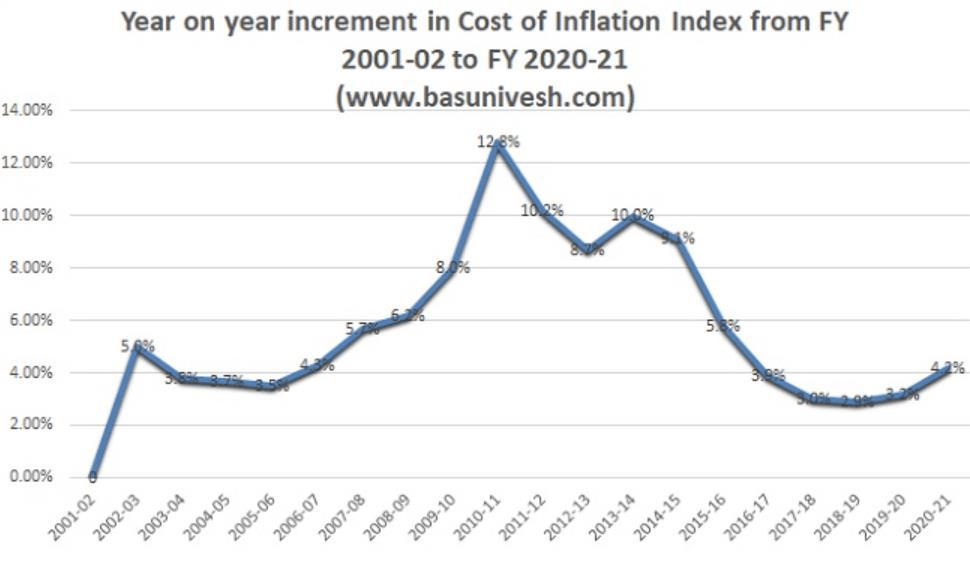
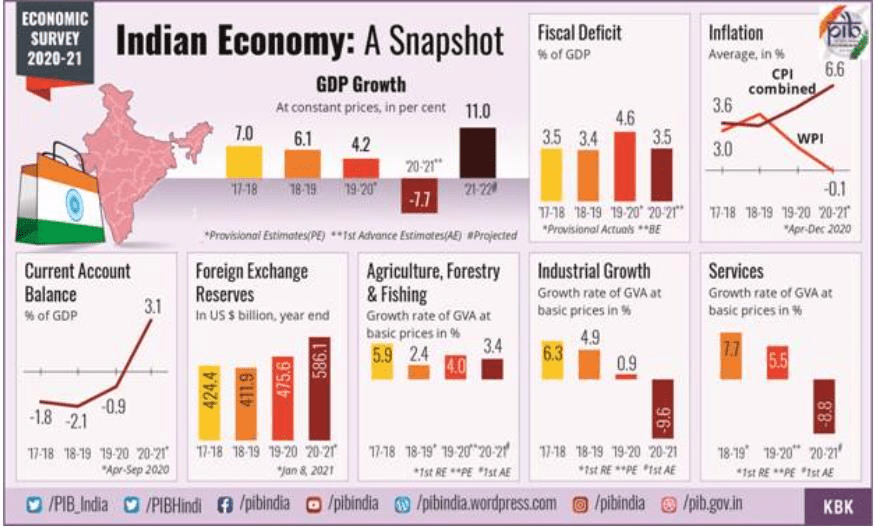
Averaged 6.6% during April-December, 2020 and remained at 4.6% in December, 2020, principally determined by ascend in food swelling (from 6.7% in 2019-20 to 9.1% during April-December, 2020, attributable to develop in vegetable costs) CPI feature and its sub gatherings saw swelling during April-October 2020, driven by significant expansion in value energy – because of the underlying interruptions brought about by COVID-19 lockdown Moderated value force by November 2020 for most sub gatherings, combined with positive base impact.
Sustainable Development and Climate Change
Voluntary National Review (VNR) presented to the United Nations High-Level Political Forum (HLPF) on Sustainable Development . Limitation of SDGs is significant to any methodology pointed toward accomplishing the objectives under the 2030 Agenda. Sustainable advancement remains center to the improvement technique regardless of the remarkable COVID-19 pandemic emergency .Eight National Missions under National Action Plan on Climate Change (NAPCC) zeroed in on the targets of variation, relief and readiness on environment chances. India’s Nationally Determined Contributions (NDC) states that money is a basic empowering influence of environment change activity . The financing contemplations will subsequently stay basic particularly as the nation ventures up the objectives considerably .The objective of mutually preparing US$ 100 billion every year by 2020 for environment financing by the created nations has stayed tricky.
GDP
India’s real GDP has recorded a growth of 11 per cent in 2021-22 and the nominal GDP by 15.4 per cent- which has been the the highest since independence. The V-shaped economic recovery is supported by the initiation of a mega vaccination drives with the hopes of a robust recovery in the services sector and prospects for robust growth in consumption and investment. The Union Minister for Finance & Corporate Affairs, Nirmala Sitharaman presented the Economic Survey 2020-21 in Parliament, which stated that the rebound will be led by the low base and continued normalization in economic activities as the rollout of COVID-19 vaccines gathers traction. The fundamentals of the economy remain strong as gradual scaling back of lockdowns along with the astute support of Atmanirbhar.
Conclusion
India has evolved through the pandemic on the back of strong policy initiatives by the government, along with an optimistic outlook for economic recovery. India has administered ~4 million doses of COVID-19 vaccines in two weeks since January 16, 2021, becoming the fifth-largest inoculated country globally. India has become the world’s vaccine hub and extended support to 90+ countries seeking to stock up vaccines.
Since March 2020, early lockdown, health-infra ramp-up, incremental unlocking, blanket testing, social distancing, tailored fiscal stimulus (to reduce supply-side disruptions and revive demand) and structural reforms initiated by the government have helped restrict the fatality rate in India to 1.2%—one of the lowest in the world. India is emerging as the world’s fastest-growing major economy, with the IMF holding its growth forecasts as high as 6.8% for FY23. Also, the Economic Survey 2020-21 has drawn attention to the V-shaped economic growth—a testament to the burgeoning Indian economy and its intrinsic strength. India is not yet out of the danger of the pandemic. Social distancing continues to be the most effective tool to combat the pandemic as activity levels continue to rise in the economy boosted by the rapidly escalating inoculation drive in the country. Infrastructure to boost sectors to grow with unlocking of economy Terming investment in infrastructure “quintessential” to boost growth, the Economic Survey on Friday said post unlocking of the economy, infra sectors are poised for growth and construction of roads is expected to return to the high pace attained before COVID-19. The infrastructure sector will be the key to overall economic growth and macroeconomic stability, the Survey said emphasizing that the year after the crisis (2021-22) will require sustained and calibrated measures to facilitate the process of economic recovery and enable the economy to get back on its long term growth trajectory.
Tesla launched the Model-S in 2012, the luxury car was one of the more mainstream vehicles that accelerated the growth of electric vehicles. Some traditional cars manufacturers also followed the suit to compete with Tesla. Fast forward to a decade later, electric cars have become even more relevant and every major internal combustion engine manufacturer has an electric car model in their portfolio.
The rise of electric cars has been commendable with 75% growth rate and current sales north of 3 million units. But we have to look at the sustainability of electric vehicles realistically. Internal Combustion Engines cars have come a long way from 20 years back. Conventional cars are significantly more fuel-efficient and release less harmful gases to the environment. But still, they are incomparable to electric vehicle zero fuel emissions.
When we talk about electric vehicles, we also have to consider the whole infrastructure that is required to sustain that. The elephant in the room is the batteries. Battery technology has progressed a lot in the past decade but still, there are lots of limitations that have hindered the adaptability of EVs. One of the biggest issues that EVs face is the limited lifespan of batteries. The average lifespan of a typical EV battery is approximately 10 years depending upon the usage. In many EVs, the replacement of batteries is very difficult or almost impossible. Another problem is the case of recycling batteries. It’s not easy to recycle batteries and currently, electric vehicles have a very small percentage of market share. But as more and more people adopt EVs, there will be more EVs that will have to be scrapped and the proper disposal of batteries will be required. This can be a cause of environmental concerns as batteries will accumulate with no proper arrangement for its recycling.
Issues that will have to be addressed
The problem is much more than just battery technology. The power delivery and infrastructure also need to be developed to support the EVs. It’s going to be easier in urbanized areas with a small population, for instance Norway has been moderately successful in adopting EVs as a standard with plans to totally cease the sales of internal combustion engine vehicles by 2025. This target is going to be much more difficult in large countries with large populations and rural populations where distances between cities are larger. It also requires a considerable amount of capital resources to make the transition possible. Currently, traditional gas vehicles are still more viable, practical, and cheaper than EVs. This tells us that EV manufacturers and the government will require much more than subsidies to convince people to convert. EV manufacturers will also need to control the amount of energy that is required to produce a single EV, which is much more than a gas vehicle.
The extraction of lithium is also a contested issue and just as fossil fuels, the elements that are required to make batteries are non-renewable. Lithium can be extracted in a limited capacity and with more demand, it will become even more challenging to supply the raw materials required to build a battery. Building new battery production factories will also require a considerable amount of time and money. Until battery production facilities are not increased, supplying batteries will be a challenge and mass adoption will not be as fast as we would like it to be.
In conclusion, EVs are certainly the future, they are cheaper to operate and have zero emissions. But there are many other issues like infrastructure, battery supply, and proper disposal that would have to be addressed.
In these pandemic situation there no offline meetings and interviews. Video conference is daily habited in these time , we are using lot of application for video conference like Google meet, zoom meet, Microsoft teams , Skype and jio meet
Most of people facing problems while hosting and interviews times ,our laptops and PC doesn’t have good quality of video
Then , is there any way to optimise for good quality of video . yes there is a way for that problem
In these day every one have mobile phones , by those mobile phone we can as a webcam
Are you thinking I am joking , then just follow my instruction you will be find my word are no joke..
I have research many application but ,I recommended an application Droidcam that can be download by our favourite app stores
Now you connect your PC or a Laptop over the same Wi-Fi network or with the help of a USB cable. If you downloaded the DroidCam app on your phone from the app store, then download the DroidCam Client on your Windows laptop or PC
There are two ways :
Using wi-fi
Using cable
using Browser
Using Wi-Fi
Open the DroidCam app on your phone and click on the ‘Wireless’ option.
Then next screen should display the ‘WiFi IP’ and ‘DroidCam Port’ . If your ‘WiFi IP’ appears 0.0.0.0, then you are not connected to the Wi-Fi.
Open the DroidCam Client on your PC or laptop and enter the ‘WiFi IP’ and ‘DroidCam Port’ as displayed on your mobile phone. Click on the ‘Start’ button.
Now start the video conferencing app and check the webcam by clicking on the ‘Webcam’ or ‘Video’ settings.
Using cable
Connect your mobile phone to your PC or Laptop with USB cable.
We have remember to note is that you need iTunes downloaded on your PC to connect using USB cable. If you do not have iTunes, you can download it . Once you login to iTunes, it will automatically detect your mobile Phone.
Start the DroidCam Client, select the ‘USB’ option and tap on ‘Start’.
using Browser
DroidCam mobile phone application also connect to the camera using a web browser.
Then you have to connect your phone to a Wi-Fi and open DroidCam application.
Lunch Chrome on your Laptop or PC and enter the ‘Browser IP Cam Access’ data then ‘http://192.168……./video’ and click on enter.
If you have wish to specify the resolution of the video in the URL by using the path including ‘force’. example – http://192.168…./video.force?1280×720.
The application DroidCam Wireless Webcam we used was the free ver . You canl also find the paid ver of this app, called the DroidCamX Wireless Webcam Pro in the Google Play Store. The paid version application supports HD video streaming with out ads
there is one more application I recommends i.e Xsplit connect
Diesel fuel, in general is any liquid fuel specifically designed for use in diesel engines, whose fuel ignition takes place, without any spark, as a result of compression of the inlet air mixture and then injection of fuel. Therefore, diesel fuel needs good compression ignition characteristics.
The most common type of diesel fuel is a specific fractional distillate of petroleum fuel oil, but alternatives that are not derived from petroleum, such as biodiesel, biomass to liquid (BTL) or gas to liquid (GTL) diesel are increasingly being developed and adopted. To distinguish these types, petroleum-derived diesel is increasingly called petrodiesel in some academic circles.
In many countries, diesel fuel is standardised. For example, in the European Union, the standard for diesel fuel is EN 590. Diesel fuel has many colloquial names, most commonly, it is simply referred to as Diesel. In the UK, diesel fuel for on-road use is commonly abbreviated DERV, standing for diesel-engined road vehicle, which carries a tax premium over equivalent fuel for non-road use. In Australia, diesel fuel is also known as distillate, and in Indonesia, it is known as Solar, a trademarked name by the local oil company Pertamina.
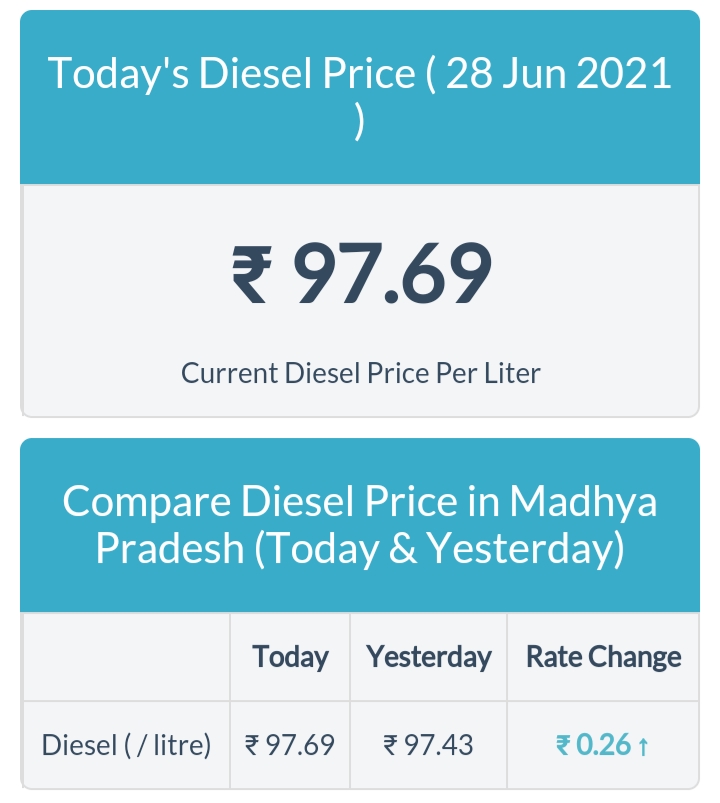
Diesel price in Madhya Pradesh today is fixed by state-run oil marketing companies based the daily ‘Dynamic Fuel Pricing’ mechanism. Here, you can check the current diesel price in Madhya Pradesh, find todays diesel price as well as the quarterly price trend in Madhya Pradesh. New diesel prices in Madhya Pradesh are updated by oil firms daily at 6:00 am IST.
You can also find out how diesel prices in Madhya Pradesh are calculated and how prices are compared to other states. Additionally, find the current Madhya Pradesh diesel price and primary factors impacting diesel prices in India as well as the highest and lowest price recorded during a month.
In todays world , management is the base of any organization or administration to accomplish the desired goals . It is not a new term or a new skill because it has always been a part and parcel of all the ancient civilizations in the world.
Ancient texts and scriptures of many countries like India, china, America throws the important light on management. We can find the fundamentals of management in the ancient scripture of Bhagwat Gita. Bhagwat Gita contains rich of managerial techniques which was written a thousands of years ago.
During the first pre world war phase (1870-1974) there is a rapid change in economies in terms of trade, transportation and communication which indeed led to globalization. Globalization made management as one of the important aspect of development where the classical management theories were developed.
Classical Theories Of Management :
SCIENTIFIC MANAGEMENT THEORY :
Scientific management theory was developed by “FREDRICK WINSLOW TAYLOR”. This theory got popularity in the period of 1880s and 1890s in U.S manufacturing industries with its analyzing techniques of work flow .
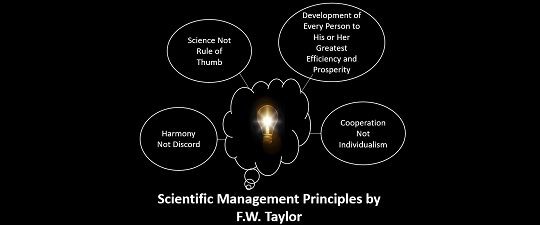
The Principles Of Scientific Management Theory are:
Taylor theory was mostly concentrated on shop floor level and suggested functional foremanship to the industries.
1:Science not a rule of thumb, this principle specifies that organizations should constantly develop new methodologies which makes work easier, faster and quicker rather than sticking to the old methods.
2:Harmony,not discord, this principle specifies that maintaining a positive atmosphere in the organization improves the productivity.
3:Cooperation, not individualism, all the activities of the organization must carried with mutual coordination in order to get improved results.
4:Development of each and every person to his (or) her greatest efficiency, this principle specify that organization should ensure the growth of every individual according to their performance.
ADMINISTRATIVE THEORY:
Administrative theory was developed by “HENRY FAYOL(1841-1925)” .Fayol mainly focused on the administrative management of the organization and structure of work tasks.
Fayol concentrated on top level management and he suggested unit of command. Administrative theory is quite opposite to the scientific theory.
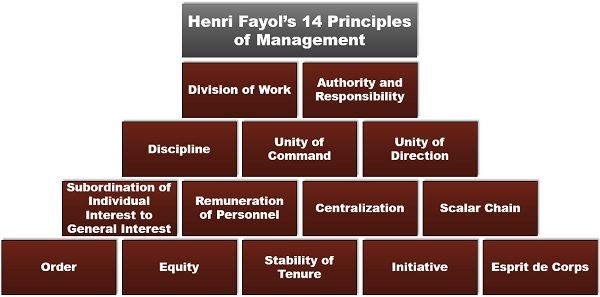
Fayol’s generalized principles ofmanagement:
Fayol developed 14 principles for the organizational development. Fayol consider that effective management of an organization would lead to efficient results.
Fayol’s five functions of management:
Fayol considered that categorizing the functions of management helps the organization in day to day progress of work. The five management functions are:
Planning: This function is used to classify the needs of an organization and arranging them into tasks to develop strategies in order reach the desired goals.
Organizing: This function is used to determine the appropriate process to complete a task.
Commanding: This function is used to supervise the subordinates in completion of day to day tasks.
Coordinating: This function helps in integrating with different kind of groups and making things get done efficiently.
Controlling: This function ensures in evaluating the overall tasks according to the plan set and making changes if needed.
BUREAUCRATIC THEORY:
Bureaucracy theory was developed by “MAX WEBER(1864-1920)” .This theory was generated during the industrial revolution of Germany to manage it’s growing industrial enterprises.
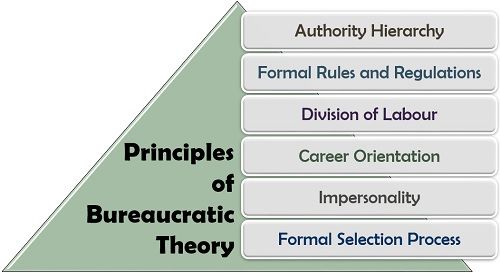
Weber mainly concentrated on the top level management of an organization. According to weber the bureaucratic organization is more rational and can get control over every individual employ. He developed six ideal principles of bureaucracy.
Six principles of bureaucratic theory:
Authority Hierarchy: It is a chain of command to promote individual’s effort to accomplish the organizational goal.
Formal rules and Regulations: These are rules and procedures that are to be followed by the employ’s of entire organization .
Division of Labour: The whole work flow is divided into tasks and distributed among the employees according to their ability.
Career Orientation: Promotion of loyalty among the employs and making the long term relations with the organization.
Impersonality: Making decisions according to the facts rather than personal interests.
Formal selection process: Hiring employ’s according to their skills, qualification , experience etc…
CONCLUSION:
As management & leadership are closely related to each other which has been provided since ages. With globalization management studies has undergone changes in formal study of management which needs a constant experimenting. These classical theories enhance the management abilities and predicts the control behavior of an organization.
As Globalisation takes over the world, more and more businesses are expanding and opening their manufacturing units, branches, outlets, offices all over the globe. While some grow exponentially and expand their market, sales and customer base, some fail to get any response and incur huge promotional, travel, administration and financial costs.
This is why it is extremely crucial to form an entry strategy that suits the organisation. It is also important to assess the financial position and capacity of the organisation and to understand that International business gives delayed returns as spreading awareness, competing with the competitor’s product and building an International customer base takes time and incurs promotional costs.
Once the business is ready to enter the international market, there are several factors to be considered.
Firstly, the organisation needs to conduct market research and choose the country and the specific locations where there is demand for their product/service.
Secondly, assessing the culture, language of the country and city is also very important. The organisation can make the necessary changes (if any) to its product/service and its packaging and labelling accordingly.
The last step is to form an entry strategy that suits the organisation and the market and implement the stategy.
Ways of entering an International Market
There are several ways to enter a market depending on the product/service reach preferred by the organisation and the financial capacity of the organisation.
Direct Exporting- In this method, the organisation directly sends its products, transfers its employees and workers to the location chosen. It involves huge setup, transportation and transfer costs. Therefore, this method is only used when the product that is being exported has a lot of demand in the new market and will definitely get a response from the target audience. For example, exporting machines to developing countries where there’s no manufacturing of such machines but a huge demand for the same.
Through a distributor- In this method, products are sold to distributors who are wholesale buyers. The distributor uses his own selling and pricing strategies to sell the product in the market.
Licensing- Through licensing, the organisation can share its technology, method and basic know how with local companies. However, through this method, the product is sold under the local companies’ name and brand so there is no scope of building an international brand and consumer base.
Contract Manufacturing– Through this method, the company pays a local manufacturing unit to manufacture their products by sharing their technology and design. It saves the cost of exporting or setting up a manufacturing unit abroad and is ideal for products that require large scale production.
Strategic Alliance- This method includes Mergers, Acquisitions and Joint Ventures. In Joint Ventures, two companies form another company to work as partners. For example, Hero Honda. In Mergers and Acquisitions, one company merges with or acquires another company. There is no formation of third company or new identity in this case. For example, Walmart acquired Flipkart.
Through an Overseas agent- Using this method, the company hires a local agent to make business relationships on behalf of the company. The agent acts as a sales representative who sells the products on behalf of the company and has no direct relationship with the customers. The agent gets commission on his sales. This is an effective method to save costs in case the organisation wants to test out the response of the foreign potential consumers or distribute their products on small scale without incurring huge costs.
Goods and services tax is an indirect tax which is levied by government on taxable value of goods, services or both were supplied by persons. It is a value added tax which is charged in every stage of supply.
Goods and services tax came into force in India on 1st July 2017, which is marked as one of the historical dates in India’s tax history.
Goods and services tax which helped remove various taxes under one.
Excise duty, Service tax, VAT, CST, Entry tax, etc. = GST
Goods and Services tax is a destination-based tax which is levied on every stage from the manufacturing level to the final consumer of that goods or services, only on the value addition.
Salient features of GST or GOODS AND SERVICES Tax.
Levy on Good and Services
Goods and services tax is only levied on taxable goods and services on each stage of transaction a tax on, Except supply of alcohol and liquor for human consumption
Indirect Tax
GST is an indirect tax which means tax liability on consumer in indirect they pay tax indirectly to the government.
Dual GST in India
India is a federal country there fore a Dual GST system has been adopted.
1. On Intra state supply- The GST to be levied on intra state supply of goods or services would be called CGST or SGST. E.g., A transaction took place inside the state. 2. On Inter state supply- The GST to be levied on interstate supply of goods and services would be called IGST. E.g., A supply took place between M.P. and C.G.
Uniform GST law in India.
SGST tax of each state is just a copy of CGST act passed by central government, except changing reference from central tax to state tax. Forms and procedures are all same all over India and rates are also expected to be uniform. There would be no difficulty for a businessman to set his/her business in many states.
Consumption based TAX
GST is a consumption-based tax which means the state which is finally consuming the goods and services.
Registration
A supplier of Goods and services or both should be registered under GST law –
1. Supplier of goods or/and services within the state. 2. Registration is not required for farmers and supplier of wholly exempted goods.
Multi point TAX
GST is applied on every state of transaction.
GST is not only implied in India it is on effect in many parts of the words.
When the GST was not implemented in India and was in the process there were various challenges IN front of the makers. But with continuous efforts GST was implemented successfully in India.
Though the revenue collected from GST in the fiscal year 2019-2020 was about Rupee 10 lakh crore which is less than expected.
A administration is been set up to govern the Goods and services Act properly in India.
The Books are of knowledge oceans, from every book we learn some thing new and to improve our knowledge and build our personality
BOOK Defination
we all know that a lot of English words come from ancient Latin – that’s because the Romans occupied England for almost five hundred years from 54BC to 410 AD. … The word book comes from Old English “boc” which in its turn comes from a Germanic root “*bok-“, which means “beech” – as in the beech tree
Types of Book Reviews
Endorsements: Hand-picking Relevant Reviewers Before Your Book is Published. …
Trade Reviews: Publishing Professionals May Advocate Your Book To The Industry. …
Reader Reviews: Individuals Recommending Your Book To Each Other. …
Editorial Reviews: Third Parties Publishing Reviews About Your Book.
Why write book reviews
Book reviews give books greater visibility and a greater chance of getting found by more readers. On some websites, books that have more book reviews are more likely to be shown to prospective readers and buyers as compared to books with few or no book reviews.
How to write a book review
Start with a couple of sentences describing what the book is about. …
Discuss what you particularly liked about the book. …
Mention anything you disliked about the book. …
Round up your review. …
You can give the book a rating, for example a mark out of five or ten, if you like!
In this days most of people like to read blogs because they have simple and clear to understand content
Some of people read books by help of Book review, its give simple summary to understand that book
The Securities and Exchange Board of India (SEBI) is the regulatory body for securities and commodity market in India under the jurisdiction of Ministry of Finance , Government of India. It was established on 12 April 1988 and given Statutory Powers on 30 January 1992 through the SEBI Act, 1992.
Securities and Exchange Board of India (SEBI) was first established in 1988 as a non-statutory body for regulating the securities market. It became an autonomous body on 30 January 1992 and was accorded statutory powers with the passing of the SEBI Act 1992 by the Indian Parliament. SEBI has its headquarters at the business district of Bandra Kurla Complex in Mumbai and has Northern, Eastern, Southern and Western Regional Offices in New Delhi, Kolkata, Chennai, and Ahmedabad respectively. It has opened local offices at Jaipur and Bangalore and has also opened offices at Guwahati, Bhubaneshwar, Patna, Kochi and Chandigarh in Financial Year 2013–2014.
The SEBI is managed by its members, which consists of the following:
*The chairman is nominated by the Union Government of India. *Two members, i.e., Officers from the Union Finance Ministry. *One member from the Reserve Bank of India. *The remaining five members are nominated by the Union Government of India, out of them at least three shall be whole-time members.
SEBI has to be responsive to the needs of three groups, which constitute the market:
*issuers of securities *investors *market intermediaries
SEBI has three powers rolled into one body: quasi-legislative, quasi-judicial and quasi-executive. It drafts regulations in its legislative capacity, it conducts investigation and enforcement action in its executive function and it passes rulings and orders in its judicial capacity. Though this makes it very powerful, there is an appeal process to create accountability.
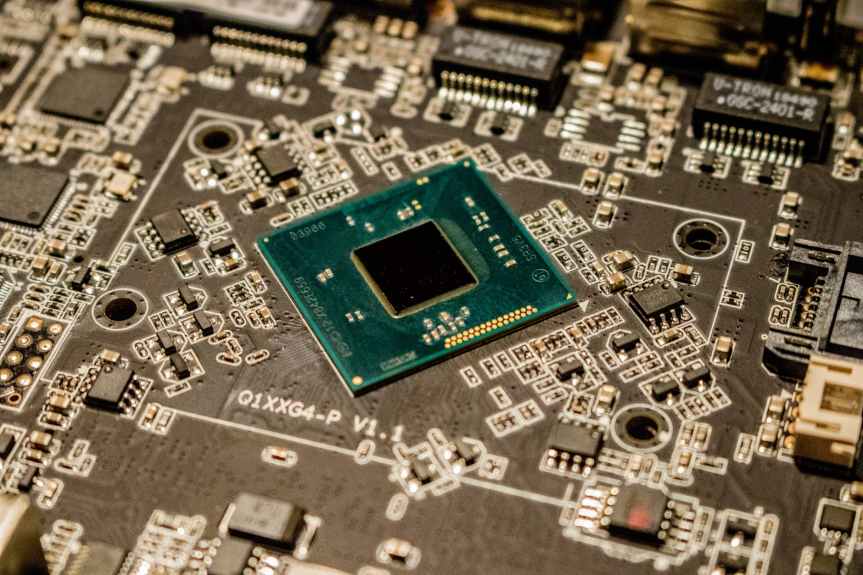
Not many industries have suffered the fate of disarray as the chip industry after the advent of the Covid pandemic. Things were not great for chipmakers in 2020 due to the pandemic but instead of seeing any signs of improvement, 2021 has been even worse for the industry so far. There has been a deficit of chip supply as compared to the demand and it’s not just the electronic industry that is going through a rough phase but it’s many other industries as well. Unlike a couple of decades back when chips were mainly present in personal computers and specialized electronic appliances and gadgets. Now chips power the world. One of the worst-hit industries has been the automobile sector. When the first wave of Covid-19 hit the world, global sales of cars had dwindled, and to compensate for this, car manufacturers had lowered their chip orders from the manufacturers. These chips are a requirement for assembling the critical electronics and computers that are inside modern cars. 2021 saw a sudden increase in automobile sales and this caused the disruption in equilibrium of chip supply and many automobile manufacturers started giving large orders and chip fabrication plants like TSMC were unable to cope up with the sudden growth in demand. This parallel demand for chips has increased the backlog and even though the chip manufacturers are operating over time, they have not been able to keep up with the demand. Now even home appliances might face issues with their chip supply.
There is one more important aspect that we have to address and it’s the increased demand for electronics items after the pandemic. As many people were and are still stuck in homes, they are buying computers, consoles, televisions, and various other electronic components. Many companies have not been able t keep up with the demand due to this. Graphics card is one of those elusive items that have suffered a double whammy. Both potential gamers and crypto miners want their hands on the newest graphics card but due to a shortage of chips card manufacturers are not able to keep up with the demand. There have been many cases where individuals and groups are scalping (buying in bulk) these new cards and reselling them at much higher prices.
Basic appliances and car components often use chips manufactured with older technology. For instance, PC and smartphones are using 7nm manufacturing whereas cars manufacturers uses older 32 nm or 14 nm technology because they are comparatively cheaper to manufacture. But due to the shortage in supply, manufacturers are prioritizing their newer chips and it’s getting challenging to allocate resources for older manufacturing processes. Due to this many car manufacturers have scaled-down on the extra amenities in their models.
TSMC (Taiwan Semiconductor manufacturing company) is one of the biggest chip manufacturers in the world. The company produces 60 percent of the world’s chips for automobiles and 92 percent of cutting-edge chips. Recently Taiwan is experiencing its worst drought in over 50 years. A high quantity of water is required to clean the wafers during the manufacturing of the chips. Droughts have only increased the problems in the manufacturing of these chips. There is immense pressure when most of the world’s chips are made in one single building. This also exposes the problem of relying on a single source of manufacturing. Due to globalization and completion, most of the world’s manufacturing shifted to Asia. The issue of chip shortage will most probably remain next year as well. Intel (U.S) is has started to set up two new manufacturing plants in Arizona. This comes at a time when many have realized that a concentrated source of manufacturing is not the most reliable thing and diversification is the only way to deter any future shortages.
Human development refers to the process of widening people’s choices, freedom and opportunities as well as raising the level of their well being. Human development focusses on the enlargement of all human choices whether economic, social, cultural or political. Economic growth or development alone cannot guarantee human development. This is because these two terms pertain to economic advancement which is usually expressed in monetary terms. Accumulation of wealth does not necessarily mean the fulfilment of several kinds of human choices. For instance, a society does not have to be rich to afford democracy or equality. It is the how we use the wealth and not the wealth itself that is decisive in attaining human development. The real wealth of a society is its people and development of those people can transform that society. In recent times, an alternative to GNP as a measure of economic development has lead to computation of the Human Development Index. This measure has been enlarged and many related indices like gender development index, gender inequality index, human poverty index, etc. have been developed as well. Human development is necessary for several reasons. Human development leads to higher productivity. A healthy and skilled labour is a very important productive asset for any economy. Improvement in education not only enhances skills but also helps in lowering family sizes. Education makes people aware of the benefits of smaller families. Human development also leads to a better physical and social environment. Population growth effects the environment. Deforestation, desertification etc decline with a decline in poverty. Reduced poverty also contributes to a healthy civil society, increased democracy and greater social stability. Human development embraces the entire society and not just the economy. The political, cultural and social factors are given much importance as the economic factors. Some of the important components of human development are equity, empowerment, sustainability and productivity. People must enjoy equitable access to opportunities. They must be empowered so that they are in a position to exercise choices of their own free will. The development should be sustainable i.e. needs of future generations should also be under consideration. Productivity is an essential part of human development as therefore should always be a priority. In the recent years, economists have shifted their concern from economic growth to human development. This has lead to the creation of Human Development Index (HDI). HDI is a measure of human development done on the basis of three dimensions: long and healthy life, access to education and decent standard of living. Long and healthy life can be measured through life expectancy while literacy rate shows access to knowledge. For measuring standard of living, GNP is often used. Since human development is so closely linked to economic growth, it is important that planning in economic growth should coincide with human development. It means that equal emphasis should be laid on production and distribution objectives. Human beings should be declared the ultimate objective of economic planning. There are enormous difficulties in doing so but it is worthwhile.
The social issue is a problem that influences by many citizens within a society.
Social issue be a group of common problem in present society and one that many people struggle to solve. Social issues are distinguished from economic issues. Some issues have both social and economic aspects, such as immigration. There are also issues that don’t fall into either category, such as wars.
The definition of a social problem has both an objective component and a subjective component. The objective component involves empirical evidence of the negative consequences of a social condition or behavior, while the subjective component involves the perception that the condition or behavior is indeed a problem that needs to be addressed.
social issues influence society
Slow social change is desirable, but rapid social change threatens social order. Social problems weaken a society’s stability but do not reflect fundamental faults in how the society is structured. Solutions to social problems should take the form of gradual social reform rather than sudden and far-reaching change.
COVID-19 from 2020 is the hell of the year for all of us . the world facing many issues in this pandemic situation . many of people lose thire dear and nears ones and many of finacial supports many of the people become homeless, they don’t have proper food to continue thire lifes
In every conntry thire many of issues facing in society , in this pandemic the people facing issues are:
Suicide Prevention
With so many people forced into lockdown and isolation over the last year, many people have suffered from poor mental health. In Victoria alone, there has been a 40% spike in calls to various mental health hotlines as a consequence of COVID-19, and it is now more important than it ever has been to pay attention to the struggles of millions of people around the world
Family Violence
Another victim of the pandemic are families who are in dangerous situations due to loss of work, lockdowns and being isolated from the public. Record rates of family violence were recorded in 2020, and cases have increased dramatically, resulting in many support services struggling to help those in need
The Rise In Homelessness
Over the last year, the number of people who have been forced into homelessness has surged as short-term coronavirus and housing protections have phased down. Due to loss of income, many families have had to bear the burden of being kicked out of housing due to an inability to pay rent.
Our Ecological Crisis
Poverty and pandemic aside, another issue we are facing is the ecological crisis due to the collapse of ecosystems and troubling disappearance of biodiversity. Although the slowdown in economic activity due to COVID-19 created a very brief reduction in global carbon emissions, it is impossible to ignore the mounting effects of unchecked human activity over the last decade or so
Speeding Up The Vaccine Rollout
Last but certainly by no means the least, 2021 will see the COVID-19 vaccines being rolled out in most countries around the world. Although more than 360 million vaccine doses have been administered, there is a troubling gap between vaccination programmes in various countries, with many yet to report even a single dose.
Common of Social Issues
Poverty and Homelessness. Poverty and homelessness are worldwide problems. …
Climate Change. A warmer, changing climate is a threat to the entire world. …
Overpopulation. …
Immigration Stresses. …
Civil Rights and Racial Discrimination. …
Gender Inequality. …
Health Care Availability. …
Childhood Obesity.
Poverty and Homelessness
Poverty and homelessness are worldwide problems. According to Habitat for Humanity, one-quarter of the world’s population lives in conditions that harm their health and safety. Many do not have shelter, a basic human need for survival.
This social issue also goes beyond the 25% of the population directly affected. Because of the lack of shelter for this vulnerable population, there is greater stress on government and social programs, including schools and healthcare systems.
Climate Change
A warmer, changing climate is a threat to the entire world. Climate change affects the entire world population, and the Union of Concerned Scientists calls this social issue “one of the most devastating problems humanity has ever faced.”
The 800 million people already living in extreme poverty will be impacted most severely. Around the world, people are already noticing warmer winters, more severe storms and rainfall events, and more frequent wildfires. These issues already put stress on governments and systems in many countries.
Overpopulation
As the population of the world grows, resources become scarcer. The United Nations reports that the current population of 7.7 billion people is expected to grow in coming decades, with a projection of 8.5 billion people by 2030.
The fastest growing areas of the world, such as sub-Saharan Africa, often face already scarce resources like land for farming. As the population becomes more than the country can sustain, people will need to move elsewhere to avoid starvation and homelessness.
Immigration Stresses
People move from one country to another, and in itself, this isn’t a social problem. However, immigration can place stress on government programs and social systems within a country, and it can be a divisive topic in a society. These immigration-related stresses affect many people.
Civil Rights and Racial Discrimination
Civil rights, or the rights of citizens in a country to have equal treatment socially and politically, is another one of the most significant social issues in America and around the world. More than 40 years after the Civil Rights Act passed, almost 60% of African Americans still live in segregated neighborhoods and 90% of African Americans report that racial discrimination is still a major problem.
Gender Inequality
A report from the Pew Research Center Fact Tank indicates that about 50% of Americans feel the country needs to do more to address the income gap between men and women. Women still lag behind men in wages and top leadership positions held, although they are now more likely to attain a college degree.
Worldwide, the situation is even more extreme. UNICEF reports that 12 million girls are married before they reach adulthood, and 98 million high school-aged girls do not attend school.
Health Care Availability
When people are sick or hurt, they need access to medical care to get better. According to the Centers for Disease Control and Prevention (CDC), almost one in 20 U.S. citizens do not obtain needed medical care because of the cost. Worldwide, 97 million people become impoverished by seeking needed medical care, as reported by the World Health Organization (WHO). Governments around the world are working on this problem, as are nonprofit organizations.
Childhood Obesity
Some types of social problems are health-based, but they also have an impact on socio-economic issues. For instance, the CDC reports that 18.5% of U.S. children are considered obese, having a body mass index at or above the 95th percentile.
However, the childhood obesity epidemic doesn’t affect all children equally. Children in families where the parents have more education and higher incomes are far less likely to be obese than those in families with less education and lower incomes.
Poor Leadership
Many of the social problems in society are connected in subtle ways, but all social problems are connected to the leadership of countries, corporations, and other groups. An ongoing Gallup poll asks Americans to rate the most important problems and social issues facing the country. By far, the most significant issue was poor leadership; 28% of respondents list it as the number one problem.
Social Issues Teens facing
Advances in technology mean today’s teens are facing issues that no previous generation has ever seen. While some issues are not exactly new, electronic media has changed or amplified some of the struggles young people face.
Depression
According to The National Institute of Mental Health, an estimated 3.2 million adolescents in the United States had at least one major depressive episode in 2017. That means about 13% of teenagers may experience depression before reaching adulthood.
Depressive disorders are treatable, but it’s important to seek professional help. If your teen seems withdrawn, experiences a change in his sleep patterns, or starts to perform badly in school, schedule an appointment with your teen’s physician or contact a mental health professional. Do not delay getting help for your teen if you notice these symptoms
Bullying
It’s also important to talk to your child about when and how to get help from an adult. Remind them that asking for help is not a sign of weakness, but instead a show of courage. Talking about how someone has humiliated them is never an easy topic.
Sexual Activity
Of the 20 million new sexually transmitted diseases each year, more than half were among young people between the ages of 15 and 24.
Parents may not be aware that their children are sexually active, however. Talk to your teen about sex, even if you don’t think your child is engaging in sexual activity.
Drug an Alcohol use
Make sure you have regular conversations with your teen about the dangers of drugs. And don’t forget to mention the dangers of prescription drugs, too. Many teens do not recognize the dangers of taking a friend’s prescription or popping a few pills that are not prescribed to them.
Unfortunately, teens often underestimate how easy it is to develop an addiction. And they don’t understand the risks associated with overdosing. Be sure you are talking about these risks on a consistent basis.
Fixing Social Issues
Although many Americans feel their leaders are the biggest problem they face, governments, corporations, and communities are working to fix some of the top social issues. These are just a few of the actions they are taking:
Schools are implementing anti-bullying programs, which the PACER National Bullying Preventions Center says can decrease bullying by up to 25%.
Community efforts to help reduce childhood obesity include adding salad bars to school lunches, focusing on physical fitness, and adding obesity prevention initiatives to hospitals.
The U.S. enacted the Affordable Care Act (ACA) to begin addressing the challenges in health care availability, and it remains an important political issue.
The European Union is on track to meet its goals for reducing carbon emissions and helping mitigate the effects of climate change. Other countries are also working hard to make progress.



![AN ANLYSIS ON OVERALL GROWTH IN THE INDIAN ECONOMY [2020-2021]](https://eduindex.org/wp-content/uploads/2021/06/1609833276_axhez7_istock_indian_economy_stocks_markets_915768_1605451970.jpg?w=700&h=1&crop=1)









 Eduindex
You must be logged in to post a comment.