The Dutch are the people of Holland (now the Netherlands). The Dutch arrived in India shortly after the Portuguese. The Dutch have long been experts in sea trading. The Dutch government granted the United East India Company of the Netherlands license to trade in the East Indies, including India, in 1602. Dutch India was more of a geographical location than a political authority. In comparison to the Portuguese and the English, the Dutch had the shortest presence in India of all the European colonial powers.
Dutch history in India The Dutch East India Company was founded in 1602 and signified the Dutch entrance in India. They arrived in Andhra Pradesh’s Masulipatam (now Machilipatnam). From 1605 to 1825, they occupied the Indian subcontinent. Given the growing demand for Indian spices from Asia in Europe, the Dutch arrived to India with the intention of trading. The establishment of the Dutch East India Company marked the beginning of the modern multinational company (MNC). Following a pact between the Zamorin of Calicut and the Dutch chief, Steven Van der Hagen, Dutch trading in India began on November 11, 1604. The goal was to force the Portuguese off the Malabar Coast, but this was never achieved. The Dutch, on the other hand, soon built commercial facilities in various parts of India and traded cotton, textiles, silk, Indigo, and Golconda diamonds. In 1661, the Dutch conquered the Portuguese and took control of all of Malabar. They had now mastered the pepper trade and made tremendous profits selling pepper, which was known in Europe as “Black Gold.” In the 17th century, nothing could stop the Dutch from capturing Pondicherry from the French in 1693. In the East Indies, the Dutch became a large producer of sugar and coffee, as well as a big exporter of spices and textiles. During their time in India, the Dutch tried their hand at currency manufacture as well. They established mints in Cochin, Masulipatam, Nagapatam Pondicherry, and Pulicat as their trade grew. Furthermore, the Pulicat mint issued a gold pagoda with an image of Lord Venkateswara (god Vishnu). The Dutch minted coins that were all based on local coinages.
The Decline of Dutch power The Dutch East India Company began to fade in the mid-eighteenth century. It was characterised by poor corporate practices, corruption, and political upheaval. Martanda Verma, the formidable monarch of Travancore, defeated the Dutch in 1741 and reclaimed control of Malabar. The fourth Anglo-Dutch war, in which the British navy sunk Dutch ships and seized trading ports, resulted to their bankruptcy in 1799. Finally, the Anglo-Dutch Treaty of 1825 ended the Dutch dominance in India by transferring all Dutch assets to the British.
Carbon farming (also known as carbon sequestration) is a system of agricultural management that helps the land store more carbon and reduce the amount of Greenhouse Gases (GHGs) that it releases into the atmosphere. Carbon farming explicitly recognises that it is solar energy that drives farm ecosystem dynamics and that carbon is the carrier of that energy within the farm system.
Agriculture covers more than half of Earth’s terrestrial surface and contributes roughly one-third of global GHG emissions.
According to the Third Biennial Update Report submitted by the Government of India in early 2021 to the UNFCCC, the agriculture sector contributes 14% of the total GHG emissions.
Carbon Farming: a Viable Option
Climate Friendly: Carbon farming promises a bold new agricultural business model – one that fights climate change, creates jobs, and saves farms that might otherwise be unprofitable.
Optimising Carbon Capture: It is a whole farm approach to optimising carbon capture on working landscapes by implementing practices known to improve the rate at which CO2 is removed from the atmosphere and stored in plant material and/or soil organic matter.
Carbon farming can incentivise our farmers to introduce regenerative practices in their agricultural processes helping them shift their focus from improving yields to functioning ecosystems and sequestering carbon that can be sold or traded in carbon markets.
Farmer Friendly: It not only improves the health of soil but can also result in improved quality, organic and chemical-free food along with boosted/secondary income from carbon credits for the marginalised farmers.
Growth in Carbon Market: The total value of the global carbon markets grew by 20% in 2020 — the fourth consecutive year of record growth — and is well on its way in raising a critical mass of investors.
Carbon thus can effectively prove to be the ‘cash crop’ of the future for farmers
In India, Meghalaya is currently working on a blueprint of a ‘carbon farming’ Act to create a prototype of sustainable agriculture model for the entire North-East region. Sikkim became the first State in the world to become fully organic in 2016.
Steps can be Taken to Encourage Carbon Farming?
Soil is one of the most untapped and underutilised defences against climate change and acts as an efficient carbon sink.
Legal Backing for Carbon Farming: An extensive and pioneering carbon farming Act with a robust transition plan can effectively demonstrate the idea of creating a carbon sink on working land.
Carbon Credits and Carbon Banks: The farmers can be rewarded through globally tradable carbon credits. Carbon banks can also be created that would buy and sell carbon credits from farmers. Paying farmers to restore carbon-depleted soils offers a great opportunity for a natural climate solution and to stabilise global warming below 2°C.
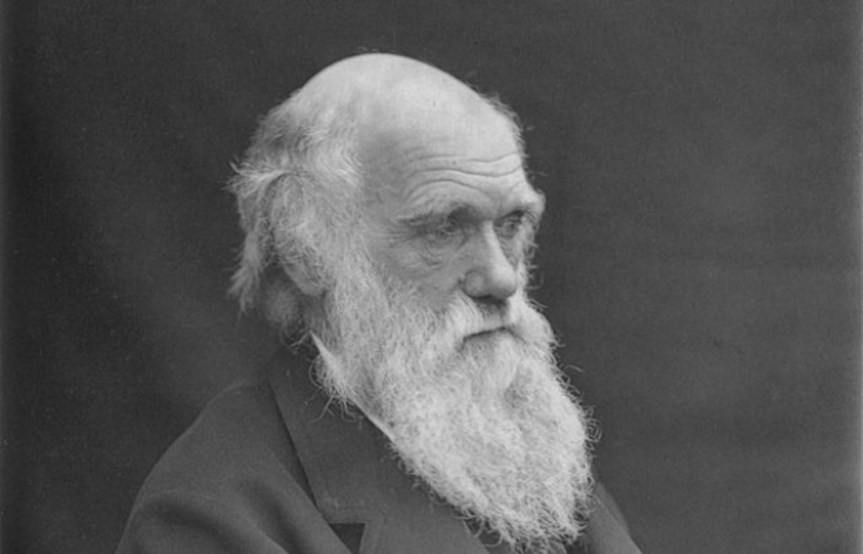
Charles Robert Darwin (1809-1882) was a British biologist, born on 12th February 1809 in Shrewberg, England.
He presented his theory of evolution in the book On the Origin of Species by means of natural selection in 1859. Darwin argued that new species had evolved from older species, and he described the mechanism behind the transformation process. Darwin’s theory of evolution is based on the following five principles:
Organisms produce more offspring than can possibly survive.
Organisms face a constant struggle to survive.
Organisms within a species vary.
Organisms best suited to their environment survive.
Those organisms which survive will reproduce and pass on their genes to the next generation.
Over-production: All species have a tendency to produce more and more offspring in order to increase the population. For example, a salmon produces 28,000,000 eggs in a single season; a single spawning of an Oyster may yield as many as 114,000,000 eggs; a common roundworm lays about 70,000,000 eggs in a day. This huge production is to ensure the survival of the species. Even though species are produced in larger numbers, the population of a particular organism remains more or less constant.
Struggle for Existence: Darwin claimed that there was a continual ‘struggle for existence in nature, in which only the fittest would survive. As a result of overproduction, there is a struggle for existence among organisms. Since the number of is persons is large, there is competition for food, shelter, mates etc.
struggle for existence may be of different types as follows:
a. Intra-specific (Intra-species) struggle: The members of the same species struggle among themselves for food, shelter and mates.
b. Inter-specific (Inter-species) struggle: The members of different species may go on fighting for survival. A member from one species may hunt other members of other species for food.
c. Environmental struggle: Organisms of different species struggle against the environmental hazards like earthquake, flood, drought etc. Only those species with better adjustment with the environment will survive.
Variations: Variation is the tendency of an organism to deviate from the parental generation. These variations play a very important role for adaptations in the environment. Some variations are considered as favourable and others are unfavourable. Organisms with unfavourable variations easily get defeated in the struggle for survival. Variations that are useful to adapt to the pressures of the environment survive long. The new trait of advantageous characteristics is passed on to the future generations.
Survival of the Fittest: The struggle for existence leads to the survival of the fittest. When there are too many of an organism in an area, they compete for resources such as food and perhaps shelter, for example trees and caves.The surviving species will reproduce more offspring than those who are less adaptive.
Natural Selection: The surviving individuals will give rise to the next generation. The successful variations are transmitted to the succeeding generations. The accumulation of advantageous traits in future generations gradually brings changes in species. Successive generations in this way tend to become better adapted to their environment. Eventually, a new species may evolve.
Furthermore, certain members of a population with one group of variations may become adapted to the environment in one way, while others, with a different set of variations, become adapted in a different way or become adapted to different environments. In this way, two or more species may arise from a single ancestral stock.
Examples of Natural Selection
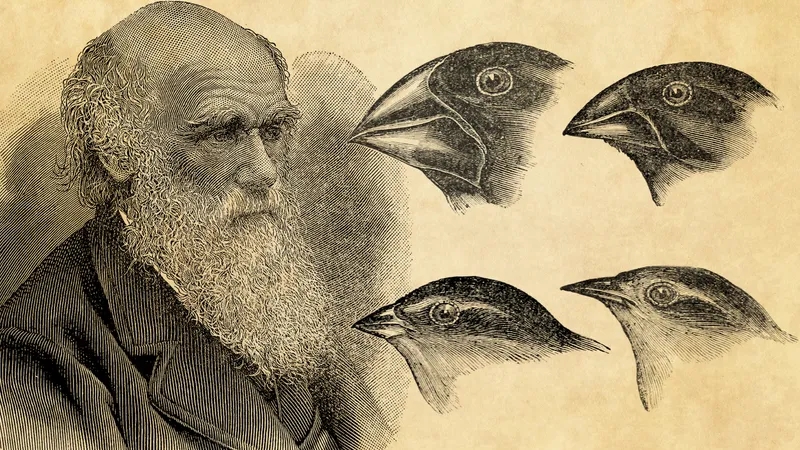
1. The finches of Galapagos : Some species of finches have short thick beaks. They are used to eating seeds, fruits and buds. Some others have long straight beaks. They subsist primarily on nectar from flowers. If environmental condition suddenly changes some characteristics may be more favoured than others.
2. Industrial melanism in moth : Before Industrialisation, the tree trunks were lighter and light coloured moths were predominant. Dark coloured moths were also present but they were limited in number. As a result of industrialisation, the pollution resulted in the darkening of tree trunks. So the light coloured moths become more visible to birds and were therefore eaten by their predators. As a result of this at the end of 19th century the common light coloured moths were almost completely replaced by the black variety.
The theory of origin of species by natural selection is regarded as a major advancement in evolutionary thought. Darwin contributed to the modern understanding of biological evolution by documenting the variation of living forms and identifying the key process of natural selection.
Like most 19th century scientists, however, he did not understand heredity or how specific traits are passed from one generation to the next. His theory lacked the knowledge of modern genetics. However, mutation theory explained the causes of variations among organisms.
The Portuguese State of India was a Portuguese colonial state on the Indian Subcontinent. Vasco De Gama was the first Portuguese to set foot in India in 1498. However, Portuguese control in India is considered to have lasted from 1505 until 1961. Although Portuguese colonialism outlasted its English counterpart, it had little influence outside of its territories. The Portuguese were the first Europeans to arrive in India and the last to go.
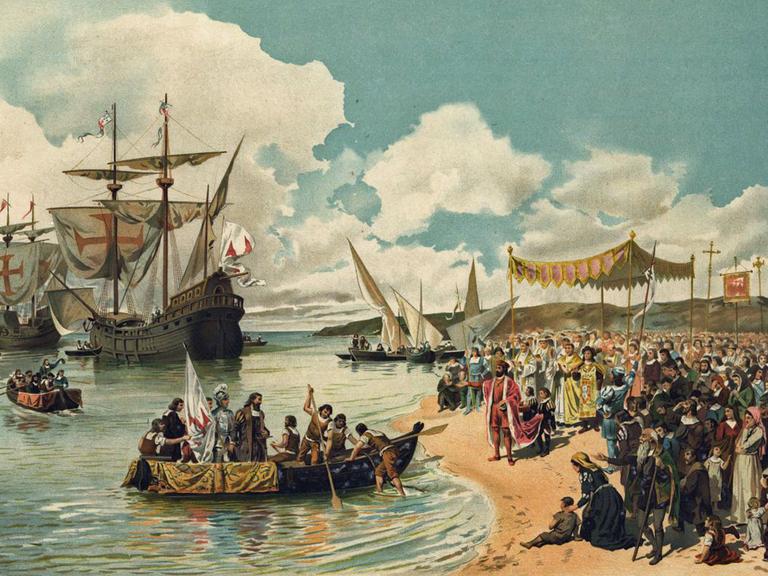
Portugal’s Early Years in India When Vasco da Gama arrived in Calicut on the Malabar Coast on May 20, 1498, Portuguese colonialism began in earnest. He met with the ruler of Calicut, the Zamorin, and received permission to trade in Calicut. But Vasco da Gama was unable to pay the customs duties and the cost of his merchandise. The Zamorin’s officials detained some of Vasco da Gama’s soldiers when the duties were not paid. This enraged him so much that he kidnapped some Indians and fisherman. However, the voyage was a success in the eyes of the Portuguese authorities in Lisbon. A sea path around the Ottoman Empire was discovered, and the expedition made a profit well in excess of its initial cost.
Expansion of Portuguese Colonialism Vasco da Gama established a base of operations on the Malabar coast after further conflict with the Zamorin Kingdom. Francisco de Almeida, the first viceroy, placed his headquarters in what is now Cochin. Alfonso de Albuquerque, the second governer of the Portuguese territories in the East, was appointed in 1509. Off the coast of Calicut, a Portuguese fleet led by Marshal Fernão Coutinho arrives. Their orders were quite clear: destroy the Zamorin. The city was levelled and the palace of the Zamorins was taken, but the local soldiers rallied and attacked the invading Portuguese, forcing them to retreat and wounded Albuquerque. In 1510, Afonso de Albuquerque defeated the Sultanate of Bijapur, establishing Goa as a permanent settlement. It would later become the viceroy’s seat and the headquarters of the Portuguese colonial conquests in India. Modern-day Mumbai was likewise a colonial possession until 1661, when it was handed over to the British. From 1799 until 1813, the British conquered Goa for a brief while, eradicating the final vestiges of the inquisition. The capital was moved to Panjim, which was later renamed Nova Goa, in 1843, when it became the administrative center of Portuguese India. For the next century, Portuguese control would be limited to Goa and the enclaves of Diu and Daman.
Cause of Decline of Portugal in India While the British granted independence to most of India, the Portuguese retained colonial colonies in India. Local anti-Portuguese demonstrations in Goa were violently suppressed. Despite repeated pleas from the Indian government, the Portuguese government, led by dictator António de Oliveira Salaza, refused to hand over its colonial holdings, saying that they were an intrinsic part of Portuguese territory. The invasion of Goa by the Indian troops took place in December 1961. The Portuguese attempted to resist against overwhelming odds, but were quickly crushed by the Indian Army. On December 19, 1961, the Governor of Portuguese India signed the Instrument of Surrender, freeing Goa after 450 years of Portuguese domination in India.
The most important question that has always been exciting to human mind is about human origin and destination. Where did we come from and where are we heading to?
To understand the human origin and evolution, we have to first look in to the emergence of life on the earth. It is believed that life is originated from inorganic matters due to many physical-chemical conditions
Theories of Organic Evolution
The term evolution was first applied by the English philosopher Herbert Spencer, to mean the historic development in life. Evolution is a process that results inheritable changes in a population spread over many generations.
Lamarckism
Jean Baptist de Lamarck (1744-1829) was a French biologist. He spent the early part of his life as a botanist. Then at the age of 50, he turned his attention to zoology, particularly to the study of invertebrates. His extensive studies on invertebrates formed a base in zoological classification. As a result of his systematic studies, he became convinced that species were not constant but rather were derived from pre-existing ones. By consolidating all these ideas, he proposed his theory of evolution in his book Philosophie Zoologique 1809 which is known as Lamarckism.
Lamarck believed that organic changes seen in animals resulted from the influence of environment. According to him, when the environment changes, animals need to change their body structure as well. He proposed his ideas as two different laws as the following-
i) The law of use and disuse: A living body is influenced by environmental factors, and ultimately this phenomenon initiates an adaptation of organisms to their surroundings. As per the necessity, some parts of the body may be used more and more. Therefore, those parts tend to show more development or changes in the course of time, while the other parts of the body, which may not be required much, will become weak or degenerate due to constant disuse.
ii) Inheritance of acquired characters: Modifications produced during the lifetime of organisms become hereditary and will be inherited by the offspring. All the modifications that the organism acquires during its lifetime in adaptation to the environment are automatically transmitted to the next generation and so become a part of heredity
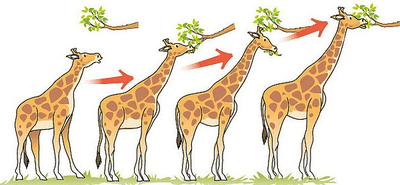
To support his theory, Lamarck presented several examples. The most remarkable one is associated with the long neck and tall front legs of giraffes. According to Lamarck, the ancestors of giraffe were normal animals with reasonably long neck and forelimbs. They depended on grass and bushy vegetation for their survival. But a sudden scarcity of leafy vegetation due to some environmental factors, forced the giraffe to depend on leaves of tall trees and for that they had to stretch their neck and forelimbs. The continuous stretching of these organs resulted in the long neck and long forelimbs of present day giraffe.
In another example, he mentioned that the ducks are unable to fly because their wings became weak, when they stopped flying. Again, the birds that started to live in an aquatic environment, gradually acquired webbed feet through the conquest of survival.
Criticism of Lamarckism
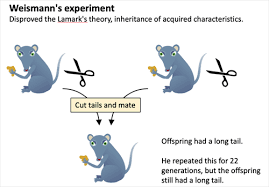
Lamarck’s theory has been criticised from many angles. The German scientist August Weismann criticised the essence of Lamarck’s theory of inheritance acquired characters by his experiments, which involved cutting off the tails of mice for over twenty-one generations. All tailless mice in all generations produced their offspring with tails. Therefore, he reached to the conclusion that the environmental factors might influence the body cells, but it is not enough to profess a change of reproductive cells. Characters of an organism would not be inherited unless the change could occur in the reproductive cells.
Characters of an organism would not be inherited unless the change could occur in the reproductive cells. According to Weismann the body of an animal is composed of two parts viz. germ plasm (germ cells) and somato plasm (body cells). Only those characters which are located in the germ plasm will be inherited.
As a result of these experiments, Lamarckian law of inheritance of acquired characters lost its evolutionary ground. But the effort towards finding facts related to organic evolution continued. Charles Darwin’s interest in this field gave birth to new findings (Darwinism).
As a parent, it’s sometimes hard to be away from your kids. But it’s an indescribable, heartwarming feeling when you return – their smiles, the running to you with open arms, their tiny arms squeezing your neck. Whether you’ve been gone ten minutes or two days, that moment, this sweet reward, is everything.But what if reunions aren’t possible because the goodbyes are too much for your child to bear? If goodbyes are full of tears and fits, your little one might have separation anxiety.
Separation anxiety is a normal part of development that occurs when toddlers begin to grow more aware and develop stronger relationships with their caregivers. This awareness can make them more apprehensive and possibly feel unsafe without their parent or caregiver.Whether it’s dropping your child off at day-care or leaving your child at home as you head out to work, farewells can be difficult. Your child may understand that mommy and daddy didn’t vanish, but they might not know for how long. All they know is that they feel safest when you’re around.
When does it begin?
Separation anxiety typically develops before age 1 and peters out around age 3, but it can be experienced by older children and young adults as well—particularly during major life changes like transitioning to high school or leaving for college. Certain life stressors can trigger feelings of anxiety about being separated, such as divorce, loss of a pet, new caregiver, a new sibling, a new school or moving to a new place.
Separation anxiety can be normal and temporary. Although it can be difficult for your child, and for you as their parent, remember this indicates a strong attachment between you and your child.However, if you notice your child’s anxiety starts affecting their daily life and academics, talk to their doctor. Things like stomach aches, vomiting, headaches, constant worry about losing you or a loved one to a disease or illness or a reluctance to sleep away from you may be a sign of a more serious emotional problem called separation anxiety disorder (SAD. The main difference between the two is that with SAD their fears keep them from normal activities. Adult separation anxiety can have an onset in childhood or adulthood. Similar to other anxiety disorders, adult separation anxiety can affect your quality of life, but the condition can be managed with treatment. Talk to a medical professional if you suspect you or someone you love is living with this disorder.
Common causes of separation anxiety disorder
Separation anxiety disorder occurs because a child feels unsafe in some way. Take a look at anything that may have thrown your child’s world off balance, made them feel threatened, or upset their normal routine. If you can pinpoint the root cause—or causes—you’ll be one step closer to helping your child through their struggles.Common causes of separation anxiety disorder in children include:
Change in environment. Changes in surroundings, such as a new house, school, or day care situation, can trigger separation anxiety disorder.
Stress. Stressful situations like switching schools, divorce, or the loss of a loved one—including a pet—can trigger separation anxiety problems.
Insecure attachment. The attachment bond is the emotional connection formed between an infant and their primary caretaker. While a secure attachment bond ensures that your child will feel secure, understood and calm enough for optimal development, an insecure attachment bond can contribute to childhood problems such as separation anxiety.
Tips to reduce separation anxiety
Separation anxiety may come and go, but there’s plenty you can do to help ease your child’s symptoms. These tips can help them through this difficult period.
Talk to your child in a calm, positive tone. Let your child know what will happen while you are gone, who they will be with and all the fun things they get to do. Even if you feel your child is too young to understand, your positive tone and attitude will send a reassuring message. It may even be helpful to find and read picture books that talk about separation and that goodbyes aren’t forever.
Practice separating. Practice leaving your child at home with a caregiver for a short period of time. As time goes on, you can extend the time you are away before returning home.
Ease the separation. Leave your child with their favorite stuffed animal or toy.
Prepare an activity. Engage your child in a fun activity when the caregiver arrives or ask the daycare teacher to have an activity ready as soon as you drop your child off.
Make your goodbye short. Whenever you leave your child or drop them off, keep the goodbye brief. If you act anxious or keep returning for just one more hug or kiss, you may unnecessarily worry your child
Follow through on your promise. It’s important that you return when you promised to return as this helps your child build confidence and trust.
Aim for consistency. Kids like consistency, so try to schedule the same caregiver whenever possible, so your child feels more comfortable when you leave. Develop a brief, consistent routine for when you leave to create a familiar transition from being with you to being without you.
Attention: When separating, give your child full attention, be loving, and provide affection. Then say good-bye quickly despite their antics or cries for you to stay.
Additional tips for older children
Although separation anxiety tends to lower during adolescence, teens can experience it too. it is necessary to make sure an older child still feels safe and emotionally well to start being independent or it can resurface in untimely situations. . Here are some additional tips to help your adolescent child:
Acknowledge their fears. Let them know you’re there for them and that uneasy feelings are natural parts of adolescence.
Praise them for doing something they are anxious about.
Gently encourage, don’t force, them to do things that make them anxious.
Wait until your child is anxious before stepping in to help.
Remind your child of times when they were initially afraid but still managed to do something.
Many modern-day scientists see themselves as the first to create all the technological advancements we use today. Yet many of the so-called discoveries are nothing more than re-inventions created by examining the knowledge of the ancients. Many things related to science and invention have their origins in the thoughts and imagination of the sages of Ancient India. Indian culture has evolved over the ages by India’s ancient Rishis, who at the banks of its holy rivers had ‘discovered’ the Vedic literature – the very foundation of Indian civilization. The term ‘Rishi’ originally denoted the composers and singers of Vedic hymns. However, the Rishi is also a ‘sage’ to whom the Gods revealed the Vedas (knowledge of the eternal truths about the Creator, His creation and means to preserve it).Some lost works of science by Indian sages are-
Acharya Sushruta – Father of Surgery
Acharya Sushruta was a great Indian Physician and was known to be as the Father of Surgery or Father of Plastic Surgery. The Sushruta Samhita is one of the most important survived ancient texts on medicine and it is considered a foundational text of Ayurveda. He was the world’s first surgeon who performed complicated surgeries 2600 years ago.The Sushruta Samhita has 184 chapters containing descriptions of 1,120 illnesses, 700 medicinal plants, 64 preparations from mineral sources and 57 preparation based on animal sources. It describes thoroughly the surgical techniques of making incisions, extractions of foreign body or particles, how to probe, excisions, tooth extraction, how to remove prostate gland, dilation of Urethral stricture, vesicolithotomy, hernia surgery, how to do C-section (Caesarian for baby delivery), laparotomy, management of intestinal obstruction, perforated intestines and accidental perforation of the abdomen with protrusion of omentum and the principle of fracture management. He also classified the eye diseases including cataract surgery.It is interesting to note that when surgery was not even heard and performed by the other parts of the world, here Sushruta was performing Rhinoplasty and many other challenging operations.
Panini – Father of Linguistics
Panini was an ancient Sanskrit philologist, grammarian and a received scholar in ancient India. He is considered as First Descriptive Linguist and is known as the Father of Linguistics. He is well known for his text Astadhyayi, a Sutra on Sanskrit grammar. He analyzed the noun compounds which is still been followed in the theories of the Indian language. Panini’s comprehensive and scientific theory on grammar is conventionally taken to mark the start of Classical Sanskrit.The Astadhyayi is the oldest linguistic and grammar text of any language and of Sanskrit surviving in its entity. His rules have a reputation for perfection – he described the Sanskrit morphology completely. Panini made use of technical metalanguage consisting of syntax, morphology and Lexicon. This metalanguage is organized according to a series of Meta – rules, some of which are explicitly stated while others can be deduced.The Astadhyayi consists of 3,959 sutras in eight chapters. This text attracted many of the ancient authors to upgrade their text in terms of Language.
Acharya Nagarjuna – Master of Chemical Science
Nagarjuna was a great Indian metallurgist and alchemistHe did his research for around 12 years in the field of chemistry and metallurgy. Textual masterpieces like “Ras Ratnakar”, “Rashrudaya” and “Rasebdramangal” are his renowned contributions to the science of chemistry. He also discovered the alchemy of transmuting base metals into gold. He did his experiments especially on mercury. He distinguished between the metals and the sub metals and also between solvents and soluble. He stated that Mercury could dissolve all metals. He also invented the processes of “Distillation” and “Calcinations”. He was the first person in the planet to use a Mercury as medicine. He found five types of mercury: red and grey were good; yellow, white or multi colored had so much of bad qualities and this should use as a medicine after several treatments.Alchemist or today what we called as Chemist was the Gifts for Nagarjuna. He made several discoveries which was the path to the other discovers to lead in this field.
Baudhayana – Discovered Pythagoras Theorem
Baudhayana was a great Mathematician, who was also called a priest. He is the author of the Sulba Sutra which contained several important mathematical results. He discovered the several concepts in mathematics which was later rediscovered by the other scientist in the western world. The value of the pie was discovered by him. Today all know how to use the pie and where to use (calculating the area and the circumference of a circle). He also discovered Pythagoras Theorem in Sulba Sutra. He provided how to find a circle whose area is the same as that of a square. The other theorems includes the diagonals of rectangle bisect with each other, diagonals of rhombus bisect at right angles, area of square formed by joining the mid points of a square is half of original.The mathematics given in the Sulba Sutras is there to enable the accurate construction of altars needed for sacrifices. It is clear from the writing that Baudhayana must have been a skilled craftsman. He was a great Practitioner.
Acharya Aryabhata – Motions of the Solar System
Acharya Aryabhata was the first mathematician astronomer from the classical age of Indian mathematics and Indian astronomy and is not an unknown name. His major work on Aryabhatiya was very successful. It is extensively referred in the Indian mathematical literature and has been survived to modern times.
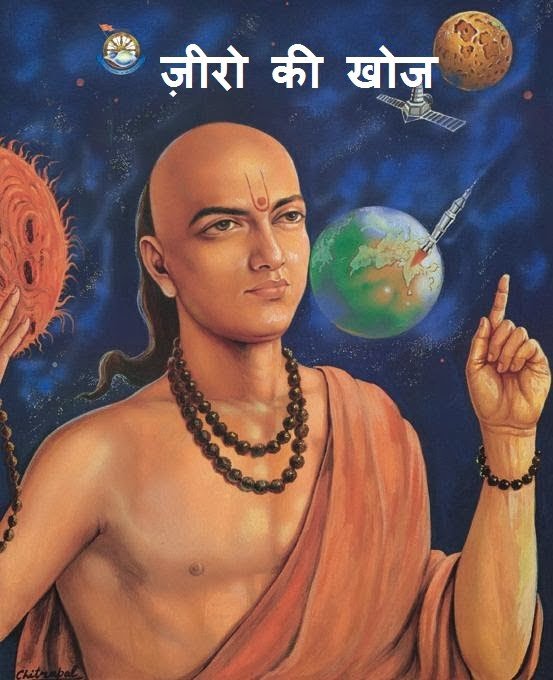
Acharya Aryabhata correctly stated that the earth rotates about its axis dailyr. He also stated that the motion of the stars are being observed just because the earth is rotating. He was also succeeded in explaining the geocentric model of the Solar System. The positions and periods of the planet was calculated relative to uniformly moving points. He stated that the Mercury and Venus move around the earth at the same speed as of the sun. He was also succeeded in explaining eclipses in terms of shadows cast by and falling on earth. He also mentioned Units of Time or the Sidereal rotation that earth takes 23 hours, 56 minutes and 4.1 second to complete one revolution and the sidereal year has 365 days, 6 hours, 12 minutes and 30 seconds which in turn adds an extra one day every after four years which is called a leap year.Calendric calculation which was devised by him is still being used in India for Practical purposes for fixing the Hindu calendar. India’s first satellite Aryabhata and the lunar crater Aryabhata are both named in his honor.
Maharishi Bharadwaj –Invention of the First Airplane of Earth
In 1875, the Vymaanika Shaastra, a 4th Century BC text written by Sage Bharadwaj was discovered in a temple in India. The book greatly deals with the operation of ancient vimanas and included information on steering, precautions for long flights, protection of the airships from storms and lightning and how to switch the drive of solar energy or some other form of energy.
One of the chapter will reveal the secrets of constructing aeroplanes that cannot be broken or cut, that is indestructible, that is fire resistant. It also deals with the secret of making planes motionless and invisible. It also describes how to defeat the enemy planes etc. as per the Sage Bharadwaj the vimanas were classifies as per the Yugas. During the period of Krita Yuga, Dharma was establishes firmly. The pushpak Vimana which was used by Ravan was an Aerial vehicle. He used this vehicle to kidnap Sita from jungle and took him to his Kingdom Srilanka. Ramayana was during the Treta Yug in which the Vimanas were highly discovered. During this period “Laghima” gave them the power to lighten their vehicle do they can travel freely in the air.In present Kaliyuga both Mantra and Tantra Shakti are almost vanished from the earth and so the ability to control vehicle has also been gone. Today the artificial vehicles are built which is called as Kritaka Vimanas.
Practicing yoga for even a few minutes a day can help you gain more awareness of your body. This will help you notice where you’re holding tension and where you have imbalances. You can use this awareness to bring yourself into balance and alignment. We hardly sit with a straight back or take any effort to improve our body posture. This imbalance in the alignment results in back pain. Sedentary lifestyle and lack of exercise are other reasons for a back ache but it’s not too late. You can get rid of back ache with yoga asanas.
Adho mukha svanasana (Downward facing dog)
Adho mukha svanasana or the downward dog position is one of the best known yoga poses. This asana is for your entire body. It boosts your metabolism, clears your mind, stretches your ankles and calves, strengthens your bones and is an excellent pose to get relief from back pain.
Marjaryasana (cat/cow pose)
Cat/cow pose massages your spine and relieve the stress. This pose keeps your back healthy and limber. It is also effective in improving your mental stability. It allows for a nice flexion and extension of the spine, promotes mobility, and it also helps to just relieve any tension in the lower back.Cat/cow also helps you get familiar with what your neutral spine is—not too arched and not too rounded—which can help improve posture.
Paschimottanasana (Seated forward bend)
The seated forward bend or paschimottanasana stretches your spine and eases lower back pain. It provides relief from neck pain and stiffness, eases PMS symptoms, stimulates liver, improves digestion and reduces fatigue
Salabhasana (Locust Pose)
Locust pose or salabhasana improves your core strength, stretches your spine and strengthens your legs. It will open your chest, improve your digestion and stimulates kidneys. Do not do this if you suffered an injury to your shoulders, arms or back recently
Trikonasana (Triangle Pose)
The triangle pose or trikonasana strengthens your spine, legs, shoulders and chest. It also improves your body alignment and stretches your hamstrings and calves.
Bhujangasana(Upward-Facing Dog)
If you experience back pain when bending forward, this is an especially helpful move since it stretches your low back. This also works to activate the muscles around the spine, which better supports painful areas
Shashankasana (Child’s Pose)
This gentle forward fold is the perfect way to relax and release tension in your neck and back. Your spine is lengthened and stretched. Child’s Pose also stretches your hips, thighs, and ankles. Practicing this pose can help relieve stress and fatigue.
Yoga is such an efficient way to help your body and mental health. It is also very easy, but make sure you follow instructions and try out increate asana to avoid pulling a muscle! You can start a home practice with as little as 10 minutes per day. You can use books, articles, and online classes to guide your practice. Once you learn the basics, you can intuitively create your own sessions.
Traditionally, the Senate filibuster was reserved for only the most controversial issues, but its use has escalated in recent years, often slowing business in the chamber to a halt. Some lawmakers acknowledge that the filibuster, which has effectively set a 60-vote supermajority requirement for passing legislation in the Senate, could doom many of the proposals they have championed, including meaningful reforms on issues ranging from health care to climate change to gun control. Behind this dysfunction, the filibuster also has a troubling legacy: it has often been used to block civil rights legislation intended to combat racial discrimination.
As advocates push for pro-democracy legislation, calls for eliminating the filibuster have grown louder. In his remarks at the funeral of civil rights hero and congressman John Lewis in July 2020, former President Barack Obama called the filibuster a “Jim Crow relic,” arguing that the procedure should be eliminated if it is used to block voting reforms. Others note that certain types of legislation are already exempt from the filibuster’s supermajority requirement and argue that a similar exemption should be made for voting rights.The stakes were raised in March 2021, when the For the People Act — a comprehensive democracy reform bill — was passed by the House of Representatives and introduced in the Senate, where the filibuster may determine its fate. Whether through elimination or reform, the filibuster cannot be allowed to impede the expansion of Ameican democracy or the rights of all eligible voters.
What is the filibuster?
The filibuster is a 19th-century procedural rule in the Senate that allows any one senator to block or delay action on a bill or other matter by extending debate. While a final vote in the Senate requires a simple majority of 51 votes, a supermajority, or 60 votes, is needed to start or end debate on legislation so it can proceed to a final vote. Therefore, even if a party has a slim majority in the Senate, it still needs a supermajority to even move forward with legislation a tall task for a hyper-partisan Washington. The House of Representatives does not use the filibuster. Instead, a simple majority can end debate.
How can the filibuster rule be changed?
Senators have carved out exceptions to the filibuster rule before.One option to do so is called “going nuclear” — when senators override an existing rule, such as the number of votes needed to end debate. This is usually done by lowering the threshold needed to end a filibuster to 50 votes.In 2017, then-Senate Majority Leader Mitch McConnell, R-Ky., eliminated the filibuster for Supreme Court nominees, clearing the way for then-President Donald Trump’s first nominee to be confirmed.
Why a call for change now?
In the last 50 years, the filibuster has been used more and more to kill major legislation. And with Biden’s agenda stalled, Democrats are calling for a carve out to pass voting rights legislation. In the last year, at least 19 states passed 34 laws restricting access to voting, according to the Brennan Center for Justice. If the threshold to end debate on a bill is lowered to 50 votes, for instance, Democrats could end debate on their voting reform bill and eventually move to a final vote, with Vice President Kamala Harris serving as a tie-breaking vote in the 50-50 Senate to pass the legislation. Incidentally, Harris, as president of the Senate, would play a key role in any potential rules change. She would be expected to occupy the chair and preside over any rule change action.
What’s the difference between “talking” and “silent” filibusters?
Filibusters traditionally involved long speeches in which a senator attempted to block a vote from proceeding by refusing to yield the floor. To stage such a “talking” filibuster, a senator would hold the floor by standing and talking for as long as they could, sometimes overnight. This was popularized in the 1939 film Mr. Smith Goes to Washington. The longest filibuster ever recorded, by South Carolina Sen. Strom Thurmond in opposition to the Civil Rights Act of 1957, lasted for more than 24 hours. But since the early 1970s, senators have been able to use a “silent” filibuster. Anytime a group of 41 or more senators simply threatens a filibuster, the Senate majority leader can refuse to call a vote.
How has the filibuster changed over time?
The use of the filibuster, once reserved for only the most controversial issues, has increased dramatically in recent years alongside growing polarization in Washington. There have been more than 2,000 filibusters since 1917; about half have been in just the last 12 years. Critics argue that this increased use has slowed business in the Senate to a halt, often entangling the chamber in procedural maneuvering instead of substantive debate and, ultimately, lawmaking.
For decades, filmmakers have tackled the sensitive and emotionally-driven theme of World War II in an array of noteworthy and poignant pictures. These moving and oftentimes brutal depictions of the horrors, shocking realities, and devastating impacts of the violent war seem to deeply touch audiences across the world. Production studios continuously harness tales of this frightening and monumental period of history with gripping and heartbreaking stories, and moviegoers can’t help but be drawn to them. The most shocking stories are showed in light, reminding us that world wars were truly the most horrifying times, a person could live through. Some of Hollywood’s most talented and esteemed visionaries have ventured into the touching and difficult subject, crafting memorable and thought-provoking results, and frequently winning Best Picture Oscars as a result. Here is a list of brilliantly made war movies you mustn’t miss out on
The Pianist
The Pianist is based on the Holocaust memoir of Polish-Jewish pianist and composer Władysław Szpilman, depicting his struggles to survive the destruction of the Warsaw ghetto of World War II. The emotionally-moving picture has a deep connection with Polanski, as he escaped from the Kraków Ghetto after the death of his mother and ended up living in a Polish farmer’s barn until the war’s end.
Hacksaw Ridge
Hacksaw Ridge focuses on the World War II experiences of pacifist combat medic Desmond Doss who, as a Seventh-day Adventist Christian refused to use or carry a weapon or firearm of any kind. The film was based on the 2004 documentary The Conscientious Objector, and after initially turning down the project twice, Gibson finally agreed and was tasked with creating a concoction of violence and faith. Andrew Garfield powerfully portrays Doss, and the biopic features the additional talents of stars like Sam Worthington, Teresa Palmer and Vince Vaughn. Upon reading the screenplay for the first time, Garfield revealed he was moved to tears. The Oscar-nominated drama garnered universal acclaim upon its release, earning praise for both Gibson’s directing and Garfield’s moving performance.
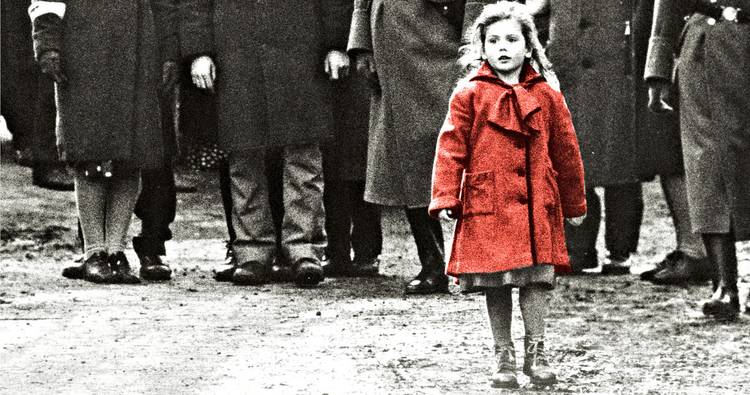
Schindler’s List
Spielberg’s deeply personal masterpiece is perhaps the most moving war film ever made. All the more so with the knowledge that it was based on the true story of Oskar Schindler, who originally set out to make his fortune by exploiting cheap Jewish labour in Krakow.However, as Schindler witnesses the unfolding horror of the Holocaust, his motivation changes and he bribes Nazi leaders to keep his employees out of the extermination camps, saving more than 1,100 lives. The winner of seven Oscars, Schindler’s List does full justice to Thomas Keneally’s source novel and remains just as powerful and relevant today.. Liam Neeson delivers the performance of a lifetime as Schindler, and appears alongside the gifted Ralph Fiennes and Ben Kingsley.
Dunkirk
Dunkirk, which depicts the Dunkirk evacuation of World War II through the perspectives of the land, sea, and air. The outstanding ensemble cast features some of cinema’s finest performers like Kenneth Branagh, Cillian Murphy, and Tom Hardy, and the drama was portrayed with very little dialogue, as Nolan wanted to create suspense with the stunning cinematography and music. The filmmaker conceived the premise of the war flick in the mid-1990s, when he and his wife sailed across the English Channel, following the path of many small boats in the Dunkirk evacuation.
Saving Private Ryan,
Saving Private Ryan, which is set during the Invasion of Normandy and follows a group of U.S. soldiers who go behind enemy lines to retrieve a paratrooper whose brothers have been killed in action. The gripping film stars a myriad of distinguished leads including Tom Hanks, Edward Burns and Matt Damon and was partially inspired by the Niland brothers, four American brothers from New York who served in WWII, with only two surviving. On why he repeatedly returns to the subject, Spielberg revealed, “I think that World War II is the most significant event of the last 100 years; the fate of the Baby Boomers and even Generation X was linked to the outcome. Beyond that, I’ve just always been interested in World War II.” The Oscar-winning Saving Private Ryan is frequently cited as influential in the war and action film genre, and is credited with renewing World War II interest in the media.
Casablanca
Classic Hollywood movie is considered one of the finest films ever created. The 1942 romantic drama Casablanca famously features Hollywood icons Humphrey Bogart and Ingrid Bergman, centring on a cynical American expatriate who must decide whether he wants to help his former lover and her fugitive boyfriend escape the Nazis in French Morocco. The iconic picture was based on an original play by writer Murray Burnett, who drew inspiration after traveling to Vienna in 1938.Since Casablanca’s premiere, its popularity has only continued to grow, with Burnett once calling it, “true yesterday, true today, true tomorrow.”
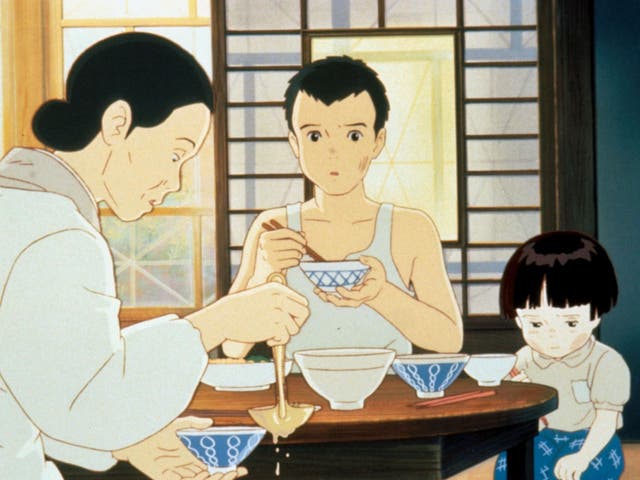
Grave of the Fireflies
Heartbreaking and thought-provoking anime from Studio Ghibli about brother and sister Japanese orphans desperately trying to survive in the dying days of the war. A haunting anti-war statement almost without peer, adapted from the story by Akiyuki Nosaka and based on his own experiences in the firebombed city of Kobe.
Inglourious Basterds,
Inglourious Basterds, telling an alternate history story of two plots to assassinate Nazi Germany’s leadership: one planned by a group of Jewish U.S. soldiers and the other by a French Jewish theater owner. Tarantino spent over a decade creating the script, and viewed the project as his masterpiece-in-the making and his best work thus far. He described the men of the picture as “not your normal hero types that are thrown into a big deal in the Second World War.” The famed director wanted the character of Hans Landa portrayed by a native German-speaking actor and cast Austrian Christoph. Tarantino was worried the part was unplayable, but Waltz delivered an Oscar-winning knockout performance as the ruthless SS officer
Letters From Iwo Jima
A companion piece to Eastwood’s Flags of Our Fathers, which told the story of the battle for Iwo Jima from the American perspective, this is the better of the two films, told from the viewpoint of the Japanese. The film marks the culmination of Eastwood’s growth as an artist, as he eloquently and movingly humanises the Japanese soldiers fighting against near impossible odds.Letters from Iwo Jima is stunning, depicting a group of soldiers even more bound by tradition and honour than their American counterparts, trapped in an unwinnable war and dreaming only of home.
On October 17, 1949, Article 370 was added to the Indian constitution, as a ‘temporary provision’, which exempted Jammu & Kashmir, permitting it to draft its own Constitution and restricting the Indian Parliament’s legislative powers in the state. It was introduced into the draft constitution by N Gopalaswami Ayyangar as Article 306 A.
Under Article 370: The Constituent Assembly of Jammu & Kashmir was empowered to recommend which articles of the Indian Constitution should apply to the state,The J&K Constituent Assembly was dissolved after it drafted the state’s constitution. The article allowed the state a certain amount of autonomy – its own constitution, a separate flag and freedom to make laws. Foreign affairs, defence and communications remained the preserve of the central government.As a result, Jammu and Kashmir could make its own rules relating to permanent residency, ownership of property and fundamental rights. It could also bar Indians from outside the state from purchasing property or settling there.
On 5th August 2019, President of India in the exercise of the powers conferred by Clause (1) of Article 370 of the Constitution had issued the Constitution (Application to Jammu and Kashmir) Order, 2019. Through this, Government of India has made modifications in Article 370 itself (not revoked it).With this, the Government of India has dramatically altered the relationship between the state of Jammu and Kashmir and the Indian Union. Order, 2019 has replaced Presidential Order of 1954.Subsequently, the Jammu and Kashmir Reorganisation Bill, 2019, passed by Parliament divides the state of Jammu and Kashmir into two new Union Territories (UTs): Jammu & Kashmir, and Ladakh.This is the first time that a state has been converted into a UT.Of the six Lok Sabha seats currently with the state of Jammu and Kashmir, five will remain with the union territory of Jammu and Kashmir, while one will be allotted to Ladakh.The UT of Jammu and Kashmir will have an Assembly, like in Delhi and Puducherry.Instead of 29, India will now have 28 states. Kashmir will no longer have a Governor, rather a Lieutenant .The special status provided to J&K under Article 370 will be abolished. Jammu & Kashmir will no longer have the separate constitution, flag or anthem. The citizens of Jammu and Kashmir will not have dual citizenship. As the new union territory of Jammu and Kashmir will be subject to the Indian Constitution, its citizens will now have the Fundamental Rights enshrined in the Indian constitution. Article 360, which can be used to declare a Financial Emergency, will now also be applicable. All laws passed by Parliament will be applicable in Jammu and Kashmir, including the Right to Information Act and the Right to Education Act. The Indian Penal Code will replace the Ranbir Penal Code of Jammu and Kashmir. Article 35A, which originates from the provisions of Article 370 stands null and void. Since Presidential Order has extended all provisions of the Constitution to Jammu and Kashmir, including the chapter on Fundamental Rights, the discriminatory provisions under Article 35A will now be unconstitutional.
The Need for Changes in abolishing A370 was dire. Article 370 was added in the Indian constitution to provide autonomy to J&K.However, it failed to address the well-being of Kashmiris who have now endured two generations of insurgency and violence. It contributed to the gap between Kashmir and the rest of the nation. In the newly-formed Union Territory of J&K, the central government is trying to formulate new rules that will give domicile rights to residents over land and in government jobs. This has been a response to the perception that the unemployment rate in J&K is higher than the national average.Domicile rights have also been a long-standing demand of the Dogras of Jammu and the Buddhists of Ladakh. While most of those interviewed by this author chose to remain silent on the issue of domicile rights, a few expressed their fears that such a move will further limit the employment opportunities for the local youth and also lead to a demographic disruption in the Valley.
Possible Consequences include rise in militancy as Article 370 was seen by Kashmiris as a marker of their separate identity and autonomy. Widespread protests and violence as a reaction to the dilution of Article 370 are bound to take place .Terror elements in Pakistan would find Kashmir to be the most fertile ground for breeding terrorism. The unrest can affect the democratic progress that has been made so far. Opposition political parties could launch a legal challenge but Kashmir is an emotive issue with many Indians, and most parties would be wary of opposing the move lest they be branded anti-India. All in all, Kashmir and the people there are reaching towards normalcy after 2 years of removing article 370, but for how long will peace prevail? India is hoping for a long one.
“If we want to reach real peace in this world, we should start educating children”
-Mahatma Gandhi
Pandemic times are desperate times for the people everywhere in the world. The vicious disease disrupted not only the social life of individuals but it also destabilized the mental peace and well -being for many. The sudden shutdown following the virus outbreak has brought about several changes around the globe. One of the most significant change among them is the shift from offline teaching mode to online teaching. In a country like India where a large section of the population still has not got access to the basic digital devices, the adoption of online education was highly experimental. But, the realization that “better to have something than not having them at all” led the government to take this giant step.
Online learning mode is the need of the hour because it helps to ensure productive usage of time by the younger generation who otherwise would have lost the purpose of life during these desperate ages. In the present scenario, stepping out of the houses is considered extremely dangerous and online learning provides children an opportunity to widen their knowledge within the safety of their houses. The availability of several platforms which provide access to certified courses from universities around the world is an added advantage. Widespread access to knowledge without any boundaries has helped the students to choose their area of interest rather than sticking on to the limited scope of school curriculum. The provision of recorded classes either at free of cost or at negligible costs help students to upskill themselves without stepping out from their comfort zones. Online repositories and digital libraries also make the scope of online learning mode wider.
Even though online teaching has got all these wider applications, it is subject to some limitations. The most significant limitation is that it is devoid of the physical presence of teachers and students, which reduces the effectiveness of the process to a great extent. The increasing number suicides among student population brings out the fact that virtual learning fails to provide psychological support, which the traditional schooling structure offers. As the students do not have the opportunities for relationship building, most of them lack social skills. Tests and examinations conducted in online mode is more like a test of honesty and self-discipline than tests of knowledge. Digital divide and socio -economic inequalities further worsens the problem. Among primary level students, parents play a more important role than teachers in case of online learning, which increases the disparity as many adults are still illiterate and incapable of supporting their children in our nation. Apart from this schools also functioned as a means for implementing social security schemes of government like mid-day meal scheme which got disrupted.
The offline learning could easily cover up all the above stated limitations of online learning. The presence of teachers and friends will make the learning experience lively. Rather than imparting knowledge it lightens up the wisdom among younger population. It teaches students to face failure, the worth of sharing and to care for their fellow beings. The educational institutions play an important role in shaping the character of each individual because they function as a living library where we could see a wide range of individuals from whom students could adopt moral values for life. It also helps teachers to ensure that children have understood what they have taught through regular tests. The schools narrow the gap between rich and poor and ensure all are getting equal access to education through government support.
Right to education is a fundamental right as per Indian constitution. Pandemic should not be an obstacle in ensuring that right. Thus, online teaching mode could be used as a supplement for facilitating access to education, but not a substitute. Idle mind is a devil’s workshop. Online mode of teaching helps to ensure that students are not left idle during the pandemic times. It could lend a hand for lifting children from the helplessness and despair created by the disease. This brigs to the conclusion that online teaching could be adopted to meet the current needs but not as a substitute for offline teaching. Ultimately the aim of education is to uplift the students from the darkness of ignorance by shedding the light of knowledge.
Anarchism is a process whereby authority and domination is being replaced with non-hierarchical, horizontal structures, with voluntary associations between human beings. It is a form of social organisation with a set of key principles, such as self-organisation, voluntary association, freedom, autonomy, solidarity, direct democracy, egalitarianism and mutual aid. Based on these principles and values, anarchism rejects both a capitalist economy and a nation state that is governed by means of a representative democracy. It is a utopian project that aspires to combine the best parts of liberalism with the best parts of communism. At its heart is a mix of the liberal emphasis on individual freedom and the communist emphasis on an equal society. Let’s unpack this a bit. The etymology of the term traces back to the Greek word “anarkhia”, which means “without rulers” or “without authority”. It stands for the absence of domination, hierarchy and power over others.
Whenever public protests ignite into violent behaviour, the mainstream media are often quick to refer to “anarchy” and to “anarchists”. Those who are referred to as anarchists are protesters who burn tyres or engage in battles with the police. In this narrative, anarchists are lawless hooligans and anarchy is about chaos and pointless violence. The political philosophy of anarchisms emerged in the mid-19th century – as part of the thought of Enlightenment. Key anarchist thinkers include Pierre-Joseph Proudhon, William Godwin, Peter Kropotkin, Mikhail Bakunin, Emma Goldman, and Max Stirner. Proudhon is credited as the first self-proclaimed anarchist and is often seen as the founder of classic anarchist thinking. In particular, he developed the concept of spontaneous order in society, where organisations can emerge without central or top-down coordination.
The most common definitions of anarchism stress two points; first, anarchists are opposed to any form of coercive authority; following from this, anarchists are opposed to state power and seek to destroy it. But even this basic definition ignores the important distinction between anarchists who emphasize collective action rather than individualism, or who avoid any strategies focused on the state (even its destruction. The last stand of traditional anarchism, which reached its high point in Spain during the 1930s, suffered a devastating defeat at the hands of Franco’s fascists and the criminal policies of the Stalinized Communist Party. A once vibrant international anarchist movement was in ruins by the end of the Second World War. In the United States, political repression and Red Squad terror decimated the anarchist ranks more than a decade earlier. Small, isolated groups of anarchists survived, but never again reached the influence once attained during the Spanish Civil War.
After World War II, anarchist groups and federations reemerged in almost all countries where they had formerly flourished—the notable exceptions being Spain and the Soviet Union—but these organizations wielded little influence compared to that of the broader movement inspired by earlier ideas. This development is not surprising, since anarchists never stressed the need for organizational continuity, and the cluster of social and moral ideas that are identifiable as anarchism always spread beyond any clearly definable movement.
Anarchist ideas emerged in a wider frame of reference beginning with the American Civil Rights Movement of the 1950s, which aimed to resist injustice through the tactic of civil disobedience. In the 1960s and ’70s a new radicalism took root among students and the left in general in the United States, Europe, and Japan, embracing a general criticism of “elitist” power structures and the materialist values of modern industrial societies—both capitalist and communist. For these radicals, who rejected the traditional parties of the left as strongly as they did the existing political structure, the appeal of anarchism was strong. The general anarchist outlook—with its emphasis on spontaneity, theoretical flexibility, simplicity of life, and the importance of love and anger as complementary and necessary components in both social and individual action—attracted those who opposed impersonal political institutions and the calculations of older parties. The anarchist rejection of the state, and the insistence on decentralism and local autonomy, found strong echoes among those who advocated participatory democracy. The anarchist insistence on direct action was reflected in calls for extra parliamentary action and violent confrontation by some student groups in France, the United States, and Japan. Anarchists also took up issues related to feminism and developed a rich body of work, known as anarcha-feminism, that applied anarchist principles to the analysis of women’s oppression, arguing that the state is inherently patriarchal and that women’s experience as nurturers and caregivers reflects the anarchist ideals of mutuality and the rejection of hierarchy and authority.
The most prevalent current in anarchist thinking during the last two decades of the 20th century (at least in the United States) was an eclectic, countercultural mixture of theories reflecting a wide range of artistic, literary, political, and philosophical influences, including Dada, Surrealism, and Situationism; the writers of the Beat movement; the Frankfurt School of Marxist-oriented social and political philosophers—especially Herbert Marcuse—and post-structuralist and postmodern philosophy and literary theory, in particular the work of the French philosopher and historian Michel Foucault.
Contemporary anarchism has some important differences, but also a great deal of continuity, with historical anarchism. Where it focuses on building an alternative in the “interstices” of capitalism, it accommodates to, rather than challenges, capitalism; and where it fetishizes street tactics, it generates more press than tangible success in either building the struggle or in challenging the state.But struggle teaches, and those anarchists most engaged in struggle and most concerned with finding the most effective means of winning a better world are looking for alternative ideas to make sense of the crises around us. Marxists and these anarchists should stand shoulder-to-shoulder in every aspect of struggle, whether fighting evictions, the far right, or budget cuts. And serious revolutionaries must consider what tactics will strengthen the movement and its chances of victory. Foolish acts of vandalism by unaccountable individuals only serve to disrupt and weaken the movement, and the best anarchists recognize this.
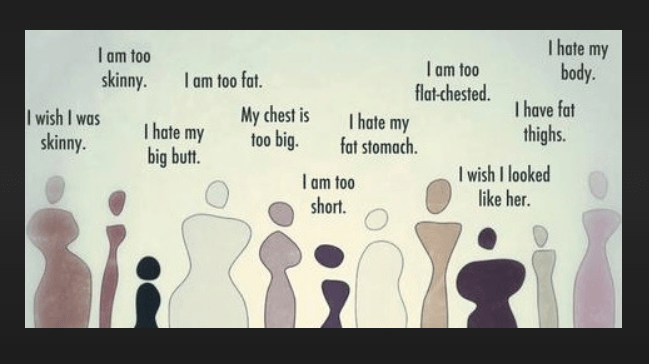
Ever heard these? I hear them daily and it’s either about my self or a group of people or a person talking , to be more clear gossiping about some one else.
So the society expects one to be perfect ,like fair color, good height and slim and fit ,but are every one built in the same way? of course no , just like all the five fingers of our hand are different ,every human being is different and beautiful in their own ways.
If a girl is dark the whole society gives advices ,how to become fair ,if she or he is fat they are given advices about how to reduce weight , if skinny then how to increase their weight, if short ,how to become tall , I just keep wondering if the society has problem with every one’s appearance ?
From my personal experience , I can tell you that I faced such things , I was bullied in my school by my classmates , my friends and even my relatives bullied for my appearance , I could not tolerate them and even I cried due to that , and used to be envious of others for their personalities. I too wanted to achieve what they had and for that I used to skip meals some times and due to that I would feel more hungry than ever and used to over eat. As the time passed I started to accept my body and for my health and fitness , I took healthy steps in my life and started exercising and developing good healthy food habits.
I understood that everyone is beautiful in their own ways and its something that everyone has to accept , I understood that this bullying and body shaming is not good , not for your mental neither for your physical health, body shaming can lead to mental health issues , people start to overthink and worry about their appearance and in order to look perfect and beautiful they will choose faster and dangerous ways , like trying to reduce fat in just a week or trying to increase height and all this is really dangerous for one’s health and can lead to other dangerous consequences.
People of every gender and of all ages must deal with body shaming , it not a big issues , but this can damage one’s mental health the one at whom we are laughing at , whom we are body shaming, or mocking, this may also lead to emotional damage and trauma and depression.
So who are the culprits behind this , one is the society and the other is we ourselves , the product advertisers are the main ones for creating a pain point and then offering a solution to it, making ourselves think that we are not worthy and if we are not of certain skin tone ,height or weight and all , secondly we have ourselves to blame because we do not believe in ourselves and our bodies and we do not treat them well , we do not accept ourselves for how we are and then all this leads to a solution to overcome our issues and that too in a quick and unhealthy way ,leading to more disasters .
I just want the society to accept everyone as they are and to appreciate everyone’s personality since its unique for everyone and to stop body shaming or bullying . Society can be more beautiful if we accept people how they are and try not to change their appearance and instead help build confidence with in them about how unique they are and how to accept and love your body . Not only the society but firstly you yourself have to accept your body and treat it in a proper way and you have to love yourself the way you are , because self love comes first and you have to your first priority.
With war declared, hundreds of working-class women flocked to the studio where they were employed to paint watches and military dials with the new element radium, which had been discovered by Marie Curie a little less than 20 years before. Dial painting was “the elite job for the poor working girls”; it paid more than three times the average factory job, and those lucky enough to land a position ranked in the top 5% of female workers nationally, giving the women financial freedom in a time of burgeoning female empowerment. Radium’s luminosity was part of its allure, and the dial painters soon became known as the “ghost girls” — because by the time they finished their shifts, they themselves would glow in the dark. They made the most of the perk, wearing their good dresses to the plant so they’d shine in the dance halls at night, and even painting radium onto their teeth for a smile that would knock their suitors dead.
What’s more, the painters ingested the radioactive substance as part of their job. Because some of the watch dials on which they worked were extremely small, they were instructed to use their lips to bring their paint brushes to a fine point. When they asked about radium’s safety, they were assured by their managers that they had nothing to worry about.Of course, that wasn’t true. Radium can be extremely dangerous, especially with repeated exposure. Marie Curie suffered radiation burns while handling it, and she eventually died from radiation exposure.
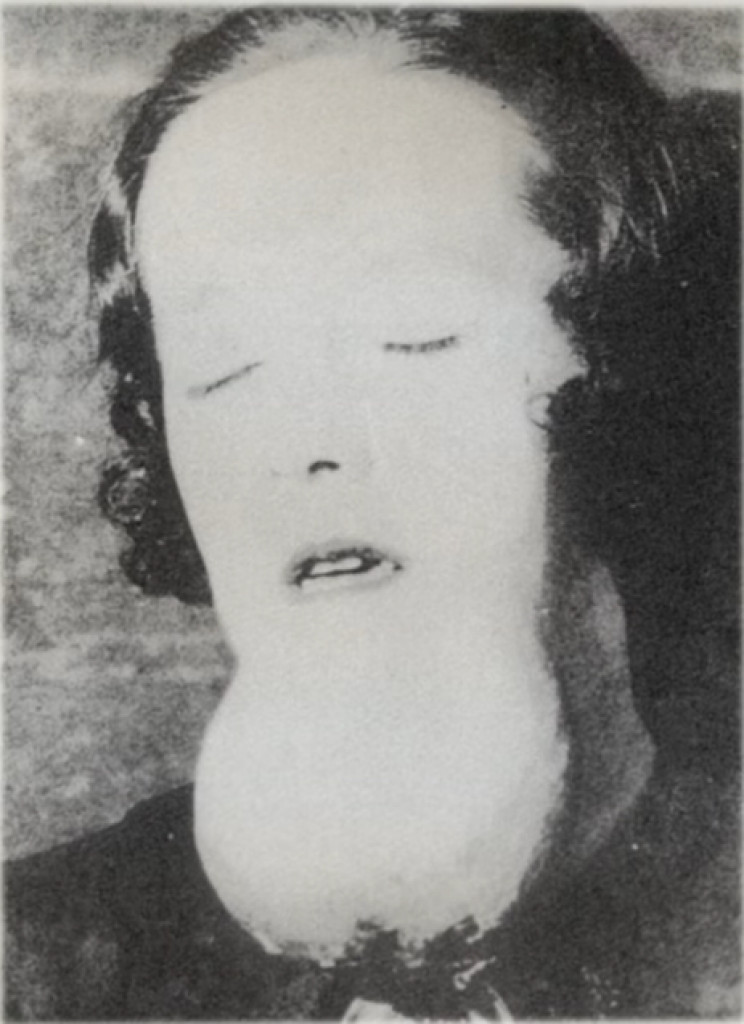
It wasn’t long before the “Radium Girls” began to experience the physical ravages of their exposure. Among the first was Amelia (“Mollie”) Maggia, who painted watches for the Radium Luminous Materials Corp. Maggia’s first symptom was a toothache, which required the removal of the tooth. Soon the tooth next to it also had to be extracted. Painful ulcers, bleeding and full of pus, developed where the teeth had been. Maggia died on September 12, 1922, of a massive hemorrhage. Doctors were puzzled as to the cause of her condition. In growing numbers, other Radium Girls became deathly ill, experiencing many of the same agonizing symptoms as Maggia. For two years their employer vociferously denied any connection between the girls’ deaths and their work. Facing a downturn in business because of the growing controversy, the company finally commissioned an independent study of the matter, which concluded that the painters had died from the effects of radium exposure.
In 1925 a pathologist named Harrison Martland developed a test that proved conclusively that radium had poisoned the watch painters by destroying their bodies from the inside. The radium industry tried to discredit Martland’s findings, but the Radium Girls themselves fought back. Many knew that their days were numbered, but they wanted to do something to help their colleagues still working with the deadly substance. Ingested radium had subsequently settled in the women’s bodies and was now emitting constant, destructive radiation that “honeycombed” their bones. It was literally boring holes inside them while they were alive. It attacked the women all over their bodies.
In 1927, a smart young lawyer named Raymond Berry accepted their case, and Grace (along with four colleagues) found herself at the canter of an internationally famous courtroom drama. The women had been given just four months to live, and the company seemed intent on dragging out the legal proceedings. The New Jersey radium girls’ case was front-page news, and it sent shockwaves across America.
It was the mid-1930s: America was in the grip of the Great Depression. Catherine and her friends , victims of this heinous poisoning, were shunned by their community for suing one of the few firms left standing. Though close to death when her case went to court in 1938, Catherine ignored her doctors’ advice and instead gave evidence from her deathbed. In doing so, and with the help of her lawyer, Leonard Grossman, she finally won justice not only for herself, but for workers everywhere.
The radium girls’ case was one of the first in which an employer was made responsible for the health of the company’s employees. It led to life-saving regulations and, ultimately, to the establishment of the Occupational Safety and Health Administration, which now operates nationally in the United States to protect workers. . The women also left a legacy to science that has been termed “invaluable.”























-5.jpg?q=50&fit=crop&w=750&dpr=1.5)










 Eduindex
You must be logged in to post a comment.