The Principle Of Maximum Social Advantage. ( Meaning , Assumptions , Explanation , Theories , Limitations )


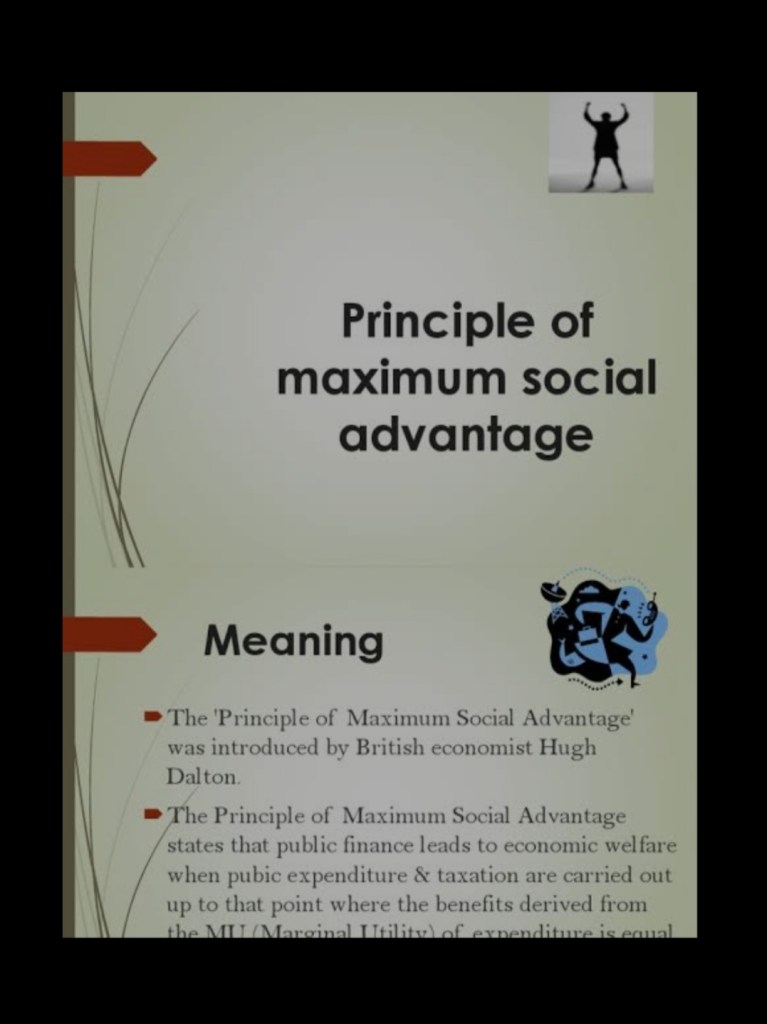
“The Principle of Public Finance means the fundamental rule by which the financial policy of the state is determined.
This fundamental rule of principle of public finance is called “The Principle of Maximum Social Advantage “

The credit for the implementation of this principle goes to Prof. Pigou and Prof. Dalton .
Just like an individual seeks to maximize his satisfaction or welfare by the use of his resources ,the state ought to maximize social advantages or benefit from the resources at its command .

According to Dalton , principle lies “at the root of public finance “.
The principles of maximum social advantage are applied to determine whether the tax or the expenditure has proved to be the optimum benefit .

He stated “The best system of public finance is that which secures the maximum social advantage from the operation which it conducts “
This principle is also called as ” Principle of Maximum Social Benefits “

Prof Pigou called this principle ” The Principle of Maximum Aggregate Welfare


Significance of the principle :-

Public revenue and public finance are two important financial operations of the state. These operations should be performed on fundamental principles so as to obtain maximum social benefit .

Prof. Hugh Dalton and Prof. Pigou were two famous economists who implemented the principle of Maximum Social Advantage to give the fundamental basis of the function performed by the state to earn revenue and to spend the revenue in the best possible way to Maximum benefit incrementation in the welfare of the public .


Prof. Dalton has expressed it in these words ,
As a result of operations of public finance ,the nature and quantity of money produced and between the categories and different persons there are many changes in the distribution of that money . The question is do these changes ; leave a profitable impact on society ? If it is so then it will be considered that the operations of public finance are justified , otherwise not .The best system of public finance is that can obtain maximum social profit by the operation organised by them .”

Therefore , the Principle of Maximum Social Advantage is the principle that guides the operation of financial activities of the government to obtain economic welfare of the society .

According to Dalton , attainment of the principle requires :-

• Public expenditure and taxation should be carried out up to certain limits i.e where marginal utility received by the Government expenditure must be equal to marginal disutility due to taxation ( government income ).

• Public expenditure should be utilised among the various uses in an optimum manner

• The different sources of taxation should be so trapped that the aggregate sacrifice entailed is the minimum .


Assumptions :-

• The public revenue consists of only taxes ( and not gifts , loans , fees ,etc.,) and the state has no surplus or deficit budgets.

•Public expenditure is subject to diminishing marginal social benefits and the taxes are subject to increasing marginal cost or disutility .


Principle Of Maximum Social Advantage:-

The Principle states that :-

The state should collect revenue and spend the money so as to maximize the welfare of the people. When the state imposes taxes, some disutility is created. On the
On the other hand, when the state spends some money, there is a gain in utility. The state should so adjust revenue and
expenditure that surplus of utility is maximised and disutility is minimised.”

According to Dalton , “ maximum social advantage is at a point where the Marginal Social Sacrifice of Taxation ( MSS) and Marginal Social Benefit ( MSB) are equal .
The point of equality between MSS and MSB is referred to as the point of maximum social advantage or least aggregate social sacrifice .


Maximum social sacrifice of taxation :-

The amount of social sacrifice undergone by the public due to the imposition of an additional unit of tax is called Maximum Social Sacrifice of taxation .
Every unit of tax imposed by the government taxes result in loss of utility.

According to Dalton ,
“The additional burden (marginal sacrifice) resulting from additional units of taxation goes on increasing. Every additional unit of taxation creates greater amount of sacrifice on the society”
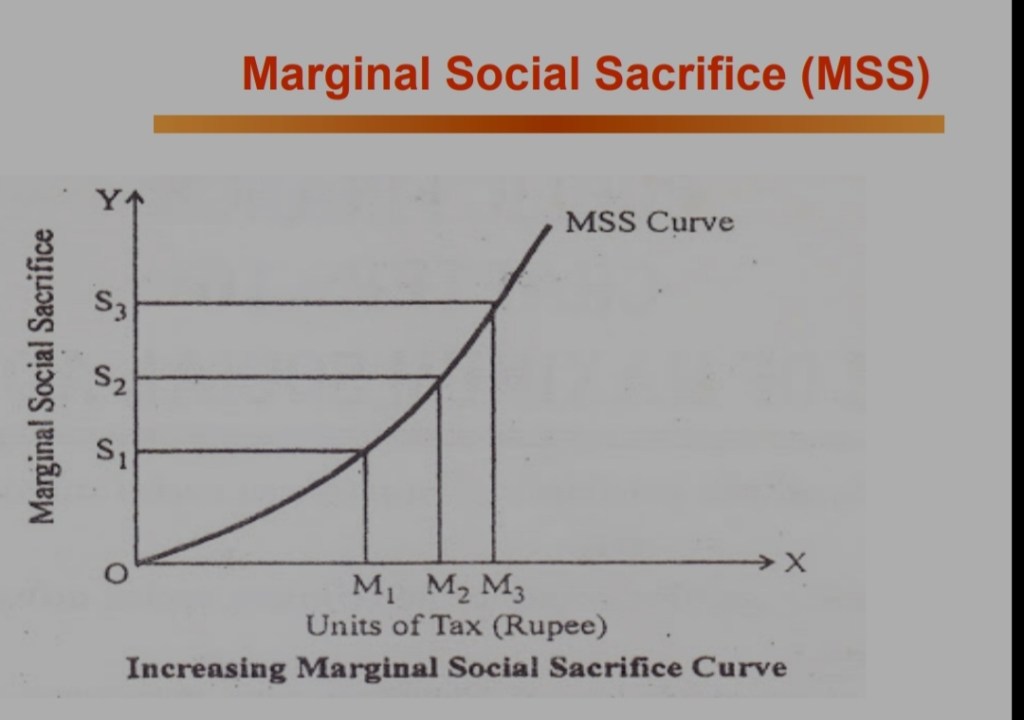


The Marginal Social Sacrifice (MSS) curve rises upwards from left to right. This indicates that with each additional unit of taxation, the level of sacrifice also increases.


•. Marginal Social Benefit :

The benefit conferred on the society, by an additional unit of public expenditure is called the Marginal Social Benefit curve .

The social benefit from each additional unit of public expenditure declines as more and more units of public expenditure are spent. The marginal utility from commodity to a consumer declines as more and more units of the commodity are made available to him .
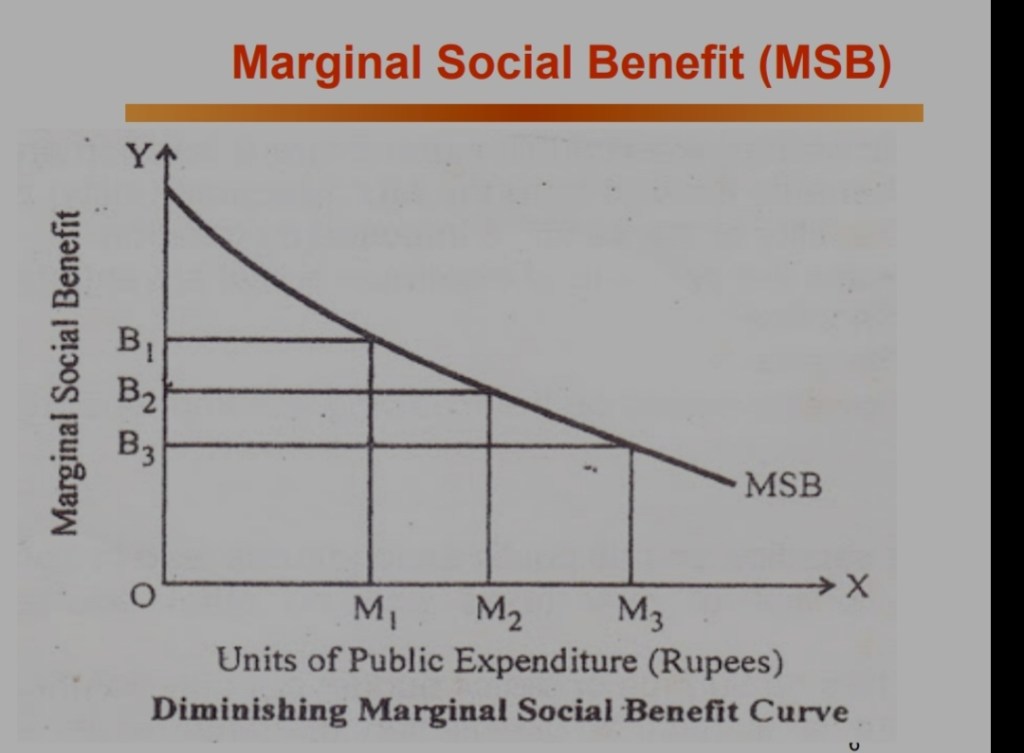


MSB curve slopes downward from left to right. This indicates that the social benefit derived out of public expenditure is reducing at a diminishing rate.


Maximum social welfare can be understood by the following example :-
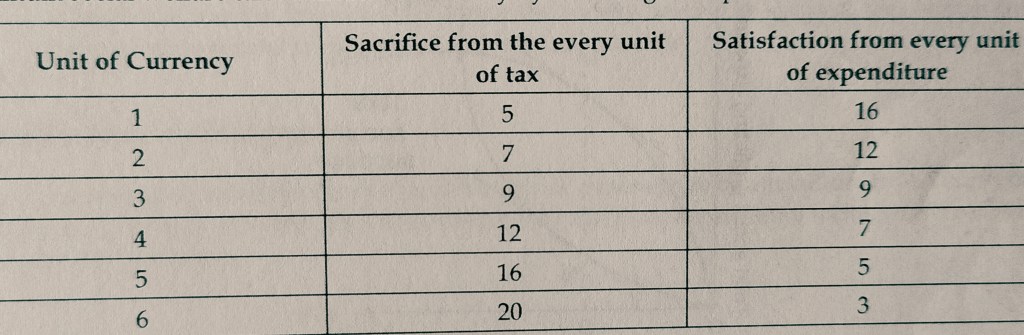


Table

It can be seen in the above table that marginal sacrifice is increasing due to the increase in every unit weight of tax on society.
Inversely , from every additional unit of Government expenditure ,its utilities diminish .

On the third unit of currency , marginal social sacrifice is equal to marginal social advantage ( 9 units ) . At this point the tax and public expenditure will be fixed .
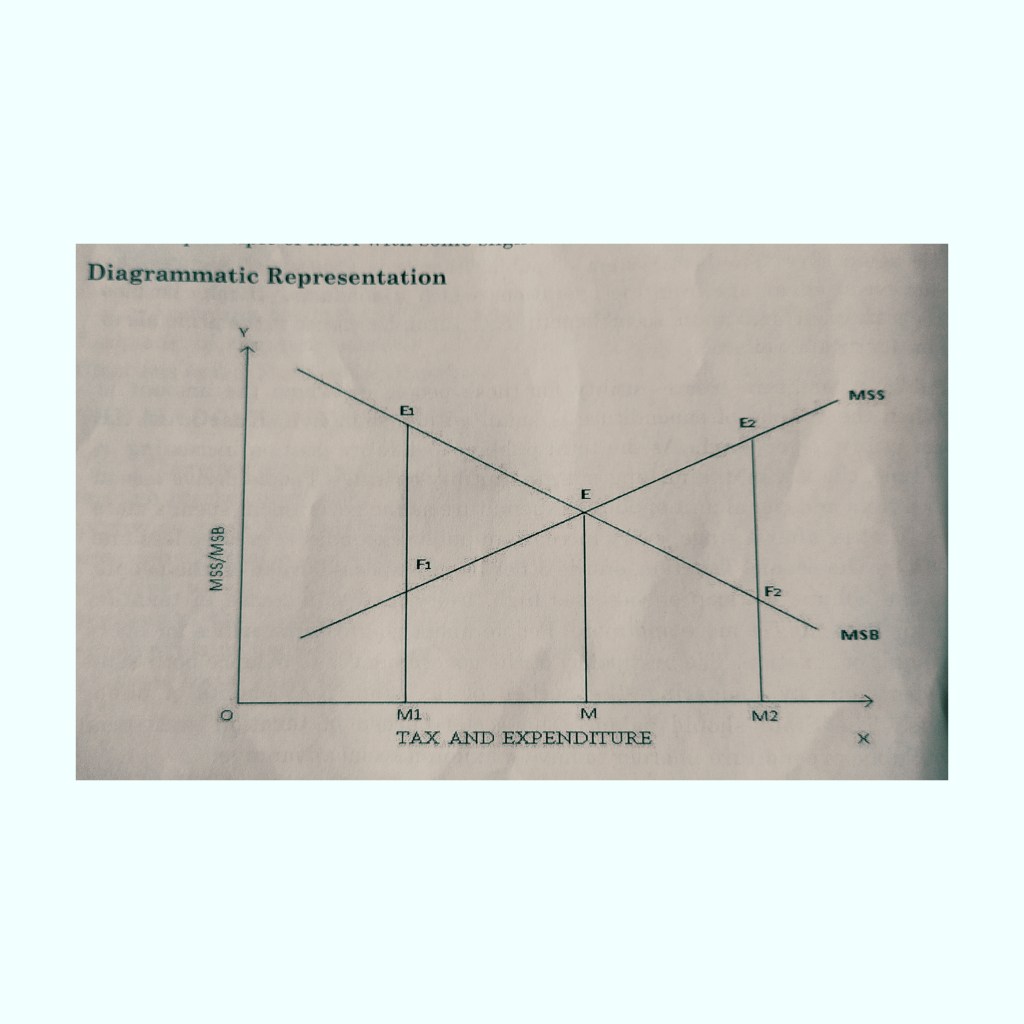
In the above given figure ,
MSS represent marginal social sacrifice of the taxation curve , slopes upward since taxation increases resulting in Increasing of MSS,.
and MSB represents the marginal social benefit of the public expenditure curve , slopes downwards showing that public benefit goes on declining with every unit increase in public expenditure.

The point E where the MSS curve intersects MSB curve , is the ideal point of financial operations where the government collects OM taxation from the society and uses it for public expenditure .


According to Dalton ,
“Public expenditure in every direction should be carried just so far that the advantage to the community of a further small increase in any direction is just counterbalanced by the disadvantage of a corresponding increase in taxation or in receipts from any other source of public income . This gives the ideal public expenditure and income.”


Musgrave’s View :-

The Principle of maximum social advantage can be explained using total sacrifice and total benefit curve as well .

Musgrave called Dalton ‘s principle as
“Maximum Welfare Principle Of Budget Determination “
According to him , the difference between total social benefit and total social sacrifice is the net social benefit where maximum social benefit is obtainable .
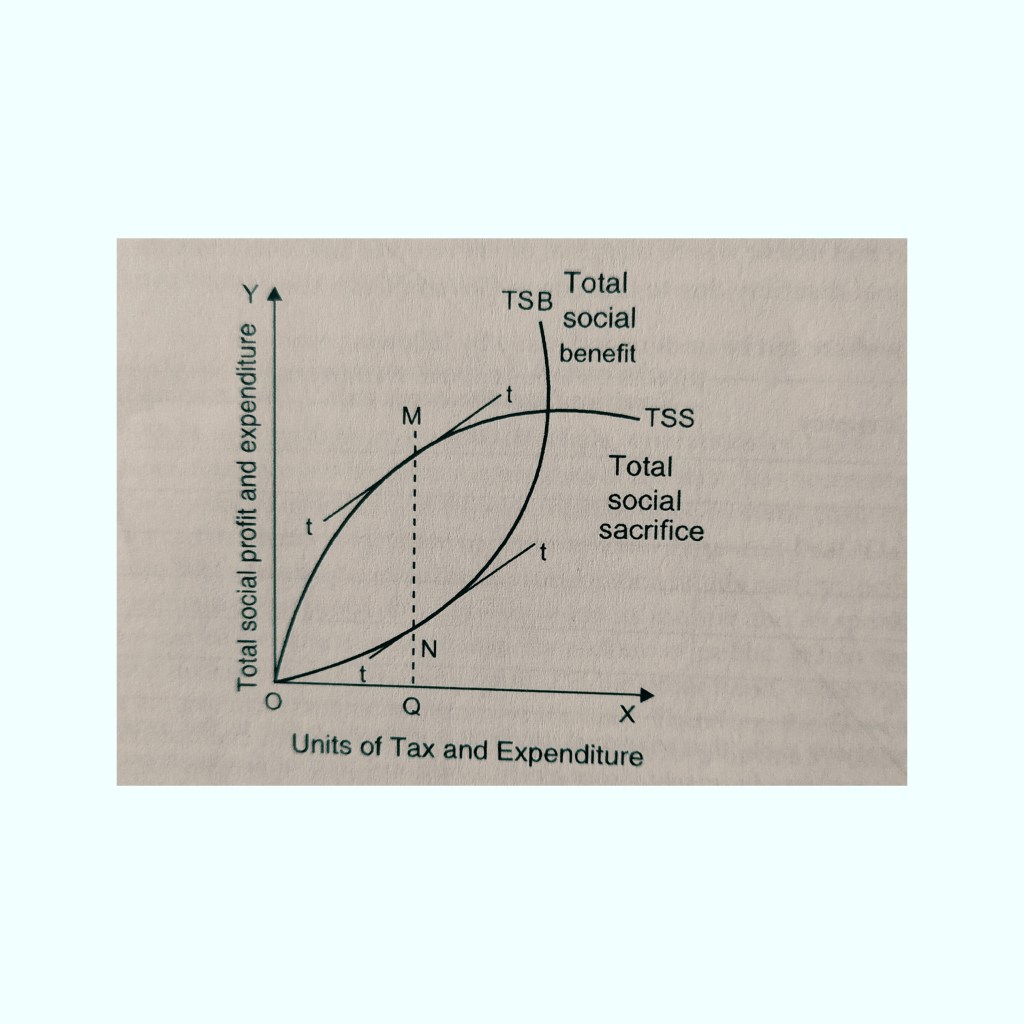
The TSB curve represents total social benefit received from public expenditure which slopes upward but decreases after some time , showing that as public expenditure increases total social benefit increases .
The TSS curve represents total social sacrifice produced due to tax showing that as total social sacrifice increases with increase in amount of tax but rapidly .

Maximum social benefit will be achieved at a point where the difference between total social benefit and total social sacrifice is maximum .
MN denotes the difference between TSB and TSS showing net social benefit.


Objective Tests Of Social Advantage :-

Dalton has given the following three objective Tests which can lead to Maximum Social Advantage :-

• To preserve the Community :-
According to Dalton , the first test is the need to preserve the community against internal disorders and external attacks. The financial operations of the state to preserve the society in this manner leads to maximum social advantage .

• To increase Economic Welfare :-
Increasing the economic welfare of the community leads to maximum social advantage . According to Dalton ,this can be achieved by improvements in production and improvements in the distribution of national product ( or income ) through state’s financial operations .

• To provide for Future Generation :-
According to Dalton , the financial operations of the state should provide for the future generation . The state should prefer a larger social advantage in the future to a smaller one in the present .


Limitations of Maximum Social Advantage :-

In spite being guiding principle of financial operations of the state , the principle of maximum social advantage possesses the following limitations :-

Vague and Abstract :- The terms “benefit ” and “sacrifice ” are vague and abstract concepts. It is not possible to quantify them and find out their exact implications.


Different Areas :-
It is not possible to compare the marginal benefits accruing to people in one area from a given public expenditure with marginal sacrifice undergone by persons who are taxed in some other areas .

Lack of Divisibility :-
In order to equate the marginal benefit from public expenditure with the marginal sacrifice from taxation , the resources are required to be divided into smaller units . But it is not possible because of the lack of Divisibility of public expenditure and taxes in small units .

Ignores Non- Tax Revenues:
This principle takes into consideration the sacrifice on the part of direct tax payers and ignores Non- tax revenues like fines , fees ,market borrowing , profits of public undertaking ,etc., are equally important sources of revenue and in the effects on social benefit are as important as those of taxes.

Maintaining Balance :-
It is a difficult task for the state to maintain balance between disutility and utility produced due to imposing tax and utility obtained by people from the Government expenditure as the government is not a single person but different servants at different places in different departments .

Simultaneous Calculation not Possible :-
This principle requires simultaneous calculations and equating marginal social benefits from public expenditure and sacrifices from taxation which is not easy .
As put by Prof. Buchana , ” To match them is a function for the’ fiscal brain ”and ‘computers ‘. “

According it Dalton , despite these limitations ,the principle of maximum social advantage is “the best system of public finance “.


Is it your anxiety .

“Your mind will answer most questions if you learn to relax and wait for the answer.”

—William S. Burroughs

Am I losing my mind or its just my mind playing tricks ?

In the world , where people are ready to fight against their competitor . What will happen when you loose ?

Or didn’t get what you desire the most ?

Would you accept the reality or choose to mourn for your loss.

Introduction

Do you ever feel anxious about going to the new place or meeting with new people ?

Do you ever feel the numbness in your body when you lost something or someone ?

Have you ever get overwhelmed by your fears ?

So what do you call it .

Is it an anxiety disorder?

Well hold your horses because it’s not . Like really we all feel anxious , hesitation , numbness , fear in our life . But if you think it’s an anxiety disorder . It’s a big NO .

If you want to know what is anxiety disorder and how to differentiate it from normal anxiety . You have to ask me .

SO . ASK . ME .

Well if you don’t ask me then also I will tell you .

When we feel something is crawling on our leg but didn’t find a thing . Instead of sleeping peacefully , we think of possible aspects that will make our night hell .

Well it happened with me and guess what , I always wake up middle of the night and try to find the invisible ghost ( is it only me who thinks about these weird things or it happened with you as well .)

Anxiety is when these types of situations happened only single time , maybe 2 or 3 times. But when these kind of situations happened every time whenever you sleep than maybe you have Anxiety Disorder.

What is Anxiety Disorder?

Let’s get to know about the Father before we get to know about the Son .

Anxiety is a feeling that comes and goes, but does not interfere with your everyday life.This type of anxiety is unpleasant, but it may motivate you to work harder and to do a better job.

But what about Anxiety Disorder . Well I am explaining just have some patience . You know patience is the virtue of life .

Yes , we were talking about the Son . I mean Anxiety Disorder . It is the feeling of fear may be with you all the time. It is intense and sometimes debilitating. These type of anxiety can cause more damage than you think about.

You will stop enjoy everything . In extreme cases you stop socialising with other and if it left untreated, it may be worse like you will kill yourself.

According to the APA ( American Psychiatric Association) , women are more likely than men to be diagnosed with an anxiety disorder.

Types of Anxiety Disorder

  • Panic Disorder .
  • Phobia .
  • Social Anxiety Disorder.
  • Separation Anxiety Disorder.
  • PTSD (Post Traumatic Stress Disorder.)
  • Illness Anxiety Disorder .

In present world , PTSD is most likely to be found in the women rather than men. It happens when a person goes through some traumatic experience.

Symptoms:

  • Increased heart rate.
  • Rapid breathing.
  • Restlessness.
  • Trouble concentrating.
  • Difficulty falling asleep.
  • Stop trusting.
  • Worried about small things .

Remedies :

  • Getting enough sleep.
  • Meditating.
  • Staying active and exercising.
  • Eating a healthy diet.
  • Staying active and working out.
  • Avoiding alcohol.
  • Avoiding caffeine.
  • Quitting smoking cigarettes.

Conclusion :

Anxiety Disorder can be found in anyone from 5 year old boy to 80 year old woman or from 15 year old girl to 50 year old man. It may be cured , only if it treated properly . If not , it can cause some serious issue .

What lies behind us and what lies before us are tiny matters compared to what lies within us.

—Henry Stanley Haskins

Link

ALL YOU NEED TO KNOW ABOUT MENDEL

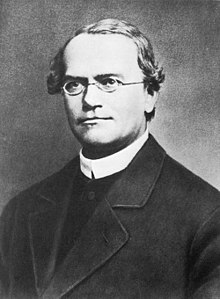
Once in a while we all have gone through the term ‘genes’. We know that genes are the basic physical and functional unit of heredity which determine the nature of protein formed and those expressing the characteristics passed on from one generation to another generation. Least do we know about who experimented and discovered the same. Gregor Johann Mendel, also known as the father of modern genetics, discovered the ‘factors’ that were responsible for the transfer of characters from parents to off springs, which were later known to be the genes.

WHO WAS GREGOR MENDEL?

Gregor Johann Mendel was an Austrian Monk, a meteorologist, mathematician, biologist born in 1822 near Brunn in Austria. Born to a family with limited means in German-speaking Silesia, Mendel was raised in a rural setting. His academic abilities were recognized by the local priest who urged his parents to send him away to school at the age of 11. His Gymnasium studies(grammar school) completed in 1840, Mendel entered a two-year program in philosophy at the Philosophical Institute of the University of Olemouc, Czech Republic, where he excelled in physics and mathematics completing his studies in 1843. His initial years away from home were hard, because his family could not sufficiently support him. He tutored other students to make ends meet and twice he suffered serious depression and had to return home to recover from the same. As his father’s only son, Mendel was expected to take over the small family farm, but he preferred a different solution to his predicament, choosing to enter monastery(local community or residence of a religious order) where he was given the name Gregor.

However, in 1850 Mendel failed an exam- introduced through new legislation for teacher certification and was sent to the University of Vienna for 2 years. There he devoted his time in physics and mathematics and also studied botany. In 1854, Abbot Cyril Napp permitted Mendel to plan a major experimental program in hybridization at Monastery. The aim of this program was to trace the transmission of hereditary characters in successive generations of hybrid progeny. Mendel chose to conduct his studies with the edible pea(Pisum sativum).

From 1854 to 1856 he tested 34 varieties for constancy of their traits. In order to trace the transmission of characters, he chose seven traits that were expressed in a distinctive manner, such as:-

  1. plant height(short or tall)
  2. seed color(green or yellow)
  3. seed shape(smooth or wrinkled)
  4. pod color(green or yellow)
  5. pod shape(inflated or pinched)
  6. flower color(purple/grey or white)
  7. flower position(axial or terminal)

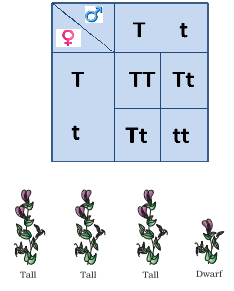
He crossed the varieties that differed in just one trait- tall plant with short plant(monohybrid cross). The first generation of hybrids(F1) displayed the character of one variety but not that of the other. In Mendel’s term, one character was dominant and the other was recessive. In the second generation(F2), however, the recessive character reappeared, and the proportion of off springs bearing the dominant and recessive trait was in the ratio 3:1.

WHY DID MENDEL CHOOSE PEA PLANT FOR HIS EXPERIMENTS?

  • Flower structure of pea plant ensured self-pollination and also had a well defined male and female reproductive structures.
  • pea plant is a single season crop.
  • they can be grown easily.
  • emasculation and pollination of flowers is quite easy
  • these plants reproduce sexually.
  • they have easily distinguishable pair of characters.

Science and technology related

INTRODUCTION:-

The evolution of science is like a boon to the world, as human beings come to know a lot about the world they are living in including the activities they indulge into. Furthermore, the development of technology along with the advancement in Science helps to bring in a revolution in various fields such as medicine, agriculture, education, information and technology, and many more.In the present world, if we think of any sort of development, then the presence of science and technology cannot be ignored.

What is Science?

Science fundamentally is the systematic study of the structure and behavior of the natural and physical world through observations and experiments.
Study of science evolved with the civilization of human beings.

What is Technology?

Technology (which is basically derived from the Greek word ‘technologia’) is an art, skill or ability, which is used to create and develop products and acquire knowledge.
Scientists used their knowledge to develop technology and then used technology to develop Science; so, because of this reason science and technology are an integrated term in today’s world.
Consider the following points to understand the relationship between Science and Technology −
  • Contribution of Science to Technology
  • Contribution of Technology to Science
Let us discuss these points in brief.

Contribution of Science to Technology

Let us now understand how Science has contributed to Technology −

Science as a direct source of new technological ideas

For example, innovation and development medical instruments; nuclear technology, radar system, etc.
Contribution of Science

Science as a source of engineering

Most of the technical knowledge used in the designing and development of tools and techniques is actually an outcome of ‘engineering science’.
Engineering Science
Science has also helped in the development of human skills. This is one of the fundamental contributions of Science.

Contribution of Technology to Science

Consider the following points to understand the contribution of Technology to Science −

Technology as a source of scientific challenges

The development in the field of technology paves way for research and development in the field of Science. For example, space science is one of them. Technological development likewise indirectly stimulates basic research in the field of science.

Instrumentation and measurement techniques

Development of advanced instruments facilitated scientists to measure the distance between sun and earth, the intensity of sun’s rays, the revolution of celestial bodies, internal problems of human beings, life of a bridge, etc.

Connection between science and technology:-

Science is the study of the natural world by scientific method i.e. collecting data through a systematic process. And technology is where we apply science to create devices that can solve problems and perform different tasks. Technology is literally the application of science. So, it is really impossible to separate the two.
Science, innovation, and technology each represent a successively larger category of activities that are highly interdependent from each other but distinct. Science contributes to technology generally in six ways:
  • New knowledge which serves as a direct source of ideas for new technological innovations.
  • Source of tools and techniques for more efficient engineering designs and a knowledge base for evaluation of the feasibility of different new designs.
  • Research instrumentation and laboratory techniques used in research eventually find their way into the design or industrial practices, through different methods in different areas.
  • The practice of research as a source for the development and assimilation of new human skills and capabilities useful for different innovative technologies.
  • Creating a knowledge that becomes increasingly important in the assessment of technology in terms of its wider social and environmental impacts.
  • Develops knowledge that enables more efficient strategies of applied research, development, and refinement of new technologies.
The confer impact of technology on science is of equal importance as a source of unavailable instrumentation and techniques needed to address difficult scientific questions more efficiently.

Reference Links:-

https://www.tutorialspoint.com/fundamentals_of_science_and_technology/fundamentals_of_science_and_technology_introduction.htm
https://timesofindia.indiatimes.com/readersblog/tech-freek/connection-between-science-and-technology-23913/

Necessity of Uniform Civil Code

WHAT DOES IT MEAN TO HAVE A UNIFORM CIVIL CODE?
In this context, a uniform civil code refers to a single law that applies to all Indian citizens in personal concerns including marriage, divorce, custody, adoption, and inheritance.

Its goal is to replace the current system of disjointed personal rules that govern interpersonal relationships and associated matters within religious groupings.
“The state shall seek to provide for the citizens a uniform civil code across the territory of India,” says Article 44 of the Indian Constitution. In view of Article 44 of the Indian constitution, it is sometimes questioned if it is not past time for India to adopt a uniform civil code. Personal laws are civil laws that deal with issues like marriage, divorce, custody, adoption, and inheritance, among others. The article, as one of the state’s directive principles, should be “enjoyed” rather than “pressed” onto any society or communities. However, many important concerns must be answered before such a code may become a reality.


A civil code that is consistent is required.
Almost every country on the planet has a civil code that applies to all of its residents. The fundamental goal of developing an universal civil code is to eliminate religious discrimination. Almost every religion’s personal law has been used to oppress women, with the majority of cases using religious and societal responsibilities as justifications. Gender discrimination has always been exacerbated by personal laws. The constitution’s promise of a uniform civil code has become a highly sensitive and contentious issue that has always been communalized by those with vested interests.


How has the Supreme Court dealt with the UCC issue?

Since its decision in the Shah Bano Case in 1985, the Supreme Court has focused on the UCC in numerous of its decisions. In several of these cases, the court favoured a common law system for all citizens and reminded Parliament of Article 44’s spirit. The Supreme Court, on the other hand, stayed within its constitutional bounds by refusing to provide any positive directives to the administration in this regard, emphasising that lawmaking is solely the province of Parliament.


Suggestions for Implementing a Uniform Civil Code include the following:

The following ideas must be considered immediately in order to achieve the DPSP’s goals and maintain legal uniformity:

• People should be encouraged to have a progressive and open-minded mindset in order to grasp the spirit of the UCC. •Education, awareness, and sensitization programmes must be implemented to achieve this.
• The Uniform Civil Code should be written with the greatest interests of all religions in mind.
• To maintain uniformity, a committee of distinguished jurists should be formed, and care must be taken not to offend the feelings of any particular group.
• Given the sensitivity of the subject, it is always preferable if the initiative comes from the religious groups involved.


CONCLUSIONS
Article 44 of the Indian Constitution mandates that the state ensure a Uniform Civil Code for all Indian nationals across the country’s territory. As previously said, India is a unique blend and fusion of Hindu, Muslim, Christian, and Parsi codified personal laws.

However, there is no unified family-related law for all Indians in a single legislative book that is acceptable to all religious communities that coexist in India. The issue is not one of minority protection or even national unity; rather, it is one of treating each human being with the respect that he or she deserves, something that personal laws have failed to do thus far.

THE HIMALAYAN RIVERS: PART 1

The three main Himalayan rivers are the Indus, the Ganga and the Brahmaputra. The river Ganga starts from the glacier called Gangothri Glacier, which is in Uttarakhand. At its birthplace, it is known as the Bhagirathi. the Brahmaputra also originates from a glacier, the Angsi glacier in Tibet. Indus originates from the Tibetan plateau near Lake Manasarovar and enters India in Ladakh.

THE GANGA

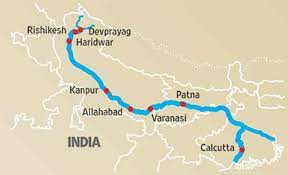
The mighty Ganga isn’t confined to one country. Its valleys stretch across India and Bangladesh. In fact its basin covers parts of China and Nepal too. Born in the lofty peaks of Himalayas, in the Gangotri glacier, it begins its journey as Bhagirathi. The Bhagirathi rushes down to meet the Mandakini, and then the Alaknanda at Dev Prayag. From then on, the river is known as Ganga. After cutting through the Himalayas, the Ganga breaks out of the foothills at Haridwar, and flows across the vast Gangetic plain. Midway in its course, near Allahabad, it is joined by one of its chief tributaries, the Yamuna river. The Ganga is one of the greatest rivers. The 2525 km long journey finally ends at Bay of Bengal. Thus it is called a river without boundaries.

Tributaries of the Ganga

Rivers have headstreams, tributaries and distributaries. A headstream is a stream that is a source of a river. The Ganga’s headstreams are the Alaknanda, DhauliGanga, Nandakini, Pindar, Mandakini, and Bhagirathi rivers. A tributary is a freshwater stream that joins a larger river. Most large rivers are formed from many tributaries and the Ganga has more than a dozen. Among them are the Ghagara, Yamuna, Koshi, Ramganga, Gomti, Gandaki, Burhi Gandak, Mahananda, Tamsa, Son, Punpun. the Ghaghara is the largest tributary of the river Ganga followed by Yamuna and Koshi. Though Yamuna is a separate river system in itself it is a tributary of the Ganga. A distributary is a branch of rivers that flows away from it. The Hooghly is a distributary of the Ganga that provides water for irrigation for west Bengal. It leaves Ganga just before the river enters the Bangladesh.

Rivers that join the Ganga

The river Ganga actually begins at Dev Prayag, the meeting place of two of its headstreams- the Bhagirathi and Alaknanda. After merging from the mountains of Rishikesh, the Ganga is joined by Ramganga. Later, it joins the Allahabad. The Hindus believe that the mythical river Saraswati too joins here. Hence the name Triveni Sangam, means the meeting place of three rivers. Next the Ganga flows east to meet the river Tamsa, later on, the river Gomti joins it. The next river to join the Ganga is the Ghaghara. Further downstream, the river Son joins the Ganga from the south, the river Koshi from the north. By the time the Ganga reaches the bay of Bengal, its waters have mingled with those of several other rivers, making it mystically representative of a soul of India itself.

Why is the Ganga important to Bangladesh?

The Ganga’s river basin is one of the most fertile and densely populated in the world. It covers an area of1000000 sq.km. For most 150 km, the Ganga forms the boundary between India and Bangladesh. When it enters Bangladesh, it is known as the Padma. The upper Padma flows southeastward to receive the mighty Brahmaputra river. The Brahmaputra is known as the Jamuna river in Bangladesh. The Padma joins the Meghna river, before it empties into the bay of Bengal. The Padma river is known for the frequent erosion of its banks, and sandbars that continually emerge in its course. The river is a busy waterway, and fishing is an important industry along its banks. A number of fast developing urban centres have also come up along its banks. 

Yamuna

The river Yamuna is the most famous and greatest tributary of Ganga. One of the country’s most sacred rivers, its birthplace is the Yamunotri glacier, high up in the Himalayas in Uttarakhand. It flows through the foothills of the Himalayas into the Indo-Gangetic plain, flowing through Uttar Pradesh, Himachal Pradesh, Haryana, Rajasthan, Madhya Pradesh and Delhi. After 1376 km, the Yamuna meets the Ganga at Allahabad. Their confluence is well known. The important tributaries of the Yamuna river are Tons, Chambal, Hindon, Betwa and Ken. Other small tributaries of the Yamuna river include the Giri, Sind, Uttangan, Sengar and the rind. Thus, though the Yamuna is a tributary of the Ganga, it has many tributaries of its own as well. Therefore, the Yamuna is considered to be a river system in itself.

Ghaghara

The Ghaghara is the largest tributary of the Ganga. It is a river that crosses many countries in the journey. Born in Himalayas in Tibet, it flows southeast through Nepal. Later it splits into two branches  that rejoin south of Indian border. The Ghaghara flows through Uttar Pradesh and Bihar, and then joins the Ganga. Its major tributaries – the Kuvana, the Rapti and the little Gandak rivers – all flow into the Ghaghara from the mountains to the north. The river’s flow is influenced by both the glacial melt and the monsoon together with the Ganges and its tributaries, the Ghaghara has helped to form the vast, fertile, alluvial plain of northern Uttar Pradesh.

Gomti

The river Gomti, a tributary of the Ganga, has great mythological significance. Most Hindus believe that a ritual dip in its waters will purify a person from all sins. According to legend, the river the daughter of sage Vasishta, who brought the river from heaven to earth. The river is also associated with the epic Ramayana. Lord Rama is believed to have taken a dip in the river on the advice of sage Vasishta. Lakshmana, the younger brother of lord Rama, is believed to have Lakshman Teela – part of present day Lucknow on the banks of river Gomti. Some even trace the name of Lucknow city to Lakshmana. The Gomti rises in northern Uttar Pradesh, and flows through the state, draining an area of 18750 sq. km. It is joined by one of its own tributaries before flowing into Ganga.

Gandak

The river Gandak is formed by the union of two rivers that have their own source in the Himalayas in Nepal. These rivers are the Kali and the Trisuli, and once they merge, the river is known as the Narayani in Nepal. The river then flows southwards into India. It is joined at the Indo – Nepalese border by two other rivers from Nepal – the Panchnad and Sohna. Once it enters India, the river is known as the Gandak. After winding its way through 765 km, it merges with the Ganga opposite the Patna. The Gandak is one of the major rivers in Nepal and India. It is distinguished for the deep gorge across which it flows, and for a large hydroelectric facility in Nepal. This river also provides water for a major irrigation and hydroelectric power facility at the Indo Nepal border at Valmikinagar.  

Koshi

The Koshi river also called the Kosi – is an important tributary of the Ganga. It flows through Tibet and Nepal, before entering India from the Himalayas. The river is joined by major tributaries, approximately 48 km north of the Indo Nepal border, breaking into more than 12 distinct channels. These channels shift during flooding and so, the river shifts course frequently. The river basin is surrounded by the ridges separating it from the Brahmaputra in the north, the Gandaki in the west, the Mahananda in the east, and by the Ganga in the south. The river, along with its tributaries, drains a total area of 69300 sq.km up to its confluence with the Ganga in India.

Tamsa

The Tamsa river flows through Madhya Pradesh and Uttar Pradesh. A tributary of the Ganga, its origin is at Tamakund in Kaimur range. The Tamsa is 264 km long. It is famous for the many waterfalls through which it tumbles during its journey to meet the Ganga. The river has great significance for Hindus for their belief that lord Rama spent his first night during 14 years of forest exile on the banks of Tamsa. There is also a belief that the rare and elusive Fwindoju fish lives in this river. The ashrams of the sage Valmiki and Bharatwaj are also believed to have been located on the banks of the Tamsa.

Son 

The Son, a tributary of the Ganga, is one of the largest rivers in India. It starts near Amarkantak in Madhya Pradesh and has a total length of 784 km. The Son’s main tributaries are the Rihand and the North Koel. It flows through Uttar Pradesh, Jharkhand, and Bihar to join the Ganga just above Patna. When fed by the monsoons, it becomes a roaring force. However, during  the summer, it dries up in places, leaving large pools of water along its course. The Indrapuri barrage is located on the Son. It is one of the longest dams of India and it irrigates vast areas of agricultural land.

E-COMMERCE

What is e-commerce?

“E-commerce” and “online shopping” are often used interchangeably, but the scope of e-commerce is much broader: it embodies the concept of doing business on the Internet, for example, it includes many different services. Make online payments, book flights, etc. Buying and selling goods or services electronically via the Internet is called e-commerce.

Why buy online?

  • Lower prices
  • Affordability and convenience
  • More options

Higher profits
Scalability
Consumer knowledge/technology

E-commerce fulfillment model overview

Courier delivery model
Traditional order fulfillment model

Ecommerce

Including network marketing, also known as online marketing. Internet marketing is the process of using tools that help generate potential customers and sales to promote a company or brand and its products or services on the Internet.

Content marketing
Content marketing aims at
Your personal brand and your target audience
Keywords and research.
Focus and content commitment. What will you create? How often do you post? Where will you post? You need to define these basics to create consistent and quality content.
Content Creation
Content Promotion

SEO (Search Engine Optimization)

The process of maximizing the number of visitors to a given website by placing the websiteat the top of the search engine results list. SEO
stands
for search engine optimization, which means increasing the quantity and quality of website traffic through regular search results.

SEM (Search Engine Marketing)

Search Engine Marketing(SEM) is one of the most effective ways to develop business in an increasingly competitive market.
Online advertising is important to millions of businesses, and search marketing is the most effective way to promote your products and grow your business.

Email marketing

Email marketing is an efficient digital marketing strategy for sending emails to potential customers and customers. Effective marketing emails turn potential customers into customers and long-term customers into loyal and enthusiastic followers.

INDIA AND INDUSTRIAL REVOLUTION 4.0 Part-3

This article is in continuation with the previous part INDIA AND INDUSTRIAL REVOLUTION 4.0 Part-2.

Solutions-

1. The product manufacturing unit in a factory is referred to as the shop floor. It is that place where production tasks are performed in a continuous flow while manufacturing a product.

The efficiency is determined by the amount of work done by a person as well as the machine in a particular time frame.

Shop floor automation is the integration of manufacturing hardware with software. Human pace cannot match with a machine’s speed, hence shop floor automation proves to be a great breakthrough for industrial advancement. As we all know the Industrial Revolution 4.0 is mainly about integrating new technology to a very great extent in the industries, or the manufacturing sector, hence making way for automated machines to do precise jobs can be helpful.

A manufacturing task requires high precision. So, if a person is considered, it is his skill, speed and accuracy that determines the quality of a product and that too, for every single piece.

Compare this to a machine that is programmed to do a particular task. It reuses the code and hence only the code mainly determines the quality of the product.

Automation saves time, reduces wastage and increases productivity. Hence large industries can apply this

2. IoT can help us send information regarding delivery insufficiencies and this void can be filled with the help of drones for small products for faster delivery in a specific radius.

3. We know that India has a large potential for utilizing its human resource, but the problem is illiteracy, lack of digital resources etc.

If these people are given proper training in small skills such as hardware and software development and maintenance, it would prove helpful in the proper utilization of human resources in the digital domain. More importantly, with a large digital setup in the whole country, more technical problems would arise. With these skilled people in the picture, problems can be resolved in a much quicker manner and efficiently.

As we all know that there is that more and more startups are coming up these days. For this technological revolution among people, startups and youth having basic knowledge of software can help to make technology available for all. Startups do not have many liabilities as compared to tech giants. Hence, they can be more helpful at the ground-zero level. Doing this can also bring startups to the attention of many techies, and it would be an innovational breakthrough.

4. Securing the Network Against Cyber Threats- This applies to companies currently having a large digital base. Although rare, a cyberattack could be devastating to your organization’s reputation and bottom line. Whether it’s ransomware or a targeted, zero-day attack, these incidents can be detected and prevented with the right plan in place. First, your organization must have an up-to-date inventory of its digital assets to develop an understanding of its network to pinpoint any existing vulnerabilities within it. Second, you need to have authentication processes in place to guard your digital and physical assets. Third, your organization needs to have the ability to detect anomalous activity. The most effective way to achieve this is to deploy a continuous monitoring solution. Finally, your organization should have a contingency plan in place to quickly respond and recover from a potential cyberattack.

5. It is estimated that by 2023, industry 4.0 and cyber-physical systems will be at a much larger level as compared to today. With changing scenarios of technology, the current technology will not be sufficient. The nature of jobs will change. Hence, keeping that in mind, upcoming techies and also the current techies in the market should be given the knowledge of A.I., machine learning, big data analytics and IoT to efficiently adapt to the changing nature of work.

CONCLUSION

“Industry 4.0 is opening significant opportunities for organizations,” says Stankard. “From re-evaluating business models to new data-driven revenue streams, the sky is the limit and we’ve only begun to see the possibilities.“ But on the other side of the coin, there is going to be a significant incremental risk, likely posed by cyber and the immense – and growing –the amount of connectivity. There is a risk reduction element here as well. With such levels of connectivity, Industry 4.0 is likely to isolate and improve quality issues and enhance the overall customer experience. Rising to these challenges is going to be key if we are to fully take advantage of the amazing new opportunities the fourth industrial revolution will offer.”

Optic Fibers in Communication

What are optical fibers ?

It is thin strands of pure glass which carry data over long distances. At very high speeds. The Fiber can be bent or twisted. Fibers are used instead of metal wires because signals travel without loss. Also, fibers are immune to the electromagnetic interference.

In an general optic fiber there is a core which is surrounded by cladding material which has lower refraction index than core.

Communication Systems

Basic Blocks

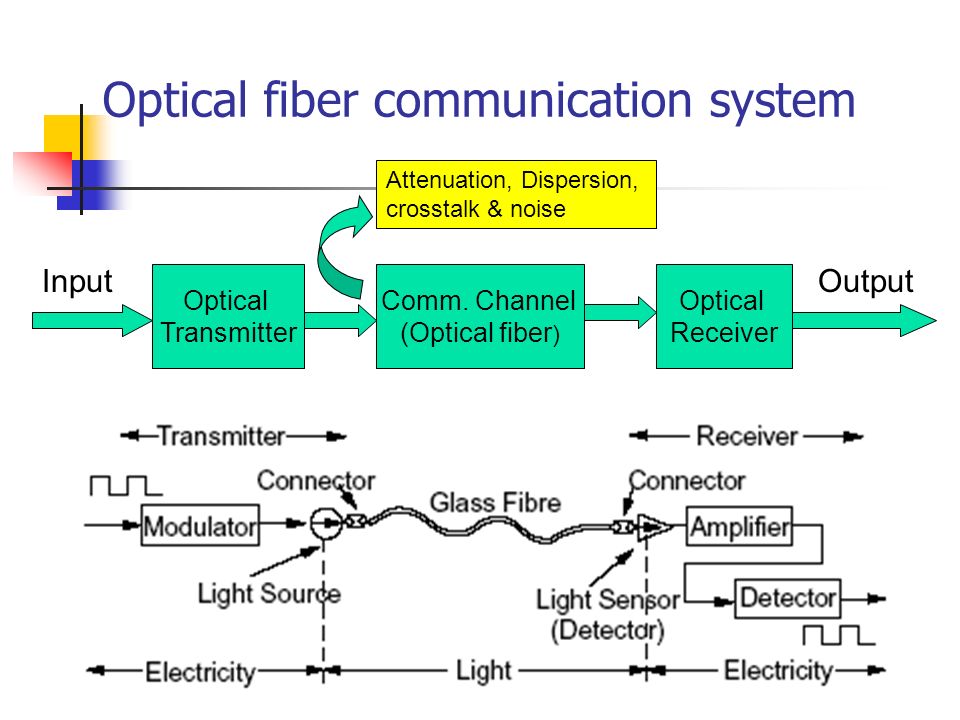
  • Transmitter : transmitter is one of the key elements of any fiber optic communications system and the choice of the correct one will depend upon the particular application that is envisaged.
  • Communication channel (medium) :fiber-optic link (or fiber channel) is usually a part of an optical fiber communications system which provides a data connection between two points.

Communication channel

  1. Wired
  2. Wireless Glass
  • Destinations and Receiver : Fiber optic receivers convert light signals into electrical signals for use by equipment such as computer networks.

Advantages of optical fibers

  • Can carry much more information
  • Easily available & cheaper
  • Much longer distances than co-axial cables
  • Immune to electromagnetic noise
  • Light in weight
  • Unaffected by atmospheric agents
  • Longer life Not hazardous

Disadvantages of Optical fibers

  • Expensive to install
  • They have to be installed by specialists
  • More costly to repair
  • Can only be used on ground
  • The distance between transmitter and
  • Receiver should keep short

COMMERCIAL BANKS & CREDIT CREATION PROCESS

COMMERCIAL BANKS

A commercial bank is that financial institution which accepts deposits from the people and offers loans for the purpose of consumption or investment.

The rate if interest charged by the commercial banks(for the loans the offer) is higher the the rate of interest paid by them (for the deposits the accept ).The difference between two rates is called ‘spread’, which is the source of profit for the banks.

BASIC FUNCTION OF COMMERCIAL BANKS

Commercial banks perform two basic function:

1.Aceepting deposits

2. Advancing loans.

CREDIT CREATION PROCESS OF COMMERCIAL BANKS

Commercial banks create credit on the basics of their cash reserve .

Let assume all banks in the economy receive cash deposit of RS.10000. The banks are guided by their historical experience that all the depositors never withdraw their deposits at a single time. Thus, the bank find it safe to keep cash reserve of only 10% of their demand deposit. That is RS. 10000.

Now , the banks can safely advance loans of RS.9000 and earned profit. The banks never offer loan on cash so the loan amount again returned back to banking system of an economy. Now the total deposit of bank is RS.10000+RS.9000= RS.19000.

By keeping 10%of secondary deposit that is RS.9000 of 9000 he again lend RS.8100 and this process is going to continue until all cash balance are not going to exhaust.

With the help of credit multiplier a bank can know maximum of credit creation .

K = 1/RR

Globalization!

Globalization is the word used to describe the growing interdependence of the world’s economies, cultures, and populations, brought about by cross-border trade in goods and services, technology, and flows of investment, people, and information.

Globalization is driven by the convergence of political, cultural and economic systems that ultimately promote — and often necessitate — increased interaction, integration and dependency amongst nations.

The more that disparate regions of the world become intertwined politically, culturally and economically, the more globalized the world becomes.

These international interactions and dependencies are enabled and accelerated by advances in technology, especially in transportation and telecommunications. In general, money, technology, materials and even people flow more swiftly across national boundaries today than they ever have in the past. The flow of knowledge, ideas and cultures is expediated through Internet communications.

There are three types of globalization:

1. Economic globalization. This type focuses on the unification and integration of international financial markets, as well as multinational corporations that have a significant influence on international markets.
2. Political globalization. This type deals mainly with policies designed to facilitate international trade and commerce. It also deals with the institutions that implement these policies, which can include national governments as well as international institutions, such as the International Monetary Fund and the World Trade Organization.
3. Cultural globalization. This type focuses on the social factors that cause cultures to converge — such as increased ease of communication and transportation, brought about by technology.

Privacy in Internet era

The use of digital technology is growing, and people are becoming more aware of it, as well as the numerous benefits that technology provides. They are always connected, can contact almost anyone from anywhere, and carry the world’s most powerful information source in their pockets. People, on the other hand, appear to overlook one fact: how much data technology generates. And that’s where the issue of privacy comes into the picture and it is no secret that the modern use of the Internet and social media has a significant impact on people’s privacy. And our need for privacy is one of the characteristics that define us as human beings. Nobody like having their privacy invaded, whether it’s by someone looking over our shoulder or by a data breach. Every day, we come across headlines concerning privacy breaches that make us worry. The Internet is commonly regarded as a tool that has enabled people to write their own stories and share their experiences with a global network of people. As we continue to digitize every aspect of our lives, from gyms to vacation destinations, security and privacy protection will become increasingly more important in the coming years. As a result, it is growing easier to unintentionally give out sensitive information via email, social media, and other means these days. From internet service providers collecting user browsing history to software vendors gathering broad data about our personal life, there is a lot of data being collected about us. As a result, simple laws and regulations ensuring consumers’ ability to opt out of personal data collecting are urgently needed. In the digital era, this would go a long way toward safeguarding privacy.

Until 2021, the total sum of our personal information on the internet will be around 1.2 Million TBs, and it will undoubtedly rise in the future. Have we ever thought about how to keep it safe? If we continue to take this lightly, the day will come when digital privacy issues will attract an increase in cyber attacks, resulting in a loss of reputation, theft of sensitive documents, and a lack of confidence among users.

To emphasize the importance of data privacy in our lives, we should all take a look at the approaches or methods that can help us add value to data privacy.

  • Using technologies to effectively manage compliance and vulnerability in security.
  • Auditing security setups on a regular basis.
  • Staffs should be well-trained and educated on the ongoing threat of ransom ware.
  • Make the Privacy Procedures sound more effective by updating them.
  • Creating and restoring backup files with caution.
  • For reaching the unreachable updates, technology should be used.
  • Obtaining illegible H/W Channels from the attackers.
  • Also education has the duty of transferring awareness, attitudes, skills, and conduct from actual life domains such as home, school, and friends to young people.

From beginning till the end, it can be concluded that data privacy should not be overlooked. And what we should be doing right now is actively participating in the fight to make our lives more secure in this era of digitization.

Cyber Stalking – A Psychological Study

Cyber stalking is a crime in which stalkers use the internet or another electronic device to stalk an individual. It is also known as online harassment or online abuse. It entails harassing or threatening an individual on a regular basis. Stalking can be done in the following ways such as to follow a person till his home or where he does his business, to cause destruction to a person’s property, leaving written messages or objects, or making harassing phone calls.

The Cyber stalkers always think that they’re anonymous and can hide. In other words, the cyber stalker’s greatest power is their ability to rely on the anonymity that the internet offers them, allowing them to monitor their victim’s activities without their name being revealed. Thus, there is a need of efficient cyber tools to investigate cyber crimes and to be prepared to defend against them and to bring victims to justice.

Extreme narcissism, hatred, frustration, vengeance, jealousy, obsession, psychiatric disorder, power and control, sadistic fantasies, sexual predation, internet addiction, or religious bigotry are all psychological reasons for stalking. Some of them are discussed below:

  • Jealousy: Stalking can be motivated by jealousy, especially when it involves ex-lovers and present partners.
  • Obsession: Obsession could be another reason for stalking. The stalker may be drawn to the victim on a sexual or mental basis. The difference between admiring and stalking is very marginal.
  • Erotomania: It’s a type of belief in which the stalker believes the victim, who is usually a stranger or well-known figure, is in love with him.
  • Harassment: Cyber stalking is claimed to be motivated by this. This is due to the fact that the internet reflects actual life.
  • Revenge or Hate- Even though the victim is not the cause of the stalker’s feelings of hatred and revenge, he or she remains the stalker’s target. Based on the aforementioned causes for stalking, a stalker could be obsessed, outraged, psychotic, or crazy, and the Internet appears to be the most convenient venue for the stalker to vent his feelings of hatred and revenge.

In particular, there are three types of stalkers. Obsession stalkers are motivated by their fixation with sexual harassment and sometimes love, deluded stalkers are motivated by the urge to display their authority, and vengeful stalkers are motivated by the want to exact retribution.

The term cyber space means the environment where the communication takes place using internet. To put it another way, the internet has created a world. A global domain inside the digital landscape consisting of the interdependent network of information technology infrastructures, including the Internet, telecommunication systems, computer systems, and embedded processors can be classified as cyber space. Another term is the virtual environment in which worldwide PCs’ electronic data circulates. This is a hazy explanation of cyberspace. Its fundamental feature is that it is made up of many computer networks, switches, routers, servers, and so on. It consists of a collection of infrastructures including transportation, banking, finance, telecommunications, energy, and public health.

Cyber stalking is an activity in which a person, abuser, or stalker uses the internet or electronic media to stalk or harass another person or victim. In cyber stalking, a stalker may communicate with a victim via email, social media, messaging apps, or other forms of online communication. A stalker may use the internet to harass a person by posting messages, pictures, or information about them. Some also track location or online activities of individuals while stalking. Although cyber stalkers do not physically follow the person who has been wronged, they do so virtually. The cyber stalkers do adopt all types of technological and digital instruments assault but it is an emotional assault and harassment which is carried out by using electronic media. However, the provisions made for cyber stalking are not the same as those made for real-life scenarios.

MEANING OF MOTIVATION

Multicolored Bontainer

Kilimanjaro is a snow – covered mountain that is 19,710 feet high and is said to be the highest mountain of Africa ……. close to the western summit there is the dried and frozen carcass of a leopard . No one has explained what the leopard was seeking at the altitude.

Ernest Hemingway

In the above passage , two points draw the attention of the reader . First, the behaviour of the leopard was purposive – that he was trying to find out something by climbing on the snow -covered peak . Second, to understand the leapord’s behaviour , we would have to understand his purpose – what he was seeking . But one thing is sure that there was some force of motivation behind such action . Motivation is the main determinant of an individual’s behavior . The term ‘Motivation’ is derived from the word ‘Motive’ . Motive is a combination of of thought , feeling or condition that causes one to act . Motive can be for a short period or can be for a long longer one . If a child takes a colourful ball , he plays with the ball but if , in the meantime , he is attracted towards the other colourful ball , or toy, then we say that his motive for the first ball was a short period . But if a player wants to win gold medal at the international level and he/ she works hard for years to get the medal , we say that his/her motive is for longer period .

Human behavior is controlled , directed and modified through certain motives . When a person feels hungry and searches for food , we say that he/she is motivated by his/her drive , i.e. biological drive . When he/she gets food and is satisfied , we say that his/her drive for food has been fulfilled .

Motivation is one of the main psychological factors which affects performance . Motivation means to be inspired to do something . The definition of motivation is to give reason , enthusiasm or interest that causes a specific action or certain behaviour . Motivation is present in every function of life .

The following definitions may clarify the meaning of motivation more explicitly .

According to Crooks and Stein, Any condition , that might energies and direct our actions” is called motivation.

According to Sage, The drive to strive ” is called motivation .

According to Alderman, Motivation is the general level of arousal to action in an individual .”

Motivation is the inclination to persue and persist in activities related to one’s sports .”

The fragile ecology of the Himalayas

On 7 February 2021 Uttarakhand’s Chamoli district experienced a disaster in the form of an avalanche when a small portion of the Nanda Devi glacier broke off. The sudden deluge caused considerable damage to NTPC’s Tapovan-Vishnugad hydel project and the Rishi Ganga Hydel Project. At least 72 people were confirmed to have been killed in the disaster. But this is not a new phenomenon and every year there are many reports of sudden deluge all across the Himalayan region.

The Himalayas has maintained the climate of the Indian subcontinent. Himalayas act as a barrier by diverting the monsoons to pour the rain in the fertile northern pains rather than to drift away to further north. Similarly, the mountain range also blocks the cold northern winds to reach the Indian subcontinent. The Himalayas all the way from Afghanistan to Myanmar with 110 peaks over 24,000 feet. They are also very rich in biodiversity and are the source of numerous perennial rivers and water bodies. Rivers like Indus, Ganges, and Brahmaputra that originate in the Himalayas are the lifelines of millions of people in the subcontinent.  

But in recent years, the Himalayan region has seen a drastic transformation with increasing population and deforestation. The Himalayas are still a very young mountain range and this means the region is not as stable as older mountain ranges. This is also the reason for the high number of earthquakes. There are many exploitative projects and resource extractions initiatives have are going throughout the region. The increasing influx of tourists in the Ladakh region which is increasing the pressure in the already sensitive region or the limestone extraction near Mussoorie which has transformed the surrounding lush mountain region barren and unstable are just some of the instances.  The cities located in the periphery of the Himalayas have started are also facing the same degradation problems in the plain region. Due to ever-increasing population growth, the size of cities is also increasing and this means overflowing garbage and drains. Unplanned growth of new settlements and uncontrolled tourism has only exacerbated this issue.

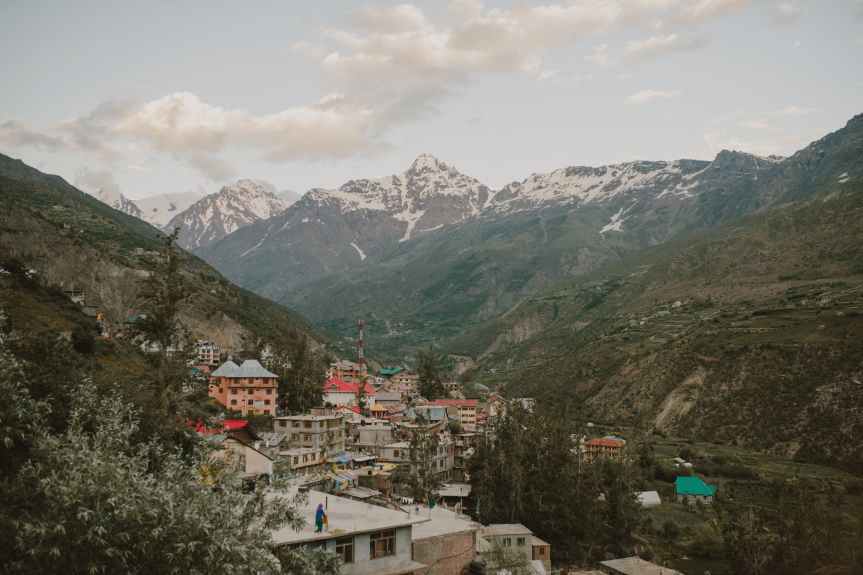
Photo by rasik on Pexels.com

Steps to safeguard the region

There is a need for safeguards on a national level that would help in preserving the fragile ecology of this region. First, it needs to be ensured that there is sustainable urbanization in the mountain habitats by town planning and adoption of architectural norms. Due to the sensitivity in this region, it is imperative that we have to control the growth of new settlements in the region and the existing settlements should be developed with all the basic urban facilities. Solid waste management is another area that needs to be the focus. Plastic bags use should be banned in all the towns and villages in the Himalayan region. Some states like Himachal Pradesh and Sikkim have enforced this rule but there are still many other states that have not fully implemented this rule. Pilgrimage is an important part of the tourism sector in the Himalayan region. Sustainable pilgrimage needs to be promoted and the inflow of pilgrims has to be determined according to the ecological capacity of that site. Roads are an essential node for the connectivity and development of a region but the construction of the roads and highways needs to take into account the sensitivity and fragility of the region as well. Environmental impact assessment should be compulsory before the construction of roads. Finally, environmental awareness needs to be propagated so that every individual can be empathetic and mindful of the dangers of environmental degradation. A coordinated effort will be essential between local cultures, local people, unions, and state governments to make this happen.

References:

http://www.ipcs.org/comm_select.php?articleNo=582