RAGS TO RICHES-KARSANBHAI PATEL

Karsan bhai khodidas patel is an Indian industrialist who is the founder of a Rs.42,500 crore nirma group, a company which majorly deals with detergents, cements and cosmetics. Karsan bhai patel was born in 1945 into a farmer family from Ruppur village, Mehsana, Gujarat. Karsan bhai completed his B.Sc in chemistry and he initially joined in a cotten mill as a lab technician in Ahmedabad later served for the state government.

He has an abaundant knowledge on chemicals and in 1969, he started manufacturing phosphate free detergent for domestic usage in his backyard. He named that detergent powder as “NIRMA” . He dedicated his time after the office hours to prepare and market the detergent. At initial stage this business was purely one-man-company.

Karsan bhai used to sell his handmade detergent packets door to door using his cycle. The hand made detergent packets were sold at Rs.3 per kg, which was one third of least priced compared to popular detergents at that time. This least price making strategy gave him instant success. At that time domestic detergent market was limited and mostly controlled by the top most MNC companies only but with entry of karsan bhai’s market strategy, nirma created a revolution in domestic detergent sector.

It made the best and environment friendly detergent than other brands and occupied the top most shares in the market with its innovative methods. With in a short span of time Nirma became the largest selling detergent company in India. Since, the industry was labour intensive nirma also builded a large scale of employment.

Now, the company was recognized as the 9th among the top FMCG brands in India as per the year 2002. In the year of 2010 Karshan bhai received “PADMA SRI AWARD” and in 2019 karsan bhai ranked with #30 by forbes magazine for the list of Indias richest persons.

CONCLUSION:

Finally, we can understand karsan bhai’s success story as a good source for marketing strategy because he understood the need and demand of the domestic detergents perfectly and he applied his innovative marketing formula strictly in his business and also he focused on the new technologies to develop his business as well and worked consistently to bag the success.

” SUCCESSFULL PEOPLE ARE NOT GIFTED BUT THEY DO HARD WORK TO ACHIEVE SUCCESS ON A PURPOSE “

Start from down and reach the up

Hello guys, today’s topic is going to be very informative.

“Start up ” have you ever heard of this
Word before? Even if you have never heard of the word start up many of us actually heard about those startups which are doing fantastic .

Start ups are the newly established business,by one or more entrepreneurs.These entrepreneurs set up business by taking financial risks .

Start ups are actually initiated by its founders based on an idea which has a potential to become successful and bring profits to the company .

Even though startups gives wings to an individual’s dreams it is not easy to create an impact with an startup during this tough competition era.

And while setting up an start up the individual needs to have necessary funds so mostly the start ups are setup by taking loans,or borrowing money from families,friends.

So generally startup are built around one main idea which can change the whole picture,which can create an impact in the industry.

Startups can become successful only when the foundations that is the base on which the company is started should be rock solid,their main aim should not change even though some alterations can be done .

As the company grows the more the need of funds increases so especially the risk of setting up a startup should be taken very seriously and the decision must taken carefully.

There are many thing that you need such as impressive idea,funds and trusted partners and sacrifice your time,health  for the wellbeing of the startup.

Start ups basis is believe ,the belief you have in your own self,your idea which is projected outside.

Entrepreneurs should have certain qualities that is needed for a successful startup so many institutions and universities are providing training for those who dream of starting their own company.

But in reality many startups that don’t stand a chance in the competition lack those qualities,they have the idea but cannot put into action,they cannot manage work as they have very little experience in this industry,they get swayed by others words and forget their whole main aim .

Mock startups are those programs where a student gets to experience the simulation of the real world.

Even the government entrepreneurship programs ,non profit entrepreneurship programs support many start ups They give guidance and even support them if the idea shows a potential .

Intellectual advisors ,hardworking staff ,investors who don’t mind to try risks for profits ,mentors who can guide you ,and great Teamwork makes the dream work that is it accelerates the growth rate of that start up.

Every start up has their own ups and downs but what is important is to never lose faith in yourselves and always hope for the best by putting out your best .

Startups don't have a instant success they to grow step by step and the more impact it has on the business industry the more it grows.

Some of the successful startups are

  • Ola
  • Swiggy
  • Zomato
  • Oyo
  • Flipkart

Every succesful company at present is a startup in the past and lessons should be learnt from those experiences

So always dream big ,work hard ,have faith,never lose hope ,never give up, and

“Learning from failures , paves the way to success.”

Thankyou^^

Self-help and personality development

Self help and personality development is a weapon for us

The spirit of self help creates many good qualities in a person. … These people work more harder than a person who is reliable on others for their work. This leads to help them obtain strong will- power and determination.

Self-help or self-improvement is a self-guided improvement—economically, intellectually, or emotionally—often with a substantial psychological basis. … Many different self-help group programs exist, each with its own focus, techniques, associated beliefs, proponents and in some cases, leaders

The following are common examples of self-improvement.

  • Self-Awareness. A process of introspection to understand your own character, behavior, fears and ambitions.
  • Awareness. A process of extrospection to understand the world around you.
  • Health. …
  • Physical Fitness. …
  • Time Management. …
  • Productivity. …
  • Performance. …
  • Know-How

Here’s a look at some ways to build self-improvement into your daily routine and let go of negative thoughts about yourself.

  • Cultivate gratitude. …
  • Greet everyone you meet. …
  • Try a digital detox. …
  • Use positive self-talk. …
  • Practice random acts of kindness. …
  • Eat at least one meal mindfully. …
  • Get enough sleep. …
  • Breathe consciously.

Personality development refers to how the organized patterns of behavior that make up each person’s unique personality emerge over time. Many factors go into influencing personality, including genetics, environment, parenting, and societal variables.

Personality development helps you gain recognition and acceptance from the society as well as people around. Personality development plays an essential role not only in an individual’s professional but also personal lives. It makes an individual disciplined, punctual and an asset for his/her organization.

Here are  great ways to improve your personality:

  • Be a better listener. …
  • Read more and expand your interests. …
  • Be a good conversationalist. …
  • Have an Opinion. …
  • Meet New People. …
  • Be yourself. …
  • Have a positive outlook and attitude. …
  • Be fun and see the humorous side of life.

The four personality types are: Driver, Expressive, Amiable, and Analytical. There are two variables to identify any personality: Are they better at facts & data or relationships? And are they introverted or extroverted. Note: Most people will have major and minor type.

Jobs and career related topics

INTRODUCTION:-

* Gender – Are there male jobs & female jobs? – A useful debate which can get heated. The statutory guidance states that you must promote equality of opportunity so care must be taken when guiding this debate.
* Jobs of the future – What jobs will exist in 5, 10, 20 years that don’t exist now?
* What effects are robotic workers having on the job market? Will robots be able to do jobs like journalism & legal work (yes they will, computerised copy writing and contract checking are already a reality) or will automation only affect ‘physical’ jobs?
* Transferable skills – what are they and why do we need them? – Useful question to elicit knowledge of transferable skills – you may find this definition useful in order to help your students decide which skills are transferable “Transferable skills are general skills you can use in many jobs. You gain these skills from previous jobs, projects, voluntary work, sport, your home life, hobbies, and interests. They enable you to be adaptable and flexible in case you need to change your job”
* What skills & qualities do employers want when they employ a person straight out of school/college/university?
* Employers are frequently reported as saying school leavers are not workplace ready. A discussion around what skills are needed and what they are can be structured using the following frequently cited skills:-Understanding of business world; Teamwork; Communication; Negotiation skills; Problem Solving; Leadership; Organisation; Perseverance/motivation; Ability to work under pressure; Confidence
* Why do some people try and dissuade people from taking certain jobs? – An ideal opportunity to explore the motivation behind advice from various sources. E.g. university & school leaver recruitment staff. Teachers who have been instructed to recruit for the school 6th  Parents who would like to see their children achieve their parent’s dream etc.
* Can you turn a hobby into a career? – Students may wish to pursue a hobby such as photography or sport as a careers. What considerations might they need to have when doing this? E.g. need to be self-employed; the effect of training 7 days a week on enjoyment of the sport etc.
* Can work be fun? What makes work fun? Can it always be fun? What is fun?
* How many types of job can I expect to do over my lifetime? – A discussion about career paths. Not just changing jobs but changing types of job and progression.  The role of lifelong learning, retraining, transferable skills.  Using a story about somebody’s career journey is a good prompt for this discussion.
* What’s the difference between a job and a career?
* Is a job just to pay the bills and a career something you’re interested in?

Jobs:-

INTRODUCTION:-

God rebukes Job’s three friends and orders them to make a sacrifice. Job prays for God’s forgiveness of them and God accepts his prayer. At the end of the book, God gives Job twice as much wealth as he had before, along with seven sons and three daughters. After that, Job lived 140 more years.
An Introduction to the Book of Job | Speaking the Truth in Love
A job, employment, work or occupation, is a person’s role in society. More specifically, a job is an activity, often regular and often performed in exchange for payment (“for a living”). Many people have multiple jobs (e.g., parent, homemaker, and employee). A person can begin a job by becoming an employee, volunteering, starting a business, or becoming a parent. The duration of a job may range from temporary (e.g., hourly odd jobs) to a lifetime (e.g., judges).
An activity that requires a person’s mental or physical effort is work (as in “a day’s work”). If a person is trained for a certain type of job, they may have a profession. Typically, a job would be a subset of someone’s career. The two may differ in that one usually retires from their career, versus resignation or termination from a job.

Jobs for people:-

Most people spend up to forty or more hours each week in paid employment. Some exceptions are children, retirees, and people with disabilities; however, within these groups, many will work part-time, volunteer, or work as a homemaker. From the age of 5 or so, many children’s primary role in society (and therefore their “job”) is to learn and study as a student.

Types of jobs:-

Jobs can be categorized by intensity (hours per week), by payment status, or by the level of experience required. The types of job stemming from intensity are categorized as full-time or part-time. They can also be classified into temporary, odd jobs, seasonal, self-employment, consulting, or contract employment. Regarding payment status, jobs are categorized as paid or unpaid. Examples of unpaid jobs include volunteer, homemaker, mentor, student, and sometimes intern. Finally, according to the level of experience required, jobs are usually grouped as entry level, intern, and co-op.
Some jobs require specific training or an academic degree.
Those without paid full-time employment may be categorized as unemployed or underemployed if they are seeking a full-time paid job.
A side job, also called a side hustle, side gig or moonlighting, is an additional job or jobs to supplement one’s income. A person with a side job may have little time left for sleep or leisure activities.
The Office for National Statistics in the United Kingdom lists 27,966 different job titles, within a website published 2015.

Day job:-

The expression day job is often used for a job one works in order to make ends meet rather than working in their preferred vocation. Archetypal examples of this are the actor who works as a waiter (the day job) while looking for roles, and the professional athlete who works as a laborer in the offseason because the athlete’s professional or semi-professional team does not pay a full living. The term is also applied to those who maintain a steady occupation while working as a day trader.
While many people do hold a full-time occupation, “day job” specifically refers to those who hold the position solely to pay living expenses so they can pursue the job they really want (which may also be during the day). The phrase strongly implies that the day job would be quit, if only the real vocation paid a living wage.
The phrase “don’t quit your day job” is a humorous response to a poor or mediocre performance not up to professional caliber. The phrase implies that the performer is not talented enough in that activity to be able to make a career out of it.

Getting a job:-

Further information: Job hunting and Employment
Getting a first job is an important rite of passage in many cultures. The youth may start by doing household work, odd jobs, or working for a family business. In many countries, school children get summer jobs during the longer summer vacation. Students enrolled in higher education can apply for internships or coops to further enhance the probability of securing an entry level job upon graduation.
Résumés summarize a person’s education and job experience for potential employers. Employers read job candidate résumés to decide whom to interview for an open position.

Use of the word:-

Workers often talk of “getting a job”, or “having a job”. This conceptual metaphor of a “job” as a possession has led to its use in slogans such as “money for jobs, not bombs”. Similar conceptions are that of “land” as a possession (real estate) or intellectual rights as a possession (intellectual property).

Occupation and life expectancy:-

Historically, manual work has seemed to contribute to shortening one’s lifespan.High rank(a higher position at the pecking order) has a positive effect. Professions that cause anxiety have a direct negative impact on health and lifespan.Some data is more complex to interpret due to the various reasons of long life expectancy; thus skilled professionals, employees with secure jobs and low anxiety occupants may live a long life for variant reasons.The more positive characteristics one’s job is, the more likely he or she will have a longer lifespan.Gender, country, and statistically confirmed danger are also notable parameters.

See also:-

  • Career and Life Planning Education
  • International Standard Classification of Occupations
  • Job analysis
  • Job guarantee
  • Job interview
  • Job performance
  • Job satisfaction
  • Job stress
  • Labour economics
  • Refusal of work
  • Unemployment
  • Wage labor

References:-

Citations:-

  1. “FOI Request: List of all the occupations noted in the UK”. Office for National Statistics. The Crown. 2015. Retrieved December 6, 2015.
  2. Newberry, Jon (October 2000). “Night Moves: Be a day trader after hours and keep your day job, too”. ABA Journal86 (10): 86. Retrieved 19 September 2020.
  3. Womack, Sarah (24 October 2007). “Why accountants live longer than builders”. The Telegraph. Archived from the original on 29 August 2018. Retrieved 4 April 2018.
  4. “Living Longer, Working Longer: The Changing Landscape of the Aging Workforce – A MetLife Study” (PDF). MetLife Mature Market Institute. April 2006. Archived from the original (PDF) on 2015-10-02.
  5. “The Most Stressful Jobs of 2014”. CareerCast.com. Archived from the original on 2016-02-20. Retrieved 2016-02-12.
  6. Lyte, Brittany (18 March 2015). “5 Jobs Proven to Make You Live Longer”. Wise Bread. Archived from the original on 16 February 2016. Retrieved 12 February 2016.
  7. Lees, John (11 November 2014). “Personality test: what job would make you happiest?”. the Guardian. Archived from the original on 9 December 2016. Retrieved 11 December 2016.
  8. “Whistling While You Work: The 10 Most Satisfying Careers”. CareerCast.com. Archived from the original on 2016-02-04. Retrieved 2016-02-12.
  9. “Find out how your gender and job may affect your life expectancy”. the Guardian. 21 October 2015. Archived from the original on 2 February 2017. Retrieved 11 December 2016.

Sources:-

  • Davis, Steven; Haltiwanger, John; Schuh, Scott (1998), Job Creation and Destruction, MIT Press, ISBN 978-0-262-54093-3
  • Graeber, David (2018). Bullshit Jobs: A Theory. Simon & Schuster. ISBN 978-1501143311.
  • Granovetter, Mark (1995), Getting a Job: A Study of Contacts and Careers, University of Chicago Press, ISBN 978-0-226-30581-3
  • Joshel, Sandra (1992), Work, Identity, and Legal Status at Rome: A Study of the Occupational Inscriptions, University of Oklahoma Press, ISBN 978-0-8061-2444-5
  • Kranzberg, Melvin; Gies, Joseph (1986), By the Sweat of Thy Brow: Work in the Western World, Greenwood Press, ISBN 978-0-313-25323-2
  • Miller, Ann Ratner; Treiman, Donald; Cain, Pamela; Roos, Pamela (1980), Work, Jobs, and Occupations: a critical review of the Dictionary of Occupational Titles, National Academy Press
  • Orr, Julian Edgerton (1996), Talking about Machines: An Ethnography of a Modern Job, Cornell University Press, ISBN 978-0-8014-8390-5
  • Robinson, Tony; Willcock, David (2005), The Worst Jobs in History: Two Thousand Years of Miserable Employment, Pan Macmillan, ISBN 978-0-330-43857-5
  • Roebuck, Carl (1969), The Muses at Work: arts, crafts, and professions in ancient Greece and Rome, MIT Press
  • Morse, Nancy; Weiss, Robert (1955). “The Function and Meaning of Work and the Job”. American Sociological Review20 (2): 191–198. doi:10.2307/2088325. JSTOR 2088325.

career:-

INTRODUCTION:-

Career development is now a lifelong process, rather than a lifelong job, and involves moving laterally or upwards within an organisation or between organisations. It is the combination of your life experience, learning, and all work experience.
Career Management Introduction | Human Resource Management

What is a career?

The past, the present and the future

The past:-

A typical career path in the past involved almost guaranteed job security. You obtained a “job for life” and you could expect steady progression up an organisation’s structure.

The present:-

Factors such as technological growth and consumer demand have changed the world of work. Career development is now a lifelong process, rather than a lifelong job, and involves moving laterally or upwards within an organisation or between organisations. It is the combination of your life experience, learning, and all work experience. These days, you are responsible for your own career and you have to continuously reflect on where you are, where you want to be and how you will prepare for further career opportunities.

The future:-

Change is everywhere. The world of work is constantly changing and we must rely on ourselves much more for stability and direction. In order to do this, we need to be aware of the changes that are occurring in the current world of work.

What is the world of work like?

Have I got the right information?

It’s important to make sure that your career decisions are informed by a realistic assessment of the information available rather than relying on assumptions that you or others may have.
Some of these assumptions may have gained credibility over time, especially if they have been reinforced by the media and people whose opinion you value.
The exercise below will give you the opportunity to test your own career assumptions.

Myths and realities quiz

This mini quiz gives you the opportunity to become aware of any career myths you may have accepted as realities and to possibly challenge these assumptions. Being aware of career myths that have influenced your career planning so far may open up new possibilities for exploration that you may not have considered.

Unmistakeable trends

Change is everywhere. There are no longer short periods of change followed by long periods of stability. We have to learn to live and prosper in a world of constantly changing demands and possibilities. Some of these changes include technological change, globally competitive markets, new patterns of work and higher educational requirements.
Whatever the reason, there has been a series of unmistakable trends, particularly in the world of work. These trends include:
  • changing social contracts between employers and labourers;
  • increasing contract work;
  • globalisation;
  • an increased competition for employment;
  • technology and its impact on all industries;
  • the creation of new industries;
  • an ageing population.
In South Africa, we are still grappling with high youth unemployment, unequal access to further education opportunities, and a widening income gap.
The results of these changes and trends are now having a major impact on our lives and we must rely on ourselves much more for stability and direction. We are constantly being reminded that we need to operate as a “company of one” and be flexible enough to respond quickly in this ever-changing environment.

Reference Links:

https://en.wikipedia.org/wiki/Job
https://www.unisa.ac.za/sites/myunisa/default/Learner-support-&-regions/Counselling-and-career-development/Plan-your-career/Introduction-to-careers

Insights into Caste System, and Is Reservation still needed?

The caste system in India finds its origin around 1500 BC on the arrival of Aryans. Primarily, it was based on the occupation one chooses to practice. For example, a religious leader performing sacred rituals was called Brahmin, while the one who was a part of a kingdom’s army ( a warrior ) was called Kshatriya etc.  Every occupation and individuals associated with it were addressed with particular names like a cobbler was called Chamar, a blacksmith as Lohaar, etc. And all of these occupations were a part of 4 Varnas viz. Brahmin, Kshatriya, Vaishya, Shudra. Teachers, farmers were a part of Vaishya while Shudras consisted of artisans, blacksmiths, laborers, maids, etc.

       Like most societies of the world, in India also the son inherited his father’s profession. And so there developed families, who professed the same family profession for generation in which, the son continued his father’s profession. Later on, as these families became larger, they were seen as communities or Jatis. Different families who professed the same profession developed social relations between them and organized as a common community, meaning Jati. But later this Varma system became rigid. There was merely any occupational fluidity left. A Brahmin’s son also became a Brahmin, a cobbler’s son had to become a cobbler and nothing else. If he aspires to become a Kshatriya (warrior), the society and societal norms did not permit him to do so. Perhaps, the Varna system which was primarily based on occupation had now become a basic identity attained by an individual right from his birth, hence evolving as the ‘CASTE SYSTEM’. Subsequently, the rigidity of this system proliferated on the advent of the norms like intra-caste marriages, where a Brahmin could marry only to a Brahmin, a Chamar (cobbler) only to a Chamar, a Kshatriya only to Kshatriya. Besides, it also stated hierarchy in the society where Brahmins were considered the elite and were at the top. Followed by the Kshatriyas, then Vaishyas, and then Shudras. There was another community that was excluded from the society, the UNTOUCHABLES (aka Dalits).

         Everyone was expected to follow societal norms. The problem began when some did not wish to comply. As popularly said ‘Love knows no bounds’, couples who wished to get married and live together had to face backlash from society if they didn’t belong to same castes. Such couples had to face a social boycott. Their families, as well, had to face a social boycott, many times, resulting in eviction from the village. As a result, the need to protect honor was palpable. Hence, honor killings were frequent in society.

         The caste-based hierarchy was strictly followed. Defiance was eligible for punishment. Dalits were not included in religious practices. They were denied entry to temples. Water reservoirs meant for the upper caste were not allowed access to Dalits. They were barred from educational institutions. Chhatrapati Shahu Maharaj made efforts to eradicate caste discrimination, educate people against caste prejudice. He also offered scholarship to Dr. Babasaheb Ambedkar for his further studies. Dr. Ambedkar was intelligent and a studious one but was overwhelmed and fed up by the discrimination he faced resulting in his initiation of a battle against the Caste system and Brahmanical patriarchy. In March 1930, Dr. Babasaheb Ambedkar launched a satyagraha seeking that Dalits be allowed to enter and pray in the Kalaram temple at the pilgrimage center of Nashik in Maharashtra. Evidently, was opposed by the upper castes. He also initiated the Mahad satyagraha to thereby allow Dalits to drink water from a public tank only meant for the upper castes.

Reservations.

Chhatrapati Shahu Maharaj, in 1921, had first introduced reservations for SC, ST, and OBC cadres. Also, Dr. Babasaheb Ambedkar strived for reservations in government jobs and educational institutions in order to alleviate the socio-economic and educational backwardness of the lower castes. After 70 years of Independence, do we still need reservations? Few questions need to be answered first. Reservations were granted due to social inequality and discrimination. But has this social discrimination ceased to exist? Chhatrapati Shahu Maharaj, in 1921, had first introduced reservations for SC, ST, and OBC cadres. Also, Dr. Babasaheb Ambedkar strived for reservations in government jobs and educational institutions in order to alleviate the socio-economic and educational backwardness of the lower castes. After 70 years of Independence, do we still need reservations? Few questions need to be answered first. Reservations were granted due to social inequality and discrimination. But has this social discrimination ceased to exist? Has the educational backwardness of lower castes alleviated? Are the untouchables (Dalits) and Shudras permitted entry to temples and educational institutions everywhere in India? Has the educational backwardness of lower castes alleviated?

  According to a research by IIT Delhi, there is a systematic bias against the socially and economically backward castes in the provisions of public schools. Eg: In the state of Uttar Pradesh, the villages where upper caste population in maximum, there is 1 government school for every 3 villages, while the villages where Schedule caste (SC) population is in majority, there is 1 school for every 10 villages. Also, in Schedule tribe (ST)-majority villages there is 1 school for every 12 villages. The situation is not any better in Madhya Pradesh or Maharashtra. A study has shown that upper caste villages are twice as likely to get secondary level school than Dalit ones. In SC-majority villages, the probability drops from 75% at primary level to 9% at secondary.

Talking about our society, even today, in many rural areas, Dalits get beaten up for entering temples. One such incident in Rajasthan’s Pali district, where a minor Dalit boy was tied and beaten allegedly by a group of upper-caste men after he tried to enter a temple. Two months before this, many incidents of atrocities were seen, particularly the wedding processions being attacked because Dalit grooms were riding on horses. In Jalgaon district of Maharashtra, Dalit boys were beaten as they were found swimming in a well, apparently meant for the upper castes. Villagers (many from the upper castes) allegedly caught them, stripped them, and paraded them naked around the village. After the video went viral, the then Union Minister Ramdas Athavle had condemned the incident, and subsequently, police arrested few men under the Prevention of Atrocities Act. Such incidents are pervasive and omnipresent.

Water is a natural resource and everyone has a right to it. But caste restrictions and discrimination haven’t left it untouched. When natural resources are denied to lower castes, how can we expect that resources like education and jobs aren’t denied to them? Our society, unfortunately, has continued to practice these age-old norms of casteism and discrimination associated with it. Hence, if society cannot ensure equal opportunities to the lower castes, then the government has to! This is why reservations were introduced and still continue to exist. 

All about CMAT exam

Photo by Thirdman on Pexels.com

CMAT or the Common Management Admission Test is an aptitude test conducted by the National Testing Agency (NTA) for admission to MBA/PGDM courses in over 1,000 B-Schools across India.

Eligibility Criteria

  • The CMAT aspirant must have completed graduation in any discipline or equivalent from a recognized university
  • Final year Graduation students (10+2+3) are also eligible to apply for CMAT 2022 but they will have to present passing certificate at the time of admission

It evaluates a candidate’s ability in Quantitative Technique, Logical Reasoning, Language Comprehension and General Awareness areas. A new optional section on Innovation and Entrepreneurship with 25 questions of 30 minutes duration is also added.

  • The first option is of 3 hours Exam which is divided in 4 sections with 25 questions in each section. The sections are Quantitative Technique, Logical Reasoning, Language Comprehension and General Awareness
  • The second option is of 3½ hours exam which is divided in 5 sections with 25 questions in each section. The sections are Quantitative Technique, Logical Reasoning, Language Comprehension, General Awareness and Innovation and Entrepreneurship
  • There will be 100 questions for 3 hours exam and 125 questions for 3½ hours exam.
  • All are of objective type questions in MCQs form.
  • Question difficulty level is easy to moderate
  • Each correct answer is awarded +4 Mark
  • Each wrong answer is penalized with negative marking of -1 mark
  • No Individual Time limit to attempt question paper. Candidates can attempt any question from any section within the overall CMAT exam time limit
  • Merit Score and percentile is calculated on the basis of 4 sections.
  • CMAT score card displays Actual score obtained out of 400/500 Marks, Sectional score obtained and the sectional and overall percentile obtained in the Exam

Mimesis in Aristotle’s Theory of Art [Part B]

In addition to imitation, representation and expression; mimetic activity produces appearance and illusion that affects the perception and behaviour of people, though this doesn’t negate Plato’s theory on the “realness” of imitation. For, though it is a common belief that perpetual experience allows us to have a closer look at the ‘real’ because works of art are encoded in such a way that humans are not duped into believing that they are the reality but rather recognise features from their own experience of the world within the work of art that cause the representation to seem valid and acceptable – not just existing object or element but beautifies, improves upon and universalises these artistic musings. Aristotle next explores how imitation gives knowledge not just only to the philosophers but to everyone, which in turn creates a delight. Art unlike Plato who dismisses the said notion of art as an imitative form brings about the best in an artist, in terms of how he produces art. It is also essential to note that Aristotle doesn’t put Mimesis in some hierarchical nomenclature like Plato who’d put it to the lowest level of stratification. In any Tragedy, Aristotle insists on a plot arousing Pity and Fear by spectacle/audience which adds more to comprehending imitation; the spectator need not see the object in person which though is crucial, isn’t a deal – breaker, as even a play which has this element of imitation – can convey the plot effectively this can. Be achieved by delivering the speech, actions, the chorus, setting and other elements in such a way that imitation of the desired idea is carried out with brilliance and would successfully be rousing the cathartic element of tragic pleasure is also an important idea with Mimesis.

He dwells upon how Art doesn’t reflect any aspect of natural life as origin of art to the human affinity is through imitation, and while doing so isn’t discarding or trampling is as something necessarily bad but is entirely critical of an artist. Furthermore, he speaks on The Theory of Art as a productive science — for Aristotle, something which only rational human beings can engage in — as the quality produced determines merit of Art, and so art in its absolute formation is acknowledged by Aristotle focusing on its imitative element, as all works of art are modes of mimesis. 

Mimesis in Aristotle’s Theory of Art [Part A]

Please make sure that you read cache up on the next post for more.

Aristotle in his Theory of Art reasons on the imitative nature of art; and further proposes that art imitates everything that is nature. In his theory he hints out that a poet, by his work tells us what is to happen unlike a historian who recites on what occurred in the past, which is put forth by Aristotle himself on the imitative nature of ‘poets’ work. The Oxford English Dictionary defines Mimesis as “a figure of speech, whereby words or actions of another are imitated” or “the deliberate imitation of the behaviour of one group of people by another as a factor in social change”. Mimicry as “the action, practice, or art of mimicking or closely imitating … the manner, gesture, speech, or mode of actions and persons, or the superficial characteristics of a thing” .
Aristotle focuses on the Mimetic nature of Art which isn’t a sole focus of Poetics, and while doing so, he had opposed to what Plato believed, that mimesis was manifested in ‘particulars’ which copies or imitates the forms from which they are derived; thus, the mimetic world (the world of representation and the world of structure of conscious experience) is inherently inferior in that it consists of imitations which will always be subordinate or auxiliary to their original. Aristotle, unlike Plato, has his own interpretation to the theory of imitation and thus doesn’t comply with what Plato presents when he talks about Mimesis. Aristotle has evidently accepted and agreed of the heterogeneous notion of art being produced by different artist differently, which gives a distinct identity to the theory of imitation and so he believes that an artist is responsible to birth an art form unlike Plato, who negates any form of Art – as it’s being thrice removed from reality. He contests these notions of reality and argues to the point that imitation is an extremely natural instinct in human nature, something very basic, the ability to imitate sets human beings apart from other animals and so not only it is natural to imitate it further helps to learn and simultaneously experience delight from it. In Poetics, what Aristotle has wrapped up for us isn’t a very definite answer, for what he means about ‘Mimesis’, instead has left it broad and elusive. Although various discussions on ‘Mimesis’ to be an integral fraction to the relationship between art and nature and to the relations governing works of art themselves. Therefore, we can assert the various species that Mimesis is distinguished in, i.e. Mean; Object; Mode of Imitation. Although for Aristotle, Imitation involves not merely physical resemblance, but also what one might call generally the relations between things or the ‘mechanism’ of things, he thus proposes the three key distinguishers through which one could filter imitations. Mean – is something a poet applies to his work of art, say Poetry and Dance, what distinguishes these two forms is; one requires spoken language to be at fruition and the other, not essentially emphasises on language and it thus could be substituted by music, similarly in Poetry difference in its metres or rhyme scheme and the structure in general could itself separately each genre from the other like Epics, Ballads or Elegy, et cetera. Next is Object of imitation – what the mean — the ‘matter’ of imitation — represent, and this would produce for better or worse or the same effect of the original piece imitated, here Aristotle points at the distinction of Tragedy and Comedy, for tragedy we’d need a better mode of imitation and for Comedy one uses caricature i.e. laughing at the object of imitation, to show an inferior or worse form of imitation to produce the choice effect. Further along is Means of imitation which in poem could be what the poet chooses as a form of delivering his work of imitation.

Think Before You Eat

Can our eating habits effect our environment? What we today will be responsible for tomorrow’s destruction? Is there a relation between between global warming and food we eat? Answer to all these questions is a big “YES”

The relation between food and environment can be understood through chain of carbon foot print. ‘Carbon footprint’ is amount of greenhouse gases that emits due to human activities which obviously includes ‘eating habits’. Almost every food we consume emits carbon gases in certain amount. But consumption of meat releases highest carbon gases as compared to other food products. The carbon hierarchy within meat is as follows-

Beef > lamb > pork> poultry.

According to Agriculture Organisation of United Nations (FAO) emission from global live stocks is estimated at 7.1 gigatons of carbon dioxide each year. Not only consumption but also food that we waste emits carbon gases. Decomposition of waste food is a long process and throughout this process certain amount of green house gases is released , thus, deteriorating the condition of our planet. According to FAO around 1.3 billion tons of food produced for human consumption are either lost or wasted every year.

So the question arises, how can we save our planet from further destruction ? Answer is quite simple — changing our diet. Planning our diet in a careful manner may create a huge impact not only globally but also in our individual health. Eating more leafy vegetables and cutting down meat consumption will surely contribute to a noble cause. We often ignore the food choices we make and try our best to satisfy our tummy. So next time before consuming food lets ask one question, is it good for my planet and my health? This simple question may change our future.

All about : Business enenvironment

Photo by Zeeshaan Shabbir on Pexels.com

The word ‘business environment’ indicates the aggregate total of all people, organisations and other forces that are outside the power of industry but that may affect its production. 

Business environment is an aggregate of all conditions, events and influences that surround and affect it. It is broad and ever changing as its separate elements interact. A single firm’s environment is narrow in scope than the total environment of business. It is complicated and continuously changing.” —Professor Keith Davis.

No business can exist in a vacuum. The rapidly changing business environment might shorten the life of a given strategy. The external changes might influence the activities and quality of decisions of both the firm and its competitors. George Salk says, “If you’re not faster than your competitor, you’re in a tenuous position, and if you’re only half as fast, you’re terminal.”

Hence, as Kenich Ohmae says that “environmental analysis is the critical starting point of strategic thinking.” Charles Darwin has said, “It is not the strongest of the species that survive nor the most intelligent, but the one most responsive to change.”

We live in a dynamic environment that changes all the time. Businesses must understand the changes in the environment and how these changes affect their performance. The process of thinking strategically requires that managers understand how the structure and competitive dynamics of their industry affect the performance and profitability of their companies. Armed with an appreciation of the forces in their industry that give rise to opportunities and threats, managers should be able to make better strategic decisions.

Successful managers must recognize opportunities and threats in their firm’s external environment. Regardless of the industry, the external environment is critical to a firm’s survival and success. A host of external factors influence a firm’s choice of direction and action.

https://byjus.com/commerce/business-environment/

https://www.google.com/url?sa=t&source=web&rct=j&url=https://www.economicsdiscussion.net/business-environment/business-environment/32496&ved=2ahUKEwi03ayMjsLxAhWH73MBHSywCNMQFjAdegQIQhAC&usg=AOvVaw0q8hAs46xYNiZxMosg94ta&cshid=1625151231113

Capture Your Prey!

“Your intuition knows what to write, so get out of the way.”

Ray Bradbury

Today’s article speaks about being a Tiger and Capturing your Prey. I’m sure you are left wondering as to how a tiger is related to writing. Let’s quickly delve into the topic to learn how!

Consider the entire concept of Writing as a Forest and the Tiger as a writer. A tiger succeeds in capturing his prey efficiently and is thus, proficient. Similar is the case with Writing. We have to Capture Creative Wordings in order to prove our efficiency. In short, the way you write is all that matters. Your Content is the prey! Capture it and be the king! Capturing the prey could also mean capturing the ‘X’ factor in the writing process!

However, some aspects are necessary to cover when aspiring to reach the ‘X’ factor. Let us view some of them!

Read More And More!

Consider reading books of famous authors who use native English vocabulary because they sometimes tend to make use of interesting phrases and go – to lines which you could use for your content.

Subscribe To YouTube Channels For English Learning!

YouTube, a widely used video platform comes with all the remedies, doesn’t it? All you’ve got to do is, type in the search bar “English learning for beginners” and vast options are available for you to scroll by!

Audio Books Are Bae!

A new concept is out in the market! You could purchase audio books and read them while listening. Sounds cray cray, doesn’t it? But that’s exactly what you can do if you aren’t much of a bookworm and would prefer listening rather than reading!

Try Conversing More In English!

Conversation is the key where vocabulary is the lock,

Go about framing interesting sentences as you talk!

Said by The Laconic Writer! 😉 This may be said by me, but isn’t it true? Go about framing interesting sentences which you picked up from the above mentioned sources. After all, when you learn something, you should implement it for further enhancement. That’s how conversation comes in handy! When you learn some advanced words, try using them in your day to day conversation so that you capture that particular phrase or word in your head for next use. However, make sure you don’t use heavy oxford dictionary words during regular conversations. After all, you don’t want your friends wondering the meaning of your emotions and expressions! 😉

Hold That Pen!

Another way is to hold the pen and write as much as you can think of and resolving to incorporate as many advanced words in your write up as possible! This helps develop your vocabulary.

Make A Note Of Certain Interesting Facts!

Try noting down certain mind boggling and humorous facts which you could use for your content. When you incorporate fun facts, your content becomes all the more engaging. Clutch an important topic and write an amazing fact on the basis of that!

Try Inventing Some Of Your Own Peculiar Phrases And Quotes!

That works! That really does work! Readers consider it interesting to read something new that you come up with. You could frame your own acronyms, come up with creative illustrations by dragging your mundane daily life elements or using natural aspects. For instance, helping caterpillars bloom into a butterfly meaning helping novices become experts 😉

These are some of the ways to effective English learning. All that matters is how well you Capture the Prey at the end while remembering that it comes from within and requires utmost imagination.

After you have gained expertise and strong hold on the reigns of vocabulary, remember to use your talent in copywriting. Don’t know what that is? Well, let me introduce you to it. Copywriting is content intending to make sales. It is solely used for marketing wherein you provide ample information regarding your services or products thereby compelling people to buy your facilities through the incorporation of various calls to action!

Call to action includes involvement of various links for customers to be redirected to the “buying” page. It also comprises of boosting content at the end that usually starts with a verb like, Try our products now and you won’t regret. You introduce discounts for your customers and create a sense of urgency by involving limited time periods for a specific offer or purchase of goods. You provide incentives to customers thereby getting them acquainted with the benefits of the product or service. You try creating convenient situations for them by providing money back guarantees. In short, customer satisfaction and well – being becomes your goal because marketing is all about understanding the pain points and desires of the mob.

Content is thus, the basis of digital marketing and to master copywriting, one needs to work on the creativity aspect of this interesting English language. Basic English vocabulary gives birth to intermediate expertise in it which in turn opens the doors to creativity and later helps you climb the advanced ladder of English language wherein you hop into copywriting.

A copy mustn’t ever include incorrect punctuations or grammar because that is enough to let your marketing efforts go down the drain!

Avoid redundancy or repetition of words. For instance, ‘We provide goods that are good enough for daily life.’ Sounds crazy doesn’t it?

Improper punctuation or overuse of it like, “We, provide, high quality, goods, and services.” Enough to infuriate the reader, isn’t it? That’s exactly why, it is advisable to work on enhancement of English before resolving to move towards copywriting.

Thus, now you know why improvement of vocabulary was stressed upon in the earlier part of this article.

What if you already are an ardent English fan and copywriting isn’t at all a monotonous or tedious task for you? Set up your own website and get marketing.

Thank You For Reading!

MIGRAINE- A Severe headache

Migraine is a medical condition described by severe recurring and intense headache. There can also be sensory changes called as aura. Aura includes visual disturbances like flashing lights, seeing zigzag pattern or a temporary vision loss. Other symptoms are nausea, stress, anxiety, hormonal changes, lack of sleep, vomiting, nasal congestion, sweating, diarrhea etc. Migraine affects the capacity to perform regular works due to pain. Sensitivity to light and sound may also increase. It is 3 times more common in women than men and affects more than 10% of the population worldwide. Migraine effects may vary from person to person.

HOW MIGRAINE IS DIFFERENT FROM NORMAL HEADACHE

Even though it is difficult to differentiate between the normal headache and a migraine, the intensity of pain may tell something about that. Migraine pain sometimes can be so severe that patient may need hospitalization which is not seen in the cases of normal headaches. Normal headaches tend to occur in both sides of the head. Migraine headaches can also occur in both sides, but majority instances include pain in only one part of the head. In normal headache you may feel pressure instead of throbbing which happens in migraine cases. Normal headaches are may be due to stress and worry or tiredness. But reason for migraine is unclear.

as already said, the cause of migraine is unknown. Some suspect that genetic features play a role in migraine. But it can be said that they arise mainly because of the changes in the way nerves communicate, loss of balance in chemicals and dilation of blood vessels in the head. But migraine can be triggered by hormonal changes, inadequate hydration, change in diet and some emotional triggers. Some medications can also cause it as side effects. Strong smells, loud noises or tiredness and lack of sleep also trigger migraine.

treatment

There is no cure for migraine. But medications can control or reduce pain and other symptoms. The frequency of the headache can also be reduced from the medication.

HOME REMIDIES TO REDUCE PAIN

Effective stress management and a good sleep habit will help to manage the pain. An improvement in the diet can also help. A regular practice of yoga and workouts may help but don’t do them while having pain. It may increase the pain. During pain staying in a dark quiet room or taking a good sleep will definitely help. Putting icepacks on forehead, neck and shoulders will help to manage the pain.

SOME FACTS ABOUT MIGRAINE
  • Migraine is found to be most common in the people belonging to the age group between 18 to 44 years.
  • Migraine tends to run in families.
  • It is the 6th most disabling illness in the world.
  • People who suffer from migraine are prone to depression and anxiety.
  • Majority of the migraine sufferers remain undiagnosed and majority people do not seek medication as well.
  • Migraine can be related to menstrual cycle as well.
  • Children can also get migraine.
  • There are surgical procedures available for migraine treatment.
  • migraines without headache and aura are also possible.

Who Says You Have To Get Out Of Your Comfort Zone?

I love my comfort zone. To me, that’s where the real magic happens.

In my comfort zone, I have my family, friends, work, music, books, movies, bike, gym, park, you name it. Everything I love.

And from that place of safety, I’m more open to trying new things and take risks.

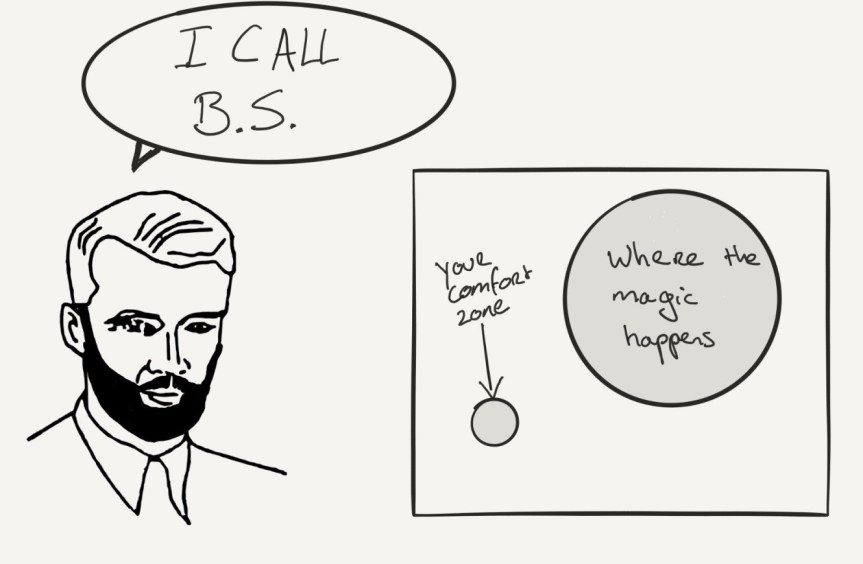
I’ve never believed the idea of that stupid little drawing. You know what I’m talking about, right?

  • “Your comfort zone.” A little circle.
  • “Where the magic happens.” A big circle that stands for the promise of success.

As if “magic” only happens when you step outside your comfort zone; that’s ridiculous. And while we’re at it; why pretend as if your comfort zone is bad? It’s this little pathetic circle displayed against the bigger “magical” circle.

Sure, I’m all about pushing yourself, trying new things, moving forward, growing, etc. But in contrast to many popular self-help people, I don’t believe the comfort zone is a bad thing.

Call me a pessimist. Call me a stoic. But more than anything, I’m merely a practical person.

And practically speaking, you don’t even want to make a huge leap outside your comfort zone. In fact, I believe in the slow road to “magic.”

Where’s The Magic People Talk About?

I’ve found that I do my best work when I don’t worry about money, finding new friends, getting familiar with a new environment, and anything else that is related to always moving around.

But don’t get me wrong. I’m not saying I prefer to stay put. Stagnation is a death sentence to me.

I believe that there are different phases to life. Sometimes, you take it easy, work on your skills, your character — you invest in yourself.

And sometimes, you just go out there and take a chance. Life’s too short to be a wimp.

But those two things are interconnected. If you don’t work on yourself, and if you lack self-confidence, you will never take a risk.

For years I wanted to do what I’m doing now. But instead of jumping out of my comfort zone (which was scary), I slowly took on new and bigger challenges.

First, I got two degrees in business. Then, I started a business together with my father. That was in 2010. And after two years of working on that business for six or seven days a week, I started doing freelance marketing work.

Again, after a few years of freelancing and starting (and failing) other businesses on my own, I took a job at a research advisory firm because I wanted to know how it is to work for a major corporation.

And after doing that for a year and a half, I finally decided to write and talk about productivity, career, and entrepreneurship on the internet.

By then, I‘d been doing the things I write about for more than 10 years. And yet, I don’t have all the answers—I just share the stuff I’ve learned.

So it would be ridiculous if I would join people who scream: “If you want to be successful, all you have to do is step outside your comfort zone. NOW!”

Well, have you ever stepped outside your comfort zone? Even just a little bit counts. And what did you find? A leprechaun with a bag of money?

That comfort zone shit is just a story. It might motivate some people, but you don’t have to believe it if you don’t want to. It’s just like when people claim you have to wake up early if you want to be successful. Says who?

I believe this: If you step outside your comfort zone, there’s only more work waiting for you. It’s not fancy at all. There’s no magic involved. Just blood, sweat, and tears.

Work Your Way Up From A Place Of Comfort

I think that most people who read these type of articles want to achieve something. Maybe you want to quit your job, start a business, grow your business, become an artist, publish a book, whatever.

And you probably also know that it’s not easy. So why do you make things even harder for yourself by doing shit that makes you very uncomfortable?

Instead, start from the very bottom. Build a strong foundation. Get comfortable before you do scary stuff.

“How does that foundation look like?”

If you want to live stress-free, you need enough money in your savings account so you can live and eat for six months in case things go south—see it as a fail-safe system. Again, that’s my practical mind speaking for me.

Make some calculations and figure your what that number is for you. And don’t even think about taking a risk before you have that money on your savings account.

Also, build a skill set that’s worth something. One of the reasons I don’t care about money is because I trust my ability to find work. Even when I go broke tomorrow, I’ll find a way to get work the next day. I’ve invested years and hundreds of thousands of dollars in my education.

The question is: What’s your skill? How can you add value to the world? What problems can you solve?

Other things that complete your foundation:

  1. Family. If you don’t have a family, create one.
  2. Friends. You can’t be friends with everyone. Stick to a few people who also stick to you.
  3. Yourself. Consciously improve your body and mind. Go to bed a little stronger and wiser every night.

Lastly, don’t try to be something you’re not. If you’re an introvert, don’t pretend that you can work in a boiler room. If you’re an extrovert, don’t pretend you can work in solitude.

Stay close to yourself—there’s no point in pushing yourself so badly that your life becomes miserable.

In the end, we all need comfort: It’s one of our basic needs as human beings. But we also need growth. So whatever you do, don’t stay in your comfort zone for too long.

Try to keep moving forward every day: Even if it’s just a tiny step. No magic. Just effort.

Through His Eyes

After an interview with a group of rapists, some interesting facts came out about how these rapists “choose” their victims.

 • The first thing they always notice in their victim is the “hairstyle”. They probably go after the women whose hair is tied in a ponytail, braid, or bun. Since these hairdos will make it easy for them to grab.
They usually go behind women who have long hair.

 • The second thing they look at is the clothing style. They’ll follow women whose apparel will be simple for them to remove.
It is also seen that they usually carry scissors around to cut clothing.

 • They focus on those ladies who are occupied on a call or searching for something through their purse because such women can be easily overpowered during such situations as they are distracted.


• They are bound to attack in the early
mornings between 5:00 am to 8:30 am as there wouldn’t be anyone to help around.

 • They also mentioned the place where they can easily attack their victims. Parking lots, garages, restrooms are most common among them.

 • These rapists don’t for the most part carry a weapon with them because rape carries a 3-5 years sentence whereas, rape with a weapon carries a 15-20 years sentence.

 • They mentioned that they don’t go after women who carry umbrellas or any other comparable object as it can be utilised from distance.

These are some common things found through the interview which will always help you to stay aware.

How to be aware or save yourself?

 • Always carry a pepper spray with you
 • Pinch the assailant in some sensitive parts very hard such as under the arms, inner thighs.
 • After this, always go for the groin!
It’ll be extremely painful for them.
 • You can also grab his fingers and twist them as much as you can.
 • Always be aware of your surroundings especially when you notice some odd behavior.

Other six Jyotirling of Lord Shiva

7. Mallikarjuna Jyotirlinga, Andhra Pradesh: According to the Shiva Purana, Lord Ganesha was married off before Kartikeya which left Kartikeya angered. He went away to the Kraunch Mountain. All the Gods tried to console him but in vain. Ultimately Shiva-Parvati themselves travelled to the mountain but were turned away by Kartikeya. Seeing their son in such a state they were very hurt and Shiva assumed the form of a Jyotirlinga and resided on the mountain by the name of Mallikarujna. Mallika means Parvati, while Arjuna is another name of Shiva. It is also known as “Kailash of the South” and is one of the greatest Shaivite shrines in India.

8. Ghrishneshwar Jyotirlinga, Aurangabad: According to the Shiva Purana, a couple named Sudharm and Sudeha resided on the Devagiri Mountain. They were childless, and thus Sudeha got her sister Ghushma married to Sudharm. They bore a son who rendered Ghushma proud and Sudeha jealous of her sister. In her jealousy, Sudeha threw the son in the lake where Ghushma used to discharge 101 lingams. Ghushma prayed to Lord Shiva who ultimately returned her the son and told her of her sister’s deeds. Sudharm asked Shiva to emancipate Sudeha which left Shiva pleased with his generosity. On Sudharm’s request, Shiva manifested himself in the form of the Jyotirlinga and assumed the name Ghushmeshwar.

9.  Trimbakeshwar Jyotirlinga, Nasik: According to the Shiva Purana, it is on the earnest request of River Godavari, Gautam Rishi and all the other Gods that Shiva decided to reside here and assumed the name Trimbakeshwar. Gautam Rishi earned a boon from Varuna in the form of a pit from which he received an inexhaustible supply of grains and food. The other Gods were rendered jealous by him and they send a cow to enter the granary. The cow was mistakenly killed by Gautam Rishi who then asked Lord Shiva to do something to purify the premises. Shiva asked Ganga to flow through the land to make it pure. Everyone thus sang praise for the Lord who then resided beside Ganga in the form of Trimbakeshwar Jyotirlinga. Hindus believe that this Jyotirlinga in Maharashtra is the one which fulfils everyone’s desires.

10. Rameshwar Jyotirlinga, Tamil Nadu:  It is believed that Ram on his way to Sri Lanka stopped at Rameshwaram and was drinking water on the seashore when there was a celestial proclamation: “You are drinking water without worshipping me.” Listening to this Ram made a linga of sand and worshipped it and asked for its blessings to defeat Ravana. He got the blessings from Lord Shiva who then turned into a Jyotirlinga and resided at the place for eternity.

11. Bhimashankar Jyotirlinga, Maharashtra: The legend about the existence of this Jyotirlinga is related to Kumbhakarna’s son Bhima. When Bhima learned that he was the son of Kumbhakarana who was annihilated by Lord Vishnu in his incarnation as Lord Ram, he vowed to avenge Lord Vishnu. He performed penance to please Lord Brahma who granted him immense power. On achieving this power, he started creating havoc in the world. He defeated the staunch devotee of Lord Shiva- Kamrupeshwar and put him in the dungeons. This angered the Lords who requested Shiva to descend Earth and put an end to this tyranny. A war ensued between the two and Shiva ultimately put the demon to ashes. All the Gods then requested Shiva to make that place his abode. Shiva then manifested himself in the form of Bhimashankar Jyotirlinga. It is believed that the sweat which poured from Shiva’s body after the battle is what formed the Bhima River. 

12.  Baidyanath Jyotirlinga, Jharkhand:  According to a famous legend, the demon king Ravana meditated and asked Lord Shiva to come over to Sri Lanka and make it invincible. Ravana tried to take Mount Kailash with him, but Lord Shiva crushed it. Ravana asked for penance and in turn, was given of the twelve Jyotirlingas on the condition that if it was placed on the ground it would remain rooted to that spot till eternity. While transporting it to Sri Lanka, Lord Varuna entered Ravana’s body and he felt an urgent need to relieve himself. Lord Vishnu came down in the form of a lad and offered to hold the lingam in the meantime. However, Vishnu placed the lingam on the ground and it got rooted to the spot. As a form of penance, Ravana cut off nine of his heads. Shiva revived him and joined the heads to the body, like a vaidya and hence this Jyotirlinga came to be known as Vaidyanath.