THE ROGAN ART

Hello guys! Today I am going to tell you guys about a 400 year old art .

Abdul Gaffur khatri’s family is ” the only family in the world” that is keeping this art alive for almost 8 generations.

This art is called “The Rogan Art”.

The palm of the hand is the essential tool for getting this painting technique just right.


These designs were once popular throughout India, but the rise of industrial textiles forced many artisans to leave the craft for more lucrative work.

Rogan means oil in Farsi”

From:roganartnirona

This art starts with castor oil.
It’s the base of the paint.So the art is named after it .

  • In this process the oil should be heated for two days until it becomes a honey-like texture.
  • It’s a dangerous process only a few can handle.
  • After it cools they combine the oil with pigment to create the paint.The above mentioned steps are only for making the paint now comes the main thing.
  • In this art the use of the hand gives the Rogan art it’s unique nature.
  • The paint needs to be swirled in the palm which in turn creates heat to thin it out after that the thread of paint is floated over the fabric using a metal rod.
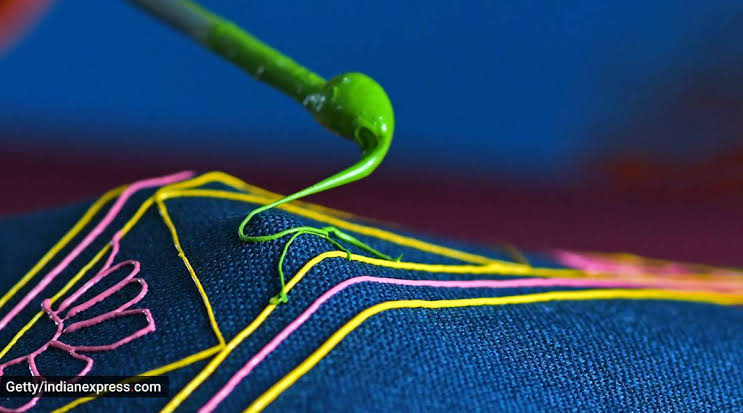
From : The Indian express

Using the other hand underneath the cloth to guiding the paint and this process is completely free hand which makes this art more peculiar as the final design is to be anticipated and not ready made before.

Before it dries, they folds the cloth to print the design’s mirror image.which is timesaving and also the design will be symmetric.

From:livemint.com

This art is said to have originated from from Persia400 years ago to India and it was once popular on bedding and ceremonial clothing here in India.

But with the rise of mass-produced textiles in the ’80s,locals lost interest in these more expensive handmade pieces.

Many artisans couldn’t compete with mass manufacturers and dropped their crafts to find other work.

This beautiful art is also going extinct and covid-19 has the greatest impact on these artisans forcing them to leave this and find some other work for their livelihood as before they used to sell their pieces to foreigners but after the pandemic even that income has come to a halt.

We have to encourage them so that the art’s legacy can carry on and our next generations can also see this beautiful art.

Thankyou.

Pomodoro Technique for productive study/work

” Time and tide wait for none”. No matter how many times we hear or see this clichéd quote, not all of us actually understand the essence of these words. Time management is an essential skill for aspirants of all kinds. In this fast-evolving world, one must keep up par with others to achieve their goal. The fact that smart work is better than hard work is of the essence. Productivity is smart work. One such method to maintain productivity in our daily life is the Pomodoro technique.

Pomodoro technique is a time management method where a timer is used to break down the work at hand into intervals, separated by short breaks. This method was developed by Francesco Cirillo in the late 1980s. Each interval is called a ‘Pomodoro’ the Italian word for tomato, the tomato-shaped kitchen timer that Cirillo used as a college student.

The original technique has 6 steps

1. Choose a task you would like to get done

No matter how small or big the task is, it deserves your full undivided attention.

2. Set the timer for 25 minutes

Keep a promise to yourself that you don’t interrupt yourself for just 25 minutes. You can use your mobile timer or a good old clock for timing your session.

3. Work on the task until the timer rings

Immerse yourself. Meanwhile, if you remember anything other than the work at hand, write it down on a sheet of paper. You can give them thought later.

4. When the timer rings, tick off your completed task

Hurray! You have given your undivided attention to the task for 25 minutes.

5. Take a short break

Take a deep breath, meditate, grab a cup of your favourite beverage go for a stroll or do something that is relaxing for your brain to reward yourself.

6. After every 4 Pomodoros take a longer break

A break of 20 to 30 minutes is good enough to rest, preview the information and prepare yourself for the next set of Pomodoros.

To make the best out of these Pomodoro sessions you can:

  • Use the first few minutes of the session to review what you have done earlier.
  • Set up a timetable and try to be devoted to it.
  • You can use airplane mode or do not disturb mode on your mobile. (Apply only if you are not accountable for not picking up calls 🙂
  • Be mindful of the shorter breaks. They might prolong at times, thus unsettling your next Pomodoro cycle.
  • Understand your body — find out which part of the day you are most productive. This can work wonders and get a lot of things done.

The rules of the Pomodoro technique are not necessarily rigid. If you are not able to pull up 4 Pomodoros continuously, opt for one or two Pomodoros in a day. At the end of the day, what matters the most is how much productive and focus you are in those sessions and how much work gets done. You can also vary the time interval as 50/10 (50 minutes of focus and 10 minutes of break) instead of the traditional 25/5 technique if you are quite confident about your focus.

This technique is useful if you feel distracted or overwhelmed to focus on what matters to you. It has worked well for me in this lockdown and has helped a lot in my exam preparations. Hope it works for you too!

Everything you should know about SEBI

Securities and Exchange Board of India (SEBI) is a statutory regulatory body entrusted with the responsibility to regulate the Indian capital markets. It monitors and regulates the securities market and protects the interests of the investors by enforcing certain rules and regulations.

SEBI was founded on April 12, 1992 under the SEBI Act, 1992. Headquartered in Mumbai, SEBI has regional offices in New Delhi, Chennai, Kolkata and Ahmedabad along with other local regional offices across prominent cities in India.

The objective of SEBI is to ensure that the Indian capital market works in a systematic manner and provide investors with a transparent environment for their investment. To put it simply, the primary objective of setting up SEBI is the creation of such an environment that helps in effective mobilization as well as the allocation of resources with the help of securities market of India.

Objectives

SEBI has many objectives and is meant for the betterment of each participant in the market, be it investors, intermediaries or the issuers of securities. Some of these objectives are-

  1. Provide protection: It guides and educates people who are willing to invest their money in the securities market. This is done in order to protect their interests.
  2. Preventing malpractices: It aims at prohibiting of all kinds of malpractices which are prevalent in the trading market.
  3. Professional and Competitive environment: SEBI has the objective to develop a code of conduct through which it can easily regulate the activities of the intermediaries. Brokers, merchant bankers are some of the intermediaries. The main objective of SEBI is to make these intermediaries professional and competitive.
  4. Orderly Functioning: SEBI has been entrusted with the duty of promoting the functioning of the securities industry and stock exchanges in an orderly manner.
  5. Establishing balance: SEBI also maintains a balance between the regulations provided by various statutes and the regulations made by the securities industry.

Functions of SEBI

SEBI is entitled to fulfil various functions, which can be divided into the following three parts:

  • Developmental functions
  • Protective functions
  • Regulatory functions

These broad functions can be subdivided into various other functions. Some of them are as follows:

DEVELOPMENTAL FUNCTIONS

There are various developmental functions of SEBI. Some of them are as follows:

  • Promoting fair trade: SEBI has made underwriting optional in order to achieve the goal of promotion of fair trade.
  • Research: SEBI also makes a publication of the data and information which is necessary for various participants of the market in order to conduct effective research.
  • Training of brokers: Intermediaries of the securities market are trained to promote the efficiency of the market.

PROTECTIVE FUNCTIONS

There are various protective functions of SEBI. Some of them are as follows:

  • Prevention of various Fraudulent and Unfair Trade Practices: Price ragging and purchase or sale of securities with the help of several misleading statements are some of instances of Fraudulent and Unfair Trade Practices. SEBI aims at prohibiting such practices.
  • Prohibition of Insider Trading: Promoters, directors and other key managerial personnel of the companies take advantage of the possession of the unpublished price sensitive information for making profits by trading into securities. SEBI aims at preventing such insiders to trade.
  • Educates Investors: SEBI organizes various campaigns in to order to promote awareness amongst the investors. This is done to protect them, from various fraudulent activities prevalent in the securities market.
  • Promotion of Fair Practices: SEBI is also responsible for the promotion of code of conduct and other fair practices in the market of securities in India. For instance, SEBI regularly keeps a check on the interests of debenture holders with respect to any midterm revision of rates of interest and many more.

REGULATORY FUNCTIONS

  • Notifications of various Rules and Regulations: SEBI is empowered to issue various rules and regulations to make the functioning of all the intermediaries existing in the securities market smooth.
  • Levying of Fees: If any of the players of the market contravenes any order or direction passed by it, SEBI has the power to levy penalties, fees and other charges for the same.
  • Registration of Agents and Brokers: For the purpose of making a safe market place for trading into the securities, it is mandatory for all the transfer agents, brokers, merchant banks, sub-brokers and so on to register themselves.
  • Regulator of Investment Schemes: It has made the registration of mutual funds and collective investment schemes mandatory in order to regulate them.
  • Exercising and Performing Powers: SEBI has been delegated various powers under the Securities Contracts (Regulation) Act 1956 by the Government of India. SEBI exercises and performs all such powers.
  • Enquiries and Inspection: SEBI conducts various inspections and undertakes audits and enquiries of stock exchanges of India.

Economic significance of Algae

People are mainly aware about the algae as seaweeds or algal blooms. They are the organisms with ability of photosynthesis and very much diverse community as well. But algae are important to man and their economic importance is manyfold. They are used as food, fodder and manure. They are also important in industrial field as well as agriculture.

there are 7 major types in algae
  • Chrysophytes
  • Euglenophytes
  • Pyrrophytes
  • Chlorophytes
  • Rhodophytes
  • Phaeophytes
  • Xanthophytes
these are the benificial roles of algae
  1. Algae is a food source: In different parts of the world algae have been utilized as direct source of food. They are rich in proteins, carbohydrates, oils, vitamins and minerals hence used as a diet food. They possess minerals like Cu, Fe, Zn, Co, V, Mn and Cr. About 20 different seaweeds are used as food source. Nostoc,
  2. Algae as fodder: Many seaweeds are as food for cattle, poultry and aquatic organisms. Sargassum is used as cattle feed in China. Laminaria and Fucus are also used for the same purpose. Seaweed meal increases the egg laying capacity of fowls. These eggs contain high amount of iodine and carotene.
  3. Algae in agriculture: Algae are used as green manures in agriculture. Sargassum, Laminaria, Macrocystis and Gracilaria are the most commonly used ones. Seaweed manure increases the yield of barley, potato, coconut palms, citrus etc. Many blue green algae have the ability to fix the atmospheric nitrogen into the soil. So they can be used as biofertilizers. Saline and alkaline soils can be converted into productive ones by growing some blue-green algae on soil. Anabaena, Rivularia, Spirulina are used for this purpose.
  4. Algae in Industries: In Industries many algae have been used as sources for the extraction of commercial products like agar-agar, diatomite, carrageenin and algin. Agar-agar is used as culture media for bacteria. It is also used as emulsifier in ice-cream, fruit jellies and dairy product preparation. Algin is used as painting pastes in textile industry and thickeners in cosmetics, pharmaceutical products etc. Carrageenin which is extracted from Chondrus crispus and Gigartina are used in food industry, textiles and leather industry. It is a remedy for cough.
  5. Algae in sewage disposal: Sewage water contains organic and inorganic substances which makes it low in oxygen content. But sewage finds use in agricultural practice as they are rich in salts. To decrease the foul smell algae are used. Algae are used to decompose the organic and inorganic substances.
  6. Algae and Research: Algae are used in the study of effects of pesticides, herbicides and UV light. They are used in the research for preparing biofuels.
  7. Algae as pollution indicator: Some algae grow well in polluted water as they are more tolerant towards pollution. Growth of these algae indicates the pollution and its intensity. Scenedesmus indicates copper wastes and Ulothrix zonata indicates indicates paper mill wastes.

Though many algae are useful, there are harmful algae are also there. The development of water blooms is considered to be a bad effect of algae. There are some parasitic algae cause diseases in plants. Attachment of algae tp ship retards the speed of the ship. growth of algae on cloths are also seen and they ruin the cloth.

When Clothes Define Character

It’s not a surprise to come across a comment or an opinion that is often made on the character of an individual based on their clothes. It’s been a long going tradition, especially one where pre-defined ‘ethics’ have already pre-conditioned the minds of many that it’s not easy to escape from such an opinion.

When a girl is in a bikini, she is tagged as a prostitute. If a male wears feminine-looking clothes, he is tagged as a transgender or gay. A woman who chooses to wear shirts and pants unlike the traditionally viewed girls’ clothes, they are praised as tomboys. From Clothes defining character, to clothes defining gender, to clothes defining opinion, the chain of link between clothes and humans don’t seem to end.

Often under the hood of this orthodox opinion some people even go on to ‘police’ someone’s cloth choices while being condescending and prejudiced. Clothes have been exploited as a way to define someone’s character, someone’s gender or someone’s life in a nutshell. These pre-conditioned orthodox views have been passed down from generations to generations for so long that even after learning about it, unlearning this becomes tough.

From being commented by India’s well-off leaders about jeans and skirts being arousing to that common gasping stares of people when you walk out with shorts, all of them not only degrade one’s life quality but also restrain them from opportunities that they’d like to explore.

Now, it’s possible that you may argue about how clothes are one of the essentials of human life and it’s inevitable to not link clothes with character? If clothes were not meant for character reflection, then why do places such as offices, schools, etc. have a dress code? Shouldn’t we all should be allowed to wear a bikini at work?

To quench your curiosity let me reveal a little fact to you. Dress-codes actually emerged to enhance team-spirit and comfortable environment and fit for the individuals. It was meant to improve the feeling of ‘belonging’ together among the members. However, this too strayed from it’s path of goal and ended up as being one of the traditionally forced ethics. But the focus of the article is not the history. It’s the present. It is because of this orthodox view that dress-codes which started out as a way to provide comfort actually became a ‘moral police’ baton. Skin-revealing clothes started became tagged as modern and this modern-ness a trolling weapon for many orthodox people.

So, what’s the solution to this cloth-character problem?

Here are some things that you can do!

  1. Unlearn – This is definitely the most needed solution. To unlearn. Unless we re-teach ourselves the basis of what makes a person a good person, (which btw aren’t clothes) none of this will ever change. Mahatma Gandhi once said, ‘Be the change you want to see.’ And it is indeed true. Start with you. Your values. Your views. Teach yourself how clothes don’t have a gender and neither a character.
  2. Unresponsive to people holding orthodox views – Instead of trying your best to change some orthodox person’s view, who is unyielding and strongly stupid, the best you can do is ignore them. Ignore their comments and don’t let your blood boil. It’s not easy to unlearn. And what’s more tough is to let go of your wrong convictions if that’s what’s you’ve been conditioned with the whole life.
  3. Express your views – This may sound conflicting but give it a read. You need to express your views about how cloth-character assumption is wrong and why it is so. This is because unless you will tell them, no one ever will. They won’t know that a view opposite to theirs can exist. So you be the opposite one. But never waste your time by continuously pestering them with your views. You know how the saying goes, ‘A dog’s twisted tail will always remain twisted.’ So, don’t waste your energy on such people.
  4. Teach the kids – Just like how we and the previous generations have been conditioned with some wrong views, you can start on the right foot by teaching the kids the difference and the right thing about what defines a good human character. And it’s definitely not the clothes.

We’ve heard the ‘Don’t Judge a Book by its Cover’ and ‘Don’t Judge a Song by its Language’. Now, it’s time that we also learn; ‘Don’t Judge a Character by its Clothes’.

internet of things (IoT)

The internet of things, or IoT, is a system of interrelated computing devices, mechanical and digital machines, objects, animals or people that are provided with unique identifiers (UIDs) and the ability to transfer data over a network without requiring human-to-human or human-to-computer interaction.

thing in the internet of things can be a person with a heart monitor implant, a farm animal with a biochip transponder, an automobile that has built-in sensors to alert the driver when tire pressure is low or any other natural or man-made object that can be assigned an Internet Protocol (IP) address and is able to transfer data over a network.

Increasingly, organizations in a variety of industries are using IoT to operate more efficiently, better understand customers to deliver enhanced customer service, improve decision-making and increase the value of the business.

How IoT works

An IoT ecosystem consists of web-enabled smart devices that use embedded systems, such as processors, sensors and communication hardware, to collect, send and act on data they acquire from their environments. IoT devices share the sensor data they collect by connecting to an IoT gateway or other edge device where data is either sent to the cloud to be analyzed or analyzed locally. Sometimes, these devices communicate with other related devices and act on the information they get from one another. The devices do most of the work without human intervention, although people can interact with the devices — for instance, to set them up, give them instructions or access the data.

UNIX

UNIX Full Form - GeeksforGeeks

UNIX is a multi-user and multitasking operating system. in a multi-user environment. the computer can receive the commands from a number of end users programs, access files, and print documents simultaneously.

The host computer, which has a UNIX operating system, provides services to the terminal, such as file access services. four terminals are connected to one host computer and all the terminals are sharing resources from the host computer.

Features of UNIX

The general and additional features of UNIX operating system are :

  • File and Processes : file and process are two entities that are supported by UNIX. A file contains information, such as text, code or directory structure that you need to save in the computer, The file is stored in the hard disk of the computer at a particular location, which can be easily remember whereas a process is the name given to a file or a programs that is currently running . UNIX provides various tools that enable you to control a process, change the sequence of the process, and kill the process.
  • Multi-user system: UNIX supports multitasking system as the kernel is designed to handle multiple processes. A single user can run multiple process simultaneously. For example, an end user can print a file and edit another file simultaneously. The kernel handles the multiple processes as foreground and background process. The current process runs in the foreground and the other processes run in the background. This multitasking feature is an advantage for the programmers, as they do not have to close the editor and run the program; this can done simultaneously.
  • UNIX toolkit: The UNIX toolkit provides various tools that are enable you to perform different tasks in UNIX as kernel alone cannot perform every task. The tools that are included in the UNIX toolkit are:

1:- General purpose tools , such as vi editor

2:- Text manipulation utilizes filters that are used to retrieve the output from two or more commands simultaneously .

3:- Compiler and Interpreter .

4:- Network administration and system tools , such as mailx and pine.

  • Pattern Matching :- UNIX supports pattern matching feature that enables you to retrieve the output according to the required pattern . Pattern matching in UNIX can be implemented using a special characters , such as * known as metacharacter .
  • Programming Facility :- UNIX provides a programming facility known as shell that is developed specifically for programmers and not for the users .

Most important days in our history

TEACHER’S DAY

Happy teacher’s day

Teacher’s day is a special day for the appreciation of teachers,& may include celebration to honor them for their special contributions in a particular field area ,or the community in general.

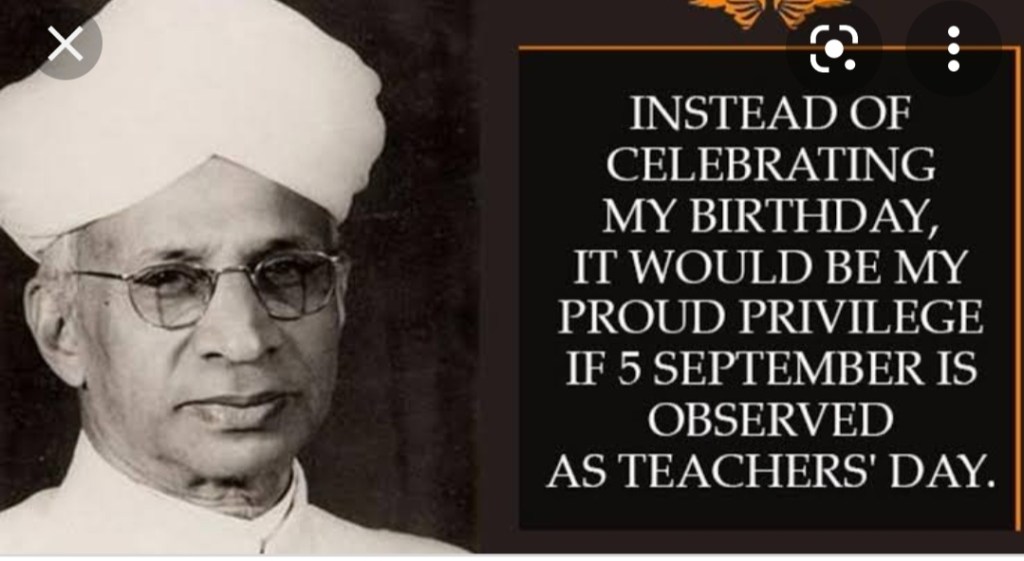
5 th September is the birth anniversary of a great teacher Dr Sarvepalli Radhakrishnan who was a staunch believer of education & was a well known diplomat,scholar,the president of India and above all a teacher.

Best teacher ever

Who are Teachers?

Teachers nourish and prepare students for their future as they are the real icon of knowledge and wisdom. They create awareness among the students and common people. They are the source of light in the world that has been darkened due to ignorance. Our teachers are the true pillars of our success. They help us garner knowledge, improve our skills, grow confidence as well as they help us to choose the right path to success. But, despite playing such a crucial role in the lives of students and in nation-building, they rarely are shown the gratitude that they deserve. So, as a student, it is our duty to thank them at least once a year and Teachers’ Day gives us an ideal opportunity to do so!.

As it is rightly said that:

Jagranjosh

In addition to their own teachers and mentors, 5th September is also a day when a person can look back, and be inspired by the life and works of Dr. S. Radhakrishnan. Dr. Radhakrishnan hailed from a small city boy and with the help of education, he became an esteemed politician and a visionary educationist.

Benefits of learning any foreign language.

In this cutting-edge World, who would mind having an extra set of skills. Having proficiency in more than one language is one of the skills needed in today’s era. Being bilingual/multilingual doesn’t mean one can only connect with the world in a more meaningful way but being bilingual/multilingual one can also stand out from the crowd, and advance their career. These are not the only benefits, let’s have a look at some of the benefits in brief. Mentioned below are some of the many benefits a bilingual/multilingual can have:–

Advance your career

Learning a second language can set you apart from your monolingual colleagues and provide you with opportunities for better employment. Companies with overseas clients and foreign customers are looking for fluent professionals in a second language, who can deal with various communities.

Improves decision-making skills 

It is found in a study by the University of Chicago that a multilingual person is better at decision making than a monolingual.

When you learn a foreign language, you try to learn native expressions and their hidden meaning, which enhances your decision-making process. It is also proved that the decision you make in a foreign language is more reasonable than the decision you make in your native language. 

Connect with people

One of the most incredible advantages of learning a foreign language is opening new windows of opportunities and meeting new people of different communities. When you learn a foreign language, you also generate a sense of better understanding and appreciation towards people from different communities. And you might end up having a lifelong connection with people from different parts of the world. Isn’t it magical?

Sharpens memory

When you learn a new language, your mind is been introduced to various rules, different grammar, and an entirely new set of vocabulary, which exercises your memory. It has also been claimed that people who are into learning a new language find it easier to remember names, facts, directions, and figures. 

Makes traveling easy

When you have fluency in more than one language, it is easier to travel to different parts of the world, as it makes it easier to connect with different cultures and native speakers. When you can talk to a native person you can get more information about the place, even the information that is not on the web. Hence, being bilingual/multilingual can make your traveling so much easier. 

Be it learning a foreign from a university or online classes. If you are planning to learn one, it will for sure provide you several benefits and will boost your career to new heights.

PSYCHOLOGICAL ASPECTS OF WOMEN ATHLETE

Lesson 6 women and sports

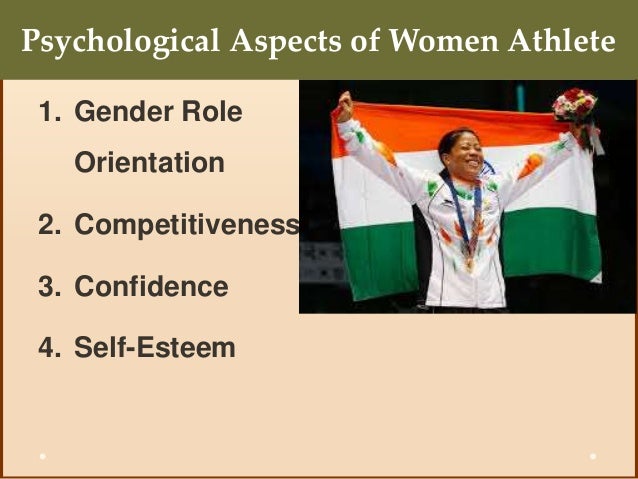
Over the past several decades , the role of women has changed drastically .However , gender beliefs and stereotypes still do exist across the world especially in sports . Most of the people in our society consider that sports are not meant for females but only for males .Social tradition , customs and cultures have great influence upon the psychology of women . In a male dominating society , males are expected to be aggressive , independent , dominating , robust and confident , whereas females are expected as well as considered to be emotional , sensitive , cooperative , sympathetic , loyal , etc. It is a well – known fact that participation of women in sports is increasing year after year .With this enhancement in female participation in sports , there is also renewed interest in the psychological characteristics of the female athletes and the effects of athletics on women . The various psychological traits of women athletes are stated below .

  1. Gender Role Orientation : It is an established fact that there has been an increase in the level of women’s participation in the types of sports that have been traditionally limited to only males , e.g., wrestling , weightlifting , kick boxing , body building , etc . However , many sports have been still considered inappropriate for women . For a long time it was considered that women should not take part in athletics because of the potentially harmful masculinising effects of sports .
  2. Competitiveness : It is evident that in the field of sports , both men and women are competitive in their own fields . In fact , women are more goal oriented and perform magnificently in artistic activities such as gymnastics . However , a number of research studies indicate that females who take part in sports are more competitive in comparison to the females who do not participate in sports .
  3. Confidence : As mentioned earlier , due to social pressures , women tend to have less confidence than men . Participation in sports , competitive environment , awards and recognitions increase confidence levels of sportspersons . However , a significant difference may exist between sportswomen and non- sportswomen .
  4. Self-esteem : Most of the research studies indicate that training plays a vital role in performance . Self -esteem improves with good performance . In the field of sports , intensive training helps in enhancing self-esteem . Research studies also show that those people who engage in sports have high self-esteem in comparison to non-participants .
  5. Aggression : Aggression is a forceful , goal- directed action that maybe verbal or physical . Participation in sports has many positive aspects which usually involve aggressive behavior . Various studies of aggression show that athletes who participate in contact sports , i.e., football players , judos or wrestlers are more aggressive than the athletes who participate in less contact sports . However , females who participate in contact sports show more aggression in comparison to females who do not participate in sports at all.

Environmental pollution

“Humankind has not woven the web of life. We are but one thread within it. Whatever we do to the web, we do to ourselves. All things are bound together. All things connect.”

~ Chief Seattle

What is environmental pollution ?

Is it degrading our lifestyle ?

How can we improve our environment ?

Let’s get through the topic .

Introduction

One of the greatest problems that the world is facing today is that of environmental pollution, which is causing grave and irreparable damage to the natural world and human society with about 40% of deaths worldwide being caused by water, air and soil pollution and coupled with human overpopulation has contributed to the malnutrition of 3.7 billion people worldwide, making them more susceptible to disease.

Environmental pollution is defined as “the contamination of the physical and biological components of the earth/atmosphere system to such an extent that normal environmental processes are adversely affected.”

From: Environmental Management, 2017

We all are well known about the word Environmental pollution . It is not some kind of new phenomenon , yet it is a greatest problem facing by our society . Still , people are avoiding the topic to its utmost.

Environmental pollution is one of the most serious global challenges. Wild-type organisms have a slower degradation rate of hazardous materials.

Both developed and developing nations share this burden together, though awareness and stricter laws in developed countries have contributed to a larger extent in protecting their environment.

Reasons behind environmental pollution

  • The Burning of Fossil Fuels. Industrial Emission.
  • Indoor Air Pollution.
  • Wildfires.
  • Microbial Decaying Process.
  • Transportation.
  • Open Burning of Garbage Waste.
  • Construction and Demolition.
  • Urbanization and industrialization. Since the era of industrial revolution, man has continued to introduce hazardous materials into the environment at an alarming rate.Mining and exploration.
  • Agricultural activities.
  • Particulate matter.
  • Plastics.
  • Energy production.
  • Deforestation.
  • Mining.
  • Over population.
  • Increase in global average temperature.

Effects of environmental pollution

Environmental pollution is an incurable disease . It can only be prevented.

Barry commoner

1. Effects on Humans. The effects of environmental pollution on humans are mainly physical, but can also turn into neuro-affections in the long term. The best-known troubles to us are respiratory, in the form of allergies, asthma, irritation of the eyes and nasal passages, or other forms of respiratory infections. Other rarer diseases include hepatitis, typhoid affections, diarrhea, and hormonal disruptions.

2. Effects on Animals . Environmental pollution mainly affects animals by causing harm to their living environment, making it toxic for them to live in.

3. Effects on plants . As for animals, plants, and especially trees, can be destroyed by acid rains (and this will also have a negative impact on animals as well, as their natural environment will be modified), ozone in the lower atmosphere block the plant respiration, and harmful pollutants can be absorbed from the water or soil.

Solutions for environmental pollution.

  • Evironment planning.
  • Shifting to eco-friendly transportation.
  • Air pollution must involve moving away from fossil fuels, replace them with sustainable fuels .
  • Solar power .
  • Wind power.
  • Go green.
  • Storage facilities for solid waste.
  • Environmental friendly products.
  • Policies implimentation for environmental pollution.
  • We also need to work on electromagnetic radiation (ER) reduction.
  • Awareness through mass media.
  • More green parks and areas.
  • Environmental education, etc,.

“We say we love flowers, yet we pluck them. We say we love trees, yet we cut them down. And people still wonder why some are afraid when told they are loved.”

~ Paul Morley

Link

ENVIRONMENTAL PROTECTION LAWS – Wildlife Act

Environment protection is practice of protecting the environment, on individual, organizational or governmental & (or) humans. Protection of the environment is needed due to various human activities.

Why laws are implemented?

  • Protect and preserve the environment.
  • The law  prescribes Responsibilities of the State for protecting the national environment.
  • Determine who can use natural resources and on what terms.
  • Create rules for how people can use natural resources.
  • Governments have determined to strengthen their judicial capacity to enforce environmental laws.

Wildlife Act (1972)

The wild life protection Act, 1972 is an Act of the Parliament of India enacted on 9 Sept 1972. It provides for protection of wild animals, birds, plants and for matters connected therewith. It extends to whole India, except Jammu and Kashmir. It has six schedules which give varying degrees of protection.

Definitions

  1. Animal- Amphibians, birds, mammals
  2. Animal Article- Articles made from wild animal
  3. Hunting- Capturing, Killing, poisoning, trapping, injuring animals etc
  4. Trophy- Whole or part of animal which been preserved.
  5. Wildlife- Any animal, bees, butterflies, crustacean, fish & moths;

Authorities appointed

Central government may appoint A Director of wild life preservation, Assistant Directors of wild life preservation, Other officers & employees as may be necessary.

State government may appoint A chief wild life warden, Wild life wardens, One Honorary wild life warden in each district, Other officers & employees as may be necessary.

Wild life Advisory Board

  • The Act enforces & enables the state governments & the administrators of the union Territories to constitute a wildlife Advisory Board in each state & Union Territory.
  • Areas to be declared as sanctuaries, national parks, or closed areas & their administration.
  • Formulation of policy for protection & conservation of wildlife.
  • Amendment of any schedule.
  • Any other matter referred by State government.

Hunting of wildlife animals

Hunting of wild animals is permitted in certain cases – If the animal has become dangerous to human life or beyond recovery. Killing or wounding in good faith in defense of oneself or any other person.

Grant of permit for special purpose like Education, Scientific research, Scientific management, Collection of specimen for zoos, museums & similar institute, Derivation, collection or preparation of snake- venom for manufacture of life saving drugs.

Protection of specified plants

No person shall Willfully pick, uproot, damage, destroy, acquire, or collect any specified plant from any land & any specified area by Central government. Possess, sell, offer for sale, or transfer by way to gift or otherwise, or transport any specified plant whether alive or dead.

Penalties

Imprisonment varying from six months up to seven years and/ or ranging from rs. 500 upto not less than rs. 10000 depending upon on the nature or seriousness of the offence committed regarding the specified wildlife.

Math 2.0 day

Today is math 2.0 day, but what exactly does that even mean?.With or without knowing we all use math several times every single day. The subject is also important for the advancement of technology. And thus, to celebrate the combination of maths and technology, Math 2.0 Day is celebrated on July 8. Read on to know other details.

Imagine the way the world used to be viewed! Math as known to be important but not thought to be something you could make a living at and the rising tide of technology was considered a fad! Math 2.0 Day reminds us that technology is here to stay!

Every year, Math 2.0 Day is celebrated on July 8. The day is observed to highlight the importance of the combination of maths and technology. The day was formed to celebrate the achievement made through the combination of maths and technology. Math 2.0 Day also helps to educate the masses about the benefits of maths and technology. Without maths and technology, it would have been impossible for us to achieve the various entertainment mediums we have now.

History of Math 2.0 Day

In 2009, the Math Interest Group formed Math 2.0 Day. Math is extremely important for the advancement of science, technology and education.Math 2.0 Day is a celebration of the blending of technology and mathematics. For a lot of us, math wasn’t a favorite subject, we’d spend the entire period staring at the equations and wondering what sort of livid madman designed these torture chambers on paper. Ultimately, however, we realized that math is utterly indispensable in our modern world. If you’ve ever wondered who uses math in their day to day careers, you aren’t alone and we have some answers for you.

Programmers deal with mathematics every day, as it’s the framework upon which all computer operations are formed. Everything from the order of operations to quadratic equations is necessary to make even the simplest program. Scientists are one of the biggest users of mathematics, whether they’re calculating the statistical variance of their data or figuring out how much to add to their chemistry experiment, it’s involved at every step.

One presumes you live in a house, drive a car, or operate a computer? The engineers responsible for designing those things so that they work, and especially in the case of the house, use math to ensure it doesn’t come crumbling down on your head. Math 2.0 day celebrates all these mathematical heroes and more.

How to celebrate Math 2.0 Day

If you’re like me, you probably have your old math books from college laying around. I suggest busting them open and studying them again. Who knows, in the intervening years you may have secretly developed a love for those dancing numbers. If not, make sure that you stop by those people who use math every day and thank them for doing the work so you don’ thave to.Mathematics is one of the most important fields in the world today, and just about everything we know and love is built on its back.

Asset Bubble

What Is a Bubble?

A bubble is an economic cycle that is characterized by the rapid escalation of market value, particularly in the price of assets. This fast inflation is followed by a quick decrease in value, or a contraction, that is sometimes referred to as a “crash” or a “bubble burst. Typically, a bubble is created by a surge in asset prices that is driven by exuberant market behavior. During a bubble, assets typically trade at a price, or within a price range, that greatly exceeds the asset’s intrinsic value (the price does not align with the fundamentals of the asset).The cause of bubbles is disputed by economists; some economists even disagree that bubbles occur at all (on the basis that asset prices frequently deviate from their intrinsic value). However, bubbles are usually only identified and studied in retrospect, after a massive drop in prices occurs.

How a Bubble Works

An economic bubble occurs any time that the price of a good rises far above the item’s real value. Bubbles are typically attributed to a change in investor behavior, although what causes this change in behavior is debated. Bubbles in equities markets and economies cause resources to be transferred to areas of rapid growth. At the end of a bubble, resources are moved again, causing prices to deflate.

The Japanese economy experienced a bubble in the 1980s after the country’s banks were partially deregulated. This caused a huge surge in the prices of real estate and stock prices. The dot-com boom, also called the dot-com bubble, was a stock market bubble in the late 1990s. It was characterized by excessive speculation in Internet-related companies. During the dot-com boom, people bought technology stocks at high prices—believing they could sell them at a higher price—until confidence was lost and a large market correction occurred.

The research of American economist Hyman P. Minsky helps to explain the development of financial instability and provides one explanation of the characteristics of financial crises. Through his research, Minsky identified five stages in a typical credit cycle. While his theories went largely under-the-radar for many decades, the subprime mortgage crisis of 2008 renewed interest in his formulations, which also help to explain some of the patterns of a bubble.

Displacement

This stage takes place when investors start to notice a new paradigm, like a new product or technology, or historically low interest rates. This can be basically anything that gets their attention. 

Boom

Prices start to rise. Then, they get even more momentum as more investors enter the market. This sets up the stage for the boom. There is an overall sense of failing to jump in, causing even more people to start buying assets. 

Euphoria

When euphoria hits and asset prices skyrocket, it could be said that caution on the part of investors is mostly thrown out the window. 

Profit-Taking

Figuring out when the bubble will burst isn’t easy; once a bubble has burst, it will not inflate again. But anyone who can identify the early warning signs will make money by selling off positions. 

Panic

Asset prices change course and drop (sometimes as rapidly as they rose). Investors want to liquidate them at any price. Asset prices decline as supply outshines demand. 

Living Life Intentionally

People, especially those in young adulthood or in their middle ages, often find themselves questioning their life and purpose. You might find yourself wondering, what am I doing? Or, what should I do? The answer to these questions differs from person to person, and what it means to live intentionally also varies depending on the person. In case an individual is not able to find an answer to these, there can be a certain discomfort or disappointment as they feel lost and without purpose. However, there is a basic framework that can be adhered to which helps everyone one of us live intentionally.

Some important qualities

Firstly, we must learn to nurture wisdom in ourselves. Wisdom means that we are able to recognise what is good for us, what is bad for us, and what we are indifferent to. It is easy to understand what is good for you, like honesty, kindness, empathy, and what is bad for you like, dishonesty, greed, jealousy. In the indifferent category come the things that are not completely good or bad, like money, success, possessions, etc. You should not be too worried about whether you have a lot of these things or not, as they do not define your life’s worth.

Next there is temperance, which includes things like self-restraint, self-discipline and self-control. It is about balancing the short-term gains with the things that are good for us in the long-term. It also means that there should be moderation in all things, whether that be eating, watching TV or even working. Learning to exhibit self-control in your life and work towards things that provide long-term rewards rather than instant gratification will work wonders in your life. The classic example of this is exercise, which does not have any immediate results unless we are disciplined and stick to it, and after a while the hard work will show.

Following this is courage, which is not the elimination of fear or anxiety, but rather feeling the fear and anxiety and still acting in the right way. Courage is perhaps one of the most important qualities in life in general. When we are afraid of something, we should try to deal with that fear directly by leaning into it rather than running away from it. This is a display of courage. For example, if someone is scared of jumping in the water, the best way to overcome this fear is to simply jump without thinking about it too much. It is the same in case we have to make a difficult decision in life, but we are afraid of making it. Being courageous means we make the decision despite the fear behind it.

Lastly there is the virtue of justice. This is not to mean justice like in our legal system or jurisprudence. Rather it means our duty to the society and to our fellow man. So, if we want to live intentionally, we also have to live in ways that are beneficial to other people. This implies being caring and considerate of people around us. Justice also means doing the right things whenever we can, which is called being righteous. Righteousness helps us in living fulfilling and happy lives, free from feelings of greed or anger. An example for this could be if you see someone drop money, would you act in service of yourself and be greedy (pick it up and take it) or be righteous and just (pick it up and return it). The latter should be the one to aim for.

Conclusion

Hence, it can be concluded that living life intentionally may mean different things to different people, but there are certain qualities we can follow to help in our search for meaning. It is important to highlight here that there is a difference between happiness and meaning. Happiness occurs at points in our life for short periods, while meaning enlightens our whole life and gives us direction. Every person’s meaning in life may be different, but it serves the same purpose, which is to give us purpose. So, finding meaning in our lives will help us to live intentionally, and will also help us to become overall better people.