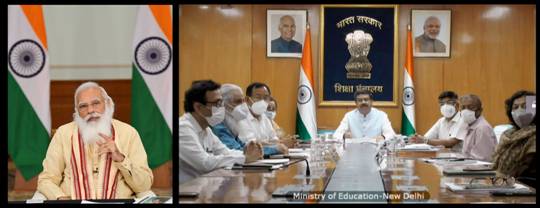
To commemorate 75thyears of progressive India‘Azadi Ka Amrit Mahotsav’, Ministry of Education (MoE), AICTE and Ministry of Commerce& Industry (DPIIT) are jointly organising ‘National Innovation Week’ from 10th – 16th Jan 2022. The innovation week is also the iconic week of Ministry of Education. This Innovation week will highlight various initiatives undertaken by these agencies to spread awareness to promote innovation and entrepreneurship in India. Renowned personalities gracing the occasion with there presence are Shri Sridhar Vembu, Founder, ZOHO Corporation, Dr. K. Radhakrishnan, Ex-Chairman, ISRO, Shri Ankit Agarwal, Founder & CEO, Phool, Smt. Arundhati Bhattacharya, Chairperson & CEO, Salesforce, Smt. Sri devi Pankajam, MD, Commonwealth Bank of Australia, Shri C V Raman, Chief Technology Officer, Maruti and many more
A 2 days long e- Symposium on ‘Building Innovation Ecosystem in Educational Institutions’ will be held on 11th and 12th January 2022 by the Ministry of Education. E-Symposium will be inaugurated by Shri Rajkumar Ranjan Singh Minister of State for Education on 11th Jan 2022 at 10.30 AM. Program will be held virtually and it will see huge participation from academic institutions, schools, industry, Start-up and investor community.
From 10th January onwards, 75 innovative technologies selected from various programs such as National Innovation Contest, Smart India Hackathon, YUKTI2.0 and Toycathon conducted by the Ministry of Education will participate in e-exhibition and demonstrate their innovations. Alongside exhibition, there are full day activities scheduled for 11th and 12th Jan comprising of multiple key note sessions and panel discussions on emerging areas related to innovation and entrepreneurship in HEIs and schools.
Prof Anil D Sahasrabudhe, Chairman, All India Council for Technical Education (AICTE) said the Innovation week will inspire young innovators to solve the problems faced by society through constructive ideas and address upcoming challenges. Proposed symposium highlights key aspects for building innovation system like investment, mentoring etc. and we believe that this symposium will further encourage our educational institutes to focus on building innovation eco-system within their campuses. As India is witnessing an exponential growth in terms of number of Start-ups, concerted efforts to create holistic innovation culture will pave the way for making Atmanirbhar Bharat and a 5 trillion-dollar economy as envisioned by Prime Minister Shri Narendra Modi, he added.
Dr. Abhay Jere, Chief Innovation Officer, Innovation Cell, Ministry of Education said that the Innovation Week is an opportunity for all innovators to showcase their work and inspire the young minds to take their entrepreneurial journey more seriously so that India can emerge as a global Innovation and Start-ups hub. As Innovation Cell, we are under taking multiple Innovation, Entrepreneurship related initiative and through this symposium we would like to encourage our educational institutions to work closely with us so that a sustainable ecosystem is establish within the campus, he added.
Eminent industry leaders, emerging unicorn founder, investors and policy practitioners will join as key note speakers and panellists to share their views and perspective on different aspects of innovation and start-up. Special panel sessions consisting of panellists from early stage start-up founders, and student innovators will be held to motivate school kids and young minds to pursue innovation and entrepreneurship as career choice.
The program is aiming to sensitize and orient the stakeholders as part of innovation and Start-up ecosystem in academic institutions.
Union Education and Skill Development Minister Shri Dharmendra Pradhan today virtally addressed the 82nd Indian Public Schools’ Conference (IPSC) Principals’ Conclave organised by Doon School today.
Speaking on the occasion, Shri Pradhan said that National Education Policy (2020) focusses on equitable and inclusive education with special emphasis given on Socially and Economically Disadvantaged Groups. An inclusive classroom benefits everyone from myriad experiences and viewpoints, and understand the various challenges facing this country, he added. The Minister urged all the schools attending the conclave to reflect how inclusive our leading schools are and what more can be done towards ensuring that every child in the country gets the best education.
The Minister stated that a knowledgeable individual is the building block of a good society, a just society, and a progressive society. The will to learn, apply and pass that knowledge forward has pushed humanity as far as it has, from discovering fire, to farming, to soaring past the skies and floating amongst the stars. He stressed that tt is the duty of every single one of us to do what is best for our children to give them the fundamental right to education, to guide them to their full potential, and thereby make our country and this world a better, more inclusive place.
The Minister was happy to know that IPSC which started in 1939 with a few residential schools now has a strength of 81 schools including Sainik Schools and Military Schools. The annual meet of the Headmasters, Headmistresses of more than 80 leading schools of India holds significant weight in terms of the power to influence the generation of tomorrow.
Shri Pradhan expressed his confidence that the Conclave has been productive where everyone has learnt something new, something to reflect on, something to innovate and implement in their respective schools so that they are able to produce curious, learned, and well-informed leaders for the society and the nation.
The IPSC (Indian Public Schools’ Conference), since its inception in 1939, has guided public schools in India in forming traditions that also build character and personality of students engendering a well-rounded education.
Mrs. Nishi Misra, Chairperson of the IPSC, Dr. Jagpreet Singh, Headmaster Doon School were also present on the occasion.
The nation-wide quiz will give a chance to compete on a national platform and an opportunity to win a total cash prize of more than Rs 3 crores for their schools
This Fit India Quiz is part of the central government’s ‘Azadi Ka Amrit Mahotsav’ initiative to celebrate 75 years of India’s Independence
Tokyo Olympics medalists Neeraj Chopra and P V Sindhu virtually joined the event
Union Minister of Education Shri Dharmendra Pradhan and Union Minister of Youth Affairs and Sports Shri Anurag Singh Thakur and launched the Fit India Quiz, which is the first-ever quiz on fitness and sports, in New Delhi today. Minister of State of Youth Affairs and Sports, Shri Nisith Pramanik also graced the launch event. Tokyo Olympics medalists Neeraj Chopra and P V Sindhu virtually joined the event. A few school students also took part in an impromptu Quiz to launch the said initiative.
The nation-wide quiz is aimed at creating awareness about fitness and sports among school-going children, while giving them a chance to compete on a national platform and an opportunity to win a total cash prize of more than Rs 3 crores for their schools. This Fit India Quiz is part of the central government’s ‘Azadi Ka Amrit Mahotsav’ initiative to celebrate 75 years of India’s Independence and is designed to not just bring students from all states on to one platform, but also to involve them in a competition of mental skill and physical fitness.
Speaking on the occasion Shri Dharmendra Pradhan said that there is a strong interconnection between fitness and education. New Education Policy (NEP)-2020 gives special attention to sports-integrated learning for students to adopt fitness as a lifelong attitude as envisaged in the Fit India Movement. Shri Pradhan stated that COVID-19 pandemic has disrupted normal routines and the relevance of Fit India Movement has increased manifold. He said that Fit India Quiz will provide a national platform to students to showcase their knowledge about fitness & sports, create awareness about India’s rich sporting history, including indigenous sports, our sports heroes and how traditional Indian lifestyle activities hold the key to a Fit Life for all.
Speaking about the Fit India Quiz, Shri Thakur said, “Mental fitness is equally important to physical fitness. The Fit India Quiz will inculcate mental alertness at a very early age and the quiz is a perfect way to simultaneously enhance sports knowledge. India has a vast sporting history, along with our success at the Olympics; we’ll add momentum to the goal of building a sports culture in the country with the school students as its champions. A sense of competitiveness also build team character and team spirit. Prime Minister Narendra Modi has emphasised on holistic education and the importance of sports in our lives. His interaction with children has also built a stress free environment for students to learn and grow; the Fit India Quiz is aimed in this direction.”
During his address MOS for YAS Shri Nisith Pramanik said that people of every age group have participated in the Fit India Mission and appealed to all schools to participate in Fit India quiz and make New India a Fit India.
Neeraj Chopra said that he is feeling very happy that now we are thinking and doing so much about sports. It will definitely motivate all students. P V Sindhu said that Fit India quiz is going to give a platform to students and she appealed to every student to participate in this quiz.
To participate in the quiz, the schools have will have to register on the link provided on the Fit India website between 1st September to 30th September 2021 and nominate their students who will take part in the preliminary round of the Quiz at the end of October.
The winners of the Preliminary Round will then take part in the State Round in the month of December and the winners of the state round will then go on to participate at the National level in January – February 2022. The Final round of the Quiz will be aired on Star Sports.
Shri Santosh Kumar Sarangi, Additional Secretary, School Education, Shri R.C.Meena, Joint Secretary and Shri Vipin Kumar, Joint Secretary held a press conference on the upcoming National Award to Teachers and Shikshak Parv here today.
Shri Sarangi informed that in recognition of valuable contributions of our teachers and to take New Education Policy (NEP) 2020 a step forward, like the previous year this year too, the Department of School Education & Literacy has decided to celebrate Shikshak Parv-2021. Shikshak Parv 2021 will commence from 5th September, 2021 till 17th September through virtual mode, he said.
On vaccination drive to vaccinate more than 2 crore teachers, Shri Sarangi said that the vaccination progress in the states is being monitored by the Department of School Education and Literacy. This will also contribute to decisions pertaining to school reopening.
Shri Meena informed that President Shri Ram Nath Kovind will confer the awards to 44 Awardees through virtual mode on 5th September, 2021. A documentary film on each of the 44 Awardee Teachers will also be shown. He further informed that the National Awards to Teachers were first instituted in 1958 to recognize excellence and commitment of teachers in shaping the minds as well as future of the youth. The award was to accord public recognition to meritorious teachers working in elementary and secondary schools, he added.
Shri Vipin Kumar informed that Prime Minister Shri Narendra Modi will be addressing the teachers, students, parents and stakeholders associated with education on 7th September, 2021 at 11 AM. He also informed that Prime Minister will be launching five initiatives of the Department, that is, Indian Sign Language dictionary of 10,000 words, Talking Books (audio books for visually impaired), School Quality Assessment and Accreditation Framework (SQAAF) of CBSE, NISTHA teachers’ training programme for NIPUN Bharat, and Vidyanjali Portal (for facilitating education volunteers/donors/CSR contributors for school development). The conclave will be attended by Shri Dharmendra Pradhan, Union Minister for Education; Smt. Annpurna Devi, Minister of State for Education; Dr.Subhas Sarkar, Minister of State for Education and Dr.Rajkumar Ranjan Singh, Minister of State for Education along with senior officials of the Ministry.
Shri Vipin Kumar said that the inaugural conclave will be followed by webinars, discussions, presentations etc. upto 17th September, 2021 in which the educational practitioners from various schools of the country have been invited to share their experience, learnings and the roadmap ahead. It is noteworthy that teachers and practitioners from even remote schools will be speaking on issues relating quality and innovation in schools. The SCERT and DIETs in respective states will also be deliberating further on each of the webinars and suggesting the roadmap which will be consolidated by State SCERT. These will be shared with NCERT and provide inputs for curricular framework and teacher training modules, he said.
He highlighted that the theme of Webinars has been further segregated into nine sub-themes in the subsequent webinars such as Technology in Education: NDEAR, Foundational Literacy and Numeracy: A Pre-requisite to Learning and ECCE, Nurturing Inclusive Classrooms etc. to highlight the best practices and initiatives which can be adopted by schools of India.
Union Education Minister Shri Dharmendra Pradhan chaired a virtual meeting with the Steering Committee constituted for organizing of the R&D fair of all Indian Institute of Technology (IIT).Minister of State for Education Shri Subhas Sarkar and Minister of State for Education, Shri Ranjan Kumar Singh; Shri Amit Khare, Secretary, Higher Education along with senior officials of the Ministry attended the meeting.
While addressing the participants, the Minister said that R&D Fair of all 23 IITs is scheduled to be held in second half of November, 2021 in commemoration of the 75thyear of Indian independence under the aegis of the Azaadi ka Amirt Mahotsav initiative. He further said the the fair will lead to better understanding and create awareness among Indian industry on the capabilities and the high technology readiness levels in the IITs.
Shri Pradhan stated that this R&D fair will create an enabling environment for cutting-edge research across the areas envisaged in NEP. The collaborative initiative by 23 IITs with Indian industries on developing innovations for the Indian and global markets would facilitate ease of living and augment the investment by alumni and industries in futuristic research in emerging technologies.
The Minister suggested prioritizing the focus areas for thematic sessions on energy systems, communication tools, waste management, integration of traditional knowledge in structural and architecture, spatial research etc.
Ten themes have been identified in focused areas and 72 projects brought out by 23 IITs on these themes will be shortlisted by the Committee. After due scrutiny, these projects will be presented before the audience in the 2-day mega event. The audience for the event shall include partners from Indian Industry and global institutions, Faculties of various CFTIs, Scientists from DRDO, ISRO, CSIR and ICAR, Students and Youths and Research Scholars.
Dr Pawan Goenka, Chairman, BoG IIT Madras; Dr BVR Mohan Reddy, Chairman, IIT Hyderabad; Dr. K. Radhakrishan, Chairman, Standing Committee for IIT Council; Prof Virendra Kumar, Director, IIT KGP; Prof Bhaskar Ramamurthy, Director, IIT Madras; Prof Abhay Karandikar, Director, IIT, Kanpur; Prof Ramgopal Rao, Director, IIT Delhi; Prof T V Sitharam, Director, IIT Guwahati; Prof B.S.Murty, Director, IIT Hyderabad and Prof Subhasis Chowdhary, Director, IIT Bombay were present in the meeting.
Union Education and Skill Development Minister Shri Dharmendra Pradhan today held a meeting with Vice Chancellors of Central Universities through video conferencing. Minister of State for Education Shri Subhash Sarkar, Secretary, Higher Education, ShriAmitKhare, Chairman UGC, Prof D P Singh and senior officials of the Ministry and UGC attended the meeting.
Addressing the participants, Shri Pradhan said that our universities are cradles of creativity, innovation and opportunities. The New Education Policy- 2020 will play a crucial role in placing India at the top of the emerging new world order and, as custodians of India’s destiny, our universities should fulfil their responsibilities outlined in the NEP.He stressed on making education a lot more vibrant & holistic and establishing India as a knowledge superpower through NEP.
The Minister said that our higher education institutions are key catalysts for promoting socio-economic development and for realising aspirations and national goals. The Minister appealed that universities should popularise and promote learning in Indian languages & cultural heritage of India.
Shri Pradhan encouraged Central Universities to work on mission-mode to fill-up the 6,000 vacant posts by October, 2021. He urged them to create a framework for alumni endowment.
Shri Pradhan expressed his happiness to learn about the best practices of Central Universities and on several matters of importance, including filling up of general and reserved vacancies, education during Covid19, online learning and status of NEP implementation.
The Minister exhorted the Universities to come with the strategies for making India fully literate, as well as to contribute helping the country to meet its Nutrition Challenge during ‘Poshan Month’ as a mark of AzadiKaAmrutMahotsav.
The VCs were also requested to encourage Sports in their Universities, thereby promoting a sporting culture in the country. The VCs were encouraged to make their students Job Creators by promoting innovation and research in their campuses.
The Minister thanked the VCs for their insights and valuable suggestions. He urged that as thought leaders, our central universities should assume pioneering roles in building capacities, initiating frameworks for implementation of Academic Bank of Credit, Multiple Entry & Exit, virtual universities and several other facets of the NEP from this academic year itself.
Union Minister of Education Shri Dharmendra Pradhan conferred AICTE- Visvesvaraya Best Teacher Award to 17 faculty members in Engineering and Technology whereas 3 faculty members were awarded the AICTE-Dr. Pritam Singh Best Teacher Award in Management Education. He also conferred Chhatra Vishwakarma Award Clean and Smart Campus Award, 2020 to the winners today.
Minister of State for Education, Dr. Rajkumar Ranjan Singh also graced the occasion. Secretary, Higher Education Shri Amit Khare; Chairman, AICTE, Prof. Anil D Sahasrabudhe, Vice Chairman, AICTE, Prof. MP Poonia and Member Secretary, AICTE Prof. Rajive Kumar also complimented the awardees during the event and highlighted the importance of teachers in nation building.
Speaking on the occasion, Union Minister said that as we complete 75 Years of Independence, the citizens finally have the will to shape India. He stated that the new National Education Policy is expected to revolutionize the educational sector in India and lay the path for the next 25 years as per the Vision 2047 of Prime Minister Shri Narendra Modi. He stressed that the education has to make each one of us more responsible and become Global Citizen. The Minister congratulated AICTE for instituting these 4 awards. Apart from recognizing the efforts of the Teachers, these awards have also brought the spark for innovation, he said.
Shri Pradhan said that the aim of AICTE Visvesvaraya awards is to honour meritorious faculties and encourage them to update themselves to the ever changing needs of higher education at global level and thereby becoming an effective contributor to the knowledge society. Dr. Pritam Singh Best Teacher Award introduced this year only and is conferred on the faculty members for demonstrating teaching excellence and institutional leadership in management education, he added.
Shri Pradhan highlighted that Chhatra Vishwakarma Award provides a platform for our students to look at the societal challenges, with an aim to provide innovative and low-cost solutions. This year again, the council announced the Chhatra Vishwakarma Award 2020, with the theme of “INDIA’S ECONOMIC RECOVERY POST COVID: Reverse migration and rehabilitation plan to support “Atmanirbhar Bharat”. The Minister informed that 24 teams of students who developed very useful and creative solutions for various socio-economic issues have been awarded. The zeal, enthusiasm, innovativeness and hard work of these students will make India a focal point to generate innovative ideas in the near future, he added.
The Minister interacted with all the awardees and appreciated their contribution to the society. While visiting the displayed projects of students, he admired the innovativeness and efforts of winning teams of Chhatra Vishwakarma Award and expressed confidence in India’s bright future.
Minister of State for Education, Dr. Rajkumar Ranjan Singh motivated the students & all other stakeholders. He encouraged them to enhance their respective activities so that tangible social outcomes are achieved.
Clean and Smart Campus Award, 2020 has also been conferred to selected technical institutes. The award aims to seek engagement with all stakeholders, primarily the student community, to draw their attention towards the immense scope and potential that the technology offers on abstract objectives such as cleanliness, sustainability and environment etc. in line with Swachh Bharat Abhiyan. Winning institutions have displayed great concern and commitment for the environment. All institutions must align their activities with sustainable, clean, and green environmental Policy.
The primary responsibility of combining the inherent talents of the students lies with the teachers; a good teacher is a personality-builder, a society-builder, and a nation-builder, said the President of India, Shri Ram Nath Kovind. He was speaking at a virtual award ceremony today (September 5, 2021) on the occasion of Teachers’ Day wherein 44 teachers from across the country were honoured with the National Awards.
Union Minister for Education, Shri Dharmendra Pradhan and Minister of State for Education, Shri Subhas Sarkar; MoS, Shri RajKumar Ranjan Singh and Smt Annapurna Devi also graced the occasion. Smt. Anita Karwal, Secretary, Department of School Education and Literacy and Shri Amit Khare, Secretary, Department of Higher Education and other senior officials were present on the occasion.
The President congratulated all the teachers who received the award for their distinguished contributions. He said that such teachers strengthen his belief that the future generation is safe in the hands of our well-qualified teachers. He said that teachers have a very important place in everyone’s life. People remember their teachers life-long. Teachers who nurture their students with affection and devotion always get respect from their students.
The President urged teachers to inspire and enable their students to envision a golden future and acquire aptitude to fulfill their aspirations. He said that it is the duty of teachers to inculcate interest in studies in their students. Sensitive teachers can shape the future of students by their behaviour, conduct and teaching. He said that they should pay special attention to the fact that each student has different abilities, talents, psychology, social background and environment. Therefore, emphasis should be laid on all-round development of each child according to their special needs, interests and abilities.
The President said that the National Education Policy, implemented last year, has set an ambitious objective of establishing India as a global knowledge super-power. We have to provide such education to the students which would be helpful in building a just society based on knowledge. Our education system should be such that students develop commitment to the constitutional values and fundamental duties, strengthen patriotic feeling, and make them aware of their role in the changing global scenario.
The President noted that the Union Ministry of Education has taken some important steps to enable teachers. The Ministry has started integrated teachers’ training programme called ‘Nishtha’ under which efforts are being made for ‘Online Capacity Building’ for teachers. Apart from this, ‘Pragyata’ i.e. guidelines on digital education which were issued last year, is also a commendable step with a view to maintain the pace of education even during the crisis of Covid pandemic. He commended the entire team of Union Ministry of Education for finding new avenues even in difficult circumstances.
Speaking on the occasion, Shri Pradhan said that the role that a teacher plays is crucial for the robust development of a nation. They are instrumental in shaping the minds of our new generation, he added. Shri Pradhan thanked all the teachers who are working tirelessly to shape the destiny of a 21st-century India.
The Minister congratuled all the 44 teachers from 28 states/UTs who have done exemplary work and been conferred with the National Awards. He also remembered Padma Shri Late Shri Prakash Rao of Odisha and countless others like him who have empowered children through education.
Shri Pradhan said that he feels privileged to join the ceremony to recognise the, efforts of the best teachers in India. They have played a key role in ensuring continuity of education during Covid – 19, he added.
MoS, Education, Smt Annpurna Devi gave the Vote of Thanks.
In 2013, a group of seven boys, all from different backgrounds, who left behind their friends and family to follow their dream of becoming K-pop artistes, were about to debut. But soon afterwards, their hopes were crushed as the bad press from the media, internal strife and lack of proper finance forced them to almost disband multiple times. But they kept on fighting for their dream, even if that meant living in one cramped dorm room and having to beg people to come to their concerts. These boys had very humble beginnings – one of the members, Yoongi, recently had a surgery to repair a torn shoulder labrum. The tear was related to an injury that occurred in 2012, when the performer was hit by a car during one of his delivery-boy shifts.
Flash forward to years later, that same group of boys from South Korea, Bangtan Sonyeondan (BTS), are now one of the biggest boy bands in the world. Among other outstanding achievements, they have multiple No. 1 albums in the US Billboard Hot 100, 15 Guinness World Records and over 300 awards. BTS are the youngest recipients of South Korea’s Order of Cultural Merit award and the first ever K-pop act to receive a Grammy nomination. They are changing the world and the face of K-pop forever, paving the way for others.
For years, BTS struggled to get their music heard. They were not an overnight success, like some people might believe. But because of their struggles and despite of it, they became worldwide superstars and South Korea’s pride and joy. BTS refuse to be confined within the boundaries of the “K-pop” industry, instead often experimenting with different, versatile styles and musical genres like Hip-Hop, Jazz, EDM, R&B, Latin pop, Ballad, Country and Rock among others. Each of the seven members embody various roles and positions in the group, such as dancer, vocalist, leader, rapper, producer, choreographer, and more.
BTS
BTS’s music transcends language, time and cultural barriers; their raw and relatable lyrics resonates with people, going through different stages of life. The healing power of their music does not discriminate. The majority of their self-written and self-produced songs discuss socio-political issues found in contemporary society such as mental health, toxic-masculinity, women’s empowerment, self-love, capitalism, burn-out and the struggles of growing up among other things. Most of their topics are still taboo in the culturally-conservative Asia and are often brushed away as non-existent.
The Korean music industry is known for their “manufactured” and “engineered” sound, where the artistes themselves have no say in what they are singing about, but instead, have their music written and produced by a group of professionals fit for the industry standards. BTS breaks all those preconceived rules by having a voice in their own music. They have started a new trend for Korean singers to explore more complex and impactful themes.
These motifs are often seen in both their studio albums and individual mixtapes. In their latest album “BE”, which was released on November 20, 2020, BTS shared their experiences and hopes during the pandemic, as they as embrace “Be”-ing in this new reality. The relatable lyrics and catchy beats in titles like “Fly to my Room”, “Dis-ease”, “Stay” and “Telepathy” are contrasted with the raw, emotional ballads like “Blue & Grey” and “Life Goes On”.
This album also features their first ever completely English language song, “Dynamite”. It consoles anyone struggling with their mental health during these times and is a beacon of hope for listeners that everything will be okay and life goes on. To me, this album feels like a warm hug from a loved one on a cold winter morning.
BTS’s fans, known as ARMY (short for Adorable Representative MC for Youth) are a group of passionate and creative individuals, from all walks of life, who stand by BTS and each other through thick and thin. Shehrin Tabassum Odri, a digital marketer and an ARMY since 2018, shared her story of how much of an impact BTS has had in her life. “When I was at my loneliest, having hit rock bottom and losing the will to live, BTS was there for me. It was the day they released their ‘Life Goes On’ music video,” she says. “The song was like a wakeup call. It made me realise how many future opportunities and loved ones I will be losing if I give up now and that I’m not the only one feeling this miserable and lost, the members of BTS have gone through this phase too. If they have found a way to stay hopeful for the future to change and better times to come, maybe I should hold on a bit longer too. BTS gave me the hope to keep living.”
“In conservative countries like ours, masculinity is associated with tall, bearded men with deep voices,” mentions Sumaiya Islam, a Nuclear Science and Engineering student. “In a society where men struggle to be vulnerable and be seen as ‘manly’ enough, BTS breaks the gender norms by wearing makeup, jewellery, gender-neutral clothes, and long, colourful hair. They have completely changed my viewpoint on Asian men.” Sumaiya has been an ARMY since 2018.
Atanu Roy Chowdhury shared that the band makes him feel “seen”. “Mental health is affecting our lives, but people don’t want to talk about it. BTS is using the universal language of music to tell the world how important mental health is,” he says. “One of my closest friends died by suicide in 2012, and there are times when it still breaks my heart thinking that I will never see her or talk to her again. Songs from BTS albums help to ease the pain. Having my favourite musicians talk about such issues makes me feel more connected to them.”
By breaking down age-old, ignorant ideas like “men don’t cry” and “only girls can wear makeup”, openly talking about their struggles and sharing their emotions, BTS are showing the world that gender does not have to confine anyone and there should be no one standard of being. Group members Min Yoongi (Suga), Kim Namjoon (RM) and recently, Kim Taehyung (V) and Kim Seokjin (Jin), are known for being open about their struggles with anxiety, depression and burn-out. “I have been called ‘girly’ because I like cooking, cleanliness and keeping my hair long. Even the way I walk has been criticised. Terms like ‘girly’ and ‘gay’ are so easily used as insults, when they should not be,” adds Atanu. “Toxic masculinity is so ingrained in us, and it affects people of all ages. BTS is fighting a difficult fight, and kudos to them for that!” Seeing someone like BTS’ Jungkook be named “Sexiest International Man Alive 2020”, in a sphere usually dominated by white men, can do wonders for brown, Asian men worldwide, giving them an ideal person they can actually relate to. Another ARMY, Niaz Ahmed, shared that messages from the band to “Love Yourself” (a trilogy of their albums in 2018) resonated with him. “Their music was eye-opening, and helped me to start thinking that being happy with who I am is very important,” he says.
Subyeta Sarwar mentioned how being a part of the BTS fandom in Bangladesh has helped her connect with other ARMYs easily, creating deep bonds and long-lasting friendships. Going to different events such as the BD Korean Festival, hosted by BD K-Family, has helped her socialise and meet fellow ARMYs. Since there is a lack of K-pop concerts in Bangladesh, these events are the closest fans can get to experiencing them.
For fans who have been with BTS for a couple of years like myself, it feels like we are growing up with them, experiencing the highs and lows of their lives and career alongside them, not as a distant fan, but as a close friend. There is a popular saying in the fandom, “If you are not a fan of BTS now, it’s because you’re not at a point where you need them yet. Just wait, they’ll find you and come to you when you need to be healed, never too early or too late.”
In the pop-dominated culture we live in, BTS have successfully utilised their music platform to spread the message of social inequality and injustice, which the youth often face. By speaking up about these issues, BTS are not only breaking the preconceived societal stereotypes and creating awareness, they are also urging their fans to do the same. To quote the group’s leader, Kim Namjoon (RM), from his UNICEF speech at the United Nations in 2018, “No matter who you are, where you’re from, your skin colour, gender identity: speak yourself.”
This interesting incident has taken place in the state of Andhra Pradesh. We all know many people do not repay even bank loans or loans for various reasons including intentionally. According to the Economic Times, 9 February 2021 (online edition) in India ‘top 100 wilful defaulters owe Rs. 84,632 crore to banks as of March 2020’. Further, the total size of the top 100 wilful defaults rose 5.34 percent in the financial year 2020 from Rs. 80,344 crore as of March 2019, according to the Reserve Bank of India. Even in the case of self-help groups, the huge amount of loan is outstanding. “A loan of over Rs 1.12 lakh crore is outstanding with self-help groups (SHGs) under the Deendayal Antyodaya Yojana-National Rural Livelihoods Mission (DAY-NRLM, which is a Government of India Yojana for the rural Below Poverty Line (BPL) families) as of June 30, 2021, while the loan repayment rate by SHGs to banks is 97.17 percent”, (The Economic Times, 30 July 2021, online edition). But here I am presenting an interesting case that portrays honesty and sincerity to repay a small amount of money. Nemani Pranav, now 21 years old, and his younger sister Suchita presently live in the USA and continue their study. In 2010 (that is 11 years ago) they with their father, Mohon went to a Sea beach located at Kakinada district of East Godavari district, Andhra Pradesh. At that time Pranav was only 10 years old and his sister was younger than him. When they were roaming along the Sea beach and enjoying the tides they saw a hawker selling groundnuts. Both the children desired to eat fried groundnuts. The hawker Ginjalla Pedda Satyaiah sold a few packets of groundnuts. We know in those days the handmade paper bags were used for selling the items. When the children started eating, the father found he forgot to bring the money bag. As a result, no money was with him to pay the hawker. Anyway, Mohan took the address of the hawker Satyaiah and a photograph in his camera and promised to pay back the money. In the meantime, Mohon passed away and both his son and daughter went to the USA. But they remembered the incident of not paying money to the hawker. So by staying in the USA they contacted a local influential person who was kind enough to find out the address of the hawker in a small village in present Andhra Pradesh. Both brother and sister came from the USA to meet Satyaiah. By this time, Satyaiah also passed away but they handed over Rs. 25, 000 to their family members on 30 December 2021. They felt happy that at least they could repay the money (they paid more money which I assume) to the family for eating the groundnuts.
I salute to the children for honouring both father and the hawker. Here the proverb is applicable, “Honesty is the best policy”. I believe that is why with their skills they could pursue their study in the USA.
(Necessary inputs have been collected from Bengali newspaper Anandabazar Patrika,online edition, 5 January 2022)
Prime Minister Shri Narendra Modi addressed the inaugural conclave of Shikshak Parv today via video conferencing. He also launched Indian Sign Language Dictionary (audio and text embedded sign language video for the hearing impaired, in conformity with Universal Design of Learning), Talking Books (audiobooks for the visually impaired), School Quality Assurance and Assessment Framework of CBSE, NISHTHA teachers’ training programme for NIPUN Bharat and Vidyanjali portal (for facilitating education volunteers/ donors/ CSR contributors for school development). The conclave was attended by Shri Dharmendra Pradhan, Union Minister for Education, Smt. Annpurna Devi, Minister of State for Education, Dr. Subhas Sarkar, Minister of State for Education, Dr. Rajkumar Ranjan Singh, Minister of State for Education and senior officials of the Ministry of Education.
Addressing the gathering, the Prime Minister congratulated the teachers who have received the National Award. He commended the contribution the teachers have made for the future of students in the country in difficult times. He said that today, on the occasion of Shikshak Parv, many new schemes have been started which are also important because the country is currently celebrating the Azadi ka Amrit Mahotsav. Taking new resolutions for how India will be after 100 years of independence. The Prime Minister praised students, teachers and the entire academic community for rising up to the challenge of pandemic and asked them to take forward the capabilities developed to deal with that difficult time. “If we are in the midst of a transformation period, fortunately, we also have modern and futuristic new National Education Policy”, he said.
The Prime Minister praised the contribution of academicians, experts, teachers, at every level of the formulation of the National Education Policy and its implementation. He urged everyone to take this participation to a new level and also to involve society in it. These transformations in the education sector are not just policy-based but also participation -based, he added.
The Prime Minister said ‘Vidyanjali 2.0’ is like a platform for the country’s resolve of ‘Sabka Prayas’ with ‘Sabka Saath, Sabka Vikas, Sabka Vishwas’. In this society, our private sector has to come forward and contribute to increasing the quality of education in government schools.
The Prime Minister said that in the last few years, public participation is again becoming the national character of India. In the last 6-7 years, due to the power of public participation, many things have been done in India, which were difficult to imagine earlier. When society does something together, then the desired results are assured, he said. The Prime Minister said that everyone, in whichever sphere of life, has a role in shaping the future of the youth. He recalled the stellar performance of our athletes in the recently concluded olympics paralympics. He expressed happiness that athletes have accepted his request that every player visit at least 75 schools during Azadi Ka Amrit mahotsav. This will inspire the students and many talented students will get encouragement to go forward in the field of sports, he said.
The Prime Minister said that for the progress of any country, education should not only be inclusive but should also be equitable. He added that National Digital Architecture i.e. N-DEAR is likely to play a major role in eradicating inequality in education and its modernization. N-DEAR will act as a ‘super-connect’ between various academic activities in the same way as UPI interface revolutionized the banking sector. The country is making technology like Talking Books and Audiobooks a part of education. He said
School Quality Assessment and Assurance Framework (S.Q.A.A.F), which was operationalized today, would address the deficiency of the absence of a common scientific framework for dimensions like curricula, pedagogy, assessment, infrastructure, inclusive practices and governance process. SQAAF will help in bridging this inequality.
He added that in this rapidly changing era, our teachers also have to learn about new systems and techniques rapidly. He informed that the country is preparing its teachers for these changes through ‘Nishtha’ training programs.
The Prime Minister said Teachers of India not only meet any global standard, but they also have their special capital. This special capital, this special strength is the Indian culture within them. He said our teachers do not consider their work as a mere profession, teaching for them is marked by human empathy, a sacred moral duty. That is why we do not have a mere professional relationship between the teacher and the children, but a family relationship. And this relationship is for life, the Prime Minister added.
Speaking on the occasion Union Minister Shri Dharmendra Pradhan expressed his gratitude to the Prime Minister Shri Narendra Modi for sharing his vision and thoughts on New Education Policy 2020 and on India’s journey towards becoming a world leader in education. The Prime Minister himself launching multiple initiatives in the education sector and his regular interaction with the stakeholders reflect his commitment to foster an education system aligned with the aspirations of a 21st-century India, he added. Shri Pradhan said that the celebration of Shikshak Parv will encourage innovative practices to ensure not only spread of education at all levels but also to improve quality, institutionalise inclusive practices and enhance sustainability in the schools.
The theme of Shikshak Parv has been identified keeping in view three of the five pillars of Azadi Ka Amrit Mahotsav celebrations – Ideas@75, Actions@75 and Achievements@75 and looks at the practitioners of school education like Teachers, Principals, etc. to share their experiences on webinars based on the current year’s theme: “Quality and Sustainable Schools: Learnings from Schools in India”.
The inaugural conclave was followed by a technical session on the current year’s theme: “Quality and Sustainable Schools: Learnings from Schools in India” chaired by Dr. K. Kasturirangan, Chairman, National Education Policy Committee and Prof. J.S. Rajput Former Director, NCERT and other educationists. They shared their experiences during the conclave.
Till 17th September, webinars, discussions, presentations have been scheduled in which the educational practitioners from various schools of the country have been invited to share their experience, learnings and the roadmap ahead. It is noteworthy that teachers and practitioners from even remote schools will be speaking on issues relating quality and innovation in schools. The SCERT and DIETs in respective states will also be deliberating further on each of the webinars and suggesting the roadmap which will be consolidated by State SCERT.
A large number of teachers, principals, students, parents and stakeholders attended the Shikshak Parv inaugural conclave and subsequent webinars from across the country.
Prime Minister Shri Narendra Modi addressed the inaugural conclave of Shikshak Parv on 7 September, 2021 via video conferencing. The inaugural conclave was followed by a technical session on the current year’s theme: “Quality and Sustainable Schools: Learnings from Schools in India”. Smt. Annapurna Devi, Minister of State for Education was the chief guest on the occasion. The session was chaired by Dr. K. Kasturirangan, Chairman, National Education Policy Committee. Prof. J.S. Rajput Former Director, NCERT and senior officials of the Ministry were present on the occasion.
Speaking on the occasion Smt Annapurna Devi stated that the development of a nation is dependent on education as education is an important tool for national character building. Therefore capacity building of children is essential. Follow the website to ensure better capacity for your child. She stressed that it is important that both teachers ad children learn together, they must also learn the local skills and acquire experience based learning to make education more relevant in present times. She also mentioned that quality and sustainability are two sides of the same coin. Smt Annapurna Devi hoped that the discussions and ideas that emerge out of this conclave will help in realising the vision of our Prime Minister of strengthening the education system of our country.
Sh. Kasturiangan appreciated the efforts of the Ministry of Education in organising this important conclave with the Prime Minister setting the tone of the deliberations for the forthcoming sessions and also lauded the initiatives that have been taken to realised the vision of NEP 2020. He also appreciated the efforts taken by Sh. Dharmendra Pradhan, Minister of Education for the steps taken by him to realise the goals of NEP in such a short span of time. He pointed out that owing to the outbreak of Covid 19 there were some disruptions as well as learning loss among children and hopes that many of these issues and challenges will be addressed during the conclave. He emphasised on focusing on four issues in this regard: Firstly, the Foundational Literacy and Numeracy is an important aspect mentioned in NEP 2020. Secondly, community engagement and support is also required to ensure that all children are retained in school. The thirds point is curricular transformation with regard to which the NEP focuses on lessening the burden so that there is more scope for other forms of learning. The fourth issue relates to the teachers who are central to the education system and have an important role to play in bridging the gap of learning loss. Thus restoring quality education and maintaining sustainability are the two major challenges, beside the challenges posed by the pandemic.
Prof. J.S. Rajput said there is a need to restore respect for teachers. He further said that, teachers must also remember that they must first know the child, understand the mind of the child and remember that nothing can be taught but learnt. Learning is the treasure within, teachers can only inspire the learners to realise the treasure from within, he added.
Prof. Rajput highlighted that there is a social responsibility of parents, principals, teachers and community to feel a sense of belonging towards the school. The pandemic has given us a chance to improve the environment of government schools in terms of access, security and quality of teaching, teacher student ratio, etc., he added. He concluded by saying that three things are very important to re- establish the glory of rich educational heritage of India in the world: Lifelong Learning, Learning to Learn and Learning to Live Together.
Prof. Sridhar Srivastava, Director, NCERT, welcomed the participants to the concluding session of the Conclave. He highlighted the active role played by NCERT during the pandemic situation by supporting the education in the online mode, developing teaching-learning resources such as the Alternative Academic Calendar, PRAGYATA Guidelines and NISHTHA 2.0 online training modules for supporting teachers. He further said that this year’s Shikshak Parv adopts a “whole-school” approach; one that extends beyond the curriculum and addresses the entire planning, operation and management of the school facility. He informed that the upcoming nine National Webinars during Shikshak Parv will focus on various themes that will help all those connected to the Parv learn from schools and teachers. NCERT will incorporate the learnings from schools into the National Curriculum Framework (NCF), which is under development at present, he added.
Smt. Anita Karwal thanked Smt Annapurna Devi, Dr. K. Kasturirangan, Prof. J.S. Rajput and all the speakers. She stated some of the initiatives taken by teachers are eye openers such as starting entrepreneurship for grade I, exposure of nature these are excellent examples of connecting learning to real life. There is need to build capacity of school, society and of parents to participate hand in hand to bring sustainability, she added.
Ministry of Education is organizing 9-days webinars on different themes as part of celebration of Shikshak Parv during 5-17 September 2021. The theme for today’s webinar was‘Foundational Literacy and Numeracy: A Pre-requisite to Learning and ECCE’. Smt Anita Karwal, Secretary (SE&L), MoE, Shri Maneesh Garg, Joint Secretary (SE&L); Prof. Sridhar Srivastava, Director NCERT and senior officials of the Ministry attended the webinar.
Smt Anita Karwal stated that Foundational Literacy and Numeracy (FLN) has been given a lot of emphasis in NEP 2020. She informed that all the states have begun the process of allocating resources for Nipun Bharat, so the discussion on its implementation gains significance. Smt Karwal said that FLN will be spearheaded by teachers so they need to develop a mindset of recognizing the uniqueness of each child, and thus use unique interventions. She urged that administrators, planners, and experts have developed Nipun Bharat guidelines, which may be followed by States.
Shri Maneesh Garg stressed on the importance of FLN in school education. He highlighted that the vision of Nipun Bharat is to create an enabling environment that leads to universalization of FLN to ensure universal acquisition of FLN in primary classes within 5 years so that every child achieves the desired learning competencies in reading, writing and numeracy at the end of Class III. He informed that a five-tier implementation mechanism for Nipun Bharat will be set up at the National, State, District, Block and School level in all states and UTs. All stakeholders will have a specific role in the implementation of the mission targets and measureable key performance indicators will be developed for monitoring of the mission, he added.
Prof. Sridhar Srivastava, Director NCERT made a presentation on developmental goals and codification of Learning outcomes. He explained the three developmental goals of FLN i.e. children maintain good health and wellbeing; children become effective communicators and children become involved learners and connect with their immediate environment. He elaborated on the underlying competencies under each goal in detail, and explained the codification of the Learning Outcomes under each goal. Further he added that the competencies are age appropriate based on 21st century skills and the learning outcomes are progressive and are in continuum.
Ministry of Education and University Grants Commission (UGC) today organised a webinar on ‘Ensuring Inclusive Governance: Making Every Person Matter’, as part of the vision to provide quality education to all. Union Minister for Tribal Affairs Shri Arjun Munda addressed the webinar as a Chief guest. Secretary, Higher Education Shri Amit Khare; Chairman, UGC, Shri D.P. Singh; Joint Secretary, Higher Education, Smt. Neeta Prasad and senior officials of the Ministry were present on the occasion.
Speaking on the occasion, Shri Arjun Munda said that Eklavya Model Residential School (EMRS) Scheme is reflective of Prime Minister’s visionary approach towards inclusive education. EMRS provides access to education to the marginalized population in tribal regions, he added. Shri Munda highlighted that the National Education Policy 2020 which aims to ensure equity and inclusion has given a national perspective to education of tribals, and is a true manifest of good governance. He also said that programmes like Digital India, SamagraShiksha, etc are facilitating students from tribal and rural areas to compete at the national level.
Shri Arjun Munda stressed on the importance of Self Governance with the spirit of SabkaSaath, SabkaVikaas, SabkaVishwas and SabkaPrayaas and said that the Prime Minister has given us this mantra with focus on people’s participation in achieving these ideals which is the basis of a true democracy.
The Minister reiterated that as we celebrate Azadi Ka Amrit Mahotsav, it should be our resolve to empower everyone to take advantage of opportunities with our long -standing constitutional commitment to provide equal opportunities to all.
Shri Munda emphasised upon good governance, self-governance and inclusive governance leading to inclusive growth. Shri Munda also reminded the academia about their responsibility of giving wings to the aspirations of new generation, particularly the deprived one.
Shri Amit Khare shed light on the problems faced by students from deprived section of the society including, students from rural and tribal areas. Shri Khare stressed upon language problems being faced by the students. He emphasised on the need for promoting Hindi and regional languages so that no student should be left behind.
Prof. D.P. Singh, Chairman, UGC in his opening address reiterated the constitutional ideals of equality of status and opportunity as pivots of our democracy. He called upon the leaders of higher education institutions to make concerted effort towards good governance with specific focus on inclusiveness and strive to provide opportunity to all their constituents equally.
The Webinar on Ensuring Inclusive Governance: Making Every Person Matters provided an opportunity to bring academic leaders, educationist and administrators on one platform and was supported by Babasaheb Bhimrao Ambedkar University, Lucknow. The Vice Chancellor of the University, Prof. Sanjay Singh delivered the welcome address.Prof. Alok Rai, Vice Chancellor, University of Lucknow in his Keynote address reiterated students as fundamental to our education system. He underlined the issues being faced by students from all section of society and elaborated different issues of Women students, Divyang Students, Tribal Students, etc. Prof. Rai emphasised upon value creation and value addition for students from different background.
The Technical Session was chaired by Prof. Sushma Yadav, Former Vice-Chancellor, BhagatPhool Singh MahilaVishwavidyalaya, Sonepat and Member-UGC. Prof. M.M. Salunkhe, Vice-Chancellor, BharatiVidyapeeth, Pune, Prof. H.C.S. Rathore, Former Vice-Chancellor, Central University of South Bihar and Prof. BhimrayaMetri, Director, IIM Nagpur addressed the technical session.
Union Education Minister Shri Dharmendra Pradhan held a meeting on universalisation of quality education through digital education. Minister of State for Education Smt. Annapurna Devi, Smt Anita Karwal, Secretary, DoSE&L, Dr. T.P. Singh, DG, BISAG-N, Shri Shashi S. Vempati, CEO, Prasar Bharati and other officials from the Ministry of Education were also present in the meeting.
Discussion centred on leveraging satellite technology and internet to develop an integrated digital ecosystem. The Minister called for an innovative approach to leverage technology to further expand the existing platforms to cover all spectrums of School Education, Higher Education, Skill Development and Teachers training. He called for strengthening and expanding the existing Swayam Prabha Initiative and synergize initiatives like National Digital Education Architecture (NDEAR) and National Educational Technology Forum (NETF). Shri Pradhan stressed on the need to bridge digital divide and reach the unreached to bring greater inclusion in education.
The Minister said that a committee may be formed under Chairpersonship of Secretary, DoSE&L with senior officials from School Education, Higher Education, Ministry of Skill Development, Ministry of Electronics and Information Technology, Dept of Telecommunication, Prasar Bharti, Ministry of I&B, BISAG-N and Department of Space.
You must be logged in to post a comment.